z
z
Made by:- Krittin Kumar Dhanna
Mauli Dubey
8th H
6293
z
RED PANDA
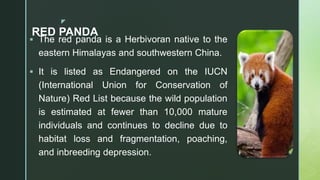
 The red panda is a Herbivoran native to the
eastern Himalayas and southwestern China.
 It is listed as Endangered on the IUCN
(International Union for Conservation of
Nature) Red List because the wild population
is estimated at fewer than 10,000 mature
individuals and continues to decline due to
habitat loss and fragmentation, poaching,
and inbreeding depression.
z
COMMON NAME: Red Panda
SCIENTIFIC NAME: Ailurus fulgens
TYPE: Mammals
DIET: Herbivore
AVERAGE LIFE SPAN IN THE WILD: 8 years
SIZE: Head and body: 20 to 26 inches; tail: 12
to 20 inches
WEIGHT: 12 to 20 pounds
SIZE RELATIVE TO A 6-FT MAN
SCIENTIFIC CLASSIFICATION
z
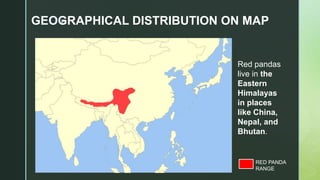
GEOGRAPHICAL DISTRIBUTION ON MAP
RED PANDA
RANGE
Red pandas
live in the
Eastern
Himalayas
in places
like China,
Nepal, and
Bhutan.
z
 It is listed as Endangered on the IUCN
Red List because the wild population is
estimated at fewer than 10,000 mature
individuals and continues to decline due to
habitat loss and fragmentation, poaching,
and inbreeding depression.
CONSERVATION STATUS
z
Habitat of
Red
panda
Red Pandas live in Eastern Himalaya in places
like Bhutan, Nepal and China.
Red pandas live mostly in Cool temperate forests
with a shrubby understory dominated by thick
bamboo.
It lives in rainy, high-altitude forest. They spend
most of their lives in trees and even Sleep aloft.
z
Ecology
of Red
panda
Red pandas live in high-altitude, temperate forests
with bamboo understories in the Himalayas and
other high mountains.
They range from northern Myanmar (Burma) to the
west Sichuan and Yunnan Provinces of China. They
are also found in suitable habitat in Nepal, India and
Tibet.
z
Diet of
Red
panda
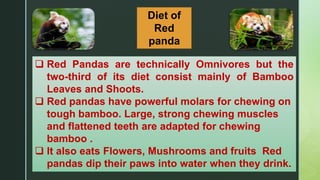
 Red Pandas are technically Omnivores but the
two-third of its diet consist mainly of Bamboo
Leaves and Shoots.
 Red pandas have powerful molars for chewing on
tough bamboo. Large, strong chewing muscles
and flattened teeth are adapted for chewing
bamboo .
 It also eats Flowers, Mushrooms and fruits Red
pandas dip their paws into water when they drink.
z
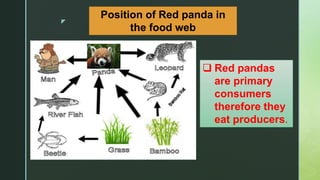
Position of Red panda in
the food web
 Red pandas
are primary
consumers
therefore they
eat producers.
z
Behavior of Red panda
 They are most active in the early morning and
late afternoon. (crepuscular)
 Spend most of the day resting in trees
(arboreal) conserving their energy.
 Red pandas are normally solitary creatures but
come together in pairs in the breeding season.
z Reproduction of Red panda
 Red pandas breed once a year in early winter.
 The females come into heat in January or
February, and it lasts one to three days.
 Adult red pandas rarely interact with each
other outside of the mating season.
z CAUSES OF RED PANDAS
ENDANGERMENT
Habitat Loss and Deforestation
Red pandas also face threats from hunting and
poaching.
Livestock Herding
Climate Change
Low Red Panda Awareness
z
MEASURES TO PROTECT OR SAVE RED
PANDA
• Increasing the area of Red Panda habitat under
legal protection.
• Creating green corridors to link isolated pandas.
• Patrolling against poaching, illegal logging, and
encroachment.
• Building local capacities for nature reserve
management.
• continuing research and monitoring.
z
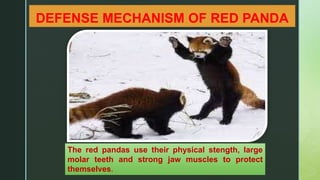
The red pandas use their physical stength, large
molar teeth and strong jaw muscles to protect
themselves.
DEFENSE MECHANISM OF RED PANDA
z
 They sounds like a big
bear is in the room and if
they are stressed or
cornered they may even
defend themselves with
their sharp claws or
realese of foul smell
from their scent glands
on the intruder or stand
on their hind legs.
z
They are unique—very unique : Saving them will
help preserve our world’s natural heritage.
Preserve the Ecological Integrity of South Asia .
More red pandas = more trees red panda
conservation also has a global impact: If we protect
red panda habitat, help to mitigate deforestation
RED PANDA CAN SAVE THE
ENVIRONMENT IF THEY ARE
CONSERVED:
z

red panda.pptx

  • 1.
  • 2.
    z Made by:- KrittinKumar Dhanna Mauli Dubey 8th H 6293
  • 3.
    z RED PANDA  Thered panda is a Herbivoran native to the eastern Himalayas and southwestern China.  It is listed as Endangered on the IUCN (International Union for Conservation of Nature) Red List because the wild population is estimated at fewer than 10,000 mature individuals and continues to decline due to habitat loss and fragmentation, poaching, and inbreeding depression.
  • 4.
    z COMMON NAME: RedPanda SCIENTIFIC NAME: Ailurus fulgens TYPE: Mammals DIET: Herbivore AVERAGE LIFE SPAN IN THE WILD: 8 years SIZE: Head and body: 20 to 26 inches; tail: 12 to 20 inches WEIGHT: 12 to 20 pounds SIZE RELATIVE TO A 6-FT MAN SCIENTIFIC CLASSIFICATION
  • 5.
    z GEOGRAPHICAL DISTRIBUTION ONMAP RED PANDA RANGE Red pandas live in the Eastern Himalayas in places like China, Nepal, and Bhutan.
  • 6.
    z  It islisted as Endangered on the IUCN Red List because the wild population is estimated at fewer than 10,000 mature individuals and continues to decline due to habitat loss and fragmentation, poaching, and inbreeding depression. CONSERVATION STATUS
  • 7.
    z Habitat of Red panda Red Pandaslive in Eastern Himalaya in places like Bhutan, Nepal and China. Red pandas live mostly in Cool temperate forests with a shrubby understory dominated by thick bamboo. It lives in rainy, high-altitude forest. They spend most of their lives in trees and even Sleep aloft.
  • 8.
    z Ecology of Red panda Red pandaslive in high-altitude, temperate forests with bamboo understories in the Himalayas and other high mountains. They range from northern Myanmar (Burma) to the west Sichuan and Yunnan Provinces of China. They are also found in suitable habitat in Nepal, India and Tibet.
  • 9.
    z Diet of Red panda  RedPandas are technically Omnivores but the two-third of its diet consist mainly of Bamboo Leaves and Shoots.  Red pandas have powerful molars for chewing on tough bamboo. Large, strong chewing muscles and flattened teeth are adapted for chewing bamboo .  It also eats Flowers, Mushrooms and fruits Red pandas dip their paws into water when they drink.
  • 10.
    z Position of Redpanda in the food web  Red pandas are primary consumers therefore they eat producers.
  • 11.
    z Behavior of Redpanda  They are most active in the early morning and late afternoon. (crepuscular)  Spend most of the day resting in trees (arboreal) conserving their energy.  Red pandas are normally solitary creatures but come together in pairs in the breeding season.
  • 12.
    z Reproduction ofRed panda  Red pandas breed once a year in early winter.  The females come into heat in January or February, and it lasts one to three days.  Adult red pandas rarely interact with each other outside of the mating season.
  • 13.
    z CAUSES OFRED PANDAS ENDANGERMENT Habitat Loss and Deforestation Red pandas also face threats from hunting and poaching. Livestock Herding Climate Change Low Red Panda Awareness
  • 14.
    z MEASURES TO PROTECTOR SAVE RED PANDA • Increasing the area of Red Panda habitat under legal protection. • Creating green corridors to link isolated pandas. • Patrolling against poaching, illegal logging, and encroachment. • Building local capacities for nature reserve management. • continuing research and monitoring.
  • 15.
    z The red pandasuse their physical stength, large molar teeth and strong jaw muscles to protect themselves. DEFENSE MECHANISM OF RED PANDA
  • 16.
    z  They soundslike a big bear is in the room and if they are stressed or cornered they may even defend themselves with their sharp claws or realese of foul smell from their scent glands on the intruder or stand on their hind legs.
  • 17.
    z They are unique—veryunique : Saving them will help preserve our world’s natural heritage. Preserve the Ecological Integrity of South Asia . More red pandas = more trees red panda conservation also has a global impact: If we protect red panda habitat, help to mitigate deforestation RED PANDA CAN SAVE THE ENVIRONMENT IF THEY ARE CONSERVED:
  • 18.