Global Handwashing Day 2010 An Initiative of the Public-Private Partnership for Handwashing with Soap (PPPHW)  Webinar: June 24,  2010 Better Together
I - BACKGROUND
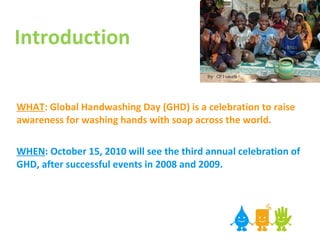
Introduction WHAT : Global Handwashing Day (GHD) is a celebration to raise awareness for washing hands with soap across the world .  WHEN : October 15, 2010 will see the third annual celebration of GHD, after successful events in 2008 and 2009.
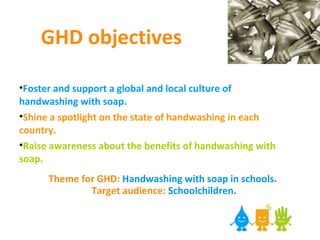
GHD objectives Foster and support a global and local culture of handwashing with soap.  Shine a spotlight on the state of handwashing in each  country. Raise awareness about the benefits of handwashing with soap.  Theme for GHD:  Handwashing with soap in schools.  Target audience:  Schoolchildren.
Objectives of this webinar Share information on Global Handwashing Day: background and achievements to date.  Inform on planned tools for GHD 2010. Strengthen links between GHD Steering Committee and participating organizations.
The case for targeting schoolchildren Only 2% of children use soap when washing hands. Mothers who see or attend WASH in schools activities are more likely to have soap for handwashing in the toilet area at home. Schools with active children’s health clubs have far better managed WASH facilities.  Only 1 out of 12 children reported using a school toilet over the week. Girls of schools without facilities were twice as likely to experience problems during menstruation.  School sanitation increased girls’ enrollment by one third, and improved academic performance for boys and girls by 25%.  * Based on a Study on Sustainability and Impact of WASH in Schools Programming in Kerala/India  and Kenya.
 
Better Together:  The Power of Partnership At a global level, GHD Public-Private partners work for  a higher purpose than organizational or corporate objectives. Private sector resources created award-winning  visual identity and much more. International organizations mobilized local staff and  convened partners.
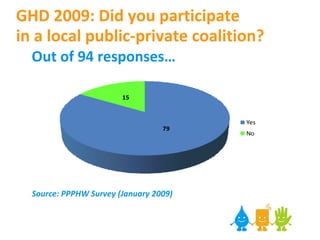
GHD 2009: Did you participate  in a local public-private coalition? Out of 94 responses… Source: PPPHW Survey (January 2009)
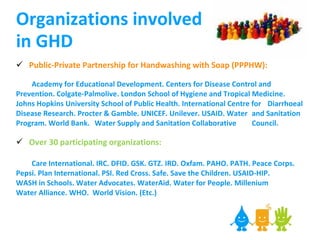
Organizations involved  in GHD  Public-Private Partnership for Handwashing with Soap (PPPHW): Academy for Educational Development. Centers for Disease Control and  Prevention. Colgate-Palmolive. London School of Hygiene and Tropical Medicine.  Johns Hopkins University School of Public Health. International Centre for  Diarrhoeal Disease Research. Procter & Gamble. UNICEF. Unilever. USAID. Water  and Sanitation Program. World Bank.  Water Supply and Sanitation Collaborative  Council.  Over 30 participating organizations:  Care International. IRC. DFID. GSK. GTZ. IRD. Oxfam. PAHO. PATH. Peace Corps.  Pepsi. Plan International. PSI. Red Cross. Safe. Save the Children. USAID-HIP.  WASH in Schools. Water Advocates. WaterAid. Water for People. Millenium  Water Alliance. WHO.  World Vision. (Etc.)
II - ACHIEVEMENTS
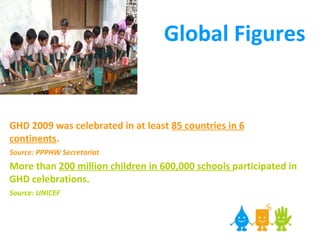
Global Figures GHD 2009 was celebrated in at least  85 countries in 6 continents .   Source: PPPHW Secretariat   More than  200 million children in 600,000 schools  participated in GHD celebrations.  Source: UNICEF
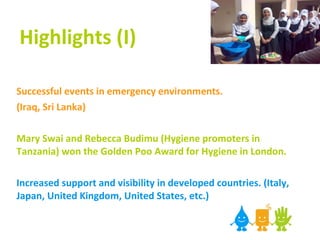
Highlights (I) Successful events in emergency environments.  (Iraq, Sri Lanka) Mary Swai and Rebecca Budimu (Hygiene promoters in Tanzania) won the Golden Poo Award for Hygiene in London. Increased support and visibility in developed countries. (Italy, Japan, United Kingdom, United States, etc.)
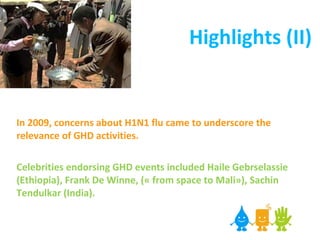
Highlights (II) In 2009, concerns about H1N1 flu came to underscore the relevance of GHD activities.   Celebrities endorsing GHD events included Haile Gebrselassie (Ethiopia), Frank De Winne, (« from space to Mali»), Sachin Tendulkar (India).
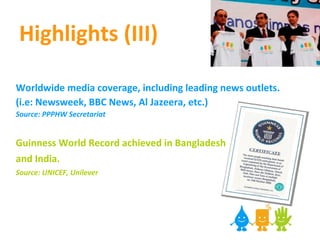
Highlights (III) Worldwide media coverage, including leading news outlets.  (i.e: Newsweek, BBC News, Al Jazeera, etc.)  Source: PPPHW Secretariat Guinness World Record achieved in Bangladesh and India.   Source: UNICEF, Unilever
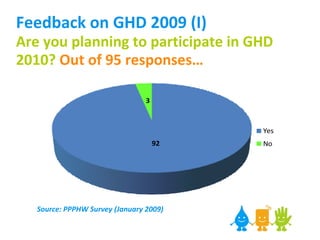
Feedback on GHD 2009 (I) Are you planning to participate in GHD 2010?  Out of 95 responses… Source: PPPHW Survey (January 2009)
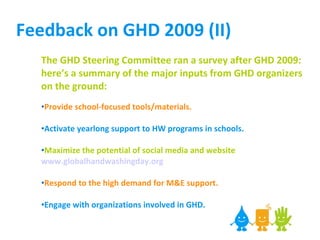
Feedback on GHD 2009 (II) The GHD Steering Committee ran a survey after GHD 2009: here’s a summary of the major inputs from GHD organizers on the ground: Provide school-focused tools/materials. Activate yearlong support to HW programs in schools.  Maximize the potential of social media and website  www.globalhandwashingday.org   Respond to the high demand for M&E support.  Engage with organizations involved in GHD.
III - PLANS FOR 2010 INTEGRATING NEW TOOLS
Integrating New Tools Based on the feedback received in the GHD survey 2009, the following  tools/products are being elaborated for GHD 2010, and beyond: Monitoring & Evaluation Toolkit. Advocacy – « More than just a day » approach. Schools toolkit.   Digital strategy and translation of Planner’s Guide. Webinar with organizations.
1 – Monitoring & Evaluation Produce a guide to evaluating GHD events, communications and advocacy efforts.  This guide will also attempt to link GHD advocacy and event monitoring within the broader national HWWS/hygiene programming context.  A roughly 10 page document in the style of the Planner’s Guide, with each section (six in total) as a tear-away, stand-alone piece. Key elements: Understanding the difference between advocacy, education and behavior change . Child-led approaches. Monitoring GHD events, advocacy, and communications materials. Strength of partnership. Step by step.
2 – Advocacy: « More than a day »  Building on the momentum created by GHD, advocate for turning a one-day event into year-long, handwashing friendly schools. This approach includes: Create a “100 SCHOOLS SURVEY” advocacy tool and guidelines to carry put the surveys. Elaborate a package of activities and events for GHD actors to help make GHD “more than just one day”. A call for partnership for private sector actors to support the ‘more than just one day’ movement. 
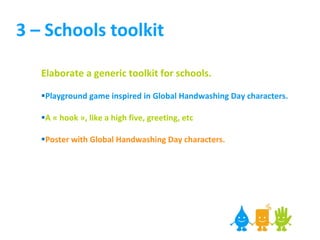
3 – Schools toolkit Elaborate a generic toolkit for schools. Playground game inspired in Global Handwashing Day characters. A « hook », like a high five, greeting, etc Poster with Global Handwashing Day characters.
4 – Communications strategy    and translations Objective:  Increase number of people with materials and tools to implement GHD in their countries, schools & communities. Tools: GHD-related information on www.globalhandwashingday.org  Translation of  Planner’s Guide into Chinese and Arabic. (Already available in English, French, and Spanish on  www.globalhandwashingday.org ) Boost digital communications (Social media, new tools on website, quizzes during weeks prior to GHD to create buzz.)
5 – Reaching out to Organizations  Share plans and tools with organizations involved in GHD. (Website, Planner’s Guides, New tools) Webinar with collaborating organizations  Inform about GHD 2010 to Water, Sanitation,  Hygiene organizations involved in GHD. World Water Week Make GHD tools available to delegates from the water, hygiene  and sanitation sectors. (September 2010, Stockholm)
QUESTIONS & FEEDBACK
THANKS! www.globalhandwashingday.org

Global Handwashing Day 2010 Webinar

  • 1.
    Global Handwashing Day2010 An Initiative of the Public-Private Partnership for Handwashing with Soap (PPPHW) Webinar: June 24, 2010 Better Together
  • 2.
  • 3.
    Introduction WHAT :Global Handwashing Day (GHD) is a celebration to raise awareness for washing hands with soap across the world . WHEN : October 15, 2010 will see the third annual celebration of GHD, after successful events in 2008 and 2009.
  • 4.
    GHD objectives Fosterand support a global and local culture of handwashing with soap. Shine a spotlight on the state of handwashing in each country. Raise awareness about the benefits of handwashing with soap. Theme for GHD: Handwashing with soap in schools. Target audience: Schoolchildren.
  • 5.
    Objectives of thiswebinar Share information on Global Handwashing Day: background and achievements to date. Inform on planned tools for GHD 2010. Strengthen links between GHD Steering Committee and participating organizations.
  • 6.
    The case fortargeting schoolchildren Only 2% of children use soap when washing hands. Mothers who see or attend WASH in schools activities are more likely to have soap for handwashing in the toilet area at home. Schools with active children’s health clubs have far better managed WASH facilities. Only 1 out of 12 children reported using a school toilet over the week. Girls of schools without facilities were twice as likely to experience problems during menstruation. School sanitation increased girls’ enrollment by one third, and improved academic performance for boys and girls by 25%. * Based on a Study on Sustainability and Impact of WASH in Schools Programming in Kerala/India and Kenya.
  • 7.
  • 8.
    Better Together: The Power of Partnership At a global level, GHD Public-Private partners work for a higher purpose than organizational or corporate objectives. Private sector resources created award-winning visual identity and much more. International organizations mobilized local staff and convened partners.
  • 9.
    GHD 2009: Didyou participate in a local public-private coalition? Out of 94 responses… Source: PPPHW Survey (January 2009)
  • 10.
    Organizations involved in GHD Public-Private Partnership for Handwashing with Soap (PPPHW): Academy for Educational Development. Centers for Disease Control and Prevention. Colgate-Palmolive. London School of Hygiene and Tropical Medicine. Johns Hopkins University School of Public Health. International Centre for Diarrhoeal Disease Research. Procter & Gamble. UNICEF. Unilever. USAID. Water and Sanitation Program. World Bank. Water Supply and Sanitation Collaborative Council. Over 30 participating organizations: Care International. IRC. DFID. GSK. GTZ. IRD. Oxfam. PAHO. PATH. Peace Corps. Pepsi. Plan International. PSI. Red Cross. Safe. Save the Children. USAID-HIP. WASH in Schools. Water Advocates. WaterAid. Water for People. Millenium Water Alliance. WHO. World Vision. (Etc.)
  • 11.
  • 12.
    Global Figures GHD2009 was celebrated in at least 85 countries in 6 continents . Source: PPPHW Secretariat More than 200 million children in 600,000 schools participated in GHD celebrations. Source: UNICEF
  • 13.
    Highlights (I) Successfulevents in emergency environments. (Iraq, Sri Lanka) Mary Swai and Rebecca Budimu (Hygiene promoters in Tanzania) won the Golden Poo Award for Hygiene in London. Increased support and visibility in developed countries. (Italy, Japan, United Kingdom, United States, etc.)
  • 14.
    Highlights (II) In2009, concerns about H1N1 flu came to underscore the relevance of GHD activities. Celebrities endorsing GHD events included Haile Gebrselassie (Ethiopia), Frank De Winne, (« from space to Mali»), Sachin Tendulkar (India).
  • 15.
    Highlights (III) Worldwidemedia coverage, including leading news outlets. (i.e: Newsweek, BBC News, Al Jazeera, etc.) Source: PPPHW Secretariat Guinness World Record achieved in Bangladesh and India. Source: UNICEF, Unilever
  • 16.
    Feedback on GHD2009 (I) Are you planning to participate in GHD 2010? Out of 95 responses… Source: PPPHW Survey (January 2009)
  • 17.
    Feedback on GHD2009 (II) The GHD Steering Committee ran a survey after GHD 2009: here’s a summary of the major inputs from GHD organizers on the ground: Provide school-focused tools/materials. Activate yearlong support to HW programs in schools. Maximize the potential of social media and website www.globalhandwashingday.org Respond to the high demand for M&E support. Engage with organizations involved in GHD.
  • 18.
    III - PLANSFOR 2010 INTEGRATING NEW TOOLS
  • 19.
    Integrating New ToolsBased on the feedback received in the GHD survey 2009, the following tools/products are being elaborated for GHD 2010, and beyond: Monitoring & Evaluation Toolkit. Advocacy – « More than just a day » approach. Schools toolkit. Digital strategy and translation of Planner’s Guide. Webinar with organizations.
  • 20.
    1 – Monitoring& Evaluation Produce a guide to evaluating GHD events, communications and advocacy efforts. This guide will also attempt to link GHD advocacy and event monitoring within the broader national HWWS/hygiene programming context. A roughly 10 page document in the style of the Planner’s Guide, with each section (six in total) as a tear-away, stand-alone piece. Key elements: Understanding the difference between advocacy, education and behavior change . Child-led approaches. Monitoring GHD events, advocacy, and communications materials. Strength of partnership. Step by step.
  • 21.
    2 – Advocacy:« More than a day »  Building on the momentum created by GHD, advocate for turning a one-day event into year-long, handwashing friendly schools. This approach includes: Create a “100 SCHOOLS SURVEY” advocacy tool and guidelines to carry put the surveys. Elaborate a package of activities and events for GHD actors to help make GHD “more than just one day”. A call for partnership for private sector actors to support the ‘more than just one day’ movement. 
  • 22.
    3 – Schoolstoolkit Elaborate a generic toolkit for schools. Playground game inspired in Global Handwashing Day characters. A « hook », like a high five, greeting, etc Poster with Global Handwashing Day characters.
  • 23.
    4 – Communicationsstrategy and translations Objective: Increase number of people with materials and tools to implement GHD in their countries, schools & communities. Tools: GHD-related information on www.globalhandwashingday.org Translation of Planner’s Guide into Chinese and Arabic. (Already available in English, French, and Spanish on www.globalhandwashingday.org ) Boost digital communications (Social media, new tools on website, quizzes during weeks prior to GHD to create buzz.)
  • 24.
    5 – Reachingout to Organizations  Share plans and tools with organizations involved in GHD. (Website, Planner’s Guides, New tools) Webinar with collaborating organizations Inform about GHD 2010 to Water, Sanitation, Hygiene organizations involved in GHD. World Water Week Make GHD tools available to delegates from the water, hygiene and sanitation sectors. (September 2010, Stockholm)
  • 25.
  • 26.