
Welcome
Getting Organized…The GO System Seminar
 Learning to Get Organized, Focused and Highly Productive


                       Presented by:
           Anne McGurty of Strategize & Organize
Workshop Purpose:
   Present ideas to help you get organized
   Present ideas to help you stay organized
   Present ideas to help you get focused
   Present ideas to help you stay focused
   Present ideas to help you get more productive
   Present ideas to help you stay more productive
Learn to focus…Right Now
Checklist for Resource Material
        Relax, Focus and Listen
“Handle Every Piece of Paper Once”
     Bad Advice...In Most Cases.
        Other myths or mantras you’ve
         learned
Warning!!

Workaholics and Over-schedulers
Three Possible Outcomes:

   Nothing

   “Human reset button”

   Change your life
Best Reasons to Get Organized:
   It feels great!
   Like the day before vacation
   Motivation
       Seeking positive feelings
       Avoiding negative feelings
The Productive Environment™
     Design Your Vision*
     Eliminate Your Obstacles/Excuses*
     Select Your Tools
     Commit Your Time and $$
     Maintain Your Success
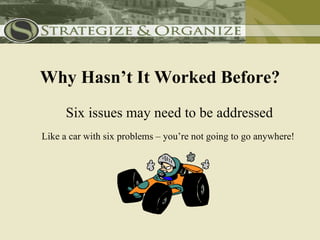
Why Hasn’t It Worked Before?
      Six issues may need to be addressed
Like a car with six problems – you’re not going to go anywhere!
Other Significant Barriers to Success
       Gadget solutions
          Some planners
          Some PDAs
          Some software programs
Time Management Ideas
DiSC Time Mastery Profile™
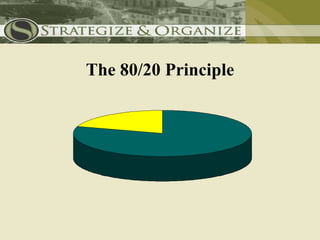
The 80/20 Principle
Conducting Effective Meetings
Speed-Reading
Keyboarding Skills
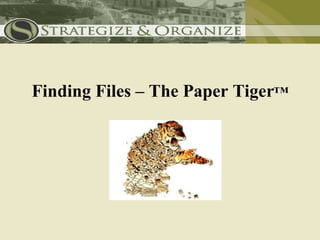
Finding Files – The Paper Tiger™
Computer Skills

 Maximize your Efficiency
 Document Control
 Intranet
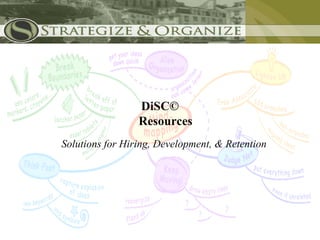
DiSC©
                 Resources
Solutions for Hiring, Development, & Retention
Project Management Ideas
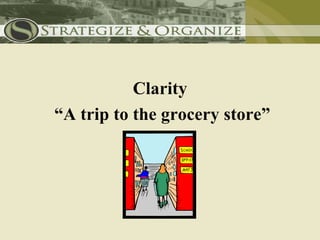
Clarity
“A trip to the grocery store”
Once Again…The 80/20 Principle
   Eliminate, Eliminate, Eliminate!!!

 Contrast John Gagliardi with the “Busy Managers”
“Jethro Bodine” Project Planning
Personality Issues
Personality Issues
 Mismatches (100/300 pound candidates)
 Spontaneous person/methodical job
 Extrovert person/introvert assignment
 Accommodating person/dominant assignment (Ike and
  Patton)
 Concrete thinker/abstract assignment
 Work teams – proper mix (especially your assistant if you
  have one)
General Eric Von Manstein’s Matrix
  Lazy/stupid – leave them alone, no harm
  Hard working/intelligent – excellent staff
   officers
  Hard working/stupid – fire them at once!
  Lazy/intelligent – these are suited for the
   highest office
                Be economical with your energy!
Psychological Issues
Psychological Issues:
 Call 911! Story
 Chronic disorganization, adult-add and other
  dysfunctions
    May need paper “in sight”
    May need noise
    May need another person to help
    May think quite differently about filing
      (emotional filing)
Psychological Issues:
 Potential self-defeating behavior
     Multitasking
     Perfectionism
     Workaholic behavior
     Procrastination
Psychological Issues:
 Duration and intensity – negative impact
  on your life
 As anxiety increases, typical response is
  action – action drives out thought
 What really matters often falls by the
  wayside in this situation
Handling Incoming Items

    Simplicity Warning!

      Zero Gravity Pen
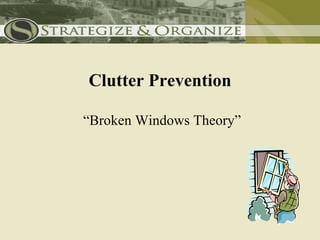
Clutter Prevention

“Broken Windows Theory”
Controlling Incoming Items
 Paper
 E-mails
 Voice mails
 Verbal requests
 Your thoughts (things you want to do)
Sequence of Getting Organized

    Gathering
    Filtering
    Prioritizing
    Doing
The Five Decisions
 Discard or recycle
 Delegate
 Take immediate action
 File for follow-up (must keep because you
  need to take further action)
 Put in a reference file (want to keep, but no
  further action is required)
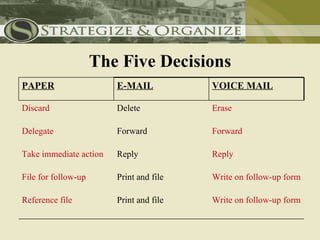
The Five Decisions
PAPER                   E-MAIL           VOICE MAIL

Discard                 Delete           Erase

Delegate                Forward          Forward

Take immediate action   Reply            Reply

File for follow-up      Print and file   Write on follow-up form

Reference file          Print and file   Write on follow-up form
The Five Decisions –
          Pace Is Important!
 Pick up the item
 Ask – “which one of the five”?
 If it is a follow-up item:
     What am I going to do next on this item?
     When am I going to do it?
     Drop it in the appropriate follow-up file
Where Do I Put This Stuff?

 Causes of clutter:
     Not putting things away
     Not having a pre-designated storage
      place for things
     A cyclical issue
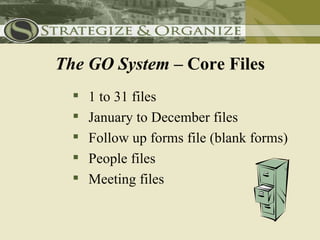
The GO System – Core Files
     1 to 31 files
     January to December files
     Follow up forms file (blank forms)
     People files
     Meeting files
The GO System – Core Files
   Reading file (casual reading)
   Project files
   Waiting for response file
   Purchases and errands file
   Someday/maybe file
   Other files based on your unique situation
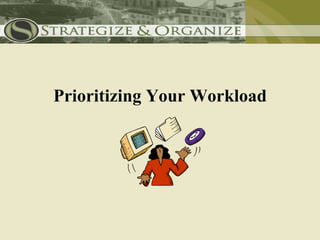
Prioritizing Your Workload
 Use the “flip-over” method (less than 60 seconds)
 Can get it all done
 Can’t get it all done
 Handling interruptions
 Resetting your system (“human reset button”)
 Can’t come to work
 Prioritize any time you feel yourself losing control
Kit Contents
 24 page step-by-step workbook
 24 page tip workbook
 Poster – “the five decisions” reminder
 Card – “the five incoming items” and “the five
  decisions” reminder
 Sample pad of follow-up forms
 A set of core labels for your files
 A CD with a variety of implementation resources
Implementation Tips
 Serious throw-away session with someone
  else present
 Getting over the “homeostasis hump”
 Using capture cards
 Setting appointments with yourself
 Keep a serious abundance of file folders
  and labels handy
Implementation Tips

 Work on unavoidable irritants
 Use in/out baskets (even if you have no
  assistant)
 Other “flipping” applications
 Get a copy of the book getting organized
  by Chris crouch
JLS Story
“The job of a problem is to get your attention”
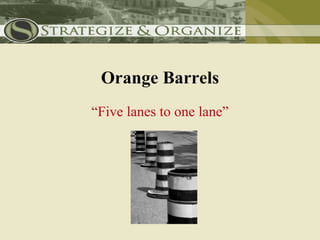
Orange Barrels
“Five lanes to one lane”
Influencing Others
   Edgar Guest Poem
“The Sermon” by Edgar Guest
      I’d rather see a sermon, than hear one any day.
I’d rather you walk with me, than merely show the way.
 For the lessons you deliver, may be very wise and true,
But I think I’ll get my lessons, by observing what you do,
  I might misunderstand, all this high advice you give,
But I won’t misunderstand how you act and how you live.
Second Half of Day
 The DiSC Profiles
What we will cover today:
 What is DiSC classic?
 Basic Insights
 New Features in DiSC
 Marston’s DiSC Model
 DiSC Classic EPIC Record
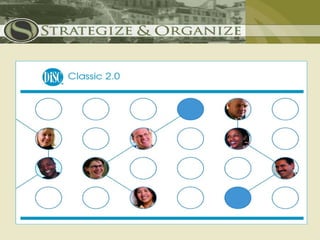
DiSC Classic 2.0
DiSC® Classic is used to improve performance,
deal more effectively with conflict, and value
differences. Using the research-based DiSC model,
DiSC Classic helps you better understand why
you act the way you do.
DiSC Four Dimensions
The four dimensions of D, i, S, and C are
combined to provide a Classical Profile
Pattern that describes a wide range of
interpersonal behaviors and preferences.
Basic Insights:
 Personal Insight into Behavioral Preferences
  and Inclinations
 Appreciation of Personal Diversity
 A Common Language to Understand
  and Discuss Personality
 Dialogue About Personality Preferences and
  Differences
 Relating to Individuals with Different Personalities
What is new in DiSC ®
          Classic 2.0?
 Enhanced narrative representation
    Broader interpretation
    Personalization
    Story about YOU
    Strong personal connection
Organized and presented in a more meaningful way
 Ease of interpretation
    Elaboration on highest DiSC Dimension through
      personalization
    Richer descriptions
    Affirming language inspires action
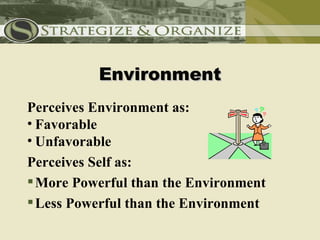
Environment
Perceives Environment as:
• Favorable
• Unfavorable
Perceives Self as:
 More Powerful than the Environment
 Less Powerful than the Environment
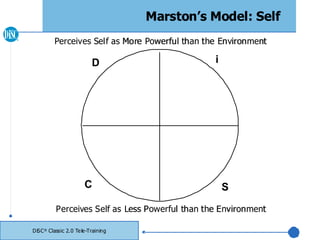
Marston’s Model: Self
         Perceives Self as More Powerful than the Environment

                         D                       i


                      C                              S
          Perceives Self as Less Powerful than the Environment

DiSC® Classic 2.0 Te le-Training
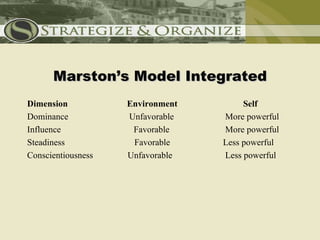
Marston’s Model Integrated
Dimension           Environment        Self
Dominance           Unfavorable   More powerful
Influence            Favorable    More powerful
Steadiness           Favorable    Less powerful
Conscientiousness   Unfavorable   Less powerful
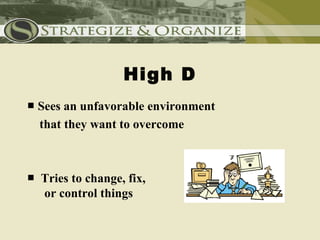
High D
■ Sees an unfavorable environment
  that they want to overcome


■ Tries to change, fix,
  or control things
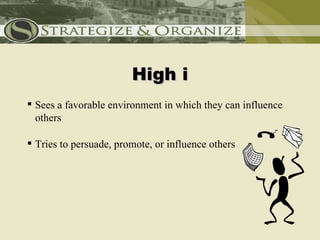
High i
 Sees a favorable environment in which they can influence
  others

 Tries to persuade, promote, or influence others
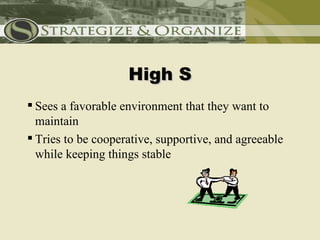
High S
 Sees a favorable environment that they want to
  maintain
 Tries to be cooperative, supportive, and agreeable
  while keeping things stable
High C
 Sees an unfavorable environment that they do not
  want to try to change

 Tries to work within established rules, guidelines,
  and procedures to ensure accuracy and quality
Response Form
28 boxes of 4 adjectives       Forced choice

The DiSC® Classic Individual Report
 has four sections.
 Section l is devoted entirely to you and your unique
  behavior style
 Section ll covers the DiSC model and the DiSC Dimensions
 Section lll overviews the Classical Patterns
 Section lV contains the scoring and data analysis for your
  report
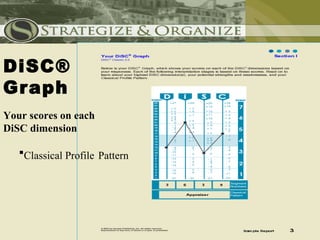
DiSC®
Graph
Your scores on each
DiSC dimension

   Classical Profile Pattern
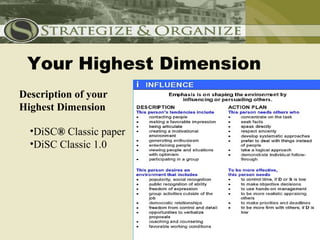
Your Highest Dimension
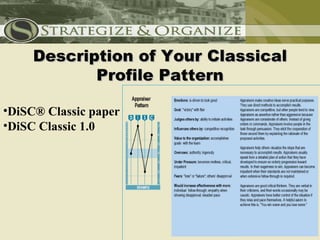
Description of your
Highest Dimension

  •DiSC® Classic paper
  •DiSC Classic 1.0
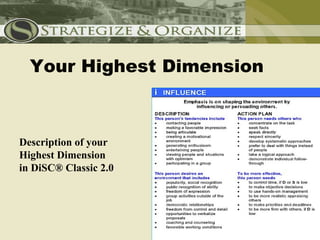
Your Highest Dimension


Description of your
Highest Dimension
in DiSC® Classic 2.0
Individual Report:

   Intensity Index
  Adjectives that describe a person on each of the four
  dimensions
 DiSC® Classic paper
 DiSC Classic 1.0
 DiSC Classic 2.0
Intensity Index


D Dimension
i Dimension
S Dimension
C Dimension
Description of Your Classical
            Profile Pattern

•DiSC® Classic paper
•DiSC Classic 1.0
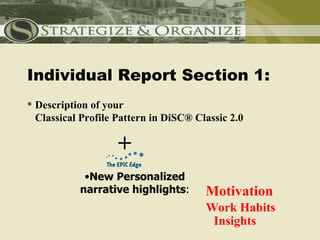
Individual Report Section 1:
 Description of your
  Classical Profile Pattern in DiSC® Classic 2.0

                    +
            •New Personalized
           narrative highlights:       Motivation
                                       Work Habits
                                        Insights
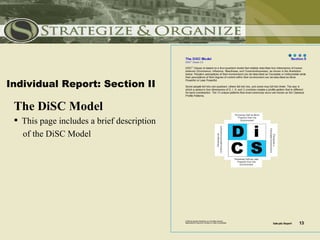
Individual Report: Section II

 The DiSC Model
  This page includes a brief description
   of the DiSC Model
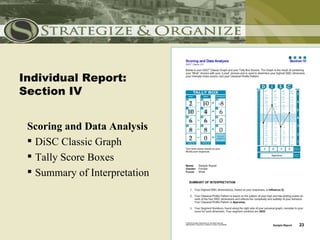
Individual Report:
Section IV


 Scoring and Data Analysis
  DiSC Classic Graph
  Tally Score Boxes
  Summary of Interpretation
Contact Anne McGurty
 www.StrategizeAndOrganize.com
Now to Schedule a Custom Training
          or Consulting

Getting Organizing and Understanding Your Personal DiSC Style

  • 1.
    Welcome Getting Organized…The GOSystem Seminar Learning to Get Organized, Focused and Highly Productive Presented by: Anne McGurty of Strategize & Organize
  • 2.
    Workshop Purpose:  Present ideas to help you get organized  Present ideas to help you stay organized  Present ideas to help you get focused  Present ideas to help you stay focused  Present ideas to help you get more productive  Present ideas to help you stay more productive
  • 3.
  • 4.
    Checklist for ResourceMaterial Relax, Focus and Listen
  • 5.
    “Handle Every Pieceof Paper Once”  Bad Advice...In Most Cases.  Other myths or mantras you’ve learned
  • 6.
  • 7.
    Three Possible Outcomes:  Nothing  “Human reset button”  Change your life
  • 8.
    Best Reasons toGet Organized:  It feels great!  Like the day before vacation  Motivation  Seeking positive feelings  Avoiding negative feelings
  • 9.
    The Productive Environment™  Design Your Vision*  Eliminate Your Obstacles/Excuses*  Select Your Tools  Commit Your Time and $$  Maintain Your Success
  • 10.
    Why Hasn’t ItWorked Before? Six issues may need to be addressed Like a car with six problems – you’re not going to go anywhere!
  • 11.
    Other Significant Barriersto Success  Gadget solutions  Some planners  Some PDAs  Some software programs
  • 12.
    Time Management Ideas DiSCTime Mastery Profile™
  • 13.
  • 14.
  • 15.
  • 16.
  • 17.
    Finding Files –The Paper Tiger™
  • 18.
    Computer Skills  Maximizeyour Efficiency  Document Control  Intranet
  • 19.
    DiSC© Resources Solutions for Hiring, Development, & Retention
  • 20.
  • 21.
    Clarity “A trip tothe grocery store”
  • 22.
    Once Again…The 80/20Principle Eliminate, Eliminate, Eliminate!!! Contrast John Gagliardi with the “Busy Managers”
  • 23.
  • 24.
  • 25.
    Personality Issues  Mismatches(100/300 pound candidates)  Spontaneous person/methodical job  Extrovert person/introvert assignment  Accommodating person/dominant assignment (Ike and Patton)  Concrete thinker/abstract assignment  Work teams – proper mix (especially your assistant if you have one)
  • 26.
    General Eric VonManstein’s Matrix  Lazy/stupid – leave them alone, no harm  Hard working/intelligent – excellent staff officers  Hard working/stupid – fire them at once!  Lazy/intelligent – these are suited for the highest office Be economical with your energy!
  • 27.
  • 28.
    Psychological Issues:  Call911! Story  Chronic disorganization, adult-add and other dysfunctions  May need paper “in sight”  May need noise  May need another person to help  May think quite differently about filing (emotional filing)
  • 29.
    Psychological Issues:  Potentialself-defeating behavior  Multitasking  Perfectionism  Workaholic behavior  Procrastination
  • 30.
    Psychological Issues:  Durationand intensity – negative impact on your life  As anxiety increases, typical response is action – action drives out thought  What really matters often falls by the wayside in this situation
  • 31.
    Handling Incoming Items Simplicity Warning! Zero Gravity Pen
  • 32.
  • 33.
    Controlling Incoming Items Paper  E-mails  Voice mails  Verbal requests  Your thoughts (things you want to do)
  • 34.
    Sequence of GettingOrganized  Gathering  Filtering  Prioritizing  Doing
  • 35.
    The Five Decisions Discard or recycle  Delegate  Take immediate action  File for follow-up (must keep because you need to take further action)  Put in a reference file (want to keep, but no further action is required)
  • 36.
    The Five Decisions PAPER E-MAIL VOICE MAIL Discard Delete Erase Delegate Forward Forward Take immediate action Reply Reply File for follow-up Print and file Write on follow-up form Reference file Print and file Write on follow-up form
  • 37.
    The Five Decisions– Pace Is Important!  Pick up the item  Ask – “which one of the five”?  If it is a follow-up item:  What am I going to do next on this item?  When am I going to do it?  Drop it in the appropriate follow-up file
  • 38.
    Where Do IPut This Stuff?  Causes of clutter:  Not putting things away  Not having a pre-designated storage place for things  A cyclical issue
  • 39.
    The GO System– Core Files  1 to 31 files  January to December files  Follow up forms file (blank forms)  People files  Meeting files
  • 40.
    The GO System– Core Files  Reading file (casual reading)  Project files  Waiting for response file  Purchases and errands file  Someday/maybe file  Other files based on your unique situation
  • 41.
  • 42.
    Prioritizing Your Workload Use the “flip-over” method (less than 60 seconds)  Can get it all done  Can’t get it all done  Handling interruptions  Resetting your system (“human reset button”)  Can’t come to work  Prioritize any time you feel yourself losing control
  • 43.
    Kit Contents  24page step-by-step workbook  24 page tip workbook  Poster – “the five decisions” reminder  Card – “the five incoming items” and “the five decisions” reminder  Sample pad of follow-up forms  A set of core labels for your files  A CD with a variety of implementation resources
  • 44.
    Implementation Tips  Seriousthrow-away session with someone else present  Getting over the “homeostasis hump”  Using capture cards  Setting appointments with yourself  Keep a serious abundance of file folders and labels handy
  • 45.
    Implementation Tips  Workon unavoidable irritants  Use in/out baskets (even if you have no assistant)  Other “flipping” applications  Get a copy of the book getting organized by Chris crouch
  • 46.
    JLS Story “The jobof a problem is to get your attention”
  • 47.
  • 48.
    Influencing Others Edgar Guest Poem
  • 49.
    “The Sermon” byEdgar Guest I’d rather see a sermon, than hear one any day. I’d rather you walk with me, than merely show the way. For the lessons you deliver, may be very wise and true, But I think I’ll get my lessons, by observing what you do, I might misunderstand, all this high advice you give, But I won’t misunderstand how you act and how you live.
  • 50.
    Second Half ofDay  The DiSC Profiles
  • 52.
    What we willcover today:  What is DiSC classic?  Basic Insights  New Features in DiSC  Marston’s DiSC Model  DiSC Classic EPIC Record
  • 53.
    DiSC Classic 2.0 DiSC®Classic is used to improve performance, deal more effectively with conflict, and value differences. Using the research-based DiSC model, DiSC Classic helps you better understand why you act the way you do.
  • 54.
    DiSC Four Dimensions Thefour dimensions of D, i, S, and C are combined to provide a Classical Profile Pattern that describes a wide range of interpersonal behaviors and preferences.
  • 55.
    Basic Insights:  PersonalInsight into Behavioral Preferences and Inclinations  Appreciation of Personal Diversity  A Common Language to Understand and Discuss Personality  Dialogue About Personality Preferences and Differences  Relating to Individuals with Different Personalities
  • 56.
    What is newin DiSC ® Classic 2.0?  Enhanced narrative representation  Broader interpretation  Personalization  Story about YOU  Strong personal connection Organized and presented in a more meaningful way  Ease of interpretation  Elaboration on highest DiSC Dimension through personalization  Richer descriptions  Affirming language inspires action
  • 57.
    Environment Perceives Environment as: •Favorable • Unfavorable Perceives Self as:  More Powerful than the Environment  Less Powerful than the Environment
  • 58.
    Marston’s Model: Self Perceives Self as More Powerful than the Environment D i C S Perceives Self as Less Powerful than the Environment DiSC® Classic 2.0 Te le-Training
  • 59.
    Marston’s Model Integrated Dimension Environment Self Dominance Unfavorable More powerful Influence Favorable More powerful Steadiness Favorable Less powerful Conscientiousness Unfavorable Less powerful
  • 60.
    High D ■ Seesan unfavorable environment that they want to overcome ■ Tries to change, fix, or control things
  • 61.
    High i  Seesa favorable environment in which they can influence others  Tries to persuade, promote, or influence others
  • 62.
    High S  Seesa favorable environment that they want to maintain  Tries to be cooperative, supportive, and agreeable while keeping things stable
  • 63.
    High C  Seesan unfavorable environment that they do not want to try to change  Tries to work within established rules, guidelines, and procedures to ensure accuracy and quality
  • 64.
    Response Form 28 boxesof 4 adjectives  Forced choice The DiSC® Classic Individual Report has four sections.  Section l is devoted entirely to you and your unique behavior style  Section ll covers the DiSC model and the DiSC Dimensions  Section lll overviews the Classical Patterns  Section lV contains the scoring and data analysis for your report
  • 65.
    DiSC® Graph Your scores oneach DiSC dimension Classical Profile Pattern
  • 66.
    Your Highest Dimension Descriptionof your Highest Dimension •DiSC® Classic paper •DiSC Classic 1.0
  • 67.
    Your Highest Dimension Descriptionof your Highest Dimension in DiSC® Classic 2.0
  • 68.
    Individual Report: Intensity Index Adjectives that describe a person on each of the four dimensions  DiSC® Classic paper  DiSC Classic 1.0  DiSC Classic 2.0
  • 69.
    Intensity Index D Dimension iDimension S Dimension C Dimension
  • 70.
    Description of YourClassical Profile Pattern •DiSC® Classic paper •DiSC Classic 1.0
  • 71.
    Individual Report Section1:  Description of your Classical Profile Pattern in DiSC® Classic 2.0 + •New Personalized narrative highlights: Motivation Work Habits Insights
  • 72.
    Individual Report: SectionII The DiSC Model  This page includes a brief description of the DiSC Model
  • 73.
    Individual Report: Section IV Scoring and Data Analysis  DiSC Classic Graph  Tally Score Boxes  Summary of Interpretation
  • 74.
    Contact Anne McGurty www.StrategizeAndOrganize.com Now to Schedule a Custom Training or Consulting

Editor's Notes

  • #10 Check on your scorecard every quarter to see your success. If it’s not working, there is something wrong with one of the previous 4 steps
  • #33 The bad neighborhood