Time Management

      RLDC 1
   Barry Cordero
  SHPE National VP
Agenda
  Gaining control of your day
  Handling competing priorities
  Getting organized
  Managing yourself and others
  Don’t let stress control you
10 Golden Rules of Time Management
   Identify how you spend your time
   Identify your “prime time”
   Do tomorrow’s planning tonight
   Ask yourself “why am I doing this right
   now?”
   Handle each item once
10 Golden Rules of Time Management
   Plan your work but work your plan
   Delegate whenever possible
   Delegate wisely
   Identify high payoff items, spend the
   most time on those
   Concentrate on results, not on keeping
   busy
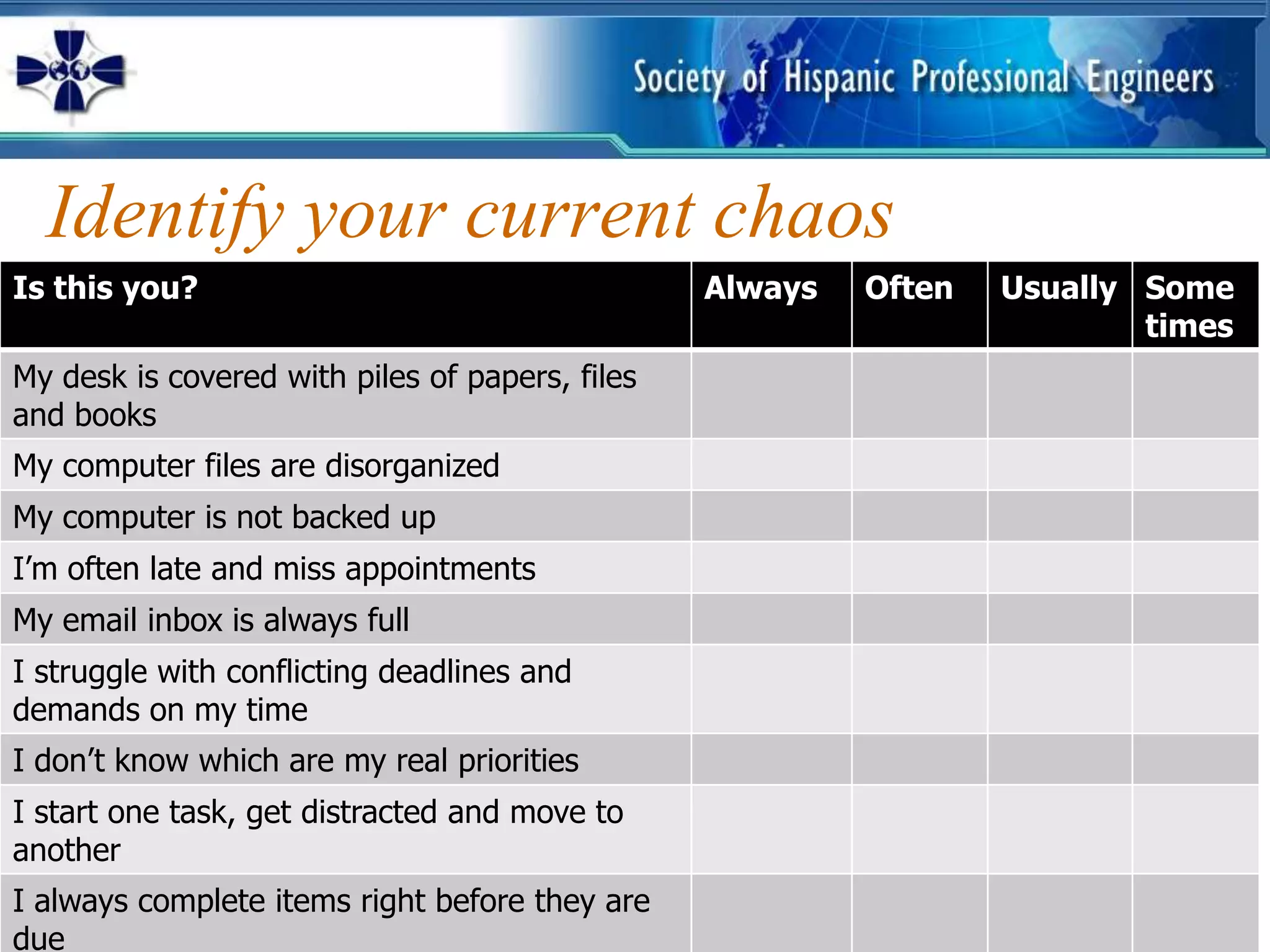
Identify your current chaos
Is this you?                                     Always   Often   Usually Some
                                                                          times
My desk is covered with piles of papers, files
and books
My computer files are disorganized
My computer is not backed up
I’m often late and miss appointments
My email inbox is always full
I struggle with conflicting deadlines and
demands on my time
I don’t know which are my real priorities
I start one task, get distracted and move to
another
I always complete items right before they are
due
TAKING CONTROL OF YOUR
DAY
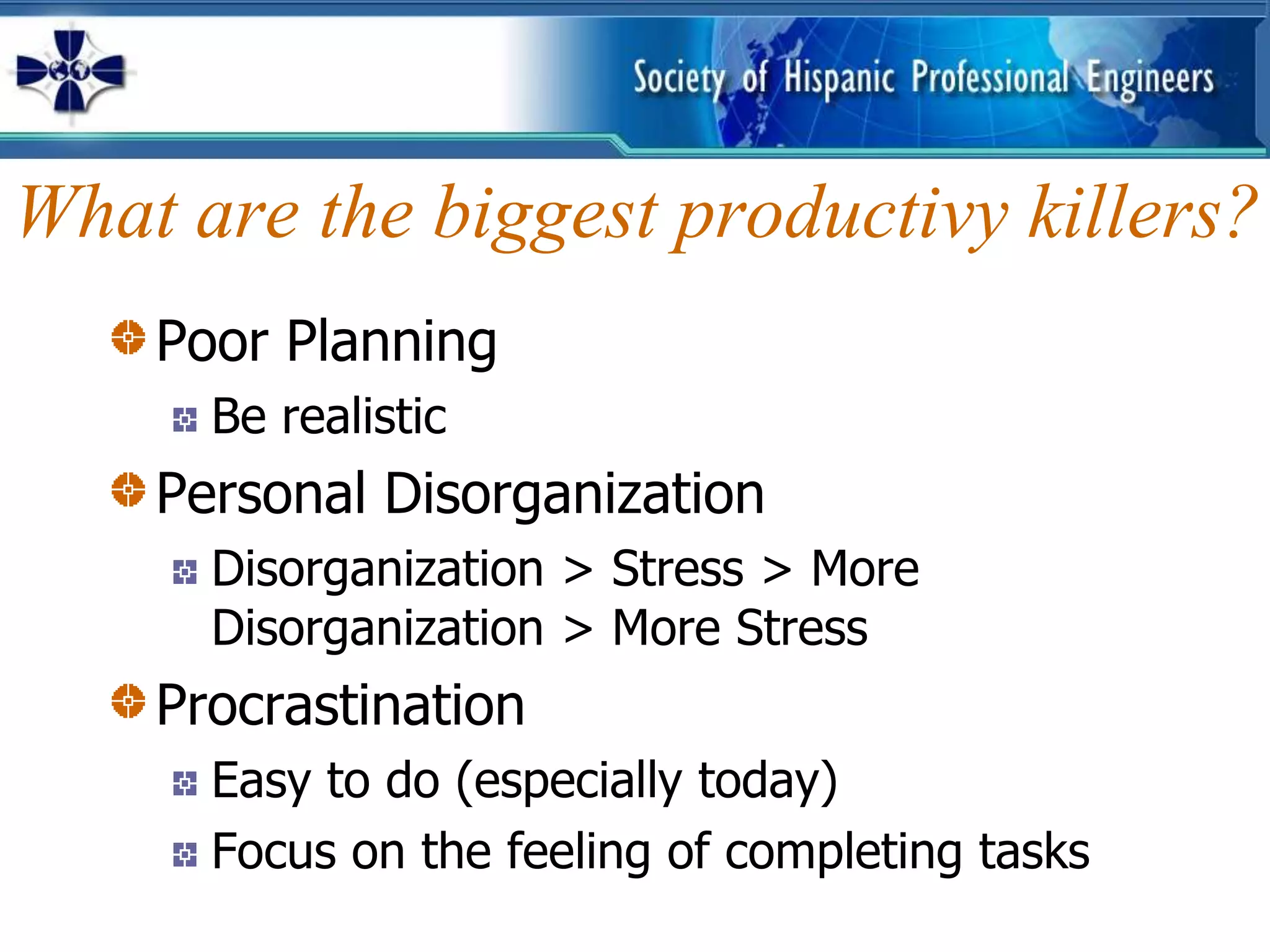
What are the biggest productivy killers?
    Poor Planning
      Be realistic
    Personal Disorganization
      Disorganization > Stress > More
      Disorganization > More Stress
    Procrastination
      Easy to do (especially today)
      Focus on the feeling of completing tasks
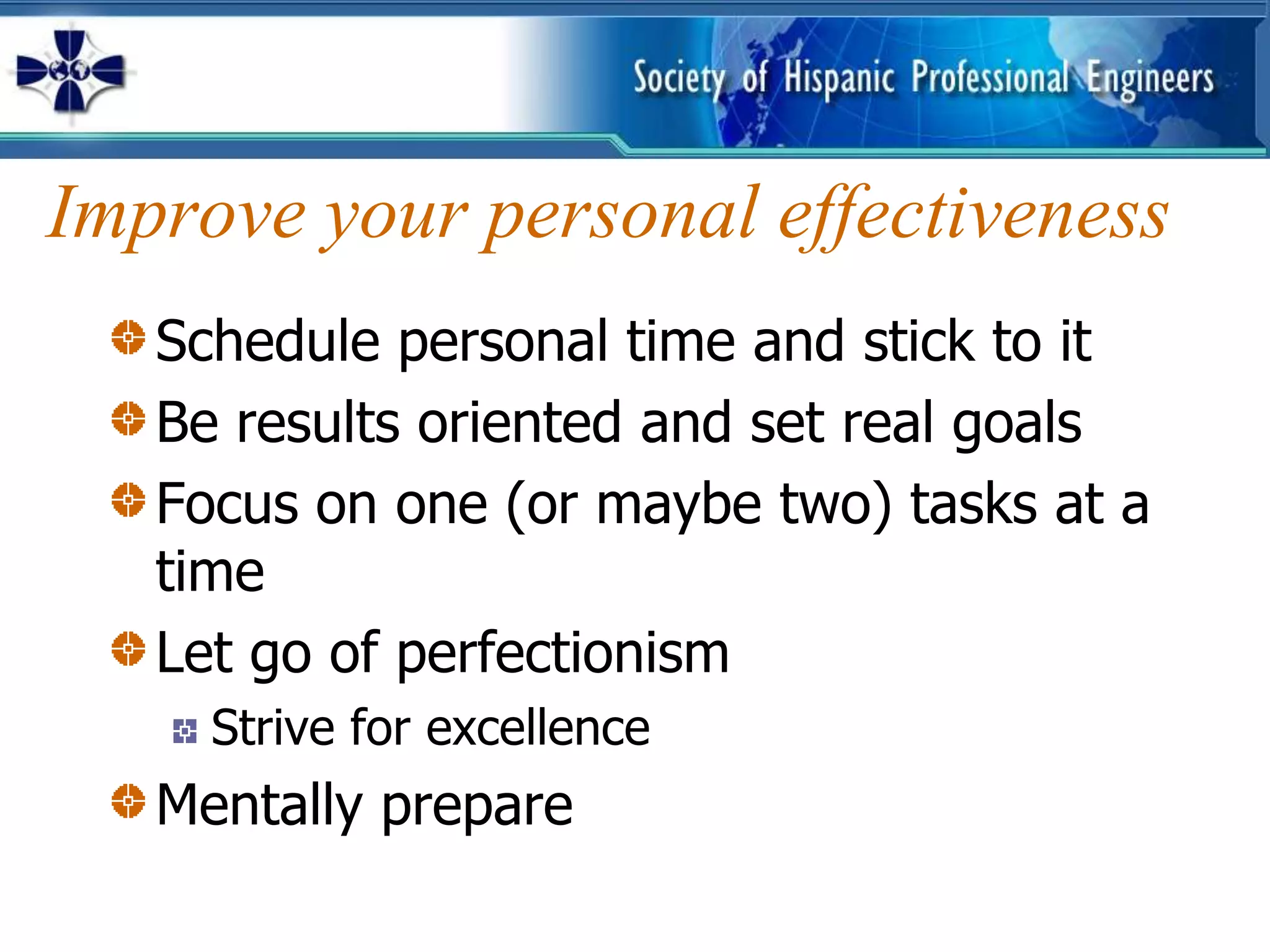
Improve your personal effectiveness
   Schedule personal time and stick to it
   Be results oriented and set real goals
   Focus on one (or maybe two) tasks at a
   time
   Let go of perfectionism
     Strive for excellence
   Mentally prepare
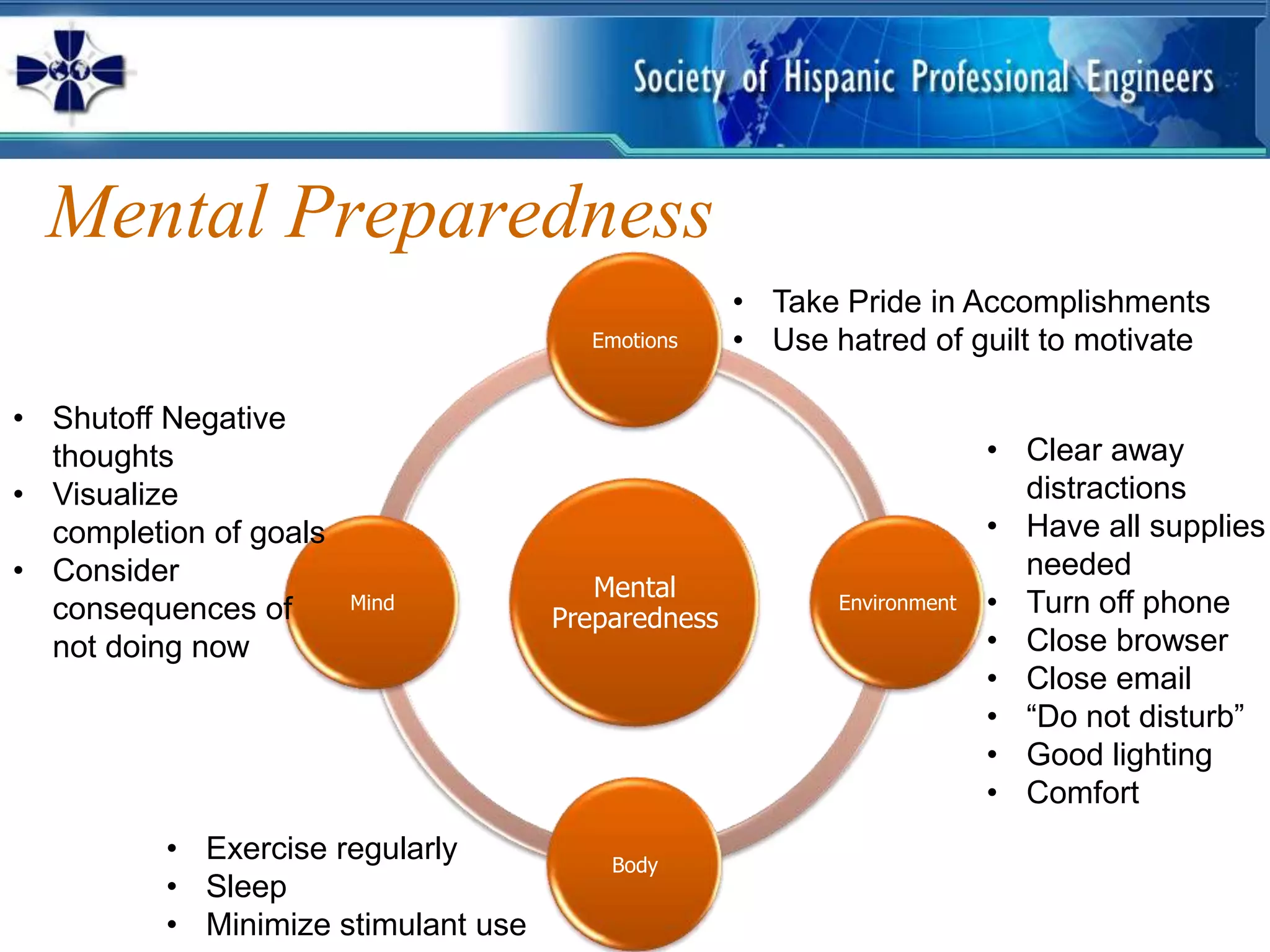
Mental Preparedness
                                                    • Take Pride in Accomplishments
                                       Emotions     • Use hatred of guilt to motivate

• Shutoff Negative
  thoughts                                                               • Clear away
• Visualize                                                                distractions
  completion of goals                                                    • Have all supplies
• Consider                                                                 needed
                                        Mental
  consequences of       Mind
                                     Preparedness
                                                           Environment   • Turn off phone
  not doing now                                                          • Close browser
                                                                         • Close email
                                                                         • “Do not disturb”
                                                                         • Good lighting
                                                                         • Comfort
          • Exercise regularly           Body
          • Sleep
          • Minimize stimulant use
Prevent chaos from interrupting
   Announce time limit: “I only have 5
   minutes”
   Use Walk-Talk method: “Can we talk
   while we walk?”
   Get to the point assertively “Maria, what
   can I help you with?” (use sparingly)
     Try: “Sorry, I am way behind, what’s going
     on?”
MANAGING COMPETING
PRIORITIES
Set Goals/Objectives
   Use SMART
     Specific – Clearly what does done look like
     Measurable – Some way to determine if
     you’ve completed
     Attainable – Can actually be done in your
     term or with your time/resources
     Relevant – Related to your education or
     chapter success
     Timely – Have a date (or even time) to be
     done
Put your goals in writing
   Non-Written goals are the first to be
   ignored
   Writing goals with your chapter allows
   discussion and alignment about
   priorities
   Assign an owner to tasks/sub tasks in
   writing
     Ensure there is agreement or nothing will
     happen
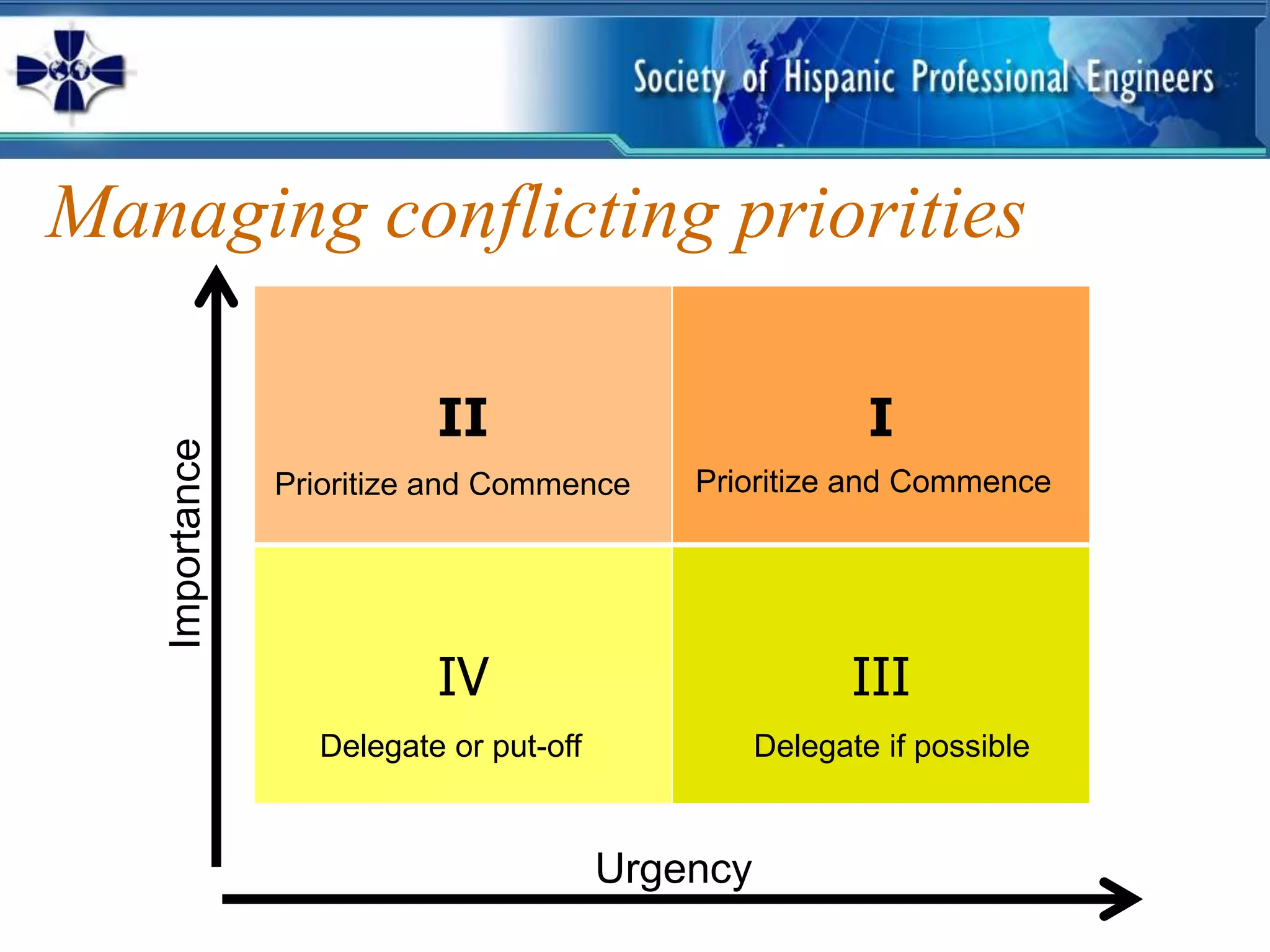
Managing conflicting priorities

                          II                              I
   Importance


                Prioritize and Commence     Prioritize and Commence


                          IV                             III
                  Delegate or put-off             Delegate if possible


                                        Urgency
Delegation
   Why?
     Allow others to develop skills
     Work more efficiently, free up time to
     focus on Quadrant I/II
   What to delegate?
     Routine stuff
     Technical expertise items
     Items enjoyable to others
     Items you know very well
Do not delegate
   Long range planning
   Strategic planning
   Selecting team members
   Rewarding team members
   Difficult situations
9-Point Delegation Checklist
   Give the necessary authority
   Provide necessary resources
   Provide ALL pertinent information
   Communicate the objective
   Make expectations clear
   Hold them accountable
   Gain acceptance
   Evaluate
   Reward success
Let’s talk
   Why do you hate delegating?

   How could you overcome this?
GETTING ORGANIZED
Theory of contexts
    The learning curve and switching task
   types
    Schedule your day around contexts

   Maintain your tasks in this order
The problem with multitasking
   Time to switch between mental
   processes is time-consuming and
   inefficient
   Leads to stress and irritability
   Leads to disorganization and errors

   May be ok for simple, repetitive tasks
How do you rate?
   Do you check your email every time you
   get a new one? Texts?
   Do you fear turning off your cell? Losing
   it?
   While talking to someone, do you text
   others?
   Do you text during lecture? Studying?
Take control of phone calls
   Screen your calls
     Phone on silent
     Ignore texts
   Set time to make calls, respond to
   voicemail daily
     Get to the point. Replace “how are you?”

     with “I need to talk to you about x”
   Leave voicemails with availability
     Avoid phone tag
Email
   USE FOLDERS!
    Project folders
    Class folders
    “projects on hold”
    “opportunities”
  Use task management to respond to emails.
  Set date/time, etc. for responses
  Use your calendar and alerts
Clarity in Communication
   Use simple words
   Use active voice
     Active: “The email needs to be sent out by Friday”
     Passive: “Juan, please send the email before Friday”
     Active: “I made mistakes”
     Passive: “Mistakes were made”

   Get Feedback: “What is your
   understanding of the task?”
   Try to use correct grammar, tense and
   good style to maintain credibility
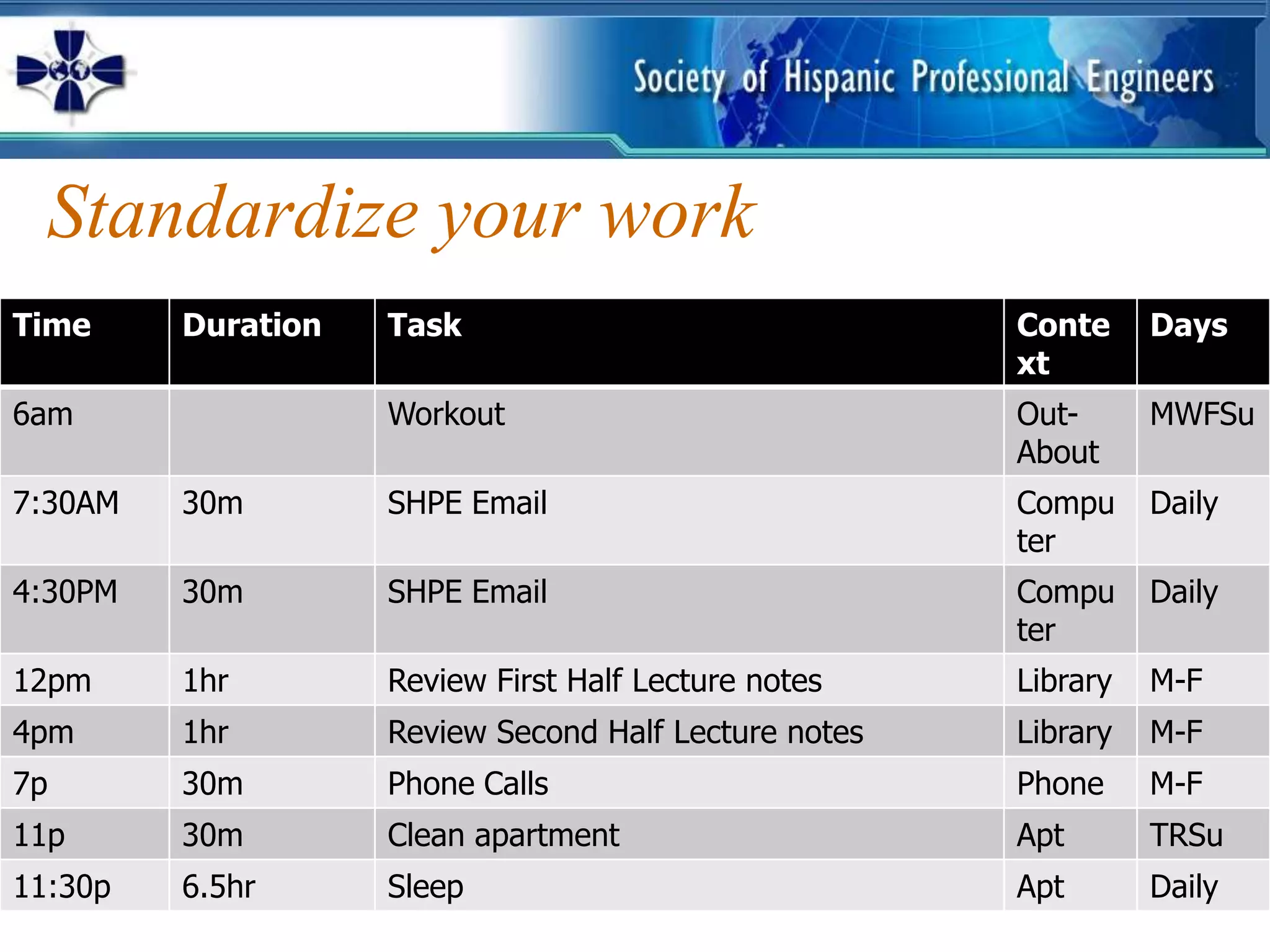
Standardize your work
Time     Duration   Task                               Conte     Days
                                                       xt
6am                 Workout                            Out-      MWFSu
                                                       About
7:30AM   30m        SHPE Email                         Compu     Daily
                                                       ter
4:30PM   30m        SHPE Email                         Compu     Daily
                                                       ter
12pm     1hr        Review First Half Lecture notes    Library   M-F
4pm      1hr        Review Second Half Lecture notes   Library   M-F
7p       30m        Phone Calls                        Phone     M-F
11p      30m        Clean apartment                    Apt       TRSu
11:30p   6.5hr      Sleep                              Apt       Daily
What are you going to do to get
organized?
MANAGING YOURSELF AND
OTHERS
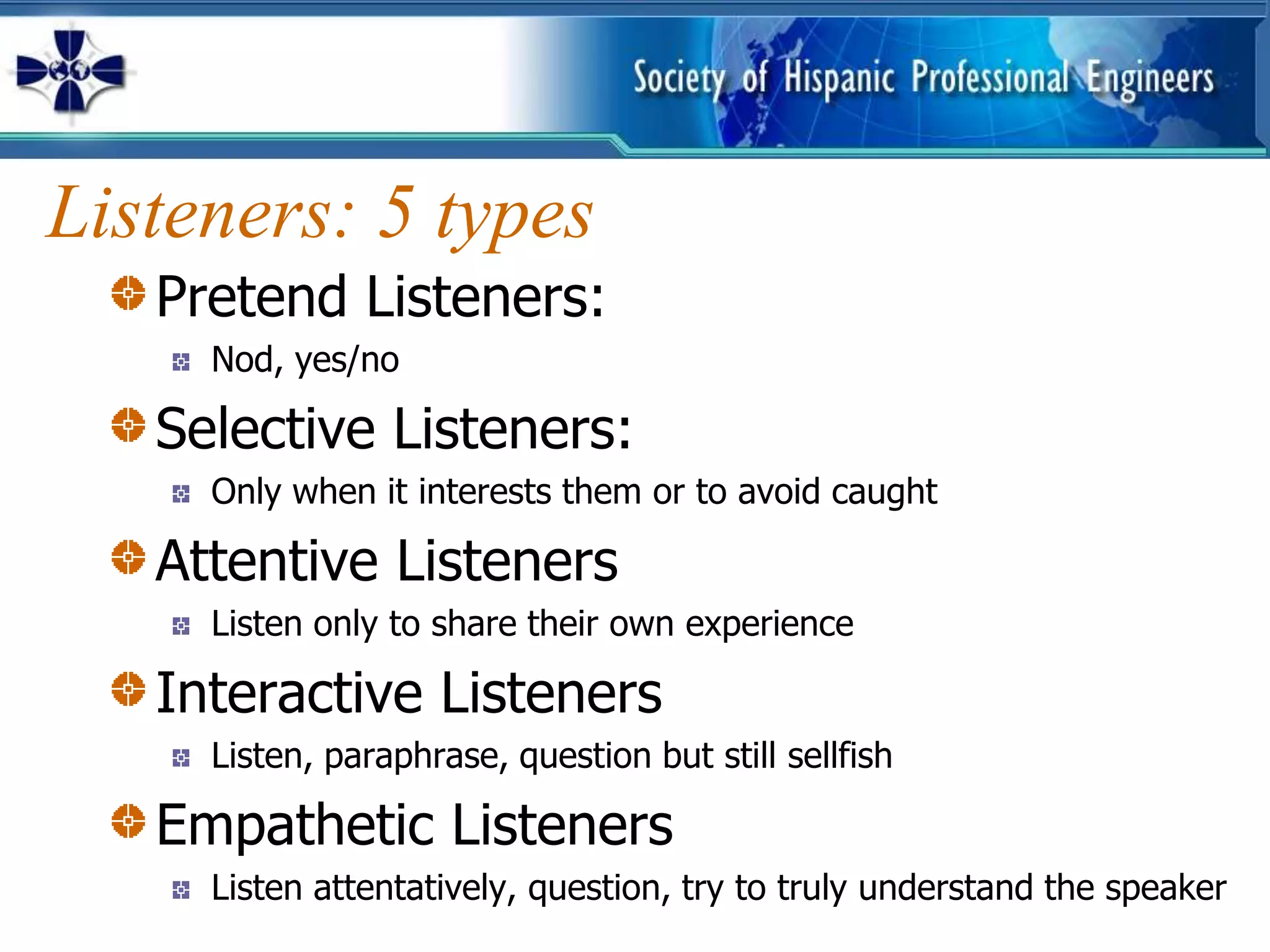
Listeners: 5 types
   Pretend Listeners:
     Nod, yes/no

   Selective Listeners:
     Only when it interests them or to avoid caught

   Attentive Listeners
     Listen only to share their own experience

   Interactive Listeners
     Listen, paraphrase, question but still sellfish

   Empathetic Listeners
     Listen attentatively, question, try to truly understand the speaker
Exercise
   Choose a listening type
   One speaks one listens
   Switch roles
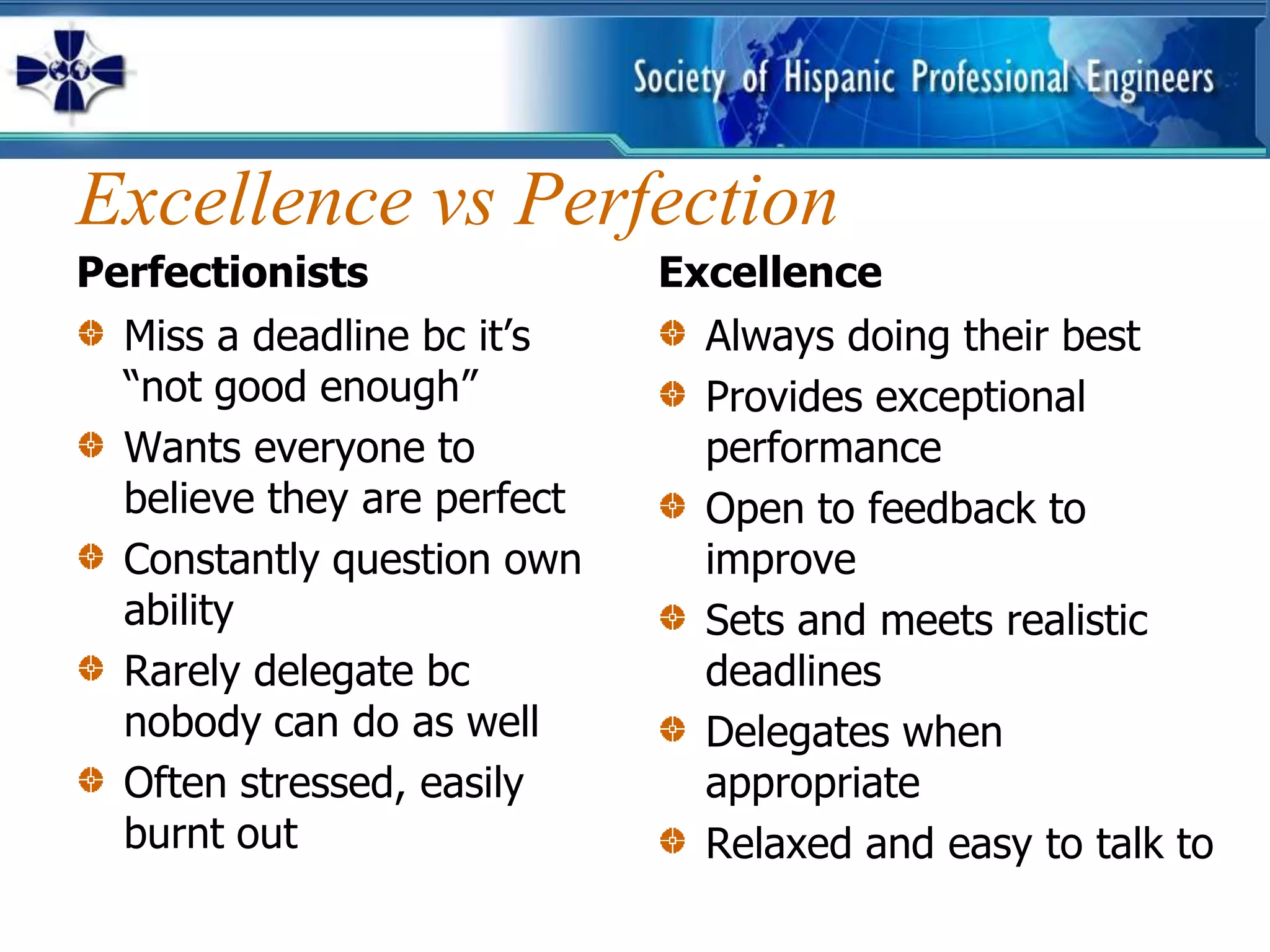
Excellence vs Perfection
Perfectionists               Excellence
  Miss a deadline bc it’s      Always doing their best
  “not good enough”            Provides exceptional
  Wants everyone to            performance
  believe they are perfect     Open to feedback to
  Constantly question own      improve
  ability                      Sets and meets realistic
  Rarely delegate bc           deadlines
  nobody can do as well        Delegates when
  Often stressed, easily       appropriate
  burnt out                    Relaxed and easy to talk to
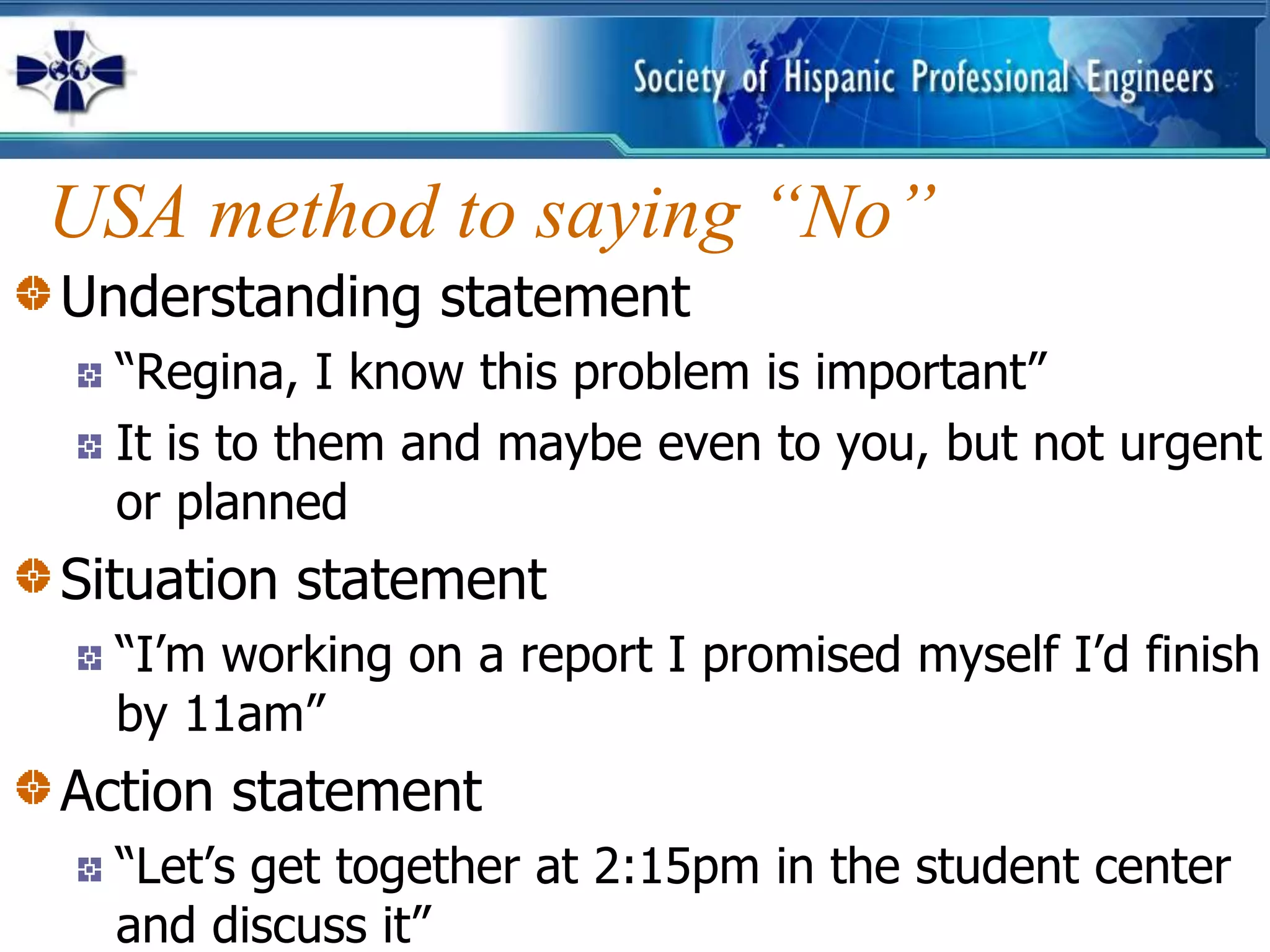
USA method to saying “No”
Understanding statement
  “Regina, I know this problem is important”
  It is to them and maybe even to you, but not urgent
  or planned
Situation statement
  “I’m working on a report I promised myself I’d finish
  by 11am”
Action statement
  “Let’s get together at 2:15pm in the student center
  and discuss it”
Follow up with task owners
   Schedule regular status meetings
     This is not micromanaging
   Try to understand project progress and
   resource, time constraints
     Prod by sharing own struggles
   Offer support, suggestions for getting
   back on task
   Reassess deadlines
Manage yourself first
   Put your grades above all else
   Get help when you need it
   Share your schedule with others
   Hold others accountable and get them
   to hold you accountable
   Study together, but stay focused (try
   lyric-free music)
Increase your value
   Keep a positive attitude
   Increase skills in areas your boss and the org
   needs them
   Learn how to express your ideas clearly
   (practice if necessary)
   Be prepared: Arrive early and do your
   homework
   Compliment your boss and others on good
   work
   Help your boss look good
Get Recognition at work
   Speak up about your accomplishments
   Publish in the company newsletter
   Participate in extracurricular activities
   (SHPE Professional Chapters)
   Volunteer in your community (SHPE)
MANAGING STRESS
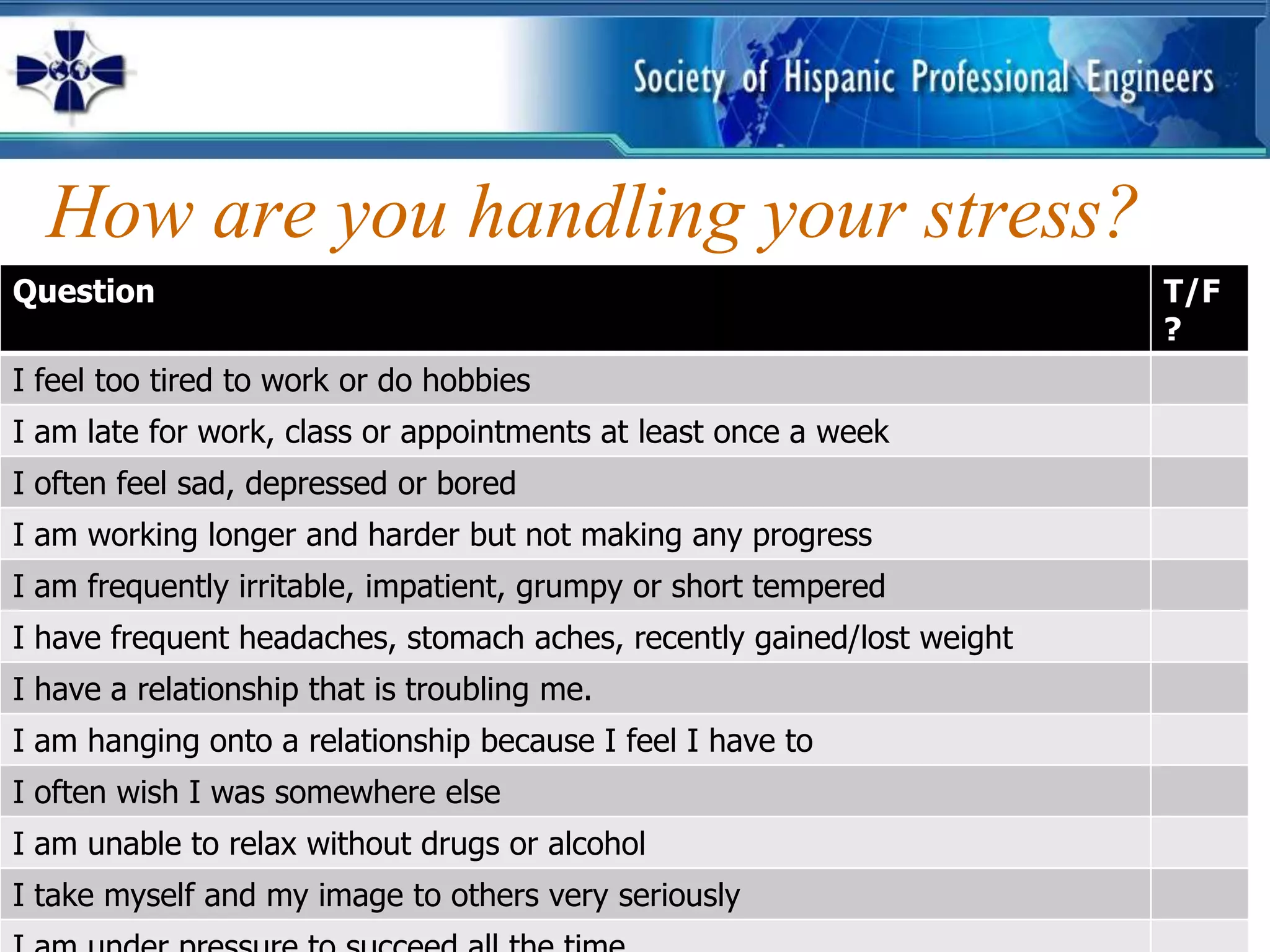
How are you handling your stress?
Question                                                                T/F
                                                                        ?
I feel too tired to work or do hobbies
I am late for work, class or appointments at least once a week
I often feel sad, depressed or bored
I am working longer and harder but not making any progress
I am frequently irritable, impatient, grumpy or short tempered
I have frequent headaches, stomach aches, recently gained/lost weight
I have a relationship that is troubling me.
I am hanging onto a relationship because I feel I have to
I often wish I was somewhere else
I am unable to relax without drugs or alcohol
I take myself and my image to others very seriously
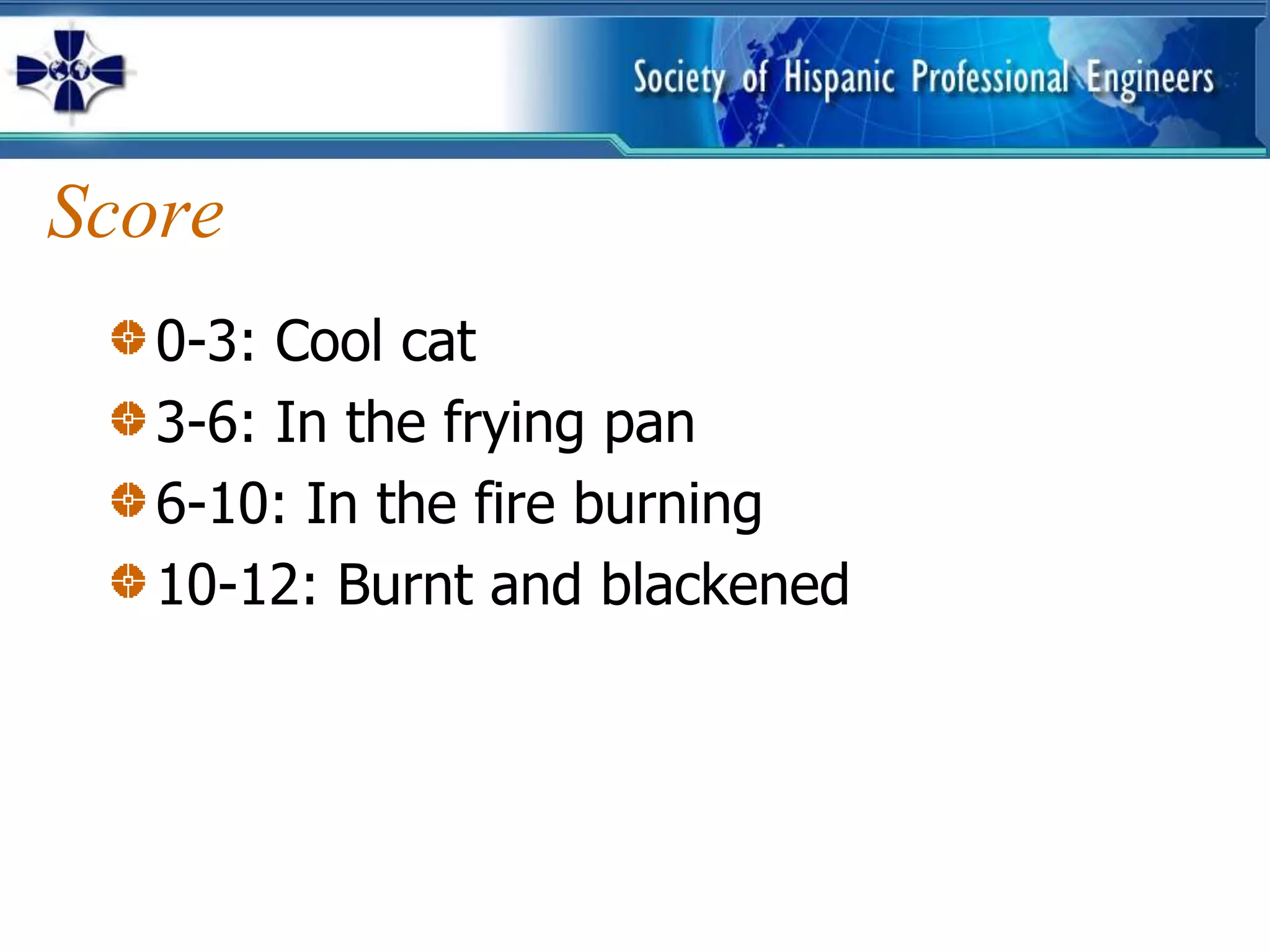
Score
   0-3: Cool cat
   3-6: In the frying pan
   6-10: In the fire burning
   10-12: Burnt and blackened
Stress affect mental and physical
   Negative impact of stress
     Lowered resistance to illness and disease
     Leads to loss in relationships
      • Stressed people are difficult to be around and
        often don’t make effort to nurture relationships
     Causes an out-of-control feeling
      • Make more mistakes, cause stress around them
      • Susceptible to shutting down, affective
        everyone
Handling “it”
   Look at the situation, determine what
   “needs to be done”
   Consider available options
     Is there a time frame?
     Are there others who can help?
   Breathe…. Write a quick plan of action
   Do your best to not sacrifice sleep and
   exercise for stress
11 step plan to avoiding burnout
Focus on you                   Control what you can
  Determine why you are          Focus on one task at a
  always in a hurry              time
  Develop a support group        Visualize calm
  (someone to vent to)           Take some time hourly to
  Determine how much             do nothing.. Breath, relax
  sleep you need and do it       Seek privacy whenever
  regularly                      possible
  Eat nutritious foods, plan     Avoid stimulants and
  meals, drink water             depressants
  Exercise regularly             Reject perfectionism
Final thoughts
   Create a standard schedule
   Stay healthy
   Do the right stuff one at a time
   Allow yourself to focus
   Control what you can
   Communicate well
   Don’t try to be perfect
Thank You
  Questions?

  Barry.Cordero@shpe.org

SHPE Time Management

  • 1.
    Time Management RLDC 1 Barry Cordero SHPE National VP
  • 2.
    Agenda Gainingcontrol of your day Handling competing priorities Getting organized Managing yourself and others Don’t let stress control you
  • 3.
    10 Golden Rulesof Time Management Identify how you spend your time Identify your “prime time” Do tomorrow’s planning tonight Ask yourself “why am I doing this right now?” Handle each item once
  • 4.
    10 Golden Rulesof Time Management Plan your work but work your plan Delegate whenever possible Delegate wisely Identify high payoff items, spend the most time on those Concentrate on results, not on keeping busy
  • 5.
    Identify your currentchaos Is this you? Always Often Usually Some times My desk is covered with piles of papers, files and books My computer files are disorganized My computer is not backed up I’m often late and miss appointments My email inbox is always full I struggle with conflicting deadlines and demands on my time I don’t know which are my real priorities I start one task, get distracted and move to another I always complete items right before they are due
  • 6.
  • 7.
    What are thebiggest productivy killers? Poor Planning Be realistic Personal Disorganization Disorganization > Stress > More Disorganization > More Stress Procrastination Easy to do (especially today) Focus on the feeling of completing tasks
  • 8.
    Improve your personaleffectiveness Schedule personal time and stick to it Be results oriented and set real goals Focus on one (or maybe two) tasks at a time Let go of perfectionism Strive for excellence Mentally prepare
  • 9.
    Mental Preparedness • Take Pride in Accomplishments Emotions • Use hatred of guilt to motivate • Shutoff Negative thoughts • Clear away • Visualize distractions completion of goals • Have all supplies • Consider needed Mental consequences of Mind Preparedness Environment • Turn off phone not doing now • Close browser • Close email • “Do not disturb” • Good lighting • Comfort • Exercise regularly Body • Sleep • Minimize stimulant use
  • 10.
    Prevent chaos frominterrupting Announce time limit: “I only have 5 minutes” Use Walk-Talk method: “Can we talk while we walk?” Get to the point assertively “Maria, what can I help you with?” (use sparingly) Try: “Sorry, I am way behind, what’s going on?”
  • 11.
  • 12.
    Set Goals/Objectives Use SMART Specific – Clearly what does done look like Measurable – Some way to determine if you’ve completed Attainable – Can actually be done in your term or with your time/resources Relevant – Related to your education or chapter success Timely – Have a date (or even time) to be done
  • 13.
    Put your goalsin writing Non-Written goals are the first to be ignored Writing goals with your chapter allows discussion and alignment about priorities Assign an owner to tasks/sub tasks in writing Ensure there is agreement or nothing will happen
  • 14.
    Managing conflicting priorities II I Importance Prioritize and Commence Prioritize and Commence IV III Delegate or put-off Delegate if possible Urgency
  • 15.
    Delegation Why? Allow others to develop skills Work more efficiently, free up time to focus on Quadrant I/II What to delegate? Routine stuff Technical expertise items Items enjoyable to others Items you know very well
  • 16.
    Do not delegate Long range planning Strategic planning Selecting team members Rewarding team members Difficult situations
  • 17.
    9-Point Delegation Checklist Give the necessary authority Provide necessary resources Provide ALL pertinent information Communicate the objective Make expectations clear Hold them accountable Gain acceptance Evaluate Reward success
  • 18.
    Let’s talk Why do you hate delegating? How could you overcome this?
  • 19.
  • 20.
    Theory of contexts The learning curve and switching task types Schedule your day around contexts Maintain your tasks in this order
  • 21.
    The problem withmultitasking Time to switch between mental processes is time-consuming and inefficient Leads to stress and irritability Leads to disorganization and errors May be ok for simple, repetitive tasks
  • 22.
    How do yourate? Do you check your email every time you get a new one? Texts? Do you fear turning off your cell? Losing it? While talking to someone, do you text others? Do you text during lecture? Studying?
  • 23.
    Take control ofphone calls Screen your calls Phone on silent Ignore texts Set time to make calls, respond to voicemail daily Get to the point. Replace “how are you?” with “I need to talk to you about x” Leave voicemails with availability Avoid phone tag
  • 24.
    Email USE FOLDERS! Project folders Class folders “projects on hold” “opportunities” Use task management to respond to emails. Set date/time, etc. for responses Use your calendar and alerts
  • 25.
    Clarity in Communication Use simple words Use active voice Active: “The email needs to be sent out by Friday” Passive: “Juan, please send the email before Friday” Active: “I made mistakes” Passive: “Mistakes were made” Get Feedback: “What is your understanding of the task?” Try to use correct grammar, tense and good style to maintain credibility
  • 26.
    Standardize your work Time Duration Task Conte Days xt 6am Workout Out- MWFSu About 7:30AM 30m SHPE Email Compu Daily ter 4:30PM 30m SHPE Email Compu Daily ter 12pm 1hr Review First Half Lecture notes Library M-F 4pm 1hr Review Second Half Lecture notes Library M-F 7p 30m Phone Calls Phone M-F 11p 30m Clean apartment Apt TRSu 11:30p 6.5hr Sleep Apt Daily
  • 27.
    What are yougoing to do to get organized?
  • 28.
  • 29.
    Listeners: 5 types Pretend Listeners: Nod, yes/no Selective Listeners: Only when it interests them or to avoid caught Attentive Listeners Listen only to share their own experience Interactive Listeners Listen, paraphrase, question but still sellfish Empathetic Listeners Listen attentatively, question, try to truly understand the speaker
  • 30.
    Exercise Choose a listening type One speaks one listens Switch roles
  • 31.
    Excellence vs Perfection Perfectionists Excellence Miss a deadline bc it’s Always doing their best “not good enough” Provides exceptional Wants everyone to performance believe they are perfect Open to feedback to Constantly question own improve ability Sets and meets realistic Rarely delegate bc deadlines nobody can do as well Delegates when Often stressed, easily appropriate burnt out Relaxed and easy to talk to
  • 32.
    USA method tosaying “No” Understanding statement “Regina, I know this problem is important” It is to them and maybe even to you, but not urgent or planned Situation statement “I’m working on a report I promised myself I’d finish by 11am” Action statement “Let’s get together at 2:15pm in the student center and discuss it”
  • 33.
    Follow up withtask owners Schedule regular status meetings This is not micromanaging Try to understand project progress and resource, time constraints Prod by sharing own struggles Offer support, suggestions for getting back on task Reassess deadlines
  • 34.
    Manage yourself first Put your grades above all else Get help when you need it Share your schedule with others Hold others accountable and get them to hold you accountable Study together, but stay focused (try lyric-free music)
  • 35.
    Increase your value Keep a positive attitude Increase skills in areas your boss and the org needs them Learn how to express your ideas clearly (practice if necessary) Be prepared: Arrive early and do your homework Compliment your boss and others on good work Help your boss look good
  • 36.
    Get Recognition atwork Speak up about your accomplishments Publish in the company newsletter Participate in extracurricular activities (SHPE Professional Chapters) Volunteer in your community (SHPE)
  • 37.
  • 38.
    How are youhandling your stress? Question T/F ? I feel too tired to work or do hobbies I am late for work, class or appointments at least once a week I often feel sad, depressed or bored I am working longer and harder but not making any progress I am frequently irritable, impatient, grumpy or short tempered I have frequent headaches, stomach aches, recently gained/lost weight I have a relationship that is troubling me. I am hanging onto a relationship because I feel I have to I often wish I was somewhere else I am unable to relax without drugs or alcohol I take myself and my image to others very seriously
  • 39.
    Score 0-3: Cool cat 3-6: In the frying pan 6-10: In the fire burning 10-12: Burnt and blackened
  • 40.
    Stress affect mentaland physical Negative impact of stress Lowered resistance to illness and disease Leads to loss in relationships • Stressed people are difficult to be around and often don’t make effort to nurture relationships Causes an out-of-control feeling • Make more mistakes, cause stress around them • Susceptible to shutting down, affective everyone
  • 41.
    Handling “it” Look at the situation, determine what “needs to be done” Consider available options Is there a time frame? Are there others who can help? Breathe…. Write a quick plan of action Do your best to not sacrifice sleep and exercise for stress
  • 42.
    11 step planto avoiding burnout Focus on you Control what you can Determine why you are Focus on one task at a always in a hurry time Develop a support group Visualize calm (someone to vent to) Take some time hourly to Determine how much do nothing.. Breath, relax sleep you need and do it Seek privacy whenever regularly possible Eat nutritious foods, plan Avoid stimulants and meals, drink water depressants Exercise regularly Reject perfectionism
  • 43.
    Final thoughts Create a standard schedule Stay healthy Do the right stuff one at a time Allow yourself to focus Control what you can Communicate well Don’t try to be perfect
  • 44.
    Thank You Questions? Barry.Cordero@shpe.org

Editor's Notes

  • #4 Consider keeping a log for a few daysSome are most effective first thingn in the morning, others after working out
  • #5 Consider keeping a log for a few daysSome are most effective first thingn in the morning, others after working out
  • #6 Count the number of always and often. If the majority are always and often, time management is a real problem for you
  • #9 Without goals, you don’t know where your going, how you got there or even if you’ve arrived
  • #10 Psych yourself up, especially for things you DO NOT want to doInternet accounts for about 25% of one’s day, it’s mostly wasted timeSelf talk is a great way to mentally prepareName some things that would help you be more effectiveWhich items do you have the most trouble with?
  • #15 Write all your current priorities and place them in boxes accordingly
  • #21 Draw graph of “Learning Curve”
  • #24 When is the best time to respond to texts?
  • #32 Which would you rather be?Which would you rather work with?
  • #33 Why meet somewhere other than your desk or area?A: So you can escape if it goes too long
  • #39 Count how many T’s you have