The Period of a Mass on a Spring
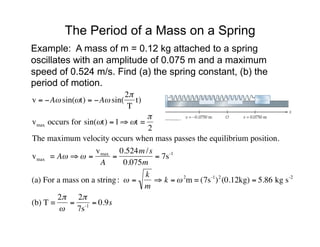
Example: A mass of m = 0.12 kg attached to a spring
oscillates with an amplitude of 0.075 m and a maximum
speed of 0.524 m/s. Find (a) the spring constant, (b) the
period of motion.
€
v = −Aω sin(ωt) = −Aω sin(
2π
T
t)
vmax occurs for sin(ωt) =1⇒ ωt =
π
2
The maximum velocity occurs when mass passes the equilibrium position.
vmax = Aω ⇒ ω =
vmax
A
=
0.524m /s
0.075m
= 7s-1
(a) For a mass on a string: ω =
k
m
⇒ k = ω2
m = (7s-1
)2
(0.12kg) = 5.86 kg s-2
(b) T =
2π
ω
=
2π
7s-1 = 0.9s
The	
  Period	
  of	
  a	
  Mass	
  on	
  a	
  Spring	
  
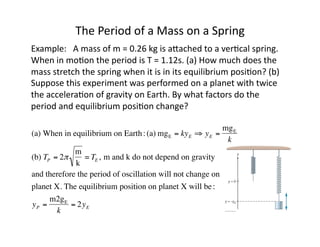
Example:	
  	
  	
  A	
  mass	
  of	
  m	
  =	
  0.26	
  kg	
  is	
  abached	
  to	
  a	
  ver:cal	
  spring.	
  
When	
  in	
  mo:on	
  the	
  period	
  is	
  T	
  =	
  1.12s.	
  (a)	
  How	
  much	
  does	
  the	
  
mass	
  stretch	
  the	
  spring	
  when	
  it	
  is	
  in	
  its	
  equilibrium	
  posi:on?	
  (b)	
  
Suppose	
  this	
  experiment	
  was	
  performed	
  on	
  a	
  planet	
  with	
  twice	
  
the	
  accelera:on	
  of	
  gravity	
  on	
  Earth.	
  By	
  what	
  factors	
  do	
  the	
  
period	
  and	
  equilibrium	
  posi:on	
  change?	
  	
  
€
(a) When in equilibrium on Earth:(a) mgE = kyE ⇒ yE =
mgE
k
(b) TP = 2π
m
k
= TE , m and k do not depend on gravity
and therefore the period of oscillation will not change on
planet X. The equilibrium position on planet X will be:
yP =
m2gE
k
= 2yE
Energy	
  Conserva:on	
  in	
  Oscillatory	
  Mo:on	
  
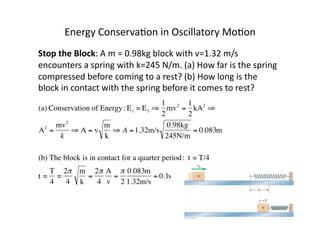
Stop	
  the	
  Block:	
  A	
  m	
  =	
  0.98kg	
  block	
  with	
  v=1.32	
  m/s	
  
encounters	
  a	
  spring	
  with	
  k=245	
  N/m.	
  (a)	
  How	
  far	
  is	
  the	
  spring	
  
compressed	
  before	
  coming	
  to	
  a	
  rest?	
  (b)	
  How	
  long	
  is	
  the	
  
block	
  in	
  contact	
  with	
  the	
  spring	
  before	
  it	
  comes	
  to	
  rest?	
  
€
(a) Conservation of Energy:Ei = Ef ⇒
1
2
mv2
=
1
2
kA2
⇒
A2
=
mv2
k
⇒ A = v
m
k
⇒ A =1.32m/s
0.98kg
245N/m
= 0.083m
(b) The block is in contact for a quarter period: t = T/4
t =
T
4
=
2π
4
m
k
=
2π
4
A
v
=
π
2
0.083m
1.32m/s
= 0.1s
Energy	
  Conserva:on	
  in	
  Oscillatory	
  Mo:on	
  
Bullet-­‐Block	
  Collision:	
  A	
  bullet	
  of	
  mass	
  m	
  embeds	
  itself	
  in	
  a	
  
block	
  of	
  mass	
  M.	
  If	
  the	
  ini:al	
  speed	
  of	
  the	
  bullet	
  is	
  v0	
  ,	
  find	
  (a)	
  
the	
  maximum	
  compression	
  of	
  the	
  spring,	
  (b)	
  the	
  :me	
  for	
  the	
  
bullet-­‐block	
  to	
  come	
  to	
  rest.
€
(a) Conservation of momentum: Pi = Pf ⇒ mv0 = (m +M)vf ⇒ vf =
mv0
(m +M)
Conservsation of Mechanical Energy: Ei = Ef ⇒
1
2
(m+ M)vf
2
=
1
2
kA2
⇒
1
2
(m+ M)
mv0
(m +M)
⎡
⎣
⎢
⎤
⎦
⎥
2
=
1
2
kA2
⇒
mv0
( )
2
(m+ M)
= kA2
⇒ A =
mv0
( )
k(m+ M)
(b) The block is in contact t =
T
4
=
2π
4
m +M
k
Simple Harmonic Motion on a Frictionless Surface: A 0.350-kg object
attached to a spring of force constant 1.30 × 10² N/m is free to move on a
frictionless horizontal surface, as in Active Figure 13.1. If the object is released
from rest at x = 0.100 m, find the force on it and its acceleration at x = 0.100 m, x
= 0.050 0 m, x = 0 m, x = 20.050 m, and x = 20.100 m.
m = 0.350kg, k =1.3 ×10²
N/m, A = 0.1m
ω2
=
k
m
=
1.3 ×10²
N/m
0.350kg
= 371.4
N
m kg
F(x) = −kx
a(x) = −Aω2
cos ωt
( ) = −ω2
x
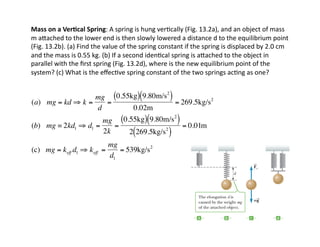
Mass	
  on	
  a	
  Ver7cal	
  Spring:	
  A	
  spring	
  is	
  hung	
  ver:cally	
  (Fig.	
  13.2a),	
  and	
  an	
  object	
  of	
  mass	
  
m	
  abached	
  to	
  the	
  lower	
  end	
  is	
  then	
  slowly	
  lowered	
  a	
  distance	
  d	
  to	
  the	
  equilibrium	
  point	
  
(Fig.	
  13.2b).	
  (a)	
  Find	
  the	
  value	
  of	
  the	
  spring	
  constant	
  if	
  the	
  spring	
  is	
  displaced	
  by	
  2.0	
  cm	
  
and	
  the	
  mass	
  is	
  0.55	
  kg.	
  (b)	
  If	
  a	
  second	
  iden:cal	
  spring	
  is	
  abached	
  to	
  the	
  object	
  in	
  
parallel	
  with	
  the	
  first	
  spring	
  (Fig.	
  13.2d),	
  where	
  is	
  the	
  new	
  equilibrium	
  point	
  of	
  the	
  
system?	
  (c)	
  What	
  is	
  the	
  effec:ve	
  spring	
  constant	
  of	
  the	
  two	
  springs	
  ac:ng	
  as	
  one?	
  
€
(a) mg = kd ⇒ k =
mg
d
=
0.55kg
( ) 9.80m/s2
( )
0.02m
= 269.5kg/s2
(b) mg = 2kd1 ⇒ d1 =
mg
2k
=
0.55kg
( ) 9.80m/s2
( )
2 269.5kg/s2
( )
= 0.01m
(c) mg = keff d1 ⇒ keff =
mg
d1
= 539kg/s2
Stop	
  That	
  Car!:	
  A	
  13	
  000-­‐N	
  car	
  starts	
  at	
  rest	
  and	
  rolls	
  down	
  a	
  hill	
  from	
  a	
  height	
  of	
  10.0	
  
m	
  (Fig.	
  13.6).	
  It	
  then	
  moves	
  across	
  a	
  level	
  surface	
  and	
  collides	
  with	
  a	
  light	
  spring-­‐
loaded	
  guard-­‐rail.	
  (a)	
  Neglec:ng	
  any	
  losses	
  due	
  to	
  fric:on,	
  and	
  ignoring	
  the	
  rota:onal	
  
kine:c	
  energy	
  of	
  the	
  wheels,	
  find	
  the	
  maximum	
  distance	
  the	
  spring	
  is	
  compressed.	
  
Assume	
  a	
  spring	
  constant	
  of	
  1.0	
  ×	
  106	
  N/m.	
  (b)	
  Calculate	
  the	
  maximum	
  accelera:on	
  
of	
  the	
  car	
  amer	
  contact	
  with	
  the	
  spring,	
  assuming	
  no	
  fric:onal	
  losses.	
  (c)	
  If	
  the	
  spring	
  
is	
  compressed	
  by	
  only	
  0.30	
  m,	
  find	
  the	
  change	
  in	
  the	
  mechanical	
  energy	
  due	
  to	
  
fric:on.	
  
€
(a) Conservation of energy: PE →KE →PE
mgh =
1
2
mv2
=
1
2
kx2
⇒ x2
=
2mgh
k
⇒ x =
2mgh
k
=
2 13000
( ) 10m
( )
1.0 ×10⁶
N/m
= 0.51m
(b) a = -Aω2
cos ωt
( ) ⇒ amax = Aω2
(1)
ω =
2π
T
=
k
m
=
1.0 ×10⁶
N/m
13000 N
( )/ 9.8 m/s2
( )
= 27.5 Hz (2)
(1)^(2) ⇒ amax = 0.51m
( ) 27.5 Hz
( )2
= 385.7m/s2
(c) Wnc = ΔE = E f - Ei =
1
2
k(0.3m)2
− (mgh) ⇒
0.5
( ) 1.0 ×10⁶
N/m
( )(0.3m)2
− 13000 N
( ) 10m
( ) = −8.5 ×10⁵
J
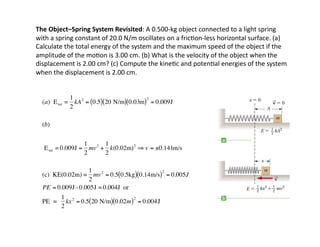
The	
  Object–Spring	
  System	
  Revisited:	
  A	
  0.500-­‐kg	
  object	
  connected	
  to	
  a	
  light	
  spring	
  
with	
  a	
  spring	
  constant	
  of	
  20.0	
  N/m	
  oscillates	
  on	
  a	
  fric:on-­‐less	
  horizontal	
  surface.	
  (a)	
  
Calculate	
  the	
  total	
  energy	
  of	
  the	
  system	
  and	
  the	
  maximum	
  speed	
  of	
  the	
  object	
  if	
  the	
  
amplitude	
  of	
  the	
  mo:on	
  is	
  3.00	
  cm.	
  (b)	
  What	
  is	
  the	
  velocity	
  of	
  the	
  object	
  when	
  the	
  
displacement	
  is	
  2.00	
  cm?	
  (c)	
  Compute	
  the	
  kine:c	
  and	
  poten:al	
  energies	
  of	
  the	
  system	
  
when	
  the	
  displacement	
  is	
  2.00	
  cm.	
  
€
(a) Etot =
1
2
kA2
= 0.5
( ) 20 N/m
( ) 0.03m
( )2
= 0.009J
(b)
Etot = 0.009J =
1
2
mv2
+
1
2
k(0.02m)2
⇒ v = ±0.141m/s
(c) KE(0.02m) =
1
2
mv2
= 0.5 0.5kg
( ) 0.14m/s
( )2
= 0.005J
PE = 0.009J - 0.005J = 0.004J or
PE =
1
2
kx2
= 0.5 20 N/m
( ) 0.02m
( )2
= 0.004J
That	
  Car	
  Needs	
  Shock	
  Absorbers!:	
  A	
  1.30	
  ×	
  103-­‐kg	
  car	
  is	
  constructed	
  on	
  a	
  frame	
  
supported	
  by	
  four	
  springs.	
  Each	
  spring	
  has	
  a	
  spring	
  constant	
  of	
  2.00	
  ×	
  104	
  N/m.	
  If	
  
two	
  people	
  riding	
  in	
  the	
  car	
  have	
  a	
  combined	
  mass	
  of	
  1.60	
  ×	
  102	
  kg,	
  find	
  the	
  
frequency	
  of	
  vibra:on	
  of	
  the	
  car	
  when	
  it	
  is	
  driven	
  over	
  a	
  pothole	
  in	
  the	
  road.	
  Find	
  
also	
  the	
  period	
  and	
  the	
  angular	
  frequency.	
  Assume	
  the	
  weight	
  is	
  evenly	
  distributed.	
  
€
Effective spring constant :
mtotalg = 4kx ⇒ keff = 4k
ω =
4k
m
=
4 2 ×10⁴
N/m
( )
1.46 ×10³
kg
= 7.4Hz
ω =
2π
T
= 2πf ⇒ f =
ω
2π
=
7.4Hz
2π
=1.18Hz
T =
2π
ω
=
2π
7.4Hz
= 0.85s
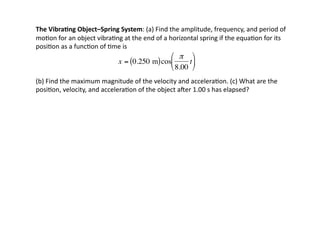
The	
  Vibra7ng	
  Object–Spring	
  System:	
  (a)	
  Find	
  the	
  amplitude,	
  frequency,	
  and	
  period	
  of	
  
mo:on	
  for	
  an	
  object	
  vibra:ng	
  at	
  the	
  end	
  of	
  a	
  horizontal	
  spring	
  if	
  the	
  equa:on	
  for	
  its	
  
posi:on	
  as	
  a	
  func:on	
  of	
  :me	
  is	


(b)	
  Find	
  the	
  maximum	
  magnitude	
  of	
  the	
  velocity	
  and	
  accelera:on.	
  (c)	
  What	
  are	
  the	
  
posi:on,	
  velocity,	
  and	
  accelera:on	
  of	
  the	
  object	
  amer	
  1.00	
  s	
  has	
  elapsed?	
  
€
x = 0.250 m
( )cos
π
8.00
t
⎛
⎝
⎜
⎞
⎠
⎟
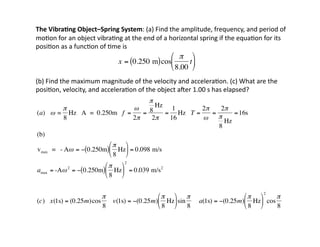
The	
  Vibra7ng	
  Object–Spring	
  System:	
  (a)	
  Find	
  the	
  amplitude,	
  frequency,	
  and	
  period	
  of	
  
mo:on	
  for	
  an	
  object	
  vibra:ng	
  at	
  the	
  end	
  of	
  a	
  horizontal	
  spring	
  if	
  the	
  equa:on	
  for	
  its	
  
posi:on	
  as	
  a	
  func:on	
  of	
  :me	
  is	


(b)	
  Find	
  the	
  maximum	
  magnitude	
  of	
  the	
  velocity	
  and	
  accelera:on.	
  (c)	
  What	
  are	
  the	
  
posi:on,	
  velocity,	
  and	
  accelera:on	
  of	
  the	
  object	
  amer	
  1.00	
  s	
  has	
  elapsed?	
  
€
x = 0.250 m
( )cos
π
8.00
t
⎛
⎝
⎜
⎞
⎠
⎟
€
(a) ω =
π
8
Hz A = 0.250m f =
ω
2π
=
π
8
Hz
2π
=
1
16
Hz T =
2π
ω
=
2π
π
8
Hz
=16s
(b)
vmax = - Aω = − 0.250m
( )
π
8
Hz
⎛
⎝
⎜
⎞
⎠
⎟ = 0.098 m/s
amax = -Aω2
= − 0.250m
( )
π
8
Hz
⎛
⎝
⎜
⎞
⎠
⎟
2
= 0.039 m/s2
(c) x(1s) = (0.25m)cos
π
8
v(1s) = −(0.25m)
π
8
Hz
⎛
⎝
⎜
⎞
⎠
⎟sin
π
8
a(1s) = −(0.25m)
π
8
Hz
⎛
⎝
⎜
⎞
⎠
⎟
2
cos
π
8
€
A Traveling Wave: A wave traveling in the positive x-direction is pictured in Figure
13.27a. Find the amplitude, wavelength, speed, and period of the wave if it has a
frequency of 8.00 Hz. In Figure 13.27a, Δx = 40.0 cm and Δy = 15.0 cm.
frequency: f = 8.00Hz
Amplitude : A = Δy =15.0 cm
Wavelength :λ = Δx = 40.0 cm
Speed : v = λf = (0.40 m)(8.00Hz) =3.2m/s
Period:P =1/f =1/8.00Hz =0.125s
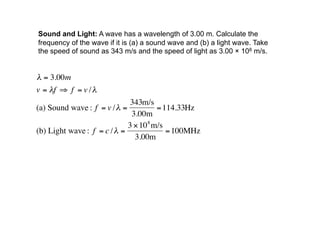
Sound and Light: A wave has a wavelength of 3.00 m. Calculate the
frequency of the wave if it is (a) a sound wave and (b) a light wave. Take
the speed of sound as 343 m/s and the speed of light as 3.00 × 10⁸ m/s.
€
λ = 3.00m
v = λf ⇒ f = v /λ
(a) Sound wave : f = v /λ =
343m/s
3.00m
=114.33Hz
(b) Light wave : f = c /λ =
3 ×10⁸
m/s
3.00m
=100MHz
A Pulse Traveling on a String: A uniform string has a mass M of 0.030 kg
and a length L of 6.00 m. Tension is maintained in the string by suspending
a block of mass m = 2.00 kg from one end (Fig. 13.28). (a) Find the speed of
a transverse wave pulse on this string. (b) Find the time it takes the pulse to
travel from the wall to the pulley. Neglect the mass of the hanging part of the
string.
€
The velocity of a wave on a string is: v =
F
µ
,
where F is the tension in the string and µ is the mass per unit length of the string.
Using Newton's 2nd Law : F = mg = 2.00kg
( ) 9.8m/s2
( ) =19.6 N
Mass per unit length of the string: µ = 0.03kg/6.00m = 0.005 kg/m
v =
19.6 N
0.005 kg/m
= 62.6m/s
t = 5m
( )/ 10.44m/s
( ) = 0.08s
Sound	
  Waves	
  
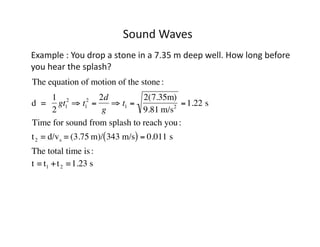
Example	
  :	
  You	
  drop	
  a	
  stone	
  in	
  a	
  7.35	
  m	
  deep	
  well.	
  How	
  long	
  before	
  
you	
  hear	
  the	
  splash?	
  
Sound	
  Waves	
  
Example	
  :	
  You	
  drop	
  a	
  stone	
  in	
  a	
  7.35	
  m	
  deep	
  well.	
  How	
  long	
  before	
  
you	
  hear	
  the	
  splash?	
  
€
The equation of motion of the stone:
d =
1
2
gt1
2
⇒ t1
2
=
2d
g
⇒ t1 =
2(7.35m)
9.81 m/s2 =1.22 s
Time for sound from splash to reach you:
t2 = d/vs = (3.75 m)/(343 m/s) = 0.011 s
The total time is:
t = t1 +t2 =1.23 s

ClassExamplesPeriodicMotionWaves.pdf

  • 1.
    The Period ofa Mass on a Spring Example: A mass of m = 0.12 kg attached to a spring oscillates with an amplitude of 0.075 m and a maximum speed of 0.524 m/s. Find (a) the spring constant, (b) the period of motion. € v = −Aω sin(ωt) = −Aω sin( 2π T t) vmax occurs for sin(ωt) =1⇒ ωt = π 2 The maximum velocity occurs when mass passes the equilibrium position. vmax = Aω ⇒ ω = vmax A = 0.524m /s 0.075m = 7s-1 (a) For a mass on a string: ω = k m ⇒ k = ω2 m = (7s-1 )2 (0.12kg) = 5.86 kg s-2 (b) T = 2π ω = 2π 7s-1 = 0.9s
  • 2.
    The  Period  of  a  Mass  on  a  Spring   Example:      A  mass  of  m  =  0.26  kg  is  abached  to  a  ver:cal  spring.   When  in  mo:on  the  period  is  T  =  1.12s.  (a)  How  much  does  the   mass  stretch  the  spring  when  it  is  in  its  equilibrium  posi:on?  (b)   Suppose  this  experiment  was  performed  on  a  planet  with  twice   the  accelera:on  of  gravity  on  Earth.  By  what  factors  do  the   period  and  equilibrium  posi:on  change?     € (a) When in equilibrium on Earth:(a) mgE = kyE ⇒ yE = mgE k (b) TP = 2π m k = TE , m and k do not depend on gravity and therefore the period of oscillation will not change on planet X. The equilibrium position on planet X will be: yP = m2gE k = 2yE
  • 3.
    Energy  Conserva:on  in  Oscillatory  Mo:on   Stop  the  Block:  A  m  =  0.98kg  block  with  v=1.32  m/s   encounters  a  spring  with  k=245  N/m.  (a)  How  far  is  the  spring   compressed  before  coming  to  a  rest?  (b)  How  long  is  the   block  in  contact  with  the  spring  before  it  comes  to  rest?   € (a) Conservation of Energy:Ei = Ef ⇒ 1 2 mv2 = 1 2 kA2 ⇒ A2 = mv2 k ⇒ A = v m k ⇒ A =1.32m/s 0.98kg 245N/m = 0.083m (b) The block is in contact for a quarter period: t = T/4 t = T 4 = 2π 4 m k = 2π 4 A v = π 2 0.083m 1.32m/s = 0.1s
  • 4.
    Energy  Conserva:on  in  Oscillatory  Mo:on   Bullet-­‐Block  Collision:  A  bullet  of  mass  m  embeds  itself  in  a   block  of  mass  M.  If  the  ini:al  speed  of  the  bullet  is  v0  ,  find  (a)   the  maximum  compression  of  the  spring,  (b)  the  :me  for  the   bullet-­‐block  to  come  to  rest. € (a) Conservation of momentum: Pi = Pf ⇒ mv0 = (m +M)vf ⇒ vf = mv0 (m +M) Conservsation of Mechanical Energy: Ei = Ef ⇒ 1 2 (m+ M)vf 2 = 1 2 kA2 ⇒ 1 2 (m+ M) mv0 (m +M) ⎡ ⎣ ⎢ ⎤ ⎦ ⎥ 2 = 1 2 kA2 ⇒ mv0 ( ) 2 (m+ M) = kA2 ⇒ A = mv0 ( ) k(m+ M) (b) The block is in contact t = T 4 = 2π 4 m +M k
  • 5.
    Simple Harmonic Motionon a Frictionless Surface: A 0.350-kg object attached to a spring of force constant 1.30 × 10² N/m is free to move on a frictionless horizontal surface, as in Active Figure 13.1. If the object is released from rest at x = 0.100 m, find the force on it and its acceleration at x = 0.100 m, x = 0.050 0 m, x = 0 m, x = 20.050 m, and x = 20.100 m. m = 0.350kg, k =1.3 ×10² N/m, A = 0.1m ω2 = k m = 1.3 ×10² N/m 0.350kg = 371.4 N m kg F(x) = −kx a(x) = −Aω2 cos ωt ( ) = −ω2 x
  • 6.
    Mass  on  a  Ver7cal  Spring:  A  spring  is  hung  ver:cally  (Fig.  13.2a),  and  an  object  of  mass   m  abached  to  the  lower  end  is  then  slowly  lowered  a  distance  d  to  the  equilibrium  point   (Fig.  13.2b).  (a)  Find  the  value  of  the  spring  constant  if  the  spring  is  displaced  by  2.0  cm   and  the  mass  is  0.55  kg.  (b)  If  a  second  iden:cal  spring  is  abached  to  the  object  in   parallel  with  the  first  spring  (Fig.  13.2d),  where  is  the  new  equilibrium  point  of  the   system?  (c)  What  is  the  effec:ve  spring  constant  of  the  two  springs  ac:ng  as  one?   € (a) mg = kd ⇒ k = mg d = 0.55kg ( ) 9.80m/s2 ( ) 0.02m = 269.5kg/s2 (b) mg = 2kd1 ⇒ d1 = mg 2k = 0.55kg ( ) 9.80m/s2 ( ) 2 269.5kg/s2 ( ) = 0.01m (c) mg = keff d1 ⇒ keff = mg d1 = 539kg/s2
  • 7.
    Stop  That  Car!:  A  13  000-­‐N  car  starts  at  rest  and  rolls  down  a  hill  from  a  height  of  10.0   m  (Fig.  13.6).  It  then  moves  across  a  level  surface  and  collides  with  a  light  spring-­‐ loaded  guard-­‐rail.  (a)  Neglec:ng  any  losses  due  to  fric:on,  and  ignoring  the  rota:onal   kine:c  energy  of  the  wheels,  find  the  maximum  distance  the  spring  is  compressed.   Assume  a  spring  constant  of  1.0  ×  106  N/m.  (b)  Calculate  the  maximum  accelera:on   of  the  car  amer  contact  with  the  spring,  assuming  no  fric:onal  losses.  (c)  If  the  spring   is  compressed  by  only  0.30  m,  find  the  change  in  the  mechanical  energy  due  to   fric:on.   € (a) Conservation of energy: PE →KE →PE mgh = 1 2 mv2 = 1 2 kx2 ⇒ x2 = 2mgh k ⇒ x = 2mgh k = 2 13000 ( ) 10m ( ) 1.0 ×10⁶ N/m = 0.51m (b) a = -Aω2 cos ωt ( ) ⇒ amax = Aω2 (1) ω = 2π T = k m = 1.0 ×10⁶ N/m 13000 N ( )/ 9.8 m/s2 ( ) = 27.5 Hz (2) (1)^(2) ⇒ amax = 0.51m ( ) 27.5 Hz ( )2 = 385.7m/s2 (c) Wnc = ΔE = E f - Ei = 1 2 k(0.3m)2 − (mgh) ⇒ 0.5 ( ) 1.0 ×10⁶ N/m ( )(0.3m)2 − 13000 N ( ) 10m ( ) = −8.5 ×10⁵ J
  • 8.
    The  Object–Spring  System  Revisited:  A  0.500-­‐kg  object  connected  to  a  light  spring   with  a  spring  constant  of  20.0  N/m  oscillates  on  a  fric:on-­‐less  horizontal  surface.  (a)   Calculate  the  total  energy  of  the  system  and  the  maximum  speed  of  the  object  if  the   amplitude  of  the  mo:on  is  3.00  cm.  (b)  What  is  the  velocity  of  the  object  when  the   displacement  is  2.00  cm?  (c)  Compute  the  kine:c  and  poten:al  energies  of  the  system   when  the  displacement  is  2.00  cm.   € (a) Etot = 1 2 kA2 = 0.5 ( ) 20 N/m ( ) 0.03m ( )2 = 0.009J (b) Etot = 0.009J = 1 2 mv2 + 1 2 k(0.02m)2 ⇒ v = ±0.141m/s (c) KE(0.02m) = 1 2 mv2 = 0.5 0.5kg ( ) 0.14m/s ( )2 = 0.005J PE = 0.009J - 0.005J = 0.004J or PE = 1 2 kx2 = 0.5 20 N/m ( ) 0.02m ( )2 = 0.004J
  • 9.
    That  Car  Needs  Shock  Absorbers!:  A  1.30  ×  103-­‐kg  car  is  constructed  on  a  frame   supported  by  four  springs.  Each  spring  has  a  spring  constant  of  2.00  ×  104  N/m.  If   two  people  riding  in  the  car  have  a  combined  mass  of  1.60  ×  102  kg,  find  the   frequency  of  vibra:on  of  the  car  when  it  is  driven  over  a  pothole  in  the  road.  Find   also  the  period  and  the  angular  frequency.  Assume  the  weight  is  evenly  distributed.   € Effective spring constant : mtotalg = 4kx ⇒ keff = 4k ω = 4k m = 4 2 ×10⁴ N/m ( ) 1.46 ×10³ kg = 7.4Hz ω = 2π T = 2πf ⇒ f = ω 2π = 7.4Hz 2π =1.18Hz T = 2π ω = 2π 7.4Hz = 0.85s
  • 10.
    The  Vibra7ng  Object–Spring  System:  (a)  Find  the  amplitude,  frequency,  and  period  of   mo:on  for  an  object  vibra:ng  at  the  end  of  a  horizontal  spring  if  the  equa:on  for  its   posi:on  as  a  func:on  of  :me  is       (b)  Find  the  maximum  magnitude  of  the  velocity  and  accelera:on.  (c)  What  are  the   posi:on,  velocity,  and  accelera:on  of  the  object  amer  1.00  s  has  elapsed?   € x = 0.250 m ( )cos π 8.00 t ⎛ ⎝ ⎜ ⎞ ⎠ ⎟
  • 11.
    The  Vibra7ng  Object–Spring  System:  (a)  Find  the  amplitude,  frequency,  and  period  of   mo:on  for  an  object  vibra:ng  at  the  end  of  a  horizontal  spring  if  the  equa:on  for  its   posi:on  as  a  func:on  of  :me  is       (b)  Find  the  maximum  magnitude  of  the  velocity  and  accelera:on.  (c)  What  are  the   posi:on,  velocity,  and  accelera:on  of  the  object  amer  1.00  s  has  elapsed?   € x = 0.250 m ( )cos π 8.00 t ⎛ ⎝ ⎜ ⎞ ⎠ ⎟ € (a) ω = π 8 Hz A = 0.250m f = ω 2π = π 8 Hz 2π = 1 16 Hz T = 2π ω = 2π π 8 Hz =16s (b) vmax = - Aω = − 0.250m ( ) π 8 Hz ⎛ ⎝ ⎜ ⎞ ⎠ ⎟ = 0.098 m/s amax = -Aω2 = − 0.250m ( ) π 8 Hz ⎛ ⎝ ⎜ ⎞ ⎠ ⎟ 2 = 0.039 m/s2 (c) x(1s) = (0.25m)cos π 8 v(1s) = −(0.25m) π 8 Hz ⎛ ⎝ ⎜ ⎞ ⎠ ⎟sin π 8 a(1s) = −(0.25m) π 8 Hz ⎛ ⎝ ⎜ ⎞ ⎠ ⎟ 2 cos π 8
  • 12.
    € A Traveling Wave:A wave traveling in the positive x-direction is pictured in Figure 13.27a. Find the amplitude, wavelength, speed, and period of the wave if it has a frequency of 8.00 Hz. In Figure 13.27a, Δx = 40.0 cm and Δy = 15.0 cm. frequency: f = 8.00Hz Amplitude : A = Δy =15.0 cm Wavelength :λ = Δx = 40.0 cm Speed : v = λf = (0.40 m)(8.00Hz) =3.2m/s Period:P =1/f =1/8.00Hz =0.125s
  • 13.
    Sound and Light:A wave has a wavelength of 3.00 m. Calculate the frequency of the wave if it is (a) a sound wave and (b) a light wave. Take the speed of sound as 343 m/s and the speed of light as 3.00 × 10⁸ m/s. € λ = 3.00m v = λf ⇒ f = v /λ (a) Sound wave : f = v /λ = 343m/s 3.00m =114.33Hz (b) Light wave : f = c /λ = 3 ×10⁸ m/s 3.00m =100MHz
  • 14.
    A Pulse Travelingon a String: A uniform string has a mass M of 0.030 kg and a length L of 6.00 m. Tension is maintained in the string by suspending a block of mass m = 2.00 kg from one end (Fig. 13.28). (a) Find the speed of a transverse wave pulse on this string. (b) Find the time it takes the pulse to travel from the wall to the pulley. Neglect the mass of the hanging part of the string. € The velocity of a wave on a string is: v = F µ , where F is the tension in the string and µ is the mass per unit length of the string. Using Newton's 2nd Law : F = mg = 2.00kg ( ) 9.8m/s2 ( ) =19.6 N Mass per unit length of the string: µ = 0.03kg/6.00m = 0.005 kg/m v = 19.6 N 0.005 kg/m = 62.6m/s t = 5m ( )/ 10.44m/s ( ) = 0.08s
  • 15.
    Sound  Waves   Example  :  You  drop  a  stone  in  a  7.35  m  deep  well.  How  long  before   you  hear  the  splash?  
  • 16.
    Sound  Waves   Example  :  You  drop  a  stone  in  a  7.35  m  deep  well.  How  long  before   you  hear  the  splash?   € The equation of motion of the stone: d = 1 2 gt1 2 ⇒ t1 2 = 2d g ⇒ t1 = 2(7.35m) 9.81 m/s2 =1.22 s Time for sound from splash to reach you: t2 = d/vs = (3.75 m)/(343 m/s) = 0.011 s The total time is: t = t1 +t2 =1.23 s