GERMAN CULTURE
DRIVERS OF GERMAN
CULTURE
 Power Distance
Power Distance is defined as the extent to which the less powerful members of
institutions and organisations within a country expect and accept that power is
distributed unequally.
 Highly decentralised and supported by a strong middle class,
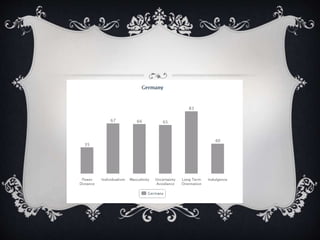
 Germany is not surprisingly among the lower power distant countries (score 35).
 Control is disliked and leadership is challenged to show expertise and best
accepted when it’s based on it.
 Individualism
The degree of interdependence a society maintains among its members. In Individualist societies
people are supposed to look after themselves and their direct family only. In Collectivist societies
people belong to ‘in groups’ that take care of them in exchange for loyalty.
 The German society is a truly Individualist one (67).
 Small families with a focus on the parent-children relationship rather than aunts and uncles
are most common.
 The Loyalty is based on personal preferences for people as well as a sense of duty and
responsibility. .
 Masculinity
A high score (Masculine) on this dimension indicates that the society will be driven by competition, achievement
and success.
A low score (Feminine) on the dimension means that the dominant values in society are caring for others and
quality of life.
 With a score of 66 Germany is considered a Masculine society.
 Performance is highly valued
 People draw a lot of self-esteem from their tasks.
 Status is often shown, especially by cars, watches and technical devices.
 Uncertainty Avoidance
The dimension Uncertainty Avoidance has to do with the way that a society deals
with the fact that the future can never be known: should we try to control the future
or just let it happen?
 Germany is among the uncertainty avoidant countries (65); the score is on the
high end, so there is a slight preference for Uncertainty Avoidance.
 Germans prefer to compensate for their higher uncertainty by strongly relying
on expertise.
 Long Term Orientation
This dimension describes how every society has to maintain some links with its own past while
dealing with the challenges of the present and future, and societies prioritise these two existential
goals differently.
 Germany's high score of 83 indicates that it is a pragmatic country. In societies with a
pragmatic orientation, people believe that truth depends very much on situation, context and
time. They show an ability to adapt traditions easily to changed conditions, a strong propensity to
save and invest, thriftiness, and perseverance in achieving results.
 Indulgence
One challenge that confronts humanity, now and in the past, is the degree to which small children are socialized.
Without socialization we do not become “human”. This dimension is defined as the extent to which people try to
control their desires and impulses, based on the way they were raised. Relatively weak control is called
“Indulgence” and relatively strong control is called “Restraint”. Cultures can, therefore, be described as Indulgent
or Restrained.
 The low score of 40 on this dimension indicates that the German culture is Restrained in nature. Societies
with a low score in this dimension have a tendency to cynicism and pessimism. Also, in contrast to Indulgent
societies, Restrained societies do not put much emphasis on leisure time and control the gratification of their
desires. People with this orientation have the perception that their actions are Restrained by social norms and feel
that indulging themselves is somewhat wrong.
German culture

German culture

  • 1.
  • 2.
    DRIVERS OF GERMAN CULTURE Power Distance Power Distance is defined as the extent to which the less powerful members of institutions and organisations within a country expect and accept that power is distributed unequally.  Highly decentralised and supported by a strong middle class,  Germany is not surprisingly among the lower power distant countries (score 35).  Control is disliked and leadership is challenged to show expertise and best accepted when it’s based on it.
  • 3.
     Individualism The degreeof interdependence a society maintains among its members. In Individualist societies people are supposed to look after themselves and their direct family only. In Collectivist societies people belong to ‘in groups’ that take care of them in exchange for loyalty.  The German society is a truly Individualist one (67).  Small families with a focus on the parent-children relationship rather than aunts and uncles are most common.  The Loyalty is based on personal preferences for people as well as a sense of duty and responsibility. .
  • 4.
     Masculinity A highscore (Masculine) on this dimension indicates that the society will be driven by competition, achievement and success. A low score (Feminine) on the dimension means that the dominant values in society are caring for others and quality of life.  With a score of 66 Germany is considered a Masculine society.  Performance is highly valued  People draw a lot of self-esteem from their tasks.  Status is often shown, especially by cars, watches and technical devices.
  • 5.
     Uncertainty Avoidance Thedimension Uncertainty Avoidance has to do with the way that a society deals with the fact that the future can never be known: should we try to control the future or just let it happen?  Germany is among the uncertainty avoidant countries (65); the score is on the high end, so there is a slight preference for Uncertainty Avoidance.  Germans prefer to compensate for their higher uncertainty by strongly relying on expertise.
  • 6.
     Long TermOrientation This dimension describes how every society has to maintain some links with its own past while dealing with the challenges of the present and future, and societies prioritise these two existential goals differently.  Germany's high score of 83 indicates that it is a pragmatic country. In societies with a pragmatic orientation, people believe that truth depends very much on situation, context and time. They show an ability to adapt traditions easily to changed conditions, a strong propensity to save and invest, thriftiness, and perseverance in achieving results.
  • 7.
     Indulgence One challengethat confronts humanity, now and in the past, is the degree to which small children are socialized. Without socialization we do not become “human”. This dimension is defined as the extent to which people try to control their desires and impulses, based on the way they were raised. Relatively weak control is called “Indulgence” and relatively strong control is called “Restraint”. Cultures can, therefore, be described as Indulgent or Restrained.  The low score of 40 on this dimension indicates that the German culture is Restrained in nature. Societies with a low score in this dimension have a tendency to cynicism and pessimism. Also, in contrast to Indulgent societies, Restrained societies do not put much emphasis on leisure time and control the gratification of their desires. People with this orientation have the perception that their actions are Restrained by social norms and feel that indulging themselves is somewhat wrong.