Nationality and Identity Issues
in Conflict Management
Tarmo Tuisk
Tallinn University of Technology
28.07.2017
National Cultural Dimensions
Geert Hofstede: “Culture is the collective
programming of the mind distinguishing the
members of one group or category of people
from others”
Hofstede, G. Cultures and Organizations:
Software of the Mind. Third Edition. 2010.
Dimensions of National Culture
• Power Distance (PDI)
• Individualism versus Collectivism (IDV)
• Masculinity versus Femininity (MAS)
• Uncertainty Avoidance (UAI)
• Long-Term Orientation (LTO) (added by
Michael Bond, 1991)
• Indulgence versus Restraint (added by
Michael Minkov, 2010)
Power Distance
This dimension expresses the degree to which the
less powerful members of a society accept and
expect that power is distributed unequally.
People in societies exhibiting a large degree of
power distance accept a hierarchical order in
which everybody has a place and which needs
no further justification.
In societies with low power distance, people strive
to equalise the distribution of power and demand
justification for inequalities of power.
Individualism vs Collectivism
The high side of this dimension, called Individualism, can
be defined as a preference for a loosely-knit social
framework in which individuals are expected to take care
of themselves and their immediate families only.
Collectivism, represents a preference for a tightly-knit
framework in society in which individuals can expect
their relatives or members of a particular in-group to look
after them in exchange for unquestioning loyalty.
A society's position on this dimension is reflected in
whether people’s self-image is defined in terms of “I” or
“we.”
Masculinity vs. Feminity
The masculinity side of this dimension represents
a preference in society for achievement,
heroism, assertiveness and material reward for
success. Society at large is more competitive.
Its opposite, femininity, stands for a preference
for co-operation, modesty, caring for the weak
and quality of life. Society at large is more
consensus-oriented.
Uncertainty Avoidance
• The uncertainty avoidance dimension expresses
the degree to which the members of a society
feel uncomfortable with uncertainty and
ambiguity.
• Countries exhibiting strong UA maintain rigid
codes of belief and behaviour and are intolerant
of unorthodox behaviour and ideas.
• Weak UA societies maintain a more relaxed
attitude in which practice counts more than
principles.
Long-term vs. Short-term
Orientation
• In societies with a long-term orientation,
people believe that truth depends very much on
situation, context and time. They show an ability
to adapt traditions to changed conditions, a
strong propensity to save and invest, thriftiness,
and perseverance in achieving results.
• Societies with a short-term orientation
generally have a strong concern with
establishing the absolute Truth. They are
normative in their thinking. They exhibit great
respect for traditions, a relatively small
propensity to save for the future, and a focus on
achieving quick results.
Indulgence vs. Restraint
• Indulgence stands for a society that
allows relatively free gratification of basic
and natural human drives related to
enjoying life and having fun.
• Restraint stands for a society that
suppresses gratification of needs and
regulates it by means of strict social
norms.
Comparison of Dimensions
The country scores on the dimensions are relative -
societies are compared to other societies. Without
making any comparison each country score is
meaningless.
These relative scores have been proven to be quite stable
over decades. The forces that cause cultures to shift
tend to be global or continent-wide.
This means that they affect many countries at the same
time, so that if their cultures shift, they shift together, and
their relative positions remain the same.
Estonia, Latvia, Lithuania
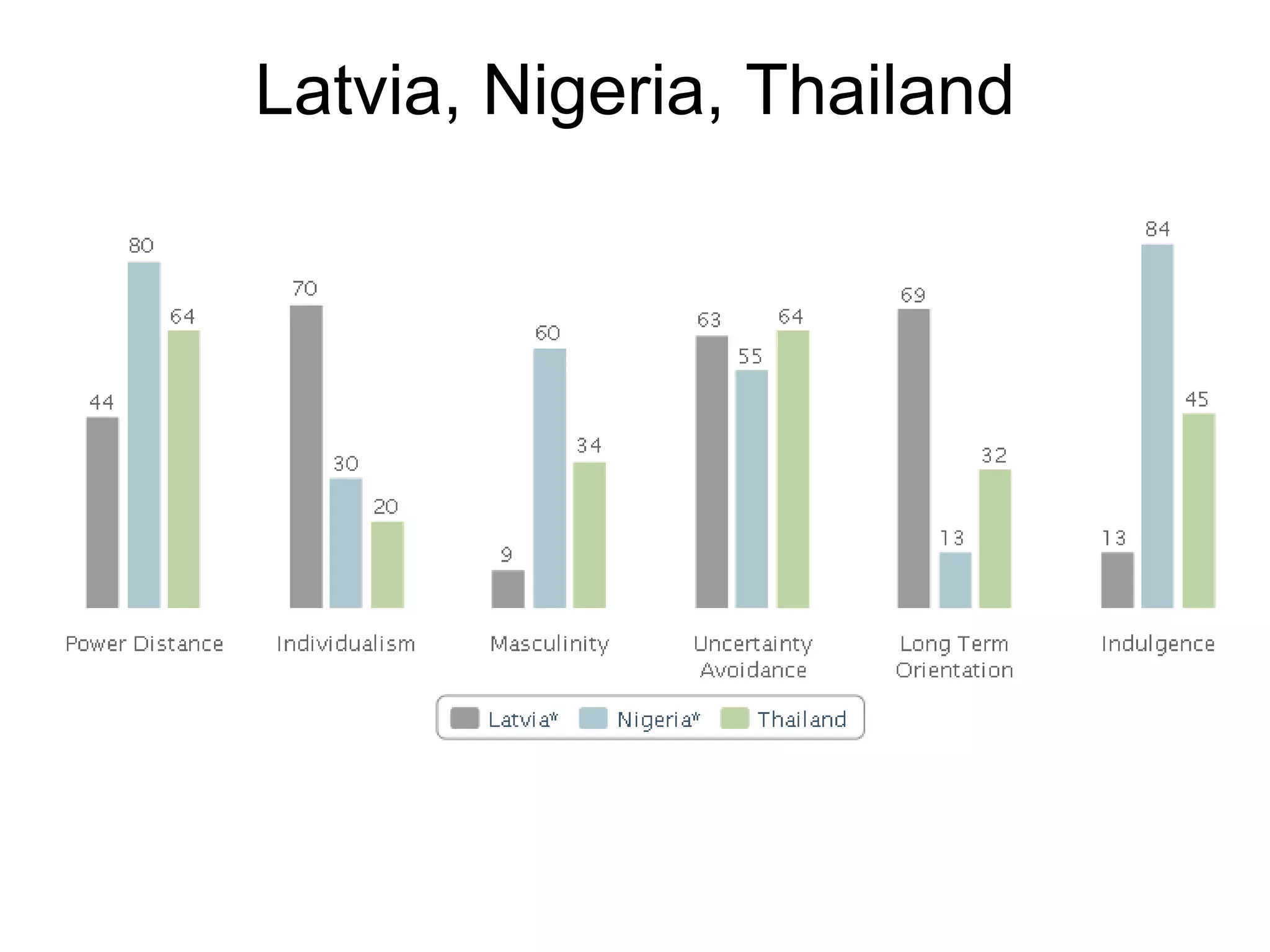
Latvia, Nigeria, Thailand
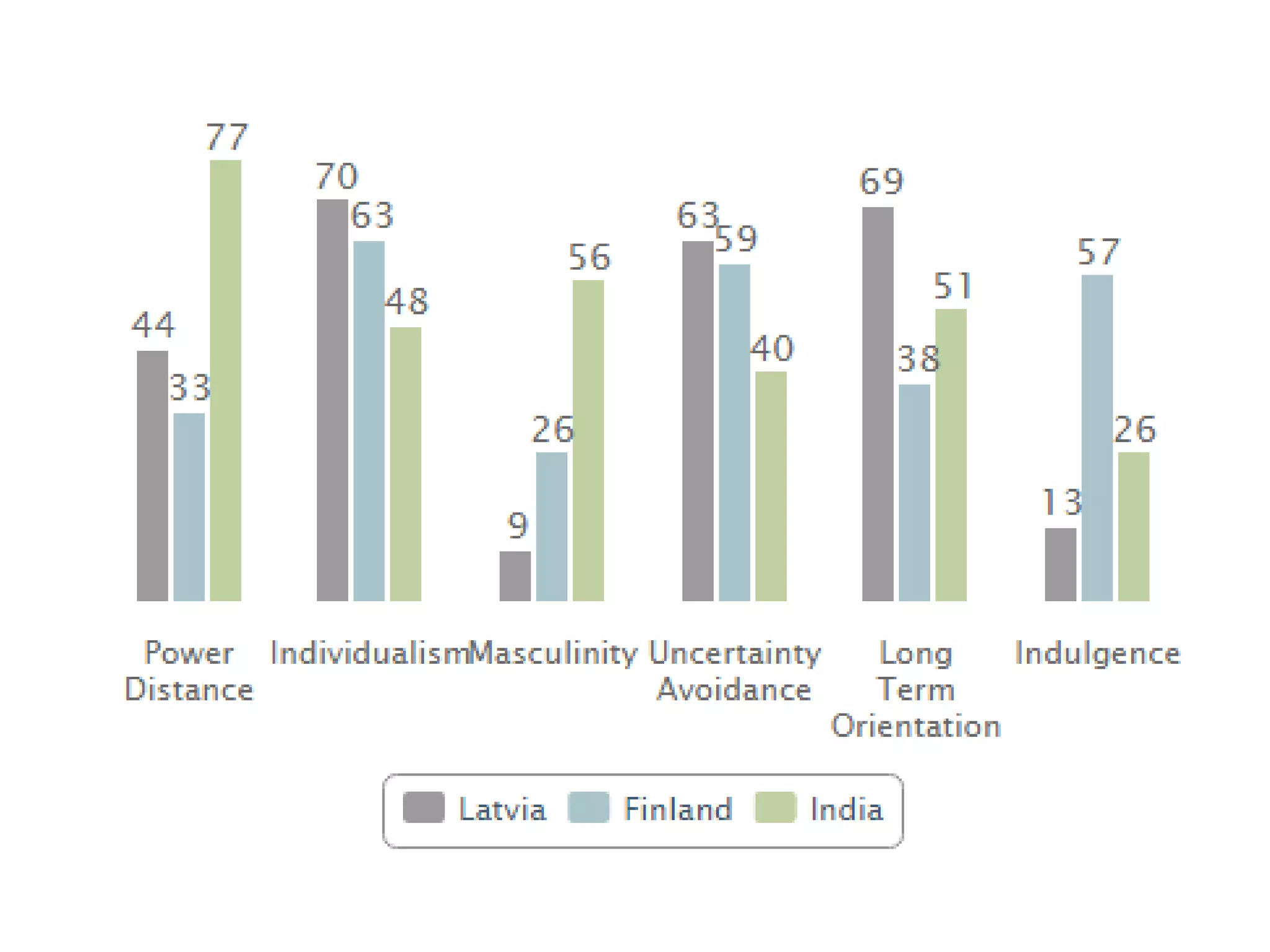
Estonia, Finland, Nigeria
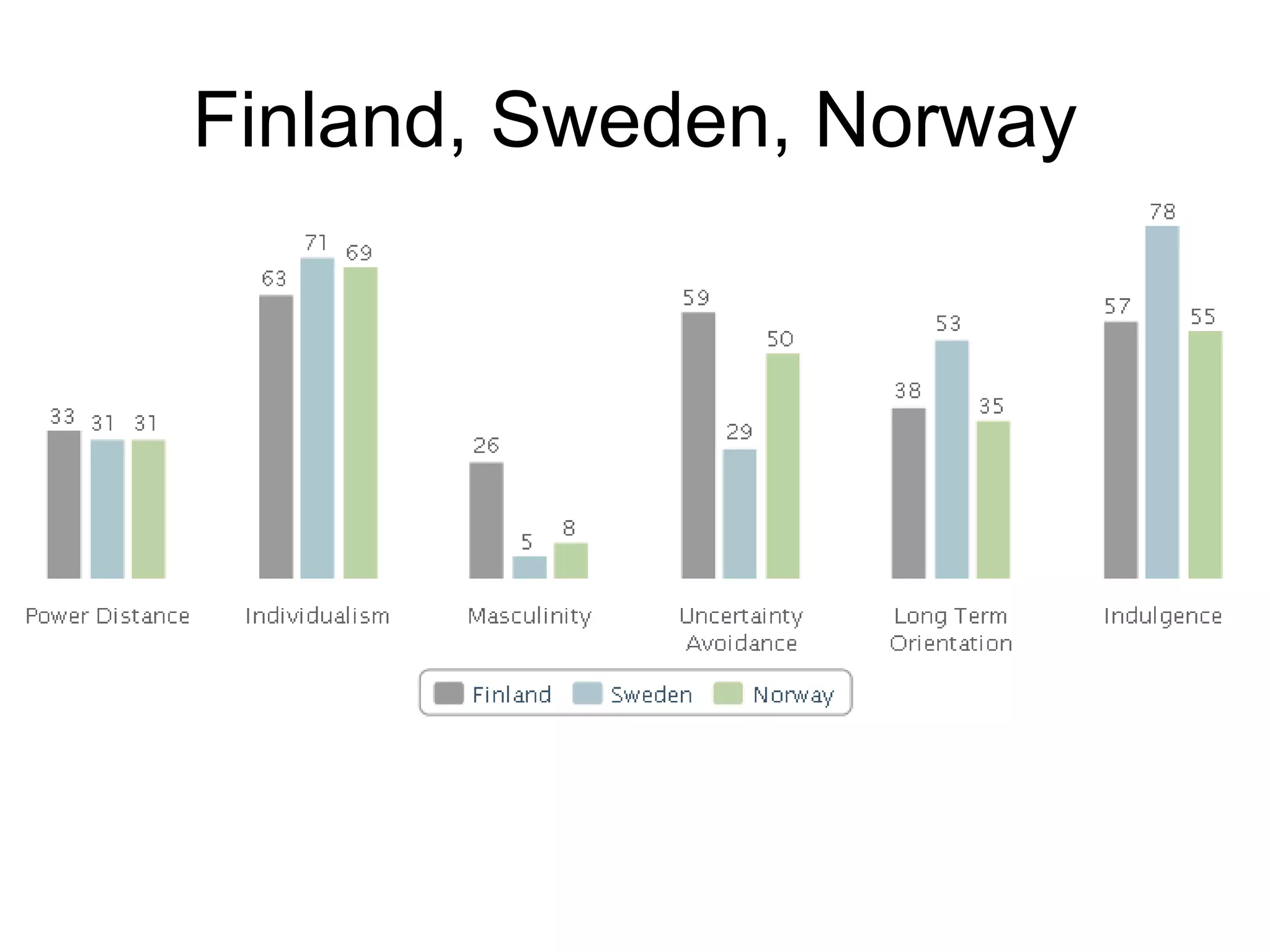
Finland, Sweden, Norway
Lithuania, USA, Russia
UK, Germany, France
Literature and Links
Hall, E.T., Hall, M.R. (1990). Understanding Cultural Differerences: Germans,
French and Americans. Intercultural Press, 3-29.
Hofstede, G., Hofstede, G. J. & Minkov. M. (2010). Cultures and Organizations:
Software of the Mind. Third Edition. 576 pages.
Hofstede, G. National Cultural Dimensions. http://geert-hofstede.com/national-
culture.html

6-nationality-and-identity.ppt

  • 1.
    Nationality and IdentityIssues in Conflict Management Tarmo Tuisk Tallinn University of Technology 28.07.2017
  • 2.
    National Cultural Dimensions GeertHofstede: “Culture is the collective programming of the mind distinguishing the members of one group or category of people from others” Hofstede, G. Cultures and Organizations: Software of the Mind. Third Edition. 2010.
  • 3.
    Dimensions of NationalCulture • Power Distance (PDI) • Individualism versus Collectivism (IDV) • Masculinity versus Femininity (MAS) • Uncertainty Avoidance (UAI) • Long-Term Orientation (LTO) (added by Michael Bond, 1991) • Indulgence versus Restraint (added by Michael Minkov, 2010)
  • 4.
    Power Distance This dimensionexpresses the degree to which the less powerful members of a society accept and expect that power is distributed unequally. People in societies exhibiting a large degree of power distance accept a hierarchical order in which everybody has a place and which needs no further justification. In societies with low power distance, people strive to equalise the distribution of power and demand justification for inequalities of power.
  • 5.
    Individualism vs Collectivism Thehigh side of this dimension, called Individualism, can be defined as a preference for a loosely-knit social framework in which individuals are expected to take care of themselves and their immediate families only. Collectivism, represents a preference for a tightly-knit framework in society in which individuals can expect their relatives or members of a particular in-group to look after them in exchange for unquestioning loyalty. A society's position on this dimension is reflected in whether people’s self-image is defined in terms of “I” or “we.”
  • 6.
    Masculinity vs. Feminity Themasculinity side of this dimension represents a preference in society for achievement, heroism, assertiveness and material reward for success. Society at large is more competitive. Its opposite, femininity, stands for a preference for co-operation, modesty, caring for the weak and quality of life. Society at large is more consensus-oriented.
  • 7.
    Uncertainty Avoidance • Theuncertainty avoidance dimension expresses the degree to which the members of a society feel uncomfortable with uncertainty and ambiguity. • Countries exhibiting strong UA maintain rigid codes of belief and behaviour and are intolerant of unorthodox behaviour and ideas. • Weak UA societies maintain a more relaxed attitude in which practice counts more than principles.
  • 8.
    Long-term vs. Short-term Orientation •In societies with a long-term orientation, people believe that truth depends very much on situation, context and time. They show an ability to adapt traditions to changed conditions, a strong propensity to save and invest, thriftiness, and perseverance in achieving results. • Societies with a short-term orientation generally have a strong concern with establishing the absolute Truth. They are normative in their thinking. They exhibit great respect for traditions, a relatively small propensity to save for the future, and a focus on achieving quick results.
  • 9.
    Indulgence vs. Restraint •Indulgence stands for a society that allows relatively free gratification of basic and natural human drives related to enjoying life and having fun. • Restraint stands for a society that suppresses gratification of needs and regulates it by means of strict social norms.
  • 10.
    Comparison of Dimensions Thecountry scores on the dimensions are relative - societies are compared to other societies. Without making any comparison each country score is meaningless. These relative scores have been proven to be quite stable over decades. The forces that cause cultures to shift tend to be global or continent-wide. This means that they affect many countries at the same time, so that if their cultures shift, they shift together, and their relative positions remain the same.
  • 11.
  • 13.
  • 14.
  • 15.
  • 16.
  • 17.
  • 18.
    Literature and Links Hall,E.T., Hall, M.R. (1990). Understanding Cultural Differerences: Germans, French and Americans. Intercultural Press, 3-29. Hofstede, G., Hofstede, G. J. & Minkov. M. (2010). Cultures and Organizations: Software of the Mind. Third Edition. 576 pages. Hofstede, G. National Cultural Dimensions. http://geert-hofstede.com/national- culture.html