Geotechnical Earthquake
Engineering
by
Dr. Deepankar Choudhury
Professor
Department of Civil Engineering
IIT Bombay, Powai, Mumbai 400 076, India.
Email: dc@civil.iitb.ac.in
URL: http://www.civil.iitb.ac.in/~dc/
Lecture - 5
IIT Bombay, DC 2
Module – 3
Engineering Seismology
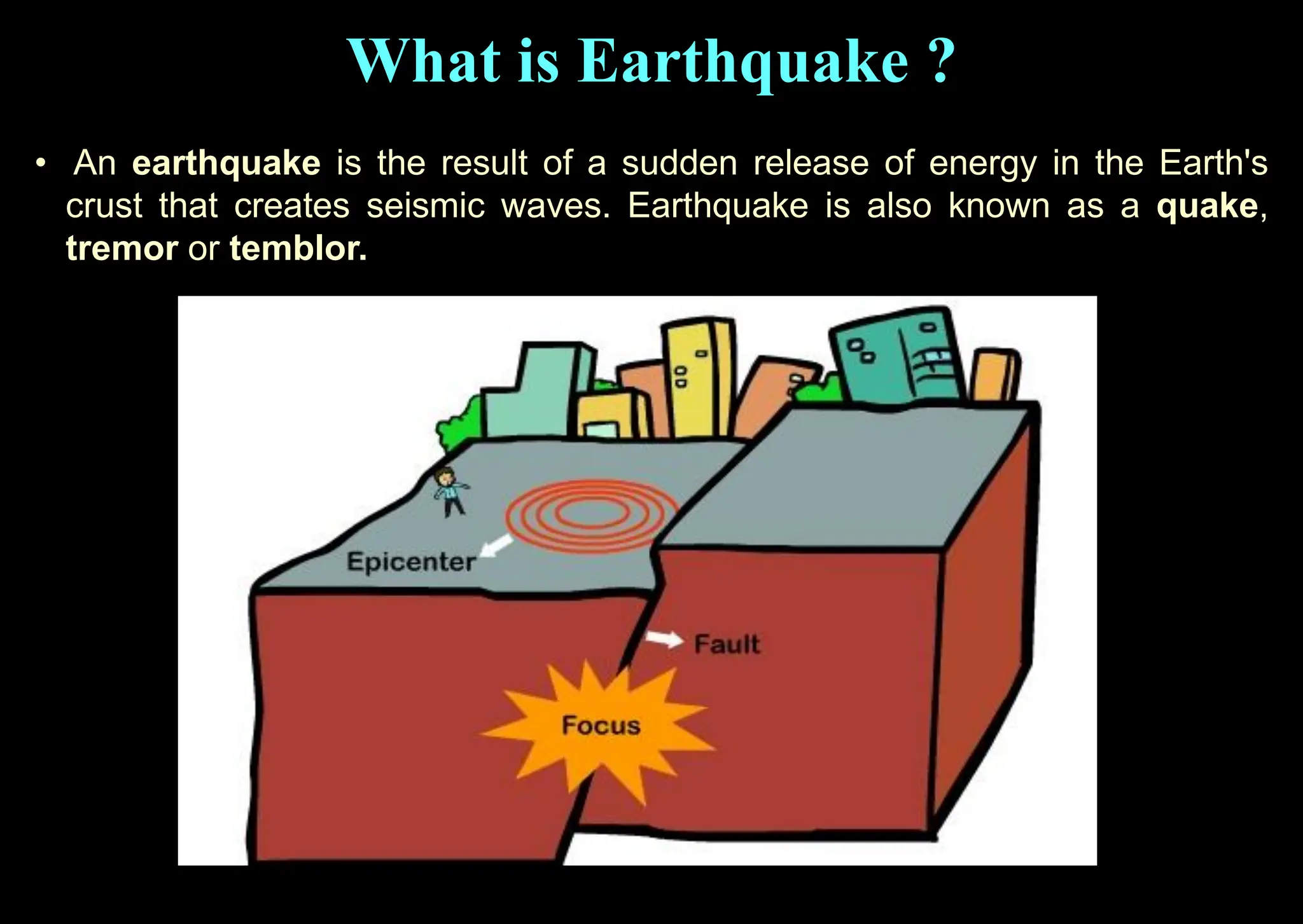
What is Earthquake ?
• An earthquake is the result of a sudden release of energy in the Earth's
crust that creates seismic waves. Earthquake is also known as a quake,
tremor or temblor.
IIT Bombay, DC 4
What causes an Earthquake?
Movement of Tectonic Plates
Earth is divided into sections called Tectonic
plates that float on the fluid-like interior of the
Earth. Earthquakes are usually caused by
sudden movement of earth plates
Rupture of rocks along a fault
Faults are localized areas of weakness in the
surface of the Earth,sometimes the plate
boundary itself
Why an earthquake occurs?
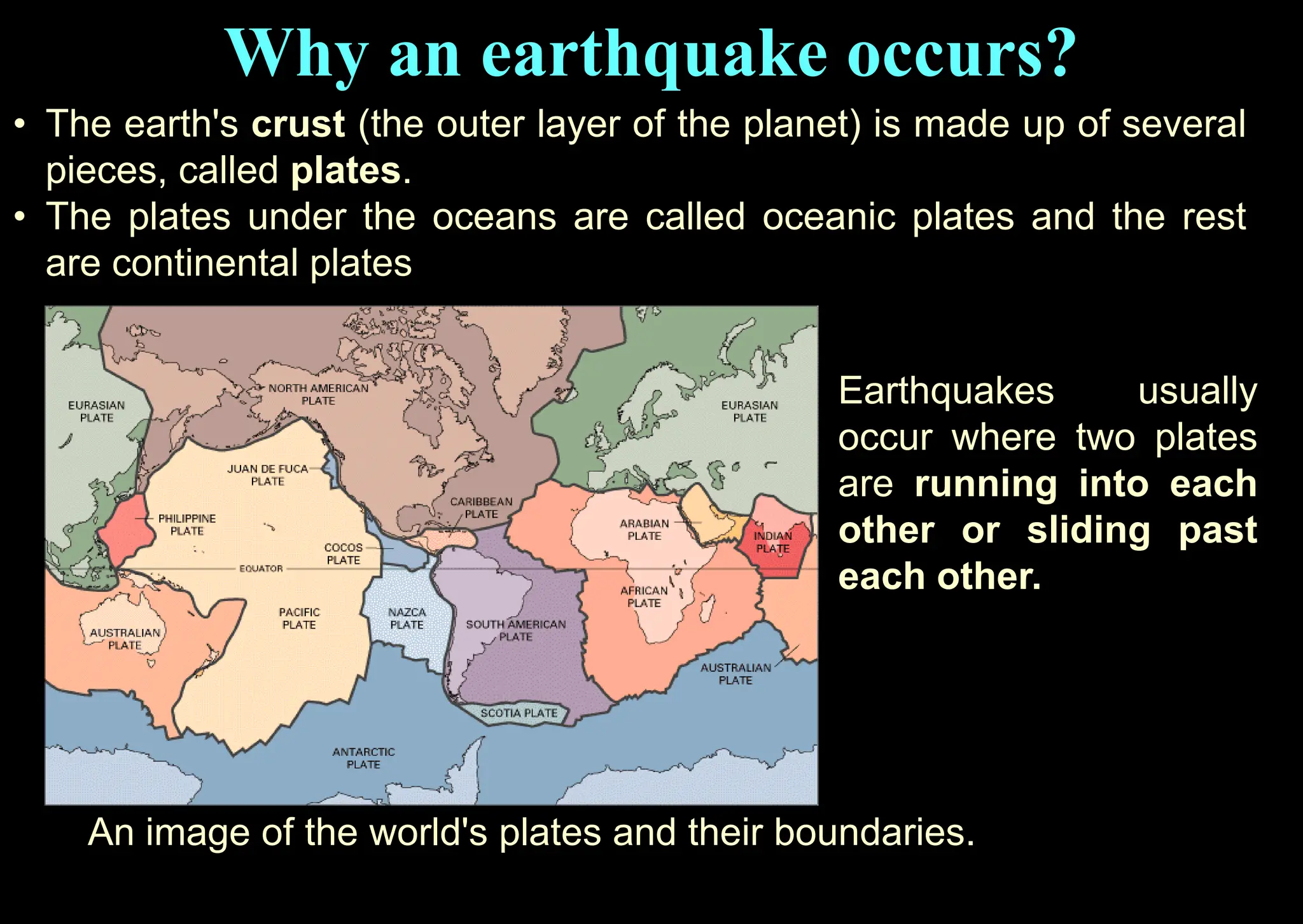
• The earth's crust (the outer layer of the planet) is made up of several
pieces, called plates.
• The plates under the oceans are called oceanic plates and the rest
are continental plates
Earthquakes usually
occur where two plates
are running into each
other or sliding past
each other.
An image of the world's plates and their boundaries.
IIT Bombay, DC 6
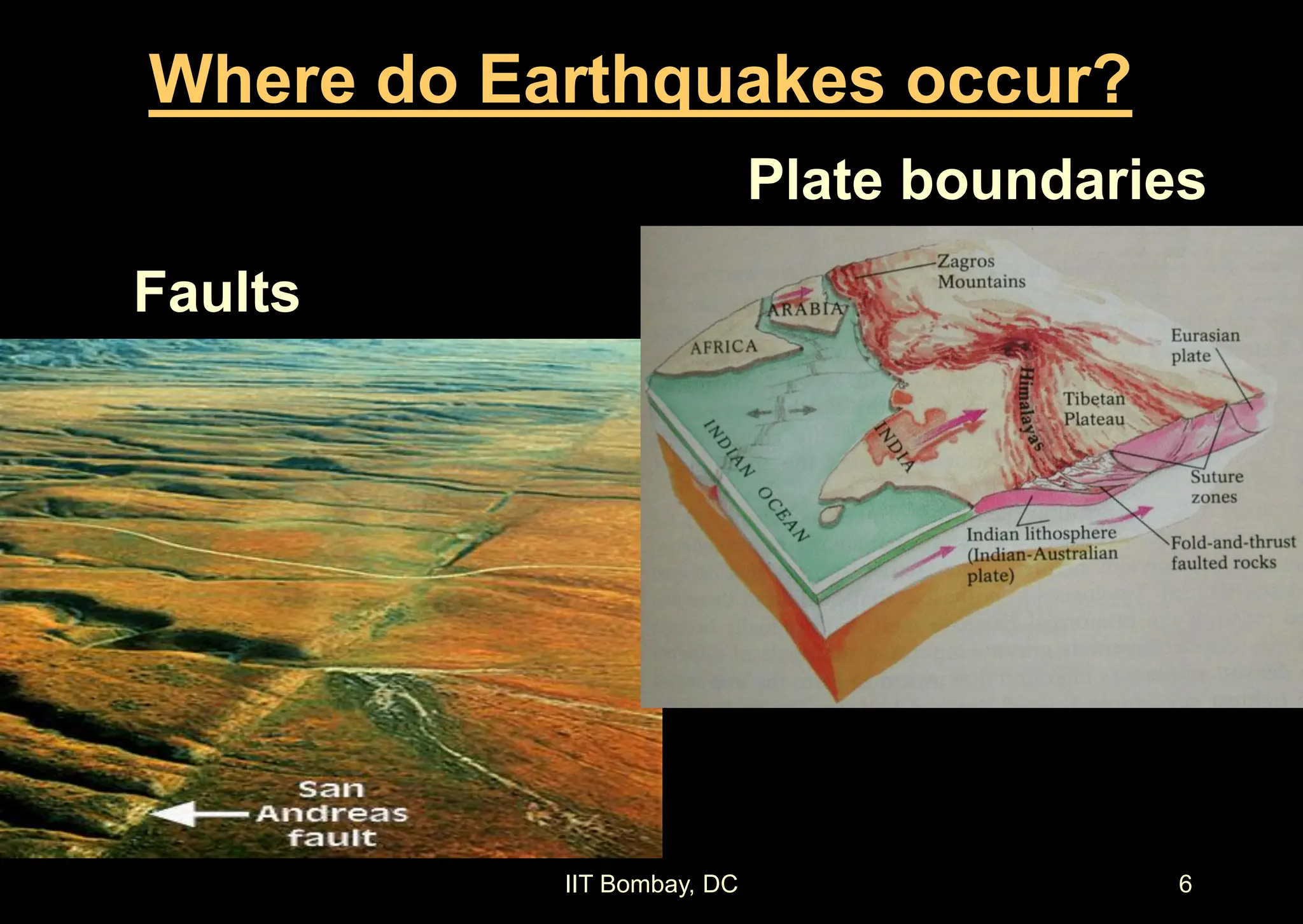
Where do Earthquakes occur?
Plate boundaries
Faults
IIT Bombay, DC 7
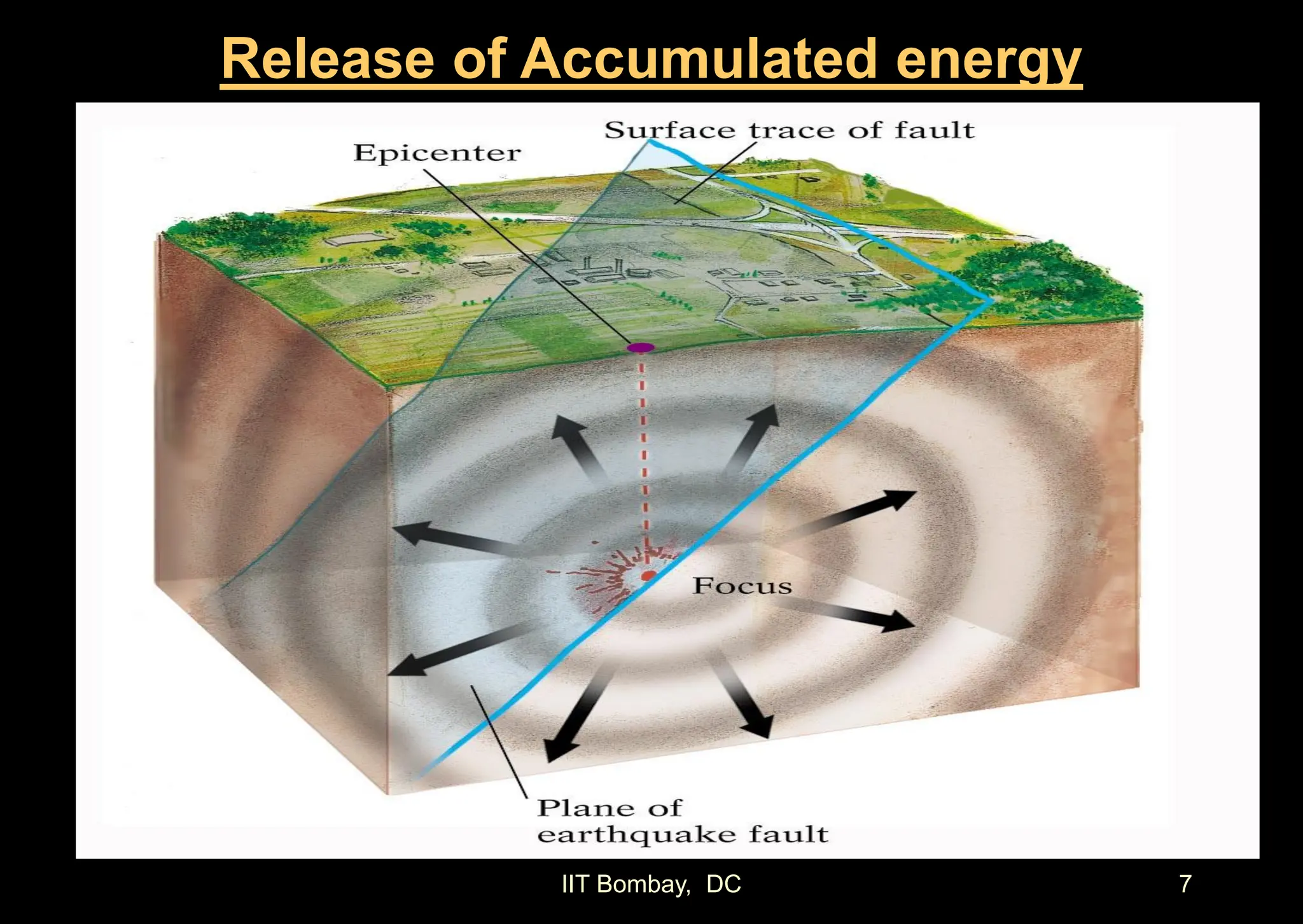
Release of Accumulated energy
IIT Bombay, DC 8
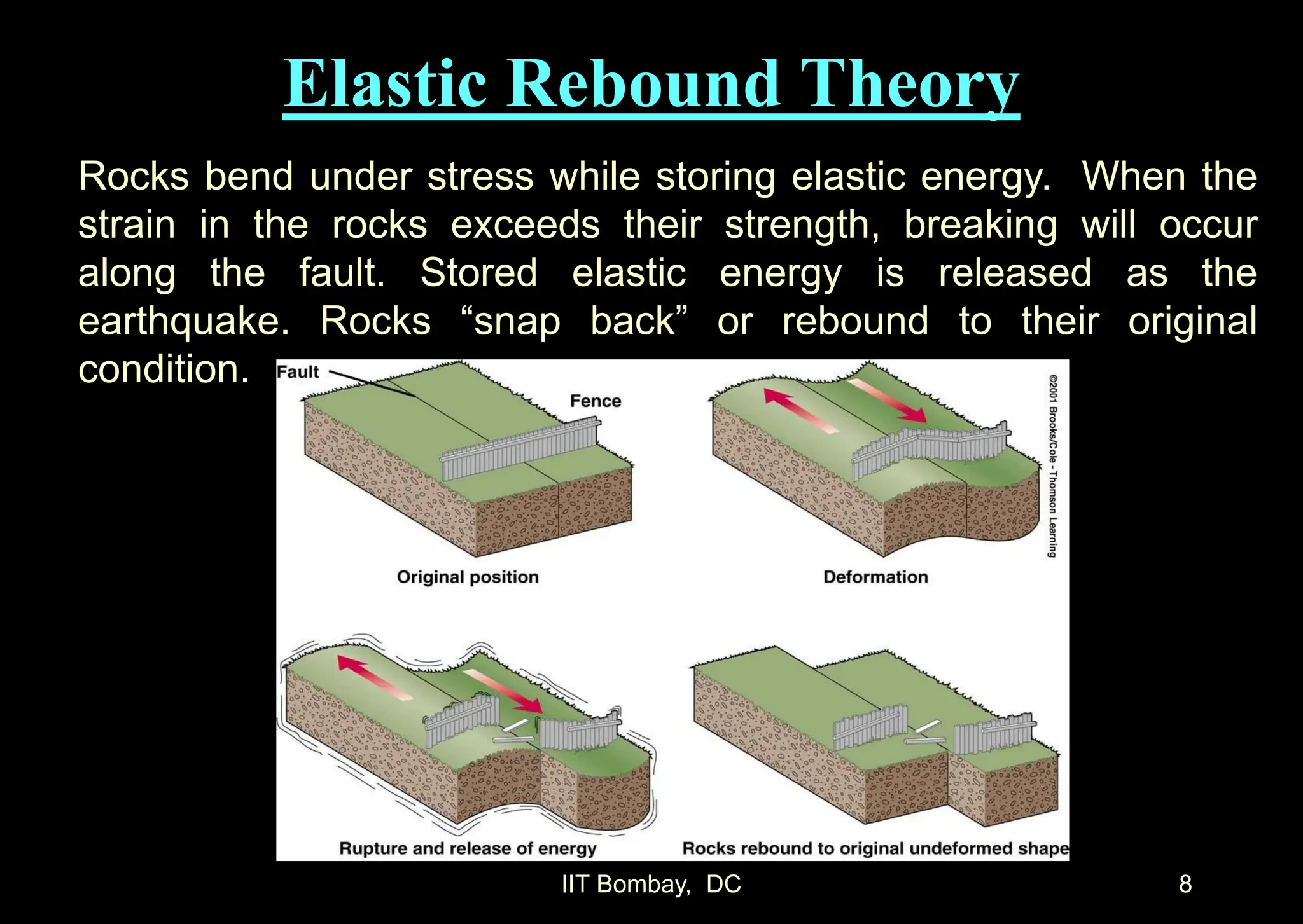
Rocks bend under stress while storing elastic energy. When the
strain in the rocks exceeds their strength, breaking will occur
along the fault. Stored elastic energy is released as the
earthquake. Rocks “snap back” or rebound to their original
condition.
Elastic Rebound Theory
IIT Bombay, DC 9
Foreshocks and aftershocks
Adjustments that follow a major earthquake
often generate smaller earthquakes called
aftershocks
Small earthquakes, called foreshocks, often
precede a major earthquake by days or, in some
cases, by as much as several years
IIT Bombay, DC 10
Study of Earthquakes
 The study of earthquake waves,
Seismology, dates back almost 2000
years to the Chinese Seismographs,
instruments that record seismic
waves. The first seismograph called
Di-Dong-Di was invented by Cheng
Heng (132 A.D.).
• Device used to measure an earthquake is called
‘seismograph’
• The seismograph has three main devices, the Richter
Magnitude Scale, the Modified Mercalli Intensity Scale,
and the Moment-Magnitude Scale.
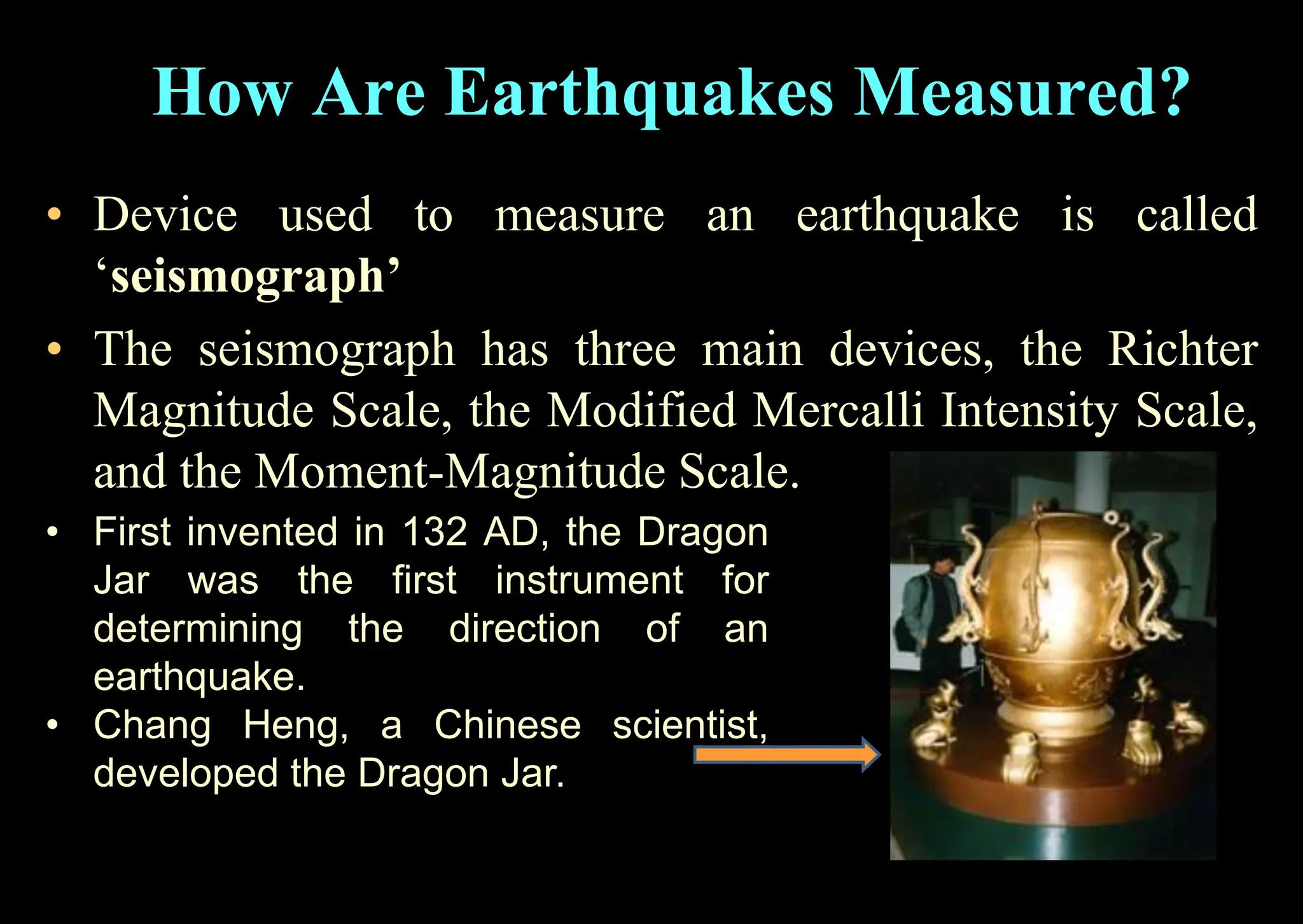
• First invented in 132 AD, the Dragon
Jar was the first instrument for
determining the direction of an
earthquake.
• Chang Heng, a Chinese scientist,
developed the Dragon Jar.
How Are Earthquakes Measured?
IIT Bombay, DC 12
IIT Bombay, DC 13
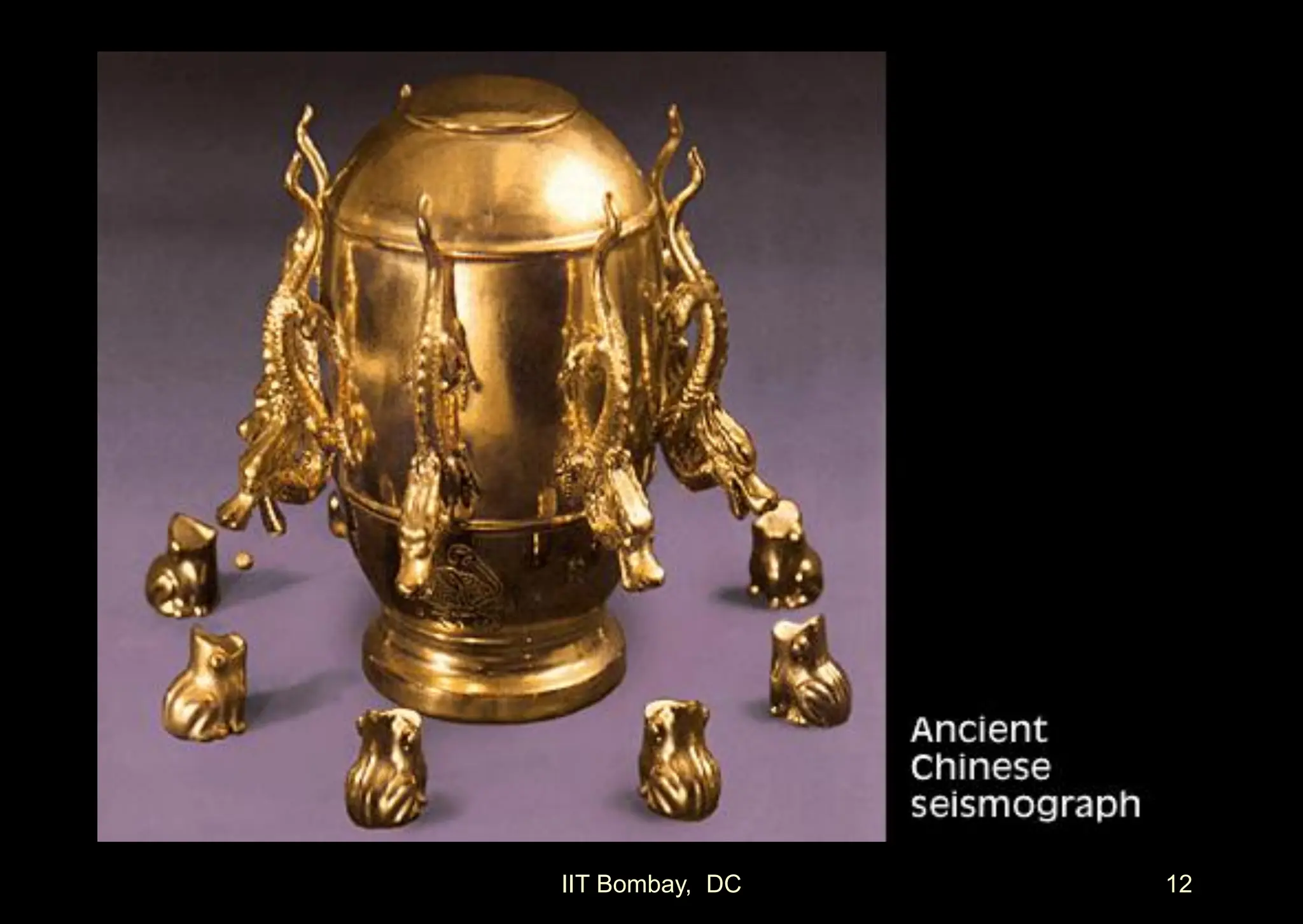
The ancient Chinese seismograph consist of
a special vase that had eight sculpted
dragons mounted around the vase in eight
primary directions. Each dragon held in its
mouth a metal ball. When the ground
shook, some of the balls would fall from
the mouths of the dragons into the waiting
mouths of the sculpted frogs to show how
the ground had moved.
IIT Bombay, DC 14
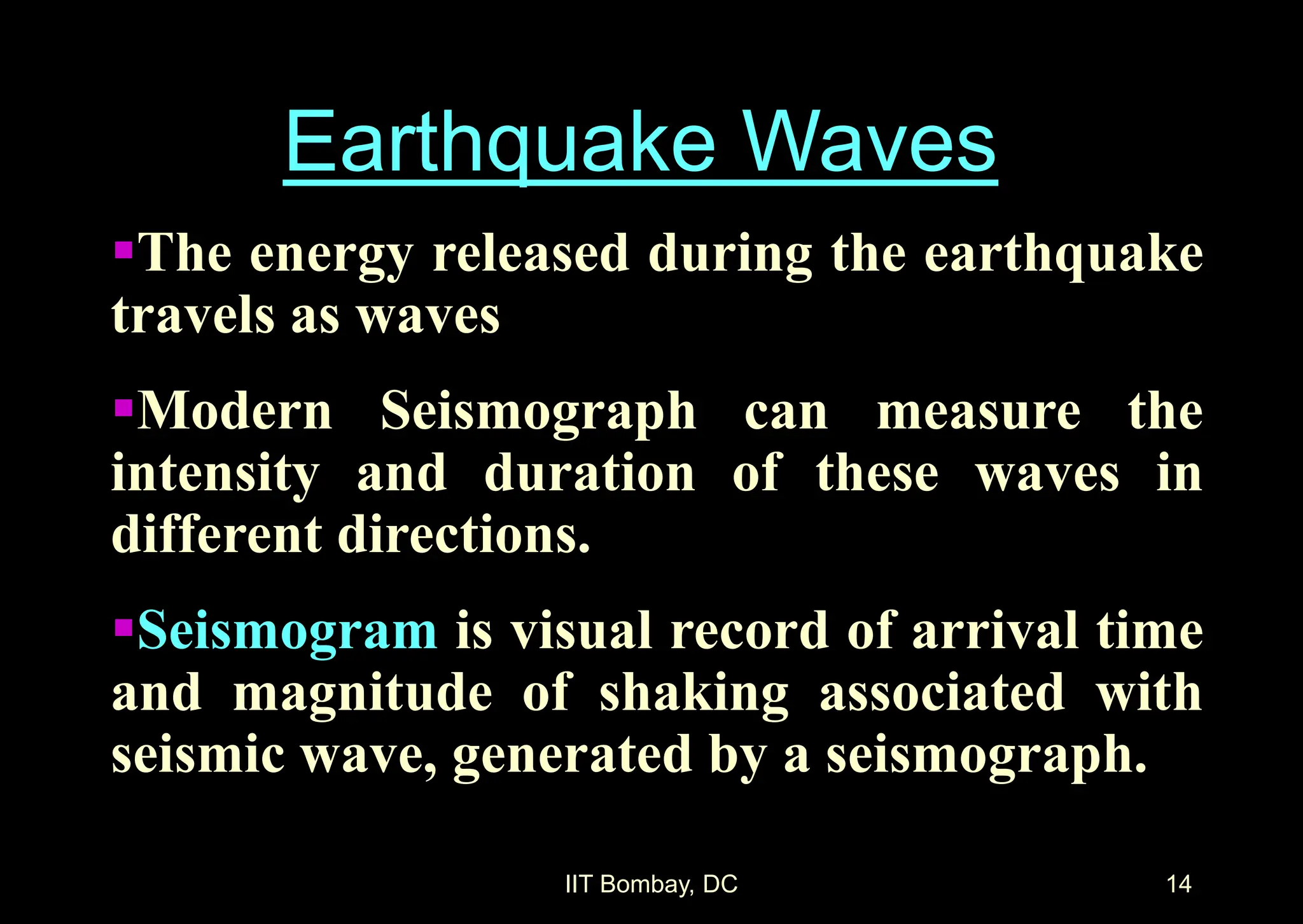
The energy released during the earthquake
travels as waves
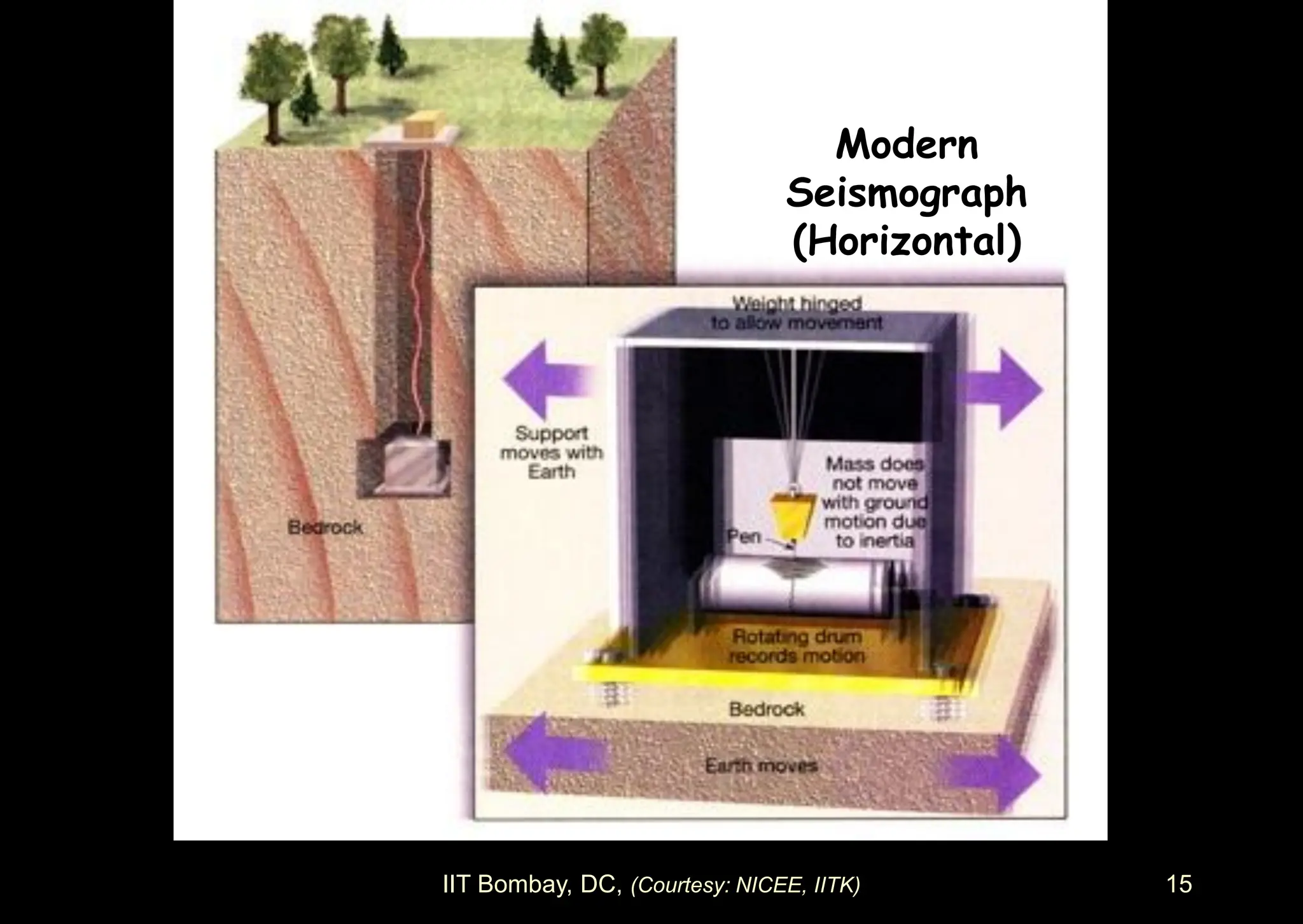
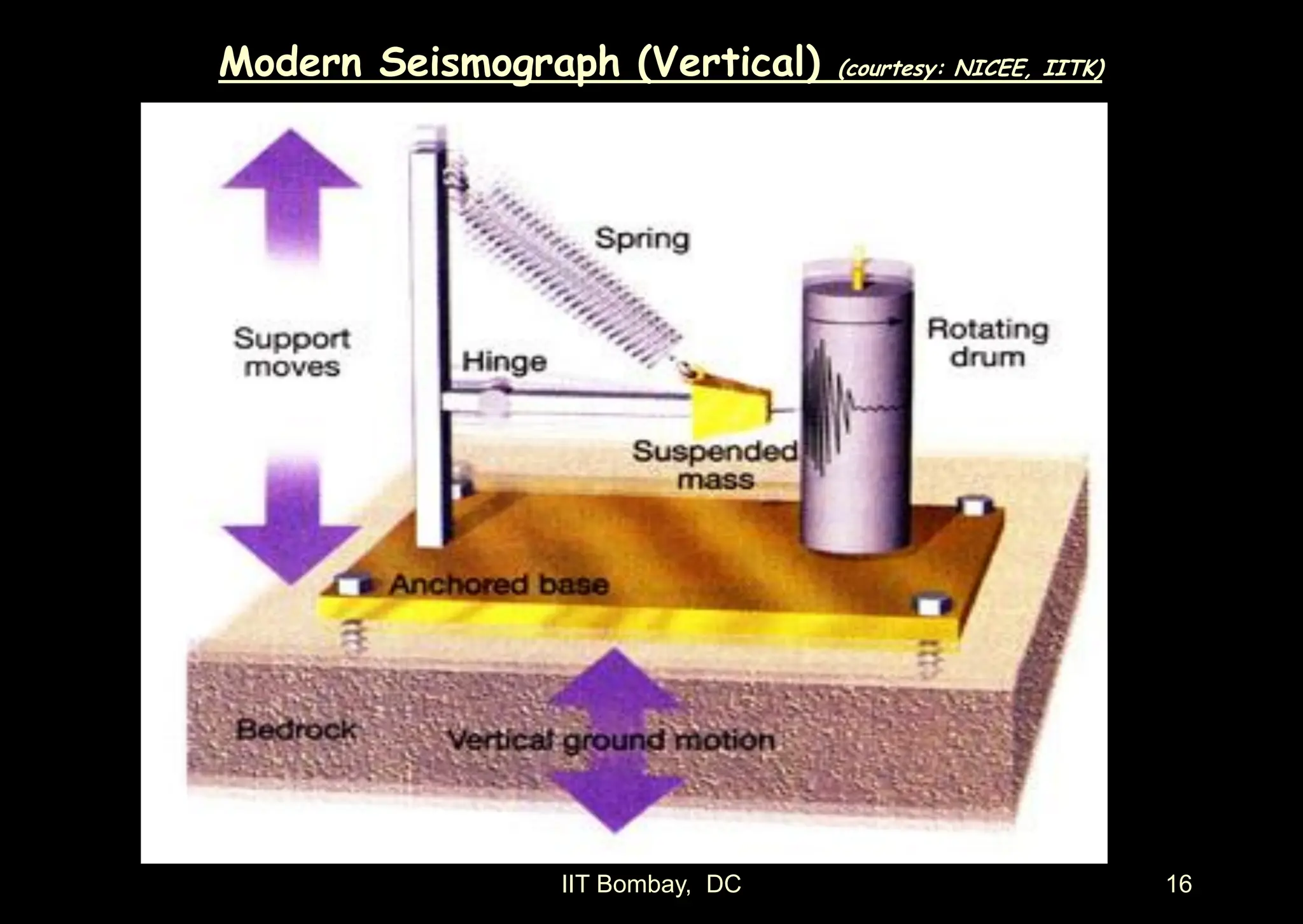
Modern Seismograph can measure the
intensity and duration of these waves in
different directions.
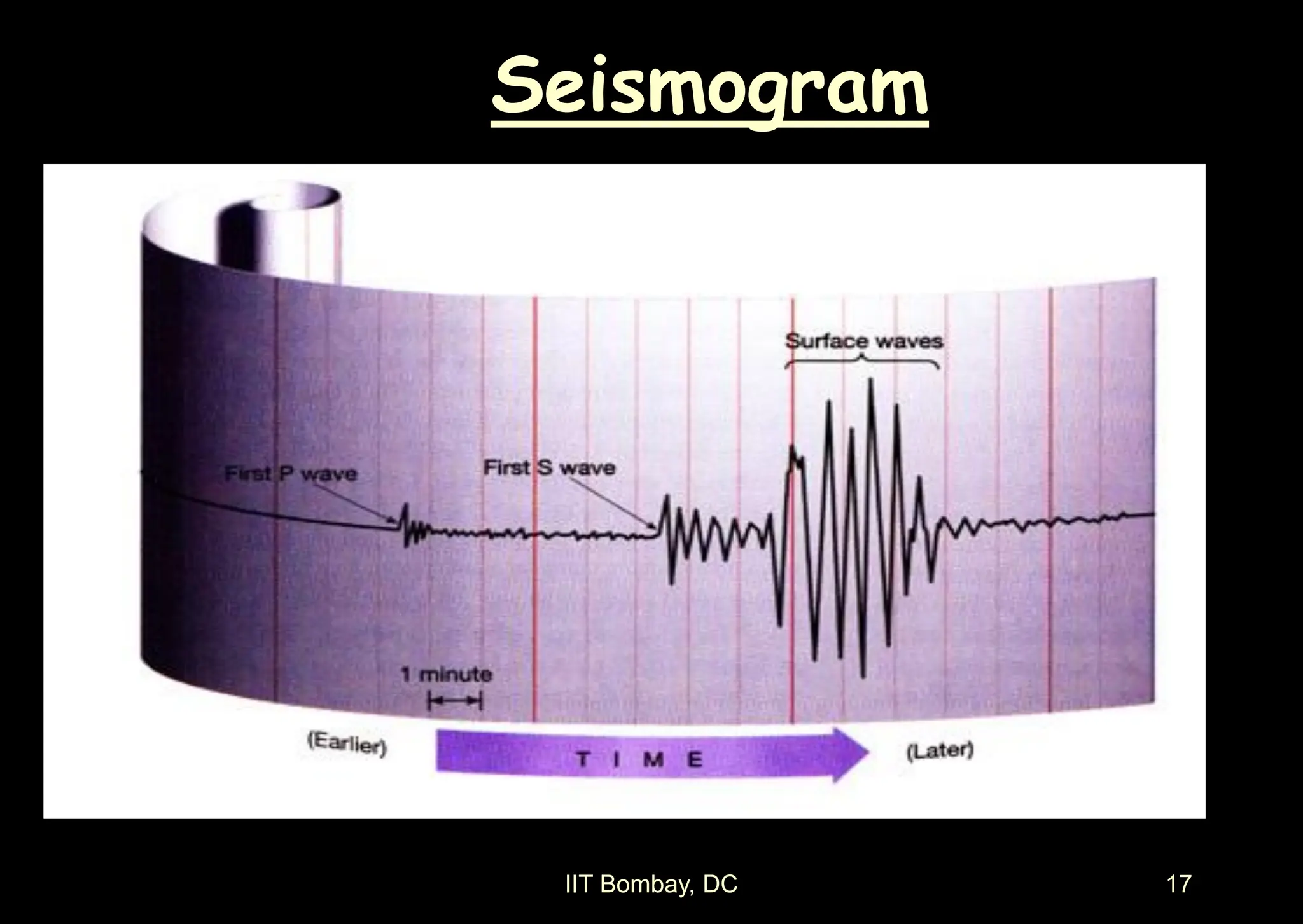
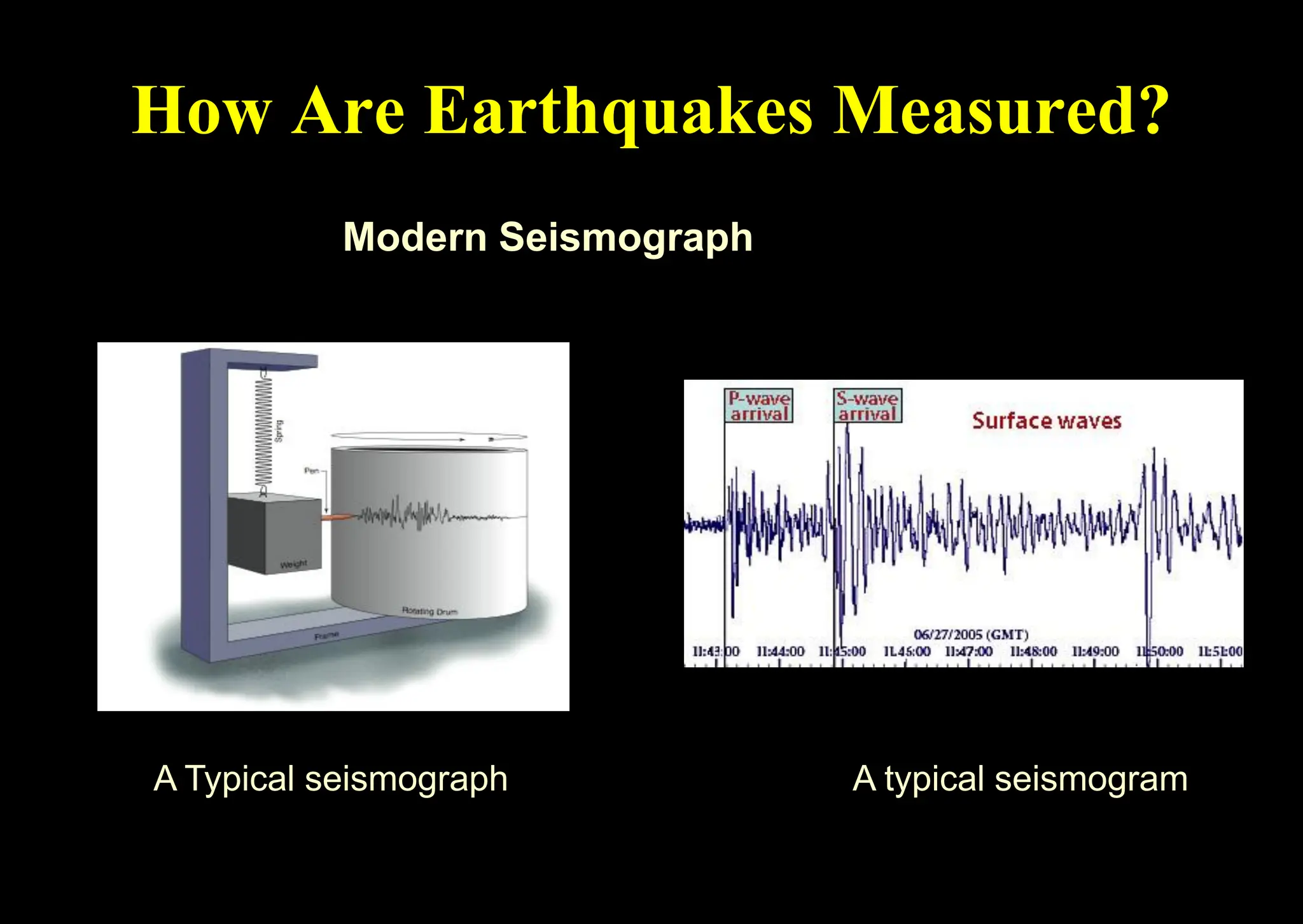
Seismogram is visual record of arrival time
and magnitude of shaking associated with
seismic wave, generated by a seismograph.
Earthquake Waves
IIT Bombay, DC, (Courtesy: NICEE, IITK) 15
Modern
Seismograph
(Horizontal)
IIT Bombay, DC 16
Modern Seismograph (Vertical) (courtesy: NICEE, IITK)
IIT Bombay, DC 17
Seismogram
How Are Earthquakes Measured?
A Typical seismograph A typical seismogram
Modern Seismograph
IIT Bombay, DC 19
seismographic stations around the
World work together to
record earthquake location
determine earthquake strength
Location and Intensity of Earthquake
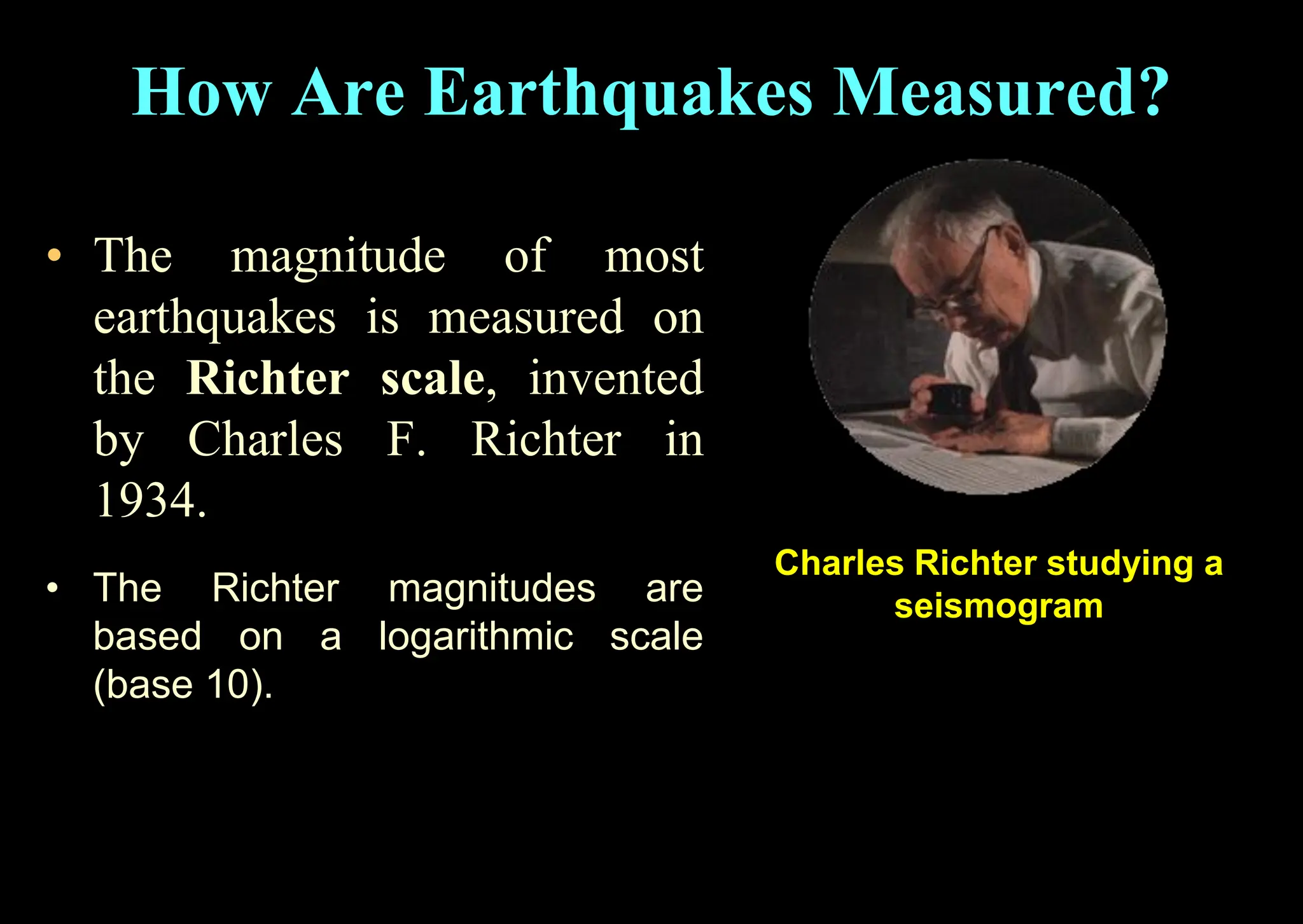
• The magnitude of most
earthquakes is measured on
the Richter scale, invented
by Charles F. Richter in
1934.
How Are Earthquakes Measured?
Charles Richter studying a
seismogram
• The Richter magnitudes are
based on a logarithmic scale
(base 10).
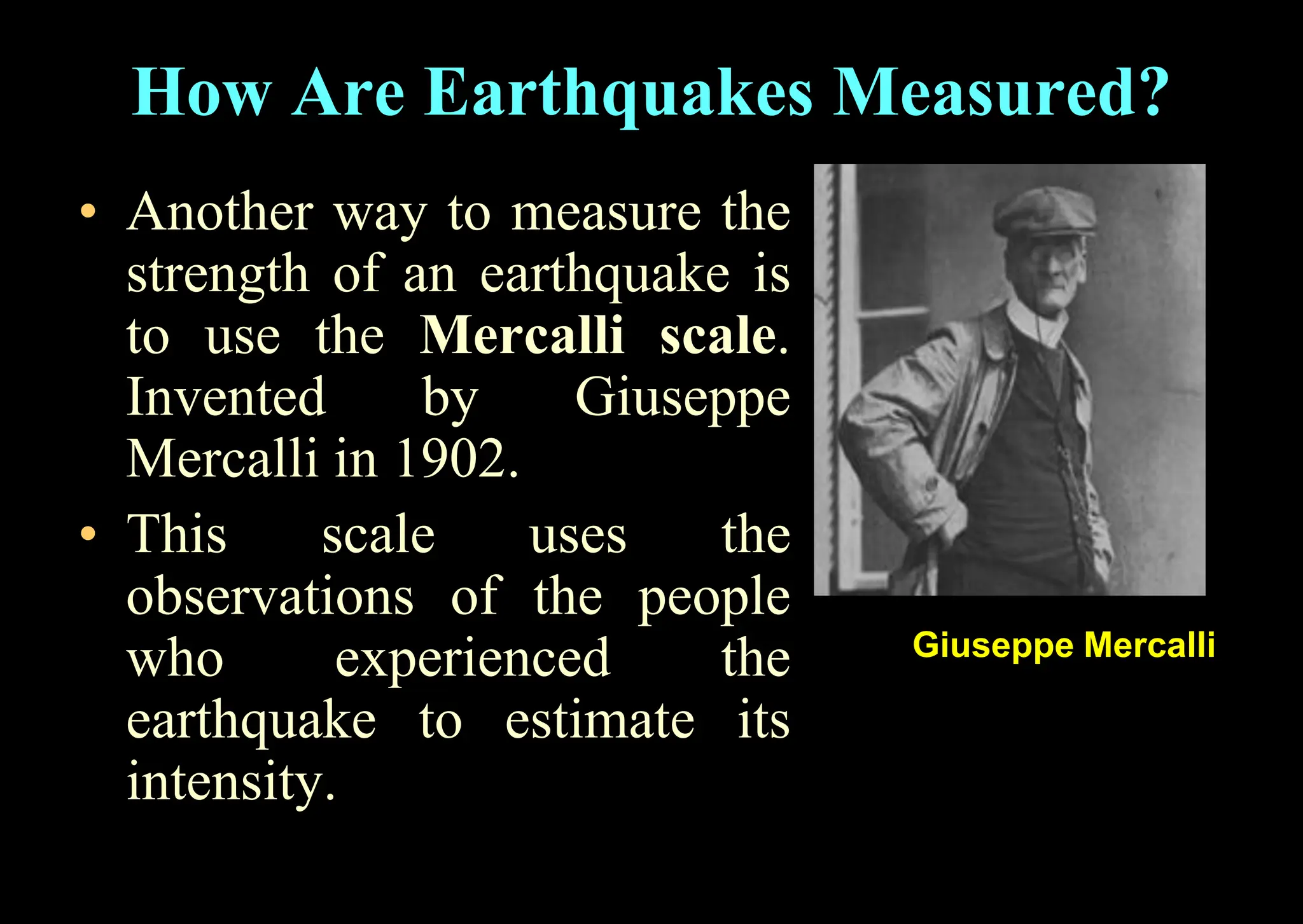
• Another way to measure the
strength of an earthquake is
to use the Mercalli scale.
Invented by Giuseppe
Mercalli in 1902.
• This scale uses the
observations of the people
who experienced the
earthquake to estimate its
intensity.
How Are Earthquakes Measured?
Giuseppe Mercalli
IIT Bombay, DC 22
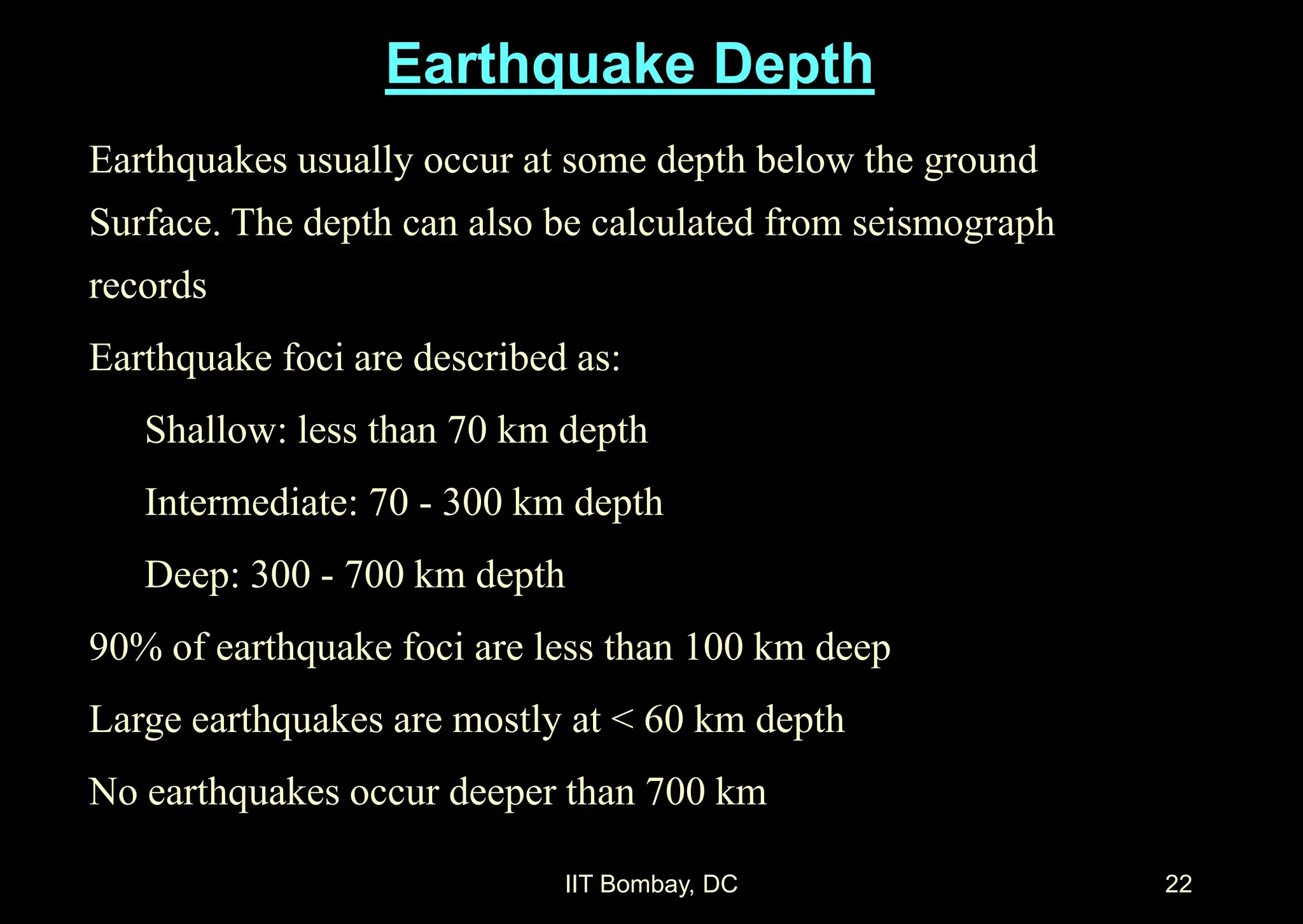
Earthquakes usually occur at some depth below the ground
Surface. The depth can also be calculated from seismograph
records
Earthquake foci are described as:
Shallow: less than 70 km depth
Intermediate: 70 - 300 km depth
Deep: 300 - 700 km depth
90% of earthquake foci are less than 100 km deep
Large earthquakes are mostly at < 60 km depth
No earthquakes occur deeper than 700 km
Earthquake Depth
IIT Bombay, DC 23
Predicting Earthquakes
Strange Animal Behavior
stress in the rocks causes tiny hairline fractures to form, the cracking of
the rocks evidently emits high pitched sounds and minute vibrations
imperceptible to humans but noticeable by many animals.
Foreshocks
unusual increase in the frequency of small earthquakes before the main
shock
Changes in water level
porosity increases or decreases with changes in strain
Seismic Gaps
based of the chronological distribution of major earthquakes

geotechnical earthquake engineering topic engineering seismology

  • 1.
    Geotechnical Earthquake Engineering by Dr. DeepankarChoudhury Professor Department of Civil Engineering IIT Bombay, Powai, Mumbai 400 076, India. Email: dc@civil.iitb.ac.in URL: http://www.civil.iitb.ac.in/~dc/ Lecture - 5
  • 2.
    IIT Bombay, DC2 Module – 3 Engineering Seismology
  • 3.
    What is Earthquake? • An earthquake is the result of a sudden release of energy in the Earth's crust that creates seismic waves. Earthquake is also known as a quake, tremor or temblor.
  • 4.
    IIT Bombay, DC4 What causes an Earthquake? Movement of Tectonic Plates Earth is divided into sections called Tectonic plates that float on the fluid-like interior of the Earth. Earthquakes are usually caused by sudden movement of earth plates Rupture of rocks along a fault Faults are localized areas of weakness in the surface of the Earth,sometimes the plate boundary itself
  • 5.
    Why an earthquakeoccurs? • The earth's crust (the outer layer of the planet) is made up of several pieces, called plates. • The plates under the oceans are called oceanic plates and the rest are continental plates Earthquakes usually occur where two plates are running into each other or sliding past each other. An image of the world's plates and their boundaries.
  • 6.
    IIT Bombay, DC6 Where do Earthquakes occur? Plate boundaries Faults
  • 7.
    IIT Bombay, DC7 Release of Accumulated energy
  • 8.
    IIT Bombay, DC8 Rocks bend under stress while storing elastic energy. When the strain in the rocks exceeds their strength, breaking will occur along the fault. Stored elastic energy is released as the earthquake. Rocks “snap back” or rebound to their original condition. Elastic Rebound Theory
  • 9.
    IIT Bombay, DC9 Foreshocks and aftershocks Adjustments that follow a major earthquake often generate smaller earthquakes called aftershocks Small earthquakes, called foreshocks, often precede a major earthquake by days or, in some cases, by as much as several years
  • 10.
    IIT Bombay, DC10 Study of Earthquakes  The study of earthquake waves, Seismology, dates back almost 2000 years to the Chinese Seismographs, instruments that record seismic waves. The first seismograph called Di-Dong-Di was invented by Cheng Heng (132 A.D.).
  • 11.
    • Device usedto measure an earthquake is called ‘seismograph’ • The seismograph has three main devices, the Richter Magnitude Scale, the Modified Mercalli Intensity Scale, and the Moment-Magnitude Scale. • First invented in 132 AD, the Dragon Jar was the first instrument for determining the direction of an earthquake. • Chang Heng, a Chinese scientist, developed the Dragon Jar. How Are Earthquakes Measured?
  • 12.
  • 13.
    IIT Bombay, DC13 The ancient Chinese seismograph consist of a special vase that had eight sculpted dragons mounted around the vase in eight primary directions. Each dragon held in its mouth a metal ball. When the ground shook, some of the balls would fall from the mouths of the dragons into the waiting mouths of the sculpted frogs to show how the ground had moved.
  • 14.
    IIT Bombay, DC14 The energy released during the earthquake travels as waves Modern Seismograph can measure the intensity and duration of these waves in different directions. Seismogram is visual record of arrival time and magnitude of shaking associated with seismic wave, generated by a seismograph. Earthquake Waves
  • 15.
    IIT Bombay, DC,(Courtesy: NICEE, IITK) 15 Modern Seismograph (Horizontal)
  • 16.
    IIT Bombay, DC16 Modern Seismograph (Vertical) (courtesy: NICEE, IITK)
  • 17.
    IIT Bombay, DC17 Seismogram
  • 18.
    How Are EarthquakesMeasured? A Typical seismograph A typical seismogram Modern Seismograph
  • 19.
    IIT Bombay, DC19 seismographic stations around the World work together to record earthquake location determine earthquake strength Location and Intensity of Earthquake
  • 20.
    • The magnitudeof most earthquakes is measured on the Richter scale, invented by Charles F. Richter in 1934. How Are Earthquakes Measured? Charles Richter studying a seismogram • The Richter magnitudes are based on a logarithmic scale (base 10).
  • 21.
    • Another wayto measure the strength of an earthquake is to use the Mercalli scale. Invented by Giuseppe Mercalli in 1902. • This scale uses the observations of the people who experienced the earthquake to estimate its intensity. How Are Earthquakes Measured? Giuseppe Mercalli
  • 22.
    IIT Bombay, DC22 Earthquakes usually occur at some depth below the ground Surface. The depth can also be calculated from seismograph records Earthquake foci are described as: Shallow: less than 70 km depth Intermediate: 70 - 300 km depth Deep: 300 - 700 km depth 90% of earthquake foci are less than 100 km deep Large earthquakes are mostly at < 60 km depth No earthquakes occur deeper than 700 km Earthquake Depth
  • 23.
    IIT Bombay, DC23 Predicting Earthquakes Strange Animal Behavior stress in the rocks causes tiny hairline fractures to form, the cracking of the rocks evidently emits high pitched sounds and minute vibrations imperceptible to humans but noticeable by many animals. Foreshocks unusual increase in the frequency of small earthquakes before the main shock Changes in water level porosity increases or decreases with changes in strain Seismic Gaps based of the chronological distribution of major earthquakes