The Values Driven Organisation
Richard Barrett
MY SPEECH TODAY
HOW TO BUILD, MEASURE AND MANAGE
A VALUES-DRIVEN CULTURE
WHY A VALUES-DRIVEN CULTURE?
BECAUSE VALUES-DRIVEN CULTURES ARE THE MOST
SUCCESSFUL ON THE PLANET
Powerful metrics that enable leaders to measure and manage cultures.
www.valuescentre.com
4
WHY ARE VALUES-DRIVEN CULTURES
THE MOST SUCCESSFUL?
BECAUSE THEY CARE ABOUT THE
NEEDS OF THEIR EMPLOYEES, AND …
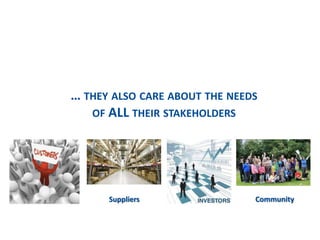
… THEY ALSO CARE ABOUT THE NEEDS
OF ALL THEIR STAKEHOLDERS
Suppliers Community
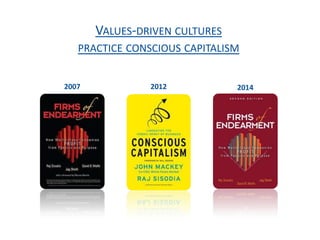
VALUES-DRIVEN CULTURES
PRACTICE CONSCIOUS CAPITALISM
2007 2012 2014
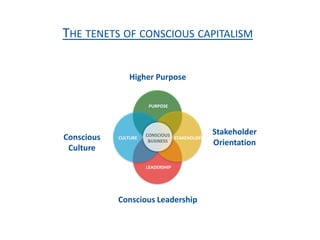
THE TENETS OF CONSCIOUS CAPITALISM
PURPOSE
CULTURE
LEADERSHIP
STAKEHOLDER
CONSCIOUS
BUSINESS
Higher Purpose
Conscious Leadership
Stakeholder
Orientation
Conscious
Culture
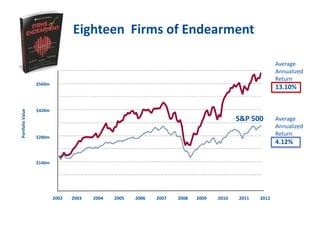
Eighteen Firms of Endearment
Average
Annualized
Return
13.10%
Average
Annualized
Return
4.12%
$140m
$280m
$420m
$560m
S&P 500
PortfolioValue
2002 2003 2004 2005 2006 2007 2008 2009 2010 2011 2012
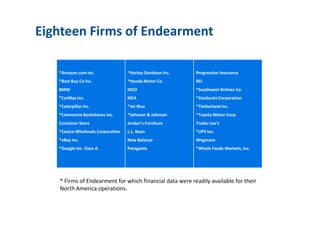
Eighteen Firms of Endearment
*Amazon.com Inc.
*Best Buy Co Inc.
BMW
*CarMax Inc.
*Caterpillar Inc.
*Commerce Bankshares Inc.
Container Store
*Costco Wholesale Corporation
*eBay Inc.
*Google Inc. Class A.
*Harley-Davidson Inc.
*Honda Motor Co.
IDEO
IKEA
*Jet Blue
*Johnson & Johnson
Jordan’s Furniture
L.L. Bean
New Balance
Patagonia
Progressive Insurance
REI
*Southwest Airlines Co.
*Starbucks Corporation
*Timberland Inc.
*Toyota Motor Corp.
Trader Joe's
*UPS Inc.
Wegmans
*Whole Foods Markets, Inc.
* Firms of Endearment for which financial data were readily available for their
North America operations.
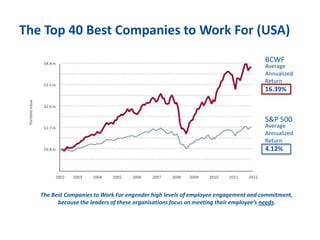
S&P 500
Average
Annualized
Return
16.39%
Average
Annualized
Return
4.12%
BCWF
The Best Companies to Work For engender high levels of employee engagement and commitment,
because the leaders of these organisations focus on meeting their employee’s needs.
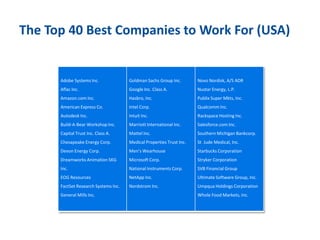
The Top 40 Best Companies to Work For (USA)
Adobe Systems Inc.
Adobe Systems Inc.
Aflac Inc.
Amazon.com Inc.
American Express Co.
Autodesk Inc.
Build-A-Bear Workshop Inc.
Capital Trust Inc. Class A.
Chesapeake Energy Corp.
Devon Energy Corp.
Dreamworks Animation SKG
Inc.
EOG Resources
FactSet Research Systems Inc.
General Mills Inc.
Goldman Sachs Group Inc.
Google Inc. Class A.
Hasbro, Inc.
Intel Corp.
Intuit Inc.
Marriott International Inc.
Mattel Inc.
Medical Properties Trust Inc.
Men’s Wearhouse
Microsoft Corp.
National Instruments Corp.
NetApp Inc.
Nordstrom Inc.
Novo Nordisk, A/S ADR
Nustar Energy, L.P.
Publix Super Mkts, Inc.
Qualcomm Inc.
Rackspace Hosting Inc.
Salesforce.com Inc.
Southern Michigan Bankcorp.
St Jude Medical, Inc.
Starbucks Corporation
Stryker Corporation
SVB Financial Group
Ultimate Software Group, Inc.
Umpqua Holdings Corporation
Whole Food Markets, Inc.
“Culture eats strategy for breakfast.”
“No matter how far reaching the vision or how brilliant
the strategy, neither will be realized if it is not supported
by the organisational culture.” Luther Johnson
Peter Drucker
Richard Barrett has made
extraordinary contributions to our
understanding of organisational
values and culture. His frame-
works for measuring culture and
enabling whole system change are
elegant. His reservoir of know-
ledge is vast and his connection to
timeless wisdom is profound.
Raj Sisodia Co-founder and co-chairman of
Conscious Capitalism Inc. and Professor of
Marketing at Bentley University
Building a Values-driven Culture
The Leader and the Values
Peters and Waterman, “In Search of Excellence:
Lessons from America’s best run companies”, 1983
Clarifying the value system
and breathing life into it are
the greatest contributions a
leader can make.
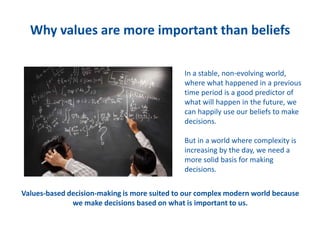
Why values are more important than beliefs
In a stable, non-evolving world,
where what happened in a previous
time period is a good predictor of
what will happen in the future, we
can happily use our beliefs to make
decisions.
But in a world where complexity is
increasing by the day, we need a
more solid basis for making
decisions.
Values-based decision-making is more suited to our complex modern world because
we make decisions based on what is important to us.
What are Values?
A shorthand way of describing
our individual and collective
motivations and what is
important to us.
They are the energetic
containers of our aspirations
and intentions.
Positive of Potentially Limiting?
Values can be positive or
potentially limiting.
Positive Values: Trust, creativity,
passion, honesty, integrity, clarity
Potentially Limiting Values:
Bureaucracy, power, blame, greed,
hierarchy, status-seeking
Let’s explore our values
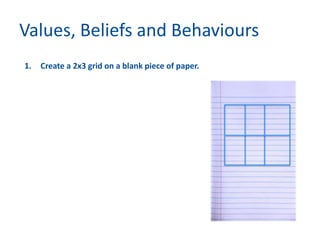
Values, Beliefs and Behaviours
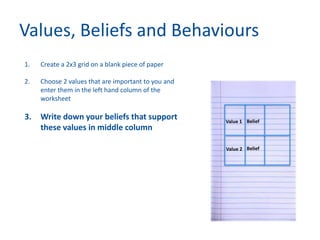
1. Create a 2x3 grid on a blank piece of paper.
Values, Beliefs and Behaviours
1. Create a 2x3 grid on a blank piece of paper.
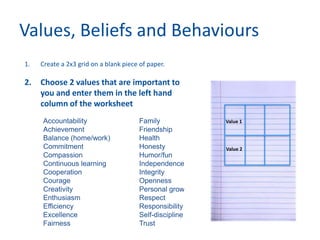
2. Choose 2 values that are important to
you and enter them in the left hand
column of the worksheet
Accountability
Achievement
Balance (home/work)
Commitment
Compassion
Continuous learning
Cooperation
Courage
Creativity
Enthusiasm
Efficiency
Excellence
Fairness
Family
Friendship
Health
Honesty
Humor/fun
Independence
Integrity
Openness
Personal growth
Respect
Responsibility
Self-discipline
Trust
Value 1
Value 2
Values, Beliefs and Behaviours
1. Create a 2x3 grid on a blank piece of paper
2. Choose 2 values that are important to you and
enter them in the left hand column of the
worksheet
3. Write down your beliefs that support
these values in middle column
Value 1
Value 2
Belief
Belief
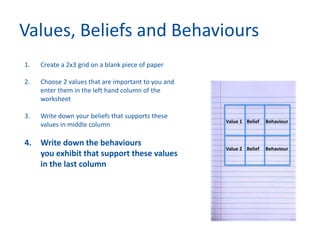
Values, Beliefs and Behaviours
1. Create a 2x3 grid on a blank piece of paper
2. Choose 2 values that are important to you and
enter them in the left hand column of the
worksheet
3. Write down your beliefs that supports these
values in middle column
4. Write down the behaviours
you exhibit that support these values
in the last column
Value 1
Value 2
Belief
Belief
Behaviour
Behaviour
Now let’s share our Values
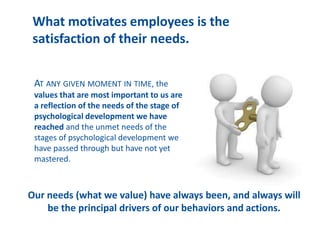
AT ANY GIVEN MOMENT IN TIME, the
values that are most important to us are
a reflection of the needs of the stage of
psychological development we have
reached and the unmet needs of the
stages of psychological development we
have passed through but have not yet
mastered.
What motivates employees is the
satisfaction of their needs.
Our needs (what we value) have always been, and always will
be the principal drivers of our behaviors and actions.
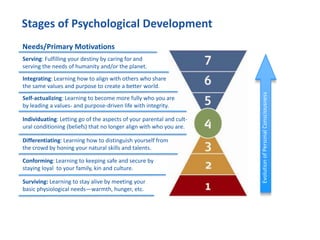
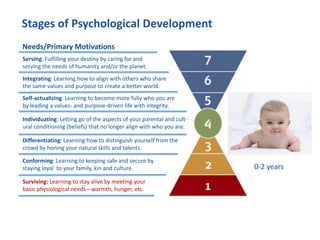
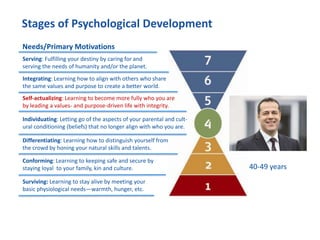
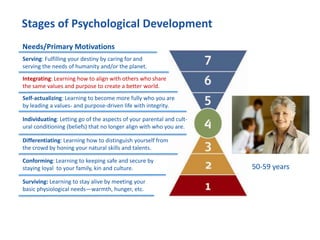
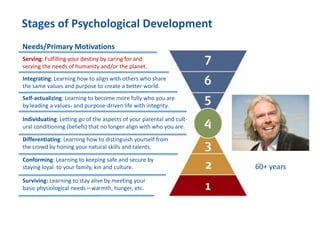
Stages of Psychological Development
Surviving: Learning to stay alive by meeting your
basic physiological needs—warmth, hunger, etc.
Conforming: Learning to keeping safe and secure by
staying loyal to your family, kin and culture.
Differentiating: Learning how to distinguish yourself from
the crowd by honing your natural skills and talents.
Individuating: Letting go of the aspects of your parental and cult-
ural conditioning (beliefs) that no longer align with who you are.
Self-actualizing: Learning to become more fully who you are
by leading a values- and purpose-driven life with integrity.
Integrating: Learning how to align with others who share
the same values and purpose to create a better world.
Serving: Fulfilling your destiny by caring for and
serving the needs of humanity and/or the planet.
EvolutionofPersonalConsciousness
Needs/Primary Motivations
Stages of Psychological Development
Surviving: Learning to stay alive by meeting your
basic physiological needs—warmth, hunger, etc.
Conforming: Learning to keeping safe and secure by
staying loyal to your family, kin and culture.
Differentiating: Learning how to distinguish yourself from the
crowd by honing your natural skills and talents.
Individuating: Letting go of the aspects of your parental and cult-
ural conditioning (beliefs) that no longer align with who you are.
Self-actualizing: Learning to become more fully who you are
by leading a values- and purpose-driven life with integrity.
Integrating: Learning how to align with others who share
the same values and purpose to create a better world.
Serving: Fulfilling your destiny by caring for and
serving the needs of humanity and/or the planet.
0-2 years
Needs/Primary Motivations
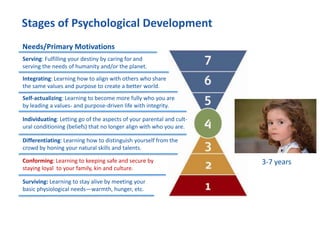
Stages of Psychological Development
Surviving: Learning to stay alive by meeting your
basic physiological needs—warmth, hunger, etc.
Conforming: Learning to keeping safe and secure by
staying loyal to your family, kin and culture.
Differentiating: Learning how to distinguish yourself from the
crowd by honing your natural skills and talents.
Individuating: Letting go of the aspects of your parental and cult-
ural conditioning (beliefs) that no longer align with who you are.
Self-actualizing: Learning to become more fully who you are
by leading a values- and purpose-driven life with integrity.
Integrating: Learning how to align with others who share
the same values and purpose to create a better world.
Serving: Fulfilling your destiny by caring for and
serving the needs of humanity and/or the planet.
3-7 years
Needs/Primary Motivations
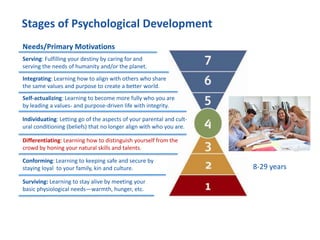
Stages of Psychological Development
Surviving: Learning to stay alive by meeting your
basic physiological needs—warmth, hunger, etc.
Conforming: Learning to keeping safe and secure by
staying loyal to your family, kin and culture.
Differentiating: Learning how to distinguish yourself from the
crowd by honing your natural skills and talents.
Individuating: Letting go of the aspects of your parental and cult-
ural conditioning (beliefs) that no longer align with who you are.
Self-actualizing: Learning to become more fully who you are
by leading a values- and purpose-driven life with integrity.
Integrating: Learning how to align with others who share
the same values and purpose to create a better world.
Serving: Fulfilling your destiny by caring for and
serving the needs of humanity and/or the planet.
8-29 years
Needs/Primary Motivations
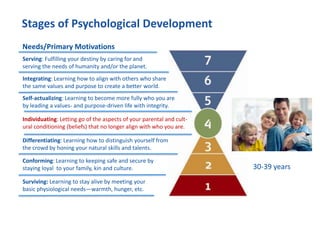
Stages of Psychological Development
Surviving: Learning to stay alive by meeting your
basic physiological needs—warmth, hunger, etc.
Conforming: Learning to keeping safe and secure by
staying loyal to your family, kin and culture.
Differentiating: Learning how to distinguish yourself from
the crowd by honing your natural skills and talents.
Individuating: Letting go of the aspects of your parental and cult-
ural conditioning (beliefs) that no longer align with who you are.
Self-actualizing: Learning to become more fully who you are
by leading a values- and purpose-driven life with integrity.
Integrating: Learning how to align with others who share
the same values and purpose to create a better world.
Serving: Fulfilling your destiny by caring for and
serving the needs of humanity and/or the planet.
30-39 years
Needs/Primary Motivations
Stages of Psychological Development
Surviving: Learning to stay alive by meeting your
basic physiological needs—warmth, hunger, etc.
Conforming: Learning to keeping safe and secure by
staying loyal to your family, kin and culture.
Differentiating: Learning how to distinguish yourself from
the crowd by honing your natural skills and talents.
Individuating: Letting go of the aspects of your parental and cult-
ural conditioning (beliefs) that no longer align with who you are.
Self-actualizing: Learning to become more fully who you are
by leading a values- and purpose-driven life with integrity.
Integrating: Learning how to align with others who share
the same values and purpose to create a better world.
Serving: Fulfilling your destiny by caring for and
serving the needs of humanity and/or the planet.
40-49 years
Needs/Primary Motivations
Stages of Psychological Development
Surviving: Learning to stay alive by meeting your
basic physiological needs—warmth, hunger, etc.
Conforming: Learning to keeping safe and secure by
staying loyal to your family, kin and culture.
Differentiating: Learning how to distinguish yourself from
the crowd by honing your natural skills and talents.
Individuating: Letting go of the aspects of your parental and cult-
ural conditioning (beliefs) that no longer align with who you are.
Self-actualizing: Learning to become more fully who you are
by leading a values- and purpose-driven life with integrity.
Integrating: Learning how to align with others who share
the same values and purpose to create a better world.
Serving: Fulfilling your destiny by caring for and
serving the needs of humanity and/or the planet.
50-59 years
Needs/Primary Motivations
Stages of Psychological Development
Surviving: Learning to stay alive by meeting your
basic physiological needs—warmth, hunger, etc.
Conforming: Learning to keeping safe and secure by
staying loyal to your family, kin and culture.
Differentiating: Learning how to distinguish yourself from
the crowd by honing your natural skills and talents.
Individuating: Letting go of the aspects of your parental and cult-
ural conditioning (beliefs) that no longer align with who you are.
Self-actualizing: Learning to become more fully who you are
by leading a values- and purpose-driven life with integrity.
Integrating: Learning how to align with others who share
the same values and purpose to create a better world.
Serving: Fulfilling your destiny by caring for and
serving the needs of humanity and/or the planet.
60+ years
Needs/Primary Motivations
LEVELS OF CONSCIOUSNESS
WE GROW IN STAGES (OF PSYCHOLOGICAL
DEVELOPMENT) AND WE OPERATE AT LEVELS (OF
CONSCIOUSNESS). ALL THINGS BEING NORMAL, THE
LEVEL OF CONSCIOUSNESS WE OPERATE AT WILL
CORRESPOND TO THE STAGE OF PSYCHOLOGICAL
DEVELOPMENT WE HAVE REACHED.
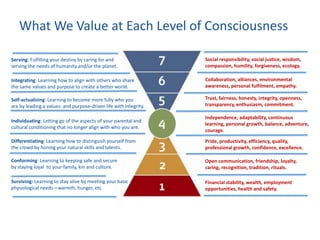
What We Value at Each Level of Consciousness
Financial stability, wealth, employment
opportunities, health and safety.
Open communication, friendship, loyalty,
caring, recognition, tradition, rituals.
Pride, productivity, efficiency, quality,
professional growth, confidence, excellence.
Independence, adaptability, continuous
learning, personal growth, balance, adventure,
courage.
Trust, fairness, honesty, integrity, openness,
transparency, enthusiasm, commitment.
Collaboration, alliances, environmental
awareness, personal fulfilment, empathy.
Social responsibility, social justice, wisdom,
compassion, humility, forgiveness, ecology.
Surviving: Learning to stay alive by meeting your basic
physiological needs—warmth, hunger, etc.
Conforming: Learning to keeping safe and secure
by staying loyal to your family, kin and culture.
Differentiating: Learning how to distinguish yourself from
the crowd by honing your natural skills and talents.
Individuating: Letting go of the aspects of your parental and
cultural conditioning that no longer align with who you are.
Self-actualizing: Learning to become more fully who you
are by leading a values- and purpose-driven life with integrity.
Integrating: Learning how to align with others who share
the same values and purpose to create a better world.
Serving: Fulfilling your destiny by caring for and
serving the needs of humanity and/or the planet.
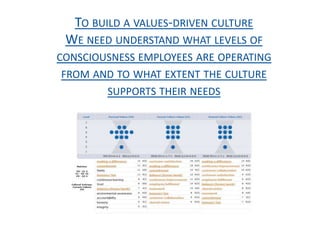
TO BUILD A VALUES-DRIVEN CULTURE
WE NEED UNDERSTAND WHAT LEVELS OF
CONSCIOUSNESS EMPLOYEES ARE OPERATING
FROM AND TO WHAT EXTENT THE CULTURE
SUPPORTS THEIR NEEDS
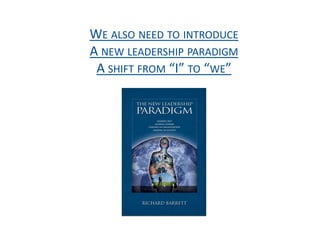
WE ALSO NEED TO INTRODUCE
A NEW LEADERSHIP PARADIGM
A SHIFT FROM “I” TO “WE”
Powerful metrics that enable leaders to measure and manage cultures.
www.valuescentre.com
37
I WILL SPEAK ABOUT LEADERSHIP DEVELOPMENT IN
MORE DEPTH LATER IN MY PRESENTATION
NOW LET US RETURN TO THE SUBJECT
OF CULTURE AND VALUES
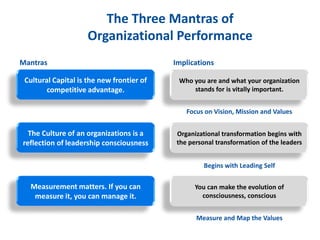
The Three Mantras of
Organizational Performance
Cultural Capital is the new frontier of
competitive advantage.
Mantras Implications
The Culture of an organizations is a
reflection of leadership consciousness
Measurement matters. If you can
measure it, you can manage it.
Who you are and what your organization
stands for is vitally important.
Organizational transformation begins with
the personal transformation of the leaders
You can make the evolution of
consciousness, conscious
Focus on Vision, Mission and Values
Begins with Leading Self
Measure and Map the Values
The Seven Levels of Consciousness Model
EVERYTHING YOU NEED TO KNOW ABOUT
BUILDING A VALUES-DRIVEN CULTURE
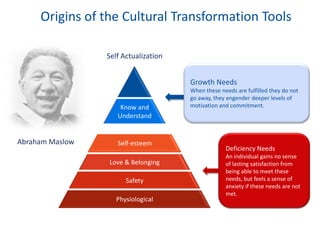
Origins of the Cultural Transformation Tools
Growth Needs
When these needs are fulfilled they do not
go away, they engender deeper levels of
motivation and commitment.
Deficiency Needs
An individual gains no sense
of lasting satisfaction from
being able to meet these
needs, but feels a sense of
anxiety if these needs are not
met.
Physiological
Safety
Love & Belonging
Self-esteem
Know and
Understand
Abraham Maslow
Self Actualization
Need s Con s ciou s n es s
Self-Actualization
Richard Barrett
Safety
Love & Belonging
Self-esteem
Physiological
Safety
Love & Belonging
Self-esteem
Know and
Understand
Abraham Maslow
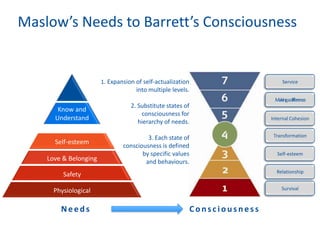
Maslow’s Needs to Barrett’s Consciousness
Need s Con s ciou s n es s
1. Expansion of self-actualization
into multiple levels.
2. Substitute states of
consciousness for
hierarchy of needs.
3. Each state of
consciousness is defined
by specific values
and behaviours.
Physiological
Safety
Love & Belonging
Self-esteem
Know and
Understand
Service
Makingadifference
Internal Cohesion
Transformation
Self-esteem
Relationship
Survival
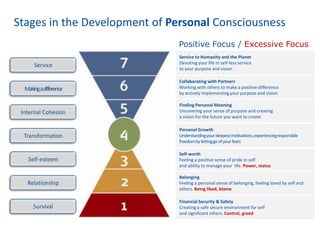
Stages in the Development of Personal Consciousness
Positive Focus / Excessive Focus
Service
Makingadifference
Internal Cohesion
Transformation
Self-esteem
Relationship
Survival
Financial Security & Safety
Creating a safe secure environment for self
and significant others. Control, greed
Belonging
Feeling a personal sense of belonging, feeling loved by self and
others. Being liked, blame
Self-worth
Feeling a positive sense of pride in self
and ability to manage your life. Power, status
Personal Growth
Understandingyourdeepestmotivations,experiencingresponsible
freedombylettinggoofyourfears
Finding Personal Meaning
Uncovering your sense of purpose and creating
a vision for the future you want to create
Collaborating with Partners
Working with others to make a positive difference
by actively implementing your purpose and vision
Service to Humanity and the Planet
Devoting your life in self-less service
to your purpose and vision
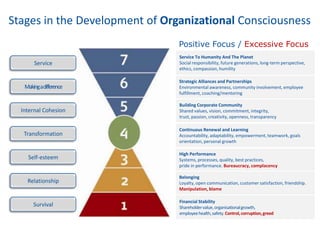
Positive Focus / Excessive Focus
Financial Stability
Shareholdervalue,organisationalgrowth,
employeehealth,safety.Control,corruption,greed
Belonging
Loyalty, open communication, customer satisfaction, friendship.
Manipulation, blame
High Performance
Systems, processes, quality, best practices,
pride in performance. Bureaucracy, complacency
Continuous Renewal and Learning
Accountability, adaptability, empowerment, teamwork, goals
orientation, personal growth
Building Corporate Community
Shared values, vision, commitment, integrity,
trust, passion, creativity, openness, transparency
Strategic Alliances and Partnerships
Environmental awareness, community involvement, employee
fulfillment, coaching/mentoring
Service To Humanity And The Planet
Social responsibility, future generations, long-term perspective,
ethics, compassion, humility
Stages in the Development of Organizational Consciousness
Service
Makingadifference
Internal Cohesion
Transformation
Self-esteem
Relationship
Survival
Powerful metrics that enable leaders to measure and manage cultures.
www.valuescentre.com
46
BUILDING A VALUES-DRIVEN ORGANSIATION
START WITH A VALUES SURVEY
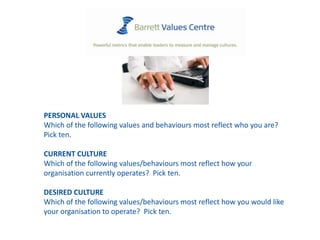
The Values Survey
PERSONAL VALUES
Which of the following values and behaviours most reflect who you are?
Pick ten.
CURRENT CULTURE
Which of the following values/behaviours most reflect how your
organisation currently operates? Pick ten.
DESIRED CULTURE
Which of the following values/behaviours most reflect how you would like
your organisation to operate? Pick ten.
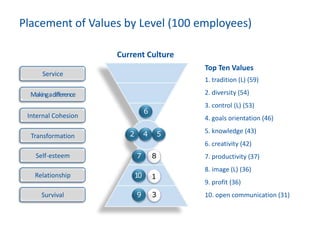
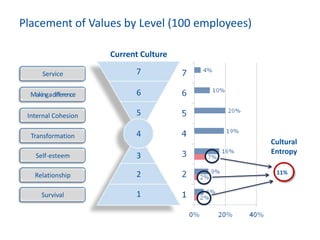
Placement of Values by Level (100 employees)
Top Ten Values
1. tradition (L) (59)
2. diversity (54)
3. control (L) (53)
4. goals orientation (46)
5. knowledge (43)
6. creativity (42)
7. productivity (37)
8. image (L) (36)
9. profit (36)
10. open communication (31)
10
42 5
7
9
6
8
3
110
Current Culture
Service
Makingadifference
Internal Cohesion
Transformation
Self-esteem
Relationship
Survival
11%
1
2
3
4
5
6
7
Cultural
Entropy
Placement of Values by Level (100 employees)
Current Culture
Service
Makingadifference
Internal Cohesion
Transformation
Self-esteem
Relationship
Survival
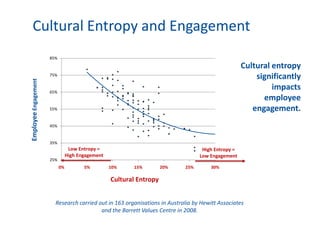
Cultural Entropy and Engagement
Cultural entropy
significantly
impacts
employee
engagement.
25%
35%
45%
55%
65%
75%
85%
0% 5% 10% 15% 20% 25% 30%
Cultural Entropy
EmployeeEngagement
Research carried out in 163 organisations in Australia by Hewitt Associates
and the Barrett Values Centre in 2008.
Low Entropy =
High Engagement
High Entropy =
Low Engagement
Entropy and Engagement
Cultural Entropy Most employees
are ….
10% or less Highly Engaged
11% to 20% Engaged
21% to 30% Becoming Disengaged
31% to 40% Disengaged
41% or more Highly Disengaged
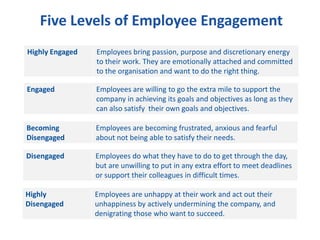
Five Levels of Employee Engagement
Highly Engaged Employees bring passion, purpose and discretionary energy
to their work. They are emotionally attached and committed
to the organisation and want to do the right thing.
Engaged Employees are willing to go the extra mile to support the
company in achieving its goals and objectives as long as they
can also satisfy their own goals and objectives.
Becoming
Disengaged
Employees are becoming frustrated, anxious and fearful
about not being able to satisfy their needs.
Disengaged Employees do what they have to do to get through the day,
but are unwilling to put in any extra effort to meet deadlines
or support their colleagues in difficult times.
Highly
Disengaged
Employees are unhappy at their work and act out their
unhappiness by actively undermining the company, and
denigrating those who want to succeed.
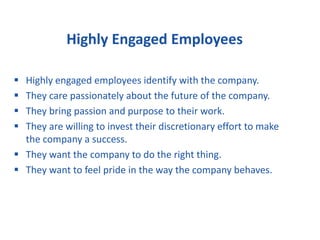
Highly Engaged Employees
 Highly engaged employees identify with the company.
 They care passionately about the future of the company.
 They bring passion and purpose to their work.
 They are willing to invest their discretionary effort to make
the company a success.
 They want the company to do the right thing.
 They want to feel pride in the way the company behaves.
What is Cultural Entropy?
The amount of energy that is consumed in an organisation
doing unnecessary or unproductive work that does not
add value.
It is a measure of the conflict, friction and frustration that
employees encounter in their day-to-day activities that
prevent the organisation from operating at peak
performance.
Cultural entropy is a function of the personal
entropy of the current leaders of an
organisation and institutional legacy of past
leaders as embedded in the structures,
systems, policies and procedures.
How Does Cultural Entropy Arise?
What is Personal Entropy?
Personal entropy is the amount of fear-driven
energy that a person expresses in his or her day-
to-day interactions with other people.
It is a measure of a lack of a person’s lack of personal
mastery skills. Fear-driven energy arises from the
conscious and subconscious fear-based beliefs of the ego
about meeting its deficiency needs.
continuous learning 11 Level 4
generosity 11 Level 5
commitment 10 Level 5
positive attitude 10 Level 5
vision 10 Level 7
ambitious 9 Level 3
making a difference 8 Level 6
results orientation 8 Level 3
honesty 7 Level 5
integrity 7 Level 5
intuition 7 Level 6
leadership developer 7 Level 6
1. customer satisfaction 16 Level 2
2. commitment 11 Level 5
3. continuous learning 11 Level 4
4. making a difference 11 Level 6
5. global perspective 9 Level 3
6. mentoring 9 Level 6
7. enthusiasm 8 Level 5
8. leadership development 8 Level 6
9. integrity 7 Level 5
10. open communication 7 Level 2
11. optimism 7 Level 5
12. shared values 7 Level 5
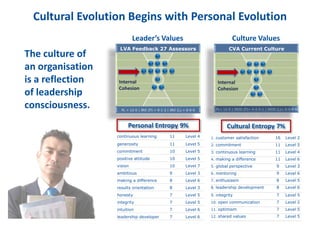
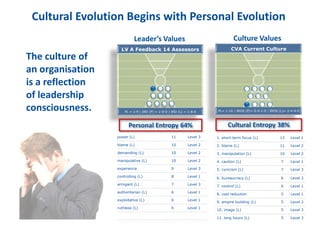
Cultural Evolution Begins with Personal Evolution
Cultural Entropy 7%Personal Entropy 9%
Culture ValuesLeader’s Values
The culture of
an organisation
is a reflection
of leadership
consciousness.
CVA Current Culture
PL= 12-0 | IROS (P)= 4-2-5-1 | IROS (L)= 0-0-0-0
Internal
Cohesion
LVA Feedback 27 Assessors
PL = 12-0 | IRO (P) = 9-1-2 | IRO (L) = 0-0-0
Internal
Cohesion
Cultural Evolution Begins with Personal Evolution
power (L) 11 Level 3
blame (L) 10 Level 2
demanding (L) 10 Level 2
manipulative (L) 10 Level 2
experience 9 Level 3
controlling (L) 8 Level 1
arrogant (L) 7 Level 3
authoritarian (L) 6 Level 1
exploitative (L) 6 Level 1
ruthless (L) 6 Level 1
1. short-term focus (L) 13 Level 1
2. blame (L) 11 Level 2
3. manipulation (L) 10 Level 2
4. caution (L) 7 Level 1
5. cynicism (L) 7 Level 3
6. bureaucracy (L) 6 Level 3
7. control (L) 6 Level 1
8. cost reduction 5 Level 1
9. empire building (L) 5 Level 2
10. image (L) 5 Level 3
11. long hours (L) 5 Level 3
LV A Feedback 14 Assessors
PL = 1-9 | IRO (P) = 1-0-0 | IRO (L) = 1-8-0
CVA Current Culture
PL= 1-10 | IROS (P)= 0-0-1-0 | IROS (L)= 2-4-4-0
Cultural Entropy 38%Personal Entropy 64%
Culture ValuesLeader’s Values
The culture of
an organisation
is a reflection
of leadership
consciousness.
Powerful metrics that enable leaders to measure and manage cultures.
www.valuescentre.com
59
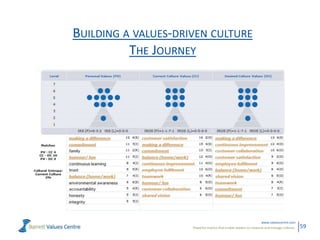
BUILDING A VALUES-DRIVEN CULTURE
THE JOURNEY
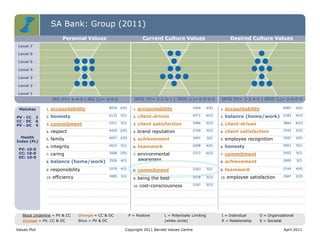
SA Bank: Group (2011)
Level 7
Level 6
Level 5
Level 4
Level 3
Level 2
Level 1
Personal Values Current Culture Values Desired Culture Values
IRS (P)= 6-4-0 | IRS (L)= 0-0-0 IROS (P)= 2-2-5-1 | IROS (L)= 0-0-0-0 IROS (P)= 3-3-4-0 | IROS (L)= 0-0-0-0
Matches
PV - CC 2
CC - DC 6
PV - DC 4
Health
Index (PL)
PV: 10-0
CC: 10-0
DC: 10-0
1. accountability 8576 4(R)
2. honesty 6133 5(I)
3. commitment 5221 5(I)
4. respect 4420 2(R)
5. family 4057 2(R)
6. integrity 4023 5(I)
7. caring 3568 2(R)
8. balance (home/work) 3526 4(I)
9. responsibility 3279 4(I)
10. efficiency 3085 3(I)
1. accountability 5464 4(R)
2. client-driven 4571 6(O)
3. client satisfaction 3486 2(O)
4. brand reputation 2740 3(O)
5. achievement 2491 3(I)
6. teamwork 2408 4(R)
7. environmental
awareness
2372 6(S)
8. commitment 2263 5(I)
9. being the best 2218 3(O)
10. cost-consciousness 2187 3(O)
1. accountability 6987 4(R)
2. balance (home/work) 4183 4(O)
3. client-driven 3864 6(O)
4. client satisfaction 3742 2(O)
5. employee recognition 3297 2(R)
6. honesty 3053 5(I)
7. commitment 2953 5(I)
8. achievement 2809 3(I)
9. teamwork 2744 4(R)
10. employee satisfaction 2687 2(O)
Values Plot Copyright 2011 Barrett Values Centre April 2011
Black Underline = PV & CC Orange = CC & DC P = Positive L = Potentially Limiting I = Individual O = Organizational
Orange = PV, CC & DC Blue = PV & DC (white circle) R = Relationship S = Societal
1%
0%
1%
5%
16%
16%
26%
4%
7%
24%
0% 20% 40%
1
2
3
4
5
6
7
3%
3%
5%
5%
11%
20%
13%
14%
6%
20%
0% 20% 40%
1
2
3
4
5
6
7
1%
0%
0%
5%
15%
16%
21%
12%
5%
25%
0% 20% 40%
1
2
3
4
5
6
7
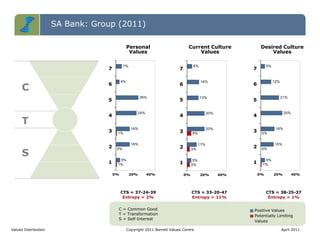
SA Bank: Group (2011)
C
T
S
Values Distribution Copyright 2011 Barrett Values Centre April 2011
C = Common Good
T = Transformation
S = Self-Interest
Positive Values
Potentially Limiting
Values
CTS = 37-24-39
Entropy = 2%
CTS = 33-20-47
Entropy = 11%
CTS = 38-25-37
Entropy = 1%
Personal
Values
Current Culture
Values
Desired Culture
Values
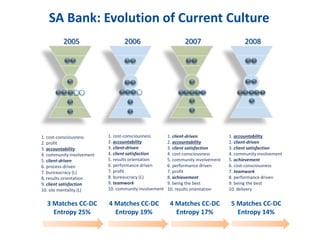
SA Bank: Evolution of Current Culture
1. cost-consciousness
2. profit
3. accountability
4. community involvement
5. client-driven
6. process-driven
7. bureaucracy (L)
8. results orientation
9. client satisfaction
10. silo mentality (L)
2005
1. cost-consciousness
2. accountability
3. client-driven
4. client satisfaction
5. results orientation
6. performance driven
7. profit
8. bureaucracy (L)
9. teamwork
10. community involvement
2006
1. client-driven
2. accountability
3. client satisfaction
4. cost-consciousness
5. community involvement
6. performance driven
7. profit
8. achievement
9. being the best
10. results orientation
2007 2008
1. accountability
2. client-driven
3. client satisfaction
4. community involvement
5. achievement
6. cost-consciousness
7. teamwork
8. performance driven
9. being the best
10. delivery
3 Matches CC-DC
Entropy 25%
4 Matches CC-DC
Entropy 19%
4 Matches CC-DC
Entropy 17%
5 Matches CC-DC
Entropy 14%
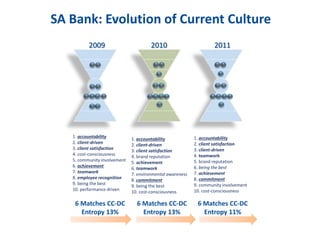
SA Bank: Evolution of Current Culture
2009 2010 2011
1. accountability
2. client-driven
3. client satisfaction
4. cost-consciousness
5. community involvement
6. achievement
7. teamwork
8. employee recognition
9. being the best
10. performance driven
1. accountability
2. client satisfaction
3. client-driven
4. teamwork
5. brand reputation
6. being the best
7. achievement
8. commitment
9. community involvement
10. cost-consciousness
1. accountability
2. client-driven
3. client satisfaction
4. brand reputation
5. achievement
6. teamwork
7. environmental awareness
8. commitment
9. being the best
10. cost-consciousness
6 Matches CC-DC
Entropy 13%
6 Matches CC-DC
Entropy 13%
6 Matches CC-DC
Entropy 11%
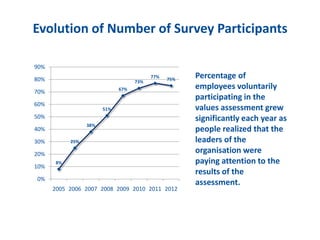
Evolution of Number of Survey Participants
8%
25%
38%
51%
67%
73%
77%
75%
0%
10%
20%
30%
40%
50%
60%
70%
80%
90%
2005 2006 2007 2008 2009 2010 2011 2012
Percentage of
employees voluntarily
participating in the
values assessment grew
significantly each year as
people realized that the
leaders of the
organisation were
paying attention to the
results of the
assessment.
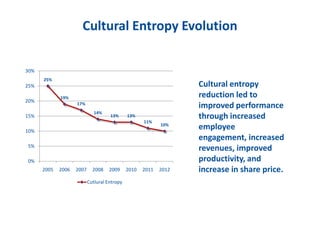
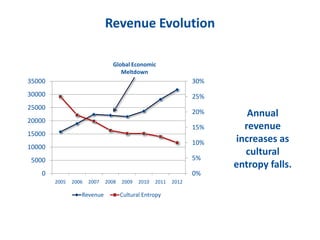
Cultural Entropy Evolution
Cultural entropy
reduction led to
improved performance
through increased
employee
engagement, increased
revenues, improved
productivity, and
increase in share price.
25%
19%
17%
14%
13% 13%
11%
10%
0%
5%
10%
15%
20%
25%
30%
2005 2006 2007 2008 2009 2010 2011 2012
Cutlural Entropy
Revenue Evolution
0%
5%
10%
15%
20%
25%
30%
0
5000
10000
15000
20000
25000
30000
35000
2005 2006 2007 2008 2009 2010 2011 2012
Revenue Cultural Entropy
Annual
revenue
increases as
cultural
entropy falls.
Global Economic
Meltdown
0%
5%
10%
15%
20%
25%
30%
0
200
400
600
800
1000
1200
2005 2006 2007 2008 2009 2010 2011 2012
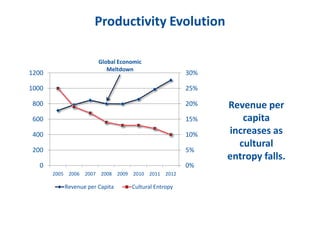
Revenue per Capita Cultural Entropy
Revenue per
capita
increases as
cultural
entropy falls.
Productivity Evolution
Global Economic
Meltdown
0%
5%
10%
15%
20%
25%
30%
0
5000
10000
15000
20000
2005 2006 2007 2008 2009 2010 2011 2012
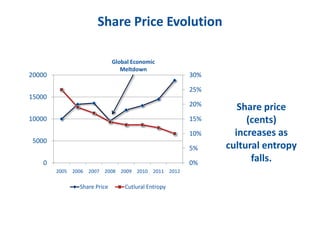
Share Price Cutlural Entropy
Share price
(cents)
increases as
cultural entropy
falls.
Share Price Evolution
Global Economic
Meltdown
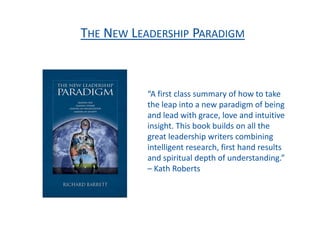
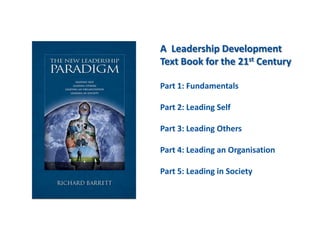
THE NEW LEADERSHIP PARADIGM
“A first class summary of how to take
the leap into a new paradigm of being
and lead with grace, love and intuitive
insight. This book builds on all the
great leadership writers combining
intelligent research, first hand results
and spiritual depth of understanding.”
– Kath Roberts
A Leadership Development
Text Book for the 21st Century
Part 1: Fundamentals
Part 2: Leading Self
Part 3: Leading Others
Part 4: Leading an Organisation
Part 5: Leading in Society
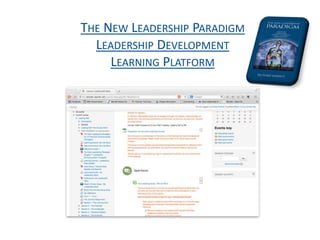
THE NEW LEADERSHIP PARADIGM
LEADERSHIP DEVELOPMENT
LEARNING PLATFORM
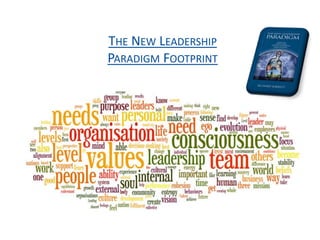
THE NEW LEADERSHIP
PARADIGM FOOTPRINT
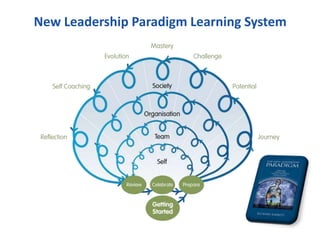
New Leadership Paradigm Learning System
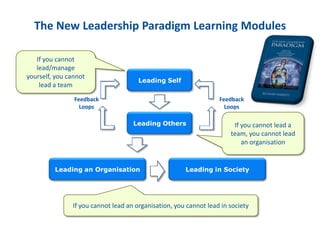
Leading Self
Leading Others
Leading an Organisation Leading in Society
Feedback
Loops
Feedback
Loops
If you cannot
lead/manage
yourself, you cannot
lead a team
If you cannot lead a
team, you cannot lead
an organisation
If you cannot lead an organisation, you cannot lead in society
The New Leadership Paradigm Learning Modules
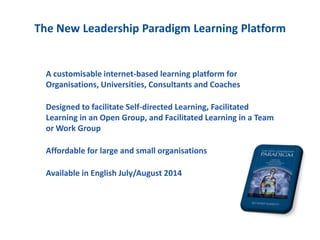
A customisable internet-based learning platform for
Organisations, Universities, Consultants and Coaches
Designed to facilitate Self-directed Learning, Facilitated
Learning in an Open Group, and Facilitated Learning in a Team
or Work Group
Affordable for large and small organisations
Available in English July/August 2014
The New Leadership Paradigm Learning Platform
Powerful metrics that enable leaders to measure and manage cultures.
www.valuescentre.com
76
For More Information
www.valuescentre.com
www.richardbarrett.net
To get a copy of this presentation go to:
http://www.slideshare.net/BarrettValues

The values driven organisation brazil may 2014 uk version

  • 1.
    The Values DrivenOrganisation Richard Barrett
  • 2.
    MY SPEECH TODAY HOWTO BUILD, MEASURE AND MANAGE A VALUES-DRIVEN CULTURE
  • 3.
    WHY A VALUES-DRIVENCULTURE? BECAUSE VALUES-DRIVEN CULTURES ARE THE MOST SUCCESSFUL ON THE PLANET
  • 4.
    Powerful metrics thatenable leaders to measure and manage cultures. www.valuescentre.com 4 WHY ARE VALUES-DRIVEN CULTURES THE MOST SUCCESSFUL? BECAUSE THEY CARE ABOUT THE NEEDS OF THEIR EMPLOYEES, AND …
  • 5.
    … THEY ALSOCARE ABOUT THE NEEDS OF ALL THEIR STAKEHOLDERS Suppliers Community
  • 6.
  • 7.
    THE TENETS OFCONSCIOUS CAPITALISM PURPOSE CULTURE LEADERSHIP STAKEHOLDER CONSCIOUS BUSINESS Higher Purpose Conscious Leadership Stakeholder Orientation Conscious Culture
  • 8.
    Eighteen Firms ofEndearment Average Annualized Return 13.10% Average Annualized Return 4.12% $140m $280m $420m $560m S&P 500 PortfolioValue 2002 2003 2004 2005 2006 2007 2008 2009 2010 2011 2012
  • 9.
    Eighteen Firms ofEndearment *Amazon.com Inc. *Best Buy Co Inc. BMW *CarMax Inc. *Caterpillar Inc. *Commerce Bankshares Inc. Container Store *Costco Wholesale Corporation *eBay Inc. *Google Inc. Class A. *Harley-Davidson Inc. *Honda Motor Co. IDEO IKEA *Jet Blue *Johnson & Johnson Jordan’s Furniture L.L. Bean New Balance Patagonia Progressive Insurance REI *Southwest Airlines Co. *Starbucks Corporation *Timberland Inc. *Toyota Motor Corp. Trader Joe's *UPS Inc. Wegmans *Whole Foods Markets, Inc. * Firms of Endearment for which financial data were readily available for their North America operations.
  • 10.
    S&P 500 Average Annualized Return 16.39% Average Annualized Return 4.12% BCWF The BestCompanies to Work For engender high levels of employee engagement and commitment, because the leaders of these organisations focus on meeting their employee’s needs. The Top 40 Best Companies to Work For (USA)
  • 11.
    The Top 40Best Companies to Work For (USA) Adobe Systems Inc. Adobe Systems Inc. Aflac Inc. Amazon.com Inc. American Express Co. Autodesk Inc. Build-A-Bear Workshop Inc. Capital Trust Inc. Class A. Chesapeake Energy Corp. Devon Energy Corp. Dreamworks Animation SKG Inc. EOG Resources FactSet Research Systems Inc. General Mills Inc. Goldman Sachs Group Inc. Goldman Sachs Group Inc. Google Inc. Class A. Hasbro, Inc. Intel Corp. Intuit Inc. Marriott International Inc. Mattel Inc. Medical Properties Trust Inc. Men’s Wearhouse Microsoft Corp. National Instruments Corp. NetApp Inc. Nordstrom Inc. Novo Nordisk, A/S ADR Novo Nordisk, A/S ADR Nustar Energy, L.P. Publix Super Mkts, Inc. Qualcomm Inc. Rackspace Hosting Inc. Salesforce.com Inc. Southern Michigan Bankcorp. St Jude Medical, Inc. Starbucks Corporation Stryker Corporation SVB Financial Group Ultimate Software Group, Inc. Umpqua Holdings Corporation Whole Food Markets, Inc.
  • 12.
    “Culture eats strategyfor breakfast.” “No matter how far reaching the vision or how brilliant the strategy, neither will be realized if it is not supported by the organisational culture.” Luther Johnson Peter Drucker
  • 13.
    Richard Barrett hasmade extraordinary contributions to our understanding of organisational values and culture. His frame- works for measuring culture and enabling whole system change are elegant. His reservoir of know- ledge is vast and his connection to timeless wisdom is profound. Raj Sisodia Co-founder and co-chairman of Conscious Capitalism Inc. and Professor of Marketing at Bentley University Building a Values-driven Culture
  • 14.
    The Leader andthe Values Peters and Waterman, “In Search of Excellence: Lessons from America’s best run companies”, 1983 Clarifying the value system and breathing life into it are the greatest contributions a leader can make.
  • 15.
    Why values aremore important than beliefs In a stable, non-evolving world, where what happened in a previous time period is a good predictor of what will happen in the future, we can happily use our beliefs to make decisions. But in a world where complexity is increasing by the day, we need a more solid basis for making decisions. Values-based decision-making is more suited to our complex modern world because we make decisions based on what is important to us.
  • 16.
    What are Values? Ashorthand way of describing our individual and collective motivations and what is important to us. They are the energetic containers of our aspirations and intentions.
  • 17.
    Positive of PotentiallyLimiting? Values can be positive or potentially limiting. Positive Values: Trust, creativity, passion, honesty, integrity, clarity Potentially Limiting Values: Bureaucracy, power, blame, greed, hierarchy, status-seeking
  • 18.
  • 19.
    Values, Beliefs andBehaviours 1. Create a 2x3 grid on a blank piece of paper.
  • 20.
    Values, Beliefs andBehaviours 1. Create a 2x3 grid on a blank piece of paper. 2. Choose 2 values that are important to you and enter them in the left hand column of the worksheet Accountability Achievement Balance (home/work) Commitment Compassion Continuous learning Cooperation Courage Creativity Enthusiasm Efficiency Excellence Fairness Family Friendship Health Honesty Humor/fun Independence Integrity Openness Personal growth Respect Responsibility Self-discipline Trust Value 1 Value 2
  • 21.
    Values, Beliefs andBehaviours 1. Create a 2x3 grid on a blank piece of paper 2. Choose 2 values that are important to you and enter them in the left hand column of the worksheet 3. Write down your beliefs that support these values in middle column Value 1 Value 2 Belief Belief
  • 22.
    Values, Beliefs andBehaviours 1. Create a 2x3 grid on a blank piece of paper 2. Choose 2 values that are important to you and enter them in the left hand column of the worksheet 3. Write down your beliefs that supports these values in middle column 4. Write down the behaviours you exhibit that support these values in the last column Value 1 Value 2 Belief Belief Behaviour Behaviour
  • 23.
  • 24.
    AT ANY GIVENMOMENT IN TIME, the values that are most important to us are a reflection of the needs of the stage of psychological development we have reached and the unmet needs of the stages of psychological development we have passed through but have not yet mastered. What motivates employees is the satisfaction of their needs. Our needs (what we value) have always been, and always will be the principal drivers of our behaviors and actions.
  • 25.
    Stages of PsychologicalDevelopment Surviving: Learning to stay alive by meeting your basic physiological needs—warmth, hunger, etc. Conforming: Learning to keeping safe and secure by staying loyal to your family, kin and culture. Differentiating: Learning how to distinguish yourself from the crowd by honing your natural skills and talents. Individuating: Letting go of the aspects of your parental and cult- ural conditioning (beliefs) that no longer align with who you are. Self-actualizing: Learning to become more fully who you are by leading a values- and purpose-driven life with integrity. Integrating: Learning how to align with others who share the same values and purpose to create a better world. Serving: Fulfilling your destiny by caring for and serving the needs of humanity and/or the planet. EvolutionofPersonalConsciousness Needs/Primary Motivations
  • 26.
    Stages of PsychologicalDevelopment Surviving: Learning to stay alive by meeting your basic physiological needs—warmth, hunger, etc. Conforming: Learning to keeping safe and secure by staying loyal to your family, kin and culture. Differentiating: Learning how to distinguish yourself from the crowd by honing your natural skills and talents. Individuating: Letting go of the aspects of your parental and cult- ural conditioning (beliefs) that no longer align with who you are. Self-actualizing: Learning to become more fully who you are by leading a values- and purpose-driven life with integrity. Integrating: Learning how to align with others who share the same values and purpose to create a better world. Serving: Fulfilling your destiny by caring for and serving the needs of humanity and/or the planet. 0-2 years Needs/Primary Motivations
  • 27.
    Stages of PsychologicalDevelopment Surviving: Learning to stay alive by meeting your basic physiological needs—warmth, hunger, etc. Conforming: Learning to keeping safe and secure by staying loyal to your family, kin and culture. Differentiating: Learning how to distinguish yourself from the crowd by honing your natural skills and talents. Individuating: Letting go of the aspects of your parental and cult- ural conditioning (beliefs) that no longer align with who you are. Self-actualizing: Learning to become more fully who you are by leading a values- and purpose-driven life with integrity. Integrating: Learning how to align with others who share the same values and purpose to create a better world. Serving: Fulfilling your destiny by caring for and serving the needs of humanity and/or the planet. 3-7 years Needs/Primary Motivations
  • 28.
    Stages of PsychologicalDevelopment Surviving: Learning to stay alive by meeting your basic physiological needs—warmth, hunger, etc. Conforming: Learning to keeping safe and secure by staying loyal to your family, kin and culture. Differentiating: Learning how to distinguish yourself from the crowd by honing your natural skills and talents. Individuating: Letting go of the aspects of your parental and cult- ural conditioning (beliefs) that no longer align with who you are. Self-actualizing: Learning to become more fully who you are by leading a values- and purpose-driven life with integrity. Integrating: Learning how to align with others who share the same values and purpose to create a better world. Serving: Fulfilling your destiny by caring for and serving the needs of humanity and/or the planet. 8-29 years Needs/Primary Motivations
  • 29.
    Stages of PsychologicalDevelopment Surviving: Learning to stay alive by meeting your basic physiological needs—warmth, hunger, etc. Conforming: Learning to keeping safe and secure by staying loyal to your family, kin and culture. Differentiating: Learning how to distinguish yourself from the crowd by honing your natural skills and talents. Individuating: Letting go of the aspects of your parental and cult- ural conditioning (beliefs) that no longer align with who you are. Self-actualizing: Learning to become more fully who you are by leading a values- and purpose-driven life with integrity. Integrating: Learning how to align with others who share the same values and purpose to create a better world. Serving: Fulfilling your destiny by caring for and serving the needs of humanity and/or the planet. 30-39 years Needs/Primary Motivations
  • 30.
    Stages of PsychologicalDevelopment Surviving: Learning to stay alive by meeting your basic physiological needs—warmth, hunger, etc. Conforming: Learning to keeping safe and secure by staying loyal to your family, kin and culture. Differentiating: Learning how to distinguish yourself from the crowd by honing your natural skills and talents. Individuating: Letting go of the aspects of your parental and cult- ural conditioning (beliefs) that no longer align with who you are. Self-actualizing: Learning to become more fully who you are by leading a values- and purpose-driven life with integrity. Integrating: Learning how to align with others who share the same values and purpose to create a better world. Serving: Fulfilling your destiny by caring for and serving the needs of humanity and/or the planet. 40-49 years Needs/Primary Motivations
  • 31.
    Stages of PsychologicalDevelopment Surviving: Learning to stay alive by meeting your basic physiological needs—warmth, hunger, etc. Conforming: Learning to keeping safe and secure by staying loyal to your family, kin and culture. Differentiating: Learning how to distinguish yourself from the crowd by honing your natural skills and talents. Individuating: Letting go of the aspects of your parental and cult- ural conditioning (beliefs) that no longer align with who you are. Self-actualizing: Learning to become more fully who you are by leading a values- and purpose-driven life with integrity. Integrating: Learning how to align with others who share the same values and purpose to create a better world. Serving: Fulfilling your destiny by caring for and serving the needs of humanity and/or the planet. 50-59 years Needs/Primary Motivations
  • 32.
    Stages of PsychologicalDevelopment Surviving: Learning to stay alive by meeting your basic physiological needs—warmth, hunger, etc. Conforming: Learning to keeping safe and secure by staying loyal to your family, kin and culture. Differentiating: Learning how to distinguish yourself from the crowd by honing your natural skills and talents. Individuating: Letting go of the aspects of your parental and cult- ural conditioning (beliefs) that no longer align with who you are. Self-actualizing: Learning to become more fully who you are by leading a values- and purpose-driven life with integrity. Integrating: Learning how to align with others who share the same values and purpose to create a better world. Serving: Fulfilling your destiny by caring for and serving the needs of humanity and/or the planet. 60+ years Needs/Primary Motivations
  • 33.
    LEVELS OF CONSCIOUSNESS WEGROW IN STAGES (OF PSYCHOLOGICAL DEVELOPMENT) AND WE OPERATE AT LEVELS (OF CONSCIOUSNESS). ALL THINGS BEING NORMAL, THE LEVEL OF CONSCIOUSNESS WE OPERATE AT WILL CORRESPOND TO THE STAGE OF PSYCHOLOGICAL DEVELOPMENT WE HAVE REACHED.
  • 34.
    What We Valueat Each Level of Consciousness Financial stability, wealth, employment opportunities, health and safety. Open communication, friendship, loyalty, caring, recognition, tradition, rituals. Pride, productivity, efficiency, quality, professional growth, confidence, excellence. Independence, adaptability, continuous learning, personal growth, balance, adventure, courage. Trust, fairness, honesty, integrity, openness, transparency, enthusiasm, commitment. Collaboration, alliances, environmental awareness, personal fulfilment, empathy. Social responsibility, social justice, wisdom, compassion, humility, forgiveness, ecology. Surviving: Learning to stay alive by meeting your basic physiological needs—warmth, hunger, etc. Conforming: Learning to keeping safe and secure by staying loyal to your family, kin and culture. Differentiating: Learning how to distinguish yourself from the crowd by honing your natural skills and talents. Individuating: Letting go of the aspects of your parental and cultural conditioning that no longer align with who you are. Self-actualizing: Learning to become more fully who you are by leading a values- and purpose-driven life with integrity. Integrating: Learning how to align with others who share the same values and purpose to create a better world. Serving: Fulfilling your destiny by caring for and serving the needs of humanity and/or the planet.
  • 35.
    TO BUILD AVALUES-DRIVEN CULTURE WE NEED UNDERSTAND WHAT LEVELS OF CONSCIOUSNESS EMPLOYEES ARE OPERATING FROM AND TO WHAT EXTENT THE CULTURE SUPPORTS THEIR NEEDS
  • 36.
    WE ALSO NEEDTO INTRODUCE A NEW LEADERSHIP PARADIGM A SHIFT FROM “I” TO “WE”
  • 37.
    Powerful metrics thatenable leaders to measure and manage cultures. www.valuescentre.com 37 I WILL SPEAK ABOUT LEADERSHIP DEVELOPMENT IN MORE DEPTH LATER IN MY PRESENTATION NOW LET US RETURN TO THE SUBJECT OF CULTURE AND VALUES
  • 38.
    The Three Mantrasof Organizational Performance Cultural Capital is the new frontier of competitive advantage. Mantras Implications The Culture of an organizations is a reflection of leadership consciousness Measurement matters. If you can measure it, you can manage it. Who you are and what your organization stands for is vitally important. Organizational transformation begins with the personal transformation of the leaders You can make the evolution of consciousness, conscious Focus on Vision, Mission and Values Begins with Leading Self Measure and Map the Values
  • 39.
    The Seven Levelsof Consciousness Model
  • 40.
    EVERYTHING YOU NEEDTO KNOW ABOUT BUILDING A VALUES-DRIVEN CULTURE
  • 41.
    Origins of theCultural Transformation Tools Growth Needs When these needs are fulfilled they do not go away, they engender deeper levels of motivation and commitment. Deficiency Needs An individual gains no sense of lasting satisfaction from being able to meet these needs, but feels a sense of anxiety if these needs are not met. Physiological Safety Love & Belonging Self-esteem Know and Understand Abraham Maslow Self Actualization
  • 42.
    Need s Cons ciou s n es s Self-Actualization Richard Barrett Safety Love & Belonging Self-esteem Physiological Safety Love & Belonging Self-esteem Know and Understand Abraham Maslow Maslow’s Needs to Barrett’s Consciousness
  • 43.
    Maslow’s Needs toBarrett’s Consciousness Need s Con s ciou s n es s 1. Expansion of self-actualization into multiple levels. 2. Substitute states of consciousness for hierarchy of needs. 3. Each state of consciousness is defined by specific values and behaviours. Physiological Safety Love & Belonging Self-esteem Know and Understand Service Makingadifference Internal Cohesion Transformation Self-esteem Relationship Survival
  • 44.
    Stages in theDevelopment of Personal Consciousness Positive Focus / Excessive Focus Service Makingadifference Internal Cohesion Transformation Self-esteem Relationship Survival Financial Security & Safety Creating a safe secure environment for self and significant others. Control, greed Belonging Feeling a personal sense of belonging, feeling loved by self and others. Being liked, blame Self-worth Feeling a positive sense of pride in self and ability to manage your life. Power, status Personal Growth Understandingyourdeepestmotivations,experiencingresponsible freedombylettinggoofyourfears Finding Personal Meaning Uncovering your sense of purpose and creating a vision for the future you want to create Collaborating with Partners Working with others to make a positive difference by actively implementing your purpose and vision Service to Humanity and the Planet Devoting your life in self-less service to your purpose and vision
  • 45.
    Positive Focus /Excessive Focus Financial Stability Shareholdervalue,organisationalgrowth, employeehealth,safety.Control,corruption,greed Belonging Loyalty, open communication, customer satisfaction, friendship. Manipulation, blame High Performance Systems, processes, quality, best practices, pride in performance. Bureaucracy, complacency Continuous Renewal and Learning Accountability, adaptability, empowerment, teamwork, goals orientation, personal growth Building Corporate Community Shared values, vision, commitment, integrity, trust, passion, creativity, openness, transparency Strategic Alliances and Partnerships Environmental awareness, community involvement, employee fulfillment, coaching/mentoring Service To Humanity And The Planet Social responsibility, future generations, long-term perspective, ethics, compassion, humility Stages in the Development of Organizational Consciousness Service Makingadifference Internal Cohesion Transformation Self-esteem Relationship Survival
  • 46.
    Powerful metrics thatenable leaders to measure and manage cultures. www.valuescentre.com 46 BUILDING A VALUES-DRIVEN ORGANSIATION START WITH A VALUES SURVEY
  • 47.
    The Values Survey PERSONALVALUES Which of the following values and behaviours most reflect who you are? Pick ten. CURRENT CULTURE Which of the following values/behaviours most reflect how your organisation currently operates? Pick ten. DESIRED CULTURE Which of the following values/behaviours most reflect how you would like your organisation to operate? Pick ten.
  • 48.
    Placement of Valuesby Level (100 employees) Top Ten Values 1. tradition (L) (59) 2. diversity (54) 3. control (L) (53) 4. goals orientation (46) 5. knowledge (43) 6. creativity (42) 7. productivity (37) 8. image (L) (36) 9. profit (36) 10. open communication (31) 10 42 5 7 9 6 8 3 110 Current Culture Service Makingadifference Internal Cohesion Transformation Self-esteem Relationship Survival
  • 49.
    11% 1 2 3 4 5 6 7 Cultural Entropy Placement of Valuesby Level (100 employees) Current Culture Service Makingadifference Internal Cohesion Transformation Self-esteem Relationship Survival
  • 50.
    Cultural Entropy andEngagement Cultural entropy significantly impacts employee engagement. 25% 35% 45% 55% 65% 75% 85% 0% 5% 10% 15% 20% 25% 30% Cultural Entropy EmployeeEngagement Research carried out in 163 organisations in Australia by Hewitt Associates and the Barrett Values Centre in 2008. Low Entropy = High Engagement High Entropy = Low Engagement
  • 51.
    Entropy and Engagement CulturalEntropy Most employees are …. 10% or less Highly Engaged 11% to 20% Engaged 21% to 30% Becoming Disengaged 31% to 40% Disengaged 41% or more Highly Disengaged
  • 52.
    Five Levels ofEmployee Engagement Highly Engaged Employees bring passion, purpose and discretionary energy to their work. They are emotionally attached and committed to the organisation and want to do the right thing. Engaged Employees are willing to go the extra mile to support the company in achieving its goals and objectives as long as they can also satisfy their own goals and objectives. Becoming Disengaged Employees are becoming frustrated, anxious and fearful about not being able to satisfy their needs. Disengaged Employees do what they have to do to get through the day, but are unwilling to put in any extra effort to meet deadlines or support their colleagues in difficult times. Highly Disengaged Employees are unhappy at their work and act out their unhappiness by actively undermining the company, and denigrating those who want to succeed.
  • 53.
    Highly Engaged Employees Highly engaged employees identify with the company.  They care passionately about the future of the company.  They bring passion and purpose to their work.  They are willing to invest their discretionary effort to make the company a success.  They want the company to do the right thing.  They want to feel pride in the way the company behaves.
  • 54.
    What is CulturalEntropy? The amount of energy that is consumed in an organisation doing unnecessary or unproductive work that does not add value. It is a measure of the conflict, friction and frustration that employees encounter in their day-to-day activities that prevent the organisation from operating at peak performance.
  • 55.
    Cultural entropy isa function of the personal entropy of the current leaders of an organisation and institutional legacy of past leaders as embedded in the structures, systems, policies and procedures. How Does Cultural Entropy Arise?
  • 56.
    What is PersonalEntropy? Personal entropy is the amount of fear-driven energy that a person expresses in his or her day- to-day interactions with other people. It is a measure of a lack of a person’s lack of personal mastery skills. Fear-driven energy arises from the conscious and subconscious fear-based beliefs of the ego about meeting its deficiency needs.
  • 57.
    continuous learning 11Level 4 generosity 11 Level 5 commitment 10 Level 5 positive attitude 10 Level 5 vision 10 Level 7 ambitious 9 Level 3 making a difference 8 Level 6 results orientation 8 Level 3 honesty 7 Level 5 integrity 7 Level 5 intuition 7 Level 6 leadership developer 7 Level 6 1. customer satisfaction 16 Level 2 2. commitment 11 Level 5 3. continuous learning 11 Level 4 4. making a difference 11 Level 6 5. global perspective 9 Level 3 6. mentoring 9 Level 6 7. enthusiasm 8 Level 5 8. leadership development 8 Level 6 9. integrity 7 Level 5 10. open communication 7 Level 2 11. optimism 7 Level 5 12. shared values 7 Level 5 Cultural Evolution Begins with Personal Evolution Cultural Entropy 7%Personal Entropy 9% Culture ValuesLeader’s Values The culture of an organisation is a reflection of leadership consciousness. CVA Current Culture PL= 12-0 | IROS (P)= 4-2-5-1 | IROS (L)= 0-0-0-0 Internal Cohesion LVA Feedback 27 Assessors PL = 12-0 | IRO (P) = 9-1-2 | IRO (L) = 0-0-0 Internal Cohesion
  • 58.
    Cultural Evolution Beginswith Personal Evolution power (L) 11 Level 3 blame (L) 10 Level 2 demanding (L) 10 Level 2 manipulative (L) 10 Level 2 experience 9 Level 3 controlling (L) 8 Level 1 arrogant (L) 7 Level 3 authoritarian (L) 6 Level 1 exploitative (L) 6 Level 1 ruthless (L) 6 Level 1 1. short-term focus (L) 13 Level 1 2. blame (L) 11 Level 2 3. manipulation (L) 10 Level 2 4. caution (L) 7 Level 1 5. cynicism (L) 7 Level 3 6. bureaucracy (L) 6 Level 3 7. control (L) 6 Level 1 8. cost reduction 5 Level 1 9. empire building (L) 5 Level 2 10. image (L) 5 Level 3 11. long hours (L) 5 Level 3 LV A Feedback 14 Assessors PL = 1-9 | IRO (P) = 1-0-0 | IRO (L) = 1-8-0 CVA Current Culture PL= 1-10 | IROS (P)= 0-0-1-0 | IROS (L)= 2-4-4-0 Cultural Entropy 38%Personal Entropy 64% Culture ValuesLeader’s Values The culture of an organisation is a reflection of leadership consciousness.
  • 59.
    Powerful metrics thatenable leaders to measure and manage cultures. www.valuescentre.com 59 BUILDING A VALUES-DRIVEN CULTURE THE JOURNEY
  • 60.
    SA Bank: Group(2011) Level 7 Level 6 Level 5 Level 4 Level 3 Level 2 Level 1 Personal Values Current Culture Values Desired Culture Values IRS (P)= 6-4-0 | IRS (L)= 0-0-0 IROS (P)= 2-2-5-1 | IROS (L)= 0-0-0-0 IROS (P)= 3-3-4-0 | IROS (L)= 0-0-0-0 Matches PV - CC 2 CC - DC 6 PV - DC 4 Health Index (PL) PV: 10-0 CC: 10-0 DC: 10-0 1. accountability 8576 4(R) 2. honesty 6133 5(I) 3. commitment 5221 5(I) 4. respect 4420 2(R) 5. family 4057 2(R) 6. integrity 4023 5(I) 7. caring 3568 2(R) 8. balance (home/work) 3526 4(I) 9. responsibility 3279 4(I) 10. efficiency 3085 3(I) 1. accountability 5464 4(R) 2. client-driven 4571 6(O) 3. client satisfaction 3486 2(O) 4. brand reputation 2740 3(O) 5. achievement 2491 3(I) 6. teamwork 2408 4(R) 7. environmental awareness 2372 6(S) 8. commitment 2263 5(I) 9. being the best 2218 3(O) 10. cost-consciousness 2187 3(O) 1. accountability 6987 4(R) 2. balance (home/work) 4183 4(O) 3. client-driven 3864 6(O) 4. client satisfaction 3742 2(O) 5. employee recognition 3297 2(R) 6. honesty 3053 5(I) 7. commitment 2953 5(I) 8. achievement 2809 3(I) 9. teamwork 2744 4(R) 10. employee satisfaction 2687 2(O) Values Plot Copyright 2011 Barrett Values Centre April 2011 Black Underline = PV & CC Orange = CC & DC P = Positive L = Potentially Limiting I = Individual O = Organizational Orange = PV, CC & DC Blue = PV & DC (white circle) R = Relationship S = Societal
  • 61.
    1% 0% 1% 5% 16% 16% 26% 4% 7% 24% 0% 20% 40% 1 2 3 4 5 6 7 3% 3% 5% 5% 11% 20% 13% 14% 6% 20% 0%20% 40% 1 2 3 4 5 6 7 1% 0% 0% 5% 15% 16% 21% 12% 5% 25% 0% 20% 40% 1 2 3 4 5 6 7 SA Bank: Group (2011) C T S Values Distribution Copyright 2011 Barrett Values Centre April 2011 C = Common Good T = Transformation S = Self-Interest Positive Values Potentially Limiting Values CTS = 37-24-39 Entropy = 2% CTS = 33-20-47 Entropy = 11% CTS = 38-25-37 Entropy = 1% Personal Values Current Culture Values Desired Culture Values
  • 62.
    SA Bank: Evolutionof Current Culture 1. cost-consciousness 2. profit 3. accountability 4. community involvement 5. client-driven 6. process-driven 7. bureaucracy (L) 8. results orientation 9. client satisfaction 10. silo mentality (L) 2005 1. cost-consciousness 2. accountability 3. client-driven 4. client satisfaction 5. results orientation 6. performance driven 7. profit 8. bureaucracy (L) 9. teamwork 10. community involvement 2006 1. client-driven 2. accountability 3. client satisfaction 4. cost-consciousness 5. community involvement 6. performance driven 7. profit 8. achievement 9. being the best 10. results orientation 2007 2008 1. accountability 2. client-driven 3. client satisfaction 4. community involvement 5. achievement 6. cost-consciousness 7. teamwork 8. performance driven 9. being the best 10. delivery 3 Matches CC-DC Entropy 25% 4 Matches CC-DC Entropy 19% 4 Matches CC-DC Entropy 17% 5 Matches CC-DC Entropy 14%
  • 63.
    SA Bank: Evolutionof Current Culture 2009 2010 2011 1. accountability 2. client-driven 3. client satisfaction 4. cost-consciousness 5. community involvement 6. achievement 7. teamwork 8. employee recognition 9. being the best 10. performance driven 1. accountability 2. client satisfaction 3. client-driven 4. teamwork 5. brand reputation 6. being the best 7. achievement 8. commitment 9. community involvement 10. cost-consciousness 1. accountability 2. client-driven 3. client satisfaction 4. brand reputation 5. achievement 6. teamwork 7. environmental awareness 8. commitment 9. being the best 10. cost-consciousness 6 Matches CC-DC Entropy 13% 6 Matches CC-DC Entropy 13% 6 Matches CC-DC Entropy 11%
  • 64.
    Evolution of Numberof Survey Participants 8% 25% 38% 51% 67% 73% 77% 75% 0% 10% 20% 30% 40% 50% 60% 70% 80% 90% 2005 2006 2007 2008 2009 2010 2011 2012 Percentage of employees voluntarily participating in the values assessment grew significantly each year as people realized that the leaders of the organisation were paying attention to the results of the assessment.
  • 65.
    Cultural Entropy Evolution Culturalentropy reduction led to improved performance through increased employee engagement, increased revenues, improved productivity, and increase in share price. 25% 19% 17% 14% 13% 13% 11% 10% 0% 5% 10% 15% 20% 25% 30% 2005 2006 2007 2008 2009 2010 2011 2012 Cutlural Entropy
  • 66.
    Revenue Evolution 0% 5% 10% 15% 20% 25% 30% 0 5000 10000 15000 20000 25000 30000 35000 2005 20062007 2008 2009 2010 2011 2012 Revenue Cultural Entropy Annual revenue increases as cultural entropy falls. Global Economic Meltdown
  • 67.
    0% 5% 10% 15% 20% 25% 30% 0 200 400 600 800 1000 1200 2005 2006 20072008 2009 2010 2011 2012 Revenue per Capita Cultural Entropy Revenue per capita increases as cultural entropy falls. Productivity Evolution Global Economic Meltdown
  • 68.
    0% 5% 10% 15% 20% 25% 30% 0 5000 10000 15000 20000 2005 2006 20072008 2009 2010 2011 2012 Share Price Cutlural Entropy Share price (cents) increases as cultural entropy falls. Share Price Evolution Global Economic Meltdown
  • 69.
    THE NEW LEADERSHIPPARADIGM “A first class summary of how to take the leap into a new paradigm of being and lead with grace, love and intuitive insight. This book builds on all the great leadership writers combining intelligent research, first hand results and spiritual depth of understanding.” – Kath Roberts
  • 70.
    A Leadership Development TextBook for the 21st Century Part 1: Fundamentals Part 2: Leading Self Part 3: Leading Others Part 4: Leading an Organisation Part 5: Leading in Society
  • 71.
    THE NEW LEADERSHIPPARADIGM LEADERSHIP DEVELOPMENT LEARNING PLATFORM
  • 72.
  • 73.
    New Leadership ParadigmLearning System
  • 74.
    Leading Self Leading Others Leadingan Organisation Leading in Society Feedback Loops Feedback Loops If you cannot lead/manage yourself, you cannot lead a team If you cannot lead a team, you cannot lead an organisation If you cannot lead an organisation, you cannot lead in society The New Leadership Paradigm Learning Modules
  • 75.
    A customisable internet-basedlearning platform for Organisations, Universities, Consultants and Coaches Designed to facilitate Self-directed Learning, Facilitated Learning in an Open Group, and Facilitated Learning in a Team or Work Group Affordable for large and small organisations Available in English July/August 2014 The New Leadership Paradigm Learning Platform
  • 76.
    Powerful metrics thatenable leaders to measure and manage cultures. www.valuescentre.com 76 For More Information www.valuescentre.com www.richardbarrett.net To get a copy of this presentation go to: http://www.slideshare.net/BarrettValues