KNOWLEDGE HUB: CONNECT, COLLABORATE,
   LEARN AND INNOVATE CONFERENCE:
              1st March 2011

  Transparency, Data and Productivity
    George Garlick: Chief Executive
               Durham


                                 www.local.gov.uk/inform
1.   Transparency: The Immediate Task
                For Local Government

Commitment to:
• January publication of:
   – £500+ spend data (all but 1 councils have or will shortly
     publish)
   – Senior salaries (most councils have published)
   – Contracts over £500 ((just getting to grips with this one)
• Initially, injunction don’t let best be enemy of the good but
  subsequent shift to wanting ‘machine readable’ format (ref.
  Government Transparency Guidelines).
• Underscored by (Central) Government Public Data Principles.
2. The Immediate Task For Local Government

Is this proving difficult:
•     Practicalities vary depending on systems, but achievable
•     Issues around:
     –      Achieving comparability and consistent data quality: e.g. potential for using
            CIPFA categories for spend data.
     –      Helping others make sense of the information
     –      Ensuring security of personal data and certain types of confidential data;
     –      Fraud protection: conflicting views and still to be resolved
     –      Pragmatic details for example who is named in publishing salaries and
            related data.
•        Practitioner help available from the Local Government Group:

                         http://lgtransparency.readandcomment.com

•        Also a Local Open Data community of practice
3. So is this the end of that story?

No:
•   There well be a legislative basis to the local transparency
    agenda with extensions to Freedom of Information and
    Environmental Information Regulations; and

•   A current consultation on a ‘Code of ‘Recommended’
    Practice under Section 2(11) of the Local Government, Land
    and Planning Act 1980 ref publication of information by
    local authorities about the discharge of their functions and
    other matters – a significant extension to the range of data
    and information to be open and public, includes
    performance.
4. Where is this headed?
Underlying this:
• A different form of accountability: less top down and target
  driven.

• More about direct accountability to citizens with armchair
  auditors as catalysts.

• Driven initially by concern to reduce spend and encourage
  challenge through scrutiny and question, but….
5. Where is this headed?
Scope for:
• Developing the accountability agenda: opening up
performance and helping local politicians tell the local story;

•Using data and information to support participatory as well as
elective democracy – e.g. involving people in decisions about
where and what to cut as budgets are reduced (e.g. the London
Borough of Redbridge experience).

•Using information as an enabler for Big Society: the process of
shifting the balance between state / citizen and unlocking
creativity: helping people do it for themselves.
6. But some challenges in doing this…

• Shifting mindsets and culture away from accepted notions of
  confidentiality and the use of statistics, whilst recognising the
  role for example of:
   – Data standards, e.g. for comparability purposes; yet
   – Creating space for ‘mashups’ and experimentation.

• Fostering innovation at a time of austerity: e.g. generating the
  market for ‘applications’ – not just an developer activity: this
  should inform public service behaviour, e.g. real time
  provision of service information and citizen engagement /
  feedback;
7. Productivity: the Other Side of the Challenge
Local government is experiencing substantial cuts which
challenges us to re-assess how local government and local public
services manage and report on performance, and at the same
time, do so transparently.

The Productivity agenda is supporting this through sector led
development of systematic approaches to assess productivity
and unit cost to give timely, robust, and comparable data to:

• Inform service performance and corporate overheads, support self
assessment, drive savings and improve efficiency;
• Offer a means to support challenge, e.g. from elected members; and
• Contribute to benchmarking, and help stimulate public scrutiny, e.g. by
offering quicker and user friendly citizen access to data, recognising that
transparency is more than publishing spend data but a shift to greater and
more open accountability to citizens and customers.
8. Productivity: What Are We Delivering?


• Through the Local Government Group, we will offer a free of charge place
  for councils to lodge data providing:
    –   Access to tools to systematically examine productivity and cost
    –   Easy access to demographic and socio-economic data
    –   On-line means to share experience
    –   Access to analytical expertise
• A facility to share and compare key data:
    – Efficiency and productivity metrics
    – Citizen satisfaction
    – Outcome and achievement measures
• Help in offering citizens meaningful access to performance data.

• Use the Knowledge Hub as a platform.
9. How Will This Work?
• Voluntary;

• A service to and for councils (not re-creating the previous centralized
  system);

• Potential for council cost savings by reducing overheads in managing
  data, but doesn’t stop councils using consultants if they wish.

• Currently working in in depth with a number of councils and aim to
  launch the first stage in Spring of this year in what we see as a 2 – 3 year
  project.

• If you want to know more contact: juliet.whitworth@local,gov.uk
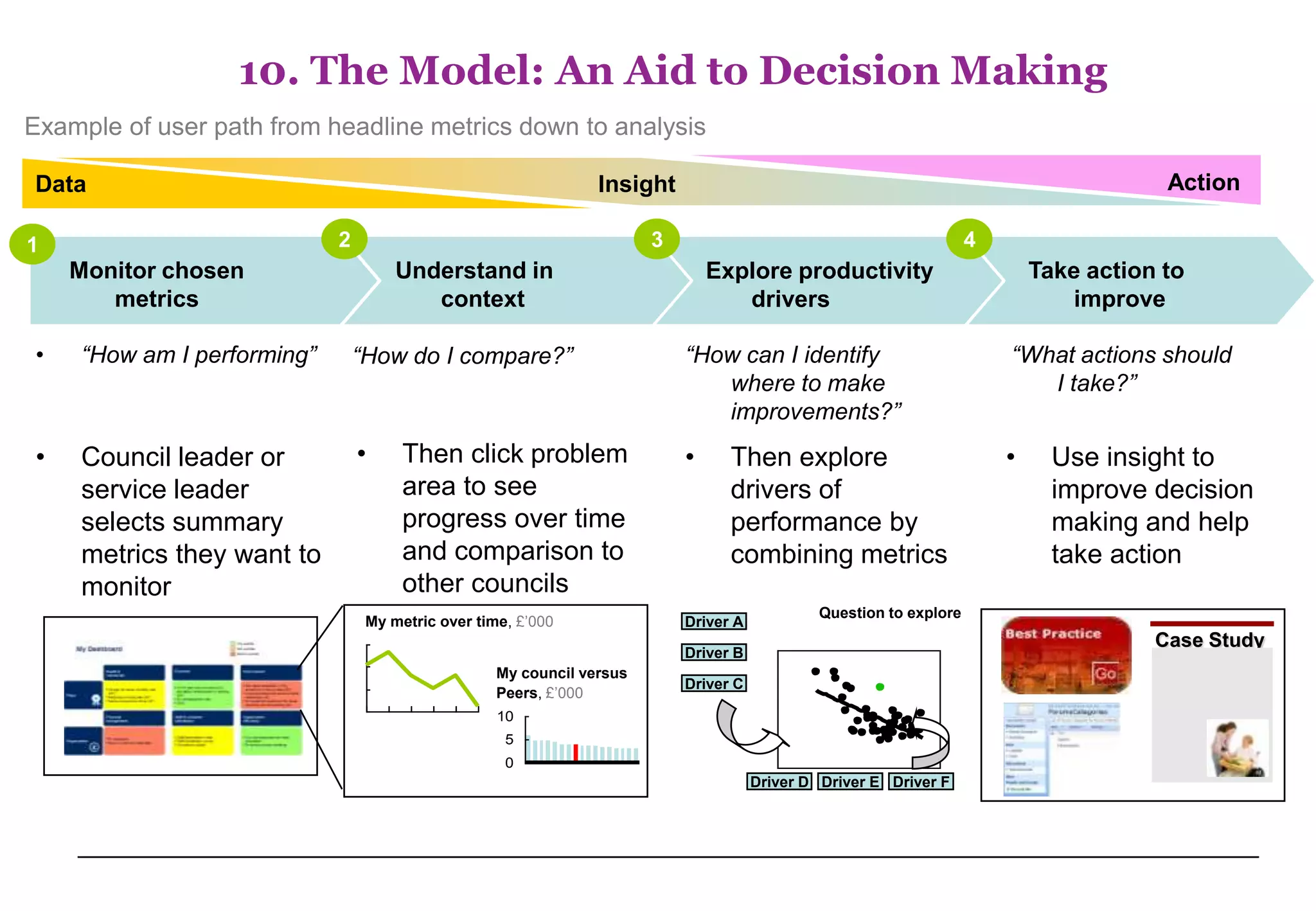
10. The Model: An Aid to Decision Making
Example of user path from headline metrics down to analysis

Data                                                          Insight
                                                                Insight                                                                 Action

1                           2                                          3                                            4
    Monitor chosen                   Understand in                             Explore productivity                         Take action to
       metrics                          context                                   drivers                                       improve

•   “How am I performing”       “How do I compare?”                        “How can I identify                          “What actions should
                                                                              where to make                                I take?”
                                                                              improvements?”
•   Council leader or           •     Then click problem                   •     Then explore                           •     Use insight to
    service leader                    area to see                                drivers of                                   improve decision
    selects summary                   progress over time                         performance by                               making and help
    metrics they want to              and comparison to                          combining metrics                            take action
    monitor                           other councils
                                                                                              Question to explore
                                 My metric over time, £’000                Driver A
                                                                                                                                       Case Study
                                                                           Driver B
                                                   My council versus
                                                                           Driver C
                                                   Peers, £’000
                                                   10
                                                    5
                                                    0
                                                                                      Driver D Driver E Driver F
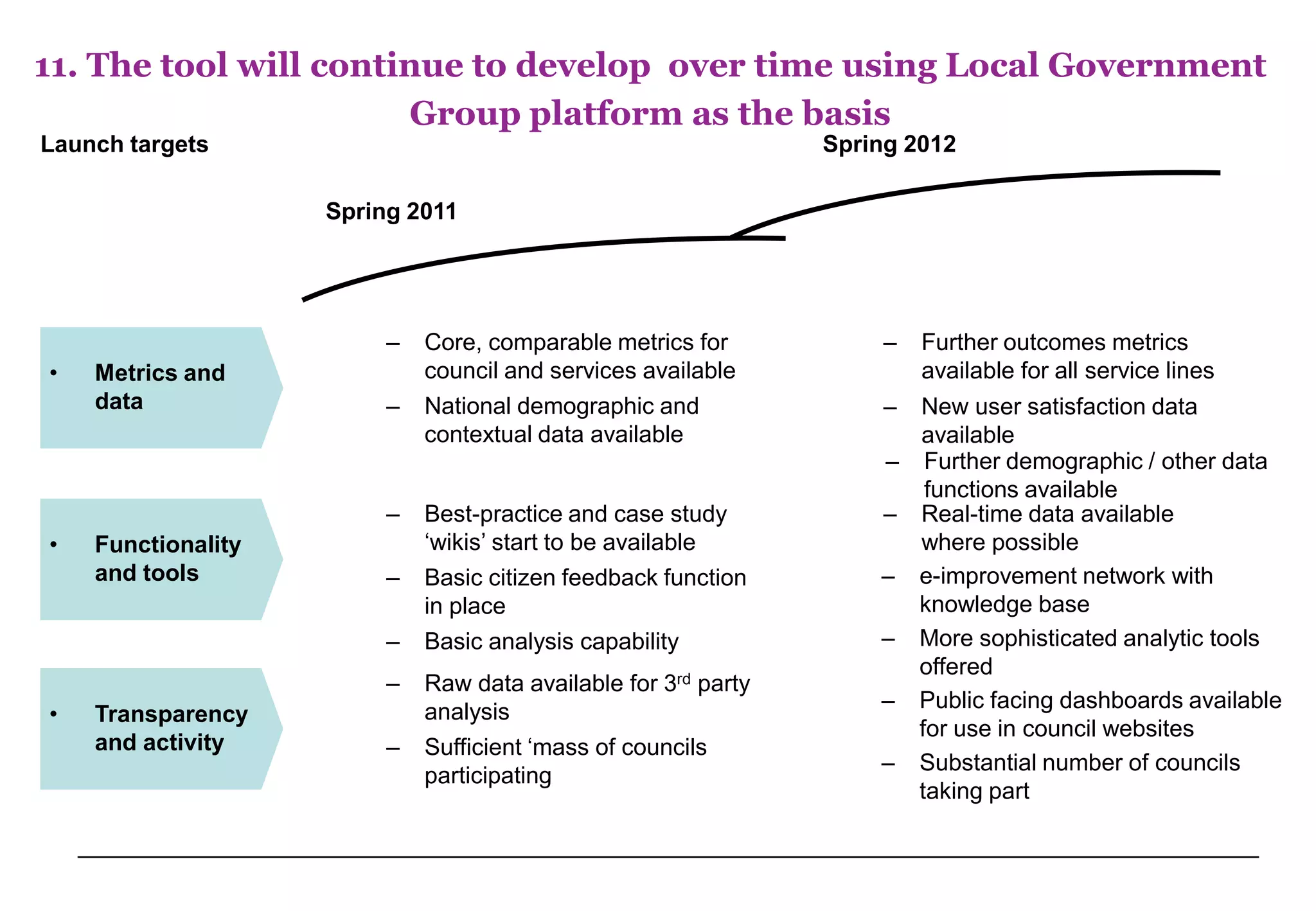
11. The tool will continue to develop over time using Local Government
                       Group platform as the basis
Launch targets                                                  Spring 2012

                    Spring 2011


                         –   Core, comparable metrics for            –   Further outcomes metrics
•   Metrics and              council and services available              available for all service lines
    data                 –   National demographic and                –New user satisfaction data
                             contextual data available                available
                                                                    – Further demographic / other data
                                                                       functions available
                         –   Best-practice and case study           – Real-time data available
•   Functionality            ‘wikis’ start to be available            where possible
    and tools            –   Basic citizen feedback function        – e-improvement network with
                             in place                                 knowledge base
                         –   Basic analysis capability              – More sophisticated analytic tools
                                                                      offered
                         –   Raw data available for 3rd party
                                                                    – Public facing dashboards available
•   Transparency             analysis
                                                                      for use in council websites
    and activity         –   Sufficient ‘mass of councils
                                                                    – Substantial number of councils
                             participating
                                                                      taking part
12. Conclusions

• Transparency and productivity are an unfolding story
  requiring a shift in culture within the public sector.

• But, we must make it work for citizens.

• Potential to be driver for innovation in public services.

• Remembering the Martha Lane-Fox point about digital being
  a 21st century element to literacy: we mustn’t forget the 10%
  who aren’t connected and find ways to draw them in.

George Garlick, Transparency and Productivity

  • 1.
    KNOWLEDGE HUB: CONNECT,COLLABORATE, LEARN AND INNOVATE CONFERENCE: 1st March 2011 Transparency, Data and Productivity George Garlick: Chief Executive Durham www.local.gov.uk/inform
  • 2.
    1. Transparency: The Immediate Task For Local Government Commitment to: • January publication of: – £500+ spend data (all but 1 councils have or will shortly publish) – Senior salaries (most councils have published) – Contracts over £500 ((just getting to grips with this one) • Initially, injunction don’t let best be enemy of the good but subsequent shift to wanting ‘machine readable’ format (ref. Government Transparency Guidelines). • Underscored by (Central) Government Public Data Principles.
  • 3.
    2. The ImmediateTask For Local Government Is this proving difficult: • Practicalities vary depending on systems, but achievable • Issues around: – Achieving comparability and consistent data quality: e.g. potential for using CIPFA categories for spend data. – Helping others make sense of the information – Ensuring security of personal data and certain types of confidential data; – Fraud protection: conflicting views and still to be resolved – Pragmatic details for example who is named in publishing salaries and related data. • Practitioner help available from the Local Government Group: http://lgtransparency.readandcomment.com • Also a Local Open Data community of practice
  • 4.
    3. So isthis the end of that story? No: • There well be a legislative basis to the local transparency agenda with extensions to Freedom of Information and Environmental Information Regulations; and • A current consultation on a ‘Code of ‘Recommended’ Practice under Section 2(11) of the Local Government, Land and Planning Act 1980 ref publication of information by local authorities about the discharge of their functions and other matters – a significant extension to the range of data and information to be open and public, includes performance.
  • 5.
    4. Where isthis headed? Underlying this: • A different form of accountability: less top down and target driven. • More about direct accountability to citizens with armchair auditors as catalysts. • Driven initially by concern to reduce spend and encourage challenge through scrutiny and question, but….
  • 6.
    5. Where isthis headed? Scope for: • Developing the accountability agenda: opening up performance and helping local politicians tell the local story; •Using data and information to support participatory as well as elective democracy – e.g. involving people in decisions about where and what to cut as budgets are reduced (e.g. the London Borough of Redbridge experience). •Using information as an enabler for Big Society: the process of shifting the balance between state / citizen and unlocking creativity: helping people do it for themselves.
  • 7.
    6. But somechallenges in doing this… • Shifting mindsets and culture away from accepted notions of confidentiality and the use of statistics, whilst recognising the role for example of: – Data standards, e.g. for comparability purposes; yet – Creating space for ‘mashups’ and experimentation. • Fostering innovation at a time of austerity: e.g. generating the market for ‘applications’ – not just an developer activity: this should inform public service behaviour, e.g. real time provision of service information and citizen engagement / feedback;
  • 8.
    7. Productivity: theOther Side of the Challenge Local government is experiencing substantial cuts which challenges us to re-assess how local government and local public services manage and report on performance, and at the same time, do so transparently. The Productivity agenda is supporting this through sector led development of systematic approaches to assess productivity and unit cost to give timely, robust, and comparable data to: • Inform service performance and corporate overheads, support self assessment, drive savings and improve efficiency; • Offer a means to support challenge, e.g. from elected members; and • Contribute to benchmarking, and help stimulate public scrutiny, e.g. by offering quicker and user friendly citizen access to data, recognising that transparency is more than publishing spend data but a shift to greater and more open accountability to citizens and customers.
  • 9.
    8. Productivity: WhatAre We Delivering? • Through the Local Government Group, we will offer a free of charge place for councils to lodge data providing: – Access to tools to systematically examine productivity and cost – Easy access to demographic and socio-economic data – On-line means to share experience – Access to analytical expertise • A facility to share and compare key data: – Efficiency and productivity metrics – Citizen satisfaction – Outcome and achievement measures • Help in offering citizens meaningful access to performance data. • Use the Knowledge Hub as a platform.
  • 10.
    9. How WillThis Work? • Voluntary; • A service to and for councils (not re-creating the previous centralized system); • Potential for council cost savings by reducing overheads in managing data, but doesn’t stop councils using consultants if they wish. • Currently working in in depth with a number of councils and aim to launch the first stage in Spring of this year in what we see as a 2 – 3 year project. • If you want to know more contact: juliet.whitworth@local,gov.uk
  • 11.
    10. The Model:An Aid to Decision Making Example of user path from headline metrics down to analysis Data Insight Insight Action 1 2 3 4 Monitor chosen Understand in Explore productivity Take action to metrics context drivers improve • “How am I performing” “How do I compare?” “How can I identify “What actions should where to make I take?” improvements?” • Council leader or • Then click problem • Then explore • Use insight to service leader area to see drivers of improve decision selects summary progress over time performance by making and help metrics they want to and comparison to combining metrics take action monitor other councils Question to explore My metric over time, £’000 Driver A Case Study Driver B My council versus Driver C Peers, £’000 10 5 0 Driver D Driver E Driver F
  • 12.
    11. The toolwill continue to develop over time using Local Government Group platform as the basis Launch targets Spring 2012 Spring 2011 – Core, comparable metrics for – Further outcomes metrics • Metrics and council and services available available for all service lines data – National demographic and –New user satisfaction data contextual data available available – Further demographic / other data functions available – Best-practice and case study – Real-time data available • Functionality ‘wikis’ start to be available where possible and tools – Basic citizen feedback function – e-improvement network with in place knowledge base – Basic analysis capability – More sophisticated analytic tools offered – Raw data available for 3rd party – Public facing dashboards available • Transparency analysis for use in council websites and activity – Sufficient ‘mass of councils – Substantial number of councils participating taking part
  • 13.
    12. Conclusions • Transparencyand productivity are an unfolding story requiring a shift in culture within the public sector. • But, we must make it work for citizens. • Potential to be driver for innovation in public services. • Remembering the Martha Lane-Fox point about digital being a 21st century element to literacy: we mustn’t forget the 10% who aren’t connected and find ways to draw them in.