CEMSDI
                 Civil-servant Empowerment for Multi Media Service Delivery ICT-enabled


                   Empower Local Authorities towards an inclusive
                              Digital Local Agenda


                                                           Sonia Massobrio


                                                              Contract No. 250482
                                                        ICT Policy Support Programme
                                                   Call 3 objective 3.3 Inclusive eGovernance


Project start date: 1st June 2010                                                                                          Date: 07-10-2011
Duration: 24 months                                                                                               Dissemination Level: Public
Coordinating partner: INNOVA Spa                                                            Work package: WP4 Instruments and elearning tools
Published by the CEMSDI Consortium                                                                                                  Learning
Project co-funded by the European Commission within the CIP ICT-PSP                                       Document owner(s): CATTID ROMA
Programme
Problems and Proposed Solution

Actual problems:

 Administrations in local areas provide 70% of public services for citizens and
  enterprises and represent the largest majority of the 90,000 local and regional
  governments in the European Union

 citizens living in non-metropolitan areas are far more likely to suffer from digital
  deprivation which in turn can create socially disadvantaged groups

 there is a high requirement for ICT services in local administrations to assist with the
  dissemination of best practice into rurally isolated areas due to socio-economic, cultural
  and language barriers

Proposed solution:

   to use ICT as an enabler and a powerful instrument to implement improved public
   and local services which tackle social and digital inclusion, and aim to leave no
   individual behind. This is through them implementation of a Digital Local Agenda (DLA)


                                             2
Digital Local Agenda (DLA)


  is a process                is a policy                is a
     in time                 instrument             monitoring tool

that requires adequate    to implement feasible     to assess improvement
planning and constant       eGov strategies in      and decide on projects
    evaluation by         local/regional areas by     and their financing
stakeholders involved      mapping real needs


                                   3
Pilots

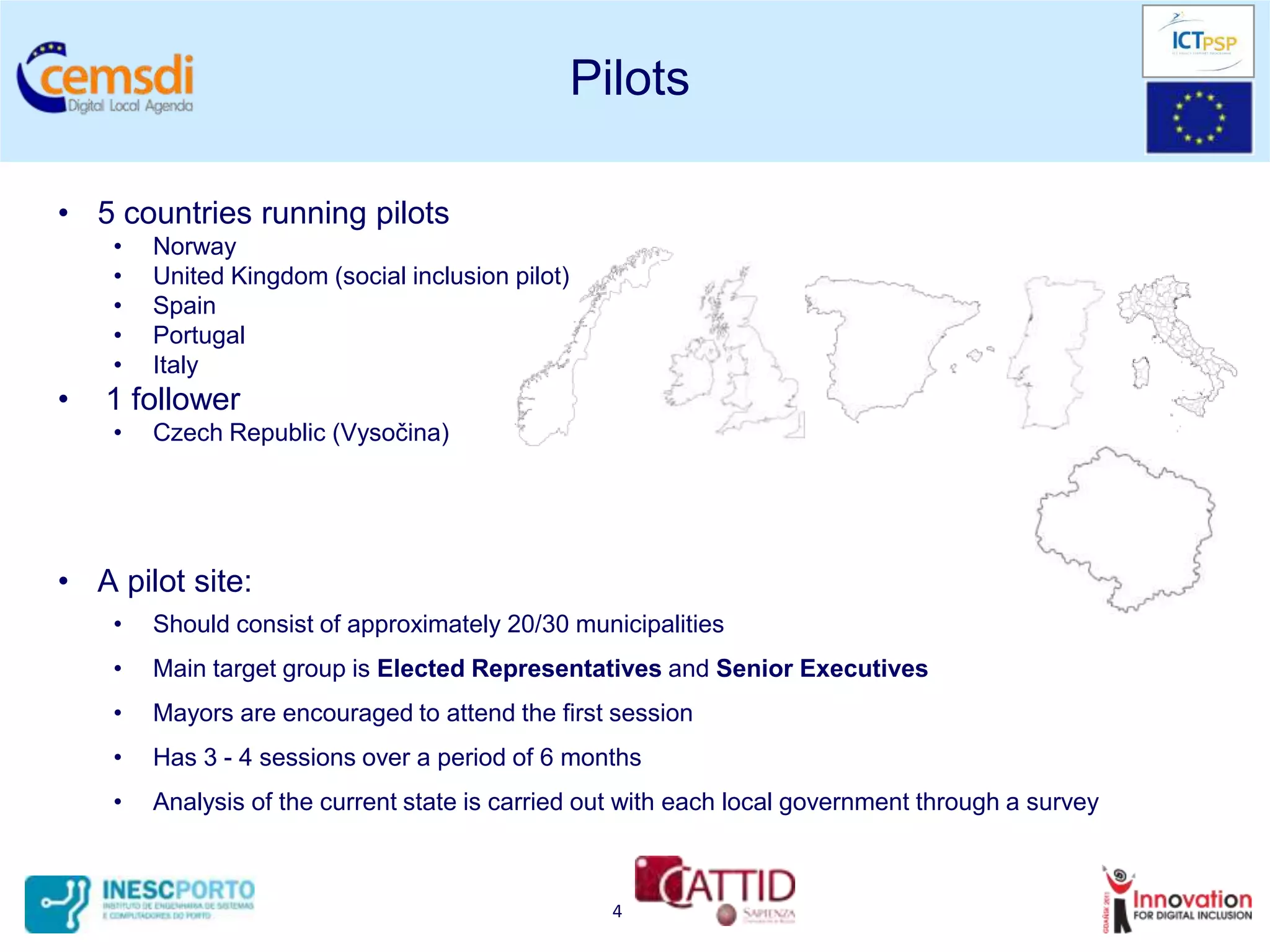
• 5 countries running pilots
    •   Norway
    •   United Kingdom (social inclusion pilot)
    •   Spain
    •   Portugal
    •   Italy
•   1 follower
    •   Czech Republic (Vysočina)


• A pilot site:
    •   Should consist of approximately 20/30 municipalities
    •   Main target group is Elected Representatives and Senior Executives
    •   Mayors are encouraged to attend the first session
    •   Has 3 - 4 sessions over a period of 6 months
    •   Analysis of the current state is carried out with each local government through a survey


                                                    4
Context


• Municipalities are too small (fewer than 10 000 inhabitants):
        •In Norway ~78%
        •In Spain ~90%
        •In Italy ~85%

• The complexity of Citizen solutions is too high for a municipality to
   solve on their own
• Insufficient resources: both financial and expertise
• Innovation capacity through ICT is very low
• Senior executives have insufficient knowledge of ICT


                                    5
Objective

•   Capacity building through
      • Lectures
      • Discussions
      • Experts and guest speakers

•   Create a common platform for
      • Problem understanding
      • Identify opportunities
      • Regional cooperation and clusters
      • Alignment in relation to european and national goals and strategies
         including social inclusion policies


The final objective is the initiation and creation of a regional DLA


                                      6
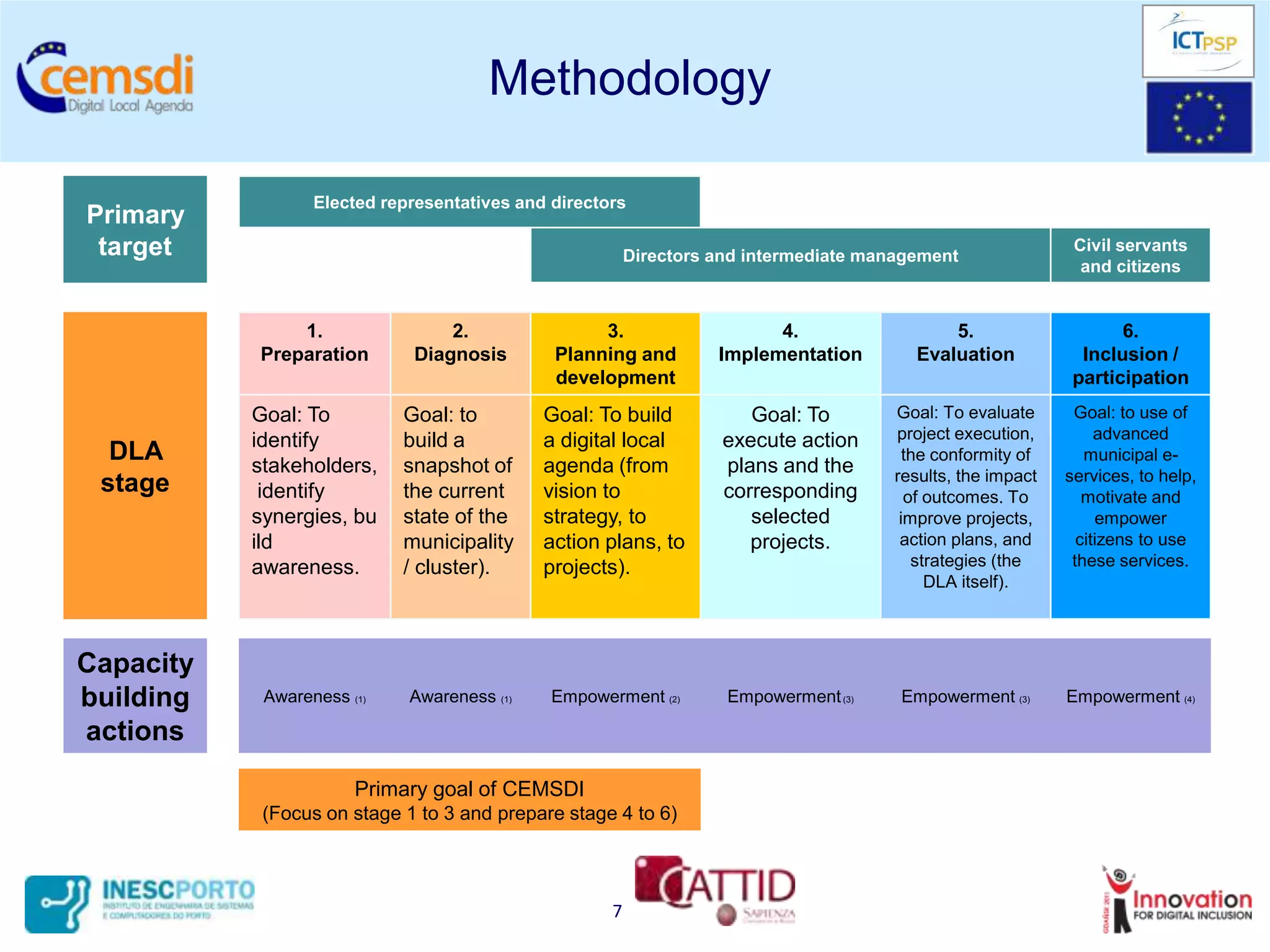
Methodology

                  Elected representatives and directors
Primary
 target                                                  Directors and intermediate management
                                                                                                             Civil servants
                                                                                                              and citizens


               1.                2.                3.                    4.                  5.                    6.
           Preparation       Diagnosis        Planning and         Implementation        Evaluation           Inclusion /
                                              development                                                    participation
           Goal: To         Goal: to         Goal: To build           Goal: To        Goal: To evaluate      Goal: to use of
           identify         build a          a digital local       execute action     project execution,         advanced
  DLA      stakeholders,    snapshot of      agenda (from          plans and the
                                                                                        the conformity of      municipal e-
                                                                                      results, the impact   services, to help,
 stage      identify        the current      vision to             corresponding        of outcomes. To        motivate and
           synergies, bu    state of the     strategy, to             selected         improve projects,         empower
           ild              municipality     action plans, to         projects.        action plans, and      citizens to use
           awareness.       / cluster).      projects).                                  strategies (the     these services.
                                                                                           DLA itself).


Capacity
building    Awareness (1)    Awareness (1)    Empowerment (2)       Empowerment (3)    Empowerment (3)      Empowerment (4)

actions
                       Primary goal of CEMSDI
            (Focus on stage 1 to 3 and prepare stage 4 to 6)


                                                     7
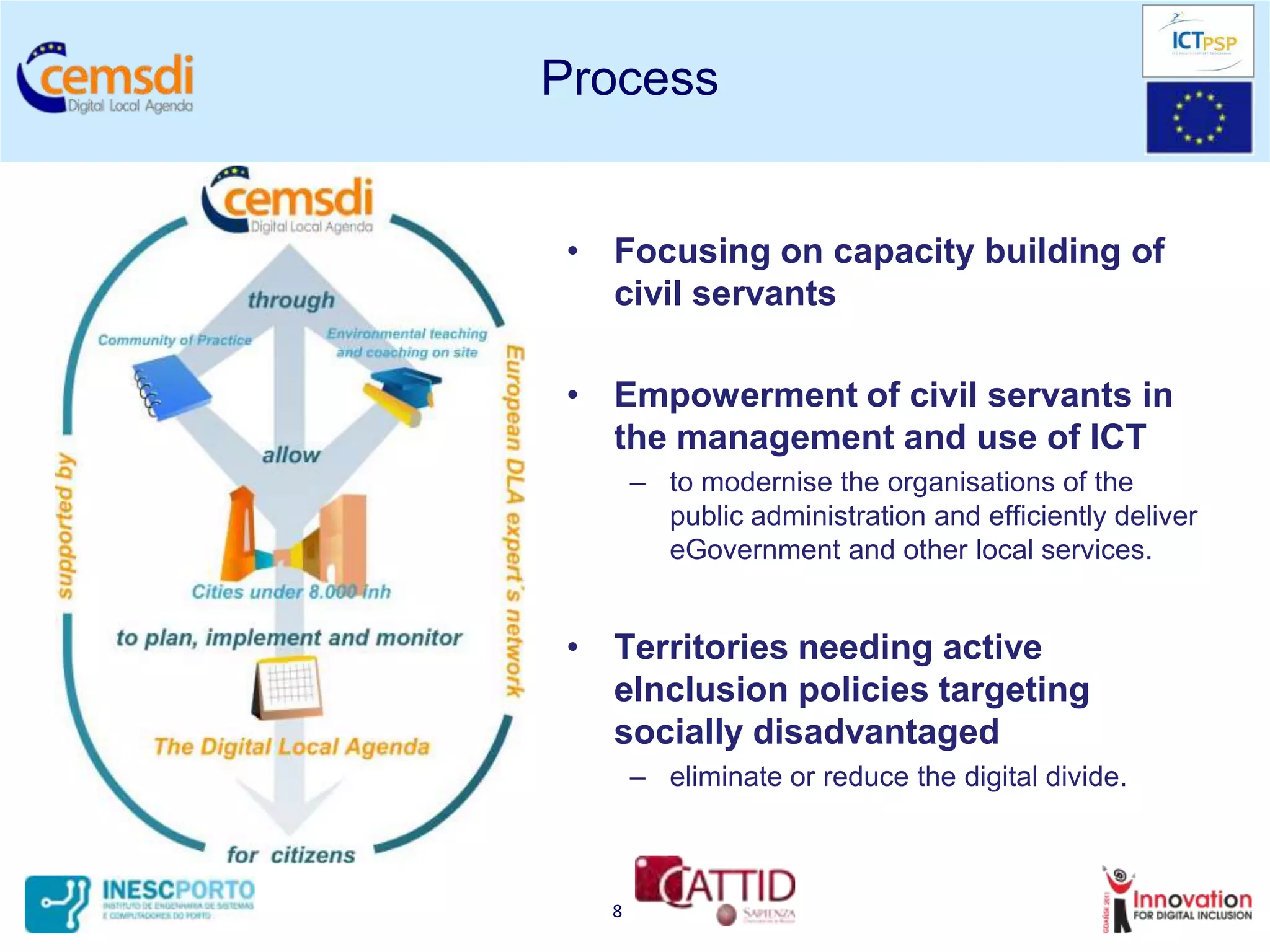
Process


 • Focusing on capacity building of
   civil servants

 • Empowerment of civil servants in
   the management and use of ICT
       – to modernise the organisations of the
         public administration and efficiently deliver
         eGovernment and other local services.


 • Territories needing active
   eInclusion policies targeting
   socially disadvantaged
       – eliminate or reduce the digital divide.


   8
Italian Pilot

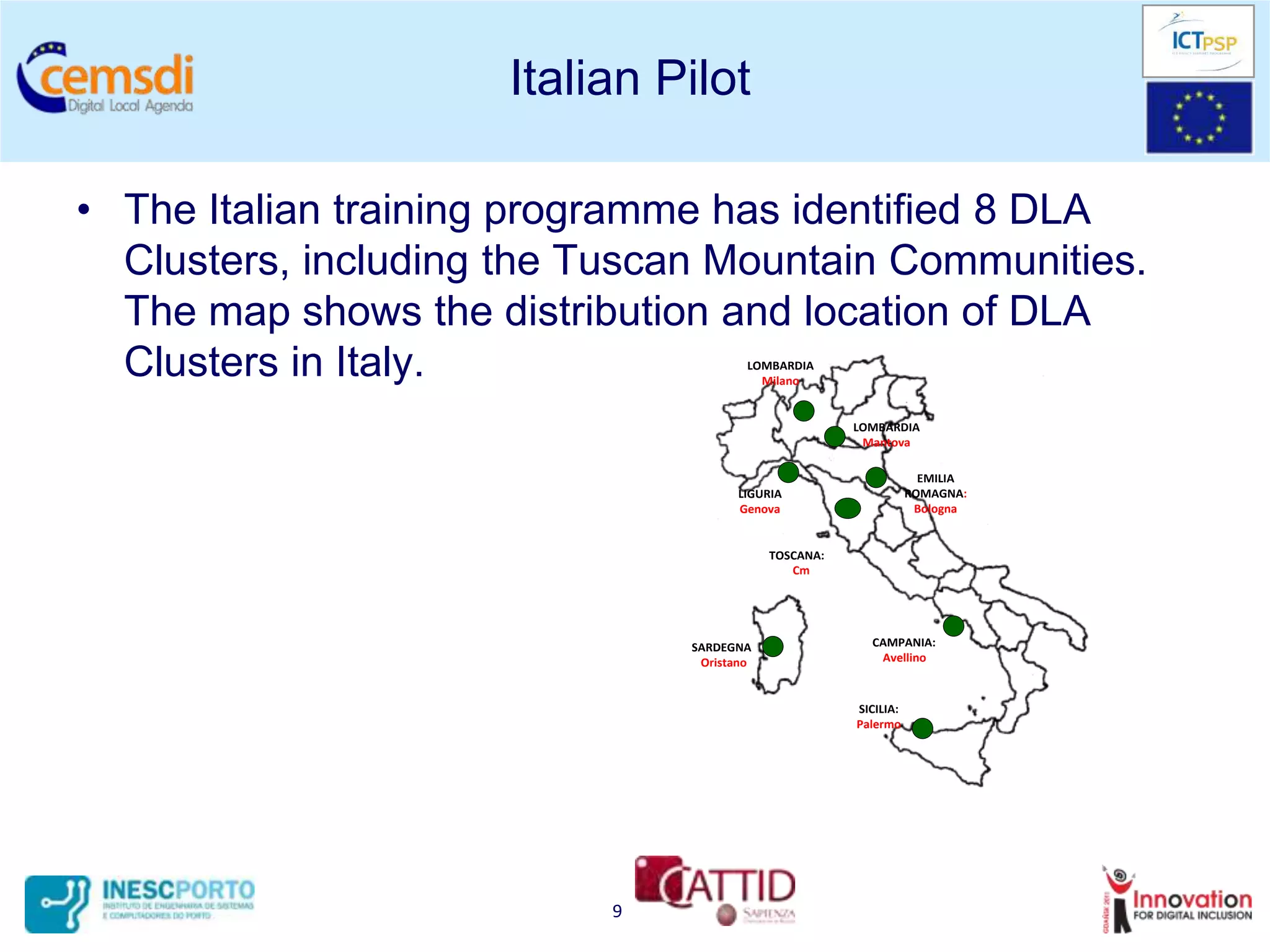
• The Italian training programme has identified 8 DLA
  Clusters, including the Tuscan Mountain Communities.
  The map shows the distribution and location of DLA
  Clusters in Italy.                   LOMBARDIA
                                         Milano


                                                      LOMBARDIA
                                                       Mantova

                                                                   EMILIA
                                      LIGURIA                    ROMAGNA:
                                      Genova                      Bologna


                                           TOSCANA:
                                              Cm


                               SARDEGNA                 CAMPANIA:
                                Oristano                 Avellino


                                                      SICILIA:
                                                      Palermo


                           9
The training programme

There are two levels of attendees:

• The strategic level: These are the highest level decision
  makers in the public administration and those who define
  policy for example mayors, Cabinet members and senior
  executives.
• The practitioner level: This includes middle-level
  management and employees.
Both levels of trainees attend the same training in order to
  ensure the efficacy of the DLA process.


                            10
The training programme

• The three subjects defined at the macro level are:
  Document management, toward Paperless processes
  management
  Cooperation (applicative and operative)
  Communication and participation
• These topics are ones which follow the national
  programme and also fit in with the CEMSDI DLA
  priorities.
• The eGovernment strategy and DLA planning and
  implementation is targeted at both levels of attendees.
  At a micro level, contents of the two topics are further
  defined.
                            11
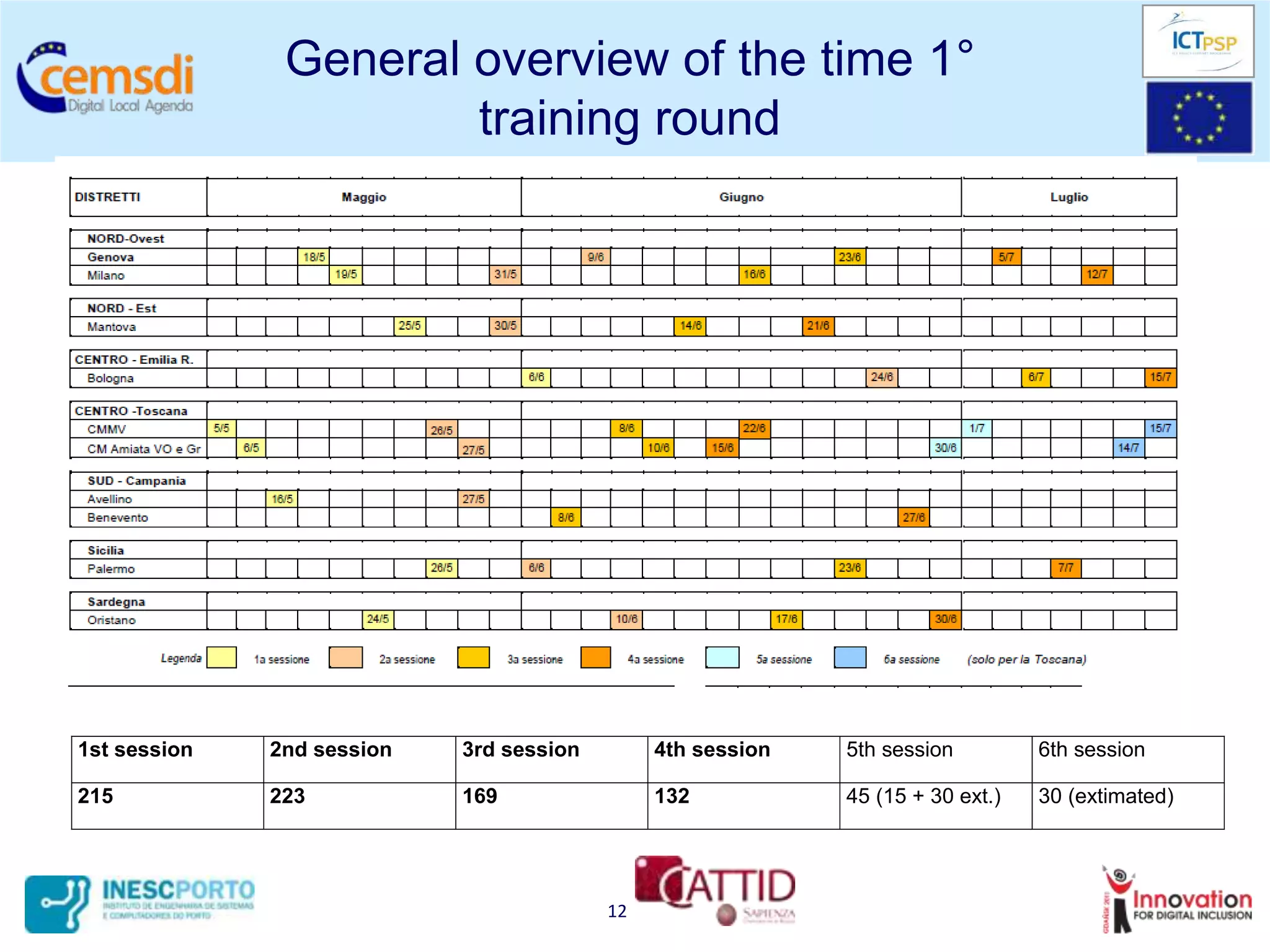
General overview of the time 1°
                       training round


1st session   2nd session   3rd session        4th session   5th session         6th session

215           223           169                132           45 (15 + 30 ext.)   30 (extimated)


                                          12
The DLA expert and the 2° training
                       round

• The expert for the training acitivities are selected int the DLA
  network experts, but also paying attention to local
  relationships.

• It is started the 2° training round, are been selected some
  groups of municipalities on wich to apply a coachin training
  approach.

• In Emilia Romagna Region, it is subscribed an agreement
  between ANCI ER and CESMDI to implement the best
  localization of trainig activity and to experiment modality for
  the sustenaibilty of the DLA process and to disseminate the
  results.

                                13
Future and Follow up

• Community of Practice
   – Practitioners and experts will exchange knowledge
• Network of Experts
   – Support to other regions starting the DLA process
   – Production of new materials
• Cluster of external users
   – Countries and regions that may not have experience and knowledge
     with the DLA
   – new materials are being produced based upon the experience from the
     5 pilots to be used by other administrations in Europe:
       • European Union member countries
       • candidate countries
       • other European countries


                                   14
EISCO Conference
                            www.eisco2012.eu
• European Information Society Conference
• Main European conference for the information
  society at local and regional level

Previous editions:
      Belgium [Brussels, 1998], Spain [Malaga, 2000], Italy [Cagliari, 2002],
      Denmark [Aalborg, 2003], Poland [Cracow, 2005], Finland [Hameenlinna, 2007],
      Italy [Naples, 2008] and Spain [Bilbao, 2010]


  EISCO 2012
      24 - 26 May 2012
      Guimarães – Portugal

                                           15
Contacts


www.cemsdi.eu           www.digitallocalagenda.eu


              Sonia Massobrio
        Sonia.massobrio@gmail.com


                  16

Empower Local Authorities towards an inclusive Digital Local Agenda

  • 1.
    CEMSDI Civil-servant Empowerment for Multi Media Service Delivery ICT-enabled Empower Local Authorities towards an inclusive Digital Local Agenda Sonia Massobrio Contract No. 250482 ICT Policy Support Programme Call 3 objective 3.3 Inclusive eGovernance Project start date: 1st June 2010 Date: 07-10-2011 Duration: 24 months Dissemination Level: Public Coordinating partner: INNOVA Spa Work package: WP4 Instruments and elearning tools Published by the CEMSDI Consortium Learning Project co-funded by the European Commission within the CIP ICT-PSP Document owner(s): CATTID ROMA Programme
  • 2.
    Problems and ProposedSolution Actual problems:  Administrations in local areas provide 70% of public services for citizens and enterprises and represent the largest majority of the 90,000 local and regional governments in the European Union  citizens living in non-metropolitan areas are far more likely to suffer from digital deprivation which in turn can create socially disadvantaged groups  there is a high requirement for ICT services in local administrations to assist with the dissemination of best practice into rurally isolated areas due to socio-economic, cultural and language barriers Proposed solution: to use ICT as an enabler and a powerful instrument to implement improved public and local services which tackle social and digital inclusion, and aim to leave no individual behind. This is through them implementation of a Digital Local Agenda (DLA) 2
  • 3.
    Digital Local Agenda(DLA) is a process is a policy is a in time instrument monitoring tool that requires adequate to implement feasible to assess improvement planning and constant eGov strategies in and decide on projects evaluation by local/regional areas by and their financing stakeholders involved mapping real needs 3
  • 4.
    Pilots • 5 countriesrunning pilots • Norway • United Kingdom (social inclusion pilot) • Spain • Portugal • Italy • 1 follower • Czech Republic (Vysočina) • A pilot site: • Should consist of approximately 20/30 municipalities • Main target group is Elected Representatives and Senior Executives • Mayors are encouraged to attend the first session • Has 3 - 4 sessions over a period of 6 months • Analysis of the current state is carried out with each local government through a survey 4
  • 5.
    Context • Municipalities aretoo small (fewer than 10 000 inhabitants): •In Norway ~78% •In Spain ~90% •In Italy ~85% • The complexity of Citizen solutions is too high for a municipality to solve on their own • Insufficient resources: both financial and expertise • Innovation capacity through ICT is very low • Senior executives have insufficient knowledge of ICT 5
  • 6.
    Objective • Capacity building through • Lectures • Discussions • Experts and guest speakers • Create a common platform for • Problem understanding • Identify opportunities • Regional cooperation and clusters • Alignment in relation to european and national goals and strategies including social inclusion policies The final objective is the initiation and creation of a regional DLA 6
  • 7.
    Methodology Elected representatives and directors Primary target Directors and intermediate management Civil servants and citizens 1. 2. 3. 4. 5. 6. Preparation Diagnosis Planning and Implementation Evaluation Inclusion / development participation Goal: To Goal: to Goal: To build Goal: To Goal: To evaluate Goal: to use of identify build a a digital local execute action project execution, advanced DLA stakeholders, snapshot of agenda (from plans and the the conformity of municipal e- results, the impact services, to help, stage identify the current vision to corresponding of outcomes. To motivate and synergies, bu state of the strategy, to selected improve projects, empower ild municipality action plans, to projects. action plans, and citizens to use awareness. / cluster). projects). strategies (the these services. DLA itself). Capacity building Awareness (1) Awareness (1) Empowerment (2) Empowerment (3) Empowerment (3) Empowerment (4) actions Primary goal of CEMSDI (Focus on stage 1 to 3 and prepare stage 4 to 6) 7
  • 8.
    Process • Focusingon capacity building of civil servants • Empowerment of civil servants in the management and use of ICT – to modernise the organisations of the public administration and efficiently deliver eGovernment and other local services. • Territories needing active eInclusion policies targeting socially disadvantaged – eliminate or reduce the digital divide. 8
  • 9.
    Italian Pilot • TheItalian training programme has identified 8 DLA Clusters, including the Tuscan Mountain Communities. The map shows the distribution and location of DLA Clusters in Italy. LOMBARDIA Milano LOMBARDIA Mantova EMILIA LIGURIA ROMAGNA: Genova Bologna TOSCANA: Cm SARDEGNA CAMPANIA: Oristano Avellino SICILIA: Palermo 9
  • 10.
    The training programme Thereare two levels of attendees: • The strategic level: These are the highest level decision makers in the public administration and those who define policy for example mayors, Cabinet members and senior executives. • The practitioner level: This includes middle-level management and employees. Both levels of trainees attend the same training in order to ensure the efficacy of the DLA process. 10
  • 11.
    The training programme •The three subjects defined at the macro level are: Document management, toward Paperless processes management Cooperation (applicative and operative) Communication and participation • These topics are ones which follow the national programme and also fit in with the CEMSDI DLA priorities. • The eGovernment strategy and DLA planning and implementation is targeted at both levels of attendees. At a micro level, contents of the two topics are further defined. 11
  • 12.
    General overview ofthe time 1° training round 1st session 2nd session 3rd session 4th session 5th session 6th session 215 223 169 132 45 (15 + 30 ext.) 30 (extimated) 12
  • 13.
    The DLA expertand the 2° training round • The expert for the training acitivities are selected int the DLA network experts, but also paying attention to local relationships. • It is started the 2° training round, are been selected some groups of municipalities on wich to apply a coachin training approach. • In Emilia Romagna Region, it is subscribed an agreement between ANCI ER and CESMDI to implement the best localization of trainig activity and to experiment modality for the sustenaibilty of the DLA process and to disseminate the results. 13
  • 14.
    Future and Followup • Community of Practice – Practitioners and experts will exchange knowledge • Network of Experts – Support to other regions starting the DLA process – Production of new materials • Cluster of external users – Countries and regions that may not have experience and knowledge with the DLA – new materials are being produced based upon the experience from the 5 pilots to be used by other administrations in Europe: • European Union member countries • candidate countries • other European countries 14
  • 15.
    EISCO Conference www.eisco2012.eu • European Information Society Conference • Main European conference for the information society at local and regional level Previous editions: Belgium [Brussels, 1998], Spain [Malaga, 2000], Italy [Cagliari, 2002], Denmark [Aalborg, 2003], Poland [Cracow, 2005], Finland [Hameenlinna, 2007], Italy [Naples, 2008] and Spain [Bilbao, 2010] EISCO 2012 24 - 26 May 2012 Guimarães – Portugal 15
  • 16.
    Contacts www.cemsdi.eu www.digitallocalagenda.eu Sonia Massobrio Sonia.massobrio@gmail.com 16