Measurement and
Geometry
First Quarter, S.Y. 2024-2025
Geometry
GEOMETRY
Geometry is one of the classical
disciplines of math.
The word geometry was derived from
two Greek words, geo and metron,
which mean earth and measure,
respectively
Point
Line
Plane
U N D E F I N E D T E R M S
U N D E F I N E D T E R M S :
1. Point
U N D E F I N E D T E R M S :
1. Point ∠
U N D E F I N E D T E R M S :
1. Point
U N D E F I N E D T E R M S :
1. Point ?
?
?
? ?
?
?
?
?
U N D E F I N E D T E R M S :
1. Point
A
B
C
D
F
G
E
H
I
Point A
U N D E F I N E D T E R M S :
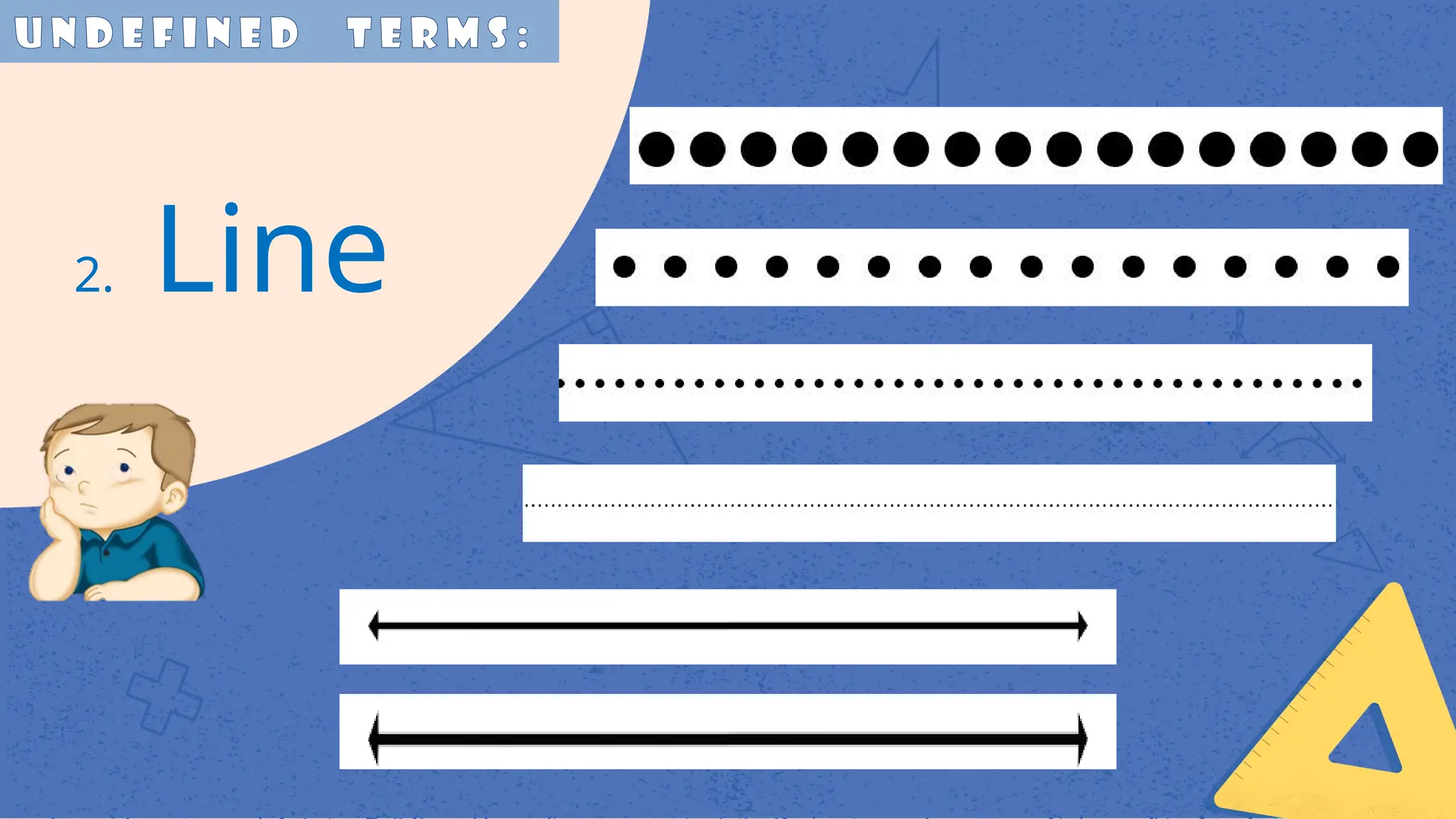
2. Line
U N D E F I N E D T E R M S :
A
B
2. Line
m
Line AB
Line m
´
𝐴𝐵
U N D E F I N E D T E R M S :
3. Plane
U N D E F I N E D T E R M S :
A
B
C
U N D E F I N E D T E R M S :
A
B
C
3. Plane
U N D E F I N E D T E R M S :
A
B
C
3. Plane
is primarily developed
to be a practical guide
for measuring lengths,
areas, and volumes, and
is still in use up to now.
GEOMETRY
Pictures will be displayed, and
players have 5 seconds to write
down the polygon’s name based on
the number of sides and what
polygon it reminds them. Correct
answer earns 1 point.
Triangle
Quadrilateral
Pentagon
Quadrilateral
Octagon
The name of a polygon will be flashed
on the screen and, the players have 5
seconds to write down the number of
sides. The correct answer earns 1 point.
Triangle
Quadrilateral
Pentagon
Octagon
What is a
polygon?
Which figure is a
polygon?
Polygons
The figures below are polygons. They are closed, plane figures,
made of line segments, and the segments intersect only at their
endpoints.
These are not polygons
Not a plane
figure
Sides do not
intersect at their
endpoints
What is a
polygon?
Polygon
is a closed-plane
figure bounded by
line segments that
meet only at their
endpoints.
Classification of Polygons
Polygons could be classified either as convex or concave. A polygon is
convex if no diagonal is in the exterior of the polygon. A polygon is
concave if at least one diagonal is in the exterior of the polygon.
A polygon consists of segments for its sides. If you extend each of the
segments past its endpoints and none of these resulting lines pass through
the inside or interior of the polygon, then the polygon is convex. Otherwise,
if even one extended side cuts into the interior of the polygon, then the
polygon is concave.
Types of Polygons
The different types of polygons in
terms of congruency of parts are
equilateral, equiangular, and
regular. A polygon is equilateral if
all its sides are equal;
equiangular if all its angles are
equal; regular if both sides and
angles are all equal.
How do we name
polygons?
Naming a Polygon
Polygons are named by writing their consecutive vertices in order,
such as ABCDE or AEDCB or CDEAB or CBAED for the figure on the left.
A polygon separates a plane into three sets of points: the polygon itself,
points in the interior of the polygon, and points in the exterior of the
polygon.
The parts of a polygon are the sides, vertices, interior and exterior angles,
and diagonals. An exterior angle of a polygon is an angle that is both
supplement and adjacent to one of its interior angles.
- Consecutive vertices are vertices on the same side of the polygon.
- Consecutive sides are sides that have a common vertex.
- A diagonal is a segment joining non-consecutive vertices.
A polygon separates a plane into three sets of points: the polygon itself,
points in the interior of the polygon, and points in the exterior of the
polygon.
DIY: Name the polygon.
Name:
Diagonals:
Angles:
Vertices:
Sides:
What do you know about a square?
No. of
Sides
No. of
diagonals
from a
fixed
vertex
No. of
triangles
formed
Sum of the
interior angles
Measure of
each interior
angle of a
regular polygon
3
4
5
6
7
8
9
10
n
Example. Compute for the sum of interior angles of a convex decagon.
GEOMETRY GRADE 8 POWERPOINT - MEASUREMENT AND GEOMETRY

GEOMETRY GRADE 8 POWERPOINT - MEASUREMENT AND GEOMETRY

  • 1.
  • 2.
  • 7.
    GEOMETRY Geometry is oneof the classical disciplines of math. The word geometry was derived from two Greek words, geo and metron, which mean earth and measure, respectively
  • 8.
    Point Line Plane U N DE F I N E D T E R M S
  • 9.
    U N DE F I N E D T E R M S : 1. Point
  • 10.
    U N DE F I N E D T E R M S : 1. Point ∠
  • 11.
    U N DE F I N E D T E R M S : 1. Point
  • 12.
    U N DE F I N E D T E R M S : 1. Point ? ? ? ? ? ? ? ? ?
  • 13.
    U N DE F I N E D T E R M S : 1. Point A B C D F G E H I Point A
  • 14.
    U N DE F I N E D T E R M S : 2. Line
  • 15.
    U N DE F I N E D T E R M S : A B 2. Line m Line AB Line m ´ 𝐴𝐵
  • 16.
    U N DE F I N E D T E R M S : 3. Plane
  • 17.
    U N DE F I N E D T E R M S : A B C
  • 18.
    U N DE F I N E D T E R M S : A B C 3. Plane
  • 19.
    U N DE F I N E D T E R M S : A B C 3. Plane
  • 20.
    is primarily developed tobe a practical guide for measuring lengths, areas, and volumes, and is still in use up to now. GEOMETRY
  • 27.
    Pictures will bedisplayed, and players have 5 seconds to write down the polygon’s name based on the number of sides and what polygon it reminds them. Correct answer earns 1 point.
  • 29.
  • 31.
  • 33.
  • 35.
  • 37.
  • 39.
    The name ofa polygon will be flashed on the screen and, the players have 5 seconds to write down the number of sides. The correct answer earns 1 point.
  • 40.
  • 42.
  • 44.
  • 46.
  • 48.
  • 50.
    Which figure isa polygon?
  • 51.
    Polygons The figures beloware polygons. They are closed, plane figures, made of line segments, and the segments intersect only at their endpoints.
  • 52.
    These are notpolygons Not a plane figure Sides do not intersect at their endpoints
  • 53.
  • 54.
    Polygon is a closed-plane figurebounded by line segments that meet only at their endpoints.
  • 56.
    Classification of Polygons Polygonscould be classified either as convex or concave. A polygon is convex if no diagonal is in the exterior of the polygon. A polygon is concave if at least one diagonal is in the exterior of the polygon. A polygon consists of segments for its sides. If you extend each of the segments past its endpoints and none of these resulting lines pass through the inside or interior of the polygon, then the polygon is convex. Otherwise, if even one extended side cuts into the interior of the polygon, then the polygon is concave.
  • 58.
    Types of Polygons Thedifferent types of polygons in terms of congruency of parts are equilateral, equiangular, and regular. A polygon is equilateral if all its sides are equal; equiangular if all its angles are equal; regular if both sides and angles are all equal.
  • 62.
    How do wename polygons?
  • 64.
  • 65.
    Polygons are namedby writing their consecutive vertices in order, such as ABCDE or AEDCB or CDEAB or CBAED for the figure on the left. A polygon separates a plane into three sets of points: the polygon itself, points in the interior of the polygon, and points in the exterior of the polygon. The parts of a polygon are the sides, vertices, interior and exterior angles, and diagonals. An exterior angle of a polygon is an angle that is both supplement and adjacent to one of its interior angles.
  • 67.
    - Consecutive verticesare vertices on the same side of the polygon. - Consecutive sides are sides that have a common vertex. - A diagonal is a segment joining non-consecutive vertices. A polygon separates a plane into three sets of points: the polygon itself, points in the interior of the polygon, and points in the exterior of the polygon.
  • 68.
    DIY: Name thepolygon. Name: Diagonals: Angles: Vertices: Sides:
  • 70.
    What do youknow about a square?
  • 71.
    No. of Sides No. of diagonals froma fixed vertex No. of triangles formed Sum of the interior angles Measure of each interior angle of a regular polygon 3 4 5 6 7 8 9 10 n
  • 77.
    Example. Compute forthe sum of interior angles of a convex decagon.

Editor's Notes

  • #62 Recall naming Undefined Terms
  • #70 Square is one of the regular polygons. What do you think is special in square that makes it regular polygon?