G eometry Start Date:  17 March 2010 End Date: _____________
Angle Measurements Target:   I will measure and estimate the measures of angles. Day 1
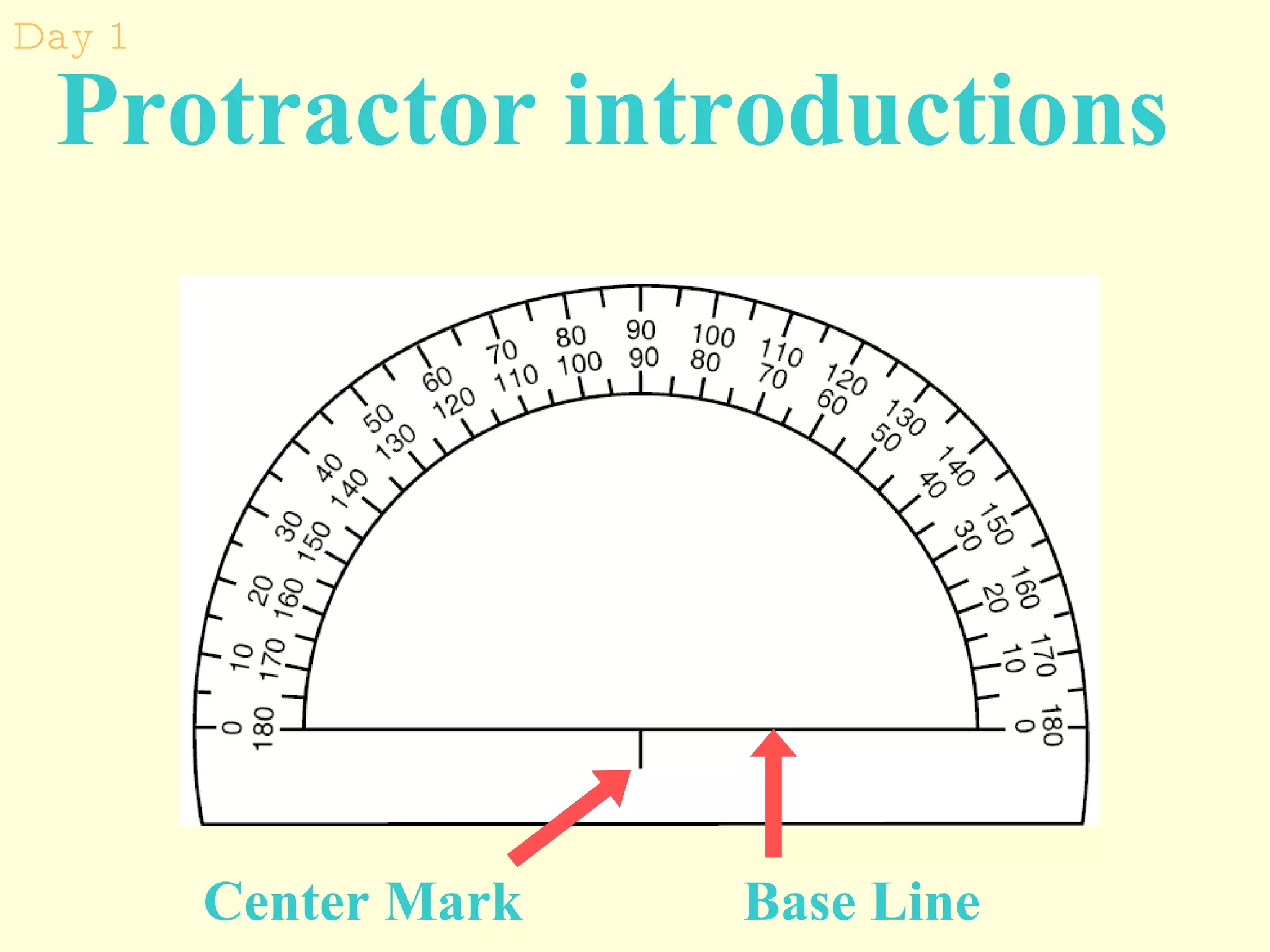
Protractor introductions Center Mark Base Line Day 1
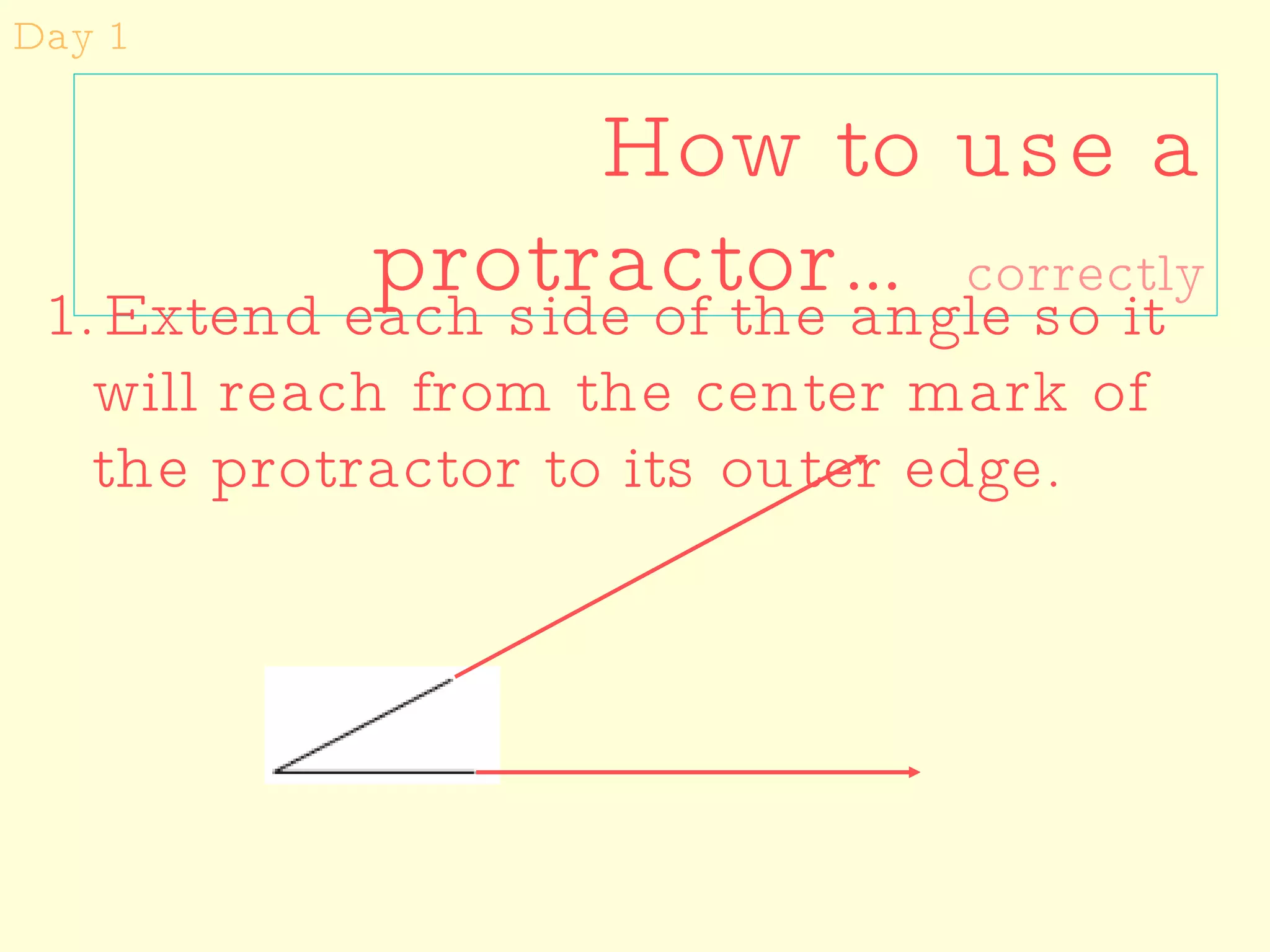
How to use a protractor…  correctly Day 1 Extend each side of the angle so it will reach from the center mark of the protractor to its outer edge.
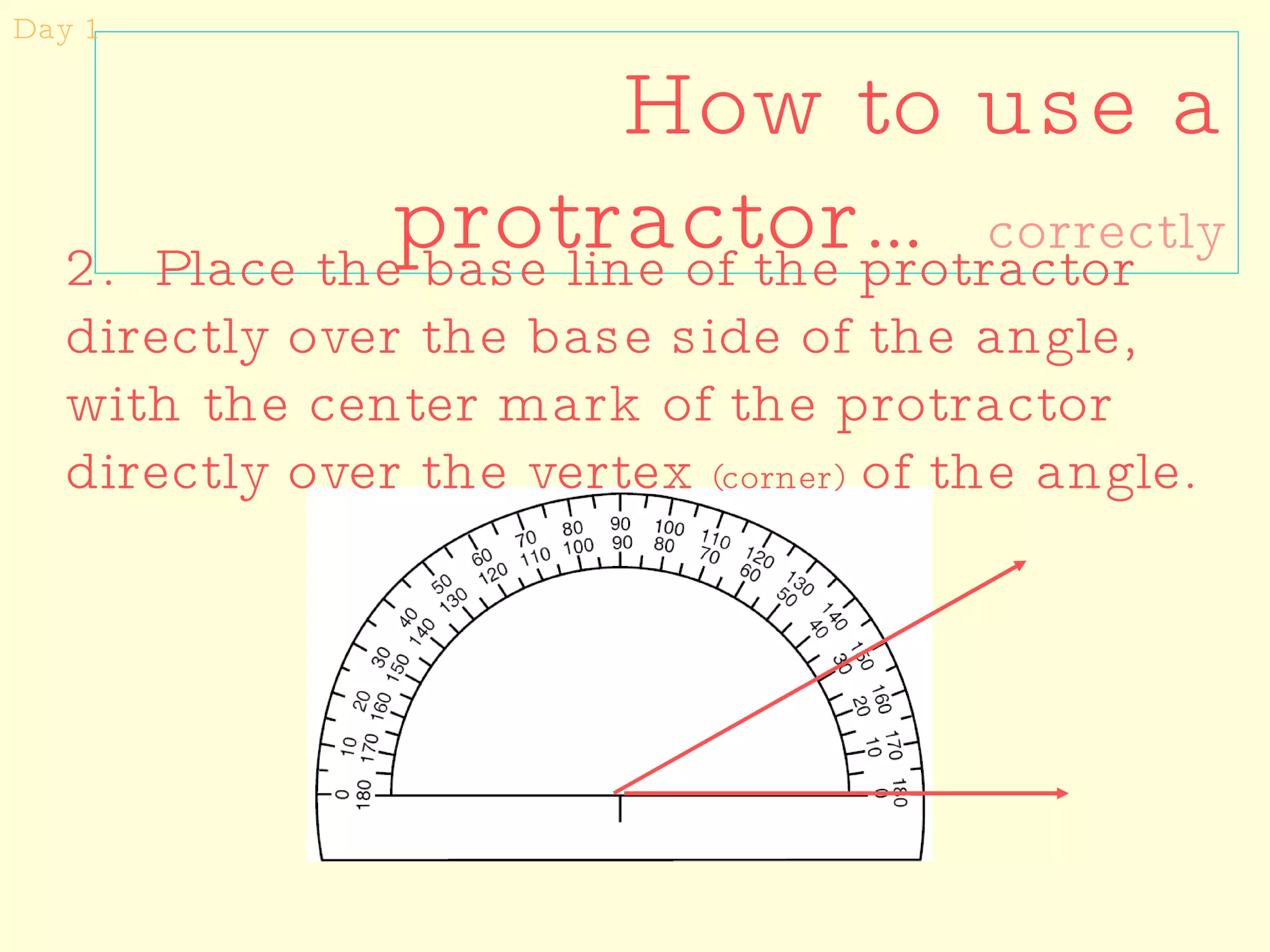
How to use a protractor…  correctly Day 1 2.  Place the base line of the protractor directly over the base side of the angle, with the center mark of the protractor directly over the vertex  (corner)  of the angle.
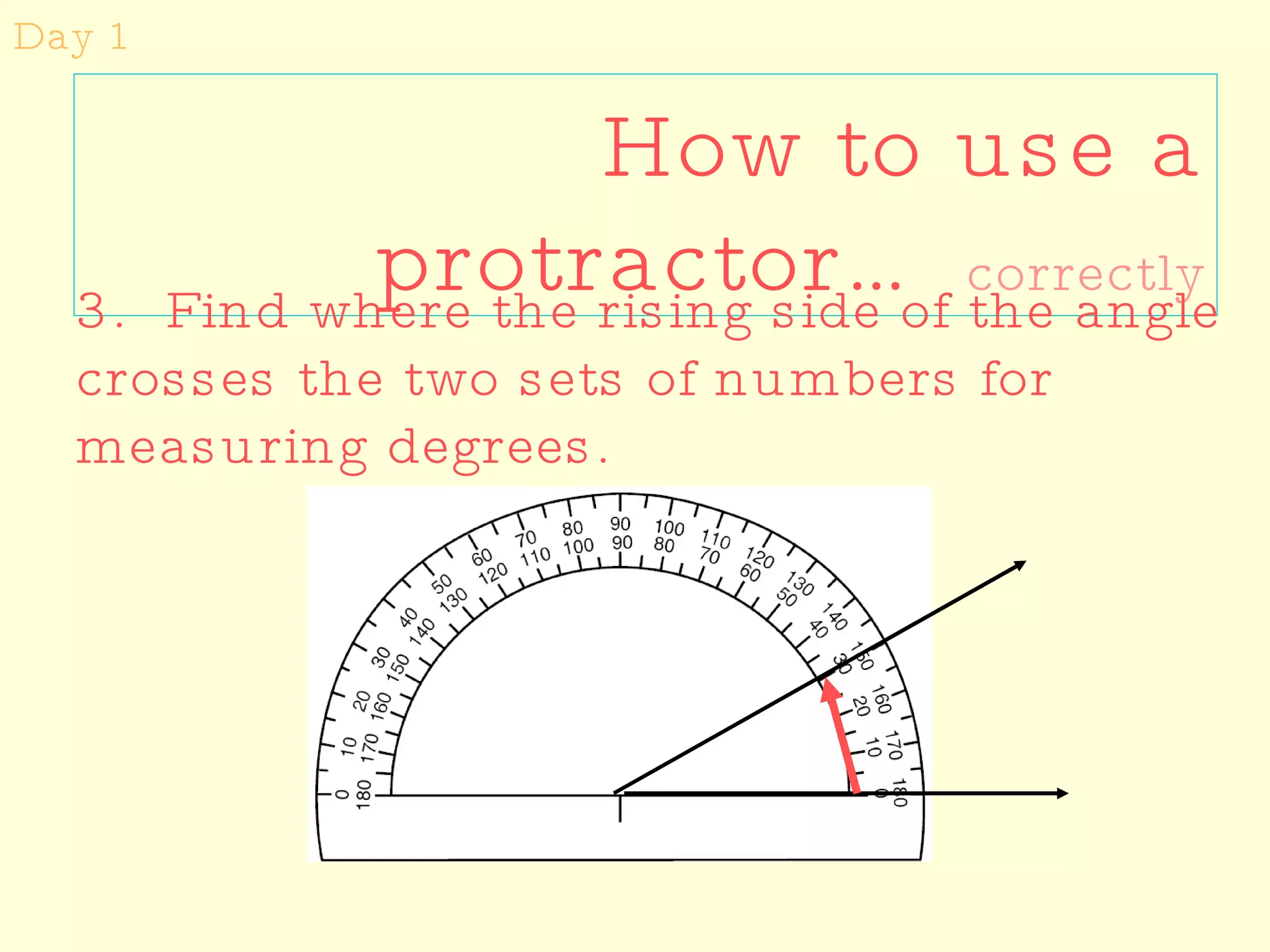
How to use a protractor…   correctly Day 1 3.  Find where the rising side of the angle crosses the two sets of numbers for measuring degrees.
Three Categories of Angles Day 1 Acute Angle  —An angle that has a measurement of less than 90 o Right Angle  —An angle that has a measurement of exactly 90 o Obtuse Angle  —An angle that has a measurement of more than 90 o
Homework Worksheet  Measuring Angles  (10.3) Vocab to Include:  Vertex Acute angle Right angle Obtuse angle Day 1
Special  Angles Vocabulary Target:  I will be able to define, name, identify, and create the following types of angles:  Congruent Angles Adjacent Angles Vertical Angles Supplementary Angles Complementary Angles Corresponding Angles  Alternate Interior Angles Alternate Exterior Angles Day 2
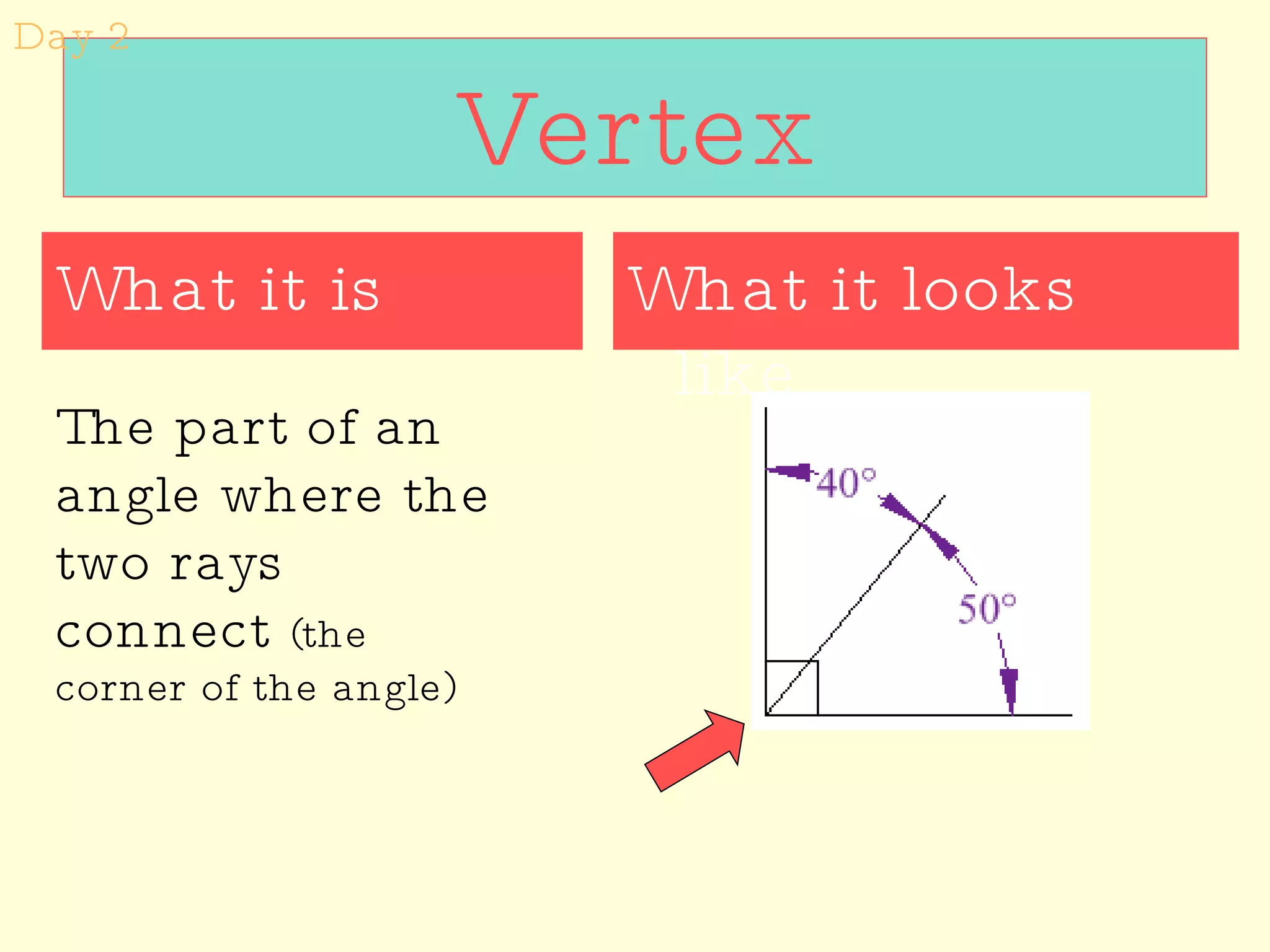
Vertex What it looks like What it is The part of an angle where the two rays connect  (the corner of the angle) Day 2
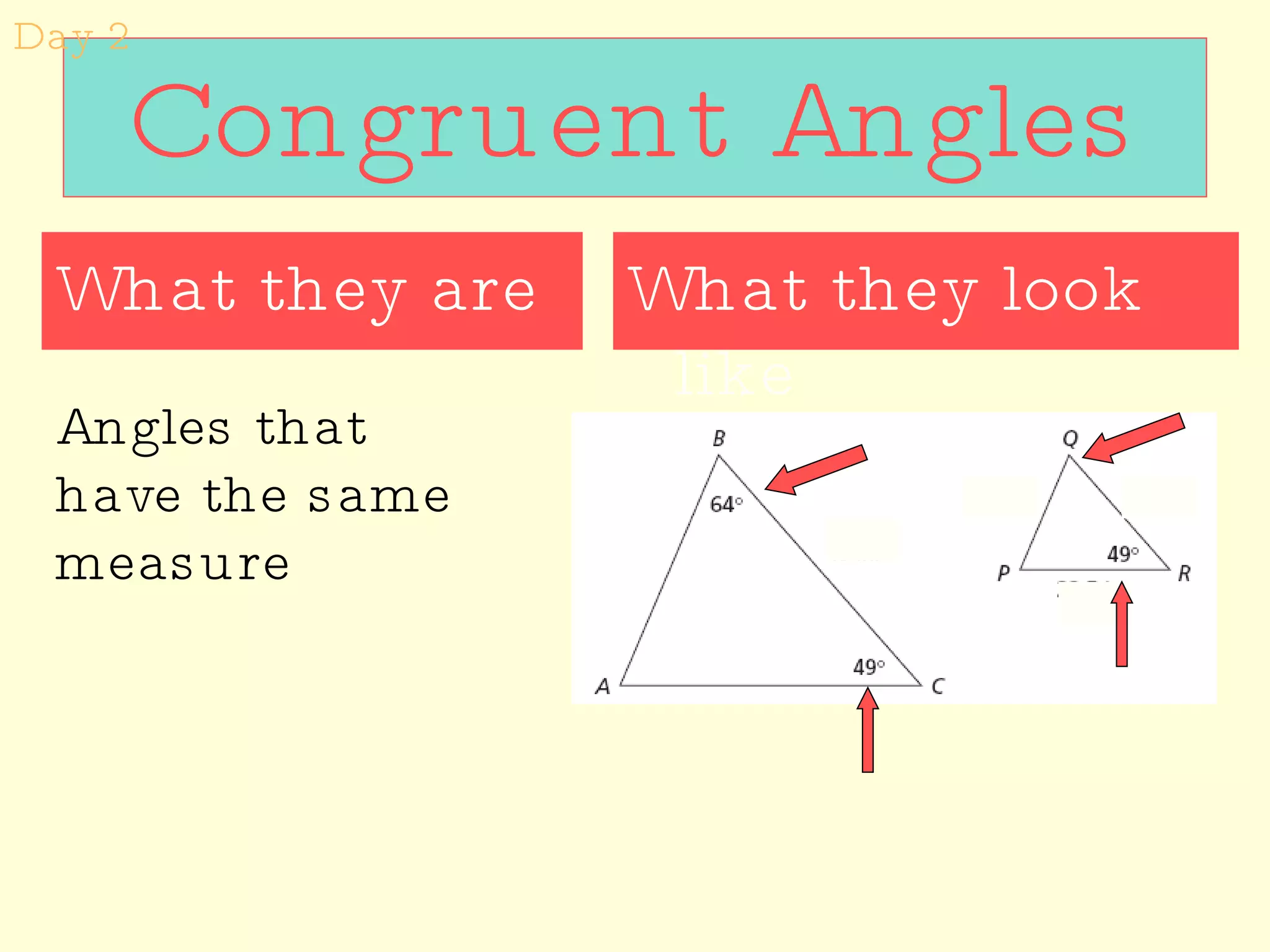
Congruent Angles What they look like What they are Angles that have the same measure Day 2
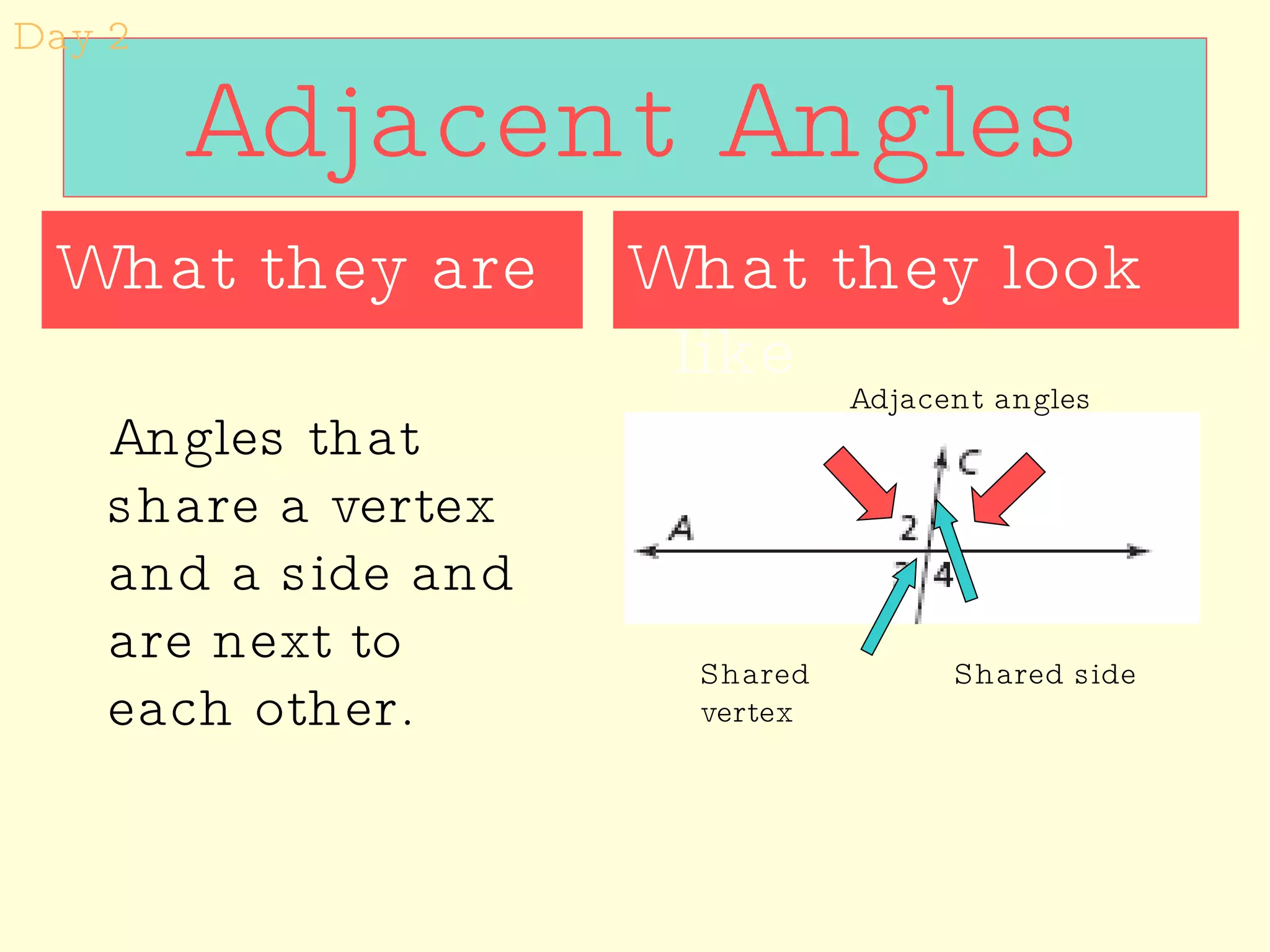
Adjacent Angles What they look like What they are Angles that share a vertex and a side and are next to each other. Shared vertex Shared side Adjacent angles Day 2
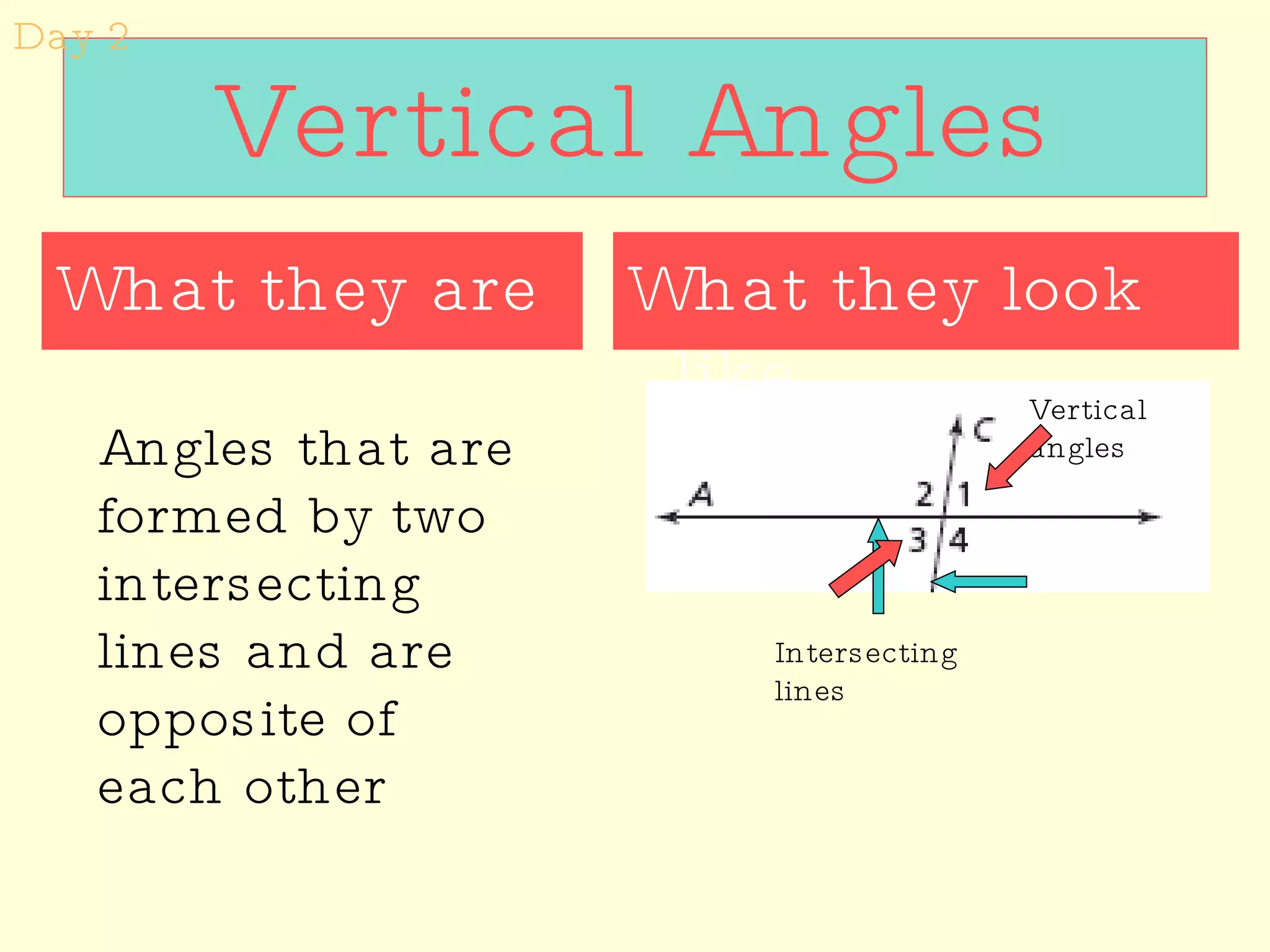
Vertical Angles What they look like What they are Angles that are formed by two intersecting lines and are opposite of each other Intersecting lines Vertical angles Day 2
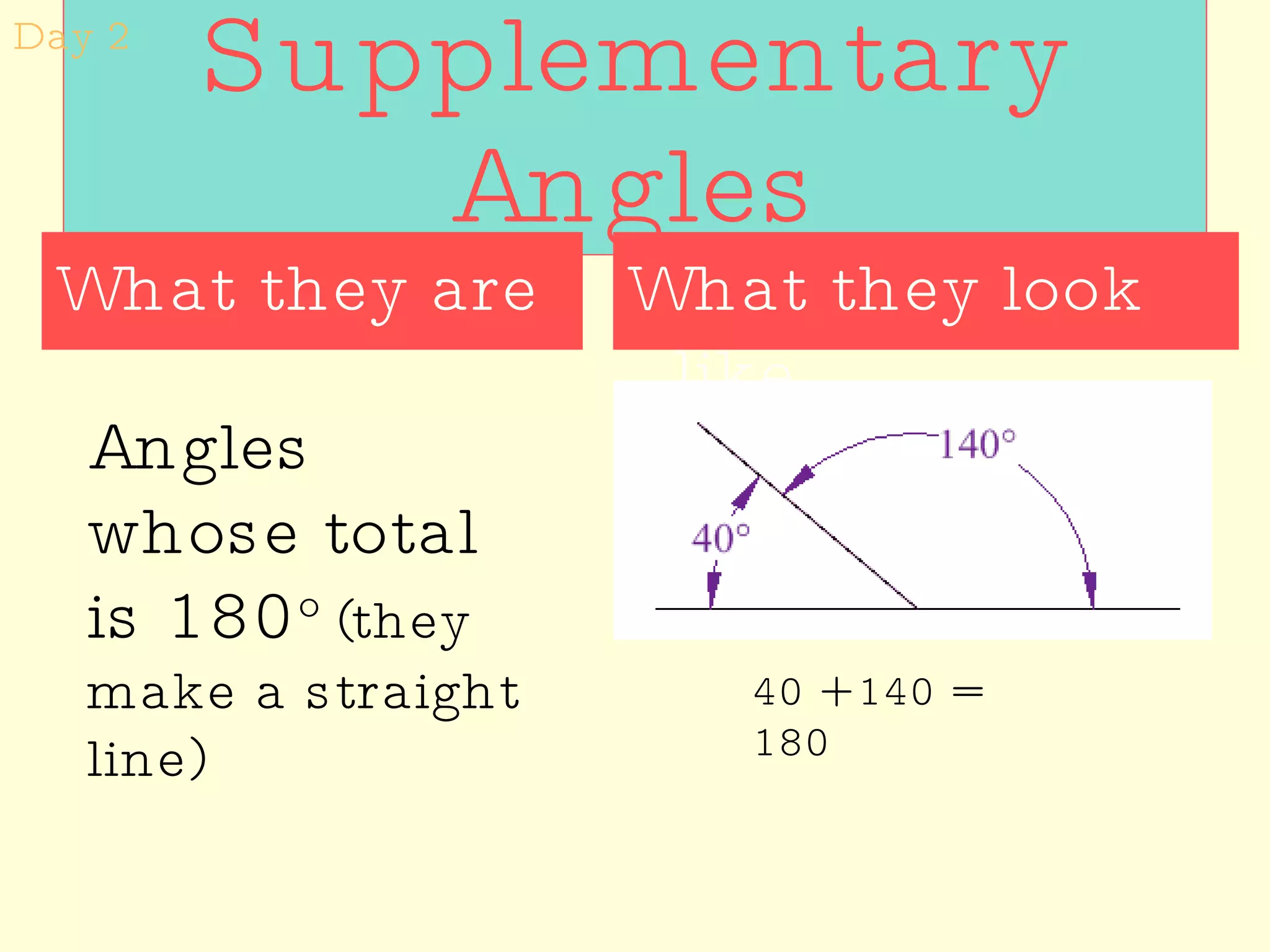
Supplementary Angles What they look like What they are Angles whose total is 180 o  (they make a straight line) 40 + 140 = 180 Day 2
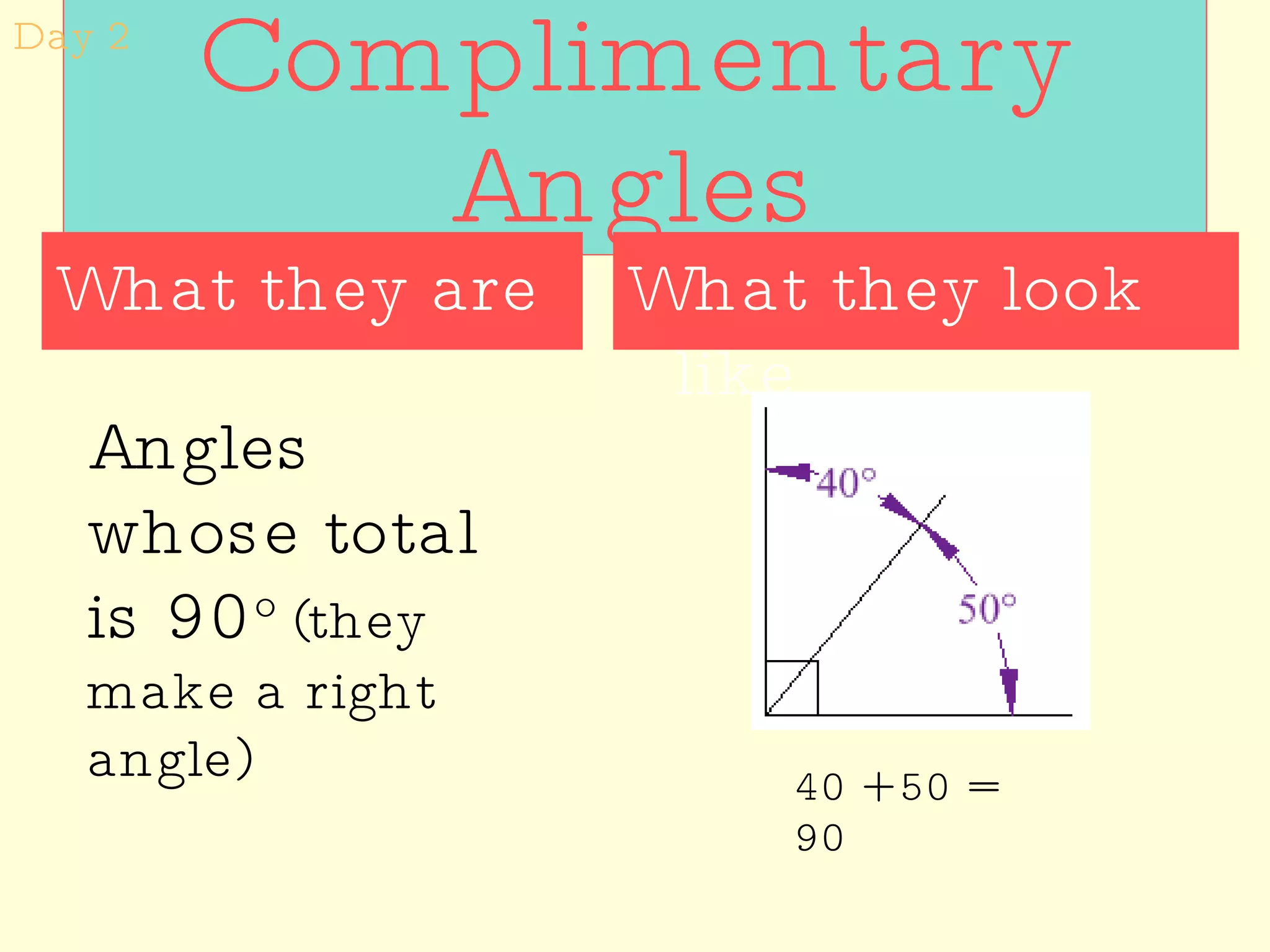
Complimentary Angles What they look like What they are Angles whose total is 90 o  (they make a right angle) 40 + 50 = 90 Day 2
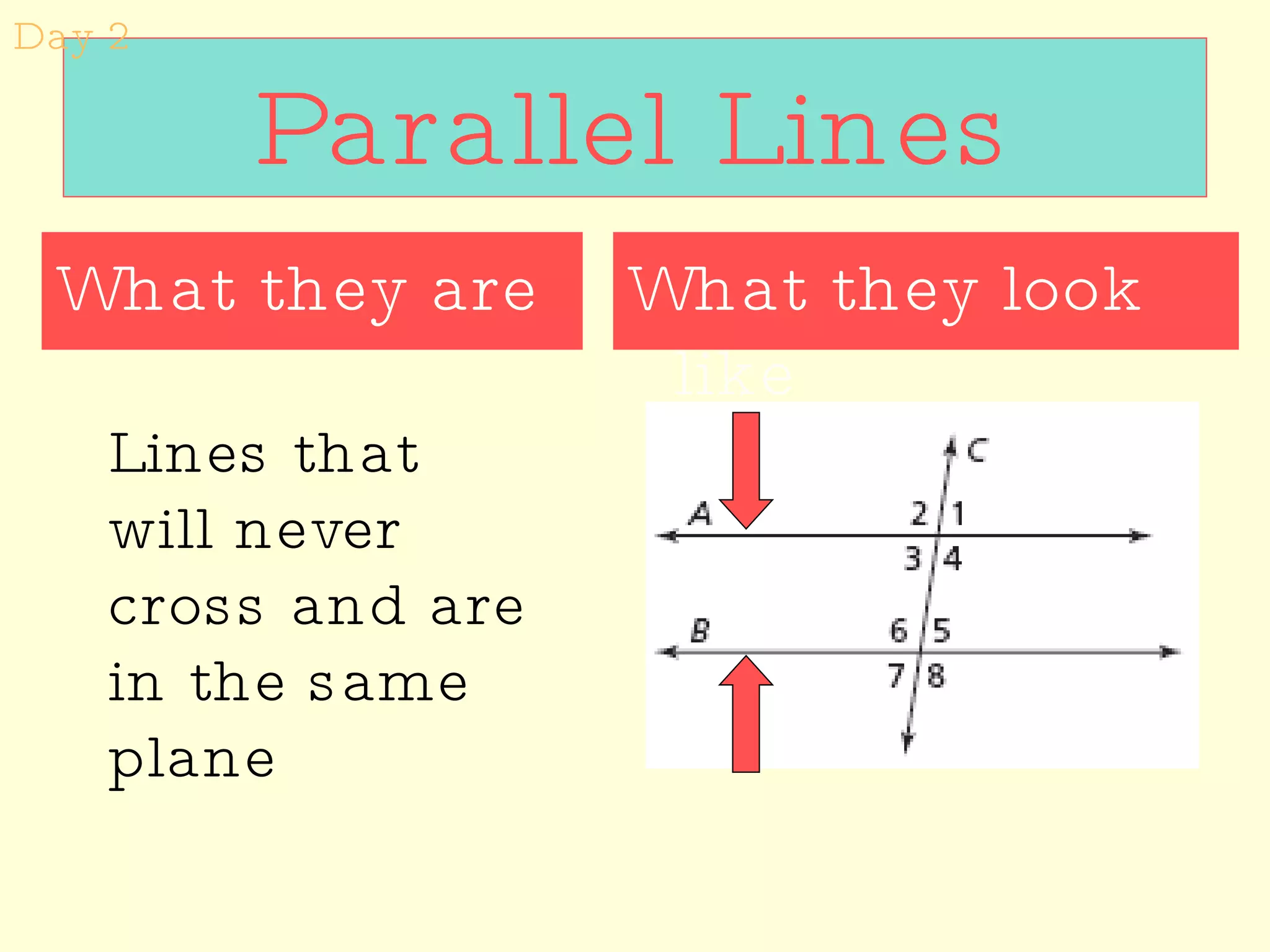
Parallel Lines What they look like What they are Lines that will never cross and are in the same plane Day 2
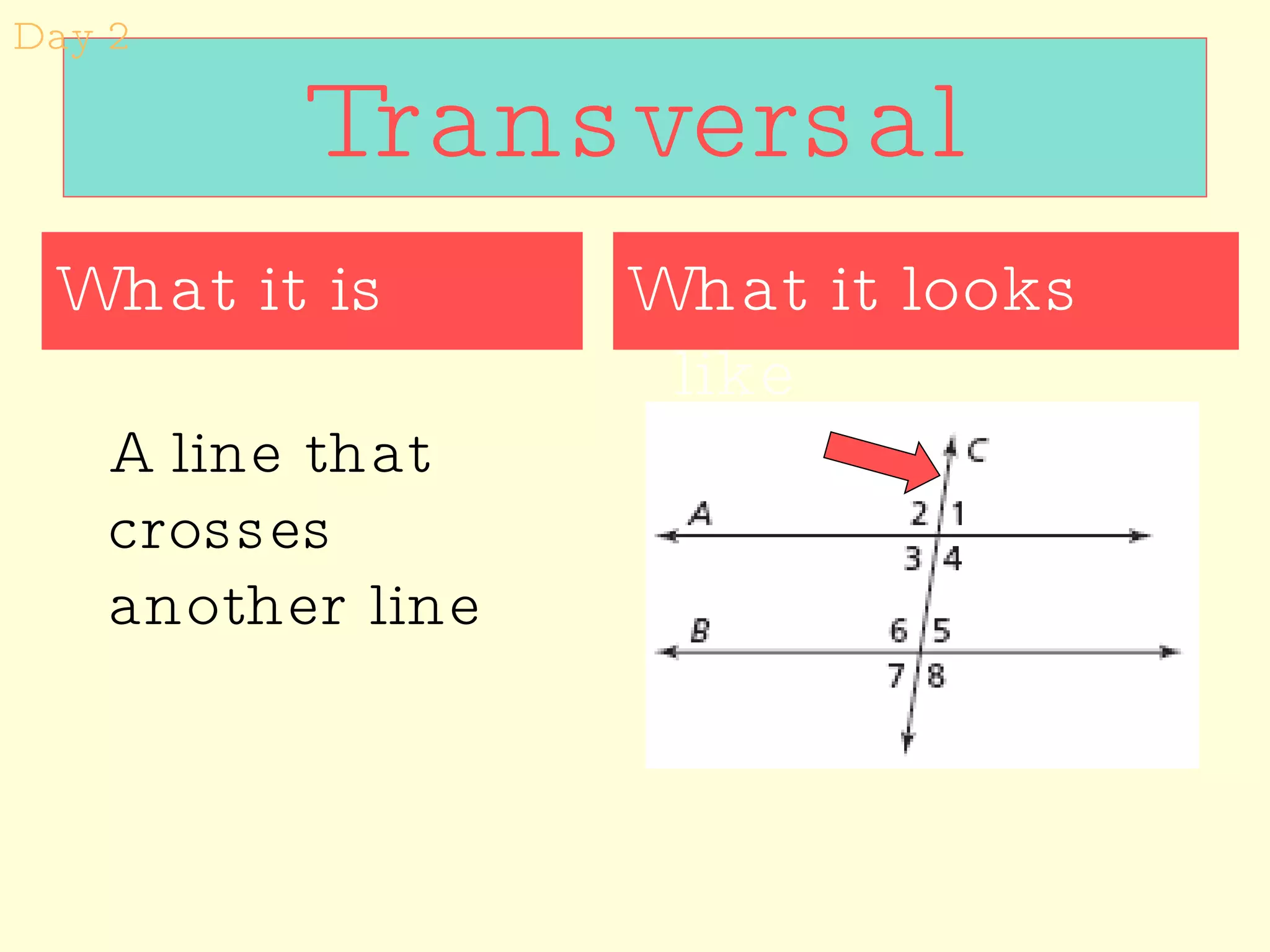
Transversal What it looks like What it is A line that crosses another line Day 2
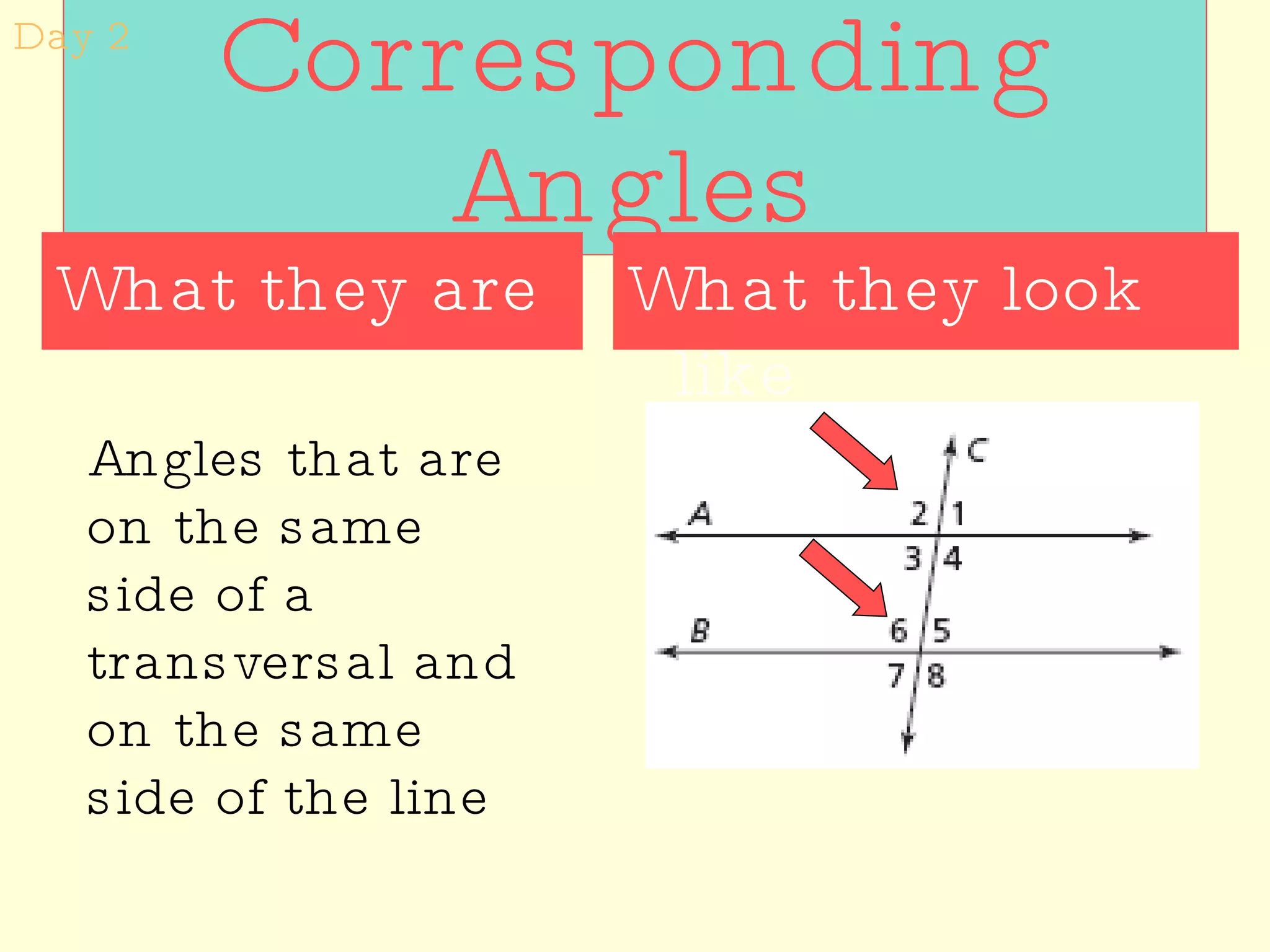
Corresponding Angles What they look like What they are Angles that are on the same side of a transversal and on the same side of the line Day 2
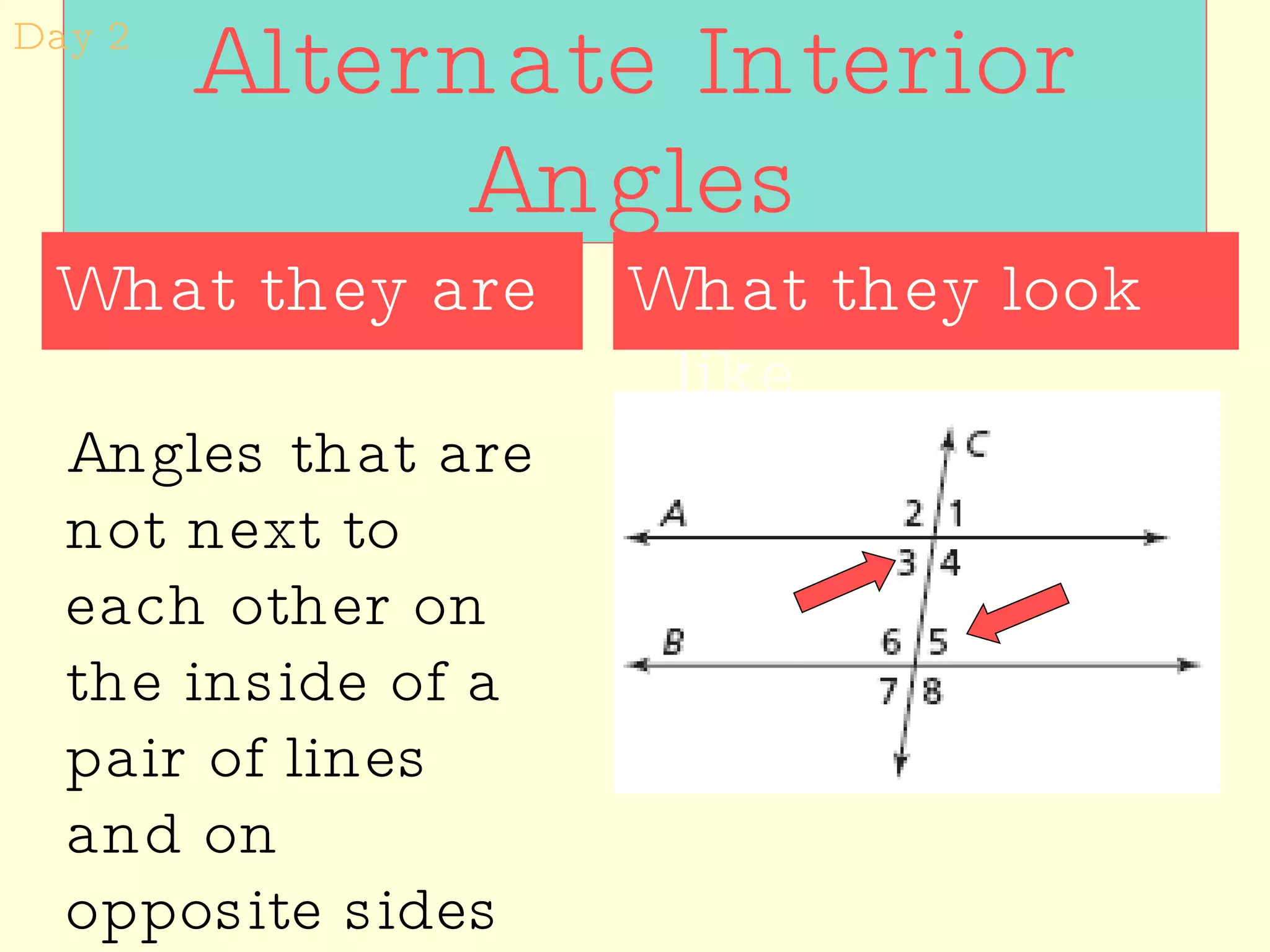
Alternate Interior Angles What they look like What they are Angles that are not next to each other on the inside of a pair of lines and on opposite sides of a transversal Day 2
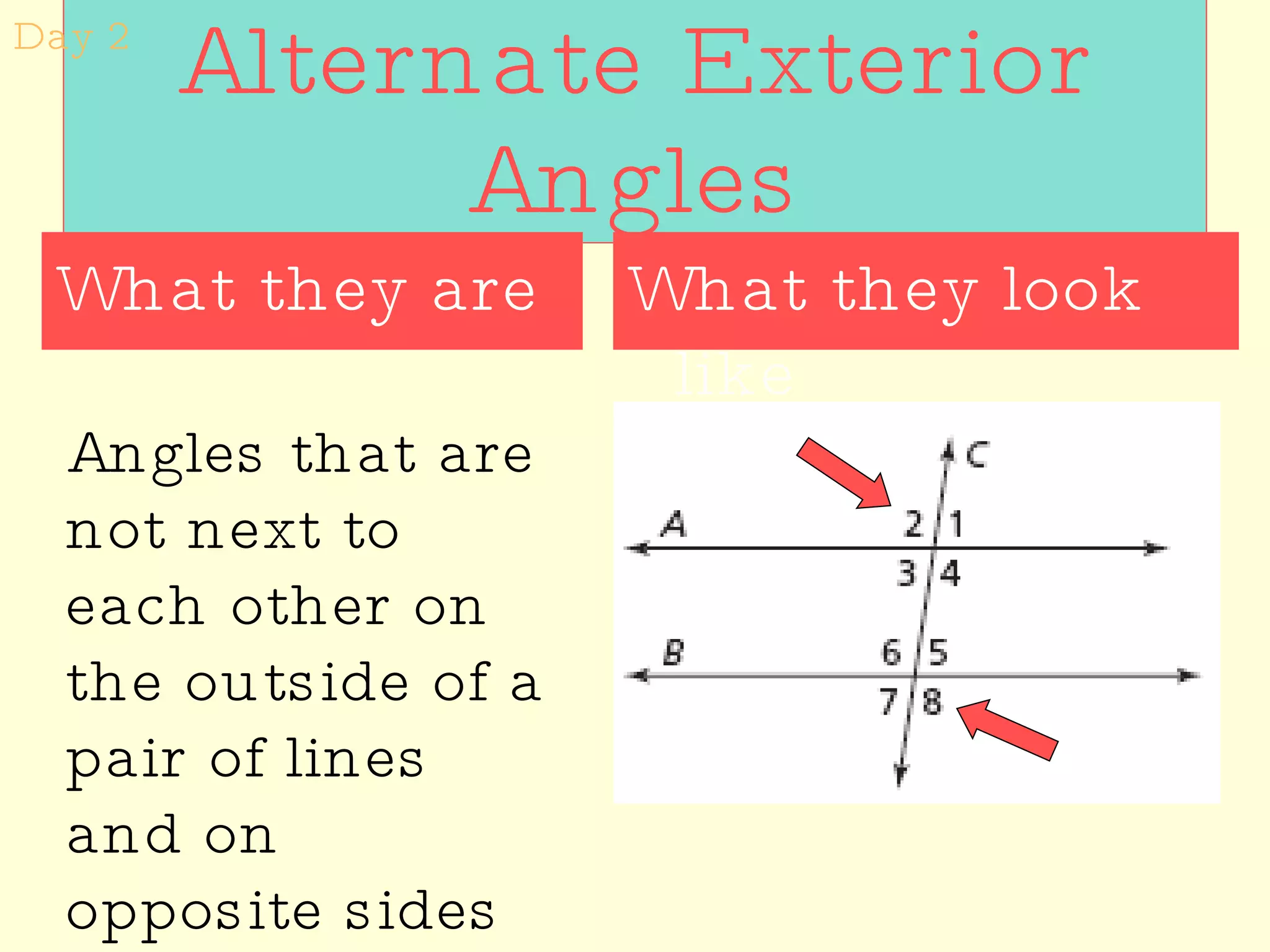
Alternate Exterior Angles What they look like What they are Angles that are not next to each other on the outside of a pair of lines and on opposite sides of a transversal Day 2
Homework Worksheet  Vocab to Include:   Congruent angles Adjacent angles Vertical angles Supplementary angles Complementary angles Parallel lines Transversal Corresponding angles Alt. interior angles Alt. exterior angles Day 2
Special Angles Target: I will develop and use rules about angles formed by parallel lines and transversals. Day 3
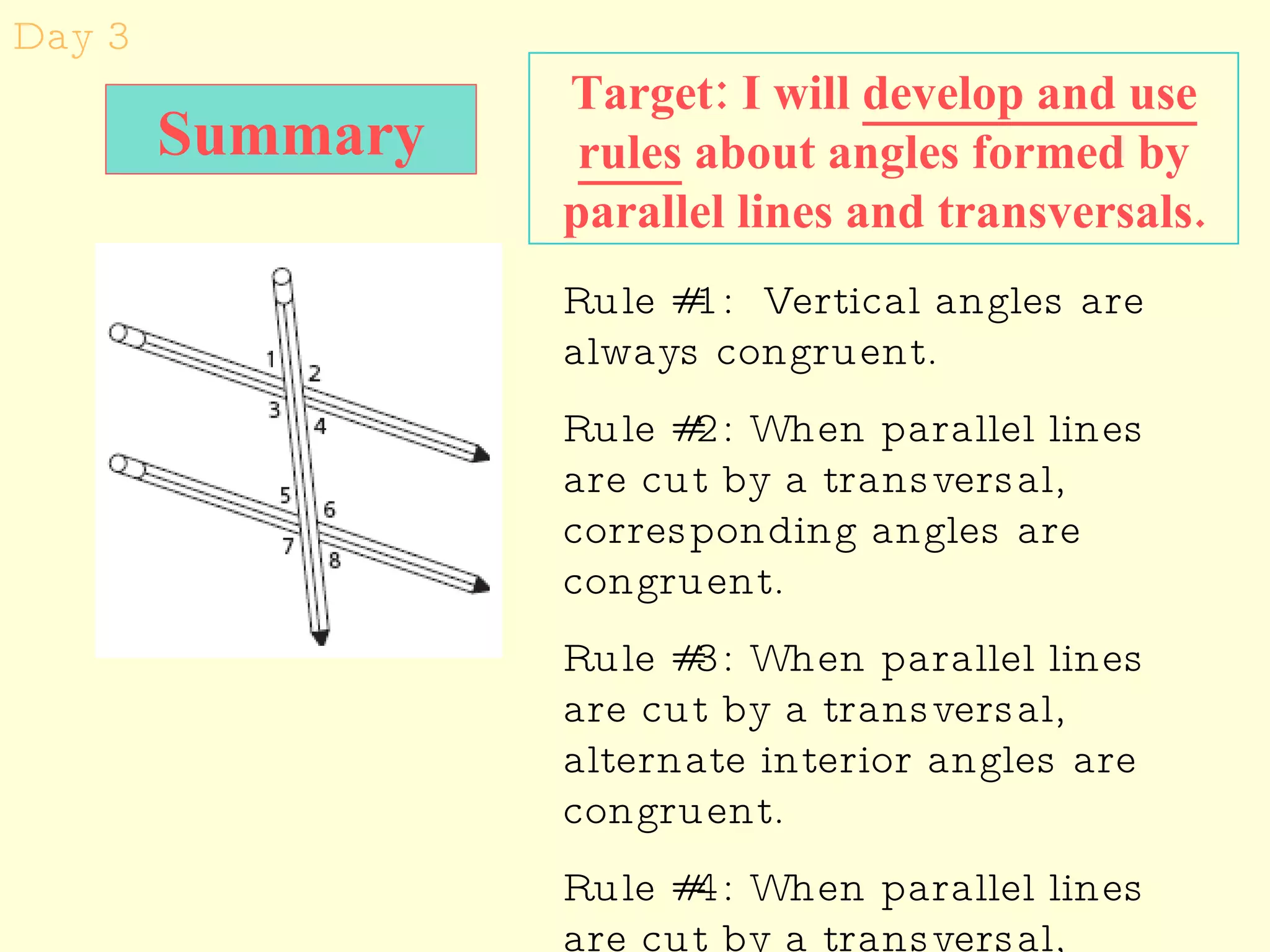
Day 3 Target: I will  develop and use rules  about angles formed by parallel lines and transversals. Rule #1:  Vertical angles are always congruent. Rule #2: When parallel lines are cut by a transversal, corresponding angles are congruent. Rule #3: When parallel lines are cut by a transversal, alternate interior angles are congruent. Rule #4: When parallel lines are cut by a transversal, alternate exterior angles are congruent. Summary
Homework Worksheet  Vocab to Include:  Day 3
Sum of the Angles in Any Triangle Target: I will determine and use the relationship among the measures of the interior angles of a triangle. Day 4
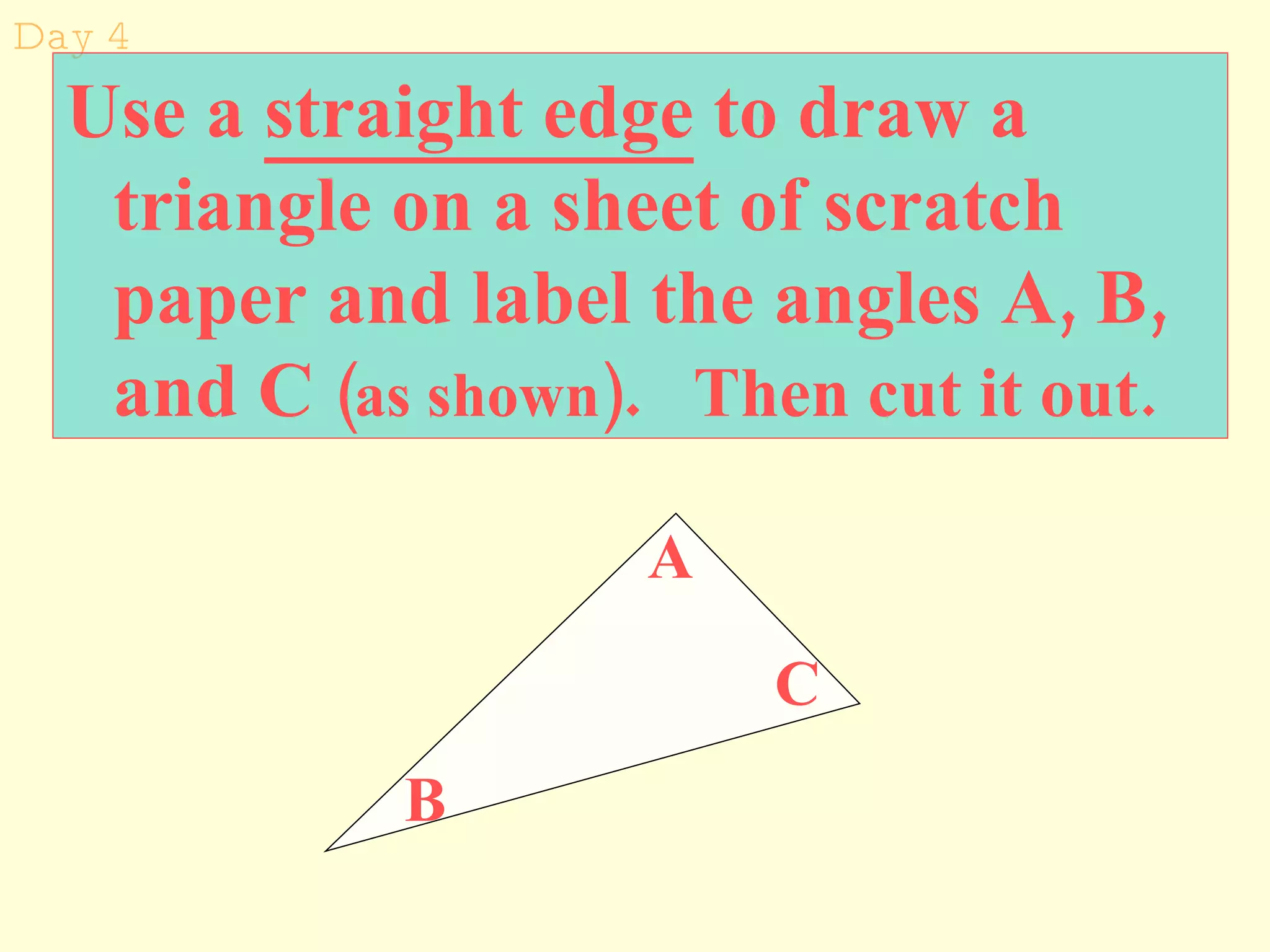
Day 4 Use a  straight edge  to draw a triangle on a sheet of scratch paper and label the angles A, B, and C  (as shown) .   Then cut it out. A B C
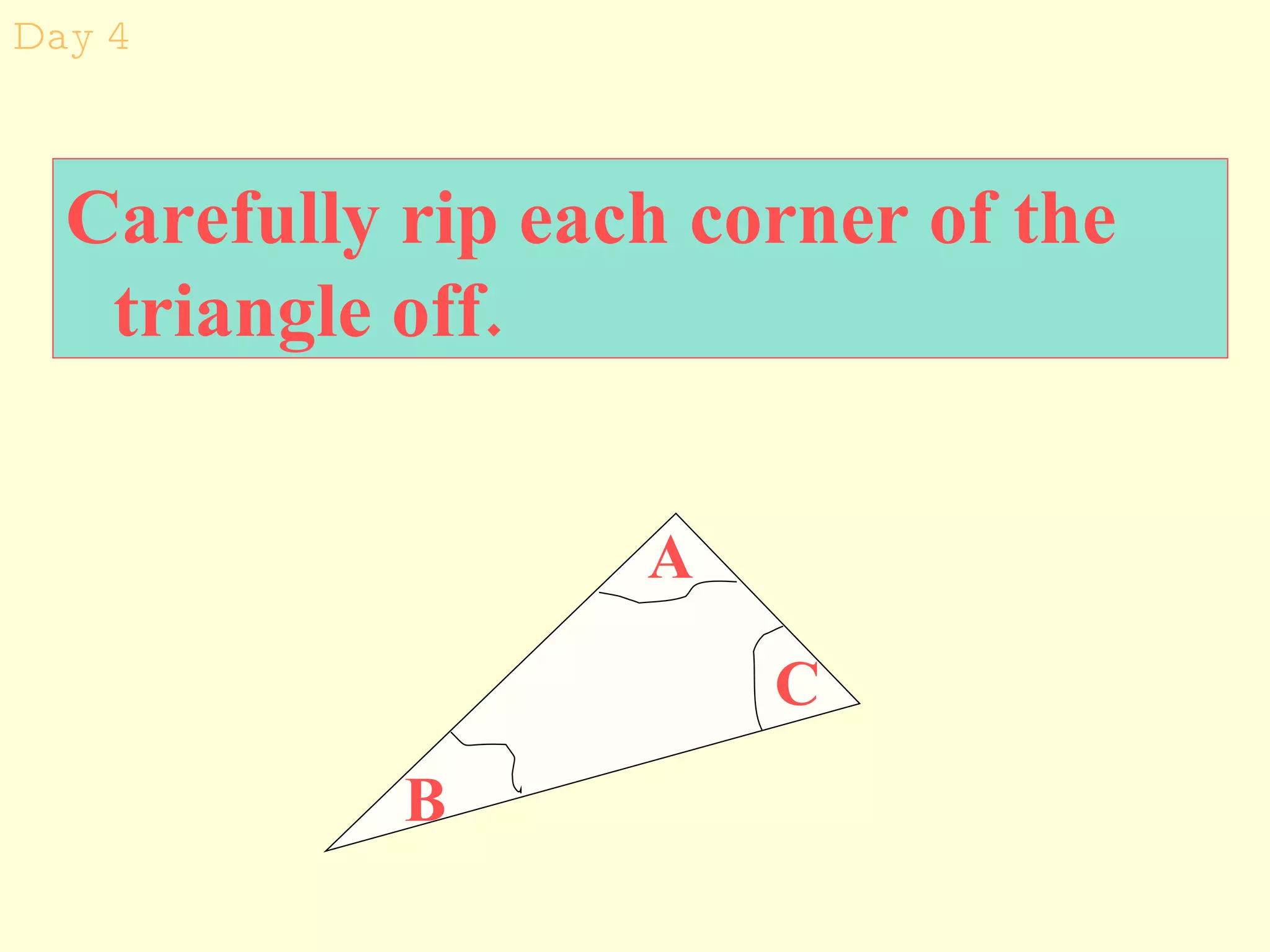
Day 4 Carefully rip each corner of the triangle off. A B C
Lay each angle adjacent to the others (in any order).  Day 4 (Tape in your compbook)
2.  Repeat  this with two more triangles.  Does it work every time?  3.  With your partner,  write   a rule  for the sum of the angle measures in any triangle. Day 4 1.  What do you notice about the angles of the triangle? Answer the 3 questions that follow in your compbook
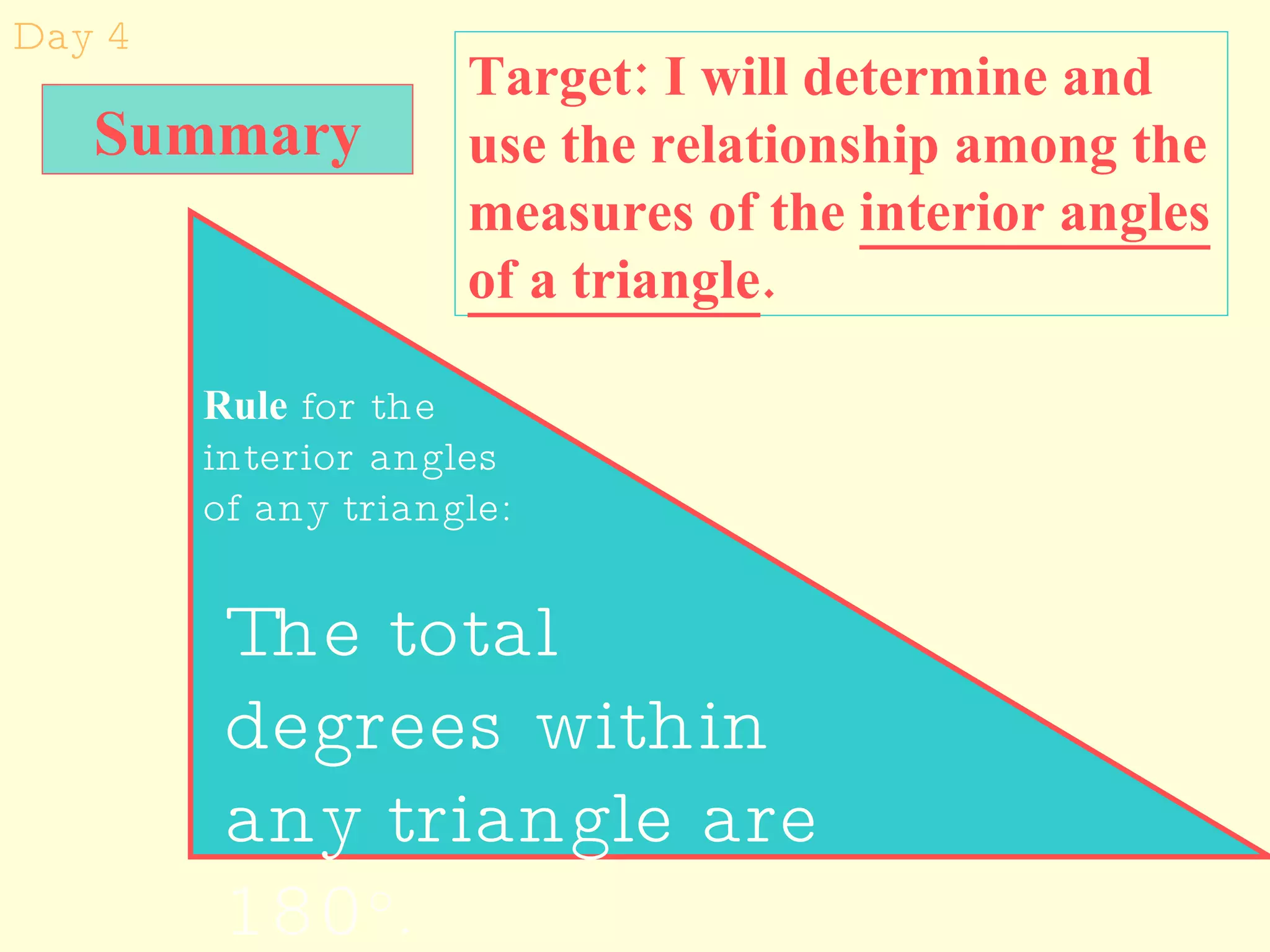
Day 4 Target: I will determine and use the relationship among the measures of the  interior angles of a triangle . Rule  for the interior angles of any triangle: The total degrees within any triangle are 180 o . Summary
Homework Worksheet  Vocab to Include:  Day 4
Sum of Angles in Any Polygon Target:  I will determine and use the relationship among the measures of the interior angles of any polygon. Day 5
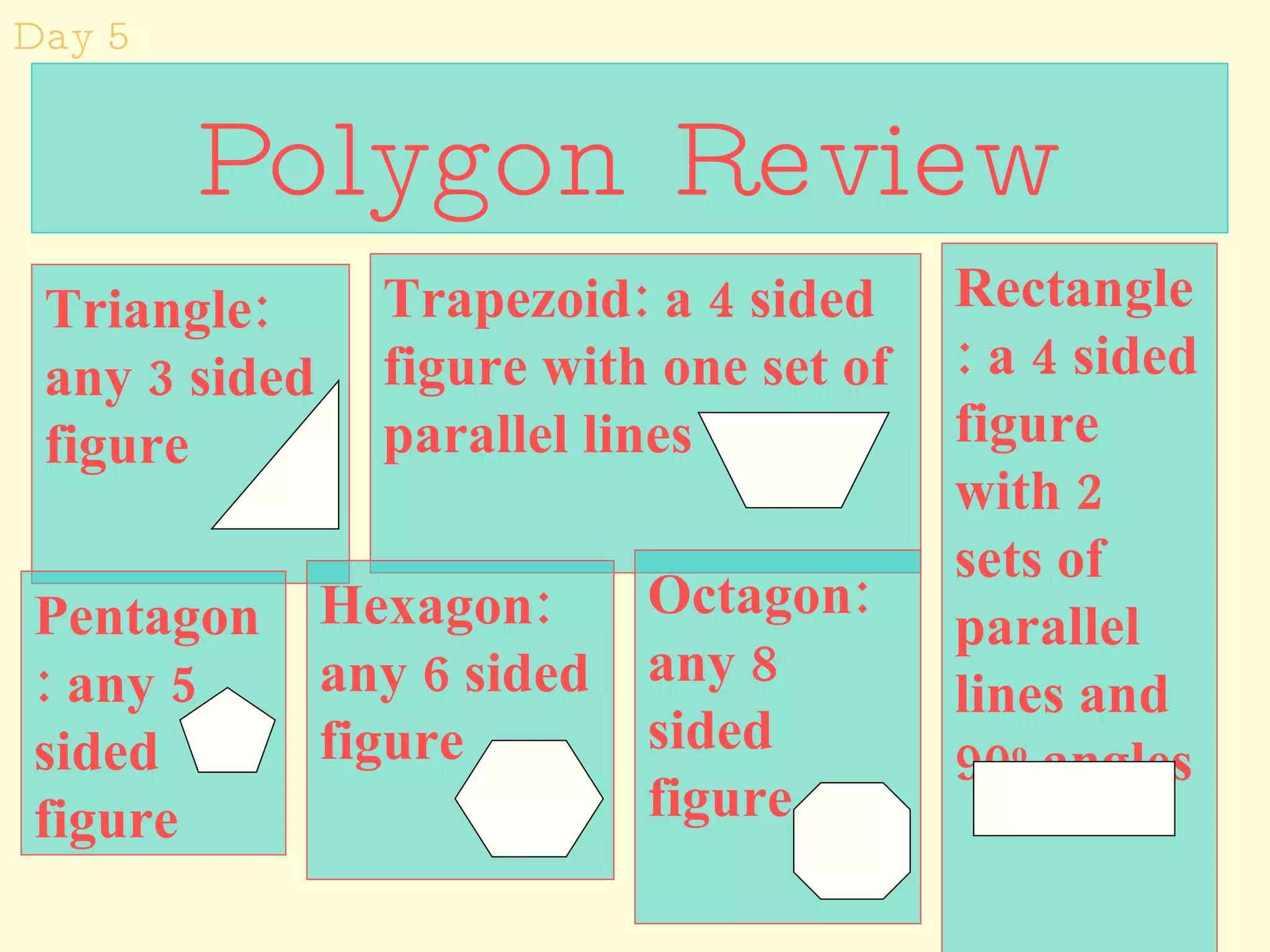
Polygon Review Triangle: any 3 sided figure Trapezoid: a 4 sided figure with one set of parallel lines Rectangle: a 4 sided figure with 2 sets of parallel lines and 90 o  angles Hexagon: any 6 sided figure Octagon:  any 8 sided figure Day 5 Pentagon: any 5 sided figure
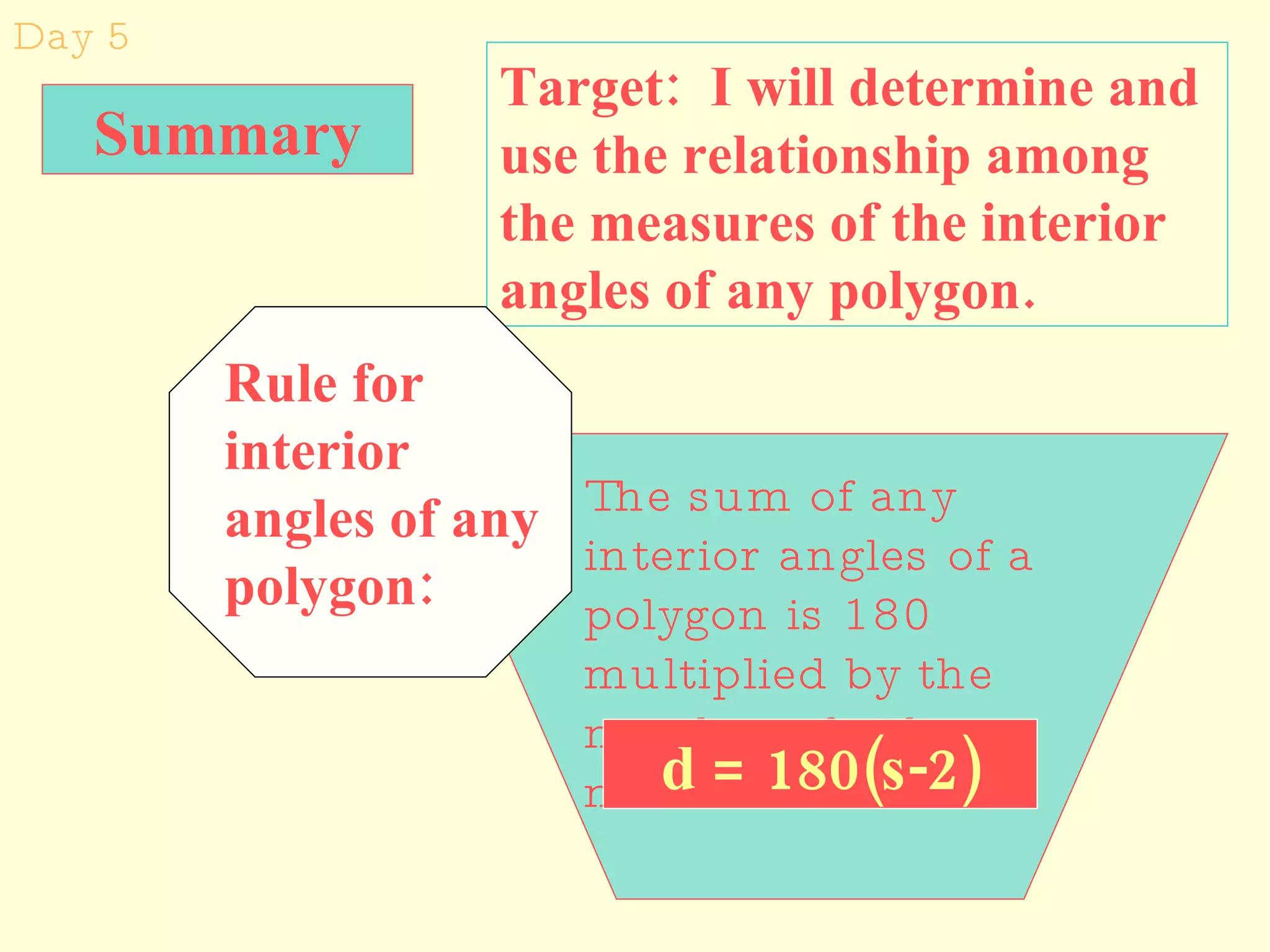
Day 5 Target:  I will determine and use the relationship among the measures of the interior angles of any polygon. Summary The sum of any interior angles of a polygon is 180 multiplied by the number of sides minus 2. d = 180(s-2) Rule for interior angles of any polygon:
Homework Worksheet  Vocab to Include:  Triangle Rectangle Trapezoid Hexagon Octagon Day 5
G eometry Start Date:  17 March 2010 End Date: 2010

Geometry

  • 1.
    G eometry StartDate: 17 March 2010 End Date: _____________
  • 2.
    Angle Measurements Target: I will measure and estimate the measures of angles. Day 1
  • 3.
    Protractor introductions CenterMark Base Line Day 1
  • 4.
    How to usea protractor… correctly Day 1 Extend each side of the angle so it will reach from the center mark of the protractor to its outer edge.
  • 5.
    How to usea protractor… correctly Day 1 2. Place the base line of the protractor directly over the base side of the angle, with the center mark of the protractor directly over the vertex (corner) of the angle.
  • 6.
    How to usea protractor… correctly Day 1 3. Find where the rising side of the angle crosses the two sets of numbers for measuring degrees.
  • 7.
    Three Categories ofAngles Day 1 Acute Angle —An angle that has a measurement of less than 90 o Right Angle —An angle that has a measurement of exactly 90 o Obtuse Angle —An angle that has a measurement of more than 90 o
  • 8.
    Homework Worksheet Measuring Angles (10.3) Vocab to Include: Vertex Acute angle Right angle Obtuse angle Day 1
  • 9.
    Special AnglesVocabulary Target: I will be able to define, name, identify, and create the following types of angles: Congruent Angles Adjacent Angles Vertical Angles Supplementary Angles Complementary Angles Corresponding Angles Alternate Interior Angles Alternate Exterior Angles Day 2
  • 10.
    Vertex What itlooks like What it is The part of an angle where the two rays connect (the corner of the angle) Day 2
  • 11.
    Congruent Angles Whatthey look like What they are Angles that have the same measure Day 2
  • 12.
    Adjacent Angles Whatthey look like What they are Angles that share a vertex and a side and are next to each other. Shared vertex Shared side Adjacent angles Day 2
  • 13.
    Vertical Angles Whatthey look like What they are Angles that are formed by two intersecting lines and are opposite of each other Intersecting lines Vertical angles Day 2
  • 14.
    Supplementary Angles Whatthey look like What they are Angles whose total is 180 o (they make a straight line) 40 + 140 = 180 Day 2
  • 15.
    Complimentary Angles Whatthey look like What they are Angles whose total is 90 o (they make a right angle) 40 + 50 = 90 Day 2
  • 16.
    Parallel Lines Whatthey look like What they are Lines that will never cross and are in the same plane Day 2
  • 17.
    Transversal What itlooks like What it is A line that crosses another line Day 2
  • 18.
    Corresponding Angles Whatthey look like What they are Angles that are on the same side of a transversal and on the same side of the line Day 2
  • 19.
    Alternate Interior AnglesWhat they look like What they are Angles that are not next to each other on the inside of a pair of lines and on opposite sides of a transversal Day 2
  • 20.
    Alternate Exterior AnglesWhat they look like What they are Angles that are not next to each other on the outside of a pair of lines and on opposite sides of a transversal Day 2
  • 21.
    Homework Worksheet Vocab to Include: Congruent angles Adjacent angles Vertical angles Supplementary angles Complementary angles Parallel lines Transversal Corresponding angles Alt. interior angles Alt. exterior angles Day 2
  • 22.
    Special Angles Target:I will develop and use rules about angles formed by parallel lines and transversals. Day 3
  • 23.
    Day 3 Target:I will develop and use rules about angles formed by parallel lines and transversals. Rule #1: Vertical angles are always congruent. Rule #2: When parallel lines are cut by a transversal, corresponding angles are congruent. Rule #3: When parallel lines are cut by a transversal, alternate interior angles are congruent. Rule #4: When parallel lines are cut by a transversal, alternate exterior angles are congruent. Summary
  • 24.
    Homework Worksheet Vocab to Include: Day 3
  • 25.
    Sum of theAngles in Any Triangle Target: I will determine and use the relationship among the measures of the interior angles of a triangle. Day 4
  • 26.
    Day 4 Usea straight edge to draw a triangle on a sheet of scratch paper and label the angles A, B, and C (as shown) . Then cut it out. A B C
  • 27.
    Day 4 Carefullyrip each corner of the triangle off. A B C
  • 28.
    Lay each angleadjacent to the others (in any order). Day 4 (Tape in your compbook)
  • 29.
    2. Repeat this with two more triangles. Does it work every time? 3. With your partner, write a rule for the sum of the angle measures in any triangle. Day 4 1. What do you notice about the angles of the triangle? Answer the 3 questions that follow in your compbook
  • 30.
    Day 4 Target:I will determine and use the relationship among the measures of the interior angles of a triangle . Rule for the interior angles of any triangle: The total degrees within any triangle are 180 o . Summary
  • 31.
    Homework Worksheet Vocab to Include: Day 4
  • 32.
    Sum of Anglesin Any Polygon Target: I will determine and use the relationship among the measures of the interior angles of any polygon. Day 5
  • 33.
    Polygon Review Triangle:any 3 sided figure Trapezoid: a 4 sided figure with one set of parallel lines Rectangle: a 4 sided figure with 2 sets of parallel lines and 90 o angles Hexagon: any 6 sided figure Octagon: any 8 sided figure Day 5 Pentagon: any 5 sided figure
  • 34.
    Day 5 Target: I will determine and use the relationship among the measures of the interior angles of any polygon. Summary The sum of any interior angles of a polygon is 180 multiplied by the number of sides minus 2. d = 180(s-2) Rule for interior angles of any polygon:
  • 35.
    Homework Worksheet Vocab to Include: Triangle Rectangle Trapezoid Hexagon Octagon Day 5
  • 36.
    G eometry StartDate: 17 March 2010 End Date: 2010