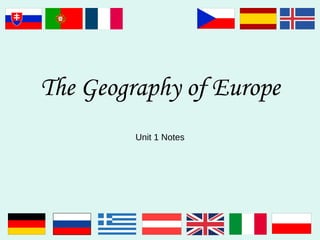
The Geography of Europe Unit 1 Notes
Europe’s Latitude Compared to the U.S.
Former Soviet Union Compared in Latitude & Area with the US
Satellite View of Europe
3,800 square miles
R E G I O N S
Continents by Size (sq. km.) Asia 44,579,000 Africa 30,065,000 North America 24,256,000  South America 17,819,000 Antarctica 13,209,000 Europe 9,938,000 Oceania (incl. Australia)   7,687,000
Rhine River Longest river in Germany An important waterway for trade Begins in Switzerland, winds through Germany, France, Luxembourg, & The Netherlands


Danube River 2 nd  largest river in Europe (Volga is first) Flows through the  12 countries  of Germany, Austria, Slovakia, Hungary, Serbia, Croatia, Bosnia and Herzegovina, Slovenia, Bulgaria, Romania, and the Ukraine!  1,770 miles long Played a vital role in the development of central Europe (trade & cultural diffusion)
 
 
The Alps  Located in Austria, France, Germany, Switzerland, Italy, Slovenia, & Liechtenstein Major tourist destination  Extend for almost 700 miles!
 
Mt. Blanc in the Alps It’s the highest mountain in the Alps: 15,771 feet.
 
 
Pyrenees Mountains Form the natural border between France & Spain Extend for about 270 miles
 
 
Ural Mountains Considered the natural boundary between Europe & Asia Divide Russia: 1/4 is in Europe, 3/4 is in Asia 1,500 miles long! Among the world’s OLDEST mountain ranges Huge deposits of gold, nickel, silver, platinum, coal, iron, & other minerals
Ural Mountains: “The Great Divide” It divides the European and Asian sections of Russia. 1500 miles


The English Channel Small body of water that separates England from France 350 miles long In the past, it was used as a good system of defense for England An important waterway for trade
 
 
Iberian Peninsula The Pyrenees form the northern border 2nd largest peninsula in Europe Includes the countries of Spain & Portugal
 
Southern Peninsulas Iberian Peninsula Italian Peninsula Balkan Peninsula Crimean Peninsula
Scandinavian Peninsula Largest peninsula in Europe (1,150 miles long) Consists of Norway, Sweden, and the northern region of Finland Region is rich in timber, iron, & copper
Scandinavian Peninsula
 
Mediterranean Sea Important route for trade & cultural exchange “ Crossroads for 3 continents” (Europe, Africa, & Asia) Covers an area of 965,000 square miles Name means “in the middle of the earth” (surrounded by land)


The European Plain Largest mountain-free landform in Europe Stretches from the Pyrenees in the west to the Ural Mountains in the east Extends 2,000 miles Successful agricultural area
European Plain
 
Northern European Plain
 

Geographyofeurope

  • 1.
    The Geography ofEurope Unit 1 Notes
  • 2.
  • 3.
    Former Soviet UnionCompared in Latitude & Area with the US
  • 4.
  • 5.
  • 6.
    R E GI O N S
  • 7.
    Continents by Size(sq. km.) Asia 44,579,000 Africa 30,065,000 North America 24,256,000 South America 17,819,000 Antarctica 13,209,000 Europe 9,938,000 Oceania (incl. Australia)   7,687,000
  • 8.
    Rhine River Longestriver in Germany An important waterway for trade Begins in Switzerland, winds through Germany, France, Luxembourg, & The Netherlands
  • 9.
  • 10.
  • 11.
  • 12.
    Danube River 2nd largest river in Europe (Volga is first) Flows through the 12 countries of Germany, Austria, Slovakia, Hungary, Serbia, Croatia, Bosnia and Herzegovina, Slovenia, Bulgaria, Romania, and the Ukraine! 1,770 miles long Played a vital role in the development of central Europe (trade & cultural diffusion)
  • 13.
  • 14.
  • 15.
    The Alps Located in Austria, France, Germany, Switzerland, Italy, Slovenia, & Liechtenstein Major tourist destination Extend for almost 700 miles!
  • 16.
  • 17.
    Mt. Blanc inthe Alps It’s the highest mountain in the Alps: 15,771 feet.
  • 18.
  • 19.
  • 20.
    Pyrenees Mountains Formthe natural border between France & Spain Extend for about 270 miles
  • 21.
  • 22.
  • 23.
    Ural Mountains Consideredthe natural boundary between Europe & Asia Divide Russia: 1/4 is in Europe, 3/4 is in Asia 1,500 miles long! Among the world’s OLDEST mountain ranges Huge deposits of gold, nickel, silver, platinum, coal, iron, & other minerals
  • 24.
    Ural Mountains: “TheGreat Divide” It divides the European and Asian sections of Russia. 1500 miles
  • 25.
  • 26.
  • 27.
  • 28.
    The English ChannelSmall body of water that separates England from France 350 miles long In the past, it was used as a good system of defense for England An important waterway for trade
  • 29.
  • 30.
  • 31.
    Iberian Peninsula ThePyrenees form the northern border 2nd largest peninsula in Europe Includes the countries of Spain & Portugal
  • 32.
  • 33.
    Southern Peninsulas IberianPeninsula Italian Peninsula Balkan Peninsula Crimean Peninsula
  • 34.
    Scandinavian Peninsula Largestpeninsula in Europe (1,150 miles long) Consists of Norway, Sweden, and the northern region of Finland Region is rich in timber, iron, & copper
  • 35.
  • 36.
  • 37.
    Mediterranean Sea Importantroute for trade & cultural exchange “ Crossroads for 3 continents” (Europe, Africa, & Asia) Covers an area of 965,000 square miles Name means “in the middle of the earth” (surrounded by land)
  • 38.
  • 39.
  • 40.
  • 41.
    The European PlainLargest mountain-free landform in Europe Stretches from the Pyrenees in the west to the Ural Mountains in the east Extends 2,000 miles Successful agricultural area
  • 42.
  • 43.
  • 44.
  • 45.