By: Mandy Stratuliak
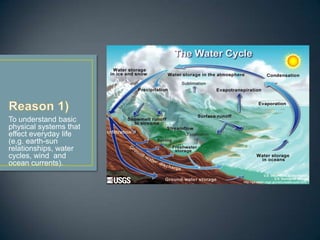
To understand basic
physical systems that
effect everyday life
(e.g. earth-sun
relationships, water
cycles, wind and
ocean currents).
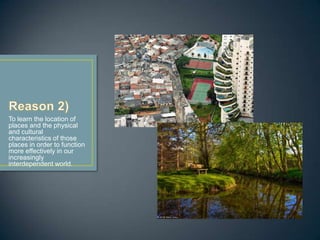
To learn the location of
places and the physical
and cultural
characteristics of those
places in order to function
more effectively in our
increasingly
interdependent world.
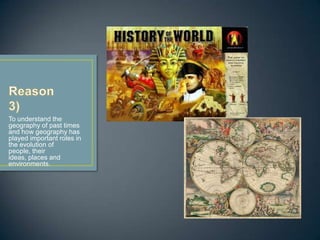
To understand the
geography of past times
and how geography has
played important roles in
the evolution of
people, their
ideas, places and
environments.
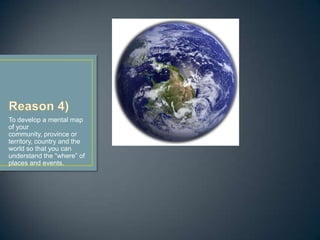
To develop a mental map
of your
community, province or
territory, country and the
world so that you can
understand the “where” of
places and events.
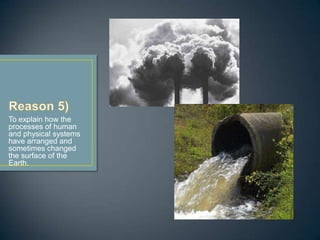
To explain how the
processes of human
and physical systems
have arranged and
sometimes changed
the surface of the
Earth.
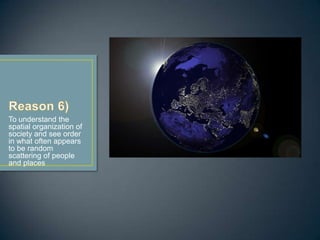
To understand the
spatial organization of
society and see order
in what often appears
to be random
scattering of people
and places
To recognize spatial
distributions at all
scales-local and
worldwide-in order to
understand the
complex connectivity
of people and places.
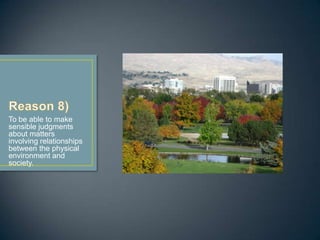
To be able to make
sensible judgments
about matters
involving relationships
between the physical
environment and
society.
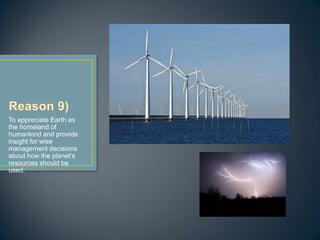
To appreciate Earth as
the homeland of
humankind and provide
insight for wise
management decisions
about how the planet’s
resources should be
used.
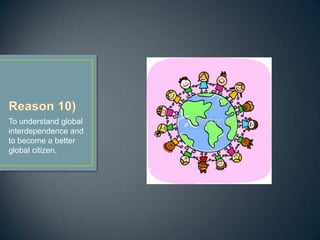
To understand global
interdependence and
to become a better
global citizen.

Geography powerpoint

  • 1.
  • 2.
    To understand basic physicalsystems that effect everyday life (e.g. earth-sun relationships, water cycles, wind and ocean currents).
  • 3.
    To learn thelocation of places and the physical and cultural characteristics of those places in order to function more effectively in our increasingly interdependent world.
  • 4.
    To understand the geographyof past times and how geography has played important roles in the evolution of people, their ideas, places and environments.
  • 5.
    To develop amental map of your community, province or territory, country and the world so that you can understand the “where” of places and events.
  • 6.
    To explain howthe processes of human and physical systems have arranged and sometimes changed the surface of the Earth.
  • 7.
    To understand the spatialorganization of society and see order in what often appears to be random scattering of people and places
  • 8.
    To recognize spatial distributionsat all scales-local and worldwide-in order to understand the complex connectivity of people and places.
  • 9.
    To be ableto make sensible judgments about matters involving relationships between the physical environment and society.
  • 10.
    To appreciate Earthas the homeland of humankind and provide insight for wise management decisions about how the planet’s resources should be used.
  • 11.
    To understand global interdependenceand to become a better global citizen.