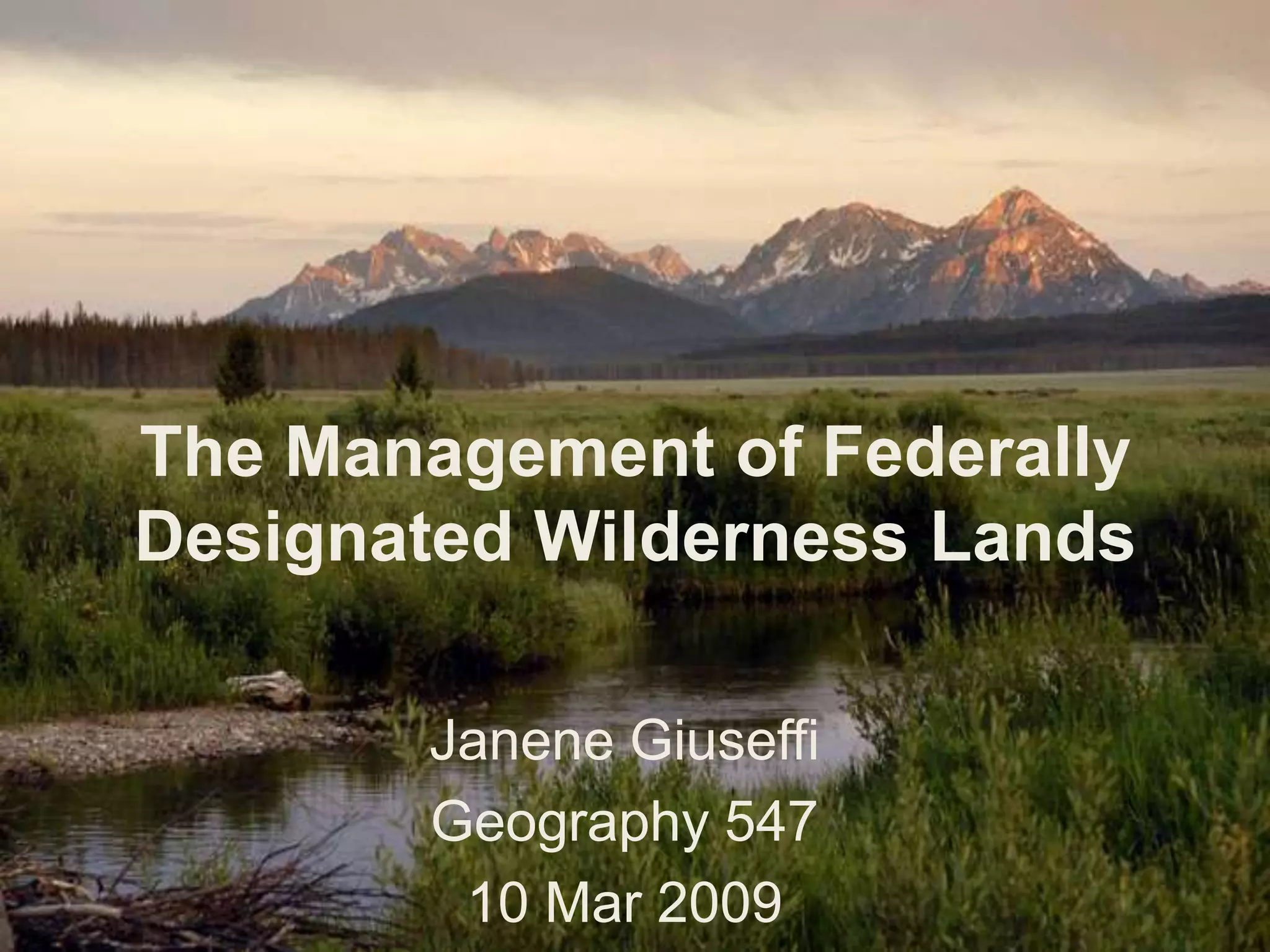
The Management of Federally Designated Wilderness LandsJanene GiuseffiGeography 54710 Mar 2009
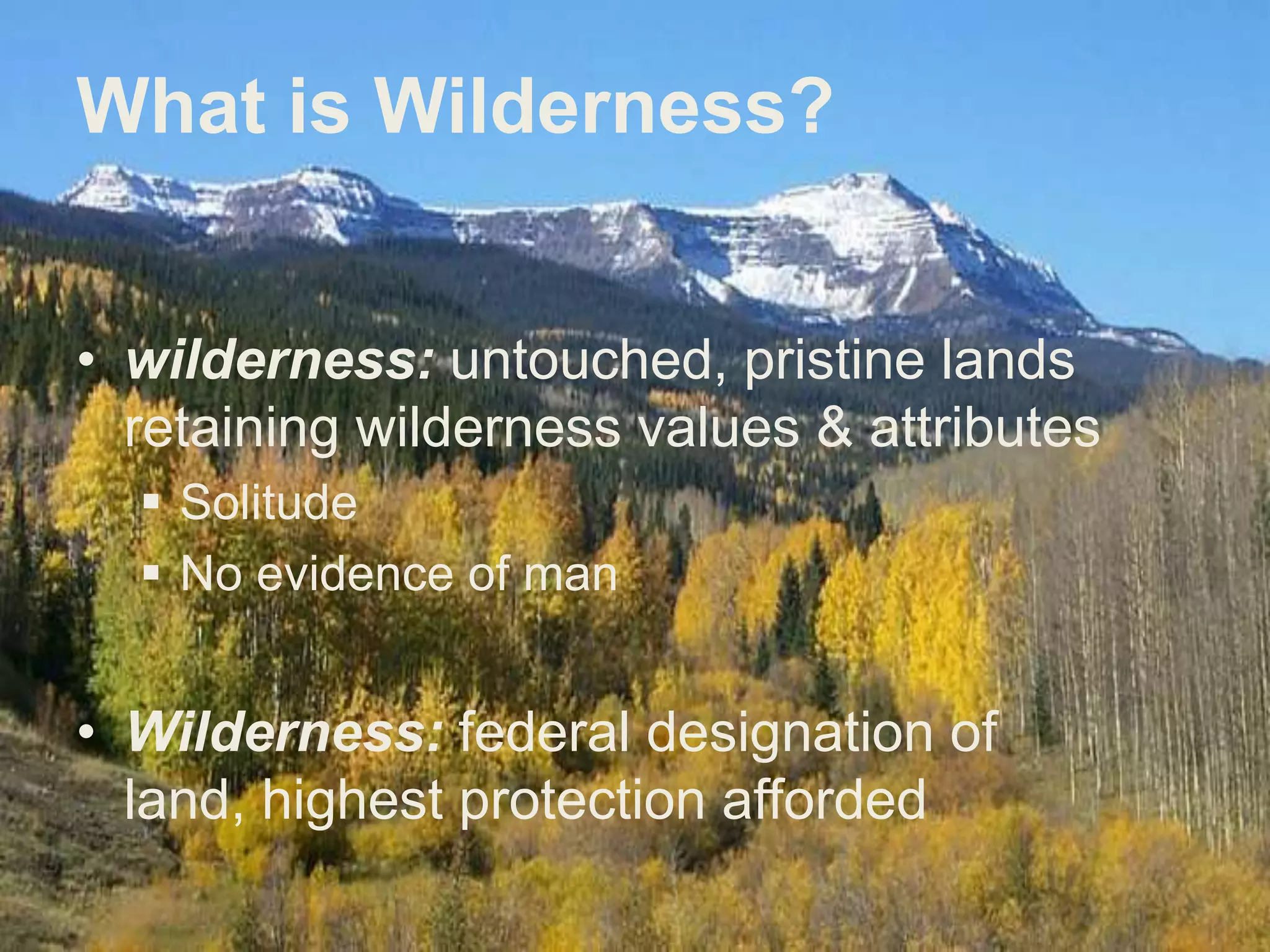
What is Wilderness?wilderness: untouched, pristine lands retaining wilderness values & attributesSolitude
No evidence of manWilderness: federal designation of land, highest protection afforded
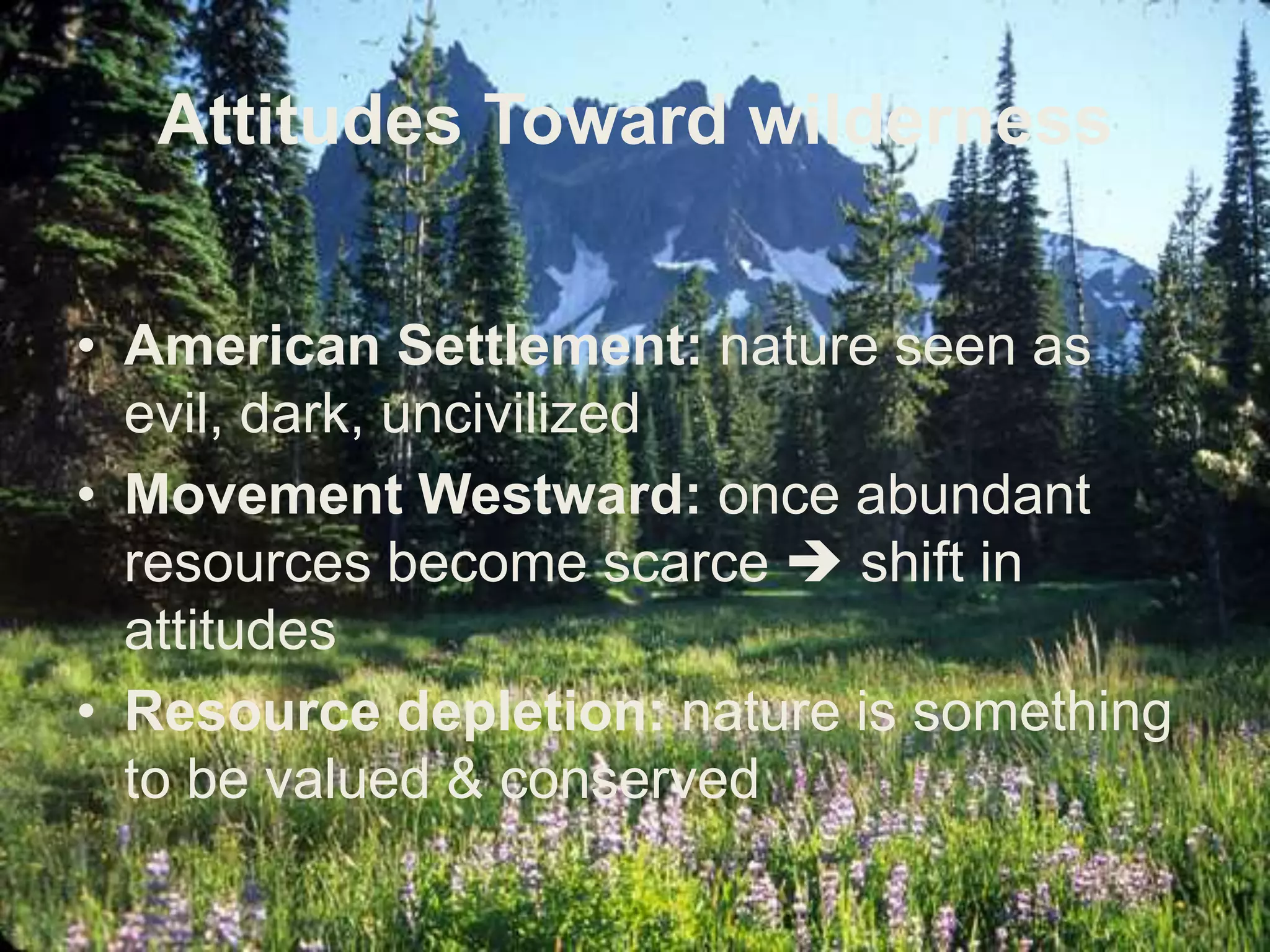
Attitudes Toward wildernessAmerican Settlement: nature seen as evil, dark, uncivilizedMovement Westward: once abundant resources become scarce  shift in attitudesResource depletion: nature is something to be valued & conserved
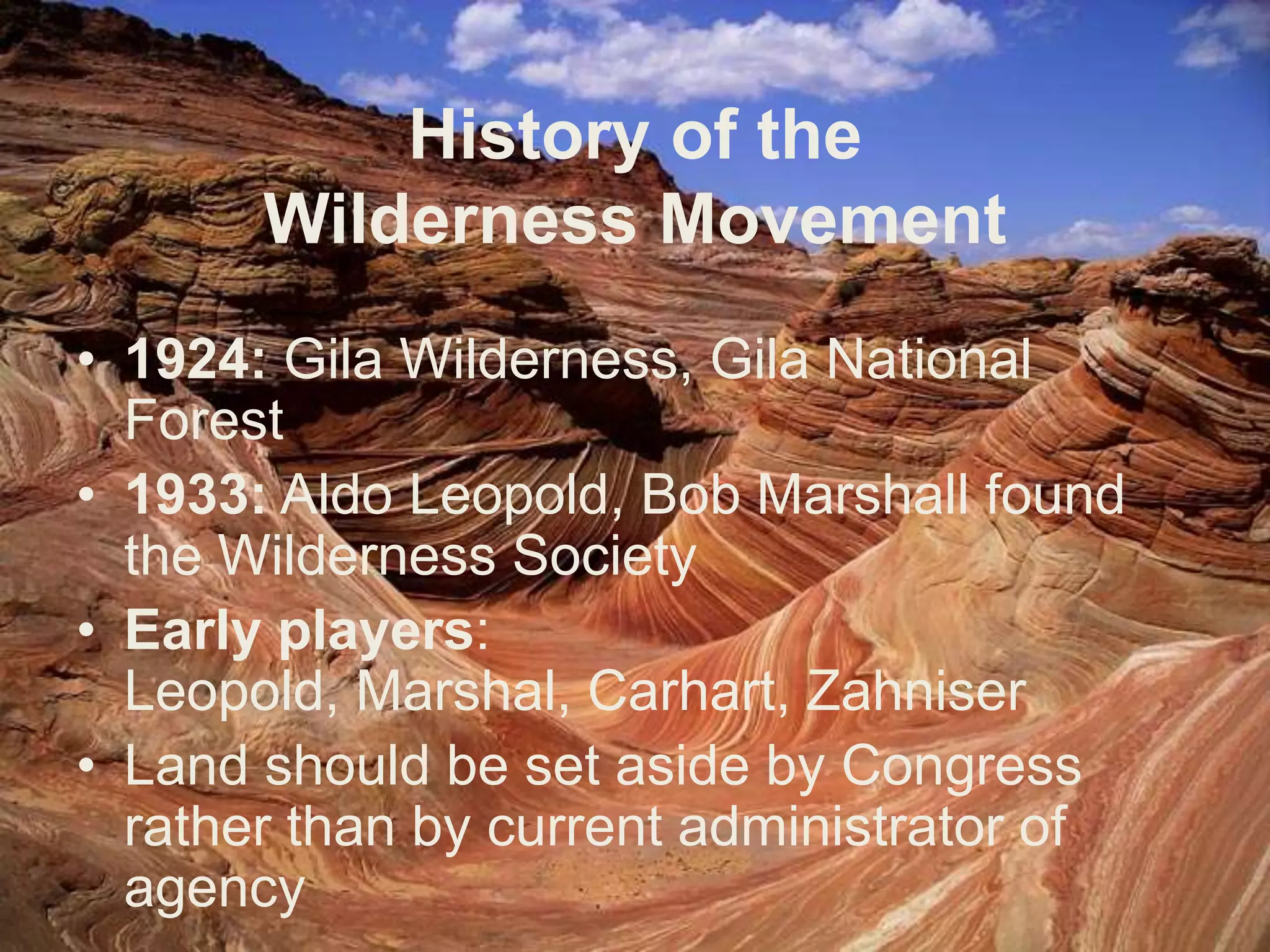
History of the            Wilderness Movement1924: Gila Wilderness, Gila National Forest1933: Aldo Leopold, Bob Marshall found the Wilderness SocietyEarly players: Leopold, Marshal, Carhart, ZahniserLand should be set aside by Congress rather than by current administrator of agency
The Wilderness Act of 1964Originally penned by Howard Zahniser in 1956Signed into law by Johnson in 1964 after 18 public hearings and 65 rewrites
The Wilderness Act of 1964A wilderness, in contrast with those areas where man and his own works dominate the landscape, is hereby recognized as an area where the earth and its community of life are untrammeled by man, where man himself is a visitor who does not remain.An area of wilderness is further defined to mean in this Act an area of undeveloped Federal land retaining its primeval character and influence, without permanent improvements or human habitation, which is protected and managed so as to preserve its natural conditions and which:(1) generally appears to have been affected primarily by the forces of nature, with the imprint of man's work substantially unnoticeable (2) has outstanding opportunities for solitude or a primitive and unconfined type of recreation; (3) has at least five thousand acres of land or is of sufficient size as to make practicable its preservation and use in an unimpaired condition; and (4) may also contain ecological, geological, or other features of scientific, educational, scenic, or historical value.
Goals of the Wilderness ActPreserving natural wildlife & ecosystemsPreventing further human manipulationProviding to society the benefits of Wilderness
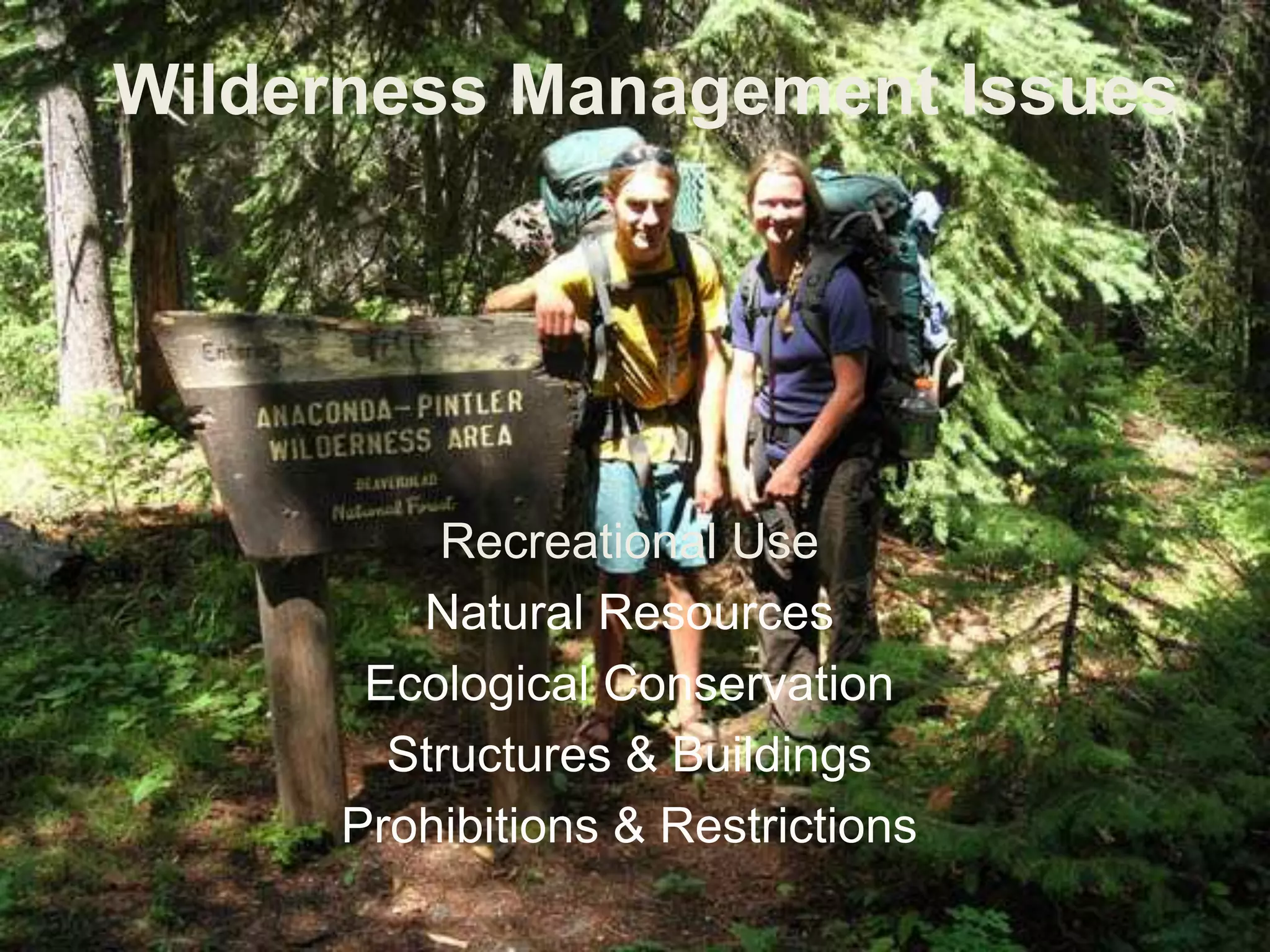
Wilderness Management IssuesRecreational UseNatural ResourcesEcological ConservationStructures & BuildingsProhibitions & Restrictions
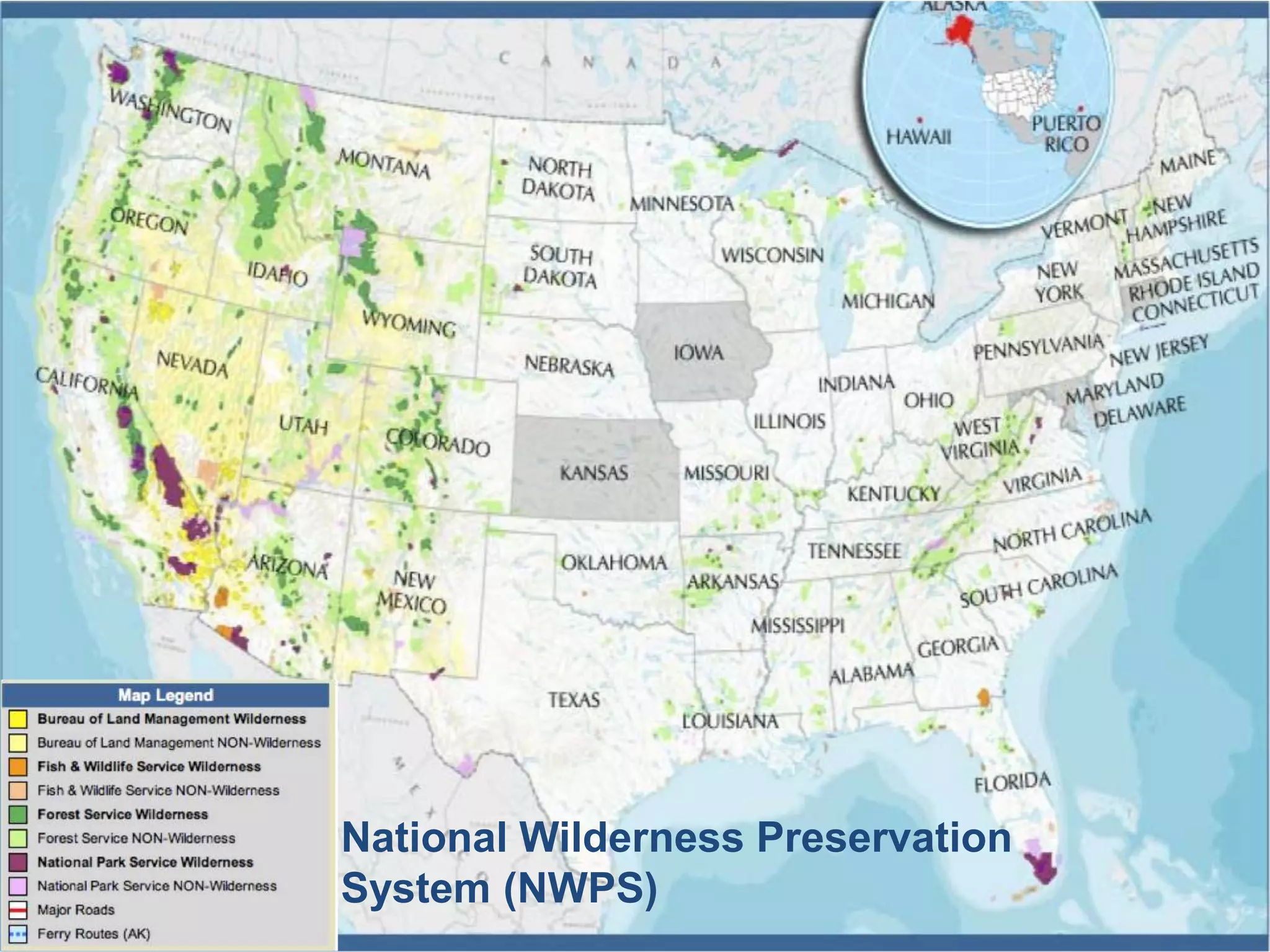
National Wilderness Preservation System (NWPS)
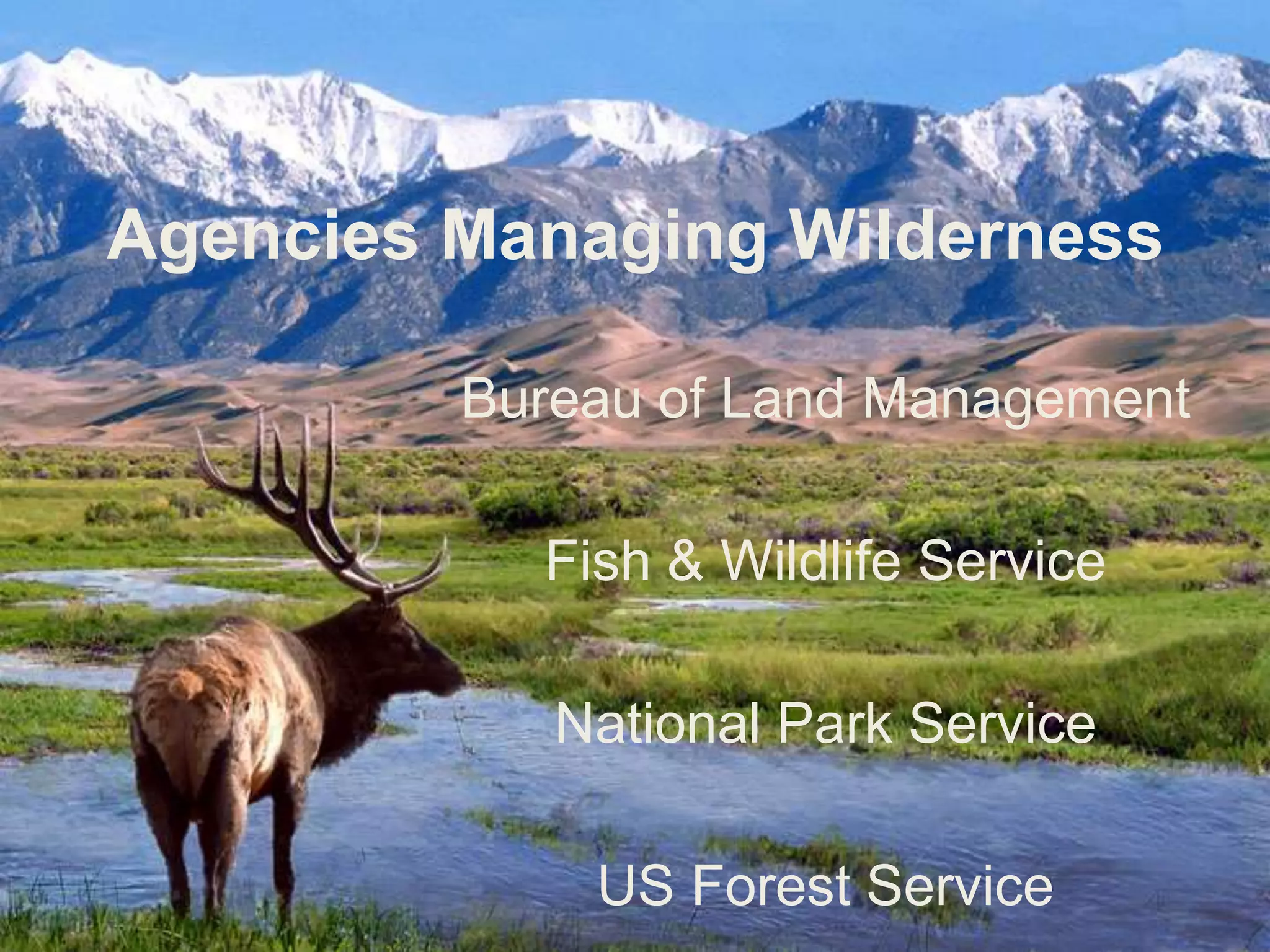
Agencies Managing WildernessBureau of Land ManagementFish & Wildlife Service National Park Service US Forest Service
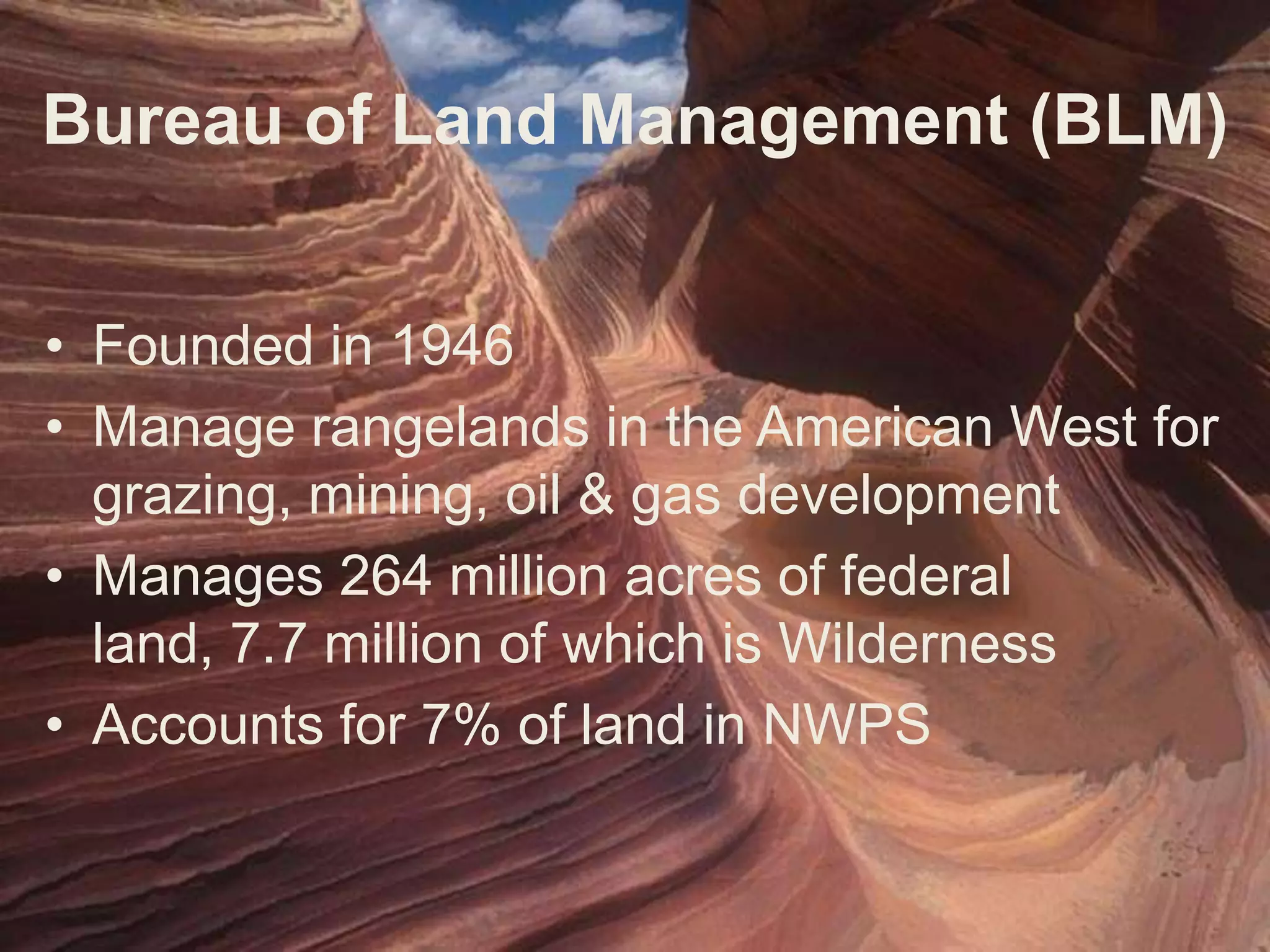
Bureau of Land Management (BLM)Founded in 1946Manage rangelands in the American West for grazing, mining, oil & gas developmentManages 264 million acres of federal land, 7.7 million of which is WildernessAccounts for 7% of land in NWPS
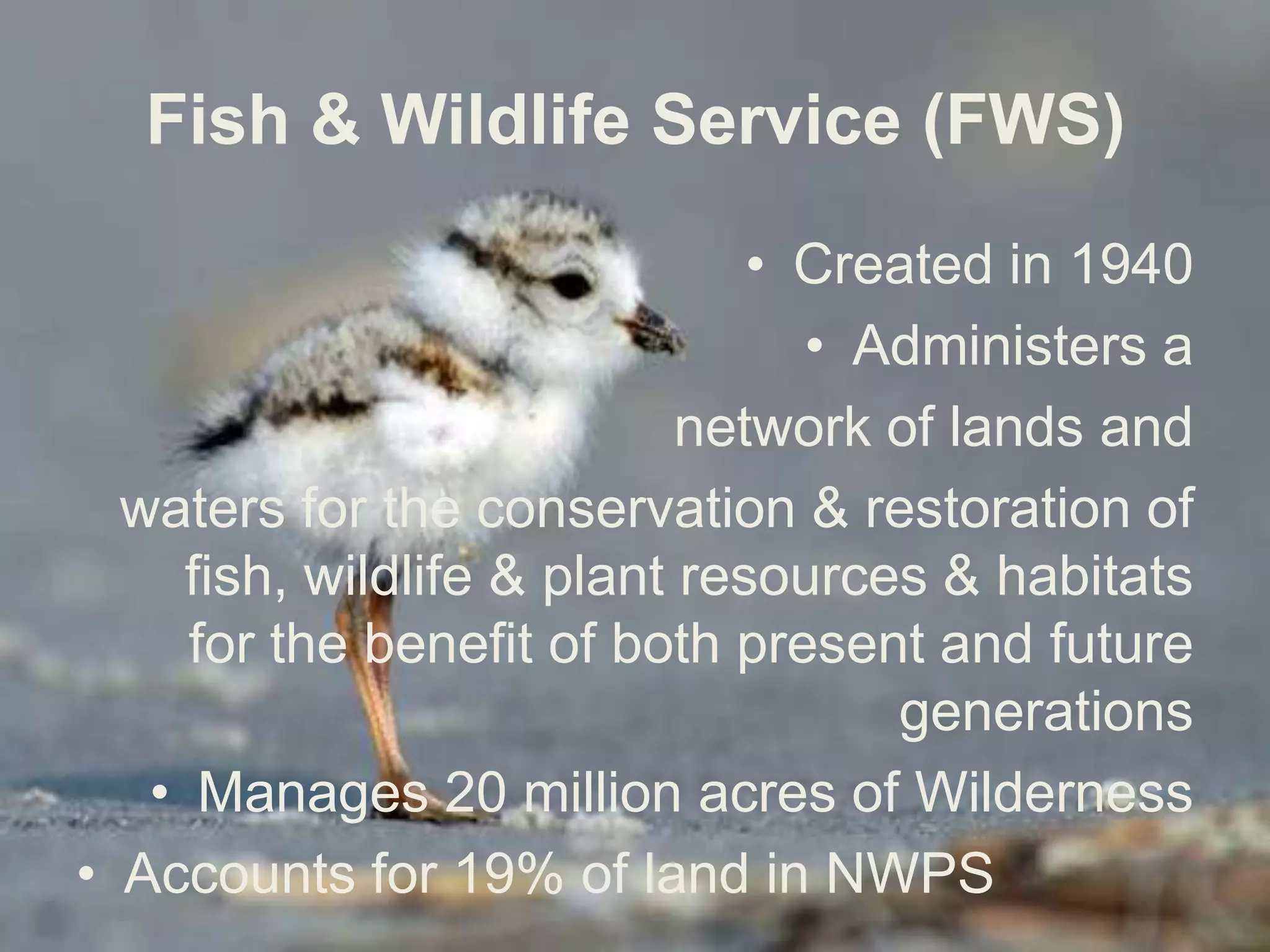
Fish & Wildlife Service (FWS)Created in 1940Administers a network of lands and waters for the conservation & restoration of fish, wildlife & plant resources & habitats for the benefit of both present and future generationsManages 20 million acres of WildernessAccounts for 19% of land in NWPS
National Park Service (NPS)Established in 1916Administers public lands for the enjoyment of the public and the preservation of land into the futureAdministers 84 million acres, including 43 million acres of WildernessAccounts for 40% of NWPS
US Forest Service (FS)Established in 1905To sustain the health, diversity, and productivity of the Nation’s forests to meet the needs of present & future generations419 Wilderness Areas 33 % of land in NWPS
Minimum RequirementAction in question is appropriate or necessary to adequately administer area without impacting wilderness characterTechniques and tools used must make minimum impact on landHighest priority is maintaining Wilderness character
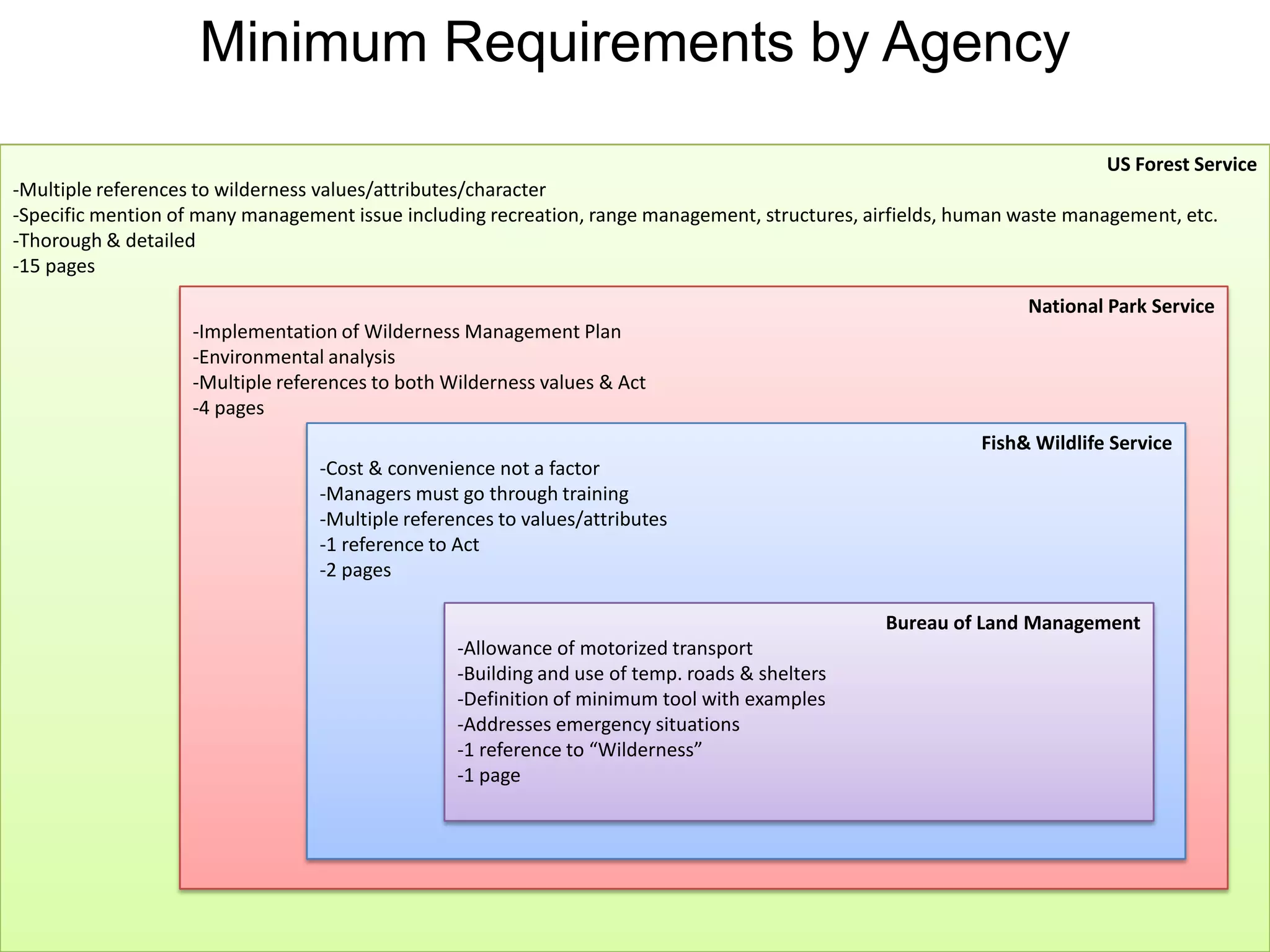
Minimum Requirements by AgencyUS Forest ServiceMultiple references to wilderness values/attributes/character
Specific mention of many management issue including recreation, range management, structures, airfields, human waste management, etc.
Thorough & detailed
15 pagesNational Park ServiceImplementation of Wilderness Management Plan

Geography 547 Final Paper Presentation

  • 1.
    The Management ofFederally Designated Wilderness LandsJanene GiuseffiGeography 54710 Mar 2009
  • 2.
    What is Wilderness?wilderness:untouched, pristine lands retaining wilderness values & attributesSolitude
  • 3.
    No evidence ofmanWilderness: federal designation of land, highest protection afforded
  • 4.
    Attitudes Toward wildernessAmericanSettlement: nature seen as evil, dark, uncivilizedMovement Westward: once abundant resources become scarce  shift in attitudesResource depletion: nature is something to be valued & conserved
  • 5.
    History of the Wilderness Movement1924: Gila Wilderness, Gila National Forest1933: Aldo Leopold, Bob Marshall found the Wilderness SocietyEarly players: Leopold, Marshal, Carhart, ZahniserLand should be set aside by Congress rather than by current administrator of agency
  • 6.
    The Wilderness Actof 1964Originally penned by Howard Zahniser in 1956Signed into law by Johnson in 1964 after 18 public hearings and 65 rewrites
  • 7.
    The Wilderness Actof 1964A wilderness, in contrast with those areas where man and his own works dominate the landscape, is hereby recognized as an area where the earth and its community of life are untrammeled by man, where man himself is a visitor who does not remain.An area of wilderness is further defined to mean in this Act an area of undeveloped Federal land retaining its primeval character and influence, without permanent improvements or human habitation, which is protected and managed so as to preserve its natural conditions and which:(1) generally appears to have been affected primarily by the forces of nature, with the imprint of man's work substantially unnoticeable (2) has outstanding opportunities for solitude or a primitive and unconfined type of recreation; (3) has at least five thousand acres of land or is of sufficient size as to make practicable its preservation and use in an unimpaired condition; and (4) may also contain ecological, geological, or other features of scientific, educational, scenic, or historical value.
  • 8.
    Goals of theWilderness ActPreserving natural wildlife & ecosystemsPreventing further human manipulationProviding to society the benefits of Wilderness
  • 9.
    Wilderness Management IssuesRecreationalUseNatural ResourcesEcological ConservationStructures & BuildingsProhibitions & Restrictions
  • 10.
  • 11.
    Agencies Managing WildernessBureauof Land ManagementFish & Wildlife Service National Park Service US Forest Service
  • 12.
    Bureau of LandManagement (BLM)Founded in 1946Manage rangelands in the American West for grazing, mining, oil & gas developmentManages 264 million acres of federal land, 7.7 million of which is WildernessAccounts for 7% of land in NWPS
  • 13.
    Fish & WildlifeService (FWS)Created in 1940Administers a network of lands and waters for the conservation & restoration of fish, wildlife & plant resources & habitats for the benefit of both present and future generationsManages 20 million acres of WildernessAccounts for 19% of land in NWPS
  • 14.
    National Park Service(NPS)Established in 1916Administers public lands for the enjoyment of the public and the preservation of land into the futureAdministers 84 million acres, including 43 million acres of WildernessAccounts for 40% of NWPS
  • 15.
    US Forest Service(FS)Established in 1905To sustain the health, diversity, and productivity of the Nation’s forests to meet the needs of present & future generations419 Wilderness Areas 33 % of land in NWPS
  • 16.
    Minimum RequirementAction inquestion is appropriate or necessary to adequately administer area without impacting wilderness characterTechniques and tools used must make minimum impact on landHighest priority is maintaining Wilderness character
  • 17.
    Minimum Requirements byAgencyUS Forest ServiceMultiple references to wilderness values/attributes/character
  • 18.
    Specific mention ofmany management issue including recreation, range management, structures, airfields, human waste management, etc.
  • 19.
  • 20.
    15 pagesNational ParkServiceImplementation of Wilderness Management Plan
  • 21.
  • 22.
    Multiple references toboth Wilderness values & Act
  • 23.
    4 pagesFish& WildlifeServiceCost & convenience not a factor
  • 24.
    Managers must gothrough training
  • 25.
    Multiple references tovalues/attributes
  • 26.
  • 27.
    2 pagesBureau ofLand ManagementAllowance of motorized transport
  • 28.
    Building and useof temp. roads & shelters
  • 29.
    Definition of minimumtool with examples
  • 30.
  • 31.
    1 reference to“Wilderness”
  • 32.
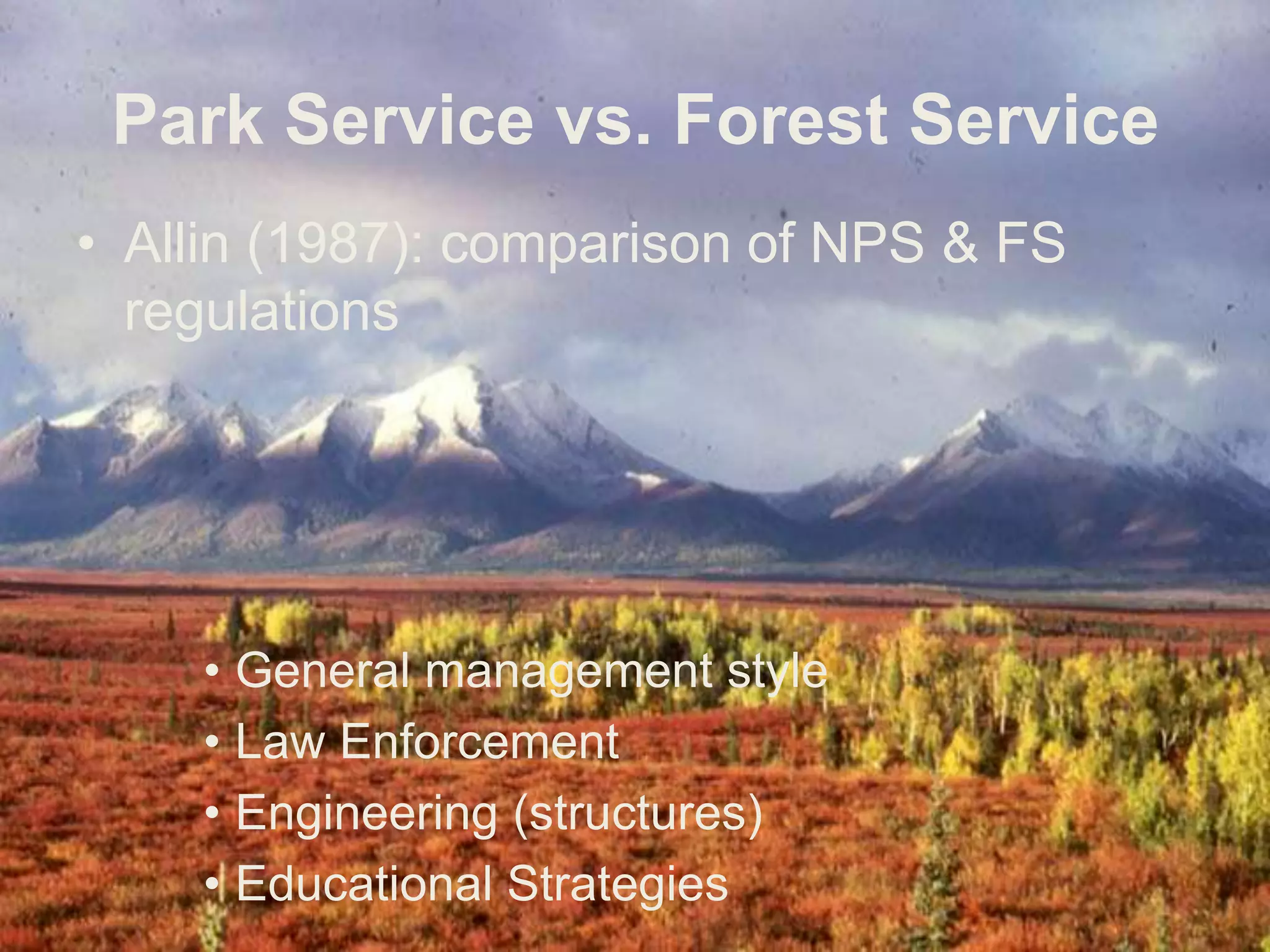
    1 pagePark Servicevs. Forest ServiceAllin (1987): comparison of NPS & FS regulationsGeneral management styleLaw EnforcementEngineering (structures)Educational Strategies
  • 33.
    Differences in ManagementAlthoughtheoretically Wilderness management should be consistent from agency to agency, the unique history & mission of each inevitably influence its decision-making process.
  • 34.
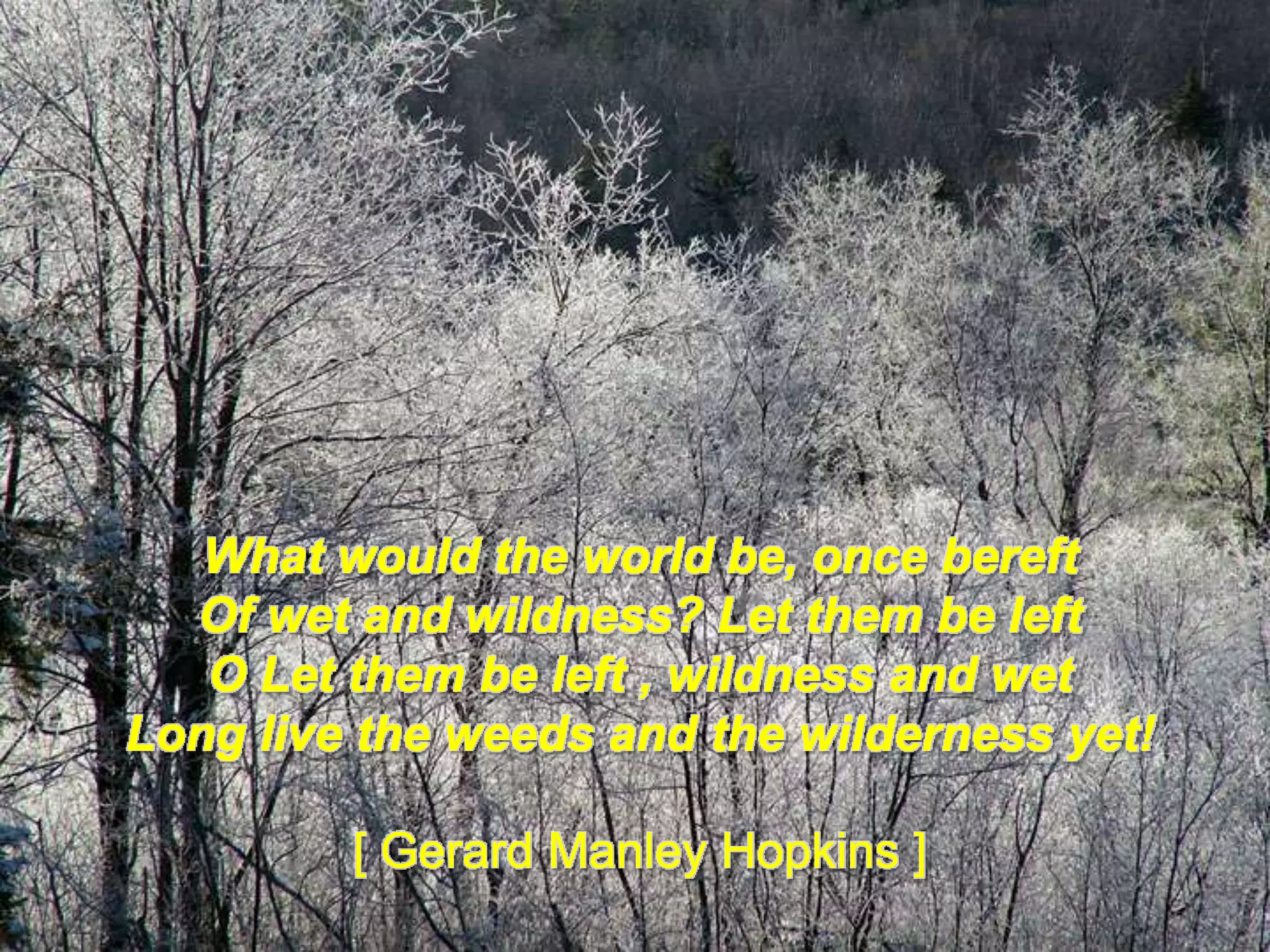
    What would theworld be, once bereftOf wet and wildness? Let them be leftO Let them be left , wildness and wetLong live the weeds and the wilderness yet![ Gerard Manley Hopkins ]
  • 35.
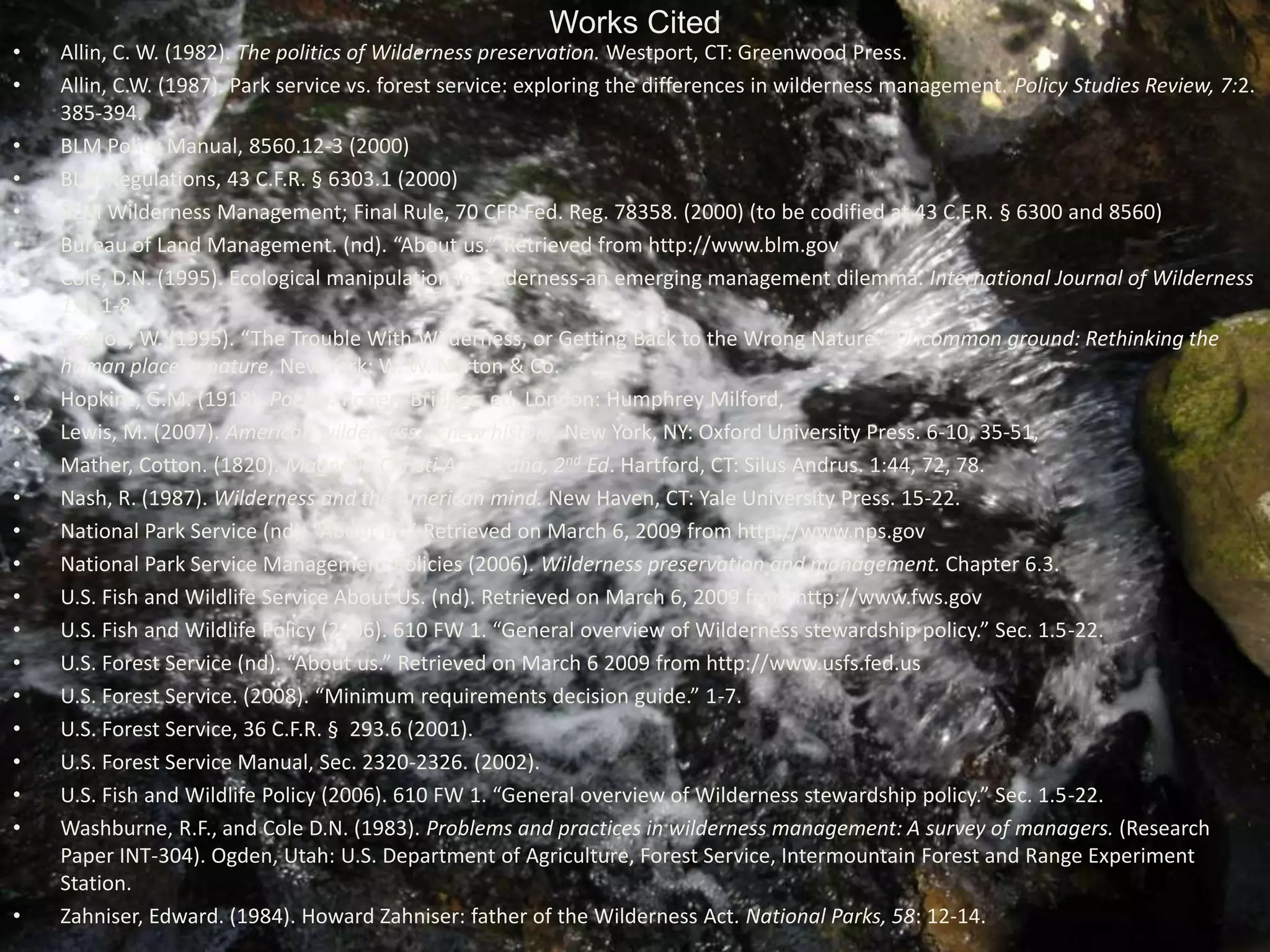
    Works CitedAllin, C.W. (1982). The politics of Wilderness preservation. Westport, CT: Greenwood Press.Allin, C.W. (1987). Park service vs. forest service: exploring the differences in wilderness management. Policy Studies Review, 7:2. 385-394.BLM Policy Manual, 8560.12-3 (2000) BLM Regulations, 43 C.F.R. § 6303.1 (2000)BLM Wilderness Management; Final Rule, 70 CFR Fed. Reg. 78358. (2000) (to be codified at 43 C.F.R. § 6300 and 8560)Bureau of Land Management. (nd). “About us.” Retrieved from http://www.blm.govCole, D.N. (1995). Ecological manipulation in wilderness-an emerging management dilemma. International Journal of Wilderness 1:1. 1-8.Cronon, W. (1995). “The Trouble With Wilderness, or Getting Back to the Wrong Nature.” Uncommon ground: Rethinking the human place in nature, New York: W. W. Norton & Co.Hopkins, G.M. (1918). Poems. Robert Bridges, ed. London: Humphrey Milford,Lewis, M. (2007). American wilderness: A new history. New York, NY: Oxford University Press. 6-10, 35-51, Mather, Cotton. (1820). Magnalia Christi Americana, 2nd Ed. Hartford, CT: Silus Andrus. 1:44, 72, 78.Nash, R. (1987). Wilderness and the American mind. New Haven, CT: Yale University Press. 15-22. National Park Service (nd). “About us.” Retrieved on March 6, 2009 from http://www.nps.govNational Park Service Management Policies (2006). Wilderness preservation and management. Chapter 6.3.U.S. Fish and Wildlife Service About Us. (nd). Retrieved on March 6, 2009 from http://www.fws.govU.S. Fish and Wildlife Policy (2006). 610 FW 1. “General overview of Wilderness stewardship policy.” Sec. 1.5-22.U.S. Forest Service (nd). “About us.” Retrieved on March 6 2009 from http://www.usfs.fed.usU.S. Forest Service. (2008). “Minimum requirements decision guide.” 1-7.U.S. Forest Service, 36 C.F.R. § 293.6 (2001).U.S. Forest Service Manual, Sec. 2320-2326. (2002). U.S. Fish and Wildlife Policy (2006). 610 FW 1. “General overview of Wilderness stewardship policy.” Sec. 1.5-22.Washburne, R.F., and Cole D.N. (1983). Problems and practices in wilderness management: A survey of managers. (Research Paper INT-304). Ogden, Utah: U.S. Department of Agriculture, Forest Service, Intermountain Forest and Range Experiment Station.Zahniser, Edward. (1984). Howard Zahniser: father of the Wilderness Act. National Parks, 58: 12-14.