Gabriel Heimberg
Gabriel Heimberg
Photo Journal for Geography 5
Lab Class
In Transit Photos
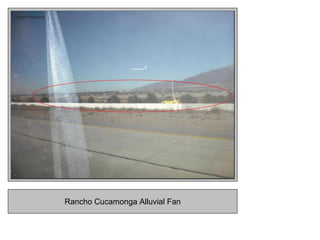
Rancho Cucamonga Alluvial Fan
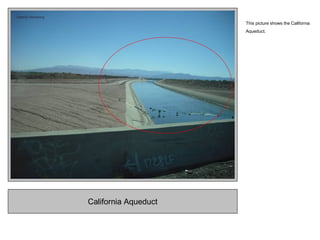
California Aqueduct
This picture shows the California
Aqueduct.
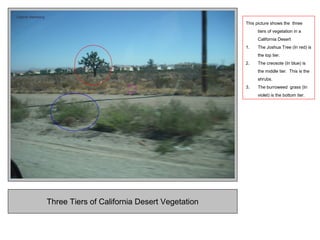
Three Tiers of California Desert Vegetation
This picture shows the three
tiers of vegetation in a
California Desert
1. The Joshua Tree (In red) is
the top tier.
2. The creosote (In blue) is
the middle tier. This is the
shrubs.
3. The burroweed grass (In
violet) is the bottom tier.
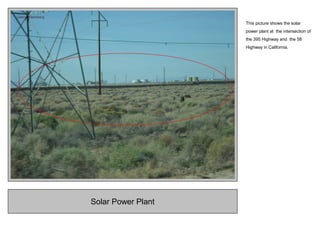
Solar Power Plant
This picture shows the solar
power plant at the intersection of
the 395 Highway and the 58
Highway in California.
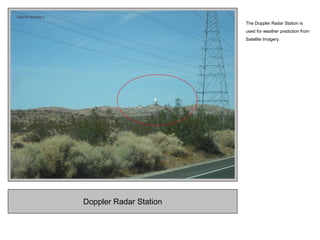
Doppler Radar Station
The Doppler Radar Station is
used for weather prediction from
Satellite Imagery.
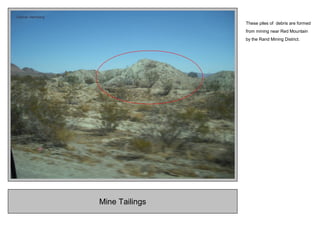
Mine Tailings
These piles of debris are formed
from mining near Red Mountain
by the Rand Mining District.
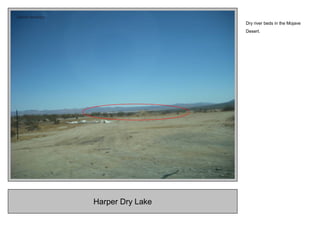
Harper Dry Lake
Dry river beds in the Mojave
Desert.
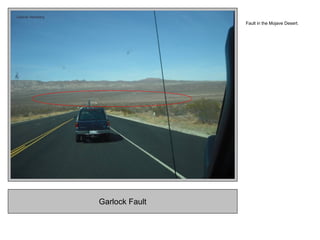
Garlock Fault
Fault in the Mojave Desert.
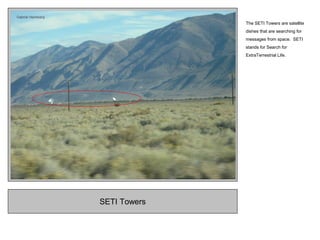
SETI Towers
The SETI Towers are satellite
dishes that are searching for
messages from space. SETI
stands for Search for
ExtraTerrestrial Life.
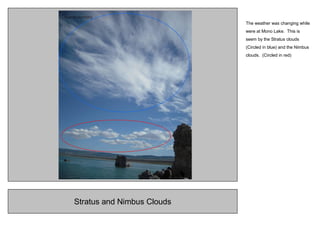
Stratus and Nimbus Clouds
The weather was changing while
were at Mono Lake. This is
seem by the Stratus clouds
(Circled in blue) and the Nimbus
clouds. (Circled in red)
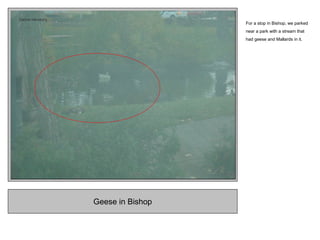
Geese in Bishop
For a stop in Bishop, we parked
near a park with a stream that
had geese and Mallards in it.
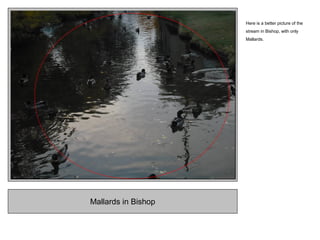
Mallards in Bishop
Here is a better picture of the
stream in Bishop, with only
Mallards.
1st
Field Trip
Mormon Rocks
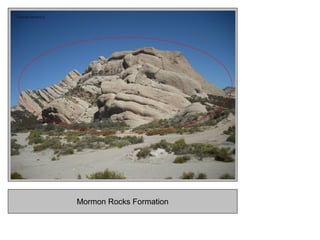
Mormon Rocks Formation
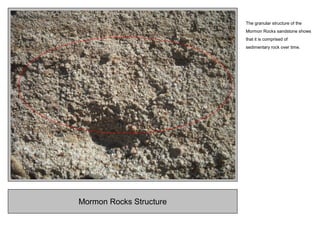
Mormon Rocks Structure
The granular structure of the
Mormon Rocks sandstone shows
that it is comprised of
sedimentary rock over time.
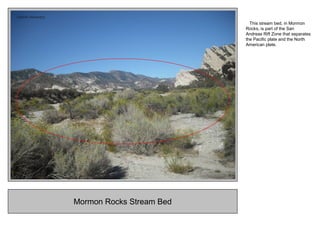
Mormon Rocks Stream Bed
This stream bed, in Mormon
Rocks, is part of the San
Andreas Rift Zone that separates
the Pacific plate and the North
American plate.
Cinder Hill
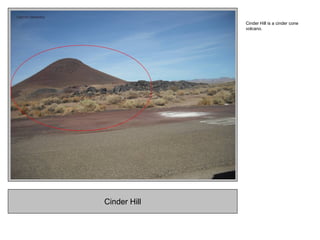
Cinder Hill
Cinder Hill is a cinder cone
volcano.
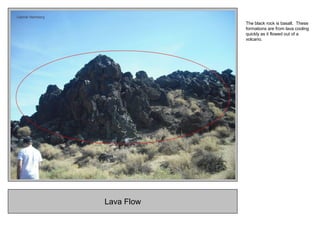
Lava Flow
The black rock is basalt. These
formations are from lava cooling
quickly as it flowed out of a
volcano.
Fossil Falls
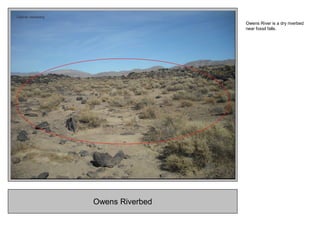
Owens Riverbed
Owens River is a dry riverbed
near fossil falls.
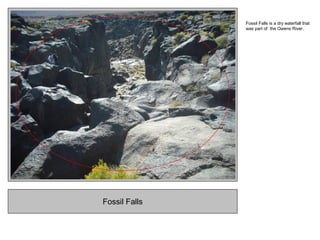
Fossil Falls
Fossil Falls is a dry waterfall that
was part of the Owens River.
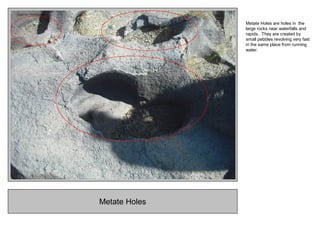
Metate Holes
Metate Holes are holes in the
large rocks near waterfalls and
rapids. They are created by
small pebbles revolving very fast
in the same place from running
water.
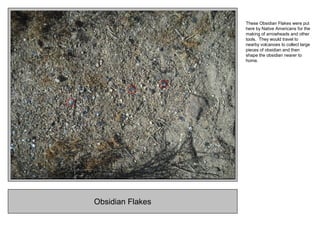
Obsidian Flakes
These Obsidian Flakes were put
here by Native Americans for the
making of arrowheads and other
tools. They would travel to
nearby volcanoes to collect large
pieces of obsidian and then
shape the obsidian nearer to
home.
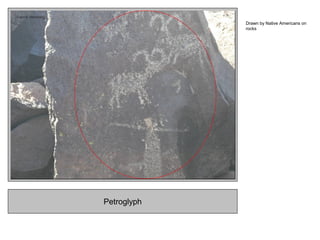
Petroglyph
Drawn by Native Americans on
rocks
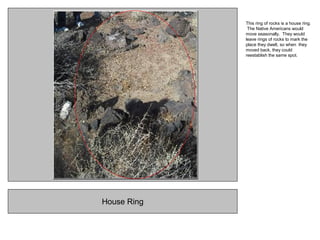
House Ring
This ring of rocks is a house ring.
The Native Americans would
move seasonally. They would
leave rings of rocks to mark the
place they dwelt, so when they
moved back, they could
reestablish the same spot.
2nd
Field Trip
Diaz Lake
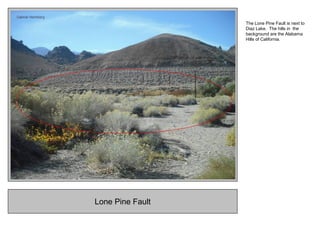
Lone Pine Fault
The Lone Pine Fault is next to
Diaz Lake. The hills in the
background are the Alabama
Hills of California.
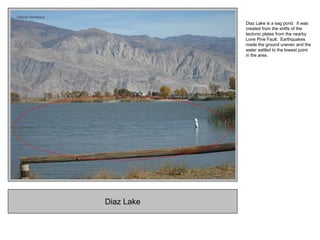
Diaz Lake
Diaz Lake is a sag pond. It was
created from the shifts of the
tectonic plates from the nearby
Lone Pine Fault. Earthquakes
made the ground uneven and the
water settled to the lowest point
in the area.
Mount Whitney
Mount Whitney
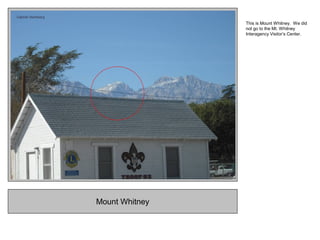
This is Mount Whitney. We did
not go to the Mt. Whitney
Interagency Visitor’s Center.
Keoughs Hot Springs
Keoughs Hot Springs
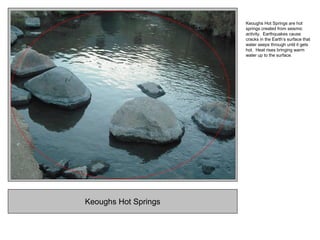
Keoughs Hot Springs are hot
springs created from seismic
activity. Earthquakes cause
cracks in the Earth’s surface that
water seeps through until it gets
hot. Heat rises bringing warm
water up to the surface.
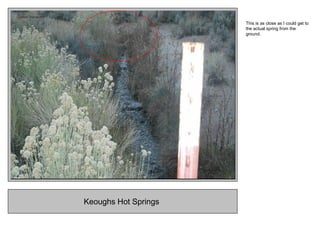
Keoughs Hot Springs
This is as close as I could get to
the actual spring from the
ground.
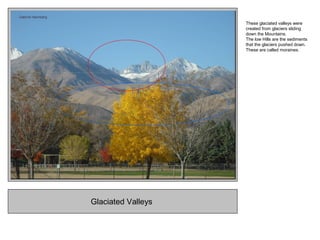
Glaciated Valleys
These glaciated valleys were
created from glaciers sliding
down the Mountains.
The low Hills are the sediments
that the glaciers pushed down.
These are called moraines.
Mono Lake
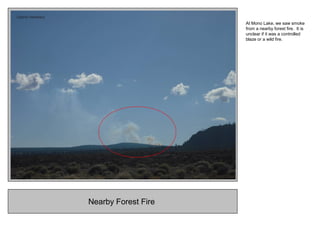
Nearby Forest Fire
At Mono Lake, we saw smoke
from a nearby forest fire. It is
unclear if it was a controlled
blaze or a wild fire.
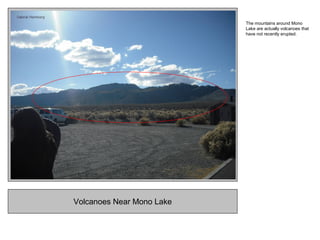
Volcanoes Near Mono Lake
The mountains around Mono
Lake are actually volcanoes that
have not recently erupted.
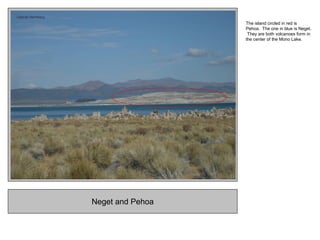
Neget and Pehoa
The island circled in red is
Pehoa. The one in blue is Neget.
They are both volcanoes form in
the center of the Mono Lake.
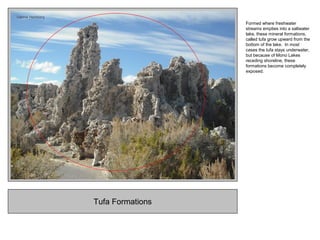
Tufa Formations
Formed where freshwater
streams empties into a saltwater
lake, these mineral formations,
called tufa grow upward from the
bottom of the lake. In most
cases the tufa stays underwater,
but because of Mono Lakes
receding shoreline, these
formations become completely
exposed.
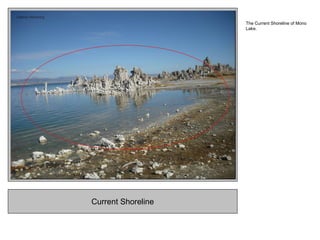
Current Shoreline
The Current Shoreline of Mono
Lake.
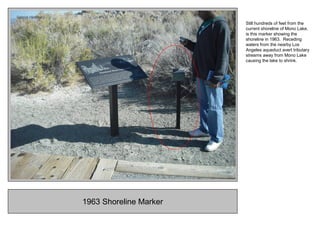
1963 Shoreline Marker
Still hundreds of feet from the
current shoreline of Mono Lake,
is this marker showing the
shoreline in 1963. Receding
waters from the nearby Los
Angeles aqueduct avert tributary
streams away from Mono Lake
causing the lake to shrink.
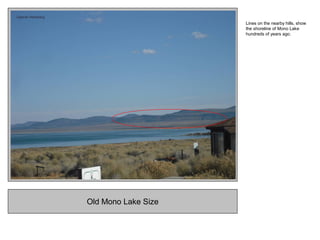
Old Mono Lake Size
Lines on the nearby hills, show
the shoreline of Mono Lake
hundreds of years ago.
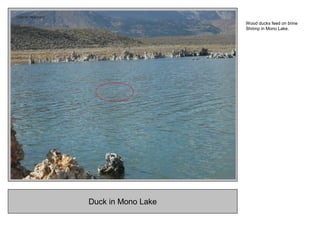
Duck in Mono Lake
Wood ducks feed on brine
Shrimp in Mono Lake.
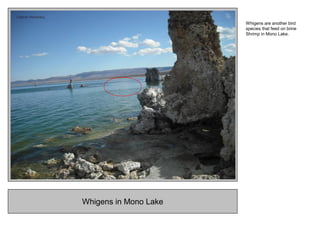
Whigens in Mono Lake
Whigens are another bird
species that feed on brine
Shrimp in Mono Lake.
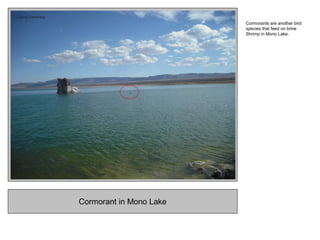
Cormorant in Mono Lake
Cormorants are another bird
species that feed on brine
Shrimp in Mono Lake.
Panum Crater
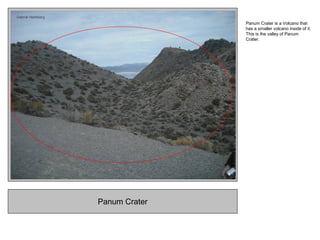
Panum Crater
Panum Crater is a Volcano that
has a smaller volcano inside of it.
This is the valley of Panum
Crater.
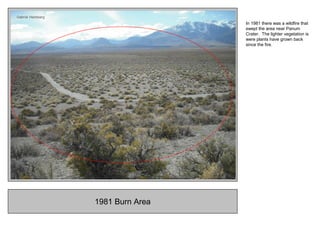
1981 Burn Area
In 1981 there was a wildfire that
swept the area near Panum
Crater. The lighter vegetation is
were plants have grown back
since the fire.
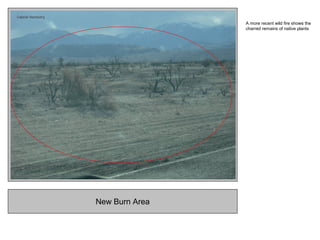
New Burn Area
A more recent wild fire shows the
charred remains of native plants
June Lake Loop
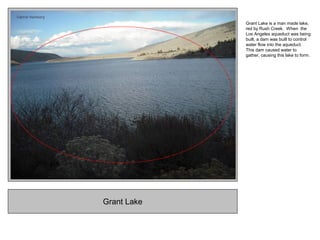
Grant Lake
Grant Lake is a man made lake,
red by Rush Creek. When the
Los Angeles aqueduct was being
built, a dam was built to control
water flow into the aqueduct.
This dam caused water to
gather, causing this lake to form.
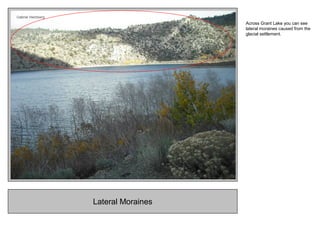
Lateral Moraines
Across Grant Lake you can see
lateral moraines caused from the
glacial settlement.
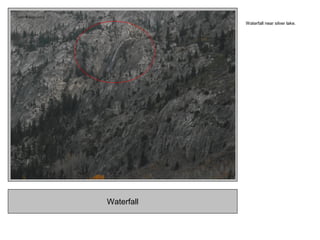
Waterfall
Waterfall near silver lake.
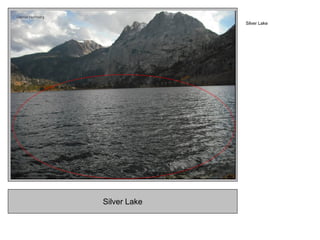
Silver Lake
Silver Lake
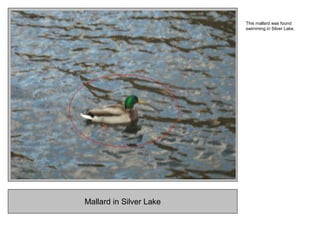
Mallard in Silver Lake
This mallard was found
swimming in Silver Lake.
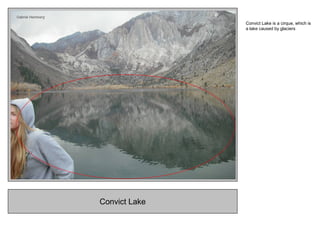
Convict Lake
Convict Lake is a cirque, which is
a lake caused by glaciers
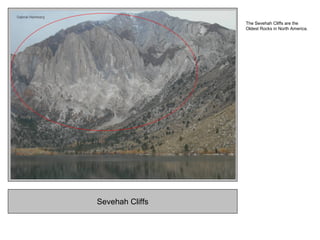
Sevehah Cliffs
The Sevehah Cliffs are the
Oldest Rocks in North America.
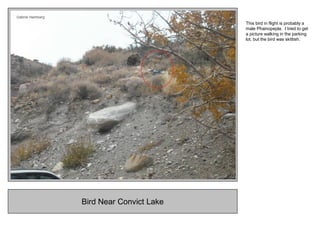
Bird Near Convict Lake
This bird in flight is probably a
male Phainopepla. I tried to get
a picture walking in the parking
lot, but the bird was skittish.
Eastern Sierra Museum
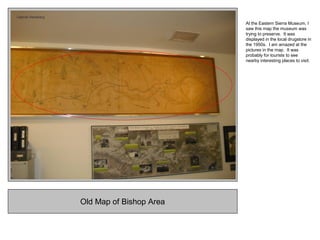
Old Map of Bishop Area
At the Eastern Sierra Museum, I
saw this map the museum was
trying to preserve. It was
displayed in the local drugstore in
the 1950s. I am amazed at the
pictures in the map. It was
probably for tourists to see
nearby interesting places to visit.
Manzanar
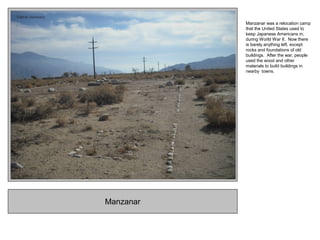
Manzanar
Manzanar was a relocation camp
that the United States used to
keep Japanese Americans in,
during World War II. Now there
is barely anything left, except
rocks and foundations of old
buildings. After the war, people
used the wood and other
materials to build buildings in
nearby towns.
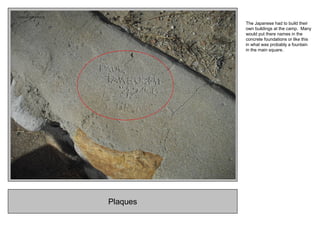
Plaques
The Japanese had to build their
own buildings at the camp. Many
would put there names in the
concrete foundations or like this
in what was probably a fountain
in the main square.
Field Question 1
Mormon Rocks is a tilted fault block. As the Pacific Plate pushes against the North American Plate at the
San Andreas Fault the rocks break and the rocks jut upward. In this instant Geologists can determine important
information through the layers of rock exposed through the fault line. Some of the information that can be
determined are annual rainfall averages, seismic activity and biome information.
Mormon Rocks is sedimentary rock around the San Andreas Fault. The San Andreas is the key point to
the seismic activity in Southern California, and the pressure is building in this area. It is also were we can see
information to the Earth beneath us through the Layers exposed.
Field Question 2
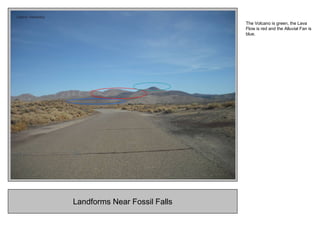
At Cinder Hill, I saw a cinder cone, lava flows, alluvial fans and other
volcanoes. Cinder Hill is a cinder cone type volcano. In the picture on the next page,
the lava flow is the darker area at the side of the mountain, circled in red. The alluvial
fan is circled in blue. The volcano is circled in green.
Near Fossil Falls, there were three evidences of former Native American
habitation. First was the chips of obsidian on the ground. Native Americans would travel
to volcanoes and collect obsidian, so they could make arrowheads and other tools.
Second are the house rings. Native Americans would mark the spot of their homes, so
when they returned from seasonal migration, they could resettle in the same spot. The
third evidence is the petroglyphs drawn on the rocks.
3
Landforms Near Fossil Falls
The Volcano is green, the Lava
Flow is red and the Alluvial Fan is
blue.
Field Question 3
The Sierra Nevada Mountains and the White Inyo Mountains look very different. The Sierra Nevada
Mountains are larger and have step U shaped valleys. The White Inyo Mountains are smaller and have more
rolling V shaped mountains.
The Sierra Nevada Mountains are an older mountain range with moraines. The U shaped valleys are
caused by the glaciers that weathered the mountains. The glaciers carved the valleys taking sediment down with
them and the piles of sediment are the small rolling hills at the bottom of the mountains called moraines.
The White Inyo Mountains are younger and shorter than the Sierra Nevada Mountains. The White Inyo
Mountains do not have as much glacier weathering, so the valleys have more of the V shape. There are also no
real moraines where we were looking at them.
Field Questions 4
Using the Analema on November 6, 2010, as we were visiting Mono Lake, the Subsolar Point (Where the
sun is directly 90 degrees overhead.) was at the latitude of about 16 degrees south. The Subsolar Point was in
the Southern Hemisphere. Mono Lake is at a latitude of 38 degrees north. Therefore, adding the two latitudes
together, because the latitudes are in separate hemispheres, the arc distance is 54 degrees. Subtracted from 90
the solar angle of the Sun at Lee Vining is 36 degrees. This means at the highest point of the day (the Zenith
Point) the Sun is only 36 degrees up from the horizon in the south.
We also know from the Analema, on November 6th
, the Zenith Point is sixteen minutes fast. In other
words the Sun hits it’s Zenith Angle of 36 degrees above the horizon at 11:44 AM.
Field Question 5
At Panum Crater there are many landforms to see. Panum Crater itself is a composite volcano with a cinder cone volcano
inside. Neget and Pehoa are also small volcanoes inside Mono Lake. There are nearby mountains with moraines at the feet of
them. In Mono Lake, you can see the tufa from Panum Crater.
Three evidences of former lake levels are first the lines on the nearby hills. This is seen in slide 48. The second evidence of
former lake levels are the tufa. The are naturally formed underwater and only exposed by the receding shoreline. The third
evidence is the sign put out of the 1963 shoreline.

Geog5 Photo J

  • 1.
  • 2.
    Gabriel Heimberg Photo Journalfor Geography 5 Lab Class
  • 3.
  • 4.
  • 5.
    California Aqueduct This pictureshows the California Aqueduct.
  • 6.
    Three Tiers ofCalifornia Desert Vegetation This picture shows the three tiers of vegetation in a California Desert 1. The Joshua Tree (In red) is the top tier. 2. The creosote (In blue) is the middle tier. This is the shrubs. 3. The burroweed grass (In violet) is the bottom tier.
  • 7.
    Solar Power Plant Thispicture shows the solar power plant at the intersection of the 395 Highway and the 58 Highway in California.
  • 8.
    Doppler Radar Station TheDoppler Radar Station is used for weather prediction from Satellite Imagery.
  • 9.
    Mine Tailings These pilesof debris are formed from mining near Red Mountain by the Rand Mining District.
  • 10.
    Harper Dry Lake Dryriver beds in the Mojave Desert.
  • 11.
    Garlock Fault Fault inthe Mojave Desert.
  • 12.
    SETI Towers The SETITowers are satellite dishes that are searching for messages from space. SETI stands for Search for ExtraTerrestrial Life.
  • 13.
    Stratus and NimbusClouds The weather was changing while were at Mono Lake. This is seem by the Stratus clouds (Circled in blue) and the Nimbus clouds. (Circled in red)
  • 14.
    Geese in Bishop Fora stop in Bishop, we parked near a park with a stream that had geese and Mallards in it.
  • 15.
    Mallards in Bishop Hereis a better picture of the stream in Bishop, with only Mallards.
  • 16.
  • 17.
  • 18.
  • 19.
    Mormon Rocks Structure Thegranular structure of the Mormon Rocks sandstone shows that it is comprised of sedimentary rock over time.
  • 20.
    Mormon Rocks StreamBed This stream bed, in Mormon Rocks, is part of the San Andreas Rift Zone that separates the Pacific plate and the North American plate.
  • 21.
  • 22.
    Cinder Hill Cinder Hillis a cinder cone volcano.
  • 23.
    Lava Flow The blackrock is basalt. These formations are from lava cooling quickly as it flowed out of a volcano.
  • 24.
  • 25.
    Owens Riverbed Owens Riveris a dry riverbed near fossil falls.
  • 26.
    Fossil Falls Fossil Fallsis a dry waterfall that was part of the Owens River.
  • 27.
    Metate Holes Metate Holesare holes in the large rocks near waterfalls and rapids. They are created by small pebbles revolving very fast in the same place from running water.
  • 28.
    Obsidian Flakes These ObsidianFlakes were put here by Native Americans for the making of arrowheads and other tools. They would travel to nearby volcanoes to collect large pieces of obsidian and then shape the obsidian nearer to home.
  • 29.
    Petroglyph Drawn by NativeAmericans on rocks
  • 30.
    House Ring This ringof rocks is a house ring. The Native Americans would move seasonally. They would leave rings of rocks to mark the place they dwelt, so when they moved back, they could reestablish the same spot.
  • 31.
  • 32.
  • 33.
    Lone Pine Fault TheLone Pine Fault is next to Diaz Lake. The hills in the background are the Alabama Hills of California.
  • 34.
    Diaz Lake Diaz Lakeis a sag pond. It was created from the shifts of the tectonic plates from the nearby Lone Pine Fault. Earthquakes made the ground uneven and the water settled to the lowest point in the area.
  • 35.
  • 36.
    Mount Whitney This isMount Whitney. We did not go to the Mt. Whitney Interagency Visitor’s Center.
  • 37.
  • 38.
    Keoughs Hot Springs KeoughsHot Springs are hot springs created from seismic activity. Earthquakes cause cracks in the Earth’s surface that water seeps through until it gets hot. Heat rises bringing warm water up to the surface.
  • 39.
    Keoughs Hot Springs Thisis as close as I could get to the actual spring from the ground.
  • 40.
    Glaciated Valleys These glaciatedvalleys were created from glaciers sliding down the Mountains. The low Hills are the sediments that the glaciers pushed down. These are called moraines.
  • 41.
  • 42.
    Nearby Forest Fire AtMono Lake, we saw smoke from a nearby forest fire. It is unclear if it was a controlled blaze or a wild fire.
  • 43.
    Volcanoes Near MonoLake The mountains around Mono Lake are actually volcanoes that have not recently erupted.
  • 44.
    Neget and Pehoa Theisland circled in red is Pehoa. The one in blue is Neget. They are both volcanoes form in the center of the Mono Lake.
  • 45.
    Tufa Formations Formed wherefreshwater streams empties into a saltwater lake, these mineral formations, called tufa grow upward from the bottom of the lake. In most cases the tufa stays underwater, but because of Mono Lakes receding shoreline, these formations become completely exposed.
  • 46.
    Current Shoreline The CurrentShoreline of Mono Lake.
  • 47.
    1963 Shoreline Marker Stillhundreds of feet from the current shoreline of Mono Lake, is this marker showing the shoreline in 1963. Receding waters from the nearby Los Angeles aqueduct avert tributary streams away from Mono Lake causing the lake to shrink.
  • 48.
    Old Mono LakeSize Lines on the nearby hills, show the shoreline of Mono Lake hundreds of years ago.
  • 49.
    Duck in MonoLake Wood ducks feed on brine Shrimp in Mono Lake.
  • 50.
    Whigens in MonoLake Whigens are another bird species that feed on brine Shrimp in Mono Lake.
  • 51.
    Cormorant in MonoLake Cormorants are another bird species that feed on brine Shrimp in Mono Lake.
  • 52.
  • 53.
    Panum Crater Panum Crateris a Volcano that has a smaller volcano inside of it. This is the valley of Panum Crater.
  • 54.
    1981 Burn Area In1981 there was a wildfire that swept the area near Panum Crater. The lighter vegetation is were plants have grown back since the fire.
  • 55.
    New Burn Area Amore recent wild fire shows the charred remains of native plants
  • 56.
  • 57.
    Grant Lake Grant Lakeis a man made lake, red by Rush Creek. When the Los Angeles aqueduct was being built, a dam was built to control water flow into the aqueduct. This dam caused water to gather, causing this lake to form.
  • 58.
    Lateral Moraines Across GrantLake you can see lateral moraines caused from the glacial settlement.
  • 59.
  • 60.
  • 61.
    Mallard in SilverLake This mallard was found swimming in Silver Lake.
  • 62.
    Convict Lake Convict Lakeis a cirque, which is a lake caused by glaciers
  • 63.
    Sevehah Cliffs The SevehahCliffs are the Oldest Rocks in North America.
  • 64.
    Bird Near ConvictLake This bird in flight is probably a male Phainopepla. I tried to get a picture walking in the parking lot, but the bird was skittish.
  • 65.
  • 66.
    Old Map ofBishop Area At the Eastern Sierra Museum, I saw this map the museum was trying to preserve. It was displayed in the local drugstore in the 1950s. I am amazed at the pictures in the map. It was probably for tourists to see nearby interesting places to visit.
  • 67.
  • 68.
    Manzanar Manzanar was arelocation camp that the United States used to keep Japanese Americans in, during World War II. Now there is barely anything left, except rocks and foundations of old buildings. After the war, people used the wood and other materials to build buildings in nearby towns.
  • 69.
    Plaques The Japanese hadto build their own buildings at the camp. Many would put there names in the concrete foundations or like this in what was probably a fountain in the main square.
  • 70.
    Field Question 1 MormonRocks is a tilted fault block. As the Pacific Plate pushes against the North American Plate at the San Andreas Fault the rocks break and the rocks jut upward. In this instant Geologists can determine important information through the layers of rock exposed through the fault line. Some of the information that can be determined are annual rainfall averages, seismic activity and biome information. Mormon Rocks is sedimentary rock around the San Andreas Fault. The San Andreas is the key point to the seismic activity in Southern California, and the pressure is building in this area. It is also were we can see information to the Earth beneath us through the Layers exposed.
  • 71.
    Field Question 2 AtCinder Hill, I saw a cinder cone, lava flows, alluvial fans and other volcanoes. Cinder Hill is a cinder cone type volcano. In the picture on the next page, the lava flow is the darker area at the side of the mountain, circled in red. The alluvial fan is circled in blue. The volcano is circled in green. Near Fossil Falls, there were three evidences of former Native American habitation. First was the chips of obsidian on the ground. Native Americans would travel to volcanoes and collect obsidian, so they could make arrowheads and other tools. Second are the house rings. Native Americans would mark the spot of their homes, so when they returned from seasonal migration, they could resettle in the same spot. The third evidence is the petroglyphs drawn on the rocks. 3
  • 72.
    Landforms Near FossilFalls The Volcano is green, the Lava Flow is red and the Alluvial Fan is blue.
  • 73.
    Field Question 3 TheSierra Nevada Mountains and the White Inyo Mountains look very different. The Sierra Nevada Mountains are larger and have step U shaped valleys. The White Inyo Mountains are smaller and have more rolling V shaped mountains. The Sierra Nevada Mountains are an older mountain range with moraines. The U shaped valleys are caused by the glaciers that weathered the mountains. The glaciers carved the valleys taking sediment down with them and the piles of sediment are the small rolling hills at the bottom of the mountains called moraines. The White Inyo Mountains are younger and shorter than the Sierra Nevada Mountains. The White Inyo Mountains do not have as much glacier weathering, so the valleys have more of the V shape. There are also no real moraines where we were looking at them.
  • 74.
    Field Questions 4 Usingthe Analema on November 6, 2010, as we were visiting Mono Lake, the Subsolar Point (Where the sun is directly 90 degrees overhead.) was at the latitude of about 16 degrees south. The Subsolar Point was in the Southern Hemisphere. Mono Lake is at a latitude of 38 degrees north. Therefore, adding the two latitudes together, because the latitudes are in separate hemispheres, the arc distance is 54 degrees. Subtracted from 90 the solar angle of the Sun at Lee Vining is 36 degrees. This means at the highest point of the day (the Zenith Point) the Sun is only 36 degrees up from the horizon in the south. We also know from the Analema, on November 6th , the Zenith Point is sixteen minutes fast. In other words the Sun hits it’s Zenith Angle of 36 degrees above the horizon at 11:44 AM.
  • 75.
    Field Question 5 AtPanum Crater there are many landforms to see. Panum Crater itself is a composite volcano with a cinder cone volcano inside. Neget and Pehoa are also small volcanoes inside Mono Lake. There are nearby mountains with moraines at the feet of them. In Mono Lake, you can see the tufa from Panum Crater. Three evidences of former lake levels are first the lines on the nearby hills. This is seen in slide 48. The second evidence of former lake levels are the tufa. The are naturally formed underwater and only exposed by the receding shoreline. The third evidence is the sign put out of the 1963 shoreline.