800 words
Choose the title you want to do Think about: Which title seems the most interesting? Will there be enough information out there? Have a look at the key questions that will need answering
Look at the Key Questions and start to collect information to help you answer them. Make sure you use a  variety of sources . Use books, magazines, internet, DVDs – anything that will provide you with the information you need. Make sure you identify all the different “ stakeholders ” (people who have some interest in the issue) and what their different opinions are. Keep a record of all the places you have looked for information on the  Research Diary  sheet
Once you have gathered the information you can start to write the report Location information  – where are the places you will be looking at? Annotate a map to show these areas. Say something about the area. Give some general background information about the place (100 words and an annotated map) Investigation question  – What is the question asking you to do? What is the issue in the question? (about 300 words)
Effects & Evaluation  – What are the effects of whatever the issue is and what do different people think about it? Can you evaluate any data that is available. Is the issue involved sustainable or can it be made sustainable? (300 words) Conclusion  – Sum up what you have found out and say something about the future (100 words) There are marks available for  spelling and grammar , so make sure this is all correct. Use Geographical language when you can.
When writing your answer you might use a quote from someone or a piece of data. You should source this information –  “ The country with the most deforestation over the past 30 years is Brazil. It has lost 8915 square miles of rainforest between 1990-2000”  ( www.mapsoftheworld.com ) This website should then be referenced properly in the research diary (in this case, by saying that it was accessed 24 th  May 2010)
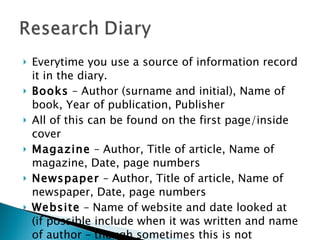
Everytime you use a source of information record it in the diary. Books  – Author (surname and initial), Name of book, Year of publication, Publisher All of this can be found on the first page/inside cover Magazine  – Author, Title of article, Name of magazine, Date, page numbers Newspaper  – Author, Title of article, Name of newspaper, Date, page numbers Website  – Name of website and date looked at (if possible include when it was written and name of author – though sometimes this is not available)
Use the information in the Research Diary to write a bibliography (a list that tells the reader where you got your information from) Set it out the same way you set your Diary out.
Go through the  self assessment  sheet (called Geographical Investigation – Assessment Criteria Table) and make a comment about how well you have done each part. Use the  student speak mark scheme  to see if you can grade each element that is to be assessed. Identify the weak points in your work and improve them!
You don’t need a fancy front cover (you can if you want) All you need is the following information: Your  name The  title  of your work Your class  teachers  name The  word count  (easy if done in word, otherwise estimate it.....remember annotation and words in a table don’t count towards the word count)

Geographical investigation

  • 1.
  • 2.
    Choose the titleyou want to do Think about: Which title seems the most interesting? Will there be enough information out there? Have a look at the key questions that will need answering
  • 3.
    Look at theKey Questions and start to collect information to help you answer them. Make sure you use a variety of sources . Use books, magazines, internet, DVDs – anything that will provide you with the information you need. Make sure you identify all the different “ stakeholders ” (people who have some interest in the issue) and what their different opinions are. Keep a record of all the places you have looked for information on the Research Diary sheet
  • 4.
    Once you havegathered the information you can start to write the report Location information – where are the places you will be looking at? Annotate a map to show these areas. Say something about the area. Give some general background information about the place (100 words and an annotated map) Investigation question – What is the question asking you to do? What is the issue in the question? (about 300 words)
  • 5.
    Effects & Evaluation – What are the effects of whatever the issue is and what do different people think about it? Can you evaluate any data that is available. Is the issue involved sustainable or can it be made sustainable? (300 words) Conclusion – Sum up what you have found out and say something about the future (100 words) There are marks available for spelling and grammar , so make sure this is all correct. Use Geographical language when you can.
  • 6.
    When writing youranswer you might use a quote from someone or a piece of data. You should source this information – “ The country with the most deforestation over the past 30 years is Brazil. It has lost 8915 square miles of rainforest between 1990-2000” ( www.mapsoftheworld.com ) This website should then be referenced properly in the research diary (in this case, by saying that it was accessed 24 th May 2010)
  • 7.
    Everytime you usea source of information record it in the diary. Books – Author (surname and initial), Name of book, Year of publication, Publisher All of this can be found on the first page/inside cover Magazine – Author, Title of article, Name of magazine, Date, page numbers Newspaper – Author, Title of article, Name of newspaper, Date, page numbers Website – Name of website and date looked at (if possible include when it was written and name of author – though sometimes this is not available)
  • 8.
    Use the informationin the Research Diary to write a bibliography (a list that tells the reader where you got your information from) Set it out the same way you set your Diary out.
  • 9.
    Go through the self assessment sheet (called Geographical Investigation – Assessment Criteria Table) and make a comment about how well you have done each part. Use the student speak mark scheme to see if you can grade each element that is to be assessed. Identify the weak points in your work and improve them!
  • 10.
    You don’t needa fancy front cover (you can if you want) All you need is the following information: Your name The title of your work Your class teachers name The word count (easy if done in word, otherwise estimate it.....remember annotation and words in a table don’t count towards the word count)