Drainage Basin Geomorphology
Fundamentals & Basin Morphometry
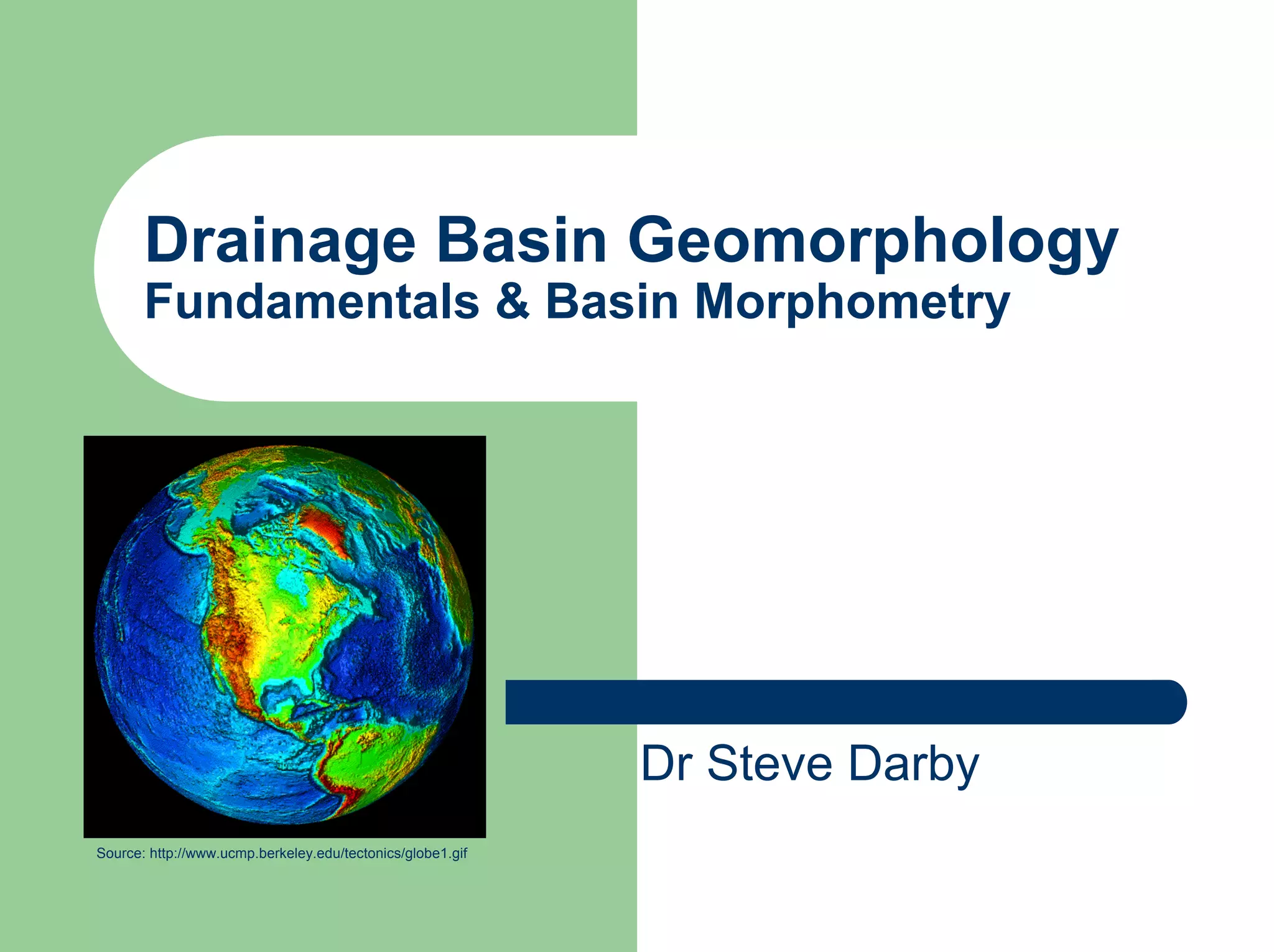
Source: http://www.ucmp.berkeley.edu/tectonics/globe1.gif
Dr Steve Darby
The Fluvial System: Components
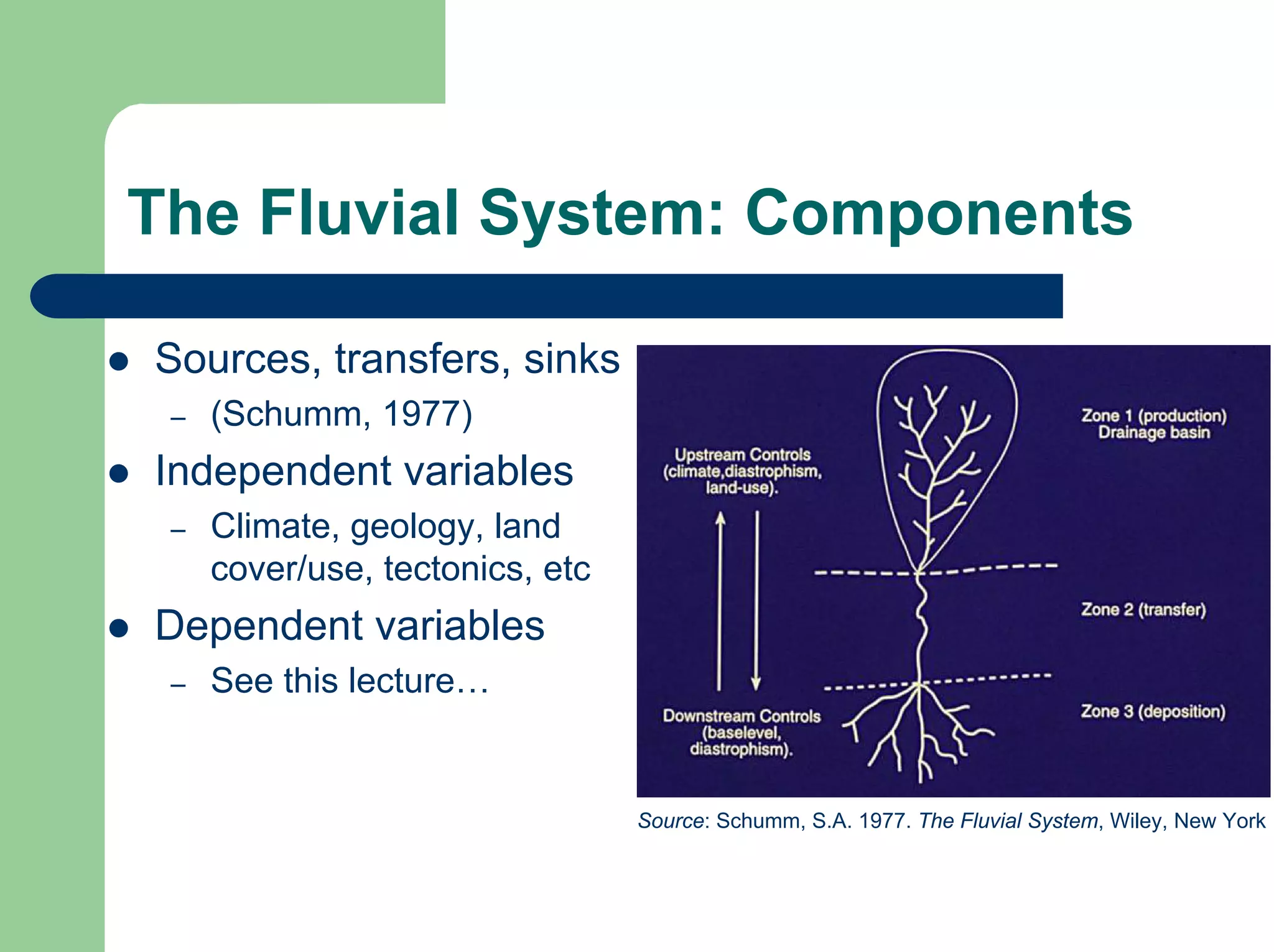
z Sources, transfers, sinks
– (Schumm, 1977)
z Independent variables
– Climate, geology, land
cover/use, tectonics, etc
z Dependent variables
– See this lecture…
Source: Schumm, S.A. 1977. The Fluvial System, Wiley, New York
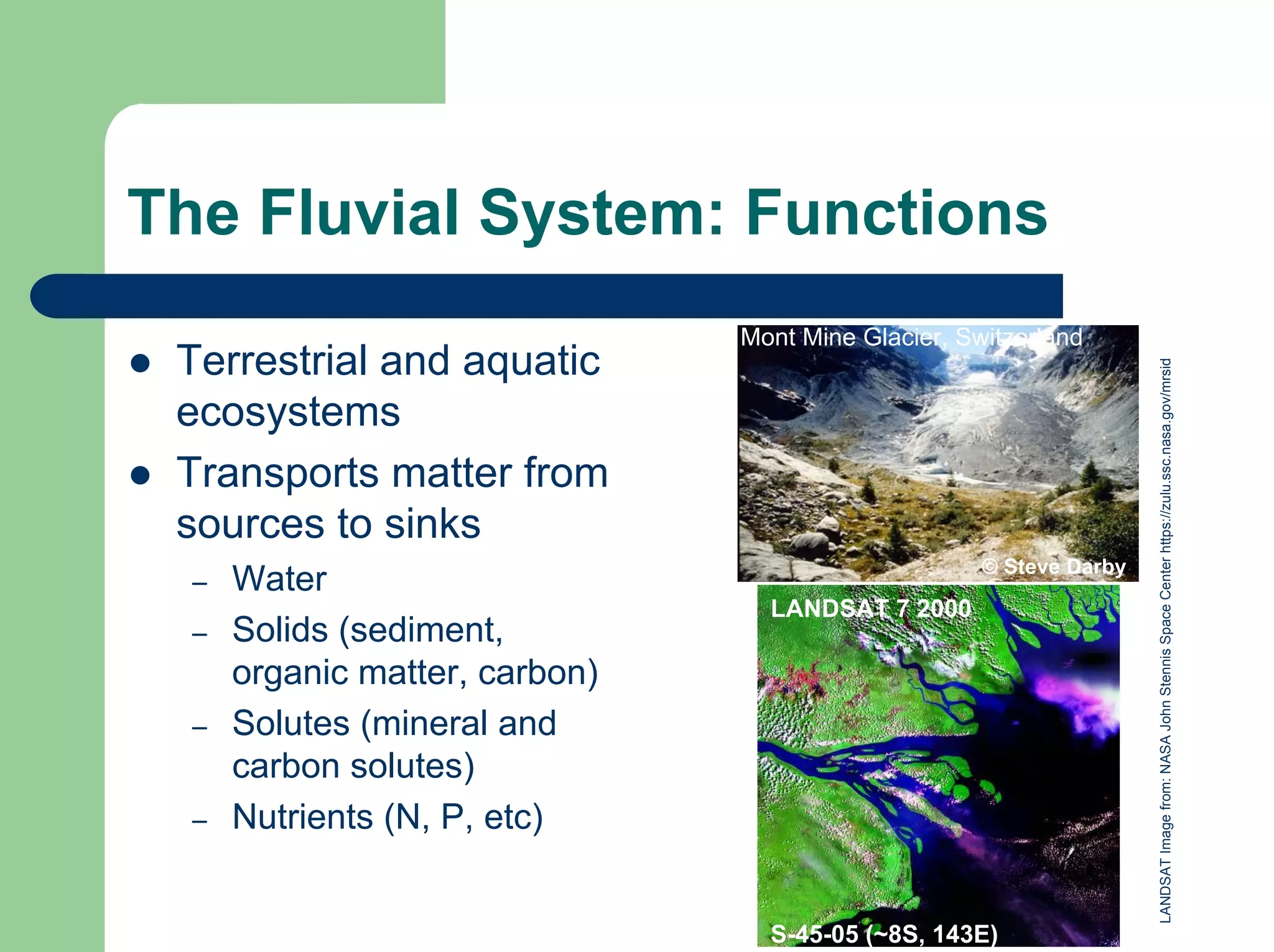
The Fluvial System: Functions
© Steve Darby
Mont Mine Glacier, Switzerland
z Terrestrial and aquatic
ecosystems
z Transports matter from
sources to sinks
– Water
– Solids (sediment,
organic matter, carbon)
– Solutes (mineral and
carbon solutes)
– Nutrients (N, P, etc)
LANDSAT
Image
from:
NASA
John
Stennis
Space
Center
https://zulu.ssc.nasa.gov/mrsid
S-45-05 (~8S, 143E)
LANDSAT 7 2000
Global Sediment Yield
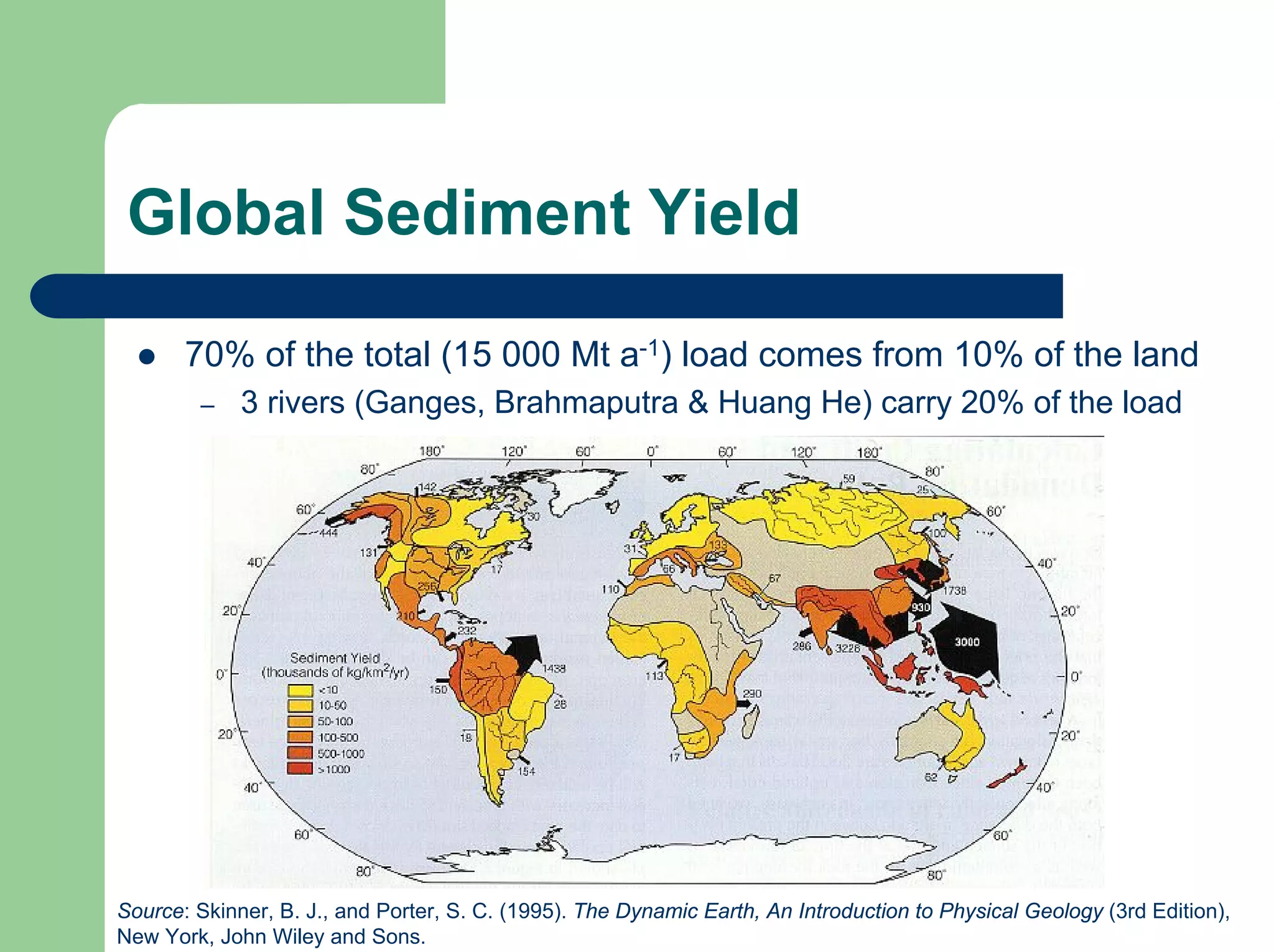
z 70% of the total (15 000 Mt a-1) load comes from 10% of the land
– 3 rivers (Ganges, Brahmaputra & Huang He) carry 20% of the load
Source: Skinner, B. J., and Porter, S. C. (1995). The Dynamic Earth, An Introduction to Physical Geology (3rd Edition),
New York, John Wiley and Sons.
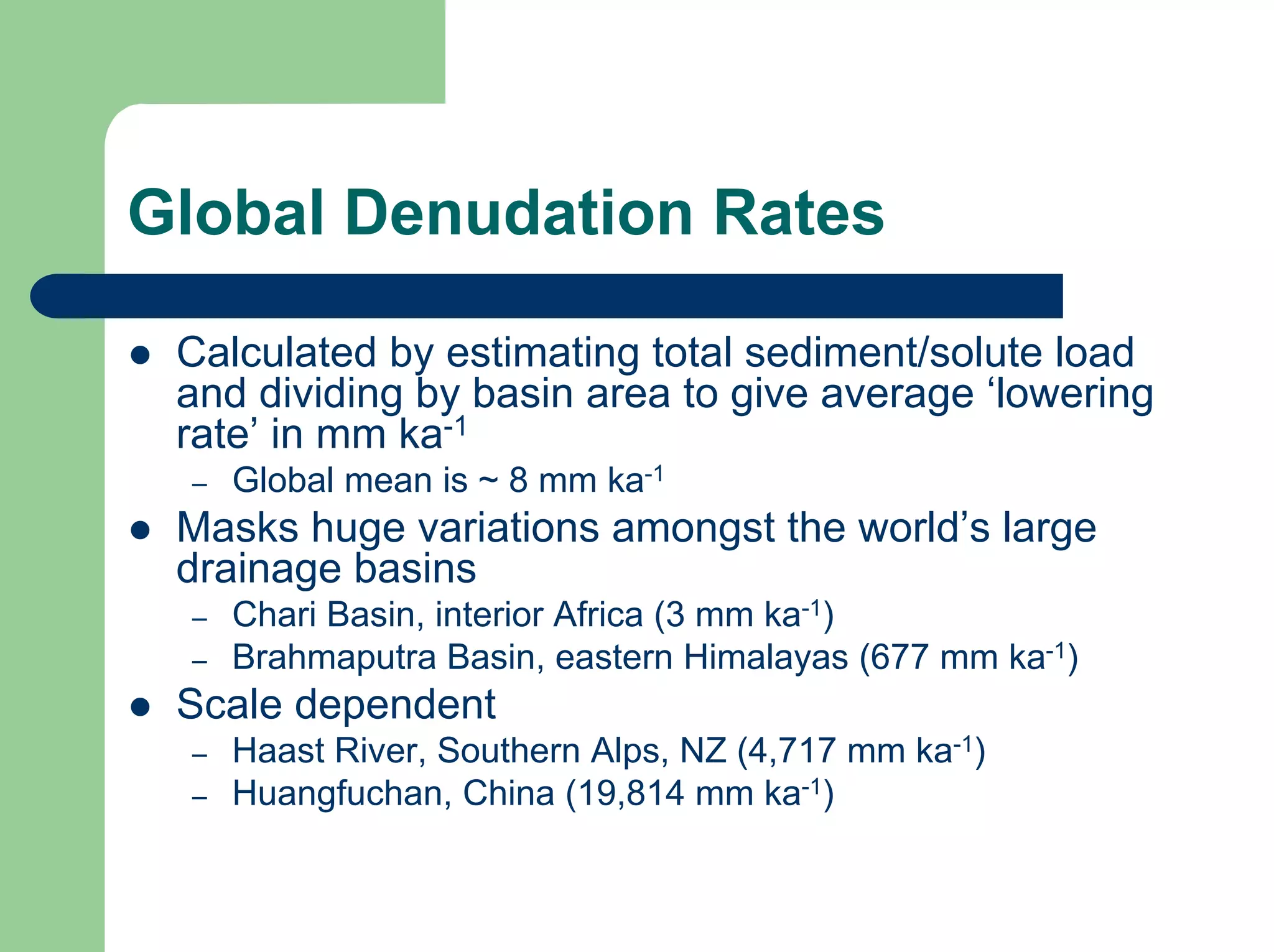
Global Denudation Rates
z Calculated by estimating total sediment/solute load
and dividing by basin area to give average ‘lowering
rate’ in mm ka-1
– Global mean is ~ 8 mm ka-1
z Masks huge variations amongst the world’s large
drainage basins
– Chari Basin, interior Africa (3 mm ka-1)
– Brahmaputra Basin, eastern Himalayas (677 mm ka-1)
z Scale dependent
– Haast River, Southern Alps, NZ (4,717 mm ka-1)
– Huangfuchan, China (19,814 mm ka-1)
The Scientific Method
Observation
Formulate ‘Theory’
(Hypothesis/Model)
Make Prediction
Test ‘Theory’ (Hypothesis/Model)
Robust Theory/Model/Hypothesis
Observation
New Observations
INDUCE
DEDUCE
PASS
REVISE
THEORY
?
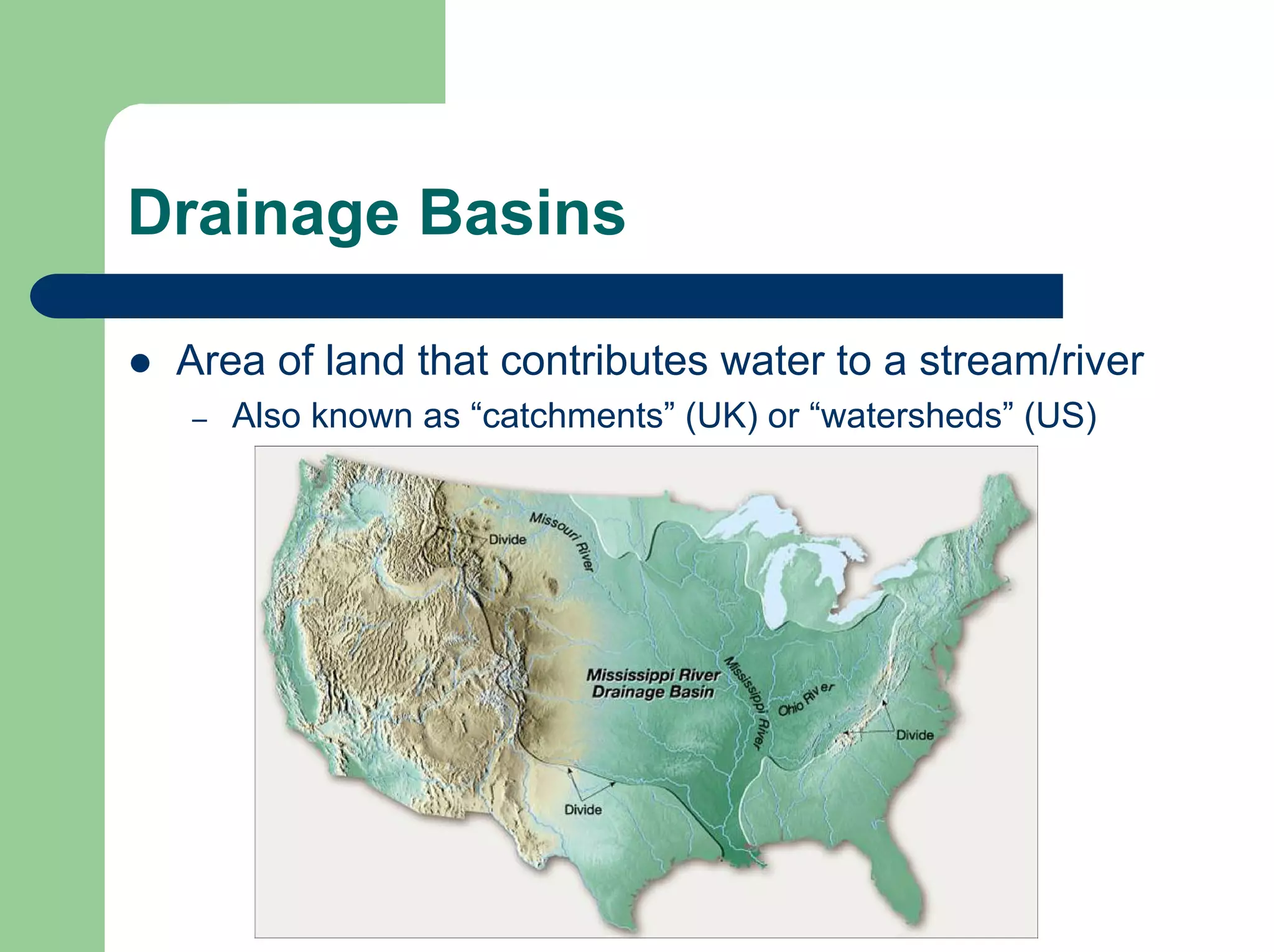
Drainage Basins
z Area of land that contributes water to a stream/river
– Also known as “catchments” (UK) or “watersheds” (US)
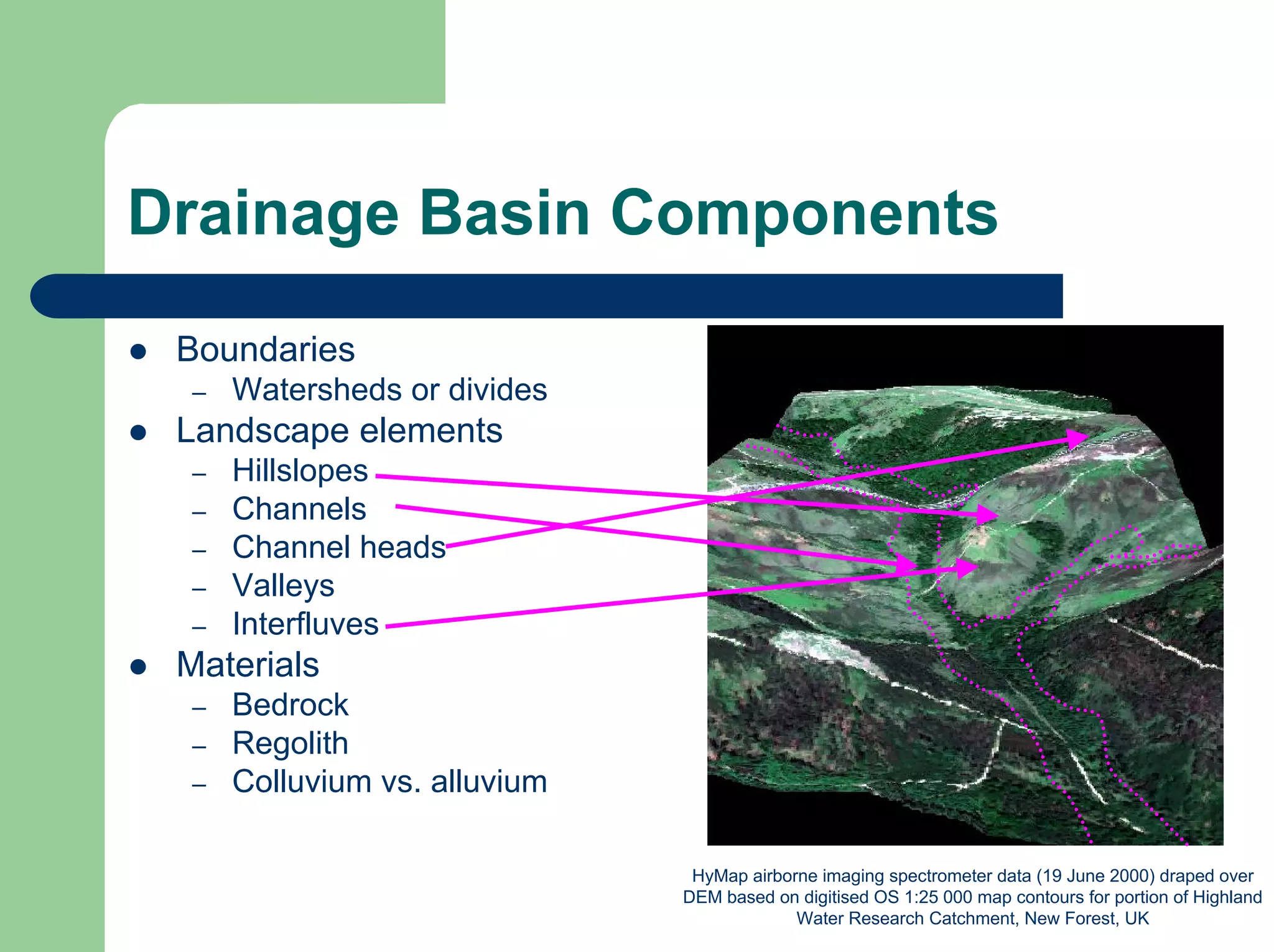
Drainage Basin Components
z Boundaries
– Watersheds or divides
z Landscape elements
– Hillslopes
– Channels
– Channel heads
– Valleys
– Interfluves
z Materials
– Bedrock
– Regolith
– Colluvium vs. alluvium
HyMap airborne imaging spectrometer data (19 June 2000) draped over
DEM based on digitised OS 1:25 000 map contours for portion of Highland
Water Research Catchment, New Forest, UK
Drainage Basin Components
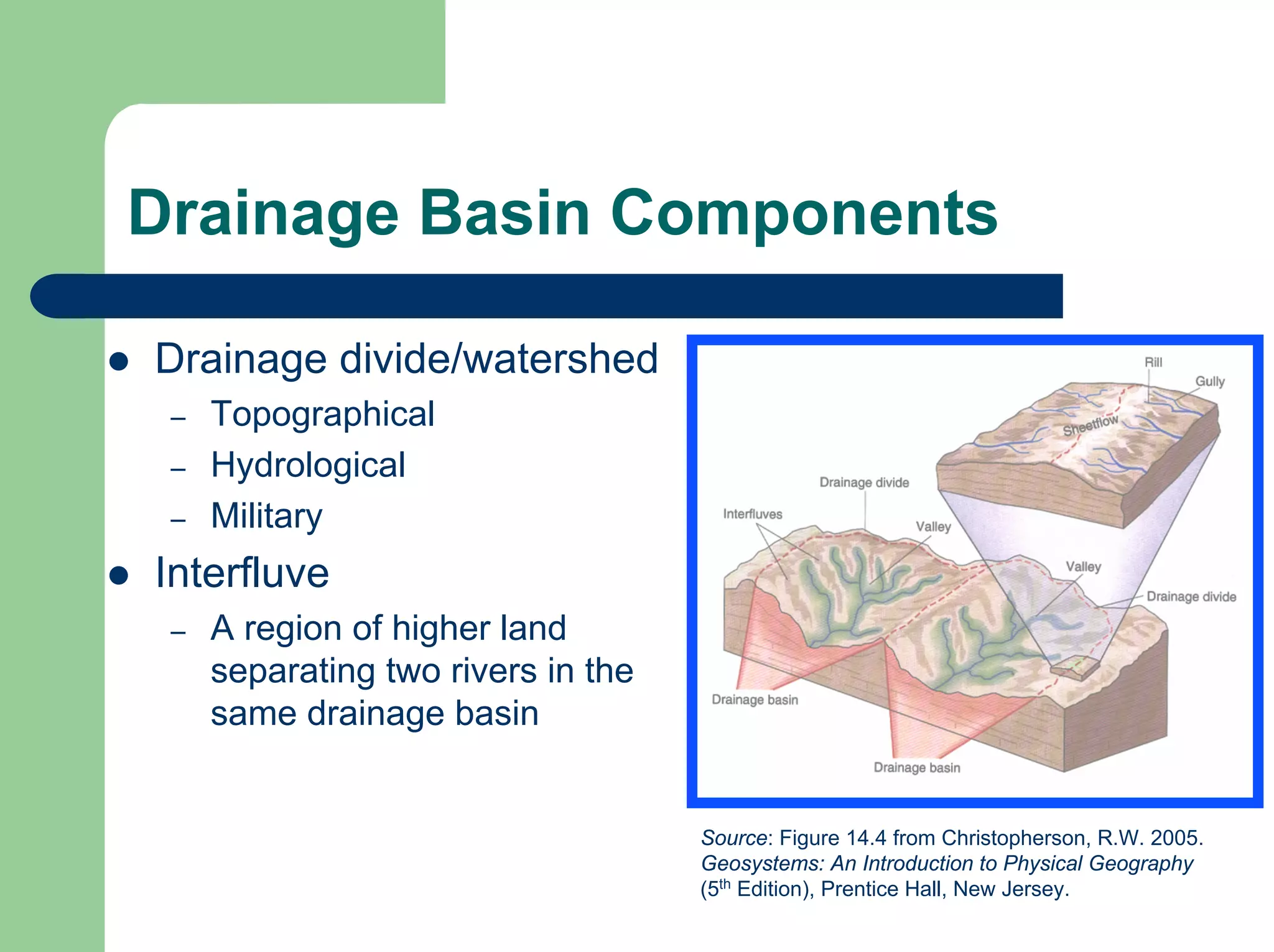
z Drainage divide/watershed
– Topographical
– Hydrological
– Military
z Interfluve
– A region of higher land
separating two rivers in the
same drainage basin
Source: Figure 14.4 from Christopherson, R.W. 2005.
Geosystems: An Introduction to Physical Geography
(5th
Edition), Prentice Hall, New Jersey.
Drainage Basin Components
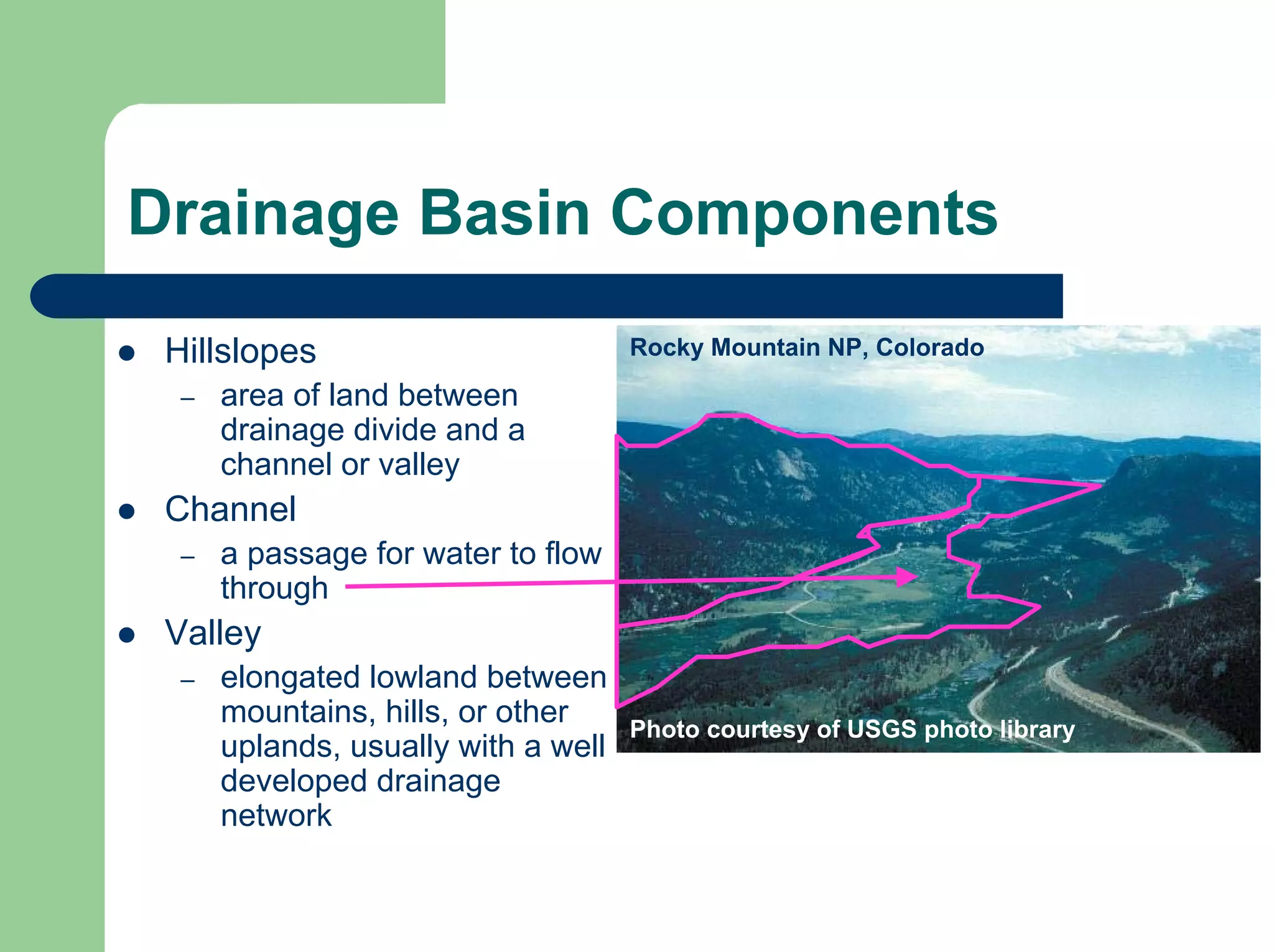
z Hillslopes
– area of land between
drainage divide and a
channel or valley
z Channel
– a passage for water to flow
through
z Valley
– elongated lowland between
mountains, hills, or other
uplands, usually with a well
developed drainage
network
Photo courtesy of USGS photo library
Rocky Mountain NP, Colorado
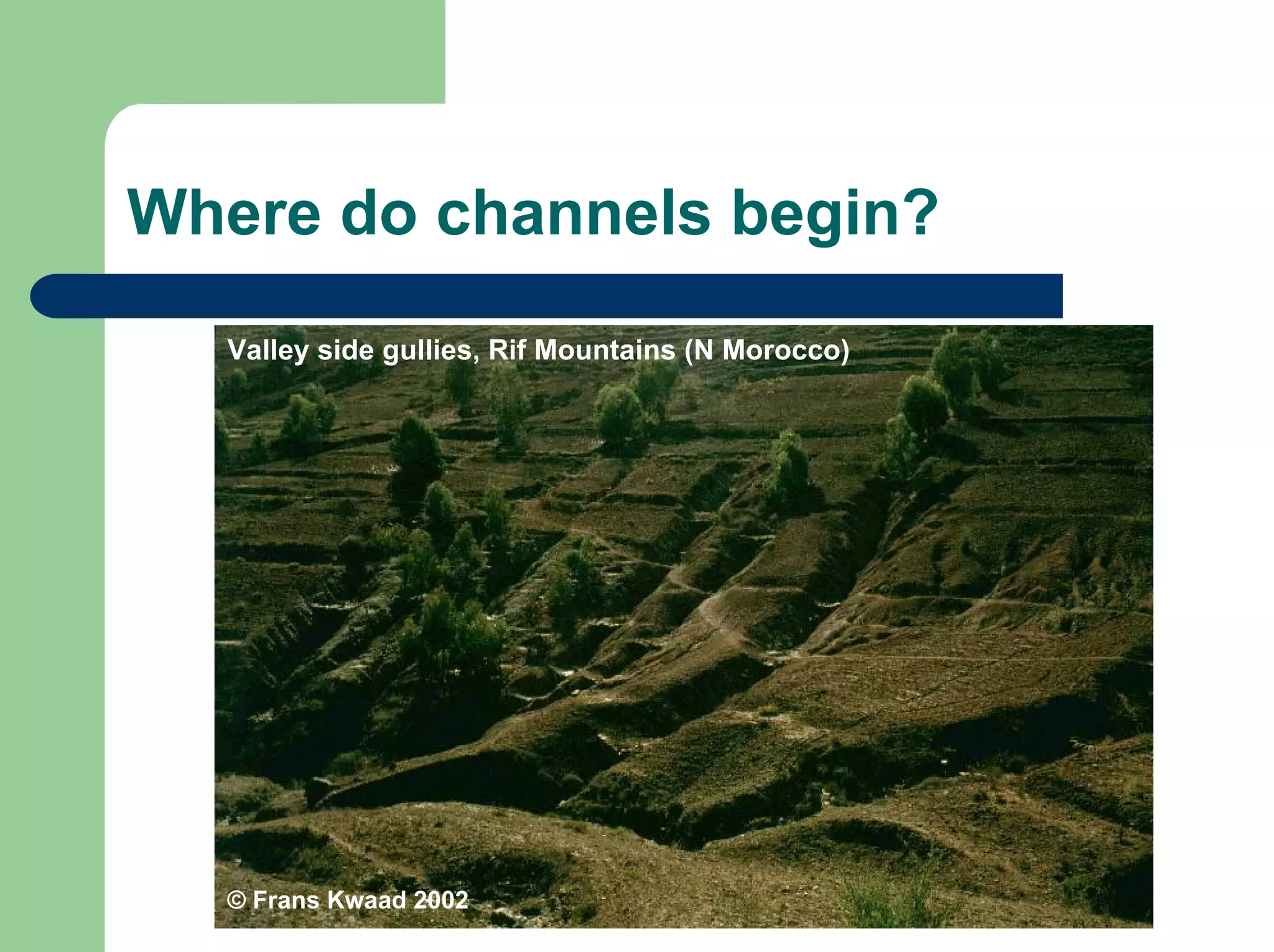
Where do channels begin?
© Frans Kwaad 2002
Valley side gullies, Rif Mountains (N Morocco)
Channel Heads
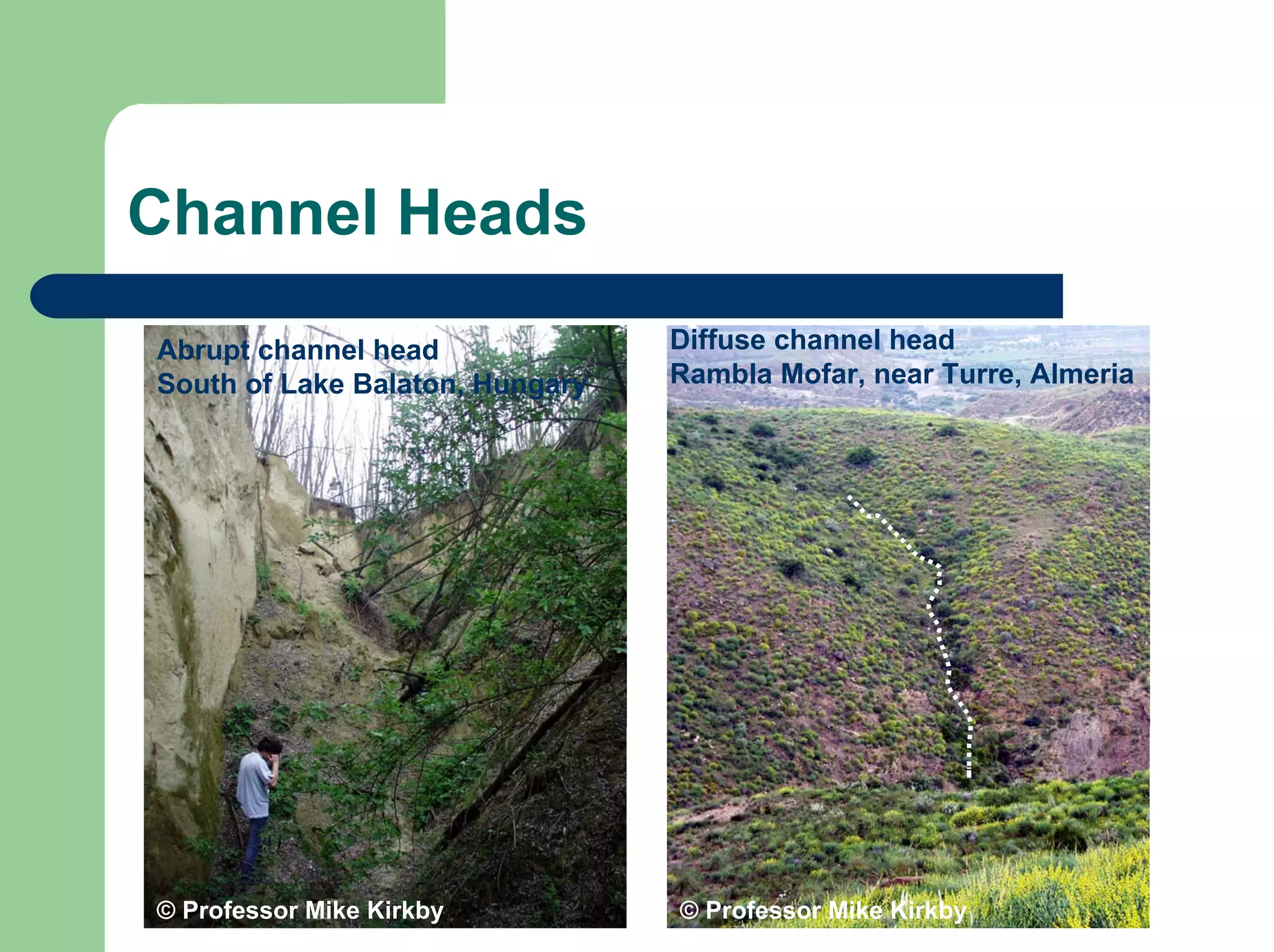
Diffuse channel head
Rambla Mofar, near Turre, Almeria
© Professor Mike Kirkby
Abrupt channel head
South of Lake Balaton, Hungary
Hillslope Morphology
z Hillslope morphology is complex and multi-dimensional, so
many parameters can be used as descriptors
– steepness, length, shape (i.e. rounded), degree of linearity,
concavity or convexity (in plan and/or in profile), etc.
z Hillslopes are usually mantled in sediment (colluvium)
– Sediment synonyms: Soil, regolith
z The significance of all these metrics is that water and gravity
mediated sediment transfer is strongly controlled by slope
– and the way in which slope varies across the landscape
Slope Profiles
Linear Hillslope Profile
0
2
4
6
8
10
12
14
16
18
20
0 20 40 60 80 100 120 140 160 180 200
Distance Across (m)
Elevation
(m)
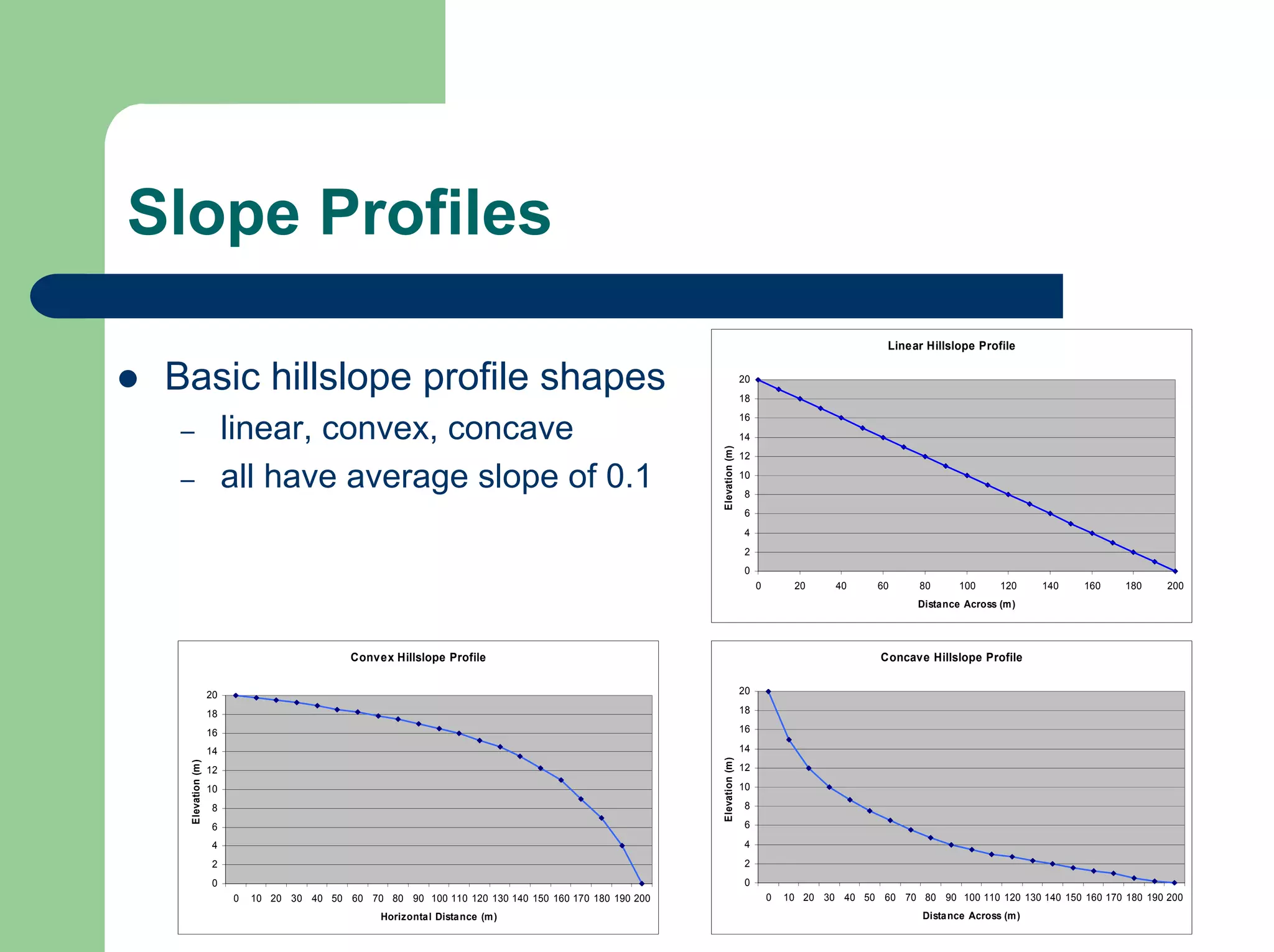
z Basic hillslope profile shapes
– linear, convex, concave
– all have average slope of 0.1
Convex Hillslope Profile
0
2
4
6
8
10
12
14
16
18
20
0 10 20 30 40 50 60 70 80 90 100 110 120 130 140 150 160 170 180 190 200
Horizontal Distance (m)
Elevation
(m)
Concave Hillslope Profile
0
2
4
6
8
10
12
14
16
18
20
0 10 20 30 40 50 60 70 80 90 100 110 120 130 140 150 160 170 180 190 200
Distance Across (m)
Elevation
(m)
3D Slope Morphology
Source:
http://www.soils.agri.umn.edu/academics/classes/soil5515/modules/topography/topography.html
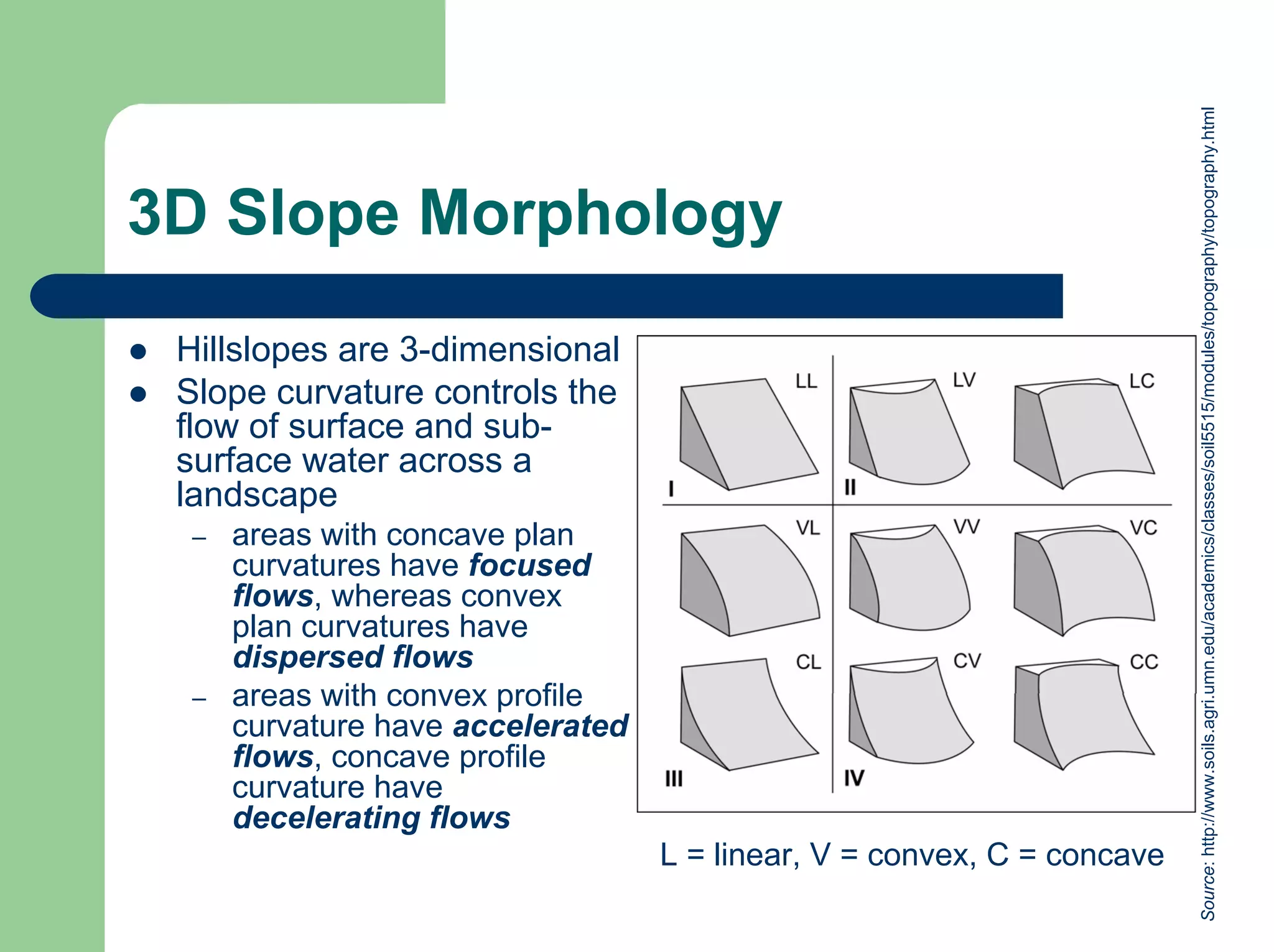
z Hillslopes are 3-dimensional
z Slope curvature controls the
flow of surface and sub-
surface water across a
landscape
– areas with concave plan
curvatures have focused
flows, whereas convex
plan curvatures have
dispersed flows
– areas with convex profile
curvature have accelerated
flows, concave profile
curvature have
decelerating flows
L = linear, V = convex, C = concave
Hillslope Morphology: Examples
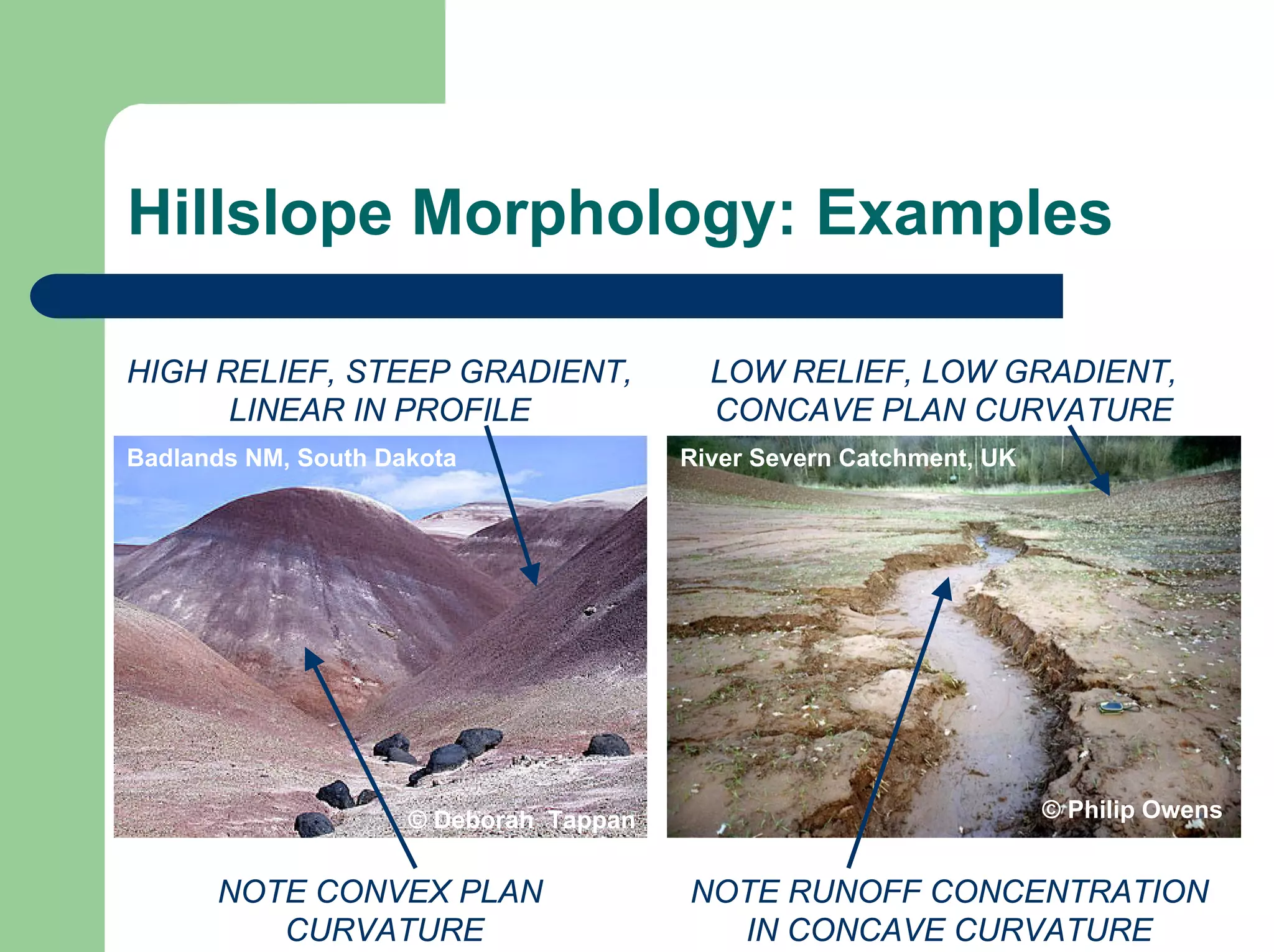
HIGH RELIEF, STEEP GRADIENT,
LINEAR IN PROFILE
NOTE CONVEX PLAN
CURVATURE
© Philip Owens
LOW RELIEF, LOW GRADIENT,
CONCAVE PLAN CURVATURE
River Severn Catchment, UK
NOTE RUNOFF CONCENTRATION
IN CONCAVE CURVATURE
© Deborah Tappan
Badlands NM, South Dakota
Drainage Basin Morphometry
z Morphometry
– The quantitative measurement of form
– Provides a systematic basis for description and comparison
(e.g. between basins, model predictions vs. observations)
z Topology versus topography
– Topological variables represent network structure
– Implies that two basins may look utterly different but be
functionally similar if their topology is similar
z Dimensional versus non-dimensional variables
– All things can be measured with 3 scales: M, L, T
– Dimensional: area (L2), velocity (L/T), density (M/L3)
– Non-dimensional: slope (L/L)
– Non-dimensional variables can be compared across basins
of different scale
Morphometric Variables
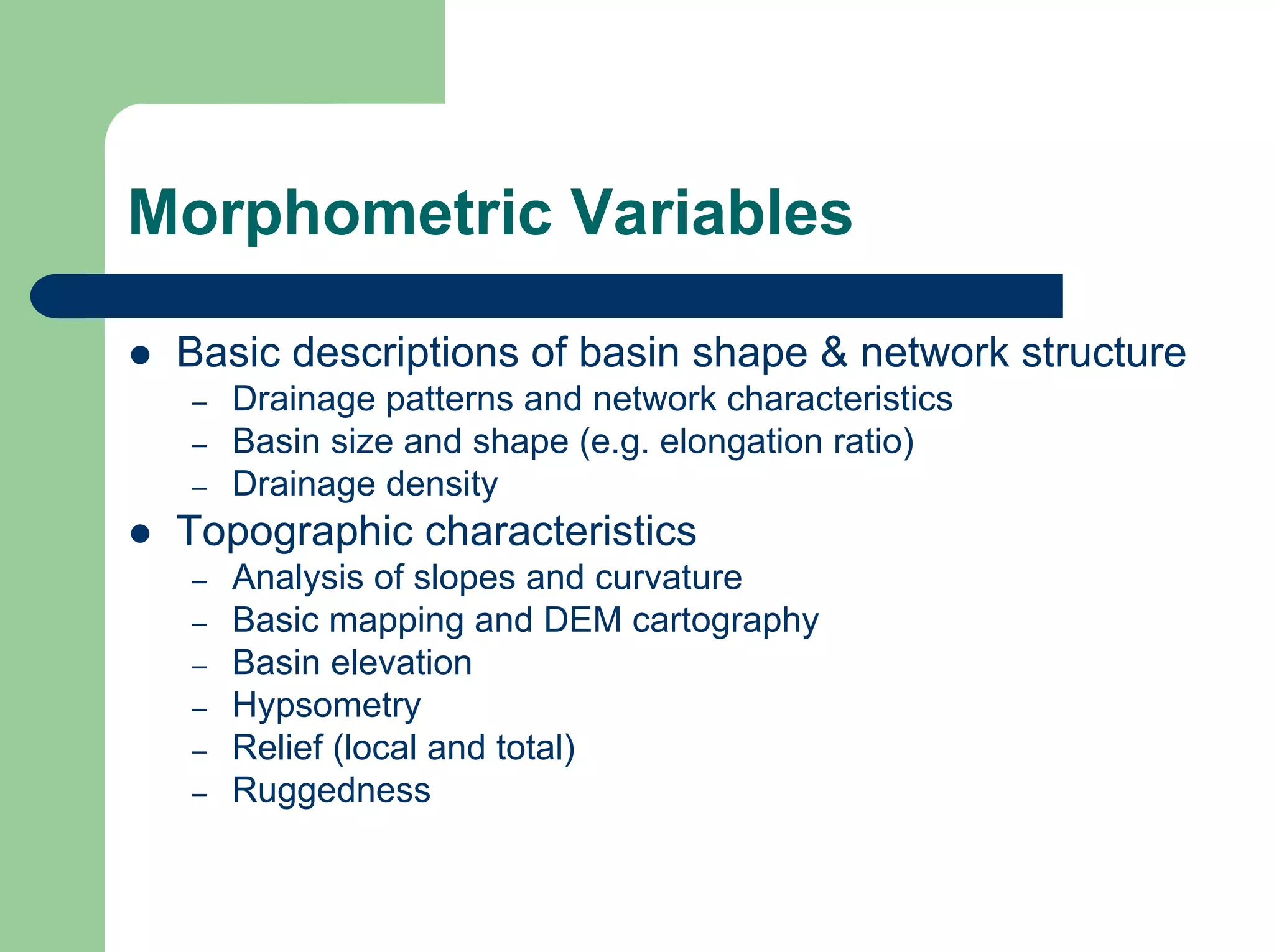
z Basic descriptions of basin shape & network structure
– Drainage patterns and network characteristics
– Basin size and shape (e.g. elongation ratio)
– Drainage density
z Topographic characteristics
– Analysis of slopes and curvature
– Basic mapping and DEM cartography
– Basin elevation
– Hypsometry
– Relief (local and total)
– Ruggedness
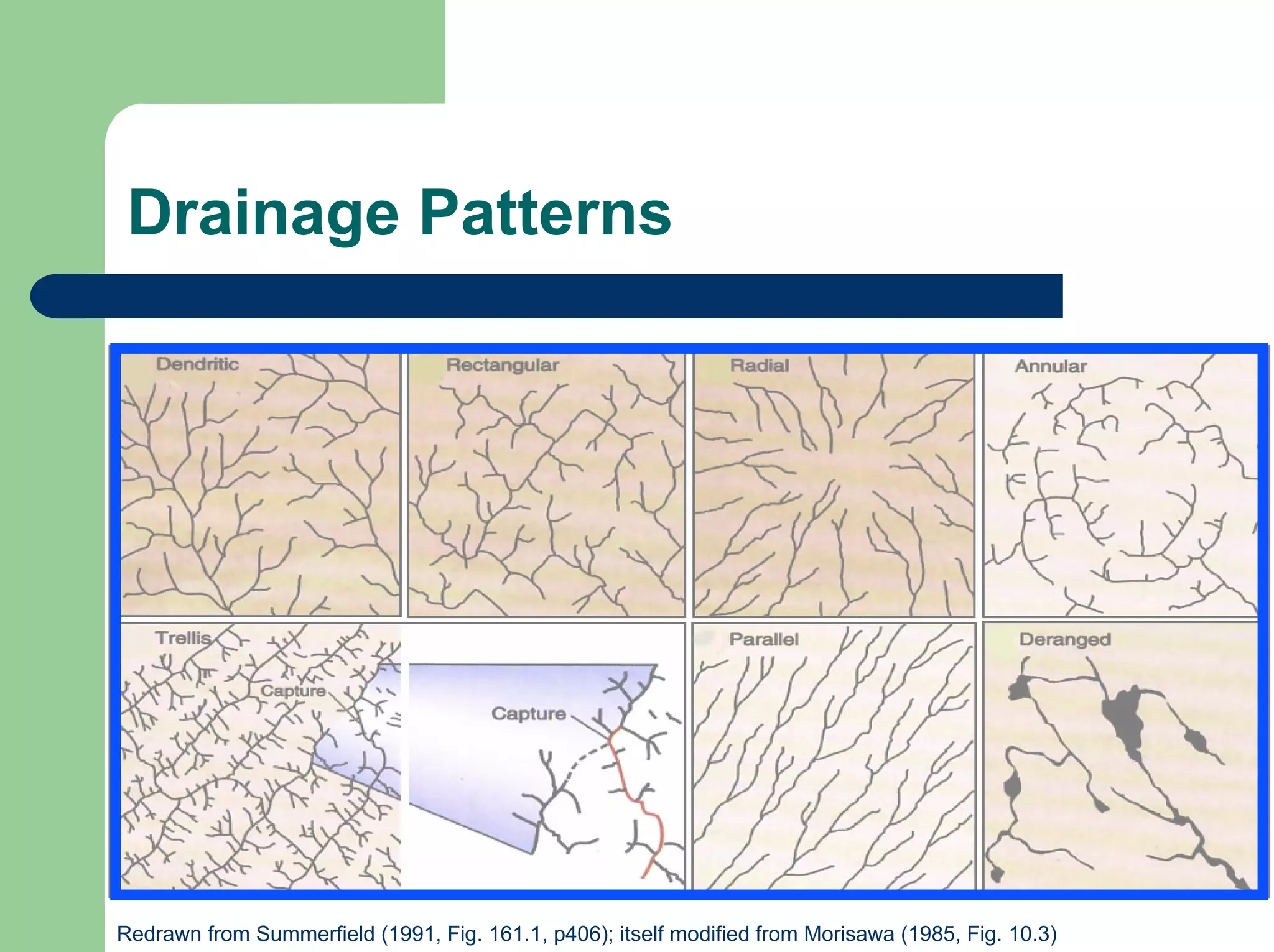
Drainage Patterns
Redrawn from Summerfield (1991, Fig. 161.1, p406); itself modified from Morisawa (1985, Fig. 10.3)
Drainage Patterns
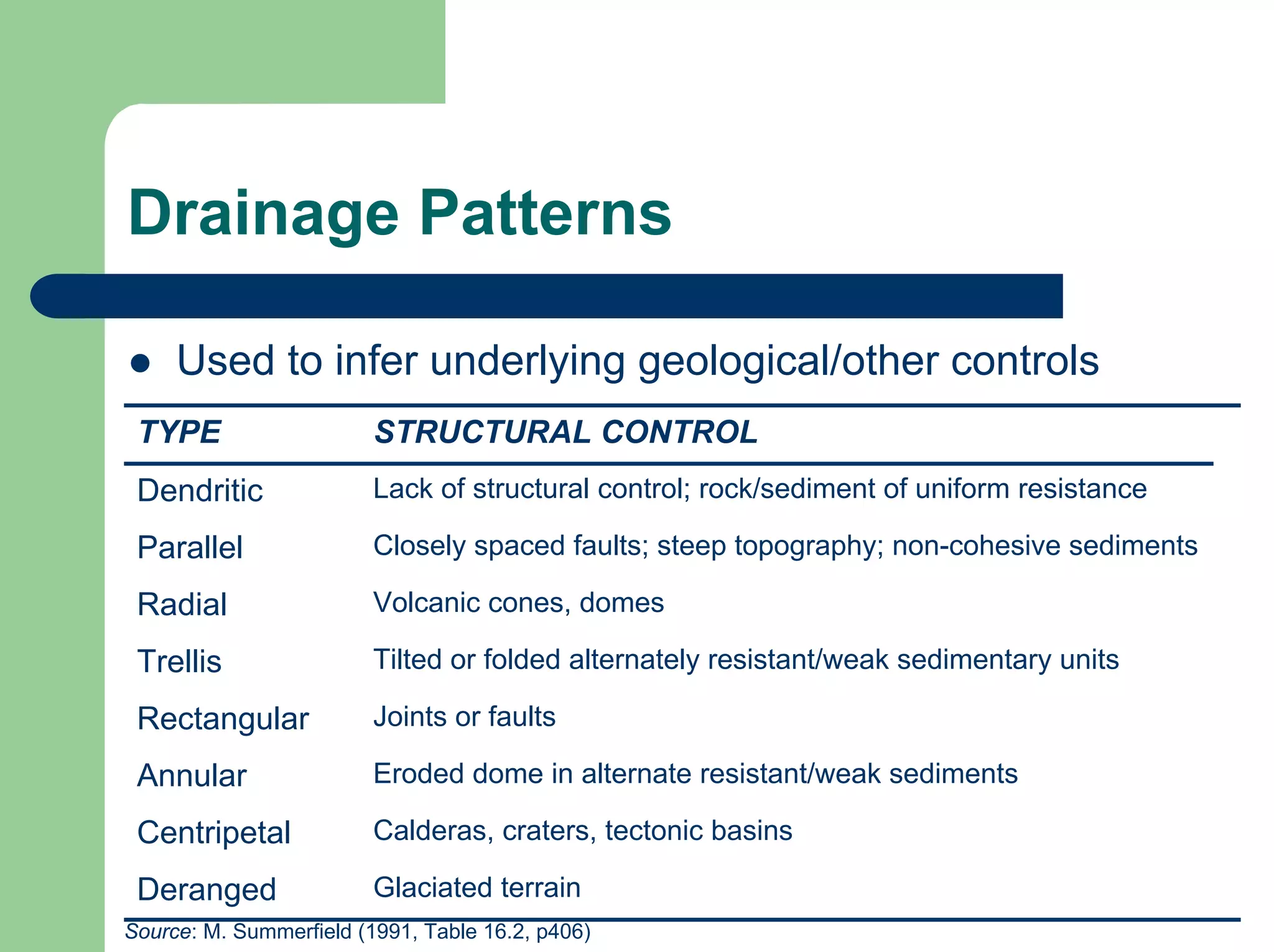
z Used to infer underlying geological/other controls
TYPE STRUCTURAL CONTROL
Dendritic Lack of structural control; rock/sediment of uniform resistance
Parallel Closely spaced faults; steep topography; non-cohesive sediments
Radial Volcanic cones, domes
Trellis Tilted or folded alternately resistant/weak sedimentary units
Rectangular Joints or faults
Annular Eroded dome in alternate resistant/weak sediments
Centripetal Calderas, craters, tectonic basins
Deranged Glaciated terrain
Source: M. Summerfield (1991, Table 16.2, p406)
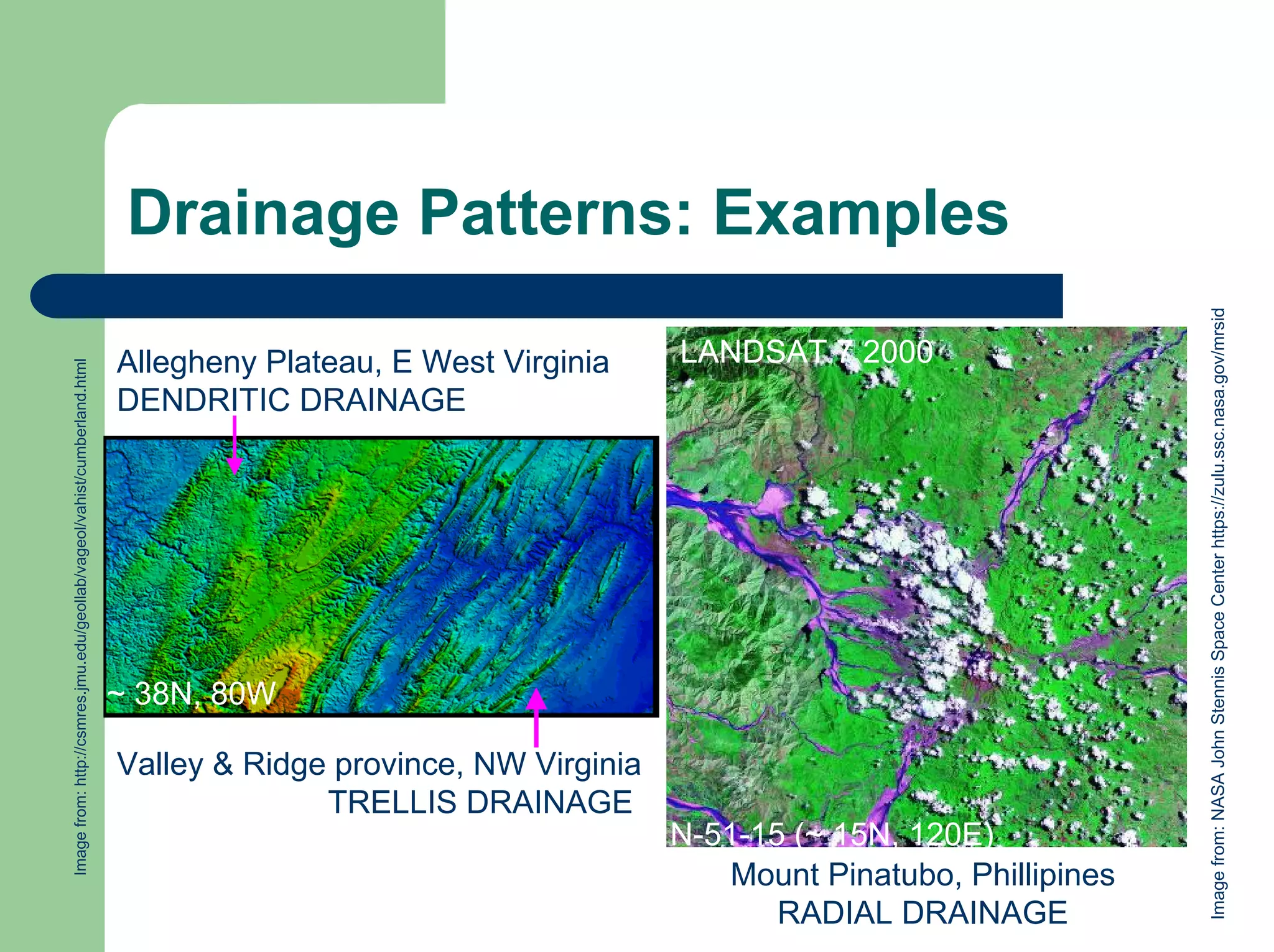
Drainage Patterns: Examples
Image
from:
NASA
John
Stennis
Space
Center
https://zulu.ssc.nasa.gov/mrsid
N-51-15 (~ 15N, 120E)
LANDSAT 7 2000
Mount Pinatubo, Phillipines
RADIAL DRAINAGE
Image
from:
http://csmres.jmu.edu/geollab/vageol/vahist/cumberland.html
Allegheny Plateau, E West Virginia
DENDRITIC DRAINAGE
Valley & Ridge province, NW Virginia
TRELLIS DRAINAGE
~ 38N, 80W
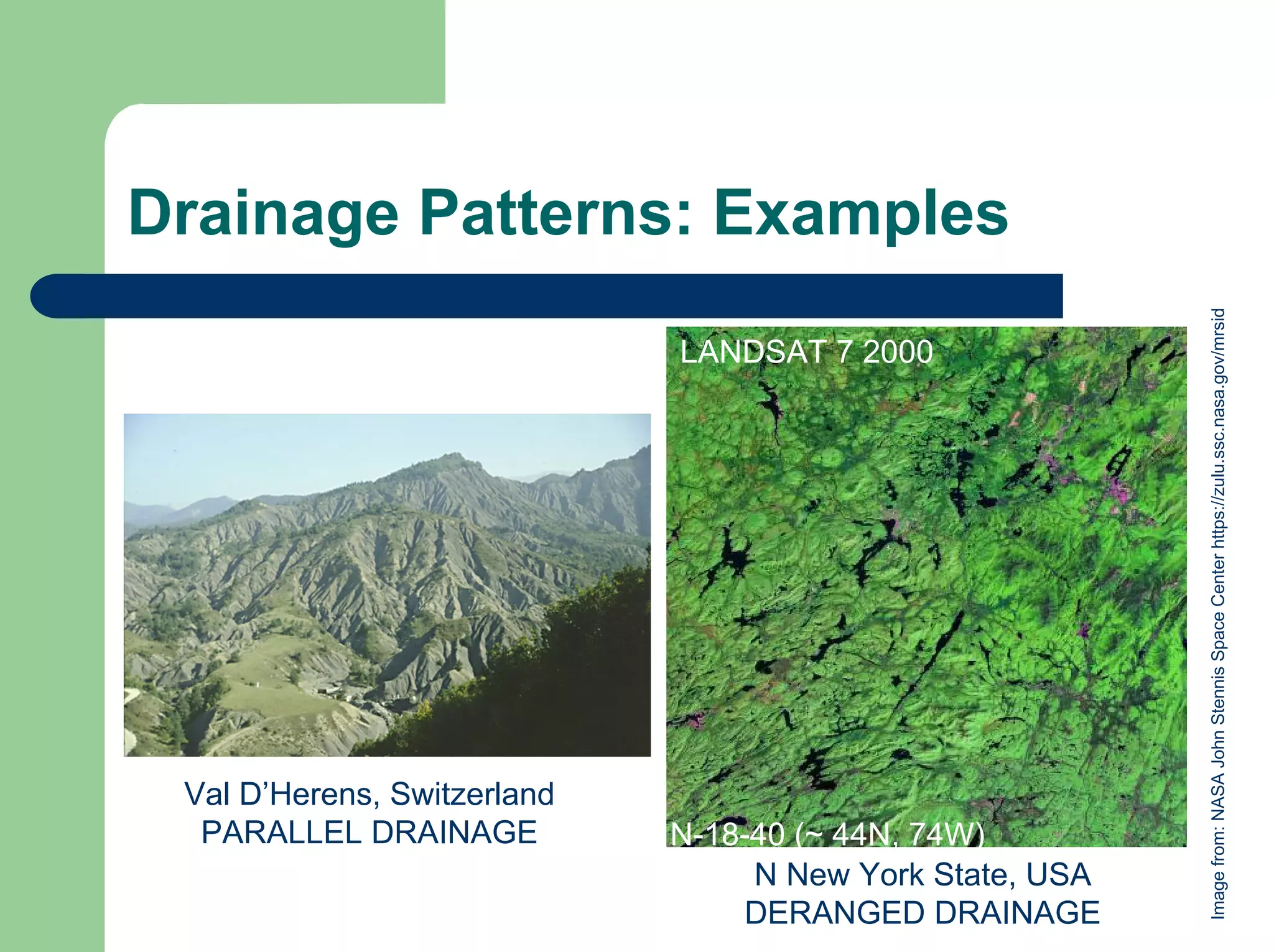
Drainage Patterns: Examples
Image
from:
NASA
John
Stennis
Space
Center
https://zulu.ssc.nasa.gov/mrsid
N-18-40 (~ 44N, 74W)
LANDSAT 7 2000
N New York State, USA
DERANGED DRAINAGE
Val D’Herens, Switzerland
PARALLEL DRAINAGE
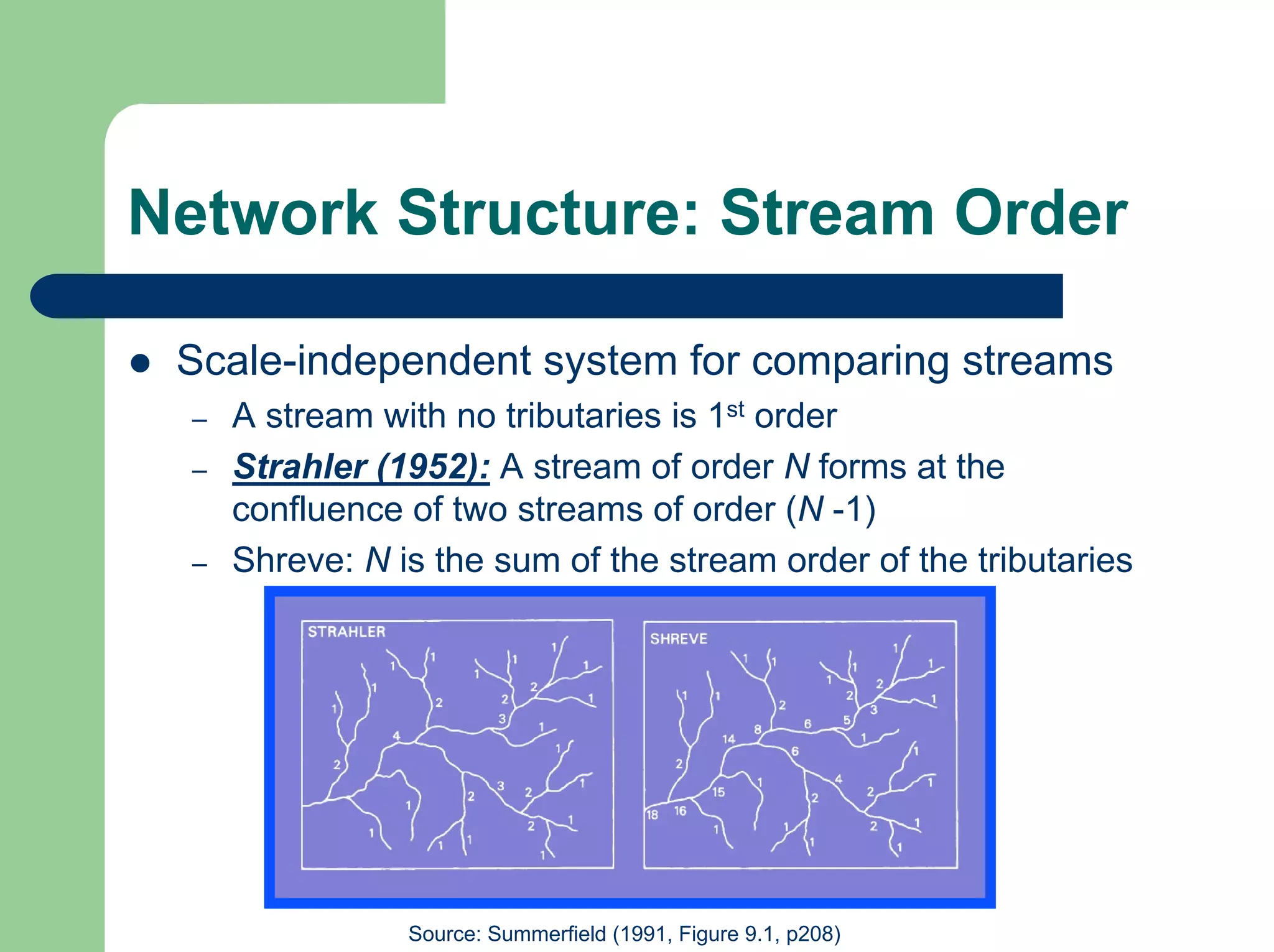
Network Structure: Stream Order
z Scale-independent system for comparing streams
– A stream with no tributaries is 1st order
– Strahler (1952): A stream of order N forms at the
confluence of two streams of order (N -1)
– Shreve: N is the sum of the stream order of the tributaries
Source: Summerfield (1991, Figure 9.1, p208)
Some Data…
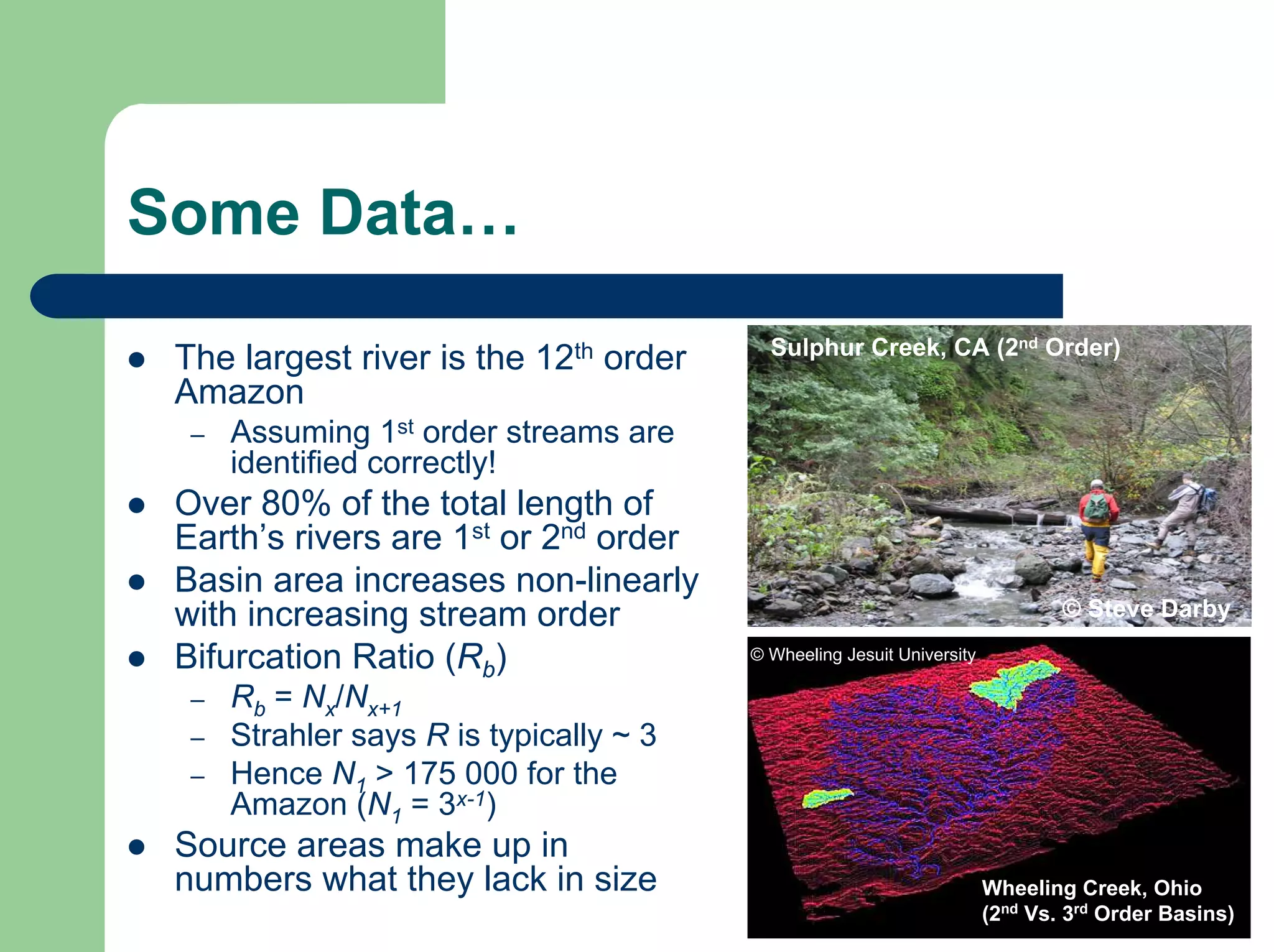
Wheeling Creek, Ohio
(2nd
Vs. 3rd
Order Basins)
Sulphur Creek, CA (2nd Order)
© Steve Darby
© Wheeling Jesuit University
z The largest river is the 12th order
Amazon
– Assuming 1st order streams are
identified correctly!
z Over 80% of the total length of
Earth’s rivers are 1st or 2nd order
z Basin area increases non-linearly
with increasing stream order
z Bifurcation Ratio (Rb)
– Rb = Nx/Nx+1
– Strahler says R is typically ~ 3
– Hence N1 > 175 000 for the
Amazon (N1 = 3x-1)
z Source areas make up in
numbers what they lack in size
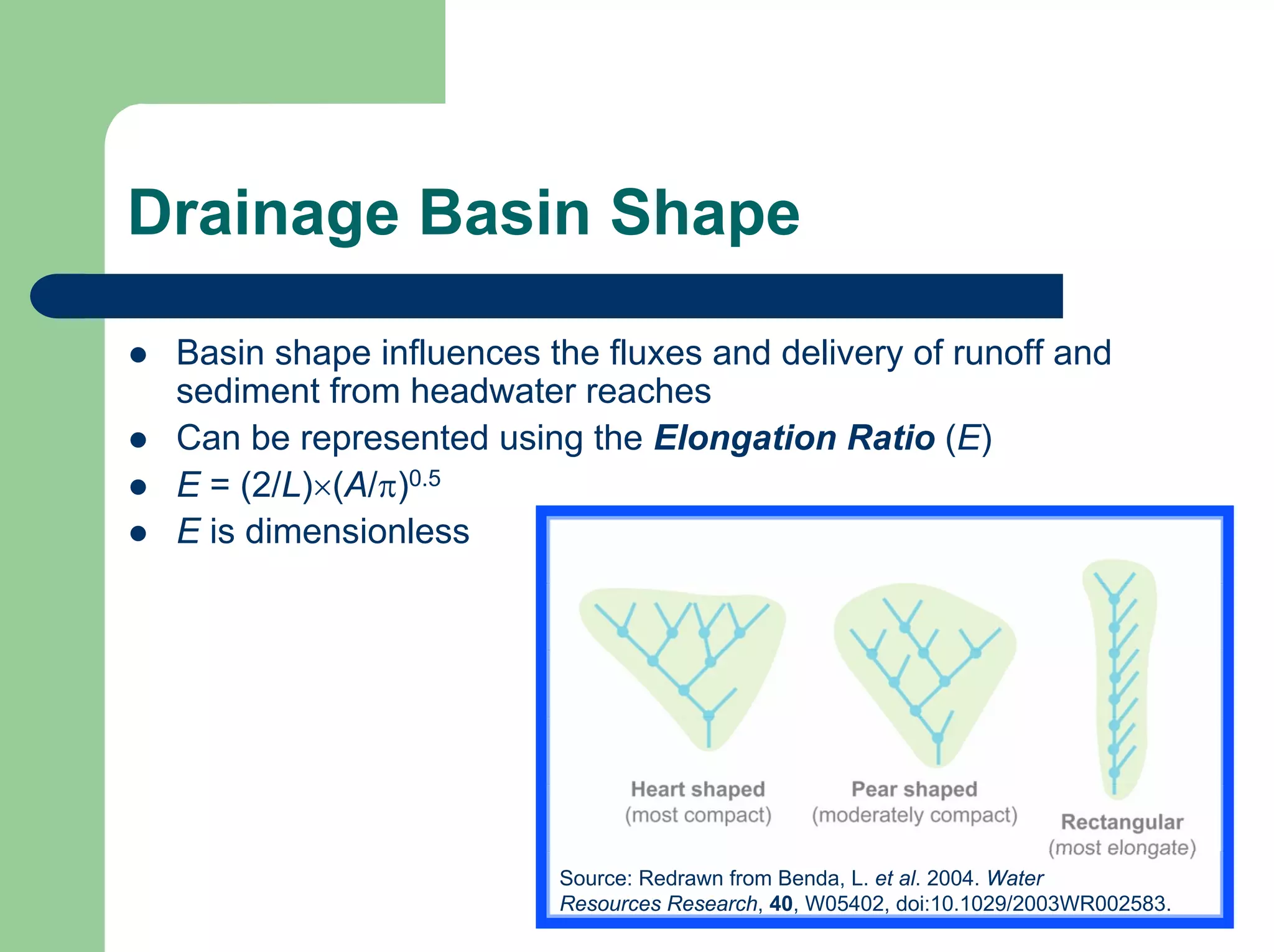
Drainage Basin Shape
z Basin shape influences the fluxes and delivery of runoff and
sediment from headwater reaches
z Can be represented using the Elongation Ratio (E)
z E = (2/L)×(A/π)0.5
z E is dimensionless
Source: Redrawn from Benda, L. et al. 2004. Water
Resources Research, 40, W05402, doi:10.1029/2003WR002583.
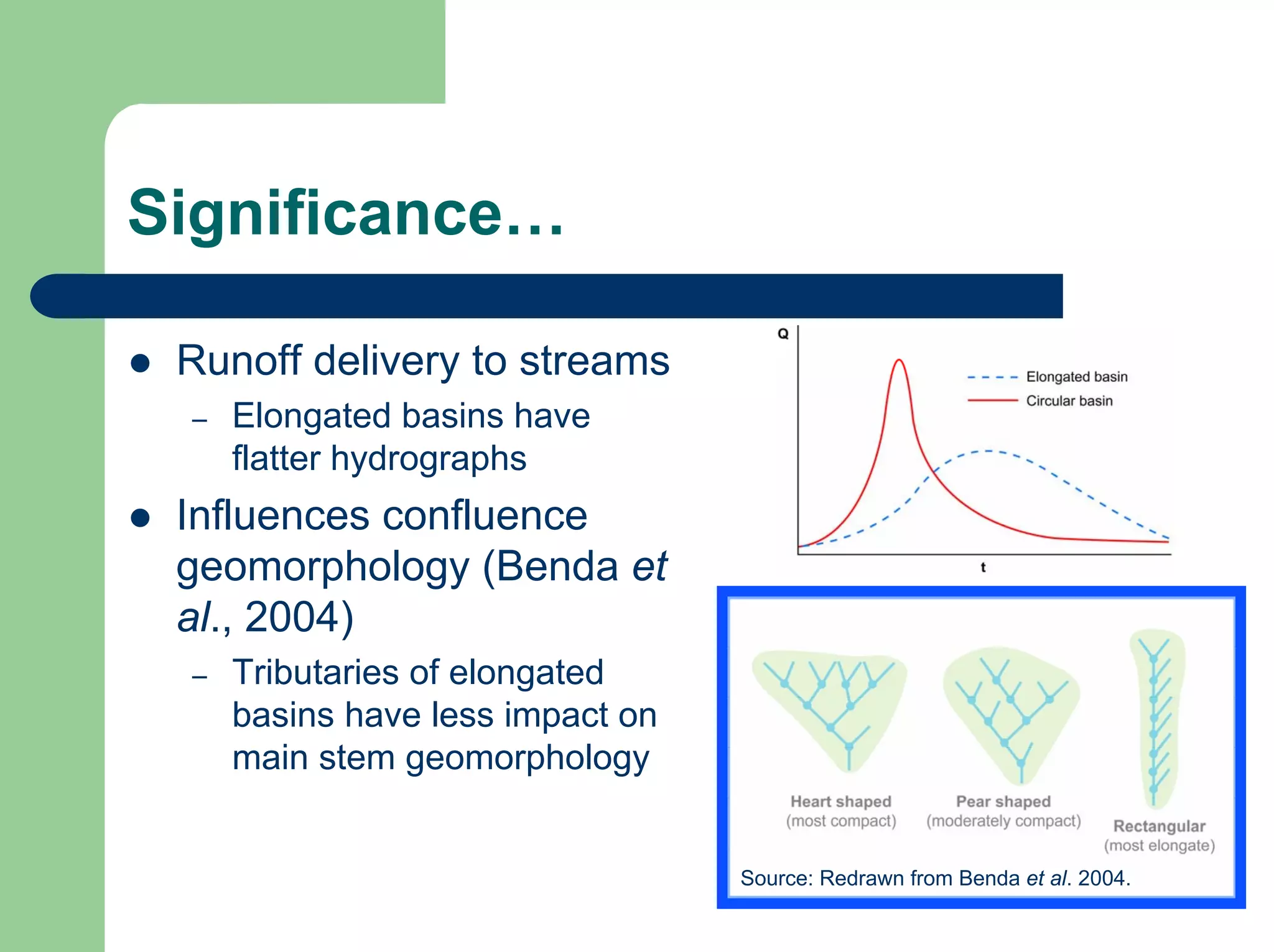
Significance…
z Runoff delivery to streams
– Elongated basins have
flatter hydrographs
z Influences confluence
geomorphology (Benda et
al., 2004)
– Tributaries of elongated
basins have less impact on
main stem geomorphology
Source: Redrawn from Benda et al. 2004.
Drainage Density
z Extent to which a landscape is channelled reflects
the balance between erosive and resisting forces
– So, likely influenced by climatic and geologic factors
z Ratio of total stream length to drainage area (ΣSL/A)
z DD (has dimensions L-1) varies across a wide range
– e.g. 5 km-1 on permeable rocks, to 500 km-1 on badlands
z Can be problematic to define where channels are
indistinct or ephemeral
– Locating channel heads is critical to accurate estimation
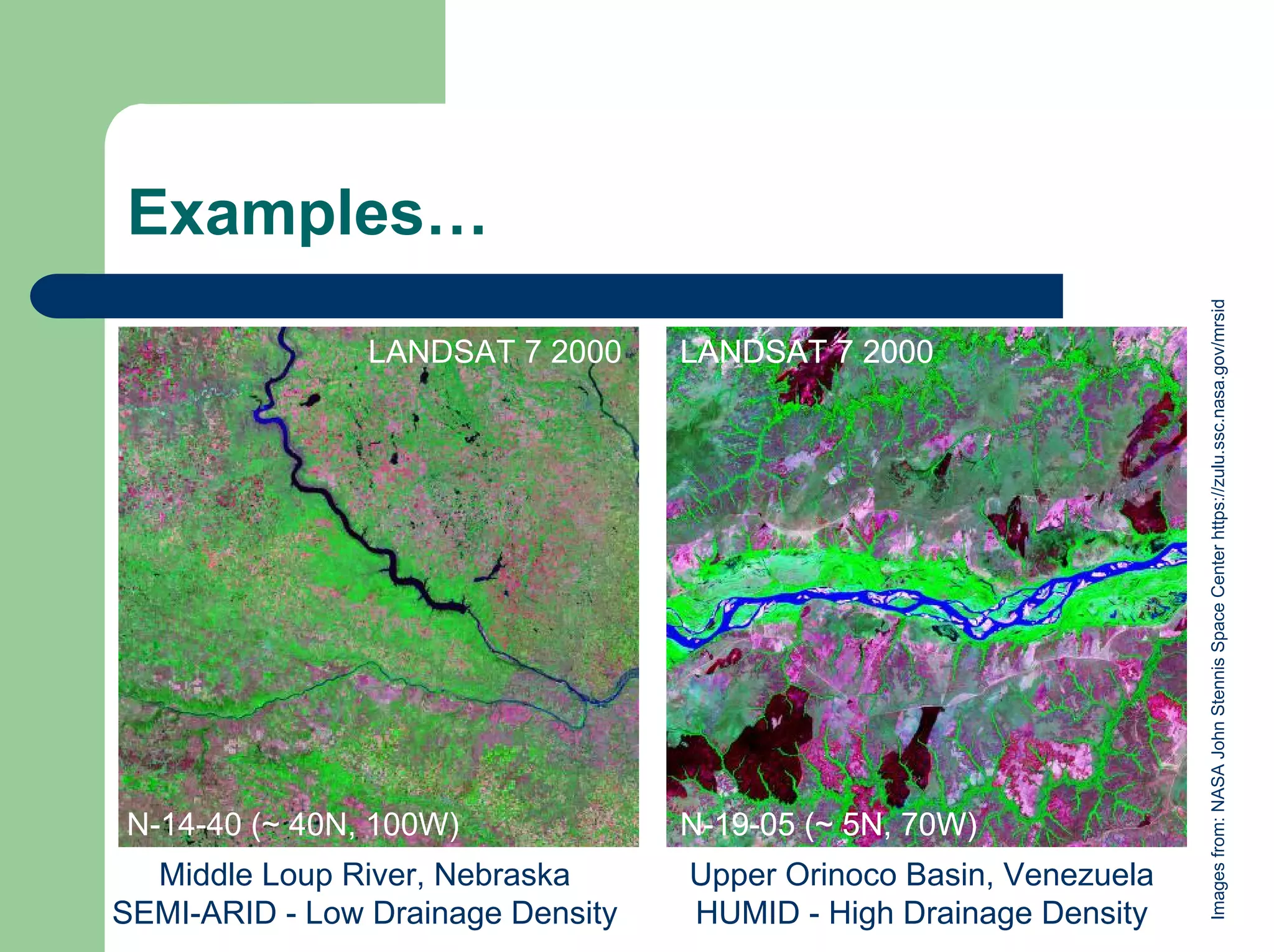
Examples…
Images
from:
NASA
John
Stennis
Space
Center
https://zulu.ssc.nasa.gov/mrsid
N-14-40 (~ 40N, 100W)
LANDSAT 7 2000
N-19-05 (~ 5N, 70W)
LANDSAT 7 2000
LANDSAT 7 2000
N-19-05 (~ 5N, 70W)
LANDSAT 7 2000
Middle Loup River, Nebraska
SEMI-ARID - Low Drainage Density
Upper Orinoco Basin, Venezuela
HUMID - High Drainage Density
Physical Significance (?)
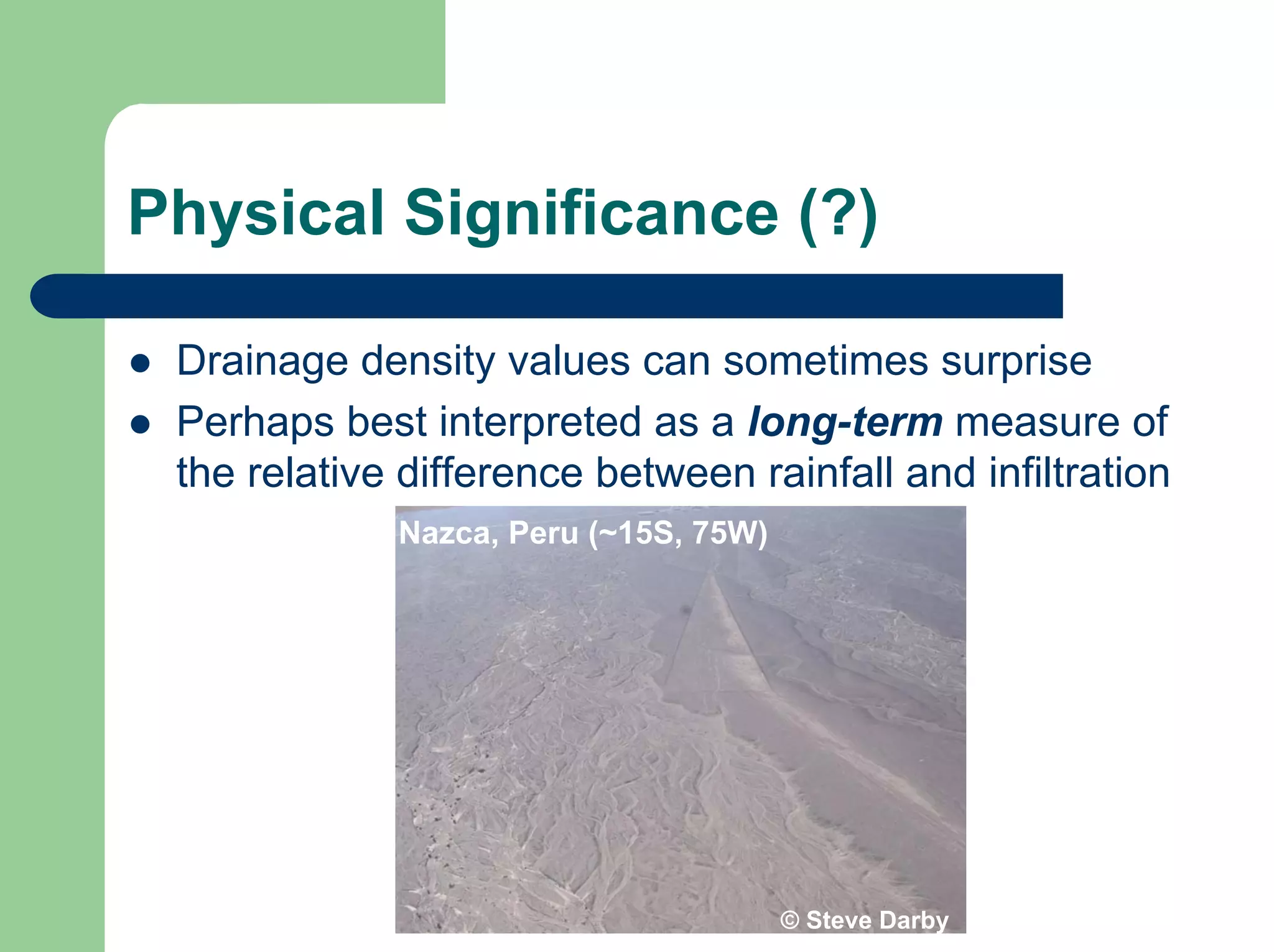
z Drainage density values can sometimes surprise
z Perhaps best interpreted as a long-term measure of
the relative difference between rainfall and infiltration
Nazca, Peru (~15S, 75W)
© Steve Darby
Drainage Basin Topography
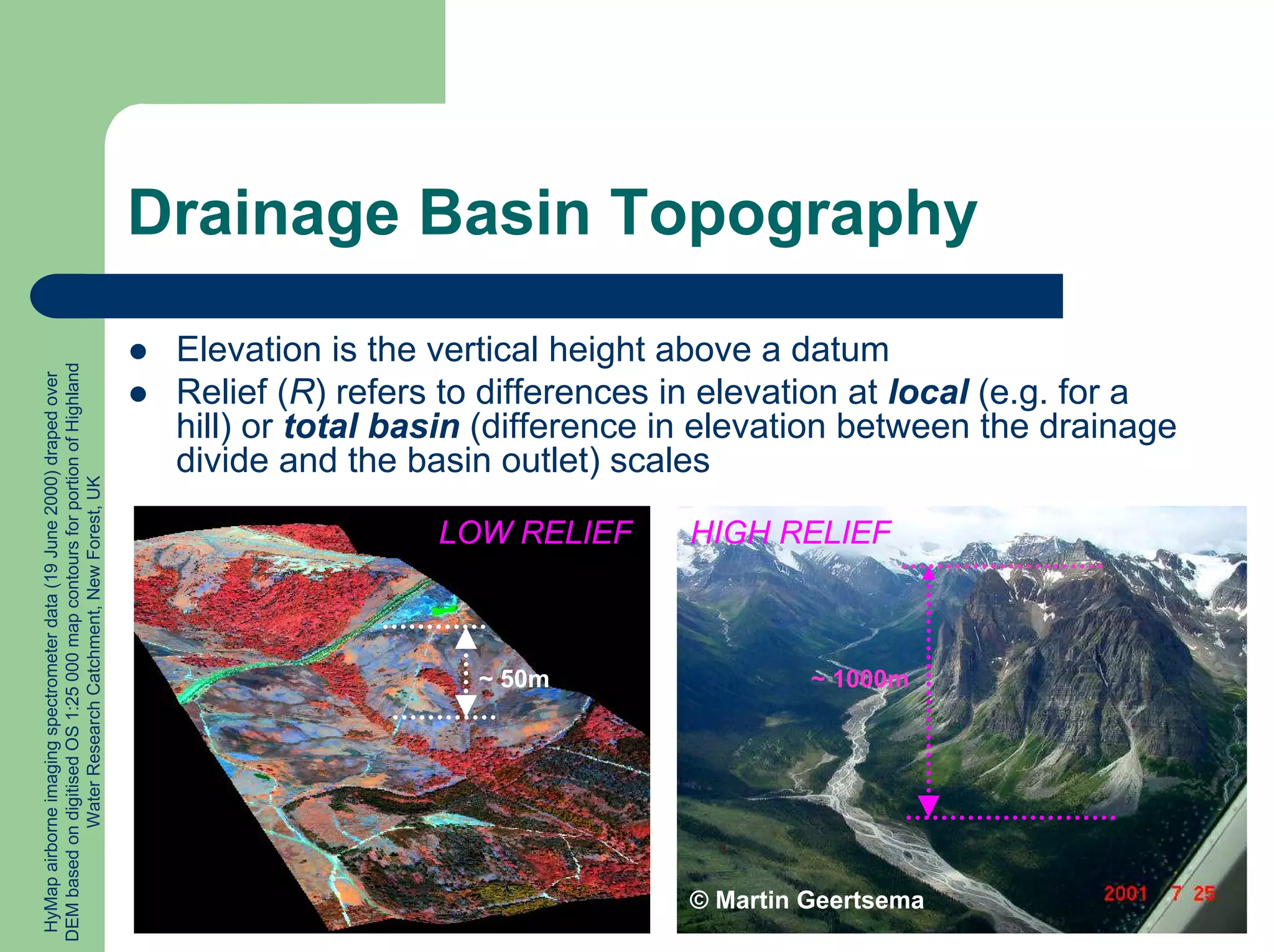
z Elevation is the vertical height above a datum
z Relief (R) refers to differences in elevation at local (e.g. for a
hill) or total basin (difference in elevation between the drainage
divide and the basin outlet) scales
© Martin Geertsema
HIGH RELIEF
LOW RELIEF
HyMap
airborne
imaging
spectrometer
data
(19
June
2000)
draped
over
DEM
based
on
digitised
OS
1:25
000
map
contours
for
portion
of
Highland
Water
Research
Catchment,
New
Forest,
UK
~ 50m ~ 1000m
Drainage Basin Ruggedness
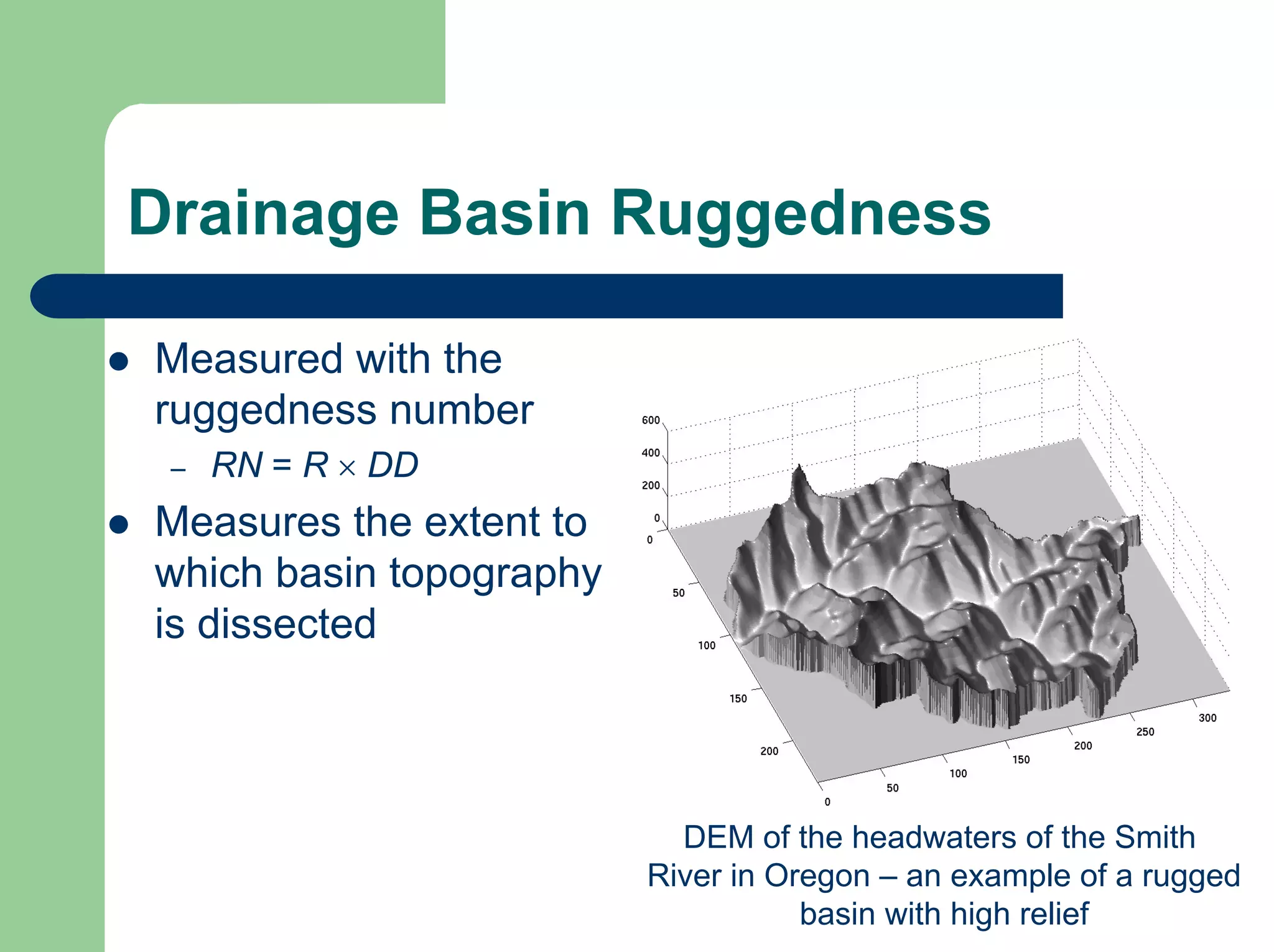
z Measured with the
ruggedness number
– RN = R × DD
z Measures the extent to
which basin topography
is dissected
DEM of the headwaters of the Smith
River in Oregon – an example of a rugged
basin with high relief
Drainage Basin Topography
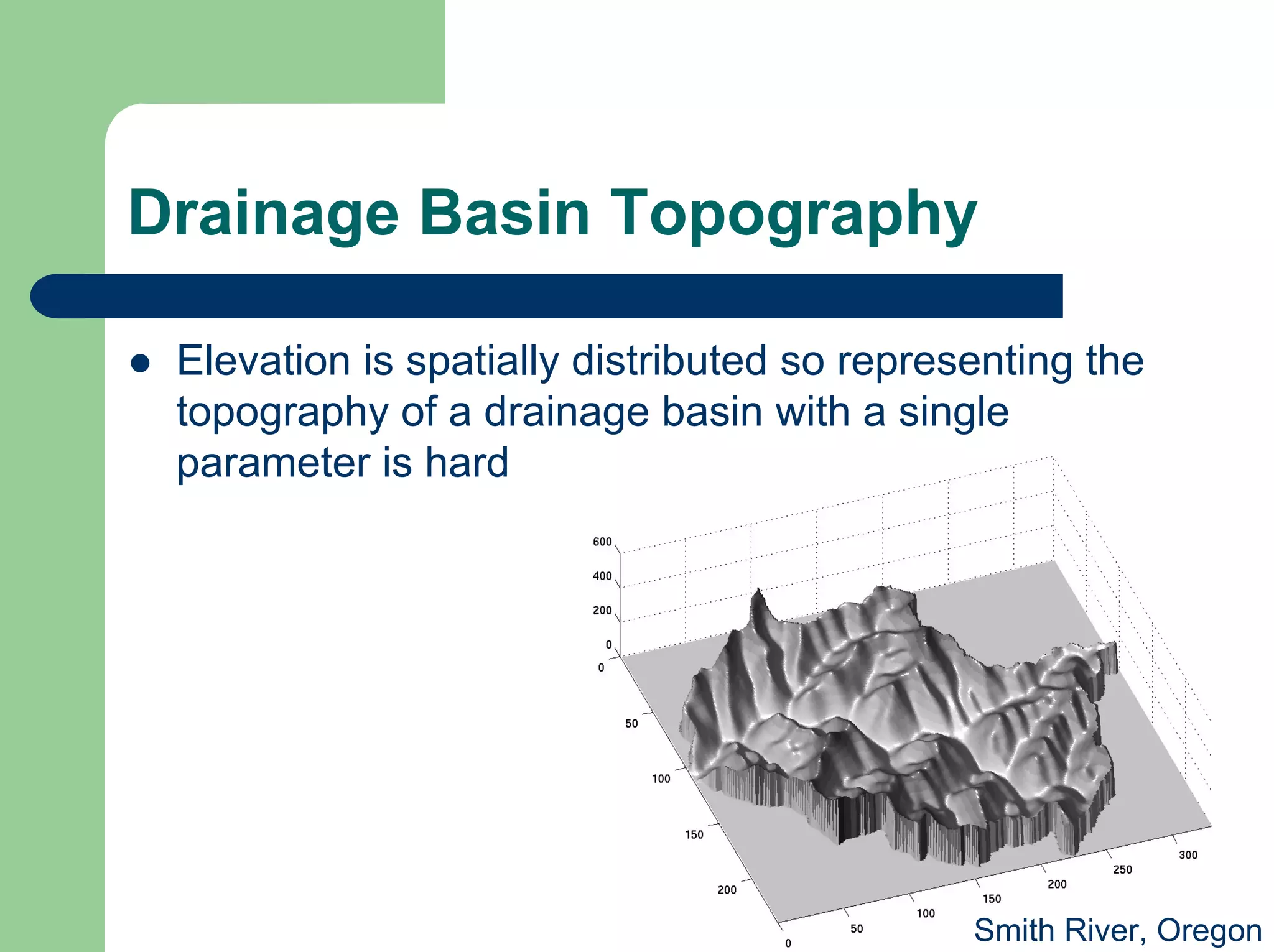
z Elevation is spatially distributed so representing the
topography of a drainage basin with a single
parameter is hard
Smith River, Oregon
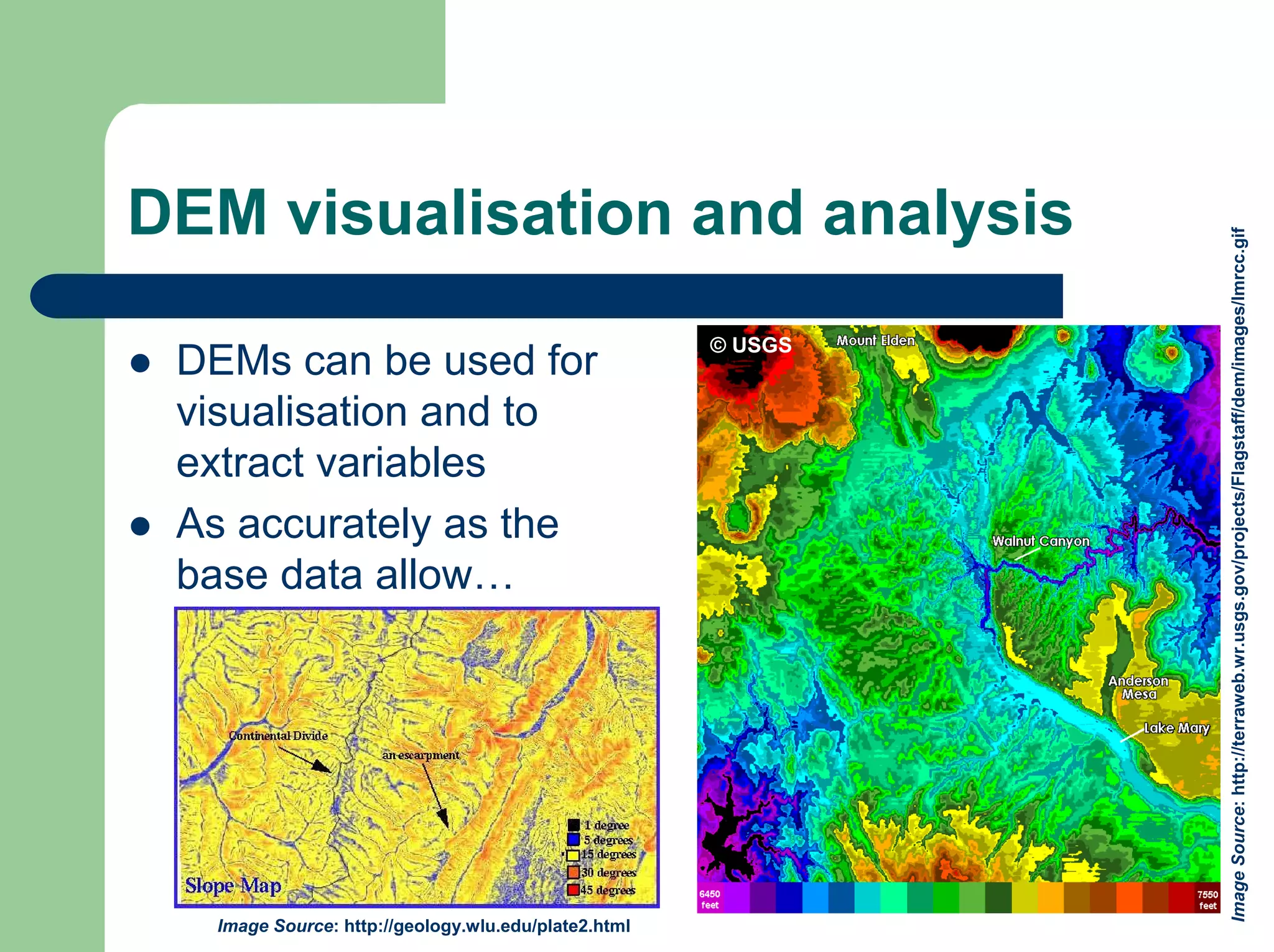
DEM visualisation and analysis
Image
Source:
http://terraweb.wr.usgs.gov/projects/Flagstaff/dem/images/lmrcc.gif
© USGS
z DEMs can be used for
visualisation and to
extract variables
z As accurately as the
base data allow…
Image Source: http://geology.wlu.edu/plate2.html
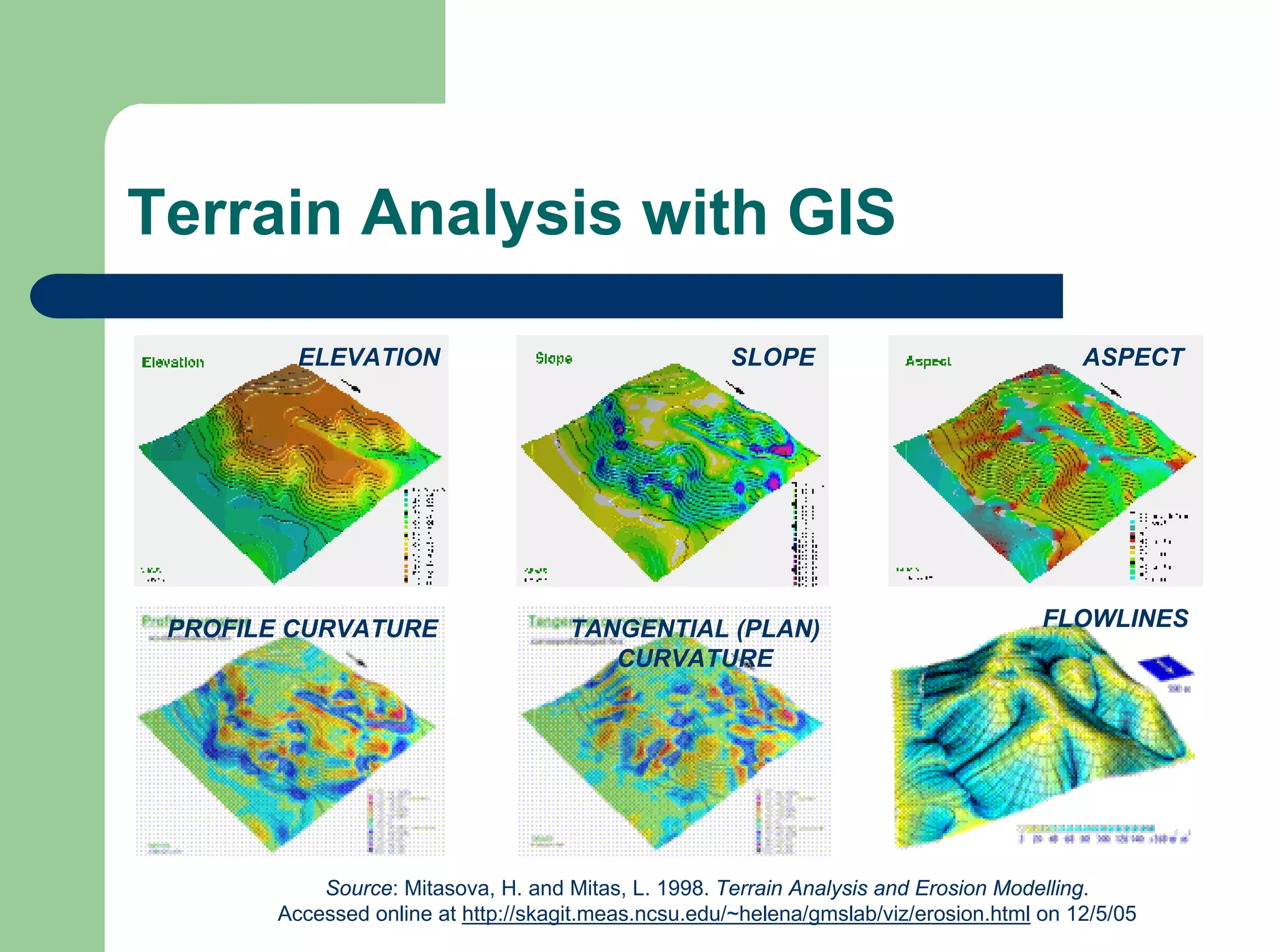
Terrain Analysis with GIS
Source: Mitasova, H. and Mitas, L. 1998. Terrain Analysis and Erosion Modelling.
Accessed online at http://skagit.meas.ncsu.edu/~helena/gmslab/viz/erosion.html on 12/5/05
ELEVATION SLOPE ASPECT
FLOWLINES
TANGENTIAL (PLAN)
CURVATURE
PROFILE CURVATURE
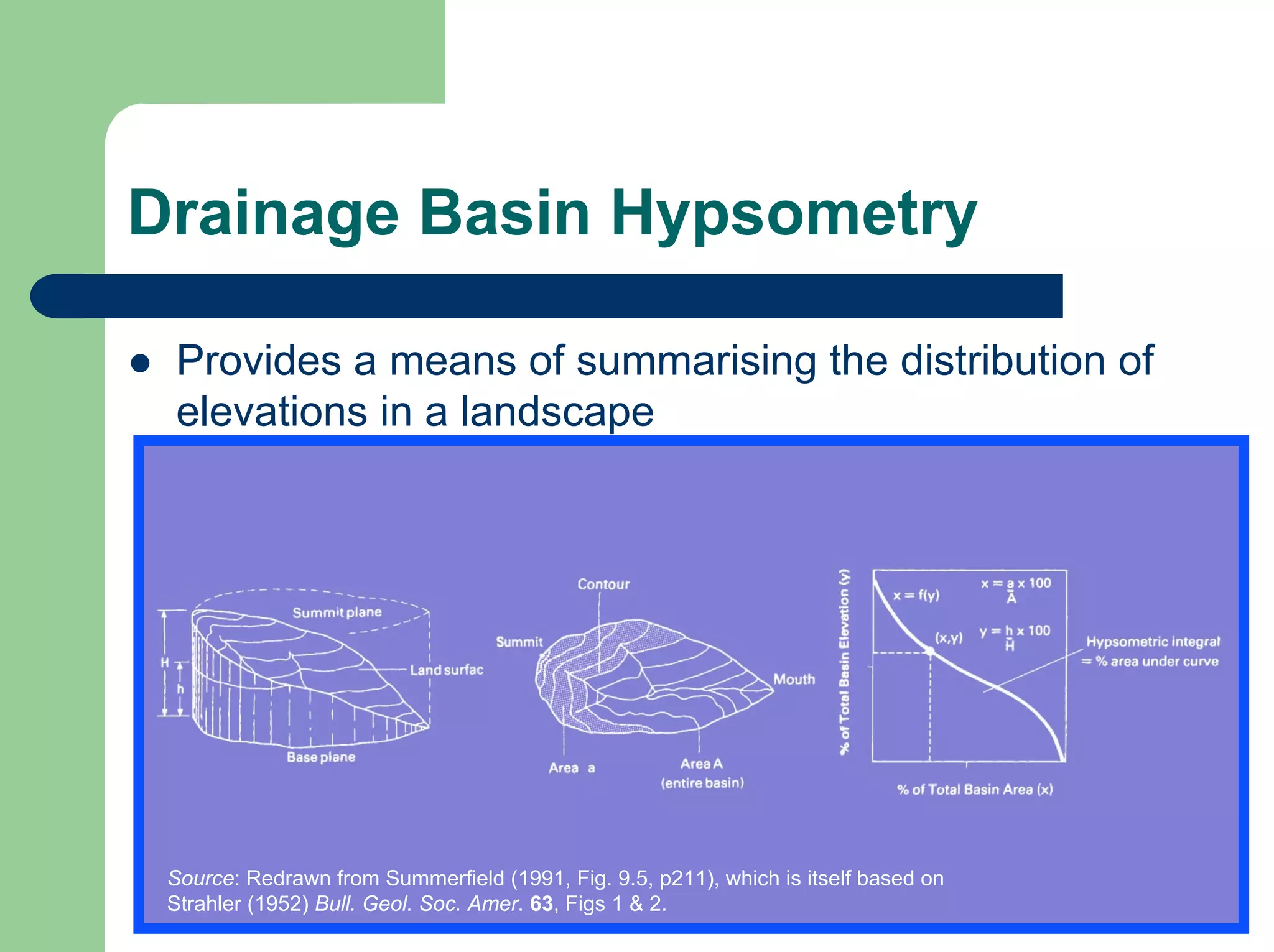
Drainage Basin Hypsometry
z Provides a means of summarising the distribution of
elevations in a landscape
Source: Redrawn from Summerfield (1991, Fig. 9.5, p211), which is itself based on
Strahler (1952) Bull. Geol. Soc. Amer. 63, Figs 1 & 2.
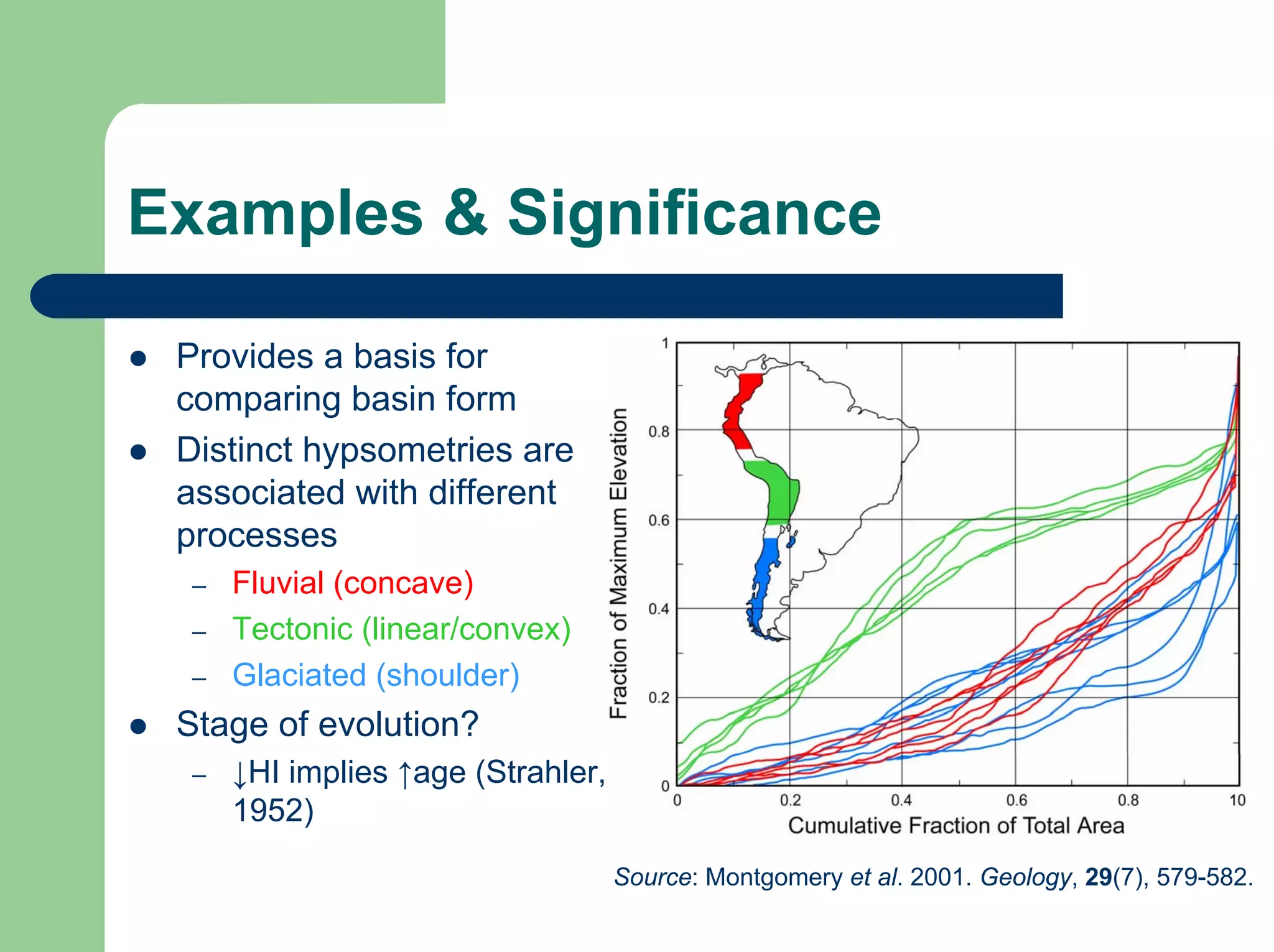
Examples & Significance
z Provides a basis for
comparing basin form
z Distinct hypsometries are
associated with different
processes
– Fluvial (concave)
– Tectonic (linear/convex)
– Glaciated (shoulder)
z Stage of evolution?
– ↓HI implies ↑age (Strahler,
1952)
Source: Montgomery et al. 2001. Geology, 29(7), 579-582.
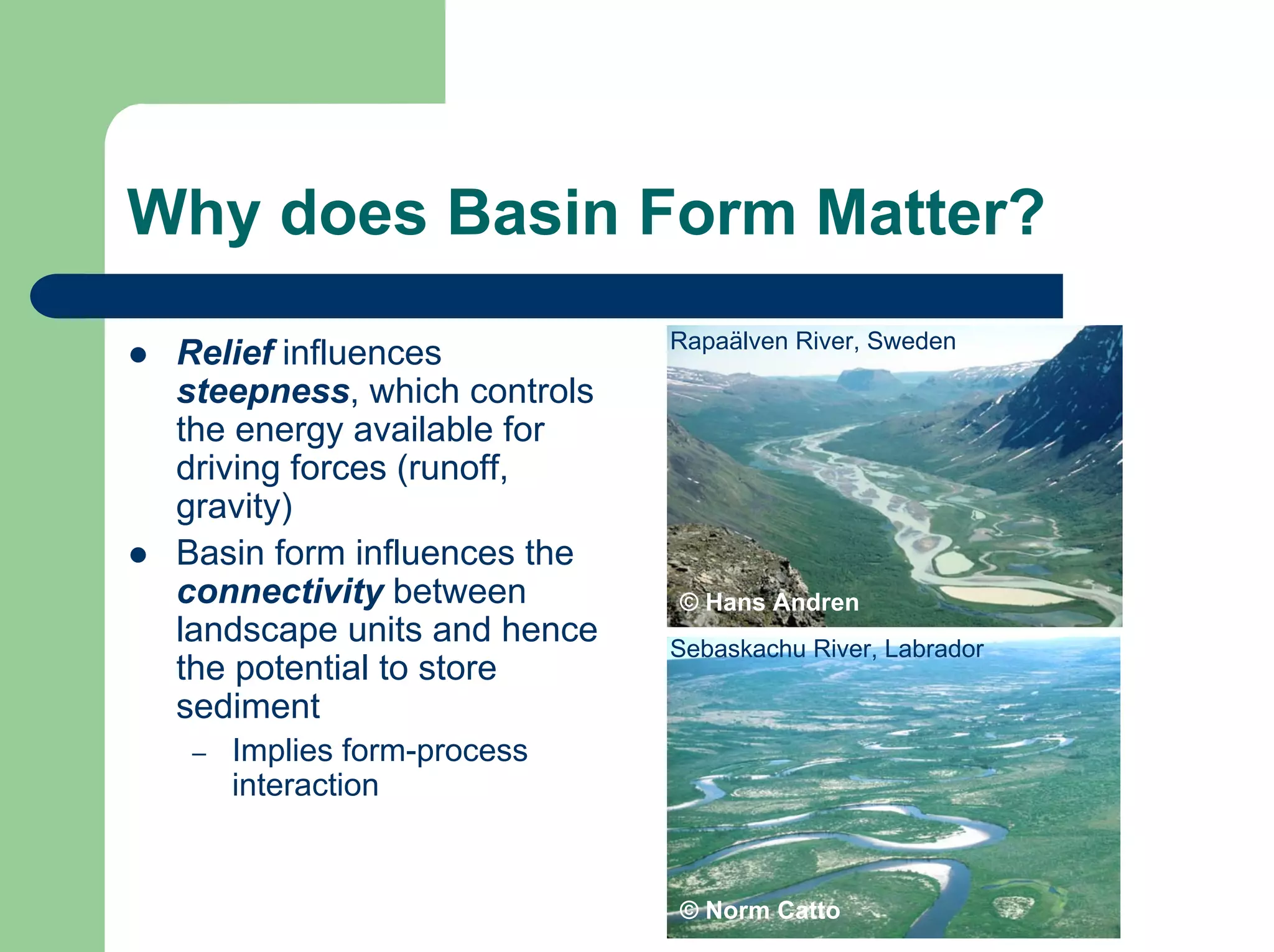
Why does Basin Form Matter?
© Hans Andren
Rapaälven River, Sweden
Sebaskachu River, Labrador
© Norm Catto
z Relief influences
steepness, which controls
the energy available for
driving forces (runoff,
gravity)
z Basin form influences the
connectivity between
landscape units and hence
the potential to store
sediment
– Implies form-process
interaction
Conclusion
z Morphometric analysis is needed to provide a
systematic basis for describing & comparing
drainage basin geomorphology & to test hypotheses
z Morphometry can highlight links between basin
forms and environmental variables, but it provides no
direct insight into formative processes
z Care is required: Underlying data are derived from
maps, DEMs, etc.
– Relationships depend on the basic quality of acquired data
– Relationships can be scale dependent
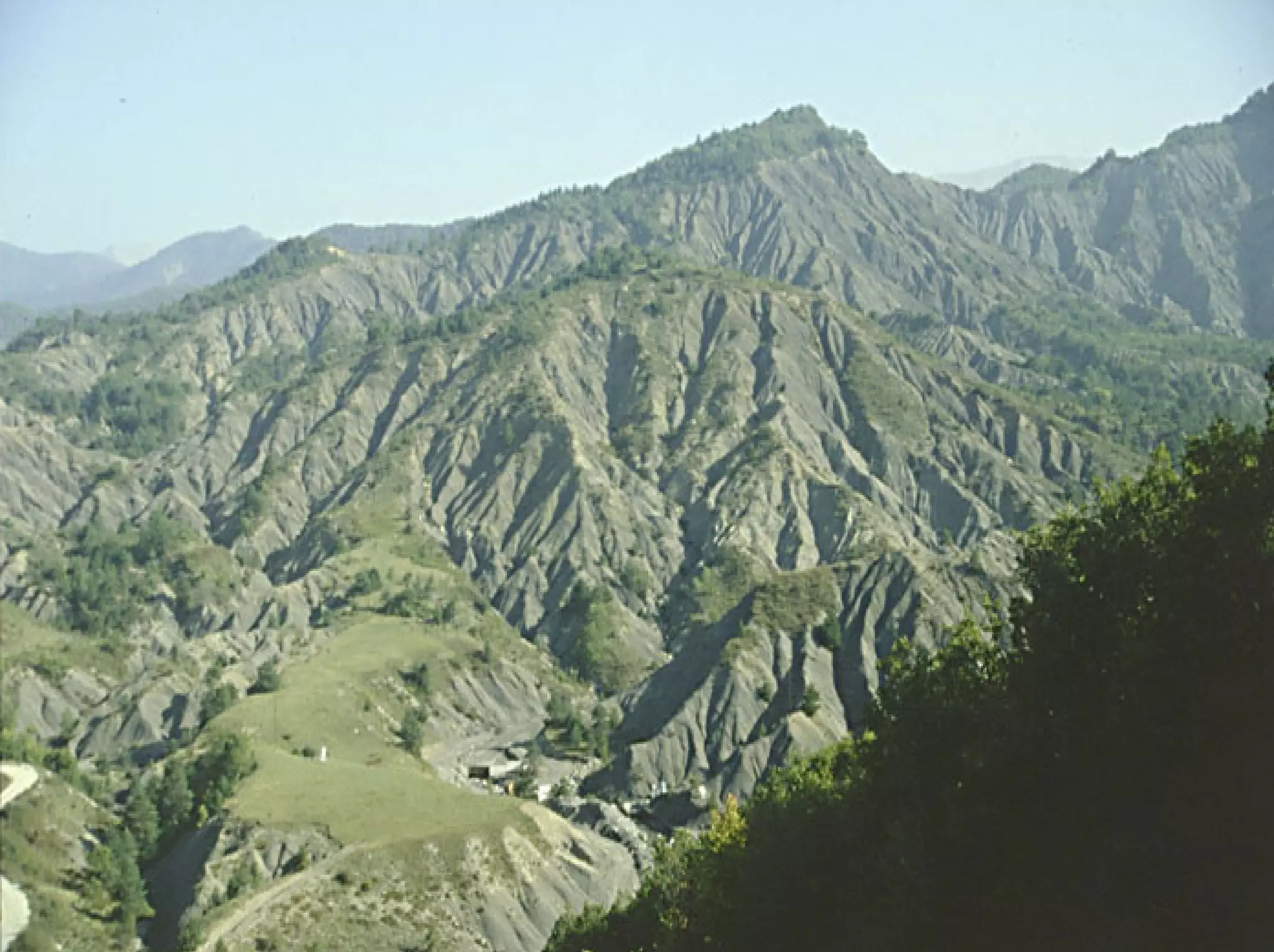
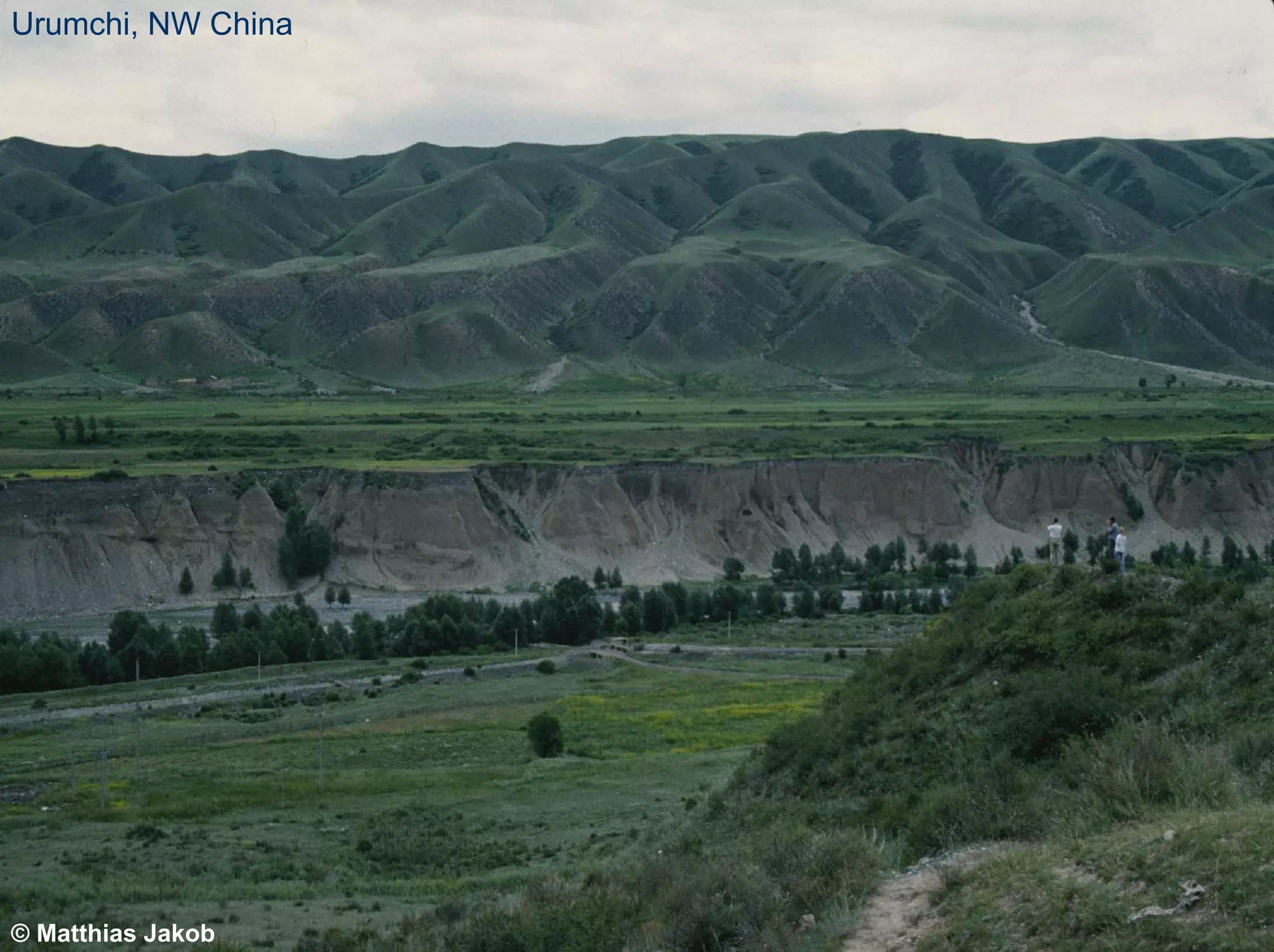
Urumchi, NW China
© Matthias Jakob

GEOG2016 Basin Morphometry Lecture 2.pdf

  • 1.
    Drainage Basin Geomorphology Fundamentals& Basin Morphometry Source: http://www.ucmp.berkeley.edu/tectonics/globe1.gif Dr Steve Darby
  • 2.
    The Fluvial System:Components z Sources, transfers, sinks – (Schumm, 1977) z Independent variables – Climate, geology, land cover/use, tectonics, etc z Dependent variables – See this lecture… Source: Schumm, S.A. 1977. The Fluvial System, Wiley, New York
  • 3.
    The Fluvial System:Functions © Steve Darby Mont Mine Glacier, Switzerland z Terrestrial and aquatic ecosystems z Transports matter from sources to sinks – Water – Solids (sediment, organic matter, carbon) – Solutes (mineral and carbon solutes) – Nutrients (N, P, etc) LANDSAT Image from: NASA John Stennis Space Center https://zulu.ssc.nasa.gov/mrsid S-45-05 (~8S, 143E) LANDSAT 7 2000
  • 4.
    Global Sediment Yield z70% of the total (15 000 Mt a-1) load comes from 10% of the land – 3 rivers (Ganges, Brahmaputra & Huang He) carry 20% of the load Source: Skinner, B. J., and Porter, S. C. (1995). The Dynamic Earth, An Introduction to Physical Geology (3rd Edition), New York, John Wiley and Sons.
  • 5.
    Global Denudation Rates zCalculated by estimating total sediment/solute load and dividing by basin area to give average ‘lowering rate’ in mm ka-1 – Global mean is ~ 8 mm ka-1 z Masks huge variations amongst the world’s large drainage basins – Chari Basin, interior Africa (3 mm ka-1) – Brahmaputra Basin, eastern Himalayas (677 mm ka-1) z Scale dependent – Haast River, Southern Alps, NZ (4,717 mm ka-1) – Huangfuchan, China (19,814 mm ka-1)
  • 7.
    The Scientific Method Observation Formulate‘Theory’ (Hypothesis/Model) Make Prediction Test ‘Theory’ (Hypothesis/Model) Robust Theory/Model/Hypothesis Observation New Observations INDUCE DEDUCE PASS REVISE THEORY ?
  • 8.
    Drainage Basins z Areaof land that contributes water to a stream/river – Also known as “catchments” (UK) or “watersheds” (US)
  • 9.
    Drainage Basin Components zBoundaries – Watersheds or divides z Landscape elements – Hillslopes – Channels – Channel heads – Valleys – Interfluves z Materials – Bedrock – Regolith – Colluvium vs. alluvium HyMap airborne imaging spectrometer data (19 June 2000) draped over DEM based on digitised OS 1:25 000 map contours for portion of Highland Water Research Catchment, New Forest, UK
  • 10.
    Drainage Basin Components zDrainage divide/watershed – Topographical – Hydrological – Military z Interfluve – A region of higher land separating two rivers in the same drainage basin Source: Figure 14.4 from Christopherson, R.W. 2005. Geosystems: An Introduction to Physical Geography (5th Edition), Prentice Hall, New Jersey.
  • 11.
    Drainage Basin Components zHillslopes – area of land between drainage divide and a channel or valley z Channel – a passage for water to flow through z Valley – elongated lowland between mountains, hills, or other uplands, usually with a well developed drainage network Photo courtesy of USGS photo library Rocky Mountain NP, Colorado
  • 12.
    Where do channelsbegin? © Frans Kwaad 2002 Valley side gullies, Rif Mountains (N Morocco)
  • 13.
    Channel Heads Diffuse channelhead Rambla Mofar, near Turre, Almeria © Professor Mike Kirkby © Professor Mike Kirkby Abrupt channel head South of Lake Balaton, Hungary
  • 14.
    Hillslope Morphology z Hillslopemorphology is complex and multi-dimensional, so many parameters can be used as descriptors – steepness, length, shape (i.e. rounded), degree of linearity, concavity or convexity (in plan and/or in profile), etc. z Hillslopes are usually mantled in sediment (colluvium) – Sediment synonyms: Soil, regolith z The significance of all these metrics is that water and gravity mediated sediment transfer is strongly controlled by slope – and the way in which slope varies across the landscape
  • 15.
    Slope Profiles Linear HillslopeProfile 0 2 4 6 8 10 12 14 16 18 20 0 20 40 60 80 100 120 140 160 180 200 Distance Across (m) Elevation (m) z Basic hillslope profile shapes – linear, convex, concave – all have average slope of 0.1 Convex Hillslope Profile 0 2 4 6 8 10 12 14 16 18 20 0 10 20 30 40 50 60 70 80 90 100 110 120 130 140 150 160 170 180 190 200 Horizontal Distance (m) Elevation (m) Concave Hillslope Profile 0 2 4 6 8 10 12 14 16 18 20 0 10 20 30 40 50 60 70 80 90 100 110 120 130 140 150 160 170 180 190 200 Distance Across (m) Elevation (m)
  • 16.
    3D Slope Morphology Source: http://www.soils.agri.umn.edu/academics/classes/soil5515/modules/topography/topography.html zHillslopes are 3-dimensional z Slope curvature controls the flow of surface and sub- surface water across a landscape – areas with concave plan curvatures have focused flows, whereas convex plan curvatures have dispersed flows – areas with convex profile curvature have accelerated flows, concave profile curvature have decelerating flows L = linear, V = convex, C = concave
  • 17.
    Hillslope Morphology: Examples HIGHRELIEF, STEEP GRADIENT, LINEAR IN PROFILE NOTE CONVEX PLAN CURVATURE © Philip Owens LOW RELIEF, LOW GRADIENT, CONCAVE PLAN CURVATURE River Severn Catchment, UK NOTE RUNOFF CONCENTRATION IN CONCAVE CURVATURE © Deborah Tappan Badlands NM, South Dakota
  • 18.
    Drainage Basin Morphometry zMorphometry – The quantitative measurement of form – Provides a systematic basis for description and comparison (e.g. between basins, model predictions vs. observations) z Topology versus topography – Topological variables represent network structure – Implies that two basins may look utterly different but be functionally similar if their topology is similar z Dimensional versus non-dimensional variables – All things can be measured with 3 scales: M, L, T – Dimensional: area (L2), velocity (L/T), density (M/L3) – Non-dimensional: slope (L/L) – Non-dimensional variables can be compared across basins of different scale
  • 19.
    Morphometric Variables z Basicdescriptions of basin shape & network structure – Drainage patterns and network characteristics – Basin size and shape (e.g. elongation ratio) – Drainage density z Topographic characteristics – Analysis of slopes and curvature – Basic mapping and DEM cartography – Basin elevation – Hypsometry – Relief (local and total) – Ruggedness
  • 20.
    Drainage Patterns Redrawn fromSummerfield (1991, Fig. 161.1, p406); itself modified from Morisawa (1985, Fig. 10.3)
  • 21.
    Drainage Patterns z Usedto infer underlying geological/other controls TYPE STRUCTURAL CONTROL Dendritic Lack of structural control; rock/sediment of uniform resistance Parallel Closely spaced faults; steep topography; non-cohesive sediments Radial Volcanic cones, domes Trellis Tilted or folded alternately resistant/weak sedimentary units Rectangular Joints or faults Annular Eroded dome in alternate resistant/weak sediments Centripetal Calderas, craters, tectonic basins Deranged Glaciated terrain Source: M. Summerfield (1991, Table 16.2, p406)
  • 22.
    Drainage Patterns: Examples Image from: NASA John Stennis Space Center https://zulu.ssc.nasa.gov/mrsid N-51-15(~ 15N, 120E) LANDSAT 7 2000 Mount Pinatubo, Phillipines RADIAL DRAINAGE Image from: http://csmres.jmu.edu/geollab/vageol/vahist/cumberland.html Allegheny Plateau, E West Virginia DENDRITIC DRAINAGE Valley & Ridge province, NW Virginia TRELLIS DRAINAGE ~ 38N, 80W
  • 23.
    Drainage Patterns: Examples Image from: NASA John Stennis Space Center https://zulu.ssc.nasa.gov/mrsid N-18-40(~ 44N, 74W) LANDSAT 7 2000 N New York State, USA DERANGED DRAINAGE Val D’Herens, Switzerland PARALLEL DRAINAGE
  • 24.
    Network Structure: StreamOrder z Scale-independent system for comparing streams – A stream with no tributaries is 1st order – Strahler (1952): A stream of order N forms at the confluence of two streams of order (N -1) – Shreve: N is the sum of the stream order of the tributaries Source: Summerfield (1991, Figure 9.1, p208)
  • 25.
    Some Data… Wheeling Creek,Ohio (2nd Vs. 3rd Order Basins) Sulphur Creek, CA (2nd Order) © Steve Darby © Wheeling Jesuit University z The largest river is the 12th order Amazon – Assuming 1st order streams are identified correctly! z Over 80% of the total length of Earth’s rivers are 1st or 2nd order z Basin area increases non-linearly with increasing stream order z Bifurcation Ratio (Rb) – Rb = Nx/Nx+1 – Strahler says R is typically ~ 3 – Hence N1 > 175 000 for the Amazon (N1 = 3x-1) z Source areas make up in numbers what they lack in size
  • 26.
    Drainage Basin Shape zBasin shape influences the fluxes and delivery of runoff and sediment from headwater reaches z Can be represented using the Elongation Ratio (E) z E = (2/L)×(A/π)0.5 z E is dimensionless Source: Redrawn from Benda, L. et al. 2004. Water Resources Research, 40, W05402, doi:10.1029/2003WR002583.
  • 27.
    Significance… z Runoff deliveryto streams – Elongated basins have flatter hydrographs z Influences confluence geomorphology (Benda et al., 2004) – Tributaries of elongated basins have less impact on main stem geomorphology Source: Redrawn from Benda et al. 2004.
  • 28.
    Drainage Density z Extentto which a landscape is channelled reflects the balance between erosive and resisting forces – So, likely influenced by climatic and geologic factors z Ratio of total stream length to drainage area (ΣSL/A) z DD (has dimensions L-1) varies across a wide range – e.g. 5 km-1 on permeable rocks, to 500 km-1 on badlands z Can be problematic to define where channels are indistinct or ephemeral – Locating channel heads is critical to accurate estimation
  • 29.
    Examples… Images from: NASA John Stennis Space Center https://zulu.ssc.nasa.gov/mrsid N-14-40 (~ 40N,100W) LANDSAT 7 2000 N-19-05 (~ 5N, 70W) LANDSAT 7 2000 LANDSAT 7 2000 N-19-05 (~ 5N, 70W) LANDSAT 7 2000 Middle Loup River, Nebraska SEMI-ARID - Low Drainage Density Upper Orinoco Basin, Venezuela HUMID - High Drainage Density
  • 30.
    Physical Significance (?) zDrainage density values can sometimes surprise z Perhaps best interpreted as a long-term measure of the relative difference between rainfall and infiltration Nazca, Peru (~15S, 75W) © Steve Darby
  • 31.
    Drainage Basin Topography zElevation is the vertical height above a datum z Relief (R) refers to differences in elevation at local (e.g. for a hill) or total basin (difference in elevation between the drainage divide and the basin outlet) scales © Martin Geertsema HIGH RELIEF LOW RELIEF HyMap airborne imaging spectrometer data (19 June 2000) draped over DEM based on digitised OS 1:25 000 map contours for portion of Highland Water Research Catchment, New Forest, UK ~ 50m ~ 1000m
  • 32.
    Drainage Basin Ruggedness zMeasured with the ruggedness number – RN = R × DD z Measures the extent to which basin topography is dissected DEM of the headwaters of the Smith River in Oregon – an example of a rugged basin with high relief
  • 33.
    Drainage Basin Topography zElevation is spatially distributed so representing the topography of a drainage basin with a single parameter is hard Smith River, Oregon
  • 34.
    DEM visualisation andanalysis Image Source: http://terraweb.wr.usgs.gov/projects/Flagstaff/dem/images/lmrcc.gif © USGS z DEMs can be used for visualisation and to extract variables z As accurately as the base data allow… Image Source: http://geology.wlu.edu/plate2.html
  • 35.
    Terrain Analysis withGIS Source: Mitasova, H. and Mitas, L. 1998. Terrain Analysis and Erosion Modelling. Accessed online at http://skagit.meas.ncsu.edu/~helena/gmslab/viz/erosion.html on 12/5/05 ELEVATION SLOPE ASPECT FLOWLINES TANGENTIAL (PLAN) CURVATURE PROFILE CURVATURE
  • 36.
    Drainage Basin Hypsometry zProvides a means of summarising the distribution of elevations in a landscape Source: Redrawn from Summerfield (1991, Fig. 9.5, p211), which is itself based on Strahler (1952) Bull. Geol. Soc. Amer. 63, Figs 1 & 2.
  • 37.
    Examples & Significance zProvides a basis for comparing basin form z Distinct hypsometries are associated with different processes – Fluvial (concave) – Tectonic (linear/convex) – Glaciated (shoulder) z Stage of evolution? – ↓HI implies ↑age (Strahler, 1952) Source: Montgomery et al. 2001. Geology, 29(7), 579-582.
  • 38.
    Why does BasinForm Matter? © Hans Andren Rapaälven River, Sweden Sebaskachu River, Labrador © Norm Catto z Relief influences steepness, which controls the energy available for driving forces (runoff, gravity) z Basin form influences the connectivity between landscape units and hence the potential to store sediment – Implies form-process interaction
  • 39.
    Conclusion z Morphometric analysisis needed to provide a systematic basis for describing & comparing drainage basin geomorphology & to test hypotheses z Morphometry can highlight links between basin forms and environmental variables, but it provides no direct insight into formative processes z Care is required: Underlying data are derived from maps, DEMs, etc. – Relationships depend on the basic quality of acquired data – Relationships can be scale dependent
  • 40.
    Urumchi, NW China ©Matthias Jakob