
Surface Water resource
Ground water resource
Water Resource
Surface
Water
Resource
Water Res
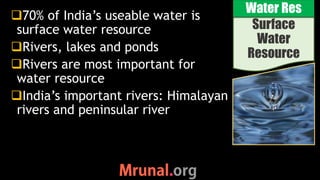
70% of India’s useable water is
surface water resource
Rivers, lakes and ponds
Rivers are most important for
water resource
India’s important rivers: Himalayan
rivers and peninsular river
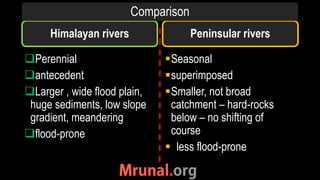
Himalayan rivers
Perennial
antecedent
Larger , wide flood plain,
huge sediments, low slope
gradient, meandering
flood-prone
Seasonal
superimposed
Smaller, not broad
catchment – hard-rocks
below – no shifting of
course
 less flood-prone
Peninsular rivers
Comparison
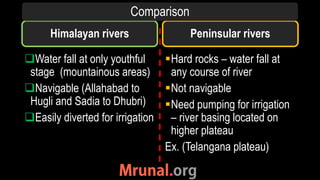
Himalayan rivers
Water fall at only youthful
stage (mountainous areas)
Navigable (Allahabad to
Hugli and Sadia to Dhubri)
Easily diverted for irrigation
Hard rocks – water fall at
any course of river
Not navigable
Need pumping for irrigation
– river basing located on
higher plateau
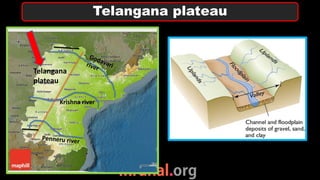
Ex. (Telangana plateau)
Peninsular rivers
Comparison
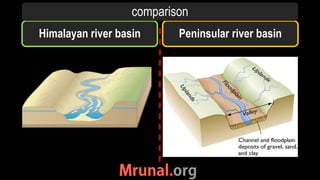
Himalayan river basin Peninsular river basin
comparison
Telangana plateau
Krishna river
Telangana
plateau
Surface Water resource
Ground water resource
Water Resource
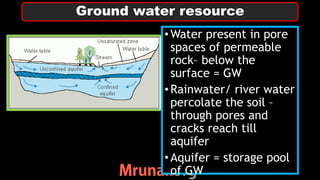
Ground water resource
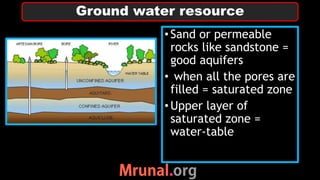
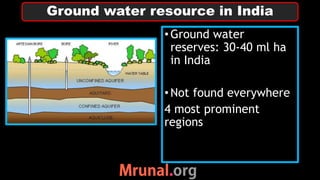
•Water present in pore
spaces of permeable
rock– below the
surface = GW
•Rainwater/ river water
percolate the soil –
through pores and
cracks reach till
aquifer
•Aquifer = storage pool
of GW
•Sand or permeable
rocks like sandstone =
good aquifers
• when all the pores are
filled = saturated zone
•Upper layer of
saturated zone =
water-table
Ground water resource
•Ground water
reserves: 30-40 ml ha
in India
•Not found everywhere
4 most prominent
regions
Ground water resource in India
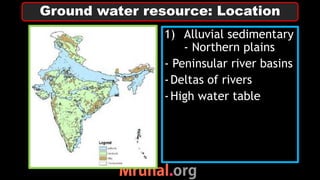
1) Alluvial sedimentary
- Northern plains
- Peninsular river basins
-Deltas of rivers
-High water table
Ground water resource: Location
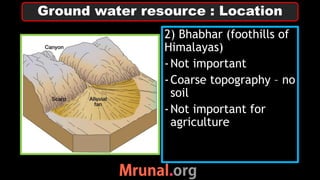
2) Bhabhar (foothills of
Himalayas)
-Not important
-Coarse topography – no
soil
-Not important for
agriculture
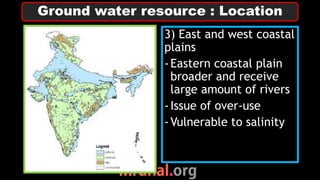
Ground water resource : Location
3) East and west coastal
plains
-Eastern coastal plain
broader and receive
large amount of rivers
-Issue of over-use
-Vulnerable to salinity
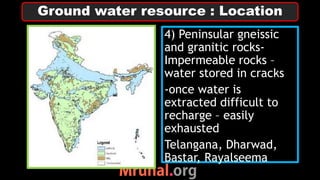
Ground water resource : Location
4) Peninsular gneissic
and granitic rocks-
Impermeable rocks –
water stored in cracks
-once water is
extracted difficult to
recharge – easily
exhausted
Telangana, Dharwad,
Bastar, Rayalseema
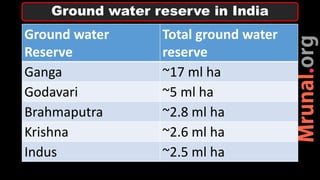
Ground water resource : Location
Ground water
Reserve
Total ground water
reserve
Ganga ~17 ml ha
Godavari ~5 ml ha
Brahmaputra ~2.8 ml ha
Krishna ~2.6 ml ha
Indus ~2.5 ml ha
Ground water reserve in India
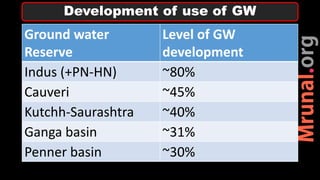
Ground water
Reserve
Level of GW
development
Indus (+PN-HN) ~80%
Cauveri ~45%
Kutchh-Saurashtra ~40%
Ganga basin ~31%
Penner basin ~30%
Development of use of GW
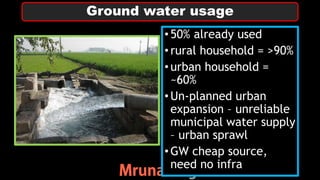
•50% already used
•rural household = >90%
•urban household =
~60%
•Un-planned urban
expansion – unreliable
municipal water supply
– urban sprawl
•GW cheap source,
need no infra
Ground water usage
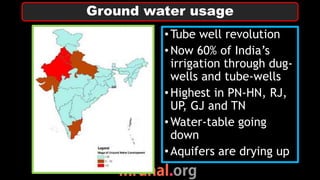
•Tube well revolution
•Now 60% of India’s
irrigation through dug-
wells and tube-wells
•Highest in PN-HN, RJ,
UP, GJ and TN
•Water-table going
down
•Aquifers are drying up
Ground water usage
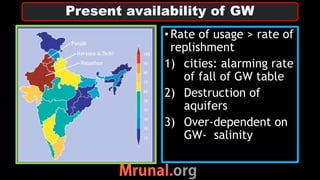
•Rate of usage > rate of
replishment
1) cities: alarming rate
of fall of GW table
2) Destruction of
aquifers
3) Over-dependent on
GW- salinity
Present availability of GW
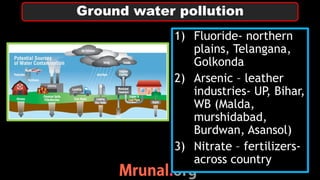
1) Fluoride- northern
plains, Telangana,
Golkonda
2) Arsenic – leather
industries- UP, Bihar,
WB (Malda,
murshidabad,
Burdwan, Asansol)
3) Nitrate – fertilizers-
across country
Ground water pollution
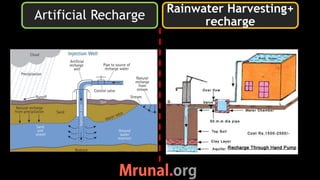
Artificial Recharge
Rainwater Harvesting+
recharge
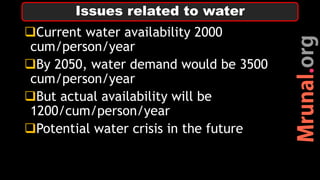
Current water availability 2000
cum/person/year
By 2050, water demand would be 3500
cum/person/year
But actual availability will be
1200/cum/person/year
Potential water crisis in the future
Issues related to water
Climatic regions of India
Vegetation pattern in India
Water resource:
1) Surface water resource
2) Ground water resource

Geo l14 water resource_india_0.2

  • 2.
    Surface Water resource Groundwater resource Water Resource
  • 3.
    Surface Water Resource Water Res 70% ofIndia’s useable water is surface water resource Rivers, lakes and ponds Rivers are most important for water resource India’s important rivers: Himalayan rivers and peninsular river
  • 4.
    Himalayan rivers Perennial antecedent Larger ,wide flood plain, huge sediments, low slope gradient, meandering flood-prone Seasonal superimposed Smaller, not broad catchment – hard-rocks below – no shifting of course  less flood-prone Peninsular rivers Comparison
  • 5.
    Himalayan rivers Water fallat only youthful stage (mountainous areas) Navigable (Allahabad to Hugli and Sadia to Dhubri) Easily diverted for irrigation Hard rocks – water fall at any course of river Not navigable Need pumping for irrigation – river basing located on higher plateau Ex. (Telangana plateau) Peninsular rivers Comparison
  • 6.
    Himalayan river basinPeninsular river basin comparison
  • 7.
  • 8.
    Surface Water resource Groundwater resource Water Resource
  • 9.
    Ground water resource •Waterpresent in pore spaces of permeable rock– below the surface = GW •Rainwater/ river water percolate the soil – through pores and cracks reach till aquifer •Aquifer = storage pool of GW
  • 10.
    •Sand or permeable rockslike sandstone = good aquifers • when all the pores are filled = saturated zone •Upper layer of saturated zone = water-table Ground water resource
  • 11.
    •Ground water reserves: 30-40ml ha in India •Not found everywhere 4 most prominent regions Ground water resource in India
  • 12.
    1) Alluvial sedimentary -Northern plains - Peninsular river basins -Deltas of rivers -High water table Ground water resource: Location
  • 13.
    2) Bhabhar (foothillsof Himalayas) -Not important -Coarse topography – no soil -Not important for agriculture Ground water resource : Location
  • 14.
    3) East andwest coastal plains -Eastern coastal plain broader and receive large amount of rivers -Issue of over-use -Vulnerable to salinity Ground water resource : Location
  • 15.
    4) Peninsular gneissic andgranitic rocks- Impermeable rocks – water stored in cracks -once water is extracted difficult to recharge – easily exhausted Telangana, Dharwad, Bastar, Rayalseema Ground water resource : Location
  • 16.
    Ground water Reserve Total groundwater reserve Ganga ~17 ml ha Godavari ~5 ml ha Brahmaputra ~2.8 ml ha Krishna ~2.6 ml ha Indus ~2.5 ml ha Ground water reserve in India
  • 17.
    Ground water Reserve Level ofGW development Indus (+PN-HN) ~80% Cauveri ~45% Kutchh-Saurashtra ~40% Ganga basin ~31% Penner basin ~30% Development of use of GW
  • 18.
    •50% already used •ruralhousehold = >90% •urban household = ~60% •Un-planned urban expansion – unreliable municipal water supply – urban sprawl •GW cheap source, need no infra Ground water usage
  • 19.
    •Tube well revolution •Now60% of India’s irrigation through dug- wells and tube-wells •Highest in PN-HN, RJ, UP, GJ and TN •Water-table going down •Aquifers are drying up Ground water usage
  • 20.
    •Rate of usage> rate of replishment 1) cities: alarming rate of fall of GW table 2) Destruction of aquifers 3) Over-dependent on GW- salinity Present availability of GW
  • 21.
    1) Fluoride- northern plains,Telangana, Golkonda 2) Arsenic – leather industries- UP, Bihar, WB (Malda, murshidabad, Burdwan, Asansol) 3) Nitrate – fertilizers- across country Ground water pollution
  • 22.
  • 23.
    Current water availability2000 cum/person/year By 2050, water demand would be 3500 cum/person/year But actual availability will be 1200/cum/person/year Potential water crisis in the future Issues related to water
  • 24.
    Climatic regions ofIndia Vegetation pattern in India Water resource: 1) Surface water resource 2) Ground water resource