DESIGN OFVIRTUAL LEARNING
ENVIRONMENTS ANDTHE
CONTRIBUTIONS OFTHE
MULTILITERACIES PEDAGOGY,
BAKHTINIAN STUDIES AND
REMEDIATION
AdolfoTanzi Neto
Pontifical Catholic University of
São Paulo (BRAZIL)
INTRODUCTION
We believe that with the democratization of knowledge, distance learning
(DL) has gained more and more space in the world. In the contemporary era,
time, mobility and autonomy have been key factors for choosing this mode of
learning. In this regard, virtual learning environments (VLEs) have been
constantly redesigned to provide different ways for information to interact
with people, widening students’ participation on the web.
INTRODUCTION
For Brazil, due to its geographical issues and a pressing need for engaging
citizens in the school context, distance education has been rapidly growing,
providing the approximation of the population to these learning contexts.Thus,
to meet the needs arising from different pedagogical practices in this new
context, theVLE has undergone great changes, mainly for being one of the
most important tools for distance learning.
INTRODUCTION
However, we should consider how this learning environment is; assuming that
theVLE in distance education is the classroom:
• how the design of aVLE can offer digital tools and resources that provide
(new) multiliteracies needed in contemporary social practices?
• how can they collaborate for the inclusion of young people in the modern
society, that engenders new ways of living, working, relating, producing and
delivering services?
BAKHTIN’S ARCHITECTURAL FORM
Bakhtin (2003 [1952-53/1979])[1] claims that the use of language is directly
linked to the various fields of human activity and that therefore such uses are
as diverse as those fields of activity.The language is in the form of
statements uttered by members from different fields of activity and each
field of language practice draws its relatively stable types of utterances,
which we call speech genres. Rojo (2013)[2] suggets the device of a diagram –
Fig. 1 below to synthesize the theory of genres presented in Bakhtin (2003
[1952-53/1979])[1]:
BAKHTIN’S ARCHITECTURAL FORM
Fig. 1 – Speech Genre
Diagram
Adapted from: ROJO,
2013, p. 27[2].
We can observe that it is by the communication practices/field of human
activity that language practices are determined. It also includes the
historical time and place and social relations between the participants,
that are marked by three characteristics or purposes: thematic content,
the style of language and its compositional form. For the thematic
content, it holds the meaning of acts in human activity: the objects,
meanings and content arising from a discursive sphere that will always be
present in a particular genre.
BAKHTIN’S ARCHITECTURAL FORM
The style of language is shaped by “the selection of lexical, phraseological
and grammatical resources of language" (Bakhtin, 2003 [1952-53/1979], p.
261)[1], which means the way the elements of a particular language
organize discourse. Despite their individual character, which is directly
connected to the individuality of the speaker, Bakhtin (2003 [1952-53/1979],
p. 265)[1] argues that not all genres are equally amenable to such reflection,
we have to consider the individuality of the speaker in the language
statement and the individual style. However, some genres require more
standardized forms, so style is still an integral part of the genre.
BAKHTIN’S ARCHITECTURAL FORM
The language styles are nothing but certain styles of genre from determined
spheres of human activity and communication. In every field there are
employed genres that correspond to specific conditions of each given field;
these genres that match certain styles (Bakhtin, 2003 [1952-53/1979], p. 266)[1].
BAKHTIN’S ARCHITECTURAL FORM
The compositional form, on the other hand, is the type of construction from a
set of different types of relationship that the speaker has with other
participants in a discursive communication - the relationship with the listeners,
with the readers, with the partners, with the discourse of the other, etc.
(Bakhtin , 2003 [1952-53/1979])[1]. In other words, it depends on the
configuration or the organization of the utterance so that it meets specificities
of a particular discursive sphere or a field of activity.
BAKHTIN’S ARCHITECTURAL FORM
We understand that the compositional form is defined by the architectural
form, according to the architectural form of the communication practices, the
compositional form, the styles and themes are organized in a genre. As we can
see from Fig. 2, the architectural form is in between the communication
practices and the speech genre.
BAKHTIN’S ARCHITECTURAL FORM
Fig. 2 – Speech Genre
Diagram with the
arquitectural form
Adapted from: ROJO,
2013, p. 27[2].
BAKHTIN’S ARCHITECTURAL FORM
For a better understanding, let us imagine for example the classroom with
its architectural form, which means, with its ergonomics, that it allows for a
specific organization of chairs, structure, space, whiteboard, walls, etc.,
and it provides a unique way to interact one to many, teacher-centered,
etc.This ergonomics or architectural form allows certain genres to fit while
others not.This is where we believe that the architectural form defines the
compositional form, as both are closely linked to the theme and style in
every genre (Bakhtin, 2003 [1952-53/1979])[1].
BAKHTIN’S ARCHITECTURAL FORM
That said, we sharpened our theoretical lenses to understand the
architectural whole of twoVLEs, in its design (concept, idealization and
form), looking at the forms of language in its particular social and historical
aspects in what we believe is a new field of human activity, the digital one.
To understand all of this, their specific composition or the arquitectural
form, we undertook further reflections on the uses of these tools on the
digital environment.
MULTILITERACIES, MULTIMODALITY AND REMEDIATION
The New London Group (NEW LONDON GROUP, 1996)[3] discusses the future
of literacy pedagogy, bringing to light a pedagogy that should include the
multiplicity of texts and discourses, focusing on two main factors: the first is
the cultural and linguistic diversity of globalized societies, facing the
multifaceted cultures intertwined in the plurality of texts that circulate in
them.
MULTILITERACIES, MULTIMODALITY AND REMEDIATION
The second factor refers to a pedagogy that takes into account the rapid
growth and variety of texts related to information technologies as well as
multimedia formats such as competence to understand different
representational forms of information, the image and its relationship with
the text or even the format (colour, sound, shape) of something in a
multimedia environment. For that, the authors bring the discussion of an
education focused on the imminent needs of the twenty-first century, that is
to say, an education for the (multi) literacies.
MULTILITERACIES, MULTIMODALITY AND REMEDIATION
Kalantzis and Cope (2006)[4] based on the assumption that as every day
human identities become more divergent, the central fact of language
becomes the multiplicity of its meanings. Just as there are many facets in our
identities, there are multiple discourses of identity and multiple discourses of
recognition to be negotiated.We have to be proficient to negotiate the
identities that exist in each of us and so many other identities that we face in
in our day-by-day lives (KALANTZIS, COPE, 2006)[4].
MULTILITERACIES, MULTIMODALITY AND REMEDIATION
The group has also discussed the urgency of addressing the issues related to
contemporary or multimodal texts, which we are faced constantly with,
meaning, to look at the regularities of structures to a type of "visual
grammar" for multimodal use, starting from the assumption that all texts,
even the printed ones, are multimodal (Kress and van Leeuwen, 1996)[5],
writing is multisemiotic, the alphabetic language is just one of the ways to
construct meaning in writing.
MULTILITERACIES, MULTIMODALITY AND REMEDIATION
For that, the Multimodality theory proposed by Kress andVan Leeuwen
(1996)[5] among others, takes the written language as just one of the modes
of meaning in communicative spheres and inquires to understand just the
written mode would not suffice students aprehension of the role power of
discursive manifestations of the modern world.
MULTILITERACIES, MULTIMODALITY AND REMEDIATION
Additionally, Bolter and Grusin (2000)[6] discuss that technological means
reuse means from their predecessors, as in the examples of painting in
relation to photography, from the novel to a film, the phone call to a
conference call, the press to an electronic hypertext.This reuse brings new
definitions of the medium, but not that there is necessarily a connection
between them, this connection can happen if the reader or viewer knows the
two versions.
MULTILITERACIES, MULTIMODALITY AND REMEDIATION
For example, a book that you read and then you watch the movie (based on
this book). In such situation, the viewer can compare the two versions of the
same story. Another example is the analysis of the characteristics of a
painting presented in a picture: color, depth, brightness that can be
compared.Thus, the representation of the other is what the authors call
remediation.
MULTILITERACIES, MULTIMODALITY AND REMEDIATION
The media is always a remediation of a previous media and the same occurs
in digital media. Hence, we must look at the acts of remediation of the
presence-based school to the digital school, in which new
multisemiotic/multimodal arrangements must be addressed to fullfil the
contemporary needs.We can observe an intense interactivity in digital media,
we have great websites where millions of citizens discuss an issue, change
the policy of a country, transform the culture of people, etc.
MULTILITERACIES, MULTIMODALITY AND REMEDIATION
If we look at education in the technological means in their acts of
remediation, we realize that, so far, what has happened is a tendency to
transpose the presence-based classroom to the virtual environment with an
strong presence of only alphabetic texts. We must rethink the educational
remediation acts to the technology-mediated virtual learning environments,
which must in their design, provide different transformations in the mode of
interaction with learning to establish a renewed sense of the past creating
future directions for mediated-technology education, which should
approximate the reality experienced by the contemporary citizens and their
new modes of meaning-making.
MULTILITERACIES, MULTIMODALITY AND REMEDIATION
Therefore, in our analysis of the virtual learning environments, we observed
the acts of remediation from the classroom environment to the digital one
and if the design tools provided can propitiate or not multisemiotic uses for
communication.
CONCLUSION
As we mentioned in our theoretical section, the realization of an architectural
form occurs in the communication situation, which organizes the
compositional forms that take place in a genre. In our analyzes, we looked at
the architectural form ofTelEduc and Edmodo, we observed their concept,
idealization and form in the digital environment, that can collaborate or not
for certain genres be constituted.
EdModo
TelEduc
CONCLUSION
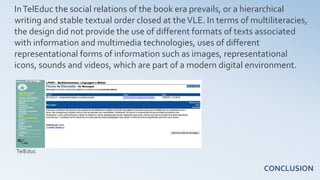
We were able to infer that in the architectural form ofTelEduc, the
environment offers little flexibility for the user, since the tools are based on
compartiments and also on non-visual icons, only alphabetic thumbnails,
which hinder colaborativity among its participants. Moreover, the
environment does not propitiate an interaction between the studied object
and the user.
EdModo
TelEduc
CONCLUSION
The tool-tasks follows a chronological order of presentation with no room for
the user’s intervention.The multidirectional communication tools, due to its
design, does not allow interaction between different users, once it’s
necessary to click to get in diferrent boxes of interaction: fields of discussions
are in isolated boxes of interaction.
EdModo
TelEduc
CONCLUSION
The tools proposed follow a predetermined direction of participation,
teacher-student and student-content; even in discussion forums, where you
could have a student-student interaction, due to its compartmentalized
design, the participation becomes artificial with the simple goal of
accomplishing a task.Thus, the environment has the characteristic of a
repository of digital data: it is static, with pre-defined paths and roles for its
members, where only one mode of language is established, the alphabetic
writing.
EdModo
TelEduc
CONCLUSION
That said, we observed that the compositional forms that constitute thisVLE
(tools and genres allowed/supported) was originated from the school context
of the twentieth century, since its architectural form has little flexibility for
the demands of the contemporary world, its form, design and idealization are
based on an alphabetic mode of learning with only text interaction controlled
by the teacher.
EdModo
TelEduc
CONCLUSION
The materials available/allowed for this design environment follow the
characteristics of the behaviorist model (Barbera; Rochera, 2010)[7] with
practical exercises, automated tutorials with passive reproduction of material
that requires only exercises and memorization, with the automation of basic
skills and content in textual format, fragmented into small units and unique
itineraries in their boxes of interaction. Furthermore, the material and the
learning tutor serve as controllers.
EdModo
CONCLUSION
We concluded, by observing the architectural form ofTelEduc environment,
its tools and flexibility for different modes of language, that theVLE
represents the 1.0 school, it means, the mentality 1, proposed by Lankshear
and Knobel (2006, p. 38)[8], in which the world is centered and hierarchical
and production is based on infrastructure and centers or units
(compartments).The expertise and authority are "located" in individuals and
institutions.
TelEduc
CONCLUSION
We concluded that the little interaction between the environment and other
web-tools provide for the users a closed learning space for only specific
purposes. Unlike EdModo, which offers the possibility to participate in
different learning communities for the exchange of content, ideas, activities
and multimedia materials enabling the construction of collaborative and
distributed intelligence.
EdModo
CONCLUSION
InTelEduc the social relations of the book era prevails, or a hierarchical
writing and stable textual order closed at theVLE. In terms of multiliteracies,
the design did not provide the use of different formats of texts associated
with information and multimedia technologies, uses of different
representational forms of information such as images, representational
icons, sounds and videos, which are part of a modern digital environment.
TelEduc
CONCLUSION
In the immersion of students in meaningful practices EdModo foster
participation in multiple and different situations based on their knowledge
and experience inTelEduc, the big challenge is to literate the student for the
environment in particular, due to its design distance from the technological
tools students are using now, even the digitally literated ones when using the
tool can have difficulties.
CONCLUSION
Therefore, to understand the architectural whole as proposed by Bakhtin
(2010 [1924])[9] inTelEduc, we observed a gap between its architectural form
and the contemporary reality of users immersed in new technologies. By
understanding its unique reality (cognitive) in theVLE, we understand that its
structure is based on the hierarchical school from the fordism era; on the
external characteristics, from the extra-aesthetic we could see from the
limitations of bandwidth, storage and design flexibility of the environment
itself, unless the teachers/tutors start using, for example, links and hyperlinks
so that the user could access the multitude of possibilities from theWeb, but
then outside theVLE.
CONCLUSION
The internal dimension of the whole architecture, we analyzed the
possibilities for different texts arrangement, images, activities, units and
tasks, which prevails the static form, with little or no user interaction,
content, starting from a model of lecture and teacher/tutor as the owners of
knowledge and power of seriation, classification, evaluation and promotion.
CONCLUSION
We believe that educational spaces supported by new technologies should
generate and establish new forms of communication and learning.We
understand that the remediation of our lives, culture and society by new
technologies have provided new signifiers and materials of expression for
students in the contemporary world.
CONCLUSION
On that account, the acts of remediation from presence-based school to
distance education context must take into account the changes of the
modern world. However, the acts of remediation, when considering the
design ofTelEduc, was based on the presence-based classroom, or in the
relations of time and space (and power) school 1.0, generating an
architectural form characterized by the traditional school literacies of the
twenth century.
CONCLUSION
Meanwhile, when we analyzed the architectural form of EdModo in its
architectural whole, we observed a constructivist design model (Barbera;
Rochera, 2010)[7], which proposes different formats of information - textual,
graphic, audio, images with dynamic and easy communication/interaction
with other technological means; which, due toTelEduc limitations for storage
and structure, it becomes much more complicated. For EdModo, there is still
flexible adaptation of content presentation and navigation, interaction as
well as connection to the study objectives.
CONCLUSION
The conception of language is seen as a complex process of reconstruction of
content with the mental activity that the student gets involved in different
cognitive abilities, prior to knowledge, strategies and learning styles,
motivations, goals and interests.Thus, we believe that the compositional
forms presented in this environment due to its architectural embodiment
may be genres that address the situational communication of the
contemporary era.
CONCLUSION
We can say, then, that Edmodo is based on a 2.0 school, which means, the
mindset 2, proposed by Lankshear and Knobel (2006, p. 38)[8], which the logic
of the world is centered, focused on continued participation and authorities
are distributed and collaborative in a more open, fluid space. EdModo offers
different possibilities and uses of technology, in which students and
teachers/tutors can support many aspects of learning, research, content
management and production of all participants with a broad community and
research partners to whom they can share their resources and achievements.
CONCLUSION
In terms of multiliteracies of its users with the immersion of students in
meaningful practices within the digital community, in the environmet they
can participate in multiple and different situations based on their knowledge
and experience of the contemporary world, it is in this sense that theVLE can
provide a contextualized practice, critical and experimental teaching -
essential attributes for the (new) multiliteracies.
CONCLUSION
Given the original reality (cognitive) based on the reflections of Bakhtin (2010
[1924])[9] on architectural form, its structure is based on the model of social
networks, proposing a more interactive learning process, dialogic, which
builds collaborative and distributed intelligence to different communities
across the world.The external dimension of thisVLE, we observed that its
flexibility talks/interacs with other tools available in the cyberspace.These
tools are part of the day-by-day contemporary student, which now can be
multiliterated in the field of collaborative learning.
CONCLUSION
We concluded that EdModo in its architectural form and educational
remediation, takes into consideration the temporality and space or
cyberspace in which we are living in.ThisVLE provides a renewal of the
senses of the past school and creates new meanings for the school of the
future, which is now up for new open contemporary transformations arising
from the space and time on theWeb.
CONCLUSION
It is, no doubt, already a first step for the future modernVLE, using three-
dimensional technology, visual representations of knowledge of cognitive
multiagent distributed collaboration, semantic networks and immersive
systems - features already present in social practices emerging from the
modern man.
REFERENCES
BAKHTIN, M. [1952-53/1979] Os Gêneros do Discurso. In: Estética da criação verbal.Trad. Paulo Bezerra. 4. ed. São
Paulo: MARTINS FONTES, 2003, p. 261-306.
ROJO, R. H. Gêneros Discursivos do Círculo de Bakhtin e Multiletramentos. In: Escola Conectada: os multiletramentos e
asTICs. São Paulo: PARÁBOLA EDITORIAL, 2013, p. 13-36.
NEW LONDON GROUP. A pedagogy of multiliteracies: designing social futures. Londres: HARVARD EDUCATIONAL
REVIEW, 1996, p. 60-92.
Kalantzis, M.; Cope, B. (2006 [2000]). Multiliteracies – A Pedagogy of Multiliteracies: Designing Social Futures –The
New London Group. NewYork: Routhledge, 2006.
Kress, G. R.; Leeuwen,T.V. (1996). Reading images:The Grammar ofVisual Design. London, NewYork: Routledge.
Bolter, J. D.; Grusin R. (2000). Remediation: Understanding New Media. Cambridge, MA, USA:The MIT Press.
BARBERÀ, E.; ROCHERA, M. J. Os AmbientesVirtuais de Aprendizagem baseados no Projeto de Materiais
Autossuficientes e na AprendizagemAutodirigida. In: COLL, C.; MONEREO, C. (Orgs) Psicologia da EducaçãoVirtual:
aprender e ensinar com as tecnologias da informação e da comunicação. Porto Alegre, RS: Artmed, 2010. pp. 157-170.
LANKSHEAR,C.; KNOBEL M. New Literacies: Everyday Practices and Classroom Learning. England: OPEN
UNIVERSITY PRESS, 2006, p. 29-62.
BAKHTIN, M. [1924] Crítica da Arte e Estética Geral. In: BAKHTIN, M. Questões de Literatura e de Estética: a teoria do
romance. 6. Ed. São Paulo: Hucitec, 2010.

Edulearn 2014 - Barcelona/Spain

  • 1.
    DESIGN OFVIRTUAL LEARNING ENVIRONMENTSANDTHE CONTRIBUTIONS OFTHE MULTILITERACIES PEDAGOGY, BAKHTINIAN STUDIES AND REMEDIATION AdolfoTanzi Neto Pontifical Catholic University of São Paulo (BRAZIL)
  • 2.
    INTRODUCTION We believe thatwith the democratization of knowledge, distance learning (DL) has gained more and more space in the world. In the contemporary era, time, mobility and autonomy have been key factors for choosing this mode of learning. In this regard, virtual learning environments (VLEs) have been constantly redesigned to provide different ways for information to interact with people, widening students’ participation on the web.
  • 3.
    INTRODUCTION For Brazil, dueto its geographical issues and a pressing need for engaging citizens in the school context, distance education has been rapidly growing, providing the approximation of the population to these learning contexts.Thus, to meet the needs arising from different pedagogical practices in this new context, theVLE has undergone great changes, mainly for being one of the most important tools for distance learning.
  • 4.
    INTRODUCTION However, we shouldconsider how this learning environment is; assuming that theVLE in distance education is the classroom: • how the design of aVLE can offer digital tools and resources that provide (new) multiliteracies needed in contemporary social practices? • how can they collaborate for the inclusion of young people in the modern society, that engenders new ways of living, working, relating, producing and delivering services?
  • 5.
    BAKHTIN’S ARCHITECTURAL FORM Bakhtin(2003 [1952-53/1979])[1] claims that the use of language is directly linked to the various fields of human activity and that therefore such uses are as diverse as those fields of activity.The language is in the form of statements uttered by members from different fields of activity and each field of language practice draws its relatively stable types of utterances, which we call speech genres. Rojo (2013)[2] suggets the device of a diagram – Fig. 1 below to synthesize the theory of genres presented in Bakhtin (2003 [1952-53/1979])[1]:
  • 6.
    BAKHTIN’S ARCHITECTURAL FORM Fig.1 – Speech Genre Diagram Adapted from: ROJO, 2013, p. 27[2].
  • 7.
    We can observethat it is by the communication practices/field of human activity that language practices are determined. It also includes the historical time and place and social relations between the participants, that are marked by three characteristics or purposes: thematic content, the style of language and its compositional form. For the thematic content, it holds the meaning of acts in human activity: the objects, meanings and content arising from a discursive sphere that will always be present in a particular genre. BAKHTIN’S ARCHITECTURAL FORM
  • 8.
    The style oflanguage is shaped by “the selection of lexical, phraseological and grammatical resources of language" (Bakhtin, 2003 [1952-53/1979], p. 261)[1], which means the way the elements of a particular language organize discourse. Despite their individual character, which is directly connected to the individuality of the speaker, Bakhtin (2003 [1952-53/1979], p. 265)[1] argues that not all genres are equally amenable to such reflection, we have to consider the individuality of the speaker in the language statement and the individual style. However, some genres require more standardized forms, so style is still an integral part of the genre. BAKHTIN’S ARCHITECTURAL FORM
  • 9.
    The language stylesare nothing but certain styles of genre from determined spheres of human activity and communication. In every field there are employed genres that correspond to specific conditions of each given field; these genres that match certain styles (Bakhtin, 2003 [1952-53/1979], p. 266)[1]. BAKHTIN’S ARCHITECTURAL FORM
  • 10.
    The compositional form,on the other hand, is the type of construction from a set of different types of relationship that the speaker has with other participants in a discursive communication - the relationship with the listeners, with the readers, with the partners, with the discourse of the other, etc. (Bakhtin , 2003 [1952-53/1979])[1]. In other words, it depends on the configuration or the organization of the utterance so that it meets specificities of a particular discursive sphere or a field of activity. BAKHTIN’S ARCHITECTURAL FORM
  • 11.
    We understand thatthe compositional form is defined by the architectural form, according to the architectural form of the communication practices, the compositional form, the styles and themes are organized in a genre. As we can see from Fig. 2, the architectural form is in between the communication practices and the speech genre. BAKHTIN’S ARCHITECTURAL FORM
  • 12.
    BAKHTIN’S ARCHITECTURAL FORM Fig.2 – Speech Genre Diagram with the arquitectural form Adapted from: ROJO, 2013, p. 27[2].
  • 13.
    BAKHTIN’S ARCHITECTURAL FORM Fora better understanding, let us imagine for example the classroom with its architectural form, which means, with its ergonomics, that it allows for a specific organization of chairs, structure, space, whiteboard, walls, etc., and it provides a unique way to interact one to many, teacher-centered, etc.This ergonomics or architectural form allows certain genres to fit while others not.This is where we believe that the architectural form defines the compositional form, as both are closely linked to the theme and style in every genre (Bakhtin, 2003 [1952-53/1979])[1].
  • 14.
    BAKHTIN’S ARCHITECTURAL FORM Thatsaid, we sharpened our theoretical lenses to understand the architectural whole of twoVLEs, in its design (concept, idealization and form), looking at the forms of language in its particular social and historical aspects in what we believe is a new field of human activity, the digital one. To understand all of this, their specific composition or the arquitectural form, we undertook further reflections on the uses of these tools on the digital environment.
  • 15.
    MULTILITERACIES, MULTIMODALITY ANDREMEDIATION The New London Group (NEW LONDON GROUP, 1996)[3] discusses the future of literacy pedagogy, bringing to light a pedagogy that should include the multiplicity of texts and discourses, focusing on two main factors: the first is the cultural and linguistic diversity of globalized societies, facing the multifaceted cultures intertwined in the plurality of texts that circulate in them.
  • 16.
    MULTILITERACIES, MULTIMODALITY ANDREMEDIATION The second factor refers to a pedagogy that takes into account the rapid growth and variety of texts related to information technologies as well as multimedia formats such as competence to understand different representational forms of information, the image and its relationship with the text or even the format (colour, sound, shape) of something in a multimedia environment. For that, the authors bring the discussion of an education focused on the imminent needs of the twenty-first century, that is to say, an education for the (multi) literacies.
  • 17.
    MULTILITERACIES, MULTIMODALITY ANDREMEDIATION Kalantzis and Cope (2006)[4] based on the assumption that as every day human identities become more divergent, the central fact of language becomes the multiplicity of its meanings. Just as there are many facets in our identities, there are multiple discourses of identity and multiple discourses of recognition to be negotiated.We have to be proficient to negotiate the identities that exist in each of us and so many other identities that we face in in our day-by-day lives (KALANTZIS, COPE, 2006)[4].
  • 18.
    MULTILITERACIES, MULTIMODALITY ANDREMEDIATION The group has also discussed the urgency of addressing the issues related to contemporary or multimodal texts, which we are faced constantly with, meaning, to look at the regularities of structures to a type of "visual grammar" for multimodal use, starting from the assumption that all texts, even the printed ones, are multimodal (Kress and van Leeuwen, 1996)[5], writing is multisemiotic, the alphabetic language is just one of the ways to construct meaning in writing.
  • 19.
    MULTILITERACIES, MULTIMODALITY ANDREMEDIATION For that, the Multimodality theory proposed by Kress andVan Leeuwen (1996)[5] among others, takes the written language as just one of the modes of meaning in communicative spheres and inquires to understand just the written mode would not suffice students aprehension of the role power of discursive manifestations of the modern world.
  • 20.
    MULTILITERACIES, MULTIMODALITY ANDREMEDIATION Additionally, Bolter and Grusin (2000)[6] discuss that technological means reuse means from their predecessors, as in the examples of painting in relation to photography, from the novel to a film, the phone call to a conference call, the press to an electronic hypertext.This reuse brings new definitions of the medium, but not that there is necessarily a connection between them, this connection can happen if the reader or viewer knows the two versions.
  • 21.
    MULTILITERACIES, MULTIMODALITY ANDREMEDIATION For example, a book that you read and then you watch the movie (based on this book). In such situation, the viewer can compare the two versions of the same story. Another example is the analysis of the characteristics of a painting presented in a picture: color, depth, brightness that can be compared.Thus, the representation of the other is what the authors call remediation.
  • 22.
    MULTILITERACIES, MULTIMODALITY ANDREMEDIATION The media is always a remediation of a previous media and the same occurs in digital media. Hence, we must look at the acts of remediation of the presence-based school to the digital school, in which new multisemiotic/multimodal arrangements must be addressed to fullfil the contemporary needs.We can observe an intense interactivity in digital media, we have great websites where millions of citizens discuss an issue, change the policy of a country, transform the culture of people, etc.
  • 23.
    MULTILITERACIES, MULTIMODALITY ANDREMEDIATION If we look at education in the technological means in their acts of remediation, we realize that, so far, what has happened is a tendency to transpose the presence-based classroom to the virtual environment with an strong presence of only alphabetic texts. We must rethink the educational remediation acts to the technology-mediated virtual learning environments, which must in their design, provide different transformations in the mode of interaction with learning to establish a renewed sense of the past creating future directions for mediated-technology education, which should approximate the reality experienced by the contemporary citizens and their new modes of meaning-making.
  • 24.
    MULTILITERACIES, MULTIMODALITY ANDREMEDIATION Therefore, in our analysis of the virtual learning environments, we observed the acts of remediation from the classroom environment to the digital one and if the design tools provided can propitiate or not multisemiotic uses for communication.
  • 25.
    CONCLUSION As we mentionedin our theoretical section, the realization of an architectural form occurs in the communication situation, which organizes the compositional forms that take place in a genre. In our analyzes, we looked at the architectural form ofTelEduc and Edmodo, we observed their concept, idealization and form in the digital environment, that can collaborate or not for certain genres be constituted. EdModo TelEduc
  • 26.
    CONCLUSION We were ableto infer that in the architectural form ofTelEduc, the environment offers little flexibility for the user, since the tools are based on compartiments and also on non-visual icons, only alphabetic thumbnails, which hinder colaborativity among its participants. Moreover, the environment does not propitiate an interaction between the studied object and the user. EdModo TelEduc
  • 27.
    CONCLUSION The tool-tasks followsa chronological order of presentation with no room for the user’s intervention.The multidirectional communication tools, due to its design, does not allow interaction between different users, once it’s necessary to click to get in diferrent boxes of interaction: fields of discussions are in isolated boxes of interaction. EdModo TelEduc
  • 28.
    CONCLUSION The tools proposedfollow a predetermined direction of participation, teacher-student and student-content; even in discussion forums, where you could have a student-student interaction, due to its compartmentalized design, the participation becomes artificial with the simple goal of accomplishing a task.Thus, the environment has the characteristic of a repository of digital data: it is static, with pre-defined paths and roles for its members, where only one mode of language is established, the alphabetic writing. EdModo TelEduc
  • 29.
    CONCLUSION That said, weobserved that the compositional forms that constitute thisVLE (tools and genres allowed/supported) was originated from the school context of the twentieth century, since its architectural form has little flexibility for the demands of the contemporary world, its form, design and idealization are based on an alphabetic mode of learning with only text interaction controlled by the teacher. EdModo TelEduc
  • 30.
    CONCLUSION The materials available/allowedfor this design environment follow the characteristics of the behaviorist model (Barbera; Rochera, 2010)[7] with practical exercises, automated tutorials with passive reproduction of material that requires only exercises and memorization, with the automation of basic skills and content in textual format, fragmented into small units and unique itineraries in their boxes of interaction. Furthermore, the material and the learning tutor serve as controllers. EdModo
  • 31.
    CONCLUSION We concluded, byobserving the architectural form ofTelEduc environment, its tools and flexibility for different modes of language, that theVLE represents the 1.0 school, it means, the mentality 1, proposed by Lankshear and Knobel (2006, p. 38)[8], in which the world is centered and hierarchical and production is based on infrastructure and centers or units (compartments).The expertise and authority are "located" in individuals and institutions. TelEduc
  • 32.
    CONCLUSION We concluded thatthe little interaction between the environment and other web-tools provide for the users a closed learning space for only specific purposes. Unlike EdModo, which offers the possibility to participate in different learning communities for the exchange of content, ideas, activities and multimedia materials enabling the construction of collaborative and distributed intelligence. EdModo
  • 33.
    CONCLUSION InTelEduc the socialrelations of the book era prevails, or a hierarchical writing and stable textual order closed at theVLE. In terms of multiliteracies, the design did not provide the use of different formats of texts associated with information and multimedia technologies, uses of different representational forms of information such as images, representational icons, sounds and videos, which are part of a modern digital environment. TelEduc
  • 34.
    CONCLUSION In the immersionof students in meaningful practices EdModo foster participation in multiple and different situations based on their knowledge and experience inTelEduc, the big challenge is to literate the student for the environment in particular, due to its design distance from the technological tools students are using now, even the digitally literated ones when using the tool can have difficulties.
  • 35.
    CONCLUSION Therefore, to understandthe architectural whole as proposed by Bakhtin (2010 [1924])[9] inTelEduc, we observed a gap between its architectural form and the contemporary reality of users immersed in new technologies. By understanding its unique reality (cognitive) in theVLE, we understand that its structure is based on the hierarchical school from the fordism era; on the external characteristics, from the extra-aesthetic we could see from the limitations of bandwidth, storage and design flexibility of the environment itself, unless the teachers/tutors start using, for example, links and hyperlinks so that the user could access the multitude of possibilities from theWeb, but then outside theVLE.
  • 36.
    CONCLUSION The internal dimensionof the whole architecture, we analyzed the possibilities for different texts arrangement, images, activities, units and tasks, which prevails the static form, with little or no user interaction, content, starting from a model of lecture and teacher/tutor as the owners of knowledge and power of seriation, classification, evaluation and promotion.
  • 37.
    CONCLUSION We believe thateducational spaces supported by new technologies should generate and establish new forms of communication and learning.We understand that the remediation of our lives, culture and society by new technologies have provided new signifiers and materials of expression for students in the contemporary world.
  • 38.
    CONCLUSION On that account,the acts of remediation from presence-based school to distance education context must take into account the changes of the modern world. However, the acts of remediation, when considering the design ofTelEduc, was based on the presence-based classroom, or in the relations of time and space (and power) school 1.0, generating an architectural form characterized by the traditional school literacies of the twenth century.
  • 39.
    CONCLUSION Meanwhile, when weanalyzed the architectural form of EdModo in its architectural whole, we observed a constructivist design model (Barbera; Rochera, 2010)[7], which proposes different formats of information - textual, graphic, audio, images with dynamic and easy communication/interaction with other technological means; which, due toTelEduc limitations for storage and structure, it becomes much more complicated. For EdModo, there is still flexible adaptation of content presentation and navigation, interaction as well as connection to the study objectives.
  • 40.
    CONCLUSION The conception oflanguage is seen as a complex process of reconstruction of content with the mental activity that the student gets involved in different cognitive abilities, prior to knowledge, strategies and learning styles, motivations, goals and interests.Thus, we believe that the compositional forms presented in this environment due to its architectural embodiment may be genres that address the situational communication of the contemporary era.
  • 41.
    CONCLUSION We can say,then, that Edmodo is based on a 2.0 school, which means, the mindset 2, proposed by Lankshear and Knobel (2006, p. 38)[8], which the logic of the world is centered, focused on continued participation and authorities are distributed and collaborative in a more open, fluid space. EdModo offers different possibilities and uses of technology, in which students and teachers/tutors can support many aspects of learning, research, content management and production of all participants with a broad community and research partners to whom they can share their resources and achievements.
  • 42.
    CONCLUSION In terms ofmultiliteracies of its users with the immersion of students in meaningful practices within the digital community, in the environmet they can participate in multiple and different situations based on their knowledge and experience of the contemporary world, it is in this sense that theVLE can provide a contextualized practice, critical and experimental teaching - essential attributes for the (new) multiliteracies.
  • 43.
    CONCLUSION Given the originalreality (cognitive) based on the reflections of Bakhtin (2010 [1924])[9] on architectural form, its structure is based on the model of social networks, proposing a more interactive learning process, dialogic, which builds collaborative and distributed intelligence to different communities across the world.The external dimension of thisVLE, we observed that its flexibility talks/interacs with other tools available in the cyberspace.These tools are part of the day-by-day contemporary student, which now can be multiliterated in the field of collaborative learning.
  • 44.
    CONCLUSION We concluded thatEdModo in its architectural form and educational remediation, takes into consideration the temporality and space or cyberspace in which we are living in.ThisVLE provides a renewal of the senses of the past school and creates new meanings for the school of the future, which is now up for new open contemporary transformations arising from the space and time on theWeb.
  • 45.
    CONCLUSION It is, nodoubt, already a first step for the future modernVLE, using three- dimensional technology, visual representations of knowledge of cognitive multiagent distributed collaboration, semantic networks and immersive systems - features already present in social practices emerging from the modern man.
  • 46.
    REFERENCES BAKHTIN, M. [1952-53/1979]Os Gêneros do Discurso. In: Estética da criação verbal.Trad. Paulo Bezerra. 4. ed. São Paulo: MARTINS FONTES, 2003, p. 261-306. ROJO, R. H. Gêneros Discursivos do Círculo de Bakhtin e Multiletramentos. In: Escola Conectada: os multiletramentos e asTICs. São Paulo: PARÁBOLA EDITORIAL, 2013, p. 13-36. NEW LONDON GROUP. A pedagogy of multiliteracies: designing social futures. Londres: HARVARD EDUCATIONAL REVIEW, 1996, p. 60-92. Kalantzis, M.; Cope, B. (2006 [2000]). Multiliteracies – A Pedagogy of Multiliteracies: Designing Social Futures –The New London Group. NewYork: Routhledge, 2006. Kress, G. R.; Leeuwen,T.V. (1996). Reading images:The Grammar ofVisual Design. London, NewYork: Routledge. Bolter, J. D.; Grusin R. (2000). Remediation: Understanding New Media. Cambridge, MA, USA:The MIT Press. BARBERÀ, E.; ROCHERA, M. J. Os AmbientesVirtuais de Aprendizagem baseados no Projeto de Materiais Autossuficientes e na AprendizagemAutodirigida. In: COLL, C.; MONEREO, C. (Orgs) Psicologia da EducaçãoVirtual: aprender e ensinar com as tecnologias da informação e da comunicação. Porto Alegre, RS: Artmed, 2010. pp. 157-170. LANKSHEAR,C.; KNOBEL M. New Literacies: Everyday Practices and Classroom Learning. England: OPEN UNIVERSITY PRESS, 2006, p. 29-62. BAKHTIN, M. [1924] Crítica da Arte e Estética Geral. In: BAKHTIN, M. Questões de Literatura e de Estética: a teoria do romance. 6. Ed. São Paulo: Hucitec, 2010.