LANGUAGE AND
WRITTEN EXPRESSION IV
Teacher:
STELLA MARIS SAUBIDET OYHAMBURU
Student: ANA CAMPOS
July 28th, 2020
ISFD N. 41
INDEX
3. How do we learn to use language?
4. Speech - Writing
5. Genre, text and grammar
model of language
6. Key concepts
7. Context
8. Genre
9. Text
10. Classification of texts
11. Grammar
13. Three aspects of grammar
14. Bibliography
A GENRE-BASED
MODEL OF LANGUAGE
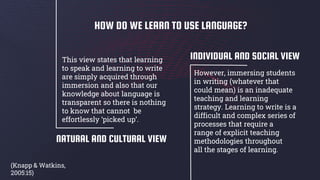
NATURAL AND CULTURAL VIEW
This view states that learning
to speak and learning to write
are simply acquired through
immersion and also that our
knowledge about language is
transparent so there is nothing
to know that cannot be
effortlessly ‘picked up’.
HOW DO WE LEARN TO USE LANGUAGE?
INDIVIDUAL AND SOCIAL VIEW
However, immersing students
in writing (whatever that
could mean) is an inadequate
teaching and learning
strategy. Learning to write is a
difficult and complex series of
processes that require a
range of explicit teaching
methodologies throughout
all the stages of learning.
(Knapp & Watkins,
2005:15)
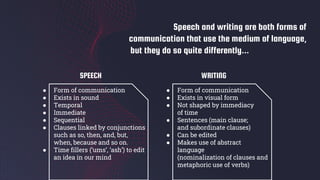
Speech and writing are both forms of
communication that use the medium of language,
but they do so quite differently...
SPEECH
● Form of communication
● Exists in sound
● Temporal
● Immediate
● Sequential
● Clauses linked by conjunctions
such as so, then, and, but,
when, because and so on.
● Time fillers (‘ums’, ‘ash’) to edit
an idea in our mind
WRITING
● Form of communication
● Exists in visual form
● Not shaped by immediacy
of time
● Sentences (main clause;
and subordinate clauses)
● Can be edited
● Makes use of abstract
language
(nominalization of clauses and
metaphoric use of verbs)
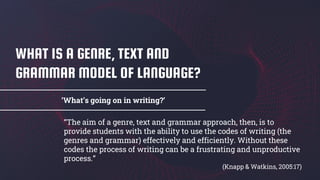
WHAT IS A GENRE, TEXT AND
GRAMMAR MODEL OF LANGUAGE?
‘What’s going on in writing?’
“The aim of a genre, text and grammar approach, then, is to
provide students with the ability to use the codes of writing (the
genres and grammar) effectively and efficiently. Without these
codes the process of writing can be a frustrating and unproductive
process.”
(Knapp & Watkins, 2005:17)
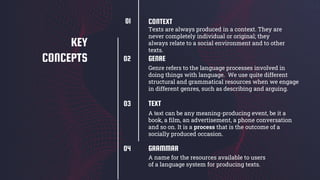
GENRE
TEXT
A text can be any meaning-producing event, be it a
book, a film, an advertisement, a phone conversation
and so on. It is a process that is the outcome of a
socially produced occasion.
CONTEXT
Texts are always produced in a context. They are
never completely individual or original; they
always relate to a social environment and to other
texts.
Genre refers to the language processes involved in
doing things with language. We use quite different
structural and grammatical resources when we engage
in different genres, such as describing and arguing.
KEY
CONCEPTS
GRAMMAR
A name for the resources available to users
of a language system for producing texts.
01
02
03
04
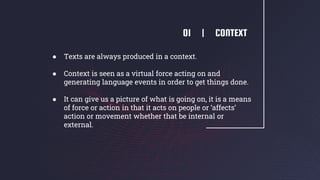
O1 | CONTEXT
● Texts are always produced in a context.
● Context is seen as a virtual force acting on and
generating language events in order to get things done.
● It can give us a picture of what is going on, it is a means
of force or action in that it acts on people or ‘affects’
action or movement whether that be internal or
external.
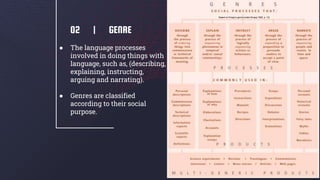
02 | GENRE
● The language processes
involved in doing things with
language, such as, (describing,
explaining, instructing,
arguing and narrating).
● Genres are classified
according to their social
purpose.
Based on Knapp’s genre model (Knapp 1992, p. 13)
03 | TEXT
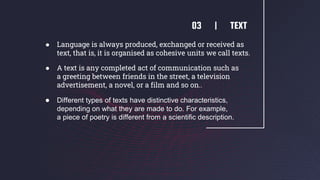
● Language is always produced, exchanged or received as
text, that is, it is organised as cohesive units we call texts.
● A text is any completed act of communication such as
a greeting between friends in the street, a television
advertisement, a novel, or a film and so on..
● Different types of texts have distinctive characteristics,
depending on what they are made to do. For example,
a piece of poetry is different from a scientific description.
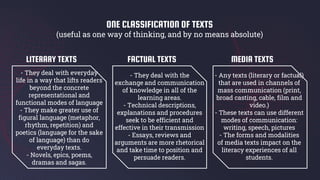
- They deal with everyday
life in a way that lifts readers
beyond the concrete
representational and
functional modes of language
- They make greater use of
figural language (metaphor,
rhythm, repetition) and
poetics (language for the sake
of language) than do
everyday texts.
- Novels, epics, poems,
dramas and sagas.
ONE CLASSIFICATION OF TEXTS
(useful as one way of thinking, and by no means absolute)
FACTUAL TEXTSLITERARY TEXTS MEDIA TEXTS
- They deal with the
exchange and communication
of knowledge in all of the
learning areas.
- Technical descriptions,
explanations and procedures
seek to be efficient and
effective in their transmission
- Essays, reviews and
arguments are more rhetorical
and take time to position and
persuade readers.
- Any texts (literary or factual)
that are used in channels of
mass communication (print,
broad casting, cable, film and
video.)
- These texts can use different
modes of communication:
writing, speech, pictures
- The forms and modalities
of media texts impact on the
literacy experiences of all
students.
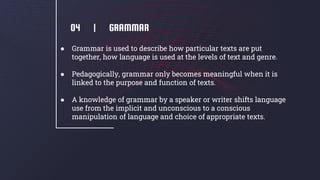
04 | GRAMMAR
● Grammar is used to describe how particular texts are put
together, how language is used at the levels of text and genre.
● Pedagogically, grammar only becomes meaningful when it is
linked to the purpose and function of texts.
● A knowledge of grammar by a speaker or writer shifts language
use from the implicit and unconscious to a conscious
manipulation of language and choice of appropriate texts.
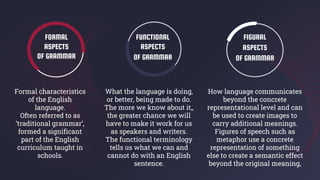
FORMAL
ASPECTS
OF GRAMMAR
FUNCTIONAL
ASPECTS
OF GRAMMAR
FIGURAL
ASPECTS
OF GRAMMAR
Formal characteristics
of the English
language.
Often referred to as
‘traditional grammar’,
formed a significant
part of the English
curriculum taught in
schools.
What the language is doing,
or better, being made to do.
The more we know about it,,
the greater chance we will
have to make it work for us
as speakers and writers.
The functional terminology
tells us what we can and
cannot do with an English
sentence.
How language communicates
beyond the concrete
representational level and can
be used to create images to
carry additional meanings.
Figures of speech such as
metaphor use a concrete
representation of something
else to create a semantic effect
beyond the original meaning,
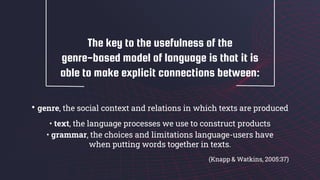
The key to the usefulness of the
genre-based model of language is that it is
able to make explicit connections between:
• genre, the social context and relations in which texts are produced
• text, the language processes we use to construct products
• grammar, the choices and limitations language-users have
when putting words together in texts.
(Knapp & Watkins, 2005:37)
BIBLIOGRAPHY
Knapp, P. & Watkins, M. (2005). Genre, Grammar, Text.
Technologies for Teaching and Assessing Writing. Australia:
UNSW Press.