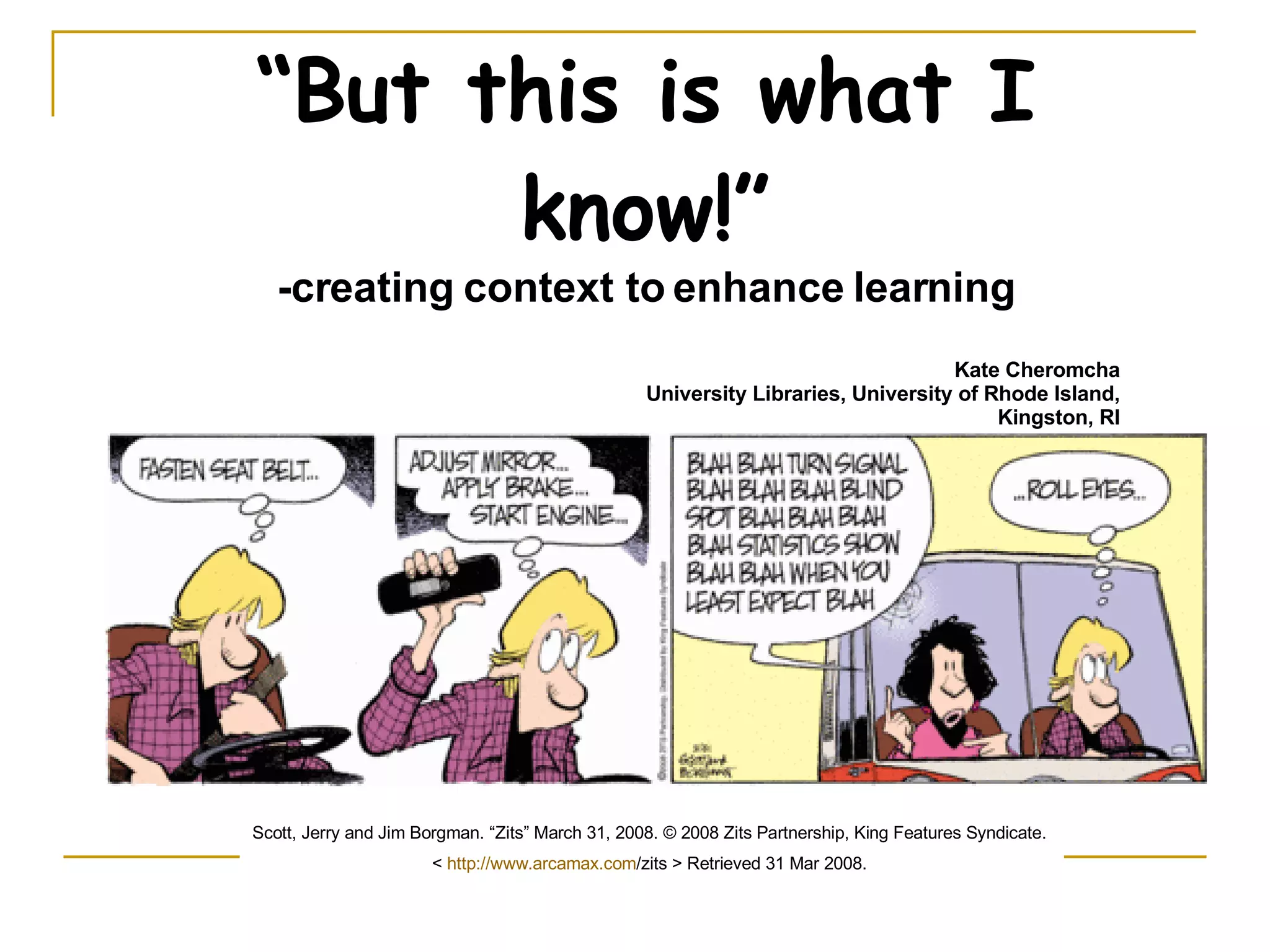
Scott, Jerry and Jim Borgman. “Zits” March 31, 2008. © 2008 Zits Partnership, King Features Syndicate.  <  http:// www.arcamax.com /zits  > Retrieved 31 Mar 2008.  “ But this is what I know!” -creating context to enhance learning Kate Cheromcha University Libraries, University of Rhode Island, Kingston, RI
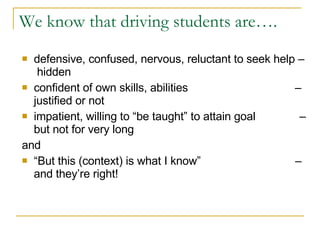
We know that driving students are…. defensive, confused, nervous, reluctant to seek help –  hidden  confident of own skills, abilities  – justified or not impatient, willing to “be taught” to attain goal  – but not for very long and “ But this (context) is what I know”  – and they’re right!
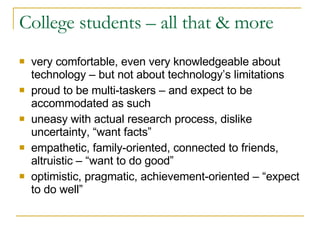
College students – all that & more very comfortable, even very knowledgeable about technology – but not about technology’s limitations proud to be multi-taskers – and expect to be accommodated as such uneasy with actual research process, dislike uncertainty, “want facts” empathetic, family-oriented, connected to friends, altruistic – “want to do good” optimistic, pragmatic, achievement-oriented – “expect to do well”
Know how they learn… Preferred instruction includes visual and kinesthetic, elements, rich media Prefer to learn by doing – experiencing, exploring, experimenting, interacting Expect teaching to accommodate learning preferences & styles – personalized choices, “consumer” attitude, flexibility, convenience Practical, want immediate connection between what is being taught and its usefulness – value, results
Know faculty expectations…. “A first year college student should be able to…” plan & conduct research evaluate content according to criteria draw conclusions based upon sufficient evidence make connections between prior knowledge & new information and more…..
Use this knowledge to create context.  Context- is the setting, background, situation, or environment relevant to an event, action, statement, etc.  can add relevance, create meaning, promote engagement. enables meaningful connections; makes the intangible, tangible; adds comfort, familiarity, confidence. is inescapable, undeniable, persistent.
“ Talk” to this student … Q. “What if you don't think plagiarism is that big a deal?  I mean, obviously you can't take someone's work word for word, but I mean you can paraphrase it.  And how is someone supposed to know if he/she is plagiarizing? How can we be sure that someone else, somewhere else hasn't written some kind of the same thing? For example, if I had a history assignment on the assassination of JFK, how can I be 100% sure that my paper, which to me is completely original, isn't like something someone else has written somewhere else?”
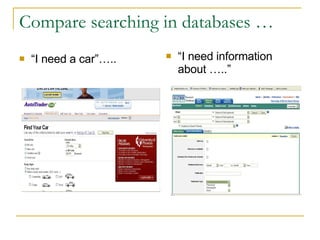
Compare searching in databases … “ I need information about …..” “ I need a car”…..
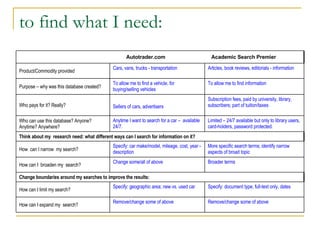
to find what I need: Remove/change some of above Remove/change some of above How can I expand my  search? Specify: document type, full-text only, dates  Specify: geographic area; new vs. used car How can I limit my search? Change boundaries around my searches to improve the results: Broader terms Change some/all of above How can I  broaden my  search? More specific search terms; identify narrow aspects of broad topic Specify: car make/model, mileage, cost, year - description How  can I narrow  my search? Think about my  research need: what different ways can I search for information on it? Limited – 24/7 available but only to library users, card-holders, password protected. Anytime I want to search for a car –  available 24/7. Who can use this database? Anyone? Anytime? Anywhere? Subscription fees, paid by university, library, subscribers; part of tuition/taxes Sellers of cars, advertisers Who pays for it? Really? To allow me to find information To allow me to find a vehicle, for buying/selling vehicles Purpose – why was this database created? Articles, book reviews, editorials - information Cars, vans, trucks - transportation Product/Commodity provided Autotrader.com  Academic Search Premier
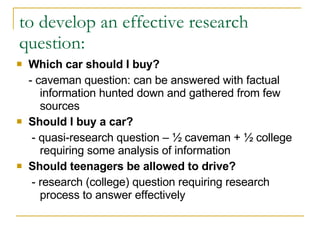
to develop an effective research  question: Which car should I buy? - caveman question: can be answered with factual information hunted down and gathered from few sources Should I buy a car?   - quasi-research question – ½ caveman + ½ college requiring some analysis of information Should teenagers be allowed to drive?  - research (college) question requiring research process to answer effectively
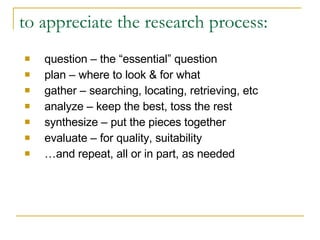
to appreciate the research process: question – the “essential” question plan – where to look & for what gather – searching, locating, retrieving, etc analyze – keep the best, toss the rest synthesize – put the pieces together evaluate – for quality, suitability … and repeat, all or in part, as needed
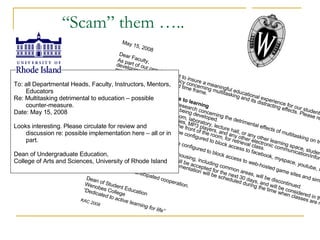
May 15, 2008 Dear Faculty, As part of our ongoing effort to insure a meaningful educational experience for our students, we are developing the following policy concerning multitasking and its distracting effects. Please review and respond within the requested time frame. Policy to eliminate obstacles to learning Pursuant to recently reported research concerning the detrimental effects of multitasking on true, meaningful learning, the following policy is being developed. Upon entering a college classroom, laboratory, lecture hall, or any other learning space, students will deposit all cell phones, PDAs, Blackberries, MP3 players, and any other electronic communication/information devices in secure containers at the front of the room, for retrieval class. All college computer servers will be configured to block access to facebook, myspace, youtube, xanga, and other online social networks. All college computer servers will be configured to block access to web-hosted game sites and similar entertainment networks. Cable television service in campus housing, including common areas, will be discontinued. Comments on the proposed policy will be accepted for the next 30 days, and will be considered in the development of the final policy. Implementation will be scheduled during the time when classes are not in session, to minimize disruption. Thank you for your anticipated cooperation. Dean of Student Education Wenobes College  “ Dedicated to active learning for life”  KAC 2008 To: all Departmental Heads, Faculty, Instructors, Mentors, Educators Re: Multitasking detrimental to education – possible counter-measure. Date: May 15, 2008 Looks interesting. Please circulate for review and discussion re: possible implementation here – all or in part. Dean of Undergraduate Education,  College of Arts and Sciences, University of Rhode Island “ Scam” them …..
….into  really  evaluating websites. Evaluate pre-selected “medical.org” websites  – dispels existing assumptions Evaluation criteria provided  – includes “look behind the scenes” “ Should your loved one use this information?”  – requires analysis for definite answer  Presentations and “thumbs up, thumbs down” class votes  - connected and engaged
Content + Context = Connection Know what students value, care about, worry about, dismiss, expect – “what do they know?” Know what skills, abilities, etc. students need to succeed – “what do they need to know?” Make the new seem familiar with context – “how will they learn it?”
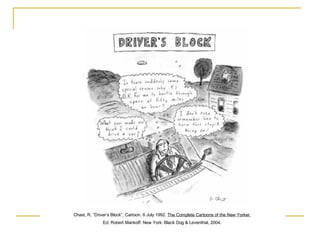
Chast, R. “Driver’s Block”, Cartoon. 6 July 1992.  The Complete Cartoons of the New Yorker.   Ed. Robert Mankoff. New York: Black Dog & Leventhal, 2004.
Bibliography Fitzgerald, Mary Ann. &quot;Making the Leap from High School to College: Three New Studies about Information Literacy Skills  of First-Year College Students.&quot;  Knowledge Quest 32.4 (2004): 19-24. Information Science & Technology Abstracts with Full Text.  EBSCO. 31 Mar 2008 University Libraries, URI, Kingston, RI <http://search.ebscohost.com> Lantz, Agneta and Brage, Christina. &quot;Towards a Learning Society - Exploring the Challenge of Applied Information Literacy  through Reality-Based Scenarios.&quot; ITALICS: Innovation in Teaching and Learning in Information and Computer Sciences. 5.1 (2006).  31 Mar 2008 <http://www.ics.heacademy.ac.uk/italics/vol5-1/pdf/lantz-brage-final.pdf> Sweeney, Richard. Article: “Millennial Behaviors & Demographics.” (Includes bibliography)  22 Dec 2006.  Personal website of Richard Sweeney. 25 May 2008. <http://library1.njit.edu/s taff-folders/sweeney/> Kirton, Jennifer, and Lyn Barham. &quot;Information Literacy in the Workplace.&quot; Australian Library Journal 54.4 (2005): 365-76. Library,  Information Science & Technology Abstracts with Full Text. EBSCO. 21 Mar 08. University Libraries, URI, Kingston, RI  <http://search.ebscohost.com> Tessmer, Martin and Rita C. Richey. &quot;Role of Context in Learning and Instructional Design.“ Educational Technology Research and Development 45.2 (1997): 85.1 Feb 2008  University Libraries, URI, Kingston, RI. <http://www.springerlink.com>

whatiknow

  • 1.
    Scott, Jerry andJim Borgman. “Zits” March 31, 2008. © 2008 Zits Partnership, King Features Syndicate. < http:// www.arcamax.com /zits > Retrieved 31 Mar 2008. “ But this is what I know!” -creating context to enhance learning Kate Cheromcha University Libraries, University of Rhode Island, Kingston, RI
  • 2.
    We know thatdriving students are…. defensive, confused, nervous, reluctant to seek help – hidden confident of own skills, abilities – justified or not impatient, willing to “be taught” to attain goal – but not for very long and “ But this (context) is what I know” – and they’re right!
  • 3.
    College students –all that & more very comfortable, even very knowledgeable about technology – but not about technology’s limitations proud to be multi-taskers – and expect to be accommodated as such uneasy with actual research process, dislike uncertainty, “want facts” empathetic, family-oriented, connected to friends, altruistic – “want to do good” optimistic, pragmatic, achievement-oriented – “expect to do well”
  • 4.
    Know how theylearn… Preferred instruction includes visual and kinesthetic, elements, rich media Prefer to learn by doing – experiencing, exploring, experimenting, interacting Expect teaching to accommodate learning preferences & styles – personalized choices, “consumer” attitude, flexibility, convenience Practical, want immediate connection between what is being taught and its usefulness – value, results
  • 5.
    Know faculty expectations….“A first year college student should be able to…” plan & conduct research evaluate content according to criteria draw conclusions based upon sufficient evidence make connections between prior knowledge & new information and more…..
  • 6.
    Use this knowledgeto create context. Context- is the setting, background, situation, or environment relevant to an event, action, statement, etc. can add relevance, create meaning, promote engagement. enables meaningful connections; makes the intangible, tangible; adds comfort, familiarity, confidence. is inescapable, undeniable, persistent.
  • 7.
    “ Talk” tothis student … Q. “What if you don't think plagiarism is that big a deal? I mean, obviously you can't take someone's work word for word, but I mean you can paraphrase it. And how is someone supposed to know if he/she is plagiarizing? How can we be sure that someone else, somewhere else hasn't written some kind of the same thing? For example, if I had a history assignment on the assassination of JFK, how can I be 100% sure that my paper, which to me is completely original, isn't like something someone else has written somewhere else?”
  • 8.
    Compare searching indatabases … “ I need information about …..” “ I need a car”…..
  • 9.
    to find whatI need: Remove/change some of above Remove/change some of above How can I expand my search? Specify: document type, full-text only, dates Specify: geographic area; new vs. used car How can I limit my search? Change boundaries around my searches to improve the results: Broader terms Change some/all of above How can I broaden my search? More specific search terms; identify narrow aspects of broad topic Specify: car make/model, mileage, cost, year - description How can I narrow my search? Think about my research need: what different ways can I search for information on it? Limited – 24/7 available but only to library users, card-holders, password protected. Anytime I want to search for a car – available 24/7. Who can use this database? Anyone? Anytime? Anywhere? Subscription fees, paid by university, library, subscribers; part of tuition/taxes Sellers of cars, advertisers Who pays for it? Really? To allow me to find information To allow me to find a vehicle, for buying/selling vehicles Purpose – why was this database created? Articles, book reviews, editorials - information Cars, vans, trucks - transportation Product/Commodity provided Autotrader.com Academic Search Premier
  • 10.
    to develop aneffective research question: Which car should I buy? - caveman question: can be answered with factual information hunted down and gathered from few sources Should I buy a car? - quasi-research question – ½ caveman + ½ college requiring some analysis of information Should teenagers be allowed to drive? - research (college) question requiring research process to answer effectively
  • 11.
    to appreciate theresearch process: question – the “essential” question plan – where to look & for what gather – searching, locating, retrieving, etc analyze – keep the best, toss the rest synthesize – put the pieces together evaluate – for quality, suitability … and repeat, all or in part, as needed
  • 12.
    May 15, 2008Dear Faculty, As part of our ongoing effort to insure a meaningful educational experience for our students, we are developing the following policy concerning multitasking and its distracting effects. Please review and respond within the requested time frame. Policy to eliminate obstacles to learning Pursuant to recently reported research concerning the detrimental effects of multitasking on true, meaningful learning, the following policy is being developed. Upon entering a college classroom, laboratory, lecture hall, or any other learning space, students will deposit all cell phones, PDAs, Blackberries, MP3 players, and any other electronic communication/information devices in secure containers at the front of the room, for retrieval class. All college computer servers will be configured to block access to facebook, myspace, youtube, xanga, and other online social networks. All college computer servers will be configured to block access to web-hosted game sites and similar entertainment networks. Cable television service in campus housing, including common areas, will be discontinued. Comments on the proposed policy will be accepted for the next 30 days, and will be considered in the development of the final policy. Implementation will be scheduled during the time when classes are not in session, to minimize disruption. Thank you for your anticipated cooperation. Dean of Student Education Wenobes College “ Dedicated to active learning for life” KAC 2008 To: all Departmental Heads, Faculty, Instructors, Mentors, Educators Re: Multitasking detrimental to education – possible counter-measure. Date: May 15, 2008 Looks interesting. Please circulate for review and discussion re: possible implementation here – all or in part. Dean of Undergraduate Education, College of Arts and Sciences, University of Rhode Island “ Scam” them …..
  • 13.
    ….into really evaluating websites. Evaluate pre-selected “medical.org” websites – dispels existing assumptions Evaluation criteria provided – includes “look behind the scenes” “ Should your loved one use this information?” – requires analysis for definite answer Presentations and “thumbs up, thumbs down” class votes - connected and engaged
  • 14.
    Content + Context= Connection Know what students value, care about, worry about, dismiss, expect – “what do they know?” Know what skills, abilities, etc. students need to succeed – “what do they need to know?” Make the new seem familiar with context – “how will they learn it?”
  • 15.
    Chast, R. “Driver’sBlock”, Cartoon. 6 July 1992. The Complete Cartoons of the New Yorker. Ed. Robert Mankoff. New York: Black Dog & Leventhal, 2004.
  • 16.
    Bibliography Fitzgerald, MaryAnn. &quot;Making the Leap from High School to College: Three New Studies about Information Literacy Skills of First-Year College Students.&quot; Knowledge Quest 32.4 (2004): 19-24. Information Science & Technology Abstracts with Full Text. EBSCO. 31 Mar 2008 University Libraries, URI, Kingston, RI <http://search.ebscohost.com> Lantz, Agneta and Brage, Christina. &quot;Towards a Learning Society - Exploring the Challenge of Applied Information Literacy through Reality-Based Scenarios.&quot; ITALICS: Innovation in Teaching and Learning in Information and Computer Sciences. 5.1 (2006). 31 Mar 2008 <http://www.ics.heacademy.ac.uk/italics/vol5-1/pdf/lantz-brage-final.pdf> Sweeney, Richard. Article: “Millennial Behaviors & Demographics.” (Includes bibliography) 22 Dec 2006. Personal website of Richard Sweeney. 25 May 2008. <http://library1.njit.edu/s taff-folders/sweeney/> Kirton, Jennifer, and Lyn Barham. &quot;Information Literacy in the Workplace.&quot; Australian Library Journal 54.4 (2005): 365-76. Library, Information Science & Technology Abstracts with Full Text. EBSCO. 21 Mar 08. University Libraries, URI, Kingston, RI <http://search.ebscohost.com> Tessmer, Martin and Rita C. Richey. &quot;Role of Context in Learning and Instructional Design.“ Educational Technology Research and Development 45.2 (1997): 85.1 Feb 2008 University Libraries, URI, Kingston, RI. <http://www.springerlink.com>