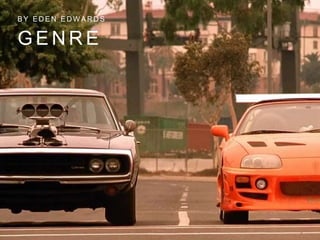
G E N R E
B Y E D E N E D W A R D S
W H A T I S G E N R E ?
• According to Google, Genre is a style or category of art,
music or literature.
• The word Genre comes from the French word which
means ‘type’ or ‘class’. Media Genres appear through
film and television. These can be horror films or on
television they could be romantic comedies.
• Genres can be recognised by their common
distinguishing features. These are conventions which
every film of a certain genre contain.
D I F F E R E N T T Y P E S O F G E N R E S
• Action,
• Adventure,
• Comedy,
• Crime,
• Fantasy,
• Historical,
• Horror/Thriller,
• Mystery,
• Romance,
• Just to name a few.
W H Y A R E G E N R E S U S E F U L F O R
A U D I E N C E S ?
• Genres are very useful for the receiving audiences
because they give them an idea of what to expect from a
film before they purchase, download or watch it.
Audiences take pleasure in the fact that they roughly
know what to expect from a film. For example a horror
film (to be scared) or a comedy (to laugh).
• For example I would know that if I scrolled through the
comedy section of Netflix, that all these films would be
happy and funny films. The same applies for any other
genre such as horror and romantic films.
W H Y A R E G E N R E S U S E F U L T O
I N S T I T U T I O N S ?
• An institution is an ‘Organisation or company, public or
privately owned that produces and/or distributes media
products.’
• Genres are useful for institutions as they give them an idea
of what sort of materials and merchandise should be used
when marketing the film to audiences so that they recognise
a film as being part of a particular genre.
• Genres have recognisable connotations, like plot, characters,
settings and music. These all give the industry a chance to
predict the expectations of audiences.
T H E
R E P E R T O I R E
O F E L E M E N T S
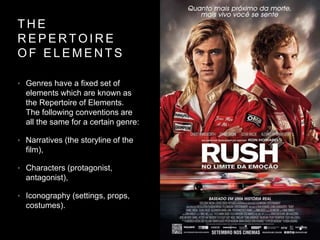
• Genres have a fixed set of
elements which are known as
the Repertoire of Elements.
The following conventions are
all the same for a certain genre:
• Narratives (the storyline of the
film),
• Characters (protagonist,
antagonist),
• Iconography (settings, props,
costumes).

Genre research pp 2016

  • 1.
    G E NR E B Y E D E N E D W A R D S
  • 2.
    W H AT I S G E N R E ? • According to Google, Genre is a style or category of art, music or literature. • The word Genre comes from the French word which means ‘type’ or ‘class’. Media Genres appear through film and television. These can be horror films or on television they could be romantic comedies. • Genres can be recognised by their common distinguishing features. These are conventions which every film of a certain genre contain.
  • 3.
    D I FF E R E N T T Y P E S O F G E N R E S • Action, • Adventure, • Comedy, • Crime, • Fantasy, • Historical, • Horror/Thriller, • Mystery, • Romance, • Just to name a few.
  • 4.
    W H YA R E G E N R E S U S E F U L F O R A U D I E N C E S ? • Genres are very useful for the receiving audiences because they give them an idea of what to expect from a film before they purchase, download or watch it. Audiences take pleasure in the fact that they roughly know what to expect from a film. For example a horror film (to be scared) or a comedy (to laugh). • For example I would know that if I scrolled through the comedy section of Netflix, that all these films would be happy and funny films. The same applies for any other genre such as horror and romantic films.
  • 5.
    W H YA R E G E N R E S U S E F U L T O I N S T I T U T I O N S ? • An institution is an ‘Organisation or company, public or privately owned that produces and/or distributes media products.’ • Genres are useful for institutions as they give them an idea of what sort of materials and merchandise should be used when marketing the film to audiences so that they recognise a film as being part of a particular genre. • Genres have recognisable connotations, like plot, characters, settings and music. These all give the industry a chance to predict the expectations of audiences.
  • 6.
    T H E RE P E R T O I R E O F E L E M E N T S • Genres have a fixed set of elements which are known as the Repertoire of Elements. The following conventions are all the same for a certain genre: • Narratives (the storyline of the film), • Characters (protagonist, antagonist), • Iconography (settings, props, costumes).