Human Rights And Citizenship
Course code: ENG-360
Submitted to: ma’am Aqdas
Submitted by: group 10
International humanitarian law (IHL) is a
set of rules that seek for humanitarian
reasons to limit the effects of armed
conflict. IHL protects persons who are not
or who are no longer participating in
hostilities and it restricts the means and
methods of warfare. IHL is also known as
the law of war and the law of armed
conflict.
A major part of international
humanitarian law is contained in the four
Geneva Conventions of 1949 that have
been adopted by all nations in the world.
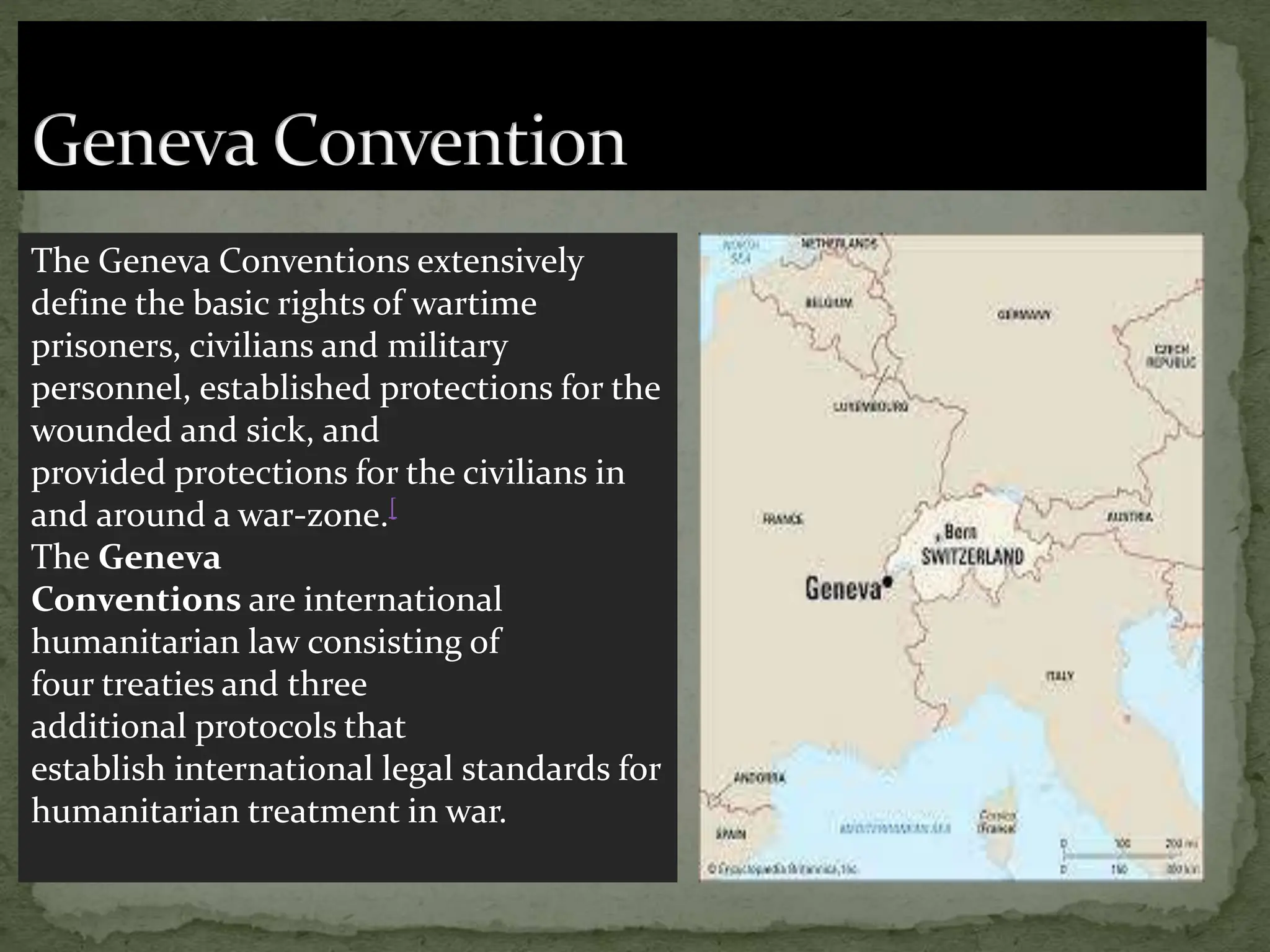
The Geneva Conventions extensively
define the basic rights of wartime
prisoners, civilians and military
personnel, established protections for the
wounded and sick, and
provided protections for the civilians in
and around a war-zone.[
The Geneva
Conventions are international
humanitarian law consisting of
four treaties and three
additional protocols that
establish international legal standards for
humanitarian treatment in war.
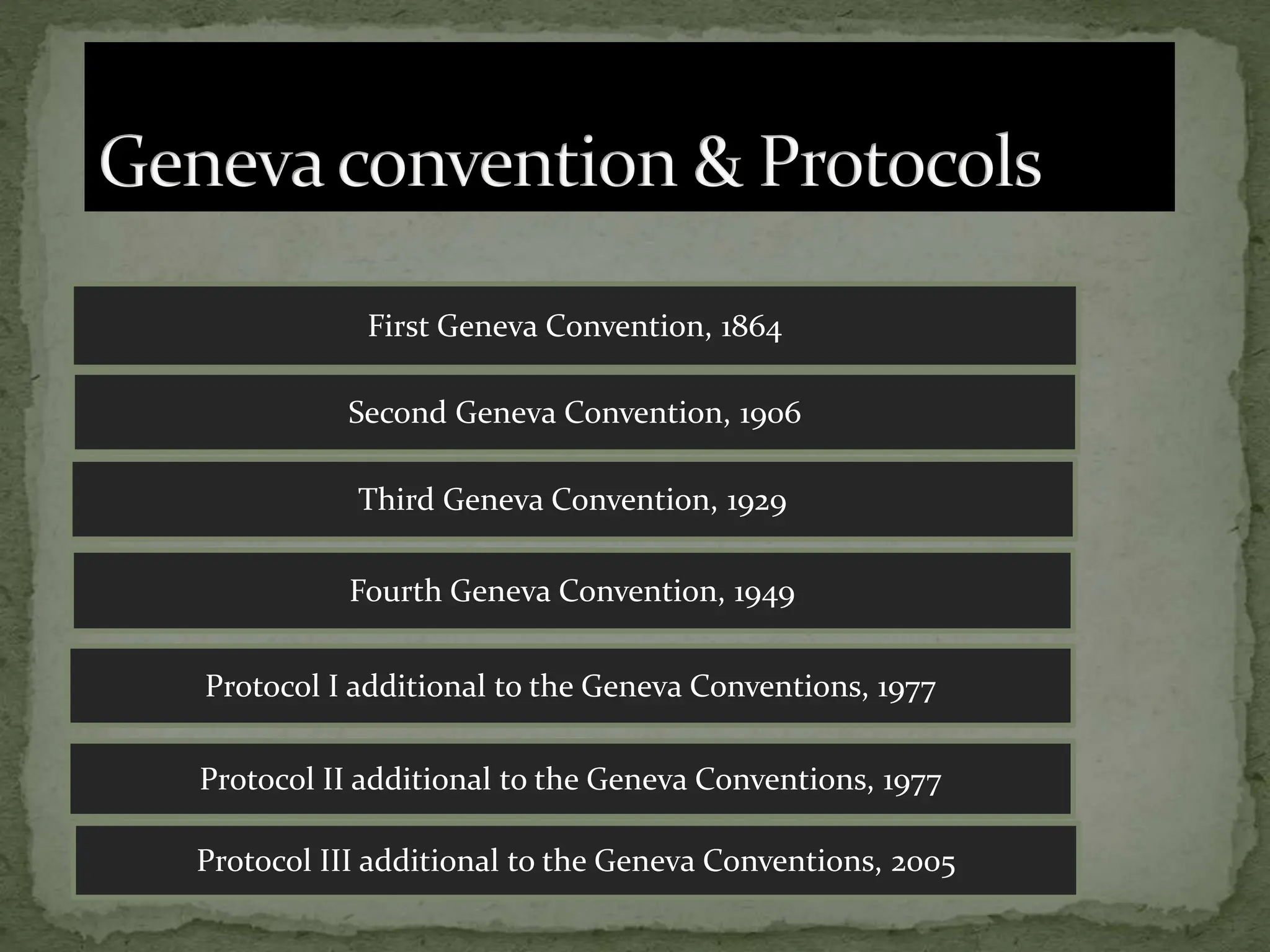
First Geneva Convention, 1864
Second Geneva Convention, 1906
Fourth Geneva Convention, 1949
Protocol I additional to the Geneva Conventions, 1977
Protocol II additional to the Geneva Conventions, 1977
Protocol III additional to the Geneva Conventions, 2005
Third Geneva Convention, 1929
The development of modern
international humanitarian law is
credited to the efforts of 19th century
Swiss businessman Henry Dunant. In
1859, Dunant witnessed the aftermath
of a bloody battle between French
and Austrian armies in Solferino, Italy.
The departing armies left a battlefield
littered with wounded and dying men.
Despite Dunant’s valiant efforts to
mobilize aid for the soldiers, thousands
died.
His humanitarian efforts won him the first
Nobel Peace Prize in 1901.
In “A Memory of Solferino,” his
book about the experience,
Dunant proposed that trained
volunteer relief groups be granted
protection during war in order to
care for the wounded. A group
known as the Committee of Five,
which later became the
International Committee of
the Red Cross, formed in Geneva
in 1863 to act on Dunant’s
suggestion.
Dunant also suggested a formal
agreement between nations “for
the relief of the wounded.”
16 nations, assisted by this
committee, as well as
representatives of military
medical services and
humanitarian societies,
negotiated a convention (treaty)
containing 10 articles specifying
that:
 Ambulances, military
hospitals, and the personnel
serving with them are to be
recognized as neutral and
protected during conflict;
 Citizens who assist the
wounded are to be protected;
 Wounded or sick combatants are
to be collected and cared for by
either side in a conflict;
 The symbol of a red cross on a
white background (the reverse of
the Swiss flag in honor of the
origin of this initiative) will serve
as a protective emblem to identify
medical personnel, equipment,
and facilities.
 The Geneva Convention for the Amelioration of the
Condition of the Wounded and Sick in Armed Forces
in the Field of August 12, 1949. The First Geneva
Convention protects soldiers who are hors de combat
(out of the battle). The 10 articles of the original 1864
version of the Convention have been expanded in the
First Geneva Convention of 1949 to 64 articles that
protect the following:
 Wounded and sick soldiers
 Medical personnel, facilities and equipment
 Wounded and sick civilian support personnel
accompanying the armed forces
 Military chaplains
 Civilians who spontaneously take up arms to repel an
invasion
 The Geneva Convention for the Amelioration of the
Condition of Wounded, Sick and Shipwrecked
Members of Armed Forces at Sea of August 12, 1949
The Second Geneva Convention adapts the protections
of the First Geneva Convention to reflect conditions at
sea. It protects wounded and sick combatants while on
board ship or at sea.
 Protocol I (102 Articles) Protocol additional to the
Geneva Conventions of 12 August 1949, and Relating to
the Protection of Victims of International Armed
Conflicts Protocol I expands protection for the civilian
population as well as military and civilian medical
workers in international armed conflicts
 Protocol II (28 Articles) Protocol additional to the
Geneva Conventions of 12 August 1949, and Relating to
the Protection of Victims of Non-International Armed
Conflicts Protocol II elaborates on protections for
victims caught up in high-intensity internal conflicts
such as civil wars. It does not apply to such internal
disturbances as riots, demonstrations and isolated acts
of violence. Protocol II expands and complements the
non-international protections contained in Article 3
common to all four Geneva Conventions of 1949.
 The Geneva Convention Relative to the Treatment of
Prisoners of War of August 12, 1949 The Third Geneva
Convention sets out specific rules for the treatment of
prisoners of war (POWs). The Convention’s 143 articles
require that POWs be treated humanely, adequately
housed and receive sufficient food, clothing and
medical care. Its provisions also establish guidelines
on labor, discipline, recreation and criminal trial.
Note that prisoners of war may include the following:
 Members of the armed forces Volunteer militia,
including resistance movements
 Civilians accompanying the armed forces.
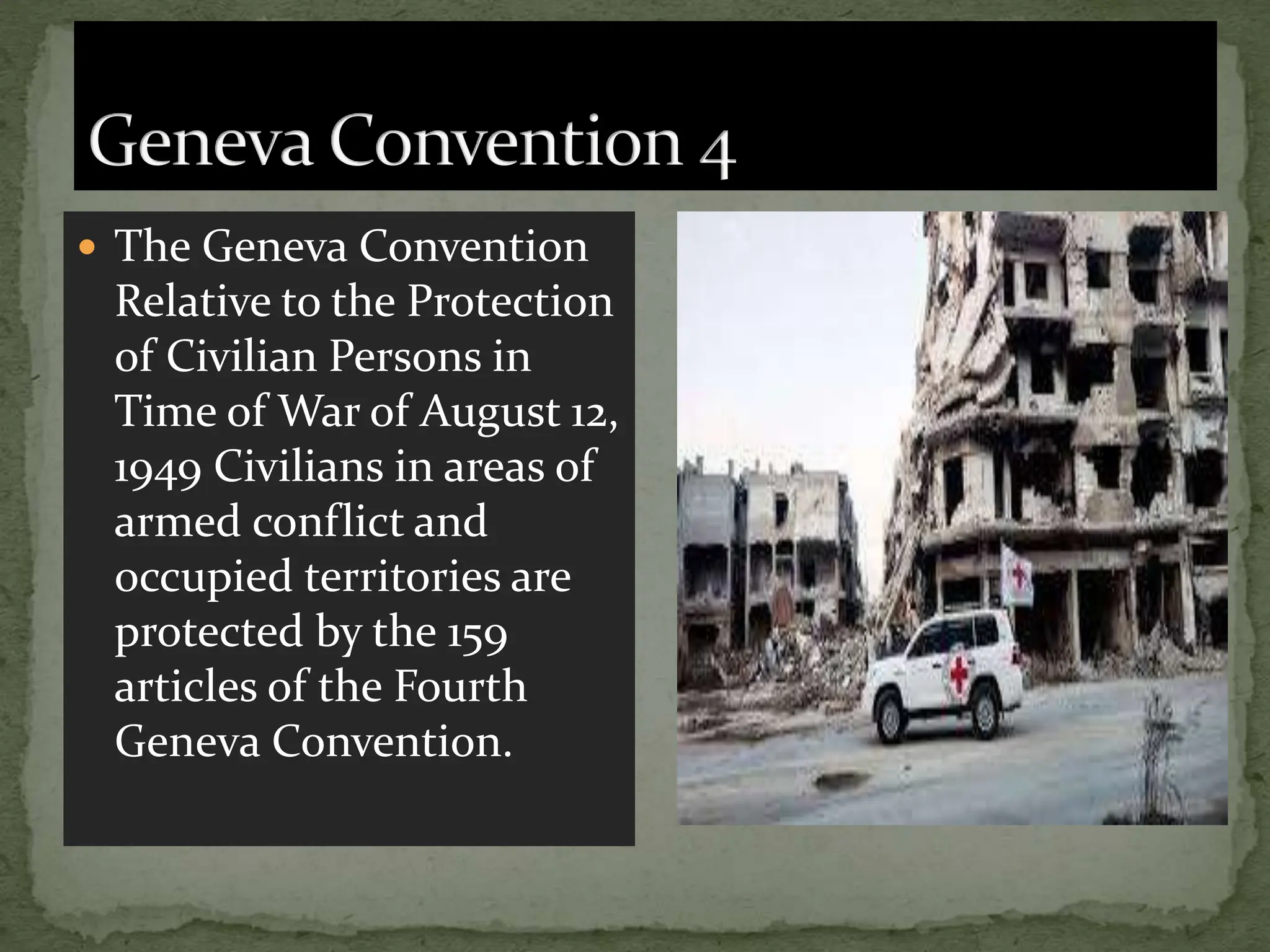
 The Geneva Convention
Relative to the Protection
of Civilian Persons in
Time of War of August 12,
1949 Civilians in areas of
armed conflict and
occupied territories are
protected by the 159
articles of the Fourth
Geneva Convention.
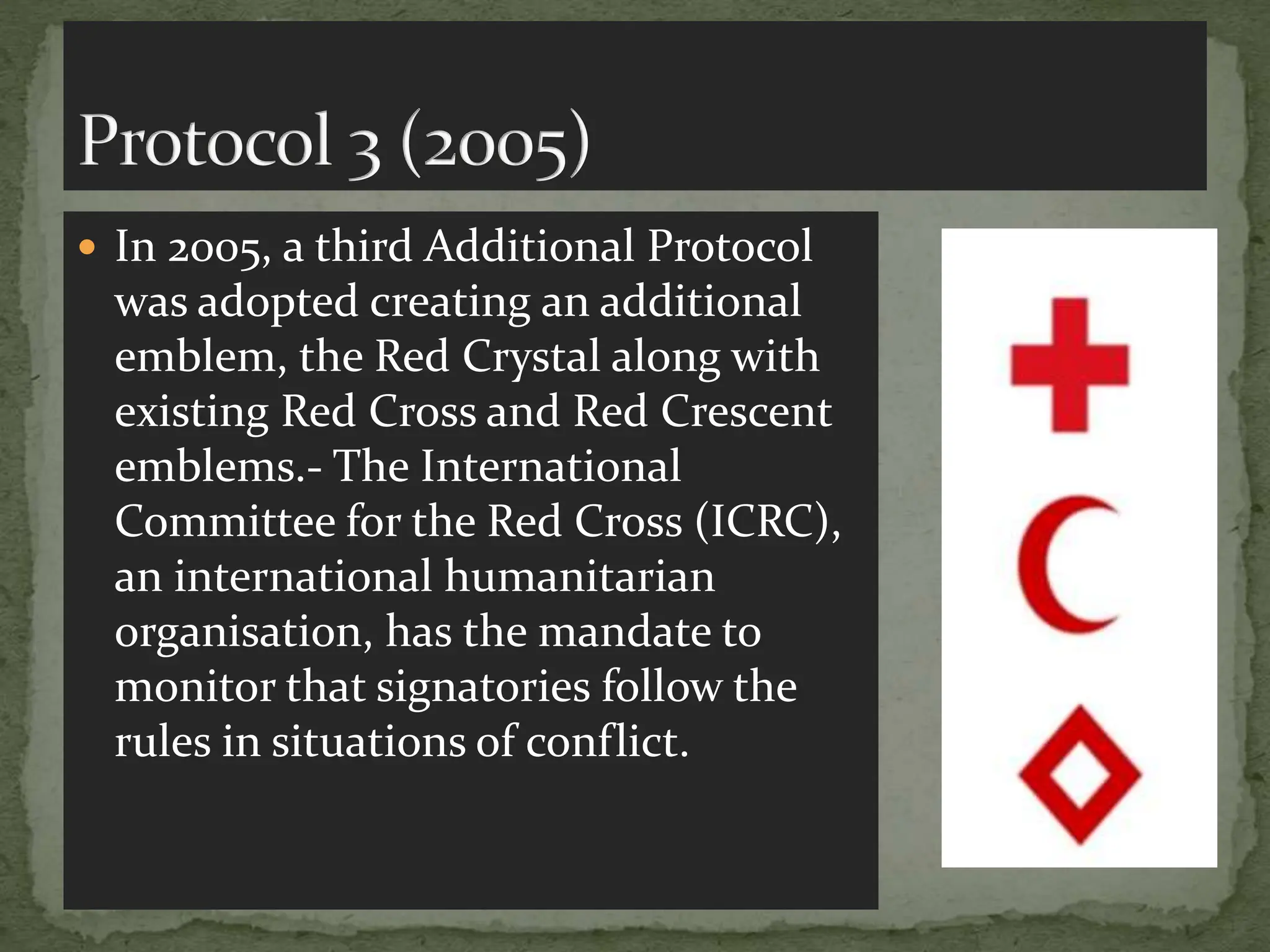
 In 2005, a third Additional Protocol
was adopted creating an additional
emblem, the Red Crystal along with
existing Red Cross and Red Crescent
emblems.- The International
Committee for the Red Cross (ICRC),
an international humanitarian
organisation, has the mandate to
monitor that signatories follow the
rules in situations of conflict.
 All four Geneva Conventions contain an identical Article 3,
extending general coverage to “conflicts not of an
international character.” In the case of armed conflict not
of an international character occurring in the territory of
one of the High Contracting Parties, each Party to the
conflict shall be bound to apply, as a minimum, the
following provisions:
 1. Persons taking no active part in the hostilities, including
members of the armed forces who have laid down their
arms and those placed hors de combat (out of the fight) by
sickness, wounds, detention, or any other cause, shall in all
circumstances be treated humanely, without any adverse
distinction founded on race, color, religion or faith, sex,
birth or wealth, or any other similar criteria.
 To this end, the following acts are and shall remain
prohibited at any time and in any place whatsoever with
respect to the above-mentioned persons:
 (a) Violence to life and person, in particular murder of all
kinds, mutilation, cruel treatment and torture;
 (b) Taking of hostages;
 (c) Outrages upon personal dignity, in particular,
humiliating and degrading treatment;
 (d) The passing of sentences and the carrying out of
executions without previous judgment pronounced by a
regularly constituted court, affording all the judicial
guarantees which are recognized as indispensable by
civilized peoples.
 2. The wounded, sick and shipwrecked shall be
collected and cared for. An impartial humanitarian
body, such as the International Committee of the Red
Cross, may offer its services to the Parties to the
conflict. The Parties to the conflict should further
endeavor to bring into force, by means of special
agreements, all or part of the other provisions of the
present Convention. The application of the preceding
provisions shall not affect the legal status of the Parties
to the conflict.
 Ancient
International humanitarian law
is founded on the principles of
humanity, partiality and
neutrality. Its roots extend to
such historic concepts of justice
as
 Babylon’s Hammurabic Code
(1775-1750)
 The Code of Justinian from
the Byzantine Empire
 The Lieber Code used during
the United States Civil War.
 During the Civil War in 1863,
Abraham Lincolnhad brought in a
code which was known as "Lieber
Code"It was a set of instructions
given by the US military
department to its officials to
ensure no citizen, wounded
combatants, etc. Lieber Code
forbade any kind of forceful labour
by the victorious government. It
also prohibited unnecessary
violence against "rival civilians"
 Hiduism
The set of ethical rules for conflict and war times have
always been in existence The great Epic Mahabharata
contains several ethical principles for war time. For eg:
Attacking enemy after the sunset was not allowed in
Mahabhara
For the treatment of
POWs, Islamic law
requires that they be
respected and treated
humanely. They must
be fed and given water
to drink, clothed if
necessary, and
protected from the heat
and the cold and from
cruel treatment.
Torturing POWs to
obtain military
information is
prohibited
 2American soldiers killed 73 unarmed
Italian and German prisoners of War
in the Biscari Massacre of 1943, the
British had an interrogation centre
that was accused of harsh treatment of
POWs* and stories of German, Soviet
and Japanese brutality to prisoners are
commonplace. Also holocaust and
genocide.
 It is worth mentioning here that till World War-1, the
head of states enjoyed absolute immunity of war
crimes
 According to the Geneva conventions, the signatory
parties are the authority to persecute such war
criminals. However, since 1990s, International
Tribunals have started implementing them
 And later ICC is to presecute individuals who have
committed war crimes or crimes against humanity
The Rome Statute of the International
Criminal Court is the treaty that
established the International Criminal
Court. It was adopted at a diplomatic
conference in Rome, Italy on 17 July 1998
and it entered into force on 1 July 2002.
As of November 2019, 123 states are party
to the statute.
Start date: July 17, 1998
 Location: Rome
 Condition: 60 ratifications
 Depositary: UN Secretary-General
 Effective: 1 July 2002
 Signed: 17 July 1998
 Signatories: 137
 Jean-Pierre Bemba
Former Congolese vice-president
and militia leader was convicted by
the ICC in 2016 for war crimes and
crimes against humanity, Bemba's
conviction only encompassed one
murder, twenty acts of rape, and
five acts of pillage in the Central
African Republic. Sentenced to 18
years' imprisonment in 2016 and
acquitted in 2018.
 Ntaganda case: ICC found
the members of Congolese
Armed group were
involved in mass sexual
crime. He was sentenced
by the ICC to a total of 30
years of imprisonment on
Nov 2019
 The International Committee of
the Red Cross (ICRC) holds
that the establishment of Israeli
settlements violate Fourth Geneva
Convention. The ICRC also holds
that the displacement of
Palestinians that may occur due to
the settlements also violates
Article 49 of the Fourth Geneva
Convention.
 Israel and USA both are not parties of the ICC. Israel
has consistently rejected the jurisdiction of ICC on
such issue
 US. Vice President Kamala
Harris has already called for an
investigation into allegations of
Russia committing war crimes in
Ukraine, citing as example the
bombing of a maternity hospital
in the southern city of Mariupol.
 Similarly, there has been
photographic and video evidence
of lethal firing on civilians trying
to escape across adamaged
bridge in Irpin, near Kyiv;
and hours of cell phone videos of bombed-out schools,
houses, and apartment buildings across Ukraine.
 On February 28 2022, the ICC opened a war crimes
investigation under its prosecutor, Karim Khan.
 There are over 700,000
Indian soldiers occupying
Kashmir, making it the
world’s most densely
militarised zone. Life
there has always
resembled living in an
open air prison, similar to
Gaza. Article 32 of the
Geneva IV prohibits
torture against civilians
in the occupied territory
 Article 27 of the Geneva IV states that, “Protected
persons are entitled, in all circumstances, to respect
for their persons, their honour, their family rights,
their religious convictions and practices, and their
manners and customs. They shall at all times be
humanely treated, and shall be protected especially
against all acts of violence or threats thereof and
against insults and public curiosity.” India denied
locals access to the Jamia Masjid, the main masjid
in Srinagar, for Eid prayers.
 Article 49 of the Geneva IV says,
“The Occupying Power shall not
deport or transfer parts of its own
civilian population into the
territory it occupies.” After
revoking Article 370 of the Indian
Constitution, India has not only
stripped the Kashmiris of their
autonomy, but also paved the way
for Indians to buy property and
make investments in Kashmir.
Mukesh Ambani announced that
his group will invest in the region
soon
 Neither the Indian MEA nor its
Pakistani counterpart has
identified the Wing
Commander as a PoW.
 However, as per the third
Geneva Convention, "The
convention applies to all cases
of declared war or of any other
armed conflict which may arise
between two or more of the
signatories, even if the state of
war is not recognized by one of
them."
 The ICC was severely criticized by African leaders for its
sole focus against African countries governments and
failure to take actions against powerful countries.
 It is true that punishing war crimes perpetrators is difficult
but some successful cases have also happened
 Critics claim that war crimes are mainly brought in against
only those countries which are either defeated or weak
 The lack of initiative for war crimes against powerful
countries clearly reflect in Isarel-Palestine, Armenia-
Azerbaijan case and in cases related to the US and China
 The eases in Iraq, Syria, Yemen & now Ukraine
underscore the grim fact that the Geneva Conventions,
even when backed by rulings of the ICC, have not been
able to be enforced.
 However , they have in the past proved effective at
raising global awareness of human rights violations
across conflict zones, and in some cases have even led
to sanctions or trade embargoes against the belligerent
parties.
Group #10
 Mussafa Zainab- Roll #9
 Saman Qayyum- Roll #11
 Shafqat Batool- Roll #14
 Waffa Shahzad- Roll #21
 Ayesha Ashraf- Roll #44
Edited by Waffa Shahzad

GENEVA CONVENTION COVERING IMPORTANT ASPECTS

  • 1.
    Human Rights AndCitizenship Course code: ENG-360 Submitted to: ma’am Aqdas Submitted by: group 10
  • 2.
    International humanitarian law(IHL) is a set of rules that seek for humanitarian reasons to limit the effects of armed conflict. IHL protects persons who are not or who are no longer participating in hostilities and it restricts the means and methods of warfare. IHL is also known as the law of war and the law of armed conflict. A major part of international humanitarian law is contained in the four Geneva Conventions of 1949 that have been adopted by all nations in the world.
  • 3.
    The Geneva Conventionsextensively define the basic rights of wartime prisoners, civilians and military personnel, established protections for the wounded and sick, and provided protections for the civilians in and around a war-zone.[ The Geneva Conventions are international humanitarian law consisting of four treaties and three additional protocols that establish international legal standards for humanitarian treatment in war.
  • 4.
    First Geneva Convention,1864 Second Geneva Convention, 1906 Fourth Geneva Convention, 1949 Protocol I additional to the Geneva Conventions, 1977 Protocol II additional to the Geneva Conventions, 1977 Protocol III additional to the Geneva Conventions, 2005 Third Geneva Convention, 1929
  • 5.
    The development ofmodern international humanitarian law is credited to the efforts of 19th century Swiss businessman Henry Dunant. In 1859, Dunant witnessed the aftermath of a bloody battle between French and Austrian armies in Solferino, Italy. The departing armies left a battlefield littered with wounded and dying men. Despite Dunant’s valiant efforts to mobilize aid for the soldiers, thousands died. His humanitarian efforts won him the first Nobel Peace Prize in 1901.
  • 6.
    In “A Memoryof Solferino,” his book about the experience, Dunant proposed that trained volunteer relief groups be granted protection during war in order to care for the wounded. A group known as the Committee of Five, which later became the International Committee of the Red Cross, formed in Geneva in 1863 to act on Dunant’s suggestion. Dunant also suggested a formal agreement between nations “for the relief of the wounded.”
  • 7.
    16 nations, assistedby this committee, as well as representatives of military medical services and humanitarian societies, negotiated a convention (treaty) containing 10 articles specifying that:  Ambulances, military hospitals, and the personnel serving with them are to be recognized as neutral and protected during conflict;  Citizens who assist the wounded are to be protected;
  • 8.
     Wounded orsick combatants are to be collected and cared for by either side in a conflict;  The symbol of a red cross on a white background (the reverse of the Swiss flag in honor of the origin of this initiative) will serve as a protective emblem to identify medical personnel, equipment, and facilities.
  • 10.
     The GenevaConvention for the Amelioration of the Condition of the Wounded and Sick in Armed Forces in the Field of August 12, 1949. The First Geneva Convention protects soldiers who are hors de combat (out of the battle). The 10 articles of the original 1864 version of the Convention have been expanded in the First Geneva Convention of 1949 to 64 articles that protect the following:
  • 11.
     Wounded andsick soldiers  Medical personnel, facilities and equipment  Wounded and sick civilian support personnel accompanying the armed forces  Military chaplains  Civilians who spontaneously take up arms to repel an invasion
  • 13.
     The GenevaConvention for the Amelioration of the Condition of Wounded, Sick and Shipwrecked Members of Armed Forces at Sea of August 12, 1949 The Second Geneva Convention adapts the protections of the First Geneva Convention to reflect conditions at sea. It protects wounded and sick combatants while on board ship or at sea.
  • 14.
     Protocol I(102 Articles) Protocol additional to the Geneva Conventions of 12 August 1949, and Relating to the Protection of Victims of International Armed Conflicts Protocol I expands protection for the civilian population as well as military and civilian medical workers in international armed conflicts
  • 15.
     Protocol II(28 Articles) Protocol additional to the Geneva Conventions of 12 August 1949, and Relating to the Protection of Victims of Non-International Armed Conflicts Protocol II elaborates on protections for victims caught up in high-intensity internal conflicts such as civil wars. It does not apply to such internal disturbances as riots, demonstrations and isolated acts of violence. Protocol II expands and complements the non-international protections contained in Article 3 common to all four Geneva Conventions of 1949.
  • 17.
     The GenevaConvention Relative to the Treatment of Prisoners of War of August 12, 1949 The Third Geneva Convention sets out specific rules for the treatment of prisoners of war (POWs). The Convention’s 143 articles require that POWs be treated humanely, adequately housed and receive sufficient food, clothing and medical care. Its provisions also establish guidelines on labor, discipline, recreation and criminal trial.
  • 18.
    Note that prisonersof war may include the following:  Members of the armed forces Volunteer militia, including resistance movements  Civilians accompanying the armed forces.
  • 20.
     The GenevaConvention Relative to the Protection of Civilian Persons in Time of War of August 12, 1949 Civilians in areas of armed conflict and occupied territories are protected by the 159 articles of the Fourth Geneva Convention.
  • 21.
     In 2005,a third Additional Protocol was adopted creating an additional emblem, the Red Crystal along with existing Red Cross and Red Crescent emblems.- The International Committee for the Red Cross (ICRC), an international humanitarian organisation, has the mandate to monitor that signatories follow the rules in situations of conflict.
  • 22.
     All fourGeneva Conventions contain an identical Article 3, extending general coverage to “conflicts not of an international character.” In the case of armed conflict not of an international character occurring in the territory of one of the High Contracting Parties, each Party to the conflict shall be bound to apply, as a minimum, the following provisions:  1. Persons taking no active part in the hostilities, including members of the armed forces who have laid down their arms and those placed hors de combat (out of the fight) by sickness, wounds, detention, or any other cause, shall in all circumstances be treated humanely, without any adverse distinction founded on race, color, religion or faith, sex, birth or wealth, or any other similar criteria.
  • 23.
     To thisend, the following acts are and shall remain prohibited at any time and in any place whatsoever with respect to the above-mentioned persons:  (a) Violence to life and person, in particular murder of all kinds, mutilation, cruel treatment and torture;  (b) Taking of hostages;  (c) Outrages upon personal dignity, in particular, humiliating and degrading treatment;  (d) The passing of sentences and the carrying out of executions without previous judgment pronounced by a regularly constituted court, affording all the judicial guarantees which are recognized as indispensable by civilized peoples.
  • 24.
     2. Thewounded, sick and shipwrecked shall be collected and cared for. An impartial humanitarian body, such as the International Committee of the Red Cross, may offer its services to the Parties to the conflict. The Parties to the conflict should further endeavor to bring into force, by means of special agreements, all or part of the other provisions of the present Convention. The application of the preceding provisions shall not affect the legal status of the Parties to the conflict.
  • 25.
     Ancient International humanitarianlaw is founded on the principles of humanity, partiality and neutrality. Its roots extend to such historic concepts of justice as  Babylon’s Hammurabic Code (1775-1750)  The Code of Justinian from the Byzantine Empire  The Lieber Code used during the United States Civil War.
  • 26.
     During theCivil War in 1863, Abraham Lincolnhad brought in a code which was known as "Lieber Code"It was a set of instructions given by the US military department to its officials to ensure no citizen, wounded combatants, etc. Lieber Code forbade any kind of forceful labour by the victorious government. It also prohibited unnecessary violence against "rival civilians"
  • 27.
     Hiduism The setof ethical rules for conflict and war times have always been in existence The great Epic Mahabharata contains several ethical principles for war time. For eg: Attacking enemy after the sunset was not allowed in Mahabhara
  • 28.
    For the treatmentof POWs, Islamic law requires that they be respected and treated humanely. They must be fed and given water to drink, clothed if necessary, and protected from the heat and the cold and from cruel treatment. Torturing POWs to obtain military information is prohibited
  • 29.
     2American soldierskilled 73 unarmed Italian and German prisoners of War in the Biscari Massacre of 1943, the British had an interrogation centre that was accused of harsh treatment of POWs* and stories of German, Soviet and Japanese brutality to prisoners are commonplace. Also holocaust and genocide.
  • 31.
     It isworth mentioning here that till World War-1, the head of states enjoyed absolute immunity of war crimes  According to the Geneva conventions, the signatory parties are the authority to persecute such war criminals. However, since 1990s, International Tribunals have started implementing them  And later ICC is to presecute individuals who have committed war crimes or crimes against humanity
  • 32.
    The Rome Statuteof the International Criminal Court is the treaty that established the International Criminal Court. It was adopted at a diplomatic conference in Rome, Italy on 17 July 1998 and it entered into force on 1 July 2002. As of November 2019, 123 states are party to the statute. Start date: July 17, 1998  Location: Rome  Condition: 60 ratifications  Depositary: UN Secretary-General  Effective: 1 July 2002  Signed: 17 July 1998  Signatories: 137
  • 38.
     Jean-Pierre Bemba FormerCongolese vice-president and militia leader was convicted by the ICC in 2016 for war crimes and crimes against humanity, Bemba's conviction only encompassed one murder, twenty acts of rape, and five acts of pillage in the Central African Republic. Sentenced to 18 years' imprisonment in 2016 and acquitted in 2018.
  • 39.
     Ntaganda case:ICC found the members of Congolese Armed group were involved in mass sexual crime. He was sentenced by the ICC to a total of 30 years of imprisonment on Nov 2019
  • 41.
     The InternationalCommittee of the Red Cross (ICRC) holds that the establishment of Israeli settlements violate Fourth Geneva Convention. The ICRC also holds that the displacement of Palestinians that may occur due to the settlements also violates Article 49 of the Fourth Geneva Convention.
  • 42.
     Israel andUSA both are not parties of the ICC. Israel has consistently rejected the jurisdiction of ICC on such issue
  • 43.
     US. VicePresident Kamala Harris has already called for an investigation into allegations of Russia committing war crimes in Ukraine, citing as example the bombing of a maternity hospital in the southern city of Mariupol.  Similarly, there has been photographic and video evidence of lethal firing on civilians trying to escape across adamaged bridge in Irpin, near Kyiv;
  • 44.
    and hours ofcell phone videos of bombed-out schools, houses, and apartment buildings across Ukraine.  On February 28 2022, the ICC opened a war crimes investigation under its prosecutor, Karim Khan.
  • 45.
     There areover 700,000 Indian soldiers occupying Kashmir, making it the world’s most densely militarised zone. Life there has always resembled living in an open air prison, similar to Gaza. Article 32 of the Geneva IV prohibits torture against civilians in the occupied territory
  • 46.
     Article 27of the Geneva IV states that, “Protected persons are entitled, in all circumstances, to respect for their persons, their honour, their family rights, their religious convictions and practices, and their manners and customs. They shall at all times be humanely treated, and shall be protected especially against all acts of violence or threats thereof and against insults and public curiosity.” India denied locals access to the Jamia Masjid, the main masjid in Srinagar, for Eid prayers.
  • 47.
     Article 49of the Geneva IV says, “The Occupying Power shall not deport or transfer parts of its own civilian population into the territory it occupies.” After revoking Article 370 of the Indian Constitution, India has not only stripped the Kashmiris of their autonomy, but also paved the way for Indians to buy property and make investments in Kashmir. Mukesh Ambani announced that his group will invest in the region soon
  • 48.
     Neither theIndian MEA nor its Pakistani counterpart has identified the Wing Commander as a PoW.  However, as per the third Geneva Convention, "The convention applies to all cases of declared war or of any other armed conflict which may arise between two or more of the signatories, even if the state of war is not recognized by one of them."
  • 49.
     The ICCwas severely criticized by African leaders for its sole focus against African countries governments and failure to take actions against powerful countries.  It is true that punishing war crimes perpetrators is difficult but some successful cases have also happened  Critics claim that war crimes are mainly brought in against only those countries which are either defeated or weak  The lack of initiative for war crimes against powerful countries clearly reflect in Isarel-Palestine, Armenia- Azerbaijan case and in cases related to the US and China
  • 50.
     The easesin Iraq, Syria, Yemen & now Ukraine underscore the grim fact that the Geneva Conventions, even when backed by rulings of the ICC, have not been able to be enforced.  However , they have in the past proved effective at raising global awareness of human rights violations across conflict zones, and in some cases have even led to sanctions or trade embargoes against the belligerent parties.
  • 51.
    Group #10  MussafaZainab- Roll #9  Saman Qayyum- Roll #11  Shafqat Batool- Roll #14  Waffa Shahzad- Roll #21  Ayesha Ashraf- Roll #44 Edited by Waffa Shahzad