STATE RESPONSIBILITY
IN INTERNATIONAL LAW
NASIR AHMADYOUSEFI
TAREQ MOHAMMAD POOR
Table of contects
• 1- introduction
• 2- Definition of responsibility
• 3-THEWRONGFUL CONDUCT IN QUESTION MUST BE ATTRIBUTABLETO
THE STATE
• Ultra vires conduct cannot be a defence to exclude state responsibility.
Introduction
• State responsibility is one of the fundamental principles of International
Law. It arises out of the international legal system and the principles of
State sovereignty and equality of States. It implies that if a State commits
an internationally wrongful (unlawful) act against another State, it will be
internationally responsible for reparation.
Definition of responsibility
Responsibility – what is it?
Action taken by one State regularly results in injury to, or
outrage on, the dignity or prestige of another State.
Responsibility is the necessary corollary of obligation –
States are primary subjects of international law.
Responsibility is concerned with the incidence and
consequences of illegal acts and ..the payment of
compensation for loss caused.
Every breach by a subject of international law of its
obligation entail its international responsibility.
A state may incur liability if it violate a
rule of customary international law or
ignore its obligation under a treaty.
To make a state responsible, Art 2
of ILCASR put 2 requirements:
1) THE WRONGFUL CONDUCT IN QUESTION MUST BE
ATTRIBUTABLETOTHE STATE •
State cannot act on its own. State Organs shall represent
the State in any matters.
• Art 4 provides that the conduct of any state organ shall
be considered an act of that state under international law
whether the organ exercises legislative, executive or
judiciary function. An organ includes any person or
entity.
• Conduct in Art means action or omission. E.g.:
Iraqi intervention to Kuwait.
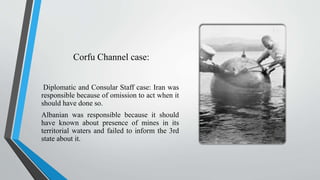
Corfu Channel case:
Diplomatic and Consular Staff case: Iran was
responsible because of omission to act when it
should have done so.
Albanian was responsible because it should
have known about presence of mines in its
territorial waters and failed to inform the 3rd
state about it.
a) Wrongful conduct of judiciary
attributable to the state
• Judicial organ can be the cause of state
responsibility because of ‘denial of
justice'.
• Janes Claim case: Mexico failed to
arrest and punish an offender which
caused death to an American citizen. ICJ
held that this is ‘a denial of justice' and
Mexico should be liable.
b) Wrongful conduct of the executive
attributable to the state e.g. conduct of
police, army, gov officers.
Massey claim case: a US citizen who was
working in Mexico was killed. Mexican
authority failed to punish the offender.
Mexico is liable and should pay damages
to US.
Does the state be responsible if
wrongful conduct committed by its
organ when off duty?
No. A state would only be attributable to
such wrongful conduct when it is
committed on duty. If committed off duty,
it cannot be attributable to the State.
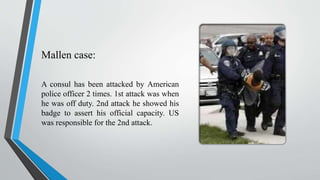
Mallen case:
A consul has been attacked by American
police officer 2 times. 1st attack was when
he was off duty. 2nd attack he showed his
badge to assert his official capacity. US
was responsible for the 2nd attack.
2) THE CONDUCT MUST
CONSTITUTE A BREACH OF AN
INTERNATIONAL LEGAL
OBLIGATION • Art 12 :
A State is in breach of its obligation when
any act of the State does not conform to its
obligation.
A state may also be liable for de
facto State organs i.e. public
corporations or private company
performing element of governmental
authority
SEDCO case:
there was a seizure of vehicle. The
claimant argued that a state owned
company took it. However, argument was
rejected because there was no proof to
show that government directed it to be
seized.
Foremost Tehran Inc v Iran case:
Iranian company did not pay dividends to
shareholders. The conduct was attributable
to Iran because it had been influenced by
Government representatives on the board
of directors.
Ultra vires conduct cannot be a
defence to exclude state
responsibility • Refer Art 7 ILCASR
US v Mexico: Mexican soldiers ignored
their orders and attacked on a house where
Americans was seeking refuge. It was held
Mexico liable.
Conduct of private persons may
be attributable to State in 2
circumstances if [Art 8]:
a) It was carried out on instructions of the
State
b) It was under direction or control of
State
what is the degree of control that
State need to exercise over the
persons? 2 views:
i) According to Nicaragua case, State needs to
exercise effective control.
Control by State is effective when, for example:
• State finances the persons
• State coordinates the conduct of such persons
• State issued specific instruction to such persons
ii) According to Prosecutor v
Tadic
State only need to exercise overall control.
State does not necessarily need issue
instructions concerning each specific
action.
Explanation Art. 12:
• International obligations may be
established by a customary rule of
international law, by a treaty, by a judgment
given by the ICJ or any other international
tribunal.
• In international law, there is no distinction
between “contractual” and “tortious
"responsibility nor between “civil” and
"criminal” responsibility.
Conclusion
State responsibility is first and foremost concerned with the secondary, not
primary, rules of international law.
International courts and tribunals rarely make specific findings or rulings on
the issue.
The ILCASR are the nearest we have to a comprehensive, coherent set of
rules; much of the content reflects custom.
The rules on individual responsibility complement the rules on State
responsibility but are much more limited in scope and ambit.
Individual responsibility concerns international crimes a categorisation
removed from the ILCASR.
Objective and subjective elements are essential for individual responsibility,
the former primarily only for State responsibility.
There is little to guide us on the responsibility of other ‘non-State’ actors.

State responsibility in international law

  • 1.
    STATE RESPONSIBILITY IN INTERNATIONALLAW NASIR AHMADYOUSEFI TAREQ MOHAMMAD POOR
  • 2.
    Table of contects •1- introduction • 2- Definition of responsibility • 3-THEWRONGFUL CONDUCT IN QUESTION MUST BE ATTRIBUTABLETO THE STATE • Ultra vires conduct cannot be a defence to exclude state responsibility.
  • 3.
    Introduction • State responsibilityis one of the fundamental principles of International Law. It arises out of the international legal system and the principles of State sovereignty and equality of States. It implies that if a State commits an internationally wrongful (unlawful) act against another State, it will be internationally responsible for reparation.
  • 4.
    Definition of responsibility Responsibility– what is it? Action taken by one State regularly results in injury to, or outrage on, the dignity or prestige of another State. Responsibility is the necessary corollary of obligation – States are primary subjects of international law. Responsibility is concerned with the incidence and consequences of illegal acts and ..the payment of compensation for loss caused. Every breach by a subject of international law of its obligation entail its international responsibility.
  • 5.
    A state mayincur liability if it violate a rule of customary international law or ignore its obligation under a treaty.
  • 6.
    To make astate responsible, Art 2 of ILCASR put 2 requirements: 1) THE WRONGFUL CONDUCT IN QUESTION MUST BE ATTRIBUTABLETOTHE STATE • State cannot act on its own. State Organs shall represent the State in any matters. • Art 4 provides that the conduct of any state organ shall be considered an act of that state under international law whether the organ exercises legislative, executive or judiciary function. An organ includes any person or entity. • Conduct in Art means action or omission. E.g.: Iraqi intervention to Kuwait.
  • 7.
    Corfu Channel case: Diplomaticand Consular Staff case: Iran was responsible because of omission to act when it should have done so. Albanian was responsible because it should have known about presence of mines in its territorial waters and failed to inform the 3rd state about it.
  • 8.
    a) Wrongful conductof judiciary attributable to the state • Judicial organ can be the cause of state responsibility because of ‘denial of justice'. • Janes Claim case: Mexico failed to arrest and punish an offender which caused death to an American citizen. ICJ held that this is ‘a denial of justice' and Mexico should be liable.
  • 9.
    b) Wrongful conductof the executive attributable to the state e.g. conduct of police, army, gov officers. Massey claim case: a US citizen who was working in Mexico was killed. Mexican authority failed to punish the offender. Mexico is liable and should pay damages to US.
  • 10.
    Does the statebe responsible if wrongful conduct committed by its organ when off duty? No. A state would only be attributable to such wrongful conduct when it is committed on duty. If committed off duty, it cannot be attributable to the State.
  • 11.
    Mallen case: A consulhas been attacked by American police officer 2 times. 1st attack was when he was off duty. 2nd attack he showed his badge to assert his official capacity. US was responsible for the 2nd attack.
  • 12.
    2) THE CONDUCTMUST CONSTITUTE A BREACH OF AN INTERNATIONAL LEGAL OBLIGATION • Art 12 : A State is in breach of its obligation when any act of the State does not conform to its obligation.
  • 13.
    A state mayalso be liable for de facto State organs i.e. public corporations or private company performing element of governmental authority
  • 14.
    SEDCO case: there wasa seizure of vehicle. The claimant argued that a state owned company took it. However, argument was rejected because there was no proof to show that government directed it to be seized.
  • 15.
    Foremost Tehran Incv Iran case: Iranian company did not pay dividends to shareholders. The conduct was attributable to Iran because it had been influenced by Government representatives on the board of directors.
  • 16.
    Ultra vires conductcannot be a defence to exclude state responsibility • Refer Art 7 ILCASR US v Mexico: Mexican soldiers ignored their orders and attacked on a house where Americans was seeking refuge. It was held Mexico liable.
  • 17.
    Conduct of privatepersons may be attributable to State in 2 circumstances if [Art 8]: a) It was carried out on instructions of the State b) It was under direction or control of State
  • 18.
    what is thedegree of control that State need to exercise over the persons? 2 views: i) According to Nicaragua case, State needs to exercise effective control. Control by State is effective when, for example: • State finances the persons • State coordinates the conduct of such persons • State issued specific instruction to such persons
  • 19.
    ii) According toProsecutor v Tadic State only need to exercise overall control. State does not necessarily need issue instructions concerning each specific action.
  • 20.
    Explanation Art. 12: •International obligations may be established by a customary rule of international law, by a treaty, by a judgment given by the ICJ or any other international tribunal. • In international law, there is no distinction between “contractual” and “tortious "responsibility nor between “civil” and "criminal” responsibility.
  • 21.
    Conclusion State responsibility isfirst and foremost concerned with the secondary, not primary, rules of international law. International courts and tribunals rarely make specific findings or rulings on the issue. The ILCASR are the nearest we have to a comprehensive, coherent set of rules; much of the content reflects custom. The rules on individual responsibility complement the rules on State responsibility but are much more limited in scope and ambit. Individual responsibility concerns international crimes a categorisation removed from the ILCASR. Objective and subjective elements are essential for individual responsibility, the former primarily only for State responsibility. There is little to guide us on the responsibility of other ‘non-State’ actors.