Seek: Study : Succeed
Genetic Engineering Prospects
• Genetic Engineering implies the deliberate modification of the characters of an
organism by the manipulation of its genetic material. In simple terms it is a laboratory
technique used by scientists to change the DNA (Deoxyribo Nucleic Acid) of living
organisms.
• This fascinating branch of science enables the human minds to interfere in and modify
the processes of life, birth death and even offers escape from certain congenital
diseases. Specialists in the field of genetics conduct researches in a broad range of
biological sciences including biochemistry, botany, embryology, and microbiology.
They have developed techniques with numerous important applications in the fields of
medicine, agriculture, and animal husbandry.
• Genetic engineers/scientists re-arrange the sequence of DNA in gene using artificial
methods. They extract the DNA out of one organism, changing it using chemicals or
radiation and subsequently put it back into the same or a different organism.
• By isolating and modifying genetic material, genetic engineering research scientists
have developed strains of bacteria that improve the effects of antibiotics and other
useful pharmaceutical products. Clinical tests to help diagnose hereditary diseases and
to circumvent infertility in humans have also been developedthrough genetic
engineering.
• In agriculture, this technology is used to develop new crops that are more nutritious,
disease-resistant, and able to flourish with less fertilizer.
• Genetic engineering has also been used to regulate animal breeding. In addition, other
work has been directed toward the development of microorganisms that can be used
to detoxify industrial waste or to provide alternate fuel sources.
• The U.S. Patent Office has approved many genetically engineered products including
bacteria that consume oil spills and hormones that improve the milk yield of cows.
Eligibility:
• An individual seeking a career in genetic engineering can start the B.Tech course after
his/her Plus Two Science with Physics, Chemistry, Math and Biology.
• Admission to B.Tech in Genetic Engineering /Biotechnology / Biochemical
Engineering is done generally through entrance tests.
• You can also pursue three-year B.Sc. degree course in Genetics / Biological Science /
Life Science / Biotechnology subjects and then go for post-graduation (MSc) in
genetics.Most institutes do not offer courses in Genetic Engineering as a special
discipline but as a subsidiary in biotechnology, microbiology and biochemistry streams.
Under-graduate and post-graduate courses in biotechnology offers specialization in
genetic engineering.
• Those who want to go for further study and research can pursue M.Tech and PhD in
genetic engineering offered by few institutes in India including the IITs.
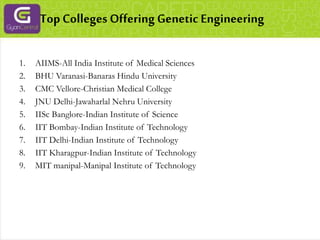
TopColleges Offering Genetic Engineering
1. AIIMS-All India Institute of Medical Sciences
2. BHU Varanasi-Banaras Hindu University
3. CMC Vellore-Christian Medical College
4. JNU Delhi-Jawaharlal Nehru University
5. IISc Banglore-Indian Institute of Science
6. IIT Bombay-Indian Institute of Technology
7. IIT Delhi-Indian Institute of Technology
8. IIT Kharagpur-Indian Institute of Technology
9. MIT manipal-Manipal Institute of Technology
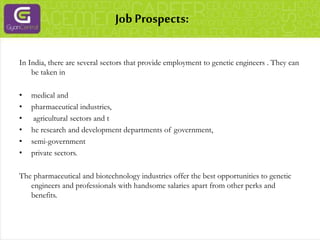
Job Prospects:
In India, there are several sectors that provide employment to genetic engineers . They can
be taken in
• medical and
• pharmaceutical industries,
• agricultural sectors and t
• he research and development departments of government,
• semi-government
• private sectors.
The pharmaceutical and biotechnology industries offer the best opportunities to genetic
engineers and professionals with handsome salaries apart from other perks and
benefits.
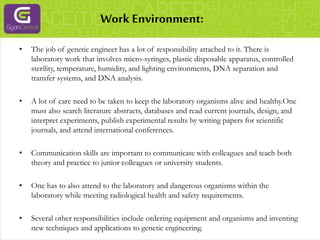
Work Environment:
• The job of genetic engineer has a lot of responsibility attached to it. There is
laboratory work that involves micro-syringes, plastic disposable apparatus, controlled
sterility, temperature, humidity, and lighting environments, DNA separation and
transfer systems, and DNA analysis.
• A lot of care need to be taken to keep the laboratory organisms alive and healthy.One
must also search literature abstracts, databases and read current journals, design, and
interpret experiments, publish experimental results by writing papers for scientific
journals, and attend international conferences.
• Communication skills are important to communicate with colleagues and teach both
theory and practice to junior colleagues or university students.
• One has to also attend to the laboratory and dangerous organisms within the
laboratory while meeting radiological health and safety requirements.
• Several other responsibilities include ordering equipment and organisms and inventing
new techniques and applications to genetic engineering.
Medical - http://gyancentral.com/articles/graduate/medical
AIEEE - http://gyancentral.com/articles/graduate/engineering/engineering-entrance-exams/all-india-
engineering-entrance-exam
Aviation - http://gyancentral.com/articles/others/aviation
Engineering - http://gyancentral.com/articles/graduate/engineering
Commerce - http://gyancentral.com/articles/graduate/commerce
Medical - http://gyancentral.com/articles/graduate/medical
Science - http://gyancentral.com/articles/graduate/science
Animation - http://gyancentral.com/articles/others/animation
Clinical Research - http://gyancentral.com/articles/others/clinical-research
Hotel Management - http://gyancentral.com/articles/others/hotel-management
Media - http://gyancentral.com/articles/others/media
Fashion Designing - http://gyancentral.com/articles/others/fashion-designing
MBA - http://gyancentral.com/articles/post-graduate/mba
IIT - http://gyancentral.com/articles/graduate/engineering/indian-institutes-of-technology
CAT - http://gyancentral.com/articles/post-graduate/mba/mba-entrance-exams/mba-entrance-tests
Media - http://gyancentral.com/articles/others/media
www.gyancentral.com

Genetic engeneering prospects

  • 1.
  • 2.
  • 3.
    • Genetic Engineeringimplies the deliberate modification of the characters of an organism by the manipulation of its genetic material. In simple terms it is a laboratory technique used by scientists to change the DNA (Deoxyribo Nucleic Acid) of living organisms. • This fascinating branch of science enables the human minds to interfere in and modify the processes of life, birth death and even offers escape from certain congenital diseases. Specialists in the field of genetics conduct researches in a broad range of biological sciences including biochemistry, botany, embryology, and microbiology. They have developed techniques with numerous important applications in the fields of medicine, agriculture, and animal husbandry. • Genetic engineers/scientists re-arrange the sequence of DNA in gene using artificial methods. They extract the DNA out of one organism, changing it using chemicals or radiation and subsequently put it back into the same or a different organism.
  • 4.
    • By isolatingand modifying genetic material, genetic engineering research scientists have developed strains of bacteria that improve the effects of antibiotics and other useful pharmaceutical products. Clinical tests to help diagnose hereditary diseases and to circumvent infertility in humans have also been developedthrough genetic engineering. • In agriculture, this technology is used to develop new crops that are more nutritious, disease-resistant, and able to flourish with less fertilizer. • Genetic engineering has also been used to regulate animal breeding. In addition, other work has been directed toward the development of microorganisms that can be used to detoxify industrial waste or to provide alternate fuel sources. • The U.S. Patent Office has approved many genetically engineered products including bacteria that consume oil spills and hormones that improve the milk yield of cows.
  • 5.
    Eligibility: • An individualseeking a career in genetic engineering can start the B.Tech course after his/her Plus Two Science with Physics, Chemistry, Math and Biology. • Admission to B.Tech in Genetic Engineering /Biotechnology / Biochemical Engineering is done generally through entrance tests. • You can also pursue three-year B.Sc. degree course in Genetics / Biological Science / Life Science / Biotechnology subjects and then go for post-graduation (MSc) in genetics.Most institutes do not offer courses in Genetic Engineering as a special discipline but as a subsidiary in biotechnology, microbiology and biochemistry streams. Under-graduate and post-graduate courses in biotechnology offers specialization in genetic engineering. • Those who want to go for further study and research can pursue M.Tech and PhD in genetic engineering offered by few institutes in India including the IITs.
  • 6.
    TopColleges Offering GeneticEngineering 1. AIIMS-All India Institute of Medical Sciences 2. BHU Varanasi-Banaras Hindu University 3. CMC Vellore-Christian Medical College 4. JNU Delhi-Jawaharlal Nehru University 5. IISc Banglore-Indian Institute of Science 6. IIT Bombay-Indian Institute of Technology 7. IIT Delhi-Indian Institute of Technology 8. IIT Kharagpur-Indian Institute of Technology 9. MIT manipal-Manipal Institute of Technology
  • 7.
    Job Prospects: In India,there are several sectors that provide employment to genetic engineers . They can be taken in • medical and • pharmaceutical industries, • agricultural sectors and t • he research and development departments of government, • semi-government • private sectors. The pharmaceutical and biotechnology industries offer the best opportunities to genetic engineers and professionals with handsome salaries apart from other perks and benefits.
  • 8.
    Work Environment: • Thejob of genetic engineer has a lot of responsibility attached to it. There is laboratory work that involves micro-syringes, plastic disposable apparatus, controlled sterility, temperature, humidity, and lighting environments, DNA separation and transfer systems, and DNA analysis. • A lot of care need to be taken to keep the laboratory organisms alive and healthy.One must also search literature abstracts, databases and read current journals, design, and interpret experiments, publish experimental results by writing papers for scientific journals, and attend international conferences. • Communication skills are important to communicate with colleagues and teach both theory and practice to junior colleagues or university students. • One has to also attend to the laboratory and dangerous organisms within the laboratory while meeting radiological health and safety requirements. • Several other responsibilities include ordering equipment and organisms and inventing new techniques and applications to genetic engineering.
  • 9.
    Medical - http://gyancentral.com/articles/graduate/medical AIEEE- http://gyancentral.com/articles/graduate/engineering/engineering-entrance-exams/all-india- engineering-entrance-exam Aviation - http://gyancentral.com/articles/others/aviation Engineering - http://gyancentral.com/articles/graduate/engineering Commerce - http://gyancentral.com/articles/graduate/commerce Medical - http://gyancentral.com/articles/graduate/medical Science - http://gyancentral.com/articles/graduate/science Animation - http://gyancentral.com/articles/others/animation Clinical Research - http://gyancentral.com/articles/others/clinical-research Hotel Management - http://gyancentral.com/articles/others/hotel-management Media - http://gyancentral.com/articles/others/media Fashion Designing - http://gyancentral.com/articles/others/fashion-designing MBA - http://gyancentral.com/articles/post-graduate/mba IIT - http://gyancentral.com/articles/graduate/engineering/indian-institutes-of-technology CAT - http://gyancentral.com/articles/post-graduate/mba/mba-entrance-exams/mba-entrance-tests Media - http://gyancentral.com/articles/others/media www.gyancentral.com