Ms. Bavinder Heer MRPharmS, Dip CNM
         Integrative Health Practitioner
    (Pharmacist & Nutritional Therapist)
Overview:
 Obesity
 Energy – what can go wrong
 Inflammation- what does it mean
 Other factors


 Current trends- do diets work?


 Looking to the future...
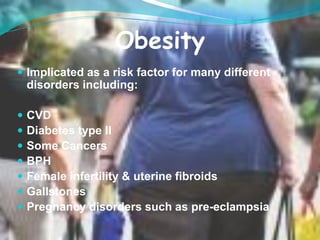
Obesity
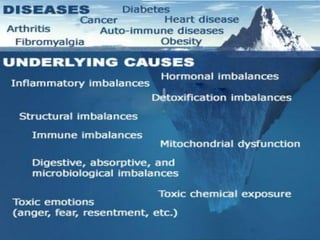
 Implicated as a risk factor for many different
    disorders including:

   CVD
   Diabetes type II
   Some Cancers
   BPH
   Female infertility & uterine fibroids
   Gallstones
   Pregnancy disorders such as pre-eclampsia
Relieving the economic burden of
disease

 “coronary heart disease, prostate and breast
  cancer, diabetes and obesity account for 75% of
  health-care costs, yet the progression of these
  diseases can be stopped or even reversed with
  intensive lifestyle changes.”
 Ornish D. Lancet Oncol. 2009 Jul;10(7):638-9
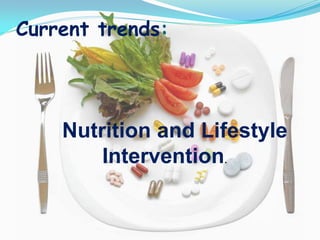
Current trends:


    Nutrition and Lifestyle
        Intervention.
Functional Medicine:


 Functional medicine involves understanding
 the origins, prevention, and treatment of
 complex, chronic disease.
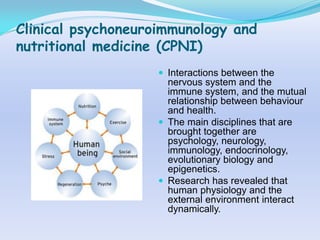
Clinical psychoneuroimmunology and
nutritional medicine (CPNI)
                     Interactions between the
                      nervous system and the
                      immune system, and the mutual
                      relationship between behaviour
                      and health.
                     The main disciplines that are
                      brought together are
                      psychology, neurology,
                      immunology, endocrinology,
                      evolutionary biology and
                      epigenetics.
                     Research has revealed that
                      human physiology and the
                      external environment interact
                      dynamically.
Considerations:
 Epigenetics: concerned with how our
 environment changes gene expression
 Proteomics: concerned with proteins
 expressed by a genome.
 Nutrigenomics: the science of how food
 substances alter gene expression within
 human cells.
Food is information for our
epigenome (gene expression)


 Food provides signals for cellular
 function to programme for health and
 disease.
What can go wrong?
An environmental mismatch:


“through nearly all human evolution genetic adaptation
  was closely coupled with environmental alterations.
  Now, however, cultural change comes too rapidly for
  genetic accommodation to keep pace.”

Prev Med. 2002 Feb; 34(2): 109-18
Our environment is changing the way
our genes are expressed

 “ ...recent studies indicate that environmental factors &
  diet can perturb the way genes are controlled by DNA
  methylation & covalent histone modifications.
  Unexpectedly, and not unlike genetic mutations, aberrant
  epigenetic alterations and their phenotypic effects can
  sometimes be passed on to the next generation.”


 Mutat. Res. 2006 Aug 30;6001-2):46-57
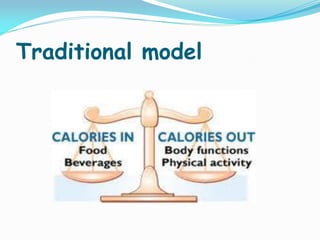
Traditional model
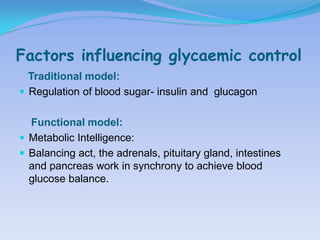
Factors influencing glycaemic control
  Traditional model:
 Regulation of blood sugar- insulin and glucagon


  Functional model:
 Metabolic Intelligence:
 Balancing act, the adrenals, pituitary gland, intestines
  and pancreas work in synchrony to achieve blood
  glucose balance.
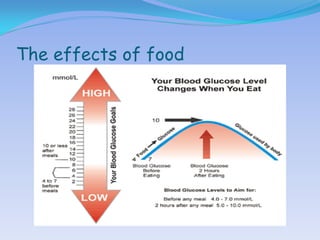
The effects of food
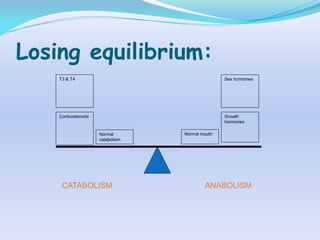
Losing equilibrium:
    T3 & T4                                         Sex hormones


    Corticosteroids                                 Growth
                                                    hormones

                      Normal       Normal insulin
                      catabolism


     CATABOLISM                              ANABOLISM
How do we confuse the metabolic system?
 Erratic eating patterns and fad diets may confuse the
  metabolic system

 Poor blood sugar regulation will lead to reduced
  response to insulin


 Breakdowns occur in signalling

 Hypothalamus develops a resistance to leptin signals
  (Halle & Persson, 2003) Primary role is to coordinate metabolic, endocrine
and behvioural responses to starvation.
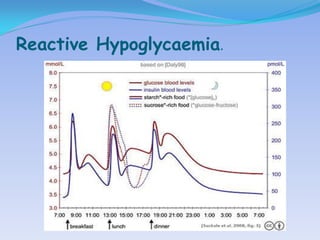
Reactive Hypoglycaemia.
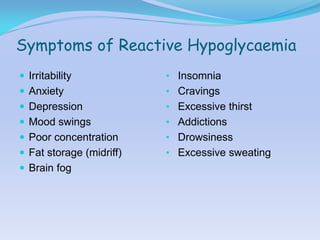
Symptoms of Reactive Hypoglycaemia
 Irritability            • Insomnia
 Anxiety                 • Cravings
 Depression              • Excessive thirst
 Mood swings             • Addictions
 Poor concentration      • Drowsiness
 Fat storage (midriff)   • Excessive sweating
 Brain fog
How do we confuse the metabolic system?


 Chronic stress and adrenal function-- stress elevated
 cortisol induces insulin resistance and inflammation

 Symptoms of high cortisol: intermittent fatigue,
 irritability, dysglycaemia, sleep disturbances, central
 obesity
The motion picture of Diabetes

 Central cortisol resistance precedes peripheral
 insulin resistance.
 Garcia-Prieto et al.; Cortisol secretary pattern and glucocorticoid feedback
 sensitivity in women from a Mediterranean area: relationship with anthropometric
 characteristics, dietary intake and plasma fatty acid profile. Clin Endocrinol
 (Oxf)). 2007 Feb;66(2):185-91.


 Higher expression of glucocorticoid receptors on the
 liver precede insulin resistance.
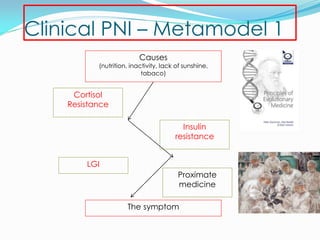
Clinical PNI – Metamodel 1
                          Causes
           (nutrition, inactivity, lack of sunshine,
                           tabaco)


     Cortisol
    Resistance

                                         Insulin
                                       resistance


        LGI
                                        Proximate
                                        medicine

                     The symptom
The result:
   T3 & T4

                                                Sex hormones

                                  Abnormal
                                  insulin
   Corticosteroids

                                                Growth
                                                hormones
                     Normal
                     catabolism


    CATABOLISM                               ANABOLISM
Other factors:
 Thyroid function- sets metabolic rate and responsible
  for energy release
 Psychological factors- serotonin, dopamine
 Immune Dysfunction- it is now widely accepted that
  obesity is associated with a level of chronic
  inflammation in the body.
 Toxicity and its impact on mitochondrial function
  Chemical known as obesogens are known to induce
  obesity
 Loss of circadian rhythm- studies have demonstrated that
  melatonin can reduce diet-induced obesity in rats (Prunet-
  Marcassus, 2003)
 Imbalance of gut flora- function of ghrelin and leptin;
  Experiments performed on mice colonized with human
  gut microbes showed that changes in diet that resulted in
  the mice becoming obese (high carb to Western diet)
  allowed a rapid switch in microbial community.... when
  this modified gut flora was transferred to germ free mice,
  the obese phenotype was also passed on. (Turnbaugh P J et
  al, 2009)
The new shape:
Current trends: do DIEts work?

  Insulin resistance is affected by the factors
  mentioned earlier, what‟s also interesting is that
  erratic eating patterns and fad diets may confuse the
  metabolic system, a breakdown occurs in the
  signalling, the hypothalamus develops a resistance
  to leptin signals (Halle and Persson, 2003)
 Evidence now clearly demonstrates that the body
  gets “stingier” in its use of calories after each diet
  (Muls E et al, 1995)
What is our aim:

Control dysglycaemia:
Minimise the effect of the
 inflammation response
Improve anti-oxidant status
MEDITERRANEAN diet:
Neopolitan researchers found that participants
assigned to a Mediterranean diet:

  • Lost more weight
  • Experienced greater improvements in glycaemic
    control
  • Showed improvements in coronary risk measures

    (Esposito K, 2009)
Med-style diet for type 2 diabetes
 (Eposito et al 2009):
 “compared with a low-fat diet, a low carbohydrate,
  Mediterranean-style diet led to more favourable changes
  in glycaemic control and coronary risk factors and
  delayed the need for anti-hyperglycaemic drug therapy in
  overweight patients with newly diagnosed type 2
  diabetes.”

 Ann Intern med. 2009 sep 1; 151(5): 306-14
REVIEW OF 35 STUDIES ON THE
MED DIET

 “The MED diet showed favourable effects on lipoprotein
    levels, endothelium vasodilation, insulin resistance
    metabolic syndrome, antioxidant capacity, myocardial
    and cardiovascular mortality, and cancer incidence in
    obese patients and those with previous myocardial
    infarction.”

 Serra-Majem et al.; Nutrition Reviews 64(2): S27-S47
MED diet reduces inflammation
 “compared with patients consuming the control diet,
    patients consuming the intervention diet had significantly
    reduced serum concentrations of hs-CRP, IL-6, IL-7 & IL-
    18, as well as decreased insulin resistance.”
   Eposito et al., JAMA 2004;292:1440-1446
Mediterranean Diet:

 • Rich in cereals, fruit, nuts, legumes, whole
  grains, fish, olive oil

 • Low in dairy, meat, junk food, fat

 • High in beta-carotene, vitamin C, tocopherols,
  polyphenols, minerals, soluble fibre.
What about fat??
“Consumption of mono-unsaturated fatty acids is
thought to increase insulin sensitivity, and this
component of the diet may explain the favourable
effect of the MED diet.”
                                          Esposito K, 2009
Good fat is better than low fat:

 The Medl-RIVAGE study: reduction of CVR disease risk
  factors after a 3-mo intervention with a MED-type diet or
  a low fat diet.


 “our data predicted a 9%reduction in cardiovascular
  disease risk with the low-fat diet and 15% reduction with
  this particular MED diet”

Vincent-Baudry et al.; Am J Clin Nutrition 2005; 82:964-71
Inflammation: immune dysfunction
 Morbid obesity is now known to be associated with low-
 grade systemic inflammation & immune activation

 Pro-inflammatory cytokines are synthesized and released
 in human adipose tissue :
   TNF-alpha,
   IL-1,
   IL-6,
   IFN-gamma
The anti-inflammatory diet
 “the MED diet ensures adequate intake of whole grains,
  fruits, vegetables, nuts, fish, cereals, legumes and olive
  oil; all this together with moderate consumption of
  alcohol, predominantly wine, leads to high ingestion of
  dietary fibre, antioxidants, magnesium and unsaturated
  fatty acids. Therefore, the MED diet could serve as an
  anti-inflammatory dietary pattern, which could protect
  from or even treat diseases that are related to chronic
  inflammation, including visceral obesity, type 2 diabetes
  and the metabolic syndrome.”
 Giugliano D, Esposito K. MED diet & Metabolic diseases. Curr Opin Lipidol.
  2008 Feb; 19(1):63-8
Benefits of the MED diet

 Improved glycaemic control
 Reduction in Cardiovascular risk
 Reduction in inflammation
Micronutrients for genomic stability....
A new paradigm for RDAs
 “current recommended dietary allowances for
  vitamins & minerals are based largely on the
  prevention of disease of deficiency, eg scurvy in the
  case of vitamin C. Because diseases of
  development, degenerative disease and aging itself
  are partly caused by damage to DNA it seems logical
  that we should focus better our attention on defining
  optimal requirements of key minerals and vitamins
  for preventing damage to both nuclear and
  mitochondrial DNA.”
 Food and Chemical Toxicology 40(2002)1113-1117
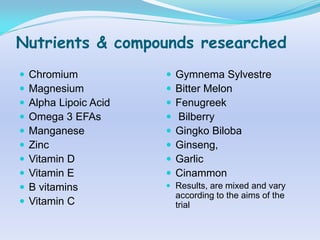
Nutrients & compounds researched
   Chromium               Gymnema Sylvestre
   Magnesium              Bitter Melon
   Alpha Lipoic Acid      Fenugreek
   Omega 3 EFAs           Bilberry
   Manganese              Gingko Biloba
   Zinc                   Ginseng,
   Vitamin D              Garlic
   Vitamin E              Cinammon
   B vitamins           Results, are mixed and vary
                            according to the aims of the
   Vitamin C               trial
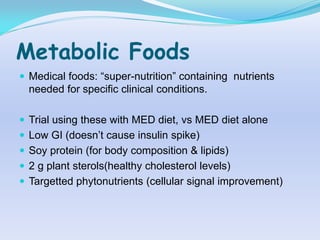
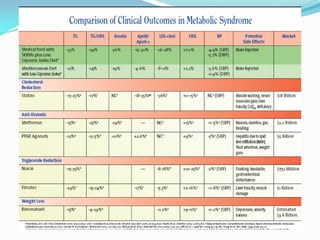
Metabolic Foods
 Medical foods: “super-nutrition” containing nutrients
  needed for specific clinical conditions.

 Trial using these with MED diet, vs MED diet alone
 Low GI (doesn‟t cause insulin spike)
 Soy protein (for body composition & lipids)
 2 g plant sterols(healthy cholesterol levels)
 Targetted phytonutrients (cellular signal improvement)
Lifestyle Intervention:
And not to forget activity levels:
To move or not to move?? That is the
question.

  • More frequent television viewing in adolescence and
   early adulthood is associated with greater BMI gains
   through to mid-adulthood and with central adiposity in
   mid-life.

                                            (Ashcroft, J 2008)
Activity
 „Our results strongly suggest that the increased risk of
  obesity owing to genetic susceptibility can be blunted
  through physical activity.

 These findings suggest the important role of physical
  activity in public health efforts to combat obesity,
  particularly in genetically susceptible individuals.‟

  Rampersaud E et al. Physical activity may help offset genetic risk for
  obesity” Archives of Internal Medicine, 2008; 168:1791-1797
We are designed to move!
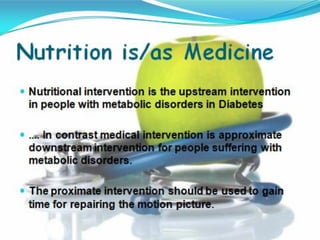
Nutrition is/as Medicine
 Nutritional intervention is the upstream intervention
 in people with metabolic disorders in Diabetes

 .... In contrast medical intervention is approximate
 downstream intervention for people suffering with
 metabolic disorders.

 The proximate intervention should be used to gain
 time for repairing the motion picture.
Shokran

Bavinder heer.nutrition in diabetes

  • 1.
    Ms. Bavinder HeerMRPharmS, Dip CNM Integrative Health Practitioner (Pharmacist & Nutritional Therapist)
  • 3.
    Overview:  Obesity  Energy– what can go wrong  Inflammation- what does it mean  Other factors  Current trends- do diets work?  Looking to the future...
  • 4.
    Obesity  Implicated asa risk factor for many different disorders including:  CVD  Diabetes type II  Some Cancers  BPH  Female infertility & uterine fibroids  Gallstones  Pregnancy disorders such as pre-eclampsia
  • 5.
    Relieving the economicburden of disease  “coronary heart disease, prostate and breast cancer, diabetes and obesity account for 75% of health-care costs, yet the progression of these diseases can be stopped or even reversed with intensive lifestyle changes.”  Ornish D. Lancet Oncol. 2009 Jul;10(7):638-9
  • 6.
    Current trends: Nutrition and Lifestyle Intervention.
  • 7.
    Functional Medicine: Functionalmedicine involves understanding the origins, prevention, and treatment of complex, chronic disease.
  • 9.
    Clinical psychoneuroimmunology and nutritionalmedicine (CPNI)  Interactions between the nervous system and the immune system, and the mutual relationship between behaviour and health.  The main disciplines that are brought together are psychology, neurology, immunology, endocrinology, evolutionary biology and epigenetics.  Research has revealed that human physiology and the external environment interact dynamically.
  • 10.
    Considerations:  Epigenetics: concernedwith how our environment changes gene expression  Proteomics: concerned with proteins expressed by a genome.  Nutrigenomics: the science of how food substances alter gene expression within human cells.
  • 11.
    Food is informationfor our epigenome (gene expression) Food provides signals for cellular function to programme for health and disease.
  • 12.
  • 13.
    An environmental mismatch: “throughnearly all human evolution genetic adaptation was closely coupled with environmental alterations. Now, however, cultural change comes too rapidly for genetic accommodation to keep pace.” Prev Med. 2002 Feb; 34(2): 109-18
  • 14.
    Our environment ischanging the way our genes are expressed  “ ...recent studies indicate that environmental factors & diet can perturb the way genes are controlled by DNA methylation & covalent histone modifications. Unexpectedly, and not unlike genetic mutations, aberrant epigenetic alterations and their phenotypic effects can sometimes be passed on to the next generation.”  Mutat. Res. 2006 Aug 30;6001-2):46-57
  • 15.
  • 16.
    Factors influencing glycaemiccontrol Traditional model:  Regulation of blood sugar- insulin and glucagon Functional model:  Metabolic Intelligence:  Balancing act, the adrenals, pituitary gland, intestines and pancreas work in synchrony to achieve blood glucose balance.
  • 17.
  • 18.
    Losing equilibrium: T3 & T4 Sex hormones Corticosteroids Growth hormones Normal Normal insulin catabolism CATABOLISM ANABOLISM
  • 19.
    How do weconfuse the metabolic system?  Erratic eating patterns and fad diets may confuse the metabolic system  Poor blood sugar regulation will lead to reduced response to insulin  Breakdowns occur in signalling  Hypothalamus develops a resistance to leptin signals (Halle & Persson, 2003) Primary role is to coordinate metabolic, endocrine and behvioural responses to starvation.
  • 20.
  • 21.
    Symptoms of ReactiveHypoglycaemia  Irritability • Insomnia  Anxiety • Cravings  Depression • Excessive thirst  Mood swings • Addictions  Poor concentration • Drowsiness  Fat storage (midriff) • Excessive sweating  Brain fog
  • 22.
    How do weconfuse the metabolic system?  Chronic stress and adrenal function-- stress elevated cortisol induces insulin resistance and inflammation  Symptoms of high cortisol: intermittent fatigue, irritability, dysglycaemia, sleep disturbances, central obesity
  • 23.
    The motion pictureof Diabetes  Central cortisol resistance precedes peripheral insulin resistance. Garcia-Prieto et al.; Cortisol secretary pattern and glucocorticoid feedback sensitivity in women from a Mediterranean area: relationship with anthropometric characteristics, dietary intake and plasma fatty acid profile. Clin Endocrinol (Oxf)). 2007 Feb;66(2):185-91.  Higher expression of glucocorticoid receptors on the liver precede insulin resistance.
  • 24.
    Clinical PNI –Metamodel 1 Causes (nutrition, inactivity, lack of sunshine, tabaco) Cortisol Resistance Insulin resistance LGI Proximate medicine The symptom
  • 25.
    The result: T3 & T4 Sex hormones Abnormal insulin Corticosteroids Growth hormones Normal catabolism CATABOLISM ANABOLISM
  • 26.
    Other factors:  Thyroidfunction- sets metabolic rate and responsible for energy release  Psychological factors- serotonin, dopamine  Immune Dysfunction- it is now widely accepted that obesity is associated with a level of chronic inflammation in the body.
  • 27.
     Toxicity andits impact on mitochondrial function Chemical known as obesogens are known to induce obesity  Loss of circadian rhythm- studies have demonstrated that melatonin can reduce diet-induced obesity in rats (Prunet- Marcassus, 2003)  Imbalance of gut flora- function of ghrelin and leptin; Experiments performed on mice colonized with human gut microbes showed that changes in diet that resulted in the mice becoming obese (high carb to Western diet) allowed a rapid switch in microbial community.... when this modified gut flora was transferred to germ free mice, the obese phenotype was also passed on. (Turnbaugh P J et al, 2009)
  • 28.
  • 29.
    Current trends: doDIEts work? Insulin resistance is affected by the factors mentioned earlier, what‟s also interesting is that erratic eating patterns and fad diets may confuse the metabolic system, a breakdown occurs in the signalling, the hypothalamus develops a resistance to leptin signals (Halle and Persson, 2003)  Evidence now clearly demonstrates that the body gets “stingier” in its use of calories after each diet (Muls E et al, 1995)
  • 30.
    What is ouraim: Control dysglycaemia: Minimise the effect of the inflammation response Improve anti-oxidant status
  • 31.
    MEDITERRANEAN diet: Neopolitan researchersfound that participants assigned to a Mediterranean diet: • Lost more weight • Experienced greater improvements in glycaemic control • Showed improvements in coronary risk measures (Esposito K, 2009)
  • 32.
    Med-style diet fortype 2 diabetes  (Eposito et al 2009):  “compared with a low-fat diet, a low carbohydrate, Mediterranean-style diet led to more favourable changes in glycaemic control and coronary risk factors and delayed the need for anti-hyperglycaemic drug therapy in overweight patients with newly diagnosed type 2 diabetes.”  Ann Intern med. 2009 sep 1; 151(5): 306-14
  • 33.
    REVIEW OF 35STUDIES ON THE MED DIET   “The MED diet showed favourable effects on lipoprotein levels, endothelium vasodilation, insulin resistance metabolic syndrome, antioxidant capacity, myocardial and cardiovascular mortality, and cancer incidence in obese patients and those with previous myocardial infarction.”  Serra-Majem et al.; Nutrition Reviews 64(2): S27-S47
  • 34.
    MED diet reducesinflammation  “compared with patients consuming the control diet, patients consuming the intervention diet had significantly reduced serum concentrations of hs-CRP, IL-6, IL-7 & IL- 18, as well as decreased insulin resistance.”  Eposito et al., JAMA 2004;292:1440-1446
  • 35.
    Mediterranean Diet: •Rich in cereals, fruit, nuts, legumes, whole grains, fish, olive oil • Low in dairy, meat, junk food, fat • High in beta-carotene, vitamin C, tocopherols, polyphenols, minerals, soluble fibre.
  • 36.
    What about fat?? “Consumptionof mono-unsaturated fatty acids is thought to increase insulin sensitivity, and this component of the diet may explain the favourable effect of the MED diet.” Esposito K, 2009
  • 37.
    Good fat isbetter than low fat:  The Medl-RIVAGE study: reduction of CVR disease risk factors after a 3-mo intervention with a MED-type diet or a low fat diet.  “our data predicted a 9%reduction in cardiovascular disease risk with the low-fat diet and 15% reduction with this particular MED diet” Vincent-Baudry et al.; Am J Clin Nutrition 2005; 82:964-71
  • 38.
    Inflammation: immune dysfunction Morbid obesity is now known to be associated with low- grade systemic inflammation & immune activation  Pro-inflammatory cytokines are synthesized and released in human adipose tissue :  TNF-alpha,  IL-1,  IL-6,  IFN-gamma
  • 39.
    The anti-inflammatory diet “the MED diet ensures adequate intake of whole grains, fruits, vegetables, nuts, fish, cereals, legumes and olive oil; all this together with moderate consumption of alcohol, predominantly wine, leads to high ingestion of dietary fibre, antioxidants, magnesium and unsaturated fatty acids. Therefore, the MED diet could serve as an anti-inflammatory dietary pattern, which could protect from or even treat diseases that are related to chronic inflammation, including visceral obesity, type 2 diabetes and the metabolic syndrome.”  Giugliano D, Esposito K. MED diet & Metabolic diseases. Curr Opin Lipidol. 2008 Feb; 19(1):63-8
  • 40.
    Benefits of theMED diet  Improved glycaemic control  Reduction in Cardiovascular risk  Reduction in inflammation
  • 41.
    Micronutrients for genomicstability.... A new paradigm for RDAs  “current recommended dietary allowances for vitamins & minerals are based largely on the prevention of disease of deficiency, eg scurvy in the case of vitamin C. Because diseases of development, degenerative disease and aging itself are partly caused by damage to DNA it seems logical that we should focus better our attention on defining optimal requirements of key minerals and vitamins for preventing damage to both nuclear and mitochondrial DNA.”  Food and Chemical Toxicology 40(2002)1113-1117
  • 42.
    Nutrients & compoundsresearched  Chromium  Gymnema Sylvestre  Magnesium  Bitter Melon  Alpha Lipoic Acid  Fenugreek  Omega 3 EFAs  Bilberry  Manganese  Gingko Biloba  Zinc  Ginseng,  Vitamin D  Garlic  Vitamin E  Cinammon  B vitamins  Results, are mixed and vary according to the aims of the  Vitamin C trial
  • 43.
    Metabolic Foods  Medicalfoods: “super-nutrition” containing nutrients needed for specific clinical conditions.  Trial using these with MED diet, vs MED diet alone  Low GI (doesn‟t cause insulin spike)  Soy protein (for body composition & lipids)  2 g plant sterols(healthy cholesterol levels)  Targetted phytonutrients (cellular signal improvement)
  • 45.
    Lifestyle Intervention: And notto forget activity levels:
  • 46.
    To move ornot to move?? That is the question. • More frequent television viewing in adolescence and early adulthood is associated with greater BMI gains through to mid-adulthood and with central adiposity in mid-life. (Ashcroft, J 2008)
  • 47.
    Activity  „Our resultsstrongly suggest that the increased risk of obesity owing to genetic susceptibility can be blunted through physical activity.  These findings suggest the important role of physical activity in public health efforts to combat obesity, particularly in genetically susceptible individuals.‟ Rampersaud E et al. Physical activity may help offset genetic risk for obesity” Archives of Internal Medicine, 2008; 168:1791-1797
  • 48.
  • 50.
    Nutrition is/as Medicine Nutritional intervention is the upstream intervention in people with metabolic disorders in Diabetes  .... In contrast medical intervention is approximate downstream intervention for people suffering with metabolic disorders.  The proximate intervention should be used to gain time for repairing the motion picture.
  • 51.