Programming
Languages and the
Programming Process
This lesson includes the following sections:
• The Evolution of Programming Languages
• The Systems Development Life Cycle for
Programming
• Machine languages
• Assembly languages
• Higher-level languages
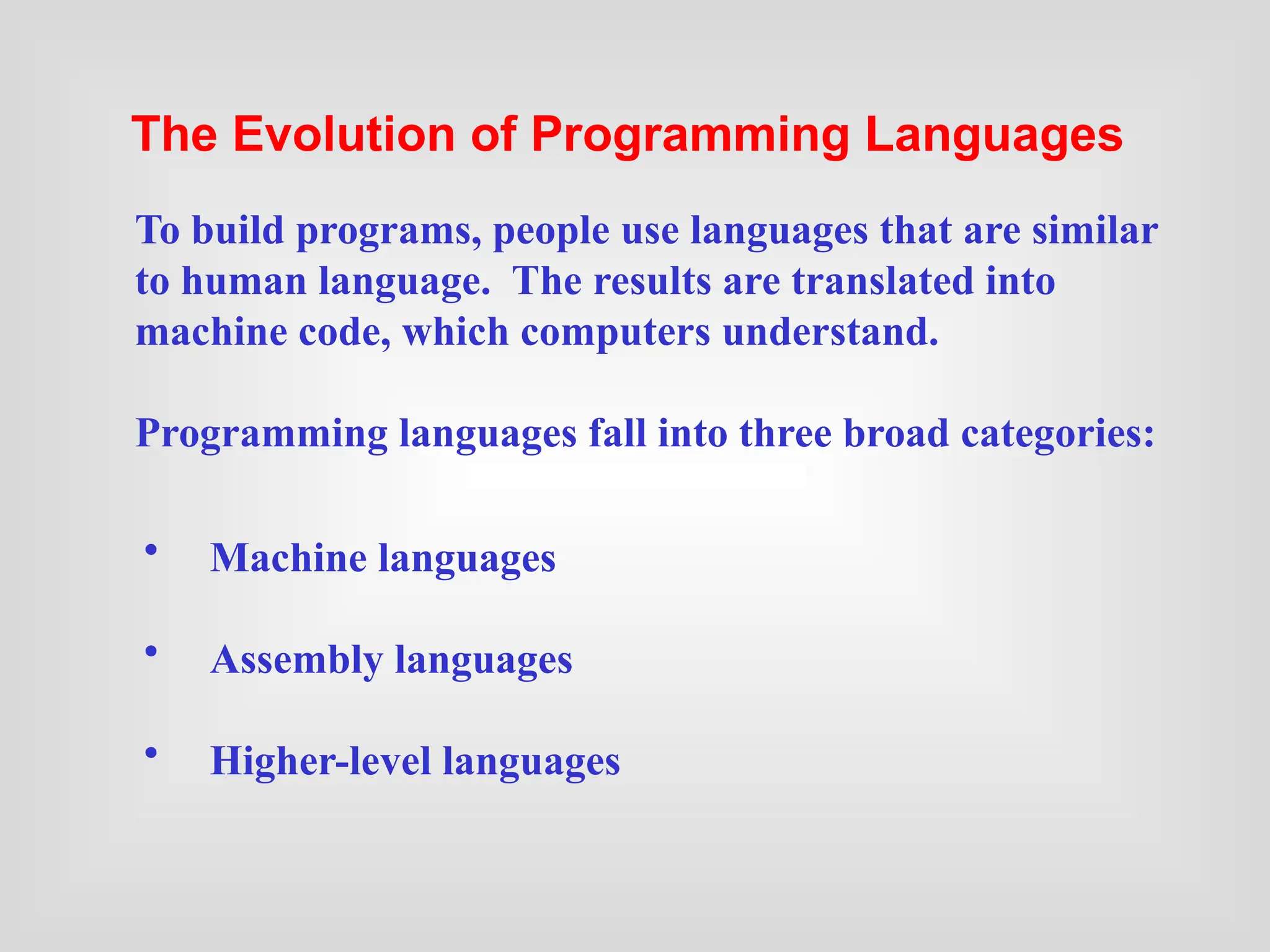
To build programs, people use languages that are similar
to human language. The results are translated into
machine code, which computers understand.
Programming languages fall into three broad categories:
The Evolution of Programming Languages
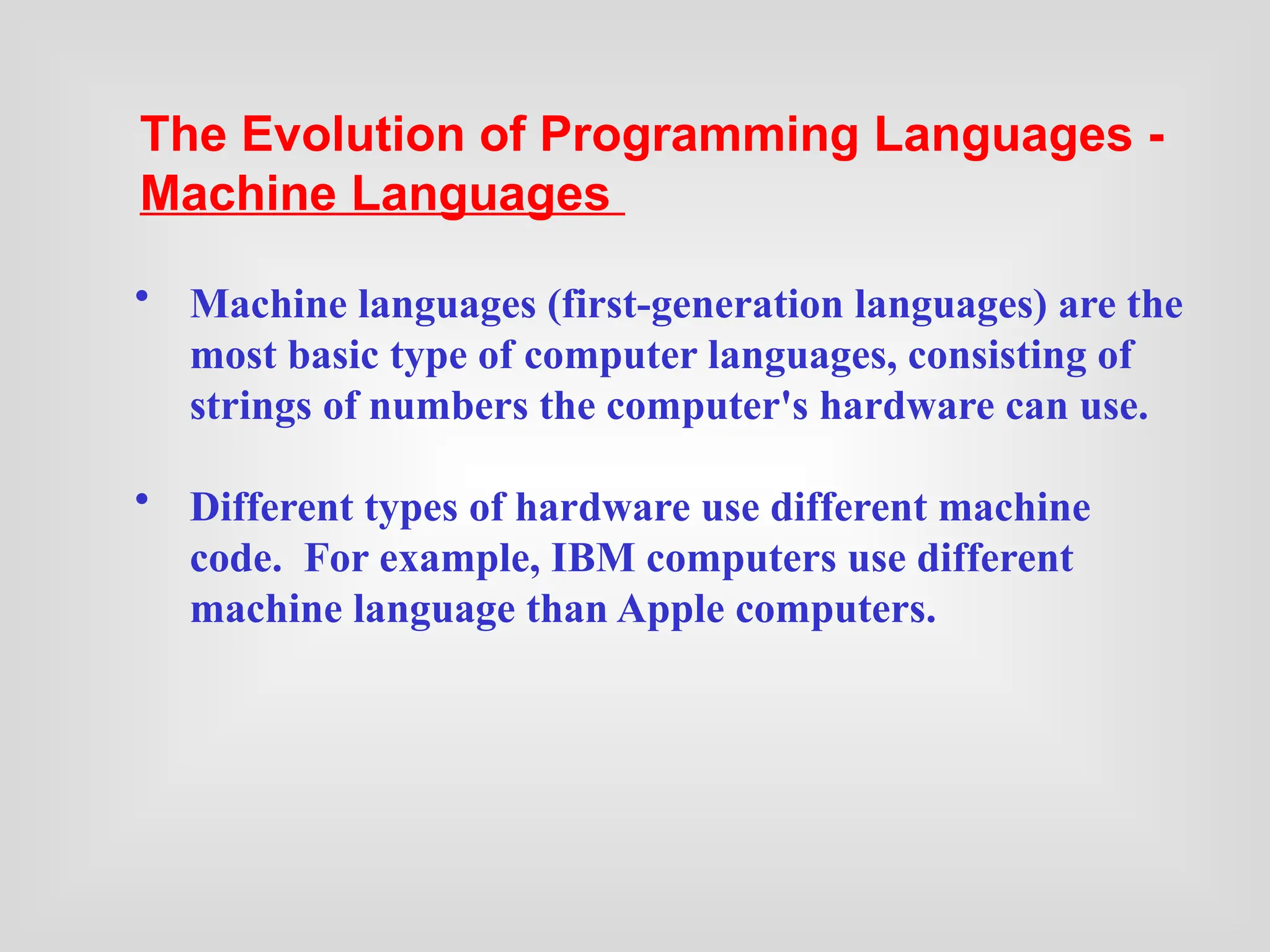
• Machine languages (first-generation languages) are the
most basic type of computer languages, consisting of
strings of numbers the computer's hardware can use.
• Different types of hardware use different machine
code. For example, IBM computers use different
machine language than Apple computers.
The Evolution of Programming Languages -
Machine Languages
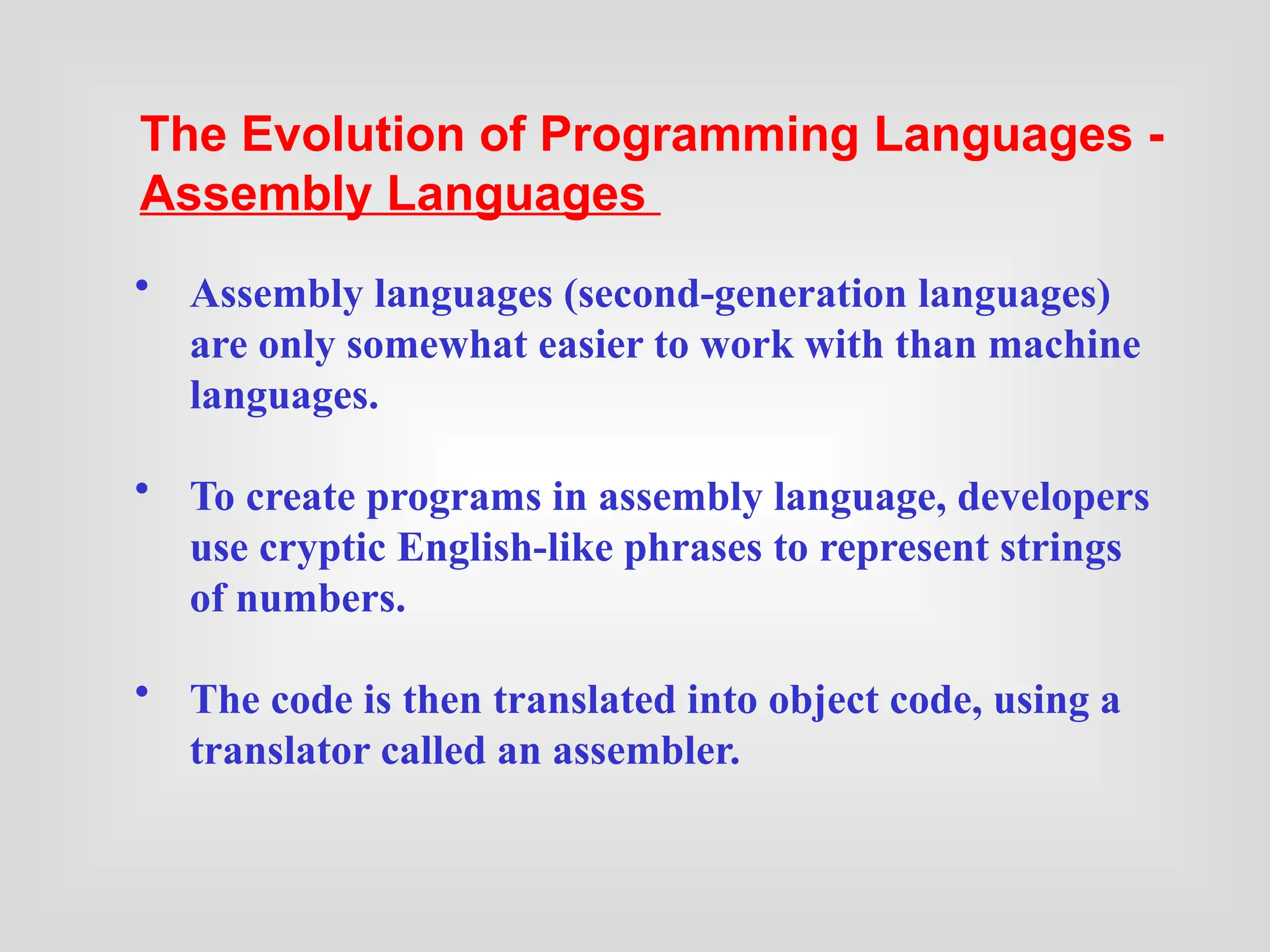
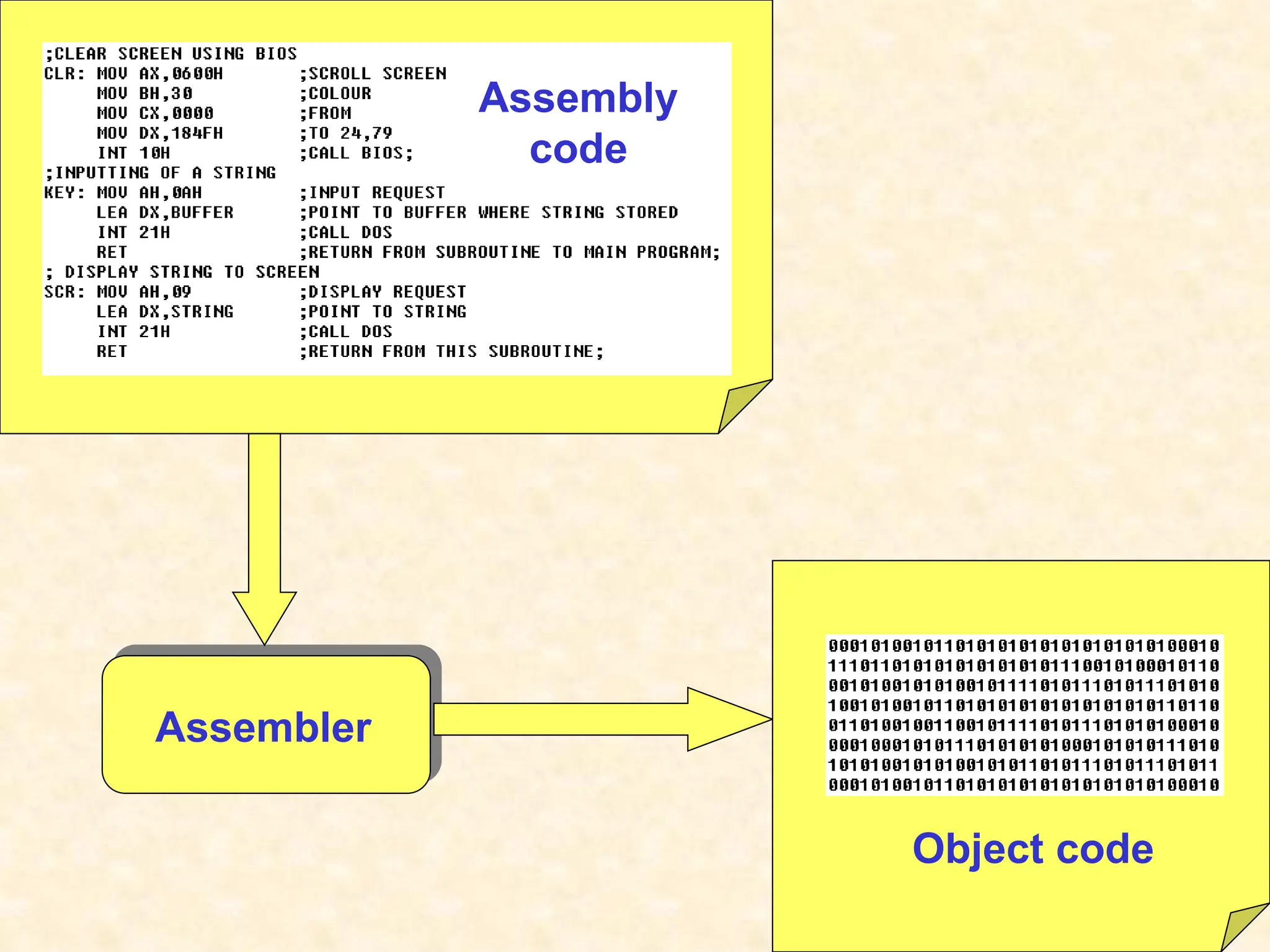
• Assembly languages (second-generation languages)
are only somewhat easier to work with than machine
languages.
• To create programs in assembly language, developers
use cryptic English-like phrases to represent strings
of numbers.
• The code is then translated into object code, using a
translator called an assembler.
The Evolution of Programming Languages -
Assembly Languages
Assembler
Assembly
code
Object code
• Third-generation languages
• Fourth-generation languages
• Fifth-generation languages
Higher-level languages are more powerful than assembly
language and allow the programmer to work in a more
English-like environment.
Higher-level programming languages are divided into
three "generations," each more powerful than the
last:
The Evolution of Programming Languages -
Higher-Level Languages
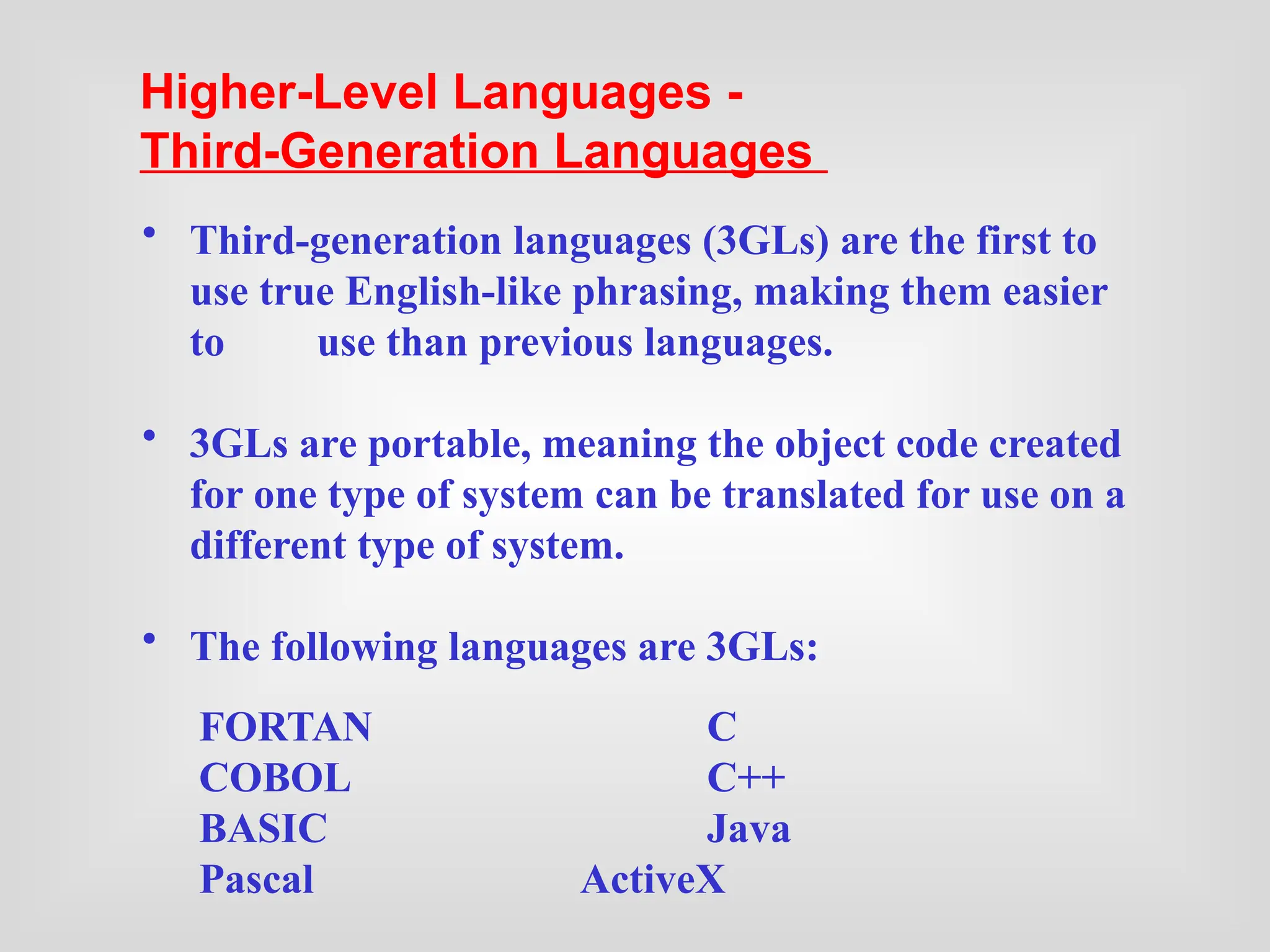
FORTAN C
COBOL C++
BASIC Java
Pascal ActiveX
• Third-generation languages (3GLs) are the first to
use true English-like phrasing, making them easier
to use than previous languages.
• 3GLs are portable, meaning the object code created
for one type of system can be translated for use on a
different type of system.
• The following languages are 3GLs:
Higher-Level Languages -
Third-Generation Languages
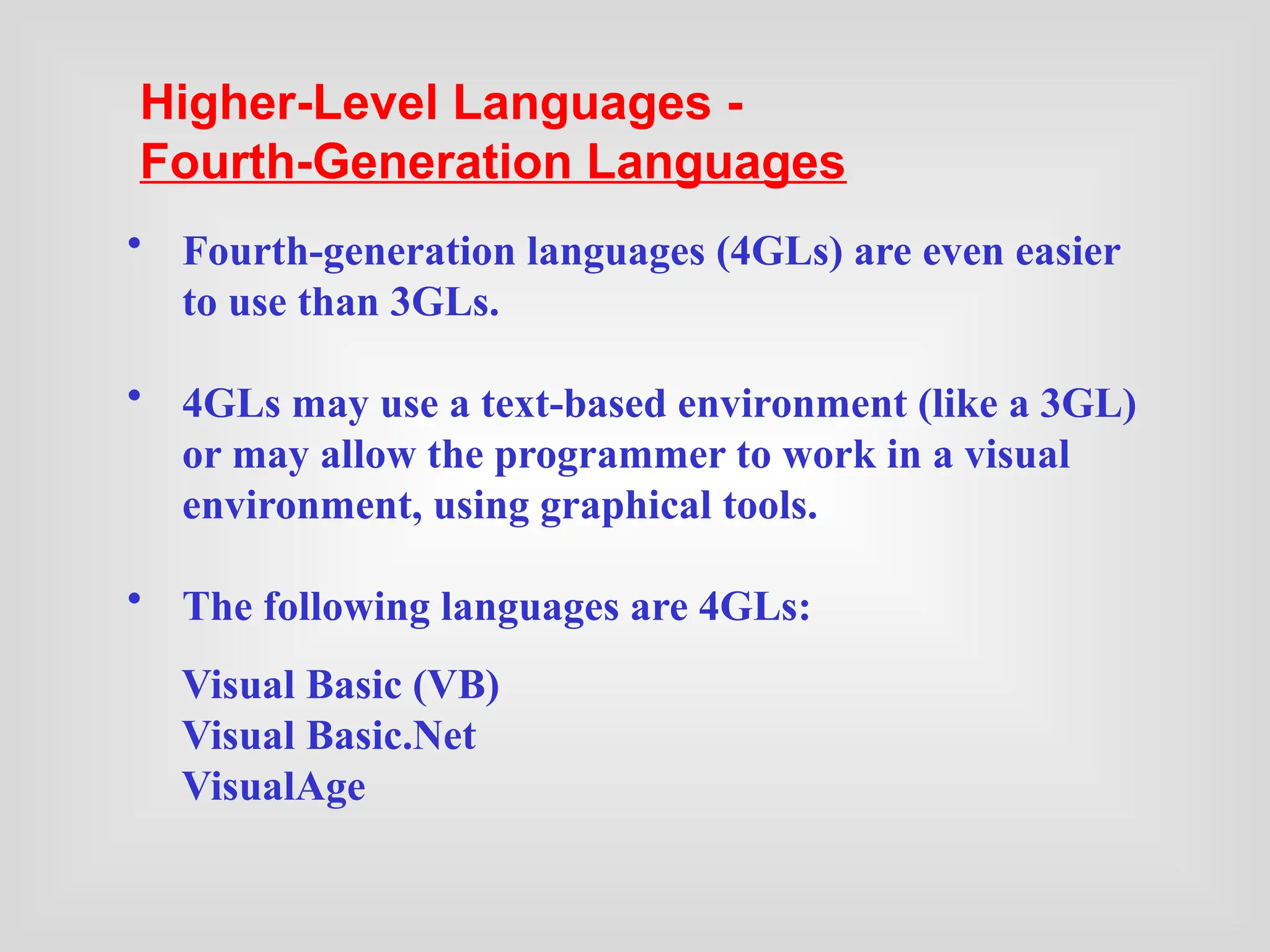
Visual Basic (VB)
Visual Basic.Net
VisualAge
• Fourth-generation languages (4GLs) are even easier
to use than 3GLs.
• 4GLs may use a text-based environment (like a 3GL)
or may allow the programmer to work in a visual
environment, using graphical tools.
• The following languages are 4GLs:
Higher-Level Languages -
Fourth-Generation Languages
• Fifth-generation languages (5GLs) are an issue of
debate in the programming community – some
programmers cannot agree that they even exist.
• These high-level languages would use artificial
intelligence to create software, making 5GLs
extremely difficult to develop.
Higher-Level Languages -
Fifth-Generation Languages
• Phase 1: Needs Analysis
• Phase 2: Program Design
• Phase 3: Development
• Phase 4: Implementation
• Phase 5: Maintenance
The SDLC for programming follows the same
phases as the SDLC for information systems
development:
The Systems Development Life Cycle for
Programming
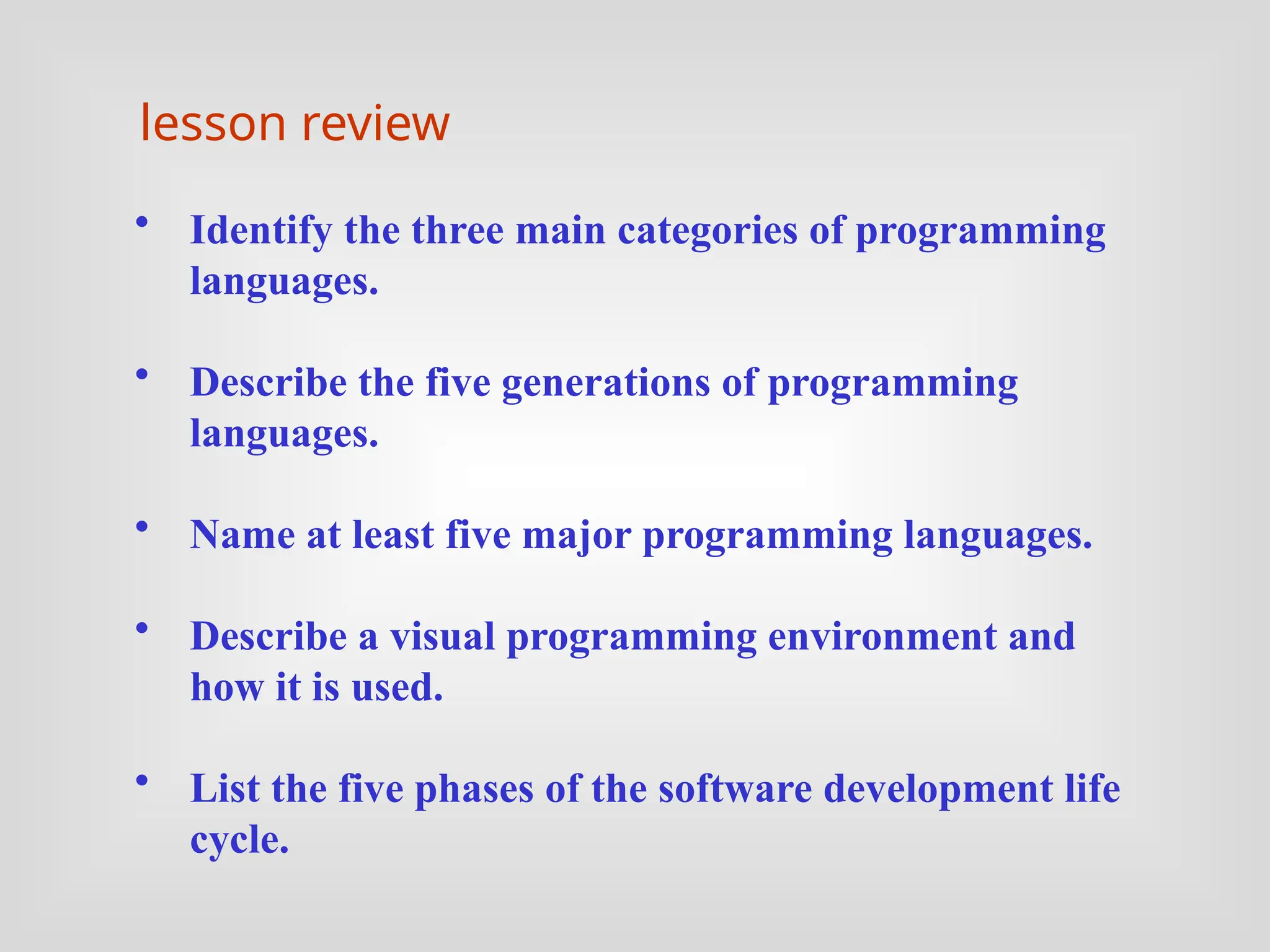
• Identify the three main categories of programming
languages.
• Describe the five generations of programming
languages.
• Name at least five major programming languages.
• Describe a visual programming environment and
how it is used.
• List the five phases of the software development life
cycle.
lesson review
A visual programming language (VPL) is a computer
program that develops applications using graphical
components and figures. A VPL uses methods to create a two-
or three-dimensional software that contains graphical
components, text, symbols, and icons inside its programming
environment.
• The SDLC has five phases: inception,
design, implementation, maintenance,
and audit or disposal, which includes
an assessment of the risk management
plan.

all computer Programming Languages.pptx

  • 1.
  • 2.
    This lesson includesthe following sections: • The Evolution of Programming Languages • The Systems Development Life Cycle for Programming
  • 3.
    • Machine languages •Assembly languages • Higher-level languages To build programs, people use languages that are similar to human language. The results are translated into machine code, which computers understand. Programming languages fall into three broad categories: The Evolution of Programming Languages
  • 4.
    • Machine languages(first-generation languages) are the most basic type of computer languages, consisting of strings of numbers the computer's hardware can use. • Different types of hardware use different machine code. For example, IBM computers use different machine language than Apple computers. The Evolution of Programming Languages - Machine Languages
  • 5.
    • Assembly languages(second-generation languages) are only somewhat easier to work with than machine languages. • To create programs in assembly language, developers use cryptic English-like phrases to represent strings of numbers. • The code is then translated into object code, using a translator called an assembler. The Evolution of Programming Languages - Assembly Languages
  • 6.
  • 7.
    • Third-generation languages •Fourth-generation languages • Fifth-generation languages Higher-level languages are more powerful than assembly language and allow the programmer to work in a more English-like environment. Higher-level programming languages are divided into three "generations," each more powerful than the last: The Evolution of Programming Languages - Higher-Level Languages
  • 8.
    FORTAN C COBOL C++ BASICJava Pascal ActiveX • Third-generation languages (3GLs) are the first to use true English-like phrasing, making them easier to use than previous languages. • 3GLs are portable, meaning the object code created for one type of system can be translated for use on a different type of system. • The following languages are 3GLs: Higher-Level Languages - Third-Generation Languages
  • 9.
    Visual Basic (VB) VisualBasic.Net VisualAge • Fourth-generation languages (4GLs) are even easier to use than 3GLs. • 4GLs may use a text-based environment (like a 3GL) or may allow the programmer to work in a visual environment, using graphical tools. • The following languages are 4GLs: Higher-Level Languages - Fourth-Generation Languages
  • 10.
    • Fifth-generation languages(5GLs) are an issue of debate in the programming community – some programmers cannot agree that they even exist. • These high-level languages would use artificial intelligence to create software, making 5GLs extremely difficult to develop. Higher-Level Languages - Fifth-Generation Languages
  • 11.
    • Phase 1:Needs Analysis • Phase 2: Program Design • Phase 3: Development • Phase 4: Implementation • Phase 5: Maintenance The SDLC for programming follows the same phases as the SDLC for information systems development: The Systems Development Life Cycle for Programming
  • 12.
    • Identify thethree main categories of programming languages. • Describe the five generations of programming languages. • Name at least five major programming languages. • Describe a visual programming environment and how it is used. • List the five phases of the software development life cycle. lesson review
  • 13.
    A visual programminglanguage (VPL) is a computer program that develops applications using graphical components and figures. A VPL uses methods to create a two- or three-dimensional software that contains graphical components, text, symbols, and icons inside its programming environment. • The SDLC has five phases: inception, design, implementation, maintenance, and audit or disposal, which includes an assessment of the risk management plan.