Generations of
Programming Languages
Programminglanguages have evolved significantly over time, each
generation building upon the previous one. This presentation will
explore the key characteristics of each generation, the trends driving
their evolution, and the implications for modern software development.
FA
by FARINA AMIER
2.
First Generation: MachineLanguage
Binary Code
First generation languages consisted of binary code,
directly understood by the computer's hardware.
Machine Dependence
Programs written in machine language were highly
machine-specific, making them difficult to port between
different computers.
3.
Second Generation: AssemblyLanguage
Symbolic Instructions
Assembly language used mnemonics to represent machine
instructions, making it easier to write and understand than
machine code.
Still Machine-Dependent
While more human-readable, assembly language still
required knowledge of the underlying hardware
architecture.
4.
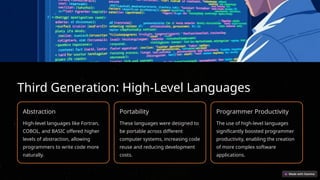
Third Generation: High-LevelLanguages
Abstraction
High-level languages like Fortran,
COBOL, and BASIC offered higher
levels of abstraction, allowing
programmers to write code more
naturally.
Portability
These languages were designed to
be portable across different
computer systems, increasing code
reuse and reducing development
costs.
Programmer Productivity
The use of high-level languages
significantly boosted programmer
productivity, enabling the creation
of more complex software
applications.
5.
Fourth Generation:
Declarative andEvent-
Driven Languages
Data Manipulation
Fourth-generation languages like
SQL focused on data manipulation
and retrieval, making it easier to
interact with databases.
Event-Driven Programming
Event-driven languages like Visual
Basic allowed programmers to
create interactive user interfaces,
responding to user actions.
6.
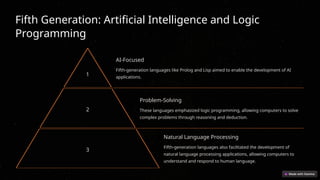
Fifth Generation: ArtificialIntelligence and Logic
Programming
1
AI-Focused
Fifth-generation languages like Prolog and Lisp aimed to enable the development of AI
applications.
2
Problem-Solving
These languages emphasized logic programming, allowing computers to solve
complex problems through reasoning and deduction.
3
Natural Language Processing
Fifth-generation languages also facilitated the development of
natural language processing applications, allowing computers to
understand and respond to human language.
7.
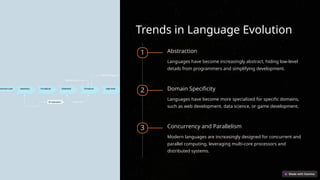
Trends in LanguageEvolution
1 Abstraction
Languages have become increasingly abstract, hiding low-level
details from programmers and simplifying development.
2 Domain Specificity
Languages have become more specialized for specific domains,
such as web development, data science, or game development.
3 Concurrency and Parallelism
Modern languages are increasingly designed for concurrent and
parallel computing, leveraging multi-core processors and
distributed systems.
8.
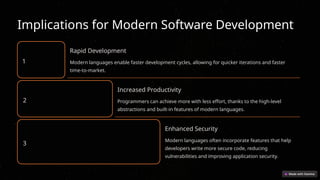
Implications for ModernSoftware Development
1
Rapid Development
Modern languages enable faster development cycles, allowing for quicker iterations and faster
time-to-market.
2
Increased Productivity
Programmers can achieve more with less effort, thanks to the high-level
abstractions and built-in features of modern languages.
3
Enhanced Security
Modern languages often incorporate features that help
developers write more secure code, reducing
vulnerabilities and improving application security.
9.
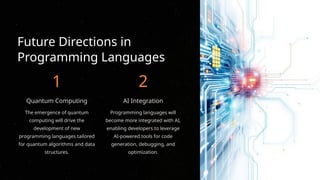
Future Directions in
ProgrammingLanguages
1
Quantum Computing
The emergence of quantum
computing will drive the
development of new
programming languages tailored
for quantum algorithms and data
structures.
2
AI Integration
Programming languages will
become more integrated with AI,
enabling developers to leverage
AI-powered tools for code
generation, debugging, and
optimization.