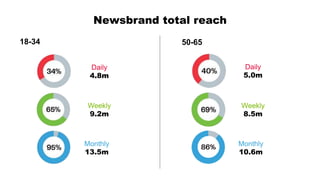


Daily
4.8m
Weekly
9.2m
Monthly
13.5m
Newsbrand total reach
18-34 50-65
Daily
5.0m
Weekly
8.5m
Monthly
10.6m
NRS PADD: May 13 – Apr 15
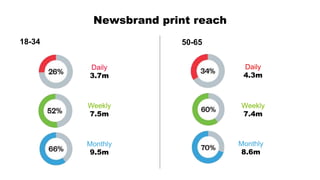
Newsbrand print reach
18-34 50-65
Daily
3.7m
Weekly
7.5m
Monthly
9.5m
Daily
4.3m
Weekly
7.4m
Monthly
8.6m
NRS PADD: May 13 – Apr 15
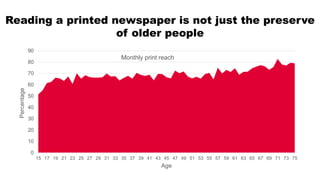
Reading a printed newspaper is not just the preserve
of older people
0
10
20
30
40
50
60
70
80
90
15 17 19 21 23 25 27 29 31 33 35 37 39 41 43 45 47 49 51 53 55 57 59 61 63 65 67 69 71 73 75
Percentage
Age
Monthly print reach
NRS PADD: May 13 – Apr 15
Bas Verplanken
Professor of Social Psychology
We talked to an
expert on habits
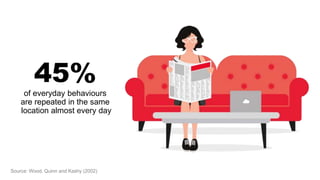
45%
of everyday behaviours
are repeated in the same
location almost every day
Source: Wood, Quinn and Kashy (2002)
But frequency is just
one aspect of a habit
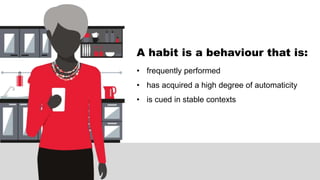
A habit is a behaviour that is:
• frequently performed
• has acquired a high degree of automaticity
• is cued in stable contexts
The unconscious nature
of habits makes them
difficult to measure
Self Reported Habit Index
Verplanken and Orbell (2003)
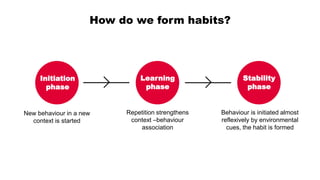
How do we form habits?
Initiation
phase
New behaviour in a new
context is started
Learning
phase
Repetition strengthens
context –behaviour
association
Stability
phase
Behaviour is initiated almost
reflexively by environmental
cues, the habit is formed
Gardner 2009
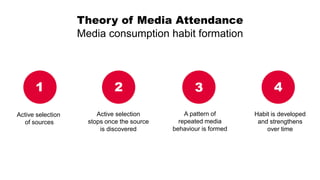
Active selection
of sources
1 2
Active selection
stops once the source
is discovered
3
A pattern of
repeated media
behaviour is formed
4
Habit is developed
and strengthens
over time
Theory of Media Attendance
Media consumption habit formation
LaRose & Eastin 2004
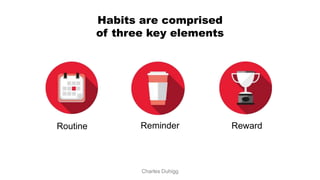
Charles Duhigg
Habits are comprised
of three key elements
Routine Reminder Reward
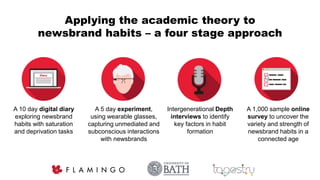
Applying the academic theory to
newsbrand habits – a four stage approach
A 10 day digital diary
exploring newsbrand
habits with saturation
and deprivation tasks
A 5 day experiment,
using wearable glasses,
capturing unmediated and
subconscious interactions
with newsbrands
Intergenerational Depth
interviews to identify
key factors in habit
formation
A 1,000 sample online
survey to uncover the
variety and strength of
newsbrand habits in a
connected age
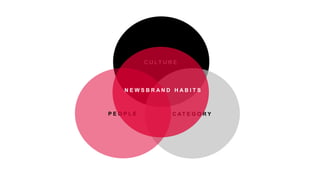
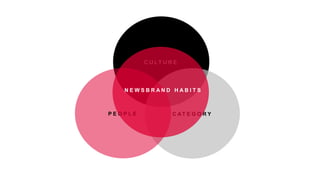
C U L T U R E
C AT E G O R YP E O P L E
N E W S B R A N D H A B I T S
“
We’re never more than a click
or a flick away from news
“
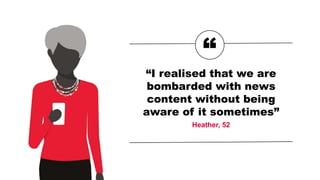
“I realised that we are
bombarded with news
content without being
aware of it sometimes”
Heather, 52
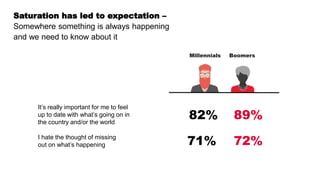
Saturation has led to expectation –
Somewhere something is always happening
and we need to know about it
Millennials Boomers
It’s really important for me to feel
up to date with what’s going on in
the country and/or the world
I hate the thought of missing
out on what’s happening
82% 89%
71% 72%
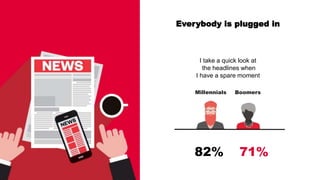
I take a quick look at
the headlines when
I have a spare moment
Everybody is plugged in
Millennials Boomers
82% 71%
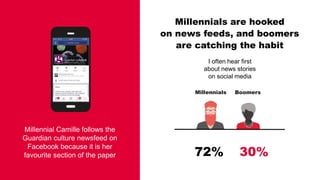
Millennials are hooked
on news feeds, and boomers
are catching the habit
Millennial Camille follows the
Guardian culture newsfeed on
Facebook because it is her
favourite section of the paper
I often hear first
about news stories
on social media
Millennials Boomers
72% 30%
We’re all wrestling with
the consequences
of a ‘digital overload’
“
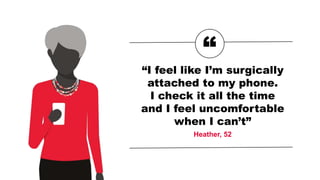
“I feel like I’m surgically
attached to my phone.
I check it all the time
and I feel uncomfortable
when I can’t”
Heather, 52
Saturation means newsbrand’s
role is more important than ever
Millennials Boomers
71% 76%
74% 81%
I identify with [my news
brand’s] point of view
I like that I get a
balanced point of view
from [my news brand]
Newsbrands continue to provide a
trusted lens on the world
Millennials Boomers
82% 90%
78% 82%
I like browsing [my news brand]
and coming across new things
I like that [my news brand]
introduced me to news stories I
wouldn’t otherwise think to read
“
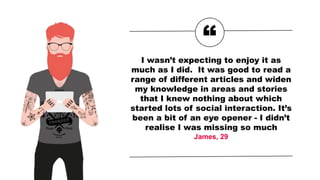
I wasn’t expecting to enjoy it as
much as I did. It was good to read a
range of different articles and widen
my knowledge in areas and stories
that I knew nothing about which
started lots of social interaction. It’s
been a bit of an eye opener - I didn’t
realise I was missing so much
James, 29
C U L T U R E
C AT E G O R YP E O P L E
N E W S B R A N D H A B I T S
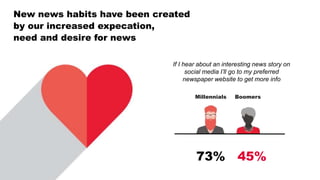
New news habits have been created
by our increased expecation,
need and desire for news
If I hear about an interesting news story on
social media I’ll go to my preferred
newspaper website to get more info
Millennials Boomers
73% 45%
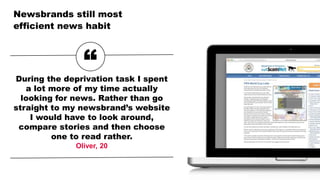
Newsbrands still most
efficient news habit
“During the deprivation task I spent
a lot more of my time actually
looking for news. Rather than go
straight to my newsbrand’s website
I would have to look around,
compare stories and then choose
one to read rather.
Oliver, 20
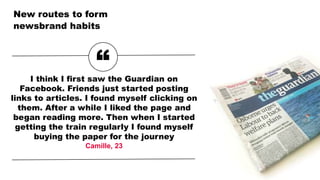
New routes to form
newsbrand habits
“I think I first saw the Guardian on
Facebook. Friends just started posting
links to articles. I found myself clicking on
them. After a while I liked the page and
began reading more. Then when I started
getting the train regularly I found myself
buying the paper for the journey
Camille, 23
The role of newsbrand
habits in a connected age
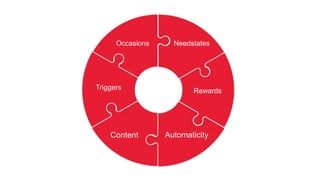
Occasions
Triggers
Content Automaticity
Rewards
Needstates
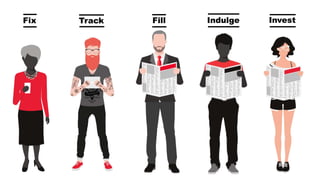
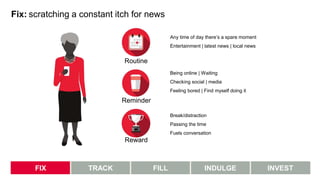
Fix Track Fill Indulge Invest
Fix: scratching a constant itch for news
FIX TRACK FILL INDULGE INVEST
Routine
Any time of day there’s a spare moment
Entertainment | latest news | local news
Reminder
Being online | Waiting
Checking social | media
Feeling bored | Find myself doing it
Reward
Break/distraction
Passing the time
Fuels conversation
FIX TRACK FILL INDULGE INVEST
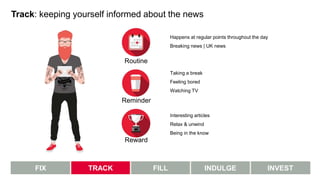
Happens at regular points throughout the day
Breaking news | UK news
Taking a break
Feeling bored
Watching TV
Interesting articles
Relax & unwind
Being in the know
Track: keeping yourself informed about the news
Routine
Reminder
Reward
FIX TRACK FILL INDULGE INVEST
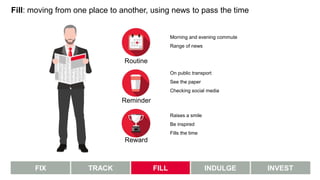
Morning and evening commute
Range of news
On public transport
See the paper
Checking social media
Reward
Raises a smile
Be inspired
Fills the time
Fill: moving from one place to another, using news to pass the time
Routine
Reminder
FIX TRACK FILL INDULGE INVEST
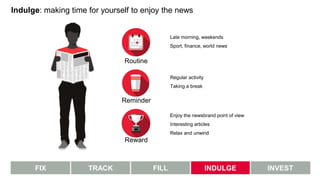
Late morning, weekends
Sport, finance, world news
Regular activity
Taking a break
Enjoy the newsbrand point of view
Interesting articles
Relax and unwind
Indulge: making time for yourself to enjoy the news
Routine
Reminder
Reward
FIX TRACK FILL INDULGE INVEST
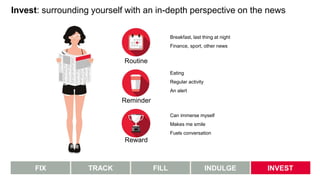
Breakfast, last thing at night
Finance, sport, other news
Eating
Regular activity
An alert
Can immerse myself
Makes me smile
Fuels conversation
Invest: surrounding yourself with an in-depth perspective on the news
Routine
Reminder
Reward
comparing habits
how they relate
to each other
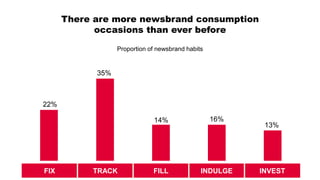
22%
35%
14% 16%
13%
There are more newsbrand consumption
occasions than ever before
Proportion of newsbrand habits
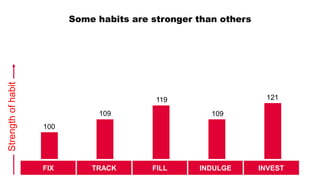
FIX TRACK FILL INDULGE INVEST
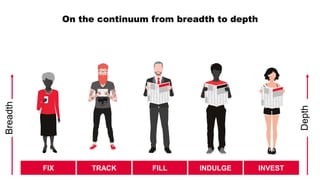
On the continuum from breadth to depth
Depth
FIX TRACK FILL INDULGE INVEST
Breadth
Strengthofhabit
FIX TRACK FILL INDULGE INVEST
100
109
119
109
121
Some habits are stronger than others
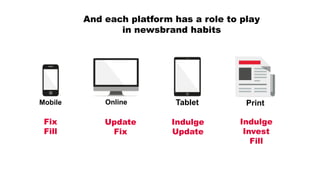
And each platform has a role to play
in newsbrand habits
Mobile Online Tablet Print
Fix
Fill
Track
Fix
Indulge
Track
Indulge
Invest
Fill
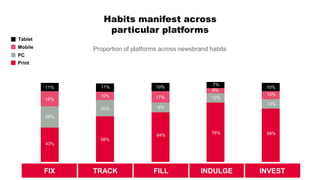
Habits manifest across
particular platforms
FIX TRACK FILL INDULGE INVEST
Proportion of platforms across newsbrand habits
Tablet
PC
Print
Mobile
28%
18%
11%
43%
58%
20%
10%
11%
64%
9%
17%
10%
76%
12%
6%
7%
68%
12%
10%
10%
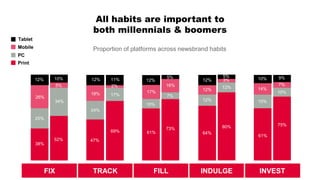
All habits are important to
both millennials & boomers
Proportion of platforms across newsbrand habits
Tablet
PC
Print
Mobile
FIX TRACK FILL INDULGE INVEST
52%
69%
73% 80% 75%
38%
47%
64%
61%
25%
34%
26%
12%
5%
10%
24%
18%
12%
17%
2%
11%
61%
10%
17%
12%
7%
16%
5%
12%
12%
12%
3%
5%
15%
14%
10%
10%
7%
9%12%
Print provides a sense
of completeness and
satisfaction like no
other platform can
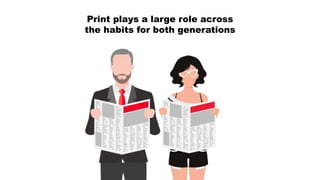
Print plays a large role across
the habits for both generations
Dispelling the myths
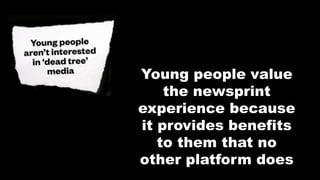
Young people value
the newsprint
experience because
it provides benefits
to them that no
other platform does
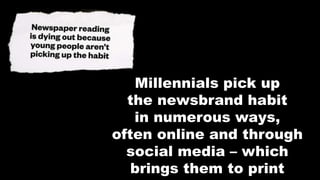
Millennials pick up
the newsbrand habit
in numerous ways,
often online and through
social media – which
brings them to print
Boomers have integrated
online news habits into
their routines and are
increasingly consuming
news on mobile devices
Newsprint provides an
experience and benefits
that no other platform
can, even in the digital
age, which keeps it
relevant to all
The newsbrand role is even more
important, providing a
lens that helps to bring order
to digital news saturation,
soothing the news itch and
providing a sense of completeness
and satisfaction
Some final thoughts
Newsbrands are hugely important to
both Millennials and Boomers – and
you can reach them in big numbers
Nothing else enables you to resonate
with the desire to both engage with and
disconnect from newsfeed culture
Audiences are more engaged and
immersed in the print newsbrand
platform than any other – you have
their undivided attention
Other platforms offer new opportunities
to engage with audiences in different
mindsets and land different messages
and experiences
In a world saturated with news,
newsbrands are more important
than ever before, providing a
trusted lens on the world
Questions
Thank you

Generation News

  • 4.
    Daily 4.8m Weekly 9.2m Monthly 13.5m Newsbrand total reach 18-3450-65 Daily 5.0m Weekly 8.5m Monthly 10.6m NRS PADD: May 13 – Apr 15
  • 5.
    Newsbrand print reach 18-3450-65 Daily 3.7m Weekly 7.5m Monthly 9.5m Daily 4.3m Weekly 7.4m Monthly 8.6m NRS PADD: May 13 – Apr 15
  • 6.
    Reading a printednewspaper is not just the preserve of older people 0 10 20 30 40 50 60 70 80 90 15 17 19 21 23 25 27 29 31 33 35 37 39 41 43 45 47 49 51 53 55 57 59 61 63 65 67 69 71 73 75 Percentage Age Monthly print reach NRS PADD: May 13 – Apr 15
  • 7.
    Bas Verplanken Professor ofSocial Psychology We talked to an expert on habits
  • 8.
    45% of everyday behaviours arerepeated in the same location almost every day Source: Wood, Quinn and Kashy (2002)
  • 9.
    But frequency isjust one aspect of a habit
  • 10.
    A habit isa behaviour that is: • frequently performed • has acquired a high degree of automaticity • is cued in stable contexts
  • 11.
    The unconscious nature ofhabits makes them difficult to measure
  • 12.
    Self Reported HabitIndex Verplanken and Orbell (2003)
  • 13.
    How do weform habits? Initiation phase New behaviour in a new context is started Learning phase Repetition strengthens context –behaviour association Stability phase Behaviour is initiated almost reflexively by environmental cues, the habit is formed Gardner 2009
  • 14.
    Active selection of sources 12 Active selection stops once the source is discovered 3 A pattern of repeated media behaviour is formed 4 Habit is developed and strengthens over time Theory of Media Attendance Media consumption habit formation LaRose & Eastin 2004
  • 15.
    Charles Duhigg Habits arecomprised of three key elements Routine Reminder Reward
  • 16.
    Applying the academictheory to newsbrand habits – a four stage approach A 10 day digital diary exploring newsbrand habits with saturation and deprivation tasks A 5 day experiment, using wearable glasses, capturing unmediated and subconscious interactions with newsbrands Intergenerational Depth interviews to identify key factors in habit formation A 1,000 sample online survey to uncover the variety and strength of newsbrand habits in a connected age
  • 17.
    C U LT U R E C AT E G O R YP E O P L E N E W S B R A N D H A B I T S
  • 18.
    “ We’re never morethan a click or a flick away from news
  • 19.
    “ “I realised thatwe are bombarded with news content without being aware of it sometimes” Heather, 52
  • 20.
    Saturation has ledto expectation – Somewhere something is always happening and we need to know about it Millennials Boomers It’s really important for me to feel up to date with what’s going on in the country and/or the world I hate the thought of missing out on what’s happening 82% 89% 71% 72%
  • 21.
    I take aquick look at the headlines when I have a spare moment Everybody is plugged in Millennials Boomers 82% 71%
  • 22.
    Millennials are hooked onnews feeds, and boomers are catching the habit Millennial Camille follows the Guardian culture newsfeed on Facebook because it is her favourite section of the paper I often hear first about news stories on social media Millennials Boomers 72% 30%
  • 23.
    We’re all wrestlingwith the consequences of a ‘digital overload’
  • 24.
    “ “I feel likeI’m surgically attached to my phone. I check it all the time and I feel uncomfortable when I can’t” Heather, 52
  • 25.
    Saturation means newsbrand’s roleis more important than ever Millennials Boomers 71% 76% 74% 81% I identify with [my news brand’s] point of view I like that I get a balanced point of view from [my news brand]
  • 26.
    Newsbrands continue toprovide a trusted lens on the world Millennials Boomers 82% 90% 78% 82% I like browsing [my news brand] and coming across new things I like that [my news brand] introduced me to news stories I wouldn’t otherwise think to read
  • 27.
    “ I wasn’t expectingto enjoy it as much as I did. It was good to read a range of different articles and widen my knowledge in areas and stories that I knew nothing about which started lots of social interaction. It’s been a bit of an eye opener - I didn’t realise I was missing so much James, 29
  • 28.
    C U LT U R E C AT E G O R YP E O P L E N E W S B R A N D H A B I T S
  • 29.
    New news habitshave been created by our increased expecation, need and desire for news If I hear about an interesting news story on social media I’ll go to my preferred newspaper website to get more info Millennials Boomers 73% 45%
  • 30.
    Newsbrands still most efficientnews habit “During the deprivation task I spent a lot more of my time actually looking for news. Rather than go straight to my newsbrand’s website I would have to look around, compare stories and then choose one to read rather. Oliver, 20
  • 31.
    New routes toform newsbrand habits “I think I first saw the Guardian on Facebook. Friends just started posting links to articles. I found myself clicking on them. After a while I liked the page and began reading more. Then when I started getting the train regularly I found myself buying the paper for the journey Camille, 23
  • 32.
    The role ofnewsbrand habits in a connected age
  • 33.
  • 34.
    Fix Track FillIndulge Invest
  • 35.
    Fix: scratching aconstant itch for news FIX TRACK FILL INDULGE INVEST Routine Any time of day there’s a spare moment Entertainment | latest news | local news Reminder Being online | Waiting Checking social | media Feeling bored | Find myself doing it Reward Break/distraction Passing the time Fuels conversation
  • 36.
    FIX TRACK FILLINDULGE INVEST Happens at regular points throughout the day Breaking news | UK news Taking a break Feeling bored Watching TV Interesting articles Relax & unwind Being in the know Track: keeping yourself informed about the news Routine Reminder Reward
  • 37.
    FIX TRACK FILLINDULGE INVEST Morning and evening commute Range of news On public transport See the paper Checking social media Reward Raises a smile Be inspired Fills the time Fill: moving from one place to another, using news to pass the time Routine Reminder
  • 38.
    FIX TRACK FILLINDULGE INVEST Late morning, weekends Sport, finance, world news Regular activity Taking a break Enjoy the newsbrand point of view Interesting articles Relax and unwind Indulge: making time for yourself to enjoy the news Routine Reminder Reward
  • 39.
    FIX TRACK FILLINDULGE INVEST Breakfast, last thing at night Finance, sport, other news Eating Regular activity An alert Can immerse myself Makes me smile Fuels conversation Invest: surrounding yourself with an in-depth perspective on the news Routine Reminder Reward
  • 40.
    comparing habits how theyrelate to each other
  • 41.
    22% 35% 14% 16% 13% There aremore newsbrand consumption occasions than ever before Proportion of newsbrand habits FIX TRACK FILL INDULGE INVEST
  • 42.
    On the continuumfrom breadth to depth Depth FIX TRACK FILL INDULGE INVEST Breadth
  • 43.
    Strengthofhabit FIX TRACK FILLINDULGE INVEST 100 109 119 109 121 Some habits are stronger than others
  • 44.
    And each platformhas a role to play in newsbrand habits Mobile Online Tablet Print Fix Fill Track Fix Indulge Track Indulge Invest Fill
  • 45.
    Habits manifest across particularplatforms FIX TRACK FILL INDULGE INVEST Proportion of platforms across newsbrand habits Tablet PC Print Mobile 28% 18% 11% 43% 58% 20% 10% 11% 64% 9% 17% 10% 76% 12% 6% 7% 68% 12% 10% 10%
  • 46.
    All habits areimportant to both millennials & boomers Proportion of platforms across newsbrand habits Tablet PC Print Mobile FIX TRACK FILL INDULGE INVEST 52% 69% 73% 80% 75% 38% 47% 64% 61% 25% 34% 26% 12% 5% 10% 24% 18% 12% 17% 2% 11% 61% 10% 17% 12% 7% 16% 5% 12% 12% 12% 3% 5% 15% 14% 10% 10% 7% 9%12%
  • 47.
    Print provides asense of completeness and satisfaction like no other platform can
  • 48.
    Print plays alarge role across the habits for both generations
  • 49.
  • 50.
    Young people value thenewsprint experience because it provides benefits to them that no other platform does
  • 51.
    Millennials pick up thenewsbrand habit in numerous ways, often online and through social media – which brings them to print
  • 52.
    Boomers have integrated onlinenews habits into their routines and are increasingly consuming news on mobile devices
  • 53.
    Newsprint provides an experienceand benefits that no other platform can, even in the digital age, which keeps it relevant to all
  • 54.
    The newsbrand roleis even more important, providing a lens that helps to bring order to digital news saturation, soothing the news itch and providing a sense of completeness and satisfaction
  • 55.
    Some final thoughts Newsbrandsare hugely important to both Millennials and Boomers – and you can reach them in big numbers Nothing else enables you to resonate with the desire to both engage with and disconnect from newsfeed culture Audiences are more engaged and immersed in the print newsbrand platform than any other – you have their undivided attention Other platforms offer new opportunities to engage with audiences in different mindsets and land different messages and experiences In a world saturated with news, newsbrands are more important than ever before, providing a trusted lens on the world
  • 56.

Editor's Notes

  • #2 Good afternoon everyone, and thanks for coming today. This is the first project I’ve worked on from start to finish for Newsworks and I’m very excited about the new learning it is bringing to the world of newsbrands. So without further ado, let me tell you a story…..
  • #3 Well not a story as such, rather I’m going to introduce you to some myths. But don’t get too attached to them, because Generation News is going to dispel those myths and demonstrate that they are false notions.
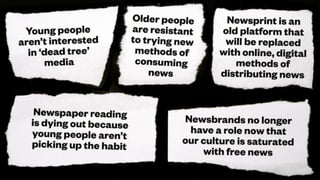
  • #4 If you ask people in the industry and even beyond (it’s always good not t rely on our industry for a true view on media consumption – we are not the average Joe!), then you will hear statements like these, expressed in a variety of ways. Young people – they don’t read print and they’re not forming the newsbrand habit Older people – set in their ways, not adopting digital And most concerning of all for newsbrands, the idea that they’re superfluous to requirements in a world saturated with news. Now it’s easy to deal with some of those using industry data, and specifically the readership data from NRS PADD.
  • #5 Looking first at a total Newsbrand level, across platforms, the statistics don’t lie – almost 5 millions18-34’s and 5 million 50-65’s read a Newsbrand each day. And when you expand that to weekly and monthly the cast majority of these groups are reached by newsbrands each month. But what about our ‘dead-tree’ media? Isn’t the reach for the younger people just made up of digital consumption of newsbrands?
  • #6 Well no actually, it’s not just digital. 3.7m 18-34’s read a printed newspaper each day, not far off those 50-65’s. And that reach increases even more, when you expand out to weekly and monthly. So thinking back to our myths at the view that young people aren’t forming the Newsbrand habit, I started wondering how and when do those young people start reading newspapers? In a connected age, the old routes in surely don’t still stand. But before we look at that in more detail, we did a bit of additional analysis , looking at how readership of print varies by age.
  • #7 This looks at the reach of print by individual age from 15 up to 75. What is interesting to me is that period on the left from 15 to 19/20. There is a gradual increase in reading a newspaper, which starts off at around 50% at age 15, rising to almost 70% at age 20. One of the theories I had is that the newspaper habit is part of the formation of your identity. So I decided it was time to investigate more about habit formation and it’s application to newsbrands.
  • #8 We found an expert – let me introduce you to Professor Bas Verplanken, Professor of Social Psychology at Bath University, whose specialist subject is psychology. Bas can’t be with us today, as he’s off on a lecture tour, but we will be hearing from him. When you ask people what a habit is, one of the most common definitions is something you do a lot, perhaps a regular routine.
  • #9 And there is a lot of frequent behaviour in our lives. Academics have estimated that almost half of every day behaviour are done in the same place almost every day. Think about which place on the sofa you like to sit, where on the tube you like to get on. But frequency is just one aspect of a habit, a surgeon will operate on a lot of patients each day/week/month, but one would hope that is not a habit.! Let’s hear from Bas, interspersed with a few comments from the respondents in our research, more of that later.
  • #11 So habits are not just frequently performed behaviours, they are also highly automatic. Just think about when you are doing something for the first time, or the first few times. You have to think about it a lot, it requires effort and concentration, but then once it becomes familiar, you stop thinking about it. Just think about when you drive the same route regularly, how many times have you found yourself at your destination with no recollection of the journey. I started a new behaviour yesterday, and it was an effort yesterday and today. I moved house to Salisbury, so I am living in a new place, and therefore commuting into London. That involves the getting to the station – I decided to cycle – but where do I lock my bike up, where do I get on the train, which platform does it leave from? I expect though in a few weeks, it will become second nature, and I will do it without thinking. The third element of a habit is that it is linked to a particular context. For instance the habit of putting your seatbelt on is linked closely to the act or context of getting in the car. It’s actually one of the reason why habits are so hard to break – the act of having a cigarette after a meal, linked to the context of the meal.
  • #12 It is the very nature of habits, the fact that they are automatics, controlled by the subconscious if you like, that makes them difficult to measure. And actually it is important to measure habits beyond just behavioural frequency – you might want to know if an intervention increases or decreases a habit. So one of the key aspects of working with Bas was his expertise on the measurement of both the existence and the strength of habits. He has developed a way of measuring habits that takes into account the behavioural element, the automatic nature and the cues.
  • #13 Bas’s SRHI is a series of questions that get under the skin of the habit, using implicit measures to do so – such as for Behaviour X – I do it without thinking, it would require effort not to do it (we all know habits like those! This has been used and validated many times over the last decade in areas such as food and beverage consumption, weight loss, exercise, internet use and travel mode choices. It has been proved to be a statistically robust tool for habit measurement.
  • #14 Initially individual behaviours are the products of rational decision processes.   The habit formation process begins at the ‘initiation phase’, during which the new behaviour and the context in which it will be done are selected. Automaticity develops in the subsequent ‘learning phase’, during which the behaviour is repeated in the chosen context to strengthen the context-behaviour association. The final phase in habit-formation is the ‘stability phase’, the behaviour is initiated almost reflexively by environmental cues, rather than deliberate decision processes (Gardner, 2009). The habit is formed and becomes automatic with little cognitive deliberation or effort needed to perform a now common action/behaviour.
  • #15 News consumers are faced with extremely varied media environments with a myriad of news sources being accessible at all times of the day. Given the many choices news consumers face the theory of media attendance (LaRose & Eastin, 2004) has proposed that the consumer lapses into habitual patterns of media consumption in order to conserve mental resources, rather than repeatedly engaging in active selection. The model proposes that active selection processes operate primarily in the early stages of media selection. Once news consumers discover which sources better suit them for their daily news they quickly stop contemplating over the news selection decision from day to day. Instead, they fall into a pattern of repeated media behaviour; a media habit. Over time, habit strength increases, by news consumers returning to their preferred news source to relieve their sense of unease about not knowing what is going on around the world.
  • #17 Need to take account of the subconscious measurement issues Using Bas’ methods and SRHI to do that Newsbrand respondents deprived of core brand for 5 days Non-Newsbrand respondents provided with appropriate brand to consume everyday on a variety of platforms Newsbrand respondents record contexts where Newsbrand missed the most/least and substitutes turned Non-Newsbrand respondents record contexts in which Newsbrand was most/least enjoyable, and its impact on their other behaviours All reflect on what they have learned about themselves and their news habits Newsbrand respondents discuss triggers and barriers to adopting substitutes Non-Newsbrand respondents discuss triggers and barriers to adopting the newsbrand habit,
  • #18 We believe that the most successful brands are those that not only resonate within their category, and with people, but with the wider culture Culture – what’s going on in the world, what are the broader trends and changes shaping people’s lives and experiences People – what are people doing, and what are the motivations and values underpinning their behaviour Category – how is the category and the brands within it evolving Newsbrand Habits are influenced by, and in turn help shape, Culture, People and the Category. They sit in the space where three factors combine and interact
  • #19 NEWS IS INCREASINGLY ALL AROUND US – PART OF EVERYDAY AMBIENCE AND EMBEDDED IN THE FABRIC OF OUR DIGITAL LIVES Never been so many opportunities to access and keep abreast of news than today…phone, laptop, tablet. TV, radio, newspapers etc. etc. Even when we are not thinking about it, we can stumble across it via home pages, rolling TV news in lobbies and waiting rooms, twitter feeds, freesheets littering the ground, news alerts etc. etc. Respondents in both out Saturation and Deprivation tasks found themselves bowled over with how much news was actually in their lives when they took the time to look. Millennial Ailish’s Facebook feeds contains a mix of friends comments, news and brand content
  • #21 WE EXPECT AND ANTICIPATE NEWS TO CONSTANTLY BE BREAKING Growth and combination of rolling news, news platform proliferation and globally shared events such as 9/11 means we expect to be able to follow and track a news story as it happens This chimes with the broader cultural view that ours is a world out of control and in constant flux (VUCA*)  SOMEWHERE SOMETHING IS ALWAYS HAPPENING AND WE NEED TO KNOW ABOUT IT A bit of a contrast to the Battle of Waterloo when it took 2 weeks for the news of Wellington’s victory over Napoleon to reach London. That is why a correspondent is so named……
  • #22 DIGITAL NEWS HABITS TRANSCENDS GENERATION – BOTH CONSUME NEWS ON AND OFFLINE Millennial’s have grown up in this world while many boomers were early adopters at the start of the tech boom The Boomers that did miss the first wave have since been introduced to tech by their children Both have developed a complex web of a personal news eco-system MILLENNIALS AND BOOMERS EQUALLY ENJOY THE SPEED AND EASE WITH WHICH THEY CAN NOW ACCESS THE NEWS Boomer Peter’s smartphone came with a newapp pre-installed that he has started to use regularly
  • #23 MILLENNIALS ARE MORE LIKELY TO BE CONSTANTLY CONSUMING A CONTINUOUS FLOW OF NEWSFEEDS Millennial’s were many of the early adopters of smartphones and ‘live’ in social media Persistently dipping in and out of newsfeeds containing a mix of content from friends, news and entertainment sources Habituated and dependent on distraction provided and find themselves consuming content on phones without realising it MILLENIAL’S OFTEN FEEL UNCOMFORTABLE IF THEY AREN’T DISTRACTED AND HAVE TO CONSTANTLY GRAZE HOWEVER BOOMER’S GROWING USE OF SMARTPHONES HAS INCREASED THEIR ENGAGEMENT IN NEWSFEED CULTURE Boomers are generally more structured in their online behaviours than Millennials – going to sites at certain times with specific purposes in mind While they lagged in their initial adoption of smartphones these devices are now becoming equally embedded in their lives and they are starting to display similar characteristics as younger generations BOOMERS INCREASINGLY ALSO FEEL THE NEED TO CONSTANTLY CHECK IN ON NEWS THROUGH THEIR PHONE
  • #24 TENSION BETWEEN THE DESIRE TO CONNECT AND KEEP UP TO DATE WITH THE WIDER WORLD AND A GROWING DEPENDENCY ON PHONES THAT BLOCKS OUT THE REST OF THE WORLD Both generations are aware about their changing behaviours and talk about being “surgically attached to phone” or possessing a “digital left hand” Most keenly felt by Millennials who are increasingly looking for ways to temporarily disconnect to regain control while Boomers don’t yet feel overwhelmed Sense that addiction is to the phone as a medium itself rather than the content on it per se AS NEWSFEED DEPENDENCY HAS GROWN, SO TO HAS THE DESIRE TO TAKE A BREAK FROM THE GRASP OF THE SMALLER SCREEN
  • #26 Newsbrands who have adapted successfully have built a range of online touchpoints that integrate with these complex webs and leverage non-newsbrand sources This resonates with newsfeed culture by enabling newsbrands to work as either the beginning, middle or end of a news habit journey. IN WORLD AWASH WITH NEWS IT CAN BE DIFFICULT TO UNDERSTAND WHAT YOU NEED TO KNOW The endless sea of information and opinion makes it difficult know when to stop, there is always the fear something important is happening and we are missing out People looking for a ‘balanced’ point of view that covers the events and issues they feel is important in the world –which in practical terms means someone or something that reflects their values Newsbrands provide trusted ‘real’ journalism* and a sense of satisfaction by giving you everything you need to know and no more - soothing the itch rather than scratching it NEWSBRANDS ARE A LENS THAT BRINGS FOCUS TO THE WORLD AND A SENSE OF UNDERSTANDING TO THE ONLINE CHATTER
  • #27 LENS IS THE FEATURE OF NEWSBRANDS THAT OUR RESPONDENTS MISSED THE MOST IN DEPRIVATION TASK Participants in Deprivation task found that while they could easily access news from other sources the one thing they really missed was the sense of a world view newsbrands provided – resulting in a sense of unease that they might be missing something important no matter how much alternative news they consumed The one thing participants in Saturation task most appreciated about Newsbrands was the broader view of the world provided by Newsbrands and the greater depth on stories they wouldn’t otherwise encounter PROVING A LENS ON THE WORLD IS THE LATENT NEED THAT NEWSBRANDS HABITS ANSWER; THE KEY REWARD THEY GET THAT THEY ARE NOT ALWAYS CONSCIOUS OF INITIALLY
  • #30 DIGITAL AND MOBILE TECHNOLOGY MEANS NEWS HABITS ARE NOW FOLDED INTO A MUCH BROADER RANGE OF RITUALS AND ROUTINES News is coming to people in many ways that it didn’t before and they have more opportunity and appetite to engage with Newsbrands The addictive nature of new digital habits are sweeping Newsbrand habits along in their wake Increasingly we look for the small buzz that a new news story can bring NEW NEWS HABITS HAVE BEEN CREATED BY OUR INCREASED EXPECATION, NEED AND DESIRE FOR NEWS
  • #31 OTHER HABITS MIGHT PROVIDE MORE RAPID ACCESS TO A AN INDIVIDUAL NEWS STORY BUT NEWBRANDS PROVIDE A MORE EFFICIENT ROUTE TO THE NEWS OVERALL Participants in the Deprivation task missed their preferred Newsbrand’s format (whether print, online, mobile) which they found made finding news both quicker and more relaxing because of its consistency and considered layout Although many people in the Saturation task initially found it difficult to ‘carve’ time out of their daily routine to fit in a Newsbrand, once they did they found it a more efficient means of covering their overall need for news ONCE A NEWSBRAND’S FORMAT HAS BEEN ‘IMPRINTED’ ON PEOPLE IT ENABLES SWIFTER NAVIGATION AND GREATER SENSE OF SATISFACTION
  • #32 MILLENNIALS CONTINUE TO FORM NEWSBRAND RELATIONSHIPS WHILE BOOMERS ENGAGE IN NEW WAYS While many Milennials are still introduced to newsbrands by parents/work others are increasingly meeting them online via posts or recommendations on social media If they frequently encouter a newsbrand with a ‘lens’ that chimes with their own developing identity they follow and explore its platforms in different contexts These Newsbrands then become one of these Millennial’s key ‘Go-To’ brands at the centre of their news eco-system Simultaneously as Boomers embrace new digital platforms they are discovering more ways to access news and developing new newsbrand habits INTEREST IN NEWS DRIVES ENGAGEMENT WITH NEWSBRANDS MORE THAN GENERATION
  • #48 PEOPLE – where it feels like the world is constantly in flux print provides a sense of finite news and the possibility for a more complete world view CULTURE – as we spend an increasing amount of time in the day looking at screens, print offers a chance to disconnect BRAND – where the news category continues to expand in sources and modes of consumption, print helps put some constrain on the world, it puts white lines around the digital chatter