2
LICENSING AND TERMS OF USE
• You are welcome to use the data and slides in this report for any purpose
(commercial or non-commercial) in return for simple attribution under a
Creative Commons license: http://creativecommons.org/licenses/by/3.0/
• Please attribute to the Reuters Institute Digital News Report 2015. If
relevant, add a link to: www.digitalnewsreport.org
• We welcome feedback and questions at info@digitalnewsreport.org
BACKGROUND AND METHODOLOGY
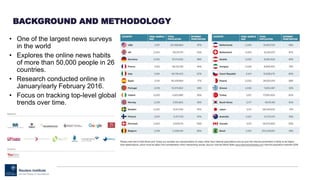
• One of the largest news surveys
in the world
• Explores the online news habits
of more than 50,000 people in 26
countries.
• Research conducted online in
January/early February 2016.
• Focus on tracking top-level global
trends over time.
KEY
FINDINGS
 Majority of people now use social media for news,
with one in ten saying it is their main source.
 Rapid move to mobile news consumption showing no
signs of slowing, with some countries now
smartphone first.
 Traditional news brands struggle to remain noticed in
a social and mobile news environment – but they
remain important to news users.
 Most are still reluctant to pay for online news.
 Around a quarter use ad blockers, but less than one
in ten block ads on their smartphones.
 Strong concerns about the drawbacks of more
personalised news – but the young are more
comfortable with algorithms.
4
THE RISE OF
SOCIAL AND
AGGREGATED
NEWS
SOURCES OF NEWS FROM 2012-2016
UNITED STATES
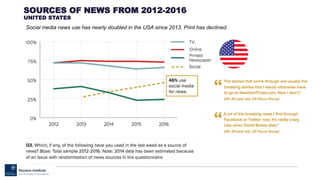
Social media news use has nearly doubled in the USA since 2013. Print has declined.
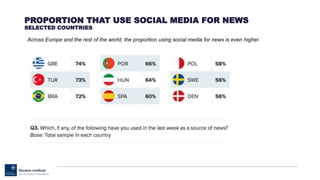
PROPORTION THAT USE SOCIAL MEDIA FOR NEWS
SELECTED COUNTRIES
Across Europe and the rest of the world, the proportion using social media for news is even higher.
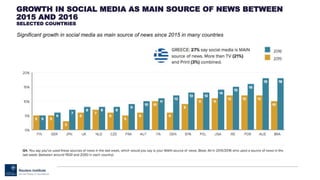
GROWTH IN SOCIAL MEDIA AS MAIN SOURCE OF NEWS BETWEEN
2015 AND 2016
SELECTED COUNTRIES
Significant growth in social media as main source of news since 2015 in many countries
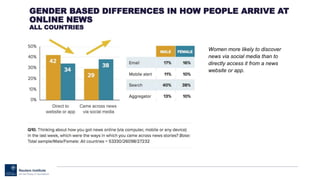
GENDER BASED DIFFERENCES IN HOW PEOPLE ARRIVE AT
ONLINE NEWS
ALL COUNTRIES
Women more likely to discover
news via social media than to
directly access it from a news
website or app.
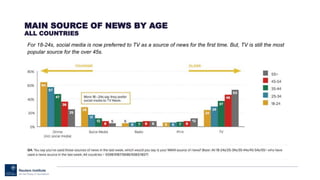
MAIN SOURCE OF NEWS BY AGE
ALL COUNTRIES
For 18-24s, social media is now preferred to TV as a source of news for the first time. But, TV is still the most
popular source for the over 45s.
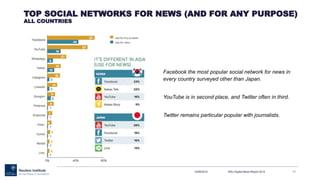
TOP SOCIAL NETWORKS FOR NEWS (AND FOR ANY PURPOSE)
ALL COUNTRIES
13/06/2014 RISJ Digital News Report 2014 11
Facebook the most popular social network for news in
every country surveyed other than Japan.
YouTube is in second place, and Twitter often in third.
Twitter remains particular popular with journalists.
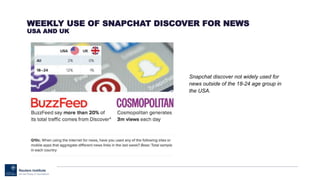
WEEKLY USE OF SNAPCHAT DISCOVER FOR NEWS
USA AND UK
Snapchat discover not widely used for
news outside of the 18-24 age group in
the USA.
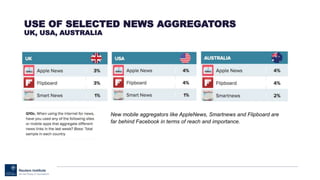
USE OF SELECTED NEWS AGGREGATORS
UK, USA, AUSTRALIA
New mobile aggregators like AppleNews, Smartnews and Flipboard are
far behind Facebook in terms of reach and importance.
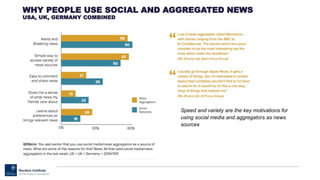
WHY PEOPLE USE SOCIAL AND AGGREGATED NEWS
USA, UK, GERMANY COMBINED
Speed and variety are the key motivations for
using social media and aggregators as news
sources
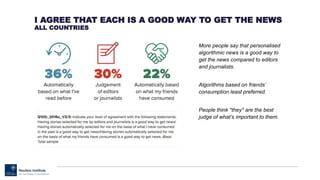
I AGREE THAT EACH IS A GOOD WAY TO GET THE NEWS
ALL COUNTRIES
More people say that personalised
algorithmic news is a good way to
get the news compared to editors
and journalists.
Algorithms based on friends’
consumption least preferred.
People think *they* are the best
judge of what’s important to them.
16
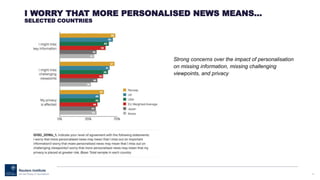
I WORRY THAT MORE PERSONALISED NEWS MEANS…
SELECTED COUNTRIES
Strong concerns over the impact of personalisation
on missing information, missing challenging
viewpoints, and privacy
17
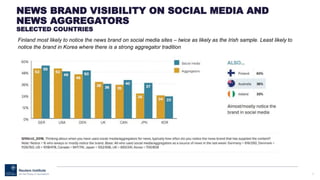
NEWS BRAND VISIBILITY ON SOCIAL MEDIA AND
NEWS AGGREGATORS
SELECTED COUNTRIES
Finland most likely to notice the news brand on social media sites – twice as likely as the Irish sample. Least likely to
notice the brand in Korea where there is a strong aggregator tradition
THE CONTINUED
GROWTH OF
MOBILE NEWS
ACCESS
19
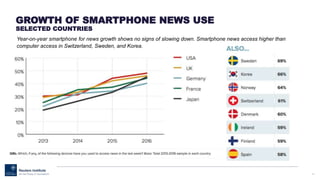
GROWTH OF SMARTPHONE NEWS USE
SELECTED COUNTRIES
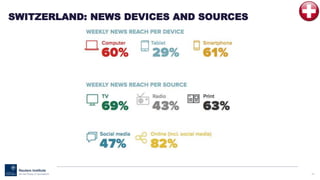
Year-on-year smartphone for news growth shows no signs of slowing down. Smartphone news access higher than
computer access in Switzerland, Sweden, and Korea.
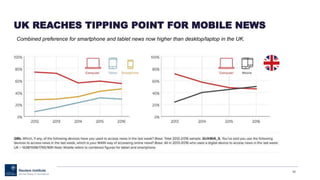
UK REACHES TIPPING POINT FOR MOBILE NEWS
20
Combined preference for smartphone and tablet news now higher than desktop/laptop in the UK.
21
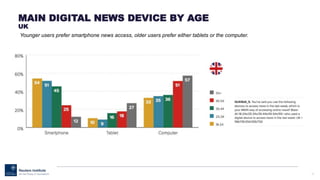
MAIN DIGITAL NEWS DEVICE BY AGE
UK
Younger users prefer smartphone news access, older users prefer either tablets or the computer.
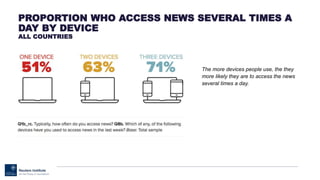
PROPORTION WHO ACCESS NEWS SEVERAL TIMES A
DAY BY DEVICE
ALL COUNTRIES
The more devices people use, the they
more likely they are to access the news
several times a day.
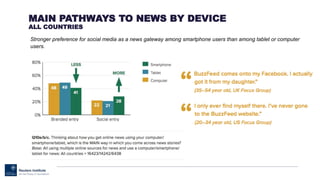
MAIN PATHWAYS TO NEWS BY DEVICE
ALL COUNTRIES
Stronger preference for social media as a news gateway among smartphone users than among tablet or computer
users.
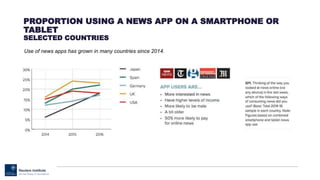
PROPORTION USING A NEWS APP ON A SMARTPHONE OR
TABLET
SELECTED COUNTRIES
Use of news apps has grown in many countries since 2014.
25
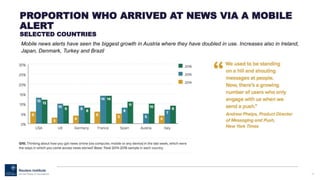
Mobile news alerts have seen the biggest growth in Austria where they have doubled in use. Increases also in Ireland,
Japan, Denmark, Turkey and Brazil
PROPORTION WHO ARRIVED AT NEWS VIA A MOBILE
ALERT
SELECTED COUNTRIES
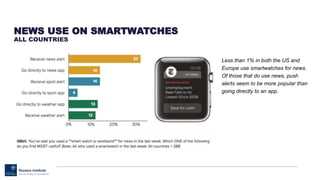
NEWS USE ON SMARTWATCHES
ALL COUNTRIES
Less than 1% in both the US and
Europe use smartwatches for news.
Of those that do use news, push
alerts seem to be more popular than
going directly to an app.
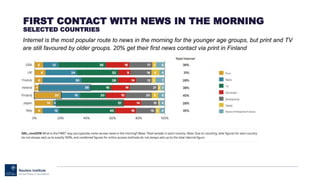
FIRST CONTACT WITH NEWS IN THE MORNING
SELECTED COUNTRIES
Internet is the most popular route to news in the morning for the younger age groups, but print and TV
are still favoured by older groups. 20% get their first news contact via print in Finland
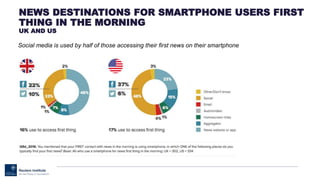
NEWS DESTINATIONS FOR SMARTPHONE USERS FIRST
THING IN THE MORNING
UK AND US
Social media is used by half of those accessing their first news on their smartphone
NEWS FORMATS
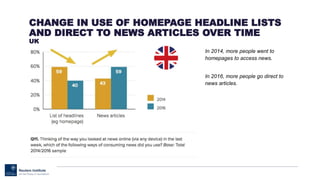
CHANGE IN USE OF HOMEPAGE HEADLINE LISTS
AND DIRECT TO NEWS ARTICLES OVER TIME
UK
In 2014, more people went to
homepages to access news.
In 2016, more people go direct to
news articles.
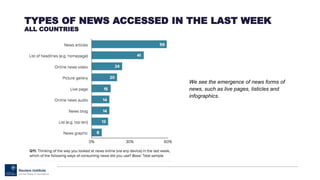
TYPES OF NEWS ACCESSED IN THE LAST WEEK
ALL COUNTRIES
We see the emergence of news forms of
news, such as live pages, listicles and
infographics.
32
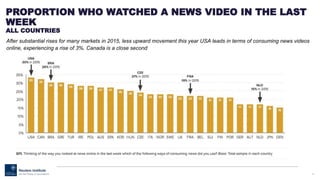
PROPORTION WHO WATCHED A NEWS VIDEO IN THE LAST
WEEK
ALL COUNTRIES
After substantial rises for many markets in 2015, less upward movement this year USA leads in terms of consuming news videos
online, experiencing a rise of 3%. Canada is a close second
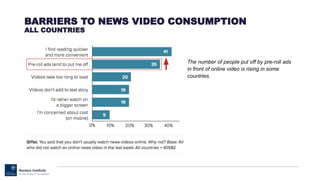
BARRIERS TO NEWS VIDEO CONSUMPTION
ALL COUNTRIES
The number of people put off by pre-roll ads
in front of online video is rising in some
countries.
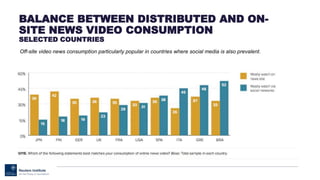
BALANCE BETWEEN DISTRIBUTED AND ON-
SITE NEWS VIDEO CONSUMPTION
SELECTED COUNTRIES
Off-site video news consumption particularly popular in countries where social media is also prevalent.
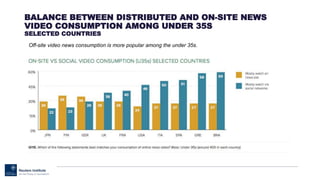
BALANCE BETWEEN DISTRIBUTED AND ON-SITE NEWS
VIDEO CONSUMPTION AMONG UNDER 35S
SELECTED COUNTRIES
Off-site video news consumption is more popular among the under 35s.
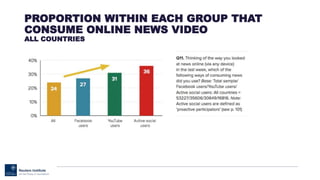
PROPORTION WITHIN EACH GROUP THAT
CONSUME ONLINE NEWS VIDEO
ALL COUNTRIES
THE BUSINESS OF
NEWS
38
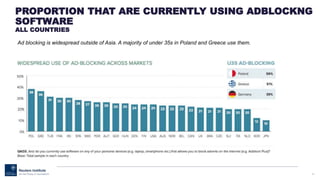
PROPORTION THAT ARE CURRENTLY USING ADBLOCKNG
SOFTWARE
ALL COUNTRIES
Ad blocking is widespread outside of Asia. A majority of under 35s in Poland and Greece use them.
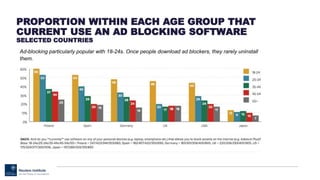
PROPORTION WITHIN EACH AGE GROUP THAT
CURRENT USE AN AD BLOCKING SOFTWARE
SELECTED COUNTRIES
Ad-blocking particularly popular with 18-24s. Once people download ad blockers, they rarely uninstall
them.
40
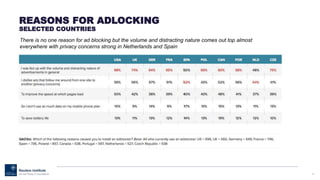
REASONS FOR ADLOCKING
SELECTED COUNTRIES
There is no one reason for ad blocking but the volume and distracting nature comes out top almost
everywhere with privacy concerns strong in Netherlands and Spain
41
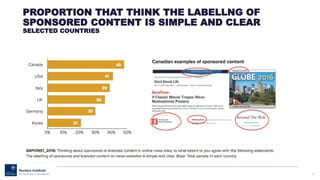
PROPORTION THAT THINK THE LABELLNG OF
SPONSORED CONTENT IS SIMPLE AND CLEAR
SELECTED COUNTRIES
42
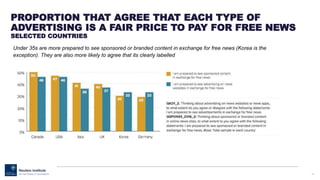
PROPORTION THAT AGREE THAT EACH TYPE OF
ADVERTISING IS A FAIR PRICE TO PAY FOR FREE NEWS
SELECTED COUNTRIES
Under 35s are more prepared to see sponsored or branded content in exchange for free news (Korea is the
exception). They are also more likely to agree that its clearly labelled
43
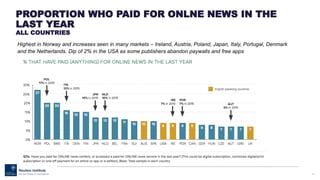
PROPORTION WHO PAID FOR ONLNE NEWS IN THE
LAST YEAR
ALL COUNTRIES
Highest in Norway and increases seen in many markets – Ireland, Austria, Poland, Japan, Italy, Portugal, Denmark
and the Netherlands. Dip of 2% in the USA as some publishers abandon paywalls and free apps
TRUST IN THE
NEWS
45
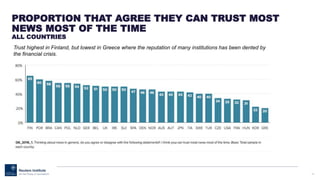
PROPORTION THAT AGREE THEY CAN TRUST MOST
NEWS MOST OF THE TIME
ALL COUNTRIES
Trust highest in Finland, but lowest in Greece where the reputation of many institutions has been dented by
the financial crisis.
46
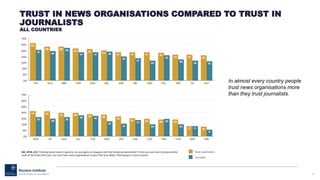
TRUST IN NEWS ORGANISATIONS COMPARED TO TRUST IN
JOURNALISTS
ALL COUNTRIES
In almost every country people
trust news organisations more
than they trust journalists.
TRADITIONAL
NEWS BRANDS
ONLINE
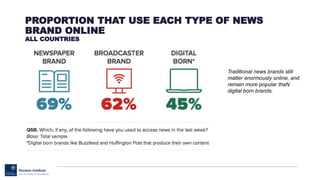
PROPORTION THAT USE EACH TYPE OF NEWS
BRAND ONLINE
ALL COUNTRIES
Traditional news brands still
matter enormously online, and
remain more popular thaN
digital born brands.
49
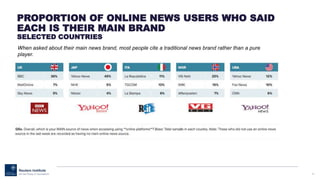
PROPORTION OF ONLINE NEWS USERS WHO SAID
EACH IS THEIR MAIN BRAND
SELECTED COUNTRIES
When asked about their main news brand, most people cite a traditional news brand rather than a pure
player.
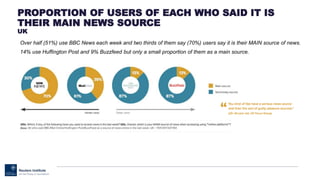
PROPORTION OF USERS OF EACH WHO SAID IT IS
THEIR MAIN NEWS SOURCE
UK
Over half (51%) use BBC News each week and two thirds of them say (70%) users say it is their MAIN source of news.
14% use Huffington Post and 9% Buzzfeed but only a small proportion of them as a main source.
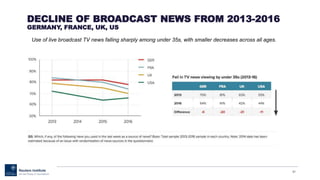
DECLINE OF BROADCAST NEWS FROM 2013-2016
GERMANY, FRANCE, UK, US
51
Use of live broadcast TV news falling sharply among under 35s, with smaller decreases across all ages.
KEY DATA BY
COUNTRY
53
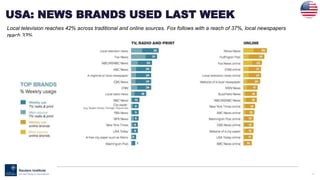
Local television reaches 42% across traditional and online sources. Fox follows with a reach of 37%, local newspapers
reach 33%
USA: NEWS BRANDS USED LAST WEEK
54
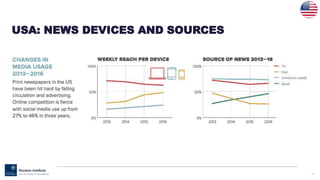
USA: NEWS DEVICES AND SOURCES
55
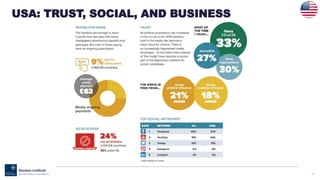
USA: TRUST, SOCIAL, AND BUSINESS
56
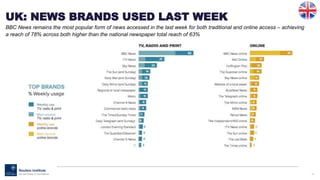
BBC News remains the most popular form of news accessed in the last week for both traditional and online access – achieving
a reach of 78% across both higher than the national newspaper total reach of 63%
UK: NEWS BRANDS USED LAST WEEK
57
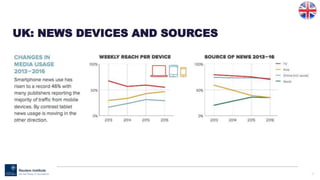
UK: NEWS DEVICES AND SOURCES
58
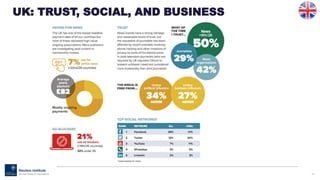
UK: TRUST, SOCIAL, AND BUSINESS
59
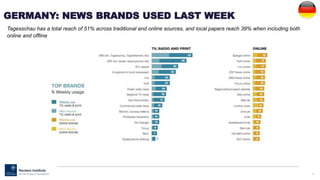
Tagesschau has a total reach of 51% across traditional and online sources, and local papers reach 39% when including both
online and offline
GERMANY: NEWS BRANDS USED LAST WEEK
60
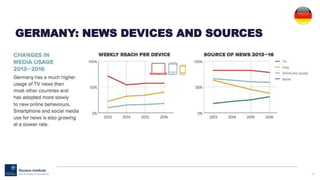
GERMANY: NEWS DEVICES AND SOURCES
61
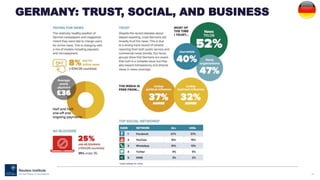
GERMANY: TRUST, SOCIAL, AND BUSINESS
62
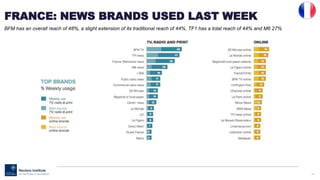
BFM has an overall reach of 48%, a slight extension of its traditional reach of 44%. TF1 has a total reach of 44% and M6 27%
FRANCE: NEWS BRANDS USED LAST WEEK
63
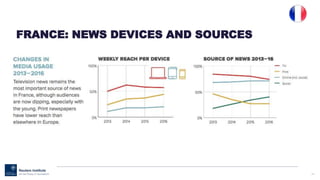
FRANCE: NEWS DEVICES AND SOURCES
64
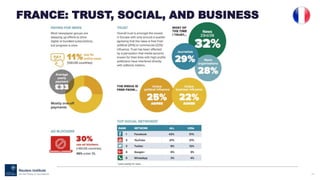
FRANCE: TRUST, SOCIAL, AND BUSINESS
65
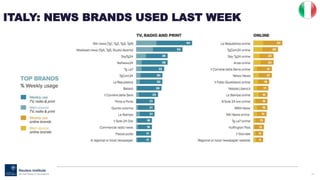
ITALY: NEWS BRANDS USED LAST WEEK
66
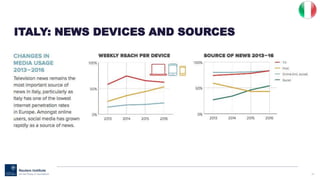
ITALY: NEWS DEVICES AND SOURCES
67
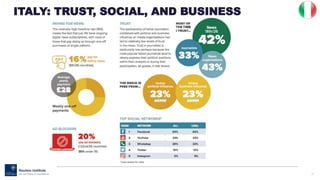
ITALY: TRUST, SOCIAL, AND BUSINESS
68
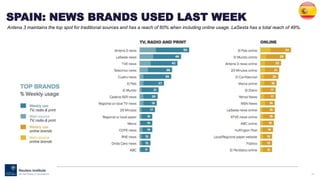
Antena 3 maintains the top spot for traditional sources and has a reach of 60% when including online usage. LaSexta has a total reach of 49%.
SPAIN: NEWS BRANDS USED LAST WEEK
69
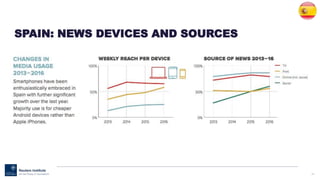
SPAIN: NEWS DEVICES AND SOURCES
70
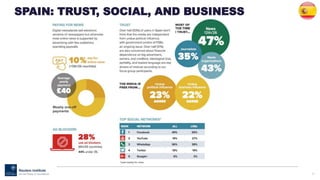
SPAIN: TRUST, SOCIAL, AND BUSINESS
71
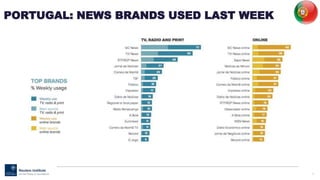
PORTUGAL: NEWS BRANDS USED LAST WEEK
72
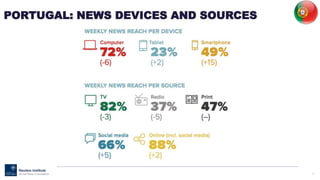
PORTUGAL: NEWS DEVICES AND SOURCES
73
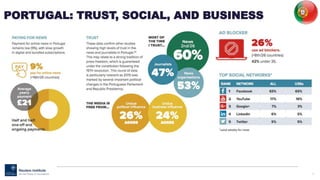
PORTUGAL: TRUST, SOCIAL, AND BUSINESS
74
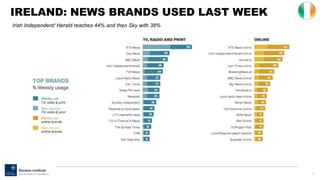
Irish Independent/ Herald reaches 44% and then Sky with 38%
IRELAND: NEWS BRANDS USED LAST WEEK
75
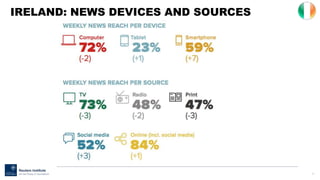
IRELAND: NEWS DEVICES AND SOURCES
76
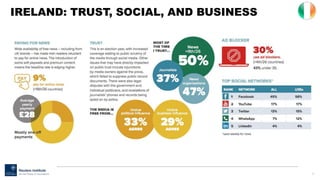
IRELAND: TRUST, SOCIAL, AND BUSINESS
77
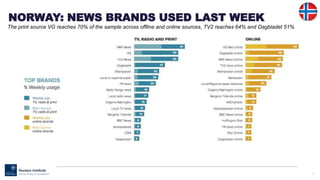
NORWAY: NEWS BRANDS USED LAST WEEK
The print source VG reaches 70% of the sample across offline and online sources, TV2 reaches 64% and Dagbladet 51%
78
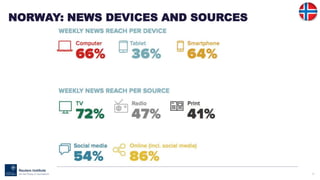
NORWAY: NEWS DEVICES AND SOURCES
79
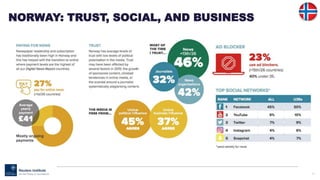
NORWAY: TRUST, SOCIAL, AND BUSINESS
80
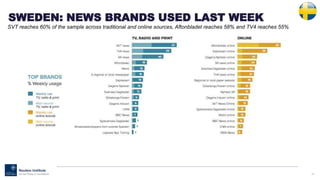
SWEDEN: NEWS BRANDS USED LAST WEEK
SVT reaches 60% of the sample across traditional and online sources, Aftonbladet reaches 58% and TV4 reaches 55%
81
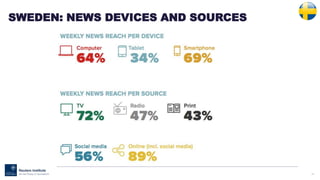
SWEDEN: NEWS DEVICES AND SOURCES
82
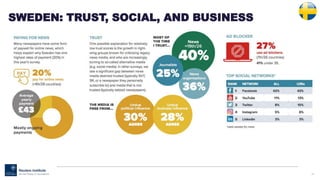
SWEDEN: TRUST, SOCIAL, AND BUSINESS
83
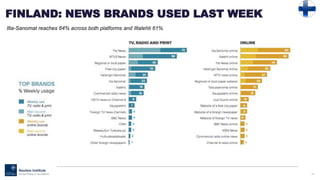
FINLAND: NEWS BRANDS USED LAST WEEK
Ilta-Sanomat reaches 64% across both platforms and Iltalehti 61%
84
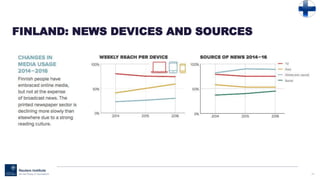
FINLAND: NEWS DEVICES AND SOURCES
85
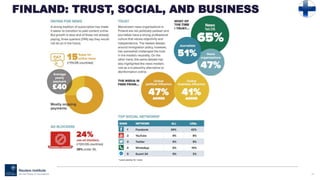
FINLAND: TRUST, SOCIAL, AND BUSINESS
86
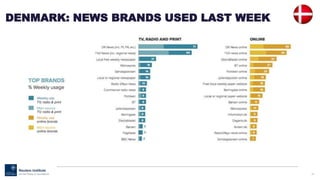
DENMARK: NEWS BRANDS USED LAST WEEK
87
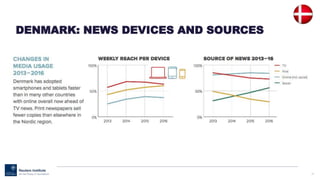
DENMARK: NEWS DEVICES AND SOURCES
88
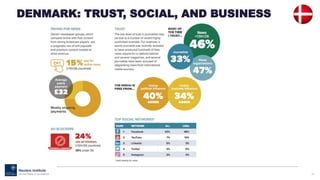
DENMARK: TRUST, SOCIAL, AND BUSINESS
89
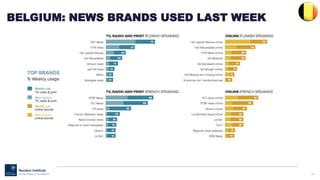
BELGIUM: NEWS BRANDS USED LAST WEEK
90
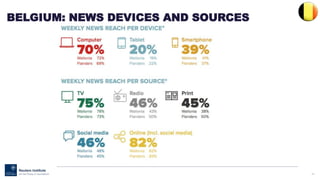
BELGIUM: NEWS DEVICES AND SOURCES
91
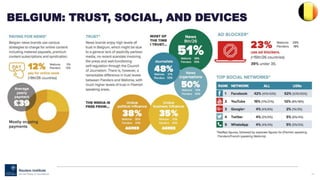
BELGIUM: TRUST, SOCIAL, AND DEVICES
92
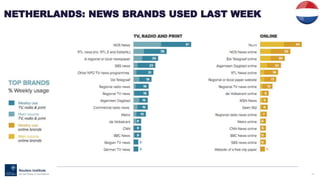
NETHERLANDS: NEWS BRANDS USED LAST WEEK
93
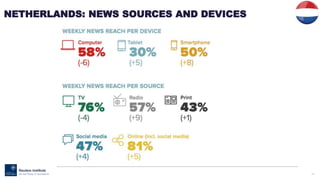
NETHERLANDS: NEWS SOURCES AND DEVICES
94
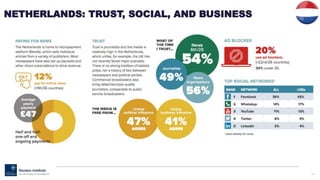
NETHERLANDS: TRUST, SOCIAL, AND BUSINESS
95
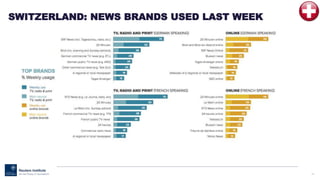
SWITZERLAND: NEWS BRANDS USED LAST WEEK
96
SWITZERLAND: NEWS DEVICES AND SOURCES
97
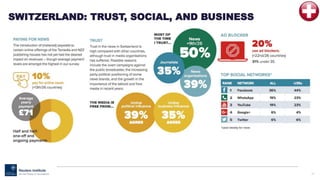
SWITZERLAND: TRUST, SOCIAL, AND BUSINESS
98
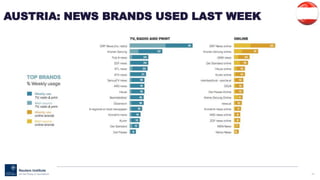
AUSTRIA: NEWS BRANDS USED LAST WEEK
99
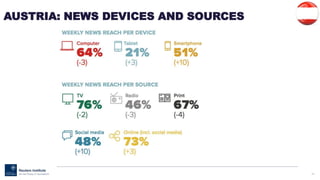
AUSTRIA: NEWS DEVICES AND SOURCES
100
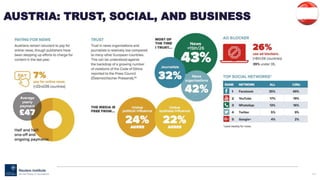
AUSTRIA: TRUST, SOCIAL, AND BUSINESS
101
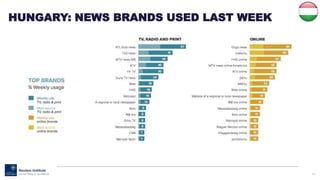
HUNGARY: NEWS BRANDS USED LAST WEEK
102
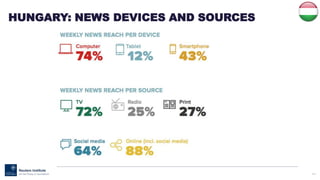
HUNGARY: NEWS DEVICES AND SOURCES
103
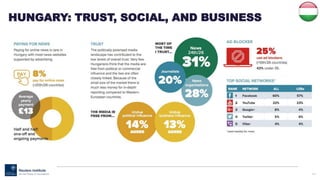
HUNGARY: TRUST, SOCIAL, AND BUSINESS
104
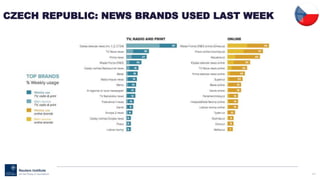
CZECH REPUBLIC: NEWS BRANDS USED LAST WEEK
105
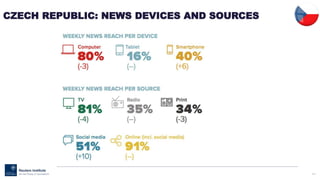
CZECH REPUBLIC: NEWS DEVICES AND SOURCES
106
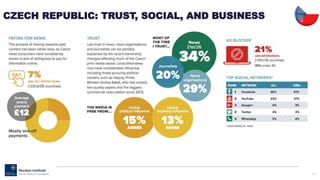
CZECH REPUBLIC: TRUST, SOCIAL, AND BUSINESS
107
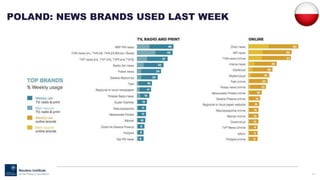
POLAND: NEWS BRANDS USED LAST WEEK
108
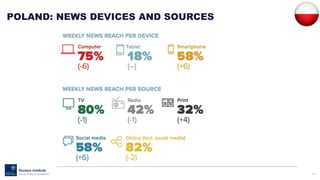
POLAND: NEWS DEVICES AND SOURCES
109
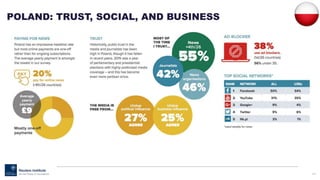
POLAND: TRUST, SOCIAL, AND BUSINESS
110
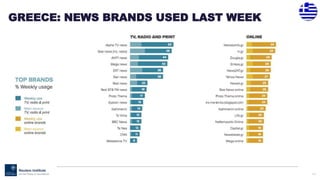
GREECE: NEWS BRANDS USED LAST WEEK
111
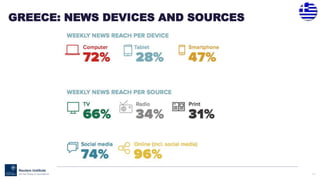
GREECE: NEWS DEVICES AND SOURCES
112
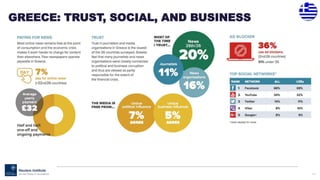
GREECE: TRUST, SOCIAL, AND BUSINESS
113
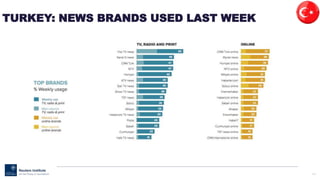
TURKEY: NEWS BRANDS USED LAST WEEK
114
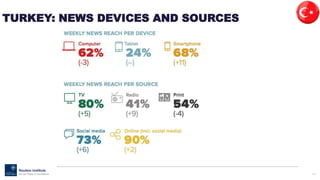
TURKEY: NEWS DEVICES AND SOURCES
115
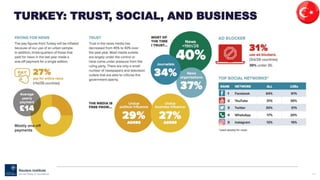
TURKEY: TRUST, SOCIAL, AND BUSINESS
116
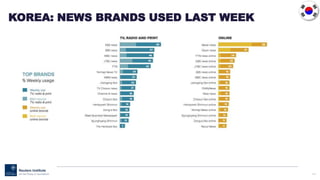
KOREA: NEWS BRANDS USED LAST WEEK
117
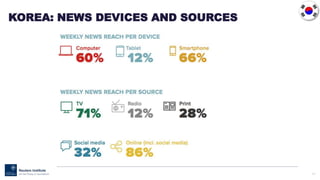
KOREA: NEWS DEVICES AND SOURCES
118
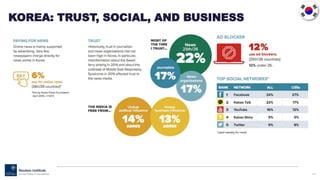
KOREA: TRUST, SOCIAL, AND BUSINESS
119
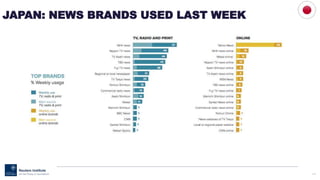
JAPAN: NEWS BRANDS USED LAST WEEK
120
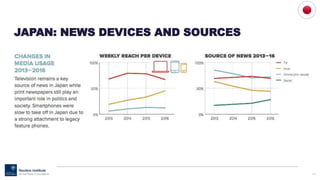
JAPAN: NEWS DEVICES AND SOURCES
121
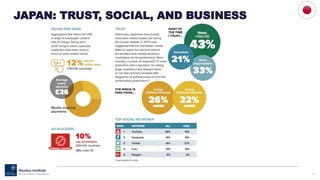
JAPAN: TRUST, SOCIAL, AND BUSINESS
122
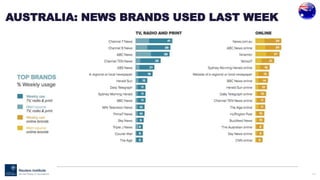
AUSTRALIA: NEWS BRANDS USED LAST WEEK
123
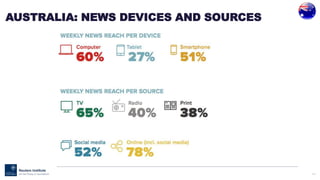
AUSTRALIA: NEWS DEVICES AND SOURCES
124
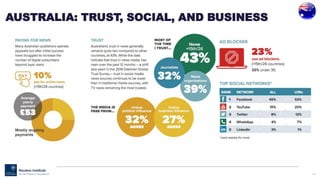
AUSTRALIA: TRUST, SOCIAL, AND BUSINESS
125
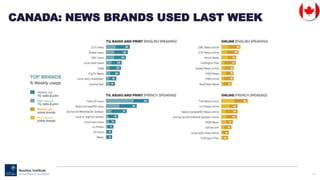
CANADA: NEWS BRANDS USED LAST WEEK
126
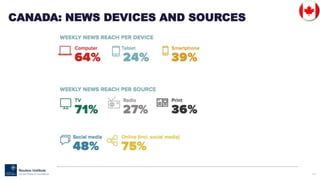
CANADA: NEWS DEVICES AND SOURCES
127
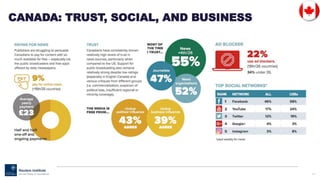
CANADA: TRUST, SOCIAL, AND BUSINESS
128
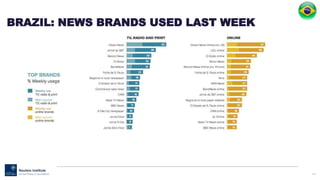
BRAZIL: NEWS BRANDS USED LAST WEEK
129
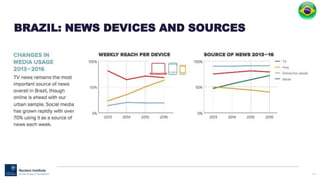
BRAZIL: NEWS DEVICES AND SOURCES
130
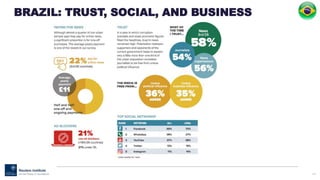
BRAZIL: TRUST, SOCIAL, AND BUSINESS
ADDITIONAL
ANALYSIS
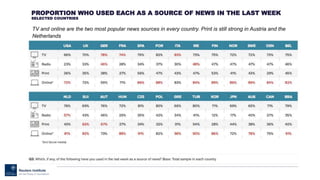
PROPORTION WHO USED EACH AS A SOURCE OF NEWS IN THE LAST WEEK
SELECTED COUNTRIES
TV and online are the two most popular news sources in every country. Print is still strong in Austria and the
Netherlands
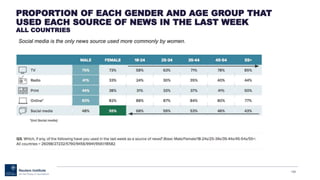
PROPORTION OF EACH GENDER AND AGE GROUP THAT
USED EACH SOURCE OF NEWS IN THE LAST WEEK
ALL COUNTRIES
133
Social media is the only news source used more commonly by women.
134
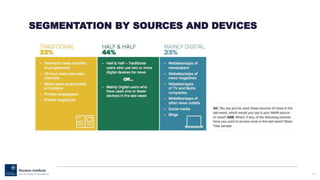
SEGMENTATION BY SOURCES AND DEVICES
135
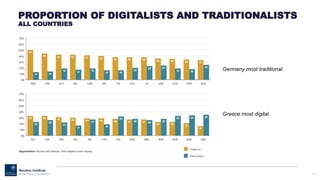
PROPORTION OF DIGITALISTS AND TRADITIONALISTS
ALL COUNTRIES
Germany most traditional.
Greece most digital.
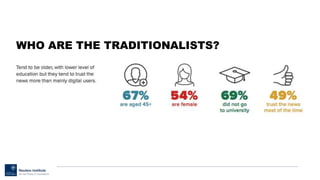
WHO ARE THE TRADITIONALISTS?
137
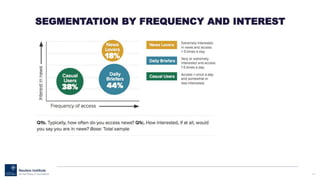
SEGMENTATION BY FREQUENCY AND INTEREST
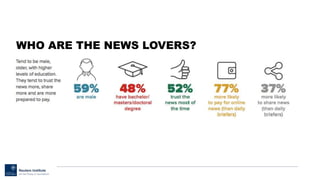
WHO ARE THE NEWS LOVERS?
139
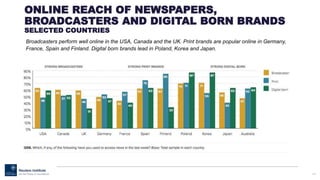
ONLINE REACH OF NEWSPAPERS,
BROADCASTERS AND DIGITAL BORN BRANDS
SELECTED COUNTRIES
Broadcasters perform well online in the USA, Canada and the UK. Print brands are popular online in Germany,
France, Spain and Finland. Digital born brands lead in Poland, Korea and Japan.
140
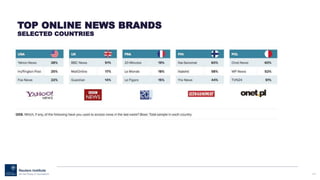
TOP ONLINE NEWS BRANDS
SELECTED COUNTRIES
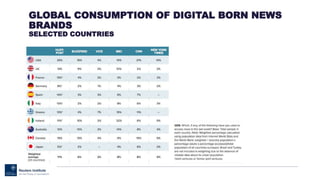
GLOBAL CONSUMPTION OF DIGITAL BORN NEWS
BRANDS
SELECTED COUNTRIES
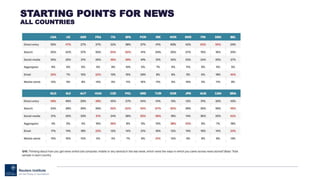
STARTING POINTS FOR NEWS
ALL COUNTRIES
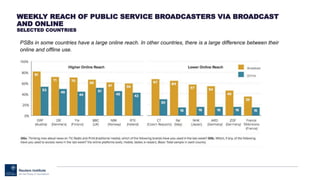
WEEKLY REACH OF PUBLIC SERVICE BROADCASTERS VIA BROADCAST
AND ONLINE
SELECTED COUNTRIES
PSBs in some countries have a large online reach. In other countries, there is a large difference between their
online and offline use.
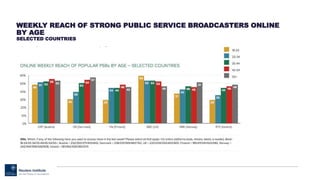
WEEKLY REACH OF STRONG PUBLIC SERVICE BROADCASTERS ONLINE
BY AGE
SELECTED COUNTRIES
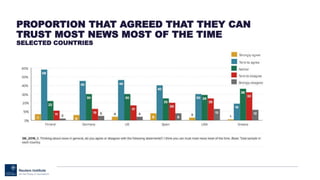
PROPORTION THAT AGREED THAT THEY CAN
TRUST MOST NEWS MOST OF THE TIME
SELECTED COUNTRIES
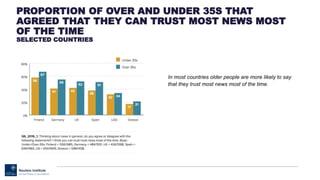
PROPORTION OF OVER AND UNDER 35S THAT
AGREED THAT THEY CAN TRUST MOST NEWS MOST
OF THE TIME
SELECTED COUNTRIES
In most countries older people are more likely to say
that they trust most news most of the time.
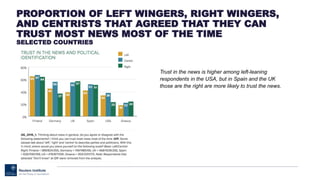
PROPORTION OF LEFT WINGERS, RIGHT WINGERS,
AND CENTRISTS THAT AGREED THAT THEY CAN
TRUST MOST NEWS MOST OF THE TIME
SELECTED COUNTRIES
Trust in the news is higher among left-leaning
respondents in the USA, but in Spain and the UK
those are the right are more likely to trust the news.
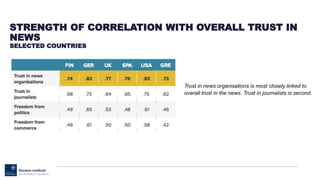
STRENGTH OF CORRELATION WITH OVERALL TRUST IN
NEWS
SELECTED COUNTRIES
Trust in news organisations is most closely linked to
overall trust in the news. Trust in journalists is second.
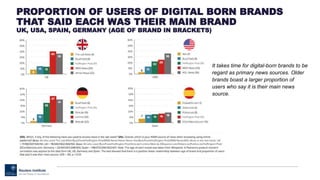
PROPORTION OF USERS OF DIGITAL BORN BRANDS
THAT SAID EACH WAS THEIR MAIN BRAND
UK, USA, SPAIN, GERMANY (AGE OF BRAND IN BRACKETS)
It takes time for digital-born brands to be
regard as primary news sources. Older
brands boast a larger proportion of
users who say it is their main news
source.
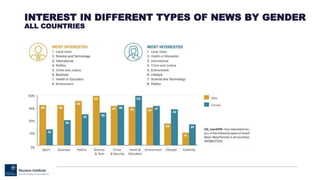
INTEREST IN DIFFERENT TYPES OF NEWS BY GENDER
ALL COUNTRIES
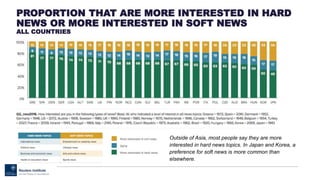
PROPORTION THAT ARE MORE INTERESTED IN HARD
NEWS OR MORE INTERESTED IN SOFT NEWS
ALL COUNTRIES
Outside of Asia, most people say they are more
interested in hard news topics. In Japan and Korea, a
preference for soft news is more common than
elsewhere.
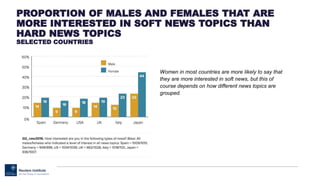
PROPORTION OF MALES AND FEMALES THAT ARE
MORE INTERESTED IN SOFT NEWS TOPICS THAN
HARD NEWS TOPICS
SELECTED COUNTRIES
Women in most countries are more likely to say that
they are more interested in soft news, but this of
course depends on how different news topics are
grouped.
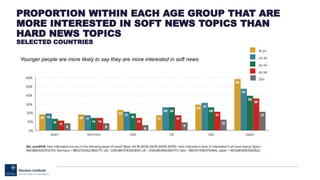
PROPORTION WITHIN EACH AGE GROUP THAT ARE
MORE INTERESTED IN SOFT NEWS TOPICS THAN
HARD NEWS TOPICS
SELECTED COUNTRIES
Younger people are more likely to say they are more interested in soft news.
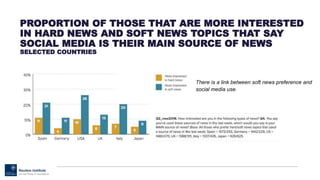
PROPORTION OF THOSE THAT ARE MORE INTERESTED
IN HARD NEWS AND SOFT NEWS TOPICS THAT SAY
SOCIAL MEDIA IS THEIR MAIN SOURCE OF NEWS
SELECTED COUNTRIES
There is a link between soft news preference and
social media use.
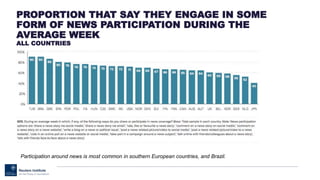
PROPORTION THAT SAY THEY ENGAGE IN SOME
FORM OF NEWS PARTICIPATION DURING THE
AVERAGE WEEK
ALL COUNTRIES
Participation around news is most common in southern European countries, and Brazil.
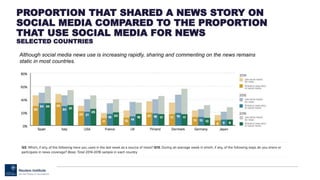
PROPORTION THAT SHARED A NEWS STORY ON
SOCIAL MEDIA COMPARED TO THE PROPORTION
THAT USE SOCIAL MEDIA FOR NEWS
SELECTED COUNTRIES
Although social media news use is increasing rapidly, sharing and commenting on the news remains
static in most countries.
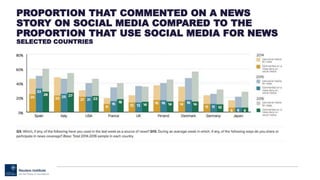
PROPORTION THAT COMMENTED ON A NEWS
STORY ON SOCIAL MEDIA COMPARED TO THE
PROPORTION THAT USE SOCIAL MEDIA FOR NEWS
SELECTED COUNTRIES
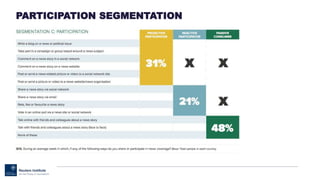
PARTICIPATION SEGMENTATION
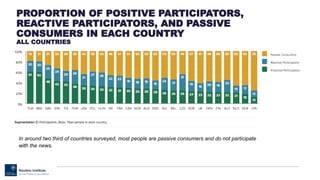
PROPORTION OF POSITIVE PARTICIPATORS,
REACTIVE PARTICIPATORS, AND PASSIVE
CONSUMERS IN EACH COUNTRY
ALL COUNTRIES
In around two third of countries surveyed, most people are passive consumers and do not participate
with the news.
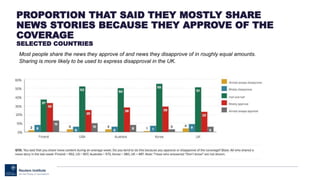
PROPORTION THAT SAID THEY MOSTLY SHARE
NEWS STORIES BECAUSE THEY APPROVE OF THE
COVERAGE
SELECTED COUNTRIES
Most people share the news they approve of and news they disapprove of in roughly equal amounts.
Sharing is more likely to be used to express disapproval in the UK.
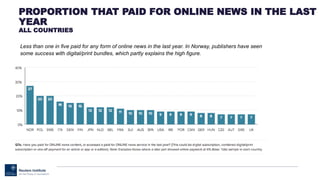
PROPORTION THAT PAID FOR ONLINE NEWS IN THE LAST
YEAR
ALL COUNTRIES
Less than one in five paid for any form of online news in the last year. In Norway, publishers have seen
some success with digital/print bundles, which partly explains the high figure.
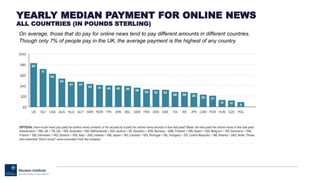
YEARLY MEDIAN PAYMENT FOR ONLINE NEWS
ALL COUNTRIES (IN POUNDS STERLING)
On average, those that do pay for online news tend to pay different amounts in different countries.
Though only 7% of people pay in the UK, the average payment is the highest of any country.
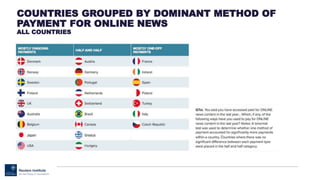
COUNTRIES GROUPED BY DOMINANT METHOD OF
PAYMENT FOR ONLINE NEWS
ALL COUNTRIES
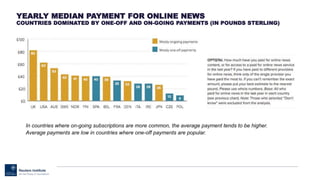
YEARLY MEDIAN PAYMENT FOR ONLINE NEWS
COUNTRIES DOMINATED BY ONE-OFF AND ON-GOING PAYMENTS (IN POUNDS STERLING)
In countries where on-going subscriptions are more common, the average payment tends to be higher.
Average payments are low in countries where one-off payments are popular.
More information
www.digitalnewsreport.org
#DNP2016
reuters.institute@politics.ox.ac.uk
165

Digital News Report 2016

  • 2.
    2 LICENSING AND TERMSOF USE • You are welcome to use the data and slides in this report for any purpose (commercial or non-commercial) in return for simple attribution under a Creative Commons license: http://creativecommons.org/licenses/by/3.0/ • Please attribute to the Reuters Institute Digital News Report 2015. If relevant, add a link to: www.digitalnewsreport.org • We welcome feedback and questions at info@digitalnewsreport.org
  • 3.
    BACKGROUND AND METHODOLOGY •One of the largest news surveys in the world • Explores the online news habits of more than 50,000 people in 26 countries. • Research conducted online in January/early February 2016. • Focus on tracking top-level global trends over time.
  • 4.
    KEY FINDINGS  Majority ofpeople now use social media for news, with one in ten saying it is their main source.  Rapid move to mobile news consumption showing no signs of slowing, with some countries now smartphone first.  Traditional news brands struggle to remain noticed in a social and mobile news environment – but they remain important to news users.  Most are still reluctant to pay for online news.  Around a quarter use ad blockers, but less than one in ten block ads on their smartphones.  Strong concerns about the drawbacks of more personalised news – but the young are more comfortable with algorithms. 4
  • 5.
    THE RISE OF SOCIALAND AGGREGATED NEWS
  • 6.
    SOURCES OF NEWSFROM 2012-2016 UNITED STATES Social media news use has nearly doubled in the USA since 2013. Print has declined.
  • 7.
    PROPORTION THAT USESOCIAL MEDIA FOR NEWS SELECTED COUNTRIES Across Europe and the rest of the world, the proportion using social media for news is even higher.
  • 8.
    GROWTH IN SOCIALMEDIA AS MAIN SOURCE OF NEWS BETWEEN 2015 AND 2016 SELECTED COUNTRIES Significant growth in social media as main source of news since 2015 in many countries
  • 9.
    GENDER BASED DIFFERENCESIN HOW PEOPLE ARRIVE AT ONLINE NEWS ALL COUNTRIES Women more likely to discover news via social media than to directly access it from a news website or app.
  • 10.
    MAIN SOURCE OFNEWS BY AGE ALL COUNTRIES For 18-24s, social media is now preferred to TV as a source of news for the first time. But, TV is still the most popular source for the over 45s.
  • 11.
    TOP SOCIAL NETWORKSFOR NEWS (AND FOR ANY PURPOSE) ALL COUNTRIES 13/06/2014 RISJ Digital News Report 2014 11 Facebook the most popular social network for news in every country surveyed other than Japan. YouTube is in second place, and Twitter often in third. Twitter remains particular popular with journalists.
  • 12.
    WEEKLY USE OFSNAPCHAT DISCOVER FOR NEWS USA AND UK Snapchat discover not widely used for news outside of the 18-24 age group in the USA.
  • 13.
    USE OF SELECTEDNEWS AGGREGATORS UK, USA, AUSTRALIA New mobile aggregators like AppleNews, Smartnews and Flipboard are far behind Facebook in terms of reach and importance.
  • 14.
    WHY PEOPLE USESOCIAL AND AGGREGATED NEWS USA, UK, GERMANY COMBINED Speed and variety are the key motivations for using social media and aggregators as news sources
  • 15.
    I AGREE THATEACH IS A GOOD WAY TO GET THE NEWS ALL COUNTRIES More people say that personalised algorithmic news is a good way to get the news compared to editors and journalists. Algorithms based on friends’ consumption least preferred. People think *they* are the best judge of what’s important to them.
  • 16.
    16 I WORRY THATMORE PERSONALISED NEWS MEANS… SELECTED COUNTRIES Strong concerns over the impact of personalisation on missing information, missing challenging viewpoints, and privacy
  • 17.
    17 NEWS BRAND VISIBILITYON SOCIAL MEDIA AND NEWS AGGREGATORS SELECTED COUNTRIES Finland most likely to notice the news brand on social media sites – twice as likely as the Irish sample. Least likely to notice the brand in Korea where there is a strong aggregator tradition
  • 18.
  • 19.
    19 GROWTH OF SMARTPHONENEWS USE SELECTED COUNTRIES Year-on-year smartphone for news growth shows no signs of slowing down. Smartphone news access higher than computer access in Switzerland, Sweden, and Korea.
  • 20.
    UK REACHES TIPPINGPOINT FOR MOBILE NEWS 20 Combined preference for smartphone and tablet news now higher than desktop/laptop in the UK.
  • 21.
    21 MAIN DIGITAL NEWSDEVICE BY AGE UK Younger users prefer smartphone news access, older users prefer either tablets or the computer.
  • 22.
    PROPORTION WHO ACCESSNEWS SEVERAL TIMES A DAY BY DEVICE ALL COUNTRIES The more devices people use, the they more likely they are to access the news several times a day.
  • 23.
    MAIN PATHWAYS TONEWS BY DEVICE ALL COUNTRIES Stronger preference for social media as a news gateway among smartphone users than among tablet or computer users.
  • 24.
    PROPORTION USING ANEWS APP ON A SMARTPHONE OR TABLET SELECTED COUNTRIES Use of news apps has grown in many countries since 2014.
  • 25.
    25 Mobile news alertshave seen the biggest growth in Austria where they have doubled in use. Increases also in Ireland, Japan, Denmark, Turkey and Brazil PROPORTION WHO ARRIVED AT NEWS VIA A MOBILE ALERT SELECTED COUNTRIES
  • 26.
    NEWS USE ONSMARTWATCHES ALL COUNTRIES Less than 1% in both the US and Europe use smartwatches for news. Of those that do use news, push alerts seem to be more popular than going directly to an app.
  • 27.
    FIRST CONTACT WITHNEWS IN THE MORNING SELECTED COUNTRIES Internet is the most popular route to news in the morning for the younger age groups, but print and TV are still favoured by older groups. 20% get their first news contact via print in Finland
  • 28.
    NEWS DESTINATIONS FORSMARTPHONE USERS FIRST THING IN THE MORNING UK AND US Social media is used by half of those accessing their first news on their smartphone
  • 29.
  • 30.
    CHANGE IN USEOF HOMEPAGE HEADLINE LISTS AND DIRECT TO NEWS ARTICLES OVER TIME UK In 2014, more people went to homepages to access news. In 2016, more people go direct to news articles.
  • 31.
    TYPES OF NEWSACCESSED IN THE LAST WEEK ALL COUNTRIES We see the emergence of news forms of news, such as live pages, listicles and infographics.
  • 32.
    32 PROPORTION WHO WATCHEDA NEWS VIDEO IN THE LAST WEEK ALL COUNTRIES After substantial rises for many markets in 2015, less upward movement this year USA leads in terms of consuming news videos online, experiencing a rise of 3%. Canada is a close second
  • 33.
    BARRIERS TO NEWSVIDEO CONSUMPTION ALL COUNTRIES The number of people put off by pre-roll ads in front of online video is rising in some countries.
  • 34.
    BALANCE BETWEEN DISTRIBUTEDAND ON- SITE NEWS VIDEO CONSUMPTION SELECTED COUNTRIES Off-site video news consumption particularly popular in countries where social media is also prevalent.
  • 35.
    BALANCE BETWEEN DISTRIBUTEDAND ON-SITE NEWS VIDEO CONSUMPTION AMONG UNDER 35S SELECTED COUNTRIES Off-site video news consumption is more popular among the under 35s.
  • 36.
    PROPORTION WITHIN EACHGROUP THAT CONSUME ONLINE NEWS VIDEO ALL COUNTRIES
  • 37.
  • 38.
    38 PROPORTION THAT ARECURRENTLY USING ADBLOCKNG SOFTWARE ALL COUNTRIES Ad blocking is widespread outside of Asia. A majority of under 35s in Poland and Greece use them.
  • 39.
    PROPORTION WITHIN EACHAGE GROUP THAT CURRENT USE AN AD BLOCKING SOFTWARE SELECTED COUNTRIES Ad-blocking particularly popular with 18-24s. Once people download ad blockers, they rarely uninstall them.
  • 40.
    40 REASONS FOR ADLOCKING SELECTEDCOUNTRIES There is no one reason for ad blocking but the volume and distracting nature comes out top almost everywhere with privacy concerns strong in Netherlands and Spain

  • 41.
    41 PROPORTION THAT THINKTHE LABELLNG OF SPONSORED CONTENT IS SIMPLE AND CLEAR SELECTED COUNTRIES
  • 42.
    42 PROPORTION THAT AGREETHAT EACH TYPE OF ADVERTISING IS A FAIR PRICE TO PAY FOR FREE NEWS SELECTED COUNTRIES Under 35s are more prepared to see sponsored or branded content in exchange for free news (Korea is the exception). They are also more likely to agree that its clearly labelled
  • 43.
    43 PROPORTION WHO PAIDFOR ONLNE NEWS IN THE LAST YEAR ALL COUNTRIES Highest in Norway and increases seen in many markets – Ireland, Austria, Poland, Japan, Italy, Portugal, Denmark and the Netherlands. Dip of 2% in the USA as some publishers abandon paywalls and free apps
  • 44.
  • 45.
    45 PROPORTION THAT AGREETHEY CAN TRUST MOST NEWS MOST OF THE TIME ALL COUNTRIES Trust highest in Finland, but lowest in Greece where the reputation of many institutions has been dented by the financial crisis.
  • 46.
    46 TRUST IN NEWSORGANISATIONS COMPARED TO TRUST IN JOURNALISTS ALL COUNTRIES In almost every country people trust news organisations more than they trust journalists.
  • 47.
  • 48.
    PROPORTION THAT USEEACH TYPE OF NEWS BRAND ONLINE ALL COUNTRIES Traditional news brands still matter enormously online, and remain more popular thaN digital born brands.
  • 49.
    49 PROPORTION OF ONLINENEWS USERS WHO SAID EACH IS THEIR MAIN BRAND SELECTED COUNTRIES When asked about their main news brand, most people cite a traditional news brand rather than a pure player.
  • 50.
    PROPORTION OF USERSOF EACH WHO SAID IT IS THEIR MAIN NEWS SOURCE UK Over half (51%) use BBC News each week and two thirds of them say (70%) users say it is their MAIN source of news. 14% use Huffington Post and 9% Buzzfeed but only a small proportion of them as a main source.
  • 51.
    DECLINE OF BROADCASTNEWS FROM 2013-2016 GERMANY, FRANCE, UK, US 51 Use of live broadcast TV news falling sharply among under 35s, with smaller decreases across all ages.
  • 52.
  • 53.
    53 Local television reaches42% across traditional and online sources. Fox follows with a reach of 37%, local newspapers reach 33% USA: NEWS BRANDS USED LAST WEEK
  • 54.
  • 55.
  • 56.
    56 BBC News remainsthe most popular form of news accessed in the last week for both traditional and online access – achieving a reach of 78% across both higher than the national newspaper total reach of 63% UK: NEWS BRANDS USED LAST WEEK
  • 57.
  • 58.
  • 59.
    59 Tagesschau has atotal reach of 51% across traditional and online sources, and local papers reach 39% when including both online and offline GERMANY: NEWS BRANDS USED LAST WEEK
  • 60.
  • 61.
  • 62.
    62 BFM has anoverall reach of 48%, a slight extension of its traditional reach of 44%. TF1 has a total reach of 44% and M6 27% FRANCE: NEWS BRANDS USED LAST WEEK
  • 63.
  • 64.
  • 65.
    65 ITALY: NEWS BRANDSUSED LAST WEEK
  • 66.
  • 67.
  • 68.
    68 Antena 3 maintainsthe top spot for traditional sources and has a reach of 60% when including online usage. LaSexta has a total reach of 49%. SPAIN: NEWS BRANDS USED LAST WEEK
  • 69.
  • 70.
  • 71.
  • 72.
  • 73.
  • 74.
    74 Irish Independent/ Heraldreaches 44% and then Sky with 38% IRELAND: NEWS BRANDS USED LAST WEEK
  • 75.
  • 76.
  • 77.
    77 NORWAY: NEWS BRANDSUSED LAST WEEK The print source VG reaches 70% of the sample across offline and online sources, TV2 reaches 64% and Dagbladet 51%
  • 78.
  • 79.
  • 80.
    80 SWEDEN: NEWS BRANDSUSED LAST WEEK SVT reaches 60% of the sample across traditional and online sources, Aftonbladet reaches 58% and TV4 reaches 55%
  • 81.
  • 82.
  • 83.
    83 FINLAND: NEWS BRANDSUSED LAST WEEK Ilta-Sanomat reaches 64% across both platforms and Iltalehti 61%
  • 84.
  • 85.
  • 86.
  • 87.
  • 88.
  • 89.
  • 90.
  • 91.
  • 92.
  • 93.
  • 94.
  • 95.
  • 96.
  • 97.
  • 98.
  • 99.
  • 100.
  • 101.
  • 102.
  • 103.
  • 104.
    104 CZECH REPUBLIC: NEWSBRANDS USED LAST WEEK
  • 105.
    105 CZECH REPUBLIC: NEWSDEVICES AND SOURCES
  • 106.
    106 CZECH REPUBLIC: TRUST,SOCIAL, AND BUSINESS
  • 107.
  • 108.
  • 109.
  • 110.
  • 111.
  • 112.
  • 113.
  • 114.
  • 115.
  • 116.
    116 KOREA: NEWS BRANDSUSED LAST WEEK
  • 117.
  • 118.
  • 119.
    119 JAPAN: NEWS BRANDSUSED LAST WEEK
  • 120.
  • 121.
  • 122.
  • 123.
  • 124.
  • 125.
  • 126.
  • 127.
  • 128.
  • 129.
  • 130.
  • 131.
  • 132.
    PROPORTION WHO USEDEACH AS A SOURCE OF NEWS IN THE LAST WEEK SELECTED COUNTRIES TV and online are the two most popular news sources in every country. Print is still strong in Austria and the Netherlands
  • 133.
    PROPORTION OF EACHGENDER AND AGE GROUP THAT USED EACH SOURCE OF NEWS IN THE LAST WEEK ALL COUNTRIES 133 Social media is the only news source used more commonly by women.
  • 134.
  • 135.
    135 PROPORTION OF DIGITALISTSAND TRADITIONALISTS ALL COUNTRIES Germany most traditional. Greece most digital.
  • 136.
    WHO ARE THETRADITIONALISTS?
  • 137.
  • 138.
    WHO ARE THENEWS LOVERS?
  • 139.
    139 ONLINE REACH OFNEWSPAPERS, BROADCASTERS AND DIGITAL BORN BRANDS SELECTED COUNTRIES Broadcasters perform well online in the USA, Canada and the UK. Print brands are popular online in Germany, France, Spain and Finland. Digital born brands lead in Poland, Korea and Japan.
  • 140.
    140 TOP ONLINE NEWSBRANDS SELECTED COUNTRIES
  • 141.
    GLOBAL CONSUMPTION OFDIGITAL BORN NEWS BRANDS SELECTED COUNTRIES
  • 142.
    STARTING POINTS FORNEWS ALL COUNTRIES
  • 143.
    WEEKLY REACH OFPUBLIC SERVICE BROADCASTERS VIA BROADCAST AND ONLINE SELECTED COUNTRIES PSBs in some countries have a large online reach. In other countries, there is a large difference between their online and offline use.
  • 144.
    WEEKLY REACH OFSTRONG PUBLIC SERVICE BROADCASTERS ONLINE BY AGE SELECTED COUNTRIES
  • 145.
    PROPORTION THAT AGREEDTHAT THEY CAN TRUST MOST NEWS MOST OF THE TIME SELECTED COUNTRIES
  • 146.
    PROPORTION OF OVERAND UNDER 35S THAT AGREED THAT THEY CAN TRUST MOST NEWS MOST OF THE TIME SELECTED COUNTRIES In most countries older people are more likely to say that they trust most news most of the time.
  • 147.
    PROPORTION OF LEFTWINGERS, RIGHT WINGERS, AND CENTRISTS THAT AGREED THAT THEY CAN TRUST MOST NEWS MOST OF THE TIME SELECTED COUNTRIES Trust in the news is higher among left-leaning respondents in the USA, but in Spain and the UK those are the right are more likely to trust the news.
  • 148.
    STRENGTH OF CORRELATIONWITH OVERALL TRUST IN NEWS SELECTED COUNTRIES Trust in news organisations is most closely linked to overall trust in the news. Trust in journalists is second.
  • 149.
    PROPORTION OF USERSOF DIGITAL BORN BRANDS THAT SAID EACH WAS THEIR MAIN BRAND UK, USA, SPAIN, GERMANY (AGE OF BRAND IN BRACKETS) It takes time for digital-born brands to be regard as primary news sources. Older brands boast a larger proportion of users who say it is their main news source.
  • 150.
    INTEREST IN DIFFERENTTYPES OF NEWS BY GENDER ALL COUNTRIES
  • 151.
    PROPORTION THAT AREMORE INTERESTED IN HARD NEWS OR MORE INTERESTED IN SOFT NEWS ALL COUNTRIES Outside of Asia, most people say they are more interested in hard news topics. In Japan and Korea, a preference for soft news is more common than elsewhere.
  • 152.
    PROPORTION OF MALESAND FEMALES THAT ARE MORE INTERESTED IN SOFT NEWS TOPICS THAN HARD NEWS TOPICS SELECTED COUNTRIES Women in most countries are more likely to say that they are more interested in soft news, but this of course depends on how different news topics are grouped.
  • 153.
    PROPORTION WITHIN EACHAGE GROUP THAT ARE MORE INTERESTED IN SOFT NEWS TOPICS THAN HARD NEWS TOPICS SELECTED COUNTRIES Younger people are more likely to say they are more interested in soft news.
  • 154.
    PROPORTION OF THOSETHAT ARE MORE INTERESTED IN HARD NEWS AND SOFT NEWS TOPICS THAT SAY SOCIAL MEDIA IS THEIR MAIN SOURCE OF NEWS SELECTED COUNTRIES There is a link between soft news preference and social media use.
  • 155.
    PROPORTION THAT SAYTHEY ENGAGE IN SOME FORM OF NEWS PARTICIPATION DURING THE AVERAGE WEEK ALL COUNTRIES Participation around news is most common in southern European countries, and Brazil.
  • 156.
    PROPORTION THAT SHAREDA NEWS STORY ON SOCIAL MEDIA COMPARED TO THE PROPORTION THAT USE SOCIAL MEDIA FOR NEWS SELECTED COUNTRIES Although social media news use is increasing rapidly, sharing and commenting on the news remains static in most countries.
  • 157.
    PROPORTION THAT COMMENTEDON A NEWS STORY ON SOCIAL MEDIA COMPARED TO THE PROPORTION THAT USE SOCIAL MEDIA FOR NEWS SELECTED COUNTRIES
  • 158.
  • 159.
    PROPORTION OF POSITIVEPARTICIPATORS, REACTIVE PARTICIPATORS, AND PASSIVE CONSUMERS IN EACH COUNTRY ALL COUNTRIES In around two third of countries surveyed, most people are passive consumers and do not participate with the news.
  • 160.
    PROPORTION THAT SAIDTHEY MOSTLY SHARE NEWS STORIES BECAUSE THEY APPROVE OF THE COVERAGE SELECTED COUNTRIES Most people share the news they approve of and news they disapprove of in roughly equal amounts. Sharing is more likely to be used to express disapproval in the UK.
  • 161.
    PROPORTION THAT PAIDFOR ONLINE NEWS IN THE LAST YEAR ALL COUNTRIES Less than one in five paid for any form of online news in the last year. In Norway, publishers have seen some success with digital/print bundles, which partly explains the high figure.
  • 162.
    YEARLY MEDIAN PAYMENTFOR ONLINE NEWS ALL COUNTRIES (IN POUNDS STERLING) On average, those that do pay for online news tend to pay different amounts in different countries. Though only 7% of people pay in the UK, the average payment is the highest of any country.
  • 163.
    COUNTRIES GROUPED BYDOMINANT METHOD OF PAYMENT FOR ONLINE NEWS ALL COUNTRIES
  • 164.
    YEARLY MEDIAN PAYMENTFOR ONLINE NEWS COUNTRIES DOMINATED BY ONE-OFF AND ON-GOING PAYMENTS (IN POUNDS STERLING) In countries where on-going subscriptions are more common, the average payment tends to be higher. Average payments are low in countries where one-off payments are popular.
  • 165.