A well-defined research question is the cornerstone of any successful investigation. This chapter guides educators on how to transform a teaching-related observation or curiosity into a precise, researchable question
1
Capacity Building forPrimary School
Teachers on the Implementation of the New
Curricula
IMPLEMENTATION MATERS
Primary
Facilitator Guide
ELIXIR Research and Consultancy PLC. in Collaboration with MOE
with Technical and Financial Assistance of UNICEF- Ethiopia
2024
2.
2
Contents
MODULE 1: TheNew Curriculum in Nexus, Professional Competencies and Foundational Learning ..6
Section 1.1 New Curriculum- Major Aims, Vision, Shifts and Dimensions ............................................6
Section 1.2 Teachers Professional Domains and Expected Competencies...............................................8
Section 1.3 Major Factors that Affect Effective Curriculum Implementation..........................................9
Section 1.4 Foundational Learning and the New Curriculum.................................................................10
MODULE 2: TEACHER PROFESSIONAL KNOWLEDGE................................................................13
Section 2.1: Know Students and how they learn ....................................................................................13
Section 2.2: Know the content and how to teach.....................................................................................22
MODULE 3: TEACHER PROFESSIONAL PRACTICE ........................................................................4
Section 3.1: Lesson Planning....................................................................................................................4
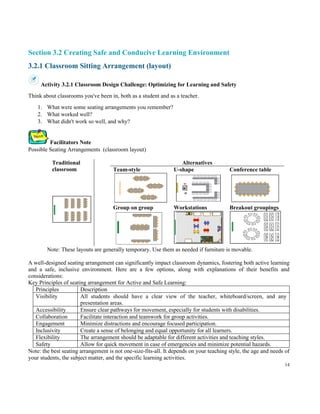
Section 3.2 Creating Safe and Conducive Learning Environment ..........................................................14
3.2.1 Classroom Sitting Arrangement (layout)...........................................................................14
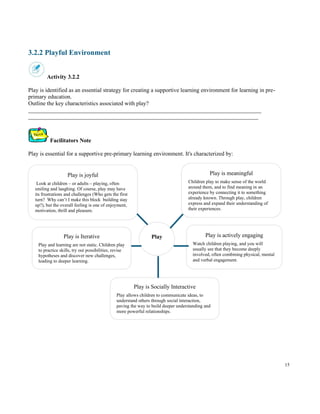
3.2.2 Playful Environment..........................................................................................................15
3.2.4 Using Low Cost Creating Supportive Envirinment..........................................................16
3.2.5 Technology and Supportive Learning Environment..........................................................20
Section 3.3 Tips to How to Teach: Basic Early Mathematics Skills ......................................................22
Section 3.4: Assessing Student’s Learning and Development and Providing Feedback........................27
MODULE 4: TEACHER PROFESSIONAL ENGAGEMENT..............................................................29
Section 4.1: Engaging in Professional Learning.....................................................................................29
Section 4.2: Engaging with Parents ........................................................................................................30
Section 4.3 Engaging the Community ....................................................................................................32
3.
3
General Introduction:
This trainingmodule is prepared for primary education (PE) teachers and focuses on equipping
teachers with the necessary competencies to promote children's holistic development and
implement the new primary curriculum. It is designed to facilitate your basic understanding of the
PE curriculum, child-centered pedagogical approaches, creating child-friendly learning spaces,
conducting quality assessments, and engaging families and communities to ensure optimal and
holistic development of young children. The Training module is designed in such a way that it
helps improving your skills of plan the days of children (‘lesson planning’), conduct children’s
learning, manage the classroom dynamics and assessment for leaning to understand children’s
learning progress and make additional interventions for those in need.
MODULE 1: The New Curriculum in Nexus, Professional Competencies and Foundational
Learning
At the end of this module participants will be able to:
o explain the major aims, vision, and key shifts of the new primary curriculum.
o identify the key dimensions of the new curriculum
o explain the key professional domains for primary teachers.
o identify the expected competencies within each professional domain.
o analyze the major factors that can impact the effective implementation of the new
curriculum
o explain how the new curriculum addresses foundational learning needs.
MODULE 2: Teacher Professional Knowledge
At the end of this module participants will be able to:
o demonstrate knowledge of brain development and individual differences.
o elaborate key principles of how student learn
o demonstrate in-depth knowledge of the primary curriculum domains and subject contents
and Minimum Learning Competencies
o apply different teaching methodologies appropriate for students
MODULE 3: Teacher Professional Practice
At the end of this module participants will be able to:
o develop effective lesson plans aligned with the new curriculum and child development
principles.
o integrate diverse learning experiences and activities into lesson plans.
o create a safe, inclusive, and stimulating learning environment that supports student’s
social, emotional, and cognitive development.
o utilize developmentally appropriate materials and resources to enhance the learning
environment.
o utilize various assessment methods to monitor student's learning and development.
o Provide timely, constructive, and developmentally appropriate feedback to students.
MODULE 4: Teacher Professional Engagement
At the end of this module participants will be able to:
o actively participate in professional development opportunities to enhance teaching skills
and knowledge.
o reflect on teaching practices and identify areas for improvement.
o establish and maintain effective communication with parents/guardians.
o collaborate with the community to support student's learning and well-being.
4.
4
Capacity Building Structure:
TheCapacity Building on the New Curriculum Implementation Diagram above outlines a five-day
professional development program focused on effectively implementing a new curriculum. The program
emphasizes understanding the curriculum's major shifts, assessing students' current learning levels, and
providing targeted interventions, particularly in foundational learning skills (FLN). Day 1 focuses on
understanding curriculum changes and student assessment, FLN interventions, grouping students based
on their FLN capabilities. Days 2, 3 and 4 concentrate on lesson planning and practice, incorporating
play-based learning and creating effective learning environments. Finally, Day 5 emphasizes professional
collaboration with parents and colleagues, utilizing Professional Learning Communities (PLC) for
continuous improvement and culminating in an action plan. The overall program promotes a structured
approach to curriculum implementation through assessment, targeted interventions, and ongoing
professional development.
5.
5
Structure of theCapacity Building
Capacity Building on the New Curriculum
Implementation
IMPLEMENTATION MATTERS!
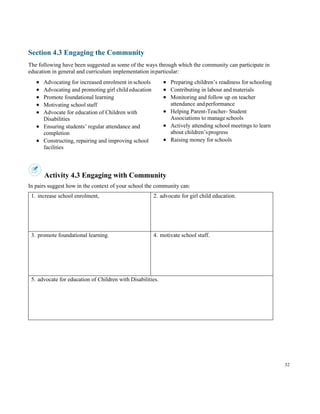
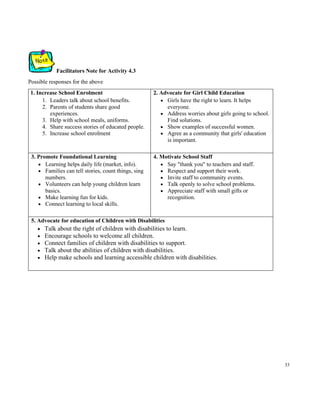
The capacity building is a structured approach to curriculum implementation, emphasizing
assessment, targeted interventions, and ongoing professional development, with special focus on
on foundational learning skills (FLN).
Major Activities
Day 1
Major Shifts +
Assessment and
Catch Up/ Remedial
Focuses on understanding the significant changes introduced by the new
curriculum.
Emphasizes knowing the child (student) as a crucial aspect leads to an assessment
stage, to determine the level of a child.
Deals with Foundational Learning Skills (FLN) based interventions.
Addresses students who are not yet capable of FLN.
Features a decision point: "Capable of FLN?"
No: Leads to "Grouping" and "Catch Up" activities.
Yes: Proceeds to the Lesson Plan stage.
Day 2, 3 & 4
Lesson Plan and
Practice
Focuses on creating lesson plans based on:
Understanding how children learn.
Knowledge of the NEW curriculum content and effective teaching
methods.
Includes "Professional Practice" which involves:
Methods with a focus on "PLAY".
Creating a conducive learning environment.
Assessment and Feedback mechanisms.
Day 5
Engagement and
Action Plan
Centers on professional engagement, including collaboration with parents and
colleagues.
Involves updating and upgrading through Professional Learning Communities
(PLC).
Culminates in an "Action Plan".
6.
6
Capacity Building forPrimary School Teachers and Instructional
Leaders on the Implementation of the New Curricula
MODULE 1: The New Curriculum in Nexus, Professional Competencies and
Foundational Learning
Objective
At the end of this module participants will be able to:
o explain the major aims, vision, and key shifts of the new pre-primary curriculum.
o identify the key dimensions of the new curriculum
o explain the key professional domains for pre-primary teachers.
o identify the expected competencies within each professional domain.
o analyze the major factors that can impact the effective implementation of the new
curriculum
o explain how the new curriculum addresses foundational learning needs.
Section 1.1 New Curriculum- Major Aims, Vision, Shifts and Dimensions
Activity 1.1
1. Have you had the opportunity to implement the new curriculum? Yes _______ or No ______
2. If Yes, what are the major aims, shofts and vision of the new curriculum?
________________________________________________________________________________
________________________________________________________________________________
3. How are you going to change your implementation strategies to attain the major aims, shifts and
vision of the new curriculum stated above?
________________________________________________________________________________
________________________________________________________________________________
________________________________________________________________________________
Facilitator Notes: Reform major Aims, Shifts
Aims
• Transition to “a knowledge-based and
technology-led economy”.
Some Shifts
• Reduce focus on theory.
• Include indigenous knowledge.
• Link to the world of work.
• Include 21st
century competences.
• Include moral education.
• Provide for gifted and talented learners.
Sources/Reference: FDRE MOE 2020. General Education Curriculum Framework, Teacher Guides,
Student Textbooks.
Vision “[…] to cultivate all-rounded, ethical, self-
reliant and responsible lifelong learners who are
competitive regionally and globally and are
equipped with 21st century skills instrumental to
thrive in a knowledge-based and technology-led
economy as citizens […].” (EGECF 2020)
7.
7
Activity 1.2. MajorDimensions of the New General Education Curriculum (Pre-primary to Grade 12)
Activity 1.1. The new curriculum may be conceptualized to have six dimensions, namely: (1) Subject or learning Areas
(2) Values (3) Principles (4) Core- competencies (5) Cross Cutting, and (6) National Pressing Issues. Some of the elements
are given under each dimension and fill in the remaining in the table below.
1.Learning Areas and Subjects
2. Values
(6)
3. Principles (11)
4. Core
Competencies
(8)
5. Cross-
cutting
issues (7)
6. National
Pressing
Issues (6)
Primary
Subjects (8)
Pre-primary
Learning Areas
(6)
1.First
Language
2.___________
3.English
4.___________
5.Environmental
Science
6.___________
7.Performing
and Visual
Arts
8.Health and
Physical
Education
1. First language
2. Environmental
Science
3. ___________
4. ___________
5. Mathematics
6. Health and
Physical
Education
1.Collaboration
2.__________
3.Respect
4.__________
5.__________
6.Hospitality
1. Use Science and
Technology
2. Provide Diverse
Skills
3. __________
4. Ensure Relevance
5. __________
6. Ensure Balance
7. Promote Cultural
Heritages
8. __________
9. Provide for
Inclusiveness
10.__________
11.__________
1.Learning to
Learn
2.__________
3.Creative
Thinking and
Innovation
4.___________
5.Collaboration
6.___________
7.Digital
Literacy
8.___________
1. Gender
2. _________
3. Education in
Emergencies
4. _________
5. Hygiene and
Sanitation
6. __________
7. Life Skills
1. Peace
Education
2. _________
3. Road
Traffic and
Safety
4. _________
5. _________
6. Child
Trafficking
Facilitator Notes
Six dimensions of the new curriculum (Sources/Reference: FDRE MOE 2020. General Education
Curriculum Framework).
1.Learning Areas and Subjects
2. Values
(6)
3. Principles (11)
4. Core
Competencies (8)
5. Cross-
cutting
issues (7)
6. National
Pressing
Issues (6)
Primary
Subjects (8)
Pre-primary
Learning Areas
(6)
1.First
Language
2.A Federal
Language
3.English
4.Mathematic
s
5.Environment
al Science
6.Moral
Education
7.Performing
and Visual
Arts
8.Health and
Physical
Education
1. First language
2. Environmental
Science
3. Personal and
Socio-
emotional
development
4. Performing &
Visual Arts
5. Mathematics
6. Health and
Physical
Education
1.Collaboration
2.Tolerance
3.Respect
4.Equity
5.Patriotism
6.Hospitality
1. Use Science and
Technology
2. Provide Diverse Skills
3. Use Indigenous
Knowledge and
Values
4. Ensure Relevance
5. Promote Integration
& Cohesiveness
6. Ensure Balance
7. Promote Cultural
Heritages
8. Promote National
Unity in Diversity
9. Provide for
Inclusiveness
10. Provide for
Entitlement
11. Apply Learner-
Centered Learning
1.Learning to Learn
2.Critical Thinking
and Problem
Solving
3.Creative Thinking
and Innovation
4.Communication
5.Collaboration
6.Leadership and
Decision Making
7.Digital Literacy
8.Cultural Identity
and Global
Citizenship
1.Gender
2. Inclusive
Education
3. Education in
Emergencies
4. Environme
nt and
Climate
Change
5. Hygiene and
Sanitation
6. HIV/AIDS
education
7. Life Skills
1. Peace
Education
2. Consumer
Protection
3. Road Traffic
and Safety
4. Tax
Education
5. drug and
substance
abuse
6. Child
Trafficking
8.
8
Section 1.2 TeachersProfessional Domains and Expected Competencies
Activity 1.3: Teachers professional domains and expected competencies.
1. As a teacher you are engaged in teaching-learning process and you are expected to build your
capacity in three domains and seven competencies according to the MOE teachers professional
standards 2024.
2. Below some of the domains and expected competencies are given and please fill in the missing
expected domains and competencies.
Domains Expected Competencies
Professional
Knowledge
1. Know students and how they learn
2. ___________________________________________
Professional
Practice
3. Plan for and implement effective teaching and learning
4. _______________________________________________
5. _______________________________________________
Professional
__________
6. Engage in professional learning
7. ________________________________________________
Facilitator Notes
1. Teachers’ professional domains and expected competencies.
Activity 1.3: Preparing to Capacitate Teachers
Teachers’ professional domains and expected competencies from MoE, 2024 Professional standards.
Domains Expected Competencies
Professional
Knowledge
1. Know students and how they learn
2. Know the content and how to teach it
Professional
Practice
3. Plan for and implement effective teaching and learning
4. Create and maintain supportive and safe learning environments
5. Assess, provide feedback and report on student learning
Professional
Engagement
6. Engage in professional learning
7. Engage professionally with colleagues, parents/care givers and
the community
2. Personal reflection: Ask teachers to think and reflect on their current practices on the above
domains and competencies.
3. Explain that this capacity building intervention will focus on the above domains and
competencies to help the effort to implement the new curriculum effectively and efficiently.
During our training and coaching processes we will walk together through all the domains and
competencies.
9.
9
Section 1.3 MajorFactors that Affect Effective Curriculum Implementation
Activity 1.4: Factors Affecting Curriculum Implementation
1. Please list major factors that affect curriculum implementation in your region.
_____________________________________________________________
_____________________________________________________________
2. Given the following factors that affect curriculum implementation and from your list of factors
identify two or three major factors.
[Major Factors: Stakeholders Buy-in, Teachers Capacity, Support from the Instructional
Leadership, Material and Education Supplies, Ongoing Professional Support, Aligned
Assessment Systems, Teacher –Student Ratio, Content Overload, Parents Involvement,
Teaching- learning strategies, Child/Students Readiness/ engagement/ interest, Safe Learning
Environment (Physical, Social …) , Living/ Social Status of the teacher, Other Please specify
_________________]
Two/ three Major factors: (1) __________ (2) ____________ (3) ______________
3. What are the opportunities available in your region to implement the new curriculum?
_____________________________________________________________________
_____________________________________________________________________
Facilitators Note for Activity 1.4
Activity 1.4: Factors affecting Effective Curriculum Implementation
Support trainees to:
• identify and discuss the major factors that affect curriculum implementation in the participants'
specific context.
• prioritize the two or thre most critical factors that impact curriculum implementation in their
specific context.
• discuss mitigation strategies of the major hindering factors.
• Help participants to build on the opportunities available in their region to implement the new
curriculum.
10.
10
Section 1.4 FoundationalLearning and the New Curriculum
Meaning and Importance of Foundational Learning
Activity 1.5: Meaning and Importance of Foundational Learning
1. Start up Question: “What do we mean by Foundational Learning?”
____________________________________________________________________________
____________________________________________________________________________
2. Why do we focus on the foundational learning currently in Ethiopia/ in your region?
____________________________________________________________________________
3. Explain the importance of Foundarional Learning.
____________________________________________________________________________
_______________________________________________________________________
Facilitators Note for Activity 1.5.
1. Foundational learning (FL) is defined as basic literacy, numeracy, and transferable skills, such as
socio-emotional skills that provide the fundamental building blocks for all other learning,
knowledge, and higher-order skills.
2. Why FL Now and its importance
Why Foundational Learning Now?
Because Low learning levels – the barrier
children face now.
Currently it is estimated that,
• globally, six out of every ten children (60%)
suffer from learning poverty: they are unable to
read and understand a simple text by the age of
ten (Grade 4) ;
• in Ethiopia the learning poverty is 90%
(meaning nine out of every ten children suffer
from learning poverty, at age ten, WBG 2023);
• in Ethiopia a national assessment conducted in
2022 using MELQO indicated that the overall
performance mean score of O-Class children
(Age 6) in literacy, numeracy, executive
function, and fine motor skills was 48.9%
(EAES, 2023).
Foundational Learning – why is it important?
• Children at home, Pre-primary, Grades 1 and 2
are critical for children as this is when they learn
the most.
• Children need to attain Foundational Literacy,
Numeracy and transferable skills (e,g. socio-
emotional skills) by grade 3 otherwise they
struggle to catch up later and risk dropping out
of school.
• Foundational learning is critical to enable all
children to reach their full potential and
participate in society.
• FL skills ensure every child has an equal footing
for success. It is linked to higher employability
and consequently improved life outcomes.
Foundational
Learning
= Foundational
Literacy
The ability to identify
letters (a, d, h),
words (at, cat, ball);
read them fluently
with meaning
+ Foundational
Numeracy
Being able to identify
numbers such as 9, 82,
76, and solve basic maths
problems like addition
and subtraction.
Transferable skills
(e.g., Socio-emotional …)
Being able to manage
emotions effectively and
build & maintain positive
relationships.
+
11.
11
Foundational Learning andthe new Curriculum
Activity 1.6: Foundational Learning and the new Curriculum
Discuss and outline the pre-primary children’s expected profiles related to foundational
learning.
_______________________________________________________________________
_______________________________________________________________________
_______________________________________________________________________
_______________________________________________________________________
Facilitators Note for Activity 1.6
According to the Ethiopian General Education Curriculum Framework, 2020 (page 76) the Pre-
primary Education Children Profile is presented below.
The pre- primary level of general education is taken as the most critical period where foundations are
laid for life-long development and full realization of the potentials of the brain. The level is supposed to
provide care, opportunities and experiences that lead to all - round changes in children including physical,
mental, social, emotional, and aesthetic development. It is at this level that children are helped to gain
knowledge, attitudes and foundational skills which make them ready to meet the requirements of learning
in primary school. Thus, through the process of learning in pre-primary schools, children are expected to
exhibit the following profile:
1. Develop foundational literacy and numeracy skills for communication and computation,
2. Use fundamental digital literacy skills for enjoyment and learning
3. Interact with the physical and socio-economic environment for learning and enjoyment,
4. Appreciate and interact with cultural activities of their localities
5. Develop basic moral attributes of obedience, loyalty (honesty, integrity, truthfulness) ,
and caring for and respecting themselves and others,
6. Use basic skills of interacting and cooperating with others
7. Express thoughts and emotions through art, music and movement,
8. Practice basic rules of hygiene, sanitation and safety skills for health
9. Develop physical fitness to engage in lower-level exercises
10. use knowledge and skills developed for learning in primary school.
Transition from “Learn to Read” to “Read to Learn”
Activity 1.7 Transition from “Learn to Read” to “Read to Learn”
1. At what level or grade are students expected to Learn to Read?________________________
2. At what level or grade are students expected to Read with comprehension to Learn (Read to
Learn)?______________________________________________________________________
_
3. Is there a horizontal and vertical alignment between pre-primary and early primary? Explain
with tangible evidence focus on Literacy, numeracy and Socioemotional learning. ________
________________________________________________________________________
12.
12
Facilitators Note forActivity 1.7 Transition from “Learn to Read” to “Read to learn”
Share the following findings and encourage participants to analyze the levels or grades of expected
“Learn to Read” and “Readto Learn” in their respective regions.
Example:
1. At what grade are students expected to Learn to Read?
Example: Amharic as a First Language.
Learning to read is expected at the end of grade 2.
2. The horizontal organization/alignment of, for example of, the subject Amharic language with
other subjects within the same grade is found NOT ALLIGNED. Students in grade 1 are expected
to read, understand, and answer written questions in other subjects (Environmental Science,
Mathematics, Moral Education, Performing and Visual Arts etc.) while they are still learning to
read in Amharic.
13.
13
MODULE 2: TEACHERPROFESSIONAL KNOWLEDGE
Objective
At the end of this module participants will be able to:
o demonstrate knowledge of student’s competency and individual differences.
o elaborate key principles of how students learn
o demonstrate in-depth knowledge of the primary curriculum domains and subjects and
Minimum Learning Competencies
o apply different teaching methodologies appropriate for students
Section 2.1: Know Students and how they learn
Knowing Students
Understanding students as individuals and how they learn is fundamental to effective teaching. This
knowledge allows teachers to create inclusive and engaging learning environments.
Activity ______________
1. Knowing students through Assessment tools (Pair Activity):
o Part I: Review the curriculum based Pre-primary Level 3 -Developmental and
Learning Outcomes.
o Part II: Review the sample (Non- Curriculum based) assessment tools presented below
(for English, Mother tongue, and Mathematics).
o In pairs, conduct a mock assessment scenario: one person acts as the student, and the
other as the assessor.
o After the mock assessment, reflect on the effectiveness of the chosen tool and the
experience.
2. Reflection and Discussion: What other strategies (beyond formal assessment) do you use to
understand your students' learning?
_______________________________________________________________________
_______________________________________________________________________
Diagnostic Assessment tools
Part I: Pre-primary Level 3 -Developmental and Learning Outcomes [Source PRESCHOOL-
CURRICULUM Preprimary Education Curriculum Syllabus, January 2025]
Learning Areas General Learning Outcomes
After completing Level 3, children will be able to:
Yes
(Y)
Partial
(P)
No
(N)
Personality and
socio-emotional
development
1. Follow a series of three commands in a row
2. Focus on a task in school for 15 minutes
3. Able to make peers line with gender identity
4. Able to cooperate and share with others
5. Takes turns when playing games with other children
6. Have positive attitudes towards learning and school
7. Demonstrate moral values and principles,
8. Develop basic skills of interacting with others
9. Have a self-concept and Demonstrate own interest
Environmental
Science
10. Know day from night and left from right
11. Be able to tell time
12. Know colors.
14.
14
13. Be ableto care for their immediate environments
14. Classify things using digital media
Health and
physical
Development
15. Have locomotors and non-locomotors skills
16. Control their major muscles and have good balance
17. Practice basic rules of hygiene, sanitation and safety
skills for health and well-being abuyyee@gmail.com
Language and
communication
18. Express themselves and object in their immediate
environments
19. Speak in simple but complete sentences with five to
seven words
20. Can read and write simple words
21. Uses words about time, like “yesterday,” “tomorrow,”
“morning,” or “night”
22. Writes some letters in their names
23. Name all letters when you point to them
Early
Mathematics
24. Express the concept of numbers
25. Perform simple additions and subtractions
26. Know the value of different coins and notes, use real
money to play shops.
27. Know the different kinds of shapes.
28. Be able to repeat three numbers backward
29. Count objects around their house
30. Count numbers up to 20
Performing and
Visual Arts
31. Perform song, dances, or acts correctly
32. Appreciate the various forms of arts
33. Appreciate diversities culture
34. Enjoy and use different artistic activities
Part II: Knowing Students Through Assessment (Foundational Learning in Focus)
At the beginning of the intervention, assessment is the first thing you will conduct. For language, you will
assess learners in ________________________ local language using the assessment tools provided. You
will then record learners’ learning levels as guided by the instructions at the bottom of every level of
assessment. A sample assessment tool for each of the languages is provided below.
Sample Assessment Tool
Subject: Amharic
ተግባር 1:- የፈደል ስያሜ ዕውቀት Task 1: Letter Name Knowledge
ምሳሌ፡- ቸ ኩ ጉ
ሙ ፐ ላ ሔ ሲ ሂ ዛ ጽ ኑ ሬ
ፉ ሡ ቲ ዊ ጌ ር ፖ ሴ ሊ ዩ
ሀ ኮ ጉ ባ ኻ ቁ ጴ ቺ ኹ ኞ
ተግባር 2፡- የተዘውታሪ ቃላት ንባብ Task 2: Familiar Words Reading
ምሳሌ፡- ሜዳ ወደቀ እህት
ብዙ መምህር እኔ ሄደ ድመት
ረገፈ አሁን ጨረቃ እበላለሁ ወላጆች
ቁመቱ ሠራ ቁም ገመድ እሸት
15.
15
ተግባር 3፡- የፈጠራቃላትን ማንበብ Task 3: Invented Words Reading
ምሳሌ፡- መጠረ ሀበለ ጃገሰ
ነለበ አቀወ ቱዛ ያሲማ ሳድ
ጀገደ ፈከዘ ዙታሜ ቃጠሰ ረተኛ
ቆቸ የኛኔ ባደሸ ቆሳዲ መሃና
ተግባር 4ሀ. ድምጽን ከፍ አድርጎ ማንበብ Task 4a: Passage Reading
ቀኑ ቅዳሜ ነው፡፡ አልማዝ ልብስ የምታጥብበት ቀን ነው፡፡ ከጧት ጀምራ ብዙ ልብሶች አጠበች፡፡ እናቷ ወይዘሮ
ትርፌ ይደክምሻል ትንሽ አረፍ በይ አሏት፡፡
አልማዝም ያጠበችውን ልብስ ገመድ ላይ አሰጣች፡፡ ከዚያም ለማረፍ ወደ ቤት ገባች፡፡ ንፋሱ የተሰጡትን ልብሶች
ወዲህ እና ወዲያ ያደርጋቸዋል፡፡
ትንሽ ቆይቶ ንፋሱ የተሰጡትን ልብሶች መሬት ላይ ጣላቸው፡፡ ጎረቤቷም አልማዝ አልማዝ እያለች ተጣራች፡፡
አልማዝም ደንግጣ እየሮጠች ወጣች፡፡ ልብሶቹን ስታይ በጣም አዘነች፡፡
Subject: English
Task E1. Familiar Words Reading
Instruction: Place the EGRA Student Stimuli Booklet in front of the child. Practice with the
example and tell the student to read the words from left to right horizontally as fast as she can.
• Start the timer when she begins reading.
• If it is incorrect or no response, put a slash on the word ‘/’.
• If the child hesitates for three seconds on a word, tell the student to move on and mark it
with slash as incorrect.
• If the child makes self-corrections circle the slash ‘’.
• Put a bracket after the last word reached when the time is over ‘]’.
• Fill in the boxes at the bottom when you finish.
Example: cat sick made
(1) (2) (3) (4) (5)
red and play at you (5)
go sad up find come (10)
jump once ask Fly want (15)
E1.1 Number of Last Word Reached _______________
E1.2 Total Number of Words Read Correct ______________
E1.3 Time Remaining on the Stopwatch _________________
E1.4 Put a Tick Mark if Discontinued ___________________
16.
16
Task E2 andTask E3
Instruction: Place the EGRA Student Stimuli Booklet in front of the child and tell the student
to read the passage as fast as she/he can. Tell the student also that she/he will be asked questions
from the story she/he read.
• Start the timer when she/he begins reading.
• If it is incorrect or no response, put a slash on the word ‘/’.
• If the child hesitates for three seconds on a word, tell the student to move on and mark it
with slash as incorrect.
• If the child makes self-corrections circle the slash ‘’.
• Put a bracket after the last word reached when the time is over ‘]’.
• Fill the boxes at the bottom when you finish.
• Ask the student the questions that are related to what she/he read.
• For correct answer circle 1, for incorrect or no response circle 0.
Task E2. Oral Passage Reading
Correct
word
Task E3. Comprehension
Correct
Incorrect
Aster1 is2 seven3 years4 old5. She6 lives7 in8
Boditi9 with10 her11 parents12. She13 had14 a15
dog16. The17 dog18 was19 fat20 and21 happy22.
3.1 Where is Aster living?
(Boditi)
1 0
One23 day24 it25 went26 out27 to28 play29.
The30 dog31 ran32 away33 but34 did35 not36
come37 back38. Aster39 was40 very41 sad42.
3.2 Why was Aster sad?
(the dog did not come back)
1 0
But43 in44 the45 afternoon46 the47 dog48
came49 back50.
3.3 When did the dog come
back? (in the afternoon)
1 0
Aster51 was52 very53 happy54 and55 the56
dog57 was58 tired59 and60 it61 slept62.
3.4 What did the dog do after
eating the meat? (it slept)
1 0
3.5 Why do you think the dog
was tired? (it was playing)
1 0
E2.1 Number of Last Word Reached __________________
E2.2 Total Number of Words Read Correct _____________
E2.3 Time Remaining on the Stopwatch _______________
E3. Total Correct _________________________________
E2.4 Put a Tick Mark if Discontinued _________________
17.
17
Subject Mathematics
Task M1.Number Identification (Timed to 60 Seconds)
Instruction: Place the EGMA Student Stimuli Booklet in front of the child. Practice with the
example and tell them to name the numbers from left to right horizontally as fast as they can.
• Start the timer when she/he begins counting.
• If it is incorrect or no response, put a slash on the number ‘/’.
• If the child makes self-corrections circle the slash ‘’.
• If the child hesitates for three seconds on a number, tell them to move on and mark it with
slash as incorrect.
• Put a bracket after the last number reached when the time is over‘]’.
• If the child is unable to identify all the numbers in the first line, discontinue the task.
• Fill the boxes at the bottom when you finish.
(1) (2) (3) (4) (5) (6) Count
57 7 28 51 62 970 (6)
16 58 99 162 109 118 (12)
236 6 703 28 590 625 (18)
M1.1 How many numbers did the child read totally? _______________________
M1.2 How many numbers did the child read correct? _______________________
M1.3 Time remaining on the stop watch in seconds. ________________________
M1.4 If the task is discontinued put a tick mark in the box.___________________
Task M2. Quantity Discrimination (Not Timed)
Instruction: Place the EGMA Student Stimuli Booklet in front of the child. Practice with the
example and ask them to tell you which number is bigger in each case.
• If the answer is correct, circle ‘1’.
• If it is incorrect or no response circle ‘0’.
• If the child hesitates for three seconds on a number, tell them to move on and circle ‘0’.
• Count the total number correct and write in the box.
Question Correct Incorrect
31 52 27 1 0
175 285 205 1 0
51 44 21 1 0
M2. Total Correct: ____________________
18.
18
Task M3. MissingNumbers (Not Timed)
Instruction: Place the EGMA Student Stimuli Booklet in front of the child. Practice with the
example and ask them to tell you the missing number in each case.
• If the child gets correct, circle ‘1’.
• If it is incorrect or no response circle ‘0’.
• If the child hesitates for five seconds on a missing number, tell them to move on and circle
‘0’.
• Count the total number correct and write in the box at the bottom.
Correct Incorrect
1
1 0
23 29 32
2
1 0
45 50 60
M3. Total Correct:______________________________
Task M4. Addition Level 1(Not Timed)
Instruction: Place the EGMA Student Stimuli Booklet in front of the child. Practice with the
example and ask them to add the numbers.
• If the child gets correct, circle ‘1’.
• If it is incorrect or no response, circle ‘0’.
• If the child hesitates for five seconds on an item, circle ‘0’ and ask them the next
question.
• Count the correct answers and write in the box at the bottom.
No. Question Correct Incorrect
1 13 + 7 1 0
2 29 + 4 1 0
5 16 + 6 1 0
M4. Total Correct: ____________________________
Task M5. Addition Level 2 (Not Timed)
Instruction: Place the EGMA Student Stimuli Booklet in front of the child. Practice with the
example and ask them to add the numbers.
• If the child gets correct, circle ‘1’.
• If it is incorrect or no response, circle ‘0’.
• If the child hesitates for five seconds on an item, circle ‘0’ and ask them the next
question.
• Count the correct answers and write in the box at the bottom.
No. Question Correct Incorrect
1 29 + 42 1 0
2 201 + 9 1 0
3 42 + 308 1 0
M5. Total Correct: ____________________________
19.
19
Task M6. SubtractionLevel 1(Not Timed)
Instruction: Place the EGMA Student Stimuli Booklet in front of the child. Practice with the
example and ask them to subtract the numbers.
• If the child gets correct, circle ‘1’.
• If it is incorrect or no response circle ‘0’.
• If the child hesitates for five seconds on an item, circle ‘0’ and ask them the next
question.
• Count the correct answers and write in the box at the bottom.
No. Question Correct Incorrect
1 6 - 2 1 0
2 22-4 1 0
3 17-9 1 0
M6. Total Correct:
Task M7. Subtraction Level 2(Not Timed)
Instruction: Place the EGMA Student Stimuli Booklet in front of the child. Practice with the
example and ask them to subtract the numbers.
• If the child gets correct, circle ‘1’.
• If it is incorrect or no response circle ‘0’.
• If the child hesitates for five seconds on an item, circle ‘0’ and ask them the next question.
• Count the correct answers and write in the box at the bottom.
1 37-9 1 0
2
3
305-5 1 0
3 8005-7005 1 0
M7. Total Correct:______________________________
Task M8. Word Problem (Not Timed)
Instruction: Tell the child to listen carefully and give you the correct answer for the word
problems. This section is not found in the Student Stimuli Booklet.
• Read the word problem to the child one by one. Make sure the child understands each
question.
• If she/he answers correct, circle ‘1’.
• If it is incorrect or no response, circle ‘0’.
• If the child hesitates for fifteen seconds on an item, consider it as no response and move to
the next question.
• Count the total correct and write in the box.
No. Question Correct Incorrect
M8.1 Nardos had 8 lemons. Her brother Tessema added 7 lemons to her.
How many mangos will Nardos have totally? (15 lemons)
1 0
M8.2 The total numbers of Foot Ball players were 11, and the Basket ball
players were 6. By How much foot ball players were exceeding
basket ball players? (5 players)
1 0
M8.3 The price of one pen is 4 Birr. Almaz wants to buy a pen for three
children. How much Birr will she pay? (12Birr)
1 0
M8.4 Daniel has 21 Oranges. If he shares equally for 3 children, how many
Oranges will each child gets? (7 Oranges)
1 0
M8. Total Correct: _________________________
20.
20
Facilitators Note
Facilitator's Note:
1.Knowing Students Through Assessment:
• Emphasize the importance of using assessment tools as a window into student understanding.
• Highlight the value of the pair activity in simulating real-world assessment scenarios.
• Reflect on the effectiveness of the sample tools and the experience.
2. Helpful Strategies to Know Students:
Strategies to know
(Understand) students
Description
Observation Observing students' behavior, interactions, and engagement in
classroom activities.
Communication Talking to students and parents, listening to their ideas, and
seeking their perspectives.
Assessment Analyzing student work to identify strengths, weaknesses, and
learning styles through diagnostic assessment, and formative
assessment approaches.
Collaboration Working with colleagues, parents, and other professionals to
gather information about students.
Activity: How Children Learn?
Objective: To explore and understand the various ways children learn and to establish key principles of
effective learning.
Instructions:
What are the common ways children learn? (Individual reflection/brainstorming)
Brainstorm and list principles of effective learning. (Example: "Learning is a process that involves effort,
mistakes, reflection, and refinement." (Group discussion/brainstorming)
Facilitator's Note:
Common Ways Children Learn:
• Emphasize the diverse nature of children's learning experiences.
• Guide participants to consider various learning modalities/ styles:
• Sensory (Observing, touching, performing/acting); Communication (Asking, talking); Cognitive
(Thinking); Social-Emotional (Expressing emotions, making friends, playing games); Creative
(Telling stories, creative plays, singing); Physical (Doing physical activities); Symbolic (Reading)
Note: Children learn through a combination of sensory, cognitive, social-emotional, and creative
experiences, with play being a fundamental aspect.
Principles of Effective Learning:
Begin by reiterating the provided principle: "Learning is a process that involves effort, mistakes,
reflection, and refinement of strategies."
Facilitate a collaborative discussion to expand on this and generate additional principles.
21.
21
Present the followingprinciples, and encourage participants to add their own:
• High expectations and challenging tasks promote student potential.
• Motivation is driven by interest, autonomy, and purpose.
• A safe and connected learning environment is crucial.
• Retrieval practice strengthens memory and application.
• Spaced and interleaved learning improves retention.
• Collaboration and social interaction enhance learning.
• Physical well-being (nutrition, sleep, exercise) impacts learning.
• The learning environment (space, temperature, lighting) affects learning.
• Deep thinking enhances attention, memory, and meaning-making.
Note: Effective learning is guided by principles that promote engagement, cognitive development, and
well-being.
22.
22
Section 2.2: Knowthe content and how to teach
Knowing the Content
2.2.1 Know the Content
Activity 2.2.1 Goals, Objectives, and Principles
Knowing the content starts from knowing (1) Goals, Objectives, and Principles(3) Major Learning areas
(as appropriate), (4) Minumum Learning Competencies (MLCs ).
Referring the syllabus of one subject you are expected to outline Learning goals, Objectives and
principles.
1. Learning Goals
Subject _______________________________________________ Grades ______________
According to the MoE __________ subject Grades 1-6 Syllabus 2020, the learning goals are:
_____________________________________________________________________________
_____________________________________________________________________________
_____________________________________________________________________________
2. Learning Objectives
Subject _________________________________________________ Grades ______________
According to the MoE __________ subject Grades 1-6 Syllabus 2020, the learning goals are:
_____________________________________________________________________________
_____________________________________________________________________________
_____________________________________________________________________________
3. Guiding Principle
Subject ________________________________________________ Grades ______________
According to the MoE __________ subject Grades 1-6 Syllabus 2020, the Guiding Principles are:
_____________________________________________________________________________
_____________________________________________________________________________
_____________________________________________________________________________
4. Major Learning Areas
Subject ___________________________________________________ Grades ______________
Learning
Areas
G 1
Contents
G 2
Contents
G 3
Contents
G 4
Contents
G 5
Contents
G 6
Contents
23.
23
Facilitators Note forActivity 2.2.1
Example: Learning Goals, Objectives and Principles
Subject: Environmental Science (Grades 1-6)
Learning Goals
According to the MoE Environmental Science Grades 1-6 Syllabus 2020, the learning goals are:
• to foster clear awareness of, and concern about, economic, social, political, and ecological
interdependence in urban and rural areas;
• to provide every person with opportunities to acquire the knowledge, values, attitudes,
commitment, and skills needed to protect and improve the environment;
• to create new patterns of behavior of individuals, groups, and society as a whole towards the
environment.
Learning Objectives
(Source New Syllabus Environmental Science for grades 1-6, 2020)
By the end of primary school and as per Environmental Science Syllabus 2023, Students are expected to:
• acquire awareness about immediate/ wider surroundings/ environment through lived experiences
on various themes related to daily life
• nurture natural curiosity and creativity for the immediate surroundings
• develop various processes/skills through interaction with immediate surroundings
• develop sensitivity for the natural, physical and human resources in the immediate environment.
• point out/ raise issues related to equality, justice and respect for human dignity and rights
Guiding Principle
Environmental Science Education Grades 1-6
(Source New Syllabus Environmental Science for grades 1-6, 2023)
• Consider the environment in its totality—natural and built, technological and social (economic,
political, cultural-historical, ethical, esthetic);
• Be a continuous lifelong process, beginning at the preschool level and continuing through all
formal and nonformal stages;
• Be interdisciplinary in its approach, drawing on the specific content of each discipline in making
possible a holistic and balanced perspective;
• Examine major environmental issues from local, national, regional, and international points of
view so that students receive insights into environmental conditions in other geographical areas;
• Focus on current and potential environmental situations while taking into account the historical
perspective;
• Promote the value and necessity of local, national, and international cooperation in the prevention
and solution of environmental problems;
• Explicitly consider environmental aspects in plans for development and growth;
• Enable learners to have a role in planning their learning experiences and provide an opportunity
for making decisions and accepting their consequences.
• Relate environmental sensitivity, knowledge, problem-solving skills, and values clarification to
every age, but with special emphasis on environmental sensitivity to the learner's own community
in early years.
24.
1
Example: Major LearningAreas
Subject: Environmental Science Grade Levels: 1-6
Learning Areas G1 G2 G3 G4 G5 G6
Location
Meaning of
Location
Location of our district Location of our zone Location of our region Relative and absolute
location of Ethiopia
Relative and absolute
location of East Africa
Demystifying
Science
Our body parts
Food & its functions
What is light
Our External body parts
and the sense organs
Physical properties of
materials
Sources of light
Food & healthy
Importance of food
The four food groups (Cereals,
meat, milk, and fruit and
leafy-vegetables)
Food Contamination
Change in the State of mater
(solid, liquid, & gases)
importance of light
Food and healthy living
Internal body organs
An essential nutrient of
the food
The balanced diet
Physical and chemical
properties of matter
Shadow and property of
light
Main parts of the
human digestive
system
Importance of Water
Sources of energy
The circulatory system
Adolescence
Components of the air
Parts of human birthing
system
Energy and its use
Natural
Environment
Weather
Living and none
living things
Wild and domestic
animals
Caring for local
Environment
Weather and climate
Plants and Animals in our
District (Woreda)
Material resources in our
district
Caring for our District
Environment
Natural resources in our zone
Caring for our Zone the
Environment
Natural resources in our
Region
Caring for our Region
Environment
Natural resources of
Ethiopia
Caring for Ethiopian
Environment
Components of the air
Parts of human birthing
system
Energy and its use
Social
Environment
Our families and
communities
Our localities
Families and communities
in our District / Woreda
Our localities
Peoples and Culture in our
Zone
Economic activities in our
Zone
Peoples and Culture in
our Region
Economic activities in
our Region
Cultural Diversity in
Ethiopia
Economic Activities
in Ethiopia
Population Diversity in
Ethiopia
Economic Activities in
Ethiopia
Key, Cross-
cutting &
Pressing Issues
Road safety
HIV
Road safety
HIV
Road safety
HIV/AIDS
Chemical Safety
HIV and other Infectious
diseases
Drought and Famine in
our Region
Chemical Safety and
drug-abuse
Drought and Famine
in Ethiopia
Harmful Traditional
Practices in our
District and Zone
Drug-abuse & Addiction
Drought and Famine in
East Africa
Harmful Traditional
Practices in our Region
& Country
25.
1
Expected Minimum LearningCompetencies (MLCs)
Activity 2.2.2 Expected Minimum Learning Competencies (MLCs)
1. General Education Frame (2020) states that Ethiopia follows “Competency-Based Curriculum”.
What is Competency? and who is competent?
______________________________________________________________________
______________________________________________________________________
2. Describe a competent person by taking common activities from our daily life like making coffee,
cooking food, cleaning houses, washing, playing football, driving a car as well as teaching.
______________________________________________________________________
______________________________________________________________________
3. Refer Syllabus or MLC document of one subject and fill the following:
Minimum Learning Competencies
Grade ___
Unit _____
Grade ___
Unit _____
Grade ___
Unit _____
Grade ___
Unit _____
Grade ___
Unit _____
Learning Area: Learning Area: Learning Area: Learning Area: Learning Area:
MLC MLC MLC MLC MLC
26.
2
Facilitators Note
1. Whatis Competency?/ Who
is competent person?
2. Competent person in our daily life
What is Competency?
Competency is an integrated set of
skills, knowledge, and attitudes that
enables one to effectively perform the
activities of a given expected
standards.
Example: “Making a Good Coffee.”
Making or boiling coffee is a task to be accomplished at certain
standard. If a person wants to prepare make coffee, he/she has to
have:
the “right knowledge” of the type of inputs required, each step to
go about starting from the first step up to the end in his/her the
mind. Because recalling the requirements and procedures of coffee
making is the function the mind.
the “right skill” of washing coffee beans, roasting to a right color,
grinding to a right texture, boiling water in a Jebena and adding
the ground coffee to it and refluxing it for some time, take from
the stove and wait for some time for settling, decanting into cups
and then distribution to coffee drinkers awaiting to enjoy the
coffee.
the “right attitude”, that is, in order to make coffee he/she has have
free will or like it to enter into the kitchen to carry out all the steps
of making coffee.
“Sharing” if a person “makes a good coffee” and serves for the
coffee drinkers, then he/she is said to be competent in coffee
making.
Therefore, a person is said to be “COMPETENT” if he/she can
integrate the three elements of competency knowledge, skill, and
attitude and accomplish a given task at a required level of
standard. To the contrary, if a person lacks one or more of the
three domains of “competency”, then he/she cannot make a good
coffee and thus he/she is said to be “INCOPMETENT”.
Who is Competent?
Competent person: Who can apply all
domains Knowledge (Learning to
Learn), Skill (Learning to Do),
Attitude (Learning to Be) + Learning
to Live Together and perform
something in a real-world context.
27.
1
3. Minimum LearningCompetencies (MLCs)
Example: Minimum Learning Competency
Subject: Environmental Science Grade: 1
N.B As an Example, we present here MLC document for Grade 1. For other grades please refer your MoE syllabus or teacher guides.
Minimum Learning Competencies
Grade 1 Unit 1
Learning Area: Location
Grade 1 Unit 2
Demystifying
Science
Grade 1 Unit 3
Natural Environment
Grade 1 Unit 4
Social Environment
Grade 1 Unit 5
Key, Cross-
cutting &
Pressing Issues
• Explain the concept of location
• Identify left, right, front and back
directions
• Discuss how location is
determined in relation to other
places
• Identify the direction of things
around them using left, right, front
and back
• Describe the direction of one
feature from another in the school
compound
• Indicate the location of their
school, home and neighborhood
• Draw a simple sketch map of
locality and show the relative
position of their school
• Name main
external body
parts.
• Explore the use
of the five senses.
• Identify the
Linkage of the
sense organ.
• Recognise that
darkness is the
absence of light.
• Define the concept of seasons, day and
night
• Explore rainbow and flood as occasional
happenings in nature
• Describe characteristics of living things
• Differentiate between living and
nonliving things
• Identify groups of domestic animals
including animals as pets; for food, for
pulling loads.
• Group animals based on observable
features e.g., skin covering, how they
move, number of legs.
• Able to apply personal toilet hygiene
using household sanitary items.
• lists of the family
members
• Describe the basic needs
of the family
• identify the school
compound
• Develop peer relationship
and the activities they can
do in school
• Discuss the right and
responsibility of family
members
• Draw poster to show
school compound and
surrounding area-showing
ways to keep safe while
using these areas.
• Describe and
apply traffic
rules
• Know about
HIV and its
effects on
human body.
• Show empathy
for children with
HIV
28.
2
2.2.2 Know Howto teach
Activity 2.2.2 Know hoe to teach
Select one specific MLCs from Grades 1-4 from the syllabus and recommend how to teach and assessment
strategies. Use the below format
Facilitators Note for Activity 2.2.2
Examples Competency Based Instructional Activities
Note: The purpose of this section is to present a prototype Instructional Activities that are aligned with the MLCs
that can be easily conducted in the classroom. This section does not cover every MLC and is not intended to be a
prescriptive that all teachers must follow. It is intended to be a guide that highlights on how to integrate competency,
active learning strategies and assessment.
Activity: Grade 1- Competency based teaching (Activity and Assessment)
Time allowed: _______.
Study critically how the MLC, Active Learning Method and Assessment are integrated in the example (samples/
prototypes) provided from are provided from grade 1.
Example 1: Grade 1 Prototype Grade 1 Unit 1
Learning Area: Location
MLC: Students should be able to identify left, right, front, and back directions.
Active Learning Method: Game
Materials Required: Exercise book
Instructions for Activity:
1. Review the different directions: ask students to name each of the four directions (left, right, front, and back)
and to point to them all.
2. Divide students in pairs and explain the game: One student will pick a destination or object in the classroom
and direct his or her partner to walk there. They may not tell the students the destination or object but must use
the four directions to get them there.
3. Students in each pair should take turns directing their partner to different destinations in the classroom.
Assessment:
1. When reviewing the four directions, call on students to informally assess whether they can name and point to
each of the four directions.
2. Showing the picture below ask students to indicate the relative location of Students “A”, “B”, “C” and “D” by
saying/ writing front, back, left and right.:
Grade: _________________________________ Subject: ____________ Date_________
Unit/week: ______________________________ Topic: __________________________
Learning Area: ____________________________________________________________
Competency or Objective or Outcome:
________________________________________________________________________
________________________________________________________________________
Name of Activity/strategy (Based on TPCK): ________________________________
Material Required: _________________________________________________________
Instructions for Activity:
________________________________________________________________________
________________________________________________________________________
________________________________________________________________________
Assessment Questions (Diagnostic, Assessment for Learning):
________________________________________________________________________
________________________________________________________________________
29.
3
Questions and Answersin Bracket
1.Where is the relative location of “Student C” from “Student D”? [on the right-hand side]
2.Where is the location of “Student B” from “Student A”? [on the left-hand side]
3.Where is the location of “Student A” from “Student C”? [on the back direction]
4.Where is the location of “Student C” from “Student A”? [on the front direction]
Example 2: Grade 1 Prototype/ Sample
Grade 1 Unit 2
Learning Area: Demystifying Science
MLC: Students should be able to name external body parts.
Active Learning Method: Self and Drawing.
Materials Required: Poster (If available), or draw in blackboard (Blackboard and Chalk)
Instructions for Activity:
1. First, review the different body parts by calling on students and having each one name and point
to a different part of his or her own body.
2. Draw body parts or use a large poster (big enough for those in the back to see) and point to
different body parts.
3. Call on students to identify the parts as you point to them.
Assessment:
• Call on students to name and point to different body parts as informal assessment.
• Write the names of the external body parts above the neck and below the neck.
Activity ___________
Select MLCs from grade 1-4 mathematics and English and develop your own lesson, using the
template given below
Grade: _______ Unit: ___________
Learning Area: _____________________________________________________________
MLC: _____________________________________________________________________
Active Learning Method: _____________________________________________________
Material Required: __________________________________________________________
Instructions for Activity:
________________________________________________________________________
________________________________________________________________________
Assessment:
________________________________________________________________________
________________________________________________________________________
30.
4
MODULE 3: TEACHERPROFESSIONAL PRACTICE
Objective
At the end of this module participants will be able to:
o develop effective lesson plans aligned with the new curriculum and students learning
development.
o integrate diverse learning experiences and activities into lesson plans.
o create a safe, inclusive, and stimulating learning environment that supports children's social,
emotional, and cognitive development.
o utilize developmentally appropriate materials and resources to enhance the learning environment.
o utilize various assessment methods to monitor student's learning and development.
o Provide timely, constructive, and developmentally appropriate feedback to students.
Section 3.1: Lesson Planning
Activity 3.1: Elements of a lesson plan
Whole Group Activity
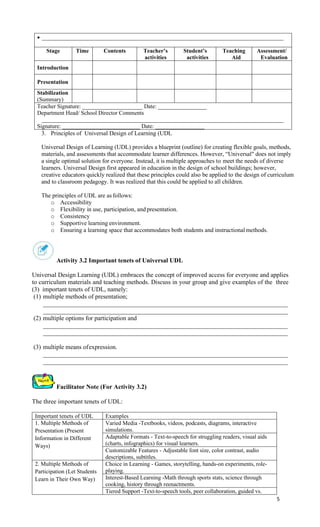
1.What is lesson plan for you and why do we need a lesson plan?
2.How do you prepare your lesson plans? As “A” or “B”?
A B
3. Is your lesson plan inclusive of disability, encourage girls education? Discuss Principles of the Universal
Design of Learning (UDL):
• Accessibility
• Flexibility in use, participation, andpresentation.
• Consistency
• Supportive learning environment.
• Ensuring a learning space that accommodates both students and instructionalmethods.
Facilitators Note
1.A lesson plan is the facilitator/teacher road map of what students need to learn and how it will be done effectively
during the class time. Then, it helps the facilitator/ teacher to design appropriate learning activities and develop
strategies to obtain feedback on student learning. A lesson plan addresses three key components: learning
Objectives, learning activities and Assessment to check for student understanding. The following chart shows
common components of a lesson plan.
2.If your lesson plan is as “A” it is linear and encourage teacher dominated classes, with less gathering of feedback.
The second type “B” believe to encourate continuous assessment and active learning.
N.B. There are other elements of lesson plans promoted by constructivist paradigm Like 5Es (Engage,
Explore, Explain, Elaborate, and Evaluate etc.). But in order to minimize confusion the old elements
of are modified to fit the purpose.
Lesson Plan Format
Name of school: __________________ Name of teacher: ___________________ Date: ______________
Subject: _________________________ Unit: ________ Sub-unit: ___________ Topic: ______________
Learning objectives: At the end of the lesson, the students will be able to:
• ____________________________________________________________________________________
31.
5
• ____________________________________________________________________________________
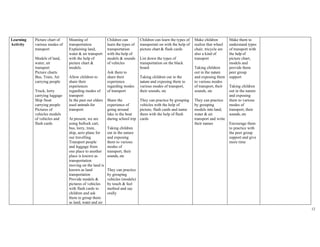
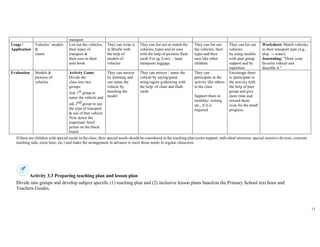
Stage TimeContents Teacher’s
activities
Student’s
activities
Teaching
Aid
Assessment/
Evaluation
Introduction
Presentation
Stabilization
(Summary)
Teacher Signature: _____________________ Date: _________________
Department Head/ School Director Comments
____________________________________________________________________________________
Signature: ___________________________ Date: _________________
3. Principles of Universal Design of Learning (UDL
Universal Design of Learning (UDL) provides a blueprint (outline) for creating flexible goals, methods,
materials, and assessments that accommodate learner differences. However, “Universal" does not imply
a single optimal solution for everyone. Instead, it is multiple approaches to meet the needs of diverse
learners. Universal Design first appeared in education in the design of school buildings; however,
creative educators quickly realized that these principles could also be applied to the design of curriculum
and to classroom pedagogy. It was realized that this could be applied to all children.
The principles of UDL are as follows:
o Accessibility
o Flexibility in use, participation, and presentation.
o Consistency
o Supportive learning environment.
o Ensuring a learning space that accommodates both students and instructionalmethods.
Activity 3.2 Important tenets of Universal UDL
Universal Design Learning (UDL) embraces the concept of improved access for everyone and applies
to curriculum materials and teaching methods. Discuss in your group and give examples of the three
(3) important tenets of UDL, namely:
(1) multiple methods of presentation;
______________________________________________________________________________
______________________________________________________________________________
(2) multiple options for participation and
______________________________________________________________________________
______________________________________________________________________________
(3) multiple means ofexpression.
______________________________________________________________________________
______________________________________________________________________________
Facilitator Note (For Activity 3.2)
The three important tenets of UDL:
Important tenets of UDL Examples
1. Multiple Methods of
Presentation (Present
Information in Different
Ways)
Varied Media -Textbooks, videos, podcasts, diagrams, interactive
simulations.
Adaptable Formats - Text-to-speech for struggling readers, visual aids
(charts, infographics) for visual learners.
Customizable Features - Adjustable font size, color contrast, audio
descriptions, subtitles.
2. Multiple Methods of
Participation (Let Students
Learn in Their Own Way)
Choice in Learning - Games, storytelling, hands-on experiments, role-
playing.
Interest-Based Learning -Math through sports stats, science through
cooking, history through reenactments.
Tiered Support -Text-to-speech tools, peer collaboration, guided vs.
32.
6
independent practice options.
3.Multiple Methods of
Expression (Allow
Different Ways to Show
Learning)
Flexible Assignments- Oral presentations, videos, posters, models,
digital portfolios.
Alternative Tools- Typing instead of handwriting, speech-to-text
software etc
Creative Demonstrations - Art projects, coding exercises, debates.
33.
7
Developing a TeachingPlan and Lesson Plan for an Inclusive Classroom
Inclusive classrooms require teachers to proactively plan for diverse learners (gender, culture, language,
background, abilities, health). This is time-intensive but fosters creativity and necessitates resourcefulness.
Key Considerations:
• Resourcefulness- Leverage school support, involve children/parents in sourcing materials (concrete
objects, aids like large print, tactile adaptations etc), and utilize community resources.
• Real World Connections- Extend learning beyond the classroom to connect with students' lives.
• Collaborative Planning- Involve children, parents, colleagues, and volunteers.
Essential Components of an Inclusive Teaching Plan:
• Topic/Content Selection
• Objective Setting
• Method/Technique Decisions
• Pre-knowledge Assessment Activities
• Inclusive Learning Activities
• Teaching-Learning Materials/Resources List
• Classroom/Learning Environment Organization
• Pair/Group Work Activities
• Feedback/Assessment Incorporation
Developing detailed teaching and lesson plans beforehand is crucial for effective inclusive instruction.
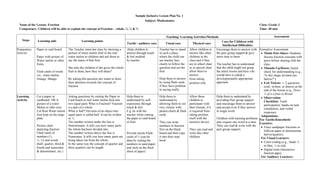
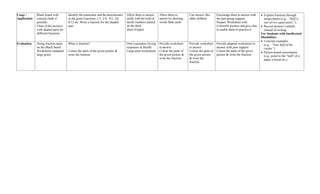
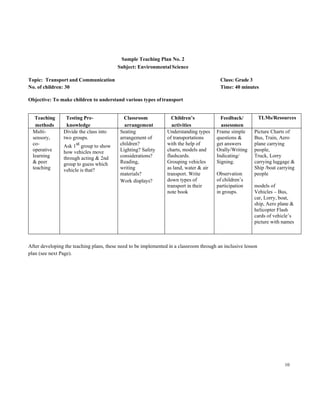
Sample Teaching Plan No. 1
Subject-Mathematics
Topic: Fraction
Class: Grade 3
No. of children: 35
Time: 40
minutes
Objective: Children will be able to explain the concept of Fraction – whole, ½, ¼ & ¾
Teaching
methods
Testing
Pre-
knowledge
Classroom
arrangeme
nt
Children’s activities Feedback/
assessment
TLMs/Resources
• Cooperativ
e learning
& peer
teaching
• Demonstrat
ion
• What is
fraction?
• How to write
half, quarter,
third &
fourth in
fraction?
• Adequate
space for
classroom
activities
Seating
arrangement of
children?
• Lighting?
• Safety
considerations?
• Reading,
writing
materials?
• Work displays?
• Children participates in
demonstration
• (Cutting a paper or other
object into ½, ¼ & ¾ and
showing each part to
children and asking them
to say the parts in fraction
& write it on the black
board)
• Answers to questions
asked by the teacher on
fraction
• Reading & Writing
fractions on the board &
in the math’s note book
• Frame simple
questions & get
answers
• Orally/Writing
• Indicating/ Signing.
• Observation of
children’s
participation
individually and
also in groups
• Worksheet for
evaluation
• Paper or card board or
other object (Scissors or
cut it using hands-fold
and cut)
• A chart with the coloured
picture of whole fruit
like “water melon” and
cutting parts of it -half,
quarter, ¾.
• Picture, words & number
flash cards eg. Flash card
of ½ , ¼ & ¾
• Worksheet for evaluation
After developing the teaching plans, these need to be implemented in a classroom through an inclusive lesson
plan (see next Page)
34.
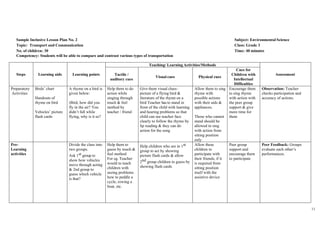
Sample Inclusive LessonPlan No. 1
Subject: Mathematics
Name of the Lesson: Fraction Class: Grade 3
Competency: Children will be able to explain the concept of Fraction – whole, ½, ¼ & ¾ Time: 40 min
Steps
Pre-Learning
Activities
Learning aids Learning points
Teaching/ Learning Activities/Methods Assessment
Tactile / auditory cues Visual cues Physical cues
Cues for Children with
Intellectual Difficulties
Preparatory
Activity
Paper or card board
Paper with picture of
Water melon or other
fruits,
Flash cards of words
viz., water melon,
Orange, Mango
The Teacher starts her class by showing a
picture of water melon fruit or the real
water melon to children and ask them to
say the name of that fruit
She asks the children if she gives the whole
fruit to them, how they will share?
By asking this question she wants to draw
their attention towards the concept of
fraction
Help children to
answer through touch
& feel method
by teacher
Teacher has to stand
in such a place
where the child can
see teacher face
clearly to follow the
question and see the
fruit
Help them to answer
by using flash cards
if they have problem
in saying orally
Allow children to
answer like other
children in the
class and if they
are in wheel chair
or in special chair
allow them to
answer
from sitting
position only
Encourage them to answer with
the peer group support & give
more time to them
The teacher has to understand
that the child might not grasp
the entire lesson and here s/he
would have to adopt a
developmentally appropriate
approach
Formative Assessment
• Think-Pair-Share: Students
discuss fraction concepts with
peers before sharing with the
class.
• Thumbs Up/Down: Quick
check for understanding (e.g.,
“Is this shape divided into
halves?”).
• Exit Tickets: 1–2 questions
(oral, written, or drawn) at the
end of the lesson (e.g., Draw
¼ of a a fruit ot Bread.
• Observation
Checklists: Track
participation, hands-on task
completion, and verbal
responses.
Adaptations:
For Tactile/Kinesthetic
Learners:
• Trace sandpaper fractions or
fold/cut paper to demonstrate
halves/quarters.
For Visual Learners:
• Color-coding (e.g., shade ½
in blue, ¼ in red).
• Digital tools (interactive
fraction apps).
For Auditory Learners:
Learning
Activity
Cut a paper or
cardboard OR A
picture of a water
Melon or othe cruit
Cut Real Water melon
fruit kept on the large
plate.
Picture chart
depicting fraction
Flash cards of
numbers (½,
¼, ¾) and words
(half, quarter, third &
fourth and numerator
& denominator, etc.)
Asking questions by cutting the Paper or
Card board or real water melon fruit into
two equal parts What is Fraction? Fraction
is a part of a whole
What is half? Division of an object into
equal parts is called half. It can be written
as ½.
The number written under the line is
Denominator. It tells you how many parts
the whole has been divided into.
The number written above the line is
Numerator. It tells you how many parts are
being taken out from the whole.
In the same way the concept of quarter and
three quarters can be taught.
Help them to
understand by self-
experience through
touch & feel
E.g. be with the
teacher while cutting
the paper or card board
or fruit.
Provide tactile Flash
cards of ½ (can be
done by cutting the
numbers in sand paper
and stick on the thick
sheet of paper)
Help them to
understand by
allowing them to see
very closely with
picture charts & flash
cards
They can write
numbers in fraction
first on the black
board and then copy
it into their note
book
Allow these
children to
participate with
their friends, if it
is required from
sitting position
itself with the
assistive device
They can read and
write like other
children
Help them to understand by
providing Peer group support
and encourage them to answer
and accept even if they answer
in single word
Children with learning problems
may require one word at a time.
They can read & write with the
peer group support.
35.
Usage /
Application
Black boardwith
colored chalk if
possible.
Chart of the pictures
with shaded parts for
different fractions
Identify the numerator and the denominator
in the given Fractions. 1/3, 2/4, 4/5, 3/6,
8/12 etc. Write a fraction for the shaded
part.
Allow them to answer
orally with the help of
tactile numbers pasted
on the thick
sheet of paper
Allow them to
answer by showing
words flash cards
Can answer like
other children
Encourage them to answer with
the peer group support.
Prepare Worksheet with
Colourful pictures and give clue
to enable them to practice it
• Explain fractions through
songs/chants (e.g., “Half is
one of two equal parts!”).
• Record answers verbally
instead of writing.
For Students with Intellectual
Disabilities:
• Concrete examples
(e.g., “Your half of the
cookie”).
• Picture-based assessments
(e.g., point to the “half” of a
papar a bread etc,).
Evaluation Doing fraction sums
on the Black board
Worksheets (adapted/
large print)
What is fraction?
Colour the parts of the given picture &
write the fraction
Oral evaluation Giving
responses in Braille
Large print worksheets
Provide worksheet
to answer
Colour the parts of
the given picture &
write the fraction
Provide worksheet
to answer
Colour the parts of
the given picture
& write the
fraction
Provide adapted worksheets to
answer with peer support
Colour the parts of the given
picture & write the fraction
36.
10
Sample Teaching PlanNo. 2
Subject: Environmental Science
Topic: Transport and Communication Class: Grade 3
No. of children: 30 Time: 40 minutes
Objective: To make children to understand various types oftransport
After developing the teaching plans, these need to be implemented in a classroom through an inclusive lesson
plan (see next Page).
Teaching
methods
Testing Pre-
knowledge
Classroom
arrangement
Children’s
activities
Feedback/
assessmen
t
TLMs/Resources
Multi-
sensory,
co-
operative
learning
& peer
teaching
Divide the class into
two groups.
Ask 1st group to show
how vehicles move
through acting & 2nd
group to guess which
vehicle is that?
Seating
arrangement of
children?
Lighting? Safety
considerations?
Reading,
writing
materials?
Work displays?
Understanding types
of transportations
with the help of
charts, models and
flashcards.
Grouping vehicles
as land, water & air
transport. Write
down types of
transport in their
note book
Frame simple
questions &
get answers
Orally/Writing
Indicating/
Signing.
Observation
of children’s
participation
in groups.
Picture Charts of
Bus, Train, Aero
plane carrying
people,
Truck, Lorry
carrying luggage &
Ship /boat carrying
people
models of
Vehicles – Bus,
car, Lorry, boat,
ship, Aero plane &
helicopter Flash
cards of vehicle’s
picture with names
37.
11
Sample Inclusive LessonPlan No. 2 Subject: Environmental Science
Topic: Transport and Communication Class: Grade 3
No. of children: 30 Time: 40 minutes
Competency: Students will be able to compare and contrast various types of transportation
Steps Learning aids Learning points
Teaching/ Learning Activities/Methods
Assessment
Tactile /
auditory cues
Visual cues Physical cues
Cues for
Children with
Intellectual
Difficulties
Preparatory
Activities
Birds’ chart
Handouts of
rhyme on bird
Vehicles’ picture
flash cards
A rhyme on a bird is
given below:
(Bird, how did you
fly in the air? You
didn’t fall while
flying, why is it so?
Help them to do
action while
singing through
touch & feel
method by
teacher / friend
Give them visual clues–
picture of a flying bird &
literature of the rhyme on a
bird Teacher has to stand in
front of the child with learning
and hearing problems so that
child can see teacher face
clearly to follow the rhyme by
lip reading & they can do
action for the song
Allow them to sing
rhyme with
possible actions
with their aids &
appliances.
Those who cannot
stand should be
allowed to sing
with action from
sitting position
only
Encourage them
to sing rhyme
with action with
the peer group
support & give
more time for
them
Observation: Teacher
checks participation and
accuracy of actions.
Pre-
Learning
activities
Divide the class into
two groups.
Ask 1st group to
show how vehicles
move through acting
& 2nd group to
guess which vehicle
is that?
Help them to
guess by touch &
feel method
For eg. Teacher
would to teach
children with
seeing problems
how to peddle a
cycle, rowing a
boat, etc.
Help children who are in 1st
group to act by showing
picture flash cards & allow
2nd group children to guess by
showing flash cards
Allow these
children to
participate with
their friends, if it
is required from
sitting position
itself with the
assistive device
Peer group
support and
encourage them
to participate
Peer Feedback: Groups
evaluate each other’s
performances.
38.
12
Learning
Activity
Picture chart of
variousmodes of
transport
Models of land,
water, air
transport
Picture charts
Bus, Train, Air
carrying people
Truck, lorry
carrying luggage
Ship /boat
carrying people
Pictures of
vehicles models
of vehicles and
flash cards
Meaning of
transportation
Explaining land,
water & air transport
with the help of
picture chart &
models.
Allow children to
share their
experiences
regarding modes of
transport
In the past our elders
used animals for
transport
At present, we are
using bullock cart,
bus, lorry, train,
ship, aero plane for
our travelling
Transport people
and luggage from
one place to another
place is known as
transportation
moving on the land is
known as land
transportation
Provide models &
pictures of vehicles
with flash cards to
children and ask
them to group them
as land, water and air
Children can
learn the types of
transportation
with the help of
models & sounds
of vehicles
Ask them to
share their
experience
regarding modes
of transport
Share the
experience of
going around
lake in the boat
during school trip
Taking children
out in the nature
and exposing
them to various
modes of
transport, their
sounds, etc
They can practice
by grouping
vehicles (models)
by touch & feel
method and say
orally
Children can learn the types of
transportati on with the help of
picture chart & flash cards
List down the types of
transportation on the black
board
Taking children out in the
nature and exposing them to
various modes of transport,
their sounds, etc
They can practice by grouping
vehicles with the help of
picture, flash cards and name
them with the help of flash
cards
Make children
realize that wheel
chair, tricycle are
also a kind of
transport
Taking children
out in the nature
and exposing them
to various modes
of transport, their
sounds, etc
They can practice
by grouping
models into land,
water & air
transport and write
their names
Make them to
understand types
of transport with
the help of
picture chart,
models and
provide them
peer group
support
Taking children
out in the nature
and exposing
them to various
modes of
transport, their
sounds, etc
Encourage them
to practice with
the peer group
support and give
more time
39.
13
transport
Usage /
Application
Vehicles’ models
&
charts
Listout the vehicles,
their types of
transport &
their uses in their
note book
They can write it
in Braille with
the help of
models of
vehicles
They can list out or match the
vehicles, types and its uses
with the help of pictures flash
cards For eg. Lorry – land,
transports luggage
They can list out
the vehicles, their
types and their
uses like other
children
They can list out
vehicles
by using models
with peer group
support and by
repetition
Worksheet: Match vehicles
to their transport type (e.g.,
ship → water).
Journaling: "Draw your
favorite vehicle and
describe it."
Evaluation Models &
pictures of
vehicles
Activity Game
Divide the
class into two
groups:
Ask 1st group to
name the vehicle and
ask 2nd group to say
the type of transport
& use of that vehicle
Note down the
important/ brief
points on the black
board
They can answer
by listening and
can name the
vehicle by
touching the
model
They can answer / name the
vehicle by saying/guest
uring/signin g/showing with
the help of chart and flash
cards
They can
participate in the
activity like others
in the class
Support them in
mobility/ writing
etc., if it is
required
Encourage them
to participate in
the activity with
the help of peer
group and give
more time and
reward them
even for the small
progress.
If there are children with special needs in the class, their special needs should be considered in the teaching plan (extra support, individual attention, special assistive devices, concrete
teaching aids, extra time, etc.) and make the arrangement in advance to meet those needs in regular classroom.
Activity 3.3 Preparing teaching plan and lesson plan
Divide into groups and develop subject specific (1) teaching plan and (2) inclusive lesson plans basedon the Primary School text boos and
Teachers Guides.
40.
14
Section 3.2 CreatingSafe and Conducive Learning Environment
3.2.1 Classroom Sitting Arrangement (layout)
Activity 3.2.1 Classroom Design Challenge: Optimizing for Learning and Safety
Think about classrooms you've been in, both as a student and as a teacher.
1. What were some seating arrangements you remember?
2. What worked well?
3. What didn't work so well, and why?
Facilitators Note
Possible Seating Arrangements (classroom layout)
Traditional
classroom
Alternatives
Team-style U-shape Conference table
Group on group Workstations Breakout groupings
Note: These layouts are generally temporary. Use them as needed if furniture is movable.
A well-designed seating arrangement can significantly impact classroom dynamics, fostering both active learning
and a safe, inclusive environment. Here are a few options, along with explanations of their benefits and
considerations:
Key Principles of seating arrangement for Active and Safe Learning:
Principles Description
Visibility All students should have a clear view of the teacher, whiteboard/screen, and any
presentation areas.
Accessibility Ensure clear pathways for movement, especially for students with disabilities.
Collaboration Facilitate interaction and teamwork for group activities.
Engagement Minimize distractions and encourage focused participation.
Inclusivity Create a sense of belonging and equal opportunity for all learners.
Flexibility The arrangement should be adaptable for different activities and teaching styles.
Safety Allow for quick movement in case of emergencies and minimize potential hazards.
Note: the best seating arrangement is not one-size-fits-all. It depends on your teaching style, the age and needs of
your students, the subject matter, and the specific learning activities.
41.
15
3.2.2 Playful Environment
Activity3.2.2
Play is identified as an essential strategy for creating a supportive learning environment for learning in pre-
primary education.
Outline the key characteristics associated with play?
_________________________________________________________________________________
________________________________________________________________________________
Facilitators Note
Play is essential for a supportive pre-primary learning environment. It's characterized by:
Play
Play is meaningful
Children play to make sense of the world
around them, and to find meaning in an
experience by connecting it to something
already known. Through play, children
express and expand their understanding of
their experiences.
Play is joyful
Look at children – or adults – playing, often
smiling and laughing. Of course, play may have
its frustrations and challenges (Who gets the first
turn? Why can’t I make this block building stay
up?), but the overall feeling is one of enjoyment,
motivation, thrill and pleasure.
Play is actively engaging
Watch children playing, and you will
usually see that they become deeply
involved, often combining physical, mental
and verbal engagement.
Play is Iterative
Play and learning are not static. Children play
to practice skills, try out possibilities, revise
hypotheses and discover new challenges,
leading to deeper learning.
Play is Socially Interactive
Play allows children to communicate ideas, to
understand others through social interaction,
paving the way to build deeper understanding and
more powerful relationships.
42.
16
3.2.3 Using LowCost Creating Supportive Envirinment
Creating supportive learning environment using locally available materials.
Activity 3.2.3 Producing Low cost materials
Instructions for all groups:
1. Form five groups.
2. Look at the visual descriptions provided below.
3. Create using local, safe materials to build the items described.
Group 1: Materials to Help Children Improve Intellectual Skills (Numeracy and Literacy
Skills)
Shape Sorting: Emphasize its importance in early mathematics development.
Math and Literacy Aids: Highlight the value of fun, repetitive games for reinforcing basic
concepts. (e.g., matching letters/numbers)
43.
17
Concrete and VisualMath Materials: Stress their effectiveness for all children.
Word Picture Matching: is specially useful for improving visual skills. Make cards for high
frequency eords.
Literacy Dominoes: The right-hand side of the last domino matchs the left-hand side of the Explain the
matching concept for literacy development.
44.
18
Addition Dominoes: Highlighttheir use as a non-
writing math practice tool.
Category Cards and Sentence Strips: Explain their use in developing thinking, reasoning, and sentence
construction.
Drawpicturesoffamiliarwords,cutoutandthencategorize
45.
19
Group 2: Materialsto Help Children Improve Fine Motor Skills
• Templates and Stencils: Explain their role in writing development.
• Wrist Support and Pencil Grips: Emphasize their role in improving writing comfort and control.
Group 3: Materials to Help Children Improve Behavior, Attention, or Social
Skills
Good Behavior Cards: in classrooms and playgrounds.
Good behavior cards can also be put up in
the classroom or in the playground.
46.
20
Group 4: Materialsto Help Children with Visual Impairments
Tactile Learning Aids: Explain the use of local materials (seeds, threads) for tactile pictures.
Tactile Math Sums: Suggest using buttons or
counters for tactile math learning.
Bead Bracelets: Explain their use in tactile
learning and fine motor development.
Activity 5: Materials to Help Children with Specific Reading Skills
For more advanced readers, reading frames can help the words to stop “jumping around“ on the page.
3.2.4 Technology and Supportive Learning Environment
The Technology, Pedagogy, and Content Knowledge (TPCK)
framework underscores the interconnectedness of these three domains
for effective teaching and learning, especially when integrating digital
tools. In the context of early childhood education, understanding and
applying TPCK is crucial for designing developmentally appropriate
and engaging learning experiences. Teachers who possess a strong
grasp of TPCK can leverage technology not just as a tool, but as an
integral part of their pedagogical approach and content delivery,
ultimately creating a more supportive and enriching learning
environment for young children.
47.
21
Activity 3.2.4
1. Howcan a pedagogical approach like storytelling be enhanced using video technology or other
technologies to teach a specific content area like animal sounds?
2. How can interactive games (technology) be designed based on child-centered pedagogy to
reinforce early literacy skills (content)?
3. Please try to access some “Open Access Education Resources (OER)” below:
• CAMARA Education Ethiopia resources are a valuable source for pre-primary
https://camara.org/ethiopia/
• Khan Academy Kids https://learn.khanacademy.org/khan-academy-kids/
o UNESCO's OER Platform https://www.unesco.org/en/open-educational-resources
o MERLOT (Multimedia Educational Resource for Learning and Online Teaching)
https://www.merlot.org/merlot/
Facilitator's Note
1. Enhancing Storytelling (Example: Animal Sounds):
• Video: Vivid multisensory learning through real animal sound clips integrated into stories.
• Interactive Touchscreens: Touch animal images to hear sounds in interactive books.
• Sound Boards/Apps: Active exploration by pressing buttons for animal sounds.
• Augmented Reality (AR): Virtual animals with sounds overlaid on the real environment.
• Digital Storytelling Tools: Personalized interactive stories with animal sounds.
2. Interactive Games (Early Literacy):
• Phonological Awareness: Engaging digital games for rhyming, segmenting, and blending sounds.
• Letter Recognition/Formation: Interactive apps for tracing, matching, and identifying letters.
• Vocabulary Building: Picture-word matching, interactive storybooks with sound labels, drag-and-
drop.
• Early Reading Comprehension: Interactive digital stories with comprehension questions and
sequencing.
• Personalized Learning: Adaptive difficulty based on individual progress.
3. Open Access Education Resources for Pre-Primary:
• Refer to provided resources like CAMARA Education Ethiopia.
48.
22
Section 3.3 Tipsto How to Teach: Basic Early Mathematics Skills
Learning Objectives:
By the end of this training, participants will be able to:
• Explain early math and its place in pre-primary education.
• Implement specific aspects of early math skills in teaching.
• Teach early math activities through fun and play-based methodologies.
• Confidently teach early math to children as pre-primary teachers.
• Apply various ways to emphasize early math in different parts of the daily schedule and lesson planning.
Math Concept: Greater or Less
Start-Up Activity:
1. Display a flip chart with smiley icons for boys and girls.
2. Ask everyone to stand up for attendance.
3. Instruct participants to draw a smiley face under "Males" or "Females" on
the flip chart.
4. Encourage participants to make the smiley faces roughly the same size.
Example:
☺
☺
☺
☺
☺
☺
☺
☺
☺
☺
Female Male
Reflection:
• Are there more men or women in the training?
• What math concept can children learn from this activity?
Note for the Trainer:
This simple graph helps children understand the concepts of "greater than" and "less than." It's a great way to
introduce data representation to young children.
Video Links
https://www.youtube.com/watch?v=ct2CXZgWK7Y
https://www.youtube.com/watch?v=ct2CXZgWK7Y
49.
23
Early Math Skillsand Competencies
Activity: Brainstorming on Early Math (30 minutes)
Discussion Questions:
1. What early math skills should young children develop before entering primary school, and why?
2. What could happen if children start primary education without a foundation in these math skills and
concepts?
Steps:
1. Divide participants into groups.
2. Distribute pre-prepared cards with early math competencies and corresponding domains (see table
below).
3. Provide each group with a flip chart and glue/masking tape.
4. Ask participants to sort and organize the competencies under the correct domains.
5. Have each group present their work.
Note for the Trainer:
The following table outlines the key early math skills and competencies:
Numbers & counting Patterns
Sorting &
Classification
Comparison &
Measurement
Geometry
123 ★☐★☐★☐ ☐☐☐
☐
• Children can count,
name and identify
numbers 1-20, and
above,
• Children can use words
to describe their
quantity or “how many”
of something (they can
say, four sisters, two
eyes, five chairs…)
• Children can match up
numerals (1,2,3 etc.) to
sets of objects or set
(for example as, three
leaves)
• Children can compare
how many in different
set, groups of objects or
people,
• Children can use money
to add or subtract and
recognize their values
• Children can look for and
identify patterns all
around them
• Children can arrange
blocks or other objects
according to a clear rule
or sequence
• Children can figure out if
something is the same or
different than something
else
• Children can group
objects in different
ways—same or different
sizes, shapes, colors, etc.
• Children can figure out
whether something
belongs with something
else, or does not belong.
• Children can match alike
objects;
• Children can figure
out if something is the
same or different.
• Children can sort and
organize objects using
one characteristic
(e.g., size, shape,
texture, or color).
• Children can sort and
organize objects using
more than one
characteristic (e.g.,
size, shape, texture, or
color).
• Children can sort
objects using self-
selected criteria.
• Children can use non-
standard units and
compare and identify
objects with their weight
as heavier or lighter
• Children can use non-
standsrd units (inch,
hand, feet) and compare
objects with their length.
• Children can compare
different set, groups and
describe as greater less,
many, few,
• Children can compare
and make sets,
• Children can talk about
“before” and “after” of
something,
• Children can describe
distance( for example as,
far, near)
• Children can use
and identify shapes
(circle, square,
triangle, etc.)
• Children can
assemble shapes(for
example, thangram)
together and make
another shapes,
• Children can
identify and
different shapes of
geometry from the
set,
• Children can create
different shapes
using available
materials in their
surroundings.
• Children can
identify shapes in
their environment
50.
24
Short Presentation onEarly Math Skill Areas (10 minutes)
Summary of Major Points:
• Early math focuses on the development of mathematical
and spatial concepts. These skills are foundational for
future academic and life success.
• Children need to learn about numbers and mathematics
even before formal arithmetic.
• Early literacy and early math knowledge are strong
predictors of school outcomes. Mastering early math
skills is crucial for success in primary grades and beyond.
• Five key learning areas/competencies are identified for
early math.
1. Number and Counting
Discussion Question (10 minutes)
• What is the difference between NUMBER and COUNTING
concepts?
• What are the teacher's roles in helping children develop these
skill areas?
General Overview Presentation by the Trainer (10 minutes)
Counting involves understanding numbers, quantity, order, number
representation, one-to-one correspondence, and the act of counting.
Associated Skills:
• Count to 20 or higher.
• Identify and name numbers.
• Determine if adding/removing an object changes the quantity.
• Differentiate between "some" and "all."
• Use number words to describe quantity.
• Match numerals to sets of objects.
Video Links:
ttps://www.youtube.com/watch?v=7D4K9oi7oBM
51.
25
2. Pattern
Group Discussion(30 minutes):
1. What do we mean by PATTERN?
2. What activities can help children recognize patterns?
3. What is the teacher's role in developing this skill?
Trainer Briefing (10 minutes):
Patterns are repeating sequences or connected sets.
Associated Skills:
• Create patterns using color, shape, size, etc.
• Identify object positions (under, in front, on, near, inside,
outside).
• Recognize simple to complex patterns.
• Identify patterns in the environment.
• Copy, extend, and create patterns.
• Describe event sequences (school day-weekend).
Teacher's Role:
• Engage children in pattern-making activities.
• Help children explore patterns in their environment.
• Encourage pattern practice (hand clapping).
• Help children recognize patterns in daily/monthly/seasonal sequences.
Video Links:
https://www.youtube.com/watch?v=kQsE09rQ9-0
3. Sorting and Classification (50 minutes)
General Overview:
Sorting and classification involve distinguishing between similar
and different objects and organizing them by properties (size,
color, shape, texture, etc.).
Associated Skills:
• Sort and organize objects by one or more characteristics.
• Match similar objects.
• Arrange numbers and objects in a series (e.g., big to
small).
• Use graphic representations of objects.
• Collect and classify environmental objects (leaves, sand, sticks, rocks, seeds).
Note for the Trainer:
To help children develop this skill:
• Provide different objects for sorting and classifying.
• Encourage children to collect and classify environmental objects.
• Allow children to sort and classify objects by their own criteria.
Video Links:
https://www.youtube.com/watch?v=c5KBoDRm5J0
52.
26
4. Comparison andMeasurement
General Overview:
Comparison and measurement involve describing and comparing
measurable attributes and classifying objects.
Associated Skills:
• Compare and measure objects by weight and length.
• Use non-standard units.
• Remember and discuss past events.
• Talk about "before" and "after."
• Determine if something is bigger or heavier than something else.
Teacher's Role:
Provide objects of varying sizes and weights, encourage comparison and measurement using non-standard units
(feet, inches, hands). Facilitate a group discussion about other ways teachers can help.
Video Links:
https://www.youtube.com/watch?v=KvmzCbjopkE&t=2s
5. Geometry
General Overview:
Geometry involves understanding shape, size, and position.
Associated Skills:
• Use and identify shapes (circle, square, triangle, etc.).
• Identify and name basic geometric shapes.
• Combine shapes to create new shapes.
• Recognize geometric shapes in the environment.
Discussion Question:
Discuss the teacher's role in developing this skill.
Note for the teacher:
Help children recognize geometry through:
• Organizing different geometric shapes.
• Encouraging children to create shapes from found objects (sticks, blocks, stones, clay).
• Connecting learned shapes to familiar objects at home and in the environment.
Video links:
https://www.youtube.com/watch?v=4tkRwMHu9NQ&list=PLZS3MUjYqjUEhFnxqht8HC9O2Rro5ydE
(Adapted from Addis Ababa Bureau of Education Teachers Training Manual)
53.
27
Section 3.4: AssessingStudent’s Learning and Development and Providing
Feedback
3.4.1 Formative Assessment
Referring to the competency/outcome/ objective from the syllabus teachers are encouraged to prepare questions
based on the below template.
Subject: ____________________________ Grade: _____ Unit or Week: _______ Semester:____
Skill/Content /Titel: __________________________________________________________________
Sub-Skill/Sub-content: __________________________________________________
Competency or Objective or Outcome:
Method of Delivery:
Oral ___ Written ____Performance ____
Method of Response:
Oral ___ Written ____Performance ____
Question:
Answer:
Rubric:
Type of
Question
Multiple Constructed Performance
Choice ___ Response _____ Task _____
Domai
n
Knowledge Recall _____ Understanding ____ Application ___
Attitude Receiving ___ Responding ______ Valuing _______
Skill Imitation ____ Manipulation ____ Precision _____
Difficulty
Level
Easy ________ Moderate ______ Difficult _____
3.4.2 Summative Assessment based on Test Blueprint (Table of Specification)
Subject: ____________________Unit (s)__________________ Quiz/ Test/ Exam No.______
Unit 1 = Total Number of Periods = ___________
No of Periods of
the sub-unit
Percentage of periods of
subunits out of Total
Periods of the unit 1
Sub-unit 1.1
Sub-unit 1.2
Sub-unit 1.3
Sub-unit 1.4
54.
28
Exam of Unit_____= Say you want to have 25 Questions
Total
Questions
Percentage of periods of
subunits out of Total
Periods of the unit 1
Number of Questions per subunit =
(Total Q 25) X (Percentage of periods
of subunits out of Total Periods of the
unit 1)
Sub-unit 1.1
25
Sub-unit 1.2
Sub-unit 1.3
Sub-unit 1.4
When you prepare an exam or test as a summative assessment in addition to the proportion of number of periods
consider:
1. Cognitive level: K= Knowledge; C= Comprehension; and A= Application etc
2. Level of difficulty: E= Easy; M=Moderate; and D= Difficulty
3. Type of Questions: MC = Multiple Choice; CR= Constructive Response; and PT= Performance Test
55.
29
MODULE 4: TEACHERPROFESSIONAL ENGAGEMENT
Objective
By the end of this module, participants will be able to:
• Analyze CPD models and their school relevance.
• Propose strategies to use underutilized CPD models.
• Identify parental challenges in supporting foundational learning and suggest solutions.
• Suggest ways to engage the community in advocating for inclusive and quality education.
Section 4.1: Engaging in Professional Learning
Activity 4.1 Ingaging in Professional Learning
1. Read through each CPD model and its description carefully.
2. For each model, consider if this approach is currently practiced in your school.
3. Brainstorm potential benefits and challenges of implementing or further developing some of the less
common or absent CPD models in your school context.
CPD Model Description
Practiced in
Our School,
Make tick (√)
If No (N), Is it
possible to consider
for the future? If
yes How?
Y N
Training Expert-led, skill-focused, standardized.
Cascade Trains few to share, cost-effective.
Action Research Teacher-led inquiry for practice
improvement.
Coaching/ Mentoring One-on-one support, hierarchical or
collaborative.
Deficit-model Addresses individual weaknesses, may
ignore systemic issues.
Individualized PD Personalized learning plans driven by
teacher needs and goals.
Community of Practice Collaborative knowledge sharing and
practice improvement.
Reflective/
collaborative Practice
Teachers critically examine their teaching
for self-improvement.
Networked Learning Connects teachers online for resource and
idea sharing.
Other (Please
Specify_____________
56.
30
Facilitators Note forActivity 4.1
Guide participants to analyze CPD models and their school's current practices honestly. Encourage
them to brainstorm realistic benefits and challenges of implementing less common models, considering
their school's context. Emphasize practical possibilities for future implementation and the value of
diverse perspectives.
Section 4.2: Engaging with Parents
Activity 4.2: Engaging with parents
"Many parents, especially those with little formal education, want to support their child’s learning but
may not know how. Today, we’ll brainstorm ways to make it easy, practical, and fun for them!"
• What challenges might these parents face?
• What strategies and actions can we use to address the challenges listed below:
Parent’s Challenge may be: Strategy Action
1 Lack of literacy and numeracy skills
(difficulty reading school materials,
helping with homework).
Provide alternative ways
to engage with learning
(e.g., oral storytelling,
visual aids, audio
recordings).
Offer picture-based
instructions, verbal
explanations, and
interactive activities that
don’t rely solely on reading.
2 Limited understanding of the formal
education system and curriculum.
3 Feeling inadequate or unqualified to help
their children academically.
4 Lack of play materials and resources
(books, learning materials).
5 Cultural beliefs or past negative
experiences with formal education.
6 Language barriers (if the school uses a
different language than the home).
7 Other specify
57.
31
Facilitator Note forActivity 4.2
1. Begin by posing the first question to the participants, allowing ample time for individual reflection and
then group sharing. Capture their responses on a flip chart or whiteboard. Encourage a supportive and
non-judgmental atmosphere.
2. Expected Responses (Facilitator to guide if needed):
Parent’s Challenge may
be:
Strategy Action
1 Lack of literacy and
numeracy skills
(difficulty reading
school materials, helping
with homework).
Provide alternative
ways to engage with
learning (e.g., oral
storytelling, visual aids,
audio recordings).
Offer picture-based instructions, verbal
explanations, and interactive activities
that don’t rely solely on reading.
2 Limited understanding
of the formal education
system and curriculum.
Simplify and demystify
school processes.
Host orientation sessions explaining
how schools function, key terms (e.g.,
"homework," "report cards"), and
parents’ roles in their child’s education.
3 Feeling inadequate or
unqualified to help their
children academically.
Emphasize that support
goes beyond
academics.
Highlight non-academic ways parents
can help (e.g., encouraging curiosity,
providing emotional support, creating a
learning-friendly home environment).
4 Lack of play materials
and resources (books,
learning materials).
Utilize low-cost/no-cost
materials.
Encourage the use of everyday objects
(e.g., counting with household items
etc).
5 Cultural beliefs or past
negative experiences
with formal education.
Build trust and validate
experiences.
Invite respected community members to
share success stories, address myths,
and create a safe space for parents to
express concerns.
6 Language barriers (if the
school uses a different
language than the
home).
Bridge communication
gaps.
Use bilingual volunteers
Encourage schools to provide key
information in parents’ native
languages.
7 Other specify
58.
32
Section 4.3 Engagingthe Community
The following have been suggested as some of the ways through which the community can participate in
education in general and curriculum implementation inparticular:
• Advocating for increased enrolment in schools
• Advocating and promoting girl child education
• Promote foundational learning
• Motivating school staff
• Advocate for education of Children with
Disabilities
• Ensuring students’ regular attendance and
completion
• Constructing, repairing and improving school
facilities
• Preparing children’s readiness for schooling
• Contributing in labour and materials
• Monitoring and follow up on teacher
attendance andperformance
• Helping Parent-Teacher- Student
Associations to manageschools
• Actively attending school meetings to learn
about children’sprogress
• Raising money for schools
Activity 4.3 Engaging with Community
In pairs suggest how in the context of your school the community can:
1. increase school enrolment, 2. advocate for girl child education.
3. promote foundational learning. 4. motivate school staff.
5. advocate for education of Children with Disabilities.
59.
33
Facilitators Note forActivity 4.3
Possible responses for the above
1. Increase School Enrolment
1. Leaders talk about school benefits.
2. Parents of students share good
experiences.
3. Help with school meals, uniforms.
4. Share success stories of educated people.
5. Increase school enrolment
2. Advocate for Girl Child Education
• Girls have the right to learn. It helps
everyone.
• Address worries about girls going to school.
Find solutions.
• Show examples of successful women.
• Agree as a community that girls' education
is important.
3. Promote Foundational Learning
• Learning helps daily life (market, info).
• Families can tell stories, count things, sing
numbers.
• Volunteers can help young children learn
basics.
• Make learning fun for kids.
• Connect learning to local skills.
4. Motivate School Staff
• Say "thank you" to teachers and staff.
• Respect and support their work.
• Invite staff to community events.
• Talk openly to solve school problems.
• Appreciate staff with small gifts or
recognition.
5. Advocate for education of Children with Disabilities
• Talk about the right of children with disabilities to learn.
• Encourage schools to welcome all children.
• Connect families of children with disabilities to support.
• Talk about the abilities of children with disabilities.
• Help make schools and learning accessible children with disabilities.

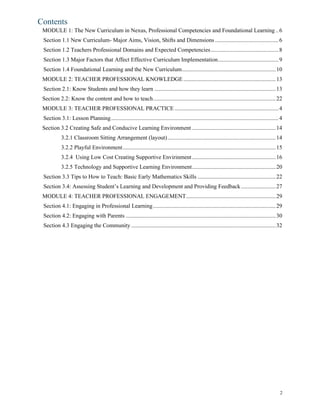
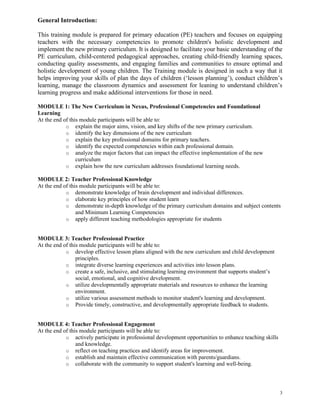
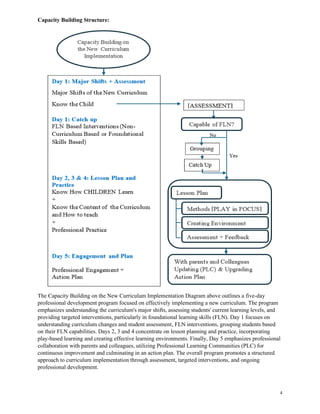
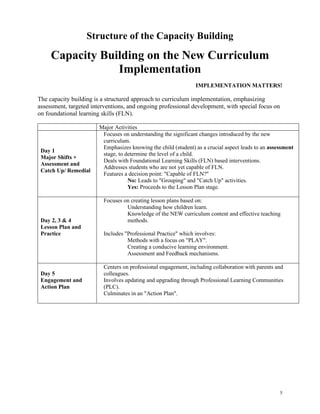
![6
Capacity Building for Primary School Teachers and Instructional
Leaders on the Implementation of the New Curricula
MODULE 1: The New Curriculum in Nexus, Professional Competencies and
Foundational Learning
Objective
At the end of this module participants will be able to:
o explain the major aims, vision, and key shifts of the new pre-primary curriculum.
o identify the key dimensions of the new curriculum
o explain the key professional domains for pre-primary teachers.
o identify the expected competencies within each professional domain.
o analyze the major factors that can impact the effective implementation of the new
curriculum
o explain how the new curriculum addresses foundational learning needs.
Section 1.1 New Curriculum- Major Aims, Vision, Shifts and Dimensions
Activity 1.1
1. Have you had the opportunity to implement the new curriculum? Yes _______ or No ______
2. If Yes, what are the major aims, shofts and vision of the new curriculum?
________________________________________________________________________________
________________________________________________________________________________
3. How are you going to change your implementation strategies to attain the major aims, shifts and
vision of the new curriculum stated above?
________________________________________________________________________________
________________________________________________________________________________
________________________________________________________________________________
Facilitator Notes: Reform major Aims, Shifts
Aims
• Transition to “a knowledge-based and
technology-led economy”.
Some Shifts
• Reduce focus on theory.
• Include indigenous knowledge.
• Link to the world of work.
• Include 21st
century competences.
• Include moral education.
• Provide for gifted and talented learners.
Sources/Reference: FDRE MOE 2020. General Education Curriculum Framework, Teacher Guides,
Student Textbooks.
Vision “[…] to cultivate all-rounded, ethical, self-
reliant and responsible lifelong learners who are
competitive regionally and globally and are
equipped with 21st century skills instrumental to
thrive in a knowledge-based and technology-led
economy as citizens […].” (EGECF 2020)](https://image.slidesharecdn.com/d2peteachertrainingmaterials4-250603115314-74f97172/85/D2-PE-Teacher-Training-Materials-4-pdf-pages-6-320.jpg)
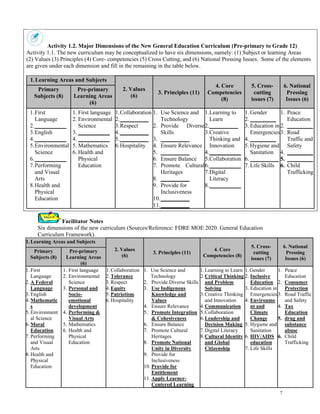
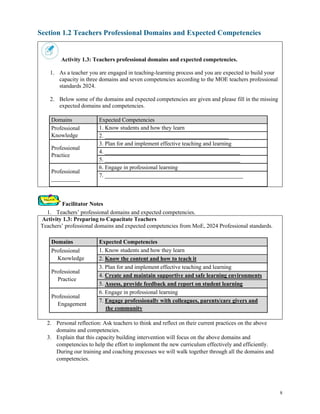
![9
Section 1.3 Major Factors that Affect Effective Curriculum Implementation
Activity 1.4: Factors Affecting Curriculum Implementation
1. Please list major factors that affect curriculum implementation in your region.
_____________________________________________________________
_____________________________________________________________
2. Given the following factors that affect curriculum implementation and from your list of factors
identify two or three major factors.
[Major Factors: Stakeholders Buy-in, Teachers Capacity, Support from the Instructional
Leadership, Material and Education Supplies, Ongoing Professional Support, Aligned
Assessment Systems, Teacher –Student Ratio, Content Overload, Parents Involvement,
Teaching- learning strategies, Child/Students Readiness/ engagement/ interest, Safe Learning
Environment (Physical, Social …) , Living/ Social Status of the teacher, Other Please specify
_________________]
Two/ three Major factors: (1) __________ (2) ____________ (3) ______________
3. What are the opportunities available in your region to implement the new curriculum?
_____________________________________________________________________
_____________________________________________________________________
Facilitators Note for Activity 1.4
Activity 1.4: Factors affecting Effective Curriculum Implementation
Support trainees to:
• identify and discuss the major factors that affect curriculum implementation in the participants'
specific context.
• prioritize the two or thre most critical factors that impact curriculum implementation in their
specific context.
• discuss mitigation strategies of the major hindering factors.
• Help participants to build on the opportunities available in their region to implement the new
curriculum.](https://image.slidesharecdn.com/d2peteachertrainingmaterials4-250603115314-74f97172/85/D2-PE-Teacher-Training-Materials-4-pdf-pages-9-320.jpg)
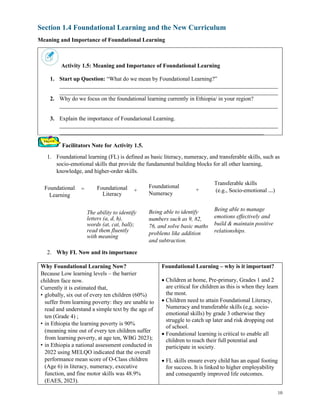
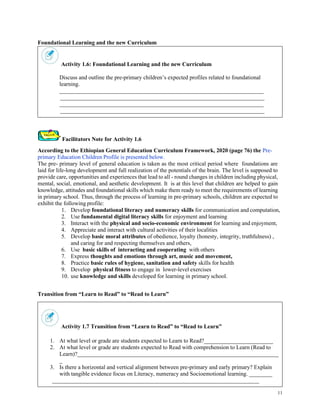
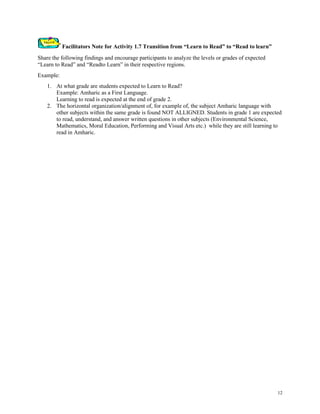
![13
MODULE 2: TEACHER PROFESSIONAL KNOWLEDGE
Objective
At the end of this module participants will be able to:
o demonstrate knowledge of student’s competency and individual differences.
o elaborate key principles of how students learn
o demonstrate in-depth knowledge of the primary curriculum domains and subjects and
Minimum Learning Competencies
o apply different teaching methodologies appropriate for students
Section 2.1: Know Students and how they learn
Knowing Students
Understanding students as individuals and how they learn is fundamental to effective teaching. This
knowledge allows teachers to create inclusive and engaging learning environments.
Activity ______________
1. Knowing students through Assessment tools (Pair Activity):
o Part I: Review the curriculum based Pre-primary Level 3 -Developmental and
Learning Outcomes.
o Part II: Review the sample (Non- Curriculum based) assessment tools presented below
(for English, Mother tongue, and Mathematics).
o In pairs, conduct a mock assessment scenario: one person acts as the student, and the
other as the assessor.
o After the mock assessment, reflect on the effectiveness of the chosen tool and the
experience.
2. Reflection and Discussion: What other strategies (beyond formal assessment) do you use to
understand your students' learning?
_______________________________________________________________________
_______________________________________________________________________
Diagnostic Assessment tools
Part I: Pre-primary Level 3 -Developmental and Learning Outcomes [Source PRESCHOOL-
CURRICULUM Preprimary Education Curriculum Syllabus, January 2025]
Learning Areas General Learning Outcomes
After completing Level 3, children will be able to:
Yes
(Y)
Partial
(P)
No
(N)
Personality and
socio-emotional
development
1. Follow a series of three commands in a row
2. Focus on a task in school for 15 minutes
3. Able to make peers line with gender identity
4. Able to cooperate and share with others
5. Takes turns when playing games with other children
6. Have positive attitudes towards learning and school
7. Demonstrate moral values and principles,
8. Develop basic skills of interacting with others
9. Have a self-concept and Demonstrate own interest
Environmental
Science
10. Know day from night and left from right
11. Be able to tell time
12. Know colors.](https://image.slidesharecdn.com/d2peteachertrainingmaterials4-250603115314-74f97172/85/D2-PE-Teacher-Training-Materials-4-pdf-pages-13-320.jpg)
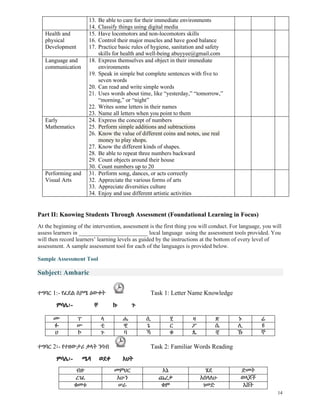
![15
ተግባር 3፡- የፈጠራ ቃላትን ማንበብ Task 3: Invented Words Reading
ምሳሌ፡- መጠረ ሀበለ ጃገሰ
ነለበ አቀወ ቱዛ ያሲማ ሳድ
ጀገደ ፈከዘ ዙታሜ ቃጠሰ ረተኛ
ቆቸ የኛኔ ባደሸ ቆሳዲ መሃና
ተግባር 4ሀ. ድምጽን ከፍ አድርጎ ማንበብ Task 4a: Passage Reading
ቀኑ ቅዳሜ ነው፡፡ አልማዝ ልብስ የምታጥብበት ቀን ነው፡፡ ከጧት ጀምራ ብዙ ልብሶች አጠበች፡፡ እናቷ ወይዘሮ
ትርፌ ይደክምሻል ትንሽ አረፍ በይ አሏት፡፡
አልማዝም ያጠበችውን ልብስ ገመድ ላይ አሰጣች፡፡ ከዚያም ለማረፍ ወደ ቤት ገባች፡፡ ንፋሱ የተሰጡትን ልብሶች
ወዲህ እና ወዲያ ያደርጋቸዋል፡፡
ትንሽ ቆይቶ ንፋሱ የተሰጡትን ልብሶች መሬት ላይ ጣላቸው፡፡ ጎረቤቷም አልማዝ አልማዝ እያለች ተጣራች፡፡
አልማዝም ደንግጣ እየሮጠች ወጣች፡፡ ልብሶቹን ስታይ በጣም አዘነች፡፡
Subject: English
Task E1. Familiar Words Reading
Instruction: Place the EGRA Student Stimuli Booklet in front of the child. Practice with the
example and tell the student to read the words from left to right horizontally as fast as she can.
• Start the timer when she begins reading.
• If it is incorrect or no response, put a slash on the word ‘/’.
• If the child hesitates for three seconds on a word, tell the student to move on and mark it
with slash as incorrect.
• If the child makes self-corrections circle the slash ‘’.
• Put a bracket after the last word reached when the time is over ‘]’.
• Fill in the boxes at the bottom when you finish.
Example: cat sick made
(1) (2) (3) (4) (5)
red and play at you (5)
go sad up find come (10)
jump once ask Fly want (15)
E1.1 Number of Last Word Reached _______________
E1.2 Total Number of Words Read Correct ______________
E1.3 Time Remaining on the Stopwatch _________________
E1.4 Put a Tick Mark if Discontinued ___________________](https://image.slidesharecdn.com/d2peteachertrainingmaterials4-250603115314-74f97172/85/D2-PE-Teacher-Training-Materials-4-pdf-pages-15-320.jpg)
![16
Task E2 and Task E3
Instruction: Place the EGRA Student Stimuli Booklet in front of the child and tell the student
to read the passage as fast as she/he can. Tell the student also that she/he will be asked questions
from the story she/he read.
• Start the timer when she/he begins reading.
• If it is incorrect or no response, put a slash on the word ‘/’.
• If the child hesitates for three seconds on a word, tell the student to move on and mark it
with slash as incorrect.
• If the child makes self-corrections circle the slash ‘’.
• Put a bracket after the last word reached when the time is over ‘]’.
• Fill the boxes at the bottom when you finish.
• Ask the student the questions that are related to what she/he read.
• For correct answer circle 1, for incorrect or no response circle 0.
Task E2. Oral Passage Reading
Correct
word
Task E3. Comprehension
Correct
Incorrect
Aster1 is2 seven3 years4 old5. She6 lives7 in8
Boditi9 with10 her11 parents12. She13 had14 a15
dog16. The17 dog18 was19 fat20 and21 happy22.
3.1 Where is Aster living?
(Boditi)
1 0
One23 day24 it25 went26 out27 to28 play29.
The30 dog31 ran32 away33 but34 did35 not36
come37 back38. Aster39 was40 very41 sad42.
3.2 Why was Aster sad?
(the dog did not come back)
1 0
But43 in44 the45 afternoon46 the47 dog48
came49 back50.
3.3 When did the dog come
back? (in the afternoon)
1 0
Aster51 was52 very53 happy54 and55 the56
dog57 was58 tired59 and60 it61 slept62.
3.4 What did the dog do after
eating the meat? (it slept)
1 0
3.5 Why do you think the dog
was tired? (it was playing)
1 0
E2.1 Number of Last Word Reached __________________
E2.2 Total Number of Words Read Correct _____________
E2.3 Time Remaining on the Stopwatch _______________
E3. Total Correct _________________________________
E2.4 Put a Tick Mark if Discontinued _________________](https://image.slidesharecdn.com/d2peteachertrainingmaterials4-250603115314-74f97172/85/D2-PE-Teacher-Training-Materials-4-pdf-pages-16-320.jpg)
![17
Subject Mathematics
Task M1. Number Identification (Timed to 60 Seconds)
Instruction: Place the EGMA Student Stimuli Booklet in front of the child. Practice with the
example and tell them to name the numbers from left to right horizontally as fast as they can.
• Start the timer when she/he begins counting.
• If it is incorrect or no response, put a slash on the number ‘/’.
• If the child makes self-corrections circle the slash ‘’.
• If the child hesitates for three seconds on a number, tell them to move on and mark it with
slash as incorrect.
• Put a bracket after the last number reached when the time is over‘]’.
• If the child is unable to identify all the numbers in the first line, discontinue the task.
• Fill the boxes at the bottom when you finish.
(1) (2) (3) (4) (5) (6) Count
57 7 28 51 62 970 (6)
16 58 99 162 109 118 (12)
236 6 703 28 590 625 (18)
M1.1 How many numbers did the child read totally? _______________________
M1.2 How many numbers did the child read correct? _______________________
M1.3 Time remaining on the stop watch in seconds. ________________________
M1.4 If the task is discontinued put a tick mark in the box.___________________
Task M2. Quantity Discrimination (Not Timed)
Instruction: Place the EGMA Student Stimuli Booklet in front of the child. Practice with the
example and ask them to tell you which number is bigger in each case.
• If the answer is correct, circle ‘1’.
• If it is incorrect or no response circle ‘0’.
• If the child hesitates for three seconds on a number, tell them to move on and circle ‘0’.
• Count the total number correct and write in the box.
Question Correct Incorrect
31 52 27 1 0
175 285 205 1 0
51 44 21 1 0
M2. Total Correct: ____________________](https://image.slidesharecdn.com/d2peteachertrainingmaterials4-250603115314-74f97172/85/D2-PE-Teacher-Training-Materials-4-pdf-pages-17-320.jpg)
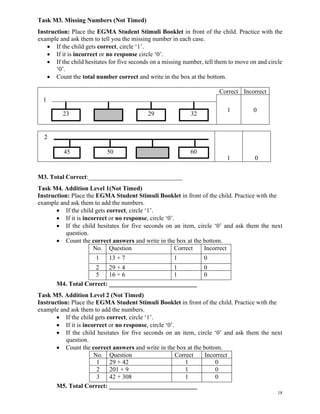
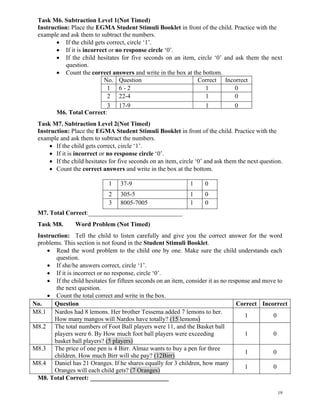
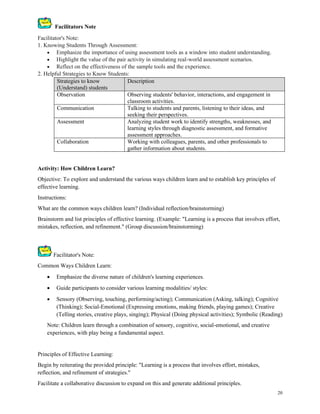
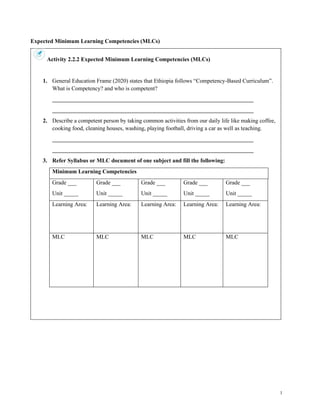
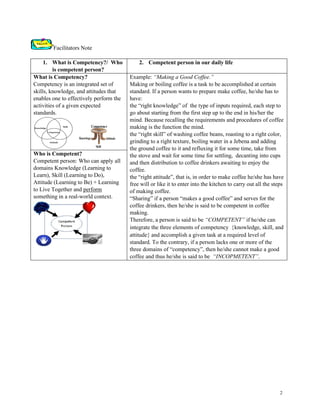
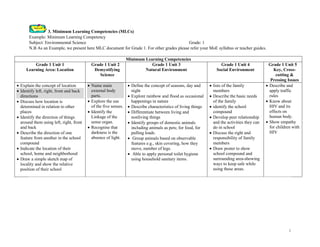
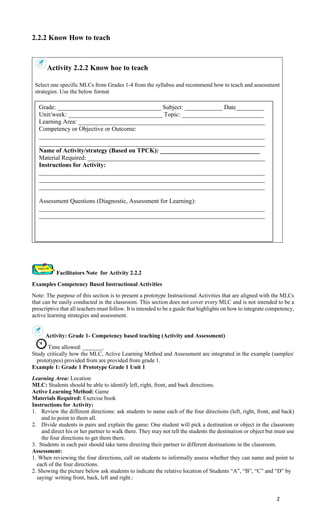
![3
Questions and Answers in Bracket
1.Where is the relative location of “Student C” from “Student D”? [on the right-hand side]
2.Where is the location of “Student B” from “Student A”? [on the left-hand side]
3.Where is the location of “Student A” from “Student C”? [on the back direction]
4.Where is the location of “Student C” from “Student A”? [on the front direction]
Example 2: Grade 1 Prototype/ Sample
Grade 1 Unit 2
Learning Area: Demystifying Science
MLC: Students should be able to name external body parts.
Active Learning Method: Self and Drawing.
Materials Required: Poster (If available), or draw in blackboard (Blackboard and Chalk)
Instructions for Activity:
1. First, review the different body parts by calling on students and having each one name and point
to a different part of his or her own body.
2. Draw body parts or use a large poster (big enough for those in the back to see) and point to
different body parts.
3. Call on students to identify the parts as you point to them.
Assessment:
• Call on students to name and point to different body parts as informal assessment.
• Write the names of the external body parts above the neck and below the neck.
Activity ___________
Select MLCs from grade 1-4 mathematics and English and develop your own lesson, using the
template given below
Grade: _______ Unit: ___________
Learning Area: _____________________________________________________________
MLC: _____________________________________________________________________
Active Learning Method: _____________________________________________________
Material Required: __________________________________________________________
Instructions for Activity:
________________________________________________________________________
________________________________________________________________________
Assessment:
________________________________________________________________________
________________________________________________________________________](https://image.slidesharecdn.com/d2peteachertrainingmaterials4-250603115314-74f97172/85/D2-PE-Teacher-Training-Materials-4-pdf-pages-29-320.jpg)