• Diabetes
•Diabetes
•A disease in which the body’s ability to produce or
respond to the hormone insulin is impaired, resulting in
abnormal metabolism of carbohydrates and elevated
levels of glucose in the blood
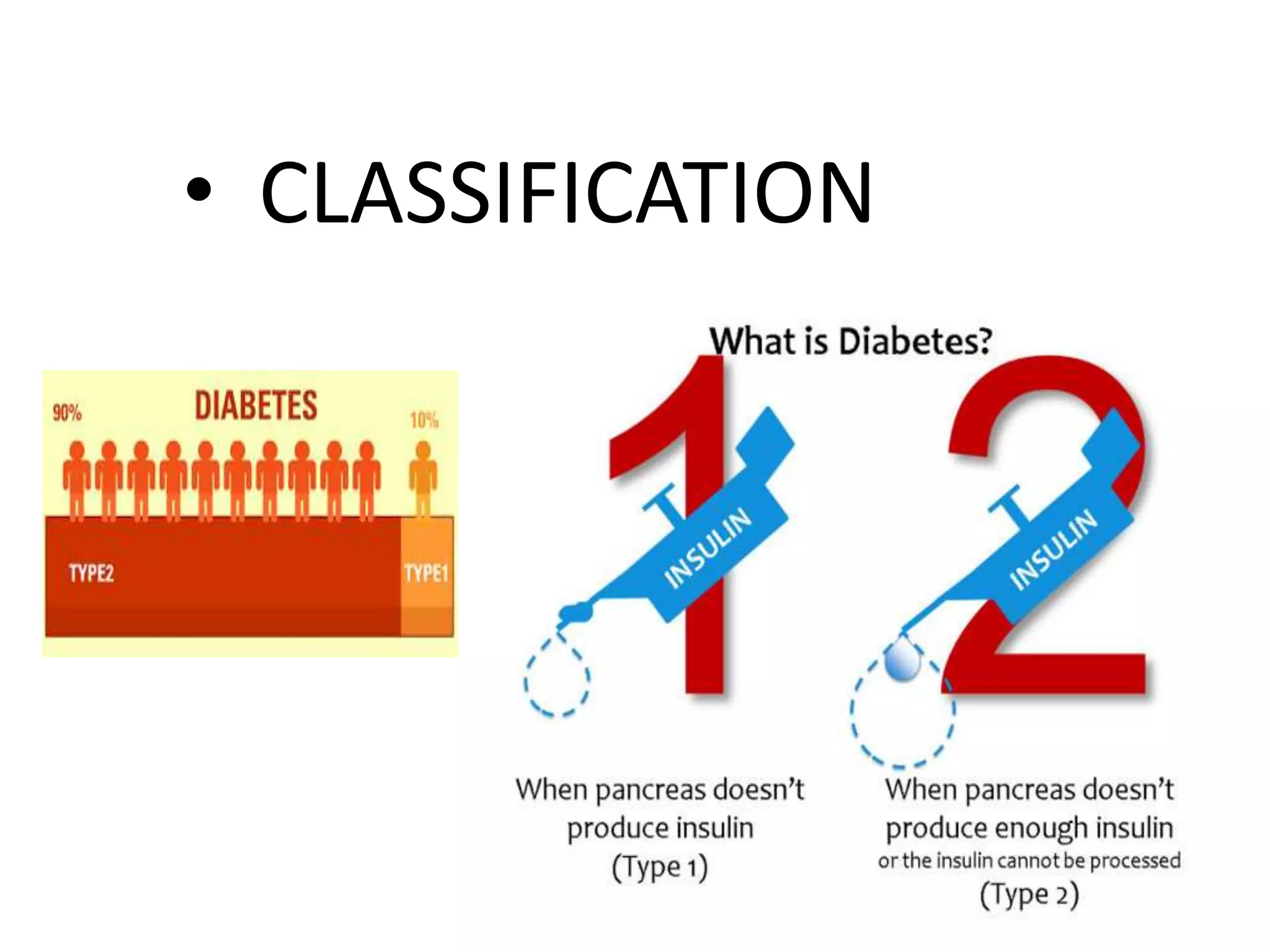
• CLASSIFICATION
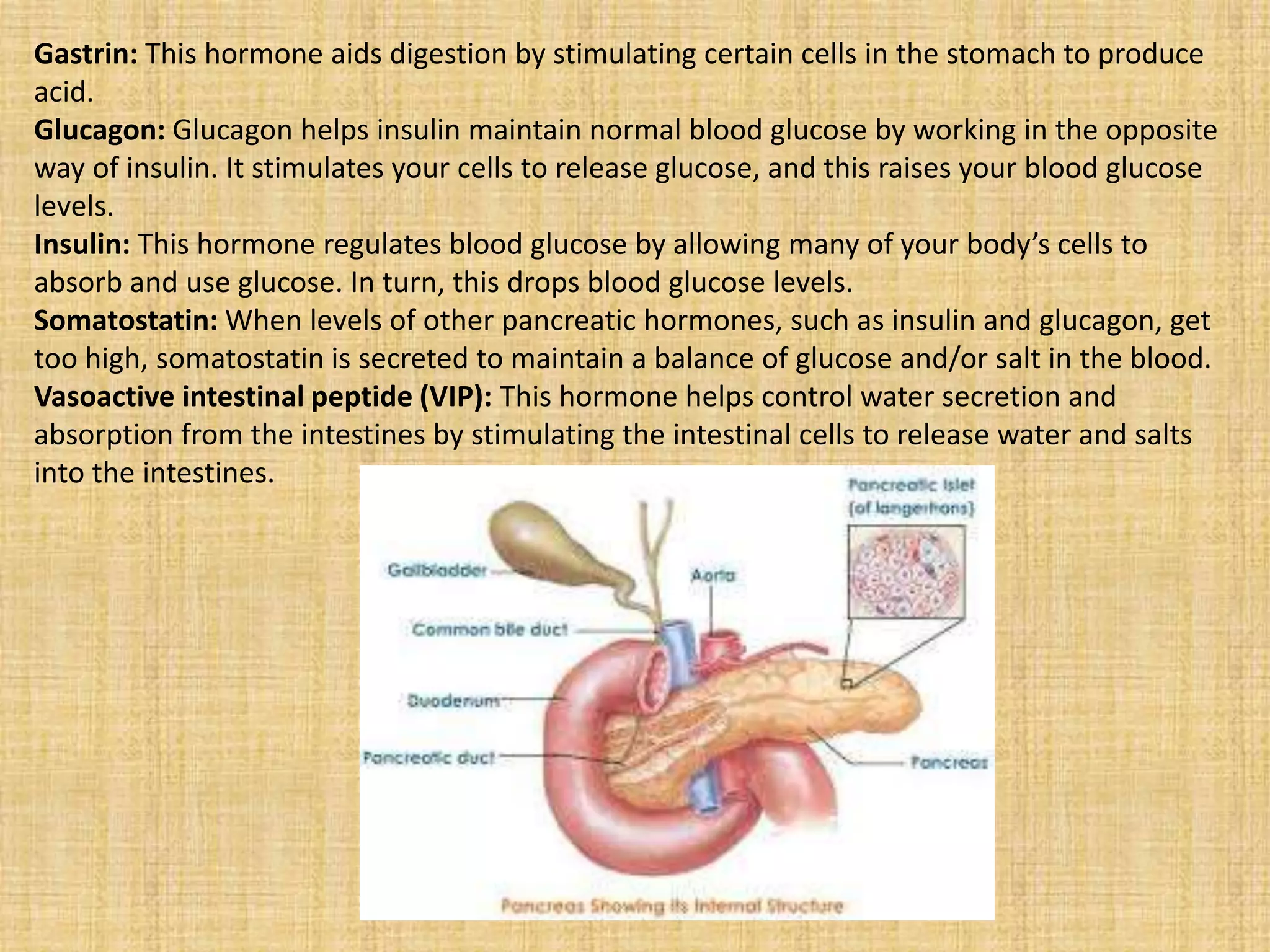
Gastrin: This hormone aids digestion by stimulating certain cells in the stomach to produce
acid.
Glucagon: Glucagon helps insulin maintain normal blood glucose by working in the opposite
way of insulin. It stimulates your cells to release glucose, and this raises your blood glucose
levels.
Insulin: This hormone regulates blood glucose by allowing many of your body’s cells to
absorb and use glucose. In turn, this drops blood glucose levels.
Somatostatin: When levels of other pancreatic hormones, such as insulin and glucagon, get
too high, somatostatin is secreted to maintain a balance of glucose and/or salt in the blood.
Vasoactive intestinal peptide (VIP): This hormone helps control water secretion and
absorption from the intestines by stimulating the intestinal cells to release water and salts
into the intestines.
•Symptoms Of Diabetes
• Diseases and Disorders of the Pancreas
.
• Type 1 diabetes: If you have type 1 diabetes, then your body doesn’t produce any
insulin to handle the glucose in your body. Insulin deficiency causes a range
of complications, so people with type 1 diabetes have to take insulin to help their body
use glucose appropriately.
.
• Type 2 diabetes: Type 2 diabetes is much more prevalent than type 1. People with
type 2 diabetes may be able to produce insulin, but their bodies don’t use it correctly.
They might also be unable to produce enough insulin to handle the glucose in their
body. Lifestyle choices, such as diet and exercise, play a major role in managing and
preventing type 2 diabetes.
Hyperglycemia: This condition is caused by abnormally high blood glucose levels. It can
be caused by overproduction of the hormone glucagon. To learn more, read our article
about hyperglycemia.
Hypoglycemia: Conversely, hypoglycemia is caused by low blood glucose levels. It is
caused by a relative overproduction of insulin. To learn more, read our article
about hypoglycemia.
•Typically appears in adolescence.
•Symptoms include increased thirst, frequent urination, hunger, fatigue
and blurred vision.
•Treatment aims at maintaining normal blood sugar levels through
regular monitoring, insulin therapy, diet and exercise.
Common:-
More than 1 million cases per year (India)
•TYPE-1 DIABETES
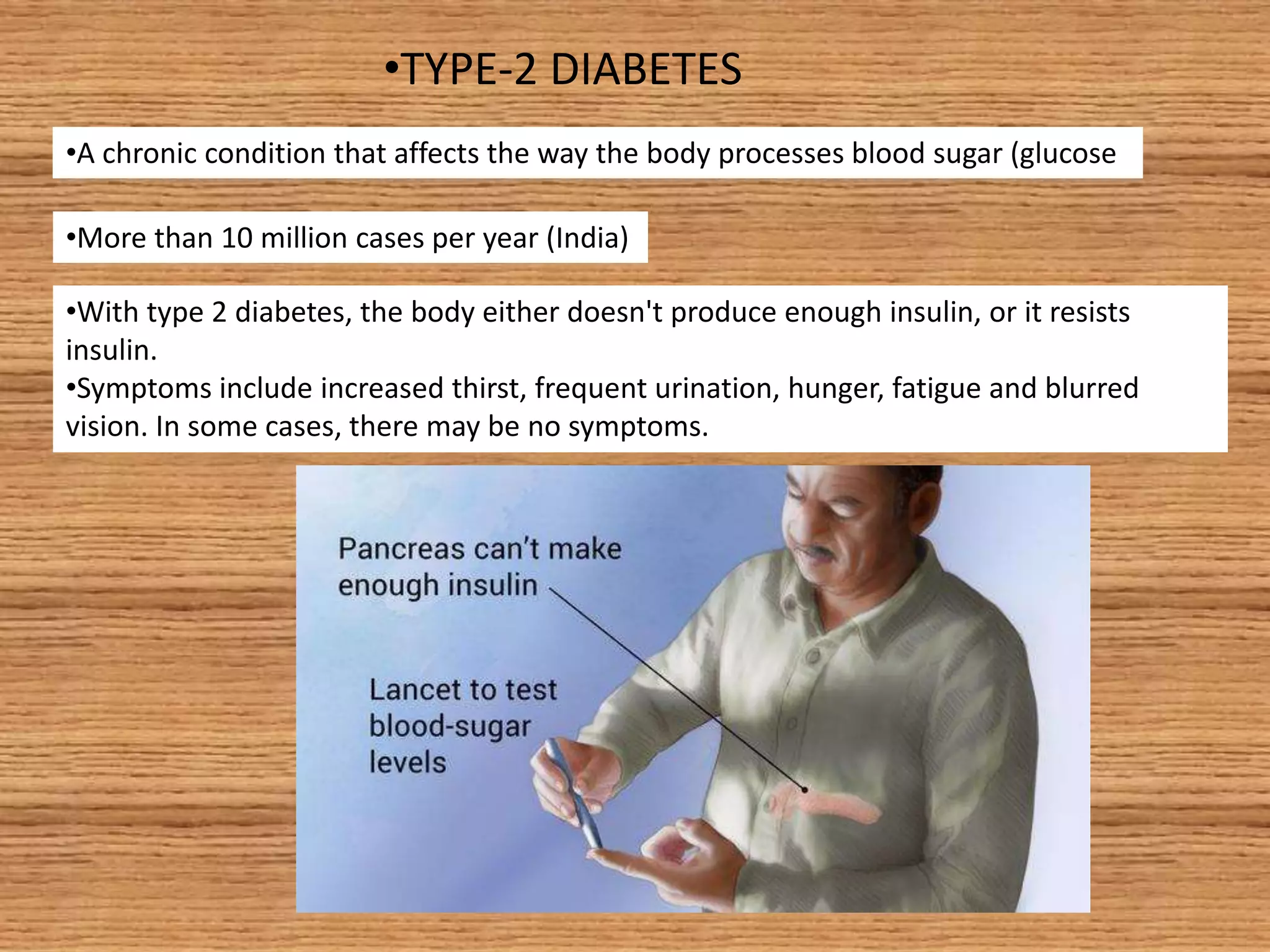
•TYPE-2 DIABETES
•A chronic condition that affects the way the body processes blood sugar (glucose
•More than 10 million cases per year (India)
•With type 2 diabetes, the body either doesn't produce enough insulin, or it resists
insulin.
•Symptoms include increased thirst, frequent urination, hunger, fatigue and blurred
vision. In some cases, there may be no symptoms.
TYPE 2 DIABETES :- DIET CHART
•Foods to eat for a type 1 diabetic diet
include complex carbohydrates such as
brown rice,
•whole wheat,
•quinoa,
•oatmeal,
•fruits,
•vegetables,
•beans, and
•lentils.
•Random blood sugar test
A random blood sugar test involves drawing blood at any given time, no matter when
you last ate. If the result is equal to or higher than 200 milligrams per deciliter (mg/dL)
this could indicate diabetes. Results in the 140-199 mg/dL range can indicate
prediabetes.
•Fasting blood sugar test
Fasting blood sugar tests involve drawing blood after you have not eaten overnight,
usually for 8 to 12 hours. Results less than 100 mg/dL are normal. Results between
100 to 125 mg/dL are considered prediabetes. Results equal to or greater than 126
mg/dL after two tests are considered diagnostic for diabetes
•Blood tests for diabetes
•A1C test
The test is also known as the glycated hemoglobin test. It measures how much glucose has
attached itself to red blood cells in your body over the last two to three months.
A1C test measures your average blood sugar for about three months.
•less than 5.7 percent: normal reading
•between 5.7 and 6.4 percent: prediabetes
•equal to or greater than 6.5 percent: diabetes
.
•Urine testing for diabetes
Urine tests aren’t used to diagnose diabetes. Doctors often use them if they
think you may have type 1 diabetes. Laboratories can test urine for ketone
bodies. The body produces ketone bodies when fat tissue is used for energy
instead of blood sugar. If ketone bodies are present in moderate to large
amounts in the urine, this could indicate your body is not making enough
insulin.
•Oral glucose tolerance test
The oral glucose test (OGTT) is a test that takes place over the course of two hours.
A person’s blood sugar is tested initially and then given a sugary drink. After two
hours, blood sugar levels are tested again. The results are:
less than 140 mg/dL: normal
between 140 and 199 mg/dL: prediabetes
greater than 200 mg/dL: diabetes
•Agents used in diabetic therapy include the
following:
•Biguanides.
•Sulfonylureas.
•Meglitinide derivatives.
•Alpha-glucosidase inhibitors.
•Thiazolidinediones (TZDs)
•Glucagon like peptide–1 (GLP-1) agonists.
•Dipeptidyl peptidase IV (DPP-4) Inhibitors.
•Selective sodium-glucose transporter-2 (SGLT-
2) inhibitors.
Thank you…
Gestational diabetes tests
Gestational diabetes can occur when a woman is pregnant. Women are tested early in a
pregnancy if they have a family history of gestational diabetes or have had it before.
Women who don’t have these risk factors are tested in the second trimester instead.
Doctors may use two different test types to diagnose gestational diabetes. The first is an
initial glucose challenge test. This test involves drinking a glucose syrup solution. Blood
is drawn after an hour to measure blood sugar levels. A result of 140 mg/dL or less is
considered normal. A higher-than-usual reading indicates the need for further testing.
The follow-up glucose tolerance testing involves not eating anything overnight. An initial
blood sugar level is measured. The expectant mom will then drink a high-sugar solution.
The blood sugar is then checked hourly for three hours. If a woman has two or more
higher-than-usual readings, the results indicate gestational diabetes.
The second test involves doing a two hour glucose tolerance test, similar to the one
described above. One out-of-range value would be diagnostic for gestational diabetes
using this test

General Introduction Towards Diabetes

  • 1.
  • 2.
    •Diabetes •A disease inwhich the body’s ability to produce or respond to the hormone insulin is impaired, resulting in abnormal metabolism of carbohydrates and elevated levels of glucose in the blood
  • 3.
  • 4.
    Gastrin: This hormoneaids digestion by stimulating certain cells in the stomach to produce acid. Glucagon: Glucagon helps insulin maintain normal blood glucose by working in the opposite way of insulin. It stimulates your cells to release glucose, and this raises your blood glucose levels. Insulin: This hormone regulates blood glucose by allowing many of your body’s cells to absorb and use glucose. In turn, this drops blood glucose levels. Somatostatin: When levels of other pancreatic hormones, such as insulin and glucagon, get too high, somatostatin is secreted to maintain a balance of glucose and/or salt in the blood. Vasoactive intestinal peptide (VIP): This hormone helps control water secretion and absorption from the intestines by stimulating the intestinal cells to release water and salts into the intestines.
  • 6.
  • 7.
    • Diseases andDisorders of the Pancreas . • Type 1 diabetes: If you have type 1 diabetes, then your body doesn’t produce any insulin to handle the glucose in your body. Insulin deficiency causes a range of complications, so people with type 1 diabetes have to take insulin to help their body use glucose appropriately. . • Type 2 diabetes: Type 2 diabetes is much more prevalent than type 1. People with type 2 diabetes may be able to produce insulin, but their bodies don’t use it correctly. They might also be unable to produce enough insulin to handle the glucose in their body. Lifestyle choices, such as diet and exercise, play a major role in managing and preventing type 2 diabetes. Hyperglycemia: This condition is caused by abnormally high blood glucose levels. It can be caused by overproduction of the hormone glucagon. To learn more, read our article about hyperglycemia. Hypoglycemia: Conversely, hypoglycemia is caused by low blood glucose levels. It is caused by a relative overproduction of insulin. To learn more, read our article about hypoglycemia.
  • 8.
    •Typically appears inadolescence. •Symptoms include increased thirst, frequent urination, hunger, fatigue and blurred vision. •Treatment aims at maintaining normal blood sugar levels through regular monitoring, insulin therapy, diet and exercise. Common:- More than 1 million cases per year (India) •TYPE-1 DIABETES
  • 9.
    •TYPE-2 DIABETES •A chroniccondition that affects the way the body processes blood sugar (glucose •More than 10 million cases per year (India) •With type 2 diabetes, the body either doesn't produce enough insulin, or it resists insulin. •Symptoms include increased thirst, frequent urination, hunger, fatigue and blurred vision. In some cases, there may be no symptoms.
  • 10.
    TYPE 2 DIABETES:- DIET CHART •Foods to eat for a type 1 diabetic diet include complex carbohydrates such as brown rice, •whole wheat, •quinoa, •oatmeal, •fruits, •vegetables, •beans, and •lentils.
  • 11.
    •Random blood sugartest A random blood sugar test involves drawing blood at any given time, no matter when you last ate. If the result is equal to or higher than 200 milligrams per deciliter (mg/dL) this could indicate diabetes. Results in the 140-199 mg/dL range can indicate prediabetes. •Fasting blood sugar test Fasting blood sugar tests involve drawing blood after you have not eaten overnight, usually for 8 to 12 hours. Results less than 100 mg/dL are normal. Results between 100 to 125 mg/dL are considered prediabetes. Results equal to or greater than 126 mg/dL after two tests are considered diagnostic for diabetes •Blood tests for diabetes •A1C test The test is also known as the glycated hemoglobin test. It measures how much glucose has attached itself to red blood cells in your body over the last two to three months. A1C test measures your average blood sugar for about three months. •less than 5.7 percent: normal reading •between 5.7 and 6.4 percent: prediabetes •equal to or greater than 6.5 percent: diabetes .
  • 12.
    •Urine testing fordiabetes Urine tests aren’t used to diagnose diabetes. Doctors often use them if they think you may have type 1 diabetes. Laboratories can test urine for ketone bodies. The body produces ketone bodies when fat tissue is used for energy instead of blood sugar. If ketone bodies are present in moderate to large amounts in the urine, this could indicate your body is not making enough insulin. •Oral glucose tolerance test The oral glucose test (OGTT) is a test that takes place over the course of two hours. A person’s blood sugar is tested initially and then given a sugary drink. After two hours, blood sugar levels are tested again. The results are: less than 140 mg/dL: normal between 140 and 199 mg/dL: prediabetes greater than 200 mg/dL: diabetes
  • 13.
    •Agents used indiabetic therapy include the following: •Biguanides. •Sulfonylureas. •Meglitinide derivatives. •Alpha-glucosidase inhibitors. •Thiazolidinediones (TZDs) •Glucagon like peptide–1 (GLP-1) agonists. •Dipeptidyl peptidase IV (DPP-4) Inhibitors. •Selective sodium-glucose transporter-2 (SGLT- 2) inhibitors. Thank you…
  • 14.
    Gestational diabetes tests Gestationaldiabetes can occur when a woman is pregnant. Women are tested early in a pregnancy if they have a family history of gestational diabetes or have had it before. Women who don’t have these risk factors are tested in the second trimester instead. Doctors may use two different test types to diagnose gestational diabetes. The first is an initial glucose challenge test. This test involves drinking a glucose syrup solution. Blood is drawn after an hour to measure blood sugar levels. A result of 140 mg/dL or less is considered normal. A higher-than-usual reading indicates the need for further testing. The follow-up glucose tolerance testing involves not eating anything overnight. An initial blood sugar level is measured. The expectant mom will then drink a high-sugar solution. The blood sugar is then checked hourly for three hours. If a woman has two or more higher-than-usual readings, the results indicate gestational diabetes. The second test involves doing a two hour glucose tolerance test, similar to the one described above. One out-of-range value would be diagnostic for gestational diabetes using this test