Diabetes:Diabetes:
screening & diagnosisscreening & diagnosis
Mohsen Eledrisi, MD, FACE, FACP
Department of Medicine
Hamad Medical Corporation
Doha, Qatar
eledrisi@yahoo.com
What’s in aWhat’s in a
name?name?
What doesWhat does
““Diabetes Mellitus”Diabetes Mellitus”
mean?mean?
The name “The name “Diabetes”Diabetes”
“…thediseaseappearsto meto
havegot the namediabetes,
which signifiesasiphon,
becausethefluid doesnot remain
in thebody, but usestheman’s
body asa ladder…” Aretaeus
(130-200 BC)
The full nameThe full name
William Cullen
(1710-1790)
“ Urine with the smell, color, and flavor
of honey ”
•• He introduced the term mellitus (honey)
•• So he named it Diabetes Mellitus
• DiabetesDiabetes = to pass= to pass
• MellitusMellitus = honey= honey
““ Passing sweet water”Passing sweet water”
Consultation
• A 42-year-old healthy man is getting a “check up”
• He has no complaints. Not physically active
• Father had diabetes “ at an old age”
• Examination: unremarkable. Only BMI 29.2
• Fasting glucose 6.6 mmol (120 mg)
• Other tests are normal
• How would you approach?
Criteria for testing for diabetes inCriteria for testing for diabetes in
asymptomatic adultsasymptomatic adults
•Physical inactivity
•First-degree relative with
diabetes
•High-risk race/ethnicity (e.g.,
African American, Latino, Native
American, Asian American,
Pacific Islander)
•Hypertension (≥140/90 mmHg
or on therapy for hypertension)
•History of cardiovascular
disease
• HDL cholesterol level
< 0.90 mmol (35 mg) and/or a
triglyceride level > 2.82 mmol (250
mg)
• Women with polycystic ovary
syndrome (PCOS)
• Other clinical conditions
associated with insulin resistance
(e.g., severe obesity, acanthosis
nigricans)
1. Adults with BMI ≥ 25 (≥ 23 in Asian Americans) and have any of the
following additional risk factors:
American Diabetes Association. Diabetes Care 2019;42 (suppl 1):S13
2. Patients with prior GDMPatients with prior GDM
3. All persons starting at age 45 years
If results are normal, testing should be repeated at least at
3-year intervals, with consideration of more frequent
testing depending on initial results (e.g., those with
prediabetes should be tested yearly), and risk status
Criteria for testing for diabetes inCriteria for testing for diabetes in
asymptomatic adults (2)asymptomatic adults (2)
American Diabetes Association. Diabetes Care 2019;42 (suppl 1):S13
Fasting plasmaglucose
How to prepare?
- Fasting at least 8 hours
- Water isallowed
Screening for diabetes
Which units do you use?
1 mmol glucose= 18 mg
mmol = mg ÷18
mg = mmol × 18
Example: 10 mmol = 180 mg
mal:
< 5.6 mmol (100 mg)
betes:
≥ 7 mmol (126 mg)
aired fasting glucose (IFG) [Prediabetes]:
5.6 to 6.9 mmol (100-125 mg)
Fasting plasmaglucose
American Diabetes Association. Diabetes Care 2019;42 (suppl 1):S13
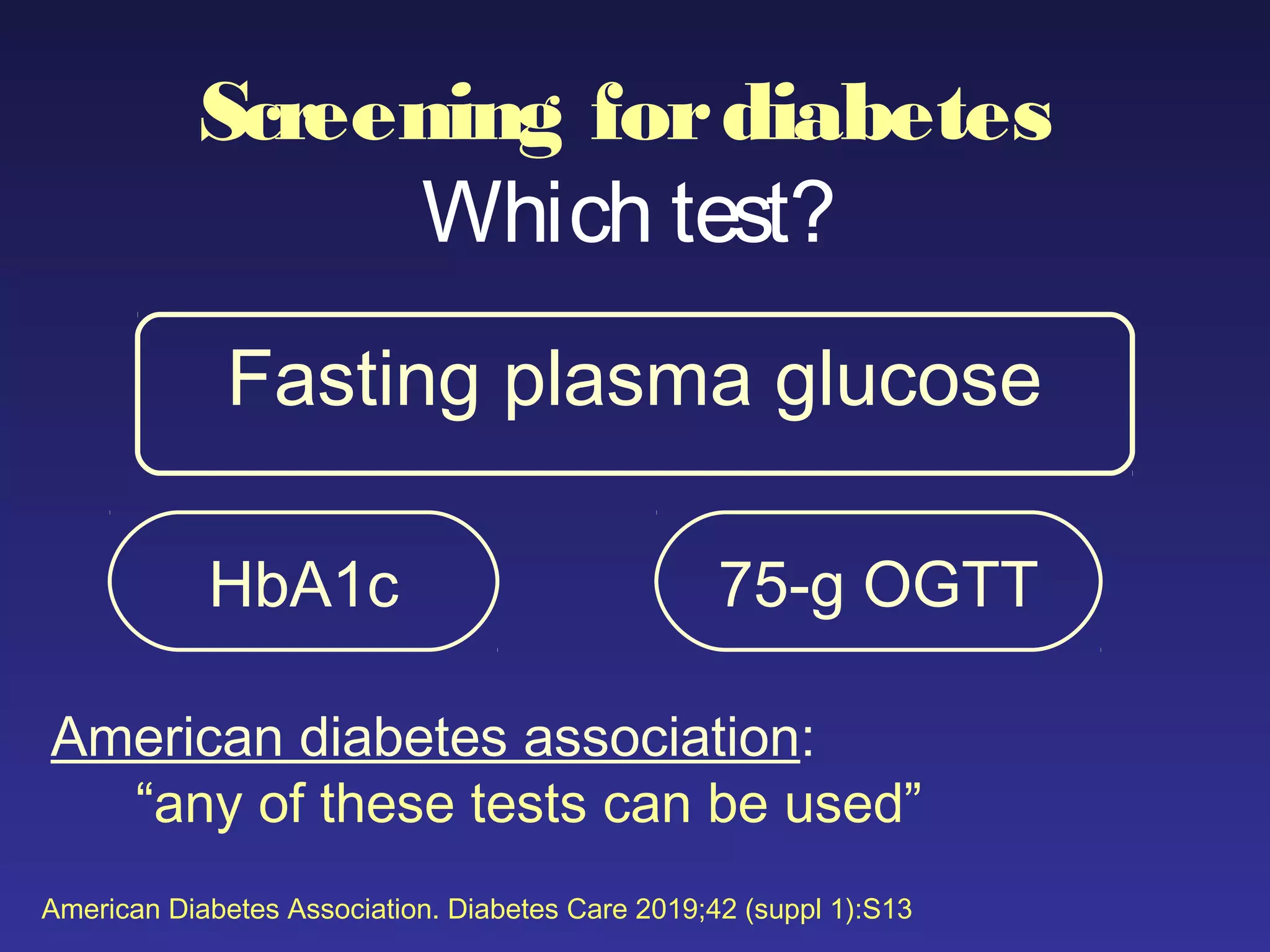
Screening fordiabetes
Which test?
Fasting plasma glucose
75-g OGTTHbA1c
American diabetes association:
“any of these tests can be used”
American Diabetes Association. Diabetes Care 2019;42 (suppl 1):S13
Precaution
Capillary glucose (glucometer) should not
be used for the diagnosis of diabetes
75-gram OGTT
Oral Glucose Tolerance Test
When to do 75-g OGTT?
• Pregnancy (screening for GDM)
• Screening for DM after GDM
•Screening for post-transplantation DM
• Diagnosis of cystic fibrosis-related DM
• To confirm the diagnosis of DM (an option)
• Screening for DM (an option)
American Diabetes Association. Diabetes Care 2019;42 (suppl 1):S13
Fasting and 2-hour glucose
How to do 75-gram OGTT
≥ 11.1 mmol
(200 mg)
< 7.8 mmol
(140 mg)
2-hourglucose
Normal Diabetes
7.8-11 mmol
(140-199 mg)
Impaired Glucose
Tolerance(IGT)
(Prediabetes)
American Diabetes Association. Diabetes Care 2019;42 (suppl 1):S13
75-gram OGTT
Use of A1c to diagnose DM
American Diabetes Association. Diabetes Care 2019;42 (suppl
1):S13
≥ 6.5 Diabetes
5.7- 6.4 Prediabetes
< 5.7 Normal
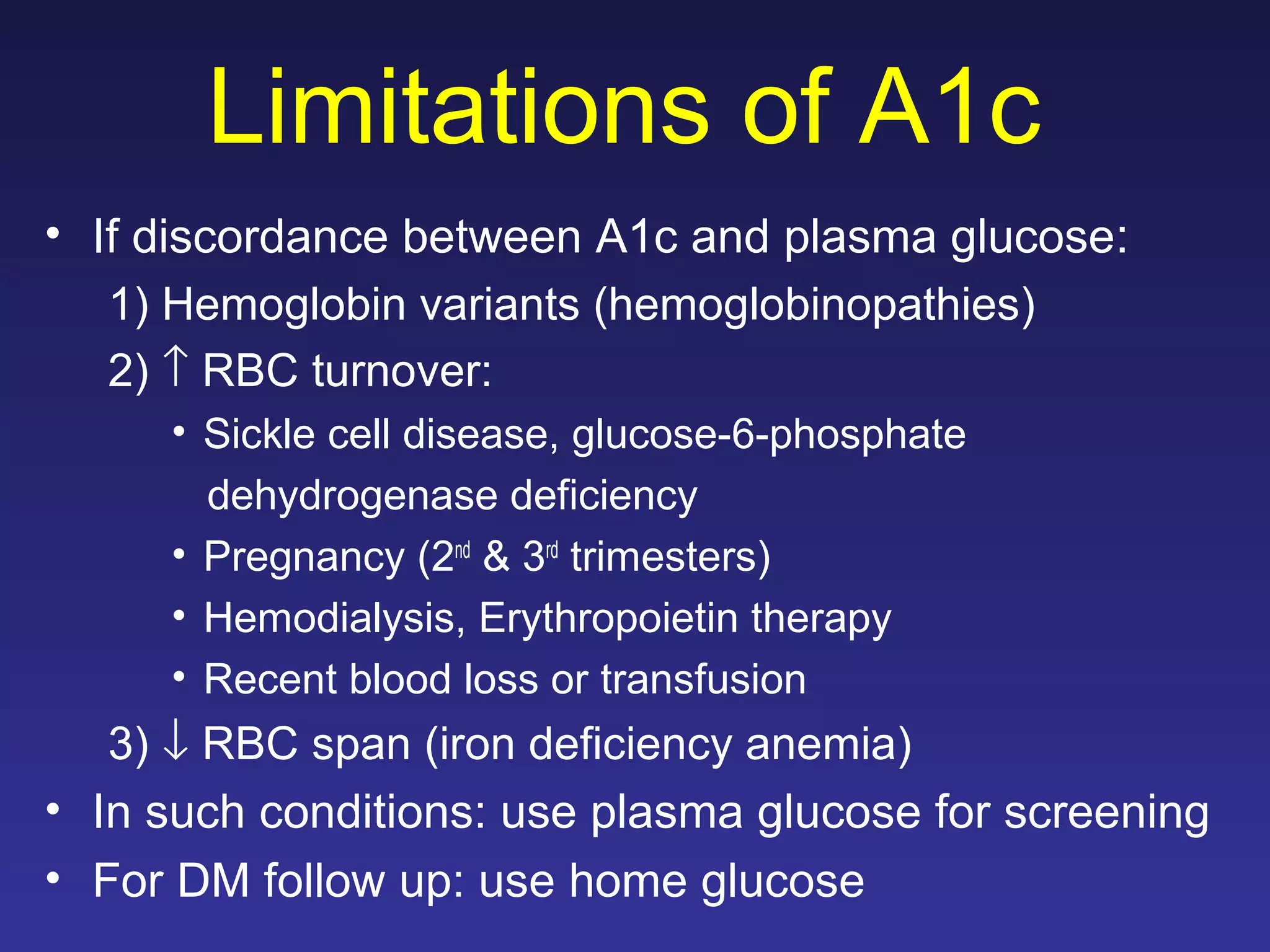
Limitations of A1c
• If discordance between A1c and plasma glucose:
1) Hemoglobin variants (hemoglobinopathies)
2) ↑ RBC turnover:
• Sickle cell disease, glucose-6-phosphate
dehydrogenase deficiency
• Pregnancy (2nd
& 3rd
trimesters)
• Hemodialysis, Erythropoietin therapy
• Recent blood loss or transfusion
3) ↓ RBC span (iron deficiency anemia)
• In such conditions: use plasma glucose for screening
• For DM follow up: use home glucose
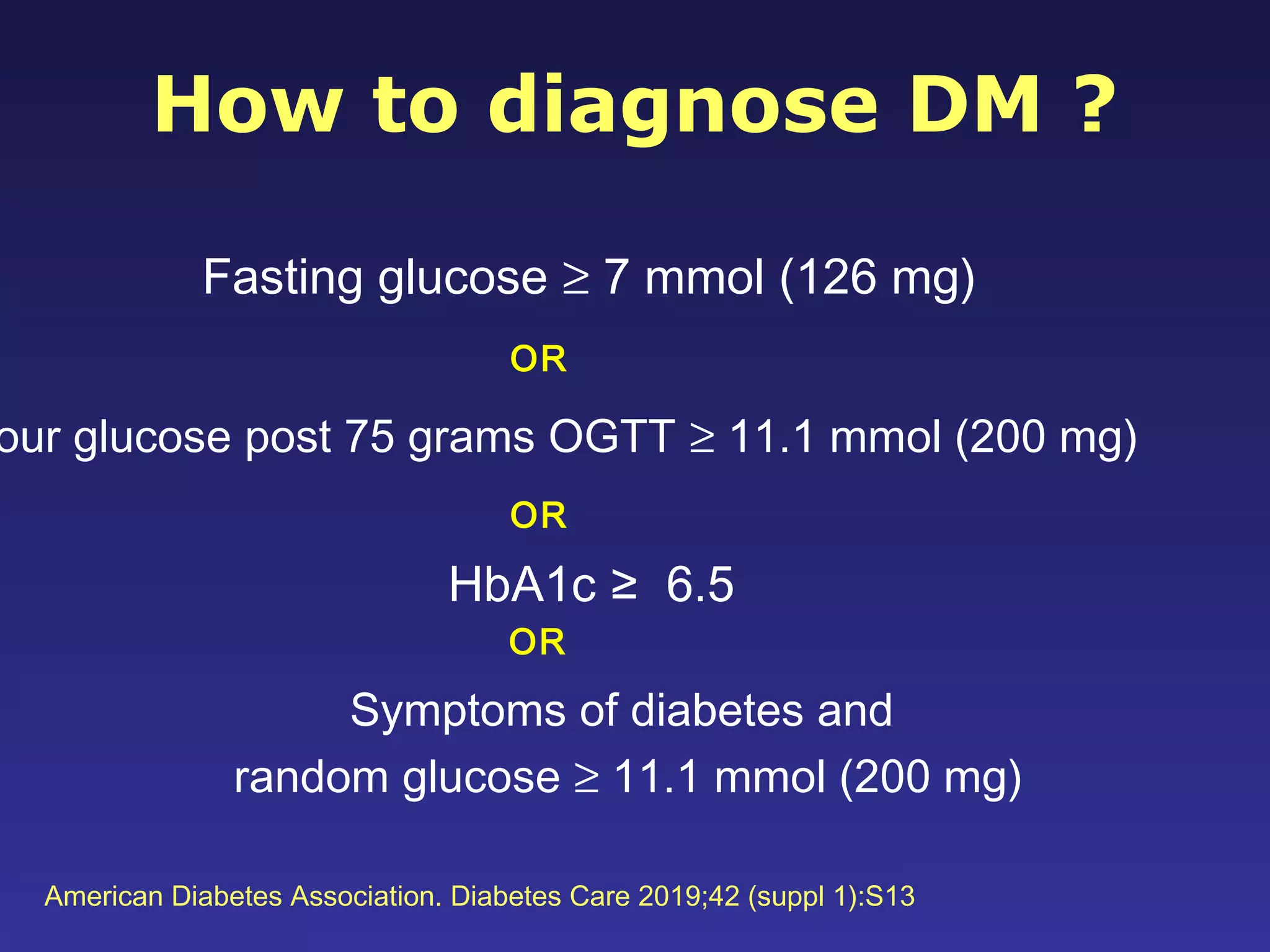
How to diagnose DM ?
Fasting glucose ≥ 7 mmol (126 mg)
OR
our glucose post 75 grams OGTT ≥ 11.1 mmol (200 mg)
OR
Symptoms of diabetes and
random glucose ≥ 11.1 mmol (200 mg)
American Diabetes Association. Diabetes Care 2019;42 (suppl 1):S13
HbA1c ≥ 6.5
OR
Confirming the diagnosis
of DM
American Diabetes Association. Diabetes Care 2019;42 (suppl 1):S13
If 1 test is abnormal:
- Repeat same test
- Or do a different test
If 2 tests are discordant
Example:
- A1c 6.3
- Fasting PG 135 mg (7.5 mmol)
- Repeat the test showing DM
(FPG in this example)
Back to our case
• Fasting glucose 6.5 mmol (120 mg)
• He has impaired fasting glucose (prediabetes )
• What are the consequences of this condition?
• What is your plan of care?
Why is prediabetes important?Why is prediabetes important?
• High risk of type 2 DM
• High risk of CVD
• High risk of hypertension
• High risk of dyslipidemia
• Number or persons with prediabetes > DM
How to
manage prediabetes?
Group on lifestyle changes:
Weight loss of 7 %
Structured exercise program
[moderate intensity]
(150 min./week)
Diabetes prevention program
Risk of DM ↓ by 58 %
• Group on Metformin
Diabetes Prevention Program Research Group.
N Engl J Med 2002; 346:393.
Risk of DM ↓ by 31 %
Persons with prediabetes (mainly IGT)
Effect of lifestyle changes on
diabetes prevention
↓ Risk of DM by 27 %
↓ Risk of DM by 45 %
Nathan D, et al. Lancet Diabetes Endocrinol 2015;3:866
Li G, et al. Lancet Diabetes Endocrinol 2014;2:474; Lindstorm J, et al. Lancet 2006;368:1673
Risk of DM ↓ by 43 %
DPPOS (USA)
Da Qing (China)
DPS (Finland)
F/U Effect
15 y
23 y
7 y
Study
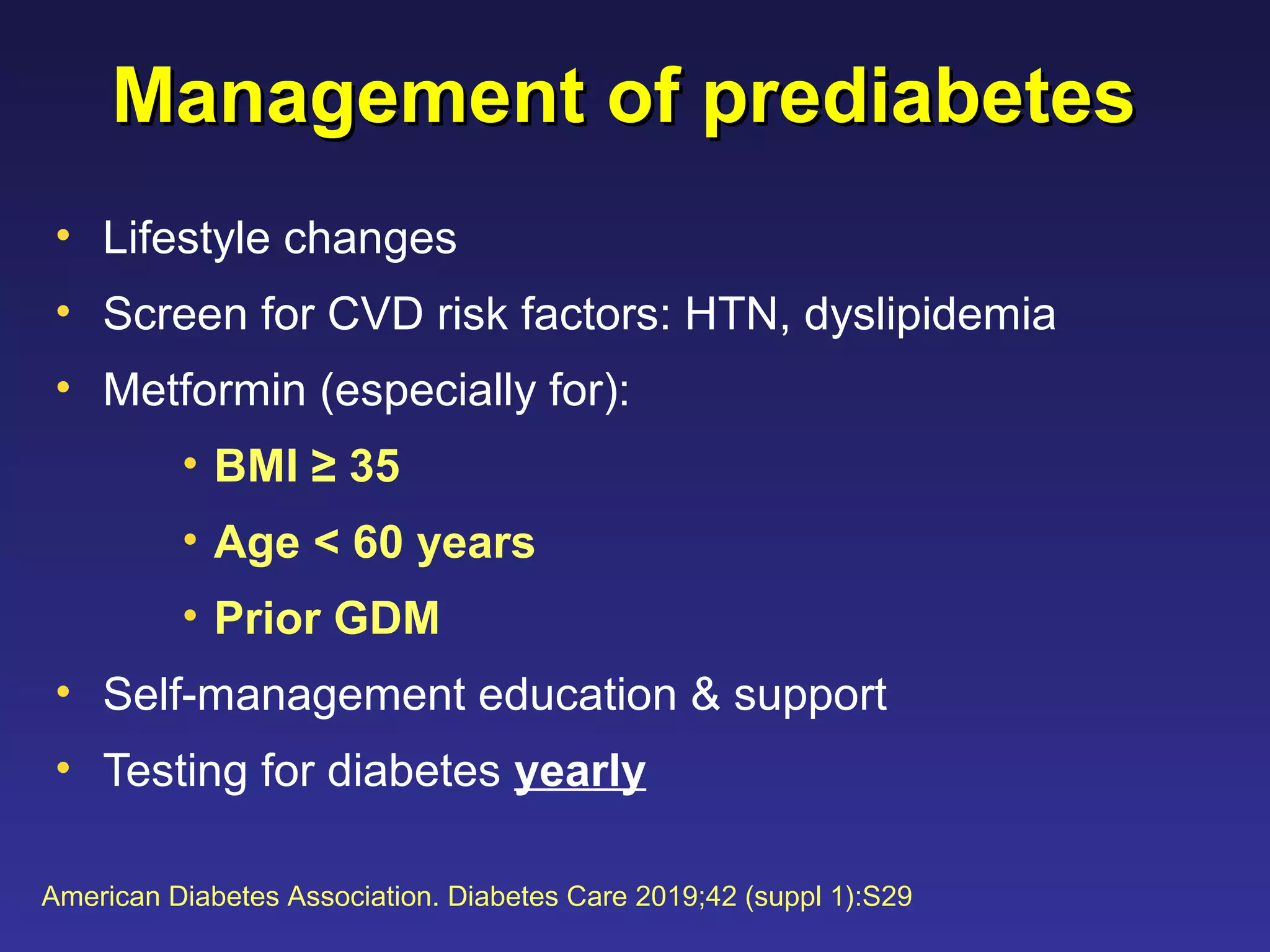
Management of prediabetesManagement of prediabetes
• Lifestyle changes
• Screen for CVD risk factors: HTN, dyslipidemia
• Metformin (especially for):
• BMI ≥ 35
• Age < 60 years
• Prior GDM
• Self-management education & support
• Testing for diabetes yearly
American Diabetes Association. Diabetes Care 2019;42 (suppl 1):S29
Classification of diabetes
1) Type 1 diabetes
2) Type 2 diabetes
3) Gestational diabetes
4) Specific types of diabetes due to other causes:
(e.g. maturity-onset diabetes of the young, cystic
fibrosis), glucocorticoids, after organ
transplantation
American Diabetes Association. Diabetes Care 2019;42 (suppl 1):S29
glucose
uptake
hepatic
glucose
production
Insulin
Glucagon
gut
carbohydrate
delivery &
absorption
incretin
effect
Pathophysiology of type 2 DM
+
renal
glucose
reabsorption Lipolysis
Neurotransmitter
dysfunction
Hyperglycemia
Ramlo-Halsted BA, Edelman SV. Prim Care 1999;26:771
Natural history of type 2 DM
Macrovascular complications
Microvascular complications
Insulin resistanceInsulin resistance
Insulin secretionInsulin secretion
Postprandial glucose
Fasting glucoseFasting glucose
Prediabetes
Undiagnosed
diabetes
Diabetes
5-65-65-105-10 YearsYears
Diabetes: why care?
American Diabetes Association. Diabetes Care 2019;42 (suppl 1):S29
Peters S, et al. Lancet 2014;383:197; Center for disease control www.cdc.gov
∀ ↑ Risk of cardiovascular disease (CAD, stroke, PAD)
• # 1 cause of chronic kidney disease and dialysis
• # 1 cause of non-traumatic limb amputations
• # 1 cause of blindness in adults
• Major cause of disability and work absenteeism
• It confers an equivalent risk to ageing 15 years
• A huge economic impact (complications, meds, labs,.)
Complications of diabetes
Macrovascular
“Macro” = large
Disease of the large vessels
Microvascular
“Micro” = small
Disease of the small vessels
Complications of diabetes
Heart disease
Stroke
Peripheral
arterial disease
Eye disease
Kidney disease
Nerve disease

Diabetes: screening & diagnosis

  • 1.
    Diabetes:Diabetes: screening & diagnosisscreening& diagnosis Mohsen Eledrisi, MD, FACE, FACP Department of Medicine Hamad Medical Corporation Doha, Qatar eledrisi@yahoo.com
  • 2.
    What’s in aWhat’sin a name?name? What doesWhat does ““Diabetes Mellitus”Diabetes Mellitus” mean?mean?
  • 3.
    The name “Thename “Diabetes”Diabetes” “…thediseaseappearsto meto havegot the namediabetes, which signifiesasiphon, becausethefluid doesnot remain in thebody, but usestheman’s body asa ladder…” Aretaeus (130-200 BC)
  • 4.
    The full nameThefull name William Cullen (1710-1790) “ Urine with the smell, color, and flavor of honey ” •• He introduced the term mellitus (honey) •• So he named it Diabetes Mellitus
  • 5.
    • DiabetesDiabetes =to pass= to pass • MellitusMellitus = honey= honey ““ Passing sweet water”Passing sweet water”
  • 6.
    Consultation • A 42-year-oldhealthy man is getting a “check up” • He has no complaints. Not physically active • Father had diabetes “ at an old age” • Examination: unremarkable. Only BMI 29.2 • Fasting glucose 6.6 mmol (120 mg) • Other tests are normal • How would you approach?
  • 7.
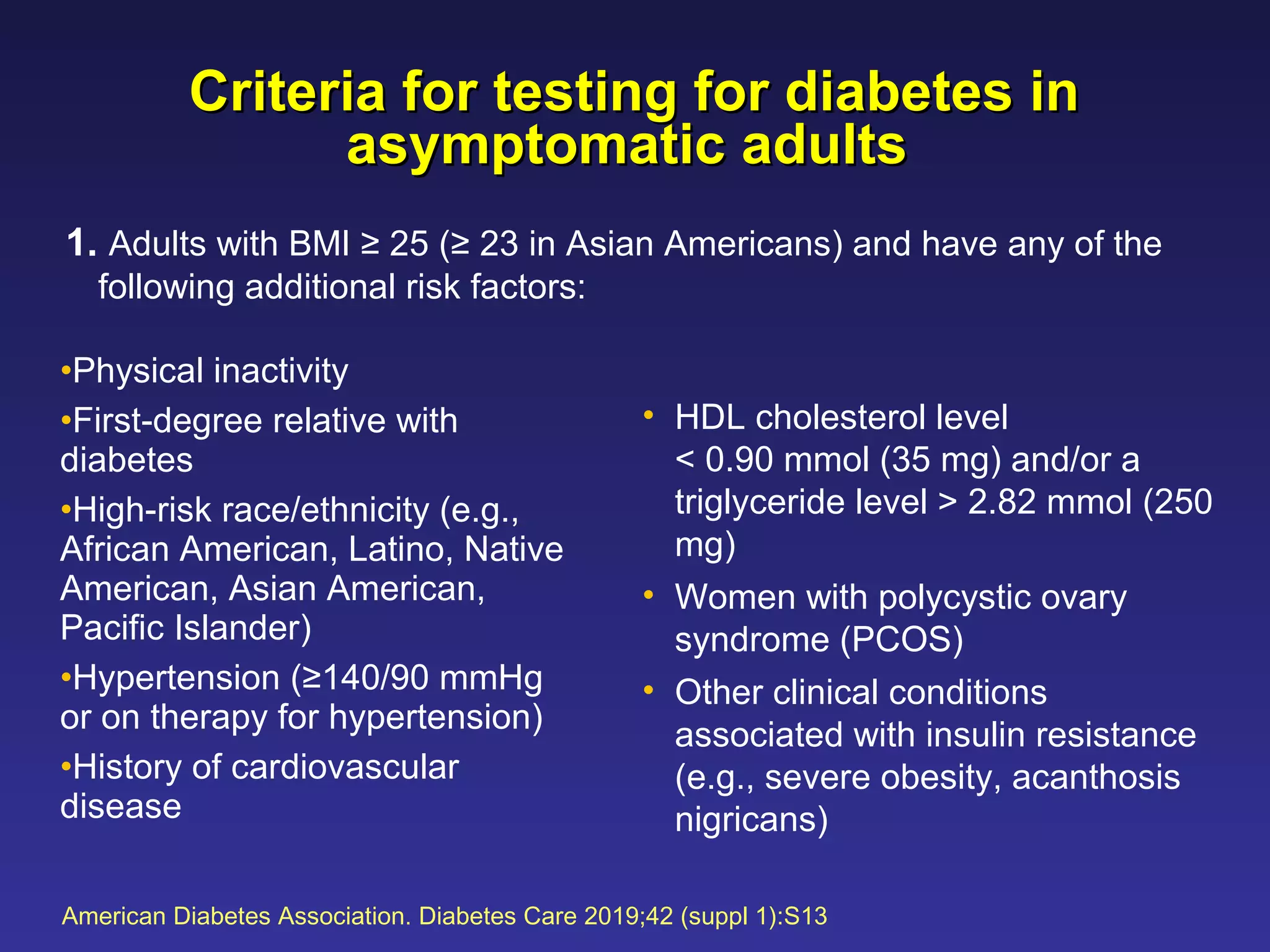
    Criteria for testingfor diabetes inCriteria for testing for diabetes in asymptomatic adultsasymptomatic adults •Physical inactivity •First-degree relative with diabetes •High-risk race/ethnicity (e.g., African American, Latino, Native American, Asian American, Pacific Islander) •Hypertension (≥140/90 mmHg or on therapy for hypertension) •History of cardiovascular disease • HDL cholesterol level < 0.90 mmol (35 mg) and/or a triglyceride level > 2.82 mmol (250 mg) • Women with polycystic ovary syndrome (PCOS) • Other clinical conditions associated with insulin resistance (e.g., severe obesity, acanthosis nigricans) 1. Adults with BMI ≥ 25 (≥ 23 in Asian Americans) and have any of the following additional risk factors: American Diabetes Association. Diabetes Care 2019;42 (suppl 1):S13
  • 8.
    2. Patients withprior GDMPatients with prior GDM 3. All persons starting at age 45 years If results are normal, testing should be repeated at least at 3-year intervals, with consideration of more frequent testing depending on initial results (e.g., those with prediabetes should be tested yearly), and risk status Criteria for testing for diabetes inCriteria for testing for diabetes in asymptomatic adults (2)asymptomatic adults (2) American Diabetes Association. Diabetes Care 2019;42 (suppl 1):S13
  • 9.
    Fasting plasmaglucose How toprepare? - Fasting at least 8 hours - Water isallowed Screening for diabetes
  • 10.
    Which units doyou use? 1 mmol glucose= 18 mg mmol = mg ÷18 mg = mmol × 18 Example: 10 mmol = 180 mg
  • 11.
    mal: < 5.6 mmol(100 mg) betes: ≥ 7 mmol (126 mg) aired fasting glucose (IFG) [Prediabetes]: 5.6 to 6.9 mmol (100-125 mg) Fasting plasmaglucose American Diabetes Association. Diabetes Care 2019;42 (suppl 1):S13
  • 12.
    Screening fordiabetes Which test? Fastingplasma glucose 75-g OGTTHbA1c American diabetes association: “any of these tests can be used” American Diabetes Association. Diabetes Care 2019;42 (suppl 1):S13
  • 13.
    Precaution Capillary glucose (glucometer)should not be used for the diagnosis of diabetes
  • 14.
  • 15.
    When to do75-g OGTT? • Pregnancy (screening for GDM) • Screening for DM after GDM •Screening for post-transplantation DM • Diagnosis of cystic fibrosis-related DM • To confirm the diagnosis of DM (an option) • Screening for DM (an option) American Diabetes Association. Diabetes Care 2019;42 (suppl 1):S13
  • 16.
    Fasting and 2-hourglucose How to do 75-gram OGTT
  • 17.
    ≥ 11.1 mmol (200mg) < 7.8 mmol (140 mg) 2-hourglucose Normal Diabetes 7.8-11 mmol (140-199 mg) Impaired Glucose Tolerance(IGT) (Prediabetes) American Diabetes Association. Diabetes Care 2019;42 (suppl 1):S13 75-gram OGTT
  • 18.
    Use of A1cto diagnose DM American Diabetes Association. Diabetes Care 2019;42 (suppl 1):S13 ≥ 6.5 Diabetes 5.7- 6.4 Prediabetes < 5.7 Normal
  • 19.
    Limitations of A1c •If discordance between A1c and plasma glucose: 1) Hemoglobin variants (hemoglobinopathies) 2) ↑ RBC turnover: • Sickle cell disease, glucose-6-phosphate dehydrogenase deficiency • Pregnancy (2nd & 3rd trimesters) • Hemodialysis, Erythropoietin therapy • Recent blood loss or transfusion 3) ↓ RBC span (iron deficiency anemia) • In such conditions: use plasma glucose for screening • For DM follow up: use home glucose
  • 20.
    How to diagnoseDM ? Fasting glucose ≥ 7 mmol (126 mg) OR our glucose post 75 grams OGTT ≥ 11.1 mmol (200 mg) OR Symptoms of diabetes and random glucose ≥ 11.1 mmol (200 mg) American Diabetes Association. Diabetes Care 2019;42 (suppl 1):S13 HbA1c ≥ 6.5 OR
  • 21.
    Confirming the diagnosis ofDM American Diabetes Association. Diabetes Care 2019;42 (suppl 1):S13 If 1 test is abnormal: - Repeat same test - Or do a different test If 2 tests are discordant Example: - A1c 6.3 - Fasting PG 135 mg (7.5 mmol) - Repeat the test showing DM (FPG in this example)
  • 22.
    Back to ourcase • Fasting glucose 6.5 mmol (120 mg) • He has impaired fasting glucose (prediabetes ) • What are the consequences of this condition? • What is your plan of care?
  • 23.
    Why is prediabetesimportant?Why is prediabetes important? • High risk of type 2 DM • High risk of CVD • High risk of hypertension • High risk of dyslipidemia • Number or persons with prediabetes > DM
  • 24.
  • 25.
    Group on lifestylechanges: Weight loss of 7 % Structured exercise program [moderate intensity] (150 min./week) Diabetes prevention program Risk of DM ↓ by 58 % • Group on Metformin Diabetes Prevention Program Research Group. N Engl J Med 2002; 346:393. Risk of DM ↓ by 31 % Persons with prediabetes (mainly IGT)
  • 26.
    Effect of lifestylechanges on diabetes prevention ↓ Risk of DM by 27 % ↓ Risk of DM by 45 % Nathan D, et al. Lancet Diabetes Endocrinol 2015;3:866 Li G, et al. Lancet Diabetes Endocrinol 2014;2:474; Lindstorm J, et al. Lancet 2006;368:1673 Risk of DM ↓ by 43 % DPPOS (USA) Da Qing (China) DPS (Finland) F/U Effect 15 y 23 y 7 y Study
  • 27.
    Management of prediabetesManagementof prediabetes • Lifestyle changes • Screen for CVD risk factors: HTN, dyslipidemia • Metformin (especially for): • BMI ≥ 35 • Age < 60 years • Prior GDM • Self-management education & support • Testing for diabetes yearly American Diabetes Association. Diabetes Care 2019;42 (suppl 1):S29
  • 28.
    Classification of diabetes 1)Type 1 diabetes 2) Type 2 diabetes 3) Gestational diabetes 4) Specific types of diabetes due to other causes: (e.g. maturity-onset diabetes of the young, cystic fibrosis), glucocorticoids, after organ transplantation American Diabetes Association. Diabetes Care 2019;42 (suppl 1):S29
  • 29.
    glucose uptake hepatic glucose production Insulin Glucagon gut carbohydrate delivery & absorption incretin effect Pathophysiology oftype 2 DM + renal glucose reabsorption Lipolysis Neurotransmitter dysfunction Hyperglycemia
  • 30.
    Ramlo-Halsted BA, EdelmanSV. Prim Care 1999;26:771 Natural history of type 2 DM Macrovascular complications Microvascular complications Insulin resistanceInsulin resistance Insulin secretionInsulin secretion Postprandial glucose Fasting glucoseFasting glucose Prediabetes Undiagnosed diabetes Diabetes 5-65-65-105-10 YearsYears
  • 31.
    Diabetes: why care? AmericanDiabetes Association. Diabetes Care 2019;42 (suppl 1):S29 Peters S, et al. Lancet 2014;383:197; Center for disease control www.cdc.gov ∀ ↑ Risk of cardiovascular disease (CAD, stroke, PAD) • # 1 cause of chronic kidney disease and dialysis • # 1 cause of non-traumatic limb amputations • # 1 cause of blindness in adults • Major cause of disability and work absenteeism • It confers an equivalent risk to ageing 15 years • A huge economic impact (complications, meds, labs,.)
  • 32.
    Complications of diabetes Macrovascular “Macro”= large Disease of the large vessels Microvascular “Micro” = small Disease of the small vessels
  • 33.
    Complications of diabetes Heartdisease Stroke Peripheral arterial disease Eye disease Kidney disease Nerve disease