
Gene Therapy
Marta Talise
Graduate Diploma Clinical Research
Introduction
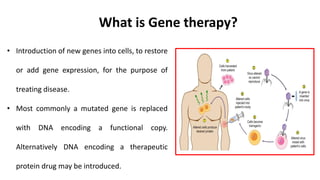
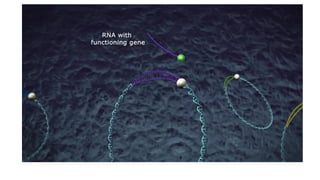
• Introduction of new genes into cells, to restore
or add gene expression, for the purpose of
treating disease.
• Most commonly a mutated gene is replaced
with DNA encoding a functional copy.
Alternatively DNA encoding a therapeutic
protein drug may be introduced.
What is Gene therapy?
Researchers are testing several approaches to Gene therapy:
• Replacing a mutated gene that causes disease with a healthy copy of the gene.
• Inactivating, or “knocking out,” a mutated gene that is functioning improperly.
• Introducing a new gene into the body to help fight a disease.
What is Gene therapy?
• Therapeutic genes transferred into the
somatic cells.
• Eg. Introduction of genes into bone
marrow cells, blood cells, skin cells etc.
• Will not be inherited later generations.
• At present all researches directed to
correct genetic defects in somatic cells.
• Therapeutic genes transferred into the
germ cells.
• Eg. Genes introduced into eggs and
sperms.
• It is heritable and passed on to later
generations.
• For safety, ethical and technical reasons, it
is not being attempted at present.
Somatic Cells gene therapy
Types of Gene therapy based on cells type
Germ Cells gene therapy
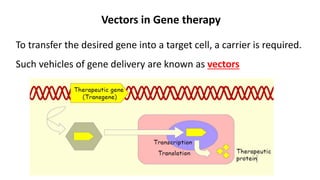
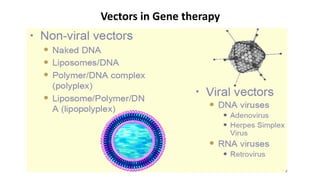
Vectors in Gene therapy
To transfer the desired gene into a target cell, a carrier is required.
Such vehicles of gene delivery are known as vectors
Vectors in Gene therapy
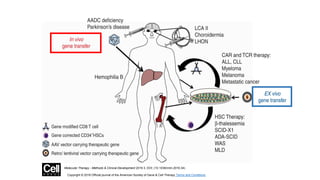
Figure 2
Molecular Therapy - Methods & Clinical Development 2016 3, DOI: (10.1038/mtm.2016.34)
Copyright © 2016 Official journal of the American Society of Gene & Cell Therapy Terms and Conditions
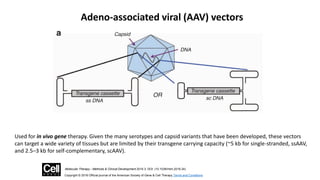
Used for in vivo gene therapy. Given the many serotypes and capsid variants that have been developed, these vectors
can target a wide variety of tissues but are limited by their transgene carrying capacity (~5 kb for single-stranded, ssAAV,
and 2.5–3 kb for self-complementary, scAAV).
Adeno-associated viral (AAV) vectors
Figure 2
Molecular Therapy - Methods & Clinical Development 2016 3, DOI: (10.1038/mtm.2016.34)
Copyright © 2016 Official journal of the American Society of Gene & Cell Therapy Terms and Conditions
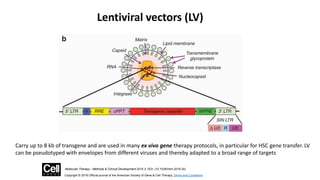
Lentiviral vectors (LV)
Carry up to 8 kb of transgene and are used in many ex vivo gene therapy protocols, in particular for HSC gene transfer. LV
can be pseudotyped with envelopes from different viruses and thereby adapted to a broad range of targets
Figure 1
Molecular Therapy - Methods & Clinical Development 2016 3, DOI: (10.1038/mtm.2016.34)
Copyright © 2016 Official journal of the American Society of Gene & Cell Therapy Terms and Conditions
Examples
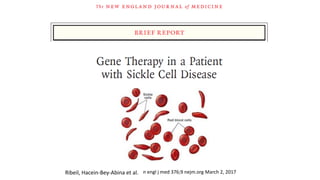
n engl j med 376;9 nejm.org March 2, 2017
Ribeil, Hacein-Bey-Abina et al.
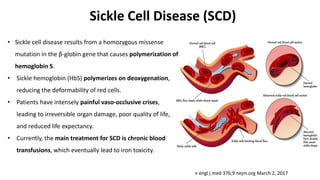
Sickle Cell Disease (SCD)
• Sickle cell disease results from a homozygous missense
mutation in the β-globin gene that causes polymerization of
hemoglobin S.
• Sickle hemoglobin (HbS) polymerizes on deoxygenation,
reducing the deformability of red cells.
• Patients have intensely painful vaso-occlusive crises,
leading to irreversible organ damage, poor quality of life,
and reduced life expectancy.
• Currently, the main treatment for SCD is chronic blood
transfusions, which eventually lead to iron toxicity.
n engl j med 376;9 nejm.org March 2, 2017
• A boy 13 years old with diagnosis of SCD at birth, followed at the Necker
Children’s Hospital Paris France.
• βS/βS genotype, a single 3.7-kb α-globin gene deletion
• October 2014- Received an infusion of the drug product LentiGlobin BB305.
n engl j med 376;9 nejm.org March 2, 2017
Gene therapy in a patient with Sickle cell disease
Results
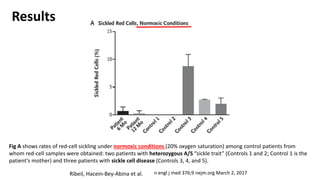
Fig A shows rates of red-cell sickling under normoxic conditions (20% oxygen saturation) among control patients from
whom red-cell samples were obtained: two patients with heterozygous A/S “sickle trait” (Controls 1 and 2; Control 1 is the
patient’s mother) and three patients with sickle cell disease (Controls 3, 4, and 5).
n engl j med 376;9 nejm.org March 2, 2017
Ribeil, Hacein-Bey-Abina et al.
Results
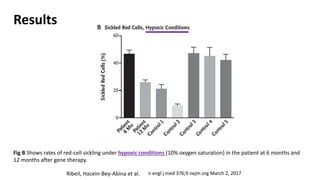
Fig B Shows rates of red-cell sickling under hypoxic conditions (10% oxygen saturation) in the patient at 6 months and
12 months after gene therapy.
n engl j med 376;9 nejm.org March 2, 2017
Ribeil, Hacein-Bey-Abina et al.
Conclusions
• Fifteen months after treatment, the level of therapeutic antisickling β-globin
remained high (approximately 50% of β-like–globin chains) without recurrence
of sickle crises and with correction of the biologic hallmarks of the disease.
• Adverse events were consistent with busulfan conditioning.
• With lifetime treatment cost of SCD of $1M, some analysts believe a reasonable
price point for LentiGlobin is $500,000, if it is indeed a one off treatment and
cure.
n engl j med 376;9 nejm.org March 2, 2017
Ribeil, Hacein-Bey-Abina et al.
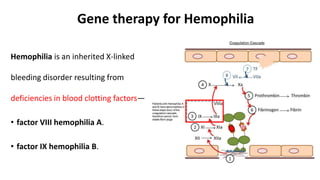
Gene therapy for Hemophilia
Hemophilia is an inherited X-linked
bleeding disorder resulting from
deficiencies in blood clotting factors—
• factor VIII hemophilia A.
• factor IX hemophilia B.
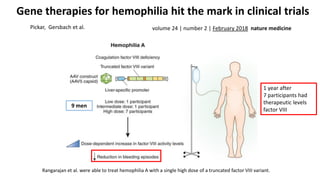
Gene therapies for hemophilia hit the mark in clinical trials
Pickar, Gersbach et al.
Rangarajan et al. were able to treat hemophilia A with a single high dose of a truncated factor VIII variant.
volume 24 | number 2 | February 2018 nature medicine
9 men
1 year after
7 participants had
therapeutic levels
factor VIII
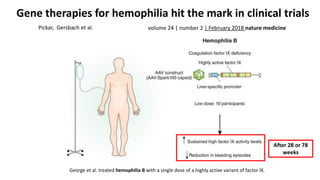
Gene therapies for hemophilia hit the mark in clinical trials
George et al. treated hemophilia B with a single dose of a highly active variant of factor IX.
volume 24 | number 2 | February 2018 nature medicine
Pickar, Gersbach et al.
After 28 or 78
weeks
Gene therapy Challenges
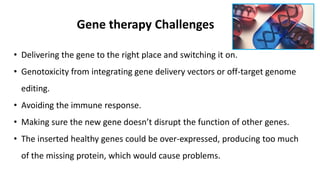
• Delivering the gene to the right place and switching it on.
• Genotoxicity from integrating gene delivery vectors or off-target genome
editing.
• Avoiding the immune response.
• Making sure the new gene doesn’t disrupt the function of other genes.
• The inserted healthy genes could be over-expressed, producing too much
of the missing protein, which would cause problems.
• How can “good” and “bad” uses of Gene therapy be distinguished?
• Who decides which traits are normal and which constitute a disability or disorder?
• Will the high costs of gene therapy make it available only to the wealthy?
• Could the widespread use of Gene therapy make society less accepting of people who
are different?
• Should people be allowed to use Gene therapy to enhance basic human traits such as
height, intelligence, or athletic ability?
• Is it interfering with God’s plan?
What are the ethical issues surrounding Gene therapy?
• Gene therapy have the potential to revolutionize the practice of medicine.
• It could prolong the lives of people suffering from genetic disorders.
• Although Gene therapy is a promising treatment option for a number of diseases
(including inherited disorders, some types of cancer, and certain viral infections), the
technique remains risky and is still under study to make sure that it will be safe and
effective.
Conclusion
Thanks
References
1. AM Keeler, MK El Mallah and TR Flotte. Gene Therapy 2017: Progress and Future Directions. Clin Transl Sci (2017)
10, 242–248.
2. Dunbar et al. Gene therapy comes of age. Science 359, eaan4672 (2018).
3. Ribeil, Hacein-Bey-Abina et al. Gene Therapy in a Patient with Sickle Cell Disease. n engl j med 376;9
4. Luigi Naldini. Gene therapy returns to centre stage. Nature Vol 526 Oct 2015.
5. Help Me Understand Genetics Gene Therapy. https://ghr.nlm.nih.gov/.
6. Sandeep RP Kumar et al. Clinical development of gene therapy: results and lessons from recent successes. Molecular
Therapy — Methods & Clinical Development (2016) 3, 16034.

Gene Therapy

  • 1.
    Gene Therapy Marta Talise GraduateDiploma Clinical Research
  • 2.
  • 3.
    • Introduction ofnew genes into cells, to restore or add gene expression, for the purpose of treating disease. • Most commonly a mutated gene is replaced with DNA encoding a functional copy. Alternatively DNA encoding a therapeutic protein drug may be introduced. What is Gene therapy?
  • 4.
    Researchers are testingseveral approaches to Gene therapy: • Replacing a mutated gene that causes disease with a healthy copy of the gene. • Inactivating, or “knocking out,” a mutated gene that is functioning improperly. • Introducing a new gene into the body to help fight a disease. What is Gene therapy?
  • 5.
    • Therapeutic genestransferred into the somatic cells. • Eg. Introduction of genes into bone marrow cells, blood cells, skin cells etc. • Will not be inherited later generations. • At present all researches directed to correct genetic defects in somatic cells. • Therapeutic genes transferred into the germ cells. • Eg. Genes introduced into eggs and sperms. • It is heritable and passed on to later generations. • For safety, ethical and technical reasons, it is not being attempted at present. Somatic Cells gene therapy Types of Gene therapy based on cells type Germ Cells gene therapy
  • 6.
    Vectors in Genetherapy To transfer the desired gene into a target cell, a carrier is required. Such vehicles of gene delivery are known as vectors
  • 7.
  • 8.
    Figure 2 Molecular Therapy- Methods & Clinical Development 2016 3, DOI: (10.1038/mtm.2016.34) Copyright © 2016 Official journal of the American Society of Gene & Cell Therapy Terms and Conditions Used for in vivo gene therapy. Given the many serotypes and capsid variants that have been developed, these vectors can target a wide variety of tissues but are limited by their transgene carrying capacity (~5 kb for single-stranded, ssAAV, and 2.5–3 kb for self-complementary, scAAV). Adeno-associated viral (AAV) vectors
  • 9.
    Figure 2 Molecular Therapy- Methods & Clinical Development 2016 3, DOI: (10.1038/mtm.2016.34) Copyright © 2016 Official journal of the American Society of Gene & Cell Therapy Terms and Conditions Lentiviral vectors (LV) Carry up to 8 kb of transgene and are used in many ex vivo gene therapy protocols, in particular for HSC gene transfer. LV can be pseudotyped with envelopes from different viruses and thereby adapted to a broad range of targets
  • 10.
    Figure 1 Molecular Therapy- Methods & Clinical Development 2016 3, DOI: (10.1038/mtm.2016.34) Copyright © 2016 Official journal of the American Society of Gene & Cell Therapy Terms and Conditions
  • 11.
  • 12.
    n engl jmed 376;9 nejm.org March 2, 2017 Ribeil, Hacein-Bey-Abina et al.
  • 13.
    Sickle Cell Disease(SCD) • Sickle cell disease results from a homozygous missense mutation in the β-globin gene that causes polymerization of hemoglobin S. • Sickle hemoglobin (HbS) polymerizes on deoxygenation, reducing the deformability of red cells. • Patients have intensely painful vaso-occlusive crises, leading to irreversible organ damage, poor quality of life, and reduced life expectancy. • Currently, the main treatment for SCD is chronic blood transfusions, which eventually lead to iron toxicity. n engl j med 376;9 nejm.org March 2, 2017
  • 14.
    • A boy13 years old with diagnosis of SCD at birth, followed at the Necker Children’s Hospital Paris France. • βS/βS genotype, a single 3.7-kb α-globin gene deletion • October 2014- Received an infusion of the drug product LentiGlobin BB305. n engl j med 376;9 nejm.org March 2, 2017 Gene therapy in a patient with Sickle cell disease
  • 16.
    Results Fig A showsrates of red-cell sickling under normoxic conditions (20% oxygen saturation) among control patients from whom red-cell samples were obtained: two patients with heterozygous A/S “sickle trait” (Controls 1 and 2; Control 1 is the patient’s mother) and three patients with sickle cell disease (Controls 3, 4, and 5). n engl j med 376;9 nejm.org March 2, 2017 Ribeil, Hacein-Bey-Abina et al.
  • 17.
    Results Fig B Showsrates of red-cell sickling under hypoxic conditions (10% oxygen saturation) in the patient at 6 months and 12 months after gene therapy. n engl j med 376;9 nejm.org March 2, 2017 Ribeil, Hacein-Bey-Abina et al.
  • 18.
    Conclusions • Fifteen monthsafter treatment, the level of therapeutic antisickling β-globin remained high (approximately 50% of β-like–globin chains) without recurrence of sickle crises and with correction of the biologic hallmarks of the disease. • Adverse events were consistent with busulfan conditioning. • With lifetime treatment cost of SCD of $1M, some analysts believe a reasonable price point for LentiGlobin is $500,000, if it is indeed a one off treatment and cure. n engl j med 376;9 nejm.org March 2, 2017 Ribeil, Hacein-Bey-Abina et al.
  • 19.
    Gene therapy forHemophilia Hemophilia is an inherited X-linked bleeding disorder resulting from deficiencies in blood clotting factors— • factor VIII hemophilia A. • factor IX hemophilia B.
  • 20.
    Gene therapies forhemophilia hit the mark in clinical trials Pickar, Gersbach et al. Rangarajan et al. were able to treat hemophilia A with a single high dose of a truncated factor VIII variant. volume 24 | number 2 | February 2018 nature medicine 9 men 1 year after 7 participants had therapeutic levels factor VIII
  • 21.
    Gene therapies forhemophilia hit the mark in clinical trials George et al. treated hemophilia B with a single dose of a highly active variant of factor IX. volume 24 | number 2 | February 2018 nature medicine Pickar, Gersbach et al. After 28 or 78 weeks
  • 23.
    Gene therapy Challenges •Delivering the gene to the right place and switching it on. • Genotoxicity from integrating gene delivery vectors or off-target genome editing. • Avoiding the immune response. • Making sure the new gene doesn’t disrupt the function of other genes. • The inserted healthy genes could be over-expressed, producing too much of the missing protein, which would cause problems.
  • 24.
    • How can“good” and “bad” uses of Gene therapy be distinguished? • Who decides which traits are normal and which constitute a disability or disorder? • Will the high costs of gene therapy make it available only to the wealthy? • Could the widespread use of Gene therapy make society less accepting of people who are different? • Should people be allowed to use Gene therapy to enhance basic human traits such as height, intelligence, or athletic ability? • Is it interfering with God’s plan? What are the ethical issues surrounding Gene therapy?
  • 25.
    • Gene therapyhave the potential to revolutionize the practice of medicine. • It could prolong the lives of people suffering from genetic disorders. • Although Gene therapy is a promising treatment option for a number of diseases (including inherited disorders, some types of cancer, and certain viral infections), the technique remains risky and is still under study to make sure that it will be safe and effective. Conclusion
  • 27.
  • 28.
    References 1. AM Keeler,MK El Mallah and TR Flotte. Gene Therapy 2017: Progress and Future Directions. Clin Transl Sci (2017) 10, 242–248. 2. Dunbar et al. Gene therapy comes of age. Science 359, eaan4672 (2018). 3. Ribeil, Hacein-Bey-Abina et al. Gene Therapy in a Patient with Sickle Cell Disease. n engl j med 376;9 4. Luigi Naldini. Gene therapy returns to centre stage. Nature Vol 526 Oct 2015. 5. Help Me Understand Genetics Gene Therapy. https://ghr.nlm.nih.gov/. 6. Sandeep RP Kumar et al. Clinical development of gene therapy: results and lessons from recent successes. Molecular Therapy — Methods & Clinical Development (2016) 3, 16034.