Introduction
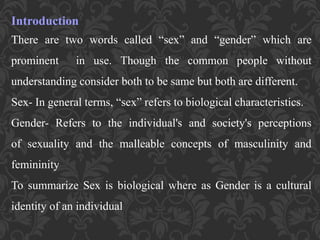
There are two words called “sex” and “gender” which are
prominent in use. Though the common people without
understanding consider both to be same but both are different.
Sex- In general terms, “sex” refers to biological characteristics.
Gender- Refers to the individual's and society's perceptions
of sexuality and the malleable concepts of masculinity and
femininity
To summarize Sex is biological where as Gender is a cultural
identity of an individual
Gender in India
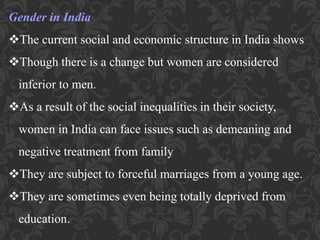
The current social and economic structure in India shows
Though there is a change but women are considered
inferior to men.
As a result of the social inequalities in their society,
women in India can face issues such as demeaning and
negative treatment from family
They are subject to forceful marriages from a young age.
They are sometimes even being totally deprived from
education.
Continued…
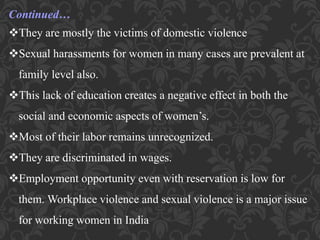
They are mostly the victims of domestic violence
Sexual harassments for women in many cases are prevalent at
family level also.
This lack of education creates a negative effect in both the
social and economic aspects of women’s.
Most of their labor remains unrecognized.
They are discriminated in wages.
Employment opportunity even with reservation is low for
them. Workplace violence and sexual violence is a major issue
for working women in India
Continued…
Women in India earn up to 30% less than their male
counterparts for same work.
Women also face higher risks with regard to their health.
Inadequate and poor nutrition.
Most of them are in a state of lack of access to primary
healthcare and are major contributors to India’s high rates
of female mortality.
Sex-specific abortions are also a major issue in India.
The media also treats the women body as a commodity
Towards a change
Economic empowerment through education can lead to a
better scenario.
Awareness among people will be helpful for a better
scenario
Healthcare facilities and other facilities should be made
available to women in proper manner.
Execution of laws and moral support to women victims
should be done properly.
Caste
“Caste is considered as a Brahminic child born and cradled in the Indo-
Gangetic planes” G.S. Ghurye
The religious theory claims that caste has its origin in Varna System of
Aryans. According to “Purusa Sukta” of “Rigveda” the four Varnas Brahmin
(Mouth) , Kshatriya (Hand) Vaishya (Thigh) and Shudra (from foot) have
taken origin.
The Untouchables
In addition to the Varnas, there is a fifth class in Hinduism. It encompassed
outcasts who, literally, did all the dirty work. They were referred to as
"untouchables" because they carried out the miserable tasks associated with
disease and pollution, such as cleaning up after funerals, dealing with sewage,
and working with animal skin.
Characteristics of caste
 Segmental Division of Society:
 Hierarchy
 Endogamy
 Hereditary Status
 Hereditary Occupation
 Restriction on Food and Drink
 Cultural Difference
 Social Segregation
 The Concept of Pollution
 A Particular Name
 Jati Panchayat
 Taboo
Caste based Discriminations in India
Economic
Social
Religious
Political
Educational
Legal
Health
Absence of Dalits in the Indian Media
Towards a change…
Educational and economic empowerment of Dalits
Showcasing the rich aspects of Dalit culture
Promoting Awareness
Providing legal support
Minimizing social distance through inter caste
marriages
Special attempt by media to promote the status of
Dalits
Social Class ?
 The division of member of a society into a hierarchy of distinct status classes, so
that members of each
 Class has some relative status and members of all other classes have either more or
less status.
 In other word, A social class is made up of people of similar social status who
regard one another as social equals.
 Classes are not sharply defined status groups like castes.
 There are three main classes—upper, middle, and lower.
 An upper class profile consists of the wealthy, employers, and industrialists, plus
top executives.
 A middle class profile which includes most white-collar workers and
professionals.
 A lower class profile usually known as a working class includes those in blue-
collar or manual jobs.
Social Classes in Rural India
Landlords, who own but do not cultivate land, either employing
intermediaries or leasing out land.
Rich farmers, who look upon agriculture as a business proposition,
produce for the market and for profit, employ wage labor, and
supervise rather than cultivate.
Middle peasants, who cultivate their own land and hire laborers only
for certain operations or at certain points of time.
Poor peasants, who own small and uneconomic holdings and often
have to work as parts laborers or as sharecroppers or tenant.
Landless agricultural workers who sell their labor and fully depend
on the first three categories for their livelihood.
Social Classes in Urban India
Capitalists (commercial and industrial)
Corporate sector
Professional classes
Petty traders, shopkeepers and unorganized
workers
Working classes
Gender caste and class

Gender caste and class

  • 2.
    Introduction There are twowords called “sex” and “gender” which are prominent in use. Though the common people without understanding consider both to be same but both are different. Sex- In general terms, “sex” refers to biological characteristics. Gender- Refers to the individual's and society's perceptions of sexuality and the malleable concepts of masculinity and femininity To summarize Sex is biological where as Gender is a cultural identity of an individual
  • 3.
    Gender in India Thecurrent social and economic structure in India shows Though there is a change but women are considered inferior to men. As a result of the social inequalities in their society, women in India can face issues such as demeaning and negative treatment from family They are subject to forceful marriages from a young age. They are sometimes even being totally deprived from education.
  • 4.
    Continued… They are mostlythe victims of domestic violence Sexual harassments for women in many cases are prevalent at family level also. This lack of education creates a negative effect in both the social and economic aspects of women’s. Most of their labor remains unrecognized. They are discriminated in wages. Employment opportunity even with reservation is low for them. Workplace violence and sexual violence is a major issue for working women in India
  • 5.
    Continued… Women in Indiaearn up to 30% less than their male counterparts for same work. Women also face higher risks with regard to their health. Inadequate and poor nutrition. Most of them are in a state of lack of access to primary healthcare and are major contributors to India’s high rates of female mortality. Sex-specific abortions are also a major issue in India. The media also treats the women body as a commodity
  • 6.
    Towards a change Economicempowerment through education can lead to a better scenario. Awareness among people will be helpful for a better scenario Healthcare facilities and other facilities should be made available to women in proper manner. Execution of laws and moral support to women victims should be done properly.
  • 7.
    Caste “Caste is consideredas a Brahminic child born and cradled in the Indo- Gangetic planes” G.S. Ghurye The religious theory claims that caste has its origin in Varna System of Aryans. According to “Purusa Sukta” of “Rigveda” the four Varnas Brahmin (Mouth) , Kshatriya (Hand) Vaishya (Thigh) and Shudra (from foot) have taken origin. The Untouchables In addition to the Varnas, there is a fifth class in Hinduism. It encompassed outcasts who, literally, did all the dirty work. They were referred to as "untouchables" because they carried out the miserable tasks associated with disease and pollution, such as cleaning up after funerals, dealing with sewage, and working with animal skin.
  • 8.
    Characteristics of caste Segmental Division of Society:  Hierarchy  Endogamy  Hereditary Status  Hereditary Occupation  Restriction on Food and Drink  Cultural Difference  Social Segregation  The Concept of Pollution  A Particular Name  Jati Panchayat  Taboo
  • 9.
    Caste based Discriminationsin India Economic Social Religious Political Educational Legal Health Absence of Dalits in the Indian Media
  • 10.
    Towards a change… Educationaland economic empowerment of Dalits Showcasing the rich aspects of Dalit culture Promoting Awareness Providing legal support Minimizing social distance through inter caste marriages Special attempt by media to promote the status of Dalits
  • 11.
    Social Class ? The division of member of a society into a hierarchy of distinct status classes, so that members of each  Class has some relative status and members of all other classes have either more or less status.  In other word, A social class is made up of people of similar social status who regard one another as social equals.  Classes are not sharply defined status groups like castes.  There are three main classes—upper, middle, and lower.  An upper class profile consists of the wealthy, employers, and industrialists, plus top executives.  A middle class profile which includes most white-collar workers and professionals.  A lower class profile usually known as a working class includes those in blue- collar or manual jobs.
  • 12.
    Social Classes inRural India Landlords, who own but do not cultivate land, either employing intermediaries or leasing out land. Rich farmers, who look upon agriculture as a business proposition, produce for the market and for profit, employ wage labor, and supervise rather than cultivate. Middle peasants, who cultivate their own land and hire laborers only for certain operations or at certain points of time. Poor peasants, who own small and uneconomic holdings and often have to work as parts laborers or as sharecroppers or tenant. Landless agricultural workers who sell their labor and fully depend on the first three categories for their livelihood.
  • 13.
    Social Classes inUrban India Capitalists (commercial and industrial) Corporate sector Professional classes Petty traders, shopkeepers and unorganized workers Working classes