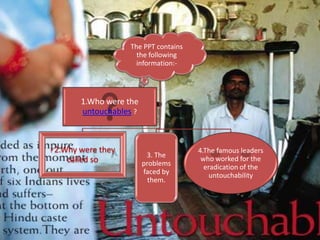
The PPT contains
the following
information:-
? 2.Why were they
called so
3. The
problems
faced by
them.
4.The famous leaders
who worked for the
eradication of the
untouchability
1.Who were the
untouchables ?
• WHAT IS UNTOUCHABILITY?
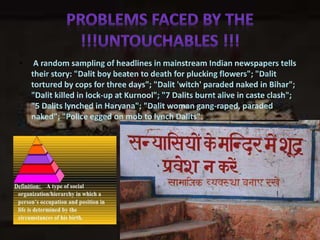
• A type of social organization in which a person’s occupation and position in life is
determined by the circumstances of his/her birth.
 Untouchability is the practice of exclude a group by segregating some castes
from the mainstream by social custom or legal mandate. The excluded group
could be one that did not accept the norms of the excluding group and
historically included foreigners, nomadic tribes, law-breakers and criminals
and those suffering from a contagious disease. It could be a group, that did
not accept change of customs enforced by a certain group. This exclusion was
a method of punishing law-breakers and also protected traditional societies
against contagion from strangers and the infected. A member of the excluded
group is known as an Untouchable or the people facing the social issue of
untouchability were the Untouchable. The term is commonly associated with
treatment of the Dalit communities, who are considered "polluting“.
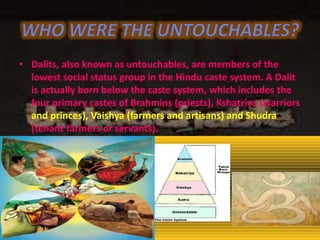
• Dalits, also known as untouchables, are members of the
lowest social status group in the Hindu caste system. A Dalit
is actually born below the caste system, which includes the
four primary castes of Brahmins (priests), Kshatriya (warriors
and princes), Vaishya (farmers and artisans) and Shudra
(tenant farmers or servants).
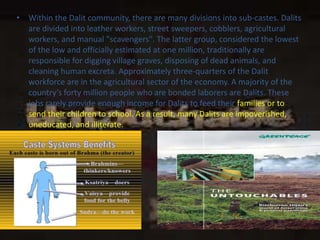
• Within the Dalit community, there are many divisions into sub-castes. Dalits
are divided into leather workers, street sweepers, cobblers, agricultural
workers, and manual "scavengers". The latter group, considered the lowest
of the low and officially estimated at one million, traditionally are
responsible for digging village graves, disposing of dead animals, and
cleaning human excreta. Approximately three-quarters of the Dalit
workforce are in the agricultural sector of the economy. A majority of the
country’s forty million people who are bonded laborers are Dalits. These
jobs rarely provide enough income for Dalits to feed their families or to
send their children to school. As a result, many Dalits are impoverished,
uneducated, and illiterate.
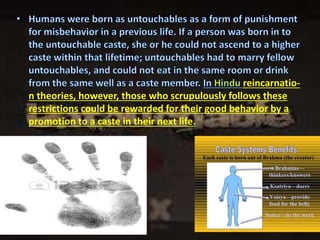
reincarnatio-
n theories, however, those who scrupulously follows these
restrictions could be rewarded for their good behavior by a
promotion to a caste in their next life.
•
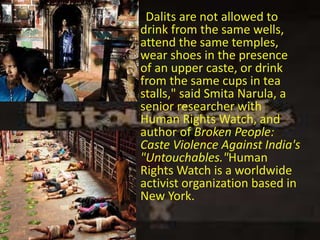
 "Dalits are not allowed to
drink from the same wells,
attend the same temples,
wear shoes in the presence
of an upper caste, or drink
from the same cups in tea
stalls," said Smita Narula, a
senior researcher with
Human Rights Watch, and
author of Broken People:
Caste Violence Against India's
"Untouchables."Human
Rights Watch is a worldwide
activist organization based in
New York.
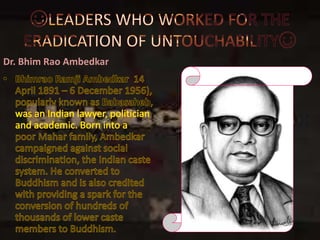
Dr. Bhim Rao Ambedkar
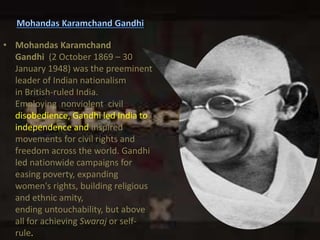
• Mohandas Karamchand
Gandhi (2 October 1869 – 30
January 1948) was the preeminent
leader of Indian nationalism
in British-ruled India.
Employing nonviolent civil
disobedience, Gandhi led India to
independence and inspired
movements for civil rights and
freedom across the world. Gandhi
led nationwide campaigns for
easing poverty, expanding
women's rights, building religious
and ethnic amity,
ending untouchability, but above
all for achieving Swaraj or self-
rule.
Untouchability

Untouchability

  • 2.
    The PPT contains thefollowing information:- ? 2.Why were they called so 3. The problems faced by them. 4.The famous leaders who worked for the eradication of the untouchability 1.Who were the untouchables ?
  • 3.
    • WHAT ISUNTOUCHABILITY? • A type of social organization in which a person’s occupation and position in life is determined by the circumstances of his/her birth.  Untouchability is the practice of exclude a group by segregating some castes from the mainstream by social custom or legal mandate. The excluded group could be one that did not accept the norms of the excluding group and historically included foreigners, nomadic tribes, law-breakers and criminals and those suffering from a contagious disease. It could be a group, that did not accept change of customs enforced by a certain group. This exclusion was a method of punishing law-breakers and also protected traditional societies against contagion from strangers and the infected. A member of the excluded group is known as an Untouchable or the people facing the social issue of untouchability were the Untouchable. The term is commonly associated with treatment of the Dalit communities, who are considered "polluting“.
  • 4.
    • Dalits, alsoknown as untouchables, are members of the lowest social status group in the Hindu caste system. A Dalit is actually born below the caste system, which includes the four primary castes of Brahmins (priests), Kshatriya (warriors and princes), Vaishya (farmers and artisans) and Shudra (tenant farmers or servants).
  • 5.
    • Within theDalit community, there are many divisions into sub-castes. Dalits are divided into leather workers, street sweepers, cobblers, agricultural workers, and manual "scavengers". The latter group, considered the lowest of the low and officially estimated at one million, traditionally are responsible for digging village graves, disposing of dead animals, and cleaning human excreta. Approximately three-quarters of the Dalit workforce are in the agricultural sector of the economy. A majority of the country’s forty million people who are bonded laborers are Dalits. These jobs rarely provide enough income for Dalits to feed their families or to send their children to school. As a result, many Dalits are impoverished, uneducated, and illiterate.
  • 6.
    reincarnatio- n theories, however,those who scrupulously follows these restrictions could be rewarded for their good behavior by a promotion to a caste in their next life.
  • 9.
  • 10.
     "Dalits arenot allowed to drink from the same wells, attend the same temples, wear shoes in the presence of an upper caste, or drink from the same cups in tea stalls," said Smita Narula, a senior researcher with Human Rights Watch, and author of Broken People: Caste Violence Against India's "Untouchables."Human Rights Watch is a worldwide activist organization based in New York.
  • 12.
    Dr. Bhim RaoAmbedkar
  • 13.
    • Mohandas Karamchand Gandhi(2 October 1869 – 30 January 1948) was the preeminent leader of Indian nationalism in British-ruled India. Employing nonviolent civil disobedience, Gandhi led India to independence and inspired movements for civil rights and freedom across the world. Gandhi led nationwide campaigns for easing poverty, expanding women's rights, building religious and ethnic amity, ending untouchability, but above all for achieving Swaraj or self- rule.