GEA Wiegand GmbH
Evaporation Technology
2
Research and Development
GEA Wiegand has its own Research and Development Centre,
where numerous laboratory and pilot plants are available for
detailed analyses and testing in the field of evaporation and
distillation. At the R&D Centre, important physical character-
istics such as boiling point elevation, surface tension, solubility
and maximum achievable concentration are determined.
Certain pilot plants are available as mobile units and can there-
fore be installed at a customer’s site. Data is captured and
plant operating behaviour modelled by means of the latest com-
puter programs.
The tests are performed in different types of tubular and plate
evaporators and distillation columns. To date, more than 3,000
product categories have been tested through our plants. The
alphabetical list of products tested ranges from acetone/alcohol
mixtures to zinc dichloride.
Evaporation Technology
Contents
Research and Development 2
Reference Products from GEA Wiegand Evaporation Plants 3
Evaporator Types 4
Special Evaporator Types 11
Quantities and Concentration Ratios in Evaporation Plants 14
Energy Efficiency of Evaporation Plants 15
Criteria for the Design Selection, Arrangement and
Operating Modes of Evaporation Plants 19
Evaporation Plant Components 19
Measuring and Control Equipment 22
Manufacture, Transport, Erection, Commissioning
and After-sales Service 23
Due to ongoing research and de-
velopment work spanning many
decades, and the experience of
several thousand installed refer-
ences, GEA Wiegand continues to
provide the broadest technical ex-
pertise and the respected ability
to offer the best solution for almost
any product, evaporation rate,
operating condition or application.
Evaporation plants are used as a thermal separation techno-
logy, for the concentration or separation of liquid solutions,
suspensions and emulsions.
A liquid concentrate that can still be pumped is generally the
desired final product. Evaporation may however also aim
at separating the volatile constituents, or distillate, as would
be the case in a solvent separation system. During these pro-
cesses, it is usual that product qualities are maintained and
preserved.
These, together with many other requirements result in a wide
variety of evaporator types, operating modes and arrangements.
GEA Wiegand has substantially contributed to the develop-
ment of evaporation technology. The first Wiegand evaporator,
built in 1908, was a patented multiple-effect circulation eva-
porator. This concentrated liquids in a gentle and efficient man-
ner in a way unparalleled in its time. It was easy to control and
had a compact arrangement.
Further technical developments led to the first Wiegand falling
film evaporator, built in 1952, which combined these consider-
ably improved, essential characteristics with new process
possibilities, especially in the field of evaporating heat-sensitive
products. At the same time, the thermal efficiency of evapora-
tion plants was considerably improved.
Thanks to its advantages, the falling film evaporator has virtu-
ally replaced other evaporator types in many fields. Forced
circulation and circulation evaporators still have some signifi-
cance, whereas special types such as spiral tube, counterflow
or stirrer evaporators are only used in special circumstances.
3
The following list shows groups of products
that are successfully concentrated in more
than 4.000 GEA Wiegand evaporation plants.
Additional products are detailed in our refe-
rence lists.
Reference Products from GEA Wiegand Evaporation Plants
Chemical and Pharmaceutical Industries
Caustic solutions Caustic soda solution, caustic potash solution
Organic acids Ascorbic acid, citric acid
Inorganic acids Phosphoric acid, nitric acid
Saline solutions Ammonium nitrate, ammonium sulphate, sodium
sulphate
Amines Urea, diethyl amine
Alcohol Methanol, ethanol, glycerine, glycol, isopropanol
Organic products Aromatic compounds, acetone, caprolactam water,
synthetic glue, aromas
Pharmaceutical Enzymes, antibiotics, drug extracts, sugar substitutes,
solutions sorbitol, sorbose and gluconate
Suspensions Kaolin, calcium carbonate
Waste water Process waste water, wash and rinsing water, oil
emulsions, etc.
Food and Beverage Industry
Dairy products Whole and skimmed milk, condensed milk, whey and
whey derivates, buttermilk proteins, lactose solutions,
lactic acid
Protein solution Soya whey, nutrient yeast and fodder yeast, whole egg
Fruit juices Orange and other citrus juices, pomaceous juice,
red berry juice, tropical fruit juices
Vegetable juices Beetroot juice, tomato juice, carrot juice
Starch products Glucose, dextrose, fructose, isomerose, maltose, starch
syrup, dextrine
Sugar Liquid sugar, white refined sugar, sweetwater, inulin
Extracts Coffee and tea extracts, hop extract, malt extract,
yeast extract, pectin, meat and bone extract
Hydrolisate Whey hydrolisate, soup seasoning, protein hydrolisate
Beer De-alcoholized beer, wort
Organic Natural Products Industry
Fermentation broth Glutamate, lysine, betain
Glue and gelatine Technical gelatine, edible gelatine, leather glue and
bone glue
Emulsions Miscella
Extracts Tanning extract
Stillage Whisky, corn, yeast, potato stillages, vinasses
Steep water Corn steep water, sorghum steep water
Stick water Slaughterhouse waste water, fish stick water, fruit peel
press water, beet chips, fibre press water, fibreboard
press water
Organic waste water Wash water, wheat and potato starch effluents, manure
Blood Whole blood, blood plasma
4
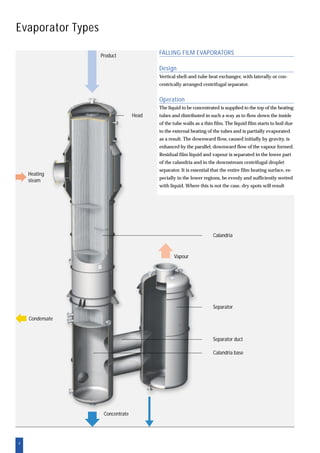
Evaporator Types
FALLING FILM EVAPORATORS
Design
Vertical shell-and-tube heat exchanger, with laterally or con-
centrically arranged centrifugal separator.
Operation
The liquid to be concentrated is supplied to the top of the heating
tubes and distributed in such a way as to flow down the inside
of the tube walls as a thin film. The liquid film starts to boil due
to the external heating of the tubes and is partially evaporated
as a result. The downward flow, caused initially by gravity, is
enhanced by the parallel, downward flow of the vapour formed.
Residual film liquid and vapour is separated in the lower part
of the calandria and in the downstream centrifugal droplet
separator. It is essential that the entire film heating surface, es-
pecially in the lower regions, be evenly and sufficiently wetted
with liquid. Where this is not the case, dry spots will result
Vapour
Head
Calandria
Separator
Separator duct
Calandria base
Concentrate
Heating
steam
Condensate
Product
5
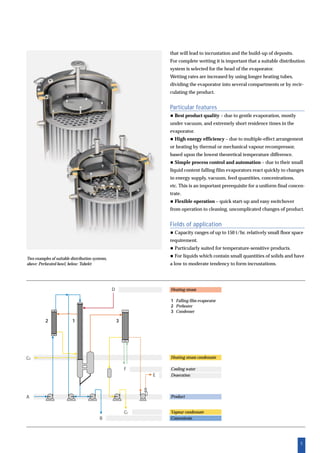
Two examples of suitable distribution systems,
above: Perforated bowl, below: Tubelet
Heating steam
Heating steam condensate
Cooling water
Deaeration
Product
Vapour condensate
Concentrate
1 Falling film evaporator
2 Preheater
3 Condenser
A
B
12 3
F
CC
CD
E
that will lead to incrustation and the build-up of deposits.
For complete wetting it is important that a suitable distribution
system is selected for the head of the evaporator.
Wetting rates are increased by using longer heating tubes,
dividing the evaporator into several compartments or by recir-
culating the product.
Particular features
Best product quality – due to gentle evaporation, mostly
under vacuum, and extremely short residence times in the
evaporator.
High energy efficiency – due to multiple-effect arrangement
or heating by thermal or mechanical vapour recompressor,
based upon the lowest theoretical temperature difference.
Simple process control and automation – due to their small
liquid content falling film evaporators react quickly to changes
in energy supply, vacuum, feed quantities, concentrations,
etc. This is an important prerequisite for a uniform final concen-
trate.
Flexible operation – quick start-up and easy switchover
from operation to cleaning, uncomplicated changes of product.
Fields of application
Capacity ranges of up to 150 t/hr, relatively small floor space
requirement.
Particularly suited for temperature-sensitive products.
For liquids which contain small quantities of solids and have
a low to moderate tendency to form incrustations.
D
6
Evaporator Types
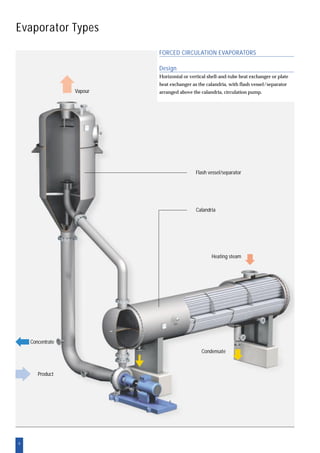
FORCED CIRCULATION EVAPORATORS
Design
Horizontal or vertical shell-and-tube heat exchanger or plate
heat exchanger as the calandria, with flash vessel/separator
arranged above the calandria, circulation pump.Vapour
Heating steam
Condensate
Product
Concentrate
Flash vessel/separator
Calandria
7
CD
A
B
CC
D
E
F
CD
3
1c1a 1b
2
Operation
The liquid is circulated through the calandria by means of a
circulation pump, where it is superheated at an elevated pres-
sure, higher than its normal boiling pressure. Upon entering
the separator, the pressure in the liquid is rapidly reduced
resulting in some of the liquid being flashed, or rapidly boiled
off. Since liquid circulation is maintained, the flow velocity in
the tubes and the liquid temperature can be controlled to suit
the product requirements independently of the pre-selected
temperature difference.
Particular features
Long operating periods – boiling/evaporation does not take
place on the heating surfaces, but in the separator. Fouling due
to incrustation and precipitation in the calandria is therefore
minimised.
Optimised heat exchange surface – flow velocity in the tubes
determined by the circulation pump.
Fields of application
Liquids with a high tendency for fouling, highly viscous
liquids, as the high concentration step in multiple-effect eva-
poration plants.
Forced circulation evaporators are optimally suited as
crystallising evaporators for saline solutions.
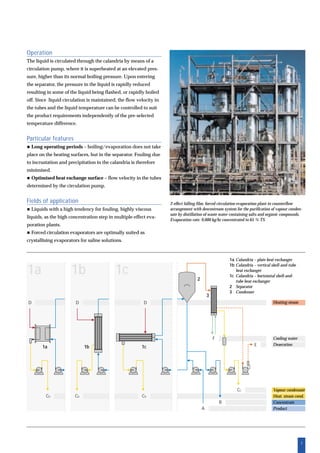
Heating steam
Cooling water
Deaeration
Vapour condensate
Heat. steam cond.
Concentrate
Product
D
1a Calandria – plate heat exchanger
1b Calandria – vertical shell-and-tube
heat exchanger
1c Calandria – horizontal shell-and-
tube heat exchanger
2 Separator
3 Condenser
2-effect falling film, forced circulation evaporation plant in counterflow
arrangement with downstream system for the purification of vapour conden-
sate by distillation of waste water containing salts and organic compounds.
Evaporation rate: 9,000 kg/hr concentrated to 65 % TS
1a 1b 1c
D
CD
8
Evaporator Types
PLATE EVAPORATORS
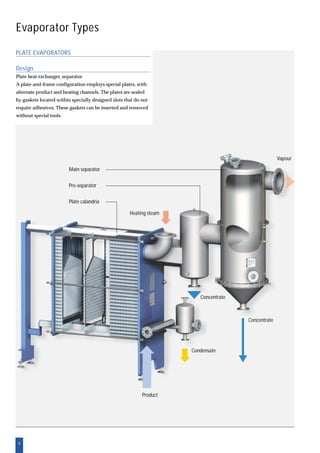
Design
Plate heat exchanger, separator.
A plate-and-frame configuration employs special plates, with
alternate product and heating channels. The plates are sealed
by gaskets located within specially designed slots that do not
require adhesives. These gaskets can be inserted and removed
without special tools.
Vapour
Heating steam
Condensate
Product
Concentrate
Concentrate
Main separator
Pre-separator
Plate calandria
9
Heating steam
Cooling water
Deaeration
Vapour condensate
Heating steam condensate
Concentrate
Product
D
A
B
CD
CC
E
F
Operation
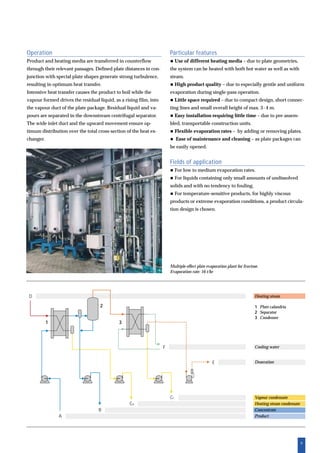
Product and heating media are transferred in counterflow
through their relevant passages. Defined plate distances in con-
junction with special plate shapes generate strong turbulence,
resulting in optimum heat transfer.
Intensive heat transfer causes the product to boil while the
vapour formed drives the residual liquid, as a rising film, into
the vapour duct of the plate package. Residual liquid and va-
pours are separated in the downstream centrifugal separator.
The wide inlet duct and the upward movement ensure op-
timum distribution over the total cross-section of the heat ex-
changer.
Particular features
Use of different heating media – due to plate geometries,
the system can be heated with both hot water as well as with
steam.
High product quality – due to especially gentle and uniform
evaporation during single-pass operation.
Little space required – due to compact design, short connec-
ting lines and small overall height of max. 3-4 m.
Easy installation requiring little time – due to pre-assem-
bled, transportable construction units.
Flexible evaporation rates – by adding or removing plates.
Ease of maintenance and cleaning – as plate packages can
be easily opened.
Fields of application
For low to medium evaporation rates.
For liquids containing only small amounts of undissolved
solids and with no tendency to fouling.
For temperature-sensitive products, for highly viscous
products or extreme evaporation conditions, a product circula-
tion design is chosen.
1 Plate calandria
2 Separator
3 Condenser
2
1 3
Multiple-effect plate evaporation plant for fructose.
Evaporation rate: 16 t/hr
10
Evaporator Types
Operation
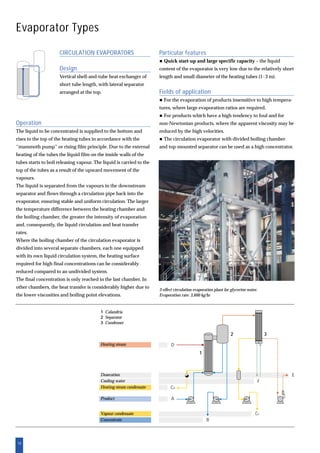
The liquid to be concentrated is supplied to the bottom and
rises to the top of the heating tubes in accordance with the
“mammoth pump” or rising film principle. Due to the external
heating of the tubes the liquid film on the inside walls of the
tubes starts to boil releasing vapour. The liquid is carried to the
top of the tubes as a result of the upward movement of the
vapours.
The liquid is separated from the vapours in the downstream
separator and flows through a circulation pipe back into the
evaporator, ensuring stable and uniform circulation. The larger
the temperature difference between the heating chamber and
the boiling chamber, the greater the intensity of evaporation
and, consequently, the liquid circulation and heat transfer
rates.
Where the boiling chamber of the circulation evaporator is
divided into several separate chambers, each one equipped
with its own liquid circulation system, the heating surface
required for high final concentrations can be considerably
reduced compared to an undivided system.
The final concentration is only reached in the last chamber. In
other chambers, the heat transfer is considerably higher due to
the lower viscosities and boiling point elevations.
CIRCULATION EVAPORATORS
Design
Vertical shell-and-tube heat exchanger of
short tube length, with lateral separator
arranged at the top.
Heating steam
Deaeration
Cooling water
Heating steam condensate
Product
Vapour condensate
Concentrate
1 Calandria
2 Separator
3 Condenser
A
F
E
CC
CD
D
2
1
3
3-effect circulation evaporation plant for glycerine water.
Evaporation rate: 3,600 kg/hr
B
Particular features
Quick start-up and large specific capacity – the liquid
content of the evaporator is very low due to the relatively short
length and small diameter of the heating tubes (1-3 m).
Fields of application
For the evaporation of products insensitive to high tempera-
tures, where large evaporation ratios are required.
For products which have a high tendency to foul and for
non-Newtonian products, where the apparent viscosity may be
reduced by the high velocities.
The circulation evaporator with divided boiling chamber
and top-mounted separator can be used as a high concentrator.
11
Operation
The liquid is evenly distributed over the heating tubes by
means of a distribution system and flows as a thin film down
the inside walls. The external heating of the tubes causes the
liquid film to boil. The vapours formed are condensed as distil-
late on the external walls of the condensate tubes and flow
downwards. Distillate and bottom product are separately kept
and discharged from the lower part of the evaporator.
Particular features
Particularly gentle product treatment – due to very low
pressure/temperature processing, short product residence
times and single pass operation. Distillation possible at
vacuum pressures ranging from 1 mbar to below 0.001 mbar.
Due to the integrated condenser tubes, there is no vapour flow
pressure loss.
Optimised design – no mechanical wear and tear, as the
system has no rotating internal parts.
Low investment cost.
Also suitable for high evaporation rates.
Fields of application
Particularly temperature sensitive, non-aqueous solutions.
Special Evaporator Types
FALLING FILM, SHORT PATH
EVAPORATORS
Design
Vertical shell-and-tube heat exchanger
equipped with concentrically arranged
condenser tubes within the heating tubes
and integrated separator in the lower part
of the unit.
FLUIDISIED BED EVAPORATORS
Design
Vertical fluidised bed heat exchanger (on
the tube side solid particles such as glass
or ceramic beads, or stainless steel wire
particles are entrained in the liquid),
flash/vessel separator and circulation
pump.
Operation
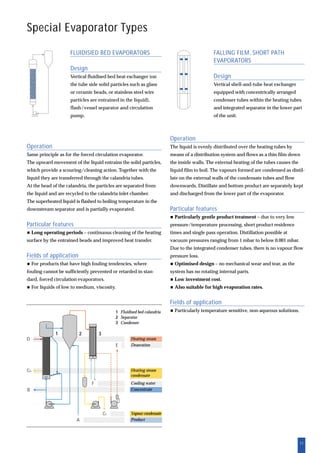
Same principle as for the forced circulation evaporator.
The upward movement of the liquid entrains the solid particles,
which provide a scouring/cleaning action. Together with the
liquid they are transferred through the calandria tubes.
At the head of the calandria, the particles are separated from
the liquid and are recycled to the calandria inlet chamber.
The superheated liquid is flashed to boiling temperature in the
downstream separator and is partially evaporated.
Particular features
Long operating periods – continuous cleaning of the heating
surface by the entrained beads and improved heat transfer.
Fields of application
For products that have high fouling tendencies, where
fouling cannot be sufficiently prevented or retarded in stan-
dard, forced circulation evaporators.
For liquids of low to medium, viscosity.
Heating steam
Deaeration
Heating steam
condensate
Cooling water
Concentrate
Vapour condensate
Product
1 Fluidised bed calandria
2 Separator
3 Condenser
A
E
F
B
CC
CD
D
21 3
12
Operation
As in falling film evaporators, the liquid is supplied to the top
of the evaporator and is distributed over the evaporator tubes,
but the vapours flow to the top in counterflow to the liquid.
Particular features
Partial distillation – amounts of volatile constituents con-
tained in the product to be concentrated can be stripped. This
process can be enhanced by the supply of an entraining stream,
such as steam or inert gas, to the lower part of the calandria.
Fields of application
This type of evaporator, designed for special cases, is used to
enhance the mass transfer between liquid and vapour. If a gas
stream is passed in counterflow to the liquid, chemical reac-
tions can be triggered.
COUNTERFLOW-TRICKLE
EVAPORATORS
Design
Shell-and-tube heat exchanger, lower part
of calandria larger than that of e.g. the
rising film evaporator, top-mounted sepa-
rator equipped with integrated liquid dis-
tribution system.
RISING FILM EVAPORATORS
Design
Vertical shell-and-tube heat exchanger
with top-mounted vapour separator.
Special Evaporator Types
Operation
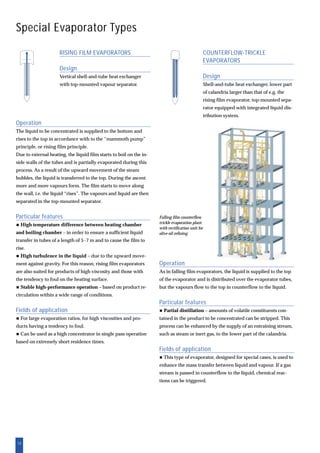
The liquid to be concentrated is supplied to the bottom and
rises to the top in accordance with to the “mammoth pump”
principle, or rising film principle.
Due to external heating, the liquid film starts to boil on the in-
side walls of the tubes and is partially evaporated during this
process. As a result of the upward movement of the steam
bubbles, the liquid is transferred to the top. During the ascent
more and more vapours form. The film starts to move along
the wall, i.e. the liquid “rises”. The vapours and liquid are then
separated in the top-mounted separator.
Particular features
High temperature difference between heating chamber
and boiling chamber – in order to ensure a sufficient liquid
transfer in tubes of a length of 5-7 m and to cause the film to
rise.
High turbulence in the liquid – due to the upward move-
ment against gravity. For this reason, rising film evaporators
are also suited for products of high viscosity and those with
the tendency to foul on the heating surface.
Stable high-performance operation – based on product re-
circulation within a wide range of conditions.
Fields of application
For large evaporation ratios, for high viscosities and pro-
ducts having a tendency to foul.
Can be used as a high concentrator in single pass operation
based on extremely short residence times.
Falling film counterflow
trickle evaporation plant
with rectification unit for
olive oil refining
13
Operation
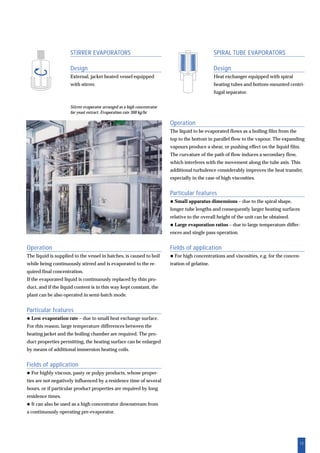
The liquid to be evaporated flows as a boiling film from the
top to the bottom in parallel flow to the vapour. The expanding
vapours produce a shear, or pushing effect on the liquid film.
The curvature of the path of flow induces a secondary flow,
which interferes with the movement along the tube axis. This
additional turbulence considerably improves the heat transfer,
especially in the case of high viscosities.
Particular features
Small apparatus dimensions – due to the spiral shape,
longer tube lengths and consequently larger heating surfaces
relative to the overall height of the unit can be obtained.
Large evaporation ratios – due to large temperature differ-
ences and single pass operation.
Fields of application
For high concentrations and viscosities, e.g. for the concen-
tration of gelatine.
Operation
The liquid is supplied to the vessel in batches, is caused to boil
while being continuously stirred and is evaporated to the re-
quired final concentration.
If the evaporated liquid is continuously replaced by thin pro-
duct, and if the liquid content is in this way kept constant, the
plant can be also operated in semi-batch mode.
Particular features
Low evaporation rate – due to small heat exchange surface.
For this reason, large temperature differences between the
heating jacket and the boiling chamber are required. The pro-
duct properties permitting, the heating surface can be enlarged
by means of additional immersion heating coils.
Fields of application
For highly viscous, pasty or pulpy products, whose proper-
ties are not negatively influenced by a residence time of several
hours, or if particular product properties are required by long
residence times.
It can also be used as a high concentrator downstream from
a continuously operating pre-evaporator.
SPIRAL TUBE EVAPORATORS
Design
Heat exchanger equipped with spiral
heating tubes and bottom-mounted centri-
fugal separator.
STIRRER EVAPORATORS
Design
External, jacket heated vessel equipped
with stirrer.
Stirrer evaporator arranged as a high concentrator
for yeast extract. Evaporation rate 300 kg/hr
14
Quantities and Concentration Ratios
in Evaporation Plants
To calculate continuous evaporation processes, mass
flow rates rather than volumetric quantities are used.
The unit kg/hr is used for A, B and C. The ratios
indicated above do not change.
A C
B
Initial concentration cA
of the product flow A kg/hr
cA
cB
Evaporated product, concentrate
Final concentration cB
of concentrate flow B kg/hr
The evaporation ratio is a measure for
the concentration process:e The evaporation ratio can also be defined as the ratio of the
initial and final concentrations (% weight dry substance).
Part of the solvent (C), is evaporated from the
product flow (A). The residual amount (B), is
the evaporated product (concentrate):
A = B + C
e = A = cB
B cA
The evaporated quantity C, can therefore
be defined as the difference between the
quantity of thin solution and concentrate:
C = A – B
Vapour flow C [kg/hr]: Evaporated water,
solvent
Given
Quantity A to be
evaporated
Formula
C = A ·
e – 1
e
B = A ·
1
e
If the solvent is evaporated from thin solution A at an even rate, the
concentration rises slowly at first, but rises increasingly rapidly to the
theoretical maximum. At this point, no more solvent would be left in
the solution. The lower the initial concentration cA, the steeper the
increase of the concentration curve. This relationship is essential for the
control of evaporation plants, and in cases of high evaporation ratios,
for the separation of the evaporation process into pre-evaporation and
high concentration steps.
If the concentrations or the evaporation ratio is known,
the quantities can be calculated using the formulae in the
table below:
Left: Increase of final concentration during the evaporation from
solutions at different initial concentrations
Required
C
B
15
Energy Efficiency of Evaporation Plants
The operating costs of an evaporation plant are largely deter-
mined by the energy consumption.
Under steady-state conditions there must be a balance between
the energy entering and leaving the system.
The energy consumption of the system can be tailored to meet the
customer’s individual requirements by intelligent thermal configura-
tions of the evaporation plant.
There are three basic possibilities to save energy:
Multiple-effect evaporation
Thermal vapour recompression
Mechanical vapour recompression
Application of one of these techniques will considerably de-
crease the energy consumption. Often it is feasible to combine
two of these possibilities to minimise capital and operating
costs. In highly sophisticated evaporation plants all three tech-
niques may be applied.
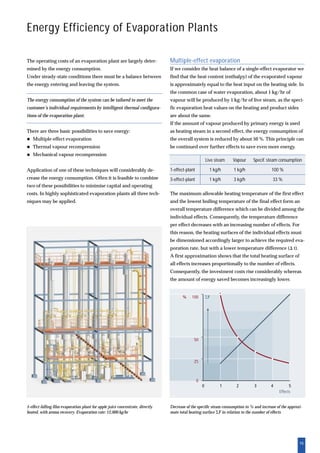
5-effect falling film evaporation plant for apple juice concentrate, directly
heated, with aroma recovery. Evaporation rate: 12,000 kg/hr
Decrease of the specific steam consumption in % and increase of the approxi-
mate total heating surface ⌺F in relation to the number of effects
Multiple-effect evaporation
If we consider the heat balance of a single-effect evaporator we
find that the heat content (enthalpy) of the evaporated vapour
is approximately equal to the heat input on the heating side. In
the common case of water evaporation, about 1 kg/hr of
vapour will be produced by 1 kg/hr of live steam, as the speci-
fic evaporation heat values on the heating and product sides
are about the same.
If the amount of vapour produced by primary energy is used
as heating steam in a second effect, the energy consumption of
the overall system is reduced by about 50 %. This principle can
be continued over further effects to save even more energy.
The maximum allowable heating temperature of the first effect
and the lowest boiling temperature of the final effect form an
overall temperature difference which can be divided among the
individual effects. Consequently, the temperature difference
per effect decreases with an increasing number of effects. For
this reason, the heating surfaces of the individual effects must
be dimensioned accordingly larger to achieve the required eva-
poration rate, but with a lower temperature difference (⌬ t).
A first approximation shows that the total heating surface of
all effects increases proportionally to the number of effects.
Consequently, the investment costs rise considerably whereas
the amount of energy saved becomes increasingly lower.
Live steam Vapour Specif. steam consumption
1-effect-plant 1 kg/h 1 kg/h 100 %
3-effect-plant 1 kg/h 3 kg/h 33 %
16
Energy Efficiency of Evaporation Plants
Thermal vapour recompression
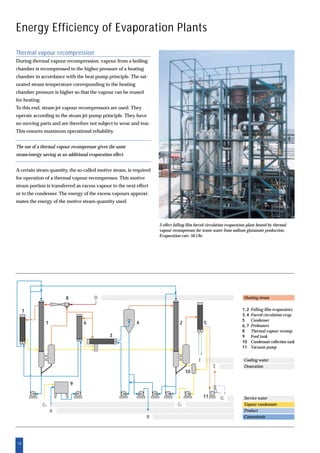
During thermal vapour recompression, vapour from a boiling
chamber is recompressed to the higher pressure of a heating
chamber in accordance with the heat pump principle. The sat-
urated steam temperature corresponding to the heating
chamber pressure is higher so that the vapour can be reused
for heating.
To this end, steam jet vapour recompressors are used. They
operate according to the steam jet pump principle. They have
no moving parts and are therefore not subject to wear and tear.
This ensures maximum operational reliability.
The use of a thermal vapour recompressor gives the same
steam/energy saving as an additional evaporation effect.
A certain steam quantity, the so-called motive steam, is required
for operation of a thermal vapour recompressor. This motive
steam portion is transferred as excess vapour to the next effect
or to the condenser. The energy of the excess vapours approxi-
mates the energy of the motive steam quantity used.
3-effect falling film forced circulation evaporation plant heated by thermal
vapour recompressor for waste water from sodium glutamate production.
Evaporation rate: 50 t/hr
Heating steam
Cooling water
Deaeration
Service water
Vapour condensate
Product
Concentrate
1, 2 Falling film evaporators
3, 4 Forced circulation evap.
5 Condenser
6, 7 Preheaters
8 Thermal vapour recomp.
9 Feed tank
10 Condensate collection tank
11 Vacuum pump
1 2
3
4 5
11
6
7
8
9
10
F
D
E
CCCC
B
A
G
17
Mechanical vapour recompression
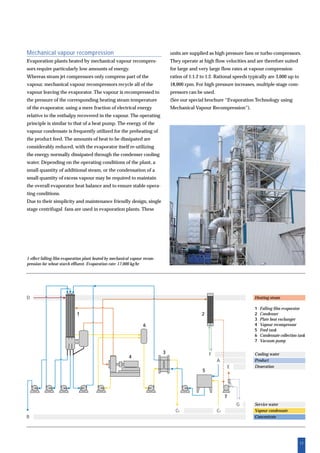
Evaporation plants heated by mechanical vapour recompres-
sors require particularly low amounts of energy.
Whereas steam jet compressors only compress part of the
vapour, mechanical vapour recompressors recycle all of the
vapour leaving the evaporator. The vapour is recompressed to
the pressure of the corresponding heating steam temperature
of the evaporator, using a mere fraction of electrical energy
relative to the enthalpy recovered in the vapour. The operating
principle is similar to that of a heat pump. The energy of the
vapour condensate is frequently utilized for the preheating of
the product feed. The amounts of heat to be dissipated are
considerably reduced, with the evaporator itself re-utilizing
the energy normally dissipated through the condenser cooling
water. Depending on the operating conditions of the plant, a
small quantity of additional steam, or the condensation of a
small quantity of excess vapour may be required to maintain
the overall evaporator heat balance and to ensure stable opera-
ting conditions.
Due to their simplicity and maintenance friendly design, single
stage centrifugal fans are used in evaporation plants. These
units are supplied as high pressure fans or turbo-compressors.
They operate at high flow velocities and are therefore suited
for large and very large flow rates at vapour compression
ratios of 1:1.2 to 1:2. Rational speeds typically are 3,000 up to
18,000 rpm. For high pressure increases, multiple-stage com-
pressors can be used.
(See our special brochure “Evaporation Technology using
Mechanical Vapour Recompression”).
1-effect falling film evaporation plant heated by mechanical vapour recom-
pression for wheat starch effluent. Evaporation rate: 17,000 kg/hr
Heating steam
Cooling water
Product
Deaeration
Service water
Vapour condensate
Concentrate
1 Falling film evaporator
2 Condenser
3 Plate heat exchanger
4 Vapour recompressor
5 Feed tank
6 Condensate collection tank
7 Vacuum pump
A
E
B
1 2
3
4
5
6
7
F
CC
D
G
CC
18
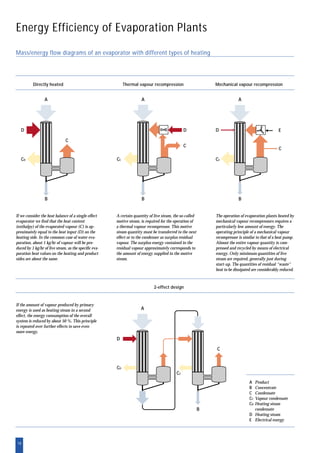
Directly heated Thermal vapour recompression
2-effect design
Mechanical vapour recompression
Mass/energy flow diagrams of an evaporator with different types of heating
A
A
D
D
D D
A A
B
B
B B
CD
CD
CC
CC CC
C
C
C
C
E
A Product
B Concentrate
C Condensate
CC Vapour condensate
CD Heating steam
condensate
D Heating steam
E Electrical energy
If we consider the heat balance of a single-effect
evaporator we find that the heat content
(enthalpy) of the evaporated vapour (C) is ap-
proximately equal to the heat input (D) on the
heating side. In the common case of water eva-
poration, about 1 kg/hr of vapour will be pro-
duced by 1 kg/hr of live steam, as the specific eva-
poration heat values on the heating and product
sides are about the same.
If the amount of vapour produced by primary
energy is used as heating steam in a second
effect, the energy consumption of the overall
system is reduced by about 50 %. This principle
is repeated over further effects to save even
more energy.
A certain quantity of live steam, the so-called
motive steam, is required for the operation of
a thermal vapour recompressor. This motive
steam quantity must be transferred to the next
effect or to the condenser as surplus residual
vapour. The surplus energy contained in the
residual vapour approximately corresponds to
the amount of energy supplied in the motive
steam.
The operation of evaporation plants heated by
mechanical vapour recompressors requires a
particularly low amount of energy. The
operating principle of a mechanical vapour
recompressor is similar to that of a heat pump.
Almost the entire vapour quantity is com-
pressed and recycled by means of electrical
energy. Only minimum quantities of live
steam are required, generally just during
start-up. The quantities of residual “waste“
heat to be dissipated are considerably reduced.
Energy Efficiency of Evaporation Plants
19
Criteria for the Design Selection, Arrangement
and Operating Modes of Evaporation Plants
Evaporation Plant Components
The core of any evaporation plant is the calandria. For the
operation of the plant, several additional components are re-
quired.
The most important of these are condensers, preheaters,
pumps, fittings, vents, vacuum systems and cleaning systems.
If substances are to be separated, the plants are also equipped
with rectification columns, membrane filtration units, scrub-
bing and aroma recovery systems.
To guarantee trouble-free operation of the plant, state-of-the-
art measuring, control and computer monitoring systems are
used.
Attention to detail, safety and protective equipment and ther-
mal and sound insulation ensure safe operation of the plant.
GEA Wiegand designs, builds and supplies turnkey evaporation
plants. Our experience and expert knowledge of the performance of
each individual component enables us to select the right equipment
for each application so that the requirements of the entire evapora-
tion plant will be met.
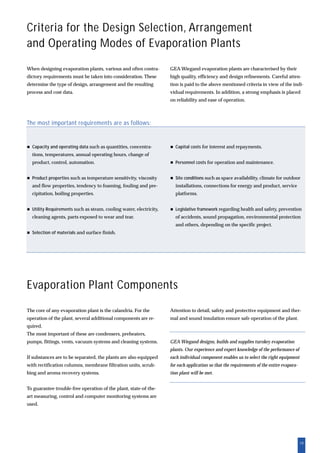
The most important requirements are as follows:
Capacity and operating data such as quantities, concentra-
tions, temperatures, annual operating hours, change of
product, control, automation.
Product properties such as temperature sensitivity, viscosity
and flow properties, tendency to foaming, fouling and pre-
cipitation, boiling properties.
Utility Requirements such as steam, cooling water, electricity,
cleaning agents, parts exposed to wear and tear.
Selection of materials and surface finish.
Capital costs for interest and repayments.
Personnel costs for operation and maintenance.
Site conditions such as space availability, climate for outdoor
installations, connections for energy and product, service
platforms.
Legislative framework regarding health and safety, prevention
of accidents, sound propagation, environmental protection
and others, depending on the specific project.
When designing evaporation plants, various and often contra-
dictory requirements must be taken into consideration. These
determine the type of design, arrangement and the resulting
process and cost data.
GEA Wiegand evaporation plants are characterised by their
high quality, efficiency and design refinements. Careful atten-
tion is paid to the above mentioned criteria in view of the indi-
vidual requirements. In addition, a strong emphasis is placed
on reliability and ease of operation.
20
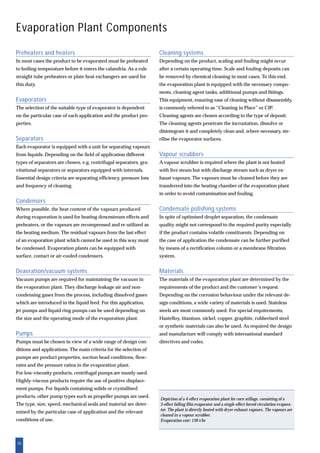
Evaporation Plant Components
Preheaters and heaters
In most cases the product to be evaporated must be preheated
to boiling temperature before it enters the calandria. As a rule
straight tube preheaters or plate heat exchangers are used for
this duty.
Evaporators
The selection of the suitable type of evaporator is dependent
on the particular case of each application and the product pro-
perties.
Separators
Each evaporator is equipped with a unit for separating vapours
from liquids. Depending on the field of application different
types of separators are chosen, e.g. centrifugal separators, gra-
vitational separators or separators equipped with internals.
Essential design criteria are separating efficiency, pressure loss
and frequency of cleaning.
Condensers
Where possible, the heat content of the vapours produced
during evaporation is used for heating downstream effects and
preheaters, or the vapours are recompressed and re-utilized as
the heating medium. The residual vapours from the last effect
of an evaporation plant which cannot be used in this way must
be condensed. Evaporation plants can be equipped with
surface, contact or air-cooled condensers.
Deaeration/vacuum systems
Vacuum pumps are required for maintaining the vacuum in
the evaporation plant. They discharge leakage air and non-
condensing gases from the process, including dissolved gases
which are introduced in the liquid feed. For this application,
jet pumps and liquid ring pumps can be used depending on
the size and the operating mode of the evaporation plant.
Pumps
Pumps must be chosen in view of a wide range of design con-
ditions and applications. The main criteria for the selection of
pumps are product properties, suction head conditions, flow-
rates and the pressure ratios in the evaporation plant.
For low-viscosity products, centrifugal pumps are mostly used.
Highly-viscous products require the use of positive displace-
ment pumps. For liquids containing solids or crystallised
products, other pump types such as propeller pumps are used.
The type, size, speed, mechanical seals and material are deter-
mined by the particular case of application and the relevant
conditions of use.
Cleaning systems
Depending on the product, scaling and fouling might occur
after a certain operating time. Scale and fouling deposits can
be removed by chemical cleaning in most cases. To this end,
the evaporation plant is equipped with the necessary compo-
nents, cleaning agent tanks, additional pumps and fittings.
This equipment, ensuring ease of cleaning without disassembly,
is commonly referred to as “Cleaning in Place” or CIP.
Cleaning agents are chosen according to the type of deposit.
The cleaning agents penetrate the incrustation, dissolve or
disintegrate it and completely clean and, where necessary, ste-
rilise the evaporator surfaces.
Vapour scrubbers
A vapour scrubber is required where the plant is not heated
with live steam but with discharge stream such as dryer ex-
haust vapours. The vapours must be cleaned before they are
transferred into the heating chamber of the evaporation plant
in order to avoid contamination and fouling.
Condensate polishing systems
In spite of optimised droplet separation, the condensate
quality might not correspond to the required purity especially
if the product contains volatile constituents. Depending on
the case of application the condensate can be further purified
by means of a rectification column or a membrane filtration
system.
Materials
The materials of the evaporation plant are determined by the
requirements of the product and the customer’s request.
Depending on the corrosion behaviour under the relevant de-
sign conditions, a wide variety of materials is used. Stainless
steels are most commonly used. For special requirements,
Hastelloy, titanium, nickel, copper, graphite, rubberised steel
or synthetic materials can also be used. As required the design
and manufacture will comply with international standard
directives and codes.
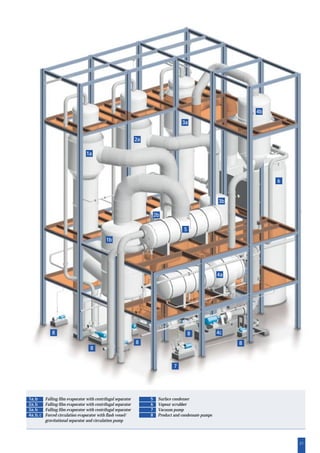
Depiction of a 4-effect evaporation plant for corn stillage, consisting of a
3-effect falling film evaporator and a single-effect forced circulation evapora-
tor. The plant is directly heated with dryer exhaust vapours. The vapours are
cleaned in a vapour scrubber.
Evaporation rate: 130 t/hr
21
1a
2a
3a
4b
6
3b
5
2b
1b
4a
4c
8
8
8
8
8
7
1a,b Falling film evaporator with centrifugal separator
2a,b Falling film evaporator with centrifugal separator
3a,b Falling film evaporator with centrifugal separator
4a,b,c Forced circulation evaporator with flash vessel/
gravitational separator and circulation pump
5 Surface condenser
6 Vapour scrubber
7 Vacuum pump
8 Product and condensate pumps
22
Measuring and Control Equipment
The major goal of the evaporation process is to achieve a con-
stant final concentration of the product. It is therefore important
to maintain all parameters, such as steam pressure, product
feed and vacuum, which might influence the evaporation plant
or alter the mass and heat balances.
In accordance with the technical and customer’s requirements,
GEA Wiegand evaporation plants are equipped with the rele-
vant measuring and control systems. We supply conventional
control systems as well as process control systems.
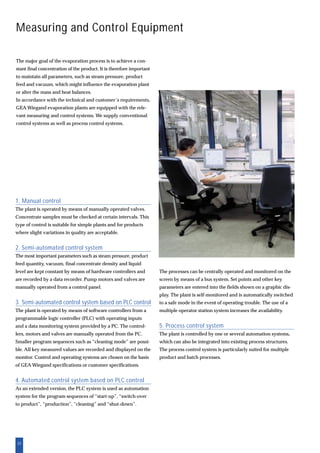
1. Manual control
The plant is operated by means of manually operated valves.
Concentrate samples must be checked at certain intervals. This
type of control is suitable for simple plants and for products
where slight variations in quality are acceptable.
2. Semi-automated control system
The most important parameters such as steam pressure, product
feed quantity, vacuum, final concentrate density and liquid
level are kept constant by means of hardware controllers and
are recorded by a data recorder. Pump motors and valves are
manually operated from a control panel.
3. Semi-automated control system based on PLC control
The plant is operated by means of software controllers from a
programmable logic controller (PLC) with operating inputs
and a data monitoring system provided by a PC. The control-
lers, motors and valves are manually operated from the PC.
Smaller program sequences such as “cleaning mode” are possi-
ble. All key measured values are recorded and displayed on the
monitor. Control and operating systems are chosen on the basis
of GEA Wiegand specifications or customer specifications.
4. Automated control system based on PLC control
As an extended version, the PLC system is used as automation
system for the program sequences of “start-up”, “switch-over
to product”, “production”, “cleaning” and “shut-down”.
The processes can be centrally operated and monitored on the
screen by means of a bus system. Set points and other key
parameters are entered into the fields shown on a graphic dis-
play. The plant is self-monitored and is automatically switched
to a safe mode in the event of operating trouble. The use of a
multiple operator station system increases the availability.
5. Process control system
The plant is controlled by one or several automation systems,
which can also be integrated into existing process structures.
The process control system is particularly suited for multiple
product and batch processes.
23
Manufacture, Transport, Erection,
Commissioning and After-sales Service
Depending on the arrangement evaporation plants can be ex-
tremely complex, and therefore the first commissioning requi-
res certain experience. Experienced specialists are therefore
assigned to this task, who are also available to train the custo-
mer’s personnel.
Each plant permanently achieves its optimal performance if it
is expertly maintained. This service requires specialists who, if
required, immediately trace and eliminate faults so that pro-
duction losses caused by periods of standstill can be minimised.
Our trained service personnel are therefore available to you.
Thanks to their up-to-date training they are in a position to carry
out maintenance and repairs quickly and thoroughly. Users
benefit from our spare parts service, based on our plant refe-
rence numbers and a description of the item, spares can be
ordered online or quotations requested for the required parts.
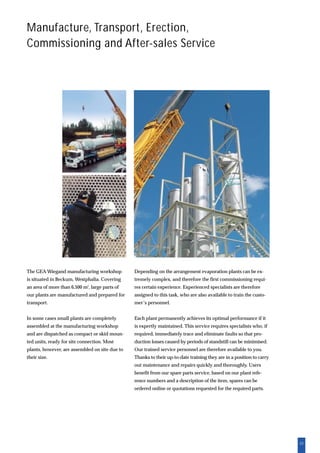
The GEA Wiegand manufacturing workshop
is situated in Beckum, Westphalia. Covering
an area of more than 6,500 m2
, large parts of
our plants are manufactured and prepared for
transport.
In some cases small plants are completely
assembled at the manufacturing workshop
and are dispatched as compact or skid moun-
ted units, ready for site connection. Most
plants, however, are assembled on site due to
their size.
P03E022009/Hinkel&Junghans,Werbeagentur,KA
Process Engineering
GEA Wiegand GmbH
Am Hardtwald 1, 76275 Ettlingen, Germany
Tel. +49 7243 705-0, Fax +49 7243 705-330
E-Mail: gea-wiegand.info@gea.com, Internet: www.gea-wiegand.com
Overview on our Range
of Products
Evaporation plants
to concentrate any type of fluid food, process water, organic and
inorganic solutions and industrial waste water; with additional equip-
ment for heating, cooling, degassing, crystallization and rectification.
Membrane filtration – GEA Filtration
to concentrate and process fluid food, process water and industrial
waste water, to separate contaminations in order to improve quality
and recover valuable substances.
Distillation / rectification plants
to separate multi-component mixtures, to recover organic solvents;
to clean, recover and dehydrate bio-alcohol of different qualities.
Alcohol production lines
for potable alcohol and dehydrated alcohol of absolute purity;
integrated stillage processing systems.
Condensation plants
with surface or mixing condensers, to condense vapour and steam/gas
mixtures under vacuum.
Vacuum/steam jet cooling plants
to produce cold water, cool liquids, even of aggressive and abrasive
nature.
Jet pumps
to convey and mix gases, liquids, and granular solids; for direct heating
of liquids; as heat pumps; and in special design for the most diverse
fields of application.
Steam jet vacuum pumps
also product vapour driven; also in combination with mechanical
vacuum pumps (hybrid systems); extensive application in the
chemical, pharmaceutical and food industries, in oil refineries and for
steel degassing.
Heat recovery plants
to utilize residual heat from exhaust gases, steam/air mixtures,
condensate and product.
Vacuum degassing plants
to remove dissolved gases from water and other liquids.
Heating and cooling plants
mobile and stationary plants for the operation of hot water heated
reactors, contact driers.
Gas scubbers
to clean and dedust exhaust air, separate aerosols, cool and condition
gases, condensate vapours and absorb gaseous pollutants.
Project studies, engineering for our plants.

Gea evaporation technology-brochure_en_tcm11-16319

  • 1.
  • 2.
    2 Research and Development GEAWiegand has its own Research and Development Centre, where numerous laboratory and pilot plants are available for detailed analyses and testing in the field of evaporation and distillation. At the R&D Centre, important physical character- istics such as boiling point elevation, surface tension, solubility and maximum achievable concentration are determined. Certain pilot plants are available as mobile units and can there- fore be installed at a customer’s site. Data is captured and plant operating behaviour modelled by means of the latest com- puter programs. The tests are performed in different types of tubular and plate evaporators and distillation columns. To date, more than 3,000 product categories have been tested through our plants. The alphabetical list of products tested ranges from acetone/alcohol mixtures to zinc dichloride. Evaporation Technology Contents Research and Development 2 Reference Products from GEA Wiegand Evaporation Plants 3 Evaporator Types 4 Special Evaporator Types 11 Quantities and Concentration Ratios in Evaporation Plants 14 Energy Efficiency of Evaporation Plants 15 Criteria for the Design Selection, Arrangement and Operating Modes of Evaporation Plants 19 Evaporation Plant Components 19 Measuring and Control Equipment 22 Manufacture, Transport, Erection, Commissioning and After-sales Service 23 Due to ongoing research and de- velopment work spanning many decades, and the experience of several thousand installed refer- ences, GEA Wiegand continues to provide the broadest technical ex- pertise and the respected ability to offer the best solution for almost any product, evaporation rate, operating condition or application. Evaporation plants are used as a thermal separation techno- logy, for the concentration or separation of liquid solutions, suspensions and emulsions. A liquid concentrate that can still be pumped is generally the desired final product. Evaporation may however also aim at separating the volatile constituents, or distillate, as would be the case in a solvent separation system. During these pro- cesses, it is usual that product qualities are maintained and preserved. These, together with many other requirements result in a wide variety of evaporator types, operating modes and arrangements. GEA Wiegand has substantially contributed to the develop- ment of evaporation technology. The first Wiegand evaporator, built in 1908, was a patented multiple-effect circulation eva- porator. This concentrated liquids in a gentle and efficient man- ner in a way unparalleled in its time. It was easy to control and had a compact arrangement. Further technical developments led to the first Wiegand falling film evaporator, built in 1952, which combined these consider- ably improved, essential characteristics with new process possibilities, especially in the field of evaporating heat-sensitive products. At the same time, the thermal efficiency of evapora- tion plants was considerably improved. Thanks to its advantages, the falling film evaporator has virtu- ally replaced other evaporator types in many fields. Forced circulation and circulation evaporators still have some signifi- cance, whereas special types such as spiral tube, counterflow or stirrer evaporators are only used in special circumstances.
  • 3.
    3 The following listshows groups of products that are successfully concentrated in more than 4.000 GEA Wiegand evaporation plants. Additional products are detailed in our refe- rence lists. Reference Products from GEA Wiegand Evaporation Plants Chemical and Pharmaceutical Industries Caustic solutions Caustic soda solution, caustic potash solution Organic acids Ascorbic acid, citric acid Inorganic acids Phosphoric acid, nitric acid Saline solutions Ammonium nitrate, ammonium sulphate, sodium sulphate Amines Urea, diethyl amine Alcohol Methanol, ethanol, glycerine, glycol, isopropanol Organic products Aromatic compounds, acetone, caprolactam water, synthetic glue, aromas Pharmaceutical Enzymes, antibiotics, drug extracts, sugar substitutes, solutions sorbitol, sorbose and gluconate Suspensions Kaolin, calcium carbonate Waste water Process waste water, wash and rinsing water, oil emulsions, etc. Food and Beverage Industry Dairy products Whole and skimmed milk, condensed milk, whey and whey derivates, buttermilk proteins, lactose solutions, lactic acid Protein solution Soya whey, nutrient yeast and fodder yeast, whole egg Fruit juices Orange and other citrus juices, pomaceous juice, red berry juice, tropical fruit juices Vegetable juices Beetroot juice, tomato juice, carrot juice Starch products Glucose, dextrose, fructose, isomerose, maltose, starch syrup, dextrine Sugar Liquid sugar, white refined sugar, sweetwater, inulin Extracts Coffee and tea extracts, hop extract, malt extract, yeast extract, pectin, meat and bone extract Hydrolisate Whey hydrolisate, soup seasoning, protein hydrolisate Beer De-alcoholized beer, wort Organic Natural Products Industry Fermentation broth Glutamate, lysine, betain Glue and gelatine Technical gelatine, edible gelatine, leather glue and bone glue Emulsions Miscella Extracts Tanning extract Stillage Whisky, corn, yeast, potato stillages, vinasses Steep water Corn steep water, sorghum steep water Stick water Slaughterhouse waste water, fish stick water, fruit peel press water, beet chips, fibre press water, fibreboard press water Organic waste water Wash water, wheat and potato starch effluents, manure Blood Whole blood, blood plasma
  • 4.
    4 Evaporator Types FALLING FILMEVAPORATORS Design Vertical shell-and-tube heat exchanger, with laterally or con- centrically arranged centrifugal separator. Operation The liquid to be concentrated is supplied to the top of the heating tubes and distributed in such a way as to flow down the inside of the tube walls as a thin film. The liquid film starts to boil due to the external heating of the tubes and is partially evaporated as a result. The downward flow, caused initially by gravity, is enhanced by the parallel, downward flow of the vapour formed. Residual film liquid and vapour is separated in the lower part of the calandria and in the downstream centrifugal droplet separator. It is essential that the entire film heating surface, es- pecially in the lower regions, be evenly and sufficiently wetted with liquid. Where this is not the case, dry spots will result Vapour Head Calandria Separator Separator duct Calandria base Concentrate Heating steam Condensate Product
  • 5.
    5 Two examples ofsuitable distribution systems, above: Perforated bowl, below: Tubelet Heating steam Heating steam condensate Cooling water Deaeration Product Vapour condensate Concentrate 1 Falling film evaporator 2 Preheater 3 Condenser A B 12 3 F CC CD E that will lead to incrustation and the build-up of deposits. For complete wetting it is important that a suitable distribution system is selected for the head of the evaporator. Wetting rates are increased by using longer heating tubes, dividing the evaporator into several compartments or by recir- culating the product. Particular features Best product quality – due to gentle evaporation, mostly under vacuum, and extremely short residence times in the evaporator. High energy efficiency – due to multiple-effect arrangement or heating by thermal or mechanical vapour recompressor, based upon the lowest theoretical temperature difference. Simple process control and automation – due to their small liquid content falling film evaporators react quickly to changes in energy supply, vacuum, feed quantities, concentrations, etc. This is an important prerequisite for a uniform final concen- trate. Flexible operation – quick start-up and easy switchover from operation to cleaning, uncomplicated changes of product. Fields of application Capacity ranges of up to 150 t/hr, relatively small floor space requirement. Particularly suited for temperature-sensitive products. For liquids which contain small quantities of solids and have a low to moderate tendency to form incrustations. D
  • 6.
    6 Evaporator Types FORCED CIRCULATIONEVAPORATORS Design Horizontal or vertical shell-and-tube heat exchanger or plate heat exchanger as the calandria, with flash vessel/separator arranged above the calandria, circulation pump.Vapour Heating steam Condensate Product Concentrate Flash vessel/separator Calandria
  • 7.
    7 CD A B CC D E F CD 3 1c1a 1b 2 Operation The liquidis circulated through the calandria by means of a circulation pump, where it is superheated at an elevated pres- sure, higher than its normal boiling pressure. Upon entering the separator, the pressure in the liquid is rapidly reduced resulting in some of the liquid being flashed, or rapidly boiled off. Since liquid circulation is maintained, the flow velocity in the tubes and the liquid temperature can be controlled to suit the product requirements independently of the pre-selected temperature difference. Particular features Long operating periods – boiling/evaporation does not take place on the heating surfaces, but in the separator. Fouling due to incrustation and precipitation in the calandria is therefore minimised. Optimised heat exchange surface – flow velocity in the tubes determined by the circulation pump. Fields of application Liquids with a high tendency for fouling, highly viscous liquids, as the high concentration step in multiple-effect eva- poration plants. Forced circulation evaporators are optimally suited as crystallising evaporators for saline solutions. Heating steam Cooling water Deaeration Vapour condensate Heat. steam cond. Concentrate Product D 1a Calandria – plate heat exchanger 1b Calandria – vertical shell-and-tube heat exchanger 1c Calandria – horizontal shell-and- tube heat exchanger 2 Separator 3 Condenser 2-effect falling film, forced circulation evaporation plant in counterflow arrangement with downstream system for the purification of vapour conden- sate by distillation of waste water containing salts and organic compounds. Evaporation rate: 9,000 kg/hr concentrated to 65 % TS 1a 1b 1c D CD
  • 8.
    8 Evaporator Types PLATE EVAPORATORS Design Plateheat exchanger, separator. A plate-and-frame configuration employs special plates, with alternate product and heating channels. The plates are sealed by gaskets located within specially designed slots that do not require adhesives. These gaskets can be inserted and removed without special tools. Vapour Heating steam Condensate Product Concentrate Concentrate Main separator Pre-separator Plate calandria
  • 9.
    9 Heating steam Cooling water Deaeration Vapourcondensate Heating steam condensate Concentrate Product D A B CD CC E F Operation Product and heating media are transferred in counterflow through their relevant passages. Defined plate distances in con- junction with special plate shapes generate strong turbulence, resulting in optimum heat transfer. Intensive heat transfer causes the product to boil while the vapour formed drives the residual liquid, as a rising film, into the vapour duct of the plate package. Residual liquid and va- pours are separated in the downstream centrifugal separator. The wide inlet duct and the upward movement ensure op- timum distribution over the total cross-section of the heat ex- changer. Particular features Use of different heating media – due to plate geometries, the system can be heated with both hot water as well as with steam. High product quality – due to especially gentle and uniform evaporation during single-pass operation. Little space required – due to compact design, short connec- ting lines and small overall height of max. 3-4 m. Easy installation requiring little time – due to pre-assem- bled, transportable construction units. Flexible evaporation rates – by adding or removing plates. Ease of maintenance and cleaning – as plate packages can be easily opened. Fields of application For low to medium evaporation rates. For liquids containing only small amounts of undissolved solids and with no tendency to fouling. For temperature-sensitive products, for highly viscous products or extreme evaporation conditions, a product circula- tion design is chosen. 1 Plate calandria 2 Separator 3 Condenser 2 1 3 Multiple-effect plate evaporation plant for fructose. Evaporation rate: 16 t/hr
  • 10.
    10 Evaporator Types Operation The liquidto be concentrated is supplied to the bottom and rises to the top of the heating tubes in accordance with the “mammoth pump” or rising film principle. Due to the external heating of the tubes the liquid film on the inside walls of the tubes starts to boil releasing vapour. The liquid is carried to the top of the tubes as a result of the upward movement of the vapours. The liquid is separated from the vapours in the downstream separator and flows through a circulation pipe back into the evaporator, ensuring stable and uniform circulation. The larger the temperature difference between the heating chamber and the boiling chamber, the greater the intensity of evaporation and, consequently, the liquid circulation and heat transfer rates. Where the boiling chamber of the circulation evaporator is divided into several separate chambers, each one equipped with its own liquid circulation system, the heating surface required for high final concentrations can be considerably reduced compared to an undivided system. The final concentration is only reached in the last chamber. In other chambers, the heat transfer is considerably higher due to the lower viscosities and boiling point elevations. CIRCULATION EVAPORATORS Design Vertical shell-and-tube heat exchanger of short tube length, with lateral separator arranged at the top. Heating steam Deaeration Cooling water Heating steam condensate Product Vapour condensate Concentrate 1 Calandria 2 Separator 3 Condenser A F E CC CD D 2 1 3 3-effect circulation evaporation plant for glycerine water. Evaporation rate: 3,600 kg/hr B Particular features Quick start-up and large specific capacity – the liquid content of the evaporator is very low due to the relatively short length and small diameter of the heating tubes (1-3 m). Fields of application For the evaporation of products insensitive to high tempera- tures, where large evaporation ratios are required. For products which have a high tendency to foul and for non-Newtonian products, where the apparent viscosity may be reduced by the high velocities. The circulation evaporator with divided boiling chamber and top-mounted separator can be used as a high concentrator.
  • 11.
    11 Operation The liquid isevenly distributed over the heating tubes by means of a distribution system and flows as a thin film down the inside walls. The external heating of the tubes causes the liquid film to boil. The vapours formed are condensed as distil- late on the external walls of the condensate tubes and flow downwards. Distillate and bottom product are separately kept and discharged from the lower part of the evaporator. Particular features Particularly gentle product treatment – due to very low pressure/temperature processing, short product residence times and single pass operation. Distillation possible at vacuum pressures ranging from 1 mbar to below 0.001 mbar. Due to the integrated condenser tubes, there is no vapour flow pressure loss. Optimised design – no mechanical wear and tear, as the system has no rotating internal parts. Low investment cost. Also suitable for high evaporation rates. Fields of application Particularly temperature sensitive, non-aqueous solutions. Special Evaporator Types FALLING FILM, SHORT PATH EVAPORATORS Design Vertical shell-and-tube heat exchanger equipped with concentrically arranged condenser tubes within the heating tubes and integrated separator in the lower part of the unit. FLUIDISIED BED EVAPORATORS Design Vertical fluidised bed heat exchanger (on the tube side solid particles such as glass or ceramic beads, or stainless steel wire particles are entrained in the liquid), flash/vessel separator and circulation pump. Operation Same principle as for the forced circulation evaporator. The upward movement of the liquid entrains the solid particles, which provide a scouring/cleaning action. Together with the liquid they are transferred through the calandria tubes. At the head of the calandria, the particles are separated from the liquid and are recycled to the calandria inlet chamber. The superheated liquid is flashed to boiling temperature in the downstream separator and is partially evaporated. Particular features Long operating periods – continuous cleaning of the heating surface by the entrained beads and improved heat transfer. Fields of application For products that have high fouling tendencies, where fouling cannot be sufficiently prevented or retarded in stan- dard, forced circulation evaporators. For liquids of low to medium, viscosity. Heating steam Deaeration Heating steam condensate Cooling water Concentrate Vapour condensate Product 1 Fluidised bed calandria 2 Separator 3 Condenser A E F B CC CD D 21 3
  • 12.
    12 Operation As in fallingfilm evaporators, the liquid is supplied to the top of the evaporator and is distributed over the evaporator tubes, but the vapours flow to the top in counterflow to the liquid. Particular features Partial distillation – amounts of volatile constituents con- tained in the product to be concentrated can be stripped. This process can be enhanced by the supply of an entraining stream, such as steam or inert gas, to the lower part of the calandria. Fields of application This type of evaporator, designed for special cases, is used to enhance the mass transfer between liquid and vapour. If a gas stream is passed in counterflow to the liquid, chemical reac- tions can be triggered. COUNTERFLOW-TRICKLE EVAPORATORS Design Shell-and-tube heat exchanger, lower part of calandria larger than that of e.g. the rising film evaporator, top-mounted sepa- rator equipped with integrated liquid dis- tribution system. RISING FILM EVAPORATORS Design Vertical shell-and-tube heat exchanger with top-mounted vapour separator. Special Evaporator Types Operation The liquid to be concentrated is supplied to the bottom and rises to the top in accordance with to the “mammoth pump” principle, or rising film principle. Due to external heating, the liquid film starts to boil on the in- side walls of the tubes and is partially evaporated during this process. As a result of the upward movement of the steam bubbles, the liquid is transferred to the top. During the ascent more and more vapours form. The film starts to move along the wall, i.e. the liquid “rises”. The vapours and liquid are then separated in the top-mounted separator. Particular features High temperature difference between heating chamber and boiling chamber – in order to ensure a sufficient liquid transfer in tubes of a length of 5-7 m and to cause the film to rise. High turbulence in the liquid – due to the upward move- ment against gravity. For this reason, rising film evaporators are also suited for products of high viscosity and those with the tendency to foul on the heating surface. Stable high-performance operation – based on product re- circulation within a wide range of conditions. Fields of application For large evaporation ratios, for high viscosities and pro- ducts having a tendency to foul. Can be used as a high concentrator in single pass operation based on extremely short residence times. Falling film counterflow trickle evaporation plant with rectification unit for olive oil refining
  • 13.
    13 Operation The liquid tobe evaporated flows as a boiling film from the top to the bottom in parallel flow to the vapour. The expanding vapours produce a shear, or pushing effect on the liquid film. The curvature of the path of flow induces a secondary flow, which interferes with the movement along the tube axis. This additional turbulence considerably improves the heat transfer, especially in the case of high viscosities. Particular features Small apparatus dimensions – due to the spiral shape, longer tube lengths and consequently larger heating surfaces relative to the overall height of the unit can be obtained. Large evaporation ratios – due to large temperature differ- ences and single pass operation. Fields of application For high concentrations and viscosities, e.g. for the concen- tration of gelatine. Operation The liquid is supplied to the vessel in batches, is caused to boil while being continuously stirred and is evaporated to the re- quired final concentration. If the evaporated liquid is continuously replaced by thin pro- duct, and if the liquid content is in this way kept constant, the plant can be also operated in semi-batch mode. Particular features Low evaporation rate – due to small heat exchange surface. For this reason, large temperature differences between the heating jacket and the boiling chamber are required. The pro- duct properties permitting, the heating surface can be enlarged by means of additional immersion heating coils. Fields of application For highly viscous, pasty or pulpy products, whose proper- ties are not negatively influenced by a residence time of several hours, or if particular product properties are required by long residence times. It can also be used as a high concentrator downstream from a continuously operating pre-evaporator. SPIRAL TUBE EVAPORATORS Design Heat exchanger equipped with spiral heating tubes and bottom-mounted centri- fugal separator. STIRRER EVAPORATORS Design External, jacket heated vessel equipped with stirrer. Stirrer evaporator arranged as a high concentrator for yeast extract. Evaporation rate 300 kg/hr
  • 14.
    14 Quantities and ConcentrationRatios in Evaporation Plants To calculate continuous evaporation processes, mass flow rates rather than volumetric quantities are used. The unit kg/hr is used for A, B and C. The ratios indicated above do not change. A C B Initial concentration cA of the product flow A kg/hr cA cB Evaporated product, concentrate Final concentration cB of concentrate flow B kg/hr The evaporation ratio is a measure for the concentration process:e The evaporation ratio can also be defined as the ratio of the initial and final concentrations (% weight dry substance). Part of the solvent (C), is evaporated from the product flow (A). The residual amount (B), is the evaporated product (concentrate): A = B + C e = A = cB B cA The evaporated quantity C, can therefore be defined as the difference between the quantity of thin solution and concentrate: C = A – B Vapour flow C [kg/hr]: Evaporated water, solvent Given Quantity A to be evaporated Formula C = A · e – 1 e B = A · 1 e If the solvent is evaporated from thin solution A at an even rate, the concentration rises slowly at first, but rises increasingly rapidly to the theoretical maximum. At this point, no more solvent would be left in the solution. The lower the initial concentration cA, the steeper the increase of the concentration curve. This relationship is essential for the control of evaporation plants, and in cases of high evaporation ratios, for the separation of the evaporation process into pre-evaporation and high concentration steps. If the concentrations or the evaporation ratio is known, the quantities can be calculated using the formulae in the table below: Left: Increase of final concentration during the evaporation from solutions at different initial concentrations Required C B
  • 15.
    15 Energy Efficiency ofEvaporation Plants The operating costs of an evaporation plant are largely deter- mined by the energy consumption. Under steady-state conditions there must be a balance between the energy entering and leaving the system. The energy consumption of the system can be tailored to meet the customer’s individual requirements by intelligent thermal configura- tions of the evaporation plant. There are three basic possibilities to save energy: Multiple-effect evaporation Thermal vapour recompression Mechanical vapour recompression Application of one of these techniques will considerably de- crease the energy consumption. Often it is feasible to combine two of these possibilities to minimise capital and operating costs. In highly sophisticated evaporation plants all three tech- niques may be applied. 5-effect falling film evaporation plant for apple juice concentrate, directly heated, with aroma recovery. Evaporation rate: 12,000 kg/hr Decrease of the specific steam consumption in % and increase of the approxi- mate total heating surface ⌺F in relation to the number of effects Multiple-effect evaporation If we consider the heat balance of a single-effect evaporator we find that the heat content (enthalpy) of the evaporated vapour is approximately equal to the heat input on the heating side. In the common case of water evaporation, about 1 kg/hr of vapour will be produced by 1 kg/hr of live steam, as the speci- fic evaporation heat values on the heating and product sides are about the same. If the amount of vapour produced by primary energy is used as heating steam in a second effect, the energy consumption of the overall system is reduced by about 50 %. This principle can be continued over further effects to save even more energy. The maximum allowable heating temperature of the first effect and the lowest boiling temperature of the final effect form an overall temperature difference which can be divided among the individual effects. Consequently, the temperature difference per effect decreases with an increasing number of effects. For this reason, the heating surfaces of the individual effects must be dimensioned accordingly larger to achieve the required eva- poration rate, but with a lower temperature difference (⌬ t). A first approximation shows that the total heating surface of all effects increases proportionally to the number of effects. Consequently, the investment costs rise considerably whereas the amount of energy saved becomes increasingly lower. Live steam Vapour Specif. steam consumption 1-effect-plant 1 kg/h 1 kg/h 100 % 3-effect-plant 1 kg/h 3 kg/h 33 %
  • 16.
    16 Energy Efficiency ofEvaporation Plants Thermal vapour recompression During thermal vapour recompression, vapour from a boiling chamber is recompressed to the higher pressure of a heating chamber in accordance with the heat pump principle. The sat- urated steam temperature corresponding to the heating chamber pressure is higher so that the vapour can be reused for heating. To this end, steam jet vapour recompressors are used. They operate according to the steam jet pump principle. They have no moving parts and are therefore not subject to wear and tear. This ensures maximum operational reliability. The use of a thermal vapour recompressor gives the same steam/energy saving as an additional evaporation effect. A certain steam quantity, the so-called motive steam, is required for operation of a thermal vapour recompressor. This motive steam portion is transferred as excess vapour to the next effect or to the condenser. The energy of the excess vapours approxi- mates the energy of the motive steam quantity used. 3-effect falling film forced circulation evaporation plant heated by thermal vapour recompressor for waste water from sodium glutamate production. Evaporation rate: 50 t/hr Heating steam Cooling water Deaeration Service water Vapour condensate Product Concentrate 1, 2 Falling film evaporators 3, 4 Forced circulation evap. 5 Condenser 6, 7 Preheaters 8 Thermal vapour recomp. 9 Feed tank 10 Condensate collection tank 11 Vacuum pump 1 2 3 4 5 11 6 7 8 9 10 F D E CCCC B A G
  • 17.
    17 Mechanical vapour recompression Evaporationplants heated by mechanical vapour recompres- sors require particularly low amounts of energy. Whereas steam jet compressors only compress part of the vapour, mechanical vapour recompressors recycle all of the vapour leaving the evaporator. The vapour is recompressed to the pressure of the corresponding heating steam temperature of the evaporator, using a mere fraction of electrical energy relative to the enthalpy recovered in the vapour. The operating principle is similar to that of a heat pump. The energy of the vapour condensate is frequently utilized for the preheating of the product feed. The amounts of heat to be dissipated are considerably reduced, with the evaporator itself re-utilizing the energy normally dissipated through the condenser cooling water. Depending on the operating conditions of the plant, a small quantity of additional steam, or the condensation of a small quantity of excess vapour may be required to maintain the overall evaporator heat balance and to ensure stable opera- ting conditions. Due to their simplicity and maintenance friendly design, single stage centrifugal fans are used in evaporation plants. These units are supplied as high pressure fans or turbo-compressors. They operate at high flow velocities and are therefore suited for large and very large flow rates at vapour compression ratios of 1:1.2 to 1:2. Rational speeds typically are 3,000 up to 18,000 rpm. For high pressure increases, multiple-stage com- pressors can be used. (See our special brochure “Evaporation Technology using Mechanical Vapour Recompression”). 1-effect falling film evaporation plant heated by mechanical vapour recom- pression for wheat starch effluent. Evaporation rate: 17,000 kg/hr Heating steam Cooling water Product Deaeration Service water Vapour condensate Concentrate 1 Falling film evaporator 2 Condenser 3 Plate heat exchanger 4 Vapour recompressor 5 Feed tank 6 Condensate collection tank 7 Vacuum pump A E B 1 2 3 4 5 6 7 F CC D G CC
  • 18.
    18 Directly heated Thermalvapour recompression 2-effect design Mechanical vapour recompression Mass/energy flow diagrams of an evaporator with different types of heating A A D D D D A A B B B B CD CD CC CC CC C C C C E A Product B Concentrate C Condensate CC Vapour condensate CD Heating steam condensate D Heating steam E Electrical energy If we consider the heat balance of a single-effect evaporator we find that the heat content (enthalpy) of the evaporated vapour (C) is ap- proximately equal to the heat input (D) on the heating side. In the common case of water eva- poration, about 1 kg/hr of vapour will be pro- duced by 1 kg/hr of live steam, as the specific eva- poration heat values on the heating and product sides are about the same. If the amount of vapour produced by primary energy is used as heating steam in a second effect, the energy consumption of the overall system is reduced by about 50 %. This principle is repeated over further effects to save even more energy. A certain quantity of live steam, the so-called motive steam, is required for the operation of a thermal vapour recompressor. This motive steam quantity must be transferred to the next effect or to the condenser as surplus residual vapour. The surplus energy contained in the residual vapour approximately corresponds to the amount of energy supplied in the motive steam. The operation of evaporation plants heated by mechanical vapour recompressors requires a particularly low amount of energy. The operating principle of a mechanical vapour recompressor is similar to that of a heat pump. Almost the entire vapour quantity is com- pressed and recycled by means of electrical energy. Only minimum quantities of live steam are required, generally just during start-up. The quantities of residual “waste“ heat to be dissipated are considerably reduced. Energy Efficiency of Evaporation Plants
  • 19.
    19 Criteria for theDesign Selection, Arrangement and Operating Modes of Evaporation Plants Evaporation Plant Components The core of any evaporation plant is the calandria. For the operation of the plant, several additional components are re- quired. The most important of these are condensers, preheaters, pumps, fittings, vents, vacuum systems and cleaning systems. If substances are to be separated, the plants are also equipped with rectification columns, membrane filtration units, scrub- bing and aroma recovery systems. To guarantee trouble-free operation of the plant, state-of-the- art measuring, control and computer monitoring systems are used. Attention to detail, safety and protective equipment and ther- mal and sound insulation ensure safe operation of the plant. GEA Wiegand designs, builds and supplies turnkey evaporation plants. Our experience and expert knowledge of the performance of each individual component enables us to select the right equipment for each application so that the requirements of the entire evapora- tion plant will be met. The most important requirements are as follows: Capacity and operating data such as quantities, concentra- tions, temperatures, annual operating hours, change of product, control, automation. Product properties such as temperature sensitivity, viscosity and flow properties, tendency to foaming, fouling and pre- cipitation, boiling properties. Utility Requirements such as steam, cooling water, electricity, cleaning agents, parts exposed to wear and tear. Selection of materials and surface finish. Capital costs for interest and repayments. Personnel costs for operation and maintenance. Site conditions such as space availability, climate for outdoor installations, connections for energy and product, service platforms. Legislative framework regarding health and safety, prevention of accidents, sound propagation, environmental protection and others, depending on the specific project. When designing evaporation plants, various and often contra- dictory requirements must be taken into consideration. These determine the type of design, arrangement and the resulting process and cost data. GEA Wiegand evaporation plants are characterised by their high quality, efficiency and design refinements. Careful atten- tion is paid to the above mentioned criteria in view of the indi- vidual requirements. In addition, a strong emphasis is placed on reliability and ease of operation.
  • 20.
    20 Evaporation Plant Components Preheatersand heaters In most cases the product to be evaporated must be preheated to boiling temperature before it enters the calandria. As a rule straight tube preheaters or plate heat exchangers are used for this duty. Evaporators The selection of the suitable type of evaporator is dependent on the particular case of each application and the product pro- perties. Separators Each evaporator is equipped with a unit for separating vapours from liquids. Depending on the field of application different types of separators are chosen, e.g. centrifugal separators, gra- vitational separators or separators equipped with internals. Essential design criteria are separating efficiency, pressure loss and frequency of cleaning. Condensers Where possible, the heat content of the vapours produced during evaporation is used for heating downstream effects and preheaters, or the vapours are recompressed and re-utilized as the heating medium. The residual vapours from the last effect of an evaporation plant which cannot be used in this way must be condensed. Evaporation plants can be equipped with surface, contact or air-cooled condensers. Deaeration/vacuum systems Vacuum pumps are required for maintaining the vacuum in the evaporation plant. They discharge leakage air and non- condensing gases from the process, including dissolved gases which are introduced in the liquid feed. For this application, jet pumps and liquid ring pumps can be used depending on the size and the operating mode of the evaporation plant. Pumps Pumps must be chosen in view of a wide range of design con- ditions and applications. The main criteria for the selection of pumps are product properties, suction head conditions, flow- rates and the pressure ratios in the evaporation plant. For low-viscosity products, centrifugal pumps are mostly used. Highly-viscous products require the use of positive displace- ment pumps. For liquids containing solids or crystallised products, other pump types such as propeller pumps are used. The type, size, speed, mechanical seals and material are deter- mined by the particular case of application and the relevant conditions of use. Cleaning systems Depending on the product, scaling and fouling might occur after a certain operating time. Scale and fouling deposits can be removed by chemical cleaning in most cases. To this end, the evaporation plant is equipped with the necessary compo- nents, cleaning agent tanks, additional pumps and fittings. This equipment, ensuring ease of cleaning without disassembly, is commonly referred to as “Cleaning in Place” or CIP. Cleaning agents are chosen according to the type of deposit. The cleaning agents penetrate the incrustation, dissolve or disintegrate it and completely clean and, where necessary, ste- rilise the evaporator surfaces. Vapour scrubbers A vapour scrubber is required where the plant is not heated with live steam but with discharge stream such as dryer ex- haust vapours. The vapours must be cleaned before they are transferred into the heating chamber of the evaporation plant in order to avoid contamination and fouling. Condensate polishing systems In spite of optimised droplet separation, the condensate quality might not correspond to the required purity especially if the product contains volatile constituents. Depending on the case of application the condensate can be further purified by means of a rectification column or a membrane filtration system. Materials The materials of the evaporation plant are determined by the requirements of the product and the customer’s request. Depending on the corrosion behaviour under the relevant de- sign conditions, a wide variety of materials is used. Stainless steels are most commonly used. For special requirements, Hastelloy, titanium, nickel, copper, graphite, rubberised steel or synthetic materials can also be used. As required the design and manufacture will comply with international standard directives and codes. Depiction of a 4-effect evaporation plant for corn stillage, consisting of a 3-effect falling film evaporator and a single-effect forced circulation evapora- tor. The plant is directly heated with dryer exhaust vapours. The vapours are cleaned in a vapour scrubber. Evaporation rate: 130 t/hr
  • 21.
    21 1a 2a 3a 4b 6 3b 5 2b 1b 4a 4c 8 8 8 8 8 7 1a,b Falling filmevaporator with centrifugal separator 2a,b Falling film evaporator with centrifugal separator 3a,b Falling film evaporator with centrifugal separator 4a,b,c Forced circulation evaporator with flash vessel/ gravitational separator and circulation pump 5 Surface condenser 6 Vapour scrubber 7 Vacuum pump 8 Product and condensate pumps
  • 22.
    22 Measuring and ControlEquipment The major goal of the evaporation process is to achieve a con- stant final concentration of the product. It is therefore important to maintain all parameters, such as steam pressure, product feed and vacuum, which might influence the evaporation plant or alter the mass and heat balances. In accordance with the technical and customer’s requirements, GEA Wiegand evaporation plants are equipped with the rele- vant measuring and control systems. We supply conventional control systems as well as process control systems. 1. Manual control The plant is operated by means of manually operated valves. Concentrate samples must be checked at certain intervals. This type of control is suitable for simple plants and for products where slight variations in quality are acceptable. 2. Semi-automated control system The most important parameters such as steam pressure, product feed quantity, vacuum, final concentrate density and liquid level are kept constant by means of hardware controllers and are recorded by a data recorder. Pump motors and valves are manually operated from a control panel. 3. Semi-automated control system based on PLC control The plant is operated by means of software controllers from a programmable logic controller (PLC) with operating inputs and a data monitoring system provided by a PC. The control- lers, motors and valves are manually operated from the PC. Smaller program sequences such as “cleaning mode” are possi- ble. All key measured values are recorded and displayed on the monitor. Control and operating systems are chosen on the basis of GEA Wiegand specifications or customer specifications. 4. Automated control system based on PLC control As an extended version, the PLC system is used as automation system for the program sequences of “start-up”, “switch-over to product”, “production”, “cleaning” and “shut-down”. The processes can be centrally operated and monitored on the screen by means of a bus system. Set points and other key parameters are entered into the fields shown on a graphic dis- play. The plant is self-monitored and is automatically switched to a safe mode in the event of operating trouble. The use of a multiple operator station system increases the availability. 5. Process control system The plant is controlled by one or several automation systems, which can also be integrated into existing process structures. The process control system is particularly suited for multiple product and batch processes.
  • 23.
    23 Manufacture, Transport, Erection, Commissioningand After-sales Service Depending on the arrangement evaporation plants can be ex- tremely complex, and therefore the first commissioning requi- res certain experience. Experienced specialists are therefore assigned to this task, who are also available to train the custo- mer’s personnel. Each plant permanently achieves its optimal performance if it is expertly maintained. This service requires specialists who, if required, immediately trace and eliminate faults so that pro- duction losses caused by periods of standstill can be minimised. Our trained service personnel are therefore available to you. Thanks to their up-to-date training they are in a position to carry out maintenance and repairs quickly and thoroughly. Users benefit from our spare parts service, based on our plant refe- rence numbers and a description of the item, spares can be ordered online or quotations requested for the required parts. The GEA Wiegand manufacturing workshop is situated in Beckum, Westphalia. Covering an area of more than 6,500 m2 , large parts of our plants are manufactured and prepared for transport. In some cases small plants are completely assembled at the manufacturing workshop and are dispatched as compact or skid moun- ted units, ready for site connection. Most plants, however, are assembled on site due to their size.
  • 24.
    P03E022009/Hinkel&Junghans,Werbeagentur,KA Process Engineering GEA WiegandGmbH Am Hardtwald 1, 76275 Ettlingen, Germany Tel. +49 7243 705-0, Fax +49 7243 705-330 E-Mail: gea-wiegand.info@gea.com, Internet: www.gea-wiegand.com Overview on our Range of Products Evaporation plants to concentrate any type of fluid food, process water, organic and inorganic solutions and industrial waste water; with additional equip- ment for heating, cooling, degassing, crystallization and rectification. Membrane filtration – GEA Filtration to concentrate and process fluid food, process water and industrial waste water, to separate contaminations in order to improve quality and recover valuable substances. Distillation / rectification plants to separate multi-component mixtures, to recover organic solvents; to clean, recover and dehydrate bio-alcohol of different qualities. Alcohol production lines for potable alcohol and dehydrated alcohol of absolute purity; integrated stillage processing systems. Condensation plants with surface or mixing condensers, to condense vapour and steam/gas mixtures under vacuum. Vacuum/steam jet cooling plants to produce cold water, cool liquids, even of aggressive and abrasive nature. Jet pumps to convey and mix gases, liquids, and granular solids; for direct heating of liquids; as heat pumps; and in special design for the most diverse fields of application. Steam jet vacuum pumps also product vapour driven; also in combination with mechanical vacuum pumps (hybrid systems); extensive application in the chemical, pharmaceutical and food industries, in oil refineries and for steel degassing. Heat recovery plants to utilize residual heat from exhaust gases, steam/air mixtures, condensate and product. Vacuum degassing plants to remove dissolved gases from water and other liquids. Heating and cooling plants mobile and stationary plants for the operation of hot water heated reactors, contact driers. Gas scubbers to clean and dedust exhaust air, separate aerosols, cool and condition gases, condensate vapours and absorb gaseous pollutants. Project studies, engineering for our plants.