Student Name- Jerin Judy
Student ID - M2326097
Unit Code - N8004 Critical Care Nursing.
Tutor Name - Ms Rathika Dharmalingam.
Levett Jones’ Clinical
Reasoning Cycle
 Clinical reasoning is a crucial cognitive
process utilized by nurses to gather
and integrate information into their
knowledge base. With this knowledge,
they can make informed decisions
about patient care and guide their
therapeutic actions( Amy Golden
Holder, 2018).
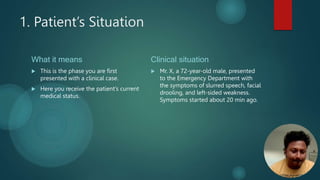
1. Patient’s Situation
What it means
 This is the phase you are first
presented with a clinical case.
 Here you receive the patient’s current
medical status.
Clinical situation
 Mr. X, a 72-year-old male, presented
to the Emergency Department with
the symptoms of slurred speech, facial
drooling, and left-sided weakness.
Symptoms started about 20 min ago.
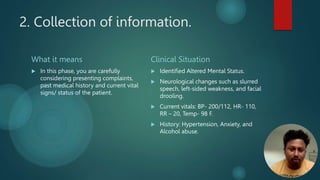
2. Collection of information.
What it means
 In this phase, you are carefully
considering presenting complaints,
past medical history and current vital
signs/ status of the patient.
Clinical Situation
 Identified Altered Mental Status.
 Neurological changes such as slurred
speech, left-sided weakness, and facial
drooling.
 Current vitals: BP- 200/112, HR- 110,
RR – 20, Temp- 98 F.
 History: Hypertension, Anxiety, and
Alcohol abuse.
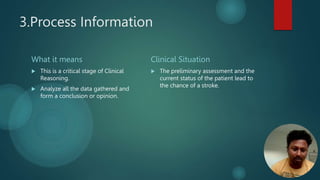
3.Process Information
What it means
 This is a critical stage of Clinical
Reasoning.
 Analyze all the data gathered and
form a conclusion or opinion.
Clinical Situation
 The preliminary assessment and the
current status of the patient lead to
the chance of a stroke.
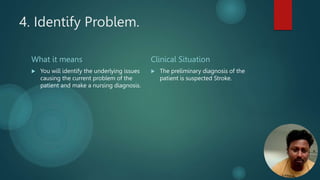
4. Identify Problem.
What it means
 You will identify the underlying issues
causing the current problem of the
patient and make a nursing diagnosis.
Clinical Situation
 The preliminary diagnosis of the
patient is suspected Stroke.
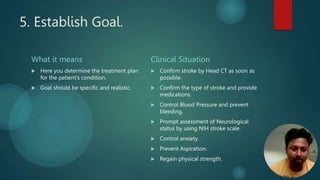
5. Establish Goal.
What it means
 Here you determine the treatment plan
for the patient’s condition.
 Goal should be specific and realistic.
Clinical Situation
 Confirm stroke by Head CT as soon as
possible.
 Confirm the type of stroke and provide
medications.
 Control Blood Pressure and prevent
bleeding.
 Prompt assessment of Neurological
status by using NIH stroke scale.
 Control anxiety.
 Prevent Aspiration.
 Regain physical strength.
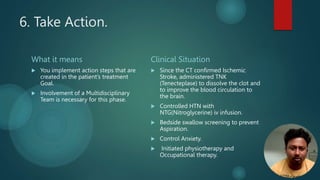
6. Take Action.
What it means
 You implement action steps that are
created in the patient’s treatment
Goal.
 Involvement of a Multidisciplinary
Team is necessary for this phase.
Clinical Situation
 Since the CT confirmed Ischemic
Stroke, administered TNK
(Tenecteplase) to dissolve the clot and
to improve the blood circulation to
the brain.
 Controlled HTN with
NTG(Nitroglycerine) iv infusion.
 Bedside swallow screening to prevent
Aspiration.
 Control Anxiety.
 Initiated physiotherapy and
Occupational therapy.
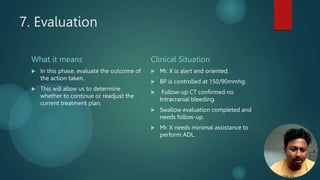
7. Evaluation
What it means
 In this phase, evaluate the outcome of
the action taken.
 This will allow us to determine
whether to continue or readjust the
current treatment plan.
Clinical Situation
 Mr. X is alert and oriented.
 BP is controlled at 150/90mmhg.
 Follow-up CT confirmed no
Intracranial bleeding.
 Swallow evaluation completed and
needs follow-up.
 Mr. X needs minimal assistance to
perform ADL.
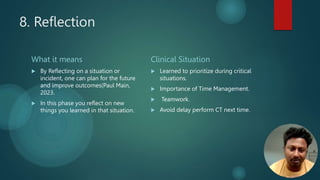
8. Reflection
What it means
 By Reflecting on a situation or
incident, one can plan for the future
and improve outcomes(Paul Main,
2023.
 In this phase you reflect on new
things you learned in that situation.
Clinical Situation
 Learned to prioritize during critical
situations.
 Importance of Time Management.
 Teamwork.
 Avoid delay perform CT next time.
Refferences
 Amy, G. (2018). Clinical reasoning: A state of the science report. From
https://www.degruyter.com/document/doi/10.1515/ijnes-2016-0024/html
 Deepti, T. (2021). Levette Jones’ Clinical Reasoning Cycle: A Case study.
https://www.tnaijournal-nji.com/admin/assets/article/pdf/9902_pdf.pdf
 European Heart Association.(2018). The clinical reasoning cycle: the eight
phases and their significance. From https://www.heartassociation.eu/the-
clinical-reasoning-cycle-the-8-phases-and-their-significance/
 Paul, M. (2023). Structural learning: Gibbs reflective cycle. From
https://www.structural-learning.com/post/gibbs-reflective-cycle

GCAN Powerpoint 1 (1) (1) 1.pptx

  • 1.
    Student Name- JerinJudy Student ID - M2326097 Unit Code - N8004 Critical Care Nursing. Tutor Name - Ms Rathika Dharmalingam.
  • 2.
    Levett Jones’ Clinical ReasoningCycle  Clinical reasoning is a crucial cognitive process utilized by nurses to gather and integrate information into their knowledge base. With this knowledge, they can make informed decisions about patient care and guide their therapeutic actions( Amy Golden Holder, 2018).
  • 3.
    1. Patient’s Situation Whatit means  This is the phase you are first presented with a clinical case.  Here you receive the patient’s current medical status. Clinical situation  Mr. X, a 72-year-old male, presented to the Emergency Department with the symptoms of slurred speech, facial drooling, and left-sided weakness. Symptoms started about 20 min ago.
  • 4.
    2. Collection ofinformation. What it means  In this phase, you are carefully considering presenting complaints, past medical history and current vital signs/ status of the patient. Clinical Situation  Identified Altered Mental Status.  Neurological changes such as slurred speech, left-sided weakness, and facial drooling.  Current vitals: BP- 200/112, HR- 110, RR – 20, Temp- 98 F.  History: Hypertension, Anxiety, and Alcohol abuse.
  • 5.
    3.Process Information What itmeans  This is a critical stage of Clinical Reasoning.  Analyze all the data gathered and form a conclusion or opinion. Clinical Situation  The preliminary assessment and the current status of the patient lead to the chance of a stroke.
  • 6.
    4. Identify Problem. Whatit means  You will identify the underlying issues causing the current problem of the patient and make a nursing diagnosis. Clinical Situation  The preliminary diagnosis of the patient is suspected Stroke.
  • 7.
    5. Establish Goal. Whatit means  Here you determine the treatment plan for the patient’s condition.  Goal should be specific and realistic. Clinical Situation  Confirm stroke by Head CT as soon as possible.  Confirm the type of stroke and provide medications.  Control Blood Pressure and prevent bleeding.  Prompt assessment of Neurological status by using NIH stroke scale.  Control anxiety.  Prevent Aspiration.  Regain physical strength.
  • 8.
    6. Take Action. Whatit means  You implement action steps that are created in the patient’s treatment Goal.  Involvement of a Multidisciplinary Team is necessary for this phase. Clinical Situation  Since the CT confirmed Ischemic Stroke, administered TNK (Tenecteplase) to dissolve the clot and to improve the blood circulation to the brain.  Controlled HTN with NTG(Nitroglycerine) iv infusion.  Bedside swallow screening to prevent Aspiration.  Control Anxiety.  Initiated physiotherapy and Occupational therapy.
  • 9.
    7. Evaluation What itmeans  In this phase, evaluate the outcome of the action taken.  This will allow us to determine whether to continue or readjust the current treatment plan. Clinical Situation  Mr. X is alert and oriented.  BP is controlled at 150/90mmhg.  Follow-up CT confirmed no Intracranial bleeding.  Swallow evaluation completed and needs follow-up.  Mr. X needs minimal assistance to perform ADL.
  • 10.
    8. Reflection What itmeans  By Reflecting on a situation or incident, one can plan for the future and improve outcomes(Paul Main, 2023.  In this phase you reflect on new things you learned in that situation. Clinical Situation  Learned to prioritize during critical situations.  Importance of Time Management.  Teamwork.  Avoid delay perform CT next time.
  • 11.
    Refferences  Amy, G.(2018). Clinical reasoning: A state of the science report. From https://www.degruyter.com/document/doi/10.1515/ijnes-2016-0024/html  Deepti, T. (2021). Levette Jones’ Clinical Reasoning Cycle: A Case study. https://www.tnaijournal-nji.com/admin/assets/article/pdf/9902_pdf.pdf  European Heart Association.(2018). The clinical reasoning cycle: the eight phases and their significance. From https://www.heartassociation.eu/the- clinical-reasoning-cycle-the-8-phases-and-their-significance/  Paul, M. (2023). Structural learning: Gibbs reflective cycle. From https://www.structural-learning.com/post/gibbs-reflective-cycle