DNA Methylation Patterns & Epigenetic Regulation in the Pacific Oyster  Mackenzie Gavery & Steven Roberts University of Washington School of Aquatic and Fishery Sciences
Outline Background : epigenetics, DNA methylation  Results : characterization of DNA  methylation in Pacific oysters Implications Future directions
Background:  GENES (DNA) TRAITS color growth disease resistance toxins ENVIRONMENT nutrition pathogens
GENES (DNA) EPIGENOME (DNA methylation) TRAITS color growth disease resistance toxins Background:  ENVIRONMENT nutrition pathogens
Epigenetics  Heritable changes in trait or phenotype, caused by a mechanism other than mutation to the DNA sequence Most well understood epigenetic mechanism is  DNA methylation: occurs at CpG sites in animals regulates gene expression influenced by the environment  Me C G C G
Effects of disruptions: tumor promotion alteration of development inhibition of reproduction Compounds that impact normal epigenetic functions: Endocrine disruptors: estrogen, BPA, pesticides DNA methylation
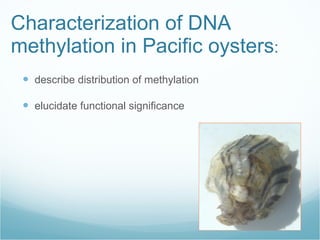
Characterization of DNA methylation in Pacific oysters : describe distribution of methylation elucidate functional significance
Results Methylation Specific PCR Bisulfite sequencing In silico  analysis
Results Methylation Sensitive PCR Bisulfite sequencing In silico  analysis
Results: gene-targeted approach Methylation Sensitive PCR 5 stress related genes were examined Identified CpG methylation in  heat shock protein 70 Bisulfite sequencing 136 bp fragment: 1 of 7 CpG methylated  (homology to  neuromedin-u receptor ) 93 bp fragment: 1 of 2 CpG methylated  (homology to  bromodomain adjacent to zinc finger domain )
Results Methylation Sensitive PCR Bisulfite sequencing In silico  analysis
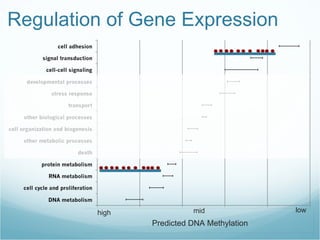
Results Methylation Sensitive PCR Bisulfite sequencing In silico  analysis predicted methylation status of 12,000  C. gigas  sequences from GigasBase sequences were grouped by Gene Ontology term an average predicted methylation status was determined
Regulation of Gene Expression high mid low Predicted DNA Methylation
Implications: evidence suggests DNA methylation plays a regulatory role in Pacific oysters implications for immune/stress responses
Implications: Environment Low   High
Selective breeding can contribute to improved & predictable performance in oysters Understanding genetic   and  epigenetic  influences will increase predictability Implications: Selective Breeding
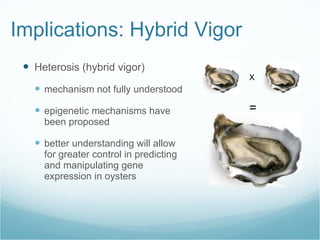
Implications: Hybrid Vigor Heterosis (hybrid vigor) mechanism not fully understood epigenetic mechanisms have been proposed better understanding will allow for greater control in predicting and manipulating gene expression in oysters  X =
Implications: Nutrition diet can modify traits by affecting DNA methylation.  Waterland & Jirtle,  Molecular and Cellular Biology , 2003
Future Directions Method evaluation/development: challenges associated with non-model species new approaches: Whole genome bisulfite sequencing (BS-seq) Methylated DNA immunoprecipitation (MeDIP) MeDIP-seq MeDIP-chip
Summary Characterization of DNA methylation in Pacific oyster suggests a role in gene regulation, specifically genes with inducible expression DNA methylation could be an important mechanism contributing to phenotypic variation in oysters  Important evaluate & develop methods and tools to evaluate epigenetic mechanisms in bivalves
Acknowledgements UW, SAFS Dr. Steven Roberts Samuel White Lisa Crosson Emma Timmins-Schiffman Taylor Shellfish Farms Joth Davis NSA-PCS  NOAA Aquaculture Program

Gavery PCSGA 2010

  • 1.
    DNA Methylation Patterns& Epigenetic Regulation in the Pacific Oyster Mackenzie Gavery & Steven Roberts University of Washington School of Aquatic and Fishery Sciences
  • 2.
    Outline Background :epigenetics, DNA methylation Results : characterization of DNA methylation in Pacific oysters Implications Future directions
  • 3.
    Background: GENES(DNA) TRAITS color growth disease resistance toxins ENVIRONMENT nutrition pathogens
  • 4.
    GENES (DNA) EPIGENOME(DNA methylation) TRAITS color growth disease resistance toxins Background: ENVIRONMENT nutrition pathogens
  • 5.
    GENES (DNA) EPIGENOME(DNA methylation) TRAITS color growth disease resistance toxins Background: ENVIRONMENT nutrition pathogens
  • 6.
    Epigenetics Heritablechanges in trait or phenotype, caused by a mechanism other than mutation to the DNA sequence Most well understood epigenetic mechanism is DNA methylation: occurs at CpG sites in animals regulates gene expression influenced by the environment Me C G C G
  • 7.
    Effects of disruptions:tumor promotion alteration of development inhibition of reproduction Compounds that impact normal epigenetic functions: Endocrine disruptors: estrogen, BPA, pesticides DNA methylation
  • 8.
    Characterization of DNAmethylation in Pacific oysters : describe distribution of methylation elucidate functional significance
  • 9.
    Results Methylation SpecificPCR Bisulfite sequencing In silico analysis
  • 10.
    Results Methylation SensitivePCR Bisulfite sequencing In silico analysis
  • 11.
    Results: gene-targeted approachMethylation Sensitive PCR 5 stress related genes were examined Identified CpG methylation in heat shock protein 70 Bisulfite sequencing 136 bp fragment: 1 of 7 CpG methylated (homology to neuromedin-u receptor ) 93 bp fragment: 1 of 2 CpG methylated (homology to bromodomain adjacent to zinc finger domain )
  • 12.
    Results Methylation SensitivePCR Bisulfite sequencing In silico analysis
  • 13.
    Results Methylation SensitivePCR Bisulfite sequencing In silico analysis predicted methylation status of 12,000 C. gigas sequences from GigasBase sequences were grouped by Gene Ontology term an average predicted methylation status was determined
  • 14.
    Regulation of GeneExpression high mid low Predicted DNA Methylation
  • 15.
    Regulation of GeneExpression high mid low Predicted DNA Methylation
  • 16.
    Implications: evidence suggestsDNA methylation plays a regulatory role in Pacific oysters implications for immune/stress responses
  • 17.
  • 18.
    Selective breeding cancontribute to improved & predictable performance in oysters Understanding genetic and epigenetic influences will increase predictability Implications: Selective Breeding
  • 19.
    Implications: Hybrid VigorHeterosis (hybrid vigor) mechanism not fully understood epigenetic mechanisms have been proposed better understanding will allow for greater control in predicting and manipulating gene expression in oysters X =
  • 20.
    Implications: Nutrition dietcan modify traits by affecting DNA methylation. Waterland & Jirtle, Molecular and Cellular Biology , 2003
  • 21.
    Future Directions Methodevaluation/development: challenges associated with non-model species new approaches: Whole genome bisulfite sequencing (BS-seq) Methylated DNA immunoprecipitation (MeDIP) MeDIP-seq MeDIP-chip
  • 22.
    Summary Characterization ofDNA methylation in Pacific oyster suggests a role in gene regulation, specifically genes with inducible expression DNA methylation could be an important mechanism contributing to phenotypic variation in oysters Important evaluate & develop methods and tools to evaluate epigenetic mechanisms in bivalves
  • 23.
    Acknowledgements UW, SAFSDr. Steven Roberts Samuel White Lisa Crosson Emma Timmins-Schiffman Taylor Shellfish Farms Joth Davis NSA-PCS NOAA Aquaculture Program