@qutdmrc
Grenoble, 30 May 2018
Prof. Axel Bruns | @snurb_dot_info
Gatewatching and News Curation
Journalism, Social Media, and the Public Sphere
@qutdmrc
Gatewatching and News Curation
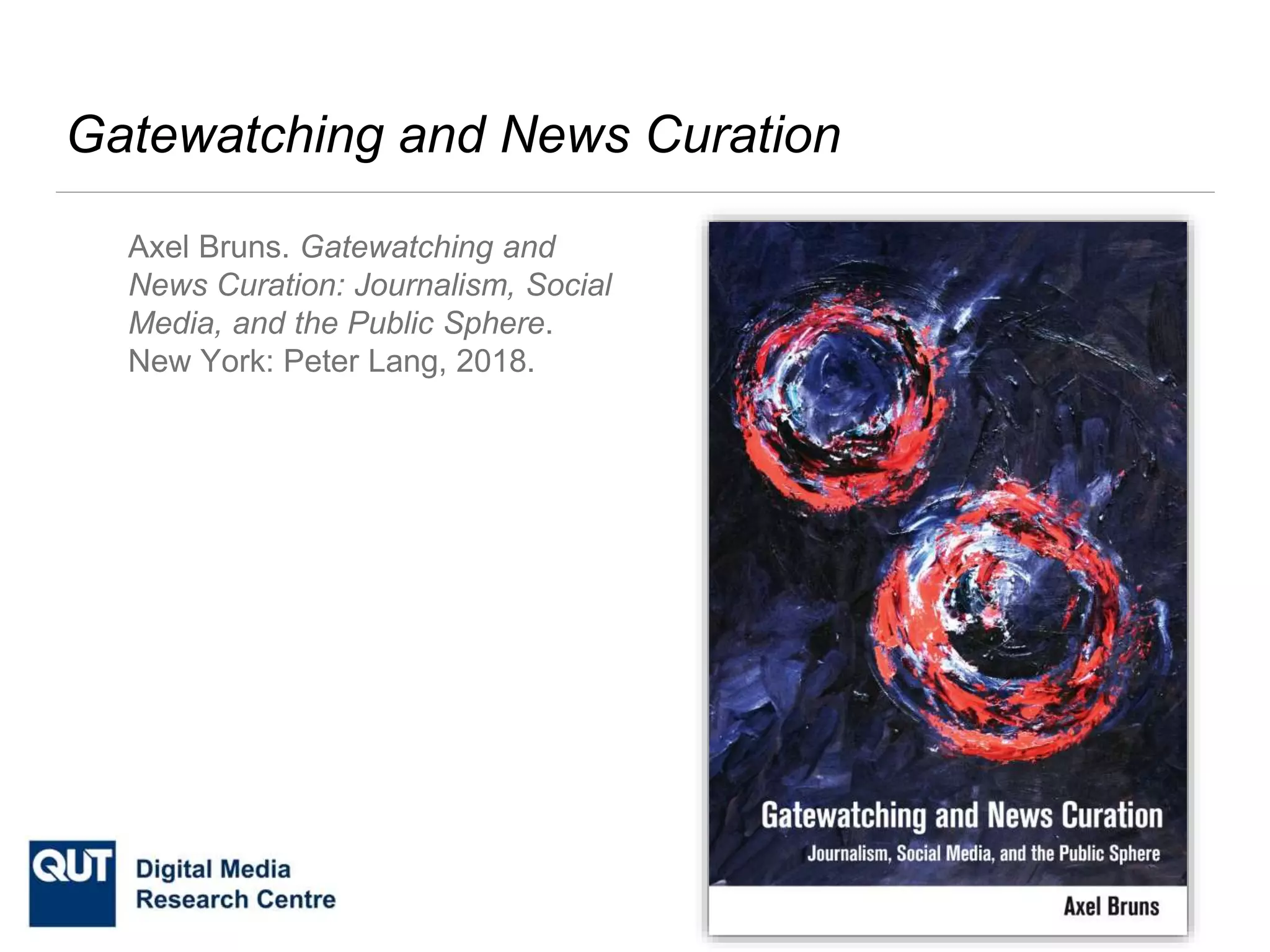
Axel Bruns. Gatewatching and
News Curation: Journalism, Social
Media, and the Public Sphere.
New York: Peter Lang, 2018.
Ancient History (The 2000s)Ancient History
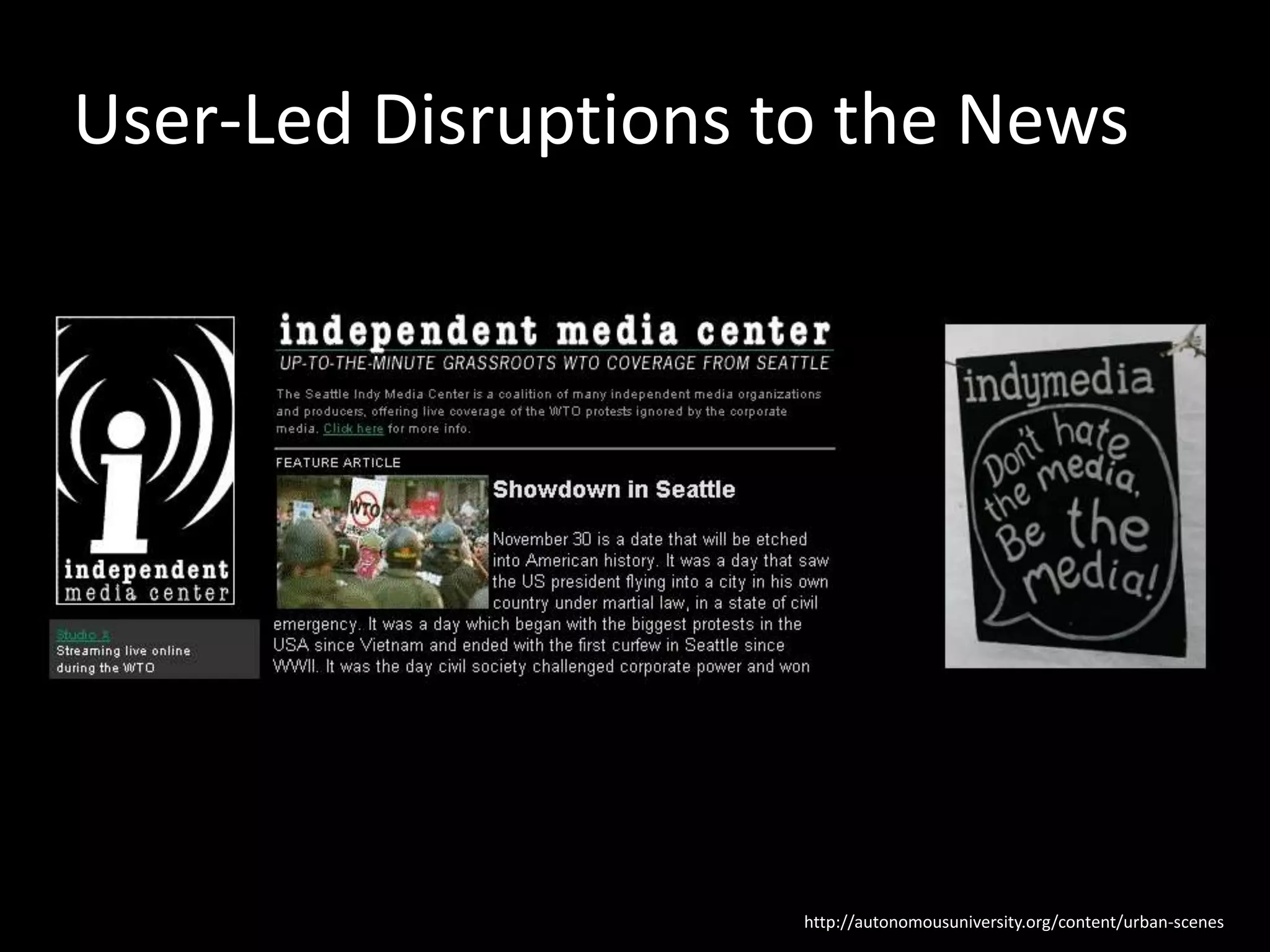
http://autonomousuniversity.org/content/urban-scenes
User-Led Disruptions to the News
@qutdmrc
User-Led Disruptions to the News
‘random acts of journalism’ — JD Lasica
‘a leap to authorship’ — Douglas Rushkoff
‘the people formerly known as the audience’ — Jay Rosen
from ‘filter, then publish’ to ‘publish, then filter’ — Clay Shirky
‘my readers know more than I do’ — Dan Gillmor
 news blogs, citizen journalism sites
 Drudge Report breaks Clinton/Lewinsky
 Salam Pax live-blogs bombing raids on Baghdad
@qutdmrc
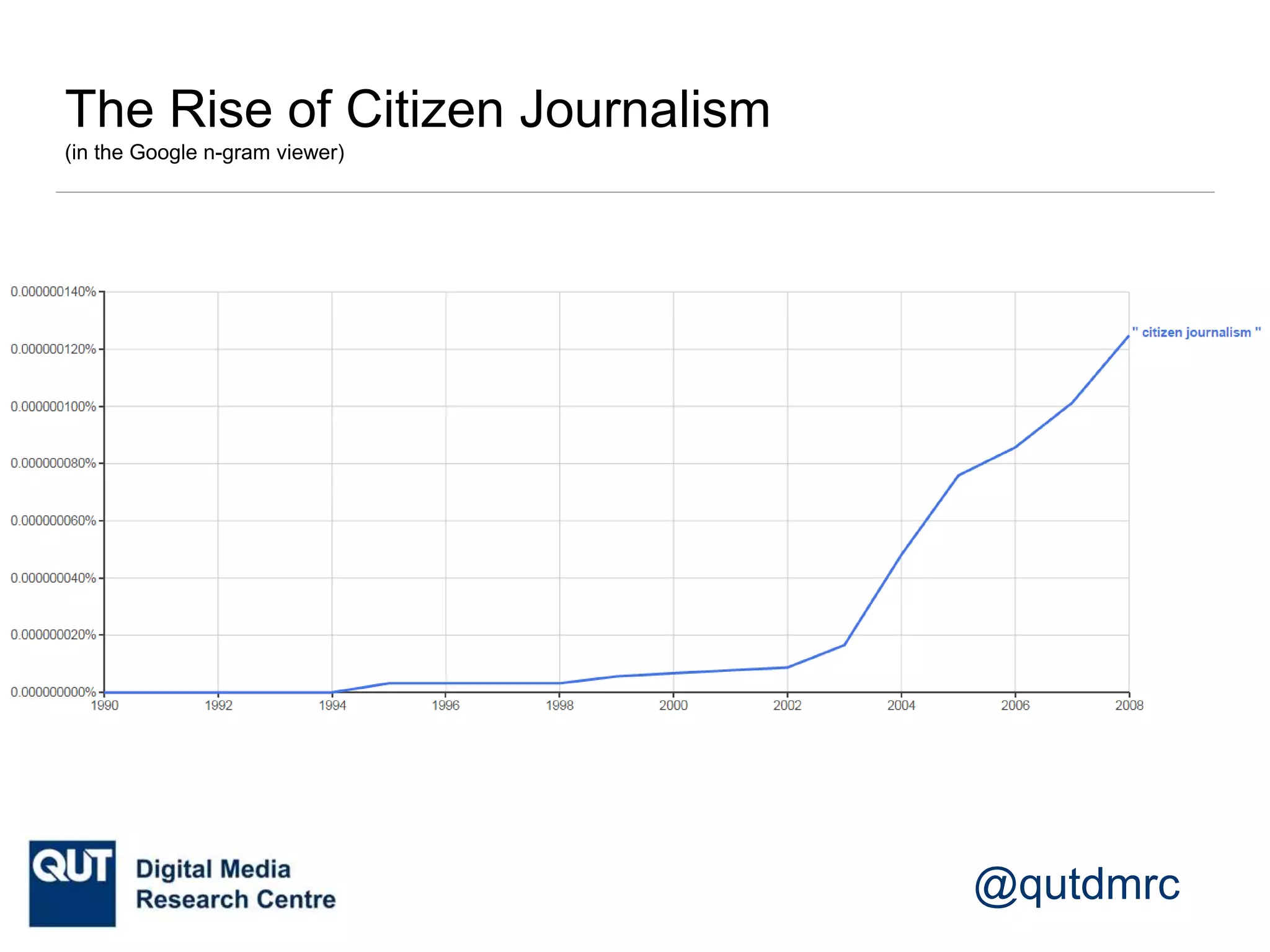
The Rise of Citizen Journalism
(in the Google n-gram viewer)
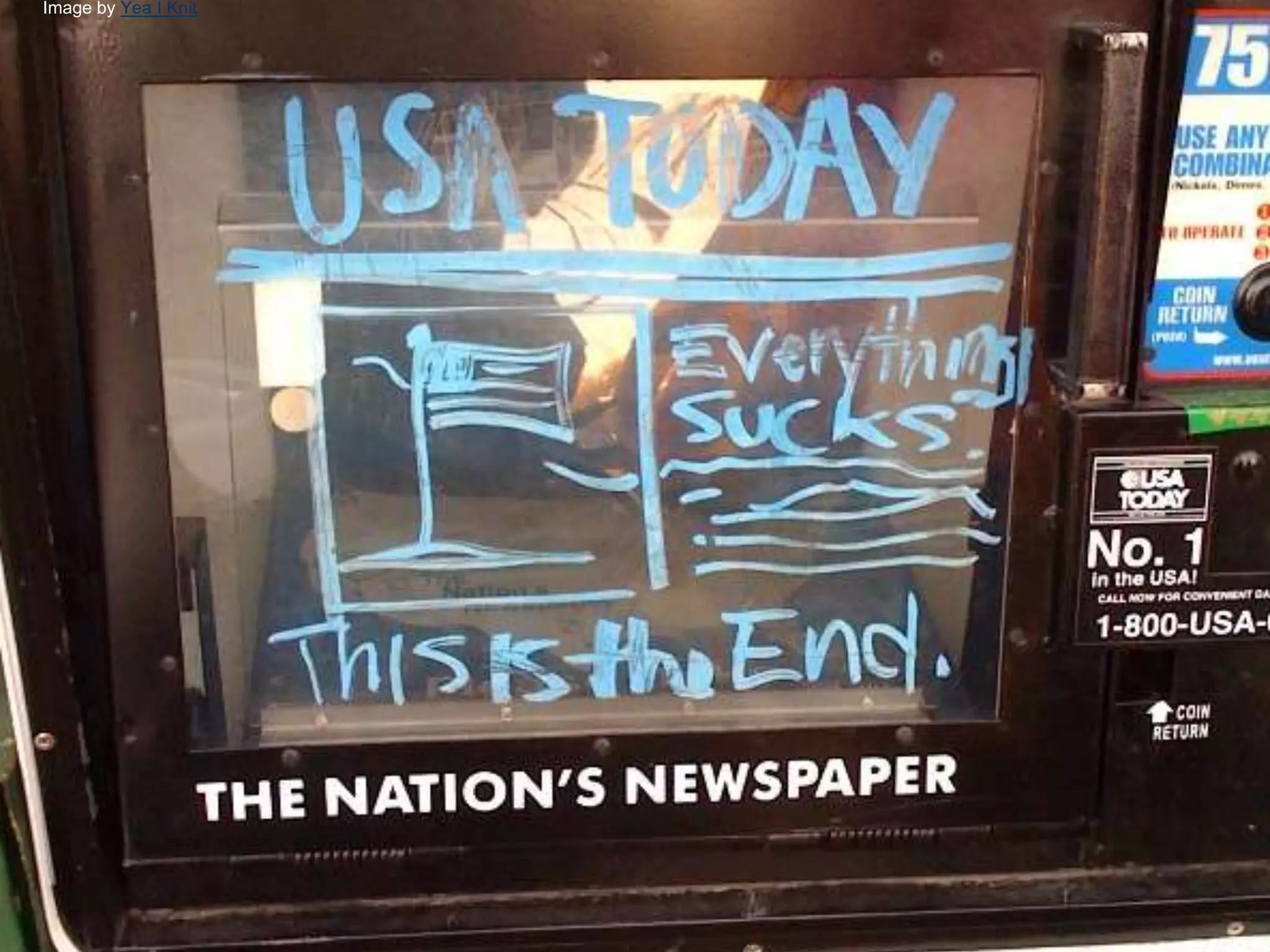
Image by Yea I Knit
@qutdmrc
From Parasites to Colleagues
‘journalists [have not] been eager to let the public in on how the
sausage is made’ — Jane Singer
but doing ‘proper’ journalism is resource-intensive: gatewatching, not gatekeeping
‘the balance of power between journalism and its publics is shifting’
— Jo Bardoel & Mark Deuze
‘the democratization of opinion on the net’ — Clay Shirky
‘the Internet, at its ugliest, is just an open sewer’ — Thomas L. Friedman
‘without the daily work of print journalists, one wonders if … blogs would
contain any real news’ — Paul Andrews
‘blogs … are being “normalized” by journalists’ — Jane Singer
‘we cannot expect citizen-journalism projects to provide serious
competition to established, corporate media’ — Chris Atton
A Second Wave of Disruption
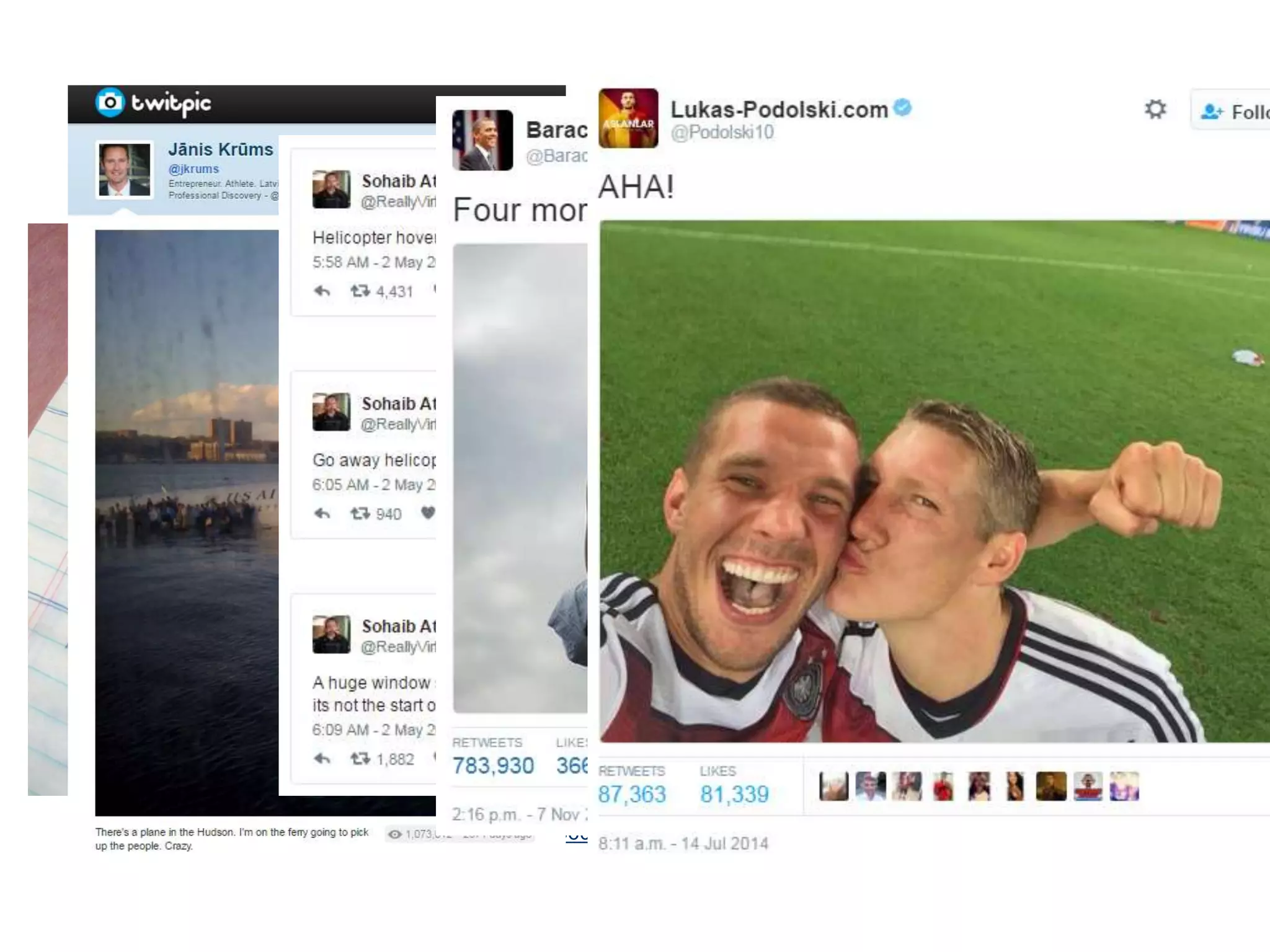
https://www.flickr.com/photos/jackdorsey/182613360
@qutdmrc
Social Media as Citizen Media
‘a vital source for real-time citizen news’ during crises — Stuart Allan
‘the witnesses are taking over the news’ — Jeff Jarvis
‘there is journalism before Twitter and journalism after Twitter’ — Emily Bell
‘a new seismograph for current and surprising events’ — Christoph Neuberger
‘a common medium for professional journalism and citizen journalism’ — Gilad Lotan et al.
‘social awareness streams … outside the formal structures of journalism’ — Alfred Hermida
‘crowdsourc[ing] prevalent actors and their tweets to prominence’
— Sharon Meraz & Zizi Papacharissi
@qutdmrc
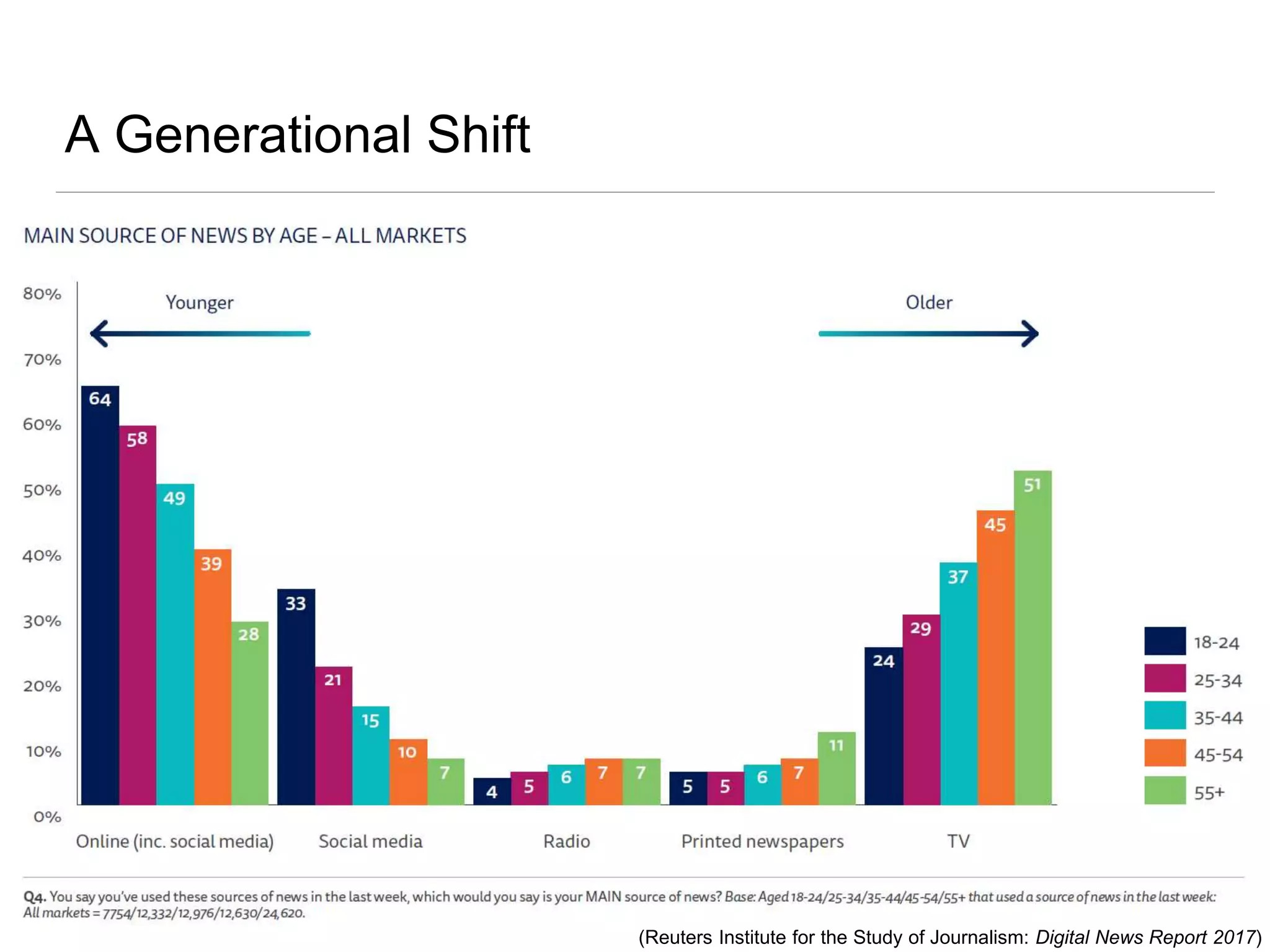
A Generational Shift
(Reuters Institute for the Study of Journalism: Digital News Report 2017)
@qutdmrc
(Image by falling.bullets)
@qutdmrc
Journalism and / on Social Media
‘hybrid system’ of ‘“older” and “newer” media’ — Andrew Chadwick et al.
‘with social media, journalism and audiences meet on uncommon ground’
— Wiebke Loosen and Jan Schmidt
‘spontaneously emerging encounter publics’ — Christoph Neuberger et al.
‘networks for the wild flows of messages’ — Jürgen Habermas
 from random acts of journalism to habitual acts of gatewatching and newssharing
 not democratic (equal voices), but demotic (widespread participation)
 collective news curation by social media users, including journalists
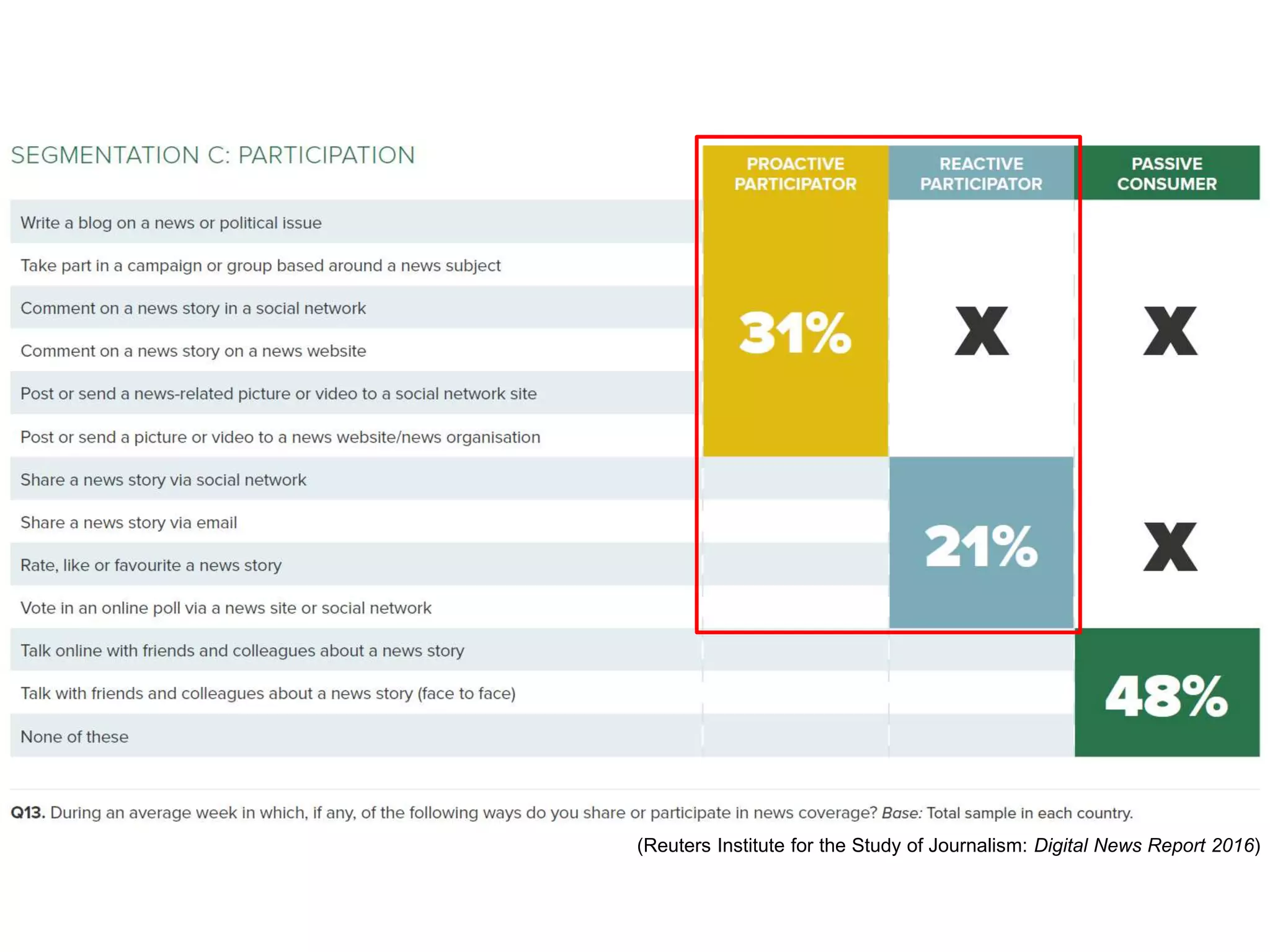
(Reuters Institute for the Study of Journalism: Digital News Report 2016)
@qutdmrc
Industry Responses
ban newssharing: paywalls, premium access, …
‘newspapers should want to be open and collaborative’ — Alan Rusbridger
belittle and vilify social media and their users
‘Twitter is … little more than a leftwing echo chamber’ — Chris Mitchell
revisit after major breakthrough events
‘I can’t tell you how many times I heard journos admit they “better get
into this Twitter thing” that fortnight’ – Latika Bourke
‘an obsolete job description just might equal success’ for The Guardian’s
Head of Digital Engagement – Joy Mayer
create ‘social media editors’ to coordinate the organisation’s strategy
@qutdmrc
Journalists’ Responses
‘individuals may be replacing institutions as the fundamental unit of the
profession’ — Logan Molyneux and Avery Holton
use for personal branding distinct from the news organisation
‘if you haven’t made it already as a journalist, you won’t become a
journalist unless you engage with social media’ — Silvia Costeloe
‘Twitter has been accepted as a ‘normalized’ medium, particularly
among younger professionals’ — Sada Reed
accept as a standard tool of the trade …
… and exploit for personal advancement
explore new modes and formats of journalistic work
‘immersed in social awareness streams that serve simultaneously as newswire,
newsroom and new outlet’ — Alfred Hermida
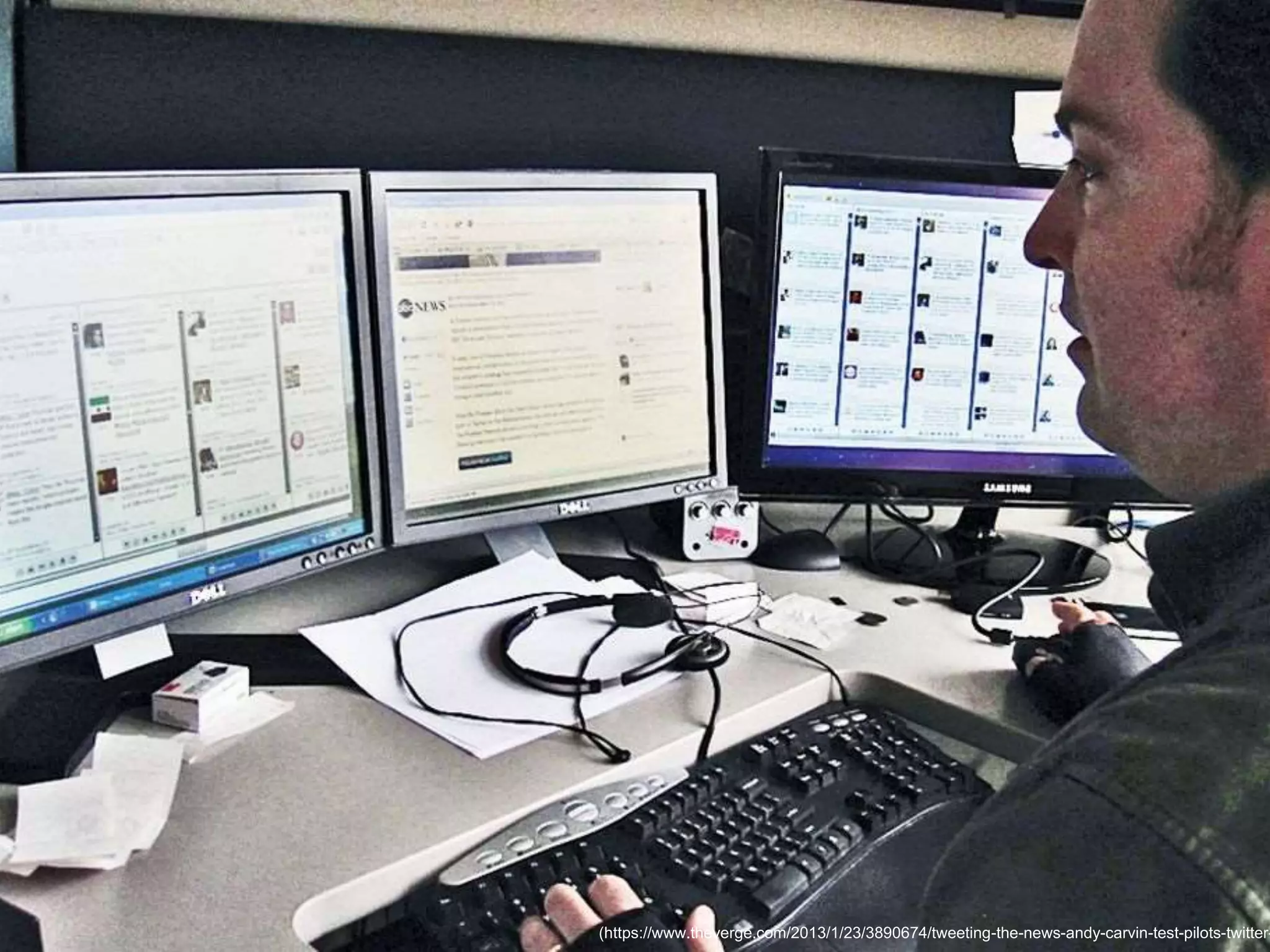
(https://www.theverge.com/2013/1/23/3890674/tweeting-the-news-andy-carvin-test-pilots-twitter-
Where to from Here?
@qutdmrc
Reshaping Networks
‘when reporters rely solely on social media, negotiation-through-conversation
is bypassed’ — Marcel Broersma and Todd Graham
‘reinforced the groupthink and echo chamber that is Washington political coverage’
— journalist interviewed by John H. Parmelee
‘you design your own filter bubble’ — Paul Bradshaw
‘Twitter has taken the conversations political reporters would have at the
press table … and pushed them into the public’ — Parmelee’s journalist
 more groupthink and concerns about echo chambers and filter bubbles,
 but also greater exposure of groupthink and insider talk to public scrutiny
 removing journalists as an inherently necessary part of the news process
@qutdmrc
Normalisation in Precarious Times
‘a more involved presence on Twitter … resulted in significant oomph in
correspondents’ popularity’ — Raluca Cozma and Kuan-Ju Chen
‘you go into survival mode, which for me means becoming a walking, talking,
texting, tweeting, whatever billboard for myself’ — journalist interviewed by Logan
Molyneux and Avery Holton
‘does journalism now include not only the content but also the journalist
herself?’ — Ulrika Hedman
 normalisation of social media into journalism,
 or normalisation of journalism into social media?
 if journalists and their content are free on Twitter, who pays the bills?
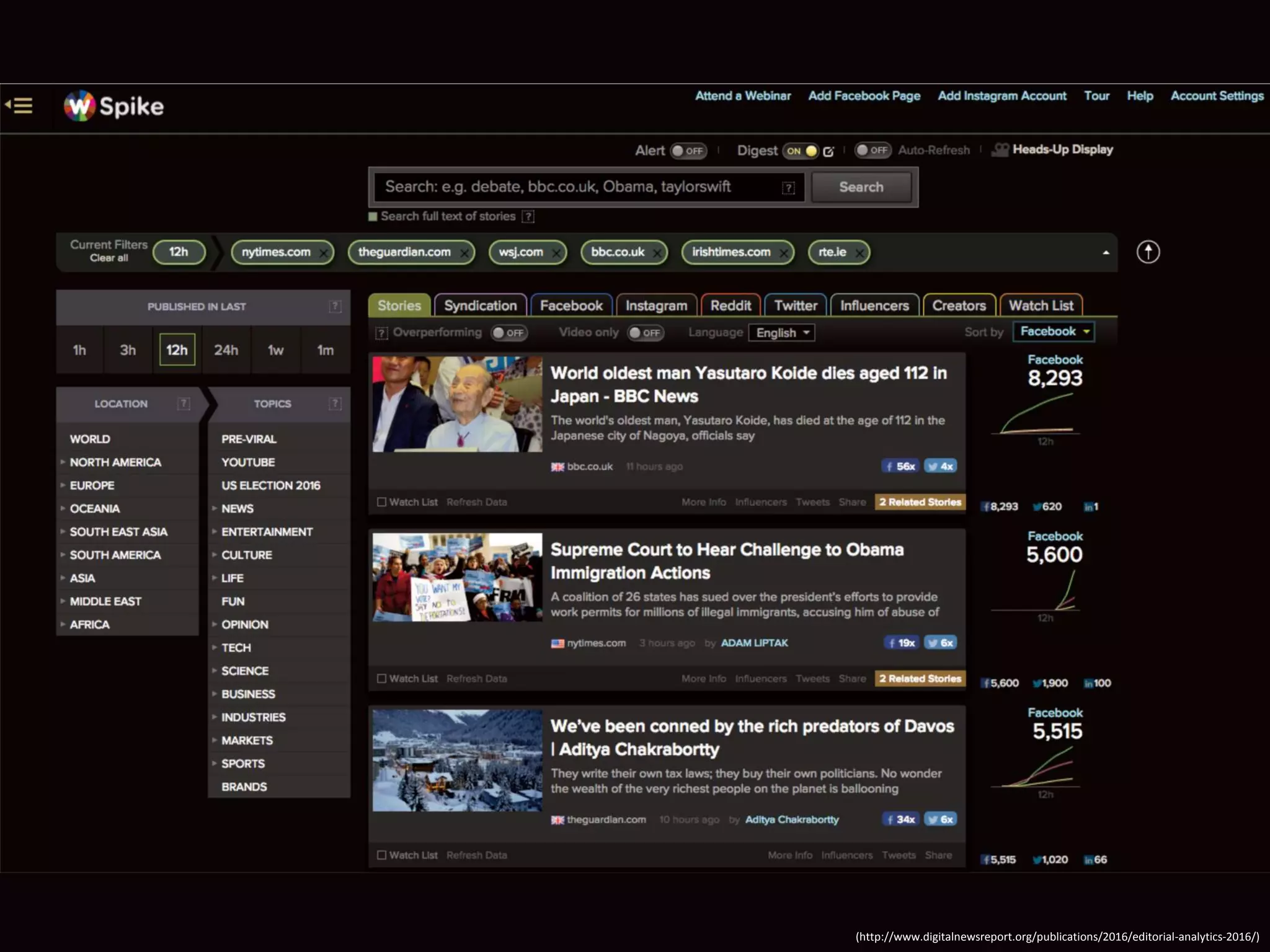
(http://www.digitalnewsreport.org/publications/2016/editorial-analytics-2016/)
@qutdmrc
Quantifying Journalism
‘systematic analysis of quantitative data on various aspects of audience
behavior’ ― Federica Cherubini and Rasmus Kleis Nielsen
‘basically, contemporary forms of analytics are very good at understanding the
main ways in which people used digital media in 2010’ ― Cherubini and Nielsen
‘“It’s like crack,” he said, grinning. “You can sit here and watch it, popping
all night.”’ ― newsroom manager interviewed by Edson Tandoc Jr.
 a feedback loop between newsroom gatekeeping and audience gatewatching
‘if the company’s not making money then I might get laid off’
― Tandoc Jr.’s interviewee
‘the natural inclination, if one metric is seen as the important, true metric
… is to game it’ ― Jonah Peretti
‘Buzzfeed has been built around the proposition that distribution of
journalism will happen primarily through social networks’ ― Jonah Peretti
@qutdmrc
Platform Power
‘journalists … are a pretty useful source of marketing for Twitter’ ― Ali Nobil Ahmad
‘transforming newspaper websites into appendages of Americanized
corporate information capitalism’ ― Ali Nobil Ahmad
‘65% of the digital ad revenue pie is swallowed up by just five tech
companies’ ― Pew Research Center
‘a trade-off between control of your own journalism, versus reaching large
audiences’ ― Emily Bell
‘we are definitely not a media company, but we do recognise that we play an
important role and that means we have responsibilities’ ― Facebook VP John
Hegeman
 need to re-route some revenue streams from platforms to content producers
 ‘fake news’ panic may provide an opportunity for wider regulatory intervention
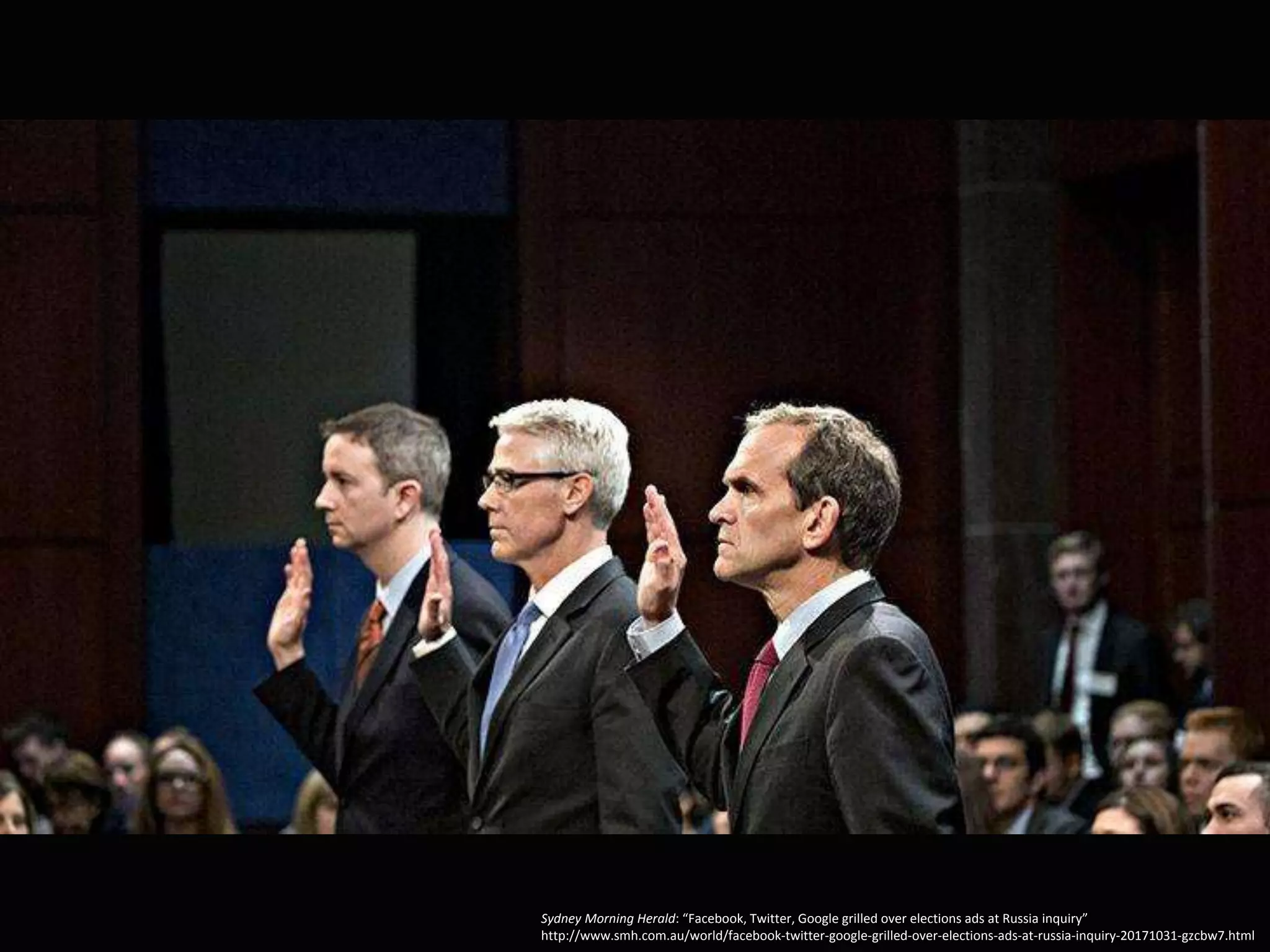
Sydney Morning Herald: “Facebook, Twitter, Google grilled over elections ads at Russia inquiry”
http://www.smh.com.au/world/facebook-twitter-google-grilled-over-elections-ads-at-russia-inquiry-20171031-gzcbw7.html
@qutdmrc
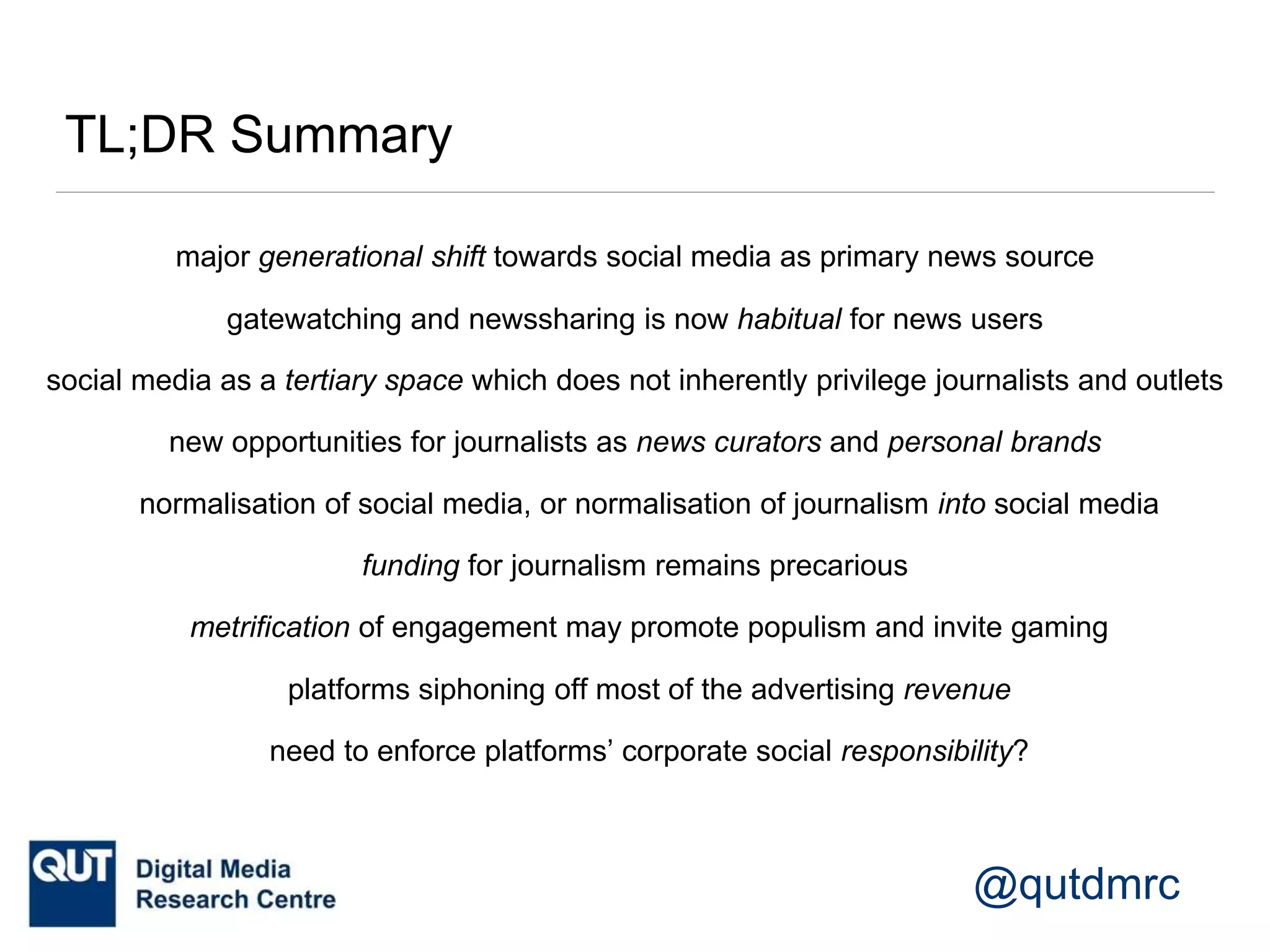
TL;DR Summary
social media as a tertiary space which does not inherently privilege journalists and outlets
metrification of engagement may promote populism and invite gaming
gatewatching and newssharing is now habitual for news users
new opportunities for journalists as news curators and personal brands
normalisation of social media, or normalisation of journalism into social media
major generational shift towards social media as primary news source
platforms siphoning off most of the advertising revenue
funding for journalism remains precarious
need to enforce platforms’ corporate social responsibility?
@qutdmrc
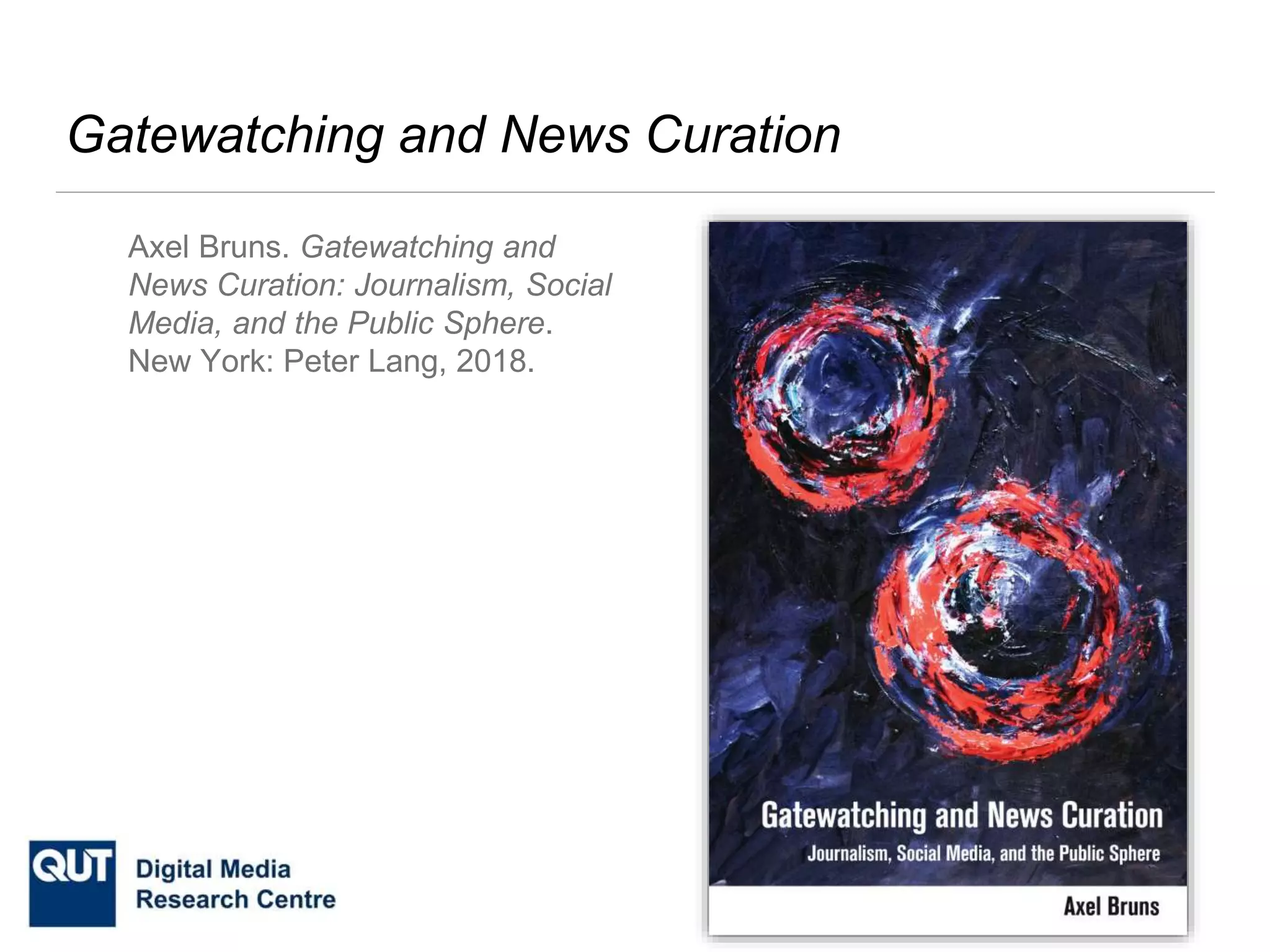
Gatewatching and News Curation
Axel Bruns. Gatewatching and
News Curation: Journalism, Social
Media, and the Public Sphere.
New York: Peter Lang, 2018.
@qutdmrc
Grenoble, 30 May 2018
Prof. Axel Bruns | @snurb_dot_info
http://snurb.info/
@socialmediaQUT – http://socialmedia.qut.edu.au/
@qutdmrc – https://www.qut.edu.au/research/dmrc
This research is supported by the ARC Future Fellowship project
“Understanding Intermedia Information Flows in the Australian
Online Public Sphere”, the ARC Discovery project “Journalism
beyond the Crisis: Emerging Forms, Practices, and Uses”, and the
ARC LIEF project “TrISMA: Tracking Infrastructure for Social
Media Analysis.”

Gatewatching and News Curation: Journalism, Social Media, and the Public Sphere

  • 1.
    @qutdmrc Grenoble, 30 May2018 Prof. Axel Bruns | @snurb_dot_info Gatewatching and News Curation Journalism, Social Media, and the Public Sphere
  • 2.
    @qutdmrc Gatewatching and NewsCuration Axel Bruns. Gatewatching and News Curation: Journalism, Social Media, and the Public Sphere. New York: Peter Lang, 2018.
  • 3.
    Ancient History (The2000s)Ancient History
  • 4.
  • 5.
    @qutdmrc User-Led Disruptions tothe News ‘random acts of journalism’ — JD Lasica ‘a leap to authorship’ — Douglas Rushkoff ‘the people formerly known as the audience’ — Jay Rosen from ‘filter, then publish’ to ‘publish, then filter’ — Clay Shirky ‘my readers know more than I do’ — Dan Gillmor  news blogs, citizen journalism sites  Drudge Report breaks Clinton/Lewinsky  Salam Pax live-blogs bombing raids on Baghdad
  • 6.
    @qutdmrc The Rise ofCitizen Journalism (in the Google n-gram viewer)
  • 7.
  • 8.
    @qutdmrc From Parasites toColleagues ‘journalists [have not] been eager to let the public in on how the sausage is made’ — Jane Singer but doing ‘proper’ journalism is resource-intensive: gatewatching, not gatekeeping ‘the balance of power between journalism and its publics is shifting’ — Jo Bardoel & Mark Deuze ‘the democratization of opinion on the net’ — Clay Shirky ‘the Internet, at its ugliest, is just an open sewer’ — Thomas L. Friedman ‘without the daily work of print journalists, one wonders if … blogs would contain any real news’ — Paul Andrews ‘blogs … are being “normalized” by journalists’ — Jane Singer ‘we cannot expect citizen-journalism projects to provide serious competition to established, corporate media’ — Chris Atton
  • 9.
    A Second Waveof Disruption
  • 10.
  • 11.
    @qutdmrc Social Media asCitizen Media ‘a vital source for real-time citizen news’ during crises — Stuart Allan ‘the witnesses are taking over the news’ — Jeff Jarvis ‘there is journalism before Twitter and journalism after Twitter’ — Emily Bell ‘a new seismograph for current and surprising events’ — Christoph Neuberger ‘a common medium for professional journalism and citizen journalism’ — Gilad Lotan et al. ‘social awareness streams … outside the formal structures of journalism’ — Alfred Hermida ‘crowdsourc[ing] prevalent actors and their tweets to prominence’ — Sharon Meraz & Zizi Papacharissi
  • 12.
    @qutdmrc A Generational Shift (ReutersInstitute for the Study of Journalism: Digital News Report 2017)
  • 13.
  • 14.
    @qutdmrc Journalism and /on Social Media ‘hybrid system’ of ‘“older” and “newer” media’ — Andrew Chadwick et al. ‘with social media, journalism and audiences meet on uncommon ground’ — Wiebke Loosen and Jan Schmidt ‘spontaneously emerging encounter publics’ — Christoph Neuberger et al. ‘networks for the wild flows of messages’ — Jürgen Habermas  from random acts of journalism to habitual acts of gatewatching and newssharing  not democratic (equal voices), but demotic (widespread participation)  collective news curation by social media users, including journalists
  • 15.
    (Reuters Institute forthe Study of Journalism: Digital News Report 2016)
  • 16.
    @qutdmrc Industry Responses ban newssharing:paywalls, premium access, … ‘newspapers should want to be open and collaborative’ — Alan Rusbridger belittle and vilify social media and their users ‘Twitter is … little more than a leftwing echo chamber’ — Chris Mitchell revisit after major breakthrough events ‘I can’t tell you how many times I heard journos admit they “better get into this Twitter thing” that fortnight’ – Latika Bourke ‘an obsolete job description just might equal success’ for The Guardian’s Head of Digital Engagement – Joy Mayer create ‘social media editors’ to coordinate the organisation’s strategy
  • 17.
    @qutdmrc Journalists’ Responses ‘individuals maybe replacing institutions as the fundamental unit of the profession’ — Logan Molyneux and Avery Holton use for personal branding distinct from the news organisation ‘if you haven’t made it already as a journalist, you won’t become a journalist unless you engage with social media’ — Silvia Costeloe ‘Twitter has been accepted as a ‘normalized’ medium, particularly among younger professionals’ — Sada Reed accept as a standard tool of the trade … … and exploit for personal advancement explore new modes and formats of journalistic work ‘immersed in social awareness streams that serve simultaneously as newswire, newsroom and new outlet’ — Alfred Hermida
  • 18.
  • 19.
  • 20.
    @qutdmrc Reshaping Networks ‘when reportersrely solely on social media, negotiation-through-conversation is bypassed’ — Marcel Broersma and Todd Graham ‘reinforced the groupthink and echo chamber that is Washington political coverage’ — journalist interviewed by John H. Parmelee ‘you design your own filter bubble’ — Paul Bradshaw ‘Twitter has taken the conversations political reporters would have at the press table … and pushed them into the public’ — Parmelee’s journalist  more groupthink and concerns about echo chambers and filter bubbles,  but also greater exposure of groupthink and insider talk to public scrutiny  removing journalists as an inherently necessary part of the news process
  • 21.
    @qutdmrc Normalisation in PrecariousTimes ‘a more involved presence on Twitter … resulted in significant oomph in correspondents’ popularity’ — Raluca Cozma and Kuan-Ju Chen ‘you go into survival mode, which for me means becoming a walking, talking, texting, tweeting, whatever billboard for myself’ — journalist interviewed by Logan Molyneux and Avery Holton ‘does journalism now include not only the content but also the journalist herself?’ — Ulrika Hedman  normalisation of social media into journalism,  or normalisation of journalism into social media?  if journalists and their content are free on Twitter, who pays the bills?
  • 22.
  • 23.
    @qutdmrc Quantifying Journalism ‘systematic analysisof quantitative data on various aspects of audience behavior’ ― Federica Cherubini and Rasmus Kleis Nielsen ‘basically, contemporary forms of analytics are very good at understanding the main ways in which people used digital media in 2010’ ― Cherubini and Nielsen ‘“It’s like crack,” he said, grinning. “You can sit here and watch it, popping all night.”’ ― newsroom manager interviewed by Edson Tandoc Jr.  a feedback loop between newsroom gatekeeping and audience gatewatching ‘if the company’s not making money then I might get laid off’ ― Tandoc Jr.’s interviewee ‘the natural inclination, if one metric is seen as the important, true metric … is to game it’ ― Jonah Peretti ‘Buzzfeed has been built around the proposition that distribution of journalism will happen primarily through social networks’ ― Jonah Peretti
  • 24.
    @qutdmrc Platform Power ‘journalists …are a pretty useful source of marketing for Twitter’ ― Ali Nobil Ahmad ‘transforming newspaper websites into appendages of Americanized corporate information capitalism’ ― Ali Nobil Ahmad ‘65% of the digital ad revenue pie is swallowed up by just five tech companies’ ― Pew Research Center ‘a trade-off between control of your own journalism, versus reaching large audiences’ ― Emily Bell ‘we are definitely not a media company, but we do recognise that we play an important role and that means we have responsibilities’ ― Facebook VP John Hegeman  need to re-route some revenue streams from platforms to content producers  ‘fake news’ panic may provide an opportunity for wider regulatory intervention
  • 25.
    Sydney Morning Herald:“Facebook, Twitter, Google grilled over elections ads at Russia inquiry” http://www.smh.com.au/world/facebook-twitter-google-grilled-over-elections-ads-at-russia-inquiry-20171031-gzcbw7.html
  • 26.
    @qutdmrc TL;DR Summary social mediaas a tertiary space which does not inherently privilege journalists and outlets metrification of engagement may promote populism and invite gaming gatewatching and newssharing is now habitual for news users new opportunities for journalists as news curators and personal brands normalisation of social media, or normalisation of journalism into social media major generational shift towards social media as primary news source platforms siphoning off most of the advertising revenue funding for journalism remains precarious need to enforce platforms’ corporate social responsibility?
  • 27.
    @qutdmrc Gatewatching and NewsCuration Axel Bruns. Gatewatching and News Curation: Journalism, Social Media, and the Public Sphere. New York: Peter Lang, 2018.
  • 28.
    @qutdmrc Grenoble, 30 May2018 Prof. Axel Bruns | @snurb_dot_info http://snurb.info/ @socialmediaQUT – http://socialmedia.qut.edu.au/ @qutdmrc – https://www.qut.edu.au/research/dmrc This research is supported by the ARC Future Fellowship project “Understanding Intermedia Information Flows in the Australian Online Public Sphere”, the ARC Discovery project “Journalism beyond the Crisis: Emerging Forms, Practices, and Uses”, and the ARC LIEF project “TrISMA: Tracking Infrastructure for Social Media Analysis.”