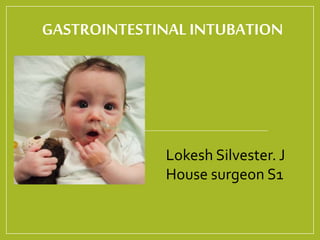
GASTROINTESTINALINTUBATION
Lokesh Silvester. J
House surgeon S1
INTRODUCTION
• Intubation: Placement of tube into
body structure
• Types of intubation
Orogastric: Mouth to stomach
Nasogastric: Nose to stomach
Nasointestinal: Nose to intestine
Ostomy: Surgically created opening
GIT INTUBATION USES
•Performing a gavage
•Administering oral medications
•Sampling sections for diagnostics
•Performing a lavage
•Compression/decompression
TYPES OFTUBES
•Orogastric tubes
•Nasogastric tubes
Some have more than one lumen
Gastric sump tubes (double-lumens)
•Nasointestinal tubes
Longer than nasogastric tubes
•Transabdominal tubes
Gastrostomy tube
Jeunostomy tube
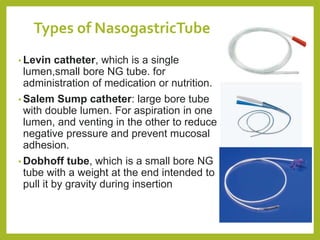
Types of NasogastricTube
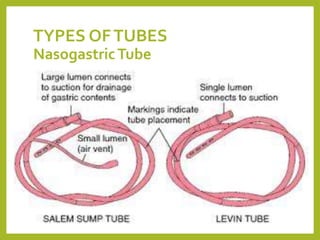
• Levin catheter, which is a single
lumen,small bore NG tube. for
administration of medication or nutrition.
• Salem Sump catheter: large bore tube
with double lumen. For aspiration in one
lumen, and venting in the other to reduce
negative pressure and prevent mucosal
adhesion.
• Dobhoff tube, which is a small bore NG
tube with a weight at the end intended to
pull it by gravity during insertion
TYPES OFTUBES
NasogastricTube
Technique
•Explain procedure to client
•Position the client in
Fowlers position
•Examine feeding tube
•Determine length of tube
to be inserted
•Measure distance from tip
of nose to earlobe and to
xyphoid process of
sternum
•Prepare tube for insertion
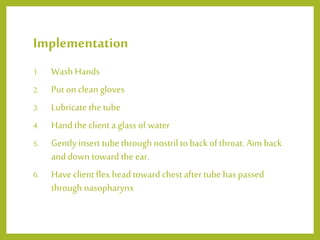
Implementation
1. Wash Hands
2. Put on clean gloves
3. Lubricate the tube
4. Hand the client a glassof water
5. Gently insert tube through nostril to back of throat. Aim back
and down toward the ear.
6. Have client flex head toward chest after tube haspassed
through nasopharynx
7. Emphasizetheneedtomouthbreatheandswallowduringtheprocedure
8. Swallowingfacilitatesthepassageofthetubethroughtheoropharynx.
9. Whenthetipofthetubereachesthecarniastopand listenfor airexchangefrom
thedistalendofthetube.Ifairisheardremove thetube.
10. Advancetubeeachtime clientswallowsuntildesiredlengthhasbeenreached
11. Donotforcetube.Ifresistanceismet(cough,chokeor becomecyanotic)stop
advancingthetubeandpullback
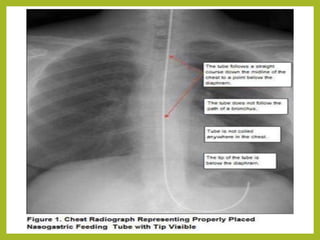
12. Checkplacementofthetube.
X-rayconfirmation
TestingpHofaspirate
13.Securethetubewithtapeor commercialdevice
Evaluation
•Observe client to determine response to procedure
•Persistent gagging can result in vomiting and aspiration
•Coughing may indicate presence oftube in airway
•Note location of external site marking on the tube
•Documentation
size of tube , which nostril and client’s response
Record length of tube from the nostril to end of tube
Record aspirate pH and characteristics
Testing placement
•Wash hands and put on clean gloves
•Draw up 30cc of airinto syringe and attach to end of NG tube.
Flush tube with 30cc of airproper to attempting to aspirate fluid.
•Draw back on syringe to obtain 5-10cc of gastric aspirate.
•Observe appearance of aspirate;
•From enteral feeding: Appearance of enteral feed
•Fromnasointestinal: Bile stained
•From stomach (non feed): Green,tan, bloody, brown
•Pleural fluid: Pale yellow and serous
Complications
•Clogged tube: Most common
•Dumping Syndrome: solution with high osmolality-
water moves into stomach and intestines from fluid
surrounding the organs and vascular system causing
dehydration, hypotension and tachycardia
•Aspiration: ensure head of bed is elevated at least 30
degrees while feeds are being administered
•Dehydration: diarrhea is common problem
•Electrolyte imbalance: Hyperkalemia and
hypernatremia
•Oral mucosa breakdown
•Nasal irritation
THANK YOU

Gastrointestinal-Intubation-1.pptx

  • 1.
  • 2.
    INTRODUCTION • Intubation: Placementof tube into body structure • Types of intubation Orogastric: Mouth to stomach Nasogastric: Nose to stomach Nasointestinal: Nose to intestine Ostomy: Surgically created opening
  • 3.
    GIT INTUBATION USES •Performinga gavage •Administering oral medications •Sampling sections for diagnostics •Performing a lavage •Compression/decompression
  • 4.
    TYPES OFTUBES •Orogastric tubes •Nasogastrictubes Some have more than one lumen Gastric sump tubes (double-lumens) •Nasointestinal tubes Longer than nasogastric tubes •Transabdominal tubes Gastrostomy tube Jeunostomy tube
  • 5.
    Types of NasogastricTube •Levin catheter, which is a single lumen,small bore NG tube. for administration of medication or nutrition. • Salem Sump catheter: large bore tube with double lumen. For aspiration in one lumen, and venting in the other to reduce negative pressure and prevent mucosal adhesion. • Dobhoff tube, which is a small bore NG tube with a weight at the end intended to pull it by gravity during insertion
  • 6.
  • 8.
    Technique •Explain procedure toclient •Position the client in Fowlers position •Examine feeding tube •Determine length of tube to be inserted •Measure distance from tip of nose to earlobe and to xyphoid process of sternum •Prepare tube for insertion
  • 9.
    Implementation 1. Wash Hands 2.Put on clean gloves 3. Lubricate the tube 4. Hand the client a glassof water 5. Gently insert tube through nostril to back of throat. Aim back and down toward the ear. 6. Have client flex head toward chest after tube haspassed through nasopharynx
  • 10.
    7. Emphasizetheneedtomouthbreatheandswallowduringtheprocedure 8. Swallowingfacilitatesthepassageofthetubethroughtheoropharynx. 9.Whenthetipofthetubereachesthecarniastopand listenfor airexchangefrom thedistalendofthetube.Ifairisheardremove thetube. 10. Advancetubeeachtime clientswallowsuntildesiredlengthhasbeenreached 11. Donotforcetube.Ifresistanceismet(cough,chokeor becomecyanotic)stop advancingthetubeandpullback 12. Checkplacementofthetube. X-rayconfirmation TestingpHofaspirate 13.Securethetubewithtapeor commercialdevice
  • 12.
    Evaluation •Observe client todetermine response to procedure •Persistent gagging can result in vomiting and aspiration •Coughing may indicate presence oftube in airway •Note location of external site marking on the tube •Documentation size of tube , which nostril and client’s response Record length of tube from the nostril to end of tube Record aspirate pH and characteristics
  • 13.
    Testing placement •Wash handsand put on clean gloves •Draw up 30cc of airinto syringe and attach to end of NG tube. Flush tube with 30cc of airproper to attempting to aspirate fluid. •Draw back on syringe to obtain 5-10cc of gastric aspirate. •Observe appearance of aspirate; •From enteral feeding: Appearance of enteral feed •Fromnasointestinal: Bile stained •From stomach (non feed): Green,tan, bloody, brown •Pleural fluid: Pale yellow and serous
  • 14.
    Complications •Clogged tube: Mostcommon •Dumping Syndrome: solution with high osmolality- water moves into stomach and intestines from fluid surrounding the organs and vascular system causing dehydration, hypotension and tachycardia •Aspiration: ensure head of bed is elevated at least 30 degrees while feeds are being administered •Dehydration: diarrhea is common problem •Electrolyte imbalance: Hyperkalemia and hypernatremia •Oral mucosa breakdown •Nasal irritation
  • 15.

Editor's Notes

  • #4 GAVAGE: the administration of food or drugs by force, especially to an animal, typically through a tube leading down the throat to the stomach LAVAGE: washing out of a body cavity, such as the colon or stomach, with water or a medicated solution COMPRESSION/ DECOMPRESSION Tube compression of the esophagus and stomach is an emergency procedure used to stop bleeding from the upper digestive tract. Eg: Esophageal varices
  • #11 carina is a ridge of cartilage in the trachea that occurs between the division of the two main bronchi.