Gap Analysis
Gap Analysis
Presentation by
Presentation by
Stephen Coppola
Stephen Coppola
Table of Contents
Table of Contents
• Definition of Gap Analysis
Definition of Gap Analysis
• Service Gap Analysis
Service Gap Analysis
• SERVQUAL
SERVQUAL
– Gaps Model
Gaps Model
– Dimension Model
Dimension Model
• Real World Gap Analysis
Real World Gap Analysis
• ISO 9001 2000
ISO 9001 2000
2
Definition
Definition of Gap Analysis
of Gap Analysis
• Formal means to identify and correct
Formal means to identify and correct
gaps between desired levels and
actual levels of performance
• Used by organizations to analyze
Used by organizations to analyze
certain processes of any division of
their company
their company
3
Service Gap Analysis
• Expected level of service vs.
Expected level of service vs.
Actual level of
Actual level of
service provided
service provided
• SERVQUAL
SERVQUAL
- 5 gaps
- 5 gaps
- 5 dimensions
- 5 dimensions
4
SERVQUAL
SERVQUAL
• A gap analysis research
A gap analysis research
instrument
instrument
– created by Parasuraman,
created by Parasuraman,
Zeithamel, and Berry
– Introduced in 1988
Introduced in 1988
5
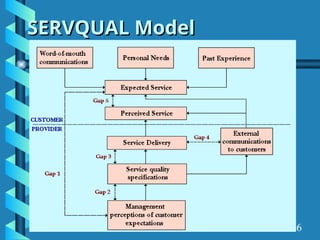
SERVQUAL Model
SERVQUAL Model
6
SERVQUAL Model Gaps
SERVQUAL Model Gaps
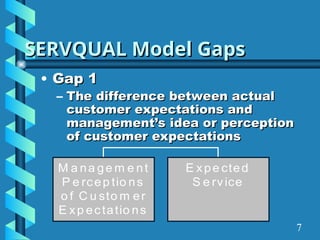
• Gap 1
Gap 1
– The difference between actual
The difference between actual
customer expectations and
management’s idea or perception
of customer expectations
M a na ge m e nt
P e rcep tio ns
o f C u sto m er
E xp ectatio ns
E xpe cted
S e rvice
7
SERVQUAL Model Gaps
SERVQUAL Model Gaps
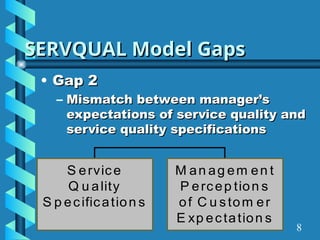
• Gap 2
Gap 2
– Mismatch between manager’s
Mismatch between manager’s
expectations of service quality and
service quality specifications
S ervice
Q u ality
S p ecification s
M an ag em en t
P ercep tion s
of C u stom er
E xp ectation s
8
SERVQUAL Model Gaps
SERVQUAL Model Gaps
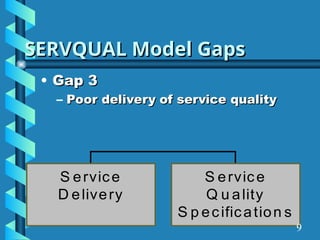
• Gap 3
Gap 3
– Poor delivery of service quality
Poor delivery of service quality
S ervice
D elivery
S ervice
Q u ality
S p ecification s
9
SERVQUAL Model Gaps
SERVQUAL Model Gaps
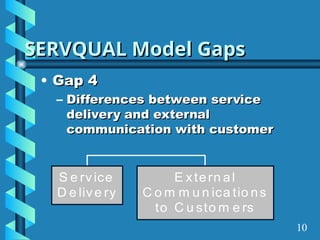
• Gap 4
Gap 4
– Differences between service
Differences between service
delivery and external
communication with customer
S e rvice
D e live ry
E xtern al
C o m m u n ica tio ns
to C u sto m e rs
10
SERVQUAL Model Gaps
SERVQUAL Model Gaps
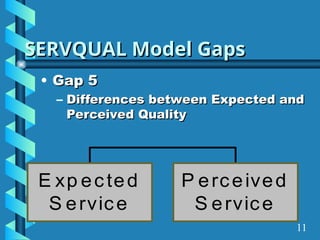
• Gap 5
Gap 5
– Differences between Expected and
Differences between Expected and
Perceived Quality
Perceived Quality
E xp ected
S ervice
P erceived
S ervice
11
Gaps Model
Gaps Model
12
Gaps Model
Gaps Model
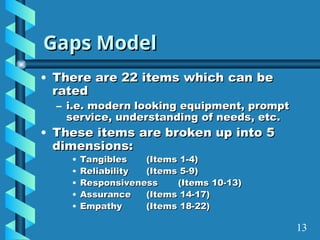
• There are 22 items which can be
There are 22 items which can be
rated
rated
– i.e. modern looking equipment, prompt
i.e. modern looking equipment, prompt
service, understanding of needs, etc.
• These items are broken up into 5
These items are broken up into 5
dimensions:
dimensions:
• Tangibles
Tangibles (Items 1-4)
(Items 1-4)
• Reliability
Reliability (Items 5-9)
(Items 5-9)
• Responsiveness
Responsiveness (Items 10-13)
(Items 10-13)
• Assurance
Assurance (Items 14-17)
(Items 14-17)
• Empathy
Empathy (Items 18-22)
(Items 18-22)
13
Gaps Model
Gaps Model
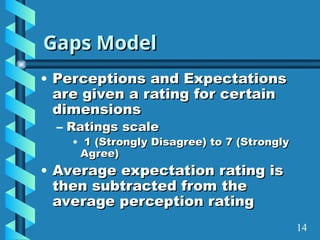
• Perceptions and Expectations
Perceptions and Expectations
are given a rating for certain
dimensions
dimensions
– Ratings scale
Ratings scale
• 1 (Strongly Disagree) to 7 (Strongly
1 (Strongly Disagree) to 7 (Strongly
Agree)
Agree)
• Average expectation rating is
Average expectation rating is
then subtracted from the
average perception rating
14
Gaps Model
Gaps Model
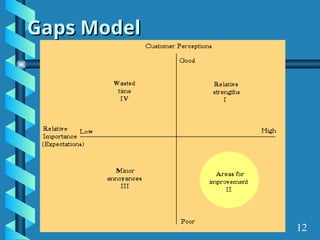
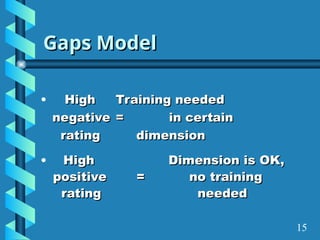
• High
High Training needed
Training needed
negative
negative = in certain
= in certain
rating
rating dimension
dimension
15
• High
High Dimension is OK,
Dimension is OK,
positive
positive =
= no training
no training
rating
rating needed
needed
Gaps Model Example
Gaps Model Example
For Example:
For Example:
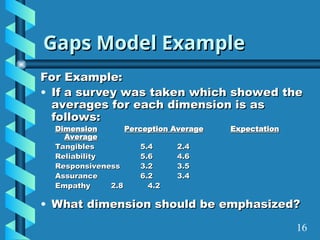
• If a survey was taken which showed the
If a survey was taken which showed the
averages for each dimension is as
follows:
follows:
Dimension
Dimension Perception Average
Perception Average Expectation
Expectation
Average
Average
Tangibles
Tangibles 5.4
5.4 2.4
2.4
Reliability
Reliability 5.6
5.6 4.6
4.6
Responsiveness
Responsiveness 3.2
3.2 3.5
3.5
Assurance
Assurance 6.2
6.2 3.4
3.4
Empathy
Empathy 2.8
2.8 4.2
4.2
• What dimension should be emphasized?
What dimension should be emphasized?
16
Gaps Model Example
Gaps Model Example
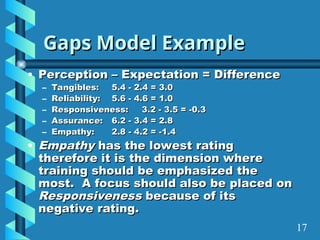
• Perception – Expectation = Difference
Perception – Expectation = Difference
– Tangibles:
Tangibles: 5.4 - 2.4 = 3.0
5.4 - 2.4 = 3.0
– Reliability:
Reliability: 5.6 - 4.6 = 1.0
5.6 - 4.6 = 1.0
– Responsiveness:
Responsiveness: 3.2 - 3.5 = -0.3
3.2 - 3.5 = -0.3
– Assurance:
Assurance: 6.2 - 3.4 = 2.8
6.2 - 3.4 = 2.8
– Empathy:
Empathy: 2.8 - 4.2 = -1.4
2.8 - 4.2 = -1.4
• Empathy
Empathy has the lowest rating
has the lowest rating
therefore it is the dimension where
training should be emphasized the
most. A focus should also be placed on
Responsiveness
Responsiveness because of its
because of its
negative rating.
negative rating.
17
Applications of Gap
Applications of Gap
Analysis
Analysis
• ISO 9001 2000
ISO 9001 2000
• Praxiom Research Group Limited
Praxiom Research Group Limited
• Process Approach
Process Approach
18
ISO 9001 2000
ISO 9001 2000
Gap Analysis Tool
Gap Analysis Tool
• Phase 1: Identify Gaps
Phase 1: Identify Gaps
• Phase 2: Fill Gaps
Phase 2: Fill Gaps
19
ISO 9001 2000
ISO 9001 2000
Gap Analysis Tool
Gap Analysis Tool
Identify Gaps:
Identify Gaps:
• Tool lists the five sets of requirements
Tool lists the five sets of requirements
from the ISO 9001 2000 as questions
– Systematic
Systematic
– Management
Management
– Resource
Resource
– Realization
Realization
– Analytical
Analytical
20
ISO 9001 2000
ISO 9001 2000
Gap Analysis Tool
Gap Analysis Tool
Identify Gaps:
Identify Gaps:
• Three answers are possible for each
Three answers are possible for each
question:
question:
– Yes
Yes – organization has met one of ISO’s
– organization has met one of ISO’s
requirement
requirement
– No
No – points to a gap
– points to a gap
– N/A
N/A – question is not applicable to
– question is not applicable to
situation
situation
21
ISO 9001 2000
ISO 9001 2000
Gap Analysis Tool
Gap Analysis Tool
Identify Gaps:
Identify Gaps:
• Each time “NO” is answered, there is
Each time “NO” is answered, there is
a column to help organization
identify which processes need to be
fixed
fixed
• 22 total processes which can be
22 total processes which can be
fixed
fixed
22
ISO 9001 2000
ISO 9001 2000
Gap Analysis Tool
Gap Analysis Tool
Fill Gaps:
Fill Gaps:
• Preparation and Implementation
Preparation and Implementation
of
of System Development Forms
System Development Forms
• Each of the 22 processes listed
Each of the 22 processes listed
in Phase One has a system
development form
development form
23
ISO 9001 2000
ISO 9001 2000
Gap Analysis Tool
Gap Analysis Tool
Fill Gaps:
Fill Gaps:
• These system development forms are
These system development forms are
used to prepare
used to prepare System Development
System Development
Plans
Plans
• The Gap Analysis questions are turned
The Gap Analysis questions are turned
into
into action statements
action statements
• These action statements formulate
These action statements formulate
remedial actions
remedial actions which will fill in the
which will fill in the
gaps
gaps
24
ISO 9001 2000
ISO 9001 2000
Gap Analysis Tool
Gap Analysis Tool
Fill Gaps:
Fill Gaps:
• Once all actions are performed
Once all actions are performed
and gaps are filled, the
organization will have a
ISO 9001 2000 compliant
Quality Management System
25
Summary of Gap Analysis
• Gaps can be found in any process of an
Gaps can be found in any process of an
organization’s operations
• Tools like SERVQUAL, Two-Dimensional
Tools like SERVQUAL, Two-Dimensional
Analysis, and ISO 9001 2000 can all be
used to perform gap analysis
• Gap Analysis is one of the best
Gap Analysis is one of the best
procedures to help lead a company to
not only improve their processes, but
recognize which processes are in need
of improvement.
of improvement.
26

GapAnalysis in Manufacturing System Management

  • 1.
    Gap Analysis Gap Analysis Presentationby Presentation by Stephen Coppola Stephen Coppola
  • 2.
    Table of Contents Tableof Contents • Definition of Gap Analysis Definition of Gap Analysis • Service Gap Analysis Service Gap Analysis • SERVQUAL SERVQUAL – Gaps Model Gaps Model – Dimension Model Dimension Model • Real World Gap Analysis Real World Gap Analysis • ISO 9001 2000 ISO 9001 2000 2
  • 3.
    Definition Definition of GapAnalysis of Gap Analysis • Formal means to identify and correct Formal means to identify and correct gaps between desired levels and gaps between desired levels and actual levels of performance actual levels of performance • Used by organizations to analyze Used by organizations to analyze certain processes of any division of certain processes of any division of their company their company 3
  • 4.
    Service Gap Analysis ServiceGap Analysis • Expected level of service vs. Expected level of service vs. Actual level of Actual level of service provided service provided • SERVQUAL SERVQUAL - 5 gaps - 5 gaps - 5 dimensions - 5 dimensions 4
  • 5.
    SERVQUAL SERVQUAL • A gapanalysis research A gap analysis research instrument instrument – created by Parasuraman, created by Parasuraman, Zeithamel, and Berry Zeithamel, and Berry – Introduced in 1988 Introduced in 1988 5
  • 6.
  • 7.
    SERVQUAL Model Gaps SERVQUALModel Gaps • Gap 1 Gap 1 – The difference between actual The difference between actual customer expectations and customer expectations and management’s idea or perception management’s idea or perception of customer expectations of customer expectations M a na ge m e nt P e rcep tio ns o f C u sto m er E xp ectatio ns E xpe cted S e rvice 7
  • 8.
    SERVQUAL Model Gaps SERVQUALModel Gaps • Gap 2 Gap 2 – Mismatch between manager’s Mismatch between manager’s expectations of service quality and expectations of service quality and service quality specifications service quality specifications S ervice Q u ality S p ecification s M an ag em en t P ercep tion s of C u stom er E xp ectation s 8
  • 9.
    SERVQUAL Model Gaps SERVQUALModel Gaps • Gap 3 Gap 3 – Poor delivery of service quality Poor delivery of service quality S ervice D elivery S ervice Q u ality S p ecification s 9
  • 10.
    SERVQUAL Model Gaps SERVQUALModel Gaps • Gap 4 Gap 4 – Differences between service Differences between service delivery and external delivery and external communication with customer communication with customer S e rvice D e live ry E xtern al C o m m u n ica tio ns to C u sto m e rs 10
  • 11.
    SERVQUAL Model Gaps SERVQUALModel Gaps • Gap 5 Gap 5 – Differences between Expected and Differences between Expected and Perceived Quality Perceived Quality E xp ected S ervice P erceived S ervice 11
  • 12.
  • 13.
    Gaps Model Gaps Model •There are 22 items which can be There are 22 items which can be rated rated – i.e. modern looking equipment, prompt i.e. modern looking equipment, prompt service, understanding of needs, etc. service, understanding of needs, etc. • These items are broken up into 5 These items are broken up into 5 dimensions: dimensions: • Tangibles Tangibles (Items 1-4) (Items 1-4) • Reliability Reliability (Items 5-9) (Items 5-9) • Responsiveness Responsiveness (Items 10-13) (Items 10-13) • Assurance Assurance (Items 14-17) (Items 14-17) • Empathy Empathy (Items 18-22) (Items 18-22) 13
  • 14.
    Gaps Model Gaps Model •Perceptions and Expectations Perceptions and Expectations are given a rating for certain are given a rating for certain dimensions dimensions – Ratings scale Ratings scale • 1 (Strongly Disagree) to 7 (Strongly 1 (Strongly Disagree) to 7 (Strongly Agree) Agree) • Average expectation rating is Average expectation rating is then subtracted from the then subtracted from the average perception rating average perception rating 14
  • 15.
    Gaps Model Gaps Model •High High Training needed Training needed negative negative = in certain = in certain rating rating dimension dimension 15 • High High Dimension is OK, Dimension is OK, positive positive = = no training no training rating rating needed needed
  • 16.
    Gaps Model Example GapsModel Example For Example: For Example: • If a survey was taken which showed the If a survey was taken which showed the averages for each dimension is as averages for each dimension is as follows: follows: Dimension Dimension Perception Average Perception Average Expectation Expectation Average Average Tangibles Tangibles 5.4 5.4 2.4 2.4 Reliability Reliability 5.6 5.6 4.6 4.6 Responsiveness Responsiveness 3.2 3.2 3.5 3.5 Assurance Assurance 6.2 6.2 3.4 3.4 Empathy Empathy 2.8 2.8 4.2 4.2 • What dimension should be emphasized? What dimension should be emphasized? 16
  • 17.
    Gaps Model Example GapsModel Example • Perception – Expectation = Difference Perception – Expectation = Difference – Tangibles: Tangibles: 5.4 - 2.4 = 3.0 5.4 - 2.4 = 3.0 – Reliability: Reliability: 5.6 - 4.6 = 1.0 5.6 - 4.6 = 1.0 – Responsiveness: Responsiveness: 3.2 - 3.5 = -0.3 3.2 - 3.5 = -0.3 – Assurance: Assurance: 6.2 - 3.4 = 2.8 6.2 - 3.4 = 2.8 – Empathy: Empathy: 2.8 - 4.2 = -1.4 2.8 - 4.2 = -1.4 • Empathy Empathy has the lowest rating has the lowest rating therefore it is the dimension where therefore it is the dimension where training should be emphasized the training should be emphasized the most. A focus should also be placed on most. A focus should also be placed on Responsiveness Responsiveness because of its because of its negative rating. negative rating. 17
  • 18.
    Applications of Gap Applicationsof Gap Analysis Analysis • ISO 9001 2000 ISO 9001 2000 • Praxiom Research Group Limited Praxiom Research Group Limited • Process Approach Process Approach 18
  • 19.
    ISO 9001 2000 ISO9001 2000 Gap Analysis Tool Gap Analysis Tool • Phase 1: Identify Gaps Phase 1: Identify Gaps • Phase 2: Fill Gaps Phase 2: Fill Gaps 19
  • 20.
    ISO 9001 2000 ISO9001 2000 Gap Analysis Tool Gap Analysis Tool Identify Gaps: Identify Gaps: • Tool lists the five sets of requirements Tool lists the five sets of requirements from the ISO 9001 2000 as questions from the ISO 9001 2000 as questions – Systematic Systematic – Management Management – Resource Resource – Realization Realization – Analytical Analytical 20
  • 21.
    ISO 9001 2000 ISO9001 2000 Gap Analysis Tool Gap Analysis Tool Identify Gaps: Identify Gaps: • Three answers are possible for each Three answers are possible for each question: question: – Yes Yes – organization has met one of ISO’s – organization has met one of ISO’s requirement requirement – No No – points to a gap – points to a gap – N/A N/A – question is not applicable to – question is not applicable to situation situation 21
  • 22.
    ISO 9001 2000 ISO9001 2000 Gap Analysis Tool Gap Analysis Tool Identify Gaps: Identify Gaps: • Each time “NO” is answered, there is Each time “NO” is answered, there is a column to help organization a column to help organization identify which processes need to be identify which processes need to be fixed fixed • 22 total processes which can be 22 total processes which can be fixed fixed 22
  • 23.
    ISO 9001 2000 ISO9001 2000 Gap Analysis Tool Gap Analysis Tool Fill Gaps: Fill Gaps: • Preparation and Implementation Preparation and Implementation of of System Development Forms System Development Forms • Each of the 22 processes listed Each of the 22 processes listed in Phase One has a system in Phase One has a system development form development form 23
  • 24.
    ISO 9001 2000 ISO9001 2000 Gap Analysis Tool Gap Analysis Tool Fill Gaps: Fill Gaps: • These system development forms are These system development forms are used to prepare used to prepare System Development System Development Plans Plans • The Gap Analysis questions are turned The Gap Analysis questions are turned into into action statements action statements • These action statements formulate These action statements formulate remedial actions remedial actions which will fill in the which will fill in the gaps gaps 24
  • 25.
    ISO 9001 2000 ISO9001 2000 Gap Analysis Tool Gap Analysis Tool Fill Gaps: Fill Gaps: • Once all actions are performed Once all actions are performed and gaps are filled, the and gaps are filled, the organization will have a organization will have a ISO 9001 2000 compliant ISO 9001 2000 compliant Quality Management System Quality Management System 25
  • 26.
    Summary of GapAnalysis Summary of Gap Analysis • Gaps can be found in any process of an Gaps can be found in any process of an organization’s operations organization’s operations • Tools like SERVQUAL, Two-Dimensional Tools like SERVQUAL, Two-Dimensional Analysis, and ISO 9001 2000 can all be Analysis, and ISO 9001 2000 can all be used to perform gap analysis used to perform gap analysis • Gap Analysis is one of the best Gap Analysis is one of the best procedures to help lead a company to procedures to help lead a company to not only improve their processes, but not only improve their processes, but recognize which processes are in need recognize which processes are in need of improvement. of improvement. 26

Editor's Notes

  • #1 156-74-1538 Gap Analysis Slide Presentation 02-19-01
  • #3 Gaps are indicators of corrective action and improvements In manufacturing, it could be difference between desired and existing conformance levels
  • #4 A good example where gap analysis is used for improvements in business is in the services field The most popular assessment tool used in service quality is called SERVQUAL, which involves a set of the 5 most important dimensions of quality according to rankings of customers Also involves a set of 5 gaps which represent the difference between customers’ expectations and perceptions
  • #5 The marketing research team of Parasuraman, Zeithamel, and Berry created this service quality measuring tool in 1988 Has been used in a wide range of studies including fields such as health care, banking, appliance repair, and many other professions Five Gaps include Customer expectations vs. managerial perceptions Manager’s expectations of quality vs. quality specs Communication with customer at point of service or sale Service delivery vs. communication Perceived services vs. expected services SERVQUAL is not a measurement to compare and rank separate companies but only to provide a measure for managers to determine actions needed in their own services
  • #7 Managers and employees have a very internal process-oriented view of their business, it is tough to break this view and to see things the way the customer does This gap of the SERVQUAL Model can help management with customer service
  • #8 To implement a system to improve this gap, management must first understand exactly what the customer wants If this understanding is not present, it will be impossible for management to know whether their expectations are aligned with customer specifications.
  • #9 Once the specifications from gap 2 are aligned the next step is to deliver these services in a perfect manner Quality of delivery must be perfected during the interaction with the customer The employees that are responsible for these actions are referred to as contact personnel Some reasons for a lack of quality include poor training, communication, and preparation
  • #10 Customers are influenced by what what they hear and see about a company’s service Word-of-mouth publicity and advertising are main outlets which customers open their opinions to The difference between what a customer hears about a company’s service and what is actually delivered is represented by gap 4 This gap can lead to dangerously negative customer perceptions
  • #11 This gap is directly related to everyone’s perception of service quality Customers expect certain things from certain companies When someone goes into a McDonalds to order their favorite meal – a Big Mac, they are expecting exactly what they are accustomed to getting (a quick, no hassle, tasty big burger with all the works). If it takes 15 minutes to get a Big Mac that doesn’t even have the famous special sauce on it the customer’s perceived service of McDonalds is going to plummet. If gaps 1 through 4 are closed to a minimum then gap 5 should follow, if there are any gaps left in steps 1 through 4 the perceived customer service quality will be negatively affected The way to make sure these gaps are closed is through thorough systems design, precise communication with customers, and a well-trained workforce.
  • #13 Tangibles: appearance of physical facilities, equipment, personnel, and communication materials Reliability: ability to perform the promised service dependably and accurately Responsiveness: willingness to help customers and provide prompt service Assurance: knowledge and courtesy of employees and their ability to convey trust and confidence Empathy: the caring, individualized attention the firm provides its customers Reliability is the most important dimension Tangibles is the least important dimension There is a shared importance between Reliability and Responsiveness
  • #14 Average ratings should usually be taken from a sample size of at least 50 participants
  • #15 If the average rating is negative there is a need for action As the rating gets lower below zero, the more stress must be placed on that process If the average rating is above zero, the requirements have been met and no action is needed
  • #18 The Praxiom Research Group Limited has a gap analysis tool offered on the internet at http://praxiom.com/iso-gap.htm This tool helps an organization find out what they need to do to meet the new ISO 9001 2000 standard The tool is offered in a hardcopy edition or a digital edition (either in Word or PDF format) This tool uses a process approach to service quality, not only because this approach makes the most sense but the ISO 9001 2000 makes it mandatory to do so Clause 4.1 of ISO 9001 2000 makes it very clear that organizations must identify and manage the processes that make up their Quality Management Systems
  • #19 The Praxion Research Group’s Gap Analysis Tools is made up of 2 phases: Identification of Gaps Filling of Gaps These Phases will be broken down in the next few slides
  • #20 This list of requirements is usually in the form of statements but for this tool they are used to ask questions not to make statements
  • #21 No answers reveal gaps between ISO’s standard and the organization’s process No answers also tell the organization that a process needs to be modified, improved, or created
  • #22 22 Processes: Quality Management Process Resource Management Process Regulatory Research Process Market Research Process Product Design Process Purchasing Process Production Process Service Process Product Protection Process Customer Needs Assessment Process Customer Communications Process Internal Communications Process Document Control Process Record Keeping Process Planning Process Training Process Internal Audit Process Management Review Process Measuring and Monitoring Process Nonconformance Management Process Continual Improvement Process General Systemic Process
  • #23 After identifying the gaps and figuring out which processes need changing, the preparation and implementation of System Development Forms occurs
  • #24 To develop plans from the forms, an organization must turn their gap analysis questions into remedial action statements These remedial actions are used to fill the gaps that are found in the identification stage The placement of these actions into the gaps is called the System Development Plan All remedial actions must be assigned a Remedial Action Number These numbers must cross reference ISO clause numbers and gap analysis questions answered earlier Job responsibilities are then given out to make sure that the remedial actions are carried out
  • #25 - After all remedial actions are set into motion and recorded in alignment with the ISO standards the date is recorded and after the actions take place the organization’s processes are soon on their way to becoming ISO 9001 2000 compliant.
  • #26 Bibliography Foster, S. Thomas, Managing Quality: An Integrative Approach. Prentice Hall, 2001: pg. 132-134, 231-234. Hiller, Steve, ARL SERVQUAL Survey Pilot. University of Washington Libraries. Nitecki, Danuta A., SERVQUAL: Measuring Service Quality In Academic Libraries, http://arl.cni.org/newsltr/191/servqual.html. “ISO 9001 2000 Gap Analysis Tool”, http://praxiom.com/iso-gap.htm.