Gap Analysis — Presentation Transcript
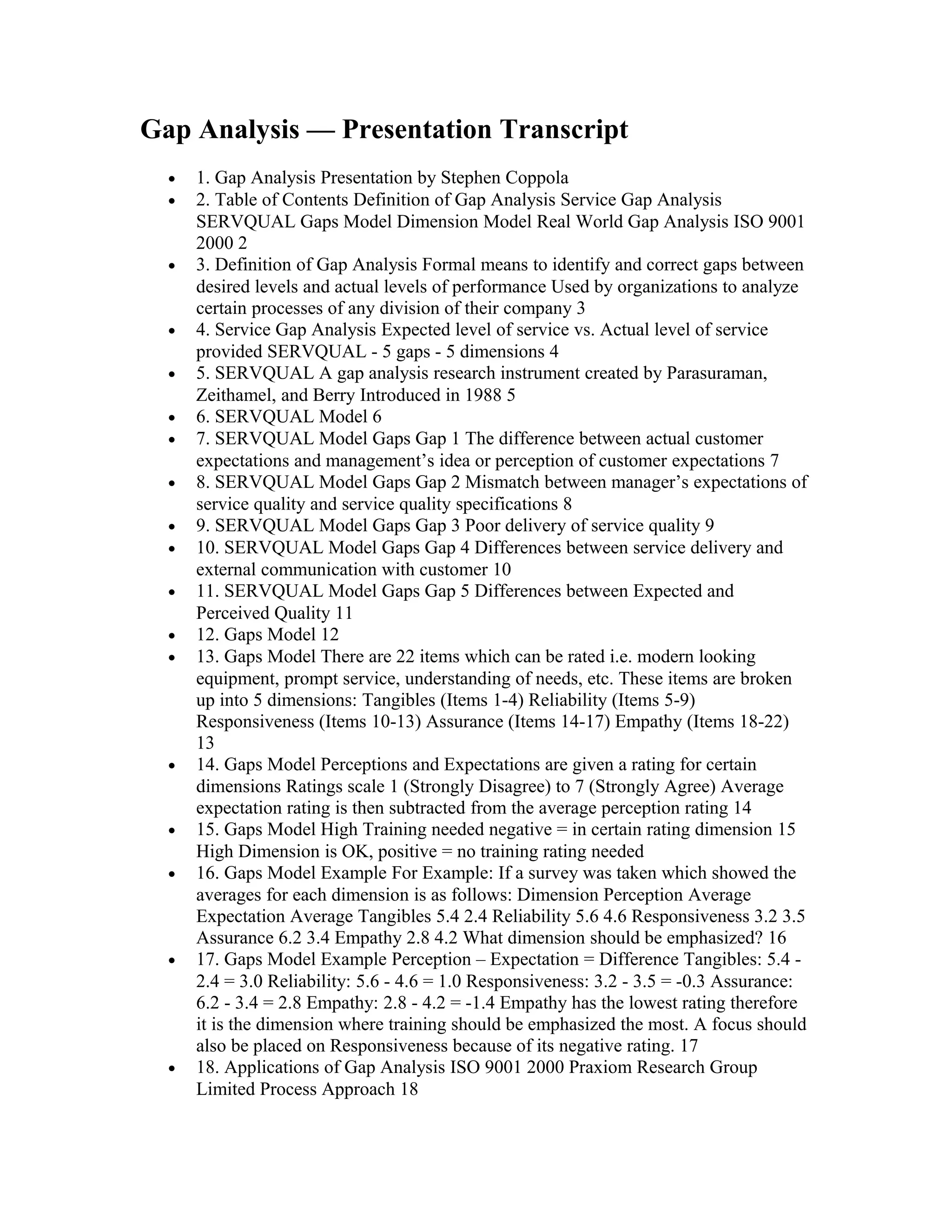
  •   1. Gap Analysis Presentation by Stephen Coppola
  •   2. Table of Contents Definition of Gap Analysis Service Gap Analysis
      SERVQUAL Gaps Model Dimension Model Real World Gap Analysis ISO 9001
      2000 2
  •   3. Definition of Gap Analysis Formal means to identify and correct gaps between
      desired levels and actual levels of performance Used by organizations to analyze
      certain processes of any division of their company 3
  •   4. Service Gap Analysis Expected level of service vs. Actual level of service
      provided SERVQUAL - 5 gaps - 5 dimensions 4
  •   5. SERVQUAL A gap analysis research instrument created by Parasuraman,
      Zeithamel, and Berry Introduced in 1988 5
  •   6. SERVQUAL Model 6
  •   7. SERVQUAL Model Gaps Gap 1 The difference between actual customer
      expectations and management’s idea or perception of customer expectations 7
  •   8. SERVQUAL Model Gaps Gap 2 Mismatch between manager’s expectations of
      service quality and service quality specifications 8
  •   9. SERVQUAL Model Gaps Gap 3 Poor delivery of service quality 9
  •   10. SERVQUAL Model Gaps Gap 4 Differences between service delivery and
      external communication with customer 10
  •   11. SERVQUAL Model Gaps Gap 5 Differences between Expected and
      Perceived Quality 11
  •   12. Gaps Model 12
  •   13. Gaps Model There are 22 items which can be rated i.e. modern looking
      equipment, prompt service, understanding of needs, etc. These items are broken
      up into 5 dimensions: Tangibles (Items 1-4) Reliability (Items 5-9)
      Responsiveness (Items 10-13) Assurance (Items 14-17) Empathy (Items 18-22)
      13
  •   14. Gaps Model Perceptions and Expectations are given a rating for certain
      dimensions Ratings scale 1 (Strongly Disagree) to 7 (Strongly Agree) Average
      expectation rating is then subtracted from the average perception rating 14
  •   15. Gaps Model High Training needed negative = in certain rating dimension 15
      High Dimension is OK, positive = no training rating needed
  •   16. Gaps Model Example For Example: If a survey was taken which showed the
      averages for each dimension is as follows: Dimension Perception Average
      Expectation Average Tangibles 5.4 2.4 Reliability 5.6 4.6 Responsiveness 3.2 3.5
      Assurance 6.2 3.4 Empathy 2.8 4.2 What dimension should be emphasized? 16
  •   17. Gaps Model Example Perception – Expectation = Difference Tangibles: 5.4 -
      2.4 = 3.0 Reliability: 5.6 - 4.6 = 1.0 Responsiveness: 3.2 - 3.5 = -0.3 Assurance:
      6.2 - 3.4 = 2.8 Empathy: 2.8 - 4.2 = -1.4 Empathy has the lowest rating therefore
      it is the dimension where training should be emphasized the most. A focus should
      also be placed on Responsiveness because of its negative rating. 17
  •   18. Applications of Gap Analysis ISO 9001 2000 Praxiom Research Group
      Limited Process Approach 18
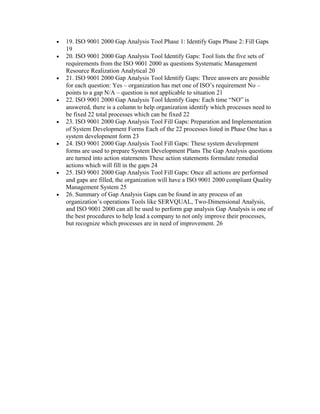
•   19. ISO 9001 2000 Gap Analysis Tool Phase 1: Identify Gaps Phase 2: Fill Gaps
    19
•   20. ISO 9001 2000 Gap Analysis Tool Identify Gaps: Tool lists the five sets of
    requirements from the ISO 9001 2000 as questions Systematic Management
    Resource Realization Analytical 20
•   21. ISO 9001 2000 Gap Analysis Tool Identify Gaps: Three answers are possible
    for each question: Yes – organization has met one of ISO’s requirement No –
    points to a gap N/A – question is not applicable to situation 21
•   22. ISO 9001 2000 Gap Analysis Tool Identify Gaps: Each time “NO” is
    answered, there is a column to help organization identify which processes need to
    be fixed 22 total processes which can be fixed 22
•   23. ISO 9001 2000 Gap Analysis Tool Fill Gaps: Preparation and Implementation
    of System Development Forms Each of the 22 processes listed in Phase One has a
    system development form 23
•   24. ISO 9001 2000 Gap Analysis Tool Fill Gaps: These system development
    forms are used to prepare System Development Plans The Gap Analysis questions
    are turned into action statements These action statements formulate remedial
    actions which will fill in the gaps 24
•   25. ISO 9001 2000 Gap Analysis Tool Fill Gaps: Once all actions are performed
    and gaps are filled, the organization will have a ISO 9001 2000 compliant Quality
    Management System 25
•   26. Summary of Gap Analysis Gaps can be found in any process of an
    organization’s operations Tools like SERVQUAL, Two-Dimensional Analysis,
    and ISO 9001 2000 can all be used to perform gap analysis Gap Analysis is one of
    the best procedures to help lead a company to not only improve their processes,
    but recognize which processes are in need of improvement. 26

Gap analysis

  • 1.
    Gap Analysis —Presentation Transcript • 1. Gap Analysis Presentation by Stephen Coppola • 2. Table of Contents Definition of Gap Analysis Service Gap Analysis SERVQUAL Gaps Model Dimension Model Real World Gap Analysis ISO 9001 2000 2 • 3. Definition of Gap Analysis Formal means to identify and correct gaps between desired levels and actual levels of performance Used by organizations to analyze certain processes of any division of their company 3 • 4. Service Gap Analysis Expected level of service vs. Actual level of service provided SERVQUAL - 5 gaps - 5 dimensions 4 • 5. SERVQUAL A gap analysis research instrument created by Parasuraman, Zeithamel, and Berry Introduced in 1988 5 • 6. SERVQUAL Model 6 • 7. SERVQUAL Model Gaps Gap 1 The difference between actual customer expectations and management’s idea or perception of customer expectations 7 • 8. SERVQUAL Model Gaps Gap 2 Mismatch between manager’s expectations of service quality and service quality specifications 8 • 9. SERVQUAL Model Gaps Gap 3 Poor delivery of service quality 9 • 10. SERVQUAL Model Gaps Gap 4 Differences between service delivery and external communication with customer 10 • 11. SERVQUAL Model Gaps Gap 5 Differences between Expected and Perceived Quality 11 • 12. Gaps Model 12 • 13. Gaps Model There are 22 items which can be rated i.e. modern looking equipment, prompt service, understanding of needs, etc. These items are broken up into 5 dimensions: Tangibles (Items 1-4) Reliability (Items 5-9) Responsiveness (Items 10-13) Assurance (Items 14-17) Empathy (Items 18-22) 13 • 14. Gaps Model Perceptions and Expectations are given a rating for certain dimensions Ratings scale 1 (Strongly Disagree) to 7 (Strongly Agree) Average expectation rating is then subtracted from the average perception rating 14 • 15. Gaps Model High Training needed negative = in certain rating dimension 15 High Dimension is OK, positive = no training rating needed • 16. Gaps Model Example For Example: If a survey was taken which showed the averages for each dimension is as follows: Dimension Perception Average Expectation Average Tangibles 5.4 2.4 Reliability 5.6 4.6 Responsiveness 3.2 3.5 Assurance 6.2 3.4 Empathy 2.8 4.2 What dimension should be emphasized? 16 • 17. Gaps Model Example Perception – Expectation = Difference Tangibles: 5.4 - 2.4 = 3.0 Reliability: 5.6 - 4.6 = 1.0 Responsiveness: 3.2 - 3.5 = -0.3 Assurance: 6.2 - 3.4 = 2.8 Empathy: 2.8 - 4.2 = -1.4 Empathy has the lowest rating therefore it is the dimension where training should be emphasized the most. A focus should also be placed on Responsiveness because of its negative rating. 17 • 18. Applications of Gap Analysis ISO 9001 2000 Praxiom Research Group Limited Process Approach 18
  • 2.
    19. ISO 9001 2000 Gap Analysis Tool Phase 1: Identify Gaps Phase 2: Fill Gaps 19 • 20. ISO 9001 2000 Gap Analysis Tool Identify Gaps: Tool lists the five sets of requirements from the ISO 9001 2000 as questions Systematic Management Resource Realization Analytical 20 • 21. ISO 9001 2000 Gap Analysis Tool Identify Gaps: Three answers are possible for each question: Yes – organization has met one of ISO’s requirement No – points to a gap N/A – question is not applicable to situation 21 • 22. ISO 9001 2000 Gap Analysis Tool Identify Gaps: Each time “NO” is answered, there is a column to help organization identify which processes need to be fixed 22 total processes which can be fixed 22 • 23. ISO 9001 2000 Gap Analysis Tool Fill Gaps: Preparation and Implementation of System Development Forms Each of the 22 processes listed in Phase One has a system development form 23 • 24. ISO 9001 2000 Gap Analysis Tool Fill Gaps: These system development forms are used to prepare System Development Plans The Gap Analysis questions are turned into action statements These action statements formulate remedial actions which will fill in the gaps 24 • 25. ISO 9001 2000 Gap Analysis Tool Fill Gaps: Once all actions are performed and gaps are filled, the organization will have a ISO 9001 2000 compliant Quality Management System 25 • 26. Summary of Gap Analysis Gaps can be found in any process of an organization’s operations Tools like SERVQUAL, Two-Dimensional Analysis, and ISO 9001 2000 can all be used to perform gap analysis Gap Analysis is one of the best procedures to help lead a company to not only improve their processes, but recognize which processes are in need of improvement. 26