THE LIFE OF GANDHI
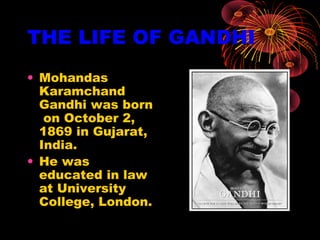
• Mohandas
Karamchand
Gandhi was born
on October 2,
1869 in Gujarat,
India.
• He was
educated in law
at University
College, London.
THE LIFE OF GANDHI
• In 1891, after
having been
admitted to the
British bar,
Gandhi returned
to India and
attempted to
establish a law
practice in
Bombay.
THE LIFE OF GANDHI
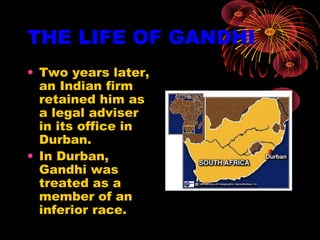
• Two years later,
an Indian firm
retained him as
a legal adviser
in its office in
Durban.
• In Durban,
Gandhi was
treated as a
member of an
inferior race.
THE LIFE OF GANDHI
• He wanted to
change the
elementary
rights for Indian
immigrants in
South Africa.
THE LIFE OF GANDHI
• Gandhi
remained in
South Africa for
20 years, where
he experienced
imprisonment
many times.
THE LIFE OF GANDHI
• In 1896, after
being attacked
and beaten by
white South
Africans, Gandhi
began to teach a
policy of passive
resistance.
THE LIFE OF GANDHI
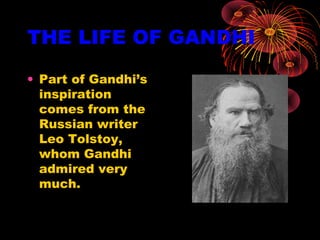
• Part of Gandhi’s
inspiration
comes from the
Russian writer
Leo Tolstoy,
whom Gandhi
admired very
much.
THE LIFE OF GANDHI
• During the Boer
War, Gandhi
organized an
ambulance
corps for the
British army and
commanded a
Red Cross unit.
THE LIFE OF GANDHI
• In 1910, he
founded a
cooperative
colony for
Indians called
Tolstoy Farm. It
was located
near Durban.
THE LIFE OF GANDHI
• In 1914 the
government of
the Union of
South Africa
made important
concessions to
Gandhi’s
demands,
including
recognition of
Indian marriages
and abolition of
the poll tax.
THE LIFE OF GANDHI
• Gandhi arrived
back in Bombay,
India in 1915.
• Europe has
already fallen
into World War I
by this time.
THE LIFE OF GANDHI
• He became the
leader of the
Indian campaign
for home rule.
• Following WWI,
he launched his
movement of
non-violent
resistance to
Great Britain.
THE LIFE OF GANDHI
• In 1919,
Parliament
passed the
Rowlatt Acts,
which gave the
Indian colonial
authorities
emergency
powers to deal
with
revolutionary
activities.
THE LIFE OF GANDHI
• Gandhi’s
teachings
spread
throughout
India, gaining
millions of
followers.
THE LIFE OF GANDHI
• Activities
against the
Rowlatt Acts
resulted in a
massacre of
Indians at
Amritsar by
British soldiers.
• There were
1,516
casualties.
THE LIFE OF GANDHI
• Economic
independence
for India,
involving the
complete
boycott of
British goods,
was made of
Gandhi’s “self-
ruling”
movement.
THE LIFE OF GANDHI
• Indians saw him
as a saint and
began calling
him “Mahatma”
(Great-soul).
• He thought that
by using non-
violence, Britain
would also
consider
violence
useless.
THE LIFE OF GANDHI
• In 1921, the
Indian National
Congress gave
Gandhi
complete
executive
authority.
THE LIFE OF GANDHI
• Series of armed
revolts broke
out against
Great Britain,
and Gandhi
ended the
campaign of the
civil-
disobedience.
THE LIFE OF GANDHI
• While
imprisoned,
Gandhi
undertook a
“fast unto
death” to
improve the
status of the
Untouchables in
1932.
THE LIFE OF GANDHI
• Gandhi formally
resigned from
politics in 1934
after being
replaced as a
leader of the
Congress by
Jawaharlal
Nehru.
THE LIFE OF GANDHI
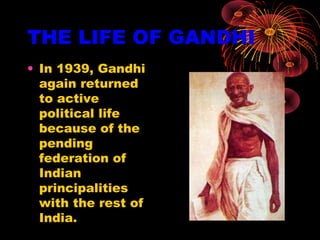
• In 1939, Gandhi
again returned
to active
political life
because of the
pending
federation of
Indian
principalities
with the rest of
India.
THE LIFE OF GANDHI
• His first action
was a fast
which would
improve the rule
of the state of
Rajkot.
THE LIFE OF GANDHI
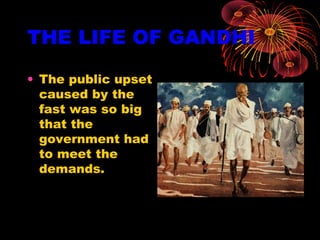
• The public upset
caused by the
fast was so big
that the
government had
to meet the
demands.
THE LIFE OF GANDHI
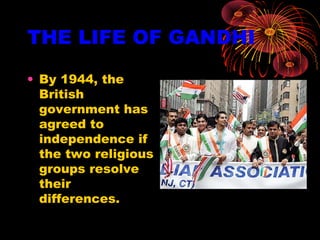
• By 1944, the
British
government has
agreed to
independence if
the two religious
groups resolve
their
differences.
THE LIFE OF GANDHI
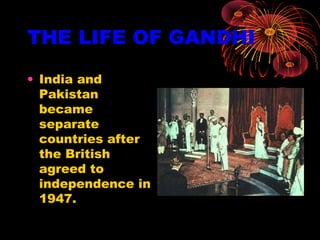
• India and
Pakistan
became
separate
countries after
the British
agreed to
independence in
1947.
THE LIFE OF GANDHI
• Gandhi was
assassinated on
January 30th
,
1948 by a Hindu.

Gandhi

  • 1.
    THE LIFE OFGANDHI • Mohandas Karamchand Gandhi was born on October 2, 1869 in Gujarat, India. • He was educated in law at University College, London.
  • 2.
    THE LIFE OFGANDHI • In 1891, after having been admitted to the British bar, Gandhi returned to India and attempted to establish a law practice in Bombay.
  • 3.
    THE LIFE OFGANDHI • Two years later, an Indian firm retained him as a legal adviser in its office in Durban. • In Durban, Gandhi was treated as a member of an inferior race.
  • 4.
    THE LIFE OFGANDHI • He wanted to change the elementary rights for Indian immigrants in South Africa.
  • 5.
    THE LIFE OFGANDHI • Gandhi remained in South Africa for 20 years, where he experienced imprisonment many times.
  • 6.
    THE LIFE OFGANDHI • In 1896, after being attacked and beaten by white South Africans, Gandhi began to teach a policy of passive resistance.
  • 7.
    THE LIFE OFGANDHI • Part of Gandhi’s inspiration comes from the Russian writer Leo Tolstoy, whom Gandhi admired very much.
  • 8.
    THE LIFE OFGANDHI • During the Boer War, Gandhi organized an ambulance corps for the British army and commanded a Red Cross unit.
  • 9.
    THE LIFE OFGANDHI • In 1910, he founded a cooperative colony for Indians called Tolstoy Farm. It was located near Durban.
  • 10.
    THE LIFE OFGANDHI • In 1914 the government of the Union of South Africa made important concessions to Gandhi’s demands, including recognition of Indian marriages and abolition of the poll tax.
  • 11.
    THE LIFE OFGANDHI • Gandhi arrived back in Bombay, India in 1915. • Europe has already fallen into World War I by this time.
  • 12.
    THE LIFE OFGANDHI • He became the leader of the Indian campaign for home rule. • Following WWI, he launched his movement of non-violent resistance to Great Britain.
  • 13.
    THE LIFE OFGANDHI • In 1919, Parliament passed the Rowlatt Acts, which gave the Indian colonial authorities emergency powers to deal with revolutionary activities.
  • 14.
    THE LIFE OFGANDHI • Gandhi’s teachings spread throughout India, gaining millions of followers.
  • 15.
    THE LIFE OFGANDHI • Activities against the Rowlatt Acts resulted in a massacre of Indians at Amritsar by British soldiers. • There were 1,516 casualties.
  • 16.
    THE LIFE OFGANDHI • Economic independence for India, involving the complete boycott of British goods, was made of Gandhi’s “self- ruling” movement.
  • 17.
    THE LIFE OFGANDHI • Indians saw him as a saint and began calling him “Mahatma” (Great-soul). • He thought that by using non- violence, Britain would also consider violence useless.
  • 18.
    THE LIFE OFGANDHI • In 1921, the Indian National Congress gave Gandhi complete executive authority.
  • 19.
    THE LIFE OFGANDHI • Series of armed revolts broke out against Great Britain, and Gandhi ended the campaign of the civil- disobedience.
  • 20.
    THE LIFE OFGANDHI • While imprisoned, Gandhi undertook a “fast unto death” to improve the status of the Untouchables in 1932.
  • 21.
    THE LIFE OFGANDHI • Gandhi formally resigned from politics in 1934 after being replaced as a leader of the Congress by Jawaharlal Nehru.
  • 22.
    THE LIFE OFGANDHI • In 1939, Gandhi again returned to active political life because of the pending federation of Indian principalities with the rest of India.
  • 23.
    THE LIFE OFGANDHI • His first action was a fast which would improve the rule of the state of Rajkot.
  • 24.
    THE LIFE OFGANDHI • The public upset caused by the fast was so big that the government had to meet the demands.
  • 25.
    THE LIFE OFGANDHI • By 1944, the British government has agreed to independence if the two religious groups resolve their differences.
  • 26.
    THE LIFE OFGANDHI • India and Pakistan became separate countries after the British agreed to independence in 1947.
  • 27.
    THE LIFE OFGANDHI • Gandhi was assassinated on January 30th , 1948 by a Hindu.