Standards
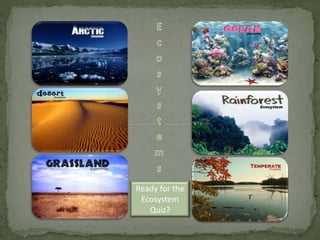
Ready for the
Ecosystem
Quiz?
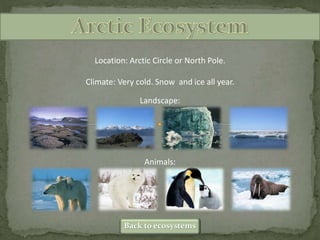
Location: Arctic Circle or North Pole.
Climate: Very cold. Snow and ice all year.
Landscape:
Animals:
Back to ecosystems
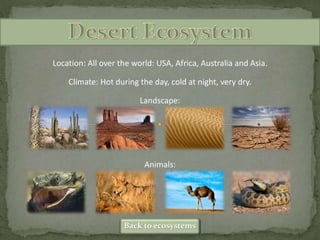
Location: All over the world: USA, Africa, Australia and Asia.
Climate: Hot during the day, cold at night, very dry.
Landscape:
Animals:
Back to ecosystems
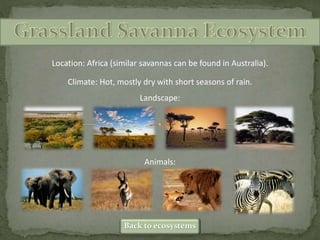
Location: Africa (similar savannas can be found in Australia).
Climate: Hot, mostly dry with short seasons of rain.
Landscape:
Animals:
Back to ecosystems
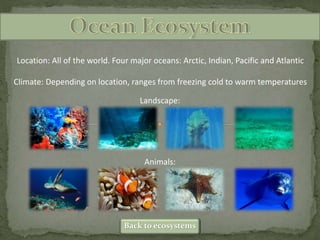
Location: All of the world. Four major oceans: Arctic, Indian, Pacific and Atlantic
Climate: Depending on location, ranges from freezing cold to warm temperatures
Landscape:
Animals:
Back to ecosystems
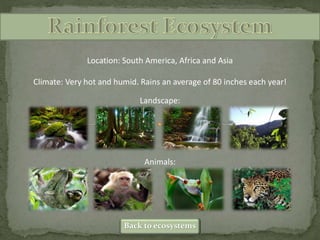
Location: South America, Africa and Asia
Climate: Very hot and humid. Rains an average of 80 inches each year!
Landscape:
Animals:
Back to ecosystems
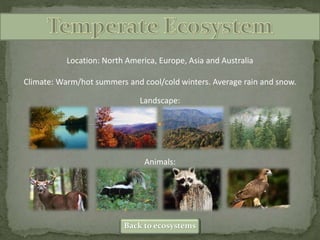
Location: North America, Europe, Asia and Australia
Climate: Warm/hot summers and cool/cold winters. Average rain and snow.
Landscape:
Animals:
Back to ecosystems
Which ecosystem has warm/hot summers and cool/cold winters?
A. Temperate ecosystem
C. Grassland savanna ecosystem
B. Rainforest ecosystem
Go Back
Next Question!
Rainforest ecosystems are most threatened by?
A. Poaching
C. Littering
B. Deforestation
Go Back
Next Question!
How is the ocean ecosystem being affected by humans?
A. Dolphins are becoming endangered due to poaching
C. It isn’t being affected
B. Ocean is being polluted by people dumping chemicals and oil spills
Go Back
Next Question!
What types of plants would you see in a desert ecosystem?
A. Tall trees and lots of small plants
C. Small bushes and evergreens
B. Cactus plants and tumbleweed
Go Back
Next Question!
True or False: You could find a skunk in a temperate ecosystem.
True
False
Go Back
Next Question!
Which ecosystem would you find a lion in?
A. Temperate ecosystem
C. Grassland savanna ecosystem
B. Desert ecosystem
Go Back
Next Question!
What type of weather would you find in a grassland savanna ecosystem?
A. Very rainy and humid
C. Hot summers and cold winters
B. Mainly dry with short seasons of rain
Go Back
Next Question!
Which ecosystem is will suffer the most if temperatures get warmer?
A. Rainforest ecosystem
C. Desert ecosystem
B. Arctic ecosystem
Go Back
Next Question!
Which ecosystem has a very dry climate that is hot during the day and cool at night?
A. Ocean ecosystem
C. Desert ecosystem
B. Arctic ecosystem
Go Back
Next Question!
True or False: Ocean ecosystems can range from cold to warm temperatures.
True
False
Go Back
End of quiz! Learn more about ecosystems!
Social Studies: Standard 3: Geography
Students will explain that simple grid systems (latitude and longitude) are used to locate places on maps and globes,
and will begin to understand the Earth/sun relationship, identify the distinctive physical and cultural features of
their community, and explain the geographic relationships within their own community with the state and other
states within the region.
3.3.10 Environment and Society: Use a variety of information resources to identify regional environmental issues
and examine the ways that people have tried to solve these problems.

3.3.11 Environment and Society: Identify and describe the relationship between human systems and physical
systems and the impact they have on each other.
Science Standard 4: The Living Environment
Students learn about an increasing variety of organisms. They use appropriate tools and identify similarities and
differences among them. Students explore how organisms satisfy their needs in typical environments.

3.4.1 Demonstrate that a great variety of living things can be sorted into groups in many ways using various features,
such as how they look, where they live, and how they act, to decide which things belong to which group
3.4.2 Explain that features used for grouping depend on the purpose of the grouping.
Home

Ecosystem learning game and quiz

  • 1.
  • 2.
  • 3.
    Location: Arctic Circleor North Pole. Climate: Very cold. Snow and ice all year. Landscape: Animals: Back to ecosystems
  • 4.
    Location: All overthe world: USA, Africa, Australia and Asia. Climate: Hot during the day, cold at night, very dry. Landscape: Animals: Back to ecosystems
  • 5.
    Location: Africa (similarsavannas can be found in Australia). Climate: Hot, mostly dry with short seasons of rain. Landscape: Animals: Back to ecosystems
  • 6.
    Location: All ofthe world. Four major oceans: Arctic, Indian, Pacific and Atlantic Climate: Depending on location, ranges from freezing cold to warm temperatures Landscape: Animals: Back to ecosystems
  • 7.
    Location: South America,Africa and Asia Climate: Very hot and humid. Rains an average of 80 inches each year! Landscape: Animals: Back to ecosystems
  • 8.
    Location: North America,Europe, Asia and Australia Climate: Warm/hot summers and cool/cold winters. Average rain and snow. Landscape: Animals: Back to ecosystems
  • 9.
    Which ecosystem haswarm/hot summers and cool/cold winters? A. Temperate ecosystem C. Grassland savanna ecosystem B. Rainforest ecosystem
  • 10.
  • 11.
  • 12.
    Rainforest ecosystems aremost threatened by? A. Poaching C. Littering B. Deforestation
  • 13.
  • 14.
  • 15.
    How is theocean ecosystem being affected by humans? A. Dolphins are becoming endangered due to poaching C. It isn’t being affected B. Ocean is being polluted by people dumping chemicals and oil spills
  • 16.
  • 17.
  • 18.
    What types ofplants would you see in a desert ecosystem? A. Tall trees and lots of small plants C. Small bushes and evergreens B. Cactus plants and tumbleweed
  • 19.
  • 20.
  • 21.
    True or False:You could find a skunk in a temperate ecosystem. True False
  • 22.
  • 23.
  • 24.
    Which ecosystem wouldyou find a lion in? A. Temperate ecosystem C. Grassland savanna ecosystem B. Desert ecosystem
  • 25.
  • 26.
  • 27.
    What type ofweather would you find in a grassland savanna ecosystem? A. Very rainy and humid C. Hot summers and cold winters B. Mainly dry with short seasons of rain
  • 28.
  • 29.
  • 30.
    Which ecosystem iswill suffer the most if temperatures get warmer? A. Rainforest ecosystem C. Desert ecosystem B. Arctic ecosystem
  • 31.
  • 32.
  • 33.
    Which ecosystem hasa very dry climate that is hot during the day and cool at night? A. Ocean ecosystem C. Desert ecosystem B. Arctic ecosystem
  • 34.
  • 35.
  • 36.
    True or False:Ocean ecosystems can range from cold to warm temperatures. True False
  • 37.
  • 38.
    End of quiz!Learn more about ecosystems!
  • 39.
    Social Studies: Standard3: Geography Students will explain that simple grid systems (latitude and longitude) are used to locate places on maps and globes, and will begin to understand the Earth/sun relationship, identify the distinctive physical and cultural features of their community, and explain the geographic relationships within their own community with the state and other states within the region. 3.3.10 Environment and Society: Use a variety of information resources to identify regional environmental issues and examine the ways that people have tried to solve these problems. 3.3.11 Environment and Society: Identify and describe the relationship between human systems and physical systems and the impact they have on each other. Science Standard 4: The Living Environment Students learn about an increasing variety of organisms. They use appropriate tools and identify similarities and differences among them. Students explore how organisms satisfy their needs in typical environments. 3.4.1 Demonstrate that a great variety of living things can be sorted into groups in many ways using various features, such as how they look, where they live, and how they act, to decide which things belong to which group 3.4.2 Explain that features used for grouping depend on the purpose of the grouping. Home