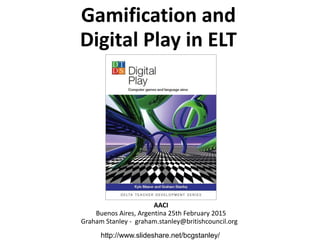
Gamification and
Digital Play in ELT
AACI
Buenos Aires, Argentina 25th February 2015
Graham Stanley - graham.stanley@britishcouncil.org
http://www.slideshare.net/bcgstanley/
Computer games and language
aims
http://www.digitalplay.info/blog/
http://www.deltapublishing.co.uk/titles/methodology/digital-play
Why digital games?
http://www.theoryoffun.com
/
http://artofgamedesign.com
/
There are 1 million gamers in UK
Average young person in UK will
spend 10,000 hours gaming by
the age of 21*
*Jane McGonigal - Reality is broken
Why digital games?
Beyond Two Souls (2013)
Why digital games?
Why gamification?
http://www.onlinebadgemaker.com/
BPL (Badges, Points, Leaderboards)
Gamification: Unlocked Achievements
BPL (Badges, Points, Leaderboards)
Gamifying writing
http://www.scholastic.com/teachers/story-starters
Simple Reward -Systems
Class Survey
& Results
No computers
http://playspent.org
One computer, one game
http://www.digitalplay.info/blog/2011/04/15/another-interactive-text-adventure-spent/
Adrian Underhill & Jim Scrivener:
http://demandhighelt.wordpress.com
• Are our learners capable of more, much more?
• How can I push my students to upgrade their
language and improve their skills more than they
believed possible?
Demand High Speaking
with a digital game
http://pencilkids.com/droppygame.html
http://demandhighelt.wordpress.com/
Now describe the
five images to your
partner
as best you can
a) Can I have a
volunteer to describe
the first image?
b) Does anyone
have a better
description?
Results
“I think it went very well. It’s the kind of lesson you can make last a bit
longer, or cut it short …to your needs. I thought it was very good the way
the lesson was structured. In terms of classroom management, it was very
easy to keep on top of the class because they were engaged not just by the
game itself, but by the first part too. It also encouraged lots of language
from the students. “ – Teacher involved in project
Multiple computers, one game
www.bubblebox.com/play/adventure/1747.htm
The aim of the game : The learners predict what to do with a list of pairs of game
objects, check their answers by playing the game and then write down the
answers using the passive voice.
Prepare to play: Choose an adventure game and start playing it. As you play, make
a note of what you do with the objects that appear in the game (or use the
walkthrough to save time) and produce a list similar to the example below. Make a
copy of this list for each learner. You will also need to use online dictionaries.
Play: Hand out the list of objects and tell the learners they are to guess how they
are used together in the game. Ask the learners to talk together in groups of three
and to use the online dictionaries to find out the meaning of the words they do not
understand. After fifteen minutes, stop them and ask them to tell you what they
think the relationship is between each pair of objects in the game: e.g. I think you
use the hairpin to open the shed, etc. They then play the game together. The
game should be easier to play because they know which objects they need to use
together, but if they get stuck, encourage them to read the walkthrough to find out
what to do next. Finally, once they have played the game (or part of the game if
it's long), ask them to look again at the pairs of words and to write about them.
Encourage the use of the passive voice here: e.g. The hairpin is used to open the
shed, etc.
Play on: The learners can continue playing the game and finish off writing passive
sentences about the objects. www.bubblebox.com/play/adventure/1747.htm
Finding and using a walkthrough
http://jayisgames.com/archives/2010/04/hetherdale.php#walkthrough
Escape the room games
Multiple computers, multiple games
Gap fill for vocabulary / grammar
Relay reading
Jigsaw reading
Information gap
Samorost 2
Live listening
The Viridian Room
“Now when you lift the waste-paper basket, you
should see a lighter underneath. Pick it up and then
move to the kitchen and open the fridge again.”
Observe and write
Observe / vocabulary
“What should we do? Stay in or go out?”
“Shall we listen to some music?”
“What do you want to do now?”
Watch and say
Listening/ questioning
“So, the squirrel has stolen your crisps?
What are you going to do now?
Well, why don't you try looking at the
Bookcase to see if there's something
There to help you?”
Procedure and practicalities
 learner grouping – pairs or groups
 use hand-outs – clear instructions / task
 teacher uses game guide (walkthrough)
 encourage use of English during computer
use
 learners explore, examine and pick up
objects
 pause game and reflect on puzzles together
 those who solve puzzle tell whole class
 discuss where they been and what seen
 authentic information gap activity
Gamification of Classwork/Project work
IWB ISland
http://www.prometheanplanet.com/
learners create islands in groups then teacher scans copies of learners’ drawings
Teacher traces over the scanned drawings using IWB software
Procedure
Thank you!
Any questions?
http://www.deltapublishing.co.uk
http://www.digitalplay.info/blog
Further Reading: Game-Based Language Learning
 Mawer & Stanley (2011) Digital Play
http://www.deltapublishing.co.uk/titles/methodology/digital-play
 Reinders (ed.) (Palgrave, 2012) Digital Games in Language Learning and Teaching
 Sykes & Reinhardt (Pearson, 2013) Language at Play: Digital Games in Second and Foreign
Language Teaching and Learning
Further Reading: Game-Based Learning
 Bartle (New Riders, 2004) Designing Virtual Worlds
 Gee (Palgrave, 2003) What Digital Games Have to Teach Us About Learning and Literacy
 Gee (Routledge, 2004) Situated Language and Learning: A critique of traditional
schooling
 Gee (Peter Lang, 2007) Good Video Games + Good Learning: Collected Essays
 Gee (Common Ground, 2005) Why video games are good for your soul
 Prensky (Paragon House, 2001) Digital game-based learning
 Prensky (Paragon House, 2006) Don't Bother Me Mom – I'm Learning!

Gamification and Digital Play

  • 1.
    Gamification and Digital Playin ELT AACI Buenos Aires, Argentina 25th February 2015 Graham Stanley - graham.stanley@britishcouncil.org http://www.slideshare.net/bcgstanley/
  • 2.
    Computer games andlanguage aims http://www.digitalplay.info/blog/ http://www.deltapublishing.co.uk/titles/methodology/digital-play
  • 3.
  • 4.
    There are 1million gamers in UK Average young person in UK will spend 10,000 hours gaming by the age of 21* *Jane McGonigal - Reality is broken Why digital games?
  • 5.
    Beyond Two Souls(2013) Why digital games?
  • 6.
  • 7.
  • 8.
    BPL (Badges, Points,Leaderboards)
  • 9.
  • 10.
    BPL (Badges, Points,Leaderboards)
  • 11.
  • 12.
  • 13.
  • 14.
  • 15.
  • 16.
  • 17.
    Adrian Underhill &Jim Scrivener: http://demandhighelt.wordpress.com • Are our learners capable of more, much more? • How can I push my students to upgrade their language and improve their skills more than they believed possible?
  • 18.
    Demand High Speaking witha digital game http://pencilkids.com/droppygame.html http://demandhighelt.wordpress.com/
  • 24.
    Now describe the fiveimages to your partner as best you can
  • 25.
    a) Can Ihave a volunteer to describe the first image? b) Does anyone have a better description?
  • 31.
    Results “I think itwent very well. It’s the kind of lesson you can make last a bit longer, or cut it short …to your needs. I thought it was very good the way the lesson was structured. In terms of classroom management, it was very easy to keep on top of the class because they were engaged not just by the game itself, but by the first part too. It also encouraged lots of language from the students. “ – Teacher involved in project
  • 32.
    Multiple computers, onegame www.bubblebox.com/play/adventure/1747.htm
  • 33.
    The aim ofthe game : The learners predict what to do with a list of pairs of game objects, check their answers by playing the game and then write down the answers using the passive voice. Prepare to play: Choose an adventure game and start playing it. As you play, make a note of what you do with the objects that appear in the game (or use the walkthrough to save time) and produce a list similar to the example below. Make a copy of this list for each learner. You will also need to use online dictionaries. Play: Hand out the list of objects and tell the learners they are to guess how they are used together in the game. Ask the learners to talk together in groups of three and to use the online dictionaries to find out the meaning of the words they do not understand. After fifteen minutes, stop them and ask them to tell you what they think the relationship is between each pair of objects in the game: e.g. I think you use the hairpin to open the shed, etc. They then play the game together. The game should be easier to play because they know which objects they need to use together, but if they get stuck, encourage them to read the walkthrough to find out what to do next. Finally, once they have played the game (or part of the game if it's long), ask them to look again at the pairs of words and to write about them. Encourage the use of the passive voice here: e.g. The hairpin is used to open the shed, etc. Play on: The learners can continue playing the game and finish off writing passive sentences about the objects. www.bubblebox.com/play/adventure/1747.htm
  • 35.
    Finding and usinga walkthrough http://jayisgames.com/archives/2010/04/hetherdale.php#walkthrough
  • 36.
    Escape the roomgames Multiple computers, multiple games
  • 37.
    Gap fill forvocabulary / grammar
  • 38.
  • 39.
  • 40.
  • 41.
    Live listening The ViridianRoom “Now when you lift the waste-paper basket, you should see a lighter underneath. Pick it up and then move to the kitchen and open the fridge again.”
  • 42.
  • 43.
  • 44.
    “What should wedo? Stay in or go out?” “Shall we listen to some music?” “What do you want to do now?” Watch and say
  • 45.
    Listening/ questioning “So, thesquirrel has stolen your crisps? What are you going to do now? Well, why don't you try looking at the Bookcase to see if there's something There to help you?”
  • 46.
    Procedure and practicalities learner grouping – pairs or groups  use hand-outs – clear instructions / task  teacher uses game guide (walkthrough)  encourage use of English during computer use  learners explore, examine and pick up objects  pause game and reflect on puzzles together  those who solve puzzle tell whole class  discuss where they been and what seen  authentic information gap activity
  • 47.
  • 48.
  • 49.
    learners create islandsin groups then teacher scans copies of learners’ drawings Teacher traces over the scanned drawings using IWB software Procedure
  • 55.
  • 56.
    Further Reading: Game-BasedLanguage Learning  Mawer & Stanley (2011) Digital Play http://www.deltapublishing.co.uk/titles/methodology/digital-play  Reinders (ed.) (Palgrave, 2012) Digital Games in Language Learning and Teaching  Sykes & Reinhardt (Pearson, 2013) Language at Play: Digital Games in Second and Foreign Language Teaching and Learning
  • 57.
    Further Reading: Game-BasedLearning  Bartle (New Riders, 2004) Designing Virtual Worlds  Gee (Palgrave, 2003) What Digital Games Have to Teach Us About Learning and Literacy  Gee (Routledge, 2004) Situated Language and Learning: A critique of traditional schooling  Gee (Peter Lang, 2007) Good Video Games + Good Learning: Collected Essays  Gee (Common Ground, 2005) Why video games are good for your soul  Prensky (Paragon House, 2001) Digital game-based learning  Prensky (Paragon House, 2006) Don't Bother Me Mom – I'm Learning!