Primary 4 TEACHER’S NOTES
SKILLS TRAINER
Syllabus		 page 2
Introduction	page 4
Teacher’s Notes
	 1	 Where we live	 page 6
	 2	 Healthy living	 page 12
	 3	 Exchanging things	 page 18
	 4	 Learning about food	 page 24
	 5	 Using public transport	 page 30
	 6	 Doing free time activities	 page 36
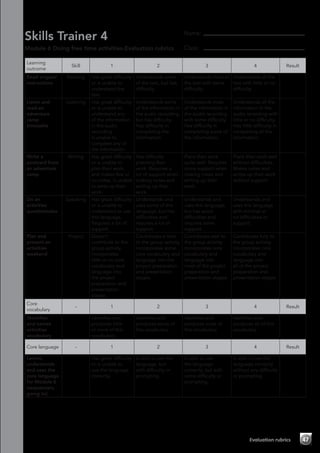
Evaluation rubrics	 page 42
SKILLS
TRAINER
Syllabus2
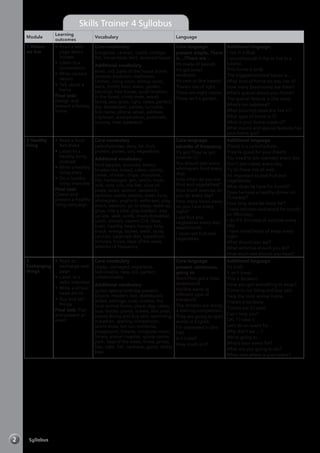
Skills Trainer 4 Syllabus
Module
Learning
outcomes
Vocabulary Language
1 Where
we live
•	 Read a web
page about
houses
•	 Listen to a
conversation
•	 Write contact
details
•	 Talk about a
home
Final task:
Design and
present a fantasy
home
Core vocabulary
bungalow, caravan, castle, cottage,
flat, house boat, tent, terraced house
Additional vocabulary
small, old, parts of the house (room,
window, bedroom, bathroom,
kitchen, living room, dining room,
walls, (ninth) floor, stairs, garden,
balcony), tree house, quiet location,
in the forest, climb trees, wood,
family, sea, glass, light, views, perfect,
shy, skateboard, parties, surname,
first name, phone, email, address,
city/town, area/province, postcode,
country, river, weekend
Core language
present simple, There
is…/There are…
It’s made of (wood).
It’s got (small
windows).
It’s next to (the beach).
There’s lots of light.
There are eight rooms.
There isn’t a garden.
Additional language
I live in a (flat).
I would/wouldn’t like to live in a
(castle).
This home is (old).
The biggest/smallest house is…
What kind of home do you live in?
How many (bedrooms) are there?
What’s special about your home?
The special feature is (the view).
What’s her (address)?
What (country) does she live in?
What type of home is it?
What is your home made of?
What rooms and special features has
your home got?
2 Healthy
living
•	 Read a food
fact sheet
•	 Listen to a
healthy living
podcast
•	 Write a healthy
living diary
•	 Do a healthy
living interview
Final task:
Create and
present a healthy
living campaign
Core vocabulary
carbohydrates, dairy, fat, fruit,
protein, pulses, salt, vegetables
Additional vocabulary
food (apples, avocado, beans,
blueberries, bread, cakes, carrots,
cereal, chicken, chips, chocolate,
fish, hamburger, jam, lentils, meat,
milk, nuts, oils, oily fish, olive oil,
pasta, salad, salmon, sandwich,
sardines, seeds, sweets, toast, tuna,
wholegrain, yoghurt), verbs (eat, play,
snack, exercise, go to sleep, wake up,
grow, ride a bike, play football, stay
up late, walk, work), meals (breakfast,
lunch, dinner), vitamin C/E, fibre,
brain, healthy, heart, hungry, fatty,
snack, energy, bones, teeth, body,
calcium, balanced diet, superfood,
minutes, hours, days of the week,
adverbs of frequency
Core language
adverbs of frequency
It’s got/They’ve got
(vitamin C).
You should (eat some
wholegrain food every
day).
How often do you eat
(fruit and vegetables)?
How much exercise do
you do every day?
How many hours sleep
do you have every
night?
I eat fruit and
vegetables every day/
week/month.
I never eat fruit and
vegetables.
Additional language
(Pasta) is a carbohydrate.
They’re good for your (heart).
You need to (do exercise) every day.
Don’t (eat cakes) every day.
Try to (have lots of rest).
It’s important to (eat fruit and
vegetables).
What does he have for (lunch)?
Does he have a healthy dinner on
(Tuesday)?
How long does he sleep for?
I have (chicken and salad) for (lunch)
on (Monday).
I do (15 minutes) of exercise every
day.
I have (nine) hours of sleep every
night.
What should you eat?
What activities should you do?
How much rest should you have?
3
Exchanging
things
•	 Read an
exchange web
page
•	 Listen to a
radio interview
•	 Write a school
news article
•	 Buy and sell
things
Final task: Plan
and present an
event
Core vocabulary
cheap, damaged, expensive,
fashionable, new, old, perfect,
unfashionable
Additional vocabulary
guitar, special birthday present,
bicycle, modern, fast, skateboard,
jacket, earrings, coat, clothes, the
local animal home, place, day, cakes,
toys, books, plants, tickets, first prize,
events (bring and buy sale, swimming
marathon, spelling competition,
talent show, fun run, tombola),
playground, theatre, computer room,
library, animal hospital, sports centre,
park, days of the week, times, prices,
free, cake, hat, necklace, game, teddy
bear
Core language
present continuous,
going to
She’s/He’s got a (new
skateboard).
He/She wants (a
different type of
transport).
The children are doing
a spelling competition.
They are going to spell
words in English.
I’m interested in (the
hat).
Is it (new)?
How much is it?
Additional language
It’s (old).
It isn’t (new).
This is (broken).
Have you got something to swap?
Come to our bring and buy sale.
Help the local animal home.
There’s a tombola.
Tickets are £1 each.
Can I help you?
OK. I’ll take it.
Let’s do an event for …
Why don’t we …?
We’re going to …
What’s your event for?
What are you going to do?
When and where is your event?
Syllabus 3
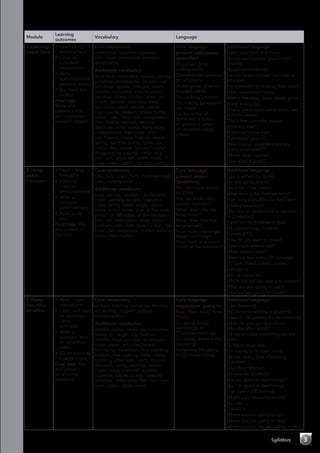
Module
Learning
outcomes
Vocabulary Language
4 Learning
about food
•	 Read about
growing food
•	 Listen to
a cookery
programme
•	 Write
instructions for
growing seeds
•	 Buy food at a
market
Final task:
Write and
present a fruit
and vegetable
research project
Core vocabulary
aubergine, cucumber, grapes,
kiwi, onion, pineapple, pumpkin,
watermelon
Additional vocabulary
food (fruit, vegetable, onions, carrots,
potatoes, strawberries, blueberries,
tomatoes, apples, oranges, pears,
lemons, avocados, melons, peas,
bananas, olives, chicken, soup, ice
cream, biscuits, cupcakes, beef,
fruit salad, salad, lettuce, starter,
main course, dessert, bread, butter,
cream, cake, fish), chef, competition,
final, finalist, excited, nervous,
delicious, cook, sweet, hairy, spiky,
underground, tree, plant, vine,
soil, flowers, ready, tropical, seeds,
spring, summer, sunny, holes, soil,
inside, skin, leaves, farmers’ market,
shopping list, pounds, verbs (dig,
pull, pick, grow, eat, plant, make,
cover, water, watch, cut, put, wash)
Core language
present continuous,
quantifiers
(Potatoes) grow
underground.
(Strawberries) grow on
(small) plants.
(Aubergines) grow on
(bigger) plants.
I’m cooking (chicken).
I’m making (pineapple
ice cream).
I’d like (a kilo of
tomatoes, a bunch
of grapes, a piece
of chocolate cake),
please.
Additional language
I eat cucumbers and kiwis.
Onions and grapes grow in my
country.
My (starter) is (soup).
For the (main course) I’m cooking
(chicken).
For (dessert) I’m making (fruit salad).
First, make small holes.
After a few days, small leaves grow.
Water every day.
Finally, plant more seeds every two
or three weeks.
That’s (two) pounds, please.
Anything else?
(Potatoes) come from …
(Tomatoes) grow in …
What fruit or vegetable are you
going to research?
Where does it grow?
How does it grow?
5 Using
public
transport
•	 Read a ferry
timetable
•	 Listen to
a station
announcement
•	 Write a
transport
advertisement
•	 Book a city
tour
Final task: Plan
and present a
city tour
Core vocabulary
bike, bus, coach, ferry, rickshaw, train,
tram, underground
Additional vocabulary
boat, service, modern, comfortable,
travel, scenery, wildlife, beautiful,
views, family ticket, single, return,
leave, arrive, times, days of the week,
prices, on (Monday), at the weekend,
first, last, destination, shop, direct,
platform, tour, rider, green, clean, city,
travel, fun, expensive, guided walking
tours, cities, sights
Core language
present simple
(questions)
You can travel slowly
by (bike).
You can travel very
quickly by (train).
When does (the last
ferry) leave?
When does (the first
ferry) arrive?
How much is (a single
ticket) on Friday?
How much is (a return
ticket) at the weekend?
Additional language
I go to school by (bike).
Do you go by (tram)?
Yes, I do. / No, I don’t.
What time is the first/last ferry?
How long does (the journey) take?
It takes (one hour).
The train at (platform 5) is the train
to (Liverpool).
Travelling by rickshaw is (fun).
It’s a (green) way to travel.
It costs (£15).
How do you want to travel?
How much does it cost?
When does it start?
There’s a tour every (30 minutes).
I’ll have (three) tickets, please.
Let’s go to …
We can travel by …
Which city are you going to choose?
What are you going to see?
How are you going to travel?
6 Doing
free time
activities
•	 Read origami
instructions
•	 Listen and read
an adventure
camp
timetable
•	 Write a
postcard from
an adventure
camp
•	 Do an activities
questionnaire
Final task: Plan
and present
an activities
weekend
Core vocabulary
archery, bowling, canoeing, fencing,
ice skating, origami, pottery,
skateboarding
Additional vocabulary
wheels, plates, bowls, warm clothes,
heavy, hit, target, top, bottom,
middle, edge, corners, rectangular,
sheet, paper, activities (tennis,
swimming, basketball, face painting,
football, tree walking, horse riding),
morning, afternoon, lunch, days of
the week, camp, exciting, ladder,
ropes, scary, postcard, address,
locations, places to stay, seasons,
activities, verbs (take, fold, turn over,
open, make, climb, walk)
Core language
sequencers, going to
First, Then, Next, Now,
Finally,
I’m going to (go
swimming) on
(Thursday morning).
I’m doing (archery and
canoeing).
Tomorrow, I’m going
to (go horse riding).
Additional language
I like (bowling).
My favourite activity is (pottery).
I want to do pottery (in the morning).
What are you going to do on
(Monday afternoon)?
I’d like to make something for my
mum.
To (Mum and Dad)
I’m having (a fantastic time).
We are doing (lots of exciting
activities).
Love from (Rachel).
Do you like (pottery)?
Are you good at (swimming)?
Yes, I’m good at (swimming).
I can (swim 200 metres).
What’s your favourite activity?
You can …
There’s a …
Where are you going to go?
Where are you going to stay?
What activities are you going to do?
Introduction4
Skills Trainer Introduction
Each Skills Trainer within this six-level series
comprises six modules and brings real, everyday
English into the classroom. This is done through
child-friendly content, based on authentic situations
and texts, and with a focus on critical thinking and
problem solving within real-life situations and tasks.
How to use the Skills Trainers
The Skills Trainers are designed to be used
flexibly. The topic-based modules can be selected
and used in any order, so as to best provide
extra skills support and extension to a particular
class. Although following the pages sequentially
throughout a module gets the most out of a topic,
there is also the option of the teacher being more
selective in terms of the order in which they work
with the module and also the content that they wish
to focus on.
The module topics focus on situations and tasks
that the pupils encounter in real life, such as
Healthy living, Exchanging things and Using public
transport. This therefore provides the pupils with
meaningful and relevant contexts that they can
relate to and explore further. Activities designed
to represent the things around us that we see,
hear and interact with each day, for example, web
pages, newspaper and magazine articles, shopping
lists, food packaging, emails, calendars, podcasts
and public announcements, further ensure that
the content of the Skills Trainers is relevant to the
pupils’ own world.
Each module contains four key learning outcomes,
such as Read an exchange web page, Listen to a
radio interview, Write a school news article and Buy
and sell things. The aim and can do approach of
these learning outcomes is that the pupils acquire
a growing confidence through the achievement of
carrying out these tasks in English and continue to
build upon the acquisition of these.
Each of the four skills, reading, listening, writing
and speaking, is focused on individually within a
module, with the final module task being a group
project, in which the pupils work together to
research, collate and present information.
The focus on functional language within each
module means that any new structures are
presented and practised within an already-
familiar context. The emphasis on functional
language aims to provide the pupils with the
confidence to use English outside the classroom
and realise its function and scope as a real means
of communication. The Skills Trainer syllabus
also ensures that additional focus is given to the
consolidation and extension of the core language
from Quest 4.
Overview of a Skills Trainer module
Although pages within a module can be used in
an order best suited to the requirements of an
individual class, a sequential use of a module is as
follows:
Vocabulary presentation
The aim of this page is to present the eight core
vocabulary items that the pupils will need for
the module and their final task. Recordings of
these words aim to reinforce pronunciation, with
additional activities providing further practice and
contextualisation within the module topic.
Reading
The reading page reinforces the module vocabulary
through presenting it within an authentic
text type, such as a food fact sheet or a ferry
timetable. Activities on this page check the pupils’
understanding of the text and also focus on the
development of more generic reading skills, such as
reading for gist and overall meaning, and looking
for specific details within a text.
Listening
These pages comprise situational audio recordings,
such as listening to a cookery programme
and listening to a station announcement. As
with the reading pages, there is a focus on the
development of generic skills, such as listening
for gist and context, as well as listening out for
specific information. The completion of activities is,
whenever possible, done within a real-life context.
Real-life tasks, such as completing fact files and
completing a timetable, make the activities more
meaningful for the pupils.
Writing
Model writing texts are first presented in context,
such as a healthy living diary and a transport
advertisement. An initial activity aims to familiarise
the pupils with the text, with further activities
focusing the pupils on detail and structure within
the text.
A draft writing template is provided for the pupils to
plan their own written text before completing it in
their notebooks or electronically. Each final writing
task is designed for the pupils to input information
relevant to them, and therefore make the task more
memorable and meaningful.
Speaking
These pages begin with equipping the pupils with
the language they need to do the task through
the reinforcement of vocabulary that has either
been presented previously within the module or is
additional vocabulary relevant to the speaking task.
An audio recording of this vocabulary is provided
Introduction 5
within the first activity as a model and guide to
pronunciation. Whenever possible, this vocabulary
is recorded within a repeated language structure,
to provide reinforcement and also to place the
vocabulary in context.
Recordings of model dialogues and conversations,
such as doing a healthy living interview, are also
provided. These are also on the page of the pupil’s
component and are intended to be personalised
and adapted by the pupils, and then repeated for
further practice.
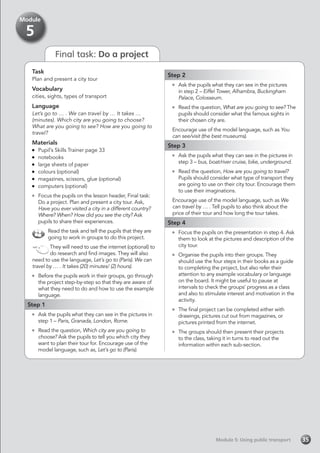
Projects
These collaborative projects aim to incorporate the
learning outcomes and language within the module,
while at the same time, reinforcing the importance
of project-related skills, such as preparation and
planning, decision-making, information gathering,
drafting, writing and presenting. Pupils are required
to work collaboratively throughout the four steps of
each project and then present their project, which
ranges from creating and presenting a healthy living
campaign to planning and presenting a city tour.
The level of guidance in this step-by-step approach
is gradually reduced throughout the levels of the
Skills Trainers, thus meaning that the pupils’ level
of learning autonomy increases and they input
more into how they want to research and present
information.
Language in speech bubbles at the top of each
project page, such as I’m going to…, You can… and
There’s a…. provides guidance as to how the pupils
can communicate with each other throughout the
projects.
Language focus points at the bottom of each
project page provide the teacher with a plenary of
the core language within each module.
Overview of the Skills Trainer Teacher’s Notes
The Module overview at the start of each module
provides a clear overview of the learning outcomes
in the module, the core vocabulary and core
language, as well as any additional vocabulary and
language.
This section is then followed by clear and concise
step-by-step instructions for each page of the
pupil’s component. Vocabulary and language for
each page is isolated, so that the teacher can see at
a glance what each page involves. Audioscripts and
answer keys are also integrated into the Teacher’s
Notes for each page of the pupil’s component,
providing the teacher with all the necessary
information in one place.
Icons within the pupil’s component are cross-
referenced within the Teacher’s Notes:
	 denotes critical thinking
	 requires personal input from the pupils
	 requires the pupils to do the activity
within their notebooks and/or on a
separate piece of paper
	 signifies that this activity can be
completed digitally
	 reinforces the importance of group work
throughout the project pages
CD
2
	 indicates recorded audio and
corresponding track number within the
downloadable MP3 audio files
Evaluation rubrics for each module are provided
at the back of the Teacher’s Notes. These can
be photocopied and completed to record the
progression of each individual pupil.
Skills Trainer downloadable MP3 audio files
Audio activities are integrated into the Skills
Trainer. These aim to bring authentic listening
experiences into the classroom, and also provide
pronunciation guidance and models of dialogues
and conversations for the pupils to follow and adapt
for themselves.
Track listings within the pupil’s component and the
Teacher’s Notes mean that audio tracks are easily
located within the downloadable MP3 audio files.
Vocabulary: Presentation
Module 1: Where we live6
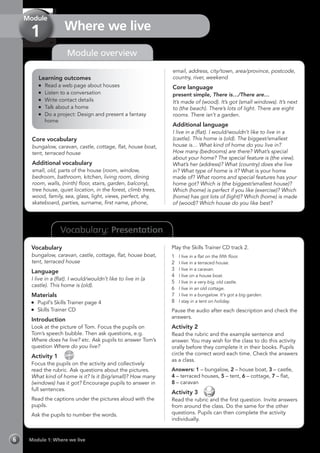
Module overview
Where we live
Module
1
Learning outcomes
	 Read a web page about houses
	 Listen to a conversation
	 Write contact details
	 Talk about a home
	 Do a project: Design and present a fantasy
home
Core vocabulary
bungalow, caravan, castle, cottage, flat, house boat,
tent, terraced house
Additional vocabulary
small, old, parts of the house (room, window,
bedroom, bathroom, kitchen, living room, dining
room, walls, (ninth) floor, stairs, garden, balcony),
tree house, quiet location, in the forest, climb trees,
wood, family, sea, glass, light, views, perfect, shy,
skateboard, parties, surname, first name, phone,
email, address, city/town, area/province, postcode,
country, river, weekend
Core language
present simple, There is…/There are…
It’s made of (wood). It’s got (small windows). It’s next
to (the beach). There’s lots of light. There are eight
rooms. There isn’t a garden.
Additional language
I live in a (flat). I would/wouldn’t like to live in a
(castle). This home is (old). The biggest/smallest
house is… What kind of home do you live in?
How many (bedrooms) are there? What’s special
about your home? The special feature is (the view).
What’s her (address)? What (country) does she live
in? What type of home is it? What is your home
made of? What rooms and special features has your
home got? Which is (the biggest/smallest house)?
Which (home) is perfect if you like (exercise)? Which
(home) has got lots of (light)? Which (home) is made
of (wood)? Which house do you like best?
Vocabulary
bungalow, caravan, castle, cottage, flat, house boat,
tent, terraced house
Language
I live in a (flat). I would/wouldn’t like to live in (a
castle). This home is (old).
Materials
	 Pupil’s Skills Trainer page 4
	 Skills Trainer CD
Introduction
Look at the picture of Tom. Focus the pupils on
Tom’s speech bubble. Then ask questions, e.g.
Where does he live? etc. Ask pupils to answer Tom’s
question Where do you live?
Activity 1 
CD
2
Focus the pupils on the activity and collectively
read the rubric. Ask questions about the pictures.
What kind of home is it? Is it (big/small)? How many
(windows) has it got? Encourage pupils to answer in
full sentences.
Read the captions under the pictures aloud with the
pupils.
Ask the pupils to number the words.
Play the Skills Trainer CD track 2.
1	 I live in a flat on the fifth floor.
2	 I live in a terraced house.
3	 I live in a caravan.
4	 I live on a house boat.
5	 I live in a very big, old castle.
6	 I live in an old cottage.
7	 I live in a bungalow. It’s got a big garden.
8	 I stay in a tent on holiday.
Pause the audio after each description and check the
answers.
Activity 2
Read the rubric and the example sentence and
answer. You may wish for the class to do this activity
orally before they complete it in their books. Pupils
circle the correct word each time. Check the answers
as a class.
Answers: 1 – bungalow, 2 – house boat, 3 – castle,
4 – terraced houses, 5 – tent, 6 – cottage, 7 – flat,
8 – caravan
Activity 3 
Read the rubric and the first question. Invite answers
from around the class. Do the same for the other
questions. Pupils can then complete the activity
individually.
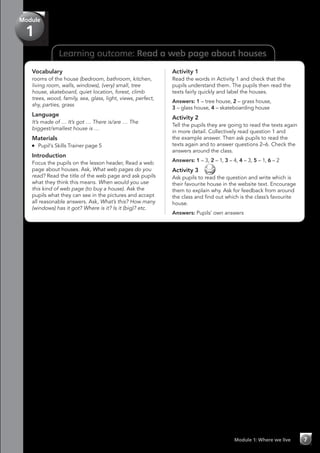
Learning outcome: Read a web page about houses
Module 1: Where we live 7
Module
1
Vocabulary
rooms of the house (bedroom, bathroom, kitchen,
living room, walls, windows), (very) small, tree
house, skateboard, quiet location, forest, climb
trees, wood, family, sea, glass, light, views, perfect,
shy, parties, grass
Language
It’s made of … It’s got … There is/are … The
biggest/smallest house is …
Materials
	 Pupil’s Skills Trainer page 5
Introduction
Focus the pupils on the lesson header, Read a web
page about houses. Ask, What web pages do you
read? Read the title of the web page and ask pupils
what they think this means. When would you use
this kind of web page (to buy a house). Ask the
pupils what they can see in the pictures and accept
all reasonable answers. Ask, What’s this? How many
(windows) has it got? Where is it? Is it (big)? etc.
Activity 1
Read the words in Activity 1 and check that the
pupils understand them. The pupils then read the
texts fairly quickly and label the houses.
Answers: 1 – tree house, 2 – grass house,
3 – glass house, 4 – skateboarding house
Activity 2
Tell the pupils they are going to read the texts again
in more detail. Collectively read question 1 and
the example answer. Then ask pupils to read the
texts again and to answer questions 2–6. Check the
answers around the class.
Answers: 1 – 3, 2 – 1, 3 – 4, 4 – 3, 5 – 1, 6 – 2
Activity 3 
Ask pupils to read the question and write which is
their favourite house in the website text. Encourage
them to explain why. Ask for feedback from around
the class and find out which is the class’s favourite
house.
Answers: Pupils’ own answers
Learning outcome: Listen to a conversation
Vocabulary
bungalow, flat, garden, view, stairs, town, sea,
balcony, city, bedroom, bathroom, (ninth) floor
Language
What kind of home do you live in? I live in (a
bungalow). How many (bedrooms) are there? There
are (three) bedrooms. What’s special about your
home? It’s got (a big garden).
Materials
	 Pupil’s Skills Trainer page 6
	 Skills Trainer CD
Introduction
Focus the pupils on the lesson header, Listen to a
conversation. Ask, What kind of home do you live
in? Where is it? How many (bedrooms) are there?
Has it got a (garden)? Ask the pupils what they can
see in the photo and accept all reasonable answers
(girl, boy, houses, etc.) Elicit that the girl and boy
are talking about what kind of house they live in.
Activity 1 
CD
3
Read the rubric and look at the photos. Identify
each type of home (bungalow, terraced house,
flat, cottage). Say the names of the children on the
audio (Adam and Susan). Tell pupils to listen to the
audio. Then they write A next to Adam’s house and
S next to Susan’s house.
Play the Skills Trainer CD track 3.
Susan:	 Hi Adam. Where do you live?
Adam:	 I live in a small town near the sea.
Susan:	 What kind of home do you live in?
Adam:	 It’s a bungalow.
Susan:	 What’s a bungalow?
Adam:	 It’s a house but it hasn’t got any stairs. All the rooms
are on one floor.
Susan:	 And how many bedrooms are there?
Adam:	 There are three big bedrooms. And there are two
bathrooms.
Susan:	 What’s special about your home?
Adam:	 It’s got a big garden and a great view of the sea.
Adam:	 How about you, Susan? Where do you live?
Susan:	 I live in a big city.
Adam:	 What kind of home do you live in?
Susan:	 I live in a small flat on the ninth floor.
Adam:	 How many bedrooms are there?
Susan:	 There are two bedrooms. I share a room with my
sister. And there’s only one bathroom.
Adam:	 What’s special about your home?
Susan:	 It’s got a nice big balcony and a nice view of the city.
And there are lots of stairs!
After listening, feedback as a class to check the
answers.
Answers: 1 – A, 3 – S
Activity 2 
CD
4
Read the rubric and tell the pupils that they are
going to hear the conversation again. Ask the pupils
to look at the fact files and read the headings in
each section. They then listen and fill in the missing
information.
Play the Skills Trainer CD track 4.
Check the answers with the whole class.
Answers: Adam – lives – in a small town near the
sea, type of home – bungalow, bedrooms – 3,
bathrooms – 2, special features – big garden, view of
the sea.
Susan – lives – in a big city, type of home – flat,
bedrooms – 2, bathrooms – 1, special features – big
balcony, view of the city, lots of stairs
Activity 3 
Read the rubric and then ask pupils to work in pairs,
talking about where they live. Share answers around
the class.
Answers: Pupils’ own answers
Module 1: Where we live8
Module
1
Module
1
Learning outcome: Write contact details
Vocabulary
first name, surname, phone, email, address, city/
town, area/province, postcode, country
Language
What’s her (address)? What (country) does she live
in?
Materials
	 Pupil’s Skills Trainer page 7
	 notebook or sheet of paper
	 computer (optional)
Introduction
Focus the pupils on the lesson header, Write
contact details. Ask, What are contact details?
Accept all reasonable answers (email, phone,
address).
Activity 1 
Read the rubric and ask pupils for suggestions.
Accept all reasonable answers, (if they are lost,
if they need something sent to them, for their
passport/an application form, etc.) They do not
need to write. Check answers.
Activity 2 
Read the rubric. Ask the pupils to read the address
form and answer the questions. They do not need
to write. Read the questions one-by-one as a class
to check the answers.
Answers: 1 – Jones, 2 – 48 Elm Avenue, Bristol,
3 – sallyjones@mail.co.uk, 4 – 0117 9574 380,
5 – BS15 2PG, 6 – England
Activity 3 
Tell the pupils that they are now going to plan their
own address form. Focus their attention on the draft
address form and go through the sub-headings one-
by-one, eliciting examples. Pupils can either work
individually, in pairs or in small groups to complete
this activity.
Activity 4   
Read the rubric. The pupils now use the information
in their draft address forms (Activity 3) to create final
versions that they can write neatly either in their
notebooks, or on the computer.
Module 1: Where we live 9
Learning outcome: Talk about a home
Vocabulary
windows, garden, view, bedroom, bathroom, living
room, kitchen, river, weekend
Language
This is (a flat). It’s made of (brick). There are (six
rooms). The special feature is (the view).
Materials
	 Pupil’s Skills Trainer page 8
	 Skills Trainer CD
Introduction
Focus the pupils on the lesson header, Talk about
a home. Ask, What different kinds of homes are
there? Accept all reasonable answers, tree house,
flat, etc.
Activity 1 
CD
5
Read the rubric. Focus pupils on the picture and the
title. Ask questions, What kind of home is it? Where
is it? What’s it made of? etc. Tell pupils they are
going to listen to someone talk about a houseboat.
Tell them to listen and complete the information in
the fact file.
Play the Skills Trainer CD track 5.
	 This is a picture of my uncle’s home. He lives on a house
boat! It’s on the river in the town centre, and there are nice
views of the river from the windows. It’s made of wood and
it’s quite big inside. There are five rooms – two bedrooms, a
living room, a bathroom and a small kitchen. There is also a
garden with lots of plants, and you can sit outside and look
at the view. The special feature of this home is that it can
move around. I sometimes go with my uncle down the river
at the weekend!
Ask questions around the class to check
understanding. Ask, How many rooms are there?
What’s the house boat made of? What special
features has it got?
Answers: Type of home – house boat, Where – on
the river, Made of – wood, Number of rooms – five,
Garden – yes, Special feature – It can move around.
Activity 2 
Tell pupils they are going to plan their own talk
about a home. Encourage them to use the prompts
and to write notes about their home. Pupils can
work individually or in pairs.
Activity 3 
CD
6
Read the rubric and the speech bubbles. Tell pupils
to listen to the example.
Play the Skills Trainer CD track 6.
Girl: 	 This is a flat.
	 It’s in the city centre.
	 It’s made of brick.
	 There are six rooms.
	 There isn’t a garden.
	 The special feature is the view.
Then ask pupils to tell the class about their home,
e.g. My bungalow is in Ireland. It’s very beautiful and
old. It’s near a river and it’s got a big garden. There
are two bedrooms and two bathrooms …
Module 1: Where we live10
Module
1
Final task: Do a project
Module 1: Where we liveModule 1: Where we live 11
Task
Design and present a fantasy home
Vocabulary
types of home, building materials, rooms of a
house, special features
Language
My home is a … . It’s made of … . It’s got … . What
type of home is it? What is your home made of?
What rooms and special features has your home
got?
Materials
	 Pupil’s Skills Trainer page 9
	notebooks
	 large sheets of paper
	 colours (optional)
	 magazines, scissors, glue (optional)
	 computers (optional)
	 Focus the pupils on the lesson header, Final task:
Do a project. Design and present a fantasy home.
Ask, What is a fantasy home? Have you ever
seen an amazing home? Ask pupils to share their
experiences.
Read the task and tell the pupils that they are
going to work in groups to do this project.
They will need to use the internet (optional)
to do research and find images. They will
also need to use the language My home is a (tree
house). It’s got … . It’s made of … . There is/there
are … .
	 Before the pupils work in their groups, go through
the project step-by-step so that they are aware of
what they need to do and how to use the example
language.
Step 1
	 Ask the pupils what they can see in the pictures
in step 1 – tree house, house boat, upside-down
house, colourful house.
	 Read the question, What type of home is it? Ask the
pupils to tell you what kind of house they want their
fantasy home to be. Encourage use of the model
language, such as, My home is a (tree house).
Module
1
Step 2
	 Ask the pupils what they can see in the pictures in
step 2. Elicit the building materials of the homes in
the pictures – glass, metal, stone, wood.
	 Read the question, What is your home made of?
The pupils should consider what they want their
house to be made of.
Encourage use of the model language, such as It’s
made of (wood and glass).
Step 3
	 Ask the pupils what they can see in the pictures
in step 3 – round windows, a swimming pool, a
bathroom with flowers, bookshelves.
	 Read the questions, What rooms and special
features has your home got? Pupils should consider
what special features their house will have.
Encourage them to use their imaginations.
Encourage use of the model language, such as It’s got
(a swimming pool) and there is (an aquarium).
Step 4
	 Focus the pupils on the presentation in step 4. Ask
them to look at the picture of the fantasy home and
to read the description.
	 Organise the pupils into their groups. They
should use the four steps in their books as a guide
to completing the project, but also refer their
attention to any example vocabulary or language
on the board. It might be useful to pause at
intervals to check the groups’ progress as a class
and also to stimulate interest and motivation in the
activity.
	 The final project can be completed either with
drawings, pictures cut out from magazines, or
pictures printed from the internet.
	 The groups should then present their projects
to the class, taking it in turns to read out the
information within each sub-section.
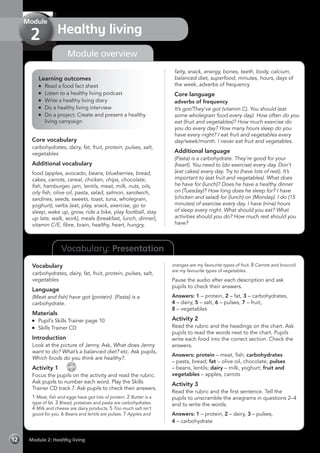
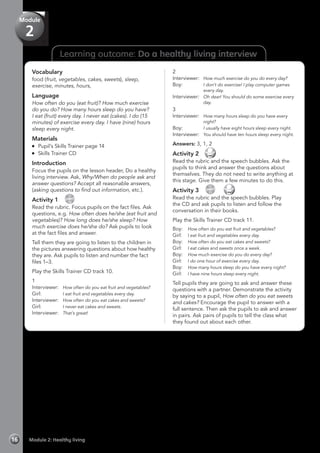
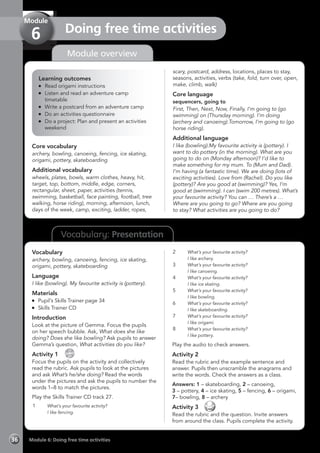
Vocabulary: Presentation
Module overview
Learning outcomes
	 Read a food fact sheet
	 Listen to a healthy living podcast
	 Write a healthy living diary
	 Do a healthy living interview
	 Do a project: Create and present a healthy
living campaign
Core vocabulary
carbohydrates, dairy, fat, fruit, protein, pulses, salt,
vegetables
Additional vocabulary
food (apples, avocado, beans, blueberries, bread,
cakes, carrots, cereal, chicken, chips, chocolate,
fish, hamburger, jam, lentils, meat, milk, nuts, oils,
oily fish, olive oil, pasta, salad, salmon, sandwich,
sardines, seeds, sweets, toast, tuna, wholegrain,
yoghurt), verbs (eat, play, snack, exercise, go to
sleep, wake up, grow, ride a bike, play football, stay
up late, walk, work), meals (breakfast, lunch, dinner),
vitamin C/E, fibre, brain, healthy, heart, hungry,
fatty, snack, energy, bones, teeth, body, calcium,
balanced diet, superfood, minutes, hours, days of
the week, adverbs of frequency
Core language
adverbs of frequency
It’s got/They’ve got (vitamin C). You should (eat
some wholegrain food every day). How often do you
eat (fruit and vegetables)? How much exercise do
you do every day? How many hours sleep do you
have every night? I eat fruit and vegetables every
day/week/month. I never eat fruit and vegetables.
Additional language
(Pasta) is a carbohydrate. They’re good for your
(heart). You need to (do exercise) every day. Don’t
(eat cakes) every day. Try to (have lots of rest). It’s
important to (eat fruit and vegetables). What does
he have for (lunch)? Does he have a healthy dinner
on (Tuesday)? How long does he sleep for? I have
(chicken and salad) for (lunch) on (Monday). I do (15
minutes) of exercise every day. I have (nine) hours
of sleep every night. What should you eat? What
activities should you do? How much rest should you
have?
Vocabulary
carbohydrates, dairy, fat, fruit, protein, pulses, salt,
vegetables
Language
(Meat and fish) have got (protein). (Pasta) is a
carbohydrate.
Materials
	 Pupil’s Skills Trainer page 10
	 Skills Trainer CD
Introduction
Look at the picture of Jenny. Ask, What does Jenny
want to do? What’s a balanced diet? etc. Ask pupils,
Which foods do you think are healthy?.
Activity 1  
CD
7
Focus the pupils on the activity and read the rubric.
Ask pupils to number each word. Play the Skills
Trainer CD track 7. Ask pupils to check their answers.
1 Meat, fish and eggs have got lots of protein. 2 Butter is a
type of fat. 3 Bread, potatoes and pasta are carbohydrates.
4 Milk and cheese are dairy products. 5 Too much salt isn’t
good for you. 6 Beans and lentils are pulses. 7 Apples and
oranges are my favourite types of fruit. 8 Carrots and broccoli
are my favourite types of vegetables.
Pause the audio after each description and ask
pupils to check their answers.
Answers: 1 – protein, 2 – fat, 3 – carbohydrates,
4 – dairy, 5 – salt, 6 – pulses, 7 – fruit,
8 – vegetables
Activity 2
Read the rubric and the headings on the chart. Ask
pupils to read the words next to the chart. Pupils
write each food into the correct section. Check the
answers.
Answers: protein – meat, fish; carbohydrates
– pasta, bread; fat – olive oil, chocolate; pulses
– beans, lentils; dairy – milk, yoghurt; fruit and
vegetables – apples, carrots
Activity 3
Read the rubric and the first sentence. Tell the
pupils to unscramble the anagrams in questions 2–4
and to write the words.
Answers: 1 – protein, 2 – dairy, 3 – pulses,
4 – carbohydrate
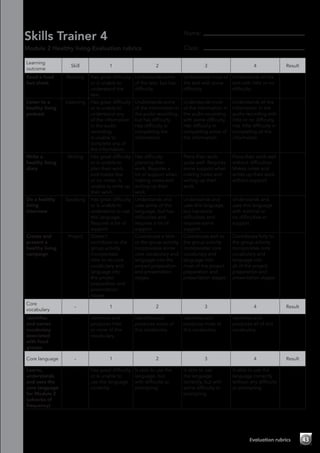
Module 2: Healthy living12
Healthy living
Module
2
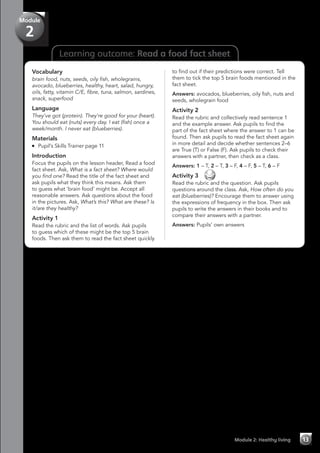
Learning outcome: Read a food fact sheet
Vocabulary
brain food, nuts, seeds, oily fish, wholegrains,
avocado, blueberries, healthy, heart, salad, hungry,
oils, fatty, vitamin C/E, fibre, tuna, salmon, sardines,
snack, superfood
Language
They’ve got (protein). They’re good for your (heart).
You should eat (nuts) every day. I eat (fish) once a
week/month. I never eat (blueberries).
Materials
	 Pupil’s Skills Trainer page 11
Introduction
Focus the pupils on the lesson header, Read a food
fact sheet. Ask, What is a fact sheet? Where would
you find one? Read the title of the fact sheet and
ask pupils what they think this means. Ask them
to guess what ‘brain food’ might be. Accept all
reasonable answers. Ask questions about the food
in the pictures. Ask, What’s this? What are these? Is
it/are they healthy?
Activity 1
Read the rubric and the list of words. Ask pupils
to guess which of these might be the top 5 brain
foods. Then ask them to read the fact sheet quickly
to find out if their predictions were correct. Tell
them to tick the top 5 brain foods mentioned in the
fact sheet.
Answers: avocados, blueberries, oily fish, nuts and
seeds, wholegrain food
Activity 2
Read the rubric and collectively read sentence 1
and the example answer. Ask pupils to find the
part of the fact sheet where the answer to 1 can be
found. Then ask pupils to read the fact sheet again
in more detail and decide whether sentences 2–6
are True (T) or False (F). Ask pupils to check their
answers with a partner, then check as a class.
Answers: 1 – T, 2 – T, 3 – F, 4 – F, 5 – T, 6 – F
Activity 3 
Read the rubric and the question. Ask pupils
questions around the class. Ask, How often do you
eat (blueberries)? Encourage them to answer using
the expressions of frequency in the box. Then ask
pupils to write the answers in their books and to
compare their answers with a partner.
Answers: Pupils’ own answers
Module 2: Healthy living 13
Module
2
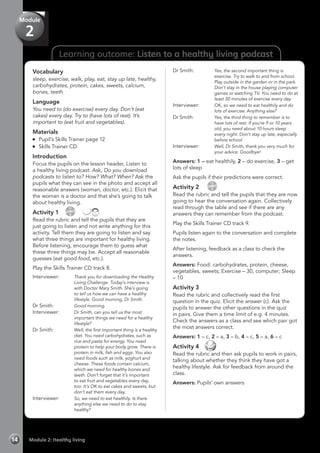
Learning outcome: Listen to a healthy living podcast
Vocabulary
sleep, exercise, walk, play, eat, stay up late, healthy,
carbohydrates, protein, cakes, sweets, calcium,
bones, teeth
Language
You need to (do exercise) every day. Don’t (eat
cakes) every day. Try to (have lots of rest). It’s
important to (eat fruit and vegetables).
Materials
	 Pupil’s Skills Trainer page 12
	 Skills Trainer CD
Introduction
Focus the pupils on the lesson header, Listen to
a healthy living podcast. Ask, Do you download
podcasts to listen to? How? What? When? Ask the
pupils what they can see in the photo and accept all
reasonable answers (woman, doctor, etc.). Elicit that
the woman is a doctor and that she’s going to talk
about healthy living.
Activity 1 
CD
8
 
Read the rubric and tell the pupils that they are
just going to listen and not write anything for this
activity. Tell them they are going to listen and say
what three things are important for healthy living.
Before listening, encourage them to guess what
these three things may be. Accept all reasonable
guesses (eat good food, etc.).
Play the Skills Trainer CD track 8.
Interviewer:	 Thank you for downloading the Healthy
Living Challenge. Today’s interview is
with Doctor Mary Smith. She’s going
to tell us how we can have a healthy
lifestyle. Good morning, Dr Smith.
Dr Smith:	 Good morning.
Interviewer:	 Dr Smith, can you tell us the most
important things we need for a healthy
lifestyle?
Dr Smith:	 Well, the first important thing is a healthy
diet. You need carbohydrates, such as
rice and pasta for energy. You need
protein to help your body grow. There is
protein in milk, fish and eggs. You also
need foods such as milk, yoghurt and
cheese. These foods contain calcium,
which we need for healthy bones and
teeth. Don’t forget that it’s important
to eat fruit and vegetables every day,
too. It’s OK to eat cakes and sweets, but
don’t eat them every day.
Interviewer:	 So, we need to eat healthily. Is there
anything else we need to do to stay
healthy?
Dr Smith:	 Yes, the second important thing is
exercise. Try to walk to and from school.
Play outside in the garden or in the park.
Don’t stay in the house playing computer
games or watching TV. You need to do at
least 30 minutes of exercise every day.
Interviewer:	 OK, so we need to eat healthily and do
lots of exercise. Anything else?
Dr Smith:	 Yes, the third thing to remember is to
have lots of rest. If you’re 9 or 10 years
old, you need about 10 hours sleep
every night. Don’t stay up late, especially
before school.
Interviewer:	 Well, Dr Smith, thank you very much for
your advice. Goodbye!
Answers: 1 – eat healthily, 2 – do exercise, 3 – get
lots of sleep
Ask the pupils if their predictions were correct.
Activity 2  
CD
9
Read the rubric and tell the pupils that they are now
going to hear the conversation again. Collectively
read through the table and see if there are any
answers they can remember from the podcast.
Play the Skills Trainer CD track 9.
Pupils listen again to the conversation and complete
the notes.
After listening, feedback as a class to check the
answers.
Answers: Food: carbohydrates, protein, cheese,
vegetables, sweets; Exercise – 30, computer; Sleep
– 10
Activity 3
Read the rubric and collectively read the first
question in the quiz. Elicit the answer (c). Ask the
pupils to answer the other questions in the quiz
in pairs. Give them a time limit of e.g. 4 minutes.
Check the answers as a class and see which pair got
the most answers correct.
Answers: 1 – c, 2 – a, 3 – b, 4 – c, 5 – a, 6 – c
Activity 4 
Read the rubric and then ask pupils to work in pairs,
talking about whether they think they have got a
healthy lifestyle. Ask for feedback from around the
class.
Answers: Pupils’ own answers
Module 2: Healthy living14
Module
2
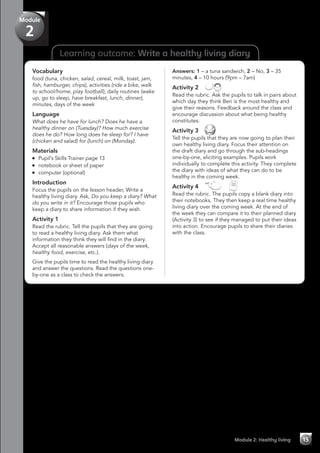
Learning outcome: Write a healthy living diary
Vocabulary
food (tuna, chicken, salad, cereal, milk, toast, jam,
fish, hamburger, chips), activities (ride a bike, walk
to school/home, play football), daily routines (wake
up, go to sleep, have breakfast, lunch, dinner),
minutes, days of the week
Language
What does he have for lunch? Does he have a
healthy dinner on (Tuesday)? How much exercise
does he do? How long does he sleep for? I have
(chicken and salad) for (lunch) on (Monday).
Materials
	 Pupil’s Skills Trainer page 13
	 notebook or sheet of paper
	 computer (optional)
Introduction
Focus the pupils on the lesson header, Write a
healthy living diary. Ask, Do you keep a diary? What
do you write in it? Encourage those pupils who
keep a diary to share information if they wish.
Activity 1
Read the rubric. Tell the pupils that they are going
to read a healthy living diary. Ask them what
information they think they will find in the diary.
Accept all reasonable answers (days of the week,
healthy food, exercise, etc.).
Give the pupils time to read the healthy living diary
and answer the questions. Read the questions one-
by-one as a class to check the answers.
Answers: 1 – a tuna sandwich, 2 – No, 3 – 35
minutes, 4 – 10 hours (9pm – 7am)
Activity 2 
Read the rubric. Ask the pupils to talk in pairs about
which day they think Ben is the most healthy and
give their reasons. Feedback around the class and
encourage discussion about what being healthy
constitutes.
Activity 3 
Tell the pupils that they are now going to plan their
own healthy living diary. Focus their attention on
the draft diary and go through the sub-headings
one-by-one, eliciting examples. Pupils work
individually to complete this activity. They complete
the diary with ideas of what they can do to be
healthy in the coming week.
Activity 4   
Read the rubric. The pupils copy a blank diary into
their notebooks. They then keep a real time healthy
living diary over the coming week. At the end of
the week they can compare it to their planned diary
(Activity 3) to see if they managed to put their ideas
into action. Encourage pupils to share their diaries
with the class.
Module 2: Healthy living 15
Module
2
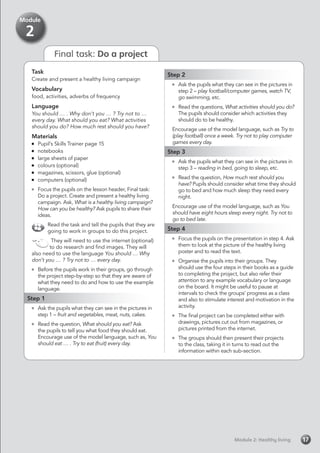
Learning outcome: Do a healthy living interview
Vocabulary
food (fruit, vegetables, cakes, sweets), sleep,
exercise, minutes, hours,
Language
How often do you (eat fruit)? How much exercise
do you do? How many hours sleep do you have?
I eat (fruit) every day. I never eat (cakes). I do (15
minutes) of exercise every day. I have (nine) hours
sleep every night.
Materials
	 Pupil’s Skills Trainer page 14
	 Skills Trainer CD
Introduction
Focus the pupils on the lesson header, Do a healthy
living interview. Ask, Why/When do people ask and
answer questions? Accept all reasonable answers,
(asking questions to find out information, etc.).
Activity 1 
CD
10
Read the rubric. Focus pupils on the fact files. Ask
questions, e.g. How often does he/she (eat fruit and
vegetables)? How long does he/she sleep? How
much exercise does he/she do? Ask pupils to look
at the fact files and answer.
Tell them they are going to listen to the children in
the pictures answering questions about how healthy
they are. Ask pupils to listen and number the fact
files 1–3.
Play the Skills Trainer CD track 10.
1
Interviewer:	 How often do you eat fruit and vegetables?
Girl:	 I eat fruit and vegetables every day.
Interviewer:	 How often do you eat cakes and sweets?
Girl:	 I never eat cakes and sweets.
Interviewer:	 That’s great!
2
Interviewer:	 How much exercise do you do every day?
Boy:	 I don’t do exercise! I play computer games
every day.
Interviewer:	 Oh dear! You should do some exercise every
day.
3
Interviewer:	 How many hours sleep do you have every
night?
Boy:	 I usually have eight hours sleep every night.
Interviewer:	 You should have ten hours sleep every night.
Answers: 3, 1, 2
Activity 2 
Read the rubric and the speech bubbles. Ask the
pupils to think and answer the questions about
themselves. They do not need to write anything at
this stage. Give them a few minutes to do this.
Activity 3 
CD
11
 
Read the rubric and the speech bubbles. Play
the CD and ask pupils to listen and follow the
conversation in their books.
Play the Skills Trainer CD track 11.
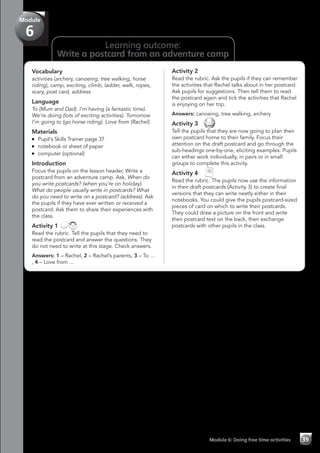
Boy:	 How often do you eat fruit and vegetables?
Girl:	 I eat fruit and vegetables every day.
Boy:	 How often do you eat cakes and sweets?
Girl:	 I eat cakes and sweets once a week.
Boy:	 How much exercise do you do every day?
Girl:	 I do one hour of exercise every day.
Boy:	 How many hours sleep do you have every night?
Girl:	 I have nine hours sleep every night.
Tell pupils they are going to ask and answer these
questions with a partner. Demonstrate the activity
by saying to a pupil, How often do you eat sweets
and cakes? Encourage the pupil to answer with a
full sentence. Then ask the pupils to ask and answer
in pairs. Ask pairs of pupils to tell the class what
they found out about each other.
Module 2: Healthy living16
Module
2
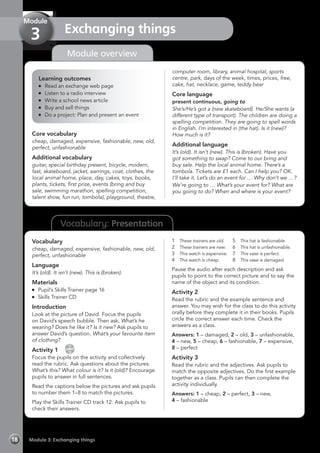
Task
Create and present a healthy living campaign
Vocabulary
food, activities, adverbs of frequency
Language
You should … . Why don’t you … ? Try not to …
every day. What should you eat? What activities
should you do? How much rest should you have?
Materials
	 Pupil’s Skills Trainer page 15
	notebooks
	 large sheets of paper
	 colours (optional)
	 magazines, scissors, glue (optional)
	 computers (optional)
	 Focus the pupils on the lesson header, Final task:
Do a project. Create and present a healthy living
campaign. Ask, What is a healthy living campaign?
How can you be healthy? Ask pupils to share their
ideas.
Read the task and tell the pupils that they are
going to work in groups to do this project.
They will need to use the internet (optional)
to do research and find images. They will
also need to use the language You should … Why
don’t you … ? Try not to … every day.
	 Before the pupils work in their groups, go through
the project step-by-step so that they are aware of
what they need to do and how to use the example
language.
Step 1
	 Ask the pupils what they can see in the pictures in
step 1 – fruit and vegetables, meat, nuts, cakes.
	 Read the question, What should you eat? Ask
the pupils to tell you what food they should eat.
Encourage use of the model language, such as, You
should eat … . Try to eat (fruit) every day.
Step 2
	 Ask the pupils what they can see in the pictures in
step 2 – play football/computer games, watch TV,
go swimming, etc.
	 Read the questions, What activities should you do?
The pupils should consider which activities they
should do to be healthy.
Encourage use of the model language, such as Try to
(play football) once a week. Try not to play computer
games every day.
Step 3
	 Ask the pupils what they can see in the pictures in
step 3 – reading in bed, going to sleep, etc.
	 Read the question, How much rest should you
have? Pupils should consider what time they should
go to bed and how much sleep they need every
night.
Encourage use of the model language, such as You
should have eight hours sleep every night. Try not to
go to bed late.
Step 4
	 Focus the pupils on the presentation in step 4. Ask
them to look at the picture of the healthy living
poster and to read the text.
	 Organise the pupils into their groups. They
should use the four steps in their books as a guide
to completing the project, but also refer their
attention to any example vocabulary or language
on the board. It might be useful to pause at
intervals to check the groups’ progress as a class
and also to stimulate interest and motivation in the
activity.
	 The final project can be completed either with
drawings, pictures cut out from magazines, or
pictures printed from the internet.
	 The groups should then present their projects
to the class, taking it in turns to read out the
information within each sub-section.
Module 2: Healthy livingModule 2: Healthy living 17
Module
2
Final task: Do a project
Vocabulary: Presentation
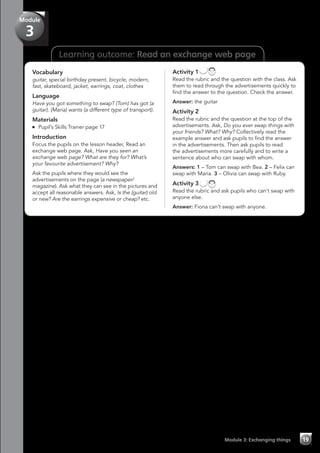
Module overview
Learning outcomes
	 Read an exchange web page
	 Listen to a radio interview
	 Write a school news article
	 Buy and sell things
	 Do a project: Plan and present an event
Core vocabulary
cheap, damaged, expensive, fashionable, new, old,
perfect, unfashionable
Additional vocabulary
guitar, special birthday present, bicycle, modern,
fast, skateboard, jacket, earrings, coat, clothes, the
local animal home, place, day, cakes, toys, books,
plants, tickets, first prize, events (bring and buy
sale, swimming marathon, spelling competition,
talent show, fun run, tombola), playground, theatre,
computer room, library, animal hospital, sports
centre, park, days of the week, times, prices, free,
cake, hat, necklace, game, teddy bear
Core language
present continuous, going to
She’s/He’s got a (new skateboard). He/She wants (a
different type of transport). The children are doing a
spelling competition. They are going to spell words
in English. I’m interested in (the hat). Is it (new)?
How much is it?
Additional language
It’s (old). It isn’t (new). This is (broken). Have you
got something to swap? Come to our bring and
buy sale. Help the local animal home. There’s a
tombola. Tickets are £1 each. Can I help you? OK.
I’ll take it. Let’s do an event for … Why don’t we …?
We’re going to … What’s your event for? What are
you going to do? When and where is your event?
Vocabulary
cheap, damaged, expensive, fashionable, new, old,
perfect, unfashionable
Language
It’s (old). It isn’t (new). This is (broken).
Materials
	 Pupil’s Skills Trainer page 16
	 Skills Trainer CD
Introduction
Look at the picture of David. Focus the pupils
on David’s speech bubble. Then ask, What’s he
wearing? Does he like it? Is it new? Ask pupils to
answer David’s question, What’s your favourite item
of clothing?
Activity 1 
CD
12
Focus the pupils on the activity and collectively
read the rubric. Ask questions about the pictures.
What’s this? What colour is it? Is it (old)? Encourage
pupils to answer in full sentences.
Read the captions below the pictures and ask pupils
to number them 1–8 to match the pictures.
Play the Skills Trainer CD track 12. Ask pupils to
check their answers.
1 	 These trainers are old.	 5	 This hat is fashionable.
2 	 These trainers are new.	 6 	 This hat is unfashionable.
3 	 This watch is expensive. 	 7 	 This vase is perfect.
4 	 This watch is cheap. 	 8 	 This vase is damaged.
Pause the audio after each description and ask
pupils to point to the correct picture and to say the
name of the object and its condition.
Activity 2
Read the rubric and the example sentence and
answer. You may wish for the class to do this activity
orally before they complete it in their books. Pupils
circle the correct answer each time. Check the
answers as a class.
Answers: 1 – damaged, 2 – old, 3 – unfashionable,
4 – new, 5 – cheap, 6 – fashionable, 7 – expensive,
8 – perfect
Activity 3
Read the rubric and the adjectives. Ask pupils to
match the opposite adjectives. Do the first example
together as a class. Pupils can then complete the
activity individually.
Answers: 1 – cheap, 2 – perfect, 3 – new,
4 – fashionable
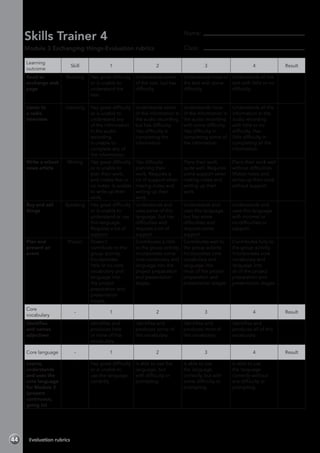
Module 3: Exchanging things18
Exchanging things
Module
3
Learning outcome: Read an exchange web page
Vocabulary
guitar, special birthday present, bicycle, modern,
fast, skateboard, jacket, earrings, coat, clothes
Language
Have you got something to swap? (Tom) has got (a
guitar). (Maria) wants (a different type of transport).
Materials
	 Pupil’s Skills Trainer page 17
Introduction
Focus the pupils on the lesson header, Read an
exchange web page. Ask, Have you seen an
exchange web page? What are they for? What’s
your favourite advertisement? Why?
Ask the pupils where they would see the
advertisements on the page (a newspaper/
magazine). Ask what they can see in the pictures and
accept all reasonable answers. Ask, Is the (guitar) old
or new? Are the earrings expensive or cheap? etc.
Activity 1
Read the rubric and the question with the class. Ask
them to read through the advertisements quickly to
find the answer to the question. Check the answer.
Answer: the guitar
Activity 2
Read the rubric and the question at the top of the
advertisements. Ask, Do you ever swap things with
your friends? What? Why? Collectively read the
example answer and ask pupils to find the answer
in the advertisements. Then ask pupils to read
the advertisements more carefully and to write a
sentence about who can swap with whom.
Answers: 1 – Tom can swap with Bea. 2 – Felix can
swap with Maria. 3 – Olivia can swap with Ruby.
Activity 3
Read the rubric and ask pupils who can’t swap with
anyone else.
Answer: Fiona can’t swap with anyone.
Module 3: Exchanging things 19
Module
3
Learning outcome: Listen to a radio interview
Vocabulary
bring and buy sale, cakes, toys, books, plants,
tombola, first prize, tickets, place, day
Language
Come to our bring and buy sale. Help the local
animal home. There’s a tombola. Tickets are £1
each.
Materials
	 Pupil’s Skills Trainer page 18
	 Skills Trainer CD
Introduction
Focus the pupils on the lesson header, Listen to a
radio interview. Ask, Do you listen to the radio? Is
there a local radio station in your town? Why are
people interviewed on the radio? Ask the pupils
what they can see in the photo and accept all
reasonable answers (girls, interview, microphone,
radio). Elicit that the girls are being interviewed on
a local radio station. Ask them to guess what the
interview is about.
Activity 1 
CD
13
 
Read the rubric and tell the pupils that they are
just going to listen and not write anything for this
activity. Ask them to listen and say what the children
are talking about.
Play the Skills Trainer CD track 13.
Interviewer:	 Good morning, Christina and Gemma.
Welcome to Radio London. You’re here to talk
to us because you’re doing something very
special, aren’t you?
Christina:	 Yes. We’re having a bring and buy sale.
Interviewer: 	Great! And why are you having a bring and buy
sale?
Gemma:	 It’s for the local animal home.
Interviewer:	 That’s fantastic. Where is the bring and buy
sale?
Christina:	 It’s at the library.
Interviewer:	 When is the bring and buy sale?
Christina:	 On Saturday afternoon.
Interviewer:	 So, I can bring something I don’t want and buy
something I do want. Is that right?
Gemma:	 Yes, that’s correct. You can bring and buy
cakes, toys and books.
Christina:	 And you can bring and buy plants.
Gemma:	 There’s a tombola, too.
Christina:	 Tombola tickets are £1 each. First prize is
theatre tickets.
Interviewer:	 Well thank you for talking to us! See you on
Saturday.
Christina/Gemma:	 Thank you! Goodbye!
Answers: They are talking about a bring and buy
sale to collect money for a local animal home.
Ask the children if their guesses were correct. Ask
them if they have ever been to a bring and buy
sale, or if they’ve ever raised money for a charity.
Encourage pupils to share their experiences.
Activity 2 
CD
14
Read the rubric and tell the pupils that they are now
going to hear the radio interview again. Collectively
read through the advertisement/flyer and see if
there are any answers they can remember from the
conversation. Pupils listen again to the interview
and complete the missing information.
Play the Skills Trainer CD track 14.
After listening, feed back as a class to check the
answers.
Answers: 1 – animal home, 2 – library,
3 – Saturday, 4 – cakes, 5 – 1, 6 – theatre tickets
Activity 3 
Read the rubric and ask the pupils to talk in pairs
about what things you could bring to a bring and
buy sale. Feed back with the whole class.
Module 3: Exchanging things20
Module
3
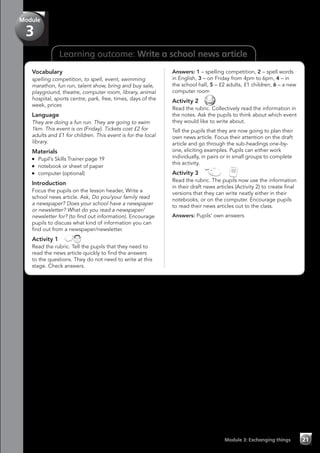
Learning outcome: Write a school news article
Vocabulary
spelling competition, to spell, event, swimming
marathon, fun run, talent show, bring and buy sale,
playground, theatre, computer room, library, animal
hospital, sports centre, park, free, times, days of the
week, prices
Language
They are doing a fun run. They are going to swim
1km. This event is on (Friday). Tickets cost £2 for
adults and £1 for children. This event is for the local
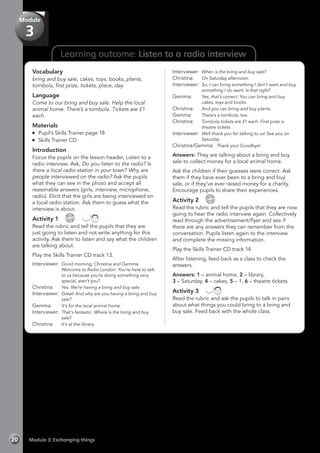
library.
Materials
	 Pupil’s Skills Trainer page 19
	 notebook or sheet of paper
	 computer (optional)
Introduction
Focus the pupils on the lesson header, Write a
school news article. Ask, Do you/your family read
a newspaper? Does your school have a newspaper
or newsletter? What do you read a newspaper/
newsletter for? (to find out information). Encourage
pupils to discuss what kind of information you can
find out from a newspaper/newsletter.
Activity 1 
Read the rubric. Tell the pupils that they need to
read the news article quickly to find the answers
to the questions. They do not need to write at this
stage. Check answers.
Answers: 1 – spelling competition, 2 – spell words
in English, 3 – on Friday from 4pm to 6pm, 4 – in
the school hall, 5 – £2 adults, £1 children, 6 – a new
computer room
Activity 2 
Read the rubric. Collectively read the information in
the notes. Ask the pupils to think about which event
they would like to write about.
Tell the pupils that they are now going to plan their
own news article. Focus their attention on the draft
article and go through the sub-headings one-by-
one, eliciting examples. Pupils can either work
individually, in pairs or in small groups to complete
this activity.
Activity 3   
Read the rubric. The pupils now use the information
in their draft news articles (Activity 2) to create final
versions that they can write neatly either in their
notebooks, or on the computer. Encourage pupils
to read their news articles out to the class.
Answers: Pupils’ own answers
Module 3: Exchanging things 21
Module
3
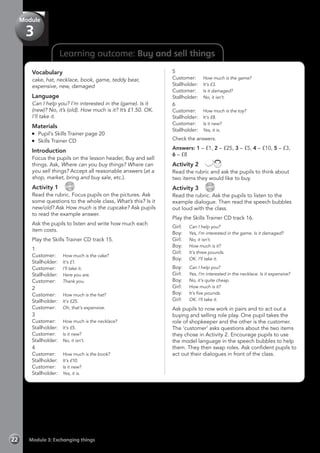
Learning outcome: Buy and sell things
Vocabulary
cake, hat, necklace, book, game, teddy bear,
expensive, new, damaged
Language
Can I help you? I’m interested in the (game). Is it
(new)? No, it’s (old). How much is it? It’s £1.50. OK.
I’ll take it.
Materials
	 Pupil’s Skills Trainer page 20
	 Skills Trainer CD
Introduction
Focus the pupils on the lesson header, Buy and sell
things. Ask, Where can you buy things? Where can
you sell things? Accept all reasonable answers (at a
shop, market, bring and buy sale, etc.).
Activity 1 
CD
15
Read the rubric. Focus pupils on the pictures. Ask
some questions to the whole class, What’s this? Is it
new/old? Ask How much is the cupcake? Ask pupils
to read the example answer.
Ask the pupils to listen and write how much each
item costs.
Play the Skills Trainer CD track 15.
1
Customer: 	 How much is the cake?
Stallholder: 	 It’s £1.
Customer: 	 I’ll take it.
Stallholder: 	 Here you are.
Customer: 	 Thank you.
2
Customer: 	 How much is the hat?
Stallholder: 	 It’s £25.
Customer: 	 Oh, that’s expensive.
3
Customer: 	 How much is the necklace?
Stallholder: 	 It’s £5.
Customer: 	 Is it new?
Stallholder: 	 No, it isn’t.
4
Customer: 	 How much is the book?
Stallholder: 	 It’s £10.
Customer: 	 Is it new?
Stallholder: 	 Yes, it is.
5
Customer: 	 How much is the game?
Stallholder: 	 It’s £3.
Customer: 	 Is it damaged?
Stallholder: 	 No, it isn’t.
6
Customer: 	 How much is the toy?
Stallholder: 	 It’s £8.
Customer: 	 Is it new?
Stallholder: 	 Yes, it is.
Check the answers.
Answers: 1 – £1, 2 – £25, 3 – £5, 4 – £10, 5 – £3,
6 – £8
Activity 2 
Read the rubric and ask the pupils to think about
two items they would like to buy.
Activity 3 
CD
16
Read the rubric. Ask the pupils to listen to the
example dialogue. Then read the speech bubbles
out loud with the class.
Play the Skills Trainer CD track 16.
Girl: 	 Can I help you?
Boy: 	 Yes, I’m interested in the game. Is it damaged?
Girl: 	 No, it isn’t.
Boy: 	 How much is it?
Girl: 	 It’s three pounds.
Boy: 	 OK. I’ll take it.
Boy: 	 Can I help you?
Girl: 	 Yes, I’m interested in the necklace. Is it expensive?
Boy: 	 No, it’s quite cheap.
Girl: 	 How much is it?
Boy: 	 It’s five pounds.
Girl: 	 OK. I’ll take it.
Ask pupils to now work in pairs and to act out a
buying and selling role play. One pupil takes the
role of shopkeeper and the other is the customer.
The ‘customer’ asks questions about the two items
they chose in Activity 2. Encourage pupils to use
the model language in the speech bubbles to help
them. They then swap roles. Ask confident pupils to
act out their dialogues in front of the class.
Module 3: Exchanging things22
Module
3
Final task: Do a project
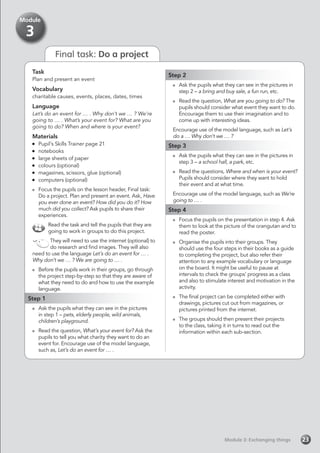
Task
Plan and present an event
Vocabulary
charitable causes, events, places, dates, times
Language
Let’s do an event for … . Why don’t we … ? We’re
going to … . What’s your event for? What are you
going to do? When and where is your event?
Materials
	 Pupil’s Skills Trainer page 21
	notebooks
	 large sheets of paper
	 colours (optional)
	 magazines, scissors, glue (optional)
	 computers (optional)
	 Focus the pupils on the lesson header, Final task:
Do a project. Plan and present an event. Ask, Have
you ever done an event? How did you do it? How
much did you collect? Ask pupils to share their
experiences.
Read the task and tell the pupils that they are
going to work in groups to do this project.
They will need to use the internet (optional) to
do research and find images. They will also
need to use the language Let’s do an event for … .
Why don’t we … ? We are going to … .
	 Before the pupils work in their groups, go through
the project step-by-step so that they are aware of
what they need to do and how to use the example
language.
Step 1
	 Ask the pupils what they can see in the pictures
in step 1 – pets, elderly people, wild animals,
children’s playground.
	 Read the question, What’s your event for? Ask the
pupils to tell you what charity they want to do an
event for. Encourage use of the model language,
such as, Let’s do an event for … .
Step 2
	 Ask the pupils what they can see in the pictures in
step 2 – a bring and buy sale, a fun run, etc.
	 Read the question, What are you going to do? The
pupils should consider what event they want to do.
Encourage them to use their imagination and to
come up with interesting ideas.
Encourage use of the model language, such as Let’s
do a … Why don’t we … ?
Step 3
	 Ask the pupils what they can see in the pictures in
step 3 – a school hall, a park, etc.
	 Read the questions, Where and when is your event?
Pupils should consider where they want to hold
their event and at what time.
Encourage use of the model language, such as We’re
going to … .
Step 4
	 Focus the pupils on the presentation in step 4. Ask
them to look at the picture of the orangutan and to
read the poster.
	 Organise the pupils into their groups. They
should use the four steps in their books as a guide
to completing the project, but also refer their
attention to any example vocabulary or language
on the board. It might be useful to pause at
intervals to check the groups’ progress as a class
and also to stimulate interest and motivation in the
activity.
	 The final project can be completed either with
drawings, pictures cut out from magazines, or
pictures printed from the internet.
	 The groups should then present their projects
to the class, taking it in turns to read out the
information within each sub-section.
Module 3: Exchanging thingsModule 3: Exchanging things 23
Module
3
Vocabulary: Presentation
Module overview
Learning outcomes
	 Read about growing food
	 Listen to a cookery programme
	 Write instructions for growing seeds
	 Buy food at a market
	 Do a project: Write and present a fruit and
vegetable research project
Core vocabulary
aubergine, cucumber, grapes, kiwi, onion,
pineapple, pumpkin, watermelon
Additional vocabulary
food (fruit, vegetable, onions, carrots, potatoes,
strawberries, blueberries, tomatoes, apples,
oranges, pears, lemons, avocados, melons, peas,
bananas, olives, chicken, soup, ice cream, biscuits,
cupcakes, beef, fruit salad, salad, lettuce, starter,
main course, dessert, bread, butter, cream, cake,
fish), chef, competition, final, finalist, excited,
nervous, delicious, cook, sweet, hairy, spiky,
underground, tree, plant, vine, soil, flowers, ready,
tropical, seeds, spring, summer, sunny, holes, soil,
inside, skin, leaves, farmers’ market, shopping list,
pounds, verbs (dig, pull, pick, grow, eat, plant,
make, cover, water, watch, cut, put, wash)
Core language
present continuous, quantifiers
(Potatoes) grow underground. (Strawberries) grow
on (small) plants. (Aubergines) grow on (bigger)
plants. I’m cooking (chicken). I’m making (pineapple
ice cream). I’d like (a kilo of tomatoes, a bunch of
grapes, a piece of chocolate cake), please.
Additional language
I eat cucumbers and kiwis. Onions and grapes
grow in my country. My (starter) is (soup). For the
(main course) I’m cooking (chicken). For (dessert)
I’m making (fruit salad). First, make small holes.
After a few days, small leaves grow. Water every
day. Finally, plant more seeds every two or three
weeks. That’s (two) pounds, please. Anything else?
(Potatoes) come from … (Tomatoes) grow in …
What fruit or vegetable are you going to research?
Where does it grow? How does it grow?
Vocabulary
aubergine, cucumber, grapes, kiwi, onion,
pineapple, pumpkin, watermelon
Language
I eat cucumbers and kiwis. Onions and grapes grow
in my country.
Materials
	 Pupil’s Skills Trainer page 22
	 Skills Trainer CD
Introduction
Look at the picture of Jill. Focus the pupils on Jill’s
speech bubble. Then ask, Where does she live?
Who does she live with? Ask pupils to answer Jill’s
question, Which of these fruit and vegetables do
you think we grow? Accept all reasonable answers,
(apples, potatoes, etc.).
Activity 1 
CD
17
Focus the pupils on the activity and collectively read
the rubric. Ask questions about the pictures. What is
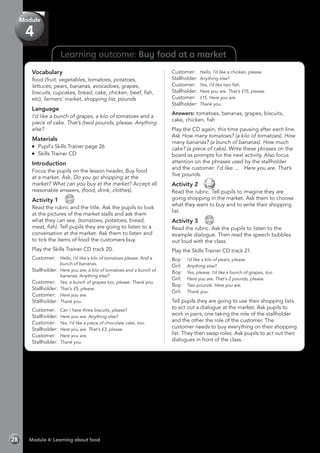
it? What colour is it? Is it a fruit or a vegetable? etc.
Read the captions below the pictures and ask pupils
to number them 1–8 according to which picture they
describe. Then ask them to listen and check their
answers.
Play the Skills Trainer CD track 17.
1	cucumber	 5	kiwi
2	pineapple	 6	watermelon
3	onion	 7	grapes
4	pumpkin	 8	aubergine
Activity 2
Read the rubric and the example sentence and
answer. You may wish for the class to do this activity
orally before they complete it in their books. Pupils
write the name of the fruit or vegetable being
described. Check the answers as a class.
Answers: 1 – cucumber, 2 – onion, 3 – watermelon,
4 – pumpkin, 5 – aubergine, 6 – pineapple,
7 – grape, 8 – kiwi
Activity 3 
Read the rubric and the first question. Invite answers
from around the class. Pupils complete the activity.
Module 4: Learning about food24
Learning about food
Module
4
Learning outcome: Read about growing food
Vocabulary
underground, tree, plant, vine, soil, fruit,
vegetables, onions, carrots, potatoes, strawberries,
blueberries, aubergines, pineapples, tomatoes,
grapes, kiwis, pumpkins, cucumbers, apples,
oranges, pears, lemons, heavy, spiky, ready, dig,
pull, pick
Language
(Onions) grow underground. (Grapes) grow on a
vine. (Apples) grow on trees. (Strawberries) grow on
plants.
Materials
	 Pupil’s Skills Trainer page 23
Introduction
Focus the pupils on the lesson header, Read about
growing food. Ask the pupils what they can see in
the pictures and accept all reasonable answers. Ask,
What fruit and vegetables can you see?
Read the title and ask pupils what they think
this means. Collectively read the introductory
paragraph. Ask pupils to work in pairs and to think
about how various fruit and vegetables grow. Share
ideas around the class. The pupils read the texts
fairly quickly to see if their ideas were correct.
Activity 1
Focus on the new vocabulary in the texts –
underground, on a tree/plant/vine. Check the
meaning. Pupils then read the text again in more
detail and decide whether the sentences are True
(T) or False (F).
Answers: 1 – F, 2 – T, 3 – F, 4 – T, 5 – T, 6 – F, 7 – T,
8 – F
Activity 2
Read the rubric and read the sub-headings in the
table, and the example answer. Tell the pupils
they are going to complete the table using the
information above. Ask them to write the names
of three fruit or vegetables in each column. They
compare answers in pairs and then ask for feedback
around the class – What grows underground/on a
plant?, etc.
Answers: Underground: potatoes, carrots, onions;
Plant: strawberries, blueberries, aubergines; Vine:
tomatoes, grapes, kiwis, cucumbers, pumpkins;
Tree: apples, pears, lemons, oranges
Activity 3   
Read the rubric and the list of food. Tell the pupils
they are going to find out about how these foods
grow. Tell them to use an encyclopaedia or the
internet. You can ask them to do this for homework
if you prefer and report back in the next lesson.
Answers: Avocados grow on trees. Melons grow
on plants. Peas grow on plants. Bananas grow on
plants. Olives grow on trees.
Module 4: Learning about food 25
Module
4
Learning outcome: Listen to a cookery programme
Vocabulary
food (cucumber, soup, chicken, aubergine,
potatoes, pineapple, (tropical) ice cream, biscuits,
tomatoes, kiwi, onion, beef, pumpkin, fruit salad,
bread, butter, cream), menu, starter, main course,
dessert, chef, competition, final, finalist, excited,
nervous, delicious, cook
Language
My (starter) is (soup). For the (main course) I’m
cooking (chicken). For (dessert) I’m making (fruit
salad).
Materials
	 Pupil’s Skills Trainer page 24
	 Skills Trainer CD
Introduction
Focus the pupils on the lesson header, Listen to
a cookery programme. Ask, Do you like cooking?
What can you cook? What’s your favourite dish?
etc. Ask the pupils what they can see in the photo
and accept all reasonable answers, girl, boy, bowl,
apron, etc. Elicit that the girl and boy are ready to
start cooking. Ask them to guess what they might
be cooking for.
Activity 1 
CD
18
 
Read the rubric and tell the pupils that they are
just going to listen and not write anything for this
activity. Ask them to listen and ask why Peter and
Sarah are cooking.
Play the Skills Trainer CD track 18.
Interviewer:	 Welcome to the final competition of Young
Chef of the Year. Peter and Sarah are the two
finalists in the competition. Let’s find out what
they’re cooking today!
Interviewer:	 So Peter, you’re in the Young Chef of the Year
final! Are you excited?
Peter:	 Yes, I’m really excited!
Interviewer:	 Can you tell us what you’re cooking today?
Peter: 	 Yes, my starter is cold cucumber soup. Then
for the main course I’m cooking chicken
with fried aubergines and tomatoes. And for
dessert I’m making pineapple ice cream and
biscuits.
Interviewer:	 Great! And Sarah, you’re a finalist, too. How
are you today?
Sarah:	 I’m a bit nervous!
Interviewer:	 What you’re cooking today?
Sarah:	 For my starter, I’m making French onion soup.
Then for my main course I’m cooking roast
beef with potatoes and pumpkin. For dessert
I’m making a tropical fruit salad, with mango,
pineapple, kiwi and melon. I’m serving it with
cream.
Interviewer:	 Well, those menus sound delicious. Now
you’ve got two hours to cook your meals.
Good luck! You can start cooking … now!
Answers: Peter and Sarah are cooking in the final of
a TV cookery programme.
Ask the pupils if they ever watch cookery
programmes on TV, or if they’ve ever taken part in a
cookery competition. If so, ask them to share their
experiences.
Activity 2 
CD
19
Read the rubric and tell the pupils that they are now
going to hear the conversation again. Collectively
read through the menus and check that pupils
understand them. Pupils listen again to the cookery
programme and tick Peter’s menu and Sarah’s
menu.
Play the Skills Trainer CD track 19.
After listening, feed back as a class to check the
answers.
Answers: Peter – menu (a), Sarah – menu (d)
Activity 3 
Read the rubric. Ask the pupils to look again at the
four menus in Activity 2. Tell them to talk in pairs
about which menu they like best, and why. Ask for
feedback from around the class and vote on the
class’s favourite menu.
Answers: Pupils’ own answers
Activity 4 
Read the rubric and then ask pupils to think of food
they would like to cook in a cookery competition.
Ask them to work individually or in pairs, and to
write out a three course menu. Ask pupils to read
out their menus to the class.
Answers: Pupils’ own answers
Module 4: Learning about food26
Module
4
Learning outcome: Write instructions for growing seeds
Vocabulary
lettuce, seeds, spring, summer, sunny, holes, soil,
water, leaves, wash, salad, tomatoes, cucumber,
verbs (make, plant, cover, water, watch, grow, cut,
wash, put)
Language
First, make small holes. After a few days, small
leaves grow. Water every day. Finally, plant more
seeds every two or three weeks.
Materials
	 Pupil’s Skills Trainer page 25
	 notebook or sheet of paper
	 computer (optional)
Introduction
Focus the pupils on the lesson header, Write
instructions for growing seeds. Ask, When do
you need to write or read instructions? Accept all
reasonable answers, (when you need to make/
do something). Ask pupils to look at the picture
and ask what they can see, (salad, lettuce, seeds,
packet, instructions). Ask pupils if they have ever
grown anything from seed and share experiences
around the class.
Activity 1 
Read the rubric. Ask the pupils to talk in pairs
about what you need to grow seeds. Then ask
for feedback from around the class. Accept all
reasonable answers, (water, sun, soil).
Activity 2
Read the rubric. Look at the pictures and ask
pupils what they can see, (plant, water, soil,
leaves, lettuces, salad). Ask the pupils to read the
instructions and to number the pictures 1–4. Give
pupils a time limit of 5 minutes to do this, then
check answers around the class. Check that pupils
understand the key words in the instructions, plant,
water, soil, grow.
Answers: 2, 4, 1, 3
Activity 3 
Tell the pupils that they are now going to choose
a fruit or vegetable and plan their own growing
instructions. Focus their attention on the draft
instructions and go through the sub-headings one-
by-one, eliciting examples. Pupils can either work
individually, in pairs or in small groups to complete
this activity.
Activity 4   
Read the rubric. The pupils now use the information
in their draft instructions (Activity 3) to create final
versions that they can write neatly either in their
notebooks, or on the computer. Encourage pupils
to read their instructions out to the class. If pupils
wish, they can use their instructions to try to grow
something from seed at home.
Module 4: Learning about food 27
Module
4
Learning outcome: Buy food at a market
Vocabulary
food (fruit, vegetables, tomatoes, potatoes,
lettuces, pears, bananas, avocadoes, grapes,
biscuits, cupcakes, bread, cake, chicken, beef, fish,
etc), farmers’ market, shopping list, pounds
Language
I’d like a bunch of grapes, a kilo of tomatoes and a
piece of cake. That’s (two) pounds, please. Anything
else?
Materials
	 Pupil’s Skills Trainer page 26
	 Skills Trainer CD
Introduction
Focus the pupils on the lesson header, Buy food
at a market. Ask, Do you go shopping at the
market? What can you buy at the market? Accept all
reasonable answers, (food, drink, clothes).
Activity 1 
CD
20
Read the rubric and the title. Ask the pupils to look
at the pictures of the market stalls and ask them
what they can see, (tomatoes, potatoes, bread,
meat, fish). Tell pupils they are going to listen to a
conversation at the market. Ask them to listen and
to tick the items of food the customers buy.
Play the Skills Trainer CD track 20.
Customer:	 Hello, I’d like a kilo of tomatoes please. And a
bunch of bananas.
Stallholder: 	Here you are, a kilo of tomatoes and a bunch of
bananas. Anything else?
Customer: 	 Yes, a bunch of grapes too, please. Thank you.
Stallholder: 	That’s £5, please.
Customer: 	 Here you are.
Stallholder: 	Thank you.
Customer: 	 Can I have three biscuits, please?
Stallholder: 	Here you are. Anything else?
Customer: 	 Yes, I’d like a piece of chocolate cake, too.
Stallholder: 	Here you are. That’s £3, please.
Customer: 	 Here you are.
Stallholder: 	Thank you.
Customer: 	 Hello, I’d like a chicken, please.
Stallholder: 	Anything else?
Customer: 	 Yes, I’d like two fish.
Stallholder: 	Here you are. That’s £15, please.
Customer: 	 £15. Here you are.
Stallholder: 	Thank you.
Answers: tomatoes, bananas, grapes, biscuits,
cake, chicken, fish
Play the CD again, this time pausing after each line.
Ask How many tomatoes? (a kilo of tomatoes). How
many bananas? (a bunch of bananas). How much
cake? (a piece of cake). Write these phrases on the
board as prompts for the next activity. Also focus
attention on the phrases used by the stallholder
and the customer: I’d like … . Here you are. That’s
five pounds.
Activity 2 
Read the rubric. Tell pupils to imagine they are
going shopping in the market. Ask them to choose
what they want to buy and to write their shopping
list.
Activity 3 
CD
21
Read the rubric. Ask the pupils to listen to the
example dialogue. Then read the speech bubbles
out loud with the class.
Play the Skills Trainer CD track 21.
Boy:	 I’d like a kilo of pears, please.
Girl:	 Anything else?
Boy:	 Yes, please. I’d like a bunch of grapes, too.
Girl:	 Here you are. That’s 2 pounds, please.
Boy:	 Two pounds. Here you are.
Girl:	 Thank you.
Tell pupils they are going to use their shopping lists
to act out a dialogue at the market. Ask pupils to
work in pairs, one taking the role of the stallholder
and the other the role of the customer. The
customer needs to buy everything on their shopping
list. They then swap roles. Ask pupils to act out their
dialogues in front of the class.
Module 4: Learning about food28
Module
4
Final task: Do a project
Task
Write and present a fruit and vegetable research
project
Vocabulary
food, countries, plant vocabulary
Language
(Pototoes) come from … . (Tomatoes) grow in … .
(Apples) grow on … . What fruit or vegetable are
you going to research? Where does it grow? How
does it grow?
Materials
	 Pupil’s Skills Trainer page 27
	notebooks
	 large sheets of paper
	 colours (optional)
	 magazines, scissors, glue (optional)
	 computers (optional)
	 Focus the pupils on the lesson header, Final
task: Do a project. Write and present a fruit and
vegetable research project. Ask, Where can you
find information about where food comes from?
(encyclopaedia/reference books, internet).
Read the task and tell the pupils that they are
going to work in groups to do this project.
They will need to use the internet (optional) to
do research and find images. They will also
need to use the language (Pototoes) come from … .
(Tomatoes) grow in … . (Apples) grow on … .
	 Before the pupils work in their groups, go through
the project step-by-step so that they are aware of
what they need to do and how to use the example
language.
Step 1
	 Ask the pupils what they can see in the pictures in
step 1 – lemons, grapes, potatoes, bananas.
	 Read the question, What fruit or vegetable are you
going to research? The pupils should consider what
food they want to find out about. Encourage use
of the model language, such as I want to research /
find out about (bananas).
Step 2
	 Ask the pupils what they can see in the pictures in
step 2 – maps showing different countries – Spain,
Italy, Ireland, Central America.
	 Read the question, Where does it grow? Pupils
should try to find out where in the world their
chosen food grows.
Encourage use of the model language, such as
Lemons come from Spain.
Step 3
	 Ask them to look at the pictures and to think about
how their chosen food grows (on a tree/a vine,
underground).
	 Read the question, How does it grow? Encourage
use of the model language, such as Potatoes grow
underground.
Step 4
	 Focus the pupils on the presentation in step 4.
	 Organise the pupils into their groups. They
should use the four steps in their books as a guide
to completing the project, but also refer their
attention to any example vocabulary or language
on the board. It might be useful to pause at
intervals to check the groups’ progress as a class
and also to stimulate interest and motivation in the
activity. Challenge pupils to also find out one ‘fun
fact’ about their food.
	 The final project can be completed either with
drawings, pictures cut out from magazines, or
pictures printed from the internet.
	 The groups should then present their projects
to the class, taking it in turns to read out the
information within each sub-section.
Module 4: Learning about foodModule 4: Learning about food 29
Module
4
Vocabulary: Presentation
Module overview
Learning outcomes
	 Read a ferry timetable
	 Listen to a station announcement
	 Write a transport advertisement
	 Book a city tour
	 Do a project: Plan and present a
	 city tour
Core vocabulary
bike, bus, coach, ferry, rickshaw, train, tram,
underground
Additional vocabulary
boat, service, modern, comfortable, travel, scenery,
wildlife, beautiful, views, family ticket, single, return,
leave, arrive, times, days of the week, prices, on
(Monday), at the weekend, first, last, destination, shop,
direct, platform, tour, rider, green, clean, city, travel,
fun, expensive, guided walking tours, cities, sights
Core language
present simple (questions)
You can travel slowly by (bike). You can travel very
quickly by (train). When does (the last ferry) leave?
When does (the first ferry) arrive? How much is
(a single ticket) on Friday? How much is (a return
ticket) at the weekend?
Additional language
I go to school by (bike). Do you go by (tram)?
Yes, I do. / No, I don’t. What time is the first/last
ferry? How long does (the journey) take? It takes
(one hour). The train at (platform 5) is the train to
(Liverpool). Travelling by rickshaw is (fun). It’s a
(green) way to travel. It costs (£15). How do you
want to travel? How much does it cost? When does
it start? There’s a tour every (30 minutes). I’ll have
(three) tickets, please. Let’s go to … We can travel
by … Which city are you going to choose? What are
you going to see? How are you going to travel?
Vocabulary
bike, bus, coach, ferry, rickshaw, train, tram,
underground
Language
I go to school by (bike). Do you go by (tram)? Yes I
do. / No, I don’t.
Materials
	 Pupil’s Skills Trainer page 28
	 Skills Trainer CD
Introduction
Look at the picture of Simon. Then ask questions,
e.g. How does he go to school? Ask pupils to
answer Simon’s question, How do you go to school?
Activity 1 
CD
22
Focus the pupils on the activity and collectively
read the rubric. Ask questions about the pictures.
What’s this? Is it quick/slow? How does it travel?
Read the words in the box and ask pupils to write
them under the correct pictures. Then tell them to
listen and check their answers.
Play the Skills Trainer CD track 22.
1	 Do you go to school by bus?
	 No, I don’t go to school by bus.
2	 Do you go to school by train?
	 No, I don’t go to school by train.
3	 Do you go to school by coach?
	 No, I don’t go to school by coach.
4	 Do you go to school by ferry?
	 No, I don’t go to school by ferry.
5	 Do you go to school by underground?
	 No, I don’t go to school by underground.
6	 Do you go to school by tram?
	 No, I don’t go to school by tram.
7	 Do you go to school by rickshaw?
	 No, I don’t go to school by rickshaw.
8	 Do you go to school by bike?
	 Yes, I go to school by bike!
Pause the audio after each answer and ask pupils to
point to the correct picture and name the vehicle.
Activity 2
Read the rubric and the example. Read the second
sentence and invite answers from around the class.
Pupils can then complete the activity individually.
Answers: 1 – b, 2 – b, 3 – b, 4 – b, 5 – a, 6 – b
Activity 3 
Encourage pupils to answer the questions about
how they travel to various places.
Module 5: Using public transport30
Using public transport
Module
5
Learning outcome: Read a ferry timetable
Vocabulary
travel, single, return, family ticket, leave, arrive,
times, days of the week, weekend, prices, modern,
comfortable, ferry service, scenery, wildlife,
beautiful
Language
How much is a ticket? What time does it leave?
What time is the first/last ferry? How long does (the
journey) take? It takes (one hour).
Materials
	 Pupil’s Skills Trainer page 29
Introduction
Focus the pupils on the lesson header, Read a
ferry timetable. Ask, What does a timetable tell us?
When do you need to look at a timetable? Where
can you find a timetable? Ask the pupils what they
can see in the pictures and accept all reasonable
answers.
Read the title of the timetable and ask, Where is the
ferry travelling from/to? How many ferries are there
every day? Where can you find the price of a ticket?
Activity 1
Focus on the new vocabulary in the timetable –
single, return, leave, arrive. Check the meaning.
Pupils then read the timetable and answer the
questions. Check answers with the class.
Answers: 1 – 08:00, 2 – 16:45, 3 – one hour forty
minutes, 4 – £10, 5 – Free, 6 – £30
Activity 2 
Read the rubric and the first speech bubble. Ask
pupils to look at the timetable and find out the
answer. Then ask pupils to work in pairs and answer
the remaining questions. Ask for feedback around
the class.
Answers: 1 – 16:30, 2 – 09:25, 3 – £15, 4 – free
Activity 3
Encourage pupils to write three questions similar
to those in Activity 2. They then ask a partner,
or ask other pupils around the class to answer
their questions using the information in the ferry
timetable.
Answers: Pupils’ own answers
Module 5: Using public transport 31
Module
5
Learning outcome: Listen to a station announcement
Vocabulary
announcement, timetable, platform, destination,
time, shop, direct
Language
The train at (platform 5) is the train to … . Go to
(platform 3) for the (9:15) train to (Liverpool).
Materials
	 Pupil’s Skills Trainer page 30
	 Skills Trainer CD
Introduction
Focus the pupils on the lesson header, Listen to
a station announcement. Ask, When/Where do
you hear announcements? (train stations, airports,
shops) Ask the pupils what they can see in the
picture and accept all reasonable answers, (a train
map, a timetable).
Activity 1 
CD
23
Read the rubric and look at the map showing train
routes. Read the city names and ask, Which line
goes to (Manchester)? (the red line). Where do
all the trains leave from? (London), etc. Tell the
pupils that they are now going to hear some train
announcements. Pupils listen and tick each city they
hear in the announcement.
Play the Skills Trainer CD track 23.
1	 The train at platform 1 is the train to Manchester. This
train leaves at 8 o’clock. This train stops at Luton and
Nottingham. Go to platform 1 for the 8 o’clock train to
Manchester.
2	 The train at platform 3 is the train to Liverpool. This
train leaves at 9:15. This is a direct train so there will be
no stops. Go to platform 3 for the 9:15 direct train to
Liverpool.
3	 The train at platform 5 is the direct train to Leeds. This
train leaves at 10:45. There is a shop on this train – you
can buy sandwiches, cakes and hot and cold drinks.
Go to platform 5 for the 10:45 direct train to Leeds.
4	 The train at platform 2 is the train to Bristol. This train
leaves at 11:30. This train stops at Swindon and Bath.
Go to platform 2 for the 11:30 train to Bristol.
After listening, feed back as a class to check the
answers. Ask them to tell you which city they did not
hear.
Answer: Portsmouth is not in the announcement.
Activity 2 
CD
24
Read the rubric and ask the pupils to look at the
train departure board. Collectively read the sub-
headings and check understanding. Ask, What time
does the train to Manchester leave? (08:00). What
platform does it leave from? (1), etc.
Play the Skills Trainer CD track 24.
Pupils listen again and complete the missing
information. Check the answers with the whole class.
Answers: 1 – 1, 2 – 3, 3 – 09:15, 4 – 5, 5 – 2,
6 – 11:30
Activity 3
Read the rubric and the speech bubbles. Ask pupils
to work in pairs, making announcements using the
information on the departure board in Activity 2.
Encourage them to use the model language in the
speech bubbles. Ask confident pupils to read their
announcements out to the class.
Answers: Pupils’ own answers
Module 5: Using public transport32
Module
5
Learning outcome: Write a transport advertisement
Vocabulary
rickshaw, rider, tours, green, clean, city, travel, fun
Language
Travelling by rickshaw is (fun). It’s a (green) way to
travel. A tour takes (one hour). It costs (£15).
Materials
	 Pupil’s Skills Trainer page 31
	 notebook or sheet of paper
	 computer (optional)
Introduction
Focus the pupils on the lesson header, Write
a transport advertisement. Ask, What are
advertisements for? Where would you see one?
Ask the pupils what advertisements they have seen
recently. Read the title of the advertising leaflet and
ask pupils what they can see in the pictures. Accept
all reasonable answers, (rickshaw tour, city, etc.).
Activity 1
Read the rubric. Tell the pupils that they need to
read the advertisement to find out why travelling by
rickshaw is a good idea. Collectively read sentences
1–4 and encourage pupils to guess the answers
first. Then tell them to read the advertisement to
check their predictions.
Answer: 3
Activity 2 
Read the rubric. Ask the pupils to talk in pairs about
whether they would like to see a city by rickshaw,
and to give their reasons. Ask for feedback from
around the class.
Activity 3 
Tell the pupils that they are now going to plan
their own advertisement for a city tour. Focus
their attention on the draft advertisement and go
through the sub-headings one-by-one, eliciting
examples. Pupils can either work individually, in
pairs or in small groups to complete this activity.
Activity 4   
Read the rubric. The pupils now use the information
in their draft advertisement (Activity 3) to create
final versions that they can write neatly either in
their notebooks, or on the computer. Encourage
pupils to read their advertisement out to the class.
Module 5: Using public transport 33
Module
5
Learning outcome: Book a city tour
Vocabulary
bus, boat, bike, ferry, rent, great views, return trip,
city, guided walking tours
Language
How do you want to travel? How much does it cost?
It costs (three pounds). When does it start? There’s a
tour every (30 minites). How long does it take? The
tour takes (3 hours). I’ll have (three) tickets, please.
Materials
	 Pupil’s Skills Trainer page 32
	 Skills Trainer CD
Introduction
Focus the pupils on the lesson header, Book a city
tour. Ask, What can you see on a city tour? How can
you see the city? Accept all reasonable answers,
(the sights, monuments, shops, by bus, coach).
Activity 1 
CD
25
Read the rubric. Focus pupils on the four tours
advertised. Ask some questions to the whole class,
Which tour is the cheapest/most expensive? Which
tour takes two hours? Which tour is good exercise?
Tell pupils they are going to listen to someone
booking a city tour. Ask them to listen and tick the
tour they choose.
Play the Skills Trainer CD track 25.
Agent:	 Hello. Can I help you?
Customer:	 I’d like a city tour, please.
Agent:	 How do you want to travel?
Customer:	 By boat, please.
Agent:	 There’s Freddy’s Ferry Cruises. You can see the
city from the river.
Customer:	 How much does it cost?
Agent:	 It costs £12.
Customer:	 When does the tour start?
Agent:	 There’s a tour every 30 minutes.
Customer:	 How long does it take?
Agent:	 The tour takes 1 hour.
Customer: 	I’ll have two tickets, please.
Agent:	 That’s £24.
Customer:	 Here you are.
Agent:	 Thank you.
Customer:	 Goodbye.
Answer: Freddy’s Ferry Cruises
Activity 2 
CD
26
Read the rubric. Ask the pupils to listen to the
dialogue and read the speech bubbles.
Play the Skills Trainer CD track 26.
Girl:	 How do you want to travel?
Boy:	 On foot, please.
Girl:	 There’s Will’s Walking Tours.
Boy:	 How much does it cost?
Girl:	 It costs £3.
Boy:	 When does it start?
Girl:	 There’s a tour every 30 minutes.
Boy:	 How long does it take?
Girl:	 The tour takes 3 hours.
Boy:	 I’ll have three tickets, please.
Girl:	 That’s £9, please.
Encourage pupils to read the dialogue aloud in
pairs. Ask each pupil to decide which of the four
tours in Activity 1 they would like to book. They
then act out a dialogue with their partner. One
partner takes the role of the agent, and the other
takes the role of the customer. The ‘customer’
books their chosen city tour and buys a ticket.
They then swap roles. Encourage them to use the
language in the speech bubbles. Ask confident
pairs to act out their dialogue in front of the class.
Module 5: Using public transport34
Module
5
Final task: Do a project
Task
Plan and present a city tour
Vocabulary
cities, sights, types of transport
Language
Let’s go to … . We can travel by … It takes …
(minutes). Which city are you going to choose?
What are you going to see? How are you going to
travel?
Materials
	 Pupil’s Skills Trainer page 33
	notebooks
	 large sheets of paper
	 colours (optional)
	 magazines, scissors, glue (optional)
	 computers (optional)
	 Focus the pupils on the lesson header, Final task:
Do a project. Plan and present a city tour. Ask,
Have you ever visited a city in a different country?
Where? When? How did you see the city? Ask
pupils to share their experiences.
Read the task and tell the pupils that they are
going to work in groups to do this project.
They will need to use the internet (optional) to
do research and find images. They will also
need to use the language, Let’s go to (Paris). We can
travel by … . It takes (20) minutes/ (2) hours).
	 Before the pupils work in their groups, go through
the project step-by-step so that they are aware of
what they need to do and how to use the example
language.
Step 1
	 Ask the pupils what they can see in the pictures in
step 1 – Paris, Granada, London, Rome.
	 Read the question, Which city are you going to
choose? Ask the pupils to tell you which city they
want to plan their tour for. Encourage use of the
model language, such as, Let’s go to (Paris).
Step 2
	 Ask the pupils what they can see in the pictures
in step 2 – Eiffel Tower, Alhambra, Buckingham
Palace, Colosseum.
	 Read the question, What are you going to see? The
pupils should consider what the famous sights in
their chosen city are.
Encourage use of the model language, such as You
can see/visit (the best museums).
Step 3
	 Ask the pupils what they can see in the pictures in
step 3 – bus, boat/river cruise, bike, underground.
	 Read the question, How are you going to travel?
Pupils should consider what type of transport they
are going to use on their city tour. Encourage them
to use their imaginations.
Encourage use of the model language, such as We
can travel by … . Tell pupils to also think about the
price of their tour and how long the tour takes.
Step 4
	 Focus the pupils on the presentation in step 4. Ask
them to look at the pictures and description of the
city tour.
	 Organise the pupils into their groups. They
should use the four steps in their books as a guide
to completing the project, but also refer their
attention to any example vocabulary or language
on the board. It might be useful to pause at
intervals to check the groups’ progress as a class
and also to stimulate interest and motivation in the
activity.
	 The final project can be completed either with
drawings, pictures cut out from magazines, or
pictures printed from the internet.
	 The groups should then present their projects
to the class, taking it in turns to read out the
information within each sub-section.
Module 5: Using public transportModule 5: Using public transport 35
Module
5
Vocabulary: Presentation
Module overview
Learning outcomes
	 Read origami instructions
	 Listen and read an adventure camp
timetable
	 Write a postcard from an adventure camp
	 Do an activities questionnaire
	 Do a project: Plan and present an activities
weekend
Core vocabulary
archery, bowling, canoeing, fencing, ice skating,
origami, pottery, skateboarding
Additional vocabulary
wheels, plates, bowls, warm clothes, heavy, hit,
target, top, bottom, middle, edge, corners,
rectangular, sheet, paper, activities (tennis,
swimming, basketball, face painting, football, tree
walking, horse riding), morning, afternoon, lunch,
days of the week, camp, exciting, ladder, ropes,
scary, postcard, address, locations, places to stay,
seasons, activities, verbs (take, fold, turn over, open,
make, climb, walk)
Core language
sequencers, going to
First, Then, Next, Now, Finally, I’m going to (go
swimming) on (Thursday morning). I’m doing
(archery and canoeing).Tomorrow, I’m going to (go
horse riding).
Additional language
I like (bowling).My favourite activity is (pottery). I
want to do pottery (in the morning). What are you
going to do on (Monday afternoon)? I’d like to
make something for my mum. To (Mum and Dad).
I’m having (a fantastic time). We are doing (lots of
exciting activities). Love from (Rachel). Do you like
(pottery)? Are you good at (swimming)? Yes, I’m
good at (swimming). I can (swim 200 metres). What’s
your favourite activity? You can … There’s a …
Where are you going to go? Where are you going
to stay? What activities are you going to do?
Vocabulary
archery, bowling, canoeing, fencing, ice skating,
origami, pottery, skateboarding
Language
I like (bowling). My favourite activity is (pottery).
Materials
	 Pupil’s Skills Trainer page 34
	 Skills Trainer CD
Introduction
Look at the picture of Gemma. Focus the pupils
on her speech bubble. Ask, What does she like
doing? Does she like bowling? Ask pupils to answer
Gemma’s question, What activities do you like?
Activity 1 
CD
27
Focus the pupils on the activity and collectively
read the rubric. Ask pupils to look at the pictures
and ask What’s he/she doing? Read the words
under the pictures and ask the pupils to number the
words 1–8 to match the pictures.
Play the Skills Trainer CD track 27.
1	 What’s your favourite activity?
	 I like fencing.
2	 What’s your favourite activity?
	 I like archery.
3	 What’s your favourite activity?
	 I like canoeing.
4	 What’s your favourite activity?
	 I like ice skating.
5	 What’s your favourite activity?
	 I like bowling.
6	 What’s your favourite activity?
	 I like skateboarding.
7	 What’s your favourite activity?
	 I like origami.
8	 What’s your favourite activity?
	 I like pottery.
Play the audio to check answers.
Activity 2
Read the rubric and the example sentence and
answer. Pupils then unscramble the anagrams and
write the words. Check the answers as a class.
Answers: 1 – skateboarding, 2 – canoeing,
3 – pottery, 4 – ice skating, 5 – fencing, 6 – origami,
7– bowling, 8 – archery
Activity 3 
Read the rubric and the question. Invite answers
from around the class. Pupils complete the activity.
Module 6: Doing free time activities36
Doing free time activities
Module
6
Learning outcome: Read origami instructions
Vocabulary
top, bottom, verbs (take, fold, turn over, open),
edges, corners, rectangular, sheet, paper
Language
First, Then, Next, Now, Finally,
Materials
	 Pupil’s Skills Trainer page 35
	 A4 sheets of paper
Introduction
Focus the pupils on the lesson header, Read
origami instructions. Ask, What is origami? Have
you ever done origami? What did you make? Ask
the pupils what they can see in the pictures and
accept all reasonable answers.
Activity 1 
Read the rubric and ask pupils to look at the
pictures. Ask them what they think the instructions
make (a hat).
Activity 2
Read the rubric and ask pupils to guess what the
correct order of the pictures is. Pupils then number
the pictures 1-6. Check the answers.
Answers: 1 – d, 2 – b, 3 – e, 4 – a, 5 – c, 6 – f
Activity 3
Read the rubric and tell pupils they are going to
follow the instructions and make their own origami
hat. Give each pupil an A4 sheet of paper. Ask
them to work individually to make their hats. When
everyone has finished, they can decorate their hats
and show them to the class.
Module 6: Doing free time activities 37
Module
6
Learning outcome:
Listen and read an adventure camp timetable
Vocabulary
activities (swimming, canoeing, climbing, fencing,
archery, tennis, bowling, origami, pottery, face
painting, ice skating, skateboarding, basketball,
football), morning, afternoon, lunch, days of the
week
Language
I want to do pottery (in the morning). I’m going to
go canoeing. What are you going to do on (Monday
afternoon)? I’d like to make something for my mum.
Materials
	 Pupil’s Skills Trainer page 36
	 Skills Trainer CD
Introduction
Focus the pupils on the lesson header, Listen and
read an adventure camp timetable. Ask, When do
you need to look at a timetable? (to find out when
certain activities are happening, etc.) Ask the pupils
what they can see in the photo and accept all
reasonable answers, (girl, boy, countryside, etc.)
Activity 1 
CD
28
Read the rubric and tell the pupils that they are
just going to listen and not write anything for this
activity. Ask them to listen and say what John and
Lizzie are talking about.
Play the Skills Trainer CD track 28.
John:	 Wow! Look at all the activities we can do at this
adventure camp. I’m so excited!
Lizzie:	 Yes, it’s great. I want to do lots of things.
John:	 What are you going to do this afternoon, Lizzie?
Lizzie:	 Hmm. Monday afternoon, let’s see ... I want to do
some pottery. I’d like to make something for my
mum.
John:	 How about tomorrow?
Lizzie:	 Um, I’m going to go canoeing in the morning, and
then bowling in the afternoon.
John:	 And what are you going to do on Wednesday?
Lizzie:	 On Wednesday I’m going to try fencing in the
morning. And after lunch I’m going to go ice skating.
John:	 I’m going to go swimming on Thursday morning.
Lizzie:	 I’m going to go swimming on Thursday, too. Then in
the afternoon … I don’t like basketball or football, so
I think I’m going to read my book.
John:	 And on Friday?
Lizzie:	 Oh, Friday is our last day! That’s sad. I’m going to do
origami in the morning. I want to make an origami
hat.
Lizzie:	 How about you, John … ?
Answer: The activities they can do at adventure
camp.
Activity 2 
CD
29
Read the rubric and tell the pupils that they are now
going to hear the conversation again. Collectively
read through the activity timetable. Ask, What
can you do on (Monday afternoon?). Can you do
(football) on (Friday)? Pupils listen again to the
conversation and circle the activities Lizzie is going
to do.
Play the Skills Trainer CD track 29.
After listening, feed back as a class to check the
answers.
Answers: Monday afternoon – pottery; Tuesday
morning – canoeing; Tuesday afternoon – bowling;
Wednesday morning – fencing; Wednesday
afternoon – ice skating; Thursday morning –
swimming; Thursday afternoon – neither of the
activities in the timetable; Friday morning – origami.
Activity 3
Read the rubric and ask the pupils if they can
remember what Lizzie is going to do on Thursday
afternoon. Ask, Is she going to play basketball or
football? (No). Play the audio for Thursday again if
necessary so that pupils can answer.
Answer: She’s going to read her book.
Activity 4 
Read the rubric and then ask pupils to work in pairs,
talking about what activities they would like to do at
the camp. Ask for feedback from around the class.
Answers: Pupils’ own answers
Module 6: Doing free time activities38
Module
6
Learning outcome:
Write a postcard from an adventure camp
Vocabulary
activities (archery, canoeing, tree walking, horse
riding), camp, exciting, climb, ladder, walk, ropes,
scary, post card, address
Language
To (Mum and Dad). I’m having (a fantastic time).
We’re doing (lots of exciting activities). Tomorrow
I’m going to (go horse riding). Love from (Rachel).
Materials
	 Pupil’s Skills Trainer page 37
	 notebook or sheet of paper
	 computer (optional)
Introduction
Focus the pupils on the lesson header, Write a
postcard from an adventure camp. Ask, When do
you write postcards? (when you’re on holiday).
What do people usually write in postcards? What
do you need to write on a postcard? (address). Ask
the pupils if they have ever written or received a
postcard. Ask them to share their experiences with
the class.
Activity 1
Read the rubric. Tell the pupils that they need to
read the postcard and answer the questions. They
do not need to write at this stage. Check answers.
Answers: 1 – Rachel, 2 – Rachel’s parents, 3 – To …
, 4 – Love from ...
Activity 2
Read the rubric. Ask the pupils if they can remember
the activities that Rachel talks about in her postcard.
Ask pupils for suggestions. Then tell them to read
the postcard again and tick the activities that Rachel
is enjoying on her trip.
Answers: canoeing, tree walking, archery
Activity 3 
Tell the pupils that they are now going to plan their
own postcard home to their family. Focus their
attention on the draft postcard and go through the
sub-headings one-by-one, eliciting examples. Pupils
can either work individually, in pairs or in small
groups to complete this activity.
Activity 4 
Read the rubric. The pupils now use the information
in their draft postcards (Activity 3) to create final
versions that they can write neatly either in their
notebooks. You could give the pupils postcard-sized
pieces of card on which to write their postcards.
They could draw a picture on the front and write
their postcard text on the back, then exchange
postcards with other pupils in the class.
Module 6: Doing free time activities 39
Module
6
Learning outcome: Do an activities questionnaire
Vocabulary
swimming, bowling, ice skating,
Language
I like (swimming). Do you like (pottery)? Are you
good at (swimming)? Yes, I’m good at (swimming).
I can (swim 200 metres). What’s your favourite
activity? My favourite activity is (ice skating).
Materials
	 Pupil’s Skills Trainer page 38
	 Skills Trainer CD
Introduction
Focus the pupils on the lesson header, Do
an activities questionnaire. Ask, What is a
questionnaire? Why/When do people carry out
questionnaires? Accept all reasonable answers,
(asking questions to find out information, etc.)
Activity 1 
CD
30
Read the rubric. Ask the pupils to listen to the
conversation and read the speech bubbles on the
page. Ask some questions to the whole class, Does
the girl like swimming? Is she good at swimming?
Ask them to complete the final sentence with the
girl’s favourite activity.
Play the Skills Trainer CD track 30.
Boy:	 I like swimming. Do you like swimming?
Girl:	 Yes, I love swimming.
Boy:	 Are you good at swimming?
Girl:	 Yes, I am. I can swim 200 metres.
Boy:	 What’s your favourite activity?
Girl:	 My favourite activity is ice skating.
Answer: Her favourite activity is ice skating.
Activity 2 
Tell pupils they are going to do a questionnaire
to find out what activities their partner likes and
is good at. Demonstrate the activity by saying
to a pupil, I like (skateboarding). Do you like
(skateboarding)? Ask another pupil, Are you good
at (ice skating)? Encourage the pupils to answer
with full sentences.
Then ask pupils to choose five activities and to write
them in the left hand column of the questionnaire.
Tell them to complete the information about
themselves. They then ask their partner questions
to complete the questionnaire. Encourage the
pupils to use the model language in the speech
bubbles in Activity 1.
Answers: Pupils’ own answers
Activity 3 
CD
31
Read the rubric. Ask the pupils to listen to the
example dialogue. Then read the speech bubble
out loud with the class.
Play the Skills Trainer CD track 31.
Boy:	 I like swimming and Anna likes swimming. We’re both
good at swimming. My favourite activity is bowling
and Anna’s favourite activity is ice skating.
Ask individual pupils to tell you what they found out
about their partner – what activities they like, what
they are good at, and their favourite activity.
Module 6: Doing free time activities40
Module
6
Final task: Do a project
Task
Plan and present an activities weekend
Vocabulary
locations, places to stay, activities, seasons, days of
the week
Language
I’m going to … . You can … . There’s a … . Where
are you going to go? Where are you going to stay?
What activities are you going to do?
Materials
	 Pupil’s Skills Trainer page 39
	notebooks
	 large sheets of paper
	 colours (optional)
	 magazines, scissors, glue (optional)
	 computers (optional)
	 Focus the pupils on the lesson header, Final
task: Do a project. Plan and present an activities
weekend. Ask, Have you ever been away on an
activities weekend? What activities did you do? Ask
pupils to share their experiences.
Read the task and tell the pupils that they are
going to work in groups to do this project.
They will need to use the internet (optional) to
do research and find images. They will also
need to use the language I’m going to … . You can …
. There’s a … .
	 Before the pupils work in their groups, go through
the project step-by-step so that they are aware of
what they need to do and how to use the example
language.
Step 1
	 Ask the pupils what they can see in the pictures in
step 1 – mountains, river, forest, beach.
	 Read the question, Where are you going to go?
Ask the pupils to tell you which location they want
to choose for their activity weekend. Encourage
use of the model language, such as, I’m going to …
Step 2
	 Ask the pupils what they can see in the pictures in
step 2 – a tent, a boat, a tree house, a caravan.
	 Read the question, Where are you going to stay?
The pupils should consider where they want to
stay/sleep on their activity weekend.
Encourage use of the model language, such as I’m
going to … . I want to … .
Step 3
	 Ask the pupils what they can see in the pictures
in step 3 – climbing, canoeing, tree walking,
skateboarding.
	 Read the question, What activities are you going to
do? Pupils should consider what activities they can
do on the activity weekend. Encourage them to
use their imaginations.
Encourage use of the model language, such as You
can … There’s a … . I’m going to … .
Step 4
	 Focus the pupils on the presentation in step 4. Ask
them to look at the picture of the adventure camp
and to read the description.
	 Organise the pupils into their groups. They
should use the four steps in their books as a guide
to completing the project, but also refer their
attention to any example vocabulary or language
on the board. It might be useful to pause at
intervals to check the groups’ progress as a class
and also to stimulate interest and motivation in the
activity.
	 The final project can be completed either with
drawings, pictures cut out from magazines, or
pictures printed from the internet.
	 The groups should then present their projects
to the class, taking it in turns to read out the
information within each sub-section. Finally ask
pupils to decide which is the best holiday.
Module 6: Doing free time activitiesModule 6: Doing free time activities 41
Module
6
Skills Trainer 4
Module 1 Where we live-Evaluation rubrics
Learning
outcome
Skill 1 2 3 4 Result
Read a web
page about
houses
Reading Has great difficulty
or is unable to
understand the
text.
Understands some
of the text, but has
difficulty.
Understands most of
the text with some
difficulty.
Understands all the
text with little or no
difficulty.
Listen to a
conversation
Listening Has great difficulty
or is unable to
understand any
of the information
in the audio
recording.
Is unable to
complete any of
the information.
Understands some
of the information in
the audio recording,
but has difficulty.
Has difficulty in
completing the
information.
Understands most
of the information in
the audio recording
with some difficulty.
Has difficulty in
completing some of
the information.
Understands all the
information in the
audio recording
with little or no
difficulty. Has
little difficulty in
completing all the
information.
Write contact
details
Writing Has great difficulty
or is unable to
plan their work,
and makes few
or no notes. Is
unable to write up
their work.
Has difficulty
planning their
work. Requires a
lot of support when
making notes and
writing up their
work.
Plans their work
quite well. Requires
some support when
making notes and
writing up their
work.
Plans their work well
without difficulties.
Makes notes and
writes up their work
without support.
Talk about a
home
Speaking Has great difficulty
or is unable to
understand or use
this language.
Requires a lot of
support.
Understands and
uses some of this
language, but has
difficulties and
requires a lot of
support.
Understands and
uses this language,
but has some
difficulties and
requires some
support.
Understands and
uses this language
with minimal or
no difficulties or
support.
Design and
present a
fantasy home
Project Doesn’t
contribute to the
group activity.
Incorporates
little or no core
vocabulary and
language into
the project
preparation and
presentation
stages.
Contributes a little
to the group activity.
Incorporates some
core vocabulary and
language into the
project preparation
and presentation
stages.
Contributes well to
the group activity.
Incorporates core
vocabulary and
language into
most of the project
preparation and
presentation stages.
Contributes fully to
the group activity.
Incorporates core
vocabulary and
language into
all of the project
preparation and
presentation stages.
Core
vocabulary
- 1 2 3 4 Result
Identifies and
names homes
vocabulary
- Identifies and
produces little
or none of this
vocabulary.
Identifies and
produces some of
this vocabulary.
Identifies and
produces most of
this vocabulary.
Identifies and
produces all of this
vocabulary.
Core language - 1 2 3 4 Result
Learns,
understands
and uses the
core language
for Module 1
(present
simple, There
is…/There
are…)
- Has great difficulty
or is unable to
use the language
correctly.
Is able to use the
language, but
with difficulty or
prompting.
Is able to use
the language
correctly, but with
some difficulty or
prompting.
Is able to use
the language
correctly without
any difficulty or
prompting.
Name:	
Class:	
Evaluation rubrics42
Skills Trainer 4
Module 2 Healthy living-Evaluation rubrics
Learning
outcome
Skill 1 2 3 4 Result
Read a food
fact sheet
Reading Has great difficulty
or is unable to
understand the
text.
Understands some
of the text, but has
difficulty.
Understands most of
the text with some
difficulty.
Understands all the
text with little or no
difficulty.
Listen to a
healthy living
podcast
Listening Has great difficulty
or is unable to
understand any
of the information
in the audio
recording.
Is unable to
complete any of
the information.
Understands some
of the information in
the audio recording,
but has difficulty.
Has difficulty in
completing the
information.
Understands most
of the information in
the audio recording
with some difficulty.
Has difficulty in
completing some of
the information.
Understands all the
information in the
audio recording with
little or no difficulty.
Has little difficulty in
completing all the
information.
Write a
healthy living
diary
Writing Has great difficulty
or is unable to
plan their work,
and makes few
or no notes. Is
unable to write up
their work.
Has difficulty
planning their
work. Requires a
lot of support when
making notes and
writing up their
work.
Plans their work
quite well. Requires
some support when
making notes and
writing up their
work.
Plans their work well
without difficulties.
Makes notes and
writes up their work
without support.
Do a healthy
living
interview
Speaking Has great difficulty
or is unable to
understand or use
this language.
Requires a lot of
support.
Understands and
uses some of this
language, but has
difficulties and
requires a lot of
support.
Understands and
uses this language,
but has some
difficulties and
requires some
support.
Understands and
uses this language
with minimal or
no difficulties or
support.
Create and
present a
healthy living
campaign
Project Doesn’t
contribute to the
group activity.
Incorporates
little or no core
vocabulary and
language into
the project
preparation and
presentation
stages.
Contributes a little
to the group activity.
Incorporates some
core vocabulary and
language into the
project preparation
and presentation
stages.
Contributes well to
the group activity.
Incorporates core
vocabulary and
language into
most of the project
preparation and
presentation stages.
Contributes fully to
the group activity.
Incorporates core
vocabulary and
language into
all of the project
preparation and
presentation stages.
Core
vocabulary
- 1 2 3 4 Result
Identifies
and names
vocabulary
associated
with food
groups
- Identifies and
produces little
or none of this
vocabulary.
Identifies and
produces some of
this vocabulary.
Identifies and
produces most of
this vocabulary.
Identifies and
produces all of this
vocabulary.
Core language - 1 2 3 4 Result
Learns,
understands
and uses the
core language
for Module 2
(adverbs of
frequency)
- Has great difficulty
or is unable to
use the language
correctly.
Is able to use the
language, but
with difficulty or
prompting.
Is able to use
the language
correctly, but with
some difficulty or
prompting.
Is able to use the
language correctly
without any difficulty
or prompting.
Name:	
Class:	
Evaluation rubrics 43
Skills Trainer 4
Module 3 Exchanging things-Evaluation rubrics
Learning
outcome
Skill 1 2 3 4 Result
Read an
exchange web
page
Reading Has great difficulty
or is unable to
understand the
text.
Understands some
of the text, but has
difficulty.
Understands most of
the text with some
difficulty.
Understands all the
text with little or no
difficulty.
Listen to
a radio
interview
Listening Has great difficulty
or is unable to
understand any
of the information
in the audio
recording.
Is unable to
complete any of
the information.
Understands some
of the information in
the audio recording,
but has difficulty.
Has difficulty in
completing the
information.
Understands most
of the information in
the audio recording
with some difficulty.
Has difficulty in
completing some of
the information.
Understands all the
information in the
audio recording
with little or no
difficulty. Has
little difficulty in
completing all the
information.
Write a school
news article
Writing Has great difficulty
or is unable to
plan their work,
and makes few or
no notes. Is unable
to write up their
work.
Has difficulty
planning their
work. Requires a
lot of support when
making notes and
writing up their
work.
Plans their work
quite well. Requires
some support when
making notes and
writing up their
work.
Plans their work well
without difficulties.
Makes notes and
writes up their work
without support.
Buy and sell
things
Speaking Has great difficulty
or is unable to
understand or use
this language.
Requires a lot of
support.
Understands and
uses some of this
language, but has
difficulties and
requires a lot of
support.
Understands and
uses this language,
but has some
difficulties and
requires some
support.
Understands and
uses this language
with minimal or
no difficulties or
support.
Plan and
present an
event
Project Doesn’t
contribute to the
group activity.
Incorporates
little or no core
vocabulary and
language into
the project
preparation and
presentation
stages.
Contributes a little
to the group activity.
Incorporates some
core vocabulary and
language into the
project preparation
and presentation
stages.
Contributes well to
the group activity.
Incorporates core
vocabulary and
language into
most of the project
preparation and
presentation stages.
Contributes fully to
the group activity.
Incorporates core
vocabulary and
language into
all of the project
preparation and
presentation stages.
Core
vocabulary
- 1 2 3 4 Result
Identifies
and names
adjectives
- Identifies and
produces little
or none of this
vocabulary.
Identifies and
produces some of
this vocabulary.
Identifies and
produces most of
this vocabulary.
Identifies and
produces all of this
vocabulary.
Core language - 1 2 3 4 Result
Learns,
understands
and uses the
core language
for Module 3
(present
continuous,
going to)
- Has great difficulty
or is unable to
use the language
correctly.
Is able to use the
language, but
with difficulty or
prompting.
Is able to use
the language
correctly, but with
some difficulty or
prompting.
Is able to use
the language
correctly without
any difficulty or
prompting.
Name:	
Class:	
Evaluation rubrics44
Skills Trainer 4
Module 4 Learning about food-Evaluation rubrics
Learning
outcome
Skill 1 2 3 4 Result
Read about
growing food
Reading Has great difficulty
or is unable to
understand the
text.
Understands some
of the text, but has
difficulty.
Understands most
of the text with
some difficulty.
Understands all the
text with little or no
difficulty.
Listen to
a cookery
programme
Listening Has great difficulty
or is unable to
understand any
of the information
in the audio
recording.
Is unable to
complete any of
the information.
Understands some
of the information in
the audio recording,
but has difficulty.
Has difficulty in
completing the
information.
Understands most
of the information in
the audio recording
with some difficulty.
Has difficulty in
completing some of
the information.
Understands all the
information in the
audio recording with
little or no difficulty.
Has little difficulty in
completing all the
information.
Write
instructions
for growing
seeds
Writing Has great difficulty
or is unable to
plan their work,
and makes few
or no notes. Is
unable to write up
their work.
Has difficulty
planning their
work. Requires a
lot of support when
making notes and
writing up their
work.
Plans their work
quite well. Requires
some support when
making notes and
writing up their
work.
Plans their work well
without difficulties.
Makes notes and
writes up their work
without support.
Buy food at a
market
Speaking Has great difficulty
or is unable to
understand or use
this language.
Requires a lot of
support.
Understands and
uses some of this
language, but has
difficulties and
requires a lot of
support.
Understands and
uses this language,
but has some
difficulties and
requires some
support.
Understands and
uses this language
with minimal or
no difficulties or
support.
Write and
present a fruit
and vegetable
research
project
Project Doesn’t
contribute to the
group activity.
Incorporates
little or no core
vocabulary and
language into
the project
preparation and
presentation
stages.
Contributes a little
to the group activity.
Incorporates some
core vocabulary and
language into the
project preparation
and presentation
stages.
Contributes well to
the group activity.
Incorporates core
vocabulary and
language into
most of the project
preparation and
presentation stages.
Contributes fully to
the group activity.
Incorporates core
vocabulary and
language into
all of the project
preparation and
presentation stages.
Core
vocabulary
- 1 2 3 4 Result
Identifies
and names
fruit and
vegetables
vocabulary
- Identifies and
produces little
or none of this
vocabulary.
Identifies and
produces some of
this vocabulary.
Identifies and
produces most of
this vocabulary.
Identifies and
produces all of this
vocabulary.
Core language - 1 2 3 4 Result
Learns,
understands
and uses the
core language
for Module 4
(present
continuous,
quantifiers)
- Has great difficulty
or is unable to
use the language
correctly.
Is able to use the
language, but
with difficulty or
prompting.
Is able to use
the language
correctly, but with
some difficulty or
prompting.
Is able to use the
language correctly
without any difficulty
or prompting.
Name:	
Class:	
Evaluation rubrics 45
Skills Trainer 4
Module 5 Using public transport-Evaluation rubrics
Learning
outcome
Skill 1 2 3 4 Result
Read a ferry
timetable
Reading Has great difficulty
or is unable to
understand the
text.
Understands some
of the text, but has
difficulty.
Understands most of
the text with some
difficulty.
Understands all the
text with little or no
difficulty.
Listen to
a station
announcement
Listening Has great difficulty
or is unable to
understand any
of the information
in the audio
recording.
Is unable to
complete any of
the information.
Understands some
of the information in
the audio recording,
but has difficulty.
Has difficulty in
completing the
information.
Understands most
of the information in
the audio recording
with some difficulty.
Has difficulty in
completing some of
the information.
Understands all the
information in the
audio recording with
little or no difficulty.
Has little difficulty in
completing all the
information.
Write a
transport
advertisement
Writing Has great difficulty
or is unable to
plan their work,
and makes few or
no notes. Is unable
to write up their
work.
Has difficulty
planning their
work. Requires a
lot of support when
making notes and
writing up their
work.
Plans their work
quite well. Requires
some support when
making notes and
writing up their
work.
Plans their work well
without difficulties.
Makes notes and
writes up their work
without support.
Book a city
tour
Speaking Has great difficulty
or is unable to
understand or use
this language.
Requires a lot of
support.
Understands and
uses some of this
language, but has
difficulties and
requires a lot of
support.
Understands and
uses this language,
but has some
difficulties and
requires some
support.
Understands and
uses this language
with minimal or
no difficulties or
support.
Plan and
present a city
tour
Project Doesn’t
contribute to the
group activity.
Incorporates
little or no core
vocabulary and
language into
the project
preparation and
presentation
stages.
Contributes a little
to the group activity.
Incorporates some
core vocabulary and
language into the
project preparation
and presentation
stages.
Contributes well to
the group activity.
Incorporates core
vocabulary and
language into
most of the project
preparation and
presentation stages.
Contributes fully to
the group activity.
Incorporates core
vocabulary and
language into
all of the project
preparation and
presentation stages.
Core
vocabulary
- 1 2 3 4 Result
Identifies
and names
transport
vocabulary
- Identifies and
produces little
or none of this
vocabulary.
Identifies and
produces some of
this vocabulary.
Identifies and
produces most of
this vocabulary.
Identifies and
produces all of this
vocabulary.
Core language - 1 2 3 4 Result
Learns,
understands
and uses the
core language
for Module 5
(present
simple
(questions))
- Has great difficulty
or is unable to
use the language
correctly.
Is able to use the
language, but
with difficulty or
prompting.
Is able to use
the language
correctly, but with
some difficulty or
prompting.
Is able to use the
language correctly
without any difficulty
or prompting.
Name:	
Class:	
Evaluation rubrics46
Skills Trainer 4
Module 6 Doing free time activities-Evaluation rubrics
Learning
outcome
Skill 1 2 3 4 Result
Read origami
instructions
Reading Has great difficulty
or is unable to
understand the
text.
Understands some
of the text, but has
difficulty.
Understands most of
the text with some
difficulty.
Understands all the
text with little or no
difficulty.
Listen and
read an
adventure
camp
timetable
Listening Has great difficulty
or is unable to
understand any
of the information
in the audio
recording.
Is unable to
complete any of
the information.
Understands some
of the information in
the audio recording,
but has difficulty.
Has difficulty in
completing the
information.
Understands most
of the information in
the audio recording
with some difficulty.
Has difficulty in
completing some of
the information.
Understands all the
information in the
audio recording with
little or no difficulty.
Has little difficulty in
completing all the
information.
Write a
postcard from
an adventure
camp
Writing Has great difficulty
or is unable to
plan their work,
and makes few or
no notes. Is unable
to write up their
work.
Has difficulty
planning their
work. Requires a
lot of support when
making notes and
writing up their
work.
Plans their work
quite well. Requires
some support when
making notes and
writing up their
work.
Plans their work well
without difficulties.
Makes notes and
writes up their work
without support.
Do an
activities
questionnaire
Speaking Has great difficulty
or is unable to
understand or use
this language.
Requires a lot of
support.
Understands and
uses some of this
language, but has
difficulties and
requires a lot of
support.
Understands and
uses this language,
but has some
difficulties and
requires some
support.
Understands and
uses this language
with minimal or
no difficulties or
support.
Plan and
present an
activities
weekend
Project Doesn’t
contribute to the
group activity.
Incorporates
little or no core
vocabulary and
language into
the project
preparation and
presentation
stages.
Contributes a little
to the group activity.
Incorporates some
core vocabulary and
language into the
project preparation
and presentation
stages.
Contributes well to
the group activity.
Incorporates core
vocabulary and
language into
most of the project
preparation and
presentation stages.
Contributes fully to
the group activity.
Incorporates core
vocabulary and
language into
all of the project
preparation and
presentation stages.
Core
vocabulary
- 1 2 3 4 Result
Identifies
and names
activities
vocabulary
- Identifies and
produces little
or none of this
vocabulary.
Identifies and
produces some of
this vocabulary.
Identifies and
produces most of
this vocabulary.
Identifies and
produces all of this
vocabulary.
Core language - 1 2 3 4 Result
Learns,
understands
and uses the
core language
for Module 6
(sequencers,
going to)
- Has great difficulty
or is unable to
use the language
correctly.
Is able to use the
language, but
with difficulty or
prompting.
Is able to use
the language
correctly, but with
some difficulty or
prompting.
Is able to use the
language correctly
without any difficulty
or prompting.
Name:	
Class:	
Evaluation rubrics 47
Macmillan Education
4 Crinan Street
London N1 9XW
A division of Macmillan Publishers Limited
Companies and representatives throughout the world
ISBN 978 0 230 47888 6
Pack ISBN 978 0 230 47894 7
Text, design and illustration © Macmillan Publishers Limited 2014
Written by Tessa Lochowski
The author has asserted her rights to be identified as the author of this work
in accordance with the Copyright, Designs and Patents Act 1988.
First published 2014
All rights reserved; no part of this publication may be reproduced, stored
in a retrieval system, transmitted in any form, or by any means, electronic,
mechanical, photocopying, recording, or otherwise, without the prior written
permission of the publishers.
Note to Teachers
Photocopies may be made, for classroom use, of pages 42-47 without the
prior written permission of Macmillan Publishers Limited. However, please
note that the copyright law, which does not normally permit multiple copying
of published material, applies to the rest of this book.
Designed by Wooden Ark Ltd
Cover design by Astwood
Cover photograph by Alamy/Dmitriy Shironosov
These materials may contain links for third party websites. We have no
control over, and are not responsible for, the contents of such third party
websites. Please use care when accessing them.

quest st_tn4

  • 1.
    Primary 4 TEACHER’SNOTES SKILLS TRAINER
  • 2.
    Syllabus page 2 Introduction page4 Teacher’s Notes 1 Where we live page 6 2 Healthy living page 12 3 Exchanging things page 18 4 Learning about food page 24 5 Using public transport page 30 6 Doing free time activities page 36 Evaluation rubrics page 42 SKILLS TRAINER
  • 3.
    Syllabus2 Skills Trainer 4Syllabus Module Learning outcomes Vocabulary Language 1 Where we live • Read a web page about houses • Listen to a conversation • Write contact details • Talk about a home Final task: Design and present a fantasy home Core vocabulary bungalow, caravan, castle, cottage, flat, house boat, tent, terraced house Additional vocabulary small, old, parts of the house (room, window, bedroom, bathroom, kitchen, living room, dining room, walls, (ninth) floor, stairs, garden, balcony), tree house, quiet location, in the forest, climb trees, wood, family, sea, glass, light, views, perfect, shy, skateboard, parties, surname, first name, phone, email, address, city/town, area/province, postcode, country, river, weekend Core language present simple, There is…/There are… It’s made of (wood). It’s got (small windows). It’s next to (the beach). There’s lots of light. There are eight rooms. There isn’t a garden. Additional language I live in a (flat). I would/wouldn’t like to live in a (castle). This home is (old). The biggest/smallest house is… What kind of home do you live in? How many (bedrooms) are there? What’s special about your home? The special feature is (the view). What’s her (address)? What (country) does she live in? What type of home is it? What is your home made of? What rooms and special features has your home got? 2 Healthy living • Read a food fact sheet • Listen to a healthy living podcast • Write a healthy living diary • Do a healthy living interview Final task: Create and present a healthy living campaign Core vocabulary carbohydrates, dairy, fat, fruit, protein, pulses, salt, vegetables Additional vocabulary food (apples, avocado, beans, blueberries, bread, cakes, carrots, cereal, chicken, chips, chocolate, fish, hamburger, jam, lentils, meat, milk, nuts, oils, oily fish, olive oil, pasta, salad, salmon, sandwich, sardines, seeds, sweets, toast, tuna, wholegrain, yoghurt), verbs (eat, play, snack, exercise, go to sleep, wake up, grow, ride a bike, play football, stay up late, walk, work), meals (breakfast, lunch, dinner), vitamin C/E, fibre, brain, healthy, heart, hungry, fatty, snack, energy, bones, teeth, body, calcium, balanced diet, superfood, minutes, hours, days of the week, adverbs of frequency Core language adverbs of frequency It’s got/They’ve got (vitamin C). You should (eat some wholegrain food every day). How often do you eat (fruit and vegetables)? How much exercise do you do every day? How many hours sleep do you have every night? I eat fruit and vegetables every day/ week/month. I never eat fruit and vegetables. Additional language (Pasta) is a carbohydrate. They’re good for your (heart). You need to (do exercise) every day. Don’t (eat cakes) every day. Try to (have lots of rest). It’s important to (eat fruit and vegetables). What does he have for (lunch)? Does he have a healthy dinner on (Tuesday)? How long does he sleep for? I have (chicken and salad) for (lunch) on (Monday). I do (15 minutes) of exercise every day. I have (nine) hours of sleep every night. What should you eat? What activities should you do? How much rest should you have? 3 Exchanging things • Read an exchange web page • Listen to a radio interview • Write a school news article • Buy and sell things Final task: Plan and present an event Core vocabulary cheap, damaged, expensive, fashionable, new, old, perfect, unfashionable Additional vocabulary guitar, special birthday present, bicycle, modern, fast, skateboard, jacket, earrings, coat, clothes, the local animal home, place, day, cakes, toys, books, plants, tickets, first prize, events (bring and buy sale, swimming marathon, spelling competition, talent show, fun run, tombola), playground, theatre, computer room, library, animal hospital, sports centre, park, days of the week, times, prices, free, cake, hat, necklace, game, teddy bear Core language present continuous, going to She’s/He’s got a (new skateboard). He/She wants (a different type of transport). The children are doing a spelling competition. They are going to spell words in English. I’m interested in (the hat). Is it (new)? How much is it? Additional language It’s (old). It isn’t (new). This is (broken). Have you got something to swap? Come to our bring and buy sale. Help the local animal home. There’s a tombola. Tickets are £1 each. Can I help you? OK. I’ll take it. Let’s do an event for … Why don’t we …? We’re going to … What’s your event for? What are you going to do? When and where is your event?
  • 4.
    Syllabus 3 Module Learning outcomes Vocabulary Language 4Learning about food • Read about growing food • Listen to a cookery programme • Write instructions for growing seeds • Buy food at a market Final task: Write and present a fruit and vegetable research project Core vocabulary aubergine, cucumber, grapes, kiwi, onion, pineapple, pumpkin, watermelon Additional vocabulary food (fruit, vegetable, onions, carrots, potatoes, strawberries, blueberries, tomatoes, apples, oranges, pears, lemons, avocados, melons, peas, bananas, olives, chicken, soup, ice cream, biscuits, cupcakes, beef, fruit salad, salad, lettuce, starter, main course, dessert, bread, butter, cream, cake, fish), chef, competition, final, finalist, excited, nervous, delicious, cook, sweet, hairy, spiky, underground, tree, plant, vine, soil, flowers, ready, tropical, seeds, spring, summer, sunny, holes, soil, inside, skin, leaves, farmers’ market, shopping list, pounds, verbs (dig, pull, pick, grow, eat, plant, make, cover, water, watch, cut, put, wash) Core language present continuous, quantifiers (Potatoes) grow underground. (Strawberries) grow on (small) plants. (Aubergines) grow on (bigger) plants. I’m cooking (chicken). I’m making (pineapple ice cream). I’d like (a kilo of tomatoes, a bunch of grapes, a piece of chocolate cake), please. Additional language I eat cucumbers and kiwis. Onions and grapes grow in my country. My (starter) is (soup). For the (main course) I’m cooking (chicken). For (dessert) I’m making (fruit salad). First, make small holes. After a few days, small leaves grow. Water every day. Finally, plant more seeds every two or three weeks. That’s (two) pounds, please. Anything else? (Potatoes) come from … (Tomatoes) grow in … What fruit or vegetable are you going to research? Where does it grow? How does it grow? 5 Using public transport • Read a ferry timetable • Listen to a station announcement • Write a transport advertisement • Book a city tour Final task: Plan and present a city tour Core vocabulary bike, bus, coach, ferry, rickshaw, train, tram, underground Additional vocabulary boat, service, modern, comfortable, travel, scenery, wildlife, beautiful, views, family ticket, single, return, leave, arrive, times, days of the week, prices, on (Monday), at the weekend, first, last, destination, shop, direct, platform, tour, rider, green, clean, city, travel, fun, expensive, guided walking tours, cities, sights Core language present simple (questions) You can travel slowly by (bike). You can travel very quickly by (train). When does (the last ferry) leave? When does (the first ferry) arrive? How much is (a single ticket) on Friday? How much is (a return ticket) at the weekend? Additional language I go to school by (bike). Do you go by (tram)? Yes, I do. / No, I don’t. What time is the first/last ferry? How long does (the journey) take? It takes (one hour). The train at (platform 5) is the train to (Liverpool). Travelling by rickshaw is (fun). It’s a (green) way to travel. It costs (£15). How do you want to travel? How much does it cost? When does it start? There’s a tour every (30 minutes). I’ll have (three) tickets, please. Let’s go to … We can travel by … Which city are you going to choose? What are you going to see? How are you going to travel? 6 Doing free time activities • Read origami instructions • Listen and read an adventure camp timetable • Write a postcard from an adventure camp • Do an activities questionnaire Final task: Plan and present an activities weekend Core vocabulary archery, bowling, canoeing, fencing, ice skating, origami, pottery, skateboarding Additional vocabulary wheels, plates, bowls, warm clothes, heavy, hit, target, top, bottom, middle, edge, corners, rectangular, sheet, paper, activities (tennis, swimming, basketball, face painting, football, tree walking, horse riding), morning, afternoon, lunch, days of the week, camp, exciting, ladder, ropes, scary, postcard, address, locations, places to stay, seasons, activities, verbs (take, fold, turn over, open, make, climb, walk) Core language sequencers, going to First, Then, Next, Now, Finally, I’m going to (go swimming) on (Thursday morning). I’m doing (archery and canoeing). Tomorrow, I’m going to (go horse riding). Additional language I like (bowling). My favourite activity is (pottery). I want to do pottery (in the morning). What are you going to do on (Monday afternoon)? I’d like to make something for my mum. To (Mum and Dad) I’m having (a fantastic time). We are doing (lots of exciting activities). Love from (Rachel). Do you like (pottery)? Are you good at (swimming)? Yes, I’m good at (swimming). I can (swim 200 metres). What’s your favourite activity? You can … There’s a … Where are you going to go? Where are you going to stay? What activities are you going to do?
  • 5.
    Introduction4 Skills Trainer Introduction EachSkills Trainer within this six-level series comprises six modules and brings real, everyday English into the classroom. This is done through child-friendly content, based on authentic situations and texts, and with a focus on critical thinking and problem solving within real-life situations and tasks. How to use the Skills Trainers The Skills Trainers are designed to be used flexibly. The topic-based modules can be selected and used in any order, so as to best provide extra skills support and extension to a particular class. Although following the pages sequentially throughout a module gets the most out of a topic, there is also the option of the teacher being more selective in terms of the order in which they work with the module and also the content that they wish to focus on. The module topics focus on situations and tasks that the pupils encounter in real life, such as Healthy living, Exchanging things and Using public transport. This therefore provides the pupils with meaningful and relevant contexts that they can relate to and explore further. Activities designed to represent the things around us that we see, hear and interact with each day, for example, web pages, newspaper and magazine articles, shopping lists, food packaging, emails, calendars, podcasts and public announcements, further ensure that the content of the Skills Trainers is relevant to the pupils’ own world. Each module contains four key learning outcomes, such as Read an exchange web page, Listen to a radio interview, Write a school news article and Buy and sell things. The aim and can do approach of these learning outcomes is that the pupils acquire a growing confidence through the achievement of carrying out these tasks in English and continue to build upon the acquisition of these. Each of the four skills, reading, listening, writing and speaking, is focused on individually within a module, with the final module task being a group project, in which the pupils work together to research, collate and present information. The focus on functional language within each module means that any new structures are presented and practised within an already- familiar context. The emphasis on functional language aims to provide the pupils with the confidence to use English outside the classroom and realise its function and scope as a real means of communication. The Skills Trainer syllabus also ensures that additional focus is given to the consolidation and extension of the core language from Quest 4. Overview of a Skills Trainer module Although pages within a module can be used in an order best suited to the requirements of an individual class, a sequential use of a module is as follows: Vocabulary presentation The aim of this page is to present the eight core vocabulary items that the pupils will need for the module and their final task. Recordings of these words aim to reinforce pronunciation, with additional activities providing further practice and contextualisation within the module topic. Reading The reading page reinforces the module vocabulary through presenting it within an authentic text type, such as a food fact sheet or a ferry timetable. Activities on this page check the pupils’ understanding of the text and also focus on the development of more generic reading skills, such as reading for gist and overall meaning, and looking for specific details within a text. Listening These pages comprise situational audio recordings, such as listening to a cookery programme and listening to a station announcement. As with the reading pages, there is a focus on the development of generic skills, such as listening for gist and context, as well as listening out for specific information. The completion of activities is, whenever possible, done within a real-life context. Real-life tasks, such as completing fact files and completing a timetable, make the activities more meaningful for the pupils. Writing Model writing texts are first presented in context, such as a healthy living diary and a transport advertisement. An initial activity aims to familiarise the pupils with the text, with further activities focusing the pupils on detail and structure within the text. A draft writing template is provided for the pupils to plan their own written text before completing it in their notebooks or electronically. Each final writing task is designed for the pupils to input information relevant to them, and therefore make the task more memorable and meaningful. Speaking These pages begin with equipping the pupils with the language they need to do the task through the reinforcement of vocabulary that has either been presented previously within the module or is additional vocabulary relevant to the speaking task. An audio recording of this vocabulary is provided
  • 6.
    Introduction 5 within thefirst activity as a model and guide to pronunciation. Whenever possible, this vocabulary is recorded within a repeated language structure, to provide reinforcement and also to place the vocabulary in context. Recordings of model dialogues and conversations, such as doing a healthy living interview, are also provided. These are also on the page of the pupil’s component and are intended to be personalised and adapted by the pupils, and then repeated for further practice. Projects These collaborative projects aim to incorporate the learning outcomes and language within the module, while at the same time, reinforcing the importance of project-related skills, such as preparation and planning, decision-making, information gathering, drafting, writing and presenting. Pupils are required to work collaboratively throughout the four steps of each project and then present their project, which ranges from creating and presenting a healthy living campaign to planning and presenting a city tour. The level of guidance in this step-by-step approach is gradually reduced throughout the levels of the Skills Trainers, thus meaning that the pupils’ level of learning autonomy increases and they input more into how they want to research and present information. Language in speech bubbles at the top of each project page, such as I’m going to…, You can… and There’s a…. provides guidance as to how the pupils can communicate with each other throughout the projects. Language focus points at the bottom of each project page provide the teacher with a plenary of the core language within each module. Overview of the Skills Trainer Teacher’s Notes The Module overview at the start of each module provides a clear overview of the learning outcomes in the module, the core vocabulary and core language, as well as any additional vocabulary and language. This section is then followed by clear and concise step-by-step instructions for each page of the pupil’s component. Vocabulary and language for each page is isolated, so that the teacher can see at a glance what each page involves. Audioscripts and answer keys are also integrated into the Teacher’s Notes for each page of the pupil’s component, providing the teacher with all the necessary information in one place. Icons within the pupil’s component are cross- referenced within the Teacher’s Notes: denotes critical thinking requires personal input from the pupils requires the pupils to do the activity within their notebooks and/or on a separate piece of paper signifies that this activity can be completed digitally reinforces the importance of group work throughout the project pages CD 2 indicates recorded audio and corresponding track number within the downloadable MP3 audio files Evaluation rubrics for each module are provided at the back of the Teacher’s Notes. These can be photocopied and completed to record the progression of each individual pupil. Skills Trainer downloadable MP3 audio files Audio activities are integrated into the Skills Trainer. These aim to bring authentic listening experiences into the classroom, and also provide pronunciation guidance and models of dialogues and conversations for the pupils to follow and adapt for themselves. Track listings within the pupil’s component and the Teacher’s Notes mean that audio tracks are easily located within the downloadable MP3 audio files.
  • 7.
    Vocabulary: Presentation Module 1:Where we live6 Module overview Where we live Module 1 Learning outcomes Read a web page about houses Listen to a conversation Write contact details Talk about a home Do a project: Design and present a fantasy home Core vocabulary bungalow, caravan, castle, cottage, flat, house boat, tent, terraced house Additional vocabulary small, old, parts of the house (room, window, bedroom, bathroom, kitchen, living room, dining room, walls, (ninth) floor, stairs, garden, balcony), tree house, quiet location, in the forest, climb trees, wood, family, sea, glass, light, views, perfect, shy, skateboard, parties, surname, first name, phone, email, address, city/town, area/province, postcode, country, river, weekend Core language present simple, There is…/There are… It’s made of (wood). It’s got (small windows). It’s next to (the beach). There’s lots of light. There are eight rooms. There isn’t a garden. Additional language I live in a (flat). I would/wouldn’t like to live in a (castle). This home is (old). The biggest/smallest house is… What kind of home do you live in? How many (bedrooms) are there? What’s special about your home? The special feature is (the view). What’s her (address)? What (country) does she live in? What type of home is it? What is your home made of? What rooms and special features has your home got? Which is (the biggest/smallest house)? Which (home) is perfect if you like (exercise)? Which (home) has got lots of (light)? Which (home) is made of (wood)? Which house do you like best? Vocabulary bungalow, caravan, castle, cottage, flat, house boat, tent, terraced house Language I live in a (flat). I would/wouldn’t like to live in (a castle). This home is (old). Materials Pupil’s Skills Trainer page 4 Skills Trainer CD Introduction Look at the picture of Tom. Focus the pupils on Tom’s speech bubble. Then ask questions, e.g. Where does he live? etc. Ask pupils to answer Tom’s question Where do you live? Activity 1  CD 2 Focus the pupils on the activity and collectively read the rubric. Ask questions about the pictures. What kind of home is it? Is it (big/small)? How many (windows) has it got? Encourage pupils to answer in full sentences. Read the captions under the pictures aloud with the pupils. Ask the pupils to number the words. Play the Skills Trainer CD track 2. 1 I live in a flat on the fifth floor. 2 I live in a terraced house. 3 I live in a caravan. 4 I live on a house boat. 5 I live in a very big, old castle. 6 I live in an old cottage. 7 I live in a bungalow. It’s got a big garden. 8 I stay in a tent on holiday. Pause the audio after each description and check the answers. Activity 2 Read the rubric and the example sentence and answer. You may wish for the class to do this activity orally before they complete it in their books. Pupils circle the correct word each time. Check the answers as a class. Answers: 1 – bungalow, 2 – house boat, 3 – castle, 4 – terraced houses, 5 – tent, 6 – cottage, 7 – flat, 8 – caravan Activity 3  Read the rubric and the first question. Invite answers from around the class. Do the same for the other questions. Pupils can then complete the activity individually.
  • 8.
    Learning outcome: Reada web page about houses Module 1: Where we live 7 Module 1 Vocabulary rooms of the house (bedroom, bathroom, kitchen, living room, walls, windows), (very) small, tree house, skateboard, quiet location, forest, climb trees, wood, family, sea, glass, light, views, perfect, shy, parties, grass Language It’s made of … It’s got … There is/are … The biggest/smallest house is … Materials Pupil’s Skills Trainer page 5 Introduction Focus the pupils on the lesson header, Read a web page about houses. Ask, What web pages do you read? Read the title of the web page and ask pupils what they think this means. When would you use this kind of web page (to buy a house). Ask the pupils what they can see in the pictures and accept all reasonable answers. Ask, What’s this? How many (windows) has it got? Where is it? Is it (big)? etc. Activity 1 Read the words in Activity 1 and check that the pupils understand them. The pupils then read the texts fairly quickly and label the houses. Answers: 1 – tree house, 2 – grass house, 3 – glass house, 4 – skateboarding house Activity 2 Tell the pupils they are going to read the texts again in more detail. Collectively read question 1 and the example answer. Then ask pupils to read the texts again and to answer questions 2–6. Check the answers around the class. Answers: 1 – 3, 2 – 1, 3 – 4, 4 – 3, 5 – 1, 6 – 2 Activity 3  Ask pupils to read the question and write which is their favourite house in the website text. Encourage them to explain why. Ask for feedback from around the class and find out which is the class’s favourite house. Answers: Pupils’ own answers
  • 9.
    Learning outcome: Listento a conversation Vocabulary bungalow, flat, garden, view, stairs, town, sea, balcony, city, bedroom, bathroom, (ninth) floor Language What kind of home do you live in? I live in (a bungalow). How many (bedrooms) are there? There are (three) bedrooms. What’s special about your home? It’s got (a big garden). Materials Pupil’s Skills Trainer page 6 Skills Trainer CD Introduction Focus the pupils on the lesson header, Listen to a conversation. Ask, What kind of home do you live in? Where is it? How many (bedrooms) are there? Has it got a (garden)? Ask the pupils what they can see in the photo and accept all reasonable answers (girl, boy, houses, etc.) Elicit that the girl and boy are talking about what kind of house they live in. Activity 1  CD 3 Read the rubric and look at the photos. Identify each type of home (bungalow, terraced house, flat, cottage). Say the names of the children on the audio (Adam and Susan). Tell pupils to listen to the audio. Then they write A next to Adam’s house and S next to Susan’s house. Play the Skills Trainer CD track 3. Susan: Hi Adam. Where do you live? Adam: I live in a small town near the sea. Susan: What kind of home do you live in? Adam: It’s a bungalow. Susan: What’s a bungalow? Adam: It’s a house but it hasn’t got any stairs. All the rooms are on one floor. Susan: And how many bedrooms are there? Adam: There are three big bedrooms. And there are two bathrooms. Susan: What’s special about your home? Adam: It’s got a big garden and a great view of the sea. Adam: How about you, Susan? Where do you live? Susan: I live in a big city. Adam: What kind of home do you live in? Susan: I live in a small flat on the ninth floor. Adam: How many bedrooms are there? Susan: There are two bedrooms. I share a room with my sister. And there’s only one bathroom. Adam: What’s special about your home? Susan: It’s got a nice big balcony and a nice view of the city. And there are lots of stairs! After listening, feedback as a class to check the answers. Answers: 1 – A, 3 – S Activity 2  CD 4 Read the rubric and tell the pupils that they are going to hear the conversation again. Ask the pupils to look at the fact files and read the headings in each section. They then listen and fill in the missing information. Play the Skills Trainer CD track 4. Check the answers with the whole class. Answers: Adam – lives – in a small town near the sea, type of home – bungalow, bedrooms – 3, bathrooms – 2, special features – big garden, view of the sea. Susan – lives – in a big city, type of home – flat, bedrooms – 2, bathrooms – 1, special features – big balcony, view of the city, lots of stairs Activity 3  Read the rubric and then ask pupils to work in pairs, talking about where they live. Share answers around the class. Answers: Pupils’ own answers Module 1: Where we live8 Module 1
  • 10.
    Module 1 Learning outcome: Writecontact details Vocabulary first name, surname, phone, email, address, city/ town, area/province, postcode, country Language What’s her (address)? What (country) does she live in? Materials Pupil’s Skills Trainer page 7 notebook or sheet of paper computer (optional) Introduction Focus the pupils on the lesson header, Write contact details. Ask, What are contact details? Accept all reasonable answers (email, phone, address). Activity 1  Read the rubric and ask pupils for suggestions. Accept all reasonable answers, (if they are lost, if they need something sent to them, for their passport/an application form, etc.) They do not need to write. Check answers. Activity 2  Read the rubric. Ask the pupils to read the address form and answer the questions. They do not need to write. Read the questions one-by-one as a class to check the answers. Answers: 1 – Jones, 2 – 48 Elm Avenue, Bristol, 3 – sallyjones@mail.co.uk, 4 – 0117 9574 380, 5 – BS15 2PG, 6 – England Activity 3  Tell the pupils that they are now going to plan their own address form. Focus their attention on the draft address form and go through the sub-headings one- by-one, eliciting examples. Pupils can either work individually, in pairs or in small groups to complete this activity. Activity 4    Read the rubric. The pupils now use the information in their draft address forms (Activity 3) to create final versions that they can write neatly either in their notebooks, or on the computer. Module 1: Where we live 9
  • 11.
    Learning outcome: Talkabout a home Vocabulary windows, garden, view, bedroom, bathroom, living room, kitchen, river, weekend Language This is (a flat). It’s made of (brick). There are (six rooms). The special feature is (the view). Materials Pupil’s Skills Trainer page 8 Skills Trainer CD Introduction Focus the pupils on the lesson header, Talk about a home. Ask, What different kinds of homes are there? Accept all reasonable answers, tree house, flat, etc. Activity 1  CD 5 Read the rubric. Focus pupils on the picture and the title. Ask questions, What kind of home is it? Where is it? What’s it made of? etc. Tell pupils they are going to listen to someone talk about a houseboat. Tell them to listen and complete the information in the fact file. Play the Skills Trainer CD track 5. This is a picture of my uncle’s home. He lives on a house boat! It’s on the river in the town centre, and there are nice views of the river from the windows. It’s made of wood and it’s quite big inside. There are five rooms – two bedrooms, a living room, a bathroom and a small kitchen. There is also a garden with lots of plants, and you can sit outside and look at the view. The special feature of this home is that it can move around. I sometimes go with my uncle down the river at the weekend! Ask questions around the class to check understanding. Ask, How many rooms are there? What’s the house boat made of? What special features has it got? Answers: Type of home – house boat, Where – on the river, Made of – wood, Number of rooms – five, Garden – yes, Special feature – It can move around. Activity 2  Tell pupils they are going to plan their own talk about a home. Encourage them to use the prompts and to write notes about their home. Pupils can work individually or in pairs. Activity 3  CD 6 Read the rubric and the speech bubbles. Tell pupils to listen to the example. Play the Skills Trainer CD track 6. Girl: This is a flat. It’s in the city centre. It’s made of brick. There are six rooms. There isn’t a garden. The special feature is the view. Then ask pupils to tell the class about their home, e.g. My bungalow is in Ireland. It’s very beautiful and old. It’s near a river and it’s got a big garden. There are two bedrooms and two bathrooms … Module 1: Where we live10 Module 1
  • 12.
    Final task: Doa project Module 1: Where we liveModule 1: Where we live 11 Task Design and present a fantasy home Vocabulary types of home, building materials, rooms of a house, special features Language My home is a … . It’s made of … . It’s got … . What type of home is it? What is your home made of? What rooms and special features has your home got? Materials Pupil’s Skills Trainer page 9 notebooks large sheets of paper colours (optional) magazines, scissors, glue (optional) computers (optional) Focus the pupils on the lesson header, Final task: Do a project. Design and present a fantasy home. Ask, What is a fantasy home? Have you ever seen an amazing home? Ask pupils to share their experiences. Read the task and tell the pupils that they are going to work in groups to do this project. They will need to use the internet (optional) to do research and find images. They will also need to use the language My home is a (tree house). It’s got … . It’s made of … . There is/there are … . Before the pupils work in their groups, go through the project step-by-step so that they are aware of what they need to do and how to use the example language. Step 1 Ask the pupils what they can see in the pictures in step 1 – tree house, house boat, upside-down house, colourful house. Read the question, What type of home is it? Ask the pupils to tell you what kind of house they want their fantasy home to be. Encourage use of the model language, such as, My home is a (tree house). Module 1 Step 2 Ask the pupils what they can see in the pictures in step 2. Elicit the building materials of the homes in the pictures – glass, metal, stone, wood. Read the question, What is your home made of? The pupils should consider what they want their house to be made of. Encourage use of the model language, such as It’s made of (wood and glass). Step 3 Ask the pupils what they can see in the pictures in step 3 – round windows, a swimming pool, a bathroom with flowers, bookshelves. Read the questions, What rooms and special features has your home got? Pupils should consider what special features their house will have. Encourage them to use their imaginations. Encourage use of the model language, such as It’s got (a swimming pool) and there is (an aquarium). Step 4 Focus the pupils on the presentation in step 4. Ask them to look at the picture of the fantasy home and to read the description. Organise the pupils into their groups. They should use the four steps in their books as a guide to completing the project, but also refer their attention to any example vocabulary or language on the board. It might be useful to pause at intervals to check the groups’ progress as a class and also to stimulate interest and motivation in the activity. The final project can be completed either with drawings, pictures cut out from magazines, or pictures printed from the internet. The groups should then present their projects to the class, taking it in turns to read out the information within each sub-section.
  • 13.
    Vocabulary: Presentation Module overview Learningoutcomes Read a food fact sheet Listen to a healthy living podcast Write a healthy living diary Do a healthy living interview Do a project: Create and present a healthy living campaign Core vocabulary carbohydrates, dairy, fat, fruit, protein, pulses, salt, vegetables Additional vocabulary food (apples, avocado, beans, blueberries, bread, cakes, carrots, cereal, chicken, chips, chocolate, fish, hamburger, jam, lentils, meat, milk, nuts, oils, oily fish, olive oil, pasta, salad, salmon, sandwich, sardines, seeds, sweets, toast, tuna, wholegrain, yoghurt), verbs (eat, play, snack, exercise, go to sleep, wake up, grow, ride a bike, play football, stay up late, walk, work), meals (breakfast, lunch, dinner), vitamin C/E, fibre, brain, healthy, heart, hungry, fatty, snack, energy, bones, teeth, body, calcium, balanced diet, superfood, minutes, hours, days of the week, adverbs of frequency Core language adverbs of frequency It’s got/They’ve got (vitamin C). You should (eat some wholegrain food every day). How often do you eat (fruit and vegetables)? How much exercise do you do every day? How many hours sleep do you have every night? I eat fruit and vegetables every day/week/month. I never eat fruit and vegetables. Additional language (Pasta) is a carbohydrate. They’re good for your (heart). You need to (do exercise) every day. Don’t (eat cakes) every day. Try to (have lots of rest). It’s important to (eat fruit and vegetables). What does he have for (lunch)? Does he have a healthy dinner on (Tuesday)? How long does he sleep for? I have (chicken and salad) for (lunch) on (Monday). I do (15 minutes) of exercise every day. I have (nine) hours of sleep every night. What should you eat? What activities should you do? How much rest should you have? Vocabulary carbohydrates, dairy, fat, fruit, protein, pulses, salt, vegetables Language (Meat and fish) have got (protein). (Pasta) is a carbohydrate. Materials Pupil’s Skills Trainer page 10 Skills Trainer CD Introduction Look at the picture of Jenny. Ask, What does Jenny want to do? What’s a balanced diet? etc. Ask pupils, Which foods do you think are healthy?. Activity 1   CD 7 Focus the pupils on the activity and read the rubric. Ask pupils to number each word. Play the Skills Trainer CD track 7. Ask pupils to check their answers. 1 Meat, fish and eggs have got lots of protein. 2 Butter is a type of fat. 3 Bread, potatoes and pasta are carbohydrates. 4 Milk and cheese are dairy products. 5 Too much salt isn’t good for you. 6 Beans and lentils are pulses. 7 Apples and oranges are my favourite types of fruit. 8 Carrots and broccoli are my favourite types of vegetables. Pause the audio after each description and ask pupils to check their answers. Answers: 1 – protein, 2 – fat, 3 – carbohydrates, 4 – dairy, 5 – salt, 6 – pulses, 7 – fruit, 8 – vegetables Activity 2 Read the rubric and the headings on the chart. Ask pupils to read the words next to the chart. Pupils write each food into the correct section. Check the answers. Answers: protein – meat, fish; carbohydrates – pasta, bread; fat – olive oil, chocolate; pulses – beans, lentils; dairy – milk, yoghurt; fruit and vegetables – apples, carrots Activity 3 Read the rubric and the first sentence. Tell the pupils to unscramble the anagrams in questions 2–4 and to write the words. Answers: 1 – protein, 2 – dairy, 3 – pulses, 4 – carbohydrate Module 2: Healthy living12 Healthy living Module 2
  • 14.
    Learning outcome: Reada food fact sheet Vocabulary brain food, nuts, seeds, oily fish, wholegrains, avocado, blueberries, healthy, heart, salad, hungry, oils, fatty, vitamin C/E, fibre, tuna, salmon, sardines, snack, superfood Language They’ve got (protein). They’re good for your (heart). You should eat (nuts) every day. I eat (fish) once a week/month. I never eat (blueberries). Materials Pupil’s Skills Trainer page 11 Introduction Focus the pupils on the lesson header, Read a food fact sheet. Ask, What is a fact sheet? Where would you find one? Read the title of the fact sheet and ask pupils what they think this means. Ask them to guess what ‘brain food’ might be. Accept all reasonable answers. Ask questions about the food in the pictures. Ask, What’s this? What are these? Is it/are they healthy? Activity 1 Read the rubric and the list of words. Ask pupils to guess which of these might be the top 5 brain foods. Then ask them to read the fact sheet quickly to find out if their predictions were correct. Tell them to tick the top 5 brain foods mentioned in the fact sheet. Answers: avocados, blueberries, oily fish, nuts and seeds, wholegrain food Activity 2 Read the rubric and collectively read sentence 1 and the example answer. Ask pupils to find the part of the fact sheet where the answer to 1 can be found. Then ask pupils to read the fact sheet again in more detail and decide whether sentences 2–6 are True (T) or False (F). Ask pupils to check their answers with a partner, then check as a class. Answers: 1 – T, 2 – T, 3 – F, 4 – F, 5 – T, 6 – F Activity 3  Read the rubric and the question. Ask pupils questions around the class. Ask, How often do you eat (blueberries)? Encourage them to answer using the expressions of frequency in the box. Then ask pupils to write the answers in their books and to compare their answers with a partner. Answers: Pupils’ own answers Module 2: Healthy living 13 Module 2
  • 15.
    Learning outcome: Listento a healthy living podcast Vocabulary sleep, exercise, walk, play, eat, stay up late, healthy, carbohydrates, protein, cakes, sweets, calcium, bones, teeth Language You need to (do exercise) every day. Don’t (eat cakes) every day. Try to (have lots of rest). It’s important to (eat fruit and vegetables). Materials Pupil’s Skills Trainer page 12 Skills Trainer CD Introduction Focus the pupils on the lesson header, Listen to a healthy living podcast. Ask, Do you download podcasts to listen to? How? What? When? Ask the pupils what they can see in the photo and accept all reasonable answers (woman, doctor, etc.). Elicit that the woman is a doctor and that she’s going to talk about healthy living. Activity 1  CD 8   Read the rubric and tell the pupils that they are just going to listen and not write anything for this activity. Tell them they are going to listen and say what three things are important for healthy living. Before listening, encourage them to guess what these three things may be. Accept all reasonable guesses (eat good food, etc.). Play the Skills Trainer CD track 8. Interviewer: Thank you for downloading the Healthy Living Challenge. Today’s interview is with Doctor Mary Smith. She’s going to tell us how we can have a healthy lifestyle. Good morning, Dr Smith. Dr Smith: Good morning. Interviewer: Dr Smith, can you tell us the most important things we need for a healthy lifestyle? Dr Smith: Well, the first important thing is a healthy diet. You need carbohydrates, such as rice and pasta for energy. You need protein to help your body grow. There is protein in milk, fish and eggs. You also need foods such as milk, yoghurt and cheese. These foods contain calcium, which we need for healthy bones and teeth. Don’t forget that it’s important to eat fruit and vegetables every day, too. It’s OK to eat cakes and sweets, but don’t eat them every day. Interviewer: So, we need to eat healthily. Is there anything else we need to do to stay healthy? Dr Smith: Yes, the second important thing is exercise. Try to walk to and from school. Play outside in the garden or in the park. Don’t stay in the house playing computer games or watching TV. You need to do at least 30 minutes of exercise every day. Interviewer: OK, so we need to eat healthily and do lots of exercise. Anything else? Dr Smith: Yes, the third thing to remember is to have lots of rest. If you’re 9 or 10 years old, you need about 10 hours sleep every night. Don’t stay up late, especially before school. Interviewer: Well, Dr Smith, thank you very much for your advice. Goodbye! Answers: 1 – eat healthily, 2 – do exercise, 3 – get lots of sleep Ask the pupils if their predictions were correct. Activity 2   CD 9 Read the rubric and tell the pupils that they are now going to hear the conversation again. Collectively read through the table and see if there are any answers they can remember from the podcast. Play the Skills Trainer CD track 9. Pupils listen again to the conversation and complete the notes. After listening, feedback as a class to check the answers. Answers: Food: carbohydrates, protein, cheese, vegetables, sweets; Exercise – 30, computer; Sleep – 10 Activity 3 Read the rubric and collectively read the first question in the quiz. Elicit the answer (c). Ask the pupils to answer the other questions in the quiz in pairs. Give them a time limit of e.g. 4 minutes. Check the answers as a class and see which pair got the most answers correct. Answers: 1 – c, 2 – a, 3 – b, 4 – c, 5 – a, 6 – c Activity 4  Read the rubric and then ask pupils to work in pairs, talking about whether they think they have got a healthy lifestyle. Ask for feedback from around the class. Answers: Pupils’ own answers Module 2: Healthy living14 Module 2
  • 16.
    Learning outcome: Writea healthy living diary Vocabulary food (tuna, chicken, salad, cereal, milk, toast, jam, fish, hamburger, chips), activities (ride a bike, walk to school/home, play football), daily routines (wake up, go to sleep, have breakfast, lunch, dinner), minutes, days of the week Language What does he have for lunch? Does he have a healthy dinner on (Tuesday)? How much exercise does he do? How long does he sleep for? I have (chicken and salad) for (lunch) on (Monday). Materials Pupil’s Skills Trainer page 13 notebook or sheet of paper computer (optional) Introduction Focus the pupils on the lesson header, Write a healthy living diary. Ask, Do you keep a diary? What do you write in it? Encourage those pupils who keep a diary to share information if they wish. Activity 1 Read the rubric. Tell the pupils that they are going to read a healthy living diary. Ask them what information they think they will find in the diary. Accept all reasonable answers (days of the week, healthy food, exercise, etc.). Give the pupils time to read the healthy living diary and answer the questions. Read the questions one- by-one as a class to check the answers. Answers: 1 – a tuna sandwich, 2 – No, 3 – 35 minutes, 4 – 10 hours (9pm – 7am) Activity 2  Read the rubric. Ask the pupils to talk in pairs about which day they think Ben is the most healthy and give their reasons. Feedback around the class and encourage discussion about what being healthy constitutes. Activity 3  Tell the pupils that they are now going to plan their own healthy living diary. Focus their attention on the draft diary and go through the sub-headings one-by-one, eliciting examples. Pupils work individually to complete this activity. They complete the diary with ideas of what they can do to be healthy in the coming week. Activity 4    Read the rubric. The pupils copy a blank diary into their notebooks. They then keep a real time healthy living diary over the coming week. At the end of the week they can compare it to their planned diary (Activity 3) to see if they managed to put their ideas into action. Encourage pupils to share their diaries with the class. Module 2: Healthy living 15 Module 2
  • 17.
    Learning outcome: Doa healthy living interview Vocabulary food (fruit, vegetables, cakes, sweets), sleep, exercise, minutes, hours, Language How often do you (eat fruit)? How much exercise do you do? How many hours sleep do you have? I eat (fruit) every day. I never eat (cakes). I do (15 minutes) of exercise every day. I have (nine) hours sleep every night. Materials Pupil’s Skills Trainer page 14 Skills Trainer CD Introduction Focus the pupils on the lesson header, Do a healthy living interview. Ask, Why/When do people ask and answer questions? Accept all reasonable answers, (asking questions to find out information, etc.). Activity 1  CD 10 Read the rubric. Focus pupils on the fact files. Ask questions, e.g. How often does he/she (eat fruit and vegetables)? How long does he/she sleep? How much exercise does he/she do? Ask pupils to look at the fact files and answer. Tell them they are going to listen to the children in the pictures answering questions about how healthy they are. Ask pupils to listen and number the fact files 1–3. Play the Skills Trainer CD track 10. 1 Interviewer: How often do you eat fruit and vegetables? Girl: I eat fruit and vegetables every day. Interviewer: How often do you eat cakes and sweets? Girl: I never eat cakes and sweets. Interviewer: That’s great! 2 Interviewer: How much exercise do you do every day? Boy: I don’t do exercise! I play computer games every day. Interviewer: Oh dear! You should do some exercise every day. 3 Interviewer: How many hours sleep do you have every night? Boy: I usually have eight hours sleep every night. Interviewer: You should have ten hours sleep every night. Answers: 3, 1, 2 Activity 2  Read the rubric and the speech bubbles. Ask the pupils to think and answer the questions about themselves. They do not need to write anything at this stage. Give them a few minutes to do this. Activity 3  CD 11   Read the rubric and the speech bubbles. Play the CD and ask pupils to listen and follow the conversation in their books. Play the Skills Trainer CD track 11. Boy: How often do you eat fruit and vegetables? Girl: I eat fruit and vegetables every day. Boy: How often do you eat cakes and sweets? Girl: I eat cakes and sweets once a week. Boy: How much exercise do you do every day? Girl: I do one hour of exercise every day. Boy: How many hours sleep do you have every night? Girl: I have nine hours sleep every night. Tell pupils they are going to ask and answer these questions with a partner. Demonstrate the activity by saying to a pupil, How often do you eat sweets and cakes? Encourage the pupil to answer with a full sentence. Then ask the pupils to ask and answer in pairs. Ask pairs of pupils to tell the class what they found out about each other. Module 2: Healthy living16 Module 2
  • 18.
    Task Create and presenta healthy living campaign Vocabulary food, activities, adverbs of frequency Language You should … . Why don’t you … ? Try not to … every day. What should you eat? What activities should you do? How much rest should you have? Materials Pupil’s Skills Trainer page 15 notebooks large sheets of paper colours (optional) magazines, scissors, glue (optional) computers (optional) Focus the pupils on the lesson header, Final task: Do a project. Create and present a healthy living campaign. Ask, What is a healthy living campaign? How can you be healthy? Ask pupils to share their ideas. Read the task and tell the pupils that they are going to work in groups to do this project. They will need to use the internet (optional) to do research and find images. They will also need to use the language You should … Why don’t you … ? Try not to … every day. Before the pupils work in their groups, go through the project step-by-step so that they are aware of what they need to do and how to use the example language. Step 1 Ask the pupils what they can see in the pictures in step 1 – fruit and vegetables, meat, nuts, cakes. Read the question, What should you eat? Ask the pupils to tell you what food they should eat. Encourage use of the model language, such as, You should eat … . Try to eat (fruit) every day. Step 2 Ask the pupils what they can see in the pictures in step 2 – play football/computer games, watch TV, go swimming, etc. Read the questions, What activities should you do? The pupils should consider which activities they should do to be healthy. Encourage use of the model language, such as Try to (play football) once a week. Try not to play computer games every day. Step 3 Ask the pupils what they can see in the pictures in step 3 – reading in bed, going to sleep, etc. Read the question, How much rest should you have? Pupils should consider what time they should go to bed and how much sleep they need every night. Encourage use of the model language, such as You should have eight hours sleep every night. Try not to go to bed late. Step 4 Focus the pupils on the presentation in step 4. Ask them to look at the picture of the healthy living poster and to read the text. Organise the pupils into their groups. They should use the four steps in their books as a guide to completing the project, but also refer their attention to any example vocabulary or language on the board. It might be useful to pause at intervals to check the groups’ progress as a class and also to stimulate interest and motivation in the activity. The final project can be completed either with drawings, pictures cut out from magazines, or pictures printed from the internet. The groups should then present their projects to the class, taking it in turns to read out the information within each sub-section. Module 2: Healthy livingModule 2: Healthy living 17 Module 2 Final task: Do a project
  • 19.
    Vocabulary: Presentation Module overview Learningoutcomes Read an exchange web page Listen to a radio interview Write a school news article Buy and sell things Do a project: Plan and present an event Core vocabulary cheap, damaged, expensive, fashionable, new, old, perfect, unfashionable Additional vocabulary guitar, special birthday present, bicycle, modern, fast, skateboard, jacket, earrings, coat, clothes, the local animal home, place, day, cakes, toys, books, plants, tickets, first prize, events (bring and buy sale, swimming marathon, spelling competition, talent show, fun run, tombola), playground, theatre, computer room, library, animal hospital, sports centre, park, days of the week, times, prices, free, cake, hat, necklace, game, teddy bear Core language present continuous, going to She’s/He’s got a (new skateboard). He/She wants (a different type of transport). The children are doing a spelling competition. They are going to spell words in English. I’m interested in (the hat). Is it (new)? How much is it? Additional language It’s (old). It isn’t (new). This is (broken). Have you got something to swap? Come to our bring and buy sale. Help the local animal home. There’s a tombola. Tickets are £1 each. Can I help you? OK. I’ll take it. Let’s do an event for … Why don’t we …? We’re going to … What’s your event for? What are you going to do? When and where is your event? Vocabulary cheap, damaged, expensive, fashionable, new, old, perfect, unfashionable Language It’s (old). It isn’t (new). This is (broken). Materials Pupil’s Skills Trainer page 16 Skills Trainer CD Introduction Look at the picture of David. Focus the pupils on David’s speech bubble. Then ask, What’s he wearing? Does he like it? Is it new? Ask pupils to answer David’s question, What’s your favourite item of clothing? Activity 1  CD 12 Focus the pupils on the activity and collectively read the rubric. Ask questions about the pictures. What’s this? What colour is it? Is it (old)? Encourage pupils to answer in full sentences. Read the captions below the pictures and ask pupils to number them 1–8 to match the pictures. Play the Skills Trainer CD track 12. Ask pupils to check their answers. 1 These trainers are old. 5 This hat is fashionable. 2 These trainers are new. 6 This hat is unfashionable. 3 This watch is expensive. 7 This vase is perfect. 4 This watch is cheap. 8 This vase is damaged. Pause the audio after each description and ask pupils to point to the correct picture and to say the name of the object and its condition. Activity 2 Read the rubric and the example sentence and answer. You may wish for the class to do this activity orally before they complete it in their books. Pupils circle the correct answer each time. Check the answers as a class. Answers: 1 – damaged, 2 – old, 3 – unfashionable, 4 – new, 5 – cheap, 6 – fashionable, 7 – expensive, 8 – perfect Activity 3 Read the rubric and the adjectives. Ask pupils to match the opposite adjectives. Do the first example together as a class. Pupils can then complete the activity individually. Answers: 1 – cheap, 2 – perfect, 3 – new, 4 – fashionable Module 3: Exchanging things18 Exchanging things Module 3
  • 20.
    Learning outcome: Readan exchange web page Vocabulary guitar, special birthday present, bicycle, modern, fast, skateboard, jacket, earrings, coat, clothes Language Have you got something to swap? (Tom) has got (a guitar). (Maria) wants (a different type of transport). Materials Pupil’s Skills Trainer page 17 Introduction Focus the pupils on the lesson header, Read an exchange web page. Ask, Have you seen an exchange web page? What are they for? What’s your favourite advertisement? Why? Ask the pupils where they would see the advertisements on the page (a newspaper/ magazine). Ask what they can see in the pictures and accept all reasonable answers. Ask, Is the (guitar) old or new? Are the earrings expensive or cheap? etc. Activity 1 Read the rubric and the question with the class. Ask them to read through the advertisements quickly to find the answer to the question. Check the answer. Answer: the guitar Activity 2 Read the rubric and the question at the top of the advertisements. Ask, Do you ever swap things with your friends? What? Why? Collectively read the example answer and ask pupils to find the answer in the advertisements. Then ask pupils to read the advertisements more carefully and to write a sentence about who can swap with whom. Answers: 1 – Tom can swap with Bea. 2 – Felix can swap with Maria. 3 – Olivia can swap with Ruby. Activity 3 Read the rubric and ask pupils who can’t swap with anyone else. Answer: Fiona can’t swap with anyone. Module 3: Exchanging things 19 Module 3
  • 21.
    Learning outcome: Listento a radio interview Vocabulary bring and buy sale, cakes, toys, books, plants, tombola, first prize, tickets, place, day Language Come to our bring and buy sale. Help the local animal home. There’s a tombola. Tickets are £1 each. Materials Pupil’s Skills Trainer page 18 Skills Trainer CD Introduction Focus the pupils on the lesson header, Listen to a radio interview. Ask, Do you listen to the radio? Is there a local radio station in your town? Why are people interviewed on the radio? Ask the pupils what they can see in the photo and accept all reasonable answers (girls, interview, microphone, radio). Elicit that the girls are being interviewed on a local radio station. Ask them to guess what the interview is about. Activity 1  CD 13   Read the rubric and tell the pupils that they are just going to listen and not write anything for this activity. Ask them to listen and say what the children are talking about. Play the Skills Trainer CD track 13. Interviewer: Good morning, Christina and Gemma. Welcome to Radio London. You’re here to talk to us because you’re doing something very special, aren’t you? Christina: Yes. We’re having a bring and buy sale. Interviewer: Great! And why are you having a bring and buy sale? Gemma: It’s for the local animal home. Interviewer: That’s fantastic. Where is the bring and buy sale? Christina: It’s at the library. Interviewer: When is the bring and buy sale? Christina: On Saturday afternoon. Interviewer: So, I can bring something I don’t want and buy something I do want. Is that right? Gemma: Yes, that’s correct. You can bring and buy cakes, toys and books. Christina: And you can bring and buy plants. Gemma: There’s a tombola, too. Christina: Tombola tickets are £1 each. First prize is theatre tickets. Interviewer: Well thank you for talking to us! See you on Saturday. Christina/Gemma: Thank you! Goodbye! Answers: They are talking about a bring and buy sale to collect money for a local animal home. Ask the children if their guesses were correct. Ask them if they have ever been to a bring and buy sale, or if they’ve ever raised money for a charity. Encourage pupils to share their experiences. Activity 2  CD 14 Read the rubric and tell the pupils that they are now going to hear the radio interview again. Collectively read through the advertisement/flyer and see if there are any answers they can remember from the conversation. Pupils listen again to the interview and complete the missing information. Play the Skills Trainer CD track 14. After listening, feed back as a class to check the answers. Answers: 1 – animal home, 2 – library, 3 – Saturday, 4 – cakes, 5 – 1, 6 – theatre tickets Activity 3  Read the rubric and ask the pupils to talk in pairs about what things you could bring to a bring and buy sale. Feed back with the whole class. Module 3: Exchanging things20 Module 3
  • 22.
    Learning outcome: Writea school news article Vocabulary spelling competition, to spell, event, swimming marathon, fun run, talent show, bring and buy sale, playground, theatre, computer room, library, animal hospital, sports centre, park, free, times, days of the week, prices Language They are doing a fun run. They are going to swim 1km. This event is on (Friday). Tickets cost £2 for adults and £1 for children. This event is for the local library. Materials Pupil’s Skills Trainer page 19 notebook or sheet of paper computer (optional) Introduction Focus the pupils on the lesson header, Write a school news article. Ask, Do you/your family read a newspaper? Does your school have a newspaper or newsletter? What do you read a newspaper/ newsletter for? (to find out information). Encourage pupils to discuss what kind of information you can find out from a newspaper/newsletter. Activity 1  Read the rubric. Tell the pupils that they need to read the news article quickly to find the answers to the questions. They do not need to write at this stage. Check answers. Answers: 1 – spelling competition, 2 – spell words in English, 3 – on Friday from 4pm to 6pm, 4 – in the school hall, 5 – £2 adults, £1 children, 6 – a new computer room Activity 2  Read the rubric. Collectively read the information in the notes. Ask the pupils to think about which event they would like to write about. Tell the pupils that they are now going to plan their own news article. Focus their attention on the draft article and go through the sub-headings one-by- one, eliciting examples. Pupils can either work individually, in pairs or in small groups to complete this activity. Activity 3    Read the rubric. The pupils now use the information in their draft news articles (Activity 2) to create final versions that they can write neatly either in their notebooks, or on the computer. Encourage pupils to read their news articles out to the class. Answers: Pupils’ own answers Module 3: Exchanging things 21 Module 3
  • 23.
    Learning outcome: Buyand sell things Vocabulary cake, hat, necklace, book, game, teddy bear, expensive, new, damaged Language Can I help you? I’m interested in the (game). Is it (new)? No, it’s (old). How much is it? It’s £1.50. OK. I’ll take it. Materials Pupil’s Skills Trainer page 20 Skills Trainer CD Introduction Focus the pupils on the lesson header, Buy and sell things. Ask, Where can you buy things? Where can you sell things? Accept all reasonable answers (at a shop, market, bring and buy sale, etc.). Activity 1  CD 15 Read the rubric. Focus pupils on the pictures. Ask some questions to the whole class, What’s this? Is it new/old? Ask How much is the cupcake? Ask pupils to read the example answer. Ask the pupils to listen and write how much each item costs. Play the Skills Trainer CD track 15. 1 Customer: How much is the cake? Stallholder: It’s £1. Customer: I’ll take it. Stallholder: Here you are. Customer: Thank you. 2 Customer: How much is the hat? Stallholder: It’s £25. Customer: Oh, that’s expensive. 3 Customer: How much is the necklace? Stallholder: It’s £5. Customer: Is it new? Stallholder: No, it isn’t. 4 Customer: How much is the book? Stallholder: It’s £10. Customer: Is it new? Stallholder: Yes, it is. 5 Customer: How much is the game? Stallholder: It’s £3. Customer: Is it damaged? Stallholder: No, it isn’t. 6 Customer: How much is the toy? Stallholder: It’s £8. Customer: Is it new? Stallholder: Yes, it is. Check the answers. Answers: 1 – £1, 2 – £25, 3 – £5, 4 – £10, 5 – £3, 6 – £8 Activity 2  Read the rubric and ask the pupils to think about two items they would like to buy. Activity 3  CD 16 Read the rubric. Ask the pupils to listen to the example dialogue. Then read the speech bubbles out loud with the class. Play the Skills Trainer CD track 16. Girl: Can I help you? Boy: Yes, I’m interested in the game. Is it damaged? Girl: No, it isn’t. Boy: How much is it? Girl: It’s three pounds. Boy: OK. I’ll take it. Boy: Can I help you? Girl: Yes, I’m interested in the necklace. Is it expensive? Boy: No, it’s quite cheap. Girl: How much is it? Boy: It’s five pounds. Girl: OK. I’ll take it. Ask pupils to now work in pairs and to act out a buying and selling role play. One pupil takes the role of shopkeeper and the other is the customer. The ‘customer’ asks questions about the two items they chose in Activity 2. Encourage pupils to use the model language in the speech bubbles to help them. They then swap roles. Ask confident pupils to act out their dialogues in front of the class. Module 3: Exchanging things22 Module 3
  • 24.
    Final task: Doa project Task Plan and present an event Vocabulary charitable causes, events, places, dates, times Language Let’s do an event for … . Why don’t we … ? We’re going to … . What’s your event for? What are you going to do? When and where is your event? Materials Pupil’s Skills Trainer page 21 notebooks large sheets of paper colours (optional) magazines, scissors, glue (optional) computers (optional) Focus the pupils on the lesson header, Final task: Do a project. Plan and present an event. Ask, Have you ever done an event? How did you do it? How much did you collect? Ask pupils to share their experiences. Read the task and tell the pupils that they are going to work in groups to do this project. They will need to use the internet (optional) to do research and find images. They will also need to use the language Let’s do an event for … . Why don’t we … ? We are going to … . Before the pupils work in their groups, go through the project step-by-step so that they are aware of what they need to do and how to use the example language. Step 1 Ask the pupils what they can see in the pictures in step 1 – pets, elderly people, wild animals, children’s playground. Read the question, What’s your event for? Ask the pupils to tell you what charity they want to do an event for. Encourage use of the model language, such as, Let’s do an event for … . Step 2 Ask the pupils what they can see in the pictures in step 2 – a bring and buy sale, a fun run, etc. Read the question, What are you going to do? The pupils should consider what event they want to do. Encourage them to use their imagination and to come up with interesting ideas. Encourage use of the model language, such as Let’s do a … Why don’t we … ? Step 3 Ask the pupils what they can see in the pictures in step 3 – a school hall, a park, etc. Read the questions, Where and when is your event? Pupils should consider where they want to hold their event and at what time. Encourage use of the model language, such as We’re going to … . Step 4 Focus the pupils on the presentation in step 4. Ask them to look at the picture of the orangutan and to read the poster. Organise the pupils into their groups. They should use the four steps in their books as a guide to completing the project, but also refer their attention to any example vocabulary or language on the board. It might be useful to pause at intervals to check the groups’ progress as a class and also to stimulate interest and motivation in the activity. The final project can be completed either with drawings, pictures cut out from magazines, or pictures printed from the internet. The groups should then present their projects to the class, taking it in turns to read out the information within each sub-section. Module 3: Exchanging thingsModule 3: Exchanging things 23 Module 3
  • 25.
    Vocabulary: Presentation Module overview Learningoutcomes Read about growing food Listen to a cookery programme Write instructions for growing seeds Buy food at a market Do a project: Write and present a fruit and vegetable research project Core vocabulary aubergine, cucumber, grapes, kiwi, onion, pineapple, pumpkin, watermelon Additional vocabulary food (fruit, vegetable, onions, carrots, potatoes, strawberries, blueberries, tomatoes, apples, oranges, pears, lemons, avocados, melons, peas, bananas, olives, chicken, soup, ice cream, biscuits, cupcakes, beef, fruit salad, salad, lettuce, starter, main course, dessert, bread, butter, cream, cake, fish), chef, competition, final, finalist, excited, nervous, delicious, cook, sweet, hairy, spiky, underground, tree, plant, vine, soil, flowers, ready, tropical, seeds, spring, summer, sunny, holes, soil, inside, skin, leaves, farmers’ market, shopping list, pounds, verbs (dig, pull, pick, grow, eat, plant, make, cover, water, watch, cut, put, wash) Core language present continuous, quantifiers (Potatoes) grow underground. (Strawberries) grow on (small) plants. (Aubergines) grow on (bigger) plants. I’m cooking (chicken). I’m making (pineapple ice cream). I’d like (a kilo of tomatoes, a bunch of grapes, a piece of chocolate cake), please. Additional language I eat cucumbers and kiwis. Onions and grapes grow in my country. My (starter) is (soup). For the (main course) I’m cooking (chicken). For (dessert) I’m making (fruit salad). First, make small holes. After a few days, small leaves grow. Water every day. Finally, plant more seeds every two or three weeks. That’s (two) pounds, please. Anything else? (Potatoes) come from … (Tomatoes) grow in … What fruit or vegetable are you going to research? Where does it grow? How does it grow? Vocabulary aubergine, cucumber, grapes, kiwi, onion, pineapple, pumpkin, watermelon Language I eat cucumbers and kiwis. Onions and grapes grow in my country. Materials Pupil’s Skills Trainer page 22 Skills Trainer CD Introduction Look at the picture of Jill. Focus the pupils on Jill’s speech bubble. Then ask, Where does she live? Who does she live with? Ask pupils to answer Jill’s question, Which of these fruit and vegetables do you think we grow? Accept all reasonable answers, (apples, potatoes, etc.). Activity 1  CD 17 Focus the pupils on the activity and collectively read the rubric. Ask questions about the pictures. What is it? What colour is it? Is it a fruit or a vegetable? etc. Read the captions below the pictures and ask pupils to number them 1–8 according to which picture they describe. Then ask them to listen and check their answers. Play the Skills Trainer CD track 17. 1 cucumber 5 kiwi 2 pineapple 6 watermelon 3 onion 7 grapes 4 pumpkin 8 aubergine Activity 2 Read the rubric and the example sentence and answer. You may wish for the class to do this activity orally before they complete it in their books. Pupils write the name of the fruit or vegetable being described. Check the answers as a class. Answers: 1 – cucumber, 2 – onion, 3 – watermelon, 4 – pumpkin, 5 – aubergine, 6 – pineapple, 7 – grape, 8 – kiwi Activity 3  Read the rubric and the first question. Invite answers from around the class. Pupils complete the activity. Module 4: Learning about food24 Learning about food Module 4
  • 26.
    Learning outcome: Readabout growing food Vocabulary underground, tree, plant, vine, soil, fruit, vegetables, onions, carrots, potatoes, strawberries, blueberries, aubergines, pineapples, tomatoes, grapes, kiwis, pumpkins, cucumbers, apples, oranges, pears, lemons, heavy, spiky, ready, dig, pull, pick Language (Onions) grow underground. (Grapes) grow on a vine. (Apples) grow on trees. (Strawberries) grow on plants. Materials Pupil’s Skills Trainer page 23 Introduction Focus the pupils on the lesson header, Read about growing food. Ask the pupils what they can see in the pictures and accept all reasonable answers. Ask, What fruit and vegetables can you see? Read the title and ask pupils what they think this means. Collectively read the introductory paragraph. Ask pupils to work in pairs and to think about how various fruit and vegetables grow. Share ideas around the class. The pupils read the texts fairly quickly to see if their ideas were correct. Activity 1 Focus on the new vocabulary in the texts – underground, on a tree/plant/vine. Check the meaning. Pupils then read the text again in more detail and decide whether the sentences are True (T) or False (F). Answers: 1 – F, 2 – T, 3 – F, 4 – T, 5 – T, 6 – F, 7 – T, 8 – F Activity 2 Read the rubric and read the sub-headings in the table, and the example answer. Tell the pupils they are going to complete the table using the information above. Ask them to write the names of three fruit or vegetables in each column. They compare answers in pairs and then ask for feedback around the class – What grows underground/on a plant?, etc. Answers: Underground: potatoes, carrots, onions; Plant: strawberries, blueberries, aubergines; Vine: tomatoes, grapes, kiwis, cucumbers, pumpkins; Tree: apples, pears, lemons, oranges Activity 3    Read the rubric and the list of food. Tell the pupils they are going to find out about how these foods grow. Tell them to use an encyclopaedia or the internet. You can ask them to do this for homework if you prefer and report back in the next lesson. Answers: Avocados grow on trees. Melons grow on plants. Peas grow on plants. Bananas grow on plants. Olives grow on trees. Module 4: Learning about food 25 Module 4
  • 27.
    Learning outcome: Listento a cookery programme Vocabulary food (cucumber, soup, chicken, aubergine, potatoes, pineapple, (tropical) ice cream, biscuits, tomatoes, kiwi, onion, beef, pumpkin, fruit salad, bread, butter, cream), menu, starter, main course, dessert, chef, competition, final, finalist, excited, nervous, delicious, cook Language My (starter) is (soup). For the (main course) I’m cooking (chicken). For (dessert) I’m making (fruit salad). Materials Pupil’s Skills Trainer page 24 Skills Trainer CD Introduction Focus the pupils on the lesson header, Listen to a cookery programme. Ask, Do you like cooking? What can you cook? What’s your favourite dish? etc. Ask the pupils what they can see in the photo and accept all reasonable answers, girl, boy, bowl, apron, etc. Elicit that the girl and boy are ready to start cooking. Ask them to guess what they might be cooking for. Activity 1  CD 18   Read the rubric and tell the pupils that they are just going to listen and not write anything for this activity. Ask them to listen and ask why Peter and Sarah are cooking. Play the Skills Trainer CD track 18. Interviewer: Welcome to the final competition of Young Chef of the Year. Peter and Sarah are the two finalists in the competition. Let’s find out what they’re cooking today! Interviewer: So Peter, you’re in the Young Chef of the Year final! Are you excited? Peter: Yes, I’m really excited! Interviewer: Can you tell us what you’re cooking today? Peter: Yes, my starter is cold cucumber soup. Then for the main course I’m cooking chicken with fried aubergines and tomatoes. And for dessert I’m making pineapple ice cream and biscuits. Interviewer: Great! And Sarah, you’re a finalist, too. How are you today? Sarah: I’m a bit nervous! Interviewer: What you’re cooking today? Sarah: For my starter, I’m making French onion soup. Then for my main course I’m cooking roast beef with potatoes and pumpkin. For dessert I’m making a tropical fruit salad, with mango, pineapple, kiwi and melon. I’m serving it with cream. Interviewer: Well, those menus sound delicious. Now you’ve got two hours to cook your meals. Good luck! You can start cooking … now! Answers: Peter and Sarah are cooking in the final of a TV cookery programme. Ask the pupils if they ever watch cookery programmes on TV, or if they’ve ever taken part in a cookery competition. If so, ask them to share their experiences. Activity 2  CD 19 Read the rubric and tell the pupils that they are now going to hear the conversation again. Collectively read through the menus and check that pupils understand them. Pupils listen again to the cookery programme and tick Peter’s menu and Sarah’s menu. Play the Skills Trainer CD track 19. After listening, feed back as a class to check the answers. Answers: Peter – menu (a), Sarah – menu (d) Activity 3  Read the rubric. Ask the pupils to look again at the four menus in Activity 2. Tell them to talk in pairs about which menu they like best, and why. Ask for feedback from around the class and vote on the class’s favourite menu. Answers: Pupils’ own answers Activity 4  Read the rubric and then ask pupils to think of food they would like to cook in a cookery competition. Ask them to work individually or in pairs, and to write out a three course menu. Ask pupils to read out their menus to the class. Answers: Pupils’ own answers Module 4: Learning about food26 Module 4
  • 28.
    Learning outcome: Writeinstructions for growing seeds Vocabulary lettuce, seeds, spring, summer, sunny, holes, soil, water, leaves, wash, salad, tomatoes, cucumber, verbs (make, plant, cover, water, watch, grow, cut, wash, put) Language First, make small holes. After a few days, small leaves grow. Water every day. Finally, plant more seeds every two or three weeks. Materials Pupil’s Skills Trainer page 25 notebook or sheet of paper computer (optional) Introduction Focus the pupils on the lesson header, Write instructions for growing seeds. Ask, When do you need to write or read instructions? Accept all reasonable answers, (when you need to make/ do something). Ask pupils to look at the picture and ask what they can see, (salad, lettuce, seeds, packet, instructions). Ask pupils if they have ever grown anything from seed and share experiences around the class. Activity 1  Read the rubric. Ask the pupils to talk in pairs about what you need to grow seeds. Then ask for feedback from around the class. Accept all reasonable answers, (water, sun, soil). Activity 2 Read the rubric. Look at the pictures and ask pupils what they can see, (plant, water, soil, leaves, lettuces, salad). Ask the pupils to read the instructions and to number the pictures 1–4. Give pupils a time limit of 5 minutes to do this, then check answers around the class. Check that pupils understand the key words in the instructions, plant, water, soil, grow. Answers: 2, 4, 1, 3 Activity 3  Tell the pupils that they are now going to choose a fruit or vegetable and plan their own growing instructions. Focus their attention on the draft instructions and go through the sub-headings one- by-one, eliciting examples. Pupils can either work individually, in pairs or in small groups to complete this activity. Activity 4    Read the rubric. The pupils now use the information in their draft instructions (Activity 3) to create final versions that they can write neatly either in their notebooks, or on the computer. Encourage pupils to read their instructions out to the class. If pupils wish, they can use their instructions to try to grow something from seed at home. Module 4: Learning about food 27 Module 4
  • 29.
    Learning outcome: Buyfood at a market Vocabulary food (fruit, vegetables, tomatoes, potatoes, lettuces, pears, bananas, avocadoes, grapes, biscuits, cupcakes, bread, cake, chicken, beef, fish, etc), farmers’ market, shopping list, pounds Language I’d like a bunch of grapes, a kilo of tomatoes and a piece of cake. That’s (two) pounds, please. Anything else? Materials Pupil’s Skills Trainer page 26 Skills Trainer CD Introduction Focus the pupils on the lesson header, Buy food at a market. Ask, Do you go shopping at the market? What can you buy at the market? Accept all reasonable answers, (food, drink, clothes). Activity 1  CD 20 Read the rubric and the title. Ask the pupils to look at the pictures of the market stalls and ask them what they can see, (tomatoes, potatoes, bread, meat, fish). Tell pupils they are going to listen to a conversation at the market. Ask them to listen and to tick the items of food the customers buy. Play the Skills Trainer CD track 20. Customer: Hello, I’d like a kilo of tomatoes please. And a bunch of bananas. Stallholder: Here you are, a kilo of tomatoes and a bunch of bananas. Anything else? Customer: Yes, a bunch of grapes too, please. Thank you. Stallholder: That’s £5, please. Customer: Here you are. Stallholder: Thank you. Customer: Can I have three biscuits, please? Stallholder: Here you are. Anything else? Customer: Yes, I’d like a piece of chocolate cake, too. Stallholder: Here you are. That’s £3, please. Customer: Here you are. Stallholder: Thank you. Customer: Hello, I’d like a chicken, please. Stallholder: Anything else? Customer: Yes, I’d like two fish. Stallholder: Here you are. That’s £15, please. Customer: £15. Here you are. Stallholder: Thank you. Answers: tomatoes, bananas, grapes, biscuits, cake, chicken, fish Play the CD again, this time pausing after each line. Ask How many tomatoes? (a kilo of tomatoes). How many bananas? (a bunch of bananas). How much cake? (a piece of cake). Write these phrases on the board as prompts for the next activity. Also focus attention on the phrases used by the stallholder and the customer: I’d like … . Here you are. That’s five pounds. Activity 2  Read the rubric. Tell pupils to imagine they are going shopping in the market. Ask them to choose what they want to buy and to write their shopping list. Activity 3  CD 21 Read the rubric. Ask the pupils to listen to the example dialogue. Then read the speech bubbles out loud with the class. Play the Skills Trainer CD track 21. Boy: I’d like a kilo of pears, please. Girl: Anything else? Boy: Yes, please. I’d like a bunch of grapes, too. Girl: Here you are. That’s 2 pounds, please. Boy: Two pounds. Here you are. Girl: Thank you. Tell pupils they are going to use their shopping lists to act out a dialogue at the market. Ask pupils to work in pairs, one taking the role of the stallholder and the other the role of the customer. The customer needs to buy everything on their shopping list. They then swap roles. Ask pupils to act out their dialogues in front of the class. Module 4: Learning about food28 Module 4
  • 30.
    Final task: Doa project Task Write and present a fruit and vegetable research project Vocabulary food, countries, plant vocabulary Language (Pototoes) come from … . (Tomatoes) grow in … . (Apples) grow on … . What fruit or vegetable are you going to research? Where does it grow? How does it grow? Materials Pupil’s Skills Trainer page 27 notebooks large sheets of paper colours (optional) magazines, scissors, glue (optional) computers (optional) Focus the pupils on the lesson header, Final task: Do a project. Write and present a fruit and vegetable research project. Ask, Where can you find information about where food comes from? (encyclopaedia/reference books, internet). Read the task and tell the pupils that they are going to work in groups to do this project. They will need to use the internet (optional) to do research and find images. They will also need to use the language (Pototoes) come from … . (Tomatoes) grow in … . (Apples) grow on … . Before the pupils work in their groups, go through the project step-by-step so that they are aware of what they need to do and how to use the example language. Step 1 Ask the pupils what they can see in the pictures in step 1 – lemons, grapes, potatoes, bananas. Read the question, What fruit or vegetable are you going to research? The pupils should consider what food they want to find out about. Encourage use of the model language, such as I want to research / find out about (bananas). Step 2 Ask the pupils what they can see in the pictures in step 2 – maps showing different countries – Spain, Italy, Ireland, Central America. Read the question, Where does it grow? Pupils should try to find out where in the world their chosen food grows. Encourage use of the model language, such as Lemons come from Spain. Step 3 Ask them to look at the pictures and to think about how their chosen food grows (on a tree/a vine, underground). Read the question, How does it grow? Encourage use of the model language, such as Potatoes grow underground. Step 4 Focus the pupils on the presentation in step 4. Organise the pupils into their groups. They should use the four steps in their books as a guide to completing the project, but also refer their attention to any example vocabulary or language on the board. It might be useful to pause at intervals to check the groups’ progress as a class and also to stimulate interest and motivation in the activity. Challenge pupils to also find out one ‘fun fact’ about their food. The final project can be completed either with drawings, pictures cut out from magazines, or pictures printed from the internet. The groups should then present their projects to the class, taking it in turns to read out the information within each sub-section. Module 4: Learning about foodModule 4: Learning about food 29 Module 4
  • 31.
    Vocabulary: Presentation Module overview Learningoutcomes Read a ferry timetable Listen to a station announcement Write a transport advertisement Book a city tour Do a project: Plan and present a city tour Core vocabulary bike, bus, coach, ferry, rickshaw, train, tram, underground Additional vocabulary boat, service, modern, comfortable, travel, scenery, wildlife, beautiful, views, family ticket, single, return, leave, arrive, times, days of the week, prices, on (Monday), at the weekend, first, last, destination, shop, direct, platform, tour, rider, green, clean, city, travel, fun, expensive, guided walking tours, cities, sights Core language present simple (questions) You can travel slowly by (bike). You can travel very quickly by (train). When does (the last ferry) leave? When does (the first ferry) arrive? How much is (a single ticket) on Friday? How much is (a return ticket) at the weekend? Additional language I go to school by (bike). Do you go by (tram)? Yes, I do. / No, I don’t. What time is the first/last ferry? How long does (the journey) take? It takes (one hour). The train at (platform 5) is the train to (Liverpool). Travelling by rickshaw is (fun). It’s a (green) way to travel. It costs (£15). How do you want to travel? How much does it cost? When does it start? There’s a tour every (30 minutes). I’ll have (three) tickets, please. Let’s go to … We can travel by … Which city are you going to choose? What are you going to see? How are you going to travel? Vocabulary bike, bus, coach, ferry, rickshaw, train, tram, underground Language I go to school by (bike). Do you go by (tram)? Yes I do. / No, I don’t. Materials Pupil’s Skills Trainer page 28 Skills Trainer CD Introduction Look at the picture of Simon. Then ask questions, e.g. How does he go to school? Ask pupils to answer Simon’s question, How do you go to school? Activity 1  CD 22 Focus the pupils on the activity and collectively read the rubric. Ask questions about the pictures. What’s this? Is it quick/slow? How does it travel? Read the words in the box and ask pupils to write them under the correct pictures. Then tell them to listen and check their answers. Play the Skills Trainer CD track 22. 1 Do you go to school by bus? No, I don’t go to school by bus. 2 Do you go to school by train? No, I don’t go to school by train. 3 Do you go to school by coach? No, I don’t go to school by coach. 4 Do you go to school by ferry? No, I don’t go to school by ferry. 5 Do you go to school by underground? No, I don’t go to school by underground. 6 Do you go to school by tram? No, I don’t go to school by tram. 7 Do you go to school by rickshaw? No, I don’t go to school by rickshaw. 8 Do you go to school by bike? Yes, I go to school by bike! Pause the audio after each answer and ask pupils to point to the correct picture and name the vehicle. Activity 2 Read the rubric and the example. Read the second sentence and invite answers from around the class. Pupils can then complete the activity individually. Answers: 1 – b, 2 – b, 3 – b, 4 – b, 5 – a, 6 – b Activity 3  Encourage pupils to answer the questions about how they travel to various places. Module 5: Using public transport30 Using public transport Module 5
  • 32.
    Learning outcome: Reada ferry timetable Vocabulary travel, single, return, family ticket, leave, arrive, times, days of the week, weekend, prices, modern, comfortable, ferry service, scenery, wildlife, beautiful Language How much is a ticket? What time does it leave? What time is the first/last ferry? How long does (the journey) take? It takes (one hour). Materials Pupil’s Skills Trainer page 29 Introduction Focus the pupils on the lesson header, Read a ferry timetable. Ask, What does a timetable tell us? When do you need to look at a timetable? Where can you find a timetable? Ask the pupils what they can see in the pictures and accept all reasonable answers. Read the title of the timetable and ask, Where is the ferry travelling from/to? How many ferries are there every day? Where can you find the price of a ticket? Activity 1 Focus on the new vocabulary in the timetable – single, return, leave, arrive. Check the meaning. Pupils then read the timetable and answer the questions. Check answers with the class. Answers: 1 – 08:00, 2 – 16:45, 3 – one hour forty minutes, 4 – £10, 5 – Free, 6 – £30 Activity 2  Read the rubric and the first speech bubble. Ask pupils to look at the timetable and find out the answer. Then ask pupils to work in pairs and answer the remaining questions. Ask for feedback around the class. Answers: 1 – 16:30, 2 – 09:25, 3 – £15, 4 – free Activity 3 Encourage pupils to write three questions similar to those in Activity 2. They then ask a partner, or ask other pupils around the class to answer their questions using the information in the ferry timetable. Answers: Pupils’ own answers Module 5: Using public transport 31 Module 5
  • 33.
    Learning outcome: Listento a station announcement Vocabulary announcement, timetable, platform, destination, time, shop, direct Language The train at (platform 5) is the train to … . Go to (platform 3) for the (9:15) train to (Liverpool). Materials Pupil’s Skills Trainer page 30 Skills Trainer CD Introduction Focus the pupils on the lesson header, Listen to a station announcement. Ask, When/Where do you hear announcements? (train stations, airports, shops) Ask the pupils what they can see in the picture and accept all reasonable answers, (a train map, a timetable). Activity 1  CD 23 Read the rubric and look at the map showing train routes. Read the city names and ask, Which line goes to (Manchester)? (the red line). Where do all the trains leave from? (London), etc. Tell the pupils that they are now going to hear some train announcements. Pupils listen and tick each city they hear in the announcement. Play the Skills Trainer CD track 23. 1 The train at platform 1 is the train to Manchester. This train leaves at 8 o’clock. This train stops at Luton and Nottingham. Go to platform 1 for the 8 o’clock train to Manchester. 2 The train at platform 3 is the train to Liverpool. This train leaves at 9:15. This is a direct train so there will be no stops. Go to platform 3 for the 9:15 direct train to Liverpool. 3 The train at platform 5 is the direct train to Leeds. This train leaves at 10:45. There is a shop on this train – you can buy sandwiches, cakes and hot and cold drinks. Go to platform 5 for the 10:45 direct train to Leeds. 4 The train at platform 2 is the train to Bristol. This train leaves at 11:30. This train stops at Swindon and Bath. Go to platform 2 for the 11:30 train to Bristol. After listening, feed back as a class to check the answers. Ask them to tell you which city they did not hear. Answer: Portsmouth is not in the announcement. Activity 2  CD 24 Read the rubric and ask the pupils to look at the train departure board. Collectively read the sub- headings and check understanding. Ask, What time does the train to Manchester leave? (08:00). What platform does it leave from? (1), etc. Play the Skills Trainer CD track 24. Pupils listen again and complete the missing information. Check the answers with the whole class. Answers: 1 – 1, 2 – 3, 3 – 09:15, 4 – 5, 5 – 2, 6 – 11:30 Activity 3 Read the rubric and the speech bubbles. Ask pupils to work in pairs, making announcements using the information on the departure board in Activity 2. Encourage them to use the model language in the speech bubbles. Ask confident pupils to read their announcements out to the class. Answers: Pupils’ own answers Module 5: Using public transport32 Module 5
  • 34.
    Learning outcome: Writea transport advertisement Vocabulary rickshaw, rider, tours, green, clean, city, travel, fun Language Travelling by rickshaw is (fun). It’s a (green) way to travel. A tour takes (one hour). It costs (£15). Materials Pupil’s Skills Trainer page 31 notebook or sheet of paper computer (optional) Introduction Focus the pupils on the lesson header, Write a transport advertisement. Ask, What are advertisements for? Where would you see one? Ask the pupils what advertisements they have seen recently. Read the title of the advertising leaflet and ask pupils what they can see in the pictures. Accept all reasonable answers, (rickshaw tour, city, etc.). Activity 1 Read the rubric. Tell the pupils that they need to read the advertisement to find out why travelling by rickshaw is a good idea. Collectively read sentences 1–4 and encourage pupils to guess the answers first. Then tell them to read the advertisement to check their predictions. Answer: 3 Activity 2  Read the rubric. Ask the pupils to talk in pairs about whether they would like to see a city by rickshaw, and to give their reasons. Ask for feedback from around the class. Activity 3  Tell the pupils that they are now going to plan their own advertisement for a city tour. Focus their attention on the draft advertisement and go through the sub-headings one-by-one, eliciting examples. Pupils can either work individually, in pairs or in small groups to complete this activity. Activity 4    Read the rubric. The pupils now use the information in their draft advertisement (Activity 3) to create final versions that they can write neatly either in their notebooks, or on the computer. Encourage pupils to read their advertisement out to the class. Module 5: Using public transport 33 Module 5
  • 35.
    Learning outcome: Booka city tour Vocabulary bus, boat, bike, ferry, rent, great views, return trip, city, guided walking tours Language How do you want to travel? How much does it cost? It costs (three pounds). When does it start? There’s a tour every (30 minites). How long does it take? The tour takes (3 hours). I’ll have (three) tickets, please. Materials Pupil’s Skills Trainer page 32 Skills Trainer CD Introduction Focus the pupils on the lesson header, Book a city tour. Ask, What can you see on a city tour? How can you see the city? Accept all reasonable answers, (the sights, monuments, shops, by bus, coach). Activity 1  CD 25 Read the rubric. Focus pupils on the four tours advertised. Ask some questions to the whole class, Which tour is the cheapest/most expensive? Which tour takes two hours? Which tour is good exercise? Tell pupils they are going to listen to someone booking a city tour. Ask them to listen and tick the tour they choose. Play the Skills Trainer CD track 25. Agent: Hello. Can I help you? Customer: I’d like a city tour, please. Agent: How do you want to travel? Customer: By boat, please. Agent: There’s Freddy’s Ferry Cruises. You can see the city from the river. Customer: How much does it cost? Agent: It costs £12. Customer: When does the tour start? Agent: There’s a tour every 30 minutes. Customer: How long does it take? Agent: The tour takes 1 hour. Customer: I’ll have two tickets, please. Agent: That’s £24. Customer: Here you are. Agent: Thank you. Customer: Goodbye. Answer: Freddy’s Ferry Cruises Activity 2  CD 26 Read the rubric. Ask the pupils to listen to the dialogue and read the speech bubbles. Play the Skills Trainer CD track 26. Girl: How do you want to travel? Boy: On foot, please. Girl: There’s Will’s Walking Tours. Boy: How much does it cost? Girl: It costs £3. Boy: When does it start? Girl: There’s a tour every 30 minutes. Boy: How long does it take? Girl: The tour takes 3 hours. Boy: I’ll have three tickets, please. Girl: That’s £9, please. Encourage pupils to read the dialogue aloud in pairs. Ask each pupil to decide which of the four tours in Activity 1 they would like to book. They then act out a dialogue with their partner. One partner takes the role of the agent, and the other takes the role of the customer. The ‘customer’ books their chosen city tour and buys a ticket. They then swap roles. Encourage them to use the language in the speech bubbles. Ask confident pairs to act out their dialogue in front of the class. Module 5: Using public transport34 Module 5
  • 36.
    Final task: Doa project Task Plan and present a city tour Vocabulary cities, sights, types of transport Language Let’s go to … . We can travel by … It takes … (minutes). Which city are you going to choose? What are you going to see? How are you going to travel? Materials Pupil’s Skills Trainer page 33 notebooks large sheets of paper colours (optional) magazines, scissors, glue (optional) computers (optional) Focus the pupils on the lesson header, Final task: Do a project. Plan and present a city tour. Ask, Have you ever visited a city in a different country? Where? When? How did you see the city? Ask pupils to share their experiences. Read the task and tell the pupils that they are going to work in groups to do this project. They will need to use the internet (optional) to do research and find images. They will also need to use the language, Let’s go to (Paris). We can travel by … . It takes (20) minutes/ (2) hours). Before the pupils work in their groups, go through the project step-by-step so that they are aware of what they need to do and how to use the example language. Step 1 Ask the pupils what they can see in the pictures in step 1 – Paris, Granada, London, Rome. Read the question, Which city are you going to choose? Ask the pupils to tell you which city they want to plan their tour for. Encourage use of the model language, such as, Let’s go to (Paris). Step 2 Ask the pupils what they can see in the pictures in step 2 – Eiffel Tower, Alhambra, Buckingham Palace, Colosseum. Read the question, What are you going to see? The pupils should consider what the famous sights in their chosen city are. Encourage use of the model language, such as You can see/visit (the best museums). Step 3 Ask the pupils what they can see in the pictures in step 3 – bus, boat/river cruise, bike, underground. Read the question, How are you going to travel? Pupils should consider what type of transport they are going to use on their city tour. Encourage them to use their imaginations. Encourage use of the model language, such as We can travel by … . Tell pupils to also think about the price of their tour and how long the tour takes. Step 4 Focus the pupils on the presentation in step 4. Ask them to look at the pictures and description of the city tour. Organise the pupils into their groups. They should use the four steps in their books as a guide to completing the project, but also refer their attention to any example vocabulary or language on the board. It might be useful to pause at intervals to check the groups’ progress as a class and also to stimulate interest and motivation in the activity. The final project can be completed either with drawings, pictures cut out from magazines, or pictures printed from the internet. The groups should then present their projects to the class, taking it in turns to read out the information within each sub-section. Module 5: Using public transportModule 5: Using public transport 35 Module 5
  • 37.
    Vocabulary: Presentation Module overview Learningoutcomes Read origami instructions Listen and read an adventure camp timetable Write a postcard from an adventure camp Do an activities questionnaire Do a project: Plan and present an activities weekend Core vocabulary archery, bowling, canoeing, fencing, ice skating, origami, pottery, skateboarding Additional vocabulary wheels, plates, bowls, warm clothes, heavy, hit, target, top, bottom, middle, edge, corners, rectangular, sheet, paper, activities (tennis, swimming, basketball, face painting, football, tree walking, horse riding), morning, afternoon, lunch, days of the week, camp, exciting, ladder, ropes, scary, postcard, address, locations, places to stay, seasons, activities, verbs (take, fold, turn over, open, make, climb, walk) Core language sequencers, going to First, Then, Next, Now, Finally, I’m going to (go swimming) on (Thursday morning). I’m doing (archery and canoeing).Tomorrow, I’m going to (go horse riding). Additional language I like (bowling).My favourite activity is (pottery). I want to do pottery (in the morning). What are you going to do on (Monday afternoon)? I’d like to make something for my mum. To (Mum and Dad). I’m having (a fantastic time). We are doing (lots of exciting activities). Love from (Rachel). Do you like (pottery)? Are you good at (swimming)? Yes, I’m good at (swimming). I can (swim 200 metres). What’s your favourite activity? You can … There’s a … Where are you going to go? Where are you going to stay? What activities are you going to do? Vocabulary archery, bowling, canoeing, fencing, ice skating, origami, pottery, skateboarding Language I like (bowling). My favourite activity is (pottery). Materials Pupil’s Skills Trainer page 34 Skills Trainer CD Introduction Look at the picture of Gemma. Focus the pupils on her speech bubble. Ask, What does she like doing? Does she like bowling? Ask pupils to answer Gemma’s question, What activities do you like? Activity 1  CD 27 Focus the pupils on the activity and collectively read the rubric. Ask pupils to look at the pictures and ask What’s he/she doing? Read the words under the pictures and ask the pupils to number the words 1–8 to match the pictures. Play the Skills Trainer CD track 27. 1 What’s your favourite activity? I like fencing. 2 What’s your favourite activity? I like archery. 3 What’s your favourite activity? I like canoeing. 4 What’s your favourite activity? I like ice skating. 5 What’s your favourite activity? I like bowling. 6 What’s your favourite activity? I like skateboarding. 7 What’s your favourite activity? I like origami. 8 What’s your favourite activity? I like pottery. Play the audio to check answers. Activity 2 Read the rubric and the example sentence and answer. Pupils then unscramble the anagrams and write the words. Check the answers as a class. Answers: 1 – skateboarding, 2 – canoeing, 3 – pottery, 4 – ice skating, 5 – fencing, 6 – origami, 7– bowling, 8 – archery Activity 3  Read the rubric and the question. Invite answers from around the class. Pupils complete the activity. Module 6: Doing free time activities36 Doing free time activities Module 6
  • 38.
    Learning outcome: Readorigami instructions Vocabulary top, bottom, verbs (take, fold, turn over, open), edges, corners, rectangular, sheet, paper Language First, Then, Next, Now, Finally, Materials Pupil’s Skills Trainer page 35 A4 sheets of paper Introduction Focus the pupils on the lesson header, Read origami instructions. Ask, What is origami? Have you ever done origami? What did you make? Ask the pupils what they can see in the pictures and accept all reasonable answers. Activity 1  Read the rubric and ask pupils to look at the pictures. Ask them what they think the instructions make (a hat). Activity 2 Read the rubric and ask pupils to guess what the correct order of the pictures is. Pupils then number the pictures 1-6. Check the answers. Answers: 1 – d, 2 – b, 3 – e, 4 – a, 5 – c, 6 – f Activity 3 Read the rubric and tell pupils they are going to follow the instructions and make their own origami hat. Give each pupil an A4 sheet of paper. Ask them to work individually to make their hats. When everyone has finished, they can decorate their hats and show them to the class. Module 6: Doing free time activities 37 Module 6
  • 39.
    Learning outcome: Listen andread an adventure camp timetable Vocabulary activities (swimming, canoeing, climbing, fencing, archery, tennis, bowling, origami, pottery, face painting, ice skating, skateboarding, basketball, football), morning, afternoon, lunch, days of the week Language I want to do pottery (in the morning). I’m going to go canoeing. What are you going to do on (Monday afternoon)? I’d like to make something for my mum. Materials Pupil’s Skills Trainer page 36 Skills Trainer CD Introduction Focus the pupils on the lesson header, Listen and read an adventure camp timetable. Ask, When do you need to look at a timetable? (to find out when certain activities are happening, etc.) Ask the pupils what they can see in the photo and accept all reasonable answers, (girl, boy, countryside, etc.) Activity 1  CD 28 Read the rubric and tell the pupils that they are just going to listen and not write anything for this activity. Ask them to listen and say what John and Lizzie are talking about. Play the Skills Trainer CD track 28. John: Wow! Look at all the activities we can do at this adventure camp. I’m so excited! Lizzie: Yes, it’s great. I want to do lots of things. John: What are you going to do this afternoon, Lizzie? Lizzie: Hmm. Monday afternoon, let’s see ... I want to do some pottery. I’d like to make something for my mum. John: How about tomorrow? Lizzie: Um, I’m going to go canoeing in the morning, and then bowling in the afternoon. John: And what are you going to do on Wednesday? Lizzie: On Wednesday I’m going to try fencing in the morning. And after lunch I’m going to go ice skating. John: I’m going to go swimming on Thursday morning. Lizzie: I’m going to go swimming on Thursday, too. Then in the afternoon … I don’t like basketball or football, so I think I’m going to read my book. John: And on Friday? Lizzie: Oh, Friday is our last day! That’s sad. I’m going to do origami in the morning. I want to make an origami hat. Lizzie: How about you, John … ? Answer: The activities they can do at adventure camp. Activity 2  CD 29 Read the rubric and tell the pupils that they are now going to hear the conversation again. Collectively read through the activity timetable. Ask, What can you do on (Monday afternoon?). Can you do (football) on (Friday)? Pupils listen again to the conversation and circle the activities Lizzie is going to do. Play the Skills Trainer CD track 29. After listening, feed back as a class to check the answers. Answers: Monday afternoon – pottery; Tuesday morning – canoeing; Tuesday afternoon – bowling; Wednesday morning – fencing; Wednesday afternoon – ice skating; Thursday morning – swimming; Thursday afternoon – neither of the activities in the timetable; Friday morning – origami. Activity 3 Read the rubric and ask the pupils if they can remember what Lizzie is going to do on Thursday afternoon. Ask, Is she going to play basketball or football? (No). Play the audio for Thursday again if necessary so that pupils can answer. Answer: She’s going to read her book. Activity 4  Read the rubric and then ask pupils to work in pairs, talking about what activities they would like to do at the camp. Ask for feedback from around the class. Answers: Pupils’ own answers Module 6: Doing free time activities38 Module 6
  • 40.
    Learning outcome: Write apostcard from an adventure camp Vocabulary activities (archery, canoeing, tree walking, horse riding), camp, exciting, climb, ladder, walk, ropes, scary, post card, address Language To (Mum and Dad). I’m having (a fantastic time). We’re doing (lots of exciting activities). Tomorrow I’m going to (go horse riding). Love from (Rachel). Materials Pupil’s Skills Trainer page 37 notebook or sheet of paper computer (optional) Introduction Focus the pupils on the lesson header, Write a postcard from an adventure camp. Ask, When do you write postcards? (when you’re on holiday). What do people usually write in postcards? What do you need to write on a postcard? (address). Ask the pupils if they have ever written or received a postcard. Ask them to share their experiences with the class. Activity 1 Read the rubric. Tell the pupils that they need to read the postcard and answer the questions. They do not need to write at this stage. Check answers. Answers: 1 – Rachel, 2 – Rachel’s parents, 3 – To … , 4 – Love from ... Activity 2 Read the rubric. Ask the pupils if they can remember the activities that Rachel talks about in her postcard. Ask pupils for suggestions. Then tell them to read the postcard again and tick the activities that Rachel is enjoying on her trip. Answers: canoeing, tree walking, archery Activity 3  Tell the pupils that they are now going to plan their own postcard home to their family. Focus their attention on the draft postcard and go through the sub-headings one-by-one, eliciting examples. Pupils can either work individually, in pairs or in small groups to complete this activity. Activity 4  Read the rubric. The pupils now use the information in their draft postcards (Activity 3) to create final versions that they can write neatly either in their notebooks. You could give the pupils postcard-sized pieces of card on which to write their postcards. They could draw a picture on the front and write their postcard text on the back, then exchange postcards with other pupils in the class. Module 6: Doing free time activities 39 Module 6
  • 41.
    Learning outcome: Doan activities questionnaire Vocabulary swimming, bowling, ice skating, Language I like (swimming). Do you like (pottery)? Are you good at (swimming)? Yes, I’m good at (swimming). I can (swim 200 metres). What’s your favourite activity? My favourite activity is (ice skating). Materials Pupil’s Skills Trainer page 38 Skills Trainer CD Introduction Focus the pupils on the lesson header, Do an activities questionnaire. Ask, What is a questionnaire? Why/When do people carry out questionnaires? Accept all reasonable answers, (asking questions to find out information, etc.) Activity 1  CD 30 Read the rubric. Ask the pupils to listen to the conversation and read the speech bubbles on the page. Ask some questions to the whole class, Does the girl like swimming? Is she good at swimming? Ask them to complete the final sentence with the girl’s favourite activity. Play the Skills Trainer CD track 30. Boy: I like swimming. Do you like swimming? Girl: Yes, I love swimming. Boy: Are you good at swimming? Girl: Yes, I am. I can swim 200 metres. Boy: What’s your favourite activity? Girl: My favourite activity is ice skating. Answer: Her favourite activity is ice skating. Activity 2  Tell pupils they are going to do a questionnaire to find out what activities their partner likes and is good at. Demonstrate the activity by saying to a pupil, I like (skateboarding). Do you like (skateboarding)? Ask another pupil, Are you good at (ice skating)? Encourage the pupils to answer with full sentences. Then ask pupils to choose five activities and to write them in the left hand column of the questionnaire. Tell them to complete the information about themselves. They then ask their partner questions to complete the questionnaire. Encourage the pupils to use the model language in the speech bubbles in Activity 1. Answers: Pupils’ own answers Activity 3  CD 31 Read the rubric. Ask the pupils to listen to the example dialogue. Then read the speech bubble out loud with the class. Play the Skills Trainer CD track 31. Boy: I like swimming and Anna likes swimming. We’re both good at swimming. My favourite activity is bowling and Anna’s favourite activity is ice skating. Ask individual pupils to tell you what they found out about their partner – what activities they like, what they are good at, and their favourite activity. Module 6: Doing free time activities40 Module 6
  • 42.
    Final task: Doa project Task Plan and present an activities weekend Vocabulary locations, places to stay, activities, seasons, days of the week Language I’m going to … . You can … . There’s a … . Where are you going to go? Where are you going to stay? What activities are you going to do? Materials Pupil’s Skills Trainer page 39 notebooks large sheets of paper colours (optional) magazines, scissors, glue (optional) computers (optional) Focus the pupils on the lesson header, Final task: Do a project. Plan and present an activities weekend. Ask, Have you ever been away on an activities weekend? What activities did you do? Ask pupils to share their experiences. Read the task and tell the pupils that they are going to work in groups to do this project. They will need to use the internet (optional) to do research and find images. They will also need to use the language I’m going to … . You can … . There’s a … . Before the pupils work in their groups, go through the project step-by-step so that they are aware of what they need to do and how to use the example language. Step 1 Ask the pupils what they can see in the pictures in step 1 – mountains, river, forest, beach. Read the question, Where are you going to go? Ask the pupils to tell you which location they want to choose for their activity weekend. Encourage use of the model language, such as, I’m going to … Step 2 Ask the pupils what they can see in the pictures in step 2 – a tent, a boat, a tree house, a caravan. Read the question, Where are you going to stay? The pupils should consider where they want to stay/sleep on their activity weekend. Encourage use of the model language, such as I’m going to … . I want to … . Step 3 Ask the pupils what they can see in the pictures in step 3 – climbing, canoeing, tree walking, skateboarding. Read the question, What activities are you going to do? Pupils should consider what activities they can do on the activity weekend. Encourage them to use their imaginations. Encourage use of the model language, such as You can … There’s a … . I’m going to … . Step 4 Focus the pupils on the presentation in step 4. Ask them to look at the picture of the adventure camp and to read the description. Organise the pupils into their groups. They should use the four steps in their books as a guide to completing the project, but also refer their attention to any example vocabulary or language on the board. It might be useful to pause at intervals to check the groups’ progress as a class and also to stimulate interest and motivation in the activity. The final project can be completed either with drawings, pictures cut out from magazines, or pictures printed from the internet. The groups should then present their projects to the class, taking it in turns to read out the information within each sub-section. Finally ask pupils to decide which is the best holiday. Module 6: Doing free time activitiesModule 6: Doing free time activities 41 Module 6
  • 43.
    Skills Trainer 4 Module1 Where we live-Evaluation rubrics Learning outcome Skill 1 2 3 4 Result Read a web page about houses Reading Has great difficulty or is unable to understand the text. Understands some of the text, but has difficulty. Understands most of the text with some difficulty. Understands all the text with little or no difficulty. Listen to a conversation Listening Has great difficulty or is unable to understand any of the information in the audio recording. Is unable to complete any of the information. Understands some of the information in the audio recording, but has difficulty. Has difficulty in completing the information. Understands most of the information in the audio recording with some difficulty. Has difficulty in completing some of the information. Understands all the information in the audio recording with little or no difficulty. Has little difficulty in completing all the information. Write contact details Writing Has great difficulty or is unable to plan their work, and makes few or no notes. Is unable to write up their work. Has difficulty planning their work. Requires a lot of support when making notes and writing up their work. Plans their work quite well. Requires some support when making notes and writing up their work. Plans their work well without difficulties. Makes notes and writes up their work without support. Talk about a home Speaking Has great difficulty or is unable to understand or use this language. Requires a lot of support. Understands and uses some of this language, but has difficulties and requires a lot of support. Understands and uses this language, but has some difficulties and requires some support. Understands and uses this language with minimal or no difficulties or support. Design and present a fantasy home Project Doesn’t contribute to the group activity. Incorporates little or no core vocabulary and language into the project preparation and presentation stages. Contributes a little to the group activity. Incorporates some core vocabulary and language into the project preparation and presentation stages. Contributes well to the group activity. Incorporates core vocabulary and language into most of the project preparation and presentation stages. Contributes fully to the group activity. Incorporates core vocabulary and language into all of the project preparation and presentation stages. Core vocabulary - 1 2 3 4 Result Identifies and names homes vocabulary - Identifies and produces little or none of this vocabulary. Identifies and produces some of this vocabulary. Identifies and produces most of this vocabulary. Identifies and produces all of this vocabulary. Core language - 1 2 3 4 Result Learns, understands and uses the core language for Module 1 (present simple, There is…/There are…) - Has great difficulty or is unable to use the language correctly. Is able to use the language, but with difficulty or prompting. Is able to use the language correctly, but with some difficulty or prompting. Is able to use the language correctly without any difficulty or prompting. Name: Class: Evaluation rubrics42
  • 44.
    Skills Trainer 4 Module2 Healthy living-Evaluation rubrics Learning outcome Skill 1 2 3 4 Result Read a food fact sheet Reading Has great difficulty or is unable to understand the text. Understands some of the text, but has difficulty. Understands most of the text with some difficulty. Understands all the text with little or no difficulty. Listen to a healthy living podcast Listening Has great difficulty or is unable to understand any of the information in the audio recording. Is unable to complete any of the information. Understands some of the information in the audio recording, but has difficulty. Has difficulty in completing the information. Understands most of the information in the audio recording with some difficulty. Has difficulty in completing some of the information. Understands all the information in the audio recording with little or no difficulty. Has little difficulty in completing all the information. Write a healthy living diary Writing Has great difficulty or is unable to plan their work, and makes few or no notes. Is unable to write up their work. Has difficulty planning their work. Requires a lot of support when making notes and writing up their work. Plans their work quite well. Requires some support when making notes and writing up their work. Plans their work well without difficulties. Makes notes and writes up their work without support. Do a healthy living interview Speaking Has great difficulty or is unable to understand or use this language. Requires a lot of support. Understands and uses some of this language, but has difficulties and requires a lot of support. Understands and uses this language, but has some difficulties and requires some support. Understands and uses this language with minimal or no difficulties or support. Create and present a healthy living campaign Project Doesn’t contribute to the group activity. Incorporates little or no core vocabulary and language into the project preparation and presentation stages. Contributes a little to the group activity. Incorporates some core vocabulary and language into the project preparation and presentation stages. Contributes well to the group activity. Incorporates core vocabulary and language into most of the project preparation and presentation stages. Contributes fully to the group activity. Incorporates core vocabulary and language into all of the project preparation and presentation stages. Core vocabulary - 1 2 3 4 Result Identifies and names vocabulary associated with food groups - Identifies and produces little or none of this vocabulary. Identifies and produces some of this vocabulary. Identifies and produces most of this vocabulary. Identifies and produces all of this vocabulary. Core language - 1 2 3 4 Result Learns, understands and uses the core language for Module 2 (adverbs of frequency) - Has great difficulty or is unable to use the language correctly. Is able to use the language, but with difficulty or prompting. Is able to use the language correctly, but with some difficulty or prompting. Is able to use the language correctly without any difficulty or prompting. Name: Class: Evaluation rubrics 43
  • 45.
    Skills Trainer 4 Module3 Exchanging things-Evaluation rubrics Learning outcome Skill 1 2 3 4 Result Read an exchange web page Reading Has great difficulty or is unable to understand the text. Understands some of the text, but has difficulty. Understands most of the text with some difficulty. Understands all the text with little or no difficulty. Listen to a radio interview Listening Has great difficulty or is unable to understand any of the information in the audio recording. Is unable to complete any of the information. Understands some of the information in the audio recording, but has difficulty. Has difficulty in completing the information. Understands most of the information in the audio recording with some difficulty. Has difficulty in completing some of the information. Understands all the information in the audio recording with little or no difficulty. Has little difficulty in completing all the information. Write a school news article Writing Has great difficulty or is unable to plan their work, and makes few or no notes. Is unable to write up their work. Has difficulty planning their work. Requires a lot of support when making notes and writing up their work. Plans their work quite well. Requires some support when making notes and writing up their work. Plans their work well without difficulties. Makes notes and writes up their work without support. Buy and sell things Speaking Has great difficulty or is unable to understand or use this language. Requires a lot of support. Understands and uses some of this language, but has difficulties and requires a lot of support. Understands and uses this language, but has some difficulties and requires some support. Understands and uses this language with minimal or no difficulties or support. Plan and present an event Project Doesn’t contribute to the group activity. Incorporates little or no core vocabulary and language into the project preparation and presentation stages. Contributes a little to the group activity. Incorporates some core vocabulary and language into the project preparation and presentation stages. Contributes well to the group activity. Incorporates core vocabulary and language into most of the project preparation and presentation stages. Contributes fully to the group activity. Incorporates core vocabulary and language into all of the project preparation and presentation stages. Core vocabulary - 1 2 3 4 Result Identifies and names adjectives - Identifies and produces little or none of this vocabulary. Identifies and produces some of this vocabulary. Identifies and produces most of this vocabulary. Identifies and produces all of this vocabulary. Core language - 1 2 3 4 Result Learns, understands and uses the core language for Module 3 (present continuous, going to) - Has great difficulty or is unable to use the language correctly. Is able to use the language, but with difficulty or prompting. Is able to use the language correctly, but with some difficulty or prompting. Is able to use the language correctly without any difficulty or prompting. Name: Class: Evaluation rubrics44
  • 46.
    Skills Trainer 4 Module4 Learning about food-Evaluation rubrics Learning outcome Skill 1 2 3 4 Result Read about growing food Reading Has great difficulty or is unable to understand the text. Understands some of the text, but has difficulty. Understands most of the text with some difficulty. Understands all the text with little or no difficulty. Listen to a cookery programme Listening Has great difficulty or is unable to understand any of the information in the audio recording. Is unable to complete any of the information. Understands some of the information in the audio recording, but has difficulty. Has difficulty in completing the information. Understands most of the information in the audio recording with some difficulty. Has difficulty in completing some of the information. Understands all the information in the audio recording with little or no difficulty. Has little difficulty in completing all the information. Write instructions for growing seeds Writing Has great difficulty or is unable to plan their work, and makes few or no notes. Is unable to write up their work. Has difficulty planning their work. Requires a lot of support when making notes and writing up their work. Plans their work quite well. Requires some support when making notes and writing up their work. Plans their work well without difficulties. Makes notes and writes up their work without support. Buy food at a market Speaking Has great difficulty or is unable to understand or use this language. Requires a lot of support. Understands and uses some of this language, but has difficulties and requires a lot of support. Understands and uses this language, but has some difficulties and requires some support. Understands and uses this language with minimal or no difficulties or support. Write and present a fruit and vegetable research project Project Doesn’t contribute to the group activity. Incorporates little or no core vocabulary and language into the project preparation and presentation stages. Contributes a little to the group activity. Incorporates some core vocabulary and language into the project preparation and presentation stages. Contributes well to the group activity. Incorporates core vocabulary and language into most of the project preparation and presentation stages. Contributes fully to the group activity. Incorporates core vocabulary and language into all of the project preparation and presentation stages. Core vocabulary - 1 2 3 4 Result Identifies and names fruit and vegetables vocabulary - Identifies and produces little or none of this vocabulary. Identifies and produces some of this vocabulary. Identifies and produces most of this vocabulary. Identifies and produces all of this vocabulary. Core language - 1 2 3 4 Result Learns, understands and uses the core language for Module 4 (present continuous, quantifiers) - Has great difficulty or is unable to use the language correctly. Is able to use the language, but with difficulty or prompting. Is able to use the language correctly, but with some difficulty or prompting. Is able to use the language correctly without any difficulty or prompting. Name: Class: Evaluation rubrics 45
  • 47.
    Skills Trainer 4 Module5 Using public transport-Evaluation rubrics Learning outcome Skill 1 2 3 4 Result Read a ferry timetable Reading Has great difficulty or is unable to understand the text. Understands some of the text, but has difficulty. Understands most of the text with some difficulty. Understands all the text with little or no difficulty. Listen to a station announcement Listening Has great difficulty or is unable to understand any of the information in the audio recording. Is unable to complete any of the information. Understands some of the information in the audio recording, but has difficulty. Has difficulty in completing the information. Understands most of the information in the audio recording with some difficulty. Has difficulty in completing some of the information. Understands all the information in the audio recording with little or no difficulty. Has little difficulty in completing all the information. Write a transport advertisement Writing Has great difficulty or is unable to plan their work, and makes few or no notes. Is unable to write up their work. Has difficulty planning their work. Requires a lot of support when making notes and writing up their work. Plans their work quite well. Requires some support when making notes and writing up their work. Plans their work well without difficulties. Makes notes and writes up their work without support. Book a city tour Speaking Has great difficulty or is unable to understand or use this language. Requires a lot of support. Understands and uses some of this language, but has difficulties and requires a lot of support. Understands and uses this language, but has some difficulties and requires some support. Understands and uses this language with minimal or no difficulties or support. Plan and present a city tour Project Doesn’t contribute to the group activity. Incorporates little or no core vocabulary and language into the project preparation and presentation stages. Contributes a little to the group activity. Incorporates some core vocabulary and language into the project preparation and presentation stages. Contributes well to the group activity. Incorporates core vocabulary and language into most of the project preparation and presentation stages. Contributes fully to the group activity. Incorporates core vocabulary and language into all of the project preparation and presentation stages. Core vocabulary - 1 2 3 4 Result Identifies and names transport vocabulary - Identifies and produces little or none of this vocabulary. Identifies and produces some of this vocabulary. Identifies and produces most of this vocabulary. Identifies and produces all of this vocabulary. Core language - 1 2 3 4 Result Learns, understands and uses the core language for Module 5 (present simple (questions)) - Has great difficulty or is unable to use the language correctly. Is able to use the language, but with difficulty or prompting. Is able to use the language correctly, but with some difficulty or prompting. Is able to use the language correctly without any difficulty or prompting. Name: Class: Evaluation rubrics46
  • 48.
    Skills Trainer 4 Module6 Doing free time activities-Evaluation rubrics Learning outcome Skill 1 2 3 4 Result Read origami instructions Reading Has great difficulty or is unable to understand the text. Understands some of the text, but has difficulty. Understands most of the text with some difficulty. Understands all the text with little or no difficulty. Listen and read an adventure camp timetable Listening Has great difficulty or is unable to understand any of the information in the audio recording. Is unable to complete any of the information. Understands some of the information in the audio recording, but has difficulty. Has difficulty in completing the information. Understands most of the information in the audio recording with some difficulty. Has difficulty in completing some of the information. Understands all the information in the audio recording with little or no difficulty. Has little difficulty in completing all the information. Write a postcard from an adventure camp Writing Has great difficulty or is unable to plan their work, and makes few or no notes. Is unable to write up their work. Has difficulty planning their work. Requires a lot of support when making notes and writing up their work. Plans their work quite well. Requires some support when making notes and writing up their work. Plans their work well without difficulties. Makes notes and writes up their work without support. Do an activities questionnaire Speaking Has great difficulty or is unable to understand or use this language. Requires a lot of support. Understands and uses some of this language, but has difficulties and requires a lot of support. Understands and uses this language, but has some difficulties and requires some support. Understands and uses this language with minimal or no difficulties or support. Plan and present an activities weekend Project Doesn’t contribute to the group activity. Incorporates little or no core vocabulary and language into the project preparation and presentation stages. Contributes a little to the group activity. Incorporates some core vocabulary and language into the project preparation and presentation stages. Contributes well to the group activity. Incorporates core vocabulary and language into most of the project preparation and presentation stages. Contributes fully to the group activity. Incorporates core vocabulary and language into all of the project preparation and presentation stages. Core vocabulary - 1 2 3 4 Result Identifies and names activities vocabulary - Identifies and produces little or none of this vocabulary. Identifies and produces some of this vocabulary. Identifies and produces most of this vocabulary. Identifies and produces all of this vocabulary. Core language - 1 2 3 4 Result Learns, understands and uses the core language for Module 6 (sequencers, going to) - Has great difficulty or is unable to use the language correctly. Is able to use the language, but with difficulty or prompting. Is able to use the language correctly, but with some difficulty or prompting. Is able to use the language correctly without any difficulty or prompting. Name: Class: Evaluation rubrics 47
  • 49.
    Macmillan Education 4 CrinanStreet London N1 9XW A division of Macmillan Publishers Limited Companies and representatives throughout the world ISBN 978 0 230 47888 6 Pack ISBN 978 0 230 47894 7 Text, design and illustration © Macmillan Publishers Limited 2014 Written by Tessa Lochowski The author has asserted her rights to be identified as the author of this work in accordance with the Copyright, Designs and Patents Act 1988. First published 2014 All rights reserved; no part of this publication may be reproduced, stored in a retrieval system, transmitted in any form, or by any means, electronic, mechanical, photocopying, recording, or otherwise, without the prior written permission of the publishers. Note to Teachers Photocopies may be made, for classroom use, of pages 42-47 without the prior written permission of Macmillan Publishers Limited. However, please note that the copyright law, which does not normally permit multiple copying of published material, applies to the rest of this book. Designed by Wooden Ark Ltd Cover design by Astwood Cover photograph by Alamy/Dmitriy Shironosov These materials may contain links for third party websites. We have no control over, and are not responsible for, the contents of such third party websites. Please use care when accessing them.