Primary 2 TEACHER’S NOTES
SKILLS TRAINER
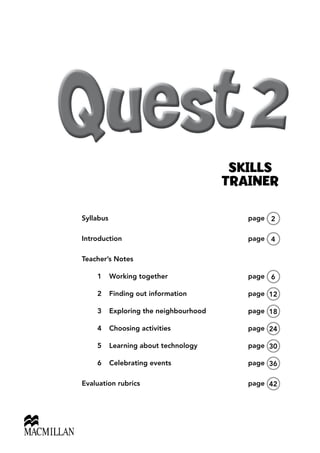
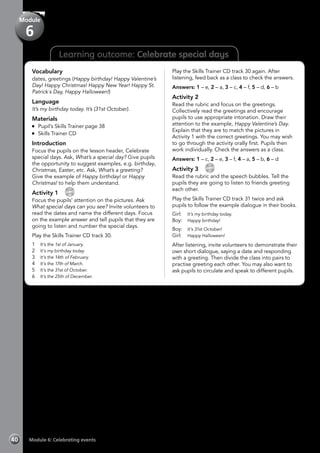
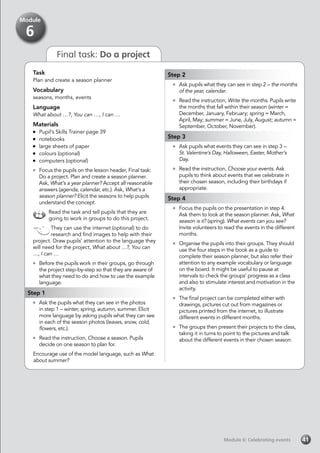
Syllabus		 page 2
Introduction	page 4
Teacher’s Notes
	 1	 Working together	 page 6
	 2	 Finding out information	 page 12
	 3	 Exploring the neighbourhood	 page 18
	 4	 Choosing activities	 page 24
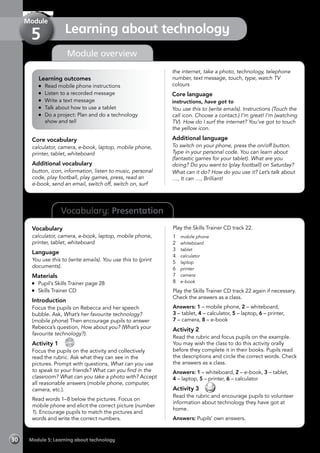
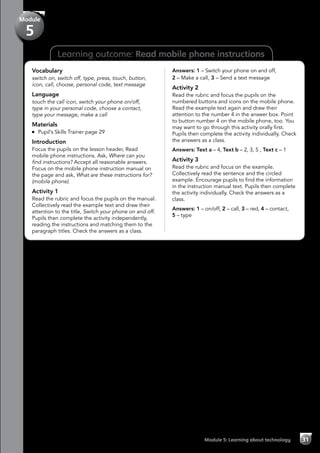
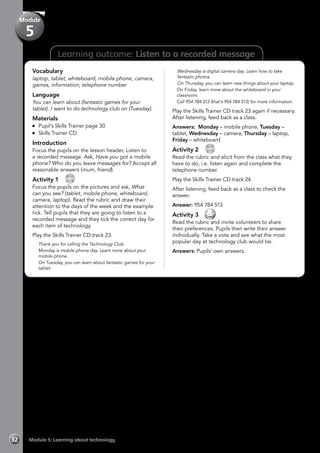
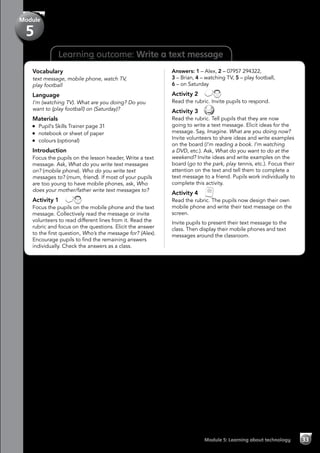
	 5	 Learning about technology	 page 30
	 6	 Celebrating events	 page 36
Evaluation rubrics	 page 42
SKILLS
TRAINER
Skills Trainer 2 Syllabus
Module Learning outcomes Vocabulary Language
1	Working
together
•	 Read school job
descriptions
•	 Listen to
classroom
instructions
•	 Write a thank you
note
•	 Ask for help in
the classroom
Final task: Plan and
present information
about people who
work in your school
Core vocabulary
clean the board, close the
door, collect the books, give
out the books, help your
friends, recycle paper, tidy up,
write the date
Additional vocabulary
jobs (caretaker, cleaner, cook,
head teacher, librarian, nurse,
teacher) responsibilities
(work, keep clean, cook, look
after), places and furniture
(office, kitchen, playground,
desks, floors, windows), Dear,
fantastic, give, interesting,
look after, ill, teach, things
Core language
present simple (I tidy
up.)
I clean the board.
I work in the (kitchen).
Can you help me (do this
exercise), please?
Yes, of course.
Thanks.
Additional language
You’re going to (give out the
books.
He (looks after children).
Who’s the note from?
Who’s the note to?
What does she give the
children?
What job does he do?
He cleans (the desks, floors and
windows).
How about…?
I like…
Great!
2	 Finding out
information
•	 Read an animal
web page
•	 Listen to a school
newspaper
interview
•	 Write a wild
animal fact file
•	 Ask and find out
information about
animals
Final task: Plan
and create animal
families fact files
Core vocabulary
encyclopaedia, library book,
magazine, newspaper,
podcast, school book,
television, web page
Additional vocabulary
internet, animals (aye aye,
crocodile, eel, elephant,
giraffe, lion, pufferfish, snake,
snow leopard), animal actions
(climb, fly, jump, run, swim)
animal families (insects,
reptiles, mammals, fish, birds),
animal parts of the body (fur,
scales, spines, feathers, tail,
teeth, claws, beak), habitats
(mountains, rainforest, water,
trees), strange animals, wild
animals, zookeeper
Core language
present simple (It runs/
climbs/eats/lives/has
got…) There is…/There
are…
I read a (magazine).
I listen to a (podcast).
I watch (television).
I ask (people).
The aye aye lives in the
rainforest.
The eel can swim fast.
The pufferfish has got
spines.
There’s (a lion).
There are (two giraffes).
How does it move?
What does it eat?
Additional language
There’s (a lion).
There are (eight crocodiles).
It’s got (grey fur).
It (climbs)/(eats meat).
It lives in (the mountains).
What does it look like?
What colour is it?
Where does it live?
What does it eat?
How does it move?
Is it an (owl)? Yes, it is.
What animals are in the zoo?
What animals do you want to
see?
Where do you find
information?
What about …?
Let’s read a …
Let’s listen to a …
3	 Exploring the
neighbourhood
•	 Read a high
street brochure
•	 Listen and
complete a
shopping list
•	 Write and
complete a library
card
•	 Order a salad in a
restaurant
Final task: Plan
and create a
postcard of your
neighbourhood
Core vocabulary
baker’s, bookshop, butcher’s,
chemist’s, fishmonger’s,
greengrocer’s, restaurant,
supermarket
Additional vocabulary
places (library, park, school),
food (apples, bread, butter,
cakes, cereal, cheese,
chicken, cucumber, fish, fruit,
ice cream, lettuce, olives,
peppers, salad, sausages,
sweetcorn, tomatoes,
tuna, vegetables, yoghurt),
prepositions (between, next
to), personal information
(name, surname, age,
birthday, address, telephone
number), book genres (fairy
tales, adventure stories,
technology, myths and
legends, history, science
fiction), brochure, shampoo,
washing-up liquid, activities
Core language
can (Can I have some
apples, please?),
prepositions of place
Can I have some
sausages, please?
The baker’s is next to the
greengrocer’s.
There’s a park.
You can play football
here.
Additional language
You can buy (fish) here.
We’ve got a lot of (fruit).
We need (cereal).
We don’t need (ice cream).
What about (yoghurt)?
What’s (her) name?
Where does (he) live?
What’s (his) telephone number?
How old is (she)?
When’s (his) birthday?
What books does (he) like?
Can I help you?
What do you want in your
salad?
Here you are.
Thanks you.
Let’s …
Good idea!
You can do …
Syllabus2
Module Learning outcomes Vocabulary Language
4	Choosing
activities
•	 Read club posters
•	 Listen and
complete diaries
•	 Write and make a
sports club poster
•	 Talk about
weekend plans
Final task: Plan and
present an activities
day for your class
Core vocabulary
art club, dance club, drama
club, library, park, scout
camp, swimming pool, zoo
Additional vocabulary
activities (camping, canoeing,
dancing, fishing, making
things, music, painting,
singing, swimming, theatre),
sports (football, karate,
tennis), weather (cloudy, rainy,
sunny, windy), afternoon,
cinema, diary, indoors,
morning, outdoors, picnic,
Saturday, Sunday, 6 o’clock
Core language
can (You can have a
picnic here.), going to
You can act and sing
here.
I like music and dancing.
I love painting and
making things.
It’s going to (be sunny).
What are you going to do
on (Saturday morning)?
I’m going to (go
swimming).
Additional language
You can (have a picnic) here.
You can (paint and make
things) here.
Can you (go canoeing) at (the
scout camp)?
Is the (dance club) on (Saturday
morning)?
What’s the weather going to
be like?
It’s going to be (rainy) on
(Saturday).
What’s the name of the club?
Where is it?
What day is it on?
It’s on (Saturday).
What time is it?
It’s at (9 o’clock).
Is it in the morning or the
afternoon?
What activities can you do?
I want to …
Me, too.
I’m going to …
5	 Learning about
technology
•	 Read mobile
phone
instructions
•	 Listen to a
recorded
message
•	 Write a text
message
•	 Talk about how to
use a tablet
Final task: Plan and
do a technology
show and tell
Core vocabulary
calculator, camera, e-book,
laptop, mobile phone, printer,
tablet, whiteboard
Additional vocabulary
button, icon, information,
listen to music, personal
code, play football, play
games, press, read an
e-book, send an email,
switch off, switch on, surf
the internet, take a photo,
technology, telephone
number, text message, touch,
type, watch TV, colours
Core language
instructions, have got to
You use this to (write
emails).
Instructions (Touch the
call icon. Choose a
contact.)
I’m great!
I’m (watching TV).
How do I surf the
internet?
You’ve got to touch the
yellow icon.
Additional language
To switch on your phone, press
the on/off button.
Type in your personal code.
You can learn about (fantastic
games for your tablet).
What are you doing?
Do you want to (play football)
on Saturday?
What can it do?
How do you use it?
Let’s talk about …
It can …
Brilliant!
6	Celebrating
events
•	 Read a school
year planner
•	 Listen to
an events
announcement
•	 Write a birthday
card
•	 Celebrate special
days
Final task: Plan and
create a season
planner
Core vocabulary
birthday, Christmas Day,
Easter, Father’s Day,
Halloween, Mother’s Day, St.
Patrick’s Day, Valentine’s Day
Additional vocabulary
months, ordinal numbers,
days of the week, dates,
seasons, events (Festival
week, Drama Day, Food
Day, Music Day, Science
Day, Sports Day, World Day),
greetings (Happy birthday!,
Happy Halloween!, Happy
Valentine’s Day!, Happy
Christmas!, Happy New Year!,
Happy St. Patrick’s Day!),
birthday card, competition,
concert, monster costume,
festival, Fireworks Night,
Easter egg hunt, party,
presents, summer holidays
Core language
exclamations (Happy
birthday!), can (I can
sing in a concert.)
It’s the (1st of January).
It’s my birthday today.
You can (see fireworks) in
November.
Additional language
On this day, you can (wear
fancy dress).
This is a special day for (dads).
the start/end of the school year
is in June
the fourteenth of February
On (Monday 8th), we’ve got
(World Day).
My favourite festival day is
(Music Day).
You’re (eight) today.
Have a great party.
Love from …
What about …?
You can …
I can …
Syllabus 3
Each Skills Trainer within this six-level series
comprises six modules and brings real, everyday
English into the classroom. This is done through
child-friendly content, based on authentic situations
and texts, and with a focus on critical thinking and
problem solving within real-life situations and tasks.
How to use the Skills Trainers
The Skills Trainers are designed to be used
flexibly. The topic-based modules can be selected
and used in any order, so as to best provide
extra skills support and extension to a particular
class. Although following the pages sequentially
throughout a module gets the most out of a topic,
there is also the option of the teacher being more
selective in terms of the order in which they work
with the module and also the content that they wish
to focus on.
The module topics focus on situations and tasks
that the pupils encounter in real life, such as
Finding out information, Choosing activities and
Celebrating events. This therefore provides the
pupils with meaningful and relevant contexts that
they can relate to and explore further. Activities
designed to represent the things around us that we
see, hear and interact with each day, for example,
web pages, newspaper and magazine articles,
shopping lists, food packaging, emails, calendars,
podcasts and public announcements, further ensure
that the content of the Skills Trainers is relevant to
the pupils’ own world.
Each module contains four key learning outcomes,
such as Read an animal web page, Listen to a
school newspaper interview, Write a wild animal
fact file and Ask and find out information about
animals. The aim and can do approach of these
learning outcomes is that the pupils acquire a
growing confidence through the achievement of
carrying out these tasks in English and continue to
build upon the acquisition of these.
Each of the four skills, reading, listening, writing
and speaking, is focused on individually within a
module, with the final module task being a group
project, in which the pupils work together to
research, collate and present information.
The focus on functional language within each
module means that any new structures are
presented and practised within an already-
familiar context. The emphasis on functional
language aims to provide the pupils with the
confidence to use English outside the classroom
and realise its function and scope as a real means
of communication. The Skills Trainer syllabus
also ensures that additional focus is given to the
consolidation and extension of the core language
from Quest 2.
Overview of a Skills Trainer module
Although pages within a module can be used in
an order best suited to the requirements of an
individual class, a sequential use of a module is as
follows:
Vocabulary presentation
The aim of this page is to present the eight core
vocabulary items that the pupils will need for
the module and their final task. Recordings of
these words aim to reinforce pronunciation, with
additional activities providing further practice and
contextualisation within the module topic.
Reading
The reading page reinforces the module vocabulary
through presenting it within an authentic text
type, such as club posters or a school year
planner. Activities on this page check the pupils’
understanding of the text and also focus on the
development of more generic reading skills, such as
reading for gist and overall meaning, and looking
for specific details within a text.
Listening
These pages comprise situational audio recordings,
such as listening to a recorded message and
listening to an events announcement. As with
the reading pages, there is a focus on the
development of generic skills, such as listening
for gist and context, as well as listening out for
specific information. The completion of activities is,
whenever possible, done within a real-life context.
Real-life tasks, such as completing a shopping list
and completing diaries, make the activities more
meaningful for the pupils.
Writing
Model writing texts are first presented in context,
such as a text message and a birthday card. An
initial activity aims to familiarise the pupils with the
text, with further activities focusing the pupils on
detail and structure within the text.
A draft writing template is provided for the pupils to
plan their own written text before completing it in
their notebooks or electronically. Each final writing
task is designed for the pupils to input information
relevant to them, and therefore make the task more
memorable and meaningful.
Speaking
These pages begin with equipping the pupils with
the language they need to do the task through
the reinforcement of vocabulary that has either
been presented previously within the module or is
additional vocabulary relevant to the speaking task.
An audio recording of this vocabulary is provided
Skills Trainer Introduction
Introduction4
within the first activity as a model and guide to
pronunciation. Whenever possible, this vocabulary
is recorded within a repeated language structure,
to provide reinforcement and also to place the
vocabulary in context.
Recordings of model dialogues and conversations,
such as talking about weekend plans, are also
provided. These are also on the page of the pupil’s
component and are intended to be personalised
and adapted by the pupils, and then repeated for
further practice.
Projects
These collaborative projects aim to incorporate the
learning outcomes and language within the module,
while at the same time, reinforcing the importance
of project-related skills, such as preparation and
planning, decision-making, information gathering,
drafting, writing and presenting. Pupils are required
to work collaboratively throughout the four steps of
each project and then present their project, which
ranges from planning and presenting an activities
day for your class to planning and creating a season
planner. The level of guidance in this step-by-step
approach is gradually reduced throughout the
levels of the Skills Trainers, thus meaning that the
pupils’ level of learning autonomy increases and
they input more into how they want to research and
present information.
Language in speech bubbles at the top of each
project page, such as What about…?, Let’s read a
… and Let’s listen to a… provides guidance as to
how the pupils can communicate with each other
throughout the projects.
Language focus points at the bottom of each
project page provide the teacher with a plenary of
the core language within each module.
Overview of the Skills Trainer Teacher’s Notes
The Module overview at the start of each module
provides a clear overview of the learning outcomes
in the module, the core vocabulary and core
language, as well as any additional vocabulary and
language.
This section is then followed by clear and concise
step-by-step instructions for each page of the
pupil’s component. Vocabulary and language for
each page is isolated, so that the teacher can see at
a glance what each page involves. Audioscripts and
answer keys are also integrated into the Teacher’s
Notes for each page of the pupil’s component,
providing the teacher with all the necessary
information in one place.
Icons within the pupil’s component are cross-
referenced within the Teacher’s Notes:
	 denotes critical thinking
	 requires personal input from the pupils
	 requires the pupils to do the activity
within their notebooks and/or on a
separate piece of paper
	 signifies that this activity can be
completed digitally
	 reinforces the importance of group work
throughout the project pages
CD
2
	 indicates recorded audio and
corresponding track number within the
downloadable MP3 audio files
Evaluation rubrics for each module are provided
at the back of the Teacher’s Notes. These can
be photocopied and completed to record the
progression of each individual pupil.
Skills Trainer downloadable MP3 audio files
Audio activities are integrated into the Skills
Trainer. These aim to bring authentic listening
experiences into the classroom, and also provide
pronunciation guidance and models of dialogues
and conversations for the pupils to follow and adapt
for themselves.
Track listings within the pupil’s component and the
Teacher’s Notes mean that audio tracks are easily
located within the downloadable MP3 audio files.
Introduction 5
Vocabulary: Presentation
Module 1: Working together6
Module overview
Working together
Module
1
Learning outcomes
	 Read school job descriptions
	 Listen to classroom instructions
	 Write a thank you note
	 Ask for help in the classroom
	 Do a project: Plan and present information
about people who work in your school
Core vocabulary
clean the board, close the door, collect the books,
give out the books, help your friends, recycle paper,
tidy up, write the date
Additional vocabulary
jobs (caretaker, cleaner, cook, head teacher,
librarian, nurse, teacher) responsibilities (work, keep
clean, cook, look after), places and furniture (office,
kitchen, playground, desks, floors, windows), Dear,
fantastic, give, interesting, look after, ill, teach,
things
Core language
present simple (I tidy up.)
I clean the board. I work in the (kitchen). Can you
help me (do this exercise), please? Yes, of course.
Thanks.
Additional language
You´re going to (give out the books). He (looks after
children). Who’s the note from? Who’s the note to?
What does he give the children? What job does he
do? He cleans (the desks, floors and windows). How
about …?, I like …, Great!
Vocabulary
clean the board, close the door, collect the books,
give out the books, help your friends, recycle paper,
tidy up, write the date
Language
I (write the date). I (collect the books).
Materials
	 Pupil’s Skills Trainer page 4
	 Skills Trainer CD
Introduction
Look at the photo of Elsie. Focus the pupils on
Elsie’s speech bubble. Then ask questions, e.g. Is
this a girl or a boy? What’s her name? Who’s her
favourite person at school? etc. Ask pupils to answer
Elsie’s question, Who’s your favourite person?
Activity 1 
CD
2
Focus the pupils on the activity and collectively read
the rubric. Ask what they can see in the pictures.
Prompt with questions, e.g. Can you see a date?
What’s happening in this picture? Can you see any
books? etc. Accept all reasonable answers.
Read the phrases 1–8 below the pictures. Focus on
give out the books and elicit the correct picture
(number 1).
Encourage pupils to match the pictures and words
and write the correct numbers.
Play the Skills Trainer CD track 2 for pupils to check
their answers.
1	 give out the books
2	 clean the board
3	 recycle paper
4	 write the date
5	 help your friends
6	 close the door
7	 tidy up
8	 collect the books
Play the Skills Trainer CD track 2 again if necessary.
Check the answers as a class.
Answers: 1 – give out the books, 2 – clean the
board, 3 – recycle paper, 4 – write the date,
5 – help your friends, 6 – close the door, 7 – tidy
up, 8 – collect the books
Activity 2
Read the rubric and focus pupils on the example.
You may wish the class to do this activity orally
before completing it in their books. Pupils match the
words in the left and right columns.
Answers: 1 – give out the books, 2 – recycle plastic,
3 – help your teacher, 4 – write in your notebook,
5 – close the window, 6 – collect the pencils
Activity 3 
Read the rubric and encourage the class to
volunteer ideas about how they help in the
classroom. Pupils can then complete the activity
individually.
Answers: Pupils’ own answers.
Learning outcome: Read school job descriptions
Module 1: Working together 7
Module
1
Vocabulary
jobs (caretaker, cleaner, cook, head teacher),
responsibilities (work, keep clean, cook, look after),
places and furniture (office, kitchen, playground,
desks, floors, windows)
Language
I (work in the kitchen). Mr Bright (keeps the school
clean).
Materials
	 Pupil’s Skills Trainer page 5
Introduction
Focus the pupils on the lesson header, Read school
job descriptions. Ask, What different jobs can you
think of? Ask pupils what jobs they can see in the
pictures. They may read the labels below. Ask, What
does a cook do? What does a cleaner do? etc.
Accept all reasonable answers (cook food, clean,
etc.).
Activity 1
Read the rubric and focus the pupils on the People
in our school texts below the pictures. Read the
example text together and look at the answer.
Encourage pupils to read the remaining texts
individually and write the correct jobs. Check the
answers as a class.
Answers: 1 – cleaner, 2 – head teacher,
3 – caretaker, 4 – cook
Activity 2
Read the rubric and focus the pupils on the
example. Look at the picture and collectively read
the completed speech bubble. Ask, What’s her job?
and elicit the answer, cook. Look at the remaining
pictures and elicit the jobs. Ask the class to suggest
what they can write in the different speech bubbles,
referring them to the texts in Activity 1 for support.
Pupils then complete the activity individually. Check
the answers as a class.
Answers: 1 – kitchen, 2 – desks, 3 – school,
4 – office
Activity 3 
Read the rubric and encourage the class to
volunteer ideas about people who work in the
school. Pupils can then complete the activity
individually.
Answers: Pupils’ own answers.
Learning outcome: Listen to classroom instructions
Vocabulary
classroom jobs (write the date, clean the board,
recycle paper, close the door, collect the books,
give out the books)
Language
You’re going to (clean the board). You’re going to
(recycle paper).
Materials
	 Pupil’s Skills Trainer page 6
	 Skills Trainer CD
Introduction
Focus the pupils on the lesson header, Listen to
classroom instructions. Ask, Where do you listen to
classroom instructions? (in school, in the classroom,
etc.). Ask pupils what they can see in the pictures.
Accept all reasonable answers (a board, a girl,
books, a door, etc.). They can read the labels below
the pictures.
Activity 1 
CD
3
Point to the teacher in the photo on the page and
ask, Who’s this? (a teacher). Read the rubric and tell
the pupils that they are going to listen to a teacher
talking about classroom jobs. They should tick the
jobs that they hear. Focus them on the example.
Play the Skills Trainer CD track 3.
	OK. Quiet everyone.
	Now, I’m going to tell you your jobs for the week.
	Peter, you’re going to give out the books.
	Zac, you’re going to collect the books.
	Susan, you’re going to clean the board.
	Joanna, you’re going to write the date.
	And David, you’re going to recycle paper.
Play the Skills Trainer CD track 3 again if necessary.
After listening, feed back as a class to check the
answers.
Answers: write the date, clean the board, recycle
paper, collect the books, give out the books
Ask pupils which job they did not hear, close the
door. Ask them to suggest other classroom jobs, e.g.
tidy up, write the weather, help a friend.
Activity 2 
CD
4
Focus the pupils on the picture of the whiteboard
and ask them what they see written on it.
Collectively read the names. Read the rubric and
tell pupils that they are now going to listen to the
teacher again. This time they listen to the classroom
jobs that the different children are going to do
and write them next to their names. Focus on the
example.
Play the Skills Trainer CD track 4.
Pupils listen and complete the list.
After listening, feed back as a class to check the
answers.
Answers: Peter – give out the books, Zac – collect
the books, Susan – clean the board, Joanna – write
the date, David – recycle paper
Activity 3 
Read the rubric and ask the class to volunteer
suggestions. They then complete the activity
individually. Pupils can write the job only or write it
as a full sentence.
Answers: Pupils’ own answers.
Module 1: Working together8
Module
1
Module
1
Learning outcome: Write a thank you note
Vocabulary
librarian, teacher, nurse, Dear, fantastic, give, teach,
look after, interesting, ill, things
Language
Who’s the note from? Who’s the note to?
What does he give the children?
Materials
	 Pupil’s Skills Trainer page 7
	 notebook or sheet of paper
	 colours (optional)
Introduction
Focus the pupils on the lesson header, Write a
thank you note. Ask, When do we say thank you?
How can you say thank you? (speaking, on the
phone, in an email/a letter). Ask pupils if they write
thank you notes.
Activity 1 
Read the rubric and draw the pupils’ attention
to the thank you note. Ask, What’s this? Elicit all
reasonable answers. Collectively read the thank you
note. Elicit the answers to the questions orally. The
pupils do not need to write at this stage. Check the
answers as a class.
Answers: 1 – Marcus, 2 – Mr Smith, 3 – interesting
books (to read)
Activity 2 
Read the rubric. Draw the pupils’ attention to the
photos and elicit the jobs. Ask pupils to identify Mr
Smith’s job (librarian – picture 3).
Ask the pupils what a nurse and a teacher do (look
after children when they are ill, teach children
interesting things).
Activity 3 
Read the rubric. Tell pupils that they are now going
to plan their own thank you note to someone in
the school. Elicit ideas of who they can write to.
They can focus on the jobs on this page or from
the Reading lesson. Draw their attention to the
incomplete thank you note and go through the
sections one by one, eliciting examples of what
they might write. Pupils can either work individually,
in pairs or in small groups to complete this activity.
Activity 4 
Read the rubric. The pupils now use their draft
thank you note from Activity 3 to create a final
version that they can write neatly either in their
notebook or on a sheet of paper. Encourage pupils
to decorate their thank you note and give it to their
chosen person.
Module 1: Working together 9
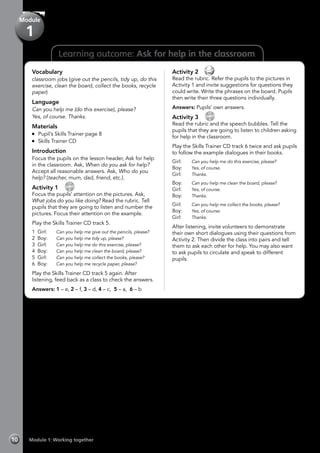
Learning outcome: Ask for help in the classroom
Vocabulary
classroom jobs (give out the pencils, tidy up, do this
exercise, clean the board, collect the books, recycle
paper)
Language
Can you help me (do this exercise), please?
Yes, of course. Thanks.
Materials
	 Pupil’s Skills Trainer page 8
	 Skills Trainer CD
Introduction
Focus the pupils on the lesson header, Ask for help
in the classroom. Ask, When do you ask for help?
Accept all reasonable answers. Ask, Who do you
help? (teacher, mum, dad, friend, etc.).
Activity 1 
CD
5
Focus the pupils’ attention on the pictures. Ask,
What jobs do you like doing? Read the rubric. Tell
pupils that they are going to listen and number the
pictures. Focus their attention on the example.
Play the Skills Trainer CD track 5.
1 Girl:	 Can you help me give out the pencils, please?
2 Boy:	 Can you help me tidy up, please?
3 Girl:	 Can you help me do this exercise, please?
4 Boy:	 Can you help me clean the board, please?
5 Girl:	 Can you help me collect the books, please?
6 Boy:	 Can you help me recycle paper, please?
Play the Skills Trainer CD track 5 again. After
listening, feed back as a class to check the answers.
Answers: 1 – e, 2 – f, 3 – d, 4 – c, 5 – a, 6 – b
Activity 2 
Read the rubric. Refer the pupils to the pictures in
Activity 1 and invite suggestions for questions they
could write. Write the phrases on the board. Pupils
then write their three questions individually.
Answers: Pupils’ own answers.
Activity 3 
CD
6
Read the rubric and the speech bubbles. Tell the
pupils that they are going to listen to children asking
for help in the classroom.
Play the Skills Trainer CD track 6 twice and ask pupils
to follow the example dialogues in their books.
Girl:	 Can you help me do this exercise, please?
Boy:	 Yes, of course.
Girl:	 Thanks.
Boy:	 Can you help me clean the board, please?
Girl:	 Yes, of course.
Boy:	 Thanks.
Girl:	 Can you help me collect the books, please?
Boy:	 Yes, of course.
Girl:	 Thanks.
After listening, invite volunteers to demonstrate
their own short dialogues using their questions from
Activity 2. Then divide the class into pairs and tell
them to ask each other for help. You may also want
to ask pupils to circulate and speak to different
pupils.
Module 1: Working together10
Module
1
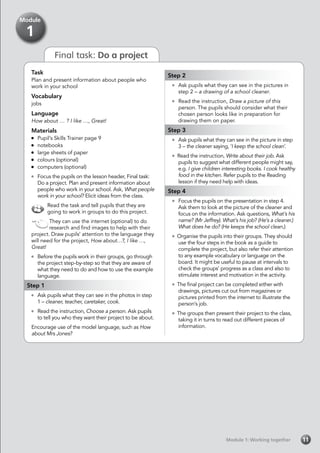
Final task: Do a project
Module 1: Working togetherModule 1: Working together 11
Task
Plan and present information about people who
work in your school
Vocabulary
jobs
Language
How about … ? I like …, Great!
Materials
	 Pupil’s Skills Trainer page 9
	notebooks
	 large sheets of paper
	 colours (optional)
	 computers (optional)
	 Focus the pupils on the lesson header, Final task:
Do a project. Plan and present information about
people who work in your school. Ask, What people
work in your school? Elicit ideas from the class.
Read the task and tell pupils that they are
going to work in groups to do this project.
They can use the internet (optional) to do
research and find images to help with their
project. Draw pupils’ attention to the language they
will need for the project, How about…?, I like …,
Great!
	 Before the pupils work in their groups, go through
the project step-by-step so that they are aware of
what they need to do and how to use the example
language.
Step 1
	 Ask pupils what they can see in the photos in step
1 – cleaner, teacher, caretaker, cook.
	 Read the instruction, Choose a person. Ask pupils
to tell you who they want their project to be about.
Encourage use of the model language, such as How
about Mrs Jones?
Module
1
Step 2
	 Ask pupils what they can see in the pictures in
step 2 – a drawing of a school cleaner.
	 Read the instruction, Draw a picture of this
person. The pupils should consider what their
chosen person looks like in preparation for
drawing them on paper.
Step 3
	 Ask pupils what they can see in the picture in step
3 – the cleaner saying, ‘I keep the school clean’.
Read the instruction, Write about their job. Ask
pupils to suggest what different people might say,
e.g. I give children interesting books. I cook healthy
food in the kitchen. Refer pupils to the Reading
lesson if they need help with ideas.
Step 4
	 Focus the pupils on the presentation in step 4.
Ask them to look at the picture of the cleaner and
focus on the information. Ask questions, What’s his
name? (Mr Jeffrey). What’s his job? (He’s a cleaner.)
What does he do? (He keeps the school clean.).
Organise the pupils into their groups. They should
use the four steps in the book as a guide to
complete the project, but also refer their attention
to any example vocabulary or language on the
board. It might be useful to pause at intervals to
check the groups’ progress as a class and also to
stimulate interest and motivation in the activity.
The final project can be completed either with
drawings, pictures cut out from magazines or
pictures printed from the internet to illustrate the
person’s job.
The groups then present their project to the class,
taking it in turns to read out different pieces of
information.
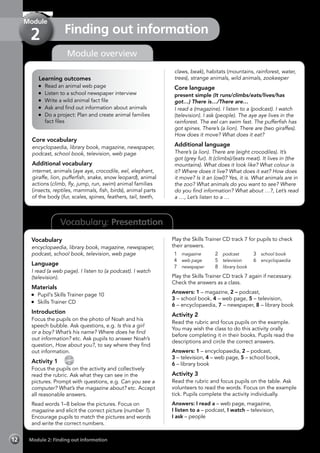
Vocabulary: Presentation
Module overview
Learning outcomes
	 Read an animal web page
	 Listen to a school newspaper interview
	 Write a wild animal fact file
	 Ask and find out information about animals
	 Do a project: Plan and create animal families
fact files
Core vocabulary
encyclopaedia, library book, magazine, newspaper,
podcast, school book, television, web page
Additional vocabulary
internet, animals (aye aye, crocodile, eel, elephant,
giraffe, lion, pufferfish, snake, snow leopard), animal
actions (climb, fly, jump, run, swim) animal families
(insects, reptiles, mammals, fish, birds), animal parts
of the body (fur, scales, spines, feathers, tail, teeth,
claws, beak), habitats (mountains, rainforest, water,
trees), strange animals, wild animals, zookeeper
Core language
present simple (It runs/climbs/eats/lives/has
got…) There is…/There are…
I read a (magazine). I listen to a (podcast). I watch
(television). I ask (people). The aye aye lives in the
rainforest. The eel can swim fast. The pufferfish has
got spines. There’s (a lion). There are (two giraffes).
How does it move? What does it eat?
Additional language
There’s (a lion). There are (eight crocodiles). It’s
got (grey fur). It (climbs)/(eats meat). It lives in (the
mountains). What does it look like? What colour is
it? Where does it live? What does it eat? How does
it move? Is it an (owl)? Yes, it is. What animals are in
the zoo? What animals do you want to see? Where
do you find information? What about …?, Let’s read
a …, Let’s listen to a …
Vocabulary
encyclopaedia, library book, magazine, newspaper,
podcast, school book, television, web page
Language
I read (a web page). I listen to (a podcast). I watch
(television).
Materials
	 Pupil’s Skills Trainer page 10
	 Skills Trainer CD
Introduction
Focus the pupils on the photo of Noah and his
speech bubble. Ask questions, e.g. Is this a girl
or a boy? What’s his name? Where does he find
out information? etc. Ask pupils to answer Noah’s
question, How about you?, to say where they find
out information.
Activity 1 
CD
7
Focus the pupils on the activity and collectively
read the rubric. Ask what they can see in the
pictures. Prompt with questions, e.g. Can you see a
computer? What’s the magazine about? etc. Accept
all reasonable answers.
Read words 1–8 below the pictures. Focus on
magazine and elicit the correct picture (number 1).
Encourage pupils to match the pictures and words
and write the correct numbers.
Play the Skills Trainer CD track 7 for pupils to check
their answers.
1	 magazine
4	 web page
7	 newspaper
2	 podcast
5	 television
8	 library book
3	 school book
6	 encyclopaedia
Play the Skills Trainer CD track 7 again if necessary.
Check the answers as a class.
Answers: 1 – magazine, 2 – podcast,
3 – school book, 4 – web page, 5 – television,
6 – encyclopaedia, 7 – newspaper, 8 – library book
Activity 2
Read the rubric and focus pupils on the example.
You may wish the class to do this activity orally
before completing it in their books. Pupils read the
descriptions and circle the correct answers.
Answers: 1 – encyclopaedia, 2 – podcast,
3 – television, 4 – web page, 5 – school book,
6 – library book
Activity 3
Read the rubric and focus pupils on the table. Ask
volunteers to read the words. Focus on the example
tick. Pupils complete the activity individually.
Answers: I read a – web page, magazine,
I listen to a – podcast, I watch – television,
I ask – people
Module 2: Finding out information12
Finding out information
Module
2
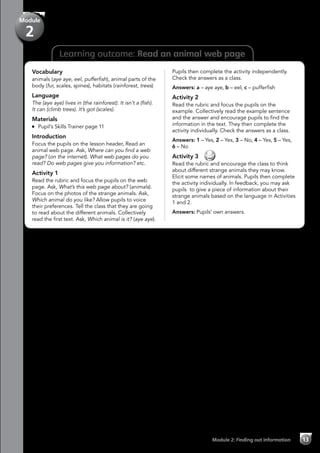
Learning outcome: Read an animal web page
Vocabulary
animals (aye aye, eel, pufferfish), animal parts of the
body (fur, scales, spines), habitats (rainforest, trees)
Language
The (aye aye) lives in (the rainforest). It isn’t a (fish).
It can (climb trees). It’s got (scales).
Materials
	 Pupil’s Skills Trainer page 11
Introduction
Focus the pupils on the lesson header, Read an
animal web page. Ask, Where can you find a web
page? (on the internet). What web pages do you
read? Do web pages give you information? etc.
Activity 1
Read the rubric and focus the pupils on the web
page. Ask, What’s this web page about? (animals).
Focus on the photos of the strange animals. Ask,
Which animal do you like? Allow pupils to voice
their preferences. Tell the class that they are going
to read about the different animals. Collectively
read the first text. Ask, Which animal is it? (aye aye).
Pupils then complete the activity independently.
Check the answers as a class.
Answers: a – aye aye, b – eel, c – pufferfish
Activity 2
Read the rubric and focus the pupils on the
example. Collectively read the example sentence
and the answer and encourage pupils to find the
information in the text. They then complete the
activity individually. Check the answers as a class.
Answers: 1 – Yes, 2 – Yes, 3 – No, 4 – Yes, 5 – Yes,
6 – No
Activity 3 
Read the rubric and encourage the class to think
about different strange animals they may know.
Elicit some names of animals. Pupils then complete
the activity individually. In feedback, you may ask
pupils to give a piece of information about their
strange animals based on the language in Activities
1 and 2.
Answers: Pupils’ own answers.
Module 2: Finding out information 13
Module
2
Learning outcome:
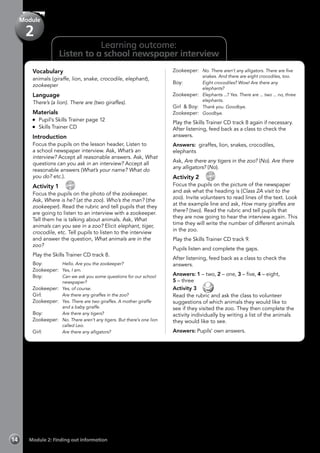
Listen to a school newspaper interview
Vocabulary
animals (giraffe, lion, snake, crocodile, elephant),
zookeeper
Language
There’s (a lion). There are (two giraffes).
Materials
	 Pupil’s Skills Trainer page 12
	 Skills Trainer CD
Introduction
Focus the pupils on the lesson header, Listen to
a school newspaper interview. Ask, What’s an
interview? Accept all reasonable answers. Ask, What
questions can you ask in an interview? Accept all
reasonable answers (What’s your name? What do
you do? etc.).
Activity 1 
CD
8
Focus the pupils on the photo of the zookeeper.
Ask, Where is he? (at the zoo). Who’s the man? (the
zookeeper). Read the rubric and tell pupils that they
are going to listen to an interview with a zookeeper.
Tell them he is talking about animals. Ask, What
animals can you see in a zoo? Elicit elephant, tiger,
crocodile, etc. Tell pupils to listen to the interview
and answer the question, What animals are in the
zoo?
Play the Skills Trainer CD track 8.
Boy: 	 Hello. Are you the zookeeper?
Zookeeper:	 Yes, I am.
Boy:	 Can we ask you some questions for our school
newspaper?
Zookeeper:	 Yes, of course.
Girl:	 Are there any giraffes in the zoo?
Zookeeper:	 Yes. There are two giraffes. A mother giraffe
and a baby giraffe.
Boy:	 Are there any tigers?
Zookeeper:	 No. There aren’t any tigers. But there’s one lion
called Leo.
Girl:	 Are there any alligators?
Zookeeper:	 No. There aren’t any alligators. There are five
snakes. And there are eight crocodiles, too.
Boy:	 Eight crocodiles? Wow! Are there any
elephants?
Zookeeper:	 Elephants ...? Yes. There are ... two ... no, three
elephants.
Girl & Boy:	 Thank you. Goodbye.
Zookeeper:	 Goodbye.
Play the Skills Trainer CD track 8 again if necessary.
After listening, feed back as a class to check the
answers.
Answers: giraffes, lion, snakes, crocodiles,
elephants
Ask, Are there any tigers in the zoo? (No). Are there
any alligators? (No).
Activity 2 
CD
9
Focus the pupils on the picture of the newspaper
and ask what the heading is (Class 2A visit to the
zoo). Invite volunteers to read lines of the text. Look
at the example line and ask, How many giraffes are
there? (two). Read the rubric and tell pupils that
they are now going to hear the interview again. This
time they will write the number of different animals
in the zoo.
Play the Skills Trainer CD track 9.
Pupils listen and complete the gaps.
After listening, feed back as a class to check the
answers.
Answers: 1 – two, 2 – one, 3 – five, 4 – eight,
5 – three
Activity 3 
Read the rubric and ask the class to volunteer
suggestions of which animals they would like to
see if they visited the zoo. They then complete the
activity individually by writing a list of the animals
they would like to see.
Answers: Pupils’ own answers.
Module 2: Finding out information14
Module
2
Learning outcome: Write a wild animal fact file
Vocabulary
snow leopard, fur, tail, climb, mountains, magazine,
internet
Language
It´s got (grey fur). It (climbs) / (eats meat). It lives in
(the mountains).
Materials
	 Pupil’s Skills Trainer page 13
	 notebook or sheet of paper
	 books or magazines about animals (optional)
	 colours (optional)
	 computer (optional)
Introduction
Focus the pupils on the lesson header, Write a wild
animal fact file. Ask, What wild animals can you
think of? Accept all reasonable answers, (tigers,
dolphins, crocodiles, etc.) Ask, Where can you
find out information about wild animals? (books,
internet, magazines).
Activity 1 
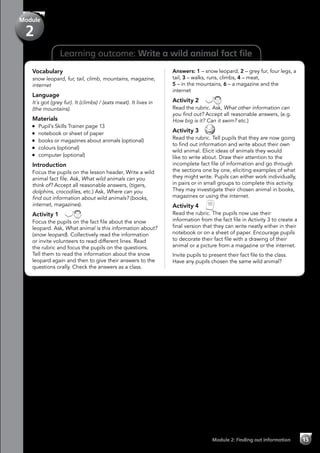
Focus the pupils on the fact file about the snow
leopard. Ask, What animal is this information about?
(snow leopard). Collectively read the information
or invite volunteers to read different lines. Read
the rubric and focus the pupils on the questions.
Tell them to read the information about the snow
leopard again and then to give their answers to the
questions orally. Check the answers as a class.
Answers: 1 – snow leopard, 2 – grey fur, four legs, a
tail, 3 – walks, runs, climbs, 4 – meat,
5 – in the mountains, 6 – a magazine and the
internet
Activity 2 
Read the rubric. Ask, What other information can
you find out? Accept all reasonable answers, (e.g.
How big is it? Can it swim? etc.)
Activity 3 
Read the rubric. Tell pupils that they are now going
to find out information and write about their own
wild animal. Elicit ideas of animals they would
like to write about. Draw their attention to the
incomplete fact file of information and go through
the sections one by one, eliciting examples of what
they might write. Pupils can either work individually,
in pairs or in small groups to complete this activity.
They may investigate their chosen animal in books,
magazines or using the internet.
Activity 4 
Read the rubric. The pupils now use their
information from the fact file in Activity 3 to create a
final version that they can write neatly either in their
notebook or on a sheet of paper. Encourage pupils
to decorate their fact file with a drawing of their
animal or a picture from a magazine or the internet.
Invite pupils to present their fact file to the class.
Have any pupils chosen the same wild animal?
Module 2: Finding out information 15
Module
2
Learning outcome:
Ask and find out information about animals
Vocabulary
animal parts of the body (feathers, tail, fur, claws,
teeth, beak)
Language
What does it look like? It’s got (fur and a tail).
How does it move? It (flies). What does it eat?
It eats (insects). Where does it live? It lives (in the
forest). Is it (an owl)? Yes, it is.
Materials
	 Pupil’s Skills Trainer page 14
	 Skills Trainer CD
Introduction
Focus the pupils on the lesson header, Ask and
find out information about animals. Ask, What
information can you find out about animals? Accept
all reasonable answers (Is it big? Has it got a tail?
etc.).
Activity 1 
CD
10
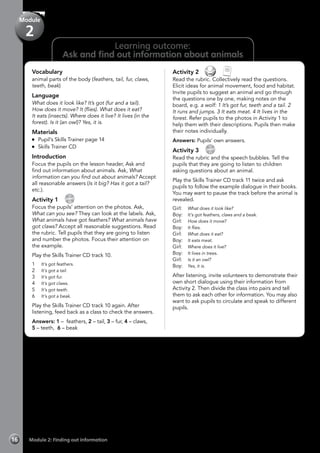
Focus the pupils’ attention on the photos. Ask,
What can you see? They can look at the labels. Ask,
What animals have got feathers? What animals have
got claws? Accept all reasonable suggestions. Read
the rubric. Tell pupils that they are going to listen
and number the photos. Focus their attention on
the example.
Play the Skills Trainer CD track 10.
1	 It’s got feathers.
2	 It’s got a tail.
3	 It’s got fur.
4	 It’s got claws.
5	 It’s got teeth.
6	 It’s got a beak.
Play the Skills Trainer CD track 10 again. After
listening, feed back as a class to check the answers.
Answers: 1 – feathers, 2 – tail, 3 – fur, 4 – claws,
5 – teeth, 6 – beak
Activity 2   
Read the rubric. Collectively read the questions.
Elicit ideas for animal movement, food and habitat.
Invite pupils to suggest an animal and go through
the questions one by one, making notes on the
board, e.g. a wolf: 1 It’s got fur, teeth and a tail. 2
It runs and jumps. 3 It eats meat. 4 It lives in the
forest. Refer pupils to the photos in Activity 1 to
help them with their descriptions. Pupils then make
their notes individually.
Answers: Pupils’ own answers.
Activity 3 
CD
11
Read the rubric and the speech bubbles. Tell the
pupils that they are going to listen to children
asking questions about an animal.
Play the Skills Trainer CD track 11 twice and ask
pupils to follow the example dialogue in their books.
You may want to pause the track before the animal is
revealed.
Girl:	 What does it look like?
Boy: 	 It’s got feathers, claws and a beak.
Girl:	 How does it move?
Boy: 	 It flies.
Girl:	 What does it eat?
Boy: 	 It eats meat.
Girl:	 Where does it live?
Boy: 	 It lives in trees.
Girl:	 Is it an owl?
Boy: 	 Yes, it is.
After listening, invite volunteers to demonstrate their
own short dialogue using their information from
Activity 2. Then divide the class into pairs and tell
them to ask each other for information. You may also
want to ask pupils to circulate and speak to different
pupils.
Module 2: Finding out information16
Module
2
Task
Plan and create animal families fact files
Vocabulary
animal families, animal actions, animal parts of the
body
Language
What about …?, Let’s read a …, Let’s listen to a …
Materials
	 Pupil’s Skills Trainer page 15
	notebooks
	 large sheets of paper
	 colours (optional)
	 computers (optional)
	 Focus the pupils on the lesson header, Final task:
Do a project. Plan and create animal families fact
files. Ask pupils to name as many animals as they
can.
Read the task and tell pupils that they are
going to work in groups to do this project.
They can use the internet (optional) to do
research and find images to help with their
project. Draw pupils’ attention to the language they
will need for the project, What about ...?,
We can do ..., I like that!
	 Before the pupils work in their groups, go through
the project step-by-step so that they are aware of
what they need to do and how to use the example
language.
Step 1
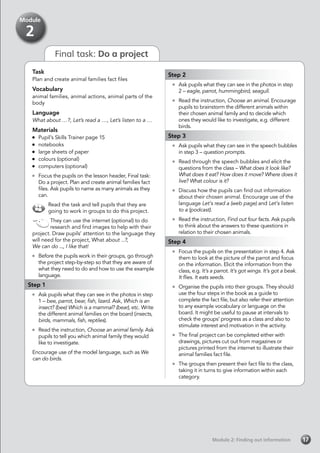
	 Ask pupils what they can see in the photos in step
1 – bee, parrot, bear, fish, lizard. Ask, Which is an
insect? (bee) Which is a mammal? (bear), etc. Write
the different animal families on the board (insects,
birds, mammals, fish, reptiles).
	 Read the instruction, Choose an animal family. Ask
pupils to tell you which animal family they would
like to investigate.
Encourage use of the model language, such as We
can do birds.
Step 2
	 Ask pupils what they can see in the photos in step
2 – eagle, parrot, hummingbird, seagull.
	 Read the instruction, Choose an animal. Encourage
pupils to brainstorm the different animals within
their chosen animal family and to decide which
ones they would like to investigate, e.g. different
birds.
Step 3
	 Ask pupils what they can see in the speech bubbles
in step 3 – question prompts.
	 Read through the speech bubbles and elicit the
questions from the class – What does it look like?
What does it eat? How does it move? Where does it
live? What colour is it?
	 Discuss how the pupils can find out information
about their chosen animal. Encourage use of the
language Let’s read a (web page) and Let’s listen
to a (podcast).
	 Read the instruction, Find out four facts. Ask pupils
to think about the answers to these questions in
relation to their chosen animals.
Step 4
	 Focus the pupils on the presentation in step 4. Ask
them to look at the picture of the parrot and focus
on the information. Elicit the information from the
class, e.g. It’s a parrot. It’s got wings. It’s got a beak.
It flies. It eats seeds.
	 Organise the pupils into their groups. They should
use the four steps in the book as a guide to
complete the fact file, but also refer their attention
to any example vocabulary or language on the
board. It might be useful to pause at intervals to
check the groups’ progress as a class and also to
stimulate interest and motivation in the activity.
	 The final project can be completed either with
drawings, pictures cut out from magazines or
pictures printed from the internet to illustrate their
animal families fact file.
	 The groups then present their fact file to the class,
taking it in turns to give information within each
category.
Module 2: Finding out informationModule 2: Finding out information 17
Module
2
Final task: Do a project
Vocabulary: Presentation
Module overview
Learning outcomes
	 Read a high street brochure
	 Listen and complete a shopping list
	 Write and complete a library card
	 Order a salad in a restaurant
	 Do a project: Plan and create a postcard of
your neighbourhood
Core vocabulary
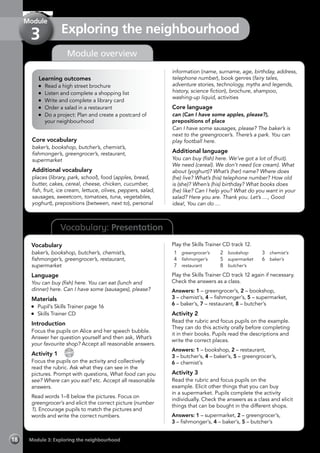
baker’s, bookshop, butcher’s, chemist’s,
fishmonger’s, greengrocer’s, restaurant,
supermarket
Additional vocabulary
places (library, park, school), food (apples, bread,
butter, cakes, cereal, cheese, chicken, cucumber,
fish, fruit, ice cream, lettuce, olives, peppers, salad,
sausages, sweetcorn, tomatoes, tuna, vegetables,
yoghurt), prepositions (between, next to), personal
information (name, surname, age, birthday, address,
telephone number), book genres (fairy tales,
adventure stories, technology, myths and legends,
history, science fiction), brochure, shampoo,
washing-up liquid, activities
Core language
can (Can I have some apples, please?),
prepositions of place
Can I have some sausages, please? The baker’s is
next to the greengrocer’s. There’s a park. You can
play football here.
Additional language
You can buy (fish) here. We’ve got a lot of (fruit).
We need (cereal). We don’t need (ice cream). What
about (yoghurt)? What’s (her) name? Where does
(he) live? What’s (his) telephone number? How old
is (she)? When’s (his) birthday? What books does
(he) like? Can I help you? What do you want in your
salad? Here you are. Thank you. Let’s …, Good
idea!, You can do …
Vocabulary
baker’s, bookshop, butcher’s, chemist’s,
fishmonger’s, greengrocer’s, restaurant,
supermarket
Language
You can buy (fish) here. You can eat (lunch and
dinner) here. Can I have some (sausages), please?
Materials
	 Pupil’s Skills Trainer page 16
	 Skills Trainer CD
Introduction
Focus the pupils on Alice and her speech bubble.
Answer her question yourself and then ask, What’s
your favourite shop? Accept all reasonable answers.
Activity 1 
CD
12
Focus the pupils on the activity and collectively
read the rubric. Ask what they can see in the
pictures. Prompt with questions, What food can you
see? Where can you eat? etc. Accept all reasonable
answers.
Read words 1–8 below the pictures. Focus on
greengrocer’s and elicit the correct picture (number
1). Encourage pupils to match the pictures and
words and write the correct numbers.
Play the Skills Trainer CD track 12.
1	 greengrocer’s
4	 fishmonger’s
7	 restaurant
2	 bookshop
5	 supermarket
8	 butcher’s
3	 chemist’s
6	 baker’s
Play the Skills Trainer CD track 12 again if necessary.
Check the answers as a class.
Answers: 1 – greengrocer’s, 2 – bookshop,
3 – chemist’s, 4 – fishmonger’s, 5 – supermarket,
6 – baker’s, 7 – restaurant, 8 – butcher’s
Activity 2
Read the rubric and focus pupils on the example.
They can do this activity orally before completing
it in their books. Pupils read the descriptions and
write the correct places.
Answers: 1 – bookshop, 2 – restaurant,
3 – butcher’s, 4 – baker’s, 5 – greengrocer’s,
6 – chemist’s
Activity 3
Read the rubric and focus pupils on the
example. Elicit other things that you can buy
in a supermarket. Pupils complete the activity
individually. Check the answers as a class and elicit
things that can be bought in the different shops.
Answers: 1 – supermarket, 2 – greengrocer’s,
3 – fishmonger’s, 4 – baker’s, 5 – butcher’s
Module 3: Exploring the neighbourhood18
Exploring the neighbourhood
Module
3
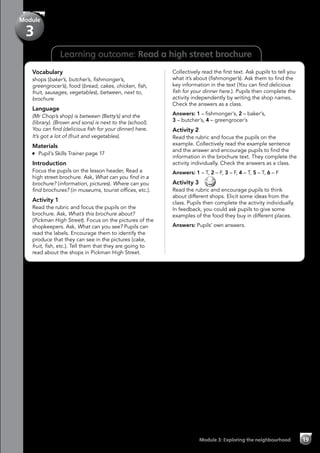
Learning outcome: Read a high street brochure
Vocabulary
shops (baker’s, butcher’s, fishmonger’s,
greengrocer’s), food (bread, cakes, chicken, fish,
fruit, sausages, vegetables), between, next to,
brochure
Language
(Mr Chop’s shop) is between (Betty’s) and the
(library). (Brown and sons) is next to the (school).
You can find (delicious fish for your dinner) here.
It’s got a lot of (fruit and vegetables).
Materials
	 Pupil’s Skills Trainer page 17
Introduction
Focus the pupils on the lesson header, Read a
high street brochure. Ask, What can you find in a
brochure? (information, pictures). Where can you
find brochures? (in museums, tourist offices, etc.).
Activity 1
Read the rubric and focus the pupils on the
brochure. Ask, What’s this brochure about?
(Pickman High Street). Focus on the pictures of the
shopkeepers. Ask, What can you see? Pupils can
read the labels. Encourage them to identify the
produce that they can see in the pictures (cake,
fruit, fish, etc.). Tell them that they are going to
read about the shops in Pickman High Street.
Collectively read the first text. Ask pupils to tell you
what it’s about (fishmonger’s). Ask them to find the
key information in the text (You can find delicious
fish for your dinner here.). Pupils then complete the
activity independently by writing the shop names.
Check the answers as a class.
Answers: 1 – fishmonger’s, 2 – baker’s,
3 – butcher’s, 4 – greengrocer’s
Activity 2
Read the rubric and focus the pupils on the
example. Collectively read the example sentence
and the answer and encourage pupils to find the
information in the brochure text. They complete the
activity individually. Check the answers as a class.
Answers: 1 – T, 2 – F, 3 – F, 4 – T, 5 – T, 6 – F
Activity 3 
Read the rubric and encourage pupils to think
about different shops. Elicit some ideas from the
class. Pupils then complete the activity individually.
In feedback, you could ask pupils to give some
examples of the food they buy in different places.
Answers: Pupils’ own answers.
Module 3: Exploring the neighbourhood 19
Module
3
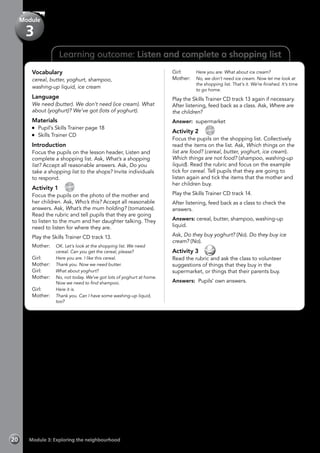
Learning outcome: Listen and complete a shopping list
Vocabulary
cereal, butter, yoghurt, shampoo,
washing-up liquid, ice cream
Language
We need (butter). We don’t need (ice cream). What
about (yoghurt)? We’ve got (lots of yoghurt).
Materials
	 Pupil’s Skills Trainer page 18
	 Skills Trainer CD
Introduction
Focus the pupils on the lesson header, Listen and
complete a shopping list. Ask, What’s a shopping
list? Accept all reasonable answers. Ask, Do you
take a shopping list to the shops? Invite individuals
to respond.
Activity 1 
CD
13
Focus the pupils on the photo of the mother and
her children. Ask, Who’s this? Accept all reasonable
answers. Ask, What’s the mum holding? (tomatoes).
Read the rubric and tell pupils that they are going
to listen to the mum and her daughter talking. They
need to listen for where they are.
Play the Skills Trainer CD track 13.
Mother: 	 OK. Let’s look at the shopping list. We need
cereal. Can you get the cereal, please?
Girl:	 Here you are. I like this cereal.
Mother:	 Thank you. Now we need butter.
Girl:	 What about yoghurt?
Mother:	 No, not today. We’ve got lots of yoghurt at home.
Now we need to find shampoo.
Girl:	 Here it is.
Mother:	 Thank you. Can I have some washing-up liquid,
too?
Girl:	 Here you are. What about ice cream?
Mother:	 No, we don’t need ice cream. Now let me look at
the shopping list. That’s it. We’re finished. It’s time
to go home.
Play the Skills Trainer CD track 13 again if necessary.
After listening, feed back as a class. Ask, Where are
the children?
Answer: supermarket
Activity 2 
CD
14
Focus the pupils on the shopping list. Collectively
read the items on the list. Ask, Which things on the
list are food? (cereal, butter, yoghurt, ice cream).
Which things are not food? (shampoo, washing-up
liquid). Read the rubric and focus on the example
tick for cereal. Tell pupils that they are going to
listen again and tick the items that the mother and
her children buy.
Play the Skills Trainer CD track 14.
After listening, feed back as a class to check the
answers.
Answers: cereal, butter, shampoo, washing-up
liquid.
Ask, Do they buy yoghurt? (No). Do they buy ice
cream? (No).
Activity 3 
Read the rubric and ask the class to volunteer
suggestions of things that they buy in the
supermarket, or things that their parents buy.
Answers: Pupils’ own answers.
Module 3: Exploring the neighbourhood20
Module
3
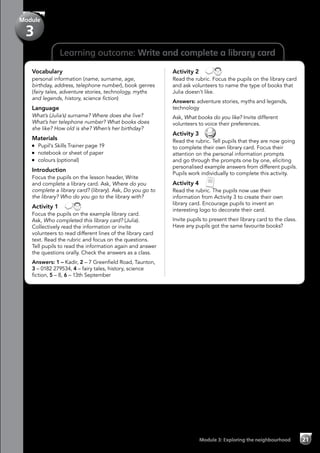
Learning outcome: Write and complete a library card
Vocabulary
personal information (name, surname, age,
birthday, address, telephone number), book genres
(fairy tales, adventure stories, technology, myths
and legends, history, science fiction)
Language
What’s (Julia’s) surname? Where does she live?
What’s her telephone number? What books does
she like? How old is she? When’s her birthday?
Materials
	 Pupil’s Skills Trainer page 19
	 notebook or sheet of paper
	 colours (optional)
Introduction
Focus the pupils on the lesson header, Write
and complete a library card. Ask, Where do you
complete a library card? (library). Ask, Do you go to
the library? Who do you go to the library with?
Activity 1 
Focus the pupils on the example library card.
Ask, Who completed this library card? (Julia).
Collectively read the information or invite
volunteers to read different lines of the library card
text. Read the rubric and focus on the questions.
Tell pupils to read the information again and answer
the questions orally. Check the answers as a class.
Answers: 1 – Kadir, 2 – 7 Greenfield Road, Taunton,
3 – 0182 279534, 4 – fairy tales, history, science
fiction, 5 – 8, 6 – 13th September
Activity 2 
Read the rubric. Focus the pupils on the library card
and ask volunteers to name the type of books that
Julia doesn’t like.
Answers: adventure stories, myths and legends,
technology
Ask, What books do you like? Invite different
volunteers to voice their preferences.
Activity 3 
Read the rubric. Tell pupils that they are now going
to complete their own library card. Focus their
attention on the personal information prompts
and go through the prompts one by one, eliciting
personalised example answers from different pupils.
Pupils work individually to complete this activity.
Activity 4 
Read the rubric. The pupils now use their
information from Activity 3 to create their own
library card. Encourage pupils to invent an
interesting logo to decorate their card.
Invite pupils to present their library card to the class.
Have any pupils got the same favourite books?
Module 3: Exploring the neighbourhood 21
Module
3
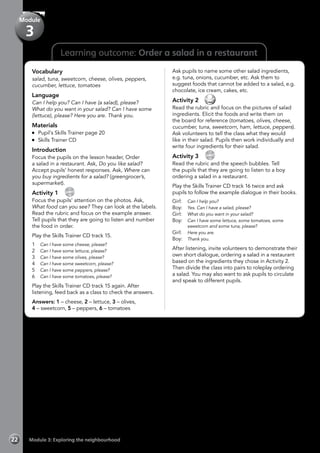
Learning outcome: Order a salad in a restaurant
Vocabulary
salad, tuna, sweetcorn, cheese, olives, peppers,
cucumber, lettuce, tomatoes
Language
Can I help you? Can I have (a salad), please?
What do you want in your salad? Can I have some
(lettuce), please? Here you are. Thank you.
Materials
	 Pupil’s Skills Trainer page 20
	 Skills Trainer CD
Introduction
Focus the pupils on the lesson header, Order
a salad in a restaurant. Ask, Do you like salad?
Accept pupils’ honest responses. Ask, Where can
you buy ingredients for a salad? (greengrocer’s,
supermarket).
Activity 1 
CD
15
Focus the pupils’ attention on the photos. Ask,
What food can you see? They can look at the labels.
Read the rubric and focus on the example answer.
Tell pupils that they are going to listen and number
the food in order.
Play the Skills Trainer CD track 15.
1	 Can I have some cheese, please?
2	 Can I have some lettuce, please?
3	 Can I have some olives, please?
4	 Can I have some sweetcorn, please?
5	 Can I have some peppers, please?
6	 Can I have some tomatoes, please?
Play the Skills Trainer CD track 15 again. After
listening, feed back as a class to check the answers.
Answers: 1 – cheese, 2 – lettuce, 3 – olives,
4 – sweetcorn, 5 – peppers, 6 – tomatoes
Ask pupils to name some other salad ingredients,
e.g. tuna, onions, cucumber, etc. Ask them to
suggest foods that cannot be added to a salad, e.g.
chocolate, ice cream, cakes, etc.
Activity 2 
Read the rubric and focus on the pictures of salad
ingredients. Elicit the foods and write them on
the board for reference (tomatoes, olives, cheese,
cucumber, tuna, sweetcorn, ham, lettuce, peppers).
Ask volunteers to tell the class what they would
like in their salad. Pupils then work individually and
write four ingredients for their salad.
Activity 3 
CD
16
Read the rubric and the speech bubbles. Tell
the pupils that they are going to listen to a boy
ordering a salad in a restaurant.
Play the Skills Trainer CD track 16 twice and ask
pupils to follow the example dialogue in their books.
Girl: 	 Can I help you?
Boy: 	 Yes. Can I have a salad, please?
Girl:	 What do you want in your salad?
Boy:	 Can I have some lettuce, some tomatoes, some
sweetcorn and some tuna, please?
Girl: 	 Here you are.
Boy: 	 Thank you.
After listening, invite volunteers to demonstrate their
own short dialogue, ordering a salad in a restaurant
based on the ingredients they chose in Activity 2.
Then divide the class into pairs to roleplay ordering
a salad. You may also want to ask pupils to circulate
and speak to different pupils.
Module 3: Exploring the neighbourhood22
Module
3
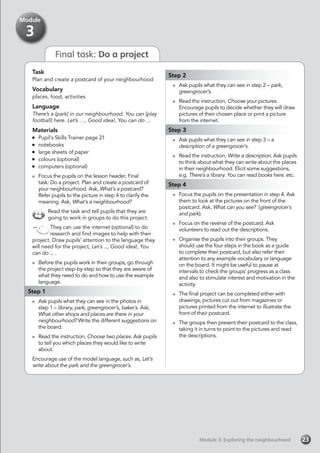
Final task: Do a project
Task
Plan and create a postcard of your neighbourhood
Vocabulary
places, food, activities
Language
There’s a (park) in our neighbourhood. You can (play
football) here. Let’s …, Good idea!, You can do …
Materials
	 Pupil’s Skills Trainer page 21
	notebooks
	 large sheets of paper
	 colours (optional)
	 computers (optional)
	 Focus the pupils on the lesson header, Final
task: Do a project. Plan and create a postcard of
your neighbourhood. Ask, What’s a postcard?
Refer pupils to the picture in step 4 to clarify the
meaning. Ask, What’s a neighbourhood?
Read the task and tell pupils that they are
going to work in groups to do this project.
They can use the internet (optional) to do
research and find images to help with their
project. Draw pupils’ attention to the language they
will need for the project, Let´s ..., Good idea!, You
can do ... .
	 Before the pupils work in their groups, go through
the project step-by-step so that they are aware of
what they need to do and how to use the example
language.
Step 1
	 Ask pupils what they can see in the photos in
step 1 – library, park, greengrocer’s, baker´s. Ask,
What other shops and places are there in your
neighbourhood? Write the different suggestions on
the board.
	 Read the instruction, Choose two places. Ask pupils
to tell you which places they would like to write
about.
Encourage use of the model language, such as, Let’s
write about the park and the greengrocer’s.
Step 2
	 Ask pupils what they can see in step 2 – park,
greengrocer’s.
	 Read the instruction, Choose your pictures.
Encourage pupils to decide whether they will draw
pictures of their chosen place or print a picture
from the internet.
Step 3
	 Ask pupils what they can see in step 3 – a
description of a greengrocer’s.
	 Read the instruction, Write a description. Ask pupils
to think about what they can write about the places
in their neighbourhood. Elicit some suggestions,
e.g. There’s a library. You can read books here. etc.
Step 4
	 Focus the pupils on the presentation in step 4. Ask
them to look at the pictures on the front of the
postcard. Ask, What can you see? (greengrocer´s
and park).
	 Focus on the reverse of the postcard. Ask
volunteers to read out the descriptions.
	 Organise the pupils into their groups. They
should use the four steps in the book as a guide
to complete their postcard, but also refer their
attention to any example vocabulary or language
on the board. It might be useful to pause at
intervals to check the groups’ progress as a class
and also to stimulate interest and motivation in the
activity.
	 The final project can be completed either with
drawings, pictures cut out from magazines or
pictures printed from the internet to illustrate the
front of their postcard.
	 The groups then present their postcard to the class,
taking it in turns to point to the pictures and read
the descriptions.
Module 3: Exploring the neighbourhoodModule 3: Exploring the neighbourhood 23
Module
3
Vocabulary: Presentation
Module overview
Learning outcomes
	 Read club posters
	 Listen and complete diaries
	 Write and make a sports club poster
	 Talk about weekend plans
	 Do a project: Plan and present an activities
day for your class
Core vocabulary
art club, dance club, drama club, library, park,
scout camp, swimming pool, zoo
Additional vocabulary
activities (camping, canoeing, dancing, fishing,
making things, music, painting, singing, swimming,
theatre), sports (football, karate, tennis), weather
(cloudy, rainy, sunny, windy), afternoon, cinema,
diary, indoors, morning, outdoors, picnic, Saturday,
Sunday, 6 o’clock
Core language
can (You can have a picnic here.), going to
You can act and sing here. I like music and
dancing. I love painting and making things. It’s
going to (be sunny). What are you going to do on
(Saturday morning)? I’m going to (go swimming).
Additional language
You can (have a picnic) here. You can (paint and
make things) here. Can you (go canoeing) at (the
scout camp)? Is the (dance club) on (Saturday
morning)? What’s the weather going to be like? It’s
going to be (rainy) on (Saturday). What’s the name
of the club? Where is it? What day is it on? It’s on
(Saturday). What time is it? It’s at (9 o’clock). Is it in
the morning or the afternoon? What activities can
you do? I want to …, Me, too. I’m going to …
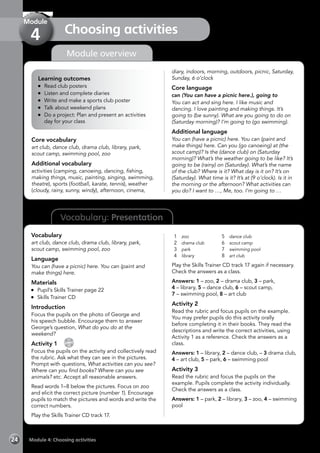
Vocabulary
art club, dance club, drama club, library, park,
scout camp, swimming pool, zoo
Language
You can (have a picnic) here. You can (paint and
make things) here.
Materials
	 Pupil’s Skills Trainer page 22
	 Skills Trainer CD
Introduction
Focus the pupils on the photo of George and
his speech bubble. Encourage them to answer
George’s question, What do you do at the
weekend?
Activity 1 
CD
17
Focus the pupils on the activity and collectively read
the rubric. Ask what they can see in the pictures.
Prompt with questions, What activities can you see?
Where can you find books? Where can you see
animals? etc. Accept all reasonable answers.
Read words 1–8 below the pictures. Focus on zoo
and elicit the correct picture (number 1). Encourage
pupils to match the pictures and words and write the
correct numbers.
Play the Skills Trainer CD track 17.
1	 zoo
2	 drama club
3	 park
4	 library
5	 dance club
6	 scout camp
7	 swimming pool
8	 art club
Play the Skills Trainer CD track 17 again if necessary.
Check the answers as a class.
Answers: 1 – zoo, 2 – drama club, 3 – park,
4 – library, 5 – dance club, 6 – scout camp,
7 – swimming pool, 8 – art club
Activity 2
Read the rubric and focus pupils on the example.
You may prefer pupils do this activity orally
before completing it in their books. They read the
descriptions and write the correct activities, using
Activity 1 as a reference. Check the answers as a
class.
Answers: 1 – library, 2 – dance club, – 3 drama club,
4 – art club, 5 – park, 6 – swimming pool
Activity 3
Read the rubric and focus the pupils on the
example. Pupils complete the activity individually.
Check the answers as a class.
Answers: 1 – park, 2 – library, 3 – zoo, 4 – swimming
pool
Module 4: Choosing activities24
Choosing activities
Module
4
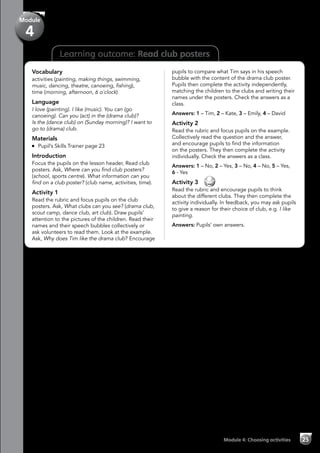
Learning outcome: Read club posters
Vocabulary
activities (painting, making things, swimming,
music, dancing, theatre, canoeing, fishing),
time (morning, afternoon, 6 o´clock)
Language
I love (painting). I like (music). You can (go
canoeing). Can you (act) in the (drama club)?
Is the (dance club) on (Sunday morning)? I want to
go to (drama) club.
Materials
	 Pupil’s Skills Trainer page 23
Introduction
Focus the pupils on the lesson header, Read club
posters. Ask, Where can you find club posters?
(school, sports centre). What information can you
find on a club poster? (club name, activities, time).
Activity 1
Read the rubric and focus pupils on the club
posters. Ask, What clubs can you see? (drama club,
scout camp, dance club, art club). Draw pupils’
attention to the pictures of the children. Read their
names and their speech bubbles collectively or
ask volunteers to read them. Look at the example.
Ask, Why does Tim like the drama club? Encourage
pupils to compare what Tim says in his speech
bubble with the content of the drama club poster.
Pupils then complete the activity independently,
matching the children to the clubs and writing their
names under the posters. Check the answers as a
class.
Answers: 1 – Tim, 2 – Kate, 3 – Emily, 4 – David
Activity 2
Read the rubric and focus pupils on the example.
Collectively read the question and the answer,
and encourage pupils to find the information
on the posters. They then complete the activity
individually. Check the answers as a class.
Answers: 1 – No, 2 – Yes, 3 – No, 4 – No, 5 – Yes,
6 - Yes
Activity 3 
Read the rubric and encourage pupils to think
about the different clubs. They then complete the
activity individually. In feedback, you may ask pupils
to give a reason for their choice of club, e.g. I like
painting.
Answers: Pupils’ own answers.
Module 4: Choosing activities 25
Module
4
Learning outcome: Listen and complete diaries
Vocabulary
places (swimming pool, drama club, zoo, scout
camp, library), weather (rainy, sunny), picnic, diary,
Saturday, Sunday, morning, afternoon
Language
What are you going to do at the weekend? I’m
going to go to (the library). What’s the weather
going to be like? It’s going to be (rainy) on
(Saturday).
Materials
	 Pupil’s Skills Trainer page 24
	 Skills Trainer CD
Introduction
Focus the pupils on the lesson header, Listen and
complete diaries. Ask, What’s a diary? Accept all
reasonable answers (book, agenda, etc.). Ask, Have
you got a diary? Invite volunteers to respond. Ask,
What do you write in a diary? (birthdays, plans,
clubs).
Activity 1 
CD
18
Focus the pupils on the pictures of different clubs
and places. Ask, What can you see? They can read
the labels. Read the rubric and draw attention to
the example tick for swimming pool. Tell pupils that
they are going to listen to Toby and Jane talking
about their weekend plans. Pupils then tick the
places they hear.
Play the Skills Trainer CD track 18.
Toby: 	Hello, Jane.
Jane: 	Hi, Toby. What are you going to do at the weekend?
Toby: 	Well, it’s going to be rainy on Saturday so I’m going to
go to the indoor swimming pool. And on Sunday, I’m
going to go to the zoo. How about you?
Jane: 	On Saturday I’m going to go to the library. On Sunday
it’s going to be sunny so I’m going to have a picnic.
Toby: 	That sounds great! See you at school on Monday.
Jane: 	Yes. See you then.
Play the Skills Trainer CD track 18 again if necessary.
After listening, feed back as a class.
Answers: swimming pool, zoo, library, picnic
Ask, What places don’t you hear? (drama club, scout
camp).
Activity 2 
CD
19
Read the rubric and draw the pupils’ attention to
the photo of Toby and Jane and their diaries. Focus
on the example in Toby’s diary, swimming pool. Tell
pupils that they are going to listen again and this
time they write the activities in the diaries.
Play the Skills Trainer CD track 19.
After listening, feed back as a class to check the
answers.
Answers: Toby – Saturday: swimming pool, Sunday:
zoo, Jane – Saturday: library, Sunday: picnic
Activity 3 
Read the rubric and ask, What’s the weather going
to be like on Saturday? (rainy). What’s the weather
going to be like on Sunday? (sunny).
Point outside and ask, What’s the weather like
today? Invite volunteers to respond. Ask, Can
you think of other weather words? Write any
contributions on the board.
Activity 4 
Read the rubric. Invite volunteers to tell the class
what they are going to do at the weekend.
Answers: Pupils’ own answers.
Module 4: Choosing activities26
Module
4
Learning outcome: Write and make a sports club poster
Vocabulary
sports (football, karate, swimming, tennis),
afternoon, morning
Language
What’s the name of the club? What day is it on? It’s
on (Saturday). Where is it? What time is it? It’s at (9
o’clock). Is it in the morning or the afternoon? What
activities can you do? You can do (swimmimg).
Materials
	 Pupil’s Skills Trainer page 25
	 notebook or sheet of paper
	 colours (optional)
Introduction
Focus the pupils on the lesson header, Write and
make a sports club poster. Ask, Where can you
see a sports club poster? (school, sports centre).
Ask, What sports do you do? Invite volunteers to
respond.
Activity 1 
Read the rubric and draw the pupils’ attention to
the sports club poster. Ask, What’s the name of the
club? (Energy Sports Club). Collectively read the
remaining questions and tell pupils to think about
the answers. Check the answers as a class.
Answers: 1 – Energy Sports Club, 2 – Hayfield
sports centre, 3 – morning, 4 – 9–12 o’clock
5 – Saturday, 6 – football, tennis, swimming, karate
Activity 2 
Read the rubric. Elicit different sports from the class
and write them on the board.
Activity 3 
Read the rubric. Tell pupils that they are now going
to create their own sports club poster. Focus their
attention on the question prompts and go through
each question one by one. Invite different pupils to
read the questions and elicit ideas from the class.
Pupils work individually to complete this activity.
Activity 4 
Read the rubric. The pupils now use their
information from Activity 3 to create their own
sports club poster. Encourage pupils to decorate
their posters with illustrations of their chosen sports.
Invite pupils to present their poster to the class.
Have some pupils chosen the same activities?
Module 4: Choosing activities 27
Module
4
Learning outcome: Talk about weekend plans
Vocabulary
weather (cloudy, rainy, sunny, windy), activities
(tennis, painting, swimming, picnic, TV, camping),
indoors/outdoors, morning/afternoon
Language
What are you going to do on (Saturday morning)?
I’m going to (have a picnic).
Materials
	 Pupil’s Skills Trainer page 26
	 Skills Trainer CD
Introduction
Focus the pupils on the lesson header, Talk about
weekend plans. Ask, What do you do at the
weekend? Accept all reasonable answers (play
football, shopping, cinema, etc.) What activities can
you do indoors/outdoors? Gesture towards indoors
(the classroom) and outdoors (beyond the window)
and accept all reasonable answers (television,
computer games, football, etc.)
Activity 1 
CD
20
Focus the pupils’ attention on the photos. Ask,
What activities can you see? Invite volunteers to
respond.
Read the rubric and focus on the example answer
for tennis. Ask, Do you play tennis indoors or
outdoors? There may be some debate if a pupil has
played on an indoor court. The same could apply for
swimming. Ask, Do you play outdoors if it is rainy or
if it is sunny?
Tell pupils to look at the photos and number the
phrases. Play the Skills Trainer CD track 20 and
pupils check their answers.
Boy:	 It’s going to be sunny. I’m going to play tennis.
Girl:	 It’s going to be rainy. I’m going to do painting.
Boy:	 It’s going to be rainy. I’m going to go swimming.
Girl:	 It’s going to be sunny. I’m going to have a picnic.
Boy:	 It’s going to be rainy. I’m going to watch TV.
Girl:	 It’s going to be sunny. I’m going to go camping.
Play the Skills Trainer CD track 20 again. After
listening, feed back as a class to check the answers.
Answers: 1 – play tennis, 2 – do painting, 3 – go
swimming, 4 – have a picnic, 5 – watch TV, 6 – go
camping
Activity 2 
Focus pupils on the weekend diary. Ask, What’s
the weather going to be like on Saturday morning?
(cloudy). Elicit the weather for other sections of
the diary (sunny, rainy, windy). Read the rubric and
elicit different activities for different times of the
weekend, taking the weather into account. Allow
pupils time to complete their weekend diary. They
then work individually to complete their plans for
the weekend.
Activity 3 
CD
21
Read the rubric and the speech bubbles. Tell the
pupils that they are going to listen to friends talking
about their weekend plans.
Play the Skills Trainer CD track 21 twice and ask
pupils to follow the example dialogue in their books.
Boy: 	 What are you going to do on Saturday morning?
Girl: 	 I’m going to go swimming. What about you?
Boy: 	 I’m going to go camping.
Girl: 	 Great!
After listening, invite volunteers to demonstrate their
own short dialogue, talking about their weekend
plans based on their diary entries in Activity 2. Then
divide the class into pairs to share their weekend
plans. You may also want to ask pupils to circulate
and speak to different pupils.
Module 4: Choosing activities28
Module
4
Final task: Do a project
Task
Plan and present an activities day for your class
Vocabulary
days of the week, places, times of the day
Language
I want to …, Me, too. I’m going to …
Materials
	 Pupil’s Skills Trainer page 27
	notebooks
	 large sheets of paper
	 colours (optional)
	 computers (optional)
	 Focus the pupils on the lesson header, Final task:
Do a project. Plan and present an activities day for
your class. Ask, What activities do you like? (cinema,
park, swimming, etc.). Accept all reasonable
answers.
Read the task and tell pupils that they are
going to work in groups to do this project.
They can use the internet (optional) to do
research and find images to help with their
project. Draw pupils’ attention to the language they
will need for the project, I want to, ... Me, too. I’m
going to …
	 Before the pupils work in their groups, go through
the project step-by-step so that they are aware of
what they need to do and how to use the example
language.
Step 1
	 Ask pupils what they can see in the box for step 1 –
the days of the week, calendar.
	 Read the instruction, Choose a day. Ask pupils to
tell you which day of the week they are going to
plan their activities for.
Encourage use of the model language, such as I’m
going to choose Friday.
Step 2
	 Ask pupils what they can see in the photos in step
2 – park, school hall.
	 Read the instruction, Choose indoors or outdoors.
Tell pupils to think of one indoor and one outdoor
activity. Elicit different ideas of indoor or outdoor
places (classroom, cinema, drama club, park,
football pitch, zoo, etc.).
Step 3
	 Ask pupils what they can see in the photos in step
3 – zoo, picnic in the park, art club, cinema.
	 Read the instructions, Choose two activities. Ask
pupils to think about which activities they want to
do in the morning and in the afternoon. Elicit some
suggestions.
Encourage use of the model language, such as I want
to go swimming.
Step 4
	 Focus the pupils on the presentation in step 4. Ask
them to look at the mind map. Elicit information
from different volunteers, e.g. ask, What’s the name
of the club? (Friday activity club).
	 Focus on the activities. Ask, What are you going to
do in the morning? (go to the park). What are you
going to do in the afternoon? (go to the cinema).
	 Organise the pupils into their groups. They should
use the four steps in the book as a guide to
complete their activities day, but also refer their
attention to any example vocabulary or language
on the board. It might be useful to pause at
intervals to check the groups’ progress as a class
and also to stimulate interest and motivation in the
activity.
	 The final project can be completed either with
drawings, pictures cut out from magazines or
pictures printed from the internet to illustrate the
activities.
	 The groups then present their activities day to the
class, taking it in turns to point to the name of the
club, describe the pictures and to present their
activities.
Module 4: Choosing activitiesModule 4: Choosing activities 29
Module
4
Vocabulary: Presentation
Module overview
Learning outcomes
	 Read mobile phone instructions
	 Listen to a recorded message
	 Write a text message
	 Talk about how to use a tablet
	 Do a project: Plan and do a technology
show and tell
Core vocabulary
calculator, camera, e-book, laptop, mobile phone,
printer, tablet, whiteboard
Additional vocabulary
button, icon, information, listen to music, personal
code, play football, play games, press, read an
e-book, send an email, switch off, switch on, surf
the internet, take a photo, technology, telephone
number, text message, touch, type, watch TV
colours
Core language
instructions, have got to
You use this to (write emails). Instructions (Touch the
call icon. Choose a contact.) I’m great! I’m (watching
TV). How do I surf the internet? You’ve got to touch
the yellow icon.
Additional language
To switch on your phone, press the on/off button.
Type in your personal code. You can learn about
(fantastic games for your tablet). What are you
doing? Do you want to (play football) on Saturday?
What can it do? How do you use it? Let’s talk about
…, It can …, Brilliant!
Vocabulary
calculator, camera, e-book, laptop, mobile phone,
printer, tablet, whiteboard
Language
You use this to (write emails). You use this to (print
documents).
Materials
	 Pupil’s Skills Trainer page 28
	 Skills Trainer CD
Introduction
Focus the pupils on Rebecca and her speech
bubble. Ask, What’s her favourite technology?
(mobile phone) Then encourage pupils to answer
Rebecca’s question, How about you? (What’s your
favourite technology?).
Activity 1 
CD
22
Focus the pupils on the activity and collectively
read the rubric. Ask what they can see in the
pictures. Prompt with questions, What can you use
to speak to your friends? What can you find in the
classroom? What can you take a photo with? Accept
all reasonable answers (mobile phone, computer,
camera, etc.).
Read words 1–8 below the pictures. Focus on
mobile phone and elicit the correct picture (number
1). Encourage pupils to match the pictures and
words and write the correct numbers.
Play the Skills Trainer CD track 22.
1	 mobile phone
2	 whiteboard
3	 tablet
4	 calculator
5	 laptop
6	 printer
7	 camera
8	 e-book
Play the Skills Trainer CD track 22 again if necessary.
Check the answers as a class.
Answers: 1 – mobile phone, 2 – whiteboard,
3 – tablet, 4 – calculator, 5 – laptop, 6 – printer,
7 – camera, 8 – e-book
Activity 2
Read the rubric and focus pupils on the example.
You may wish the class to do this activity orally
before they complete it in their books. Pupils read
the descriptions and circle the correct words. Check
the answers as a class.
Answers: 1 – whiteboard, 2 – e-book, 3 – tablet,
4 – laptop, 5 – printer, 6 – calculator
Activity 3 
Read the rubric and encourage pupils to volunteer
information about technology they have got at
home.
Answers: Pupils’ own answers.
Module 5: Learning about technology30
Learning about technology
Module
5
Learning outcome: Read mobile phone instructions
Vocabulary
switch on, switch off, type, press, touch, button,
icon, call, choose, personal code, text message
Language
touch the call icon, switch your phone on/off,
type in your personal code, choose a contact,
type your message, make a call
Materials
	 Pupil’s Skills Trainer page 29
Introduction
Focus the pupils on the lesson header, Read
mobile phone instructions. Ask, Where can you
find instructions? Accept all reasonable answers.
Focus on the mobile phone instruction manual on
the page and ask, What are these instructions for?
(mobile phone).
Activity 1
Read the rubric and focus the pupils on the manual.
Collectively read the example text and draw their
attention to the title, Switch your phone on and off.
Pupils then complete the activity independently,
reading the instructions and matching them to the
paragraph titles. Check the answers as a class.
Answers: 1 – Switch your phone on and off,
2 – Make a call, 3 – Send a text message
Activity 2
Read the rubric and focus the pupils on the
numbered buttons and icons on the mobile phone.
Read the example text again and draw their
attention to the number 4 in the answer box. Point
to button number 4 on the mobile phone, too. You
may want to go through this activity orally first.
Pupils then complete the activity individually. Check
the answers as a class.
Answers: Text a – 4, Text b – 2, 3, 5 , Text c – 1
Activity 3
Read the rubric and focus on the example.
Collectively read the sentence and the circled
example. Encourage pupils to find the information
in the instruction manual text. Pupils then complete
the activity individually. Check the answers as a
class.
Answers: 1 – on/off, 2 – call, 3 – red, 4 – contact,
5 – type
Module 5: Learning about technology 31
Module
5
Learning outcome: Listen to a recorded message
Vocabulary
laptop, tablet, whiteboard, mobile phone, camera,
games, information, telephone number
Language
You can learn about (fantastic games for your
tablet). I want to do technology club on (Tuesday).
Materials
	 Pupil’s Skills Trainer page 30
	 Skills Trainer CD
Introduction
Focus the pupils on the lesson header, Listen to
a recorded message. Ask, Have you got a mobile
phone? Who do you leave messages for? Accept all
reasonable answers (mum, friend).
Activity 1 
CD
23
Focus the pupils on the pictures and ask, What
can you see? (tablet, mobile phone, whiteboard,
camera, laptop). Read the rubric and draw their
attention to the days of the week and the example
tick. Tell pupils that they are going to listen to a
recorded message and they tick the correct day for
each item of technology.
Play the Skills Trainer CD track 23.
	 Thank you for calling the Technology Club.
	 Monday is mobile phone day. Learn more about your
mobile phone.
	 On Tuesday, you can learn about fantastic games for your
tablet.
	 Wednesday is digital camera day. Learn how to take
fantastic photos.
	 On Thursday, you can learn new things about your laptop.
	 On Friday, learn more about the whiteboard in your
classroom.
	 Call 954 784 513 (that’s 954 784 513) for more information.
Play the Skills Trainer CD track 23 again if necessary.
After listening, feed back as a class.
Answers: Monday – mobile phone, Tuesday –
tablet, Wednesday – camera, Thursday – laptop,
Friday – whiteboard
Activity 2 
CD
24
Read the rubric and elicit from the class what they
have to do, i.e. listen again and complete the
telephone number.
Play the Skills Trainer CD track 24.
After listening, feed back as a class to check the
answer.
Answer: 954 784 513
Activity 3 
Read the rubric and invite volunteers to share
their preferences. Pupils then write their answer
individually. Take a vote and see what the most
popular day at technology club would be.
Answers: Pupils’ own answers.
Module 5: Learning about technology32
Module
5
Learning outcome: Write a text message
Vocabulary
text message, mobile phone, watch TV,
play football
Language
I’m (watching TV). What are you doing? Do you
want to (play football) on (Saturday)?
Materials
	 Pupil’s Skills Trainer page 31
	 notebook or sheet of paper
	 colours (optional)
Introduction
Focus the pupils on the lesson header, Write a text
message. Ask, What do you write text messages
on? (mobile phone). Who do you write text
messages to? (mum, friend). If most of your pupils
are too young to have mobile phones, ask, Who
does your mother/father write text messages to?
Activity 1 
Focus the pupils on the mobile phone and the text
message. Collectively read the message or invite
volunteers to read different lines from it. Read the
rubric and focus on the questions. Elicit the answer
to the first question, Who’s the message for? (Alex).
Encourage pupils to find the remaining answers
individually. Check the answers as a class.
Answers: 1 – Alex, 2 – 07957 294322,
3 – Brian, 4 – watching TV, 5 – play football,
6 – on Saturday
Activity 2 
Read the rubric. Invite pupils to respond.
Activity 3 
Read the rubric. Tell pupils that they are now
going to write a text message. Elicit ideas for the
message. Say, Imagine. What are you doing now?
Invite volunteers to share ideas and write examples
on the board (I’m reading a book. I’m watching
a DVD, etc.). Ask, What do you want to do at the
weekend? Invite ideas and write examples on the
board (go to the park, play tennis, etc.). Focus their
attention on the text and tell them to complete a
text message to a friend. Pupils work individually to
complete this activity.
Activity 4 
Read the rubric. The pupils now design their own
mobile phone and write their text message on the
screen.
Invite pupils to present their text message to the
class. Then display their mobile phones and text
messages around the classroom.
Module 5: Learning about technology 33
Module
5
Learning outcome: Talk about how to use a tablet
Vocabulary
send an email, read an e-book, play a game,
surf the internet, take a photo, listen to music,
colours (orange, green, blue, purple, yellow, red)
Language
How do I (surf the internet)? You’ve got to touch the
(yellow) icon.
Materials
	 Pupil’s Skills Trainer page 32
	 Skills Trainer CD
	colours
Introduction
Focus the pupils on the lesson header, Talk about
how to use a tablet. Ask, Has your family got a
tablet? Invite volunteers to respond. What can you
do on a tablet? (surf the internet, send emails, read
an e-book, etc.).
Activity 1 
CD
25
Focus the pupils’ attention on the tablet screen.
Draw their attention to the icons and ask, What are
the different icons for? Invite volunteers to make
suggestions.
Collectively read the phrases below the tablet
screen. Read the rubric and focus on the example,
i.e. the orange box for send an email. Tell pupils that
they are going to listen and then colour the boxes to
match the icons in the tablet.
Play the Skills Trainer CD track 25.
1	 How do I send an email?
2	 How do I read an e-book?
3	 How do I take a photo?
4	 How do I play a game?
5	 How do I surf the internet?
6	 How do I listen to music?
Play the Skills Trainer CD track 25 again. After
listening, feed back as a class to check the answers.
Answers: listen to music – red, play a game –
purple, send an email – orange, surf the internet –
yellow, read an e-book – green, take a photo – blue
Activity 2 
Read the rubric and ask, What other things can you
do on a tablet? Accept all reasonable suggestions
and write them on the board (watch a video, talk to
a friend, etc.).
Pupils could design their own icons for two more
tablet activities (optional).
Activity 3 
CD
26
Read the rubric and the speech bubbles. Tell the
pupils they are going to listen to friends talking
about how to use a tablet.
Play the Skills Trainer CD track 26 twice and ask
pupils to follow the example dialogue in their books.
Boy:	 How do I surf the internet?
Girl:	 You’ve got to touch the yellow icon.
Girl:	 How do I play a game?
Boy:	 You’ve got to touch the purple icon.
After listening, invite volunteers to demonstrate their
own short dialogue, asking how to do something on
a tablet. Then divide the class into pairs to do their
roleplay. You may also want to ask pupils to circulate
and speak to different pupils.
Module 5: Learning about technology34
Module
5
Final task: Do a project
Task
Plan and do a technology show and tell
Vocabulary
technology, instructions
Language
What can it do?, How do you use it?, Let’s talk
about …, It can …, Brilliant!
Materials
	 Pupil’s Skills Trainer page 33
	notebooks
	 large sheets of paper
	 colours (optional)
	 computers (optional)
	 Focus the pupils on the lesson header, Final task:
Do a project. Plan and do a technology show and
tell. Ask, What technology can you think of? Invite
pupils to make suggestions (television, mobile
phone, etc.).
Read the task and tell pupils that they are
going to work in groups to do this project.
They can use the internet (optional) to do
research and find images to help with their
project. Draw pupils’ attention to the language they
will need for the project, Let´s talk about ..., It can...,
Brilliant!
	 Before the pupils work in their groups, go through
the project step-by-step so that they are aware of
what they need to do and how to use the example
language.
Step 1
	 Ask pupils what they can see in the photos in step 1
– mobile phone, camera, calculator, tablet. Ask the
class to remind you of other items of technology
and write the different suggestions on the board.
	 Read the instruction, Choose your favourite
technology. Ask pupils to decide on an item of
technology for their project.
Encourage use of the model language, such as Let’s
talk about the camera. Brilliant!
Step 2
	 Ask pupils what they can see in step 2 – calculator,
video camera.
	 Read the instruction, What can it do? Encourage
pupils to think about things they can do with their
chosen item of technology.
Step 3
	 Ask pupils what they can see in step 3. Elicit
language such as You press the button. You touch
the video icon.
	 Read the instruction, How do you use it? Ask pupils
to think about two or three instructions for using
their item of technology.
Step 4
	 Focus the pupils on the presentation in step 4. Ask,
What can you see? Elicit the idea that this is a digital
presentation about a camera.
	 Collectively read the description about the camera.
	 Organise the pupils into their groups. They should
use the four steps in the book as a guide to
complete their project, but also refer their attention
to any example vocabulary or language on the
board. It might be useful to pause at intervals to
check the groups’ progress as a class and also to
stimulate interest and motivation in the activity.
	 The final project can be completed using a
computer, or with drawings and pictures cut out
from magazines or printed from the internet.
	 The groups then present their project to the
class, taking it in turns to point to the images,
read the description of their technology and give
instructions on how to use it.
Module 5: Learning about technologyModule 5: Learning about technology 35
Module
5
Vocabulary: Presentation
Module overview
Learning outcomes
	 Read a school year planner
	 Listen to an events announcement
	 Write a birthday card
	 Celebrate special days
	 Do a project: Plan and create a season
planner
Core vocabulary
birthday, Christmas Day, Easter, Father’s Day,
Halloween, Mother’s Day, St. Patrick’s Day,
Valentine’s Day
Additional vocabulary
months, ordinal numbers, days of the week,
dates, seasons, events (Festival week, Drama
Day, Food Day, Music Day, Science Day, Sports
Day, World Day), greetings (Happy birthday!,
Happy Halloween!, Happy Valentine’s Day!, Happy
Christmas!, Happy New Year!, Happy St. Patrick’s
Day!), birthday card, competition, concert, monster
costume, festival, Fireworks Night, Easter egg hunt,
party, presents, summer holidays
Core language
exclamations (Happy birthday!), can (I can sing in
a concert.)
It’s the (1st of January). It’s my birthday today. You
can (see fireworks) in November.
Additional language
On this day, you can (wear fancy dress). This is a
special day for (dads). the start/end of the school
year is in (June), the fourteenth of February, On
(Monday 8th), we’ve got (World Day). My favourite
festival day is (Music Day). You’re (eight) today.
Have a great party. Love from … What about …?,
You can …, I can …
Vocabulary
birthday, Christmas Day, Easter, Father’s Day,
Halloween, Mother’s Day, St. Patrick’s Day,
Valentine’s Day
Language
On this day, (you can wear fancy dress). This is a
special day for (mums).
Materials
	 Pupil’s Skills Trainer page 34
	 Skills Trainer CD
Introduction
Focus the pupils on Max and his speech bubble.
Ask pupils to tell you when Max’s birthday is,
and then to answer Max’s question, When’s your
birthday?
Activity 1 
CD
27
Focus the pupils on the activity and collectively read
the rubric. Ask what they can see in the pictures.
Prompt with questions, Can you see an animal?
What food can you see? What’s under the tree? etc.
Accept all reasonable answers (rabbit, chocolate,
presents, etc.).
Read words 1–8 below the pictures. Focus on
St Patrick’s Day and elicit the correct picture
(number 1). Encourage pupils to match the pictures
and words and write the correct numbers.
Play the Skills Trainer CD track 27.
1	 St Patrick’s Day
4	 birthday
7	 Mother’s Day
2	 Father’s Day
5	 Halloween
8	 Christmas Day
3	 Valentine’s Day
6	 Easter
Play the Skills Trainer CD track 27 again if necessary.
Check the answers as a class.
Answers: 1 – St. Patrick’s Day, 2 – Father’s Day,
3 – Valentine’s Day, 4 – birthday, 5 – Halloween,
6 – Easter, 7 – Mother’s Day, 8 – Christmas Day
Activity 2
Read the rubric and focus pupils on the example.
Pupils can do this activity orally before completing
it in their books. They read the descriptions and
write the correct words, using Activity 1 as a
reference. Check the answers as a class.
Answers: 1 – Halloween, 2 – Mother’s Day,
3 – St. Patrick’s Day, 4 – Easter, 5 – Father’s Day,
6 – Valentine’s Day
Activity 3
Read the rubric and focus pupils on the example.
Read and drill pronunciation of the dates. Pupils
then complete the activity individually. Check the
answers as a class.
Answers: 1 – St. Patrick’s Day, 2 – Christmas Day,
3 – Halloween, 4 – Valentine’s Day
Module 6: Celebrating events36
Celebrating events
Module
6
Learning outcome: Read a school year planner
Vocabulary
months, ordinal numbers, Fireworks Night,
Christmas concert, competition, Easter egg hunt,
summer holidays, monster costume, present
Language
You can (enter a card competition) in (January). The
start of the school year is in (June), the fourteenth of
February
Materials
	 Pupil’s Skills Trainer page 35
Introduction
Focus the pupils on the lesson header, Read a
school year planner. Ask, What are important dates
in the school year? Accept all reasonable answers
(school trip, Christmas, holidays, etc.). Focus on
the school year planner and ask, Have you got a
school year planner? Invite volunteers to respond.
Collectively read the months on the planner.
Ask, What’s the first month of the school year?
(September). What’s the first month of the year?
(January).
Activity 1
Read the rubric and focus pupils on the school year
planner again. Collectively read the text for each
month. Draw the pupils’ attention to the phrases
in the word box above the planner. Focus on the
example phrase that has been crossed out, wear a
monster costume, and encourage pupils to find it in
the planner. Collectively read the remaining phrases
and have pupils complete the activity individually,
writing the missing phrases on the planner. You may
wish to do this orally first. Check the answers as a
class.
Answers: 1 – wear a monster costume, 2 – sing with
my friends, 3 – Valentine’s card competition,
4 – make a present for Mum
Activity 2
Read the rubric and focus pupils on the example.
Collectively read the example sentence and the
answer. Encourage pupils to find the event on
the planner. They then complete the activity
individually. Check the answers as a class.
Answers: 1 – Yes, 2 – No, 3 – Yes, 4 – No, 5 – Yes
Activity 3 
Ask, When’s Halloween? When’s Valentine’s Day?
etc. Invite volunteers to say the dates, giving them
support in pronouncing them correctly (e.g. 31st
October = the thirty-first of October). Read the
rubric. Ask, When’s your birthday? Invite volunteers
to say when their birthday is. Encourage them to
say the date correctly. Then pupils complete the
activity individually by writing the date of their
birthday in the correct month on the school year
planner in their books.
Module 6: Celebrating events 37
Module
6
Learning outcome: Listen to an events announcement
Vocabulary
days of the week, ordinal numbers, events (Festival
week, Music Day, Science Day, Food Day, Drama
Day, World Day, Sports Day)
Language
On (Monday 8th), we’ve got (World Day). My
favourite festival day is (Music Day).
Materials
	 Pupil’s Skills Trainer page 36
	 Skills Trainer CD
Introduction
Focus the pupils on the lesson header, Listen
to an events announcement. Tell the class, An
announcement gives you information. Ask, Where
do you hear announcements? Accept all reasonable
answers (television, radio, bus station, etc.).
Activity 1 
CD
28
Focus the pupils on the pictures representing the
events and ask, What events can you see? They
can read the labels. Read the rubric and draw the
pupils’ attention to the example tick for World
Day. Tell them they are going to listen to an events
announcement and they tick the events they hear.
Play the Skills Trainer CD track 28.
	 Good afternoon, everyone. Remember that next week is
festival week. Here are the events.
	 On Monday the eighth, we’ve got World Day. Don’t forget
to wear an international costume.
	 On Tuesday the ninth, we’ve got Food Day. Come and try
lots of delicious food.
	 On Wednesday the tenth, we’ve got Science Day. Come
and do experiments.
	 On Thursday the eleventh, we’ve got our Sports Day. Which
team is going to win this year?
	 On Friday the twelfth, we’ve got our fantastic Music Day.
Don’t forget to bring your mum and dad.
	 That’s everything. See you next week!
Play the Skills Trainer CD track 28 again if necessary.
After listening, ask Where are they? (at school). Then
feed back as a class and check answers.
Answers: World Day, Food Day, Science Day,
Sports Day, Music Day
Ask, Which event don’t you hear? (Drama Day).
Activity 2 
CD
29
Read the rubric and focus pupils on the example.
Tell the class that they are going to listen again and,
this time, they write the events on the correct days
for Festival week.
Play the Skills Trainer CD track 29. After listening,
feed back as a class to check the answers.
Answers: Monday 8th – World Day, Tuesday
9th – Food Day, Wednesday 10th – Science Day,
Thursday 11th – Sports Day, Friday 12th – Music
Day
Activity 3 
Read the rubric. Ask pupils to think about what
festival day they prefer. Ask volunteers to voice
their preferences. They then complete the activity
individually.
Answers: Pupil’s own answers.
Module 6: Celebrating events38
Module
6
Learning outcome: Write a birthday card
Vocabulary
birthday card, Happy birthday!, party
Language
You’re eight today. Have a great party! Love from …
Materials
	 Pupil’s Skills Trainer page 37
	 a piece of folded card or a sheet of paper
	 colours (optional)
Introduction
Focus the pupils on the lesson header, Write a
birthday card. Ask, Do you give birthday cards?
Who do you give birthday cards to? Many pupils
may not exchange birthday cards. Explain that this
is very traditional in the UK and Ireland.
Activity 1 
Focus the pupils on the example birthday card.
Ask, What can you see on the card? (birthday cake,
candles). Say, Look at the greeting. Collectively
read the greeting on the inside of the card. Read
the rubric and focus on the questions. Elicit the
answer to the first question (James) and tell pupils
to read the information in the card again and find
the answers to the remaining questions. Check the
answers as a class.
Answers: 1 – James, 2 – eight, 3 – Becky, 4 – today,
5 – Yes
Activity 2 
Read the rubric. Elicit ideas from the class. Accept
all reasonable answers (eat cake, dance, play
games, etc.).
Activity 3 
Read the rubric. Tell pupils that they are now going
to write their own birthday card. Ask, Who are you
going to make a birthday card for? Invite volunteers
to give their answers. Focus on the card message
and elicit names and an age to fill the gaps. Pupils
work individually to complete this activity.
Activity 4 
Read the rubric. The pupils now design their own
birthday card and copy their greeting from Activity
3 inside.
Invite pupils to present their birthday card to the
class. They can then give their card to their chosen
person.
Module 6: Celebrating events 39
Module
6
Learning outcome: Celebrate special days
Vocabulary
dates, greetings (Happy birthday! Happy Valentine’s
Day! Happy Christmas! Happy New Year! Happy St.
Patrick´s Day, Happy Halloween!)
Language
It’s my birthday today. It’s (31st October).
Materials
	 Pupil’s Skills Trainer page 38
	 Skills Trainer CD
Introduction
Focus the pupils on the lesson header, Celebrate
special days. Ask, What’s a special day? Give pupils
the opportunity to suggest examples, e.g. birthday,
Christmas, Easter, etc. Ask, What’s a greeting?
Give the example of Happy birthday! or Happy
Christmas! to help them understand.
Activity 1 
CD
30
Focus the pupils’ attention on the pictures. Ask
What special days can you see? Invite volunteers to
read the dates and name the different days. Focus
on the example answer and tell pupils that they are
going to listen and number the special days.
Play the Skills Trainer CD track 30.
1	 It’s the 1st of January.
2	 It’s my birthday today.
3	 It’s the 14th of February.
4	 It’s the 17th of March.
5	 It’s the 31st of October.
6	 It’s the 25th of December.
Play the Skills Trainer CD track 30 again. After
listening, feed back as a class to check the answers.
Answers: 1 – e, 2 – a, 3 – c, 4 – f, 5 – d, 6 – b
Activity 2
Read the rubric and focus on the greetings.
Collectively read the greetings and encourage
pupils to use appropriate intonation. Draw their
attention to the example, Happy Valentine’s Day.
Explain that they are to match the pictures in
Activity 1 with the correct greetings. You may wish
to go through the activity orally first. Pupils then
work individually. Check the answers as a class.
Answers: 1 – c, 2 – e, 3 – f, 4 – a, 5 – b, 6 – d
Activity 3 
CD
31
Read the rubric and the speech bubbles. Tell the
pupils they are going to listen to friends greeting
each other.
Play the Skills Trainer CD track 31 twice and ask
pupils to follow the example dialogue in their books.
Girl:	 It’s my birthday today.
Boy:	 Happy birthday!
Boy:	 It’s 31st October!
Girl:	 Happy Halloween!
After listening, invite volunteers to demonstrate their
own short dialogue, saying a date and responding
with a greeting. Then divide the class into pairs to
practise greeting each other. You may also want to
ask pupils to circulate and speak to different pupils.
Module 6: Celebrating events40
Module
6
Final task: Do a project
Task
Plan and create a season planner
Vocabulary
seasons, months, events
Language
What about …?, You can …, I can …
Materials
	 Pupil’s Skills Trainer page 39
	notebooks
	 large sheets of paper
	 colours (optional)
	 computers (optional)
	 Focus the pupils on the lesson header, Final task:
Do a project. Plan and create a season planner.
Ask, What’s a year planner? Accept all reasonable
answers (agenda, calendar, etc.). Ask, What’s a
season planner? Elicit the seasons to help pupils
understand the concept.
Read the task and tell pupils that they are
going to work in groups to do this project.
They can use the internet (optional) to do
research and find images to help with their
project. Draw pupils’ attention to the language they
will need for the project, What about …?, You can
…, I can …
	 Before the pupils work in their groups, go through
the project step-by-step so that they are aware of
what they need to do and how to use the example
language.
Step 1
	 Ask the pupils what they can see in the photos
in step 1 – winter, spring, autumn, summer. Elicit
more language by asking pupils what they can see
in each of the season photos (leaves, snow, cold,
flowers, etc.).
	 Read the instruction, Choose a season. Pupils
decide on one season to plan for.
Encourage use of the model language, such as What
about summer?
Step 2
	 Ask pupils what they can see in step 2 – the months
of the year, calendar.
	 Read the instruction, Write the months. Pupils write
the months that fall within their season (winter =
December, January, February; spring = March,
April, May; summer = June, July, August; autumn =
September, October, November).
Step 3
	 Ask pupils what events they can see in step 3 –
	 St. Valentine’s Day, Halloween, Easter, Mother’s
Day.
	 Read the instruction, Choose your events. Ask
pupils to think about events that we celebrate in
their chosen season, including their birthdays if
appropriate.
Step 4
	 Focus the pupils on the presentation in step 4.
Ask them to look at the season planner. Ask, What
season is it? (spring). What events can you see?
Invite volunteers to read the events in the different
months.
	 Organise the pupils into their groups. They should
use the four steps in the book as a guide to
complete their season planner, but also refer their
attention to any example vocabulary or language
on the board. It might be useful to pause at
intervals to check the groups’ progress as a class
and also to stimulate interest and motivation in the
activity.
	 The final project can be completed either with
drawings, pictures cut out from magazines or
pictures printed from the internet, to illustrate
different events in different months.
	 The groups then present their projects to the class,
taking it in turns to point to the pictures and talk
about the different events in their chosen season.
Module 6: Celebrating eventsModule 6: Celebrating events 41
Module
6
Skills Trainer 2
Module 1 Working together-Evaluation rubrics
Learning
outcome
Skill 1 2 3 4 Result
Read
school job
descriptions
Reading Has great difficulty
or is unable to
understand the
text.
Understands some
of the text, but has
difficulty.
Understands most of
the text with some
difficulty.
Understands all the
text with little or no
difficulty.
Listen to
classroom
instructions
Listening Has great difficulty
or is unable to
understand any
of the information
in the audio
recording.
Is unable to
complete any of
the information.
Understands some
of the information in
the audio recording,
but has difficulty.
Has difficulty in
completing the
information.
Understands most
of the information in
the audio recording
with some difficulty.
Has difficulty in
completing some of
the information.
Understands all the
information in the
audio recording with
little or no difficulty.
Has little difficulty in
completing all the
information.
Write a thank
you note
Writing Has great difficulty
or is unable to plan
their work, and
makes few or no
notes. Is unable to
write up their work.
Has difficulty
planning their
work. Requires a
lot of support when
making notes and
writing up their
work.
Plans their work
quite well. Requires
some support when
making notes and
writing up their
work.
Plans their work well
without difficulties.
Makes notes and
writes up their work
without support.
Ask for help in
the classroom
Speaking Has great difficulty
or is unable to
understand or use
this language.
Requires a lot of
support.
Understands and
uses some of this
language, but has
difficulties and
requires a lot of
support.
Understands and
uses this language,
but has some
difficulties and
requires some
support.
Understands and
uses this language
with minimal or
no difficulties or
support.
Plan and
present
information
about people
who work in
your school
Project Doesn’t
contribute to the
group activity.
Incorporates
little or no core
vocabulary and
language into the
project preparation
and presentation
stages.
Contributes a little
to the group activity.
Incorporates some
core vocabulary and
language into the
project preparation
and presentation
stages.
Contributes well to
the group activity.
Incorporates core
vocabulary and
language into
most of the project
preparation and
presentation stages.
Contributes fully to
the group activity.
Incorporates core
vocabulary and
language into
all of the project
preparation and
presentation stages.
Core
vocabulary
- 1 2 3 4 Result
Identifies
and names
vocabulary
associated
with helping in
the classroom
- Identifies and
produces little
or none of this
vocabulary.
Identifies and
produces some of
this vocabulary.
Identifies and
produces most of
this vocabulary.
Identifies and
produces all of this
vocabulary.
Core language - 1 2 3 4 Result
Learns,
understands
and uses the
core language
for Module
1 (present
simple (I tidy
up.))
-
Has great difficulty
or is unable to
use the language
correctly.
Is able to use the
language, but
with difficulty or
prompting.
Is able to use
the language
correctly, but with
some difficulty or
prompting.
Is able to use the
language correctly
without any difficulty
or prompting.
Name:	
Class:	
Evaluation rubrics42
Name:	
Class:	
Skills Trainer 2
Module 2 Finding out information-Evaluation rubrics
Learning
outcome
Skill 1 2 3 4 Result
Read an animal
web page
Reading Has great difficulty
or is unable to
understand the
text.
Understands some
of the text, but has
difficulty.
Understands most of
the text with some
difficulty.
Understands all the
text with little or no
difficulty.
Listen to
a school
newspaper
interview
Listening Has great difficulty
or is unable to
understand any
of the information
in the audio
recording.
Is unable to
complete any of
the information.
Understands some
of the information in
the audio recording,
but has difficulty.
Has difficulty in
completing the
information.
Understands most
of the information in
the audio recording
with some difficulty.
Has difficulty in
completing some of
the information.
Understands all the
information in the
audio recording with
little or no difficulty.
Has little difficulty in
completing all the
information.
Write a wild
animal fact file
Writing Has great difficulty
or is unable to
plan their work,
and makes few or
no notes. Is unable
to write up their
work.
Has difficulty
planning their
work. Requires a
lot of support when
making notes and
writing up their
work.
Plans their work
quite well. Requires
some support when
making notes and
writing up their
work.
Plans their work well
without difficulties.
Makes notes and
writes up their work
without support.
Ask and
find out
information
about animals
Speaking Has great difficulty
or is unable to
understand or use
this language.
Requires a lot of
support.
Understands and
uses some of this
language, but has
difficulties and
requires a lot of
support.
Understands and
uses this language,
but has some
difficulties and
requires some
support.
Understands and
uses this language
with minimal or
no difficulties or
support.
Plan and
create animal
families fact
files
Project Doesn’t
contribute to the
group activity.
Incorporates
little or no core
vocabulary and
language into
the project
preparation and
presentation
stages.
Contributes a little
to the group activity.
Incorporates some
core vocabulary and
language into the
project preparation
and presentation
stages.
Contributes well to
the group activity.
Incorporates core
vocabulary and
language into
most of the project
preparation and
presentation stages.
Contributes fully to
the group activity.
Incorporates core
vocabulary and
language into
all of the project
preparation and
presentation stages.
Core
vocabulary
- 1 2 3 4 Result
Identifies
and names
vocabulary
associated
with sources of
information
- Identifies and
produces little
or none of this
vocabulary.
Identifies and
produces some of
this vocabulary.
Identifies and
produces most of
this vocabulary.
Identifies and
produces all of this
vocabulary.
Core language - 1 2 3 4 Result
Learns,
understands
and uses the
core language
for Module
2 (present
simple (It
runs/climbs/
eats/lives/has
got…) There
is…/There
are…)
- Has great difficulty
or is unable to
use the language
correctly.
Is able to use the
language, but
with difficulty or
prompting.
Is able to use
the language
correctly, but with
some difficulty or
prompting.
Is able to use the
language correctly
without any difficulty
or prompting.
Evaluation rubrics 43
Skills Trainer 2
Module 3 Exploring the neighbourhood-Evaluation rubrics
Learning
outcome
Skill 1 2 3 4 Result
Read a
high street
brochure
Reading Has great difficulty
or is unable to
understand the
text.
Understands some
of the text, but has
difficulty.
Understands most of
the text with some
difficulty.
Understands all the
text with little or no
difficulty.
Listen and
complete a
shopping list
Listening Has great difficulty
or is unable to
understand any
of the information
in the audio
recording.
Is unable to
complete any of
the information.
Understands some
of the information in
the audio recording,
but has difficulty.
Has difficulty in
completing the
information.
Understands most
of the information in
the audio recording
with some difficulty.
Has difficulty in
completing some of
the information.
Understands all the
information in the
audio recording with
little or no difficulty.
Has little difficulty in
completing all the
information.
Write and
complete a
library card
Writing Has great difficulty
or is unable to plan
their work, and
makes few or no
notes. Is unable to
write up their work.
Has difficulty
planning their
work. Requires a
lot of support when
making notes and
writing up their
work.
Plans their work
quite well. Requires
some support when
making notes and
writing up their
work.
Plans their work well
without difficulties.
Makes notes and
writes up their work
without support.
Order a salad
in a restaurant
Speaking Has great difficulty
or is unable to
understand or use
this language.
Requires a lot of
support.
Understands and
uses some of this
language, but has
difficulties and
requires a lot of
support.
Understands and
uses this language,
but has some
difficulties and
requires some
support.
Understands and
uses this language
with minimal or
no difficulties or
support.
Plan and create
a postcard
of your
neighbourhood
Project Doesn’t
contribute to the
group activity.
Incorporates
little or no core
vocabulary and
language into the
project preparation
and presentation
stages.
Contributes a little
to the group activity.
Incorporates some
core vocabulary and
language into the
project preparation
and presentation
stages.
Contributes well to
the group activity.
Incorporates core
vocabulary and
language into
most of the project
preparation and
presentation stages.
Contributes fully to
the group activity.
Incorporates core
vocabulary and
language into
all of the project
preparation and
presentation stages.
Core
vocabulary
- 1 2 3 4 Result
Identifies and
names shops
vocabulary
- Identifies and
produces little
or none of this
vocabulary.
Identifies and
produces some of
this vocabulary.
Identifies and
produces most of
this vocabulary.
Identifies and
produces all of this
vocabulary.
Core language - 1 2 3 4 Result
Learns,
understands
and uses the
core language
for Module
3 (can (Can
I have some
apples,
please?),
prepositions
of place)
- Has great difficulty
or is unable to
use the language
correctly.
Is able to use the
language, but
with difficulty or
prompting.
Is able to use
the language
correctly, but with
some difficulty or
prompting.
Is able to use the
language correctly
without any difficulty
or prompting.
Name:	
Class:	
Evaluation rubrics44
Name:	
Class:	
Skills Trainer 2
Module 4 Choosing activities-Evaluation rubrics
Learning
outcome
Skill 1 2 3 4 Result
Read club
posters
Reading Has great difficulty
or is unable to
understand the
text.
Understands some
of the text, but has
difficulty.
Understands most of
the text with some
difficulty.
Understands all the
text with little or no
difficulty.
Listen and
complete
diaries
Listening Has great difficulty
or is unable to
understand any
of the information
in the audio
recording.
Is unable to
complete any of
the information.
Understands some
of the information in
the audio recording,
but has difficulty.
Has difficulty in
completing the
information.
Understands most
of the information in
the audio recording
with some difficulty.
Has difficulty in
completing some of
the information.
Understands all the
information in the
audio recording with
little or no difficulty.
Has little difficulty in
completing all the
information.
Write and
make a sports
club poster
Writing Has great difficulty
or is unable to plan
their work, and
makes few or no
notes. Is unable to
write up their work.
Has difficulty
planning their
work. Requires a
lot of support when
making notes and
writing up their
work.
Plans their work
quite well. Requires
some support when
making notes and
writing up their
work.
Plans their work well
without difficulties.
Makes notes and
writes up their work
without support.
Talk about
weekend plans
Speaking Has great difficulty
or is unable to
understand or use
this language.
Requires a lot of
support.
Understands and
uses some of this
language, but has
difficulties and
requires a lot of
support.
Understands and
uses this language,
but has some
difficulties and
requires some
support.
Understands and
uses this language
with minimal or
no difficulties or
support.
Plan and
present an
activities day
for your class
Project Doesn’t
contribute to the
group activity.
Incorporates
little or no core
vocabulary and
language into the
project preparation
and presentation
stages.
Contributes a little
to the group activity.
Incorporates some
core vocabulary and
language into the
project preparation
and presentation
stages.
Contributes well to
the group activity.
Incorporates core
vocabulary and
language into
most of the project
preparation and
presentation stages.
Contributes fully to
the group activity.
Incorporates core
vocabulary and
language into
all of the project
preparation and
presentation stages.
Core
vocabulary
- 1 2 3 4 Result
Identifies
and names
vocabulary
associated
with activity
places
- Identifies and
produces little
or none of this
vocabulary.
Identifies and
produces some of
this vocabulary.
Identifies and
produces most of
this vocabulary.
Identifies and
produces all of this
vocabulary.
Core language - 1 2 3 4 Result
Learns,
understands
and uses the
core language
for Module 4
(can (You can
have a picnic
here.), going
to)
- Has great difficulty
or is unable to
use the language
correctly.
Is able to use the
language, but
with difficulty or
prompting.
Is able to use
the language
correctly, but with
some difficulty or
prompting.
Is able to use the
language correctly
without any difficulty
or prompting.
Evaluation rubrics 45
Name:	
Class:	
Skills Trainer 2
Module 5 Learning about technology-Evaluation rubrics
Learning
outcome
Skill 1 2 3 4 Result
Read mobile
phone
instructions
Reading Has great difficulty
or is unable to
understand the
text.
Understands some
of the text, but has
difficulty.
Understands most
of the text with
some difficulty.
Understands all the
text with little or no
difficulty.
Listen to a
recorded
message
Listening Has great difficulty
or is unable to
understand any
of the information
in the audio
recording.
Is unable to
complete any of
the information.
Understands some
of the information in
the audio recording,
but has difficulty.
Has difficulty in
completing the
information.
Understands most
of the information in
the audio recording
with some difficulty.
Has difficulty in
completing some of
the information.
Understands all the
information in the
audio recording with
little or no difficulty.
Has little difficulty in
completing all the
information.
Write a text
message
Writing Has great difficulty
or is unable to
plan their work,
and makes few or
no notes. Is unable
to write up their
work.
Has difficulty
planning their
work. Requires a
lot of support when
making notes and
writing up their
work.
Plans their work
quite well. Requires
some support when
making notes and
writing up their
work.
Plans their work well
without difficulties.
Makes notes and
writes up their work
without support.
Talk about
how to use a
tablet
Speaking Has great difficulty
or is unable to
understand or use
this language.
Requires a lot of
support.
Understands and
uses some of this
language, but has
difficulties and
requires a lot of
support.
Understands and
uses this language,
but has some
difficulties and
requires some
support.
Understands and
uses this language
with minimal or
no difficulties or
support.
Plan and do
a technology
show and tell
Project Doesn’t
contribute to the
group activity.
Incorporates
little or no core
vocabulary and
language into
the project
preparation and
presentation
stages.
Contributes a little
to the group activity.
Incorporates some
core vocabulary and
language into the
project preparation
and presentation
stages.
Contributes well to
the group activity.
Incorporates core
vocabulary and
language into
most of the project
preparation and
presentation stages.
Contributes fully to
the group activity.
Incorporates core
vocabulary and
language into
all of the project
preparation and
presentation stages.
Core
vocabulary
- 1 2 3 4 Result
Identifies
and names
technology
vocabulary
- Identifies and
produces little
or none of this
vocabulary.
Identifies and
produces some of
this vocabulary.
Identifies and
produces most of
this vocabulary.
Identifies and
produces all of this
vocabulary.
Core language - 1 2 3 4 Result
Learns,
understands
and uses the
core language
for Module 5
(instructions,
have got to)
- Has great difficulty
or is unable to
use the language
correctly.
Is able to use the
language, but
with difficulty or
prompting.
Is able to use
the language
correctly, but with
some difficulty or
prompting.
Is able to use the
language correctly
without any difficulty
or prompting.
Evaluation rubrics46
Name:	
Class:	
Skills Trainer 2
Module 6 Celebrating events-Evaluation rubrics
Learning
outcome
Skill 1 2 3 4 Result
Read a school
year planner
Reading Has great difficulty
or is unable to
understand the
text.
Understands some
of the text, but has
difficulty.
Understands most of
the text with some
difficulty.
Understands all the
text with little or no
difficulty.
Listen to
an events
announcement
Listening Has great difficulty
or is unable to
understand any
of the information
in the audio
recording.
Is unable to
complete any of
the information.
Understands some
of the information in
the audio recording,
but has difficulty.
Has difficulty in
completing the
information.
Understands most
of the information in
the audio recording
with some difficulty.
Has difficulty in
completing some of
the information.
Understands all the
information in the
audio recording with
little or no difficulty.
Has little difficulty in
completing all the
information.
Write a
birthday card
Writing Has great difficulty
or is unable to
plan their work,
and makes few or
no notes. Is unable
to write up their
work.
Has difficulty
planning their
work. Requires a
lot of support when
making notes and
writing up their
work.
Plans their work
quite well. Requires
some support when
making notes and
writing up their
work.
Plans their work well
without difficulties.
Makes notes and
writes up their work
without support.
Celebrate
special days
Speaking Has great difficulty
or is unable to
understand or use
this language.
Requires a lot of
support.
Understands and
uses some of this
language, but has
difficulties and
requires a lot of
support.
Understands and
uses this language,
but has some
difficulties and
requires some
support.
Understands and
uses this language
with minimal or
no difficulties or
support.
Plan and
create a
season
planner
Project Doesn’t
contribute to the
group activity.
Incorporates
little or no core
vocabulary and
language into
the project
preparation and
presentation
stages.
Contributes a little
to the group activity.
Incorporates some
core vocabulary and
language into the
project preparation
and presentation
stages.
Contributes well to
the group activity.
Incorporates core
vocabulary and
language into
most of the project
preparation and
presentation stages.
Contributes fully to
the group activity.
Incorporates core
vocabulary and
language into
all of the project
preparation and
presentation stages.
Core
vocabulary
- 1 2 3 4 Result
Identifies
and names
festivals
vocabulary
- Identifies and
produces little
or none of this
vocabulary.
Identifies and
produces some of
this vocabulary.
Identifies and
produces most of
this vocabulary.
Identifies and
produces all of this
vocabulary.
Core language - 1 2 3 4 Result
Learns,
understands
and uses the
core language
for Module 6
(exclamations
(Happy
birthday!) can
(I can sing in a
concert.))
- Has great difficulty
or is unable to
use the language
correctly.
Is able to use the
language, but
with difficulty or
prompting.
Is able to use
the language
correctly, but with
some difficulty or
prompting.
Is able to use the
language correctly
without any difficulty
or prompting.
Evaluation rubrics 47
Macmillan Education
4 Crinan Street
London N1 9XW
A division of Macmillan Publishers Limited
Companies and representatives throughout the world
ISBN 978 0 230 47886 2
Pack ISBN 978 0 230 47892 3
Text, design and illustration © Macmillan Publishers Limited 2014
Written by Roisin O’Farrell
The author has asserted her rights to be identified as the author of this work
in accordance with the Copyright, Designs and Patents Act 1988.
First published 2014
All rights reserved; no part of this publication may be reproduced, stored
in a retrieval system, transmitted in any form, or by any means, electronic,
mechanical, photocopying, recording, or otherwise, without the prior written
permission of the publishers.
Note to Teachers
Photocopies may be made, for classroom use, of pages 42-47 without the
prior written permission of Macmillan Publishers Limited. However, please
note that the copyright law, which does not normally permit multiple copying
of published material, applies to the rest of this book.
Designed by Wooden Ark Ltd
Cover design by Astwood
Cover photograph by Thinkstock/Andresr
These materials may contain links for third party websites. We have no con-
trol over, and are not responsible for, the contents of such third party web-
sites. Please use care when accessing them.

quest st_tn2

  • 1.
    Primary 2 TEACHER’SNOTES SKILLS TRAINER
  • 2.
    Syllabus page 2 Introduction page4 Teacher’s Notes 1 Working together page 6 2 Finding out information page 12 3 Exploring the neighbourhood page 18 4 Choosing activities page 24 5 Learning about technology page 30 6 Celebrating events page 36 Evaluation rubrics page 42 SKILLS TRAINER
  • 3.
    Skills Trainer 2Syllabus Module Learning outcomes Vocabulary Language 1 Working together • Read school job descriptions • Listen to classroom instructions • Write a thank you note • Ask for help in the classroom Final task: Plan and present information about people who work in your school Core vocabulary clean the board, close the door, collect the books, give out the books, help your friends, recycle paper, tidy up, write the date Additional vocabulary jobs (caretaker, cleaner, cook, head teacher, librarian, nurse, teacher) responsibilities (work, keep clean, cook, look after), places and furniture (office, kitchen, playground, desks, floors, windows), Dear, fantastic, give, interesting, look after, ill, teach, things Core language present simple (I tidy up.) I clean the board. I work in the (kitchen). Can you help me (do this exercise), please? Yes, of course. Thanks. Additional language You’re going to (give out the books. He (looks after children). Who’s the note from? Who’s the note to? What does she give the children? What job does he do? He cleans (the desks, floors and windows). How about…? I like… Great! 2 Finding out information • Read an animal web page • Listen to a school newspaper interview • Write a wild animal fact file • Ask and find out information about animals Final task: Plan and create animal families fact files Core vocabulary encyclopaedia, library book, magazine, newspaper, podcast, school book, television, web page Additional vocabulary internet, animals (aye aye, crocodile, eel, elephant, giraffe, lion, pufferfish, snake, snow leopard), animal actions (climb, fly, jump, run, swim) animal families (insects, reptiles, mammals, fish, birds), animal parts of the body (fur, scales, spines, feathers, tail, teeth, claws, beak), habitats (mountains, rainforest, water, trees), strange animals, wild animals, zookeeper Core language present simple (It runs/ climbs/eats/lives/has got…) There is…/There are… I read a (magazine). I listen to a (podcast). I watch (television). I ask (people). The aye aye lives in the rainforest. The eel can swim fast. The pufferfish has got spines. There’s (a lion). There are (two giraffes). How does it move? What does it eat? Additional language There’s (a lion). There are (eight crocodiles). It’s got (grey fur). It (climbs)/(eats meat). It lives in (the mountains). What does it look like? What colour is it? Where does it live? What does it eat? How does it move? Is it an (owl)? Yes, it is. What animals are in the zoo? What animals do you want to see? Where do you find information? What about …? Let’s read a … Let’s listen to a … 3 Exploring the neighbourhood • Read a high street brochure • Listen and complete a shopping list • Write and complete a library card • Order a salad in a restaurant Final task: Plan and create a postcard of your neighbourhood Core vocabulary baker’s, bookshop, butcher’s, chemist’s, fishmonger’s, greengrocer’s, restaurant, supermarket Additional vocabulary places (library, park, school), food (apples, bread, butter, cakes, cereal, cheese, chicken, cucumber, fish, fruit, ice cream, lettuce, olives, peppers, salad, sausages, sweetcorn, tomatoes, tuna, vegetables, yoghurt), prepositions (between, next to), personal information (name, surname, age, birthday, address, telephone number), book genres (fairy tales, adventure stories, technology, myths and legends, history, science fiction), brochure, shampoo, washing-up liquid, activities Core language can (Can I have some apples, please?), prepositions of place Can I have some sausages, please? The baker’s is next to the greengrocer’s. There’s a park. You can play football here. Additional language You can buy (fish) here. We’ve got a lot of (fruit). We need (cereal). We don’t need (ice cream). What about (yoghurt)? What’s (her) name? Where does (he) live? What’s (his) telephone number? How old is (she)? When’s (his) birthday? What books does (he) like? Can I help you? What do you want in your salad? Here you are. Thanks you. Let’s … Good idea! You can do … Syllabus2
  • 4.
    Module Learning outcomesVocabulary Language 4 Choosing activities • Read club posters • Listen and complete diaries • Write and make a sports club poster • Talk about weekend plans Final task: Plan and present an activities day for your class Core vocabulary art club, dance club, drama club, library, park, scout camp, swimming pool, zoo Additional vocabulary activities (camping, canoeing, dancing, fishing, making things, music, painting, singing, swimming, theatre), sports (football, karate, tennis), weather (cloudy, rainy, sunny, windy), afternoon, cinema, diary, indoors, morning, outdoors, picnic, Saturday, Sunday, 6 o’clock Core language can (You can have a picnic here.), going to You can act and sing here. I like music and dancing. I love painting and making things. It’s going to (be sunny). What are you going to do on (Saturday morning)? I’m going to (go swimming). Additional language You can (have a picnic) here. You can (paint and make things) here. Can you (go canoeing) at (the scout camp)? Is the (dance club) on (Saturday morning)? What’s the weather going to be like? It’s going to be (rainy) on (Saturday). What’s the name of the club? Where is it? What day is it on? It’s on (Saturday). What time is it? It’s at (9 o’clock). Is it in the morning or the afternoon? What activities can you do? I want to … Me, too. I’m going to … 5 Learning about technology • Read mobile phone instructions • Listen to a recorded message • Write a text message • Talk about how to use a tablet Final task: Plan and do a technology show and tell Core vocabulary calculator, camera, e-book, laptop, mobile phone, printer, tablet, whiteboard Additional vocabulary button, icon, information, listen to music, personal code, play football, play games, press, read an e-book, send an email, switch off, switch on, surf the internet, take a photo, technology, telephone number, text message, touch, type, watch TV, colours Core language instructions, have got to You use this to (write emails). Instructions (Touch the call icon. Choose a contact.) I’m great! I’m (watching TV). How do I surf the internet? You’ve got to touch the yellow icon. Additional language To switch on your phone, press the on/off button. Type in your personal code. You can learn about (fantastic games for your tablet). What are you doing? Do you want to (play football) on Saturday? What can it do? How do you use it? Let’s talk about … It can … Brilliant! 6 Celebrating events • Read a school year planner • Listen to an events announcement • Write a birthday card • Celebrate special days Final task: Plan and create a season planner Core vocabulary birthday, Christmas Day, Easter, Father’s Day, Halloween, Mother’s Day, St. Patrick’s Day, Valentine’s Day Additional vocabulary months, ordinal numbers, days of the week, dates, seasons, events (Festival week, Drama Day, Food Day, Music Day, Science Day, Sports Day, World Day), greetings (Happy birthday!, Happy Halloween!, Happy Valentine’s Day!, Happy Christmas!, Happy New Year!, Happy St. Patrick’s Day!), birthday card, competition, concert, monster costume, festival, Fireworks Night, Easter egg hunt, party, presents, summer holidays Core language exclamations (Happy birthday!), can (I can sing in a concert.) It’s the (1st of January). It’s my birthday today. You can (see fireworks) in November. Additional language On this day, you can (wear fancy dress). This is a special day for (dads). the start/end of the school year is in June the fourteenth of February On (Monday 8th), we’ve got (World Day). My favourite festival day is (Music Day). You’re (eight) today. Have a great party. Love from … What about …? You can … I can … Syllabus 3
  • 5.
    Each Skills Trainerwithin this six-level series comprises six modules and brings real, everyday English into the classroom. This is done through child-friendly content, based on authentic situations and texts, and with a focus on critical thinking and problem solving within real-life situations and tasks. How to use the Skills Trainers The Skills Trainers are designed to be used flexibly. The topic-based modules can be selected and used in any order, so as to best provide extra skills support and extension to a particular class. Although following the pages sequentially throughout a module gets the most out of a topic, there is also the option of the teacher being more selective in terms of the order in which they work with the module and also the content that they wish to focus on. The module topics focus on situations and tasks that the pupils encounter in real life, such as Finding out information, Choosing activities and Celebrating events. This therefore provides the pupils with meaningful and relevant contexts that they can relate to and explore further. Activities designed to represent the things around us that we see, hear and interact with each day, for example, web pages, newspaper and magazine articles, shopping lists, food packaging, emails, calendars, podcasts and public announcements, further ensure that the content of the Skills Trainers is relevant to the pupils’ own world. Each module contains four key learning outcomes, such as Read an animal web page, Listen to a school newspaper interview, Write a wild animal fact file and Ask and find out information about animals. The aim and can do approach of these learning outcomes is that the pupils acquire a growing confidence through the achievement of carrying out these tasks in English and continue to build upon the acquisition of these. Each of the four skills, reading, listening, writing and speaking, is focused on individually within a module, with the final module task being a group project, in which the pupils work together to research, collate and present information. The focus on functional language within each module means that any new structures are presented and practised within an already- familiar context. The emphasis on functional language aims to provide the pupils with the confidence to use English outside the classroom and realise its function and scope as a real means of communication. The Skills Trainer syllabus also ensures that additional focus is given to the consolidation and extension of the core language from Quest 2. Overview of a Skills Trainer module Although pages within a module can be used in an order best suited to the requirements of an individual class, a sequential use of a module is as follows: Vocabulary presentation The aim of this page is to present the eight core vocabulary items that the pupils will need for the module and their final task. Recordings of these words aim to reinforce pronunciation, with additional activities providing further practice and contextualisation within the module topic. Reading The reading page reinforces the module vocabulary through presenting it within an authentic text type, such as club posters or a school year planner. Activities on this page check the pupils’ understanding of the text and also focus on the development of more generic reading skills, such as reading for gist and overall meaning, and looking for specific details within a text. Listening These pages comprise situational audio recordings, such as listening to a recorded message and listening to an events announcement. As with the reading pages, there is a focus on the development of generic skills, such as listening for gist and context, as well as listening out for specific information. The completion of activities is, whenever possible, done within a real-life context. Real-life tasks, such as completing a shopping list and completing diaries, make the activities more meaningful for the pupils. Writing Model writing texts are first presented in context, such as a text message and a birthday card. An initial activity aims to familiarise the pupils with the text, with further activities focusing the pupils on detail and structure within the text. A draft writing template is provided for the pupils to plan their own written text before completing it in their notebooks or electronically. Each final writing task is designed for the pupils to input information relevant to them, and therefore make the task more memorable and meaningful. Speaking These pages begin with equipping the pupils with the language they need to do the task through the reinforcement of vocabulary that has either been presented previously within the module or is additional vocabulary relevant to the speaking task. An audio recording of this vocabulary is provided Skills Trainer Introduction Introduction4
  • 6.
    within the firstactivity as a model and guide to pronunciation. Whenever possible, this vocabulary is recorded within a repeated language structure, to provide reinforcement and also to place the vocabulary in context. Recordings of model dialogues and conversations, such as talking about weekend plans, are also provided. These are also on the page of the pupil’s component and are intended to be personalised and adapted by the pupils, and then repeated for further practice. Projects These collaborative projects aim to incorporate the learning outcomes and language within the module, while at the same time, reinforcing the importance of project-related skills, such as preparation and planning, decision-making, information gathering, drafting, writing and presenting. Pupils are required to work collaboratively throughout the four steps of each project and then present their project, which ranges from planning and presenting an activities day for your class to planning and creating a season planner. The level of guidance in this step-by-step approach is gradually reduced throughout the levels of the Skills Trainers, thus meaning that the pupils’ level of learning autonomy increases and they input more into how they want to research and present information. Language in speech bubbles at the top of each project page, such as What about…?, Let’s read a … and Let’s listen to a… provides guidance as to how the pupils can communicate with each other throughout the projects. Language focus points at the bottom of each project page provide the teacher with a plenary of the core language within each module. Overview of the Skills Trainer Teacher’s Notes The Module overview at the start of each module provides a clear overview of the learning outcomes in the module, the core vocabulary and core language, as well as any additional vocabulary and language. This section is then followed by clear and concise step-by-step instructions for each page of the pupil’s component. Vocabulary and language for each page is isolated, so that the teacher can see at a glance what each page involves. Audioscripts and answer keys are also integrated into the Teacher’s Notes for each page of the pupil’s component, providing the teacher with all the necessary information in one place. Icons within the pupil’s component are cross- referenced within the Teacher’s Notes: denotes critical thinking requires personal input from the pupils requires the pupils to do the activity within their notebooks and/or on a separate piece of paper signifies that this activity can be completed digitally reinforces the importance of group work throughout the project pages CD 2 indicates recorded audio and corresponding track number within the downloadable MP3 audio files Evaluation rubrics for each module are provided at the back of the Teacher’s Notes. These can be photocopied and completed to record the progression of each individual pupil. Skills Trainer downloadable MP3 audio files Audio activities are integrated into the Skills Trainer. These aim to bring authentic listening experiences into the classroom, and also provide pronunciation guidance and models of dialogues and conversations for the pupils to follow and adapt for themselves. Track listings within the pupil’s component and the Teacher’s Notes mean that audio tracks are easily located within the downloadable MP3 audio files. Introduction 5
  • 7.
    Vocabulary: Presentation Module 1:Working together6 Module overview Working together Module 1 Learning outcomes Read school job descriptions Listen to classroom instructions Write a thank you note Ask for help in the classroom Do a project: Plan and present information about people who work in your school Core vocabulary clean the board, close the door, collect the books, give out the books, help your friends, recycle paper, tidy up, write the date Additional vocabulary jobs (caretaker, cleaner, cook, head teacher, librarian, nurse, teacher) responsibilities (work, keep clean, cook, look after), places and furniture (office, kitchen, playground, desks, floors, windows), Dear, fantastic, give, interesting, look after, ill, teach, things Core language present simple (I tidy up.) I clean the board. I work in the (kitchen). Can you help me (do this exercise), please? Yes, of course. Thanks. Additional language You´re going to (give out the books). He (looks after children). Who’s the note from? Who’s the note to? What does he give the children? What job does he do? He cleans (the desks, floors and windows). How about …?, I like …, Great! Vocabulary clean the board, close the door, collect the books, give out the books, help your friends, recycle paper, tidy up, write the date Language I (write the date). I (collect the books). Materials Pupil’s Skills Trainer page 4 Skills Trainer CD Introduction Look at the photo of Elsie. Focus the pupils on Elsie’s speech bubble. Then ask questions, e.g. Is this a girl or a boy? What’s her name? Who’s her favourite person at school? etc. Ask pupils to answer Elsie’s question, Who’s your favourite person? Activity 1  CD 2 Focus the pupils on the activity and collectively read the rubric. Ask what they can see in the pictures. Prompt with questions, e.g. Can you see a date? What’s happening in this picture? Can you see any books? etc. Accept all reasonable answers. Read the phrases 1–8 below the pictures. Focus on give out the books and elicit the correct picture (number 1). Encourage pupils to match the pictures and words and write the correct numbers. Play the Skills Trainer CD track 2 for pupils to check their answers. 1 give out the books 2 clean the board 3 recycle paper 4 write the date 5 help your friends 6 close the door 7 tidy up 8 collect the books Play the Skills Trainer CD track 2 again if necessary. Check the answers as a class. Answers: 1 – give out the books, 2 – clean the board, 3 – recycle paper, 4 – write the date, 5 – help your friends, 6 – close the door, 7 – tidy up, 8 – collect the books Activity 2 Read the rubric and focus pupils on the example. You may wish the class to do this activity orally before completing it in their books. Pupils match the words in the left and right columns. Answers: 1 – give out the books, 2 – recycle plastic, 3 – help your teacher, 4 – write in your notebook, 5 – close the window, 6 – collect the pencils Activity 3  Read the rubric and encourage the class to volunteer ideas about how they help in the classroom. Pupils can then complete the activity individually. Answers: Pupils’ own answers.
  • 8.
    Learning outcome: Readschool job descriptions Module 1: Working together 7 Module 1 Vocabulary jobs (caretaker, cleaner, cook, head teacher), responsibilities (work, keep clean, cook, look after), places and furniture (office, kitchen, playground, desks, floors, windows) Language I (work in the kitchen). Mr Bright (keeps the school clean). Materials Pupil’s Skills Trainer page 5 Introduction Focus the pupils on the lesson header, Read school job descriptions. Ask, What different jobs can you think of? Ask pupils what jobs they can see in the pictures. They may read the labels below. Ask, What does a cook do? What does a cleaner do? etc. Accept all reasonable answers (cook food, clean, etc.). Activity 1 Read the rubric and focus the pupils on the People in our school texts below the pictures. Read the example text together and look at the answer. Encourage pupils to read the remaining texts individually and write the correct jobs. Check the answers as a class. Answers: 1 – cleaner, 2 – head teacher, 3 – caretaker, 4 – cook Activity 2 Read the rubric and focus the pupils on the example. Look at the picture and collectively read the completed speech bubble. Ask, What’s her job? and elicit the answer, cook. Look at the remaining pictures and elicit the jobs. Ask the class to suggest what they can write in the different speech bubbles, referring them to the texts in Activity 1 for support. Pupils then complete the activity individually. Check the answers as a class. Answers: 1 – kitchen, 2 – desks, 3 – school, 4 – office Activity 3  Read the rubric and encourage the class to volunteer ideas about people who work in the school. Pupils can then complete the activity individually. Answers: Pupils’ own answers.
  • 9.
    Learning outcome: Listento classroom instructions Vocabulary classroom jobs (write the date, clean the board, recycle paper, close the door, collect the books, give out the books) Language You’re going to (clean the board). You’re going to (recycle paper). Materials Pupil’s Skills Trainer page 6 Skills Trainer CD Introduction Focus the pupils on the lesson header, Listen to classroom instructions. Ask, Where do you listen to classroom instructions? (in school, in the classroom, etc.). Ask pupils what they can see in the pictures. Accept all reasonable answers (a board, a girl, books, a door, etc.). They can read the labels below the pictures. Activity 1  CD 3 Point to the teacher in the photo on the page and ask, Who’s this? (a teacher). Read the rubric and tell the pupils that they are going to listen to a teacher talking about classroom jobs. They should tick the jobs that they hear. Focus them on the example. Play the Skills Trainer CD track 3. OK. Quiet everyone. Now, I’m going to tell you your jobs for the week. Peter, you’re going to give out the books. Zac, you’re going to collect the books. Susan, you’re going to clean the board. Joanna, you’re going to write the date. And David, you’re going to recycle paper. Play the Skills Trainer CD track 3 again if necessary. After listening, feed back as a class to check the answers. Answers: write the date, clean the board, recycle paper, collect the books, give out the books Ask pupils which job they did not hear, close the door. Ask them to suggest other classroom jobs, e.g. tidy up, write the weather, help a friend. Activity 2  CD 4 Focus the pupils on the picture of the whiteboard and ask them what they see written on it. Collectively read the names. Read the rubric and tell pupils that they are now going to listen to the teacher again. This time they listen to the classroom jobs that the different children are going to do and write them next to their names. Focus on the example. Play the Skills Trainer CD track 4. Pupils listen and complete the list. After listening, feed back as a class to check the answers. Answers: Peter – give out the books, Zac – collect the books, Susan – clean the board, Joanna – write the date, David – recycle paper Activity 3  Read the rubric and ask the class to volunteer suggestions. They then complete the activity individually. Pupils can write the job only or write it as a full sentence. Answers: Pupils’ own answers. Module 1: Working together8 Module 1
  • 10.
    Module 1 Learning outcome: Writea thank you note Vocabulary librarian, teacher, nurse, Dear, fantastic, give, teach, look after, interesting, ill, things Language Who’s the note from? Who’s the note to? What does he give the children? Materials Pupil’s Skills Trainer page 7 notebook or sheet of paper colours (optional) Introduction Focus the pupils on the lesson header, Write a thank you note. Ask, When do we say thank you? How can you say thank you? (speaking, on the phone, in an email/a letter). Ask pupils if they write thank you notes. Activity 1  Read the rubric and draw the pupils’ attention to the thank you note. Ask, What’s this? Elicit all reasonable answers. Collectively read the thank you note. Elicit the answers to the questions orally. The pupils do not need to write at this stage. Check the answers as a class. Answers: 1 – Marcus, 2 – Mr Smith, 3 – interesting books (to read) Activity 2  Read the rubric. Draw the pupils’ attention to the photos and elicit the jobs. Ask pupils to identify Mr Smith’s job (librarian – picture 3). Ask the pupils what a nurse and a teacher do (look after children when they are ill, teach children interesting things). Activity 3  Read the rubric. Tell pupils that they are now going to plan their own thank you note to someone in the school. Elicit ideas of who they can write to. They can focus on the jobs on this page or from the Reading lesson. Draw their attention to the incomplete thank you note and go through the sections one by one, eliciting examples of what they might write. Pupils can either work individually, in pairs or in small groups to complete this activity. Activity 4  Read the rubric. The pupils now use their draft thank you note from Activity 3 to create a final version that they can write neatly either in their notebook or on a sheet of paper. Encourage pupils to decorate their thank you note and give it to their chosen person. Module 1: Working together 9
  • 11.
    Learning outcome: Askfor help in the classroom Vocabulary classroom jobs (give out the pencils, tidy up, do this exercise, clean the board, collect the books, recycle paper) Language Can you help me (do this exercise), please? Yes, of course. Thanks. Materials Pupil’s Skills Trainer page 8 Skills Trainer CD Introduction Focus the pupils on the lesson header, Ask for help in the classroom. Ask, When do you ask for help? Accept all reasonable answers. Ask, Who do you help? (teacher, mum, dad, friend, etc.). Activity 1  CD 5 Focus the pupils’ attention on the pictures. Ask, What jobs do you like doing? Read the rubric. Tell pupils that they are going to listen and number the pictures. Focus their attention on the example. Play the Skills Trainer CD track 5. 1 Girl: Can you help me give out the pencils, please? 2 Boy: Can you help me tidy up, please? 3 Girl: Can you help me do this exercise, please? 4 Boy: Can you help me clean the board, please? 5 Girl: Can you help me collect the books, please? 6 Boy: Can you help me recycle paper, please? Play the Skills Trainer CD track 5 again. After listening, feed back as a class to check the answers. Answers: 1 – e, 2 – f, 3 – d, 4 – c, 5 – a, 6 – b Activity 2  Read the rubric. Refer the pupils to the pictures in Activity 1 and invite suggestions for questions they could write. Write the phrases on the board. Pupils then write their three questions individually. Answers: Pupils’ own answers. Activity 3  CD 6 Read the rubric and the speech bubbles. Tell the pupils that they are going to listen to children asking for help in the classroom. Play the Skills Trainer CD track 6 twice and ask pupils to follow the example dialogues in their books. Girl: Can you help me do this exercise, please? Boy: Yes, of course. Girl: Thanks. Boy: Can you help me clean the board, please? Girl: Yes, of course. Boy: Thanks. Girl: Can you help me collect the books, please? Boy: Yes, of course. Girl: Thanks. After listening, invite volunteers to demonstrate their own short dialogues using their questions from Activity 2. Then divide the class into pairs and tell them to ask each other for help. You may also want to ask pupils to circulate and speak to different pupils. Module 1: Working together10 Module 1
  • 12.
    Final task: Doa project Module 1: Working togetherModule 1: Working together 11 Task Plan and present information about people who work in your school Vocabulary jobs Language How about … ? I like …, Great! Materials Pupil’s Skills Trainer page 9 notebooks large sheets of paper colours (optional) computers (optional) Focus the pupils on the lesson header, Final task: Do a project. Plan and present information about people who work in your school. Ask, What people work in your school? Elicit ideas from the class. Read the task and tell pupils that they are going to work in groups to do this project. They can use the internet (optional) to do research and find images to help with their project. Draw pupils’ attention to the language they will need for the project, How about…?, I like …, Great! Before the pupils work in their groups, go through the project step-by-step so that they are aware of what they need to do and how to use the example language. Step 1 Ask pupils what they can see in the photos in step 1 – cleaner, teacher, caretaker, cook. Read the instruction, Choose a person. Ask pupils to tell you who they want their project to be about. Encourage use of the model language, such as How about Mrs Jones? Module 1 Step 2 Ask pupils what they can see in the pictures in step 2 – a drawing of a school cleaner. Read the instruction, Draw a picture of this person. The pupils should consider what their chosen person looks like in preparation for drawing them on paper. Step 3 Ask pupils what they can see in the picture in step 3 – the cleaner saying, ‘I keep the school clean’. Read the instruction, Write about their job. Ask pupils to suggest what different people might say, e.g. I give children interesting books. I cook healthy food in the kitchen. Refer pupils to the Reading lesson if they need help with ideas. Step 4 Focus the pupils on the presentation in step 4. Ask them to look at the picture of the cleaner and focus on the information. Ask questions, What’s his name? (Mr Jeffrey). What’s his job? (He’s a cleaner.) What does he do? (He keeps the school clean.). Organise the pupils into their groups. They should use the four steps in the book as a guide to complete the project, but also refer their attention to any example vocabulary or language on the board. It might be useful to pause at intervals to check the groups’ progress as a class and also to stimulate interest and motivation in the activity. The final project can be completed either with drawings, pictures cut out from magazines or pictures printed from the internet to illustrate the person’s job. The groups then present their project to the class, taking it in turns to read out different pieces of information.
  • 13.
    Vocabulary: Presentation Module overview Learningoutcomes Read an animal web page Listen to a school newspaper interview Write a wild animal fact file Ask and find out information about animals Do a project: Plan and create animal families fact files Core vocabulary encyclopaedia, library book, magazine, newspaper, podcast, school book, television, web page Additional vocabulary internet, animals (aye aye, crocodile, eel, elephant, giraffe, lion, pufferfish, snake, snow leopard), animal actions (climb, fly, jump, run, swim) animal families (insects, reptiles, mammals, fish, birds), animal parts of the body (fur, scales, spines, feathers, tail, teeth, claws, beak), habitats (mountains, rainforest, water, trees), strange animals, wild animals, zookeeper Core language present simple (It runs/climbs/eats/lives/has got…) There is…/There are… I read a (magazine). I listen to a (podcast). I watch (television). I ask (people). The aye aye lives in the rainforest. The eel can swim fast. The pufferfish has got spines. There’s (a lion). There are (two giraffes). How does it move? What does it eat? Additional language There’s (a lion). There are (eight crocodiles). It’s got (grey fur). It (climbs)/(eats meat). It lives in (the mountains). What does it look like? What colour is it? Where does it live? What does it eat? How does it move? Is it an (owl)? Yes, it is. What animals are in the zoo? What animals do you want to see? Where do you find information? What about …?, Let’s read a …, Let’s listen to a … Vocabulary encyclopaedia, library book, magazine, newspaper, podcast, school book, television, web page Language I read (a web page). I listen to (a podcast). I watch (television). Materials Pupil’s Skills Trainer page 10 Skills Trainer CD Introduction Focus the pupils on the photo of Noah and his speech bubble. Ask questions, e.g. Is this a girl or a boy? What’s his name? Where does he find out information? etc. Ask pupils to answer Noah’s question, How about you?, to say where they find out information. Activity 1  CD 7 Focus the pupils on the activity and collectively read the rubric. Ask what they can see in the pictures. Prompt with questions, e.g. Can you see a computer? What’s the magazine about? etc. Accept all reasonable answers. Read words 1–8 below the pictures. Focus on magazine and elicit the correct picture (number 1). Encourage pupils to match the pictures and words and write the correct numbers. Play the Skills Trainer CD track 7 for pupils to check their answers. 1 magazine 4 web page 7 newspaper 2 podcast 5 television 8 library book 3 school book 6 encyclopaedia Play the Skills Trainer CD track 7 again if necessary. Check the answers as a class. Answers: 1 – magazine, 2 – podcast, 3 – school book, 4 – web page, 5 – television, 6 – encyclopaedia, 7 – newspaper, 8 – library book Activity 2 Read the rubric and focus pupils on the example. You may wish the class to do this activity orally before completing it in their books. Pupils read the descriptions and circle the correct answers. Answers: 1 – encyclopaedia, 2 – podcast, 3 – television, 4 – web page, 5 – school book, 6 – library book Activity 3 Read the rubric and focus pupils on the table. Ask volunteers to read the words. Focus on the example tick. Pupils complete the activity individually. Answers: I read a – web page, magazine, I listen to a – podcast, I watch – television, I ask – people Module 2: Finding out information12 Finding out information Module 2
  • 14.
    Learning outcome: Readan animal web page Vocabulary animals (aye aye, eel, pufferfish), animal parts of the body (fur, scales, spines), habitats (rainforest, trees) Language The (aye aye) lives in (the rainforest). It isn’t a (fish). It can (climb trees). It’s got (scales). Materials Pupil’s Skills Trainer page 11 Introduction Focus the pupils on the lesson header, Read an animal web page. Ask, Where can you find a web page? (on the internet). What web pages do you read? Do web pages give you information? etc. Activity 1 Read the rubric and focus the pupils on the web page. Ask, What’s this web page about? (animals). Focus on the photos of the strange animals. Ask, Which animal do you like? Allow pupils to voice their preferences. Tell the class that they are going to read about the different animals. Collectively read the first text. Ask, Which animal is it? (aye aye). Pupils then complete the activity independently. Check the answers as a class. Answers: a – aye aye, b – eel, c – pufferfish Activity 2 Read the rubric and focus the pupils on the example. Collectively read the example sentence and the answer and encourage pupils to find the information in the text. They then complete the activity individually. Check the answers as a class. Answers: 1 – Yes, 2 – Yes, 3 – No, 4 – Yes, 5 – Yes, 6 – No Activity 3  Read the rubric and encourage the class to think about different strange animals they may know. Elicit some names of animals. Pupils then complete the activity individually. In feedback, you may ask pupils to give a piece of information about their strange animals based on the language in Activities 1 and 2. Answers: Pupils’ own answers. Module 2: Finding out information 13 Module 2
  • 15.
    Learning outcome: Listen toa school newspaper interview Vocabulary animals (giraffe, lion, snake, crocodile, elephant), zookeeper Language There’s (a lion). There are (two giraffes). Materials Pupil’s Skills Trainer page 12 Skills Trainer CD Introduction Focus the pupils on the lesson header, Listen to a school newspaper interview. Ask, What’s an interview? Accept all reasonable answers. Ask, What questions can you ask in an interview? Accept all reasonable answers (What’s your name? What do you do? etc.). Activity 1  CD 8 Focus the pupils on the photo of the zookeeper. Ask, Where is he? (at the zoo). Who’s the man? (the zookeeper). Read the rubric and tell pupils that they are going to listen to an interview with a zookeeper. Tell them he is talking about animals. Ask, What animals can you see in a zoo? Elicit elephant, tiger, crocodile, etc. Tell pupils to listen to the interview and answer the question, What animals are in the zoo? Play the Skills Trainer CD track 8. Boy: Hello. Are you the zookeeper? Zookeeper: Yes, I am. Boy: Can we ask you some questions for our school newspaper? Zookeeper: Yes, of course. Girl: Are there any giraffes in the zoo? Zookeeper: Yes. There are two giraffes. A mother giraffe and a baby giraffe. Boy: Are there any tigers? Zookeeper: No. There aren’t any tigers. But there’s one lion called Leo. Girl: Are there any alligators? Zookeeper: No. There aren’t any alligators. There are five snakes. And there are eight crocodiles, too. Boy: Eight crocodiles? Wow! Are there any elephants? Zookeeper: Elephants ...? Yes. There are ... two ... no, three elephants. Girl & Boy: Thank you. Goodbye. Zookeeper: Goodbye. Play the Skills Trainer CD track 8 again if necessary. After listening, feed back as a class to check the answers. Answers: giraffes, lion, snakes, crocodiles, elephants Ask, Are there any tigers in the zoo? (No). Are there any alligators? (No). Activity 2  CD 9 Focus the pupils on the picture of the newspaper and ask what the heading is (Class 2A visit to the zoo). Invite volunteers to read lines of the text. Look at the example line and ask, How many giraffes are there? (two). Read the rubric and tell pupils that they are now going to hear the interview again. This time they will write the number of different animals in the zoo. Play the Skills Trainer CD track 9. Pupils listen and complete the gaps. After listening, feed back as a class to check the answers. Answers: 1 – two, 2 – one, 3 – five, 4 – eight, 5 – three Activity 3  Read the rubric and ask the class to volunteer suggestions of which animals they would like to see if they visited the zoo. They then complete the activity individually by writing a list of the animals they would like to see. Answers: Pupils’ own answers. Module 2: Finding out information14 Module 2
  • 16.
    Learning outcome: Writea wild animal fact file Vocabulary snow leopard, fur, tail, climb, mountains, magazine, internet Language It´s got (grey fur). It (climbs) / (eats meat). It lives in (the mountains). Materials Pupil’s Skills Trainer page 13 notebook or sheet of paper books or magazines about animals (optional) colours (optional) computer (optional) Introduction Focus the pupils on the lesson header, Write a wild animal fact file. Ask, What wild animals can you think of? Accept all reasonable answers, (tigers, dolphins, crocodiles, etc.) Ask, Where can you find out information about wild animals? (books, internet, magazines). Activity 1  Focus the pupils on the fact file about the snow leopard. Ask, What animal is this information about? (snow leopard). Collectively read the information or invite volunteers to read different lines. Read the rubric and focus the pupils on the questions. Tell them to read the information about the snow leopard again and then to give their answers to the questions orally. Check the answers as a class. Answers: 1 – snow leopard, 2 – grey fur, four legs, a tail, 3 – walks, runs, climbs, 4 – meat, 5 – in the mountains, 6 – a magazine and the internet Activity 2  Read the rubric. Ask, What other information can you find out? Accept all reasonable answers, (e.g. How big is it? Can it swim? etc.) Activity 3  Read the rubric. Tell pupils that they are now going to find out information and write about their own wild animal. Elicit ideas of animals they would like to write about. Draw their attention to the incomplete fact file of information and go through the sections one by one, eliciting examples of what they might write. Pupils can either work individually, in pairs or in small groups to complete this activity. They may investigate their chosen animal in books, magazines or using the internet. Activity 4  Read the rubric. The pupils now use their information from the fact file in Activity 3 to create a final version that they can write neatly either in their notebook or on a sheet of paper. Encourage pupils to decorate their fact file with a drawing of their animal or a picture from a magazine or the internet. Invite pupils to present their fact file to the class. Have any pupils chosen the same wild animal? Module 2: Finding out information 15 Module 2
  • 17.
    Learning outcome: Ask andfind out information about animals Vocabulary animal parts of the body (feathers, tail, fur, claws, teeth, beak) Language What does it look like? It’s got (fur and a tail). How does it move? It (flies). What does it eat? It eats (insects). Where does it live? It lives (in the forest). Is it (an owl)? Yes, it is. Materials Pupil’s Skills Trainer page 14 Skills Trainer CD Introduction Focus the pupils on the lesson header, Ask and find out information about animals. Ask, What information can you find out about animals? Accept all reasonable answers (Is it big? Has it got a tail? etc.). Activity 1  CD 10 Focus the pupils’ attention on the photos. Ask, What can you see? They can look at the labels. Ask, What animals have got feathers? What animals have got claws? Accept all reasonable suggestions. Read the rubric. Tell pupils that they are going to listen and number the photos. Focus their attention on the example. Play the Skills Trainer CD track 10. 1 It’s got feathers. 2 It’s got a tail. 3 It’s got fur. 4 It’s got claws. 5 It’s got teeth. 6 It’s got a beak. Play the Skills Trainer CD track 10 again. After listening, feed back as a class to check the answers. Answers: 1 – feathers, 2 – tail, 3 – fur, 4 – claws, 5 – teeth, 6 – beak Activity 2    Read the rubric. Collectively read the questions. Elicit ideas for animal movement, food and habitat. Invite pupils to suggest an animal and go through the questions one by one, making notes on the board, e.g. a wolf: 1 It’s got fur, teeth and a tail. 2 It runs and jumps. 3 It eats meat. 4 It lives in the forest. Refer pupils to the photos in Activity 1 to help them with their descriptions. Pupils then make their notes individually. Answers: Pupils’ own answers. Activity 3  CD 11 Read the rubric and the speech bubbles. Tell the pupils that they are going to listen to children asking questions about an animal. Play the Skills Trainer CD track 11 twice and ask pupils to follow the example dialogue in their books. You may want to pause the track before the animal is revealed. Girl: What does it look like? Boy: It’s got feathers, claws and a beak. Girl: How does it move? Boy: It flies. Girl: What does it eat? Boy: It eats meat. Girl: Where does it live? Boy: It lives in trees. Girl: Is it an owl? Boy: Yes, it is. After listening, invite volunteers to demonstrate their own short dialogue using their information from Activity 2. Then divide the class into pairs and tell them to ask each other for information. You may also want to ask pupils to circulate and speak to different pupils. Module 2: Finding out information16 Module 2
  • 18.
    Task Plan and createanimal families fact files Vocabulary animal families, animal actions, animal parts of the body Language What about …?, Let’s read a …, Let’s listen to a … Materials Pupil’s Skills Trainer page 15 notebooks large sheets of paper colours (optional) computers (optional) Focus the pupils on the lesson header, Final task: Do a project. Plan and create animal families fact files. Ask pupils to name as many animals as they can. Read the task and tell pupils that they are going to work in groups to do this project. They can use the internet (optional) to do research and find images to help with their project. Draw pupils’ attention to the language they will need for the project, What about ...?, We can do ..., I like that! Before the pupils work in their groups, go through the project step-by-step so that they are aware of what they need to do and how to use the example language. Step 1 Ask pupils what they can see in the photos in step 1 – bee, parrot, bear, fish, lizard. Ask, Which is an insect? (bee) Which is a mammal? (bear), etc. Write the different animal families on the board (insects, birds, mammals, fish, reptiles). Read the instruction, Choose an animal family. Ask pupils to tell you which animal family they would like to investigate. Encourage use of the model language, such as We can do birds. Step 2 Ask pupils what they can see in the photos in step 2 – eagle, parrot, hummingbird, seagull. Read the instruction, Choose an animal. Encourage pupils to brainstorm the different animals within their chosen animal family and to decide which ones they would like to investigate, e.g. different birds. Step 3 Ask pupils what they can see in the speech bubbles in step 3 – question prompts. Read through the speech bubbles and elicit the questions from the class – What does it look like? What does it eat? How does it move? Where does it live? What colour is it? Discuss how the pupils can find out information about their chosen animal. Encourage use of the language Let’s read a (web page) and Let’s listen to a (podcast). Read the instruction, Find out four facts. Ask pupils to think about the answers to these questions in relation to their chosen animals. Step 4 Focus the pupils on the presentation in step 4. Ask them to look at the picture of the parrot and focus on the information. Elicit the information from the class, e.g. It’s a parrot. It’s got wings. It’s got a beak. It flies. It eats seeds. Organise the pupils into their groups. They should use the four steps in the book as a guide to complete the fact file, but also refer their attention to any example vocabulary or language on the board. It might be useful to pause at intervals to check the groups’ progress as a class and also to stimulate interest and motivation in the activity. The final project can be completed either with drawings, pictures cut out from magazines or pictures printed from the internet to illustrate their animal families fact file. The groups then present their fact file to the class, taking it in turns to give information within each category. Module 2: Finding out informationModule 2: Finding out information 17 Module 2 Final task: Do a project
  • 19.
    Vocabulary: Presentation Module overview Learningoutcomes Read a high street brochure Listen and complete a shopping list Write and complete a library card Order a salad in a restaurant Do a project: Plan and create a postcard of your neighbourhood Core vocabulary baker’s, bookshop, butcher’s, chemist’s, fishmonger’s, greengrocer’s, restaurant, supermarket Additional vocabulary places (library, park, school), food (apples, bread, butter, cakes, cereal, cheese, chicken, cucumber, fish, fruit, ice cream, lettuce, olives, peppers, salad, sausages, sweetcorn, tomatoes, tuna, vegetables, yoghurt), prepositions (between, next to), personal information (name, surname, age, birthday, address, telephone number), book genres (fairy tales, adventure stories, technology, myths and legends, history, science fiction), brochure, shampoo, washing-up liquid, activities Core language can (Can I have some apples, please?), prepositions of place Can I have some sausages, please? The baker’s is next to the greengrocer’s. There’s a park. You can play football here. Additional language You can buy (fish) here. We’ve got a lot of (fruit). We need (cereal). We don’t need (ice cream). What about (yoghurt)? What’s (her) name? Where does (he) live? What’s (his) telephone number? How old is (she)? When’s (his) birthday? What books does (he) like? Can I help you? What do you want in your salad? Here you are. Thank you. Let’s …, Good idea!, You can do … Vocabulary baker’s, bookshop, butcher’s, chemist’s, fishmonger’s, greengrocer’s, restaurant, supermarket Language You can buy (fish) here. You can eat (lunch and dinner) here. Can I have some (sausages), please? Materials Pupil’s Skills Trainer page 16 Skills Trainer CD Introduction Focus the pupils on Alice and her speech bubble. Answer her question yourself and then ask, What’s your favourite shop? Accept all reasonable answers. Activity 1  CD 12 Focus the pupils on the activity and collectively read the rubric. Ask what they can see in the pictures. Prompt with questions, What food can you see? Where can you eat? etc. Accept all reasonable answers. Read words 1–8 below the pictures. Focus on greengrocer’s and elicit the correct picture (number 1). Encourage pupils to match the pictures and words and write the correct numbers. Play the Skills Trainer CD track 12. 1 greengrocer’s 4 fishmonger’s 7 restaurant 2 bookshop 5 supermarket 8 butcher’s 3 chemist’s 6 baker’s Play the Skills Trainer CD track 12 again if necessary. Check the answers as a class. Answers: 1 – greengrocer’s, 2 – bookshop, 3 – chemist’s, 4 – fishmonger’s, 5 – supermarket, 6 – baker’s, 7 – restaurant, 8 – butcher’s Activity 2 Read the rubric and focus pupils on the example. They can do this activity orally before completing it in their books. Pupils read the descriptions and write the correct places. Answers: 1 – bookshop, 2 – restaurant, 3 – butcher’s, 4 – baker’s, 5 – greengrocer’s, 6 – chemist’s Activity 3 Read the rubric and focus pupils on the example. Elicit other things that you can buy in a supermarket. Pupils complete the activity individually. Check the answers as a class and elicit things that can be bought in the different shops. Answers: 1 – supermarket, 2 – greengrocer’s, 3 – fishmonger’s, 4 – baker’s, 5 – butcher’s Module 3: Exploring the neighbourhood18 Exploring the neighbourhood Module 3
  • 20.
    Learning outcome: Reada high street brochure Vocabulary shops (baker’s, butcher’s, fishmonger’s, greengrocer’s), food (bread, cakes, chicken, fish, fruit, sausages, vegetables), between, next to, brochure Language (Mr Chop’s shop) is between (Betty’s) and the (library). (Brown and sons) is next to the (school). You can find (delicious fish for your dinner) here. It’s got a lot of (fruit and vegetables). Materials Pupil’s Skills Trainer page 17 Introduction Focus the pupils on the lesson header, Read a high street brochure. Ask, What can you find in a brochure? (information, pictures). Where can you find brochures? (in museums, tourist offices, etc.). Activity 1 Read the rubric and focus the pupils on the brochure. Ask, What’s this brochure about? (Pickman High Street). Focus on the pictures of the shopkeepers. Ask, What can you see? Pupils can read the labels. Encourage them to identify the produce that they can see in the pictures (cake, fruit, fish, etc.). Tell them that they are going to read about the shops in Pickman High Street. Collectively read the first text. Ask pupils to tell you what it’s about (fishmonger’s). Ask them to find the key information in the text (You can find delicious fish for your dinner here.). Pupils then complete the activity independently by writing the shop names. Check the answers as a class. Answers: 1 – fishmonger’s, 2 – baker’s, 3 – butcher’s, 4 – greengrocer’s Activity 2 Read the rubric and focus the pupils on the example. Collectively read the example sentence and the answer and encourage pupils to find the information in the brochure text. They complete the activity individually. Check the answers as a class. Answers: 1 – T, 2 – F, 3 – F, 4 – T, 5 – T, 6 – F Activity 3  Read the rubric and encourage pupils to think about different shops. Elicit some ideas from the class. Pupils then complete the activity individually. In feedback, you could ask pupils to give some examples of the food they buy in different places. Answers: Pupils’ own answers. Module 3: Exploring the neighbourhood 19 Module 3
  • 21.
    Learning outcome: Listenand complete a shopping list Vocabulary cereal, butter, yoghurt, shampoo, washing-up liquid, ice cream Language We need (butter). We don’t need (ice cream). What about (yoghurt)? We’ve got (lots of yoghurt). Materials Pupil’s Skills Trainer page 18 Skills Trainer CD Introduction Focus the pupils on the lesson header, Listen and complete a shopping list. Ask, What’s a shopping list? Accept all reasonable answers. Ask, Do you take a shopping list to the shops? Invite individuals to respond. Activity 1  CD 13 Focus the pupils on the photo of the mother and her children. Ask, Who’s this? Accept all reasonable answers. Ask, What’s the mum holding? (tomatoes). Read the rubric and tell pupils that they are going to listen to the mum and her daughter talking. They need to listen for where they are. Play the Skills Trainer CD track 13. Mother: OK. Let’s look at the shopping list. We need cereal. Can you get the cereal, please? Girl: Here you are. I like this cereal. Mother: Thank you. Now we need butter. Girl: What about yoghurt? Mother: No, not today. We’ve got lots of yoghurt at home. Now we need to find shampoo. Girl: Here it is. Mother: Thank you. Can I have some washing-up liquid, too? Girl: Here you are. What about ice cream? Mother: No, we don’t need ice cream. Now let me look at the shopping list. That’s it. We’re finished. It’s time to go home. Play the Skills Trainer CD track 13 again if necessary. After listening, feed back as a class. Ask, Where are the children? Answer: supermarket Activity 2  CD 14 Focus the pupils on the shopping list. Collectively read the items on the list. Ask, Which things on the list are food? (cereal, butter, yoghurt, ice cream). Which things are not food? (shampoo, washing-up liquid). Read the rubric and focus on the example tick for cereal. Tell pupils that they are going to listen again and tick the items that the mother and her children buy. Play the Skills Trainer CD track 14. After listening, feed back as a class to check the answers. Answers: cereal, butter, shampoo, washing-up liquid. Ask, Do they buy yoghurt? (No). Do they buy ice cream? (No). Activity 3  Read the rubric and ask the class to volunteer suggestions of things that they buy in the supermarket, or things that their parents buy. Answers: Pupils’ own answers. Module 3: Exploring the neighbourhood20 Module 3
  • 22.
    Learning outcome: Writeand complete a library card Vocabulary personal information (name, surname, age, birthday, address, telephone number), book genres (fairy tales, adventure stories, technology, myths and legends, history, science fiction) Language What’s (Julia’s) surname? Where does she live? What’s her telephone number? What books does she like? How old is she? When’s her birthday? Materials Pupil’s Skills Trainer page 19 notebook or sheet of paper colours (optional) Introduction Focus the pupils on the lesson header, Write and complete a library card. Ask, Where do you complete a library card? (library). Ask, Do you go to the library? Who do you go to the library with? Activity 1  Focus the pupils on the example library card. Ask, Who completed this library card? (Julia). Collectively read the information or invite volunteers to read different lines of the library card text. Read the rubric and focus on the questions. Tell pupils to read the information again and answer the questions orally. Check the answers as a class. Answers: 1 – Kadir, 2 – 7 Greenfield Road, Taunton, 3 – 0182 279534, 4 – fairy tales, history, science fiction, 5 – 8, 6 – 13th September Activity 2  Read the rubric. Focus the pupils on the library card and ask volunteers to name the type of books that Julia doesn’t like. Answers: adventure stories, myths and legends, technology Ask, What books do you like? Invite different volunteers to voice their preferences. Activity 3  Read the rubric. Tell pupils that they are now going to complete their own library card. Focus their attention on the personal information prompts and go through the prompts one by one, eliciting personalised example answers from different pupils. Pupils work individually to complete this activity. Activity 4  Read the rubric. The pupils now use their information from Activity 3 to create their own library card. Encourage pupils to invent an interesting logo to decorate their card. Invite pupils to present their library card to the class. Have any pupils got the same favourite books? Module 3: Exploring the neighbourhood 21 Module 3
  • 23.
    Learning outcome: Ordera salad in a restaurant Vocabulary salad, tuna, sweetcorn, cheese, olives, peppers, cucumber, lettuce, tomatoes Language Can I help you? Can I have (a salad), please? What do you want in your salad? Can I have some (lettuce), please? Here you are. Thank you. Materials Pupil’s Skills Trainer page 20 Skills Trainer CD Introduction Focus the pupils on the lesson header, Order a salad in a restaurant. Ask, Do you like salad? Accept pupils’ honest responses. Ask, Where can you buy ingredients for a salad? (greengrocer’s, supermarket). Activity 1  CD 15 Focus the pupils’ attention on the photos. Ask, What food can you see? They can look at the labels. Read the rubric and focus on the example answer. Tell pupils that they are going to listen and number the food in order. Play the Skills Trainer CD track 15. 1 Can I have some cheese, please? 2 Can I have some lettuce, please? 3 Can I have some olives, please? 4 Can I have some sweetcorn, please? 5 Can I have some peppers, please? 6 Can I have some tomatoes, please? Play the Skills Trainer CD track 15 again. After listening, feed back as a class to check the answers. Answers: 1 – cheese, 2 – lettuce, 3 – olives, 4 – sweetcorn, 5 – peppers, 6 – tomatoes Ask pupils to name some other salad ingredients, e.g. tuna, onions, cucumber, etc. Ask them to suggest foods that cannot be added to a salad, e.g. chocolate, ice cream, cakes, etc. Activity 2  Read the rubric and focus on the pictures of salad ingredients. Elicit the foods and write them on the board for reference (tomatoes, olives, cheese, cucumber, tuna, sweetcorn, ham, lettuce, peppers). Ask volunteers to tell the class what they would like in their salad. Pupils then work individually and write four ingredients for their salad. Activity 3  CD 16 Read the rubric and the speech bubbles. Tell the pupils that they are going to listen to a boy ordering a salad in a restaurant. Play the Skills Trainer CD track 16 twice and ask pupils to follow the example dialogue in their books. Girl: Can I help you? Boy: Yes. Can I have a salad, please? Girl: What do you want in your salad? Boy: Can I have some lettuce, some tomatoes, some sweetcorn and some tuna, please? Girl: Here you are. Boy: Thank you. After listening, invite volunteers to demonstrate their own short dialogue, ordering a salad in a restaurant based on the ingredients they chose in Activity 2. Then divide the class into pairs to roleplay ordering a salad. You may also want to ask pupils to circulate and speak to different pupils. Module 3: Exploring the neighbourhood22 Module 3
  • 24.
    Final task: Doa project Task Plan and create a postcard of your neighbourhood Vocabulary places, food, activities Language There’s a (park) in our neighbourhood. You can (play football) here. Let’s …, Good idea!, You can do … Materials Pupil’s Skills Trainer page 21 notebooks large sheets of paper colours (optional) computers (optional) Focus the pupils on the lesson header, Final task: Do a project. Plan and create a postcard of your neighbourhood. Ask, What’s a postcard? Refer pupils to the picture in step 4 to clarify the meaning. Ask, What’s a neighbourhood? Read the task and tell pupils that they are going to work in groups to do this project. They can use the internet (optional) to do research and find images to help with their project. Draw pupils’ attention to the language they will need for the project, Let´s ..., Good idea!, You can do ... . Before the pupils work in their groups, go through the project step-by-step so that they are aware of what they need to do and how to use the example language. Step 1 Ask pupils what they can see in the photos in step 1 – library, park, greengrocer’s, baker´s. Ask, What other shops and places are there in your neighbourhood? Write the different suggestions on the board. Read the instruction, Choose two places. Ask pupils to tell you which places they would like to write about. Encourage use of the model language, such as, Let’s write about the park and the greengrocer’s. Step 2 Ask pupils what they can see in step 2 – park, greengrocer’s. Read the instruction, Choose your pictures. Encourage pupils to decide whether they will draw pictures of their chosen place or print a picture from the internet. Step 3 Ask pupils what they can see in step 3 – a description of a greengrocer’s. Read the instruction, Write a description. Ask pupils to think about what they can write about the places in their neighbourhood. Elicit some suggestions, e.g. There’s a library. You can read books here. etc. Step 4 Focus the pupils on the presentation in step 4. Ask them to look at the pictures on the front of the postcard. Ask, What can you see? (greengrocer´s and park). Focus on the reverse of the postcard. Ask volunteers to read out the descriptions. Organise the pupils into their groups. They should use the four steps in the book as a guide to complete their postcard, but also refer their attention to any example vocabulary or language on the board. It might be useful to pause at intervals to check the groups’ progress as a class and also to stimulate interest and motivation in the activity. The final project can be completed either with drawings, pictures cut out from magazines or pictures printed from the internet to illustrate the front of their postcard. The groups then present their postcard to the class, taking it in turns to point to the pictures and read the descriptions. Module 3: Exploring the neighbourhoodModule 3: Exploring the neighbourhood 23 Module 3
  • 25.
    Vocabulary: Presentation Module overview Learningoutcomes Read club posters Listen and complete diaries Write and make a sports club poster Talk about weekend plans Do a project: Plan and present an activities day for your class Core vocabulary art club, dance club, drama club, library, park, scout camp, swimming pool, zoo Additional vocabulary activities (camping, canoeing, dancing, fishing, making things, music, painting, singing, swimming, theatre), sports (football, karate, tennis), weather (cloudy, rainy, sunny, windy), afternoon, cinema, diary, indoors, morning, outdoors, picnic, Saturday, Sunday, 6 o’clock Core language can (You can have a picnic here.), going to You can act and sing here. I like music and dancing. I love painting and making things. It’s going to (be sunny). What are you going to do on (Saturday morning)? I’m going to (go swimming). Additional language You can (have a picnic) here. You can (paint and make things) here. Can you (go canoeing) at (the scout camp)? Is the (dance club) on (Saturday morning)? What’s the weather going to be like? It’s going to be (rainy) on (Saturday). What’s the name of the club? Where is it? What day is it on? It’s on (Saturday). What time is it? It’s at (9 o’clock). Is it in the morning or the afternoon? What activities can you do? I want to …, Me, too. I’m going to … Vocabulary art club, dance club, drama club, library, park, scout camp, swimming pool, zoo Language You can (have a picnic) here. You can (paint and make things) here. Materials Pupil’s Skills Trainer page 22 Skills Trainer CD Introduction Focus the pupils on the photo of George and his speech bubble. Encourage them to answer George’s question, What do you do at the weekend? Activity 1  CD 17 Focus the pupils on the activity and collectively read the rubric. Ask what they can see in the pictures. Prompt with questions, What activities can you see? Where can you find books? Where can you see animals? etc. Accept all reasonable answers. Read words 1–8 below the pictures. Focus on zoo and elicit the correct picture (number 1). Encourage pupils to match the pictures and words and write the correct numbers. Play the Skills Trainer CD track 17. 1 zoo 2 drama club 3 park 4 library 5 dance club 6 scout camp 7 swimming pool 8 art club Play the Skills Trainer CD track 17 again if necessary. Check the answers as a class. Answers: 1 – zoo, 2 – drama club, 3 – park, 4 – library, 5 – dance club, 6 – scout camp, 7 – swimming pool, 8 – art club Activity 2 Read the rubric and focus pupils on the example. You may prefer pupils do this activity orally before completing it in their books. They read the descriptions and write the correct activities, using Activity 1 as a reference. Check the answers as a class. Answers: 1 – library, 2 – dance club, – 3 drama club, 4 – art club, 5 – park, 6 – swimming pool Activity 3 Read the rubric and focus the pupils on the example. Pupils complete the activity individually. Check the answers as a class. Answers: 1 – park, 2 – library, 3 – zoo, 4 – swimming pool Module 4: Choosing activities24 Choosing activities Module 4
  • 26.
    Learning outcome: Readclub posters Vocabulary activities (painting, making things, swimming, music, dancing, theatre, canoeing, fishing), time (morning, afternoon, 6 o´clock) Language I love (painting). I like (music). You can (go canoeing). Can you (act) in the (drama club)? Is the (dance club) on (Sunday morning)? I want to go to (drama) club. Materials Pupil’s Skills Trainer page 23 Introduction Focus the pupils on the lesson header, Read club posters. Ask, Where can you find club posters? (school, sports centre). What information can you find on a club poster? (club name, activities, time). Activity 1 Read the rubric and focus pupils on the club posters. Ask, What clubs can you see? (drama club, scout camp, dance club, art club). Draw pupils’ attention to the pictures of the children. Read their names and their speech bubbles collectively or ask volunteers to read them. Look at the example. Ask, Why does Tim like the drama club? Encourage pupils to compare what Tim says in his speech bubble with the content of the drama club poster. Pupils then complete the activity independently, matching the children to the clubs and writing their names under the posters. Check the answers as a class. Answers: 1 – Tim, 2 – Kate, 3 – Emily, 4 – David Activity 2 Read the rubric and focus pupils on the example. Collectively read the question and the answer, and encourage pupils to find the information on the posters. They then complete the activity individually. Check the answers as a class. Answers: 1 – No, 2 – Yes, 3 – No, 4 – No, 5 – Yes, 6 - Yes Activity 3  Read the rubric and encourage pupils to think about the different clubs. They then complete the activity individually. In feedback, you may ask pupils to give a reason for their choice of club, e.g. I like painting. Answers: Pupils’ own answers. Module 4: Choosing activities 25 Module 4
  • 27.
    Learning outcome: Listenand complete diaries Vocabulary places (swimming pool, drama club, zoo, scout camp, library), weather (rainy, sunny), picnic, diary, Saturday, Sunday, morning, afternoon Language What are you going to do at the weekend? I’m going to go to (the library). What’s the weather going to be like? It’s going to be (rainy) on (Saturday). Materials Pupil’s Skills Trainer page 24 Skills Trainer CD Introduction Focus the pupils on the lesson header, Listen and complete diaries. Ask, What’s a diary? Accept all reasonable answers (book, agenda, etc.). Ask, Have you got a diary? Invite volunteers to respond. Ask, What do you write in a diary? (birthdays, plans, clubs). Activity 1  CD 18 Focus the pupils on the pictures of different clubs and places. Ask, What can you see? They can read the labels. Read the rubric and draw attention to the example tick for swimming pool. Tell pupils that they are going to listen to Toby and Jane talking about their weekend plans. Pupils then tick the places they hear. Play the Skills Trainer CD track 18. Toby: Hello, Jane. Jane: Hi, Toby. What are you going to do at the weekend? Toby: Well, it’s going to be rainy on Saturday so I’m going to go to the indoor swimming pool. And on Sunday, I’m going to go to the zoo. How about you? Jane: On Saturday I’m going to go to the library. On Sunday it’s going to be sunny so I’m going to have a picnic. Toby: That sounds great! See you at school on Monday. Jane: Yes. See you then. Play the Skills Trainer CD track 18 again if necessary. After listening, feed back as a class. Answers: swimming pool, zoo, library, picnic Ask, What places don’t you hear? (drama club, scout camp). Activity 2  CD 19 Read the rubric and draw the pupils’ attention to the photo of Toby and Jane and their diaries. Focus on the example in Toby’s diary, swimming pool. Tell pupils that they are going to listen again and this time they write the activities in the diaries. Play the Skills Trainer CD track 19. After listening, feed back as a class to check the answers. Answers: Toby – Saturday: swimming pool, Sunday: zoo, Jane – Saturday: library, Sunday: picnic Activity 3  Read the rubric and ask, What’s the weather going to be like on Saturday? (rainy). What’s the weather going to be like on Sunday? (sunny). Point outside and ask, What’s the weather like today? Invite volunteers to respond. Ask, Can you think of other weather words? Write any contributions on the board. Activity 4  Read the rubric. Invite volunteers to tell the class what they are going to do at the weekend. Answers: Pupils’ own answers. Module 4: Choosing activities26 Module 4
  • 28.
    Learning outcome: Writeand make a sports club poster Vocabulary sports (football, karate, swimming, tennis), afternoon, morning Language What’s the name of the club? What day is it on? It’s on (Saturday). Where is it? What time is it? It’s at (9 o’clock). Is it in the morning or the afternoon? What activities can you do? You can do (swimmimg). Materials Pupil’s Skills Trainer page 25 notebook or sheet of paper colours (optional) Introduction Focus the pupils on the lesson header, Write and make a sports club poster. Ask, Where can you see a sports club poster? (school, sports centre). Ask, What sports do you do? Invite volunteers to respond. Activity 1  Read the rubric and draw the pupils’ attention to the sports club poster. Ask, What’s the name of the club? (Energy Sports Club). Collectively read the remaining questions and tell pupils to think about the answers. Check the answers as a class. Answers: 1 – Energy Sports Club, 2 – Hayfield sports centre, 3 – morning, 4 – 9–12 o’clock 5 – Saturday, 6 – football, tennis, swimming, karate Activity 2  Read the rubric. Elicit different sports from the class and write them on the board. Activity 3  Read the rubric. Tell pupils that they are now going to create their own sports club poster. Focus their attention on the question prompts and go through each question one by one. Invite different pupils to read the questions and elicit ideas from the class. Pupils work individually to complete this activity. Activity 4  Read the rubric. The pupils now use their information from Activity 3 to create their own sports club poster. Encourage pupils to decorate their posters with illustrations of their chosen sports. Invite pupils to present their poster to the class. Have some pupils chosen the same activities? Module 4: Choosing activities 27 Module 4
  • 29.
    Learning outcome: Talkabout weekend plans Vocabulary weather (cloudy, rainy, sunny, windy), activities (tennis, painting, swimming, picnic, TV, camping), indoors/outdoors, morning/afternoon Language What are you going to do on (Saturday morning)? I’m going to (have a picnic). Materials Pupil’s Skills Trainer page 26 Skills Trainer CD Introduction Focus the pupils on the lesson header, Talk about weekend plans. Ask, What do you do at the weekend? Accept all reasonable answers (play football, shopping, cinema, etc.) What activities can you do indoors/outdoors? Gesture towards indoors (the classroom) and outdoors (beyond the window) and accept all reasonable answers (television, computer games, football, etc.) Activity 1  CD 20 Focus the pupils’ attention on the photos. Ask, What activities can you see? Invite volunteers to respond. Read the rubric and focus on the example answer for tennis. Ask, Do you play tennis indoors or outdoors? There may be some debate if a pupil has played on an indoor court. The same could apply for swimming. Ask, Do you play outdoors if it is rainy or if it is sunny? Tell pupils to look at the photos and number the phrases. Play the Skills Trainer CD track 20 and pupils check their answers. Boy: It’s going to be sunny. I’m going to play tennis. Girl: It’s going to be rainy. I’m going to do painting. Boy: It’s going to be rainy. I’m going to go swimming. Girl: It’s going to be sunny. I’m going to have a picnic. Boy: It’s going to be rainy. I’m going to watch TV. Girl: It’s going to be sunny. I’m going to go camping. Play the Skills Trainer CD track 20 again. After listening, feed back as a class to check the answers. Answers: 1 – play tennis, 2 – do painting, 3 – go swimming, 4 – have a picnic, 5 – watch TV, 6 – go camping Activity 2  Focus pupils on the weekend diary. Ask, What’s the weather going to be like on Saturday morning? (cloudy). Elicit the weather for other sections of the diary (sunny, rainy, windy). Read the rubric and elicit different activities for different times of the weekend, taking the weather into account. Allow pupils time to complete their weekend diary. They then work individually to complete their plans for the weekend. Activity 3  CD 21 Read the rubric and the speech bubbles. Tell the pupils that they are going to listen to friends talking about their weekend plans. Play the Skills Trainer CD track 21 twice and ask pupils to follow the example dialogue in their books. Boy: What are you going to do on Saturday morning? Girl: I’m going to go swimming. What about you? Boy: I’m going to go camping. Girl: Great! After listening, invite volunteers to demonstrate their own short dialogue, talking about their weekend plans based on their diary entries in Activity 2. Then divide the class into pairs to share their weekend plans. You may also want to ask pupils to circulate and speak to different pupils. Module 4: Choosing activities28 Module 4
  • 30.
    Final task: Doa project Task Plan and present an activities day for your class Vocabulary days of the week, places, times of the day Language I want to …, Me, too. I’m going to … Materials Pupil’s Skills Trainer page 27 notebooks large sheets of paper colours (optional) computers (optional) Focus the pupils on the lesson header, Final task: Do a project. Plan and present an activities day for your class. Ask, What activities do you like? (cinema, park, swimming, etc.). Accept all reasonable answers. Read the task and tell pupils that they are going to work in groups to do this project. They can use the internet (optional) to do research and find images to help with their project. Draw pupils’ attention to the language they will need for the project, I want to, ... Me, too. I’m going to … Before the pupils work in their groups, go through the project step-by-step so that they are aware of what they need to do and how to use the example language. Step 1 Ask pupils what they can see in the box for step 1 – the days of the week, calendar. Read the instruction, Choose a day. Ask pupils to tell you which day of the week they are going to plan their activities for. Encourage use of the model language, such as I’m going to choose Friday. Step 2 Ask pupils what they can see in the photos in step 2 – park, school hall. Read the instruction, Choose indoors or outdoors. Tell pupils to think of one indoor and one outdoor activity. Elicit different ideas of indoor or outdoor places (classroom, cinema, drama club, park, football pitch, zoo, etc.). Step 3 Ask pupils what they can see in the photos in step 3 – zoo, picnic in the park, art club, cinema. Read the instructions, Choose two activities. Ask pupils to think about which activities they want to do in the morning and in the afternoon. Elicit some suggestions. Encourage use of the model language, such as I want to go swimming. Step 4 Focus the pupils on the presentation in step 4. Ask them to look at the mind map. Elicit information from different volunteers, e.g. ask, What’s the name of the club? (Friday activity club). Focus on the activities. Ask, What are you going to do in the morning? (go to the park). What are you going to do in the afternoon? (go to the cinema). Organise the pupils into their groups. They should use the four steps in the book as a guide to complete their activities day, but also refer their attention to any example vocabulary or language on the board. It might be useful to pause at intervals to check the groups’ progress as a class and also to stimulate interest and motivation in the activity. The final project can be completed either with drawings, pictures cut out from magazines or pictures printed from the internet to illustrate the activities. The groups then present their activities day to the class, taking it in turns to point to the name of the club, describe the pictures and to present their activities. Module 4: Choosing activitiesModule 4: Choosing activities 29 Module 4
  • 31.
    Vocabulary: Presentation Module overview Learningoutcomes Read mobile phone instructions Listen to a recorded message Write a text message Talk about how to use a tablet Do a project: Plan and do a technology show and tell Core vocabulary calculator, camera, e-book, laptop, mobile phone, printer, tablet, whiteboard Additional vocabulary button, icon, information, listen to music, personal code, play football, play games, press, read an e-book, send an email, switch off, switch on, surf the internet, take a photo, technology, telephone number, text message, touch, type, watch TV colours Core language instructions, have got to You use this to (write emails). Instructions (Touch the call icon. Choose a contact.) I’m great! I’m (watching TV). How do I surf the internet? You’ve got to touch the yellow icon. Additional language To switch on your phone, press the on/off button. Type in your personal code. You can learn about (fantastic games for your tablet). What are you doing? Do you want to (play football) on Saturday? What can it do? How do you use it? Let’s talk about …, It can …, Brilliant! Vocabulary calculator, camera, e-book, laptop, mobile phone, printer, tablet, whiteboard Language You use this to (write emails). You use this to (print documents). Materials Pupil’s Skills Trainer page 28 Skills Trainer CD Introduction Focus the pupils on Rebecca and her speech bubble. Ask, What’s her favourite technology? (mobile phone) Then encourage pupils to answer Rebecca’s question, How about you? (What’s your favourite technology?). Activity 1  CD 22 Focus the pupils on the activity and collectively read the rubric. Ask what they can see in the pictures. Prompt with questions, What can you use to speak to your friends? What can you find in the classroom? What can you take a photo with? Accept all reasonable answers (mobile phone, computer, camera, etc.). Read words 1–8 below the pictures. Focus on mobile phone and elicit the correct picture (number 1). Encourage pupils to match the pictures and words and write the correct numbers. Play the Skills Trainer CD track 22. 1 mobile phone 2 whiteboard 3 tablet 4 calculator 5 laptop 6 printer 7 camera 8 e-book Play the Skills Trainer CD track 22 again if necessary. Check the answers as a class. Answers: 1 – mobile phone, 2 – whiteboard, 3 – tablet, 4 – calculator, 5 – laptop, 6 – printer, 7 – camera, 8 – e-book Activity 2 Read the rubric and focus pupils on the example. You may wish the class to do this activity orally before they complete it in their books. Pupils read the descriptions and circle the correct words. Check the answers as a class. Answers: 1 – whiteboard, 2 – e-book, 3 – tablet, 4 – laptop, 5 – printer, 6 – calculator Activity 3  Read the rubric and encourage pupils to volunteer information about technology they have got at home. Answers: Pupils’ own answers. Module 5: Learning about technology30 Learning about technology Module 5
  • 32.
    Learning outcome: Readmobile phone instructions Vocabulary switch on, switch off, type, press, touch, button, icon, call, choose, personal code, text message Language touch the call icon, switch your phone on/off, type in your personal code, choose a contact, type your message, make a call Materials Pupil’s Skills Trainer page 29 Introduction Focus the pupils on the lesson header, Read mobile phone instructions. Ask, Where can you find instructions? Accept all reasonable answers. Focus on the mobile phone instruction manual on the page and ask, What are these instructions for? (mobile phone). Activity 1 Read the rubric and focus the pupils on the manual. Collectively read the example text and draw their attention to the title, Switch your phone on and off. Pupils then complete the activity independently, reading the instructions and matching them to the paragraph titles. Check the answers as a class. Answers: 1 – Switch your phone on and off, 2 – Make a call, 3 – Send a text message Activity 2 Read the rubric and focus the pupils on the numbered buttons and icons on the mobile phone. Read the example text again and draw their attention to the number 4 in the answer box. Point to button number 4 on the mobile phone, too. You may want to go through this activity orally first. Pupils then complete the activity individually. Check the answers as a class. Answers: Text a – 4, Text b – 2, 3, 5 , Text c – 1 Activity 3 Read the rubric and focus on the example. Collectively read the sentence and the circled example. Encourage pupils to find the information in the instruction manual text. Pupils then complete the activity individually. Check the answers as a class. Answers: 1 – on/off, 2 – call, 3 – red, 4 – contact, 5 – type Module 5: Learning about technology 31 Module 5
  • 33.
    Learning outcome: Listento a recorded message Vocabulary laptop, tablet, whiteboard, mobile phone, camera, games, information, telephone number Language You can learn about (fantastic games for your tablet). I want to do technology club on (Tuesday). Materials Pupil’s Skills Trainer page 30 Skills Trainer CD Introduction Focus the pupils on the lesson header, Listen to a recorded message. Ask, Have you got a mobile phone? Who do you leave messages for? Accept all reasonable answers (mum, friend). Activity 1  CD 23 Focus the pupils on the pictures and ask, What can you see? (tablet, mobile phone, whiteboard, camera, laptop). Read the rubric and draw their attention to the days of the week and the example tick. Tell pupils that they are going to listen to a recorded message and they tick the correct day for each item of technology. Play the Skills Trainer CD track 23. Thank you for calling the Technology Club. Monday is mobile phone day. Learn more about your mobile phone. On Tuesday, you can learn about fantastic games for your tablet. Wednesday is digital camera day. Learn how to take fantastic photos. On Thursday, you can learn new things about your laptop. On Friday, learn more about the whiteboard in your classroom. Call 954 784 513 (that’s 954 784 513) for more information. Play the Skills Trainer CD track 23 again if necessary. After listening, feed back as a class. Answers: Monday – mobile phone, Tuesday – tablet, Wednesday – camera, Thursday – laptop, Friday – whiteboard Activity 2  CD 24 Read the rubric and elicit from the class what they have to do, i.e. listen again and complete the telephone number. Play the Skills Trainer CD track 24. After listening, feed back as a class to check the answer. Answer: 954 784 513 Activity 3  Read the rubric and invite volunteers to share their preferences. Pupils then write their answer individually. Take a vote and see what the most popular day at technology club would be. Answers: Pupils’ own answers. Module 5: Learning about technology32 Module 5
  • 34.
    Learning outcome: Writea text message Vocabulary text message, mobile phone, watch TV, play football Language I’m (watching TV). What are you doing? Do you want to (play football) on (Saturday)? Materials Pupil’s Skills Trainer page 31 notebook or sheet of paper colours (optional) Introduction Focus the pupils on the lesson header, Write a text message. Ask, What do you write text messages on? (mobile phone). Who do you write text messages to? (mum, friend). If most of your pupils are too young to have mobile phones, ask, Who does your mother/father write text messages to? Activity 1  Focus the pupils on the mobile phone and the text message. Collectively read the message or invite volunteers to read different lines from it. Read the rubric and focus on the questions. Elicit the answer to the first question, Who’s the message for? (Alex). Encourage pupils to find the remaining answers individually. Check the answers as a class. Answers: 1 – Alex, 2 – 07957 294322, 3 – Brian, 4 – watching TV, 5 – play football, 6 – on Saturday Activity 2  Read the rubric. Invite pupils to respond. Activity 3  Read the rubric. Tell pupils that they are now going to write a text message. Elicit ideas for the message. Say, Imagine. What are you doing now? Invite volunteers to share ideas and write examples on the board (I’m reading a book. I’m watching a DVD, etc.). Ask, What do you want to do at the weekend? Invite ideas and write examples on the board (go to the park, play tennis, etc.). Focus their attention on the text and tell them to complete a text message to a friend. Pupils work individually to complete this activity. Activity 4  Read the rubric. The pupils now design their own mobile phone and write their text message on the screen. Invite pupils to present their text message to the class. Then display their mobile phones and text messages around the classroom. Module 5: Learning about technology 33 Module 5
  • 35.
    Learning outcome: Talkabout how to use a tablet Vocabulary send an email, read an e-book, play a game, surf the internet, take a photo, listen to music, colours (orange, green, blue, purple, yellow, red) Language How do I (surf the internet)? You’ve got to touch the (yellow) icon. Materials Pupil’s Skills Trainer page 32 Skills Trainer CD colours Introduction Focus the pupils on the lesson header, Talk about how to use a tablet. Ask, Has your family got a tablet? Invite volunteers to respond. What can you do on a tablet? (surf the internet, send emails, read an e-book, etc.). Activity 1  CD 25 Focus the pupils’ attention on the tablet screen. Draw their attention to the icons and ask, What are the different icons for? Invite volunteers to make suggestions. Collectively read the phrases below the tablet screen. Read the rubric and focus on the example, i.e. the orange box for send an email. Tell pupils that they are going to listen and then colour the boxes to match the icons in the tablet. Play the Skills Trainer CD track 25. 1 How do I send an email? 2 How do I read an e-book? 3 How do I take a photo? 4 How do I play a game? 5 How do I surf the internet? 6 How do I listen to music? Play the Skills Trainer CD track 25 again. After listening, feed back as a class to check the answers. Answers: listen to music – red, play a game – purple, send an email – orange, surf the internet – yellow, read an e-book – green, take a photo – blue Activity 2  Read the rubric and ask, What other things can you do on a tablet? Accept all reasonable suggestions and write them on the board (watch a video, talk to a friend, etc.). Pupils could design their own icons for two more tablet activities (optional). Activity 3  CD 26 Read the rubric and the speech bubbles. Tell the pupils they are going to listen to friends talking about how to use a tablet. Play the Skills Trainer CD track 26 twice and ask pupils to follow the example dialogue in their books. Boy: How do I surf the internet? Girl: You’ve got to touch the yellow icon. Girl: How do I play a game? Boy: You’ve got to touch the purple icon. After listening, invite volunteers to demonstrate their own short dialogue, asking how to do something on a tablet. Then divide the class into pairs to do their roleplay. You may also want to ask pupils to circulate and speak to different pupils. Module 5: Learning about technology34 Module 5
  • 36.
    Final task: Doa project Task Plan and do a technology show and tell Vocabulary technology, instructions Language What can it do?, How do you use it?, Let’s talk about …, It can …, Brilliant! Materials Pupil’s Skills Trainer page 33 notebooks large sheets of paper colours (optional) computers (optional) Focus the pupils on the lesson header, Final task: Do a project. Plan and do a technology show and tell. Ask, What technology can you think of? Invite pupils to make suggestions (television, mobile phone, etc.). Read the task and tell pupils that they are going to work in groups to do this project. They can use the internet (optional) to do research and find images to help with their project. Draw pupils’ attention to the language they will need for the project, Let´s talk about ..., It can..., Brilliant! Before the pupils work in their groups, go through the project step-by-step so that they are aware of what they need to do and how to use the example language. Step 1 Ask pupils what they can see in the photos in step 1 – mobile phone, camera, calculator, tablet. Ask the class to remind you of other items of technology and write the different suggestions on the board. Read the instruction, Choose your favourite technology. Ask pupils to decide on an item of technology for their project. Encourage use of the model language, such as Let’s talk about the camera. Brilliant! Step 2 Ask pupils what they can see in step 2 – calculator, video camera. Read the instruction, What can it do? Encourage pupils to think about things they can do with their chosen item of technology. Step 3 Ask pupils what they can see in step 3. Elicit language such as You press the button. You touch the video icon. Read the instruction, How do you use it? Ask pupils to think about two or three instructions for using their item of technology. Step 4 Focus the pupils on the presentation in step 4. Ask, What can you see? Elicit the idea that this is a digital presentation about a camera. Collectively read the description about the camera. Organise the pupils into their groups. They should use the four steps in the book as a guide to complete their project, but also refer their attention to any example vocabulary or language on the board. It might be useful to pause at intervals to check the groups’ progress as a class and also to stimulate interest and motivation in the activity. The final project can be completed using a computer, or with drawings and pictures cut out from magazines or printed from the internet. The groups then present their project to the class, taking it in turns to point to the images, read the description of their technology and give instructions on how to use it. Module 5: Learning about technologyModule 5: Learning about technology 35 Module 5
  • 37.
    Vocabulary: Presentation Module overview Learningoutcomes Read a school year planner Listen to an events announcement Write a birthday card Celebrate special days Do a project: Plan and create a season planner Core vocabulary birthday, Christmas Day, Easter, Father’s Day, Halloween, Mother’s Day, St. Patrick’s Day, Valentine’s Day Additional vocabulary months, ordinal numbers, days of the week, dates, seasons, events (Festival week, Drama Day, Food Day, Music Day, Science Day, Sports Day, World Day), greetings (Happy birthday!, Happy Halloween!, Happy Valentine’s Day!, Happy Christmas!, Happy New Year!, Happy St. Patrick’s Day!), birthday card, competition, concert, monster costume, festival, Fireworks Night, Easter egg hunt, party, presents, summer holidays Core language exclamations (Happy birthday!), can (I can sing in a concert.) It’s the (1st of January). It’s my birthday today. You can (see fireworks) in November. Additional language On this day, you can (wear fancy dress). This is a special day for (dads). the start/end of the school year is in (June), the fourteenth of February, On (Monday 8th), we’ve got (World Day). My favourite festival day is (Music Day). You’re (eight) today. Have a great party. Love from … What about …?, You can …, I can … Vocabulary birthday, Christmas Day, Easter, Father’s Day, Halloween, Mother’s Day, St. Patrick’s Day, Valentine’s Day Language On this day, (you can wear fancy dress). This is a special day for (mums). Materials Pupil’s Skills Trainer page 34 Skills Trainer CD Introduction Focus the pupils on Max and his speech bubble. Ask pupils to tell you when Max’s birthday is, and then to answer Max’s question, When’s your birthday? Activity 1  CD 27 Focus the pupils on the activity and collectively read the rubric. Ask what they can see in the pictures. Prompt with questions, Can you see an animal? What food can you see? What’s under the tree? etc. Accept all reasonable answers (rabbit, chocolate, presents, etc.). Read words 1–8 below the pictures. Focus on St Patrick’s Day and elicit the correct picture (number 1). Encourage pupils to match the pictures and words and write the correct numbers. Play the Skills Trainer CD track 27. 1 St Patrick’s Day 4 birthday 7 Mother’s Day 2 Father’s Day 5 Halloween 8 Christmas Day 3 Valentine’s Day 6 Easter Play the Skills Trainer CD track 27 again if necessary. Check the answers as a class. Answers: 1 – St. Patrick’s Day, 2 – Father’s Day, 3 – Valentine’s Day, 4 – birthday, 5 – Halloween, 6 – Easter, 7 – Mother’s Day, 8 – Christmas Day Activity 2 Read the rubric and focus pupils on the example. Pupils can do this activity orally before completing it in their books. They read the descriptions and write the correct words, using Activity 1 as a reference. Check the answers as a class. Answers: 1 – Halloween, 2 – Mother’s Day, 3 – St. Patrick’s Day, 4 – Easter, 5 – Father’s Day, 6 – Valentine’s Day Activity 3 Read the rubric and focus pupils on the example. Read and drill pronunciation of the dates. Pupils then complete the activity individually. Check the answers as a class. Answers: 1 – St. Patrick’s Day, 2 – Christmas Day, 3 – Halloween, 4 – Valentine’s Day Module 6: Celebrating events36 Celebrating events Module 6
  • 38.
    Learning outcome: Reada school year planner Vocabulary months, ordinal numbers, Fireworks Night, Christmas concert, competition, Easter egg hunt, summer holidays, monster costume, present Language You can (enter a card competition) in (January). The start of the school year is in (June), the fourteenth of February Materials Pupil’s Skills Trainer page 35 Introduction Focus the pupils on the lesson header, Read a school year planner. Ask, What are important dates in the school year? Accept all reasonable answers (school trip, Christmas, holidays, etc.). Focus on the school year planner and ask, Have you got a school year planner? Invite volunteers to respond. Collectively read the months on the planner. Ask, What’s the first month of the school year? (September). What’s the first month of the year? (January). Activity 1 Read the rubric and focus pupils on the school year planner again. Collectively read the text for each month. Draw the pupils’ attention to the phrases in the word box above the planner. Focus on the example phrase that has been crossed out, wear a monster costume, and encourage pupils to find it in the planner. Collectively read the remaining phrases and have pupils complete the activity individually, writing the missing phrases on the planner. You may wish to do this orally first. Check the answers as a class. Answers: 1 – wear a monster costume, 2 – sing with my friends, 3 – Valentine’s card competition, 4 – make a present for Mum Activity 2 Read the rubric and focus pupils on the example. Collectively read the example sentence and the answer. Encourage pupils to find the event on the planner. They then complete the activity individually. Check the answers as a class. Answers: 1 – Yes, 2 – No, 3 – Yes, 4 – No, 5 – Yes Activity 3  Ask, When’s Halloween? When’s Valentine’s Day? etc. Invite volunteers to say the dates, giving them support in pronouncing them correctly (e.g. 31st October = the thirty-first of October). Read the rubric. Ask, When’s your birthday? Invite volunteers to say when their birthday is. Encourage them to say the date correctly. Then pupils complete the activity individually by writing the date of their birthday in the correct month on the school year planner in their books. Module 6: Celebrating events 37 Module 6
  • 39.
    Learning outcome: Listento an events announcement Vocabulary days of the week, ordinal numbers, events (Festival week, Music Day, Science Day, Food Day, Drama Day, World Day, Sports Day) Language On (Monday 8th), we’ve got (World Day). My favourite festival day is (Music Day). Materials Pupil’s Skills Trainer page 36 Skills Trainer CD Introduction Focus the pupils on the lesson header, Listen to an events announcement. Tell the class, An announcement gives you information. Ask, Where do you hear announcements? Accept all reasonable answers (television, radio, bus station, etc.). Activity 1  CD 28 Focus the pupils on the pictures representing the events and ask, What events can you see? They can read the labels. Read the rubric and draw the pupils’ attention to the example tick for World Day. Tell them they are going to listen to an events announcement and they tick the events they hear. Play the Skills Trainer CD track 28. Good afternoon, everyone. Remember that next week is festival week. Here are the events. On Monday the eighth, we’ve got World Day. Don’t forget to wear an international costume. On Tuesday the ninth, we’ve got Food Day. Come and try lots of delicious food. On Wednesday the tenth, we’ve got Science Day. Come and do experiments. On Thursday the eleventh, we’ve got our Sports Day. Which team is going to win this year? On Friday the twelfth, we’ve got our fantastic Music Day. Don’t forget to bring your mum and dad. That’s everything. See you next week! Play the Skills Trainer CD track 28 again if necessary. After listening, ask Where are they? (at school). Then feed back as a class and check answers. Answers: World Day, Food Day, Science Day, Sports Day, Music Day Ask, Which event don’t you hear? (Drama Day). Activity 2  CD 29 Read the rubric and focus pupils on the example. Tell the class that they are going to listen again and, this time, they write the events on the correct days for Festival week. Play the Skills Trainer CD track 29. After listening, feed back as a class to check the answers. Answers: Monday 8th – World Day, Tuesday 9th – Food Day, Wednesday 10th – Science Day, Thursday 11th – Sports Day, Friday 12th – Music Day Activity 3  Read the rubric. Ask pupils to think about what festival day they prefer. Ask volunteers to voice their preferences. They then complete the activity individually. Answers: Pupil’s own answers. Module 6: Celebrating events38 Module 6
  • 40.
    Learning outcome: Writea birthday card Vocabulary birthday card, Happy birthday!, party Language You’re eight today. Have a great party! Love from … Materials Pupil’s Skills Trainer page 37 a piece of folded card or a sheet of paper colours (optional) Introduction Focus the pupils on the lesson header, Write a birthday card. Ask, Do you give birthday cards? Who do you give birthday cards to? Many pupils may not exchange birthday cards. Explain that this is very traditional in the UK and Ireland. Activity 1  Focus the pupils on the example birthday card. Ask, What can you see on the card? (birthday cake, candles). Say, Look at the greeting. Collectively read the greeting on the inside of the card. Read the rubric and focus on the questions. Elicit the answer to the first question (James) and tell pupils to read the information in the card again and find the answers to the remaining questions. Check the answers as a class. Answers: 1 – James, 2 – eight, 3 – Becky, 4 – today, 5 – Yes Activity 2  Read the rubric. Elicit ideas from the class. Accept all reasonable answers (eat cake, dance, play games, etc.). Activity 3  Read the rubric. Tell pupils that they are now going to write their own birthday card. Ask, Who are you going to make a birthday card for? Invite volunteers to give their answers. Focus on the card message and elicit names and an age to fill the gaps. Pupils work individually to complete this activity. Activity 4  Read the rubric. The pupils now design their own birthday card and copy their greeting from Activity 3 inside. Invite pupils to present their birthday card to the class. They can then give their card to their chosen person. Module 6: Celebrating events 39 Module 6
  • 41.
    Learning outcome: Celebratespecial days Vocabulary dates, greetings (Happy birthday! Happy Valentine’s Day! Happy Christmas! Happy New Year! Happy St. Patrick´s Day, Happy Halloween!) Language It’s my birthday today. It’s (31st October). Materials Pupil’s Skills Trainer page 38 Skills Trainer CD Introduction Focus the pupils on the lesson header, Celebrate special days. Ask, What’s a special day? Give pupils the opportunity to suggest examples, e.g. birthday, Christmas, Easter, etc. Ask, What’s a greeting? Give the example of Happy birthday! or Happy Christmas! to help them understand. Activity 1  CD 30 Focus the pupils’ attention on the pictures. Ask What special days can you see? Invite volunteers to read the dates and name the different days. Focus on the example answer and tell pupils that they are going to listen and number the special days. Play the Skills Trainer CD track 30. 1 It’s the 1st of January. 2 It’s my birthday today. 3 It’s the 14th of February. 4 It’s the 17th of March. 5 It’s the 31st of October. 6 It’s the 25th of December. Play the Skills Trainer CD track 30 again. After listening, feed back as a class to check the answers. Answers: 1 – e, 2 – a, 3 – c, 4 – f, 5 – d, 6 – b Activity 2 Read the rubric and focus on the greetings. Collectively read the greetings and encourage pupils to use appropriate intonation. Draw their attention to the example, Happy Valentine’s Day. Explain that they are to match the pictures in Activity 1 with the correct greetings. You may wish to go through the activity orally first. Pupils then work individually. Check the answers as a class. Answers: 1 – c, 2 – e, 3 – f, 4 – a, 5 – b, 6 – d Activity 3  CD 31 Read the rubric and the speech bubbles. Tell the pupils they are going to listen to friends greeting each other. Play the Skills Trainer CD track 31 twice and ask pupils to follow the example dialogue in their books. Girl: It’s my birthday today. Boy: Happy birthday! Boy: It’s 31st October! Girl: Happy Halloween! After listening, invite volunteers to demonstrate their own short dialogue, saying a date and responding with a greeting. Then divide the class into pairs to practise greeting each other. You may also want to ask pupils to circulate and speak to different pupils. Module 6: Celebrating events40 Module 6
  • 42.
    Final task: Doa project Task Plan and create a season planner Vocabulary seasons, months, events Language What about …?, You can …, I can … Materials Pupil’s Skills Trainer page 39 notebooks large sheets of paper colours (optional) computers (optional) Focus the pupils on the lesson header, Final task: Do a project. Plan and create a season planner. Ask, What’s a year planner? Accept all reasonable answers (agenda, calendar, etc.). Ask, What’s a season planner? Elicit the seasons to help pupils understand the concept. Read the task and tell pupils that they are going to work in groups to do this project. They can use the internet (optional) to do research and find images to help with their project. Draw pupils’ attention to the language they will need for the project, What about …?, You can …, I can … Before the pupils work in their groups, go through the project step-by-step so that they are aware of what they need to do and how to use the example language. Step 1 Ask the pupils what they can see in the photos in step 1 – winter, spring, autumn, summer. Elicit more language by asking pupils what they can see in each of the season photos (leaves, snow, cold, flowers, etc.). Read the instruction, Choose a season. Pupils decide on one season to plan for. Encourage use of the model language, such as What about summer? Step 2 Ask pupils what they can see in step 2 – the months of the year, calendar. Read the instruction, Write the months. Pupils write the months that fall within their season (winter = December, January, February; spring = March, April, May; summer = June, July, August; autumn = September, October, November). Step 3 Ask pupils what events they can see in step 3 – St. Valentine’s Day, Halloween, Easter, Mother’s Day. Read the instruction, Choose your events. Ask pupils to think about events that we celebrate in their chosen season, including their birthdays if appropriate. Step 4 Focus the pupils on the presentation in step 4. Ask them to look at the season planner. Ask, What season is it? (spring). What events can you see? Invite volunteers to read the events in the different months. Organise the pupils into their groups. They should use the four steps in the book as a guide to complete their season planner, but also refer their attention to any example vocabulary or language on the board. It might be useful to pause at intervals to check the groups’ progress as a class and also to stimulate interest and motivation in the activity. The final project can be completed either with drawings, pictures cut out from magazines or pictures printed from the internet, to illustrate different events in different months. The groups then present their projects to the class, taking it in turns to point to the pictures and talk about the different events in their chosen season. Module 6: Celebrating eventsModule 6: Celebrating events 41 Module 6
  • 43.
    Skills Trainer 2 Module1 Working together-Evaluation rubrics Learning outcome Skill 1 2 3 4 Result Read school job descriptions Reading Has great difficulty or is unable to understand the text. Understands some of the text, but has difficulty. Understands most of the text with some difficulty. Understands all the text with little or no difficulty. Listen to classroom instructions Listening Has great difficulty or is unable to understand any of the information in the audio recording. Is unable to complete any of the information. Understands some of the information in the audio recording, but has difficulty. Has difficulty in completing the information. Understands most of the information in the audio recording with some difficulty. Has difficulty in completing some of the information. Understands all the information in the audio recording with little or no difficulty. Has little difficulty in completing all the information. Write a thank you note Writing Has great difficulty or is unable to plan their work, and makes few or no notes. Is unable to write up their work. Has difficulty planning their work. Requires a lot of support when making notes and writing up their work. Plans their work quite well. Requires some support when making notes and writing up their work. Plans their work well without difficulties. Makes notes and writes up their work without support. Ask for help in the classroom Speaking Has great difficulty or is unable to understand or use this language. Requires a lot of support. Understands and uses some of this language, but has difficulties and requires a lot of support. Understands and uses this language, but has some difficulties and requires some support. Understands and uses this language with minimal or no difficulties or support. Plan and present information about people who work in your school Project Doesn’t contribute to the group activity. Incorporates little or no core vocabulary and language into the project preparation and presentation stages. Contributes a little to the group activity. Incorporates some core vocabulary and language into the project preparation and presentation stages. Contributes well to the group activity. Incorporates core vocabulary and language into most of the project preparation and presentation stages. Contributes fully to the group activity. Incorporates core vocabulary and language into all of the project preparation and presentation stages. Core vocabulary - 1 2 3 4 Result Identifies and names vocabulary associated with helping in the classroom - Identifies and produces little or none of this vocabulary. Identifies and produces some of this vocabulary. Identifies and produces most of this vocabulary. Identifies and produces all of this vocabulary. Core language - 1 2 3 4 Result Learns, understands and uses the core language for Module 1 (present simple (I tidy up.)) - Has great difficulty or is unable to use the language correctly. Is able to use the language, but with difficulty or prompting. Is able to use the language correctly, but with some difficulty or prompting. Is able to use the language correctly without any difficulty or prompting. Name: Class: Evaluation rubrics42
  • 44.
    Name: Class: Skills Trainer 2 Module2 Finding out information-Evaluation rubrics Learning outcome Skill 1 2 3 4 Result Read an animal web page Reading Has great difficulty or is unable to understand the text. Understands some of the text, but has difficulty. Understands most of the text with some difficulty. Understands all the text with little or no difficulty. Listen to a school newspaper interview Listening Has great difficulty or is unable to understand any of the information in the audio recording. Is unable to complete any of the information. Understands some of the information in the audio recording, but has difficulty. Has difficulty in completing the information. Understands most of the information in the audio recording with some difficulty. Has difficulty in completing some of the information. Understands all the information in the audio recording with little or no difficulty. Has little difficulty in completing all the information. Write a wild animal fact file Writing Has great difficulty or is unable to plan their work, and makes few or no notes. Is unable to write up their work. Has difficulty planning their work. Requires a lot of support when making notes and writing up their work. Plans their work quite well. Requires some support when making notes and writing up their work. Plans their work well without difficulties. Makes notes and writes up their work without support. Ask and find out information about animals Speaking Has great difficulty or is unable to understand or use this language. Requires a lot of support. Understands and uses some of this language, but has difficulties and requires a lot of support. Understands and uses this language, but has some difficulties and requires some support. Understands and uses this language with minimal or no difficulties or support. Plan and create animal families fact files Project Doesn’t contribute to the group activity. Incorporates little or no core vocabulary and language into the project preparation and presentation stages. Contributes a little to the group activity. Incorporates some core vocabulary and language into the project preparation and presentation stages. Contributes well to the group activity. Incorporates core vocabulary and language into most of the project preparation and presentation stages. Contributes fully to the group activity. Incorporates core vocabulary and language into all of the project preparation and presentation stages. Core vocabulary - 1 2 3 4 Result Identifies and names vocabulary associated with sources of information - Identifies and produces little or none of this vocabulary. Identifies and produces some of this vocabulary. Identifies and produces most of this vocabulary. Identifies and produces all of this vocabulary. Core language - 1 2 3 4 Result Learns, understands and uses the core language for Module 2 (present simple (It runs/climbs/ eats/lives/has got…) There is…/There are…) - Has great difficulty or is unable to use the language correctly. Is able to use the language, but with difficulty or prompting. Is able to use the language correctly, but with some difficulty or prompting. Is able to use the language correctly without any difficulty or prompting. Evaluation rubrics 43
  • 45.
    Skills Trainer 2 Module3 Exploring the neighbourhood-Evaluation rubrics Learning outcome Skill 1 2 3 4 Result Read a high street brochure Reading Has great difficulty or is unable to understand the text. Understands some of the text, but has difficulty. Understands most of the text with some difficulty. Understands all the text with little or no difficulty. Listen and complete a shopping list Listening Has great difficulty or is unable to understand any of the information in the audio recording. Is unable to complete any of the information. Understands some of the information in the audio recording, but has difficulty. Has difficulty in completing the information. Understands most of the information in the audio recording with some difficulty. Has difficulty in completing some of the information. Understands all the information in the audio recording with little or no difficulty. Has little difficulty in completing all the information. Write and complete a library card Writing Has great difficulty or is unable to plan their work, and makes few or no notes. Is unable to write up their work. Has difficulty planning their work. Requires a lot of support when making notes and writing up their work. Plans their work quite well. Requires some support when making notes and writing up their work. Plans their work well without difficulties. Makes notes and writes up their work without support. Order a salad in a restaurant Speaking Has great difficulty or is unable to understand or use this language. Requires a lot of support. Understands and uses some of this language, but has difficulties and requires a lot of support. Understands and uses this language, but has some difficulties and requires some support. Understands and uses this language with minimal or no difficulties or support. Plan and create a postcard of your neighbourhood Project Doesn’t contribute to the group activity. Incorporates little or no core vocabulary and language into the project preparation and presentation stages. Contributes a little to the group activity. Incorporates some core vocabulary and language into the project preparation and presentation stages. Contributes well to the group activity. Incorporates core vocabulary and language into most of the project preparation and presentation stages. Contributes fully to the group activity. Incorporates core vocabulary and language into all of the project preparation and presentation stages. Core vocabulary - 1 2 3 4 Result Identifies and names shops vocabulary - Identifies and produces little or none of this vocabulary. Identifies and produces some of this vocabulary. Identifies and produces most of this vocabulary. Identifies and produces all of this vocabulary. Core language - 1 2 3 4 Result Learns, understands and uses the core language for Module 3 (can (Can I have some apples, please?), prepositions of place) - Has great difficulty or is unable to use the language correctly. Is able to use the language, but with difficulty or prompting. Is able to use the language correctly, but with some difficulty or prompting. Is able to use the language correctly without any difficulty or prompting. Name: Class: Evaluation rubrics44
  • 46.
    Name: Class: Skills Trainer 2 Module4 Choosing activities-Evaluation rubrics Learning outcome Skill 1 2 3 4 Result Read club posters Reading Has great difficulty or is unable to understand the text. Understands some of the text, but has difficulty. Understands most of the text with some difficulty. Understands all the text with little or no difficulty. Listen and complete diaries Listening Has great difficulty or is unable to understand any of the information in the audio recording. Is unable to complete any of the information. Understands some of the information in the audio recording, but has difficulty. Has difficulty in completing the information. Understands most of the information in the audio recording with some difficulty. Has difficulty in completing some of the information. Understands all the information in the audio recording with little or no difficulty. Has little difficulty in completing all the information. Write and make a sports club poster Writing Has great difficulty or is unable to plan their work, and makes few or no notes. Is unable to write up their work. Has difficulty planning their work. Requires a lot of support when making notes and writing up their work. Plans their work quite well. Requires some support when making notes and writing up their work. Plans their work well without difficulties. Makes notes and writes up their work without support. Talk about weekend plans Speaking Has great difficulty or is unable to understand or use this language. Requires a lot of support. Understands and uses some of this language, but has difficulties and requires a lot of support. Understands and uses this language, but has some difficulties and requires some support. Understands and uses this language with minimal or no difficulties or support. Plan and present an activities day for your class Project Doesn’t contribute to the group activity. Incorporates little or no core vocabulary and language into the project preparation and presentation stages. Contributes a little to the group activity. Incorporates some core vocabulary and language into the project preparation and presentation stages. Contributes well to the group activity. Incorporates core vocabulary and language into most of the project preparation and presentation stages. Contributes fully to the group activity. Incorporates core vocabulary and language into all of the project preparation and presentation stages. Core vocabulary - 1 2 3 4 Result Identifies and names vocabulary associated with activity places - Identifies and produces little or none of this vocabulary. Identifies and produces some of this vocabulary. Identifies and produces most of this vocabulary. Identifies and produces all of this vocabulary. Core language - 1 2 3 4 Result Learns, understands and uses the core language for Module 4 (can (You can have a picnic here.), going to) - Has great difficulty or is unable to use the language correctly. Is able to use the language, but with difficulty or prompting. Is able to use the language correctly, but with some difficulty or prompting. Is able to use the language correctly without any difficulty or prompting. Evaluation rubrics 45
  • 47.
    Name: Class: Skills Trainer 2 Module5 Learning about technology-Evaluation rubrics Learning outcome Skill 1 2 3 4 Result Read mobile phone instructions Reading Has great difficulty or is unable to understand the text. Understands some of the text, but has difficulty. Understands most of the text with some difficulty. Understands all the text with little or no difficulty. Listen to a recorded message Listening Has great difficulty or is unable to understand any of the information in the audio recording. Is unable to complete any of the information. Understands some of the information in the audio recording, but has difficulty. Has difficulty in completing the information. Understands most of the information in the audio recording with some difficulty. Has difficulty in completing some of the information. Understands all the information in the audio recording with little or no difficulty. Has little difficulty in completing all the information. Write a text message Writing Has great difficulty or is unable to plan their work, and makes few or no notes. Is unable to write up their work. Has difficulty planning their work. Requires a lot of support when making notes and writing up their work. Plans their work quite well. Requires some support when making notes and writing up their work. Plans their work well without difficulties. Makes notes and writes up their work without support. Talk about how to use a tablet Speaking Has great difficulty or is unable to understand or use this language. Requires a lot of support. Understands and uses some of this language, but has difficulties and requires a lot of support. Understands and uses this language, but has some difficulties and requires some support. Understands and uses this language with minimal or no difficulties or support. Plan and do a technology show and tell Project Doesn’t contribute to the group activity. Incorporates little or no core vocabulary and language into the project preparation and presentation stages. Contributes a little to the group activity. Incorporates some core vocabulary and language into the project preparation and presentation stages. Contributes well to the group activity. Incorporates core vocabulary and language into most of the project preparation and presentation stages. Contributes fully to the group activity. Incorporates core vocabulary and language into all of the project preparation and presentation stages. Core vocabulary - 1 2 3 4 Result Identifies and names technology vocabulary - Identifies and produces little or none of this vocabulary. Identifies and produces some of this vocabulary. Identifies and produces most of this vocabulary. Identifies and produces all of this vocabulary. Core language - 1 2 3 4 Result Learns, understands and uses the core language for Module 5 (instructions, have got to) - Has great difficulty or is unable to use the language correctly. Is able to use the language, but with difficulty or prompting. Is able to use the language correctly, but with some difficulty or prompting. Is able to use the language correctly without any difficulty or prompting. Evaluation rubrics46
  • 48.
    Name: Class: Skills Trainer 2 Module6 Celebrating events-Evaluation rubrics Learning outcome Skill 1 2 3 4 Result Read a school year planner Reading Has great difficulty or is unable to understand the text. Understands some of the text, but has difficulty. Understands most of the text with some difficulty. Understands all the text with little or no difficulty. Listen to an events announcement Listening Has great difficulty or is unable to understand any of the information in the audio recording. Is unable to complete any of the information. Understands some of the information in the audio recording, but has difficulty. Has difficulty in completing the information. Understands most of the information in the audio recording with some difficulty. Has difficulty in completing some of the information. Understands all the information in the audio recording with little or no difficulty. Has little difficulty in completing all the information. Write a birthday card Writing Has great difficulty or is unable to plan their work, and makes few or no notes. Is unable to write up their work. Has difficulty planning their work. Requires a lot of support when making notes and writing up their work. Plans their work quite well. Requires some support when making notes and writing up their work. Plans their work well without difficulties. Makes notes and writes up their work without support. Celebrate special days Speaking Has great difficulty or is unable to understand or use this language. Requires a lot of support. Understands and uses some of this language, but has difficulties and requires a lot of support. Understands and uses this language, but has some difficulties and requires some support. Understands and uses this language with minimal or no difficulties or support. Plan and create a season planner Project Doesn’t contribute to the group activity. Incorporates little or no core vocabulary and language into the project preparation and presentation stages. Contributes a little to the group activity. Incorporates some core vocabulary and language into the project preparation and presentation stages. Contributes well to the group activity. Incorporates core vocabulary and language into most of the project preparation and presentation stages. Contributes fully to the group activity. Incorporates core vocabulary and language into all of the project preparation and presentation stages. Core vocabulary - 1 2 3 4 Result Identifies and names festivals vocabulary - Identifies and produces little or none of this vocabulary. Identifies and produces some of this vocabulary. Identifies and produces most of this vocabulary. Identifies and produces all of this vocabulary. Core language - 1 2 3 4 Result Learns, understands and uses the core language for Module 6 (exclamations (Happy birthday!) can (I can sing in a concert.)) - Has great difficulty or is unable to use the language correctly. Is able to use the language, but with difficulty or prompting. Is able to use the language correctly, but with some difficulty or prompting. Is able to use the language correctly without any difficulty or prompting. Evaluation rubrics 47
  • 49.
    Macmillan Education 4 CrinanStreet London N1 9XW A division of Macmillan Publishers Limited Companies and representatives throughout the world ISBN 978 0 230 47886 2 Pack ISBN 978 0 230 47892 3 Text, design and illustration © Macmillan Publishers Limited 2014 Written by Roisin O’Farrell The author has asserted her rights to be identified as the author of this work in accordance with the Copyright, Designs and Patents Act 1988. First published 2014 All rights reserved; no part of this publication may be reproduced, stored in a retrieval system, transmitted in any form, or by any means, electronic, mechanical, photocopying, recording, or otherwise, without the prior written permission of the publishers. Note to Teachers Photocopies may be made, for classroom use, of pages 42-47 without the prior written permission of Macmillan Publishers Limited. However, please note that the copyright law, which does not normally permit multiple copying of published material, applies to the rest of this book. Designed by Wooden Ark Ltd Cover design by Astwood Cover photograph by Thinkstock/Andresr These materials may contain links for third party websites. We have no con- trol over, and are not responsible for, the contents of such third party web- sites. Please use care when accessing them.